Highly Contaminated Water Remains in Unit 1 Basement
As groundwater has been pumped up via the outdoor subdrain pits, this has created a situation where the standing water in the basements could end up higher than the surrounding groundwater.
TEPCO is making an effort to lower the water level in some of the basement rooms of the unit 1 reactor buildings.
This work also showed that much of the water still sitting in certain areas of the basements of unit 1 is highly radioactive as seen in this table below.
TEPCO is installing more water level monitoring sensors to better control the water in the basements.
This could lead to more contaminated water leaking out of the buildings.

Source: Tepco handout
Tepco: Technology To Decommission Fukushima Needs To Be Invented

April 4, 2015
by Richard Wilcox, PhD
Anyone with a brain could have told you back in 2011 at the time of the Fukushima nuclear triple meltdown that Tokyo Electric (Tepco) was lying about the true condition of the Fukushima Nuclear Power Plant No. 1 (“Dai-ichi”). Four years later, Tepco officials have finally admitted that it may not be technologically possible to decommission the plant.
The long history of the criminal insanity and negligence of the nuclear industry is revealed in our book, Fukushima: Dispossession or Denuclearization? (edited by Nadesan, Boys, McKillop & Wilcox) which was published last year, and includes detailed chapters from a number of writers who document the nuclear crimes.
In the case of Tepco (Tipkill), the facts are overwhelming that not only was Fukushima an “accident waiting to happen” but rather “a foregone conclusion.” The location of the plant on soft fill soil at a low altitude near the ocean in a tsunami zone was the first big mistake of the planners, who must have graduated from the Homer Simpson school of donutology. Cost-cutting, corruption and incompetence is part of the well-documented history, which ultimately led to the triple meltdowns.
Will the destroyed reactors ultimately need to be buried in a sarcophagus as has been done with Chernobyl which now has the world’s largest moveable “building” covering it (at no small expense)? One big problem — Chernobyl was just one reactor and rests on rock-solid ground, so the radiation can’t go too far downward. At Fukushima the reactors rest on a mushy place next to the ocean which is also atop an underground aquifer/river deep below it. It is theoretically possible that the radiation could leak into that aquifer and reach Tokyo someday.
If they have to build a sarcophagus it will be Mission Impossible since the shielding would have to be underground as well. Nuclear engineer, Arnie Gundersen proposed this as the only solution and noted a complicated underground piping system would have to be installed to process the leaking radiation before it escapes to the ocean. He also said it may take 500 years to decommission Fukushima.
Now, some of the big-wigs at Tepco have admitted it may be impossible to decommission Fukushima due to the technical hurdles, namely, that retrieving the melted fuel is going to take years to accomplish since the technology does not yet exist (1; 2). Decommissioning Fukushima will involve a great deal of time and money, but also intelligent coordination of R&D, which has thus far not been the path. Bureaucracies, as everyone knows, do just the opposite, they wallow in inefficiency. Maybe Japan needs a strong and benevolent dictator.
One of the main technical problems with retrieving the melted fuel is that it must constantly be cooled in water, but the containers are full of holes and leaks. However, as our friend Nancy Foust of the Simply Info website points out, “the International Research Institute for Nuclear Decommissioning (IRID) already includes a ‘no water’ option in their rough planning. If that is the route they will have to go then they will need to put all their effort into that research” (personal communication, April, 2015).
Focusing effort into the right research is good advice, however IRID also made the dubious claim that the fuel could be retrieved within ten years which contradicts the pessimism of other officials and draws into question IRID credibility. Somebody ought to get the story straight.
The level of BS at Fukushima is almost as deep as how far the fuel may have melted underground. One scenario from the International Atomic Energy Agency (IAEA) describes the melted fuel in a state whereby it “erodes sideways…. The final size of the pooling maximum case is 10 to 15 meters in diameter, and 6-7 meters deep– or even deeper” (3).
Fukushima Diary reports that “Tepco and the government of Japan have been saying though molten fuel had a core-concrete reaction in [the] pedestal, but [has] stopped sinking in the concrete.” Now Tepco is starting to admit the fuel may be “outside of [the] pedestal, Tepco needs to investigate the sub-basement floor of Reactor 1. It is reported that the feasibility of inspection would be confirmed in the end of 2015” (4). Maybe they are now getting ready to admit it is indeed outside the concrete floor.
Foust told me that the location of the fuel could have been determined back in 2012 using “muon” cosmic ray scanners. Apparently this was not done because Homer Simpson, who is in charge of Fukushima decommissioning, spent the funds on donuts.
Seriously, not only is this a kind of gross incompetence (which is reminiscent of the way nuclear operations have been carried out throughout most of the world since the technology was adopted) but also appears to be a blatant political cover-up. Prime Minister Shinzo Abe and the Liberal Democratic Party (LDP) want to keep news of the actual location of the fuel secret until after they have restarted a number of the currently idled reactors in Japan. Politicians lie, governments lie, corporations are amoral killing machines. Abe even admitted he lied to the Olympic committee in order to get the 2020 Olympics bid when he told them “everything is under control” at Fukushima.
Could it be these admissions by Tepco of the dire situation are part of a psychological conditioning to get more money out of the government? One should never take statements from powerful individuals or governments/corporations at face value. On the other hand, the new chief of decommissioning, Mr. Masuda, may be a more honest and intelligent engineer and sincere about getting at the problem.
Foust provides us with a useful overview and summary of the sorry situation:
At some point the true state of Daiichi will have to be made public. The true state must be known and understood in order to do the needed research towards whatever resolution is determined to be the end goal. Right now that is fuel retrieval so the buildings could eventually be torn down. The muon scans are a step in that direction. They can use those to establish if any fuel is left in the reactors or not. If you remember back to 2011 TEPCO was insisting that most of the fuel was still in the reactor vessels. As more data is completed TEPCO is forced to admit reality.The next step after the muon scans for units 1-3 is to put the Hitachi shape changing robot into containment. If that goes as planned it will tell them where the fuel is, or isn’t. That is going to be the huge bit of data. Once the fuel is located and disclosed the extent of the meltdowns will have to be admitted. IMHO this is why LDP is so intent on getting reactors restarted right now.
What is problematic in all of this is that TEPCO is still involved. Because TEPCO is involved and also ultimately responsible for the bill for the entire mess, it is a conflict of interest. They want to deal with the problem but as cheaply as possible. You can’t have a challenge of international proportion and a self serving company who only cares about profits. TEPCO has a documented habit of taking concepts put forth by contractors or outside researchers then trying to do them on the cheap. Then the project doesn’t perform as planned and the money is wasted. The holding ponds are a perfect example of that.
Some of these efforts really are experiments. Nobody has tried these things before in this context. So it should be expected that some things won’t work as hoped right out of the box, some might need adjustments. But when you add TEPCO cost cutting to that challenge is becomes very problematic.
As far as the condition of the reactors. We had a pretty good idea in 2011 about what took place in the three melted down units. TEPCO won’t admit the possibility of something until there is no denying it so it is a slow process of enough evidence that some facet can no longer be ignored.
I must remind readers that alternative energy is viable, it is here and now. Even Forbes magazine published an article by the world’s leading alternative energy expert, Amory Lovins, proving irrefutably that Japan could be a rich source for solar and wind power which could significantly diminish the need for carbon let alone nuclear energy sources.
Ultimately nuclear power is rooted in the liberal ideology of unleashing nature’s potential as an inevitable process of human development. However, as Russia’s leading political philosopher, Alexander Dugin points out, “liberalism” in its truest form leads to the ultimate destruction of humanity: by replacing traditions with corporate hegemony; by replacing nature with artificial reality; and by replacing humans with robots (transhumanism) (5).
It could be argued that the wind and sun are natural sources of energy in keeping with his conservative ideology. In that sense, Dugin states correctly:
If you are in favor of global liberal hegemony, you are the enemy.
References
1. Decommissioning Chief Speaks Out
http://www3.nhk.or.jp/nhkworld/english/news/features/201503312108.html
2. Japan faces 200-year wait for Fukushima clean-up
http://webcache.googleusercontent.com/search?q=cache:bfGJG7i7o0gJ:https://www.thetimes.co.uk/tto/news/world/asia/article4394978.html+&cd=1&hl=en&ct=clnk&gl=us&client=firefox-a
3. AP: Melted fuel may have “dropped even beyond” the bottom of Fukushima plant
http://enenews.com/ap-melted-fuel-could-dropped-beyond-bottom-fukushima-plant-iaea-expert-pools-corium-could-be-taller-2-story-house-video
4. Tepco started stating molten fuel might be out of pedestal of Reactor 1
http://fukushima-diary.com/2015/04/tepco-started-stating-molten-fuel-might-be-out-of-pedestal-of-reactor-1/
5. Alexandr Dugin – The Fourth Political Theory
http://www.redicecreations.com/radio/2015/03/RIR-150327.php
Fukushima nuclear decommissioners have no idea how to deal with molten nuclear cores
Times: “The worst possible result” revealed at Fukushima — Plant Chief: Centuries may pass before humans find a way to deal with molten cores — Top Official: “We have no idea” what to do, “the technology simply doesn’t exist… I can’t say it’s possible” (VIDEOS) http://enenews.com/times-worst-possible-result-revealed-fukushima-plant-chief-centuries-pass-before-humans-invent-deal-molten-fuel-videos
NHK ‘Nuclear Watch’ transcript, Mar 31, 2015 (emphasis added):
- NHK: The people trying to decommission the Fukushima Daiichi nuclear plant have been hit by setback after setback… and faced accusations of misconduct. It’s lost them a lot of public trust… [Naohiro Masuda, president of Tepco’s decommissioning company] revealed he’s not sure if he can comply with the government set plan [for] removing the fuel…
- Naohiro Masuda, president of Tepco’s Fukushima Daiichi Decommissioning Company: We have no idea about the debris. We don’t know its shape or strength. We have to remove it remotely from 30 meters above, but we don’t have that kind of technology, it simply doesn’t exist... We still don’t know whether it’s possible to fill the reactor containers with water. We’ve found some cracks and holes in the three damaged container vessels, but we don’t know if we found them all. If it turns out there are other holes, we might have to look for some other way to remove the debris.
- NHK: Asked [about the gov’t target to begin by 2020], his answer was surprisingly candid.
- Masuda: It’s a very big challenge. Honestly speaking, I cannot say it’s possible.
Dale Klein, Tepco Nuclear Reform Monitoring Committee chair, Mar 31, 2015 (at 24:00 in):
- Richard Lloyd Parry, The Times: I was at the plant last week on the tour and we talked Mr. Ono, the boss. He made no bones about the fact that the technology… to remove the molten or semi-molten fuel doesn’t exist yet… I asked him how can you be sure that it will be, and he said, “Well, 200 years ago people would never have dreamed of bullet trains or mobile phones, but they exist.” That seems to be the scale of the leap… that’s going to be required. So there must be immense uncertainties around that… There must surely be a chance that it won’t work out, and that the eventual solution will be something like the Chernobyl solution… a sarcophagus of some kind sealing in the 3 plants…
- Klein: This is something that has never been done… Units 1, 2, and 3… molten fuel penetrated the bottom of the vessel… We don’t know… how much and where it moved.
The Times (complete article), Mar 28, 2015: The chief of the Fukushima nuclear power station has admitted that the technology needed to decommission three melted-down reactors does not exist, and he has no idea how it will be developed [and] conceded that the stated goal of decommissioning the plant by 2051 may be impossible without a giant technological leap… [Tepco] continues to be embarrassed by leaks of radiation into the sea… Recent scans of one revealed the worst possible result: all the nuclear fuel that was in the reactor’s furnace has melted and dripped down into the concrete outer containment vessel… The alternative would be to seal the entire complex in a giant sarcophagus like the one covering Chernobyl — butit would have to extend underground to stop contaminated groundwater reaching the sea. [See the initial report based on an excerpt from this article here]
Akira Ono, chief of Fukushima Daiichi, Mar 28, 2015: “There are so many uncertainties… For removal of the debris, we don’t have accurate information… or any viable methodology… I believe human beings have the capability to develop technologies… It may take 200 years.”
Lawsuit against Japanese government by Fukushima residents

 Fukushima residents suing government for lifting evacuation advisories Asahi Shimbun, 1 Apr 15, MINAMI-SOMA, Fukushima Prefecture–Hundreds of residents here plan to sue the central government for lifting evacuation advisories near the crippled Fukushima nuclear plant, saying the decision endangered their lives because radiation levels remained high around their homes.
In the lawsuit that will be filed with the Tokyo District Court, the 535 plaintiffs from 132 households in the city just north of the nuclear plant will demand that the government retract its decision to lift the advisories and pay 100,000 yen ($837) in compensation to each plaintiff.
According to the plaintiffs, the government’s cancellation of the advisories goes against the Law on Special Measures Concerning Nuclear Emergency Preparedness, which states that its purpose is to “protect the lives, bodies and properties of citizens from a nuclear disaster.”
After the crisis started at the Fukushima No. 1 nuclear power plant in March 2011, the government issued evacuation orders for areas within 20 kilometers of the plant. The plaintiffs’ homes are in areas that were issued evacuation advisories and surrounding neighborhoods.
During the decontamination process for areas around the plant, the government initially wanted to lower annual radiation exposure doses to 1 millisievert. After that goal proved impossible, the target became 20 millisieverts.
“The government has selfishly raised the limit on annual public radiation exposure from 1 millisievert set before the nuclear crisis to 20 millisieverts, having residents return to their homes still exposed to high doses of radiation,” said Kenji Fukuda, an attorney representing the plaintiffs. “This is an illegal act that violates the residents’ right to a healthy environment guaranteed by the Constitution and international human rights laws.”……
“The woodlands and farmlands of the surrounding areas are still contaminated, leaving many of the radiation levels unreduced,” said Shuichi Kanno, the 74-year-old chief of a ward in Minami-Soma who heads the plaintiffs. “Radiation levels have even increased in some areas. There is no way our children and grandchildren will be returning to their homes like this.” http://ajw.asahi.com/article/0311disaster/fukushima/AJ201504010062
TEPCO not paying up for radiation fallout cleanup in local municipalities
 Tepco refusing to pay fallout-hit municipalities for most decontamination work, Japan Times, 30 Mar 15 Tokyo Electric Power Co. has only covered 2 percent of the ¥76.1 billion that municipalities have spent on decontamination work since the Fukushima nuclear crisis began in 2011, according to Environment Ministry officials.
Tepco, operator of the Fukushima No. 1 power plant, has effectively refused to cover the costs of removing tainted soil and other debris gathered by the fallout-hit governments, saying it is confirming whether such payments are required by law.
The central government has paid for the cleanup work on Tepco’s behalf, but if the utility continues to balk, more taxpayer money will be needed to cover the interest payments.
Tepco has so far basically paid for decontamination work conducted directly by the central government in areas close to the nuclear plant, but it has treated decontamination work carried out by local governments in other areas in a different manner………
Tepco posted its first pretax profit in three years in the business year ended in March 2014 after plunging into financial difficulties following the triple core meltdowns in March 2011.
The utility is projecting a group pretax profit of ¥227 billion for the business year ending Tuesday. http://www.japantimes.co.jp/news/2015/03/30/national/tepco-refusing-pay-fallout-hit-municipalities-decontamination-work/#.VSIiYdyUcnk
Japan forced to give USA nuclear corporations legal immunity, in order to get help with Fukushima cleanup
 US: Japan should accept liability to receive international help at Fukushima Daiichi Enformable, Lucas W Hixson
Website 4 Nov 2013 As reported last week, United States Energy Secretary Ernest Moniz requested that Japan join a treaty called the Convention on Supplementary Compensation for Nuclear Damages. This treaty collects funds from participating nations to assist with payments for damages resulting from nuclear disasters.
What most mainstream media sources failed to relate, was that the treaty also assigns accident liability to the operators of the nuclear power plant, rather than the vendors which develop the technology or construct the equipment.
To receive help, the United States essentially told Japan that they would have to incur the losses and sign a treaty which would prevent them from seeking compensation from contracted companies, like those which built and constructed the Fukushima Daiichi nuclear power plant, and instead must satisfy itself only with seeking repayment from the operator, Tokyo Electric – who is facing bankruptcy and relies largely upon the Japanese government for funds to prevent a financial meltdown. In the wording of the treaty, “the operator’s liability for nuclear damage shall be absolute”, and “the right to compensation for nuclear damage may be exercised only against the operator liable.”……..
Seeing as Tokyo Electric will be unable to pay back the money they owe in the near future, this means Japan must accept to largely handle the financial costs themselves, aside from the amount that they would receive from the international funds.
Readers may ask why Japan would accept this deal that obviously appears to be the short end of the stick. Even if Japan were to attempt to seek compensation from the American companies that designed and constructed the Fukushima Daiichi nuclear power plant, like General Electric, they are not guaranteed to get judgment in their favor. By signing the treaty, Japan will receive some monetary compensation, and while it will likely be far less then they could seek as damages – it is more certain of a process then the legal system. http://enformable.com/2013/11/us-japan-accept-liability-receive-international-help-fukushima-daiichi/
Deceptive push by Japan’s ruling Party to bring back dependence on nuclear power
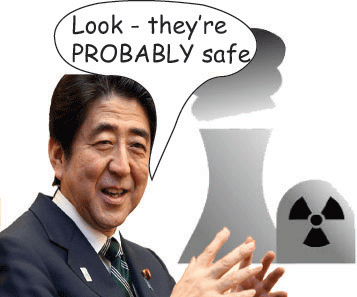 LDP stealthily seeking to raise nuclear energy dependence THE ASAHI SHIMBUN 3 Apr 15 The ruling Liberal Democratic Party is pushing a policy of heightening Japan’s dependence on nuclear energy but has buried this stance under a calculation trick.
An LDP research commission on energy issues on April 2 called on the central government to ensure that base-load electricity sources–nuclear energy, coal-fired thermal plants, hydroelectric and geothermal plants–account for about 60 percent of Japan’s energy needs in 2030.
The proposal does not mention any specific ratio for nuclear energy. But considering the difficulties in increasing the supply from the other base-load electricity sources, the dependence on nuclear power would have to rise to about 20 percent.
The proposal is expected to be presented to Prime Minister Shinzo Abe as early as next week as the formal recommendation of the LDP. The central government wants to decide on the energy mix for Japan in 2030 and beyond by June.
The government’s designation of the base-load electricity sources means their costs for power generation are comparatively low and electricity can be produced around the clock.
In fiscal 2013, Japan depended on base-load electricity sources for about 40 percent of its power: 1 percent for nuclear energy; 30 percent for coal-fired thermal plants; and a combined 9 percent for hydroelectric and geothermal plants……..
The LDP panel’s proposal said, “Energy policy must serve to strengthen Abenomics.”
It pointed out that electricity rates increased after nuclear power plants went offline following the Fukushima nuclear crisis triggered by the 2011 Great East Japan Earthquake and tsunami.
But to achieve that level of dependence on nuclear energy, nuclear plants would have to be operated beyond the current 40-year operating life set by the government or the government would have to approve the reconstruction or new construction of nuclear plants……..http://ajw.asahi.com/article/0311disaster/fukushima/AJ201504030042
Increasing percentage of radioactive cesium in water in basement of Fukushima nuclear reactor 1
 Cs-134/137 density of Reactor 1 basement water continues to increase since last July, Fukushima Diary Iori Mochizuk1, 3 Apr 15 790,000,000Bq/m3 According to Tepco, Cs-134/137 density of contaminated water that is retained in the basement of Reactor 1 has been increasing since last July.
On 3/4/2015, Tepco published the latest data of Cesium-134/137 density of retained water in Reactor 1 turbine building.
This water is assumed to be the mixture of leaked coolant water and groundwater that keeps coming in from the outside of the crippled building.
The report reads Cs-134/137 density was 1,790,000,000 Bq/m3 from the sample taken on 1/28/2015.
It was 1,670,000,000 Bq/m3 in November, 1,470,000,000 Bq/m3 in September, 1,460,000,000 Bq/m3 in July, which shows it has been constantly increasing though they release data only every two months.
It is not identified what keeps making the contamination level higher for 7 months in water retained in Reactor 1 basement.
http://www.tepco.co.jp/nu/fukushima-np/f1/smp/2014/images/tb_water_140730-j.pdf
http://www.tepco.co.jp/nu/fukushima-np/f1/smp/2014/images/tb_water_140926-j.pdf
http://www.tepco.co.jp/nu/fukushima-np/f1/smp/2014/images/tb_water_141128-j.pdf
http://www.tepco.co.jp/nu/fukushima-np/f1/smp/2015/images/tb_water_150304-j.pdf
i
TEPCO kept silent for a full year about massive radioactive waste leak at Fukushima
 TEPCO under fire after hiding massive radioactive waste leak at Fukushima for a full year
Sputnik News reports that TEPCO, which is also managing remediation efforts at the site (with guidance from the Japanese government), concealed from the public the fact that highly contaminated radioactive water has been flowing from the drainage ditch directly into the ocean. Local fishermen and others have since expressed outrage over the news.
“I don’t understand why you (TEPCO) kept silent about the leakage even though you knew about it,” stated Masakazu Yabuki, chief of the Iwaki fisheries cooperative, according to Sputnik. “Fishery operators are absolutely shocked.”
And this latest revelation only reiterates TEPCO’s tarnished legacy, proving that the company can’t be trusted with adequately addressing the looming problems that are still present at Fukushima more than four years since the disaster occurred.
Learn more: http://www.naturalnews.com/049226_TEPCO_radioactive_waste_Fukushima.html##ixzz3WHznDNCB
Plea for retired journalists to return and save Japans press freedoms in the face of censorship and control!
 Image source ; http://www.stripes.com/news/legal-experts-worry-japan-s-secrecy-law-may-silence-journalists-1.257943
“Those journalists that used to stand by the side of someone crying,
now stand by those in power.”
Hidetoshi Kiyotake 2015
Summarised by Shaun McGee
Posted to Nuclear-news.net
posted 3 April 2015
Featuring;
Minoru Tanaka: Investigative Journalist
Hidetoshi Kiyotake: Investigative Journalist and Author
Comments from the Chairman of the press committee
The reason for the Press freedom Award in Japan is because of the fact that in 2010 Japan was 11th in the rankings for press freedom according to Reporters Without Borders. Japan now has a position of 61st (just behind South Korea and far behind Croatia) out of 180 countries.
The State Secrets Act of 2013 makes nuclear power and relations with the USA taboo for journalists. Journalist freedoms are being eroded to stop embarrassing details from being made public. The governments and Corporations also have been directly influencing Broadcasters and Journalists.
Japanese Media are more fearful and are more wimpy than ever before.
For instance the story of the Education ministers links to the Yakuza has been grossly under reported and there are other scandals not reported also.
The Freedom of the Press Awards will be formally announced on the 3rd May 2015 (World Press Day)
There will be one Award for investigative journalism and another award for non journalism but have contributed to Freedom of information causes.
The prizes are to confer due recognition that is supportive of Open Society, Free Speech and democratic accountability.
Minora Tanaka(Investigative journalist also on the judging panel for the Award)
Tanaka San has been investigating a range of subjects over the years including issues surrounding the nuclear energy industry.
Tanaka San begins outlining a problem called SLAPPs (Strategic Lawsuit Against Public Participation) against journalists getting too near the truth and these defamation cases have had a chilling effect on journalism. Even if the case is withdrawn because it is a weak case it could be years before that happens and by then time , money and stress will have taken their toll.
Added to the fact that the imposition of the Orwellian State Secrets Act of 2013, Journalism in Japan is in dire straights.
Tanaka San finishes of his statement by exclaiming;
“I am Kenji” (In reference to the recently murdered journalist)
Hidetoshi Kiyotake (Investigative journalist and author)
Currently he has six lawsuits on the go and has 2 of them due in court next week (SLAPPs). Whilst not attending court Kiyotake San likes to do some journalism research and writing. He also leaves time for the freedom of the press issues also. He worked for the Yomuri Shimbun for many years as a financial analyst and has held managerial positions. In 2011 he was dismissed from his post and is now an independent journalist. He one a non fiction prize last year.
He quotes as an example his research into the Sony corporation where he reported on the use of “Isolation Rooms” being used as a punishment for employees.
He then goes onto say that reporting on government and corporate scandals and stories is getting harder and harder all the time, whilst the number of investigative journalists are going down.
It would appear that journalists have become numb to the big changes within these media corporations.
As an example he states that a story of 10,000 or 20,000 people being sacked is not a shock to them anymore.
There have been many job loses also in the media and that also would have been frowned on in the recent past in Japan.
Kiyotake San goes onto ask the question if Japan uses a managerial style that takes into account human dignity and long term perspective as it once did?
As an example he relates a story in the past where a Japanese CEO of Sony asks the CEO of GE on what might be the best managerial style. The CEO of GE announced that if a worker wakes up and is upbeat and positive about his oncoming work day than the right managerial style has been used.
“Those that used to stand by the side of someone crying now stand by those in power.”
Kiyotake San then went on to explain his hopes for the future.
He calls for retired investigative journalists to leave retirement and to come back to the job of reporting and to find some platform in the media or on the internet to publish their articles.
He also calls for working journalists to research topics and publish on other formats to increase competition and improve the quality of reporting and the oversight of government and corporations.
He finishes by asking journalists to not be content with being in a closed club but to go out and publish as independent journalists as well.
Questions and answers on the source video
UPDATE
Edited version by missmilkytheclown1 on YouTube for easy listening
Below Fukushima nuclear plant – pools of molten nuclear fuel
AP: Melted fuel may have “dropped even beyond” the bottom of Fukushima plant — ‘China Syndrome’ predicted by US gov’t analysis — IAEA Expert: Pools of corium beneath reactors are up to 2 stories high (VIDEO)http://enenews.com/ap-melted-fuel-could-dropped-beyond-bottom-fukushima-plant-iaea-expert-pools-corium-could-be-taller-2-story-house-video?utm_source=feedburner&utm_medium=email&utm_campaign=Feed%3A+ENENews+%28Energy+News%29
AP, Mar 27, 2015 (emphasis added): [It] was billed as a way to decipher where, exactly, the morass of nuclear fuel might sit at the bottom of reactors… But what went wrong, even in a simple demonstration for reporters… was a sobering reminder of the enormous challenges that lie ahead… a programming glitch could not be fixed in time for Friday’s demonstration… No one knows where the molten fuel debris lies, and in what shape or state. [TEPCO] has said itlikely sank to the bottom of the plant. But the fuel could have dropped even beyond. Tadashi Yotsuyanagi, an official in charge of the muon project at Toshiba… acknowledged the technology will not be able to get the complete image toward the bottom of the reactor… David Ireland, a professor who heads the Nuclear Physics Group at the University of Glasgow, said muons may be the only way to probe inside atomic reactors. “There are not really any other noninvasive options that will allow inspection,” he said in an email.
The Japan Times published the AP report above, however one sentence was altered. “Tepco has said it likely sank to the bottom of the plant. But the fuel could have dropped even beyond” vs. “But the fuel could possibly have escaped even beyond the containment facility to the outside environment.”
IAEA technical meeting Managing the Unexpected, Harri Tuomisto, Sr. Nuclear Safety Officer at Finland’s Fortum Power, 2012:
- Part 4: “If the cooling is not successful, it means the corium melts through the vessel… When this massive amount of corium enters into the containment zone, there are very, very many different energetic consequences… Interaction of molten core and concrete starts… concrete is eroding, and this eroding of concrete, for a long time it was known as China Syndrome.”
- Part 5: “The corium will be in 3 parts, there is a solid crust formation in the bottom of the pool, then there’s a pool of oxidic materials… The metals and oxides are not soluble with each other and the metals will be separated… which is bad news in the sense that theheat transfer to the vessel is much higher, and it’s much more difficult to guarantee the integrity of the [containment] vessel in that case.”
- Part 6: “Molten corium on the containment floor, it’s eroding the concrete and going partially downward. Actually it will never go to China, because it also erodes sideways… The final size of the pooling maximum case is 10 to 15 meters in diameter, and 6-7 meters [20-23 ft or 2 stories] deep — or even deeper.”
- Part 9: “There are quite many challenges… There are different energetic phenomenon… which can lead to different combustions… accelerating flames, or even detonations — which can cause a very high pressure in the containment and even break the containment… Then there’s this China Syndrome — attack of containment liner by corium — which can also bypass containment.” (See US gov’t analysis: Fukushima containment breached due to “failure of the drywell liner by melt-attack“)
- Slides 3-4: If corium melts through the vessel, there are various energetic consequences caused by ejected high-temperature molten corium… Molten corium on the containment basemat initiates core-concrete interaction that releases aerosols and non-condensible gases to containment atmosphere and erodes the concrete (‘China syndrome‘)
Japan’s PM pretended that Fukushima disaster was ‘under control’ – in order to get 2020 Olympic Games
 JP PM Abe “My saying Under-control was only to reassure the world to let Japan host 2020 Olympics” http://fukushima-diary.com/2015/03/jp-pm-abe-my-saying-under-control-was-only-to-reassure-the-world-to-let-japan-host-2020-olympics/ Following up these article..
Tepco inquired JP Gov about PM Abe’s statement to IOC “Contaminated water is entirely blocked” [URL 1]
[Column] How JP Prime Minister Abe lied to IOC about sea contamination [URL 2]
The Prime Minister of Japan, Abe stated he only wanted to “improve the atmosphere” by commenting “contaminated water situation is under control”.
In the summer of 2013, Abe stated to IOC that contaminated water problem is under control and it is entirely blocked within the 0.3 km2 area of Fukushima nuclear plant.
However in the House of Councilors of 3/3/2014, Abe was stating that there internationally was a political atmosphere that if Japan is not capable of settling contaminated water problems, it should not be allowed to host 2020 Olympics.
Abe added, it was his responsibility to remove such an atmosphere by saying the situation is under control, which does not mean more than he is in charge of reviewing the contaminated water situation.
http://kokkai.ndl.go.jp/SENTAKU/sangiin/186/0014/18603030014005.pdf
Brave Japanese bureaucrat speaks out for reform of energy policy
Japan’s Lonely Brave Bureaucrat Speaks Out on TV Asahi Nuclear Free by 2045? 31 Mar 15 A former high level bureaucrat in the Japanese Ministry of Trade was one of the few public officials to bravely speak up for radical change in the wake of the earthquake-tsunami-meltdown catastrophe. The Economistwas one of the first in the English language media to report on Shigeaki Koga’s radical proposals for reform of national energy policy. In September 2011, The Economist reported his views:
UPDATES:
MARCH 30, 2015: The Japan Times reported on the controversial broadcast a few days afterwards: Ex-bureaucrat blasts Abe on news program.
MARCH 29, 2015: Asahi Shimbun reported on the controversial broadcast the day after I wrote the above: Abe critic claims on air he was axed from TV program at behest of management.
Sources:
Tomohiro Sasaki, “Ex-bureaucrat blasts Abe on news program,” The Japan Times, March 30, 2015. http://nf2045.blogspot.jp/2015/03/japans-lonely-brave-bureaucrat-speaks.html
200 years before Japan can hope to clean up Fukushima
Japan faces 200-year wait for Fukushima clean-up The chief of the Fukushima nuclear power station has admitted that the technology needed to decommission three melted-down reactors does not exist, and he has no idea how it will be developed.
Japan’s ‘nuclear village’ is back in control
The corruption and collusion of Japan’s nuclear village led to numerous accidents before the Fukushima disaster.
And the corruption and collusion of Japan’s nuclear village was a root cause of the Fukushima disaster itself. On that point the Nuclear Accident Independent Investigation Commission could not have been blunter: “The accident was the result of collusion between the government, the regulators and TEPCO, and the lack of governance by said parties.”
A big part of the post-Fukushima spin is that lessons were learned from the nuclear disaster and improvements made. But the real lesson from this saga is that the nuclear industry – in Japan at least – has learned nothing from its catastrophic mistakes.
As Yotaro Hatamura says, an accident will surely happen again.

After Fukushima: Japan’s ‘nuclear village’ is back in charge, Ecologist Jim Green28th March 2015 Public opposition to nuclear power in Japan remains strong, writes Jim Green, but piece by piece, Shinzo Abe’s right-wing government has been putting the country’s infamous ‘nuclear village’ back in control – boosted by draconian press censorship laws, massive interest-free loans, and a determination to forget all the ‘lessons’ of Fukushima. Is another big accident inevitable?
Public opposition to reactor restarts (and the nuclear industry more generally) continues to exert some influence in Japan.
Five to seven of the oldest of Japan’s 48 ‘operable’ reactors are likely to be sacrificed to dampen opposition to the restart of other reactors, and local opposition may result in the permanent shut down of some other reactors.
Currently, all 48 of Japan’s ‘operable’ reactors are shut down – and the six reactors at Fukushima Daiichi have been written off.
However, slowly but surely, the corrupt and collusive practices that led to the Fukushima disaster are re-emerging. The ‘nuclear village’ is back in control……..
The Basic Energy Plan approved by Cabinet in April 2014 contains nothing more than a meaningless nod to widespread public anti-nuclear sentiment, stating that dependence on nuclear energy will be reduced ‘to the extent possible’.
Junko Edahiro, chief executive of Japan for Sustainability and one of the people removed from the energy policy advisory committee, noted in November 2014: Continue reading
1 This Month





PLEASE OPPOSE HR 8255 AND S.3639 – bills would accelerate satellite deployment, with no environmental review or safeguards – https://ncstd5li.quorum.us/campaign/169331/
To see nuclear-related stories in greater depth and intensity – go to https://nuclearinformation.wordpress.com
-
Archives
- October 2026 (49)
- September 2026 (339)
- August 2026 (330)
- July 2026 (355)
- June 2026 (287)
- May 2026 (306)
- April 2026 (356)
- March 2026 (251)
- February 2026 (267)
- January 2026 (308)
- December 2025 (358)
- November 2025 (359)
-
Categories
- 1
- 1 NUCLEAR ISSUES
- business and costs
- climate change
- culture and arts
- ENERGY
- environment
- health
- history
- indigenous issues
- Legal
- marketing of nuclear
- media
- opposition to nuclear
- PERSONAL STORIES
- politics
- politics international
- Religion and ethics
- safety
- secrets,lies and civil liberties
- spinbuster
- technology
- Uranium
- wastes
- weapons and war
- Women
- 2 WORLD
- ACTION
- AFRICA
- Atrocities
- AUSTRALIA
- Christina's notes
- Christina's themes
- culture and arts
- Events
- Fuk 2022
- Fuk 2023
- Fukushima 2017
- Fukushima 2018
- fukushima 2019
- Fukushima 2020
- Fukushima 2021
- general
- global warming
- Humour (God we need it)
- Nuclear
- RARE EARTHS
- Reference
- resources – print
- Resources -audiovicual
- Weekly Newsletter
- World
- World Nuclear
- YouTube
-
RSS
Entries RSS
Comments RSS

