Fukushima: Japan ends evacuation of Naraha as ‘radiation at safe level’
The town’s 7,400 residents are allowed to return to their homes after the four-year-old evacuation order was lifted on Saturday
 A man lights candles in Naraha, Japan. Residents of Naraha will return from Saturday to live in the town near the Fukushima nuclear power plant for the first time since the 2011 disaster.
The Japanese town of Naraha has lifted a 2011 evacuation order that sent all its 7,400 residents away after the nearby Fukushima nuclear plant was crippled by a tsunami that led to a meltdown and contamination.
Naraha was the first among seven municipalities forced to empty entirely due to radiation contamination following the massive earthquake and tsunami that sent the reactors into meltdown.
The government says radiation levels in town have fallen to levels deemed safe following decontamination efforts, and on Saturday lifted the four-year-old evacuation order.
The town represents a test case, as most residents remain cautious amid lingering health concerns and a lack of infrastructure. Only about 100 of the nearly 2,600 households have returned since a trial period begun in April.
The Naraha mayor, Yukiei Matsumoto, said Saturday marked an important milestone. “Our clock started moving again,” Matsumoto said during a ceremony held at a children’s park. “The lifting of the evacuation order is one key step but this is just a start.”
He said fear of radiation and nuclear safety was still present and the town had a long way ahead for recovery. It would be without a medical clinic until October and a new prefectural hospital would not be ready until February next year.
A grocery store started free delivery services in July, and a shopping centre will open in 2016. Still, many residents, especially those who do not drive, face limited options for their daily necessities.
Residents are given personal dosimeters to check their own radiation levels. To accommodate their concerns the town is also running 24-hour monitoring at a water filtration plant, testing tap water for radioactive materials.
In 2014 the government lifted evacuation orders for parts of two nearby towns.
Source: The Guardian
Nearly 700,000 tons of radioactive water stored at Fukushima plant

OKUMA, Fukushima Prefecture–Almost 700,000 tons of radiation-contaminated water have accumulated at the crippled Fukushima No. 1 nuclear power plant, Tokyo Electric Power Co. disclosed Sept. 4.
The water is stored in rows of massive tanks on the plant’s premises.
Contaminated water has been a persistent problem since the 2011 earthquake and tsunami disaster triggered a triple meltdown at the plant, resulting in a vast amount of radiation being spewed from the facility.
Each day, about 300 tons of groundwater still seeps into the basements of the reactor buildings, where it mixes with melted nuclear fuel and becomes highly contaminated, the utility officials said.
The storage tanks TEPCO has constructed to store the water are 10 meters tall and positioned on the inland, and not seaward, side of the reactor buildings.
The plant operator said it had lowered the radiation level of a large portion of the contaminated water using a multinuclide removal apparatus called ALPS (advanced liquid processing system) and other equipment.
The utility completed processing the most highly contaminated water stored in tanks by the end of May.
TEPCO has also worked to replace flange-type bolted storage tanks that are susceptible to leakage with welded tanks to reduce the risk of accidental seepage.
To intercept clean groundwater before it flows into contaminated reactor buildings, TEPCO started a “subdrain plan” Sept. 3 to pump tons of groundwater from “subdrain wells” before it reaches the contaminated reactor buildings each day. The water will be released into the sea after undergoing decontamination treatment
Source: Asahi Shimbun
http://ajw.asahi.com/article/0311disaster/fukushima/AJ201509050017
Japan’s Monju nuclear reprocessing reactor, plagued by safety errors, offline for most of 20 years
 Errors found in safety management of Monju reactor http://www3.nhk.or.jp/nhkworld/english/news/20150903_28.html Sep. 3, 2015 Japan’s nuclear regulators have found fresh faults with the safety management of the country’s fast-breeder reactor, which is currently offline. They say they have found thousands of errors in safety classifications of the equipment and devices at the Monju reactor.
The operator of the prototype reactor in Fukui Prefecture, central Japan, has been banned from conducting test runs since 2013 following discoveries of a large number of safety inspection oversights.
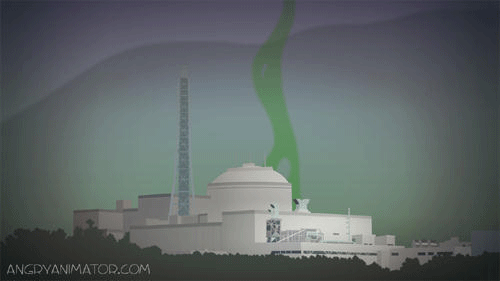
The Nuclear Regulation Authority says it has recently found at least 3,000 mistakes with safety classifications of equipment and devices at the reactor during its regular inspections which are conducted 4 times a year. Its officials say, equipment and devices with high importance were, in some cases, classified in lower ranks in the 3-level system, which suggest the operator might have failed to carry out necessary inspections for them.
The errors found recently include those going as far back as 2007. The fact suggests that government inspectors have also overlooked the operator’s mistakes. The operator, Japan Atomic Energy Agency, built the Monju fast-breeder reactor in the early 1990s to reuse the spent nuclear fuel MOX, a mixture of plutonium extracted from spent fuel and uranium.
But it has been offline for most of the period after it underwent a fire from a leak of sodium, the reactor’s coolant, in 1995.
The operator aims to conduct the reactor’s test run by next March. But it is uncertain when the ban by the authority will be lifted. The plant’s director, Kazumi Aoto, says he will take the government’s report seriously. An NRA inspector, Yutaka Miyawaki, says the regulators will try to identify the actual effects of the errors.
In Japan’s hot summer, solar power ramped up its contribution to electricity

 Solar power supplies 10 percent of Japan peak summer power: Asahi http://news.yahoo.com/solar-power-supplies-10-percent-japan-peak-summer-030520802–finance.html?utm_content=buffer78331&utm_medium=social&utm_source=twitter.com&utm_campaign=buffer September 2, 2015 TOKYO (Reuters) – Solar power generation contributed to about 10 percent of peak summer power supplies of Japan’s nine major utilities, equivalent to more than 10 nuclear reactors, the Asahi newspaper reported on Thursday.
Though solar power accounts for about 2 percent of annual generation of all power sources, summer’s favorable sunlight conditions increased power output, generating up to about 15 gigawatts of power in total in early August, the paper said.
Japan has been pouring billions of dollars in clean-energy investment after introducing a feed-in tariff (FIT) program in 2012, aiming to help the world’s third-biggest economy shift away from its reliance on nuclear power after the March 2011 Fukushima disaster.
Asahi’s survey showed that the ratio of solar power at peak hours was as low as Hokuriku Electric Power’s <9505.T> 5.9 percent and as high as Kyushu Electric Power’s <9508.T> 24.6 percent, depending on access to ample land with favorable sunlight conditions.
The installed capacity of solar power taking advantage of FIT scheme has reached more than 24 gigawatts at the end of April, government data showed, up from about 5 GW before the scheme started.(Reporting by Osamu Tsukimori; Editing by Gopakumar Warrier)
MANDATORY INDICTMENT FOR FORMER TEPCO EXECUTIVES FOR FUKUSHIMA DISASTER
 FORMER TEPCO EXECUTIVES FACE MANDATORY INDICTMENT FOR FUKUSHIMA DISASTER http://www.fukushimawatch.com/2015-09-03-former-tepco-executives-face-mandatory-indictment-for-fukushima-disaster.html The Tokyo No. 5 Committee for the Inquest of Prosecution announced last July that former Tokyo Electric Power Co. Chairman Tsunehisa Katsumata, as well as two other former company executives, should be indicted for his role in the Fukushima Daiichi disaster.
The will of the people trumped the prosecutor’s decision not to indict the men. Despite public support, convicting the three men for “culpable negligence in an accident associated with a natural disaster” will be difficult, as The Japan News reported.
The decision clearly states that [TEPCO] should’ve been able to foresee the onslaught of the tsunami,” said Hiroyuki Kawai, lawyer for the Complainants for the Criminal Prosecution of the Fukushima Nuclear Disaster, at a press conference. “The prospects for the trial are bright.”(1)
The prosecution hinges upon whether the three men knew that a tsunami would likely strike the power plant, and whether the gentlemen made adequate preparations in light of that knowledge.
A 2008 TEPCO report suggest that the three men were aware of the threat that a potential tsunami posed to the nuclear plant. The report predicted a maximum credible tsunami of 15.7 meters. Nevertheless, TEPCO claims that, since the report was preliminary, it lacked scholarly credibility. The company argues that it didn’t have sufficient reason to believe a tsunami would strike the plant, and that more evidence was needed before stirring a panic.
The inquest committee was made up of 11 members of the public. In response to these remarks, the committee stated, “it is sufficient that there must be foreseeability given the fact that a tsunami occurred and some sort of response was required.”(1)
The committee went on to note that the men held high positions of power and responsibility, and that the 2008 report should not have been taken with a grain of salt.
Soil Sample July 2015 from Nakano, Tokyo — Cesium 134 Cesium 137

From Mimi German, the head of Radcast in Portland, Oregon, USA:
Latest from RadCast Labs… not surprised to find Cesium134 and Cesium 137 in soil samples from Nakano, Tokyo.
Tokyo is 240 kms South of Fukushima Daiichi…
RadCast received samples of soil from Nakano, Tokyo which clearly showed both Cesium 137 and Cesium 134. This sample is from July 2015. We have 476 Bq/kg
Source: Radcast.org
https://www.radcast.org/radcast-soil-sample-july-2015-from-nakano-japan-cesium-134-cesium-137/
Japan to lift evacuation order for Fukushima town of Naraha
FUKUSHIMA – The government is set to lift at midnight Friday its evacuation order for the Fukushima Prefecture town of Naraha, most of which is located within 20 kilometers of Tokyo Electric Power Co.’s disaster-stricken Fukushima No. 1 nuclear power plant.
Naraha will be the first of the seven Fukushima municipalities where the entire populations were instructed to evacuate to have the order removed.
It will be the third such order to be lifted for a municipality in the former no-go zone set within 20 kilometers of the northeastern Japan power station, which suffered a reactor meltdown accident after a massive earthquake and tsunami in March 2011.
Naraha had a registered population of 7,368 in 2,694 households as of Tuesday. According to a survey by the government and others, some 46 percent of the residents hope to return home.
Only a portion of them are likely to go back immediately, however, including 780 people at some 350 households who are doing long-stays at their homes in the town to prepare for permanent returns.
The central and town governments will reopen a medical clinic in the town in October. A new prefectural clinic will be built as early as February.
To handle sudden illnesses among elderly people wishing to return home, medical services will be reinforced through steps such as the distribution of emergency buzzers to those who need them.
In a bid to meet requests for shopping services, a supermarket in the town launched free delivery services in July. A publicly built, privately run shopping center with a supermarket and do-it-yourself store will be established in fiscal 2016.
Dosimeters will be handed out to help people check radiation levels, while 24-hour monitoring will be conducted at a water filtration plant. Tap water will be tested at households hoping to check for radioactive materials.
The government lifted its evacuation order for the Miyakoji district in the city of Tamura in April 2014 and the eastern part of the village of Kawauchi in October 2014.
In August 2012, Naraha was redesignated as an area being prepared for the removal of the evacuation order and where people are allowed to enter during the daytime.
With decontamination work largely completed, evacuees have been allowed since April 2015 to return home for long-term stays to prepare for permanent returns.
Source: Japan Times
http://www.japantimes.co.jp/news/2015/09/04/national/japan-to-lift-evacuation-order-for-fukushima-town-of-naraha/#.Ven8rJeFSM9
Fukushima Daiichi drainage system enters operation
The flow of groundwater into the reactor buildings and port area of the damaged Fukushima Daiichi nuclear power plant in Japan should be significantly reduced with the start of use of a new system to pump, treat, test and discharge the water.

The subdrain system is a group of 41 wells installed in the vicinity of the reactor and turbine buildings. Pumped up by the subdrain, the amount of groundwater flowing into the buildings is expected to be significantly reduced. The groundwater flowing into the port area is held back by the coastal impermeable wall and pumped up by another group of wells, the groundwater drain system, installed in the bank protection area.
Tokyo Electric Power Company (Tepco) announced the first pumping up of groundwater by 20 of the wells in the subdrain system had begun at 10.00am today.
The collected groundwater will be temporarily stored to check its quality and then discharged into the port area, with thorough treatment processes.
Tepco said it expects the water pumped up by the subdrain and groundwater drain to be slightly more contaminated than water from the existing groundwater bypass (which intercepts water on the land side of the reactor buildings). However, it said the water will be treated to meet the more stringent quality standards for the subdrain and groundwater drain than for the groundwater bypass. The company noted the water would also be monitored more frequently to verify its quality for discharge.
Once the subdrain and groundwater drain systems are found to be operating stably, the opening that was left in the seaside impermeable wall will be closed to prevent groundwater flowing into the port area, Tepco said. The subdrain and groundwater drain will then work to keep groundwater from accumulating behind the impermeable wall.
Tepco estimates the subdrain will reduce the flow of groundwater into the reactor buildings to 150 cubic meters per day from the current 300 cubic meters. In the longer term, the company said the pumping systems and seaside wall are expected to be joined with the land side impermeable wall (frozen soil wall) currently under construction, “creating a wall around the reactor buildings and further reducing the intrusion of groundwater”.
Tepco sought the approval of prefectural and national fishermen’s associations for use of the system.
Tepco’s chief decommissioning officer Naohiro Masuda said, “The activation of the subdrain system is a major milestone in redirecting fresh water from contaminated area. It also enables the seaside impermeable wall to be closed to further prevent any leakage of contaminated water.”
Source: World Nuclear News
http://www.world-nuclear-news.org/RS-Fukushima-Daiichi-drainage-system-enters-operation-0309155.html
TEPCO pumps up groundwater for release into sea
The operator of the Fukushima Daiichi nuclear plant has begun pumping up groundwater from around reactor buildings with the aim of releasing it into the sea.
Tokyo Electric Power Company, or TEPCO, hopes the move will slow the accumulation of radioactive wastewater in the buildings, which is building up at a rate of 300 tons a day due to the inflow of groundwater.
The utility will target groundwater from wells dug around the No.1 through No.4 reactor buildings. It plans to filter out much of the radioactive material before releasing the water into the ocean.
Workers on Thursday began pumping up groundwater from 20 wells. They plan to remove 200 tons through the afternoon and store it in special tanks.
TEPCO has yet to reach an agreement with local authorities and fishermen about when to release the decontaminated water, but it will likely be later this month.
The utility claims the drainage will cut the amount of wastewater in the reactor buildings by about half.
But local authorities and fishermen worry about what could happen to the environment if something goes wrong.
http://www3.nhk.or.jp/nhkworld/english/news/20150903_17.html
TEPCO starts pumping up Fukushima groundwater
FUKUSHIMA (Jiji Press) — Tokyo Electric Power Co. started pumping up groundwater from wells at its disaster-stricken Fukushima No. 1 nuclear power plant on Thursday in an operation to prevent radiation-tainted water from increasing further.
TEPCO plans to remove radioactive substances from the pumped-up water.
The groundwater will be released into the sea if radiation levels fall below preset limits after the cleanup. When to start the water release has yet to be decided.
On Thursday, TEPCO was to pump up a total of 100-200 tons of groundwater from 20 of the 41 wells, called subdrains, located near the No. 1 to No. 4 reactor buildings at the plant, which was damaged in the March 2011 earthquake and tsunami. The water will be stored temporarily at a tank with a capacity of 1,000 tons.
At the plant in Fukushima Prefecture, groundwater flows into the reactor buildings and mixes with water that has become highly contaminated with radioactive substances after being used to cool melted nuclear fuel, leading to an increase in the amount of tainted water.
On Aug. 25, the Fukushima Prefectural Federation of Fisheries Cooperative Associations decided to allow TEPCO to release purified groundwater into the sea.
Source: Japan News (Jiji)
Despite Sendai restart, the outlook for Japan’s #nuclear industry is poor
 Japan nuclear power outlook bleak despite first reactor restart, Yahoo News, 1 Sept 15, By Kentaro Hamada and Aaron Sheldrick TOKYO (Reuters) – The number of Japanese nuclear reactors likely to restart in the next few years has halved, hit by legal challenges and worries about meeting tougher safety standards imposed in the wake of the Fukushima disaster, a Reuters analysis shows…….
analysis shows that of the other 42 operable reactors remaining in the country, just seven are likely to be turned on in the next few years, down from the 14 predicted in a similar survey last year.
The findings are based on reactor inspection data from industry watchdog the Nuclear Regulation Authority, court rulings and interviews with local authorities, utilities and energy experts. They also show that nine reactors are unlikely to ever restart and that the fate of the remaining 26 looks uncertain.
“Four-and-a-half years after the events started unfolding at Fukushima Daiichi, the Japanese government, the nuclear utilities and the NRA have not succeeded in overcoming complete planning insecurity for investors. The outlook for restarts is as cloudy as ever,” said Mycle Schneider, an independent energy consultant in Paris…….
LEGAL WOES
Legal challenges from local residents have hit all atomic plants, with the country’s most nuclear-reliant utility Kansai Electric Power issued with court rulings preventing the restart of four reactors despite two of them already receiving NRA approval to switch on.
Kansai has appealed the judgments but the court cases may take years to resolve if the rulings are not overturned on the first appeal.
Tougher safety standards and stricter implementation of rules since Fukushima have also been hitting restarts. Japan Atomic Power has been battling a regulatory ruling that one of its reactors sits above an active fault, meaning it must be decommissioned.
And highlighting the pitfalls of rebooting the industry, Kyushu Electric was forced to slow the ramp up of power from its Sendai No. 1 reactor after it restarted around mid-August due to problems with pumping equipment. Engineers warn that firing up reactors that have been offline for prolonged periods could be fraught with such troubles……..http://news.yahoo.com/japan-nuclear-power-outlook-bleak-despite-first-reactor-013149457–finance.html
Cesium – radioactive contamination in Japan
 I am afraid that there are many Japanese people now living on lands equally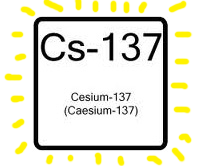
contaminated with radioactive cesium. If Japanese children are allowed to routinely ingest foodstuffs contaminated with Cesium-137, they will likely develop the same health problems that we see now in the children and teenagers of Belarus and Ukraine.
Thus it is very important that we recognize the danger posed to children by the routine ingestion of contaminated food with Cesium-137 where ever they might live. It is also important to prevent further nuclear disasters which release these fiendishly toxic poisons into the global ecosystems. Given the immense amounts of long-lived radionuclides which exist at every nuclear power plant this is an urgent task.
The Implications of The Massive Contamination of Japan With Radioactive Cesium
Steven Starr Senior Scientist, Physicians for Social Responsibility Director, University of Missouri, Clinical Laboratory Science Program Helen Caldicott Foundation Fukushima Symposium New York Academy of Medicine, 11 March 2013 A large number of highly radioactive isotopes released by the destruction of the Fukushima Daiichi nuclear power plant grossly contaminated the Japanese mainland. Most of these radionuclides had short half lives which meant they would essentially disappear in a matter of days or months. For many of those who were exposed to them there will be major health consequences.
However, there were some radioactive elements that will not rapidly disappear. And it is these long-lived radionuclides that will remain to negatively affect the health of all complex life forms that are exposed to them.
 Chief among them is Cesium-137, which has taken on special significance because it is has proven to be the most abundant of the long-lived radionuclides that has remained in the environment following the nuclear disasters at Chernobyl and Fukushima. It has a 30 year radioactive half life which is why it persists in the environment. Scientists now believe that it will be 180 to 320 years before the Cesium-137 around the destroyed Chernobyl reactor actually disappears from the environment. Continue reading
‘Political rhetoric, not science’: Greenpeace slams IAEA Fukushima report

On Monday, IAEA said that despite uncertainties about the radiation doses incurred by children immediately after the accident, “an increase in childhood thyroid cancer attributable to the accident is unlikely.”
READ MORE: Child cancers ‘attributable’ to Fukushima disaster ‘unlikely’ to increase – IAEA
On Tuesday, Greenpeace slammed the conclusions of the UN body as being ‘political rhetoric’.
“Nobody knows how much radiation citizens were exposed to in the immediate days following the disaster. If you don’t know the doses, then you can’t conclude there won’t be any consequences. To say otherwise is political rhetoric, not science,” said Kendra Ulrich, senior global energy campaigner with Greenpeace Japan.
Part of the reason why no solid data is available regarding the potential exposure of the civilian population, as IAEA notes, resulted from the chaos and unpreparedness of the authorities to deal with and document the radiological impact of the March 2011 industrial disaster. Besides security and design “weaknesses” at the nuclear facility, IAEA also noted the government’s failure to swiftly and uniformly distribute stable iodine to block radiological effects in humans.

Greenpeace notes that those were evident failures on behalf of both Tepco and Tokyo, and remains certain that there is no safe level of radiation exposure following a nuclear disaster.
Meanwhile, Japanese media reported that yet another youth has been diagnosed with thyroid cancer, bringing the total number of young victims to 104, out of the 385,000 Fukushima Prefecture non-adult residents at the time of the accident.
At the same time, the prefectural government committee investigating the issue said that “as of now, it is unlikely for the thyroid cancers found in Fukushima Prefecture to have been caused by the nuclear power plant accident,” Asahi News quotes.
Greenpeace blames IAEA for being complicit in covering up the truth about the potential harm posed by Fukushima fallout.
“The IAEA report actively supports the Abe government’s and the global nuclear industry’s agenda to make it appear that things can return to normal after a nuclear disaster,” Ulrich said. She accused Tokyo of giving the green light for Fukushima residents to return home, despite the risk of further nuclear exposure.
The organization also criticized the government’s move to restart nuclear power plants in the country. Last month, the Japanese government approved the program, which would let evacuees temporarily return to their homes for up to three months. The program is a step towards lifting the evacuation order and encouraging people to go back to their former residencies.
“But there is nothing normal about the lifestyle and exposure rates that the victims are being asked to return to,” Ulrich continued. “To intentionally subject nuclear victims to raised radiation levels is unjustified, particularly when we have the tragic reminder of Chernobyl where we saw increased rates of cancers more than five years after the crisis.”
The environmental NGO claims that its July investigation registered radioactive contamination levels in Fukushima prefecture at such a “high level” that it would be “impossible” for people to return.
Tokyo plans to lift the evacuation order by spring 2017 for many parts of the evacuation area stretching to a 20-kilometer radius around the Fukushima plant in addition to other zones that had high levels of radiation. Currently about 79,000 people from 10 localities remain evacuated.
Source: RT
http://www.rt.com/news/314053-greenpeace-criticises-iaea-fukushima/
WTO delays panel decision on ROK
TOKYO (Jiji Press) — The World Trade Organization has put off a decision on whether to set up a dispute settlement panel on South Korea’s import ban on Japanese fishery products, the Fisheries Agency said Monday.
At a meeting Monday, the WTO stopped short of making a decision as South Korea did not agree to the establishment of the panel. But the WTO is expected to approve the setting up of the panel as requested by Japan at its next meeting, on Sept. 28.
South Korea introduced the ban on some fishery products from eight prefectures, including Fukushima, in the wake of the reactor meltdown at Tokyo Electric Power Co.’s Fukushima No. 1 nuclear power plant.
Source: Japan News
Miyagi residents physically block officials from surveying proposed nuke waste dump sites

SENDAI – Residents of three Miyagi Prefecture towns selected as candidate sites for hosting a permanent nuclear waste disposal facility barred the entry Monday of Environment Ministry officials seeking to carry out survey work.
People in the towns of Kami, Kurihara and Taiwa stalled the officials’ plan to conduct geological surveys needed to determine which of the three locations would be best to host the site, which will permanently store radioactive waste that spewed from the Fukushima No. 1 power plant following the March 11, 2011, Great East Japan Earthquake.
In the Tashirodake area of Kami on Monday morning, some 350 residents turned out in a light rain to protest the visit, holding banners and signs and yelling “Protect children’s future!” and “Get lost!”
They also physically blocked the officials’ access to the areas.
An Environment Ministry official meanwhile said the ministry will consider holding a town meeting in Kami in line with a request by the municipal government.
Plans to start ground surveys in the towns have been stalled since October, when the Environment Ministry began visiting them.
Miyagi Gov. Yoshihiro Murai criticized the residents’ demonstrations, saying they should wage their battle against the nuclear dump site in the courts.
“They should open the land for a government survey without hesitating,” Murai said. “If they disagree with the government plan, they should go to court.”
Post-3/11 nuclear waste is being temporarily stored on farms around the prefecture and farmers hosting the waste are demanding the government build a proper storage site.
Source: Japan Times
1 This Month





PLEASE OPPOSE HR 8255 AND S.3639 – bills would accelerate satellite deployment, with no environmental review or safeguards – https://ncstd5li.quorum.us/campaign/169331/
To see nuclear-related stories in greater depth and intensity – go to https://nuclearinformation.wordpress.com
-
Archives
- September 2026 (339)
- August 2026 (330)
- July 2026 (355)
- June 2026 (287)
- May 2026 (306)
- April 2026 (356)
- March 2026 (251)
- February 2026 (267)
- January 2026 (308)
- December 2025 (358)
- November 2025 (359)
- October 2025 (375)
-
Categories
- 1
- 1 NUCLEAR ISSUES
- business and costs
- climate change
- culture and arts
- ENERGY
- environment
- health
- history
- indigenous issues
- Legal
- marketing of nuclear
- media
- opposition to nuclear
- PERSONAL STORIES
- politics
- politics international
- Religion and ethics
- safety
- secrets,lies and civil liberties
- spinbuster
- technology
- Uranium
- wastes
- weapons and war
- Women
- 2 WORLD
- ACTION
- AFRICA
- Atrocities
- AUSTRALIA
- Christina's notes
- Christina's themes
- culture and arts
- Events
- Fuk 2022
- Fuk 2023
- Fukushima 2017
- Fukushima 2018
- fukushima 2019
- Fukushima 2020
- Fukushima 2021
- general
- global warming
- Humour (God we need it)
- Nuclear
- RARE EARTHS
- Reference
- resources – print
- Resources -audiovicual
- Weekly Newsletter
- World
- World Nuclear
- YouTube
-
RSS
Entries RSS
Comments RSS

