Large shipment of plutonium to travel from Japan to South Carolina
 Japan to send huge cache of plutonium to South Carolina under nuclear deal: report RAW STORY AGENCE FRANCE-PRESSE 05 JAN 2016 Japan will send a huge cache of plutonium — enough to produce 50 nuclear bombs — to the United States as part of a deal to return the material that was used for research, reports and officials said Tuesday.
The plutonium stockpile, provided by the US, Britain and France decades ago, has caused some disquiet given that Japan has said it has the ability to produce a nuclear weapon even if it chooses not to.
The shipment, which comes ahead of a nuclear security summit in Washington in March, is meant to underscore both countries’ commitment to nuclear non-proliferation and is part of a deal they made in 2014.
It will be one of Japan’s most significant overseas movements of plutonium since it transported one tonne from France in 1993 to be used in nuclear reactor experiments.
That shipment triggered an outcry at the time from countries citing environmental and security concerns.
A Japanese official confirmed the amount of plutonium to be sent to the US and said that preparations for the shipment are under way. “But we can’t comment on further details, including the departure date and route, for security reasons,” the official in the nuclear technology section at the education ministry told AFP Tuesday.
The material has been stored at the Nuclear Science Research Institute northeast of Tokyo, he added…….https://www.rawstory.com/2016/01/japan-to-send-huge-cache-of-plutonium-to-south-carolina-under-nuclear-deal-report/
Fukushima Diary. Prime Minister Abe says that Fukushima nuclear station is ‘not settled’
 JP PM Abe “It is not proper to say Fukushima is settled” http://fukushima-diary.com/2015/02/jp-pm-abe-proper-say-fukushima-settled/ Iori Mochizuki The Prime Minister of Japan, Abe commented Fukushima is not settled.
This is the statement made in the Budget Committee of the House of Representatives on 1/30/2015.
Abe stated variety of problems are remaining unresolved in Fukushima plant, such as decommissioning, compensation, contaminated water etc.. Problems are piled up. Numbers of people are still forced to live outside of the hometown. It is not proper to say Fukushima is settled.
Related to this article.. Tepco inquired JP Gov about PM Abe’s statement to IOC “Contaminated water is entirely blocked” [URL]
http://www.shugiin.go.jp/internet/itdb_kaigiroku.nsf/html/kaigiroku/001818920150130003.htm
http://search.shugiin.go.jp/ja/search.x?q=%97%5C%8EZ%88%CF%88%F5%89%EF&ie=Shift_JIS
Fukushima No. 1 Nuclear Power Plant: radioactive water is rising
 Radiation-contaminated water at Fukushima plant on the rise http://mainichi.jp/english/articles/20151231/p2a/00m/0na/022000c (Mainichi Japan) FUKUSHIMA — Efforts to reduce the amount of radiation-contaminated water at the crippled Fukushima No. 1 Nuclear Power Plant have proven helpless, and the overall amount of such water has actually increased, it has been learned.

TEPCO started pumping up groundwater from the ocean-side drains in October, but gave up on releasing the water into the ocean after detecting a high concentration of radioactive materials and salt content in the water pumped from four of the five wells on the plant premises. Meanwhile, the amount of groundwater increased after its flow was stemmed by the 780-meter-long seaside impermeable wall, which is designed to prevent tainted groundwater from flowing out into the ocean. The resultant high water pressure warped the impermeable wall by about 20 centimeters, prompting TEPCO to reinforce the wall.
While TEPCO had boasted that it was able to significantly reduce risks at the plant thanks to the completion of the impermeable wall, the situation still remains unstable
“We ended up building extra tanks (due to the increase of overall contaminated water), but we will never leak such water to the outside,” Naohiro Masuda, president of TEPCO’s Fukushima Daiichi Decommissioning Co., told a press conference.
TEPCO aims to cut the influx of groundwater into reactor buildings to somewhere under 100 tons a day by the end of fiscal 2016, and ultimately make the daily increase of tainted water close to zero by the end of 2020 — the year of the Tokyo Olympics and Paralympics — by putting the multi-nuclide removal equipment called ALPS into operation. TEPCO is planning to complete the entire decommissioning process by 2041-2051.
Japan’s Nuclear Regulation Authority is by no means confident of nuclear energy safety
No endorsement of nuclear safety, Japan Times, DEC 30, 2015 Power companies and the government should not be under the illusion that the safety of nuclear power plants under the new standards of the Nuclear Regulation Authority has been endorsed by the judiciary. While last week’s decision by the Fukui District Court paves the way for Kansai Electric Power Co. to restart reactors No. 3 and 4 at its Takahama Nuclear Power Plant as early as next month, the court urged the utility and the NRA to make constant efforts to aim higher for safety in the operation of nuclear plants.
The Fukui court reversed the decision given by the same court eight months ago under a different judge, who has since been transferred to another court. In April, the court ordered an injunction banning the restart of the Takahama plant on the Sea of Japan coast in Fukui Prefecture on the grounds that the NRA’s plant safety regulations, tightened after the Tepco plant meltdowns to make nuclear power plants resilient against bigger quakes and tsunami as well as severe accidents, were too lax to secure the plant’s safety. If the logic behind the decision was to be upheld, it would have dealt a crushing blow to the restart bid by the power industry and the administration because it negates the validity of the NRA regulation itself.
In its Dec. 24 decision on a complaint filed by Kepco against the April decision, the Fukui court said the NRA’s regulations are based on the latest scientific and technological knowledge and therefore rational. There’s nothing irrational in the NRA’s approval of Kepco’s plans to restart the Takahama plant, the court said in lifting the ban on reactivating the reactors that have cleared the NRA’s safety screening.
The two opposite decisions by the same court appear to symbolize the shakiness of legal judgments on the safety of nuclear power plant operation just four years after the nation experienced the world’s worst nuclear disaster since Chernobyl. Residents in areas around the Takahama plant who sought the injunction banning its restart plan to take the case to a higher court, but Kepco, which started loading nuclear fuel to the No. 3 Takahama reactor the day after the court decision, is ready to reactivate it as early as next month……..
public concern over the safety of nuclear power remains strong. ………In lifting the ban on the Takahama plant’s restart, the Fukui court urged the utility, the national and local governments involved to take multi-layered measures to protect against severe accidents at nuclear power plants, including more effective evacuation plans. The court decision should serve as a reminder that merely clearing the NRA standard does not vouch for the safety of a nuclear power plant. http://www.japantimes.co.jp/opinion/2015/12/30/editorials/no-endorsement-nuclear-safety/#.VoWP0LZ97Gh
The facts: Fukushima today
The herculean cleanup of Fukushima Prefecture involves 105 cities, towns, and villages. Unlike Chernobyl where authorities declared a 1,000 square mile no-habitation zone and resettlement of 350,000 people, thus allowing radiation to dissipate over decades-to-centuries, Japan is attempting to remake Fukushima back into its old self. But, radioactive material collected in millions of black bags is a vexing problem for the ages.
Adding to the lingering problem of transporting and storing radioactive waste, over time, the bags will likely deteriorate and need to be replaced with fresh bags. It is an endless cycle.
Handling radioactive waste in Japan may become generational employment, similar to how second and third generation workers eventually completed the grand cathedrals of Europe, like Notre Dame de Paris with a cornerstone laid in 1163 resulting in major construction completed circa 1250.
 Fukushima Today, Dissident Voice by Robert Hunziker / December 29th, 2015 Throughout the world, the name Fukushima has become synonymous with nuclear disaster and running for the hills. Yet, Fukushima may be one of the least understood disasters in modern times, as nobody knows how to fix either the problem nor the true dimension of the damage. Thus, Fukushima is in uncharted territory, a total nuclear meltdown that dances to its own rhythm. Similar to an overly concerned parent, TEPCO merely monitors but makes big mistakes along the way.
Over time, bits and pieces of information about Fukushima Prefecture come to surface. For example, Arkadiusz Podniesinski, the noted documentary photographer of Chernobyl, recently visited Fukushima. His photos and commentary depict a scenario of ruination and anxiety, a sense of hopelessness for the future.
Ominously, the broken down Fukushima Daiichi Nuclear Power Plant looms in the background of everybody’s life, like the seemingly indestructible iconic image of destruction itself, Godzilla with its signature “atomic breath.”
Podniesinski’s commentary clearly identifies the blame for the nuclear accident, namely:………
Within Fukushima, Orange Zones are designated as less contaminated but still uninhabitable because radiation levels run 20-50 mSv/y, but decontamination work is underway. Residents are allowed to visit homes for short duration only during the daytime. However, as it happens, very few people are seen. Most of the former residents do not want to go back and the wooden houses in many of the towns and villages are severely dilapidated.
The lowest radiation areas are designated the Green Zone (< 20 mSv/y), where decontamination work is complete and evacuation orders are to be lifted.
Enormous black sealed bags filled with radioactive soil and all kinds of sizzling waste are stacked across the countryside, as approximately 20,000 workers thoroughly cleanse soil, rooftops, streets, and gutters. House-by-house, workers scrub rooftops and walls by hand.
The radioactive-contained black bags are trucked outside of towns to the far outskirts where thousands upon thousands upon thousands of big black bags are stacked. An aerial view of these temporary storage sites appears like gigantic quilts of rectangular shapes neatly, geometrically spread across the landscape for as far as the eye can see. The government claims the radioactive-contained black bags will be gone from the countryside within 30 years, but where to?………
The herculean cleanup of Fukushima Prefecture involves 105 cities, towns, and villages. Unlike Chernobyl where authorities declared a 1,000 square mile no-habitation zone and resettlement of 350,000 people, thus allowing radiation to dissipate over decades-to-centuries, Japan is attempting to remake Fukushima back into its old self. But, radioactive material collected in millions of black bags is a vexing problem for the ages.
In that regard, Japanese authorities have commissioned construction of a massive landfill just outside of the Fukushima Daiichi Power Plant, expected to contain 16-to-22 million bags of debris, enough to fill 15 baseball stadiums. Unfortunately, bags filled with radioactivity are more than a mere headache; they are more like a severe migraine. A truck can carry 6-8 of the huge bags at a time, and with so many, it could take decades to move the material. Adding to the lingering problem of transporting and storing radioactive waste, over time, the bags will likely deteriorate and need to be replaced with fresh bags. It is an endless cycle.
Handling radioactive waste in Japan may become generational employment, similar to how second and third generation workers eventually completed the grand cathedrals of Europe, like Notre Dame de Paris with a cornerstone laid in 1163 resulting in major construction completed circa 1250. http://dissidentvoice.org/2015/12/fukushima-today/
Radioactive groundwater accumulating at Fukushima Daiichi No 1 nuclear power station
 FUKUSHIMA NIGHTMARE CONTINUES UNABATED: TEPCO confronts new problem of radioactive water at Fukushima plant http://sgtreport.com/2015/12/fukushima-nightmare-continues-unabated-tepco-confronts-new-problem-of-radioactive-water-at-fukushima-plant/ by Hiromi Kumagai, The Asahi Shimbun: Tokyo Electric Power Co. has unexpectedly been forced to deal with an increasingly large amount radioactive water accumulating at the crippled Fukushima No. 1 nuclear power plant after seaside walls to block the flow of groundwater were constructed in October.
TEPCO completed the walls on Oct. 26 to block contaminated groundwater from flowing into sea. The utility began pumping up groundwater from five wells dug between the walls and the plant’s reactor buildings. The plan called for releasing the less contaminated water into the sea after a purification process, but TEPCO discovered that the water had larger amounts of radiation than it had expected.
TEPCO officials said the situation has left the utility with no option but to transfer 200 to 300 tons of groundwater each day into highly contaminated reactor buildings since November, a move that could further contaminate the water.
Comprised of numerous cylindrical steel pipes measuring 30 meters tall, the seaside walls were installed on the coastal side of the No. 1 to No. 4 reactor buildings to block contaminated groundwater flowing out of the highly contaminated buildings from reaching the ocean.
To control groundwater levels, TEPCO planned to release the less contaminated groundwater from the five wells into sea after a purification process.
However, the water from four of the wells was discovered to have high levels of tritium–a radioactive substance that is hard to remove–at levels higher than 1,500 becquerels per liter, which means the water cannot be released into sea.
To compound the problem, the seaside walls have also significantly raised groundwater levels, forcing the utility to pump a lot more groundwater than it originally planned. Read More @ ajw.asahi.com
Fukushima evacuees stay away: population at lowest level since 1945
Fukushima population at postwar low, down 5.7%, as nuclear disaster evacuees steer clear: census http://www.japantimes.co.jp/news/2015/12/28/national/fukushima-population-postwar-low-5-7-nuclear-disaster-evacuees-steer-clear-census/#.VoL85rZ97Gg FUKUSHIMA 29 DEC 15 – The population of Fukushima Prefecture fell by 115,458, or 5.7 percent, from 2010 to stand at 1,913,606 as of Oct. 1, marking the lowest level since the end of World War II, the prefecture has said.
The size of the drop, shown in a preliminary report on the census for 2015 released Friday, was the largest on record, due mainly to the evacuation of residents after the nuclear disaster at Tokyo Electric Power Co.’s disaster-crippled Fukushima No. 1 plant in March 2011.
The population was zero in the towns of Okuma, Futaba, Tomioka and Namie, all of which were evacuated.
The prefecture’s population fell for the fourth consecutive time in the census, which is conducted every five years.
By municipality, the population plunged 87.3 percent to 976 in the town of Naraha, where the government’s evacuation advisory was mostly lifted in September.
The population dropped 28.3 percent to 2,021 in the village of Kawauchi, where the evacuation advisory for its eastern part was removed in October 2014.
The figures indicate a lack of progress in the return of residents to the two municipalities.
By contrast, the population grew 0.6 to 2.1 percent in the cities of Fukushima, Iwaki and Soma, as well as the town of Miharu, as they accepted evacuees from areas close to the Tepco plant and workers involved in reconstruction-related projects, such as the decontamination of areas tainted by radioactive materials from the plant.
The number of households in Fukushima Prefecture rose 2.2 percent to 736,616, up for the 19th time in a row since the first census.
JIJI
32 Million Japanese Affected by Fukushima nuclear catastrophe
 Fukushima Today, Dissident Voice by Robert Hunziker / December 29th, 2015 32 Million Japanese Affected by Fukushima “……..According to 2015 Fukushima Report released March 11, 2015 by Green Cross/Geneva founded by former Soviet Union President Mikhail Gorbachev, thirty-two million people in Japan are negatively affected by the nuclear disaster.
The Green Cross criteria is based upon direct exposure to radiation as well as people influenced by stress factors due to the disaster, all of whom are at risk of long-term and short-term consequences, including neuropsychological and/or cancer disorders.
According to estimates, 80 percent of the released radiation was deposited in the ocean and the other 20 percent was mostly dispersed within a 50 km radius to the northwest of the power plant in the Fukushima Prefecture. While the expected cancer risks to humans caused by the radiation released over the Pacific Ocean are small, trace amounts of radiation have already reached the North American continent and, in particular, parts of the northern West Coast of the United States. The risk of cancer overall will increase, especially for those individuals who were still children at the time of the accident. Their health will be at risk over their entire lifetime as a result of the radiation released by the Fukushima Daiichi nuclear power plant.3
The 2015 Fukushima Report was prepared under the direction of Prof. Jonathan M. Samet, Director of the Institute for Global Health at the University of Southern California (USC), at the initiative of Green Cross Switzerland.
Yet, proponents of nuclear power, including several distinguished climate scientists, promote more nuclear to solve the world’s greenhouse gas problems, claiming nuclear accidents are so rare as to be low risk. But, that logic misses an important point. When nuclear disaster does strike, it lasts a lifetime, affecting millions upon millions. It only takes one disaster like a Chernobyl or a Fukushima to be equivalent to untold thousands of disasters by renewable energy sources like wind and solar.
As for a lifetime of radiation misery, one only need visit one of a couple hundred homes for Chernobyl children hidden in the back woods of Belarus. They all have physical if not mental defects or both. Because of one nuclear accident, 6,000 children are born every year in Ukraine with genetic heart defects; the country experiences a 250% increase in congenital birth deformities; 85% of Belarusian children carry “genetic markers” that could affect health at any time; UNICEF found children’s disease rates off the map, for example, a 63% increase in disorders of the bone, muscle and connective tissue; more than one million children still live in contaminated zones. Belarusian doctors have seen a dramatic increase in cancers, including a 200% increase in breast cancer, a 100% increase in leukemia, and a 2,400% increase in incidence of thyroid cancer. All from only one nuclear disaster!4
Meanwhile, China plans on building 400 nuclear power plants along waterways and coastlines where water is plentiful, thus cooling radioactive power. Imagine the fateful range of possibilities!
Robert Hunziker (MA, economic history, DePaul University) is a freelance writer and environmental journalist whose articles have been translated into foreign languages and appeared in over 50 journals, magazines, and sites worldwide. He can be contacted at:rlhunziker@gmail.com. Read other articles by Robert. http://dissidentvoice.org/2015/12/fukushima-today/
Japan’s controversial Takahama nuclear reactor loaded with problematic MOX fuel
The Problems With Takahama, Simply Info, December 29th, 2015
Takahama unit 3 is the most recent nuclear reactor to attempt a restart in Japan. It is also one of the more controversial. The reactor restart had been blocked by the courts for being unsafe until another judge overturned that decision. On December 25th 157 fuel assemblies including 24 MOX assemblies were loaded into the reactor. The power company plans to restart the reactor by the end of January.
The impact of MOX on the meltdown and explosion of unit 3 at Fukushima Daiichi is still not understood yet Japanese authorities allowed this unit to be loaded with this controversial plutonium fuel.
The plan to restart reactors in this area of Fukui prefecture has raised concerns about the ability to evacuate and respond to a nuclear disaster……..http://www.fukuleaks.org/web/?p=15253
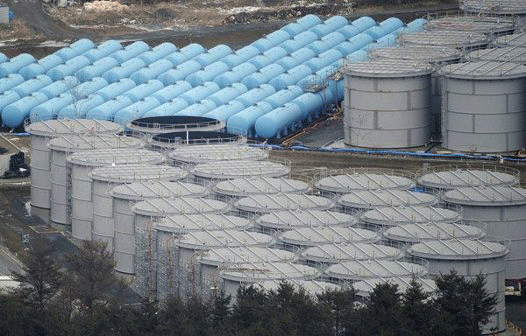
Dangerous to evaporate Fukushima’s radioactive water
Fukushima: Evaporating tank contents is not the solution http://www.ianfairlie.org/news/fukushima-evaporating-tank-contents-is-not-the-solution/ April 10, 2015 Recent news stories are suggesting that TEPCO is considering evaporating the 280,000 tonnes of highly radioactive water held in the 1,500 tanks at Fukushima. See http://www.reuters.com/article/2015/04/08/us-japan-fukushima-water-idUSKBN0MZ0WC20150408 and
http://rt.com/news/248041-fukushima-waters-evaporate-tepco/
Disposing large volumes of highly tritiated water is a serious problem for TEPCO but its evaporation proposal is quite dangerous. It is based on several misconceptions.
First, evaporating this radioactive water will NOT isolate the radioactivity: all it would do is convert liquid tritiated water to tritiated water vapour which would be emitted to the air at Fukushima and result in high exposures to those downwind of the plumes.
Second, evaporation would make the problem worse as, contrary to what many people assume, aerial emissions are more hazardous than liquid discharges to sea. Briefly, this is because you can avoid drinking tritiated water and food to a large degree, but you can’t avoid breathing in tritiated water vapour or absorbing it through skin.
Third, tritium is not “relatively harmless” as alleged. This is a common misconception: in fact, tritium is a relatively dangerous nuclide. For example, its beta particle inside the body is more harmful than most X-rays and gamma rays. But that’s just one aspect: tritiated water vapour has several other dangerous properties, and organically bound tritium (ie attached to lipids, carbohydrates and proteins) inside us is even more dangerous. See “Tritium- risks not properly assessed” in http://www.ianfairlie.org/lectures/
A complicating factor is the very high tritium levels in the tanks. From Japanese Government Meti fileshttp://www.meti.go.jp/earthquake/nuclear/pdf/140424/140424_02_008.pdf
– see slides 5 and 21- it can be seen that the tritium concentration in March 2014 was about 500,000 Bq per litre.
This is a very high level. As far as I’m aware, no internationally agreed limits exist for discharging tritium to water. But as a yardstick, the limit used by Ontario Power Generation (a nuclear utility in Canada) is 4,000 Bq/L.
TEPCO is facing a storage problem with its tanks on site now full, and no space to build more. But neither evaporating the tank contents nor discharging them to sea appears to be a solution. http://www.ianfairlie.org/news/fukushima-evaporating-tank-contents-is-not-the-solution/
Mutations in fir trees near Fukushima nuclear station, abnormalities in animal species
Major Japan Newspaper: Mutations in nearly every fir tree by Fukushima plant — Insects with missing legs or crooked — Abnormalities also found in monkeys, fish and frogs http://enenews.com/major-japan-newspaper-mutations-every-fir-tree-fukushima-plant-insects-missing-crooked-legs-abnormalities-found-monkeys-carp-frogs?utm_source=feedburner&utm_medium=email&utm_campaign=Feed%3A+ENENews+%28Energy+News%29
Asahi Shimbun, Dec 22, 2015 (emphasis added): More than 90 percent of the fir trees in forests close to the site of Japan’s 2011 nuclear disaster are showing signs of abnormality, and plant lice specimens collected in a town more than 30 kilometers from the crippled facility are missing legs or crooked. But it remains unclear whether the mutations in plants and animals are definitively connected to the disaster at the Fukushima No. 1 nuclear power plant. All that scientists in Japan are prepared to say is they are trying to figure out the effects of radioactive cesium caused by the release of huge amounts of radioactive materials from the triple meltdown at the Fukushima plant… Scientists are seeking… signs of mutation in plants and animals in areas close to the stricken nuclear plant…
Scientists have reported onmutations and abnormalities among species varying from fir trees and plant lice to Japanese monkeys, carp and frogs. The National Institute of Radiological Sciences (NIRS), a government-affiliated entity, said in late August that the trunks of fir trees are not growing vertically. Fir trees are among the 44 species that the Environment Ministry asked the NIRS and other research organizations to study in trying to determine the effects of radiation on living creatures. The NIRS reported that the frequency of these mutations corresponds to a rise in natural background radiation. More than 90 percent of fir trees in the town of Okuma, just 3.5 kilometers from the crippled plant, showed signs of abnormal growth… Among other changes reported: the legs of plant lice collected in Kawamata, a town more than 30 km from the plant, were found to be missing or crooked and the white blood cell count of Japanese monkeys was lower in Fukushima, the prefectural capital, which is about 60 km from the plant… There is also a possibility that some animals, even if they exhibited signs of radiation’s effect, may no longer be alive for analysis.
Fukushima Prefecture’s problem of disposal of radioactive trash
Behind the Scenes / Waste disposal site a dilemma for Fukushima, Japan Times 21 Dec 15 By Yuki Inamura and Keita Aimoto / Yomiuri Shimbun Staff Writes
On Dec. 4, the Fukushima prefectural government notified the national government that it would accept a proposal to dispose of the radioactive designated waste [definition below page] stored in the prefecture, where a catastrophic accident struck Tokyo Electric Power Co.’s Fukushima No. 1 nuclear power plant due to the 2011 earthquake. The Fukushima prefectural government’s recent decision signifies a step forward in efforts to rehabilitate the nuclear disaster-hit prefecture. However, the latest move poses a dilemma: In some neighboring prefectures that are home to a large amount of such designated waste, there are persistent calls for their waste to be concentrated in Fukushima Prefecture.

The government’s proposal would entail the use of the Fukushima Eco-tech Clean Center, an existing private-sector disposal plant in the town of Tomioka, to bury a portion of the designated waste stored in the prefecture. The waste subject to this disposal will consist of garbage and other waste material whose radiation levels stand at 100,000 becquerels or less per kilogram.
Two years ago, the national government formally presented the proposal to the Fukushima prefectural government. This coincided with the national government’s move to unveil another plan aimed at building an interim storage facility in the prefecture. This facility would be used to store, for extended periods, garbage whose radioactive levels exceed 100,000 becquerels per kilogram as well as a massive amount of contaminated soil. There has been a constant increase in the amount of contaminated soil as a result of ongoing decontamination work. The interim storage facility is currently being built. Continue reading
High plutonium content in MOX fuel leaked from Fukushima nuclear reactor
Officials now say Fukushima reactor with MOX fuel “leaked directly from containment” — TV: Contamination of environment was due to “failure of vessel” — Experts: This has caused additional worries because MOX is more “radioactively aggressive” due to plutonium content (VIDEO) http://enenews.com/officials-fukushima-reactor-mox-fuel-leaked-directly-containment-vessel-tv-radioactive-contamination-environment-caused-failure-vessel-experts-caused-additional-worries-tepco-govt-because-mox-ra?utm_source=feedburner&utm_medium=email&utm_campaign=Feed%3A+ENENews+%28Energy+News%29
NHK, Dec 17, 2015 (emphasis added): [TEPCO] says radioactive fallout that polluted the environment in mid-March of 2011 was likely caused by a leak directly from a containment vessel of the facility’s No.3 reactor. Officials… on Thursday reported their latest findings on what happened at the plant… They concluded that radioactive contamination of the environment between the night of March 14th and the 16th was likely caused not by the vent operations but failure of the vessel. They said the vessel likely lost airtightness due to heat from nuclear fuel, leading to the direct release of radioactive substances into the environment.
NHK transcript, Dec 17, 2015: [TEPCO] said the substances in one of the reactors probablyleaked directly from the containment vessel… They suspect the heat of fuel caused the containment vessel to lose airtightness.
TEPCO, Dec 17, 2015: A significant release of steam from the night of March 14 to March 16, 2011 is believed to have been responsible for contamination to the surrounding environment of Fukushima Daiichi. The investigation reports that the primary containment vessels in Units 2 and 3 did likely lose leakage resistant properties by March 15 and had been in a condition where radioactive materials could leak directly from them. It is therefore presumed the environmental contamination outside Fukushima Daiichi during that period was caused by steam leakage directly from the primary containment vessels and not from the vent.
TEPCO, Dec 17, 2015: Leakage and release of a large amount of steam from the Unit 3 Reactor Building — The PCVs of Units 2 & 3 lost the airtightness in the end, which is confirmed by the fact that steam escaped from the Reactor Buildings. Analysis of the behavior of the pressure in the PCVs and the situation at the time of the accident has revealed that the environmental contamination from the night of March 14 to March 16 occurred by steam leakage together withradioactive materials directly from the PCVs not from the vent.
UBS Investment Research (via WikiLeaks), Apr 2011: Of particular concern was Unit 3, because, since September 2010, the plant had been fueled with mixed oxide, or MOx… Use of MOx heightened fuel risk — Fukushima Daiichi Unit 3 was fuelled with mixed oxide (MOx), which is about 93% uranium and 7% plutonium. This has caused additional worries for TEPCO and the government, because MOx is more radioactively aggressive. We think national nuclear safety reviews might consider restrictions on its use.
Groundwater at Fukushima Daiichi has become increasingly salty
Salt Water Infiltrates Fukushima Daiichi, Simply Info December 19th, 2015 TEPCO has admitted a new problem with the water management and steel sea wall at Fukushima Daiichi.Salt levels in groundwater being pumped up from around the reactor buildings and sea front were found to now have more than the expected amount of salt. This appears to indicate some amount of sea water is infiltrating back into the plant grounds near the reactors.
The solution so far has been to dump the salty water into the reactor building basements. This itself is problematic as excess salt levels will increase the corrosion of structures in the lower levels of the buildings. It has also created a problem for treating the contaminated water. The decontamination systems are not meant to handle water with significant salt levels………http://www.fukuleaks.org/web/?p=15233
TEPCO to evaporate 800,000 m3 of Tritium water to the air ?
Tepco considers evaporating 800,000 m3 of Tritium water to the air
http://fukushima-diary.com/2015/12/tepco-considers-evaporating-800000-m3-of-tritium-water-to-the-air/ On 12/11/2015, Tepco announced the possibility of evaporating Tritium water retained in Fukushima plant area. It was reported in the task force of METI (Minister of Economy, Trade and Industry).
From their report, the estimated volume to be released is 800,000 m3. 400 m3 of Tritium water is expected to be released per day.
The maximum density of Tritium is 4,200,000,000 Bq/m3.
The water is reportedly vaporized at 900 ~ 1,000 ℃, released to the atmosphere at 60m above the ground.
Tepco states the maximum density becomes lower than 5,000 Bq/m3 at 40m area from the releasing point, which is the notice concentration limit.
1 This Month




PLEASE OPPOSE HR 8255 AND S.3639 – bills would accelerate satellite deployment, with no environmental review or safeguards – https://ncstd5li.quorum.us/campaign/169331/
To see nuclear-related stories in greater depth and intensity – go to https://nuclearinformation.wordpress.com
-
Archives
- September 2026 (339)
- August 2026 (330)
- July 2026 (355)
- June 2026 (287)
- May 2026 (306)
- April 2026 (356)
- March 2026 (251)
- February 2026 (267)
- January 2026 (308)
- December 2025 (358)
- November 2025 (359)
- October 2025 (375)
-
Categories
- 1
- 1 NUCLEAR ISSUES
- business and costs
- climate change
- culture and arts
- ENERGY
- environment
- health
- history
- indigenous issues
- Legal
- marketing of nuclear
- media
- opposition to nuclear
- PERSONAL STORIES
- politics
- politics international
- Religion and ethics
- safety
- secrets,lies and civil liberties
- spinbuster
- technology
- Uranium
- wastes
- weapons and war
- Women
- 2 WORLD
- ACTION
- AFRICA
- Atrocities
- AUSTRALIA
- Christina's notes
- Christina's themes
- culture and arts
- Events
- Fuk 2022
- Fuk 2023
- Fukushima 2017
- Fukushima 2018
- fukushima 2019
- Fukushima 2020
- Fukushima 2021
- general
- global warming
- Humour (God we need it)
- Nuclear
- RARE EARTHS
- Reference
- resources – print
- Resources -audiovicual
- Weekly Newsletter
- World
- World Nuclear
- YouTube
-
RSS
Entries RSS
Comments RSS

