U.S. would back a rethink of Japan’s plutonium recycling program: White House

WASHINGTON – The United States would back a change to Japan’s nuclear fuel reprocessing program because there are concerns it may lead to an increase in its ally’s stockpile of unused plutonium, a senior White House official said.
If Japan were to change course “they would find the United States to be supportive,” Jon Wolfsthal, senior director for arms control and nonproliferation at the National Security Council, said in a recent interview.
Wolfsthal’s remark reflected concerns in President Barack Obama’s administration about the future of Japan’s large plutonium stockpiles, which can be used to make nuclear weapons.
Wolfsthal said the upcoming renewal in 2018 of a bilateral nuclear agreement with Japan “has the potential to become a very controversial issue.”
The 1988 pact authorizes Japan to reprocess used nuclear fuel when the fuel includes U.S.-produced uranium.
“There is no question that plutonium recycling in Japan has been expensive, that it is a challenging future for Japan,” Wolfsthal said.
In March, Foreign Minister Fumio Kishida defended the reprocessing of used nuclear fuel, saying the United States has approved it.
The United States and Japan have discussed what a decision to have large stockpiles of plutonium that “don’t have a dedicated pathway to use and disposition” means for global efforts to restrict reprocessing and enrichment, he said.
If Japan keeps recycling plutonium, “what is to stop other countries from thinking the exact same thing?” Wolfsthal said, apparently referring to concerns that other Asian countries such as China and South Korea may compete to get involved in similar projects.
Under the Japanese reprocessing program, plutonium extracted from used nuclear fuel is recycled to make plutonium-uranium mixed oxide fuel usable at nuclear power plants. Japan has licensed companies in foreign countries such as Britain and France to produce the so-called MOX fuel.
Japan came up with the plutonium recycling program in the face of potential international suspicion that a large stockpile of plutonium could encourage it to go nuclear.
But the plutonium recycling effort has hit a snag because most of Japan’s nuclear plants have suspended operations due to public safety concerns since the meltdowns at the Fukushima No. 1 plant following the giant earthquake and tsunami in 2011.
Obama has urged Japan and other countries to give up unused nuclear materials including plutonium as part of his efforts to strengthen control over the management of nuclear substances all over the world to prevent terrorists from obtaining them.
Japan had 48 tons of plutonium as of the end of 2014 and sent 331 kilograms of plutonium to the United States earlier this year.
The spread of particles with plutonium and cesium, from Fukushima nuclear fuel
 Expert: Billions of pieces Fukushima nuclear fuel have spread pretty much everywhere — “It’s truly frightening… wherever there’s cesium, there’s plutonium” — Atomic bomb had one pound of uranium… Fukushima had hundreds of tons — TV: “Abundant quantities” of plutonium are being found (VIDEO) http://enenews.com/nuclear-engineer-billions-plutonium-particles-fukushima-nuke-plant-spread-pretty-everywhere-frightening-cesium-going-be-plutonium-atom-bomb-1-pound-uranium-fukushima-reactors-hundreds-tons-tv?utm_source=feedburner&utm_medium=email&utm_campaign=Feed%3A+ENENews+%28Energy+News%29Fairewinds Japan Speaking Tour Series No. 3, Feb 24, 2016 (emphasis added):
- Maggie Gundersen, Fairewinds Energy Education Podcast host: One of the things that you’ve talked about and [environmental scientist Marco Kaltofen, PhD, PE] have talked about is internal radiation exposures and hot particles. What’s the difference between a bomb exploding and a nuclear plant exploding in the hot particles?
- Arnie Gundersen, Fairewinds’ Chief Engineer and former nuclear engineer (emphasis added): Most of the bomb exposure was from a direct flash that was over in seconds. There wasn’t a significant amount of contamination on the ground because the bomb went off 1,000 feet in the air. So there was not a lot of radiation residual left on the ground for hot particles to get into people’s lungs… That’s not what we’re seeing at Fukushima Daiichi. Everything I’m finding here is millions and billions of very, very small particles that are spread pretty much everywhere. We’ll know a little bit more about that in the future… There’s no comparison between a bomb and what happened at Fukushima. A bomb obliterated maybe a pound of uranium and it was a thousand feet in the air, so most of it went up almost immediately; whereas each of the nuclear reactors at Fukushima had 100 tons of uranium in them so that the quantity of radiation that’s spread out throughout the countryside is orders of magnitude higher at Fukushima than it was at Nagasaki.
Fairewinds Japan Speaking Tour Series No. 2, Feb 17, 2016:
- Arnie Gundersen, Fairewinds’ Chief Engineer and former nuclear engineer (at 2:30 in): We found a parking lot at a supermarket [in Fukushima] that had a large radioactive source right in the middle… that people were walking over and driving over. It was loaded with black radioctive dust just wherever you go – it’s everywhere…
- AG: One of the samples that one of my fellow scientists collected showed plutonium –and significant amounts of plutonium. It was in a square meter… he was getting 19 disintegration per second [becquerels] of plutonium. That stuff is going to be around for a quarter million years…
- Maggie Gundersen, Fairewinds Energy Education Podcast founder: That plutonium was part of the core that came out then in the explosion, correct?
- AG: Yeah, the only source it could ever have come from is inside that nuclear reactor.
- MG: And the plutonium is being redeposited at locations that where unanticipated?
- AG: Yeah, it’s everywhere.… It is everywhere, and we’re very careful, we’re wearing gloves all the time, respirators all the times…
- AG: Wherever the ground is exposed, there is a high level of radiation in the mountains around here… it’s all going to run right off and into the Pacific Ocean…
- MG: You talked about the plutonium — where was that found?…
- AG: The plutonium was found in a farmer’s field about 10 miles from the power plant, it was found because that’s where they looked. If it’s sitting out in that farmer’s field, it’s everywhere. Wherever there’s radiation — cesium — there’s going to be plutonium, and that’s truly frightening… It’s pretty clear that significant amounts of plutonium are scattered throughout the hillsides… plutonium has got a 25,000 year half-life, so it’s a quarter of a million years before it’s gone.
Discovery, Dec 27, 2015: “Although only limited areas of Fukushima are allowing residents to come back, that doesn’t mean these areas are safe. You can still find dangerous radioactive elements such as cesium, strontium, and plutonium in abundant quantities here.”
Fairewinds’ podcasts here: No. 2 | No. 3 — Watch Discovery broadcast here
Japan’s Abe government intent on 2020 Olympics, pretending that Fukushima is OK now
Fukushima Flunks Decontamination, CounterPunch, 20 May 16. by ROBERT HUNZIKER Japan’s Abe administration is pushing very hard to decontaminate land, roads, and buildings throughout Fukushima Prefecture, 105 cities, towns, and villages. Thousands of workers collect toxic material into enormous black one-ton bags, thereby accumulating gigantic geometric structures of bags throughout the landscape, looking evermore like the foreground of iconic ancient temples.
Here’s the big push: PM Abe committed to the 2020 Tokyo Olympics, which shall be a crowning achievement in the face of the Fukushima disaster. Hence, all stops are pulled to repopulate Fukushima Prefecture, especially with Olympic events held within Fukushima, where foodstuff will originate for Olympic attendees.
The Abe government is desperately trying to clean up and repopulate as if nothing happened, whereas Chernobyl (1986) determined at the outset it was an impossible task, a lost cause, declaring a 1,000 square mile no-habitation zone, resettling 350,000 people. It’ll take centuries for the land to return to normal.
Fukushima: Living with a Disaster
Still and all, is it really truly possible to cleanse the Fukushima countryside? Already, workers have accumulated enough one-ton black bags filled with irradiated soil and debris to stretch from Tokyo to LA. But, that only accounts for about one-half of the job yet to be done. Still, in the face of this commendable herculean effort, analysis of decontamination reveals serious missteps and problems.
Even though the Abe government is encouraging evacuees to move back into villages, towns, and cities of Fukushima Prefecture, Greenpeace nuclear campaigner Heinz Smital claims, in a video – Fukushima: Living with Disaster d/d March 2016: “Radiation is so high here that nobody will be able to live here in the coming years.”
Greenpeace has experts on the ground in Fukushima Prefecture March 2016, testing radiation levels. The numbers do not look good at all. Still, at the insistence of the Abe government, people are moving back into partially contaminated areas. In such a case, and assuming Greenpeace is straightforward, it’s a fair statement that if the Abe government can’t do a better job, then something or somebody needs to change. The Olympics are coming……
Throughout the prefecture, decontamination is only partially carried out. For example, decontamination is confined within a 20-meter radius of private plots and along the roads as well as on farmland, leaving vast swaths of hills, valleys, riverbanks, streams, forests, and mountains untouched. Over time, radiation contamination runoff will re-contaminate many previously decontaminated areas.
Alarmingly, Greenpeace found large caches of hidden buried toxic black bags. Over time, it is likely the bags will rot away with radioactivity seeping into groundwater.
At Fukushima City, 60 km from the plant, Greenpeace discovered unacceptable radiation levels with spot readings as high as 4.26, 1.85, 9.06 μSv. According to Greenpeace: “These radiation levels are anything but harmless.”…..http://www.counterpunch.org/2016/05/20/fukushima-flunks-decontamination/
Authorities hide the truth about illnesses from Fukushima nuclear radiation
Fukushima Flunks Decontamination, CounterPunch, 20 May 16. by ROBERT HUNZIKER J
“………In a 2014 RT interview, Katsutaka Idogawa, former mayor of Futaba in Fukushima Prefecture, said: “It’s a real shame that the authorities hide the truth from the whole world, from the UN. We need to admit that actually many people are dying. We are not allowed to say that, but TEPCO employees also are dying. But they keep mum about it.”
Alas, two hundred fifty U.S. sailors of the USS Ronald Reagan, on a Fukushima humanitarian rescue mission, have a pending lawsuit against TEPCO, et al claiming they are already experiencing leukemia, ulcers, gall bladder removals, brain cancer, brain tumors, testicular cancer, dysfunctional uterine bleeding, thyroid illness, stomach ailments and other complaints extremely unusual in such young adults. Allegedly, the sailors were led to believe radiation exposure was not a problem.
Theodore Holcomb (38), an aviation mechanic, died from radiation complications, and according to Charles Bonner, attorney for the sailors, at least three sailors have now died from mysterious illnesses (Third US Navy Sailor Dies After Being Exposed to Fukushima Radiation, Natural News, August 24, 2015.) Among the plaintiffs is a sailor who was pregnant during the mission. Her baby was born with multiple genetic mutations.
Reflecting on 30 years ago, Adi Roche, chief executive of Chernobyl Children International, care for 25,000 children so far, says (2014): “The impact of Chernobyl is still very real and very present to the children who must live in an environment poisoned with radioactivity.”
“Children rocking back and forth for hours on end, hitting their heads against walls, grinding their teeth, scraping their faces and putting their hands down their throats… This is what I witnessed when I volunteered at Vesnova Children’s Mental Asylum in Belarus (February 2014),” How my Trip to a Children’s Mental Asylum in Belarus Made me Proud to be Irish, the journal.ie. March 18, 2014 (Cliodhna Russell). Belarus has over 300 institutions like this hidden deep in the backwoods.
Chernobyl is filled with tear-jerking, heart-wrenching stories of deformed, crippled, misshaped, and countless dead because of radiation sickness. It’s enough to turn one’s stomach in the face of any and all apologists for nuclear power……http://www.counterpunch.org/2016/05/20/fukushima-flunks-decontamination/
Fukushima, an ongoing tragedy Japanese government has brushed aside

Toshihide Tsuda, professor of environmental epidemiology at Okayama University, found that the rate of children suffering from thyroid cancer in Fukushima Prefecture in Japan was as much as 20 to 50 times higher than the national average as of 2014, three years after the Fukushima nuclear disaster.
His findings were published in the electronic edition of the journal of the International Society for Environmental Epidemiology late last year, but was refuted by the Fukushima prefectural government and other experts as it doubted the cases are related to the nuclear crisis and the government attributed to the surge to “over diagnosis.”
“Unless radiation exposure data are checked, any specific relationship between a cancer incidence and radiation cannot be identified,” Shiochiro Tsugane, director of the Research Center for Cancer Prevention and Screening, was quoted by a local report as saying.
More than 160 teenagers in Fukushima Prefecture were diagnosed with thyroid cancer, including suspect cases, since the Fukushima Daiichi nuclear power plant was crippled by the monstrous quake-triggered tsunami in March 2011. And the number almost certainly increase with the passage of time.
At the fifth anniversary of the Fukushima nuclear crisis, the parents of the children who were diagnosed with thyroid cancer in Fukushima formed a mutual help group to demand the government provide convincing evidence that their children’s sufferings were not related to the nuclear crisis.
In fact, the International Society for Environmental Epidemiology sent a message to the Japanese government suggesting it to conduct detailed and continuous research on residents’ health in Fukushima, but the government here did not respond to the advice, according to Tsuda who urged the government to face up to the aftermath of the nuclear issue.
Meanwhile, overseas nuclear experts are also surprised by the irresponsible and indifferent attitude of the Japanese government toward the nuclear refugees.
Oleksiy Pasyuk, an expert on energy policy at the National Ecological Center of Ukraine, told Xinhua that one of the main mistakes made by Japan in the aftermath of the accident was that the government had not stocked enough medicinal iodine tablets, which can prevent the absorption of radioactive material into the human body.
“No iodine tablets were distributed to residents living in the plant’s vicinity, who may have been exposed to radiation — it was an essential lesson, which they had to learn from Chernobyl,” Pasyuk said last month at the 30th anniversary of the Chernobyl nuclear disaster.
The Fukushima disaster is the worst nuclear crisis since the Chernobyl catastrophe in 1986, but the Japanese government has failed to learn the lessons from the Chernobyl over the past 25 years.
The management of the Fukushima plant had been warned in advance about the risks of failure of the emergency electricity generators and the subsequent failure of the cooling systems in a seismically active region, said Olga Kosharna.
The expert with the State Nuclear Regulatory Inspectorate of Ukraine said that “if they had re-ionizers of hydrogen or holes in the roof, there would be no explosion and no such severe radiation effects. There has been a human error.”
“Japanese mentality is hierarchical — all are awaiting instructions from the top chief to start acting and it is time-consuming. Besides, there was no independent nuclear agency, which examines the technical state of the plant and decides whether to stop the functioning of the reactors or suspend its operating license,” Kosharna told Xinhua.
More than five years on, the debate over the aftermath of the world’s worst nuclear disaster in three decades are continuing, but Prime Minister Shinzo Abe told the international community in 2013 when Japan bid for the 2020 Olympic Games that the crisis was “totally under control.”
The fact is obvious that about 200 tons of highly-contaminated water flows freely into the Pacific Ocean everyday and the nuclear power plant operator Tokyo Electric Power Company (TEPCO) still can not prevent the contaminated water from leaking from its makeshift containers.
TEPCO in March launched its ambitious project of freezing soil to create an ice wall to decrease toxic water leaking into the ocean. Local reports said that the project is expected to reduce the water to about 50 tons, but added that the effects are still unclear, as such a project is unprecedented on such a huge scale.
According to research by Fukushima University, about 3,500 trillion becquerels of radiative cesium-137 were discharged into the sea with the toxic water since the disaster broke out and the radiative material has reached the western coast of northern America.
Meanwhile, about a hundred thousand evacuees are still displaced and live in cramped temporary housing camps due to the uncontrolled nuclear disaster.
However, in the face of such troubles regarding the ongoing Fukushima Daiichi nuclear power plant crisis, the Japanese government is eager to reboot the country’s idled nuclear plants.
The Sendai nuclear power plant in the Kyushu area was reopened last November despite the eruption of a nearby volcano. It is also close to Kumamoto Prefecture, which was hit by waves of strong earthquakes, including one measuring a magnitude of 6.7 and another registering M7.3, last month.
The majority of the Japanese public oppose the restarting of the country’s nuclear power plants and only about 30 percent are supportive. More than 60 percent of Fukushima prefectural residents are dissatisfied with the government’s countermeasures against the nuclear disaster.
http://www.miragenews.com/fukushima-an-ongoing-tragedy-japanese-government-has-brushed-aside/
TEPCO: Frozen soil wall proving effective

The operator of the Fukushima Daiichi nuclear plant says the work to freeze soil around the crippled reactors is making progress. It is designed to stop radioactive groundwater from flowing out of the facilities.
Tokyo Electric Power Company began freezing the soil in late March to make a 1.5-kilometer frozen wall surrounding the 4 reactors.
The reactor facilities have been the main source of radioactive contamination of groundwater at the plant.
TEPCO says that as of Tuesday, more than 80 percent of 6,000 checkpoints set up along the wall logged temperatures below zero. The operator says it means the freezing work is going well.
It also says that groundwater levels are rising in areas between the reactor facilities and the frozen wall along the coast. TEPCO officials assume the wall is preventing the water from seeping out. But water is still coming in through some unfrozen parts of the hillside.
Officials told reporters on Thursday that they will further carefully monitor the effect of the frozen wall and seek its completion.
http://www3.nhk.or.jp/nhkworld/en/news/20160520_03/
Below are diagrams from TEPCO’s newest report:http://www.tepco.co.jp/nu/fukushima-np/handouts/2016/images1/handouts_160519_02-j.pdf
Fukushima Flunks Decontamination

Japan’s Abe administration is pushing very hard to decontaminate land, roads, and buildings throughout Fukushima Prefecture, 105 cities, towns, and villages. Thousands of workers collect toxic material into enormous black one-ton bags, thereby accumulating gigantic geometric structures of bags throughout the landscape, looking evermore like the foreground of iconic ancient temples.
Here’s the big push: PM Abe committed to the 2020 Tokyo Olympics, which shall be a crowning achievement in the face of the Fukushima disaster. Hence, all stops are pulled to repopulate Fukushima Prefecture, especially with Olympic events held within Fukushima, where foodstuff will originate for Olympic attendees.
The Abe government is desperately trying to clean up and repopulate as if nothing happened, whereas Chernobyl (1986) determined at the outset it was an impossible task, a lost cause, declaring a 1,000 square mile no-habitation zone, resettling 350,000 people. It’ll take centuries for the land to return to normal.
Still and all, is it really truly possible to cleanse the Fukushima countryside?
Already, workers have accumulated enough one-ton black bags filled with irradiated soil and debris to stretch from Tokyo to LA. But, that only accounts for about one-half of the job yet to be done. Still, in the face of this commendable herculean effort, analysis of decontamination reveals serious missteps and problems.
Even though the Abe government is encouraging evacuees to move back into villages, towns, and cities of Fukushima Prefecture, Greenpeace nuclear campaigner Heinz Smital claims, in a video – Fukushima: Living with Disaster d/d March 2016: “Radiation is so high here that nobody will be able to live here in the coming years.”
Greenpeace has experts on the ground in Fukushima Prefecture March 2016, testing radiation levels. The numbers do not look good at all. Still, at the insistence of the Abe government, people are moving back into partially contaminated areas. In such a case, and assuming Greenpeace is straightforward, it’s a fair statement that if the Abe government can’t do a better job, then something or somebody needs to change. The Olympics are coming.
The Greenpeace report of March 4, 2016: Radiation Reloaded – Impacts of the Fukushima Daiichi Nuclear Accident 5 Years Later, exposes deeply flawed assumptions by the IAEA and the Abe government in terms of both decontamination and ecosystem risks.
Ever since March 2011, for over 5 years now, Greenpeace has conducted 25 radiological investigations in Fukushima Prefecture, concluding that five years after the Fukushima nuclear accident, it remains clear that the environmental consequences are complex and extensive and hazardous.
A 17-minute video entitled “Fukushima: Living with Disaster,” shows Greenpeace specialists in real time, conducting radiation tests in decontaminated villages and towns of the prefecture. Viewers can see actual real time measurements of radiation on dosimeters.
For example, in the Village of Iitate, 40 kilometers northwest of the Daiichi nuclear plant, Toru Anzai, an evacuee of Iitate, is told decontamination work on his plot of land nearly complete, and he is to rehabitate in 2017. However, Toru has personal doubts about governmental claims. As it happens, Greenpeace tests show abnormally high levels of radiation where decontamination work is already complete.
“Here we have around 0.8 microsieverts (μSv) per hour,” Heinz Smital, nuclear campaigner Greenpeace, “0.23 was the government target for decontamination work.” An adjoining space registers 1.5-2.0 μSv sometimes up to 3.5 μSv. “This is not the kind of count where you can say things are back to normal.”
Throughout the prefecture, decontamination is only partially carried out. For example, decontamination is confined within a 20-meter radius of private plots and along the roads as well as on farmland, leaving vast swaths of hills, valleys, riverbanks, streams, forests, and mountains untouched. Over time, radiation contamination runoff will re-contaminate many previously decontaminated areas.
Alarmingly, Greenpeace found large caches of hidden buried toxic black bags. Over time, it is likely the bags will rot away with radioactivity seeping into groundwater.
At Fukushima City, 60 km from the plant, Greenpeace discovered unacceptable radiation levels with spot readings as high as 4.26, 1.85, 9.06 μSv. According to Greenpeace: “These radiation levels are anything but harmless.”
The government officially informed Miyoko Watanable, an evacuee of Miyakochi, of “radiation eradicated” from her home. But, she says, “I don’t plan to live here again.” Greenpeace confirmed her instincts: “Although work has only recently finished here, we find counts of 1-to-2 μSv per hour… That’s not a satisfactory for the people here in this contaminated area” (Heinz Smital).
Once an area is officially declared “decontaminated,” disaster relief payments for citizens like Miyoko Watanable stop. The government is off the hook.
Without a doubt, the government of Japan is confronted with an extraordinarily difficult challenge, and it may seem unbecoming to ridicule or find fault with the Abe administration in the face of such unprecedented circumstances. But, the issue is much bigger than the weird antics of the Abe government, which passed an absolutely insane secrecy law providing for 10 years in prison to anybody who breathes a secret, undefined.
Rather, whether nuclear power is truly safe is a worldwide issue. In that regard, the nuclear industry has an unfair PR advantage because of the latency effect of radiation. In general, the latency period for cancers is 5-6 years before statistically discernible numbers. People forget.
Consequently, it is important to reflect on key facts:
In a 2014 RT interview, Katsutaka Idogawa, former mayor of Futaba in Fukushima Prefecture, said: “It’s a real shame that the authorities hide the truth from the whole world, from the UN. We need to admit that actually many people are dying. We are not allowed to say that, but TEPCO employees also are dying. But they keep mum about it.”
Alas, two hundred fifty U.S. sailors of the USS Ronald Reagan, on a Fukushima humanitarian rescue mission, have a pending lawsuit against TEPCO, et al claiming they are already experiencing leukemia, ulcers, gall bladder removals, brain cancer, brain tumors, testicular cancer, dysfunctional uterine bleeding, thyroid illness, stomach ailments and other complaints extremely unusual in such young adults. Allegedly, the sailors were led to believe radiation exposure was not a problem.
Theodore Holcomb (38), an aviation mechanic, died from radiation complications, and according to Charles Bonner, attorney for the sailors, at least three sailors have now died from mysterious illnesses (Third US Navy Sailor Dies After Being Exposed to Fukushima Radiation, Natural News, August 24, 2015.) Among the plaintiffs is a sailor who was pregnant during the mission. Her baby was born with multiple genetic mutations.
Reflecting on 30 years ago, Adi Roche, chief executive of Chernobyl Children International, care for 25,000 children so far, says (2014): “The impact of Chernobyl is still very real and very present to the children who must live in an environment poisoned with radioactivity.”
“Children rocking back and forth for hours on end, hitting their heads against walls, grinding their teeth, scraping their faces and putting their hands down their throats… This is what I witnessed when I volunteered at Vesnova Children’s Mental Asylum in Belarus (February 2014),” How my Trip to a Children’s Mental Asylum in Belarus Made me Proud to be Irish, the journal.ie. March 18, 2014 (Cliodhna Russell). Belarus has over 300 institutions like this hidden deep in the backwoods.
Chernobyl is filled with tear-jerking, heart-wrenching stories of deformed, crippled, misshaped, and countless dead because of radiation sickness. It’s enough to turn one’s stomach in the face of any and all apologists for nuclear power.
According to Naoto Kan, Japanese PM 2010-11 during the Fukushima Daiichi Nuclear Power Plant meltdown: “For the good of humanity it is absolutely necessary to shut down all nuclear power plants. That is my firm belief” (source: Greenpeace video, March 2016).
Over 60 nuclear reactors are currently under construction in 15 countries. China has 400 nuclear power plants on the drawing boards. Russia plans mini-nuclear floating power plants to power oil drill rigs in the Arctic by 2020. Honestly!
(part 2) Young woman from Fukushima speaks out
This interview was filmed on February 12, 2016, in Fukushima Prefecture. The young woman was 15 at the time of the nuclear meltdown in Fukushima, and we are releasing this interview with her permission. She is one of the 166 Fukushima residents aged 18 or younger at the time of the nuclear disaster who has been diagnosed with or suspected of having thyroid cancer (as of February 2016).
Fukushima residents who were 18 years old or younger at the time of the nuclear accident have been asked to participate in the voluntary thyroid ultrasound examination which is part of the Fukushima Health Management Survey. However, 18.8% of this age group were not tested in the 1st round of testing.* While the final results for the 2nd round of testing are not yet complete, every year the number of children participating in the official thyroid examinations is decreasing; the number of children who have not participated in the 2nd round of testing is currently 50.7%** For those young people aged 18-21 (as of April 1, 2014) and who were living in Fukushima at the time of the nuclear accident, 74.5% have not yet taken part in the official thyroid ultrasound examination.**
This young woman’s reason for speaking out is to motivate the families of children who have not yet received the thyroid ultrasound examination to have their children tested. However, in sharing her story about a topic which has become increasingly difficult to talk publicly about in Japan, she faces inherent risks which may include those to her work, community life and personal relationships. I therefore ask that her privacy is respected.
Ian Thomas Ash, Director
contact : info@documentingian.com
Nuclear center waits over a year to report cyber-attack
Computer hackers infiltrated a server installed at a facility that oversees handling of plutonium and other nuclear materials, but the breach was not reported for over a year because officials thought it wasn’t serious.
The government-affiliated Nuclear Material Control Center acknowledged on May 18 that the server at one of its facilities in Tokai, Ibaraki Prefecture, was used as a relay point in a cyber-attack in February last year.
Under the law on regulation of nuclear source material, nuclear fuel material and reactors, such security breaches must be reported to authorities. The Tokyo-based center failed to immediately notify the Nuclear Regulation Authority about what had happened.
“We didn’t even think to make a report because we failed to recognize the fact that the attack was something serious,” said Yasuhiro Yokota, a director of the organization.
No data at the facility was compromised.
On Feb. 19, 2015, an outside information security firm notified the center, “Your server is being used as a relay point in a cyber-attack that is sending high volumes of data to an outside target.”
The center changed the settings on its server the following day to prevent further infiltration attempts. The security company did not reveal the target of the cyber-attack.
Center officials apparently learned they were required to report the breach to the NRA when they were investigating a separate computer-related incident in September 2015. A computer used by a center employee had made unauthorized access to an outside server.
The center failed to notify the NRA about this incident as well, and only announced it in January.
Fukui Prefecture plans tax on spent nuclear fuel
FUKUI – The Fukui Prefectural Government is planning to submit an ordinance to an assembly session next month that calls for a tax on spent nuclear fuel stored at nuclear plants in the prefecture, informed sources said Thursday.
The ordinance is aimed at encouraging nuclear plant operators to transfer spent fuel outside the prefecture, the sources said.
It will propose a tax of ¥1,000 per kilogram of spent nuclear fuel that has been cooled for over five years at storage pools and is ready to be relocated.
If the ordinance is passed by the assembly, the prefecture will put it into effect on Nov. 10 after receiving approval from the internal affairs minister.
Fukui will become the first prefecture to tax spent nuclear fuel. Among municipalities, the city of Kashiwazaki, Niigata Prefecture, has a spent nuclear fuel tax. Kashiwazaki and the neighboring village of Kariwa host Tokyo Electric Power Co. Holdings Inc.’s Kashiwazaki-Kariwa nuclear plant.
The Fukui Prefectural Government currently collects nuclear fuel tax from power companies based on thermal output of nuclear reactors at their facilities. Its annual revenue from the tax stands at some ¥6 billion.
The planned new tax is estimated to increase the prefecture’s annual tax revenue by about ¥3 billion, the sources said.
The ordinance will also call for expanding the scope of reactors subject to the existing tax to include those in the decommissioning process — the first such move by a local government in Japan, the sources said.
Currently, local governments cannot impose such nuclear fuel tax on reactors for which the Nuclear Regulation Authority has approved decommissioning.
Noting that safety measures are necessary as long as radioactive materials remain, an official of the Fukui Prefectural Government’s tax division said that the prefecture aims to keep imposing tax until decommissioning is completed.
The amount of the existing nuclear fuel tax will be halved for reactors in the decommissioning process, the sources said.
Among reactors in Fukui, decisions for decommissioning have been made for the No. 1 unit at Japan Atomic Power Co.’s Tsuruga plant, the No. 1 and No. 2 units at Kansai Electric Power Co.’s Mihama plant, and the Japan Atomic Energy Agency’s Fugen advanced converter reactor.
INSIGHT: Fukushima’s ‘caldrons of hell’ keep questions unanswered

A convenience store in Okuma, Fukushima Prefecture, on March 12, 2016, remains as it was when the 2011 earthquake and tsunami triggered the nuclear accident
After spending slightly more than two years in the capital of Fukushima Prefecture, I was assigned to The Asahi Shimbun’s Tokyo head office starting on May 1. I moved house the other day.
I had previously never been based in Fukushima, although I have long covered energy policy and a number of nuclear accidents as a reporter for the newspaper.
On April 11, 2014, shortly after I was assigned to Fukushima, I was told the words that would serve as a starting point for my news-gathering activities there. I am citing that phrase, which I quoted in a previous column, for a second time here:
“Whatever the future of nuclear power generation, it will remain essential to expand renewable energy sources to ensure a stable energy supply and to fight global warming. Fukushima Prefecture has swaths of land and a historical background for doing so.
The energy industry has always been its leading local industry. The prefecture is home to the Joban coal field, and Iwaki was a city of coal mines. Nobody will be able to change Japan unless Fukushima takes it upon itself to do the task.”
The remark was made by Yukihiro Higashi, then professor of thermal energy at Iwaki Meisei University.
After the Great East Japan Earthquake and tsunami triggered the Fukushima nuclear disaster in 2011, the Fukushima prefectural government defined “building communities that do not rely on nuclear energy” as a leading principle of its post-disaster rebuilding efforts.
It set a goal of having renewable energy sources cover all energy demand in the prefecture by around 2040. Higashi played a central role in working out that vision.
The goal may seem preposterous, but the professor’s remarks led me to realize that it isn’t.
LEADING ENERGY PLAYER
Fukushima Prefecture produced 10 percent of Japan’s electricity before it was hit by the nuclear disaster. Most of that electricity was sent to the greater Tokyo area, so the prefecture was sometimes sarcastically referred to as a “colony of Tokyo.”
But all that would have been impossible had it not been for the “swaths of land” and the “historical background” suitable to having electric power generated there.
Energy has always been the representative local product of Fukushima Prefecture. That history dates back to the late Edo Period (1603-1867), when the Joban coal field was discovered.
Energy created in the prefecture continued to support Japan’s modernization even after electricity replaced coal as the leading player.
Living in Fukushima Prefecture provides plenty of opportunities to learn about that history.
A cluster of old hydroelectric plants stands in the environs of Lake Inawashiroko. A dozen of these plants, which were built during the Meiji (1868-1912) and Taisho (1912-1926) eras and taken over by Tokyo Electric Power Co., continue to send electricity to the greater Tokyo area to this day.
A step-like array of hydroelectric plants along the Tadamigawa river in the prefecture’s western Oku-Aizu district was built in the postwar period in a desperate drive to “rebuild Japan.”
Both hydroelectric undertakings drew on the bountiful water resources that are the blessings of the prefecture’s terrain.
Nuclear reactors and a bunch of giant thermal power plants began to spring up along the Pacific coast during the high economic growth of the postwar period.
When cast in the context of that history, the goal set forth by the prefectural government appears to betray the pride of its own “leading local industry.” The prefecture’s people pledged that they are the ones who will replace the leading player of energy.
Ten days after I met Higashi, I visited the Yamatogawa Shuzoten sake brewery in Kitakata, Fukushima Prefecture, to see Yauemon Sato, the ninth-generation chief of the brewery, which has been operating since the mid-Edo Period.
Sato had founded Aizu Electric Power Co. in August 2013, setting out on an ambitious plan to help rebuild the prefecture by means of renewable energy sources.
“You know the caldron of hell?” Sato asked me. “You will be sent to hell and will be boiled in that caldron if you do evil. There are four such caldrons in Fukushima Prefecture. And they are still gaping.”
The No. 1 through No. 4 reactors of TEPCO’s Fukushima No. 1 nuclear power plant, which caused a calamity that will go down in the history of humankind, could certainly be called “caldrons of hell.”
The use of renewable energy sources is a means for closing those caldrons and for obliterating them from Fukushima Prefecture.
More than two years later, the use of renewable energy sources is steadily gaining ground in the prefecture, covering 26.6 percent of all energy demand as of the end of March. The goal remains far in the distance, but the ratio has been gaining about 1 percentage point every year.
The caldrons are still gaping. TEPCO has yet to solve the question of how to block groundwater from flowing into the reactor buildings, which is only increasing the stockpile of water contaminated by radioactive substances. That is preventing the utility from starting serious work to decommission the reactors.
LEFT IN LIMBO
“What should we do?” a 59-year-old woman, evacuated from Okuma, which co-hosts the crippled nuclear power plant, to Koriyama, also in Fukushima Prefecture, asked me when I interviewed her about a year ago.
“Should we go on with our new life here, or should we return to our hometown? My thoughts remain in limbo, and I cannot get around to making up my mind.”
I did not know how to answer her question.
More than 94,000 people of Fukushima Prefecture continue to live as evacuees. The government of the town of Okuma, where all residents remain evacuated, plans to create a rebuilding base with a “habitable environment,” hopefully by fiscal 2018.
But full rebuilding of the town lies far beyond that goal. And that is leaving many people “in limbo.”
What should we do? My pursuit of that unanswered question will continue.
Suspicions grow over Tokyo 2020 Olympic bid team’s payment for ‘consulting fees’
Suspicions have been raised over the credibility of the Tokyo 2020 Olympic bid team’s decision to pay about 230 million yen to the “Black Tidings” company in Singapore for “consulting fees” as part of efforts to win the right to host the Games.
Japanese Olympic Committee (JOC) Chairman Tsunekazu Takeda, who headed the bid team in 2013, was hard-pressed to explain the deal during a meeting on May 16 of the House of Representatives Budget Committee. While the total cost of hosting the 2020 Tokyo Olympic and Paralympic Games is expected to swell, facts about the Olympic bid team going to extremes to win its bid to host the Games have been exposed one after another.
Takeda, the top figure in the Japanese sports world, was grilled as an unsworn witness during the lower house budget committee meeting. Takeda emphasized, “It is a common practice to have contracts with overseas consultants and there will be no success without them. Their consultations were crucial for our last-minute vote counting and winning votes.” He made the statement when he was questioned by Democratic Party (DP) legislator Yuichiro Tamaki.
Each candidate city for hosting Olympic events signs contracts with multiple consulting firms at home and abroad in order to receive guidance on bidding campaign speeches and advice on lobbying activities aimed at collecting votes from International Olympic Committee (IOC) members. In its bid to host the 2020 Tokyo Olympic and Paralympic Games, the bid committee signed contracts with about 10 consulting firms, sources said.
According to the bid committee’s report on its activities, the Tokyo Metropolitan Government and the bid committee footed the bill for bidding activities and spent about 8.9 billion yen between September 2011 and September 2013. Still, that figure is about 60 percent of about 14.9 billion yen spent on Tokyo’s unsuccessful bid for the 2016 Summer Olympics and Paralympics.
Of the 8.9 billion yen, about 4.1 billion yen was used for overseas activities to try to win the bid to host the Games. The “consulting fees” in question were included in expenses for overseas public relations activities — part of international bidding activities. The bid committee, which had collected contributions from the private sector and support money, shouldered the expenses for the “consulting fees.” The Tokyo Metropolitan Government did not directly pay the consulting fees. Furthermore, Takeda insisted that the payment was legitimate because it was audited by a Tokyo-based audit company and approved by the IOC.
Nonetheless, suspicions have been raised about the personal connections of Ian Tan Tong Han, who represented the “Black Tidings” company. The French financial prosecutor’s office has been investigating disgraced former International Association of Athletics Federations President Lamine Diack and his son Papa Massata Diack on suspicion of receiving cash in return for giving silent approval to doping by Russian athletes. The French prosecutors focused their attention on the fact that Papa Massata Diack is a close friend of Ian Tan Tong Han. Allegations have emerged that money aimed at colleting votes was funneled to Papa Massata Diack, who had a voice in the decision on which country would host the games.
Takeda emphasized that he was not aware of the connection between Ian Tan Tong Han and Papa Massata Diack. However, Ian Tan Tong Han has not been reached since the allegations came to light and the flow of the consulting fees has not been confirmed. Sources abroad who have been long involved in Olympic events say that Ian Tan Tong Han is not well known. Ian Tan Tong Han’s Singapore office was in an apartment room. The fact that the Tokyo bid committee paid the massive amount of funds to a company that looked like a shell company has led to a sense of public distrust in the Tokyo Olympic bidding campaign.
In the final round of voting at the IOC general meeting in September 2013, Tokyo won 60 votes against 36 for Istanbul. The result showed a landslide victory for Tokyo, but the competition between the three cities including Madrid had been so keen that it was hard to predict the winner. Before the opening of the IOC general meeting, people linked to the race for the right to host the 2020 Games gathered at a lobby of a Buenos Aires hotel where IOC members were staying. Rumors were swirling that people related to Istanbul were apparently calling in IOC members to try to persuade them to vote for their city. Suspicion was stoking idle fears among people there.
At that time, Tokyo was fighting an uphill battle. Then Tokyo Gov. Naoki Inose, who was chairman of Tokyo’s Olympic bid committee, came under fire for saying in April 2013 that Islamic countries were “fighting with each other.” In July that year, Tokyo’s bid to host the Games was viewed with anxiety as news spread of a leakage of contaminated water at the Fukushima No.1 nuclear power plant.
The Tokyo bid committee regarded the IAAF World Championships in Athletics that opened in Moscow in August 2013 as a major highlight of its activities. That’s because many IOC members, mainly those related to athletic sports, would gather there. Ian Tan Tong Han had already promoted himself. Through Dentsu Inc., a major Japanese international advertising and public relations company, the Tokyo bid committee confirmed that Ian Tan Tong Han had played a role in helping Beijing win the right to host the 2015 IAAF World Championships in Athletics. The bid committee abandoned its pride to pay the consulting fees of 230 million yen.
The murky payment of consulting fees is not the only step taken by the bid committee to win the right to host the Games that sparked public distrust. Although the bid committee changed itself into an organizing committee tasked with preparing and operating the Games in January 2014, it was revealed that the total cost of hosting the world event was underestimated when the bid committee was campaigning for its bid.
Above all, the construction plan for a new Olympic stadium — the main venue for the Games — raised havoc. The construction cost for the new national stadium was estimated at 130 billion yen at the time of the bidding campaign. But after looking into details of the plan, the total cost was expected to soar to about 300 billion yen, forcing the scrapping of the construction plan in July 2015. Meanwhile, the total cost of building temporary venues that are to be dismantled after the Games is likely to rise to about 300 billion yen — about four times the 72.3 billion yen estimated at the time of the bidding campaign. Tokyo 2020 Olympic Organizing Committee President Yoshiro Mori said in July 2015 that the total cost of hosting the Games could exceed 2 trillion yen. It was earlier estimated at 734 billion yen at the time of the bidding campaign.
Why did the Tokyo Olympic committee have to bite off more than it could chew? The root cause of this stems from their eagerness to overcome Tokyo’s weakness shown when it miserably lost its bid to host the 2016 Games. The bid committee set aside hefty funds for overseas consulting fees this time because it had the bitter lesson that it was weak in lobbying activities abroad. Another weakness stems from low support ratings at home for hosting the Games. As compared with Rio de Janeiro, which received a support rate of 84.5 percent for hosting the 2016 Summer Games, Tokyo had only a 55.5 percent support rate for the same event. Tokyo received a support rate of 70 percent for hosting the 2020 Games in a survey conducted in January 2013 by the IOC, but there were persistent views in Japan that priority should be placed on efforts to rebuild the regions battered by the 2011 Great East Japan Earthquake. If the government were to spend huge amounts of money on the Games, it could see public support declining. Holding the estimated cost of hosting the Games down to the minimum was a desperate measure.
A senior official of the organizing committee said the situation looks hopeless. “If we simulated everything at the very outset, we would not be able to host the Olympic Games.” The organizing committee is under pressure to make adjustments to meet realities.
http://mainichi.jp/english/articles/20160517/p2a/00m/0na/019000c
Former Prime Minister Koizumi backs U.S. sailors suing over Fukushima radiation
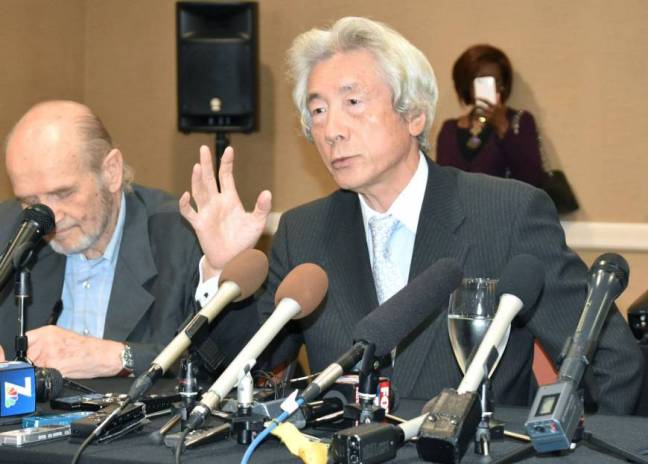
Former Prime Minister Junichiro Koizumi speaks at a news conference Tuesday in Carlsbad, California.
CARLSBAD, CALIFORNIA – Former Prime Minister Junichiro Koizumi said Tuesday he stands behind a group of former U.S. sailors suing the operator of the Fukushima No. 1 nuclear plant, who claim health problems they now suffer were caused by exposure to radiation after three reactors melted down in the days after a devastating earthquake and tsunami in March 2011.
Koizumi made the remarks at a news conference in Carlsbad, California, with some of the plaintiffs in a lawsuit brought in the United States in 2012 against plant operator Tokyo Electric Power Co., which has renamed itself Tokyo Electric Power Company Holdings Inc.
The plaintiffs include crew members of the U.S. aircraft carrier Ronald Reagan, which provided humanitarian relief along the tsunami-battered coastline in a mission dubbed Operation Tomodachi.
“Those who gave their all to assist Japan are now suffering from serious illness. I can’t overlook them,” Koizumi said.
The former premier spent Sunday through Tuesday meeting with roughly 10 of the plaintiffs, asking about the nature of the disaster relief they undertook and about their symptoms.
“I learned that the number of sick people is still increasing, and their symptoms are worsening,” he told the news conference.
Koizumi called on those in Japan, both for and against nuclear power, to come together to think of ways to help the ailing U.S. servicemen.
The group of about 400 former U.S. Navy sailors and Marines alleges the utility, known until recently as Tepco, did not provide accurate information about the dangers of radioactive material being emitted from the disaster-struck plant.
This led the U.S. military to judge the area as being safe to operate in, resulting in the radiation exposure, the group claims.
One of the plaintiffs at the news conference, Daniel Hair, said Koizumi’s involvement made him feel for the first time that Japan is paying serious attention to their plight.
According to lawyers for the group, seven of its members have died so far, including some from leukemia.
Koizumi, who served as prime minister between 2001 and 2006, came out in opposition to nuclear power in the wake of the 2011 disaster. He has repeatedly urged the administration of Prime Minister Shinzo Abe to halt its efforts to restart dormant reactors across Japan.
Young woman from Fukushima speaks out (part 1)

This interview was filmed on February 12, 2016, in Fukushima Prefecture. The young woman was 15 at the time of the nuclear meltdown in Fukushima, and we are releasing this interview with her permission. She is one of the 166 Fukushima residents aged 18 or younger at the time of the nuclear disaster who has been diagnosed with or suspected of having thyroid cancer (as of February 2016).
Fukushima residents who were 18 years old or younger at the time of the nuclear accident have been asked to participate in the voluntary thyroid ultrasound examination which is part of the Fukushima Health Management Survey. However, 18.8% of this age group were not tested in the 1st round of testing.* While the final results for the 2nd round of testing are not yet complete, every year the number of children participating in the official thyroid examinations is decreasing; the number of children who have not participated in the 2nd round of testing is currently 50.7%** For those young people aged 18-21 (as of April 1, 2014) and who were living in Fukushima at the time of the nuclear accident, 74.5% have not yet taken part in the official thyroid ultrasound examination.**
This young woman’s reason for speaking out is to motivate the families of children who have not yet received the thyroid ultrasound examination to have their children tested. However, in sharing her story about a topic which has become increasingly difficult to talk publicly about in Japan, she faces inherent risks which may include those to her work, community life and personal relationships. I therefore ask that her privacy is respected.
Ian Thomas Ash, Director
Mayor blasts nuclear power to students visiting from Taiwan
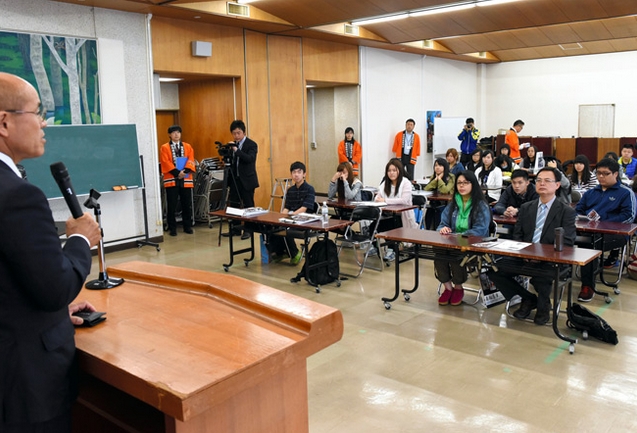
Minami-Soma Mayor Katsunobu Sakurai discusses the city’s experiences after the Fukushima nuclear disaster before Taiwanese students and teachers in Minami-Soma, Fukushima Prefecture, on May 17
MINAMI-SOMA, Fukushima Prefecture–The mayor here has lamented to visiting Taiwanese students how the Fukushima nuclear catastrophe tore his city apart, with 27,000 residents still unable to return to their homes.
Mayor Katsunobu Sakurai went on to blast nuclear energy in an impassioned speech to the 30 visiting students and their teachers on May 17.
“Putting money ahead of people’s lives is totally unacceptable,” he said.
“I was moved by his speech because he is very concerned about the welfare of children,” a 16-year-old girl said, adding that she is worried about nuclear power plants in Taiwan.
Other students said they were able to grasp the enormity of the 2011 disaster at the Fukushima No. 1 nuclear power plant and the city’s efforts to rebuild after Sakurai’s ardent talk.
Sakurai told the students, who are on a school trip from Dali High School in Taipei, that even five years on “27,000 residents including many children are still displaced” and that some elderly citizens died while being evacuated.
The mayor said that the terrible damage was not simply limited to the leakage of radioactive material, and emphasized that nuclear disasters had great potential for driving families apart and destroying local communities.
“Many local leaders tend to refrain from saying this, but I am making a strong plea to the central government, the business circles and the world that nuclear power plants are not needed because (if there is an accident) it can totally ruin people’s lives,” he said.
In replying to a question about the city’s radiation levels, Sakurai reassured the student that readings are now “low enough.” He went on to discuss efforts to decontaminate the local communities and the substantial effort required to rebuild them.
But he added that the municipal government is still monitoring radioactivity in tapping water and food products.
“The fact that we need to conduct such checks even today is unusual,” he said.
Asked about Minami-Soma residents’ reactions to restarting nuclear plants in Japan despite the Fukushima disaster, the mayor said, “An overwhelming majority are against the move to resume the operation of nuclear facilities.”
Minami-Soma is situated between 10 and 40 kilometers from the crippled plant, which stands to the city’s south.
The southern part of the city was designated part of the 20-km “no-entry” zone after the nuclear accident, forcing its residents to evacuate.
At one time, the city, whose population stood at 72,000 before the nuclear accident, had only 10,000 people left because of the evacuation order and voluntary evacation by the residents.
1 This Month




PLEASE OPPOSE HR 8255 AND S.3639 – bills would accelerate satellite deployment, with no environmental review or safeguards – https://ncstd5li.quorum.us/campaign/169331/
To see nuclear-related stories in greater depth and intensity – go to https://nuclearinformation.wordpress.com
-
Archives
- September 2026 (323)
- August 2026 (330)
- July 2026 (355)
- June 2026 (287)
- May 2026 (306)
- April 2026 (356)
- March 2026 (251)
- February 2026 (267)
- January 2026 (308)
- December 2025 (358)
- November 2025 (359)
- October 2025 (375)
-
Categories
- 1
- 1 NUCLEAR ISSUES
- business and costs
- climate change
- culture and arts
- ENERGY
- environment
- health
- history
- indigenous issues
- Legal
- marketing of nuclear
- media
- opposition to nuclear
- PERSONAL STORIES
- politics
- politics international
- Religion and ethics
- safety
- secrets,lies and civil liberties
- spinbuster
- technology
- Uranium
- wastes
- weapons and war
- Women
- 2 WORLD
- ACTION
- AFRICA
- Atrocities
- AUSTRALIA
- Christina's notes
- Christina's themes
- culture and arts
- Events
- Fuk 2022
- Fuk 2023
- Fukushima 2017
- Fukushima 2018
- fukushima 2019
- Fukushima 2020
- Fukushima 2021
- general
- global warming
- Humour (God we need it)
- Nuclear
- RARE EARTHS
- Reference
- resources – print
- Resources -audiovicual
- Weekly Newsletter
- World
- World Nuclear
- YouTube
-
RSS
Entries RSS
Comments RSS

