Sendai No 1 nuclear reactor shut down for safety work: this could drag on
Japan nuclear reactor shuttered for safety work, Channel News Asia 06 Oct 2016 TOKYO: A reactor at the centre of Japan’s national debate over nuclear power was halted on Thursday (Oct 6) under stricter post-Fukushima safety standards, as Tokyo struggles to bring back atomic energy.
Utility Kyushu Electric is shutting down the No. 1 reactor at its Sendai plant in southern Kagoshima for a few months of inspections and maintenance, leaving Japan with just two operating reactors.
But there is speculation that the reactor’s safety work could drag on longer.
Thursday’s shutdown follows demands from the region’s top politician that Kyushu Electric conduct extra safety inspections at its two operating reactors in the Sendai plant – after deadly quakes hammered a neighbouring prefecture in April.
Last month, the company refused governor Satoshi Mitazono’s demands to immediately shut down the reactors over safety concerns.
But it agreed to what it called “special inspections” in addition to regular maintenance work. Sendai’s No. 2 reactor will be shut down for a similar review starting in December………
Opposition to nuclear power has seen communities across the country file lawsuits to prevent restarts, including the Sendai plant.
The residents argued that the plant’s operator underestimated the scale of potential earthquakes and volcanic eruptions that could hit the region. A court rejected their argument and ordered restarts………http://www.channelnewsasia.com/news/asiapacific/japan-nuclear-reactor-shuttered-for-safety-work/3184554.html
Contaminated Water Tanks Without Fondation Bolts at Fukushima Daiichi
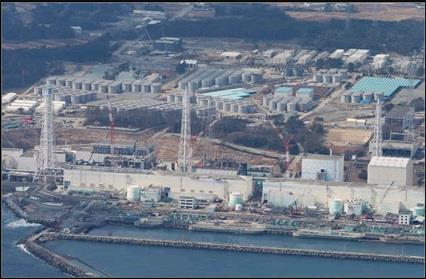
More than 1000 contaminated water tanks at Fukushima Daiichi, some do not have fondation bolts.
Even with a moderate earthquake of seismic intensity 4 there is a risk that those contaminated water tanks collapse.
The Nuclear Regulatory Commission of Japan has published on their website the seismic statement submitted by TEPCO about those tanks without fondation bolts. Their quake-resistance standard is 0.3G lower.
http://www.nsr.go.jp/data/000107385.pdf
The photograph below clearly shows the tank without fondation bolts.

Seismic intensity 4 and typhoons could cause the collapse of those contaminated water tanks. In case of tanks collapsing, a large amount of contaminated water would of course flow into the Pacific Ocean.
Japan Grapples with Cost of Scrapping Fukushima Plant

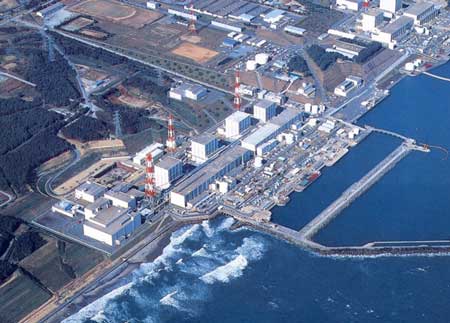
Tepco’s Fukushima Daiichi nuclear plant, site of the 2011 meltdowns.
TOKYO — Tokyo Electric Power Co. Holdings promises to shoulder as much of the burden as possible in dealing with the aftermath of the nuclear meltdown in Fukushima, but additional outside assistance is deemed inevitable to cover the gargantuan cost of dismantling the facility.
An expert panel under the Ministry of Economy, Trade and Industry began deliberations over the additional costs of the 2011 disaster on Wednesday. Attendees included Yoshimitsu Kobayashi, chairman of the Japan Association of Corporate Executives, and Akio Mimura, chairman of the Japan Chamber of Commerce and Industry.
“We want to fully meet our responsibility for the Fukushima disaster without receiving government assistance,” said Tepco President Naomi Hirose, who attended as an observer.
Tepco has allocated 2 trillion yen ($19.3 billion) so far in preparation for the decades-long process to decommission its Fukushima Daiichi nuclear plant. But it is expected to need trillions more once it starts to remove melted nuclear nuclear fuel from the site.
The bulk of the cost will not hit until the 2020s, so the government has made little progress in creating a framework to provide assistance, unlike efforts in compensating victims and decontaminating the surrounding area.
Hirose explained that once Tepco can give a realistic estimate, it will be required to recognize the entire cost at once and could turn insolvent. “We’d like the government to come up with a framework to eliminate such risks,” he said.
The panel will project decommissioning costs in its future meetings, and will make recommendations to Tepco regarding necessary reforms and restructuring by the end of the year. The utility will aim to create a new management plan in January based on the panel’s proposals. The economy ministry will iron out details on how to assist Tepco based on the expense estimate, such as by creating a reserve fund where Tepco can put aside the necessary money.
The discussion will focus on how much of the cost Tepco can assume through internal reforms. In addition to dismantling the plant, total compensation to victims is already expected to top 6.4 trillion yen, while decontamination could cost about 4 trillion yen — both above projections from January 2014. It will take Tepco and other major utilities decades to pay that off under the current framework. An update is in order.
“I am not in favor of any rescue plan that involves the government shouldering what Tepco should be paying,” said Hitotsubashi University professor Kunio Ito, who heads the expert panel. But he said something like that could happen “as a last resort.” A ministry official also suggested there may be a debate on raising electricity prices to help fund the decommissioning.
If the plan is to hike rates on customers not served by Tepco, the utility needs to put forth a strategy for reform that can satisfy the entire Japanese public. The government’s program will depend on how far Tepco is willing to go.
Tepco Threatens To Declare Bankruptcy; Dismantling Unit 1
Calls grow to curb further govt. support to TEPCO
Members of a panel looking at how to cover costs from the 2011 Fukushima Daiichi accident say government support to the operator should be limited.
Economic leaders and academic experts attended the first meeting on Wednesday of a committee set up by the industry ministry to discuss decommissioning and compensation costs.
Officials said the government has earmarked about 87 billion dollars for compensation and decontamination work, and that operator Tokyo Electric Power Company has set aside about 19 billion dollars to scrap the crippled reactors.
But they said these funds could fall well short of the amount that will be needed.
Many participants said the utility must bear the increased financial burden through business restructuring and management reforms to curb additional government support.
TEPCO President Naomi Hirose, who took part in the meeting as an observer, warned that his company could become insolvent if it is forced to post the ballooning decommissioning costs as a debt.
He argued that a special accounting rule should be created to avoid a possible insolvency.
Before the next meeting is held, the government plans to show how much the cost of decommissioning the reactors is projected to grow.
Hirose told reporters after the meeting that his company should be the first to foot the bill, and that the firm will consider what should be done to absorb the cost.
Tepco Falls After President Highlights Fukushima Cost Risk
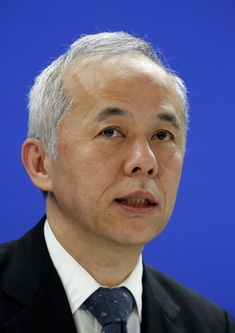
Japan utility declines 3.3% to settle at lowest in two weeks
Company seeks government help to eliminate insolvency risk
Tokyo Electric Power Co. Holdings Inc. closed at the lowest in more than two weeks after its president said it may face insolvency if it recognized at one time the cost of decommissioning the wrecked Fukushima nuclear plant and that it’s asked the government to help eliminate the risk.
Tepco, as the company is better known, fell as much as 7.9 percent during intraday trading and closed 3.3 percent lower at 414 yen a share in Tokyo, the lowest since Sept. 16. The benchmark Topix index rose 0.6 percent.
“As it becomes possible to estimate the Fukushima decommissioning cost, we will have the problem of recognizing the liability at once. That means there is a possibility Tepco becomes insolvent,” President Naomi Hirose told reporters in Tokyo Wednesday after meeting with a Ministry of Economy, Trade and Industry commission charged with reforming the company. “We are requesting institutional measures to remove such risk.”
As of June, nearly 1 trillion yen ($9.7 billion) has been allocated to decommissioning and water treatment at Fukushima, Tepco spokesman Tatsuhiro Yamagishi said last month.
The March 2011 nuclear accident and its fallout will ultimately cost more than 11 trillion yen, according to a study by Japanese college professors including Kenichi Oshima, a professor of economics at Ritsumeikan University.
Tepco calls for government help to curb impact of rising Fukushima costs
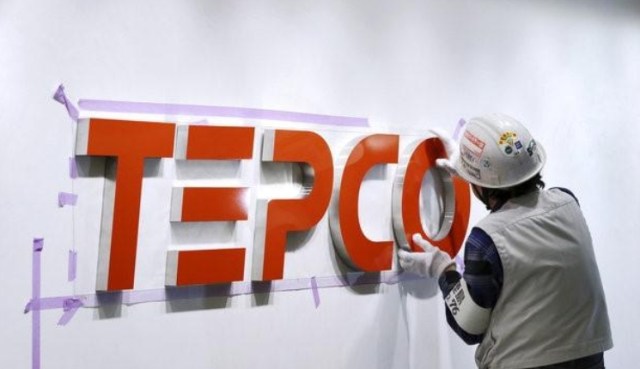
A worker puts up new logo of TEPCO Holdings and Tokyo Electric Power Company (TEPCO) Group on the wall ahead of the transition to a holding company system through a company split at the TEPCO headquarters in Tokyo, Japan, March 31, 2016.
The operator of the nuclear power plant destroyed in the Fukushima disaster five years ago has asked Japan’s government for help in avoiding the risk of the utility going bankrupt should there be a sharp rise in the full estimated clean-up costs.
Tokyo Electric Power Co Holdings Inc didn’t specify what kind of help it was seeking, but people familiar with the matter said Japan’s biggest utility is looking for new rules to avoid having to book a huge loss in its accounts if it is estimated that there will be big cost overruns for decommissioning the power station.
“We don’t want to receive national rescue measures but want to bear the Fukushima responsibility ourselves,” Tepco president Naomi Hirose told a government panel, according the panel chief, Kunio Ito, a professor at Hitotsubashi University.
“For that reason, we would like to undertake steps for a further overhaul than we have had so far,” Hirose was quoted as saying.
In March 2011, one of the worst earthquakes in history triggered a 10-metre high tsunami that crashed into the Fukushima Daiichi nuclear power station, causing the world’s worst nuclear accident since Chernobyl 30 years ago. Meltdowns in three reactors released radiation over a wide area, contaminating water, food and air, and forcing more than 160,000 people to evacuate.
Dismantling the reactors is expected to take about 40 years, but even five and a half years on, Tepco still struggles to contain radioactive water from the plant and has said it can’t predict the eventual total costs of the clean-up and decommissioning.
After the panel meeting on Tepco reform and the Fukushima Daiichi plant, Hirose told reporters that it was difficult to accurately predict the costs of even a gradual decommissioning of the crippled reactors, said a spokeswoman for the utility, which generates about a third of the country’s electricity.
“If the issue of recognising all the estimated losses at once were to emerge, our company would fail, so we would like some structural assistance from the government to be able to avoid that risk,” Hirose said.
Tepco wants the government to consider introducing rules to avoid having to book a single huge exceptional loss as soon as cost estimates for decommissioning become clearer, said a person familiar with the situation.
Cost estimates could shoot up when the company and the government, which owns 50.1 percent of Tepco, decide on how to extract fuel debris at the plant in 2018 or 2019, said a person with direct knowledge of discussions on restructuring Tepco.
A government official familiar with the deliberations said, “In the event that Tepco can’t shoulder the burden, it will mean changing the fiscal-support system.” As it’s hard to imagine the government letting the company go bust, “in the end it will have to be a matter of either shouldering the burden with public funds or responding by raising electricity prices.”
The Mainichi newspaper said on Wednesday that Japan’s utilities lobby expects clean-up and compensation costs from the Fukushima disaster to overshoot previous estimates by 8.1 trillion yen (£62 billion).
The Federation of Electric Power Companies of Japan has informally asked the government to shoulder the extra cost, the newspaper said.
However, a federation spokesman said the group has not asked the government to shoulder any extra costs and the Mainichi estimates were not correct.
The new government panel also agreed that management reform at Tepco was necessary at its first meeting earlier in the day, panel chief Ito said.
Shares in Tepco ended down 3.3 percent after falling as much as 7.9 percent on Hirose’s remarks, which were initially interpreted as a plea for additional financial aid.
“The stock market seems to have reacted to the headline that it could become insolvent,” said a credit analyst at a Japanese brokerage. “But in reality, the president has just said what’s been known, that they need an accounting system that allows them to write off the cost of decommissioning gradually because posting the cost all at once could make it insolvent.”
http://uk.reuters.com/article/uk-tepco-outlook-idUKKCN1250JT
Japan’s nuclear regulator caves to industry interests yet again–Gives nearly 40 year old reactor a green light before the aging safety review even completed
5 October 2016, Tokyo – Today, Japan’s Nuclear Regulation Authority (NRA) has again exposed itself as industry-captured by giving the Mihama 3 reactor owned by Kansai Electric Power Company (KEPCO) a green light under post-Fukushima guidelines — clearing the way for restart — even before the regulator has completed its ageing-related safety review. The safety risks of age-related degradation can be enormous.
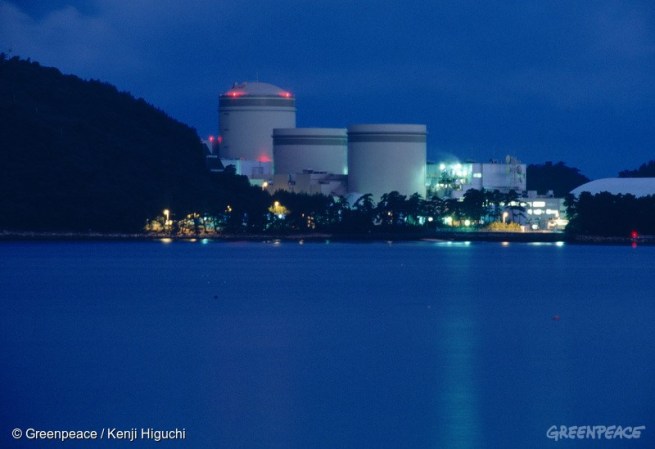
“The Mihama 3 reactor is like a vintage 1976 car that’s been driven at top speed for nearly 4 decades — and then sat idle for more than 5 years. Major safety components wear out, designs become outdated, and extended disuse creates yet another set of safety problems. Worse, it’s already been in a major accident 12 years ago due to a high-pressure pipe rupture that killed 5 workers. Most people wouldn’t just load up the kids in a car like that and speed off on a road trip. Yet, KEPCO and the NRA are trying to do just that, and they haven’t finished looking under the hood to see if the engine is alright. Unlike old cars, if an old reactor has a major accident, the victims can number in the hundreds of thousands and the crash site can extend for hundreds of kilometers. It’s nothing short of reckless, and puts the lives and livelihoods of families throughout the region at unnecessary risk,” said Kendra Ulrich, Senior Global Energy Campaigner for Greenpeace Japan.
Nuclear power plants are enormously complex, and safety-related components are only subject to normal age-related degradation. Constant irradiation of major components embrittles the metal, leading to an increased likelihood of potentially catastrophic failure during operation or emergency shutdown.
The Mihama 3 reactor is also located in the seismically-active Wakasa Bay region. The deep concerns over inadequate seismic assessments for the KEPCO’s Ohi reactors – also located in Wakasa Bay – pushed former NRA commissioner and seismologist, Kunihiko Shimazaki, to challenge the regulator directly. Although the NRA dismissed his concerns, the agency admitted that they could not reproduce the figures submitted by KEPCO in their assessment and so could not independently verify their accuracy. The same potentially faulty seismic assessment method was applied to Mihama 3.
The restart of aging reactors in Fukui has caused concern in surrounding prefectures. On 23 August, the Kyoto Governor Keiji Yamada said of the potential restart of the Takahama 1&2 reactors, “ . . .we should be extremely wary when it comes to aging nuclear reactors.”(1)
The restart of Mihama 3 is currently being challenged in court as a part of an umbrella lawsuit against all Fukui reactors. Greenpeace staff are plaintiffs in a case against KEPCO’s aging Takahama 1 & 2 reactors, also in Wakasa Bay.
Notes:
- Kyoto governor doesn’t accept Takahama 1, 2 reactor restart(京都府知事、容認せぬ姿勢 高浜原発1・2号機) Kyoto Newspaper on 23 August 2016 (accessed on 4 October 2016)
- Tomorrow, 6 October 2016, the Sendai 1 reactor in Kagoshima will be taken offline for scheduled maintenance. The newly-elected Kagoshima governor has repeatedly demanded the Sendai reactors be shut down for further safety checks. Due to his ongoing opposition to the operation of the reactors, it is unlikely that Sendai 1 will restart again before the end of 2016.
http://www.greenpeace.org/japan/ja/news/press/2016/pr201610051/
NRA grants aging Mihama reactor 20-year extension
OSAKA – The Nuclear Regulation Authority gave a green light Wednesday to extending the life of Kansai Electric Power Co.’s 40-year-old Mihama No. 3 reactor in Mihama, Fukui Prefecture, by 20 years.
The ruling was certain to provoke questions in Kansai and elsewhere about whether the NRA is lax on safety concerns.
Safety work related to the extension still needs to be carried out and is expected to take years to complete. Kepco hopes to restart the reactor sometime after the summer of 2020.
Wednesday’s decision marks the second time the NRA has approved extending the life of a 40-year-old reactor to 60. It previously approved restarting Kepco’s Takahama No. 1 and 2 reactors, which are 42 and 41 years old, respectively.
Under new guidelines adopted after the Fukushima triple meltdown in 2011, operators must decide whether to decommission units or apply to the NRA for a one-time, two-decade-maximum extension once a plant becomes 40 years old.
Fukui Gov. Issei Nishikawa and neighboring Shiga and Kyoto prefectures have expressed safety concerns over reactors that are more than 40 years old and questioned the necessity of restarting old reactors.
Obtaining local political consent for a restart could thus prove tougher for Kepco than might be the case for a younger reactor. Kyoto Gov. Keiji Yamada has already expressed wariness over the decision to restart the Takahama No. 1 and 2 reactors.
Citizens’ groups in and around Mihama are also expected to seek temporary injunctions in local district courts to halt the restart, which could mean a further delay in plans to turn it back on.
Greenpeace Japan criticized Wednesday’s decision. In a statement, Senior Global Energy Campaigner Kendra Ulrich said Mihama No. 3 was like a vintage 1976 car that was driven for four decades but has sat idle for more than five years, and that restarting it now puts the lives of people in the Kansai region at risk.
“Major safety components wear out, designs become outdated, and extended disuse creates yet another set of safety problems,” Ulrich said. “Worse, there was a major accident 12 years ago due to a high-pressure pipe rupture that killed five workers.”
Currently, five reactors that are more than 40 years old and one that is 39 years old are to be scrapped over the coming decades, including Kepco’s Mihama No. 1 and 2 reactors.
Record-breaking typhoon moves northeast to northern Japan
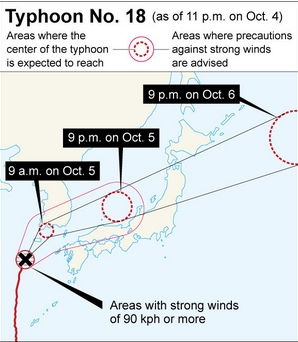
Typhoon No. 18, packing record-setting winds, was creeping northeast and is expected to hit the Hokuriku and Tohoku regions starting on the afternoon of Oct. 5.
Known as Typhoon Chaba outside Japan, the storm was 120 kilometers north of Tsushima island and moving at a speed of 45 kph as of noon. It could make landfall later in the day or early on Oct. 6.
Wide areas of western and eastern Japan are expected to see heavy rain through Oct. 5. Some areas could be drenched with more than 50 millimeters of rain per hour.
Expected rainfall in the 24 hours until the morning of Oct. 6 is 200 mm on Shikoku island and in the Kinki region, 180 mm in northern Kyushu, and 150 mm in southern Kyushu as well as the Tokai, Hokuriku and Kanto-Koshin regions.
The typhoon cut through waters west of the Okinawa island chain and headed north on Oct. 4.
In the early hours of that day, a maximum wind speed of 173.2 kph was recorded on Kumejima, an island west of the main Okinawa island.
It was the strongest wind recorded on the island since official typhoon observations began in 1951.
77.2 Billion Dollars in Public Funds Sought for Post-Fukushima Disaster Costs
They were telling us that nuclear energy was safe and cheap….

8 trillion yen in public funds sought for post-Fukushima disaster costs
The Federation of Electric Power Companies of Japan (FEPC) has informally asked the government to inject some 8 trillion yen in public funds into efforts for nuclear damage compensation and decontamination work in areas around the Fukushima No. 1 nuclear power plant, it has been learned.
The FEPC has drawn up a report stating that an extra 8 trillion yen is estimated to be necessary even after Tokyo Electric Power Co. (TEPCO) and other major utilities shoulder the planned amount of costs for dealing with the aftermath of the Fukushima disaster, and has informally requested that the government foot the surplus amount. The government has heretofore taken the position that nuclear plant operators should bear the costs for nuclear damage compensation and decontamination work in principle. It is therefore expected to approach the request with caution.
The costs for Fukushima disaster damage compensation and decontamination work are funded under the following steps: the state issues cashable government compensation bonds to the Nuclear Damage Compensation and Decommissioning Facilitation Corp. (NDF), a government-authorized corporation; TEPCO then receives necessary funds from the NDF and spends them on nuclear damage compensation and decontamination work; the NDF then receives due contributions from TEPCO and other major utilities and pays back the funds to the state.
Among the contributions made by power companies to the NDF, funds for nuclear damage compensation are shouldered by TEPCO and other major utilities, and the funds for decontamination work are covered by profits on the sale of TEPCO shares held by the NDF, while the funds for building interim storage facilities for radioactive waste are covered by revenues from the tax on the promotion of power resources development.
In 2013, the government estimated that nuclear damage compensation would cost 5.4 trillion yen, while decontamination work would require 2.5 trillion yen and construction costs for temporary storage facilities for radioactive waste and other expenses would need 1.1 trillion yen. The total amounts to be granted to the NDF were estimated at a maximum 9 trillion yen.
However, the FEPC now forecasts that damage compensation would cost 2.6 trillion yen more at 8 trillion yen and the decontamination expenses 4.5 trillion yen more at 7 trillion yen, according to sources familiar with the matter. Furthermore, the FEPC forecasts that profits on the sale of TEPCO shares would be 1 trillion yen less than the initial estimate due to a fall in the stock prices, bringing the total fund shortages to 8.1 trillion yen.
Major utilities fear that they would ultimately be forced to shoulder the additional burden as the enormous costs for decontamination work cannot be covered by profits on the sale of TEPCO shares.
The FEPC has unofficially asked that the government foot the extra amount of costs necessary for nuclear damage compensation and decontamination work on the grounds that the business environment for major utilities has deteriorated amid the stalled reactivation of nuclear reactors that have been left idle since the Fukushima disaster and the intensifying competition among power companies following the liberalization of the electricity retail market this past spring.
While TEPCO has forked out 2 trillion yen for the decommissioning of disaster-stricken reactors at the Fukushima No. 1 nuclear plant, several trillion yen extra is projected to be necessary to cover the expenses. In July, Tokyo Electric Power Company Holdings Inc. asked for government assistance in covering the expenses for reactor decommissioning at the plant and other efforts. The FEPC’s recent request to the government, meanwhile, does not include financial assistance for reactor decommissioning.
The government is poised to discuss the costs for Fukushima disaster damage compensation and reactor decommissioning at a panel on TEPCO reform and Fukushima No. 1 plant issues to be convened on Oct. 5, where the FEPC’s request is likely to be deliberated on.
http://mainichi.jp/english/articles/20161004/p2a/00m/0na/017000c
Eastern Japan Soil Becquerel Measurement Project Map

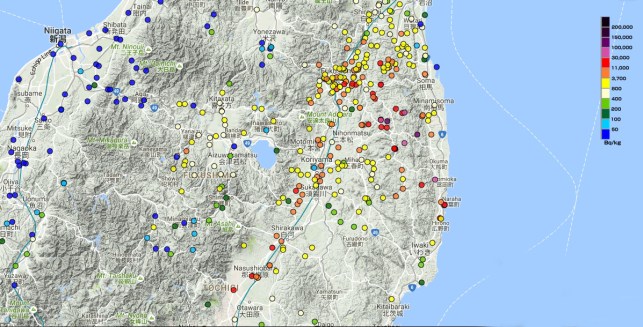


Iwaki City
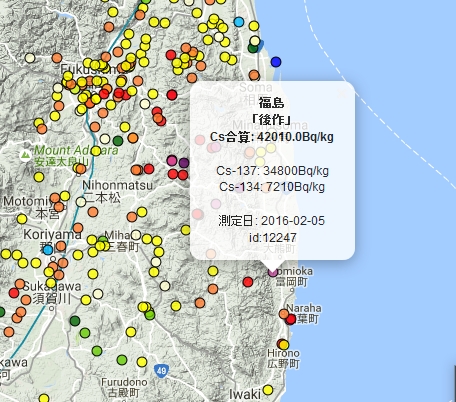
Tomioka
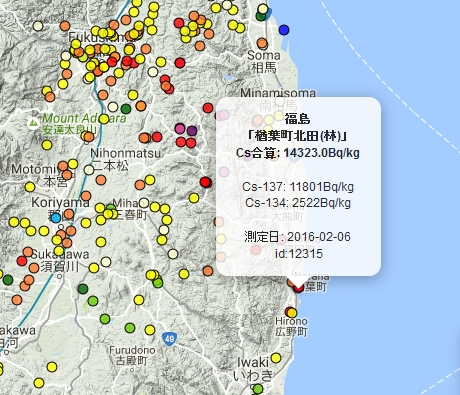
Naraha
Source Minna no Data website:
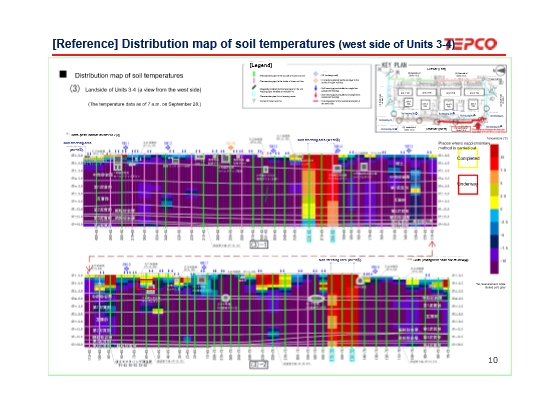
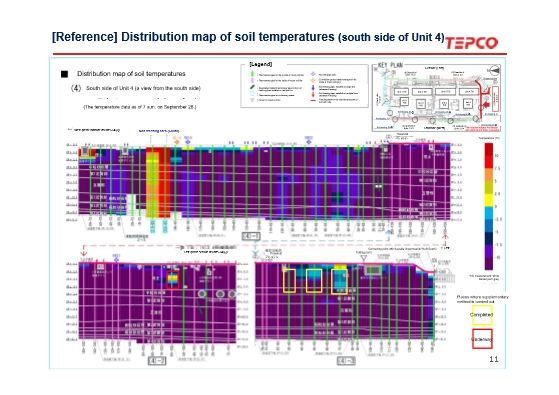
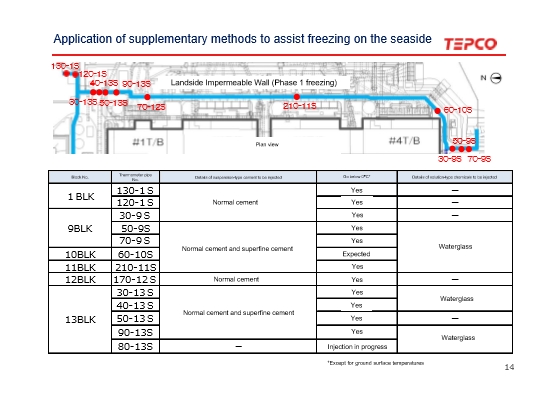
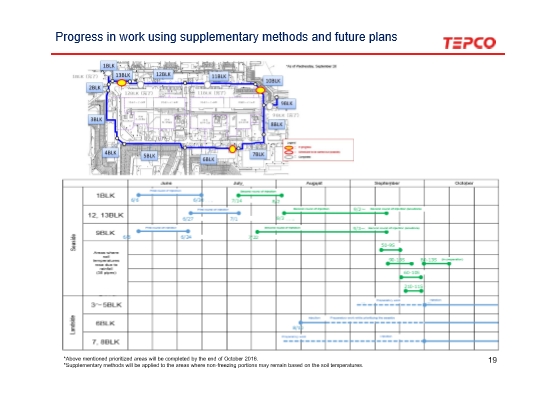
TEPCO Continues Injecting Concrete and a Soil Solidification Substance in Areas of the Frozen Wall
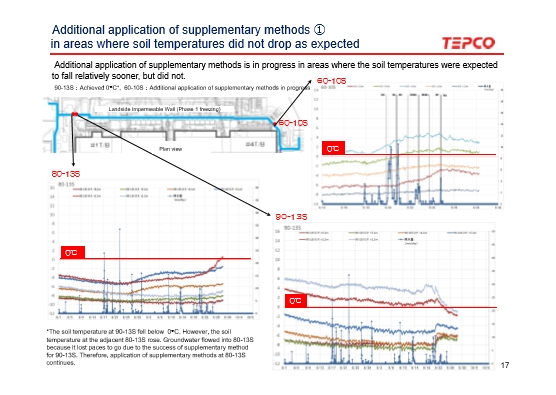
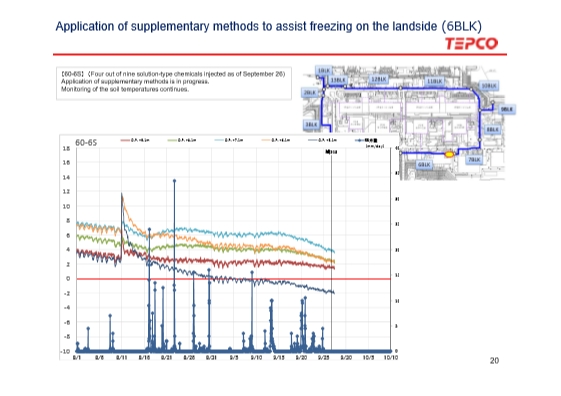
TEPCO also continues to inject concrete and a soil solidification substance in areas of the frozen wall that have been resistant to proper freezing.
Groundwater levels inside the reactor areas has been on the rise due to more success freezing the sea side section of the wall.
Therefore, application of supplementary methods at 80-13S continues.” Efforts to cement sections of the land side wall have begun and will take place through October.
They asked the NRA again within the last week for permission to freeze the remaining sections of the land side frozen wall sections.
TEPCO states that they have frozen 95 percent of the land side section of the wall.
TEPCO published a new report on the frozen wall dated September 29.
Another typhoon may hit Fukushima prefecture this week, if it does it may cause further problems with the frozen wall.
There was also a concerning note buried later in the report related to a section where they had used concrete to block the water flow.
So the concrete work just caused the water flow to divert to another part of the wall.
Progress of Landside Impermeable Wall freezing: Phase 2 of the first stage
○The purpose of the Landside Impermeable Wall construction lies not in freezing soil to form an underground wall but in keeping groundwater fromflowing into the reactor/turbine buildings and preventing new contaminated water from being generated.
○By closing less than 95 percent of the mountainside of the Landside Impermeable Wall inPhase2 of the first stage, it is expected that the amount of groundwater flowing into the areas around the reactor/turbine buildings will be reduced. This will help keep groundwater from being contaminated during the first stage.
○Throughout the first stage, how freezing of the Landside Impermeable Wall has progressed will be checked by monitoring thedifference in groundwater levels inside and outside of the wall and the amount of groundwater pumped up by the subdrain and groundwater drainsystems and the well point system.







Read more Pdf:
http://www.tepco.co.jp/en/nu/fukushima-np/handouts/2016/images/handouts_160728_02-e.pdf
Niigata governor candidates must debate nuclear safety in earnest
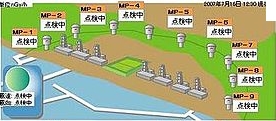
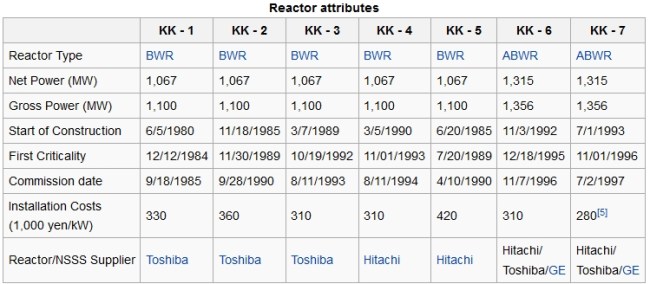
Kashiwazaki-Kariwa nuclear power plant is the largest nuclear plant in the world, owned by Tepco, Tepco will do anything to get it restarted.
Official campaigning for the upcoming Niigata gubernatorial election started on Sept. 29, setting the stage for debate on the safety of a nuclear power plant in the prefecture.
The issue of the safety of the Kashiwazaki-Kariwa nuclear power plant has gained even more traction as Niigata Governor Hirohiko Izumida, who has been cautious about approving Tokyo Electric Power Co.’s plan to restart the idled plant, has announced he will not seek re-election.
The Nuclear Regulation Authority’s safety inspections of the offline reactors, which the electric utility is seeking to bring back online, are in their final stages.
The election inevitably revolves around whether the new governor should allow TEPCO to proceed with the plan if the NRA gives the green light.
Four independent rookie candidates are running for the poll. But the race is effectively shaping up as a one-on-one battle between Tamio Mori, the former mayor of the city of Nagaoka in the prefecture supported by the ruling Liberal Democratic Party and its junior coalition partner, Komeito, and Ryuichi Yoneyama, a doctor backed by the Japanese Communist Party, the Social Democratic Party and the People’s Life Party & Taro Yamamoto and Friends.
Some 460,000 people live within 30 kilometers of the Kashiwazaki-Kariwa nuclear plant. The candidates should announce their proposals to protect the safety of these residents during campaigning for the Oct. 16 election.
Plans to ensure the safe and smooth evacuations of residents living around nuclear power plants when a serious accident occurs are described as the last safety net for nuclear power plants.
The governors of prefectures where nuclear plants are located, as the chiefs of the local governments, have to take on a huge responsibility for the safety of local residents.
Izumida has insisted that he wouldn’t start discussions on any plan to restart a reactor in his prefecture unless the 2011 disaster at the Fukushima No. 1 nuclear power plant, also operated by TEPCO, is fully reviewed and explained.
He has undertaken his own investigation of the catastrophic accident by setting up an expert committee within the prefectural government.
Izumida has also criticized the fact that the new nuclear safety standards introduced after the 2011 accident don’t require plans for evacuating local residents. He has been calling on the central government to improve the standards.
In 2002, it was revealed that TEPCO had covered up damage at its nuclear power plants including the Kashiwazaki-Kariwa plant. The magnitude-6.8 Niigata Chuetsu-oki offshore earthquake, which rocked Niigata Prefecture in July 2007, triggered a fire and resulted in small leaks of radiation at the plant.
Many people in the prefecture along the Sea of Japan remain deeply concerned about the safety of the nuclear plant and distrustful of TEPCO.
Izumida has responded to the concerns by raising issues about nuclear safety.
In the gubernatorial race, Yoneyama has cast himself as the candidate to carry on Izumida’s legacy.
“I will take over the (nuclear power) policy of Izumida and won’t start discussions on any reactor restart unless the Fukushima disaster is fully reviewed and explained,” he has said.
Mori, who has been critical of Izumida’s political approach, has taken a different stance toward the issue.
“I will put the top priority on the safety of people in the prefecture and rigorously examine the conclusion the NRA reaches (in its safety inspection),” he has said.
The difference in position on the issue between the two candidates is likely to be a key factor for Niigata voters at the polls.
The governors of prefectures hosting nuclear power plants have the “right to consent” to a plan to restart a reactor. But this is only a conventional right based on safety agreements with the electric utilities involved and has no legal basis.
When new Kagoshima Governor Satoshi Mitazono, who took office in July, asked Kyushu Electric Power Co. to suspend the operation of its Sendai nuclear power plant in the prefecture, he was criticized for undermining the central government’s energy policy.
But the criticism is off the mark. When a nuclear accident occurs, the local communities around the plant suffer the most.
To allay anxiety among residents in areas around nuclear plants, the local governments concerned, through negotiations with the operators of the plants, have established systems and rights that allow them to become involved in safety efforts.
The Fukushima disaster has only increased anxiety among residents around nuclear power plants.
The chief of the local government in an area home to a nuclear plant has every right to refuse to entrust the safety of local residents entirely to the utility and the central government.
Niigata Prefecture is not an area where TEPCO supplies power, but it has been bearing the risks involved in the operation of a massive nuclear power plant that generates electricity for the Tokyo metropolitan area.
The gubernatorial election will be a choice that directly affects the central government’s energy policy.
We are eager to see the candidates engaged in meaningful debate on the safety of the nuclear plant based on a national perspective.
http://www.asahi.com/ajw/articles/AJ201610030020.html
Increases in perinatal mortality in prefectures contaminated by the Fukushima nuclear power plant accident in Japan: A spatially stratified longitudinal study.
“Radiation damage spreading to Fukushima and other Tohoku Prefectures, and Kanto Prefectures Tokyo, Saitama, Chiba, is demonstrated. Perinatal mortality is increasing, it has been announced for the first time in peer-reviewed medical journals the Fukushima/Perinatal mortality link.”
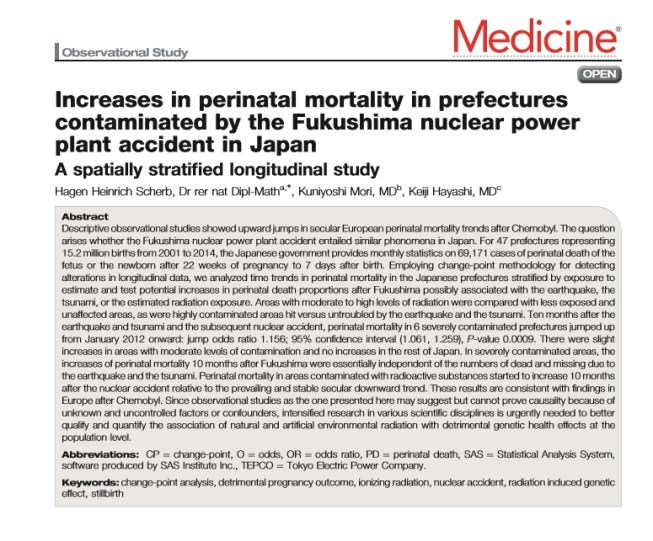

Abstract
Descriptive observational studies showed upward jumps in secular European perinatal mortality trends after Chernobyl.
The question arises whether the Fukushima nuclear power plant accident entailed similar phenomena in Japan.
For 47 prefectures representing 15.2 million births from 2001 to 2014, the Japanese government provides monthly statistics on 69,171 cases of perinatal death of the fetus or the newborn after 22 weeks of pregnancy to 7 days after birth.
Employing change-point methodology for detecting alterations in longitudinal data, we analyzed time trends in perinatal mortality in the Japanese prefectures stratified by exposure to estimate and test potential increases in perinatal death proportions after Fukushima possibly associated with the earthquake, the tsunami, or the estimated radiation exposure.
Areas with moderate to high levels of radiation were compared with less exposed and unaffected areas, as were highly contaminated areas hit versus untroubled by the earthquake and the tsunami.
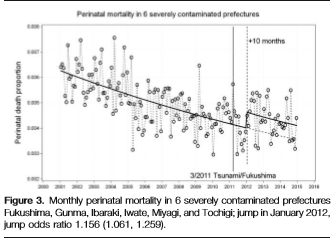
Ten months after the earthquake and tsunami and the subsequent nuclear accident, perinatal mortality in 6 severely contaminated prefectures jumped up from January 2012 onward: jump odds ratio 1.156; 95% confidence interval (1.061, 1.259), P-value 0.0009.
There were slight increases in areas with moderate levels of contamination and no increases in the rest of Japan.
In severely contaminated areas, the increases of perinatal mortality 10 months after Fukushima were essentially independent of the numbers of dead and missing due to the earthquake and the tsunami.
Perinatal mortality in areas contaminated with radioactive substances started to increase 10 months after the nuclear accident relative to the prevailing and stable secular downward trend.
These results are consistent with findings in Europe after Chernobyl. Since observational studies as the one presented here may suggest but cannot prove causality because of unknown and uncontrolled factors or confounders, intensified research in various scientific disciplines is urgently needed to better qualify and quantify the association of natural and artificial environmental radiation with detrimental genetic health effects at the population level.


https://www.ncbi.nlm.nih.gov/pubmed/27661055
http://ebm-jp.com/2016/10/media2016002/
Read more on the PDF:
http://ebm-jp.com/wp-content/uploads/media-2016002-medicine.pdf
Japan inaugurates new body for nuclear fuel reprocessing
The organization will manage Japan’s 49 tons of plutonium and 17 million kg from 56,000 used fuel assemblies for the next 241,000 years
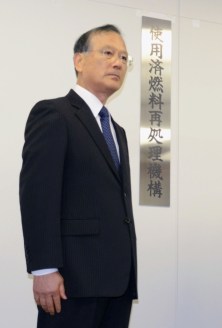
The industry ministry said Monday a new body for supervising nuclear fuel reprocessing has been established as the Japanese government seeks to retain a recycling policy, obliging 10 nuclear plant operators nationwide to fund the body for an uninterrupted reprocessing program.
The Nuclear Reprocessing Organization of Japan opened its head office in Aomori City in northeastern Japan. It mandates nuclear power utilities to shoulder the cost of reprocessing spent fuel in the form of financial contributions to itself.
Until now, power companies voluntarily set aside reserves to be used for reprocessing programs.
The new entity draws reprocessing operational plans and consigns them to Japan Nuclear Fuel Ltd., whose main shareholders are power companies, according to the Ministry of Economy, Trade and Industry.
The body plans to set up a representative office in Rokkasho, Aomori Prefecture, where Japan Nuclear Fuel has facilities for reprocessing.
In May, a law to strengthen state involvement in nuclear fuel reprocessing cleared Japan’s parliament, paving the way for securing funds to continue recycling nuclear fuel.
The ministry granted authorization for the establishment of the new body on Sep. 20 under the Spent Nuclear Fuel Reprocessing Fund Act.
Tainted Water Grows at Fukushima N-Plant despite Ice Wall

Tokyo, Oct. 2 (Jiji Pres)–Six months into operation, the much-hyped underground ice wall has not yet produced the intended effects of curbing the growth of radioactive water at Tokyo Electric Power Company Holdings Inc.’s stricken Fukushima No. 1 nuclear plant.
TEPCO initially claimed that the ice wall would prove effective in about a month and half, but the amount of contaminated water at the plant has continued to increase at a pace faster than projected by the utility.
The plant in northeastern Japan faces a chronic shortage of welded-type water storage tanks, while an increasing volume of tainted water has been transferred to the reactor and turbine buildings as a makeshift measure despite a high risk of leaks.
TEPCO constructed the 1.5-kilometer-long ice wall encircling the plant’s damaged No. 1 to No. 4 reactors in an attempt to block groundwater from flowing into reactor buildings and mixing with radioactive water accumulating inside.
The government has to date spent a total of 34.5 billion yen in the construction of the structure by freezing underground soil, which is believed to be technically very difficult.
1 This Month

22 June – Virtual Event –Climate Change: New Data, New Debate

Monday, June 22, 2026 2:30 p.m. – 3:15 p.m. CT
YouTube. Register here

Protect Sazan Island from the Trump family! https://secure.avaaz.org/campaign/en/protect_sazan_island_from_the_trump_family_loc/?bqFCVab&v=174511&cl=22707147157&_checksum=5e9dde668860e8231c33699735e16a1fbf22ab2cb01da50c999fe8732b9775ef&utm_source=email&utm_medium=blast_email&utm_campaign=174511
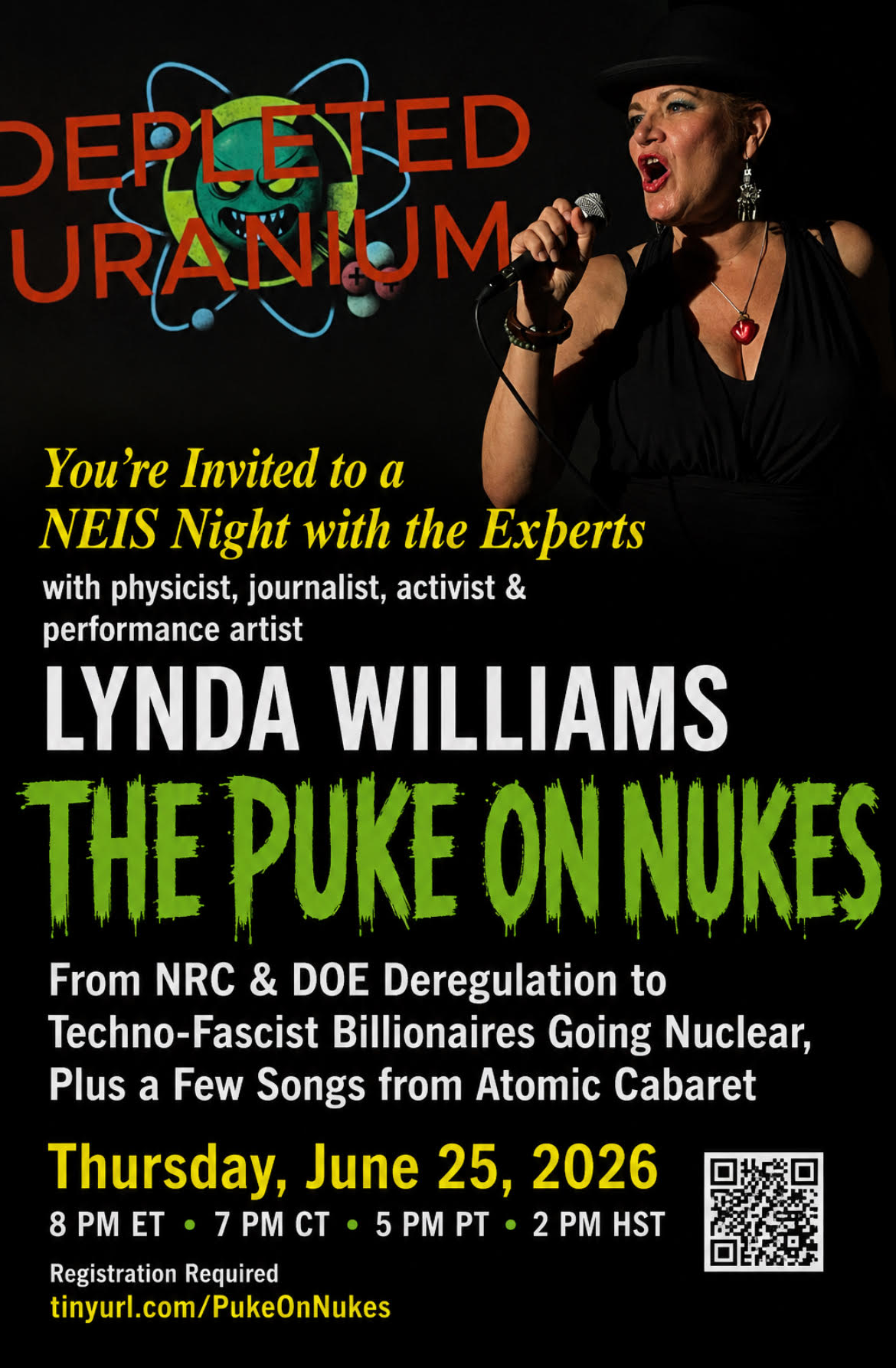
25 June- THE PUKE ON NUKES
Thursday, June 25, 2026
7pm Central Time (8pm ET, 6pm MT, 5pm PT) UTC – 5
From NRC & DOE Deregulation to Techno-Fascist Billionaires Going Nuclear, Plus a Few Songs from Atomic Cabaret REGISTER
26 June – Radiation Trainwreck at the NRC / Join the Protect Better Campaign – https://us02web.zoom.us/meeting/register/4ZlZ5_qLSHGiLSCg8FF6Bg#/registration


Cuba Is Not a Failed State – It Is a Besieged State
PETITION: “Global Appeal to Endorse Palestinian Right of Return of Refugees”
To see nuclear-related stories in greater depth and intensity – go to https://nuclearinformation.wordpress.com
-
Archives
- June 2026 (201)
- May 2026 (306)
- April 2026 (356)
- March 2026 (251)
- February 2026 (268)
- January 2026 (308)
- December 2025 (358)
- November 2025 (359)
- October 2025 (376)
- September 2025 (257)
- August 2025 (319)
- July 2025 (230)
-
Categories
- 1
- 1 NUCLEAR ISSUES
- business and costs
- climate change
- culture and arts
- ENERGY
- environment
- health
- history
- indigenous issues
- Legal
- marketing of nuclear
- media
- opposition to nuclear
- PERSONAL STORIES
- politics
- politics international
- Religion and ethics
- safety
- secrets,lies and civil liberties
- spinbuster
- technology
- Uranium
- wastes
- weapons and war
- Women
- 2 WORLD
- ACTION
- AFRICA
- Atrocities
- AUSTRALIA
- Christina's notes
- Christina's themes
- culture and arts
- Events
- Fuk 2022
- Fuk 2023
- Fukushima 2017
- Fukushima 2018
- fukushima 2019
- Fukushima 2020
- Fukushima 2021
- general
- global warming
- Humour (God we need it)
- Nuclear
- RARE EARTHS
- Reference
- resources – print
- Resources -audiovicual
- Weekly Newsletter
- World
- World Nuclear
- YouTube
-
RSS
Entries RSS
Comments RSS
 nuclear-news