
 Local consent needed despite OK to restart Oi nuclear plant, Asahi Shimbun February 23, 2017 The Nuclear Regulation Authority on Feb. 22 published a draft safety inspection report saying measures taken at the Nos. 3 and 4 reactors of Kansai Electric Power Co.’s Oi nuclear power plant in Fukui Prefecture meet the new stricter anti-disaster standards.
In 2014, however, the Fukui District Court ordered the operator to keep the two reactors offline, raising serious questions about their safety.
Some 160,000 people in Fukui, Kyoto and Shiga prefectures reside within 30 kilometers from the plant. It is also questionable whether local residents can be evacuated quickly and smoothly if a serious accident occurs at the plant.
In a recent Asahi Shimbun survey, 57 percent of the respondents expressed their opposition to the restart of offline nuclear reactors, nearly double the number of those who supported the idea.
Come next month, six years will have passed since the catastrophic accident broke out at the Fukushima No. 1 nuclear power plant. Many Japanese remain unconvinced of the safety of nuclear reactors.
Kansai Electric Power is hoping to bring the two reactors back on line as early as this summer. But we find it difficult to support the plan.
There are multiple faults around the Oi plant. The biggest worry cited in the district court ruling was the possibility that a stronger earthquake than assumed could seriously damage the reactors or the spent fuel pool.
The electric utility has since appealed the ruling. But the company has also raised the estimated maximum ground acceleration that could occur in an earthquake at the location.
The utility will spend 122 billion yen ($1.07 billion) on measures to enhance the safety of the plant.
But Kunihiko Shimazaki, a seismologist and former acting chairman of the NRA, has warned against the plan. Using observation data about the powerful earthquakes that hit areas around Kumamoto Prefecture in April last year, he has argued that the utility’s calculation method may have underestimated the biggest potential shaking of a quake at the location.
After reviewing the data, the NRA dismissed Shimazaki’s argument, with Chairman Shunichi Tanaka calling it “groundless.”
But the scientist’s warning has deepened anxiety among local residents.
The spent fuel pools at Kansai Electric Power’s three nuclear power plants including Oi are almost filled to the brim.
The utility says it will build an interim storage facility outside Fukui Prefecture around 2030 so that used fuel rods can be removed from the pools.
But the company has yet to map out a specific and workable plan to build such a facility…….http://www.asahi.com/ajw/articles/AJ201702230032.html
February 24, 2017
Posted by Christina Macpherson |
Japan, politics |
Leave a comment

NIIGATA, Japan (Kyodo) — Smoke emerged at a service building of the Kashiwazaki-Kariwa nuclear power plant in Niigata Prefecture on Thursday but it quickly halted after a firefighting effort by workers, its operator said.
Tokyo Electric Power Company Holdings Inc. said there was no radiation leak in the incident. The utility has not identified the cause of the incident.
The plant operator confirmed smoke coming out around 3:25 p.m. from a locker room inside the service building, located near the No. 6 and No. 7 reactors at the plant. The building is not a radiation controlled area, according to the company.
The two reactors on the Sea of Japan coast are being screened by the Nuclear Regulation Authority as TEPCO is seeking to resume their operation after they were halted following the 2011 nuclear meltdowns at the Fukushima Daiichi power plant, also operated by TEPCO.
http://mainichi.jp/english/articles/20170223/p2g/00m/0dm/083000c
February 24, 2017
Posted by dunrenard |
Japan | Kashiwazaki-Kariwa NPP |
1 Comment

The governor of Kagoshima in western Japan is expected to approve the continued operation of a nuclear plant in the prefecture. Experts have found no irregularities at the facility following last year’s strong earthquakes.
Governor Satoshi Mitazono had called for the operation of the Sendai nuclear plant to be suspended after a series of earthquakes centered in nearby Kumamoto Prefecture.
He noted public concern and also asked for an inspection of the plant.
Kyushu Electric Power Company officials rejected his call to halt operations, but they carried out a special inspection. They say they found the quakes caused no abnormalities.
Last Thursday, an expert panel set up by the prefecture also reported that the quakes left no effects on the plant.
Mitazono said on Wednesday that there is currently no need for strong measures against the plant. He said he will remain vigilant if troubles arise.
There were mixed reactions to Mitazono’s decision.
A man in his 70s says the governor may have found that he cannot prevail over the central government in his anti-nuclear battle. He says there was no other choice but to continue operating the plant.
A woman in her 30s says she wanted the governor to stick to the anti-nuclear policy he pledged in the campaign.
She says she wants him to ensure that Kagoshima is a place where children will be able to live safely, now and in the future.
https://www3.nhk.or.jp/nhkworld/en/news/20170222_33/
February 24, 2017
Posted by dunrenard |
Japan | Kagoshima Governor, Sendai NPP |
Leave a comment
Japan is located in the seismically active zone and that is where more than 10% of all earthquakes in the world. The ideal place to build many nuclear plants if you have a death wish!!!

16 locations in Kanto, Chugoku, Kyushu added to list of ‘major active faults’
The government’s Headquarters for Earthquake Research Promotion held a task-force meeting on Feb. 21 and decided to add 16 locations in the Kanto, Chugoku, and Kyushu regions to the list of “major active faults” that could cause heavy damage.
The decision is expected to help with regional disaster prevention efforts as the newly listed active faults will be subject to priority research to be conducted by the government and other relevant entities. The latest addition has brought the total number of locations listed as “major active faults” across the country to 113.
Detailed research had been conducted in the three regions ahead of other areas since 2013 to check the possibility of earthquakes occurring in each of the three regions. The number of major active faults could increase further as the headquarters is also planning to conduct similar research in other regions.
The newly added major active faults include: the Minobu fault straddling Yamanashi and Shizuoka prefectures; the Okubo fault in Gunma and Tochigi prefectures; the Shikano-Yoshioka fault in Tottori Prefecture; the Saga plain northern fault zone; and the Midorikawa fault zone in Kumamoto Prefecture. The Shinji fault, that stretches from east to west about 2 kilometers south of Chugoku Electric Power Co.’s Shimane Nuclear Power Plant in Matsue, was also added to the list.
Since the 1995 Great Hanshin Earthquake, the headquarters had designated active faults with high seismicity stretching at least 20 kilometers that could cause earthquakes with a magnitude of 7 or higher as major active faults.
However, in response to a series of major tremors such as the 2004 Chuetsu earthquakes caused by faults that had not been listed as major active faults, the headquarters has conducted survey research on active faults including non-listed faults. As a result, even some of those faults that were considered to fall short of meeting the criteria for being called major active faults have been added to the list.
Kojin Wada, an official of the Earthquake and Disaster-Reduction Research Division at the Education, Culture, Sports, Science and Technology Ministry, said, “We expect that the general public’s awareness of regional active faults is going to rise (with the latest addition to the list).”
http://mainichi.jp/english/articles/20170222/p2a/00m/0na/005000c
February 24, 2017
Posted by dunrenard |
Japan | Active Faults, Earthquakes, nuclear, Tectonic Plates |
Leave a comment

 HELEN CALDICOTT: The Fukushima nuclear meltdown continues unabated https://independentaustralia.net/politics/politics-display/helen-caldicott-the-fukushima-nuclear-meltdown-continues-unabated,10019 3 February 2017, Dr Helen Caldicott, explains recent robot photos taken of Fukushima’s Daiichi nuclear reactors: radiation levels have not peaked, but have continued to spill toxic waste into the Pacific Ocean — but it’s only now the damage has been photographed.
RECENT reporting of a huge radiation measurement at Unit 2 in the Fukushima Daichi reactor complex does not signify that there is a peak in radiation in the reactor building.
All that it indicates is that, for the first time, the Japanese have been able to measure the intense radiation given off by the molten fuel, as each previous attempt has led to failure because the radiation is so intense the robotic parts were functionally destroyed.
The radiation measurement was 530 sieverts, or 53,000 rems (Roentgen Equivalent for Man). The dose at which half an exposed population would die is 250 to 500 rems, so this is a massive measurement. It is quite likely had the robot been able to penetrate deeper into the inner cavern containing the molten corium, the measurement would have been much greater.
These facts illustrate why it will be almost impossible to “decommission” units 1, 2 and 3 as no human could ever be exposed to such extreme radiation. This fact means that Fukushima Daichi will remain a diabolical blot upon Japan and the world for the rest of time, sitting as it does on active earthquake zones.
What the photos taken by the robot did reveal was that some of the structural supports of Unit 2 have been damaged. It is also true that all four buildings were structurally damaged by the original earthquake some five years ago and by the subsequent hydrogen explosions so, should there be an earthquake greater than seven on the Richter scale, it is very possible that one or more of these structures could collapse, leading to a massive release of radiation as the building fell on the molten core beneath. But units 1, 2 and 3 also contain cooling pools with very radioactive fuel rods — numbering 392 in Unit 1, 615 in Unit 2, and 566 in Unit 3; if an earthquake were to breach a pool, the gamma rays would be so intense that the site would have to be permanently evacuated. The fuel from Unit 4 and its cooling pool has been removed.
But there is more to fear.
The reactor complex was built adjacent to a mountain range and millions of gallons of water emanate from the mountains daily beneath the reactor complex, causing some of the earth below the reactor buildings to partially liquefy. As the water flows beneath the damaged reactors, it immerses the three molten cores and becomes extremely radioactive as it continues its journey into the adjacent Pacific Ocean.
Every day since the accident began, 300 to 400 tons of water has poured into the Pacific where numerous isotopes – including cesium 137, 134, strontium 90, tritium, plutonium, americium and up to 100 more – enter the ocean and bio-concentrate by orders of magnitude at each step of the food chain — algae, crustaceans, little fish, big fish then us.
Fish swim thousands of miles and tuna, salmon and other species found on the American west coast now contain some of these radioactive elements, which are tasteless, odourless and invisible. Entering the human body by ingestion they concentrate in various organs, irradiating adjacent cells for many years. The cancer cycle is initiated by a single mutation in a single regulatory gene in a single cell and the incubation time for cancer is any time from 2 to 90 years. And no cancer defines its origin.
We could be catching radioactive fish in Australia or the fish that are imported could contain radioactive isotopes, but unless they are consistently tested we will never know.
As well as the mountain water reaching the Pacific Ocean, since the accident, TEPCO has daily pumped over 300 tons of sea water into the damaged reactors to keep them cool. It becomes intensely radioactive and is pumped out again and stored in over 1,200 huge storage tanks scattered over the Daichi site. These tanks could not withstand a large earthquake and could rupture releasing their contents into the ocean.
But even if that does not happen, TEPCO is rapidly running out of storage space and is trying to convince the local fishermen that it would be okay to empty the tanks into the sea. The Bremsstrahlung radiation like x-rays given off by these tanks is quite high – measuring 10 milirems – presenting a danger to the workers. There are over 4,000 workers on site each day, many recruited by the Yakuza (the Japanese Mafia) and include men who are homeless, drug addicts and those who are mentally unstable.
There’s another problem. Because the molten cores are continuously generating hydrogen, which is explosive, TEPCO has been pumping nitrogen into the reactors to dilute the hydrogen dangers.
Vast areas of Japan are now contaminated, including some areas of Tokyo, which are so radioactive that roadside soil measuring 7,000 becquerels (bc) per kilo would qualify to be buried in a radioactive waste facility in the U.S..
As previously explained, these radioactive elements concentrate in the food chain. The Fukushima Prefecture has always been a food bowl for Japan and, although much of the rice, vegetables and fruit now grown here is radioactive, there is a big push to sell this food both in the Japanese market and overseas. Taiwan has banned the sale of Japanese food, but Australia and the U.S. have not.
Prime Minister Abe recently passed a law that any reporter who told the truth about the situation could be gaoled for ten years. In addition, doctors who tell their patients their disease could be radiation related will not be paid, so there is an immense cover-up in Japan as well as the global media.
The Prefectural Oversite Committee for Fukushima Health is only looking at thyroid cancer among the population and by June 2016, 172 people who were under the age of 18 at the time of the accident have developed, or have suspected, thyroid cancer; the normal incidence in this population is 1 to 2 per million.
However, other cancers and leukemia that are caused by radiation are not being routinely documented, nor are congenital malformations, which were, and are, still rife among the exposed Chernobyl population.
Bottom line, these reactors will never be cleaned up nor decommissioned because such a task is not humanly possible. Hence, they will continue to pour water into the Pacific for the rest of time and threaten Japan and the northern hemisphere with massive releases of radiation should there be another large earthquake.
February 22, 2017
Posted by Christina Macpherson |
Fukushima continuing, Reference |
Leave a comment
Fukushima: a Lurking Global Catastrophe? http://nation.com.pk/international/21-Feb-2017/fukushima-a-lurking-global-catastrophe Robert Hunziker – Year over year, ever since 2011, the Fukushima Daiichi nuclear meltdown grows worse and worse, an ugly testimonial to the inherent danger of generating electricity via nuclear fission, which produces isotopes, some of the most deadly poisonous elements on the face of the planet.
Fukushima Diiachi has been, and remains, one of the world’s largest experiments, i.e., what to do when all hell breaks loose aka The China Syndrome. “Scientists still don’t have all the information they need for a cleanup that the government estimates will take four decades and cost ¥8 trillion. It is not yet known if the fuel melted into or through the containment vessel’s concrete floor, and determining the fuel’s radioactivity and location is crucial to inventing the technology to remove the melted fuel,” (Emi Urabe, Fukushima Fuel-Removal Quest Leaves Trail of Dead Robots, The Japan Times, Feb. 17, 2017).
As it happens, “”inventing technology” is experimental stage stuff. Still, there are several knowledgeable sources that believe the corium, or melted core, will never be recovered. Then what?
According to a recent article, “Potential Global Catastrophe of the Reactor No. 2 at Fukushima Daiichi,” d/d Feb. 11, 2017 by Dr. Shuzo Takemoto, professor, Department of Geophysics, Graduate School of Science, Kyoto University: The Fukushima nuclear facility is a global threat on level of a major catastrophe.
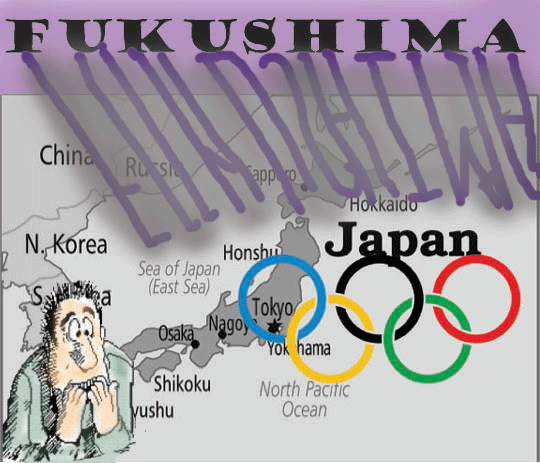
Meanwhile, the Abe administration dresses up Fukushima Prefecture for the Tokyo 2020 Olympics, necessitating a big fat question: Who in their right mind would hold Olympics in the neighborhood of three out-of-control nuclear meltdowns that could get worse, worse, and still worse? After all, that’s the pattern over the past 5 years; it gets worse and worse. Dismally, nobody can possibly know how much worse by 2020. Not knowing is the main concern about holding Olympics in the backyard of a nuclear disaster zone, especially as nobody knows what’s happening. Nevertheless and resolutely, according to PM Abe and the IOC, the games go on.
Along the way, it’s taken Tokyo Electric Power Company (TEPCO) nearly six years to finally get an official reading of radiation levels of the meltdown but in only one unit. Analysis of Unit #2 shows radiation levels off-the-charts at 530 Sieverts, or enough to kill within minutes, illustrative of why it is likely impossible to decommission units 1, 2, and 3. No human can withstand that exposure and given enough time, frizzled robots are as dead as a doornail.
“A short-term, whole-body dose of over 10 sieverts would cause immediate illness and subsequent death within a few weeks, according to the World Nuclear Association” (Emi Urabe, Fukushima Fuel-Removal Quest Leaves Trail of Dead Robots, The Japan Times, Feb. 17, 2017).
Although Fukushima’s similar to Chernobyl Exclusion Zone in some respects, where 1,000 square miles has been permanently sealed off, Fukushima’s different, as the Abe administration is already repopulating portions of Fukushima. If they don’t repopulate, how can the Olympics be held with food served from Fukushima and including events like baseball held in Fukushima Prefecture?
Without question, an old saw – what goes around comes around – rings true when it comes to radiation, and it should admonish (but it doesn’t phase ‘em) strident nuclear proponents, claiming Fukushima is an example of how safe nuclear power is “because there are so few, if any, deaths” (not true). As Chernobyl clearly demonstrates: Over time, radiation cumulates in bodily organs. For a real life example of how radiation devastates human bodies, consider this fact: 453,391 children with bodies ravaged, none born at the time of the Chernobyl meltdown in 1986, today receive special healthcare because of Chernobyl radiation-related medical problems like cancer, digestive, respiratory, musculoskeletal, eye disease, blood disease, congenital malformation, and genetic abnormalities. Their parents were children in the Chernobyl zone in 1986 (Source: Chernobyl’s Legacy: Kids With Bodies Ravaged by Disaster, USA Today, April 17, 2016).
Making matters worse yet, Fukushima Diiachi sets smack dab in the middle of earthquake country, which defines the boundaries of Japan. In that regard, according to Dr. Shuzo Takemoto, professor, Department of Geophysics, Graduate School of Science, Kyoto University: “The problem of Unit 2… If it should encounter a big earth tremor, it will be destroyed and scatter the remaining nuclear fuel and its debris, making the Tokyo metropolitan area uninhabitable. The Tokyo Olympics in 2020 will then be utterly out of the question,” (Shuzo Takemoto, Potential Global Catastrophe of the Reactor No. 2 at Fukushima Daiichi, February 11, 2017).
Accordingly, the greater Tokyo metropolitan area remains threatened for as long as Fukushima Diiachi is out of control, which could be for generations, not years. Not only that, Gee-Whiz, what if the big one hits during the Olympics? After all, earthquakes come unannounced. Regrettably, Japan has had 564 earthquakes the past 365 days. It’s an earthquake-ridden country. Japan sits at the boundary of 4 tectonic plates shot through with faults in zigzag patterns, very lively and of even more concern, the Nankai Trough, the candidate for the big one, sits nearly directly below Tokyo. On a geological time scale, it may be due for action anytime within the next couple of decades. Fukushima Prefecture’s not that far away.
Furthermore, the Fukushima Diiachi nuclear complex is tenuous, at best: “All four buildings were structurally damaged by the original earthquake some five years ago and by the subsequent hydrogen explosions so should there be an earthquake greater than seven on the Richter scale, it is very possible that one or more of these structures could collapse, leading to a massive release of radiation as the building falls on the molten core beneath.” (Helen Caldicott: The Fukushima Nuclear Meltdown Continues Unabated, Independent Australia, February 13, 2017).
Complicating matters further, the nuclear site is located at the base of a mountain range. Almost daily, water flows from the mountain range beneath the nuclear plant, liquefying the ground, a sure-fire setup for cascading buildings when the next big one hits. For over five years now, radioactive water flowing out of the power plant into the Pacific carries isotopes like cesium 134 and cesium 137, strontium 90, tritium, plutonium americium and up to 100 more isotopes, none of which are healthy for marine or human life, quite the opposite in fact as those isotopes slowly cumulate, and similar to the Daleks of Doctor Who fame (BBC science fiction series, 1963-present) “Exterminate! Exterminate! Exterminate!”
Isotopes bio-concentrate up the food chain from algae to crustaceans to small fish to big fish to bigger humans. Resultant cancer cells incubate anytime from two years to old age, leading to death. That’s what cancer does; it kills.
Still, the fact remains nobody really knows for sure how directly Fukushima Diiachi radiation affects marine life, but how could it be anything other than bad? After all, it’s a recognized fact that radiation cumulates over time; it’s tasteless, colorless, and odorless as it cumulates in the body, whether in fish or further up the food chain in humans. It travels!
An example is Cesium 137 one of the most poisonous elements on the planet. One gram of Cesium 137 the size of a dime will poison one square mile of land for hundreds of years. That’s what’s at stake at the world’s most rickety nuclear plant, and nobody can do anything about it. In fact, nobody knows what to do. They really don’t.
When faced with the prospect of not knowing what to do, why not bring on the Olympics? That’s pretty good cover for a messy situation, making it appear to hundreds of thousands of attendees, as well as the world community “all is well.” But, is it? Honestly….
The Fukushima nuclear meltdown presents a special problem for the world community. Who knows what to believe after PM Abe lied to the IOC to get the Olympics; see the following headline from Reuters News: “Abe’s Fukushima ‘Under Control’ Pledge to Secure Olympics Was a Lie: Former PM,” Reuters, Sept. 7, 2016.– COUNTERPUNCH
“Abe gave the assurances about safety at the Fukushima plant in his September 2013 speech to the International Olympic Committee to allay concerns about awarding the Games to Tokyo. The comment met with considerable criticism at the time… Mr. Abe’s ‘under control remark, that was a lie,’ Koizumi (former PM) now 74 and his unruly mane of hair turned white, told a news conference where he repeated his opposition to nuclear power,” Ibid.
As such, a very big conundrum precedes the 2020 games: How can the world community, as well as Olympians, believe anything the Abe administration says about the safety and integrity of Fukushima?
Still, the world embraces nuclear power more so than ever before as it continues to expand and grow. Sixty reactors are currently under construction in fifteen countries. In all, 160 power reactors are in the planning stage and 300 more have been proposed. Pro-Nuke-Heads claim Fukushima proves how safe nuclear power is because there are so few, if any, deaths, as to be inconsequential. That’s a boldfaced lie.
Here’s one of several independent testimonials on deaths because of Fukushima Diiachi radiation exposure (many, many, many more testimonials are highlighted in prior articles, including USS Ronald Reagan sailors on humanitarian rescue missions at the time): “It’s a real shame that the authorities hide the truth from the whole world, from the UN. We need to admit that actually many people are dying. We are not allowed to say that, but TEPCO employees also are dying. But they keep mum about it,” Katsutaka Idogawa, former mayor of Futaba (Fukushima Prefecture), Fukushima Disaster: Tokyo Hides Truth as Children Die, Become Ill from Radiation – Ex-Mayor, RT News, April 21, 2014.
February 22, 2017
Posted by Christina Macpherson |
Fukushima continuing |
Leave a comment
 Greenpeace exposes high radiation risks in Fukushima village as govt prepares to lift evacuation order http://www.newkerala.com/news/fullnews-228867.html Tokyo/ New Delhi, Feb 21 : The Japanese government will soon lift evacuation orders for 6,000 citizens of Iitate village in Fukushima prefecture where radiation levels in nearby forests are comparable to the current levels within the Chernobyl 30km exclusion zone – an area that more than 30 years after the accident remains formally closed to habitation.
Seventy-five percent of Iitate is contaminated forested mountains, a Greenpeace statement claimed..
A survey team led by Greenpeace Japan recently found radiation dose rates at houses in the village of Iitate well above long-term government targets, with annual and lifetime exposure levels posing a long-term risk to citizens who may return. Evacuation orders will be lifted for Iitate no later than March 31, 2017, to be followed one year later by the termination of compensation payments.
The relatively high radiation values, both inside and outside houses, show an unacceptable radiation risk for citizens if they were to return to Iitate. Citizens returning to their irradiated homes are at risk of receiving radiation equivalent to one chest X-ray every week. This is not normal or acceptable, said Ai Kashiwagi, energy campaigner with Greenpeace Japan .
As Japan nears the six year anniversary of the nuclear disaster, the Japanese government last week confirmed that it has not yet conducted any assessments of lifetime exposure risks for citizens if they were to return to Iitate.
Recent reports suggest that the cost of cleaning up of Fukushima plant would cost more than 12lakh crores. If a developed country like Japan, known for its processes and systems, is finding it too difficult to handle the disaster, it makes little sense for India to go ahead and sign up for four more reactors at Kudankulam and elsewhere. In the words of George Santania Those who cannot remember the past are condemned to repeat it, says G. Sundarrajan of Poovulagin Nanbargal.
Life can never go back to normal for people living near nuclear power plants. But clearly, the world has failed to learn its lessons from nuclear accidents like those in Chernobyl and Fukushima. India, for instance, seems determined to add on to its nuclear power capacity despite putting the lives of millions of people at risk, says Nandikesh Sivalingam, climate and energy campaigner, Greenpeace India.
The fact remains that nuclear power is neither safe nor economical, and that India is grossly ill-prepared to handle a nuclear disaster. This was pointed out by Red Alert, a Greenpeace India report that released last year.
Last years Indo-Japan nuclear deal also negated the lessons learnt from Fukushima.
The deal to buy six AP1000 reactors was more of a last ditch effort to save Westinghouse/Toshiba from imminent meltdown. Now, after the meltdown, the future of the six nuclear reactors has put a question mark on the economic viability of nuclear power. Its reported that the cost of building these six reactors will be three to six times greater than the cost of building a solar photovoltaic plant of the same capacity.
It should also be noted that India is currently in a situation of surplus power witnessing massive installed overcapacity in the electricity sector. With the solar tariffs going down to record low levels, Indias energy needs for the next ten years can be fulfilled by cleaner and safer sources of energy in the form of solar and wind.
Greenpeace India stand by the victims of Fukushima who are being forced to return to the accident site for economic reasons. India must learn from the Fukushima disaster and its long lasting impacts on peoples lives and livelihoods and move away permanently from highly risky and economically unviable nuclear energy to safer, greener and cheaper energy sources like solar and wind.
Greenpeace has launched a public petition in solidarity with the Fukushima survivors campaigning for the restitution/protection of their human rights.
February 22, 2017
Posted by Christina Macpherson |
environment, Fukushima continuing, Japan |
Leave a comment
 Radiation levels at Fukushima reactor puzzle nuclear experts, THE ASAHI SHIMBUN, February 19, 2017 A robot was expected to solidify ways to clean up the No. 2 reactor at the Fukushima No. 1 nuclear plant, but its short-lived mission raised puzzling questions that could derail existing decommissioning plans.
The robot, Sasori, was abandoned in the melted-down reactor after it became stuck in deposits and other debris that are believed to have interfered with its drive system.
But it did take radiation measurements that indicate Tokyo Electric Power Co., operator of the plant, was too optimistic about the state and location of the melted fuel within the reactor. The melted fuel, in fact, may be spread out all over the reactor’s containment vessel.
Scientists had believed the melted nuclear fuel fell through the reactor’s pressure vessel and landed on metal grating and the floor of the containment vessel.
The results of Sasori’s investigation, coupled with previous data taken from possible images of the melted fuel, show the situation within the reactor is much worse than expected. And a fresh investigation into the reactor is now nowhere in sight.
A remote-controlled video camera inserted into the reactor on Jan. 30 took what are believed to be the first images of melted fuel at the plant, which suffered a triple meltdown after the March 2011 Great East Japan Earthquake and tsunami.
Based on the images, TEPCO estimated 530 sieverts per hour at a point almost halfway between the metal grating directly beneath the pressure vessel and the wall of the containment vessel. Black lumps on the grating are believed to be melted fuel.
A different robot sent in on Feb. 9 to take pictures and prepare for Sasori’s mission estimated 650 sieverts per hour near the same spot.
Both 530 and 650 sieverts per hour can kill a person within a minute.
Sasori, equipped with a dosimeter and two cameras, on Feb. 16 recorded a reading of 210 sieverts per hour near the same location, the highest figure measured with instruments in the aftermath of the disaster.
Sasori was supposed to travel along a rail connecting the outer wall of the containment vessel with the metal grating to measure radiation doses and shoot pictures inside, essential parts of work toward decommissioning the reactor.
After traveling only 2 meters, the robot became stuck before it could reach the metal grating.
TEPCO at a news conference repeatedly said that Sasori’s investigation was not a “failure” but had produced “meaningful” results.
However, an official close to TEPCO said, “I had great expectations for Sasori, so I was shocked by how it turned out.”……(This article was compiled from reports by Kohei Tomida, Masanobu Higashiyama and Takashi Sugimoto) http://www.asahi.com/ajw/articles/AJ201702190042.html
February 20, 2017
Posted by Christina Macpherson |
Fukushima continuing |
Leave a comment

The logo of Toshiba Corp. is seen at the company’s facility in Kawasaki, Kanagawa Prefecture, on Monday
Toshiba’s woes weigh heavily on government’s ambition to sell Japan’s nuclear technology
OSAKA – Toshiba’s announcement that it will write down nearly ¥712.5 billion in losses involving its U.S. nuclear unit, Westinghouse, is seen as a major setback for the government’s strategy of selling Japanese nuclear power technology abroad.
Over the past four years, Prime Minister Shinzo Abe, the Ministry of Economy, Trade, and Industry, and nuclear power players, such as Toshiba/Westinghouse, General Electric-Hitachi and Mitsubishi Heavy Industries, have promoted Japanese nuclear reactor technology worldwide.
Attempts to increase exports came even as concern within Japan grew over nuclear safety following a triple meltdown at the Fukushima No. 1 plant in the wake of the March 11, 2011 earthquake and tsunami. The efforts also came as questions were being raised about the total cost of nuclear power compared with other energy sources.
Japanese firms have attempted, with little success, to sell their technologies in countries as diverse as France, Vietnam, India, Turkey, Hungary, Poland, Slovakia, the Czech Republic and the United Arab Emirates. In June 2016, Toshiba said its goal was to win orders for 45 or more nuclear reactors overseas by 2030.
But Tuesday’s announcement by Toshiba came a few weeks after the company announced it would not take any new construction orders for nuclear reactors, and that it would focus instead on maintenance and decommissioning operations.
That decision effectively ended a decade-long effort by Toshiba, which began when it acquired a majority stake in Westinghouse in 2006, to make nuclear reactors a viable export business.
It follows greater than projected construction costs for four Westinghouse AP1000 next-generation nuclear reactors in the U.S. that have run billions of dollars over budget and are three years behind schedule. Original plans called for their startup around 2019 but that could be delayed.
Yoshimitsu Kobayashi, chairman of the Japan Association of Corporate Executives, told reporters at a regular news conference on Tuesday that promoting nuclear reactor exports was a necessary strategy, but one that needed to be reviewed.
“The nuclear power industry requires huge amounts of money for safety,” Kobayashi said.
“Given such high costs, we have to think about whether just one company can succeed. We have to keep strong technology in Japan, but we need to rethink how to create a union of private firms” in the nuclear business, he said.
But with Toshiba’s problems and the growing use worldwide of other, cheaper energy sources, including some renewables, anti-nuclear groups see an opportunity for Japan to change its basic policy.
“The Japanese government’s nuclear export policy was built on a combination of a poor understanding of the global energy market and self-delusion, said Shaun Burnie, a senior nuclear specialist at Greenpeace Germany who is currently based in Japan.
“The sooner the government and industry realize there is no future for nuclear power either domestically or in exports, the sooner they can concentrate on the energy technology of the future — renewables.”
http://www.japantimes.co.jp/news/2017/02/15/national/toshibas-woes-weigh-heavily-governments-ambition-sell-japans-nuclear-technology/#.WKTKvBh7Sis
VOX POPULI: Toshiba’s plight shows nuclear business is now a treacherous bet
What appears to be a lump of melted nuclear fuel is discernible in a photo, released late last month, of the interior of the crippled No. 2 reactor at the Fukushima No. 1 nuclear power plant.
The high radiation level inside the reactor would be lethal to humans so a small robot was expected to start inspecting the interior on Feb. 16. (The robot started inspection around 7:50 a.m.)
The robot is marked with the name TOSHIBA.
While leading the nation in the dismantling of nuclear reactors, Toshiba Corp. has aggressively pursued nuclear power plant construction overseas through its U.S. affiliate.
But on Feb. 14, the company announced a projected loss of 712.5 billion yen ($6.3 billion) in its nuclear business. To survive, Toshiba will have to sell off its profitable businesses piecemeal. To be sure, the company is in for massive restructuring.
The 2011 nuclear accident at the Fukushima plant was one of the indirect causes of Toshiba’s losses. Around the world, tighter regulations have been applied to nuclear power plants because of safety concerns, and Toshiba’s four nuclear plant construction projects in the United States became far more costly than anticipated.
The company has only itself to blame for underestimating the consequences of the Fukushima disaster.
I dropped in at the Toshiba Science Museum in Kawasaki, Kanagawa Prefecture, the other day. Its impressive array of exhibits included Japan’s first electric refrigerator, washing machine and vacuum cleaner. There was even a portable personal computer, said to be the first of its kind in the world.
Once a prestigious corporation that boasted cutting-edge technology, I wonder how long Toshiba’s decline will continue.
Overseas, Siemens AG of Germany withdrew from the nuclear business after the Fukushima accident, and France’s Areva SA is said to be struggling.
Toshiba’s massive losses remind us anew that the end is drawing near on the era of lucrative nuclear businesses.
A long, tough road lies ahead for the decommissioning of Fukushima’s nuclear reactors. I feel for Toshiba workers who are engaged in this task while their company languishes.
It will soon be six years since the Fukushima disaster. The days of having to confront the gravity of that accident are far from over.
http://www.asahi.com/ajw/articles/AJ201702160039.html
February 17, 2017
Posted by dunrenard |
Japan | Losses, nuclear, Toshiba |
Leave a comment

TEPCO admits error in screening report
Japan’s Nuclear Regulation Authority is demanding an explanation from Tokyo Electric Power Company.
TEPCO has admitted to submitting inaccurate information from calculations 3 years ago on plans for restarting two of its nuclear reactors in Niigata Prefecture.
The regulator is in the final stages of screening the No.6 and 7 reactors at TEPCO’s Kashiwazaki-Kariwa plant.
The reactors must meet new government requirements introduced after the 2011 Fukushima disaster.
Regulators gathered on Tuesday for discussions with TEPCO about buildings at the plant to be used as headquarters in an emergency.
TEPCO officials admitted one of the buildings lacked the necessary quake-resistance in all 7 of the company’s tests.
They had earlier said that the building had failed 5 of the 7 tests. They said they would not use the building.
They blamed the discrepancy on a failure by the civil engineering department to convey test results to the equipment design department.
The regulators noted the lack of coordination between TEPCO departments on the impact of soil liquefaction on breakwaters.
They called the mistakes unacceptable, and they’re demanding that TEPCO provide details and countermeasures.
https://www3.nhk.or.jp/nhkworld/en/news/20170215_18/

Kashiwazaki Mayor Masahiro Sakurai, center, visiting the Kashiwazaki-Kariwa nuclear power plant in Niigata Prefecture during an emergency drill in December. He is briefed by plant chief Chikashi Shitara, right
Key Niigata nuclear plant building may not be quake-proof
Tokyo Electric Power Co. has revealed that a key building at its Kashiwazaki-Kariwa nuclear power plant may not be able to withstand even half of the assumed strongest seismic shaking, contrary to its earlier assurances.
TEPCO’s disclosure came Feb. 14 during a screening by the Nuclear Regulation Authority (NRA) for the restart of the No. 6 and No. 7 reactors at the nuclear power plant in Niigata Prefecture, which is the world’s largest.
The utility became aware of the possibility in 2014, but the information was not shared within the company. TEPCO reported to the NRA that the building can withstand temblors of 7, the highest category on the Japanese seismic intensity scale.
The building is designed to serve as an on-site emergency headquarters in the event of a severe accident, such as one caused by an earthquake.
An earthquake that occurred off the Chuetsu region of Niigata Prefecture in 2007 badly damaged the Kashiwazaki-Kariwa plant.
In response, TEPCO constructed the building in question in 2009. At that time, it said the structure could withstand the assumed biggest earthquake motions that are 1.5 times stronger than those described in the Building Standards Law.
In 2014, the utility checked the building’s anti-quake capabilities again. It found that it may not be able to withstand horizontal movements triggered by even half the anticipated strongest earthquake, and that it could collapse into the side of an adjacent building.
That information was not conveyed to the company’s division in charge of the NRA’s screening, and thus escaped notice from NRA inspections.
Takafumi Anegawa, managing executive officer of TEPCO, apologized, saying, “We did not conceal the possibility. The in-house liaison was insufficient.”
An NRA official said, “Information is not shared in the company. Lessons from the accident at the Fukushima No. 1 nuclear power plant are not utilized.”
http://www.asahi.com/ajw/articles/AJ201702150042.html
February 16, 2017
Posted by dunrenard |
Japan | Kashiwazaki-Kariwa NPP, NRA, Quake Proof, Tests |
Leave a comment

Visitors look at the logo of Tokyo Electric Power Co (TEPCO) at the Energy Market Liberalisation Expo in Tokyo, Japan March 2, 2016
Tokyo Electric Power Co (Tepco) submitted plans on Wednesday to sell a total of 70 billion yen ($612 million) of bonds, its first sale since the 2011 Fukushima nuclear disaster.
Tepco unit, Tepco Power Grid Inc, which is in charge of power transmission and distribution, said in a filing with the Kanto Local Finance Bureau it will sell a 30 billion yen three-year bond and a 40 billion yen five-year bond. The coupon will be set between March 3 and 17.
The sale will mark the return of the company to Japan’s corporate bond market, which it dominated before the 2011 earthquake and tsunami triggered the world’s worst nuclear crisis since Chernobyl in 1986, bringing Tepco to its knees.
The utility, once Asia’s largest, was essentially nationalized after Fukushima. It currently faces billions of dollars in costs to dismantle the crippled Fukushima-Daiichi nuclear power plant, decontaminate the area and compensate victims after the meltdown of three reactors.
Tepco, which has 650 billion yen worth of bonds maturing in the year ending March 2018, wants to restart regular bond issuance to ensure stable refinancing. It said the planned issue was to pay for “equipment, pay back debt and bond redemption.”
Investors, who were initially skeptical about the bond issuance plan, have become more comfortable with the utility’s outlook after the government last year provided more details on decommissioning and compensation costs.
The government owns 50.1 percent of the company following its bailout, seen by some investors as an implicit state guarantee for the company.
Six firms have been hired to manage the sale: SMBC Nikko Securities, a unit of Sumitomo Mitsui Financial Group; Nomura Securities; Mitsubishi UFJ Morgan Stanley Securities, a unit of Mitsubishi UFJ Financial Group Inc; Mizuho Securities, a unit of Mizuho Financial Group Inc; Daiwa Securities; and Shinkin Securities, a unit of Shinkin Central Bank.
http://www.reuters.com/article/us-tepco-bonds-sale-idUSKBN15U06Z
February 16, 2017
Posted by dunrenard |
Japan | Bond Sale, Tepco |
Leave a comment

Japan’s nuclear watchdog will ease quake-related and other regulations on storing spent fuel to push the use of dry casks and reduce the dangers stemming from power failures at nuclear power plants.
The Nuclear Regulation Authority decided on Jan. 25 that utilities should place spent nuclear fuel in the special air cooling containers instead of the common practice of submerging the fuel rods in pools of water.
Fuel stored in pools is cooled by circulating water with pumps, but the system can shut down if earthquakes and other disasters cut off the power supply. The water could then evaporate, leaving the spent fuel and radioactive substances exposed to air.
Electric power companies have shown a positive attitude toward the dry storage system because it would enable them to keep more spent fuel when the pools are filled close to capacity.
However, municipalities that host nuclear power plants have expressed strong concerns that the system will let utilities keep spent nuclear fuel at plant sites for prolonged periods.
NRA Chairman Shunichi Tanaka stressed the need for safety.
“It (dry cask storage) is much safer than storing fuel in pools,” he said.
The Great East Japan Earthquake and tsunami cut off power to Tokyo Electric Power Co.’s Fukushima No. 1 nuclear plant in March 2011. Three reactors melted down, and the cooling system would not work for more than 1,000 spent fuel assemblies in the pool in the No. 4 reactor building.
Fears arose that all water in the pool could evaporate. But emergency measures, including the pumping in of water, were taken to keep the fuel submerged.
Under the dry storage system, the fuel is sufficiently cooled in pools and placed in dedicated airtight cases. The special casks are then stored inside air-permeable facilities.
The NRA plans to promote use of casks that are currently used to transport spent nuclear fuel.
The containers have passed durability tests and can withstand falls from a height of 9 meters and high-temperature fires.
Dry storage containers are widely used in the United States and Europe.
But the use of dry casks has not spread in Japan because of the high hurdles that must be cleared. One requirement is that those containers must be stored in building that can withstand the strongest earthquake predicted in the area.
As a result, dry storage containers are used at only a few nuclear facilities in the country, such as Japan Atomic Power Co.’s Tokai No. 2 nuclear power plant in Ibaraki Prefecture.
According to the Federation of Electric Power Companies of Japan, a total of 15,000 tons of spent fuel is stored at 17 nuclear plants across Japan.
Seventy percent of their fuel pools and other storage facilities have been filled with spent fuel.
http://www.asahi.com/ajw/articles/AJ201702140004.html
February 14, 2017
Posted by dunrenard |
Japan | Dry Cask Storage, NRA, Spent Nuclear Fuel |
Leave a comment
The government-backed Riken research institute is set to launch experiments on converting radioactive substances contained in high-level nuclear waste generated at atomic power stations into precious metals starting fiscal 2018, it has been learned.
The method, which is dubbed “modern alchemy,” is said to be theoretically viable but hasn’t been put into practical use. If realized, the formula is expected to contribute to trimming nuclear waste and even making effective use of it.
The experiment will be part of the Cabinet Office’s program to promote innovative research and development, called “Impulsing Paradigm Change through Disruptive Technologies (ImPACT)” program. In the initial stage of the demonstration experiment, palladium-107, a radioactive material contained in nuclear waste and whose half-life is 6.5 million years, will be turned into nontoxic palladium-106, which is commonly used in dental therapy, jewelry goods and exhaust gas purification catalysts.
Using an accelerator at the Riken Nishina Center for Accelerator-Based Science in Wako, Saitama Prefecture, the scientists will attempt to convert palladium-107 into palladium-106 by irradiating the former with deuteron beams, in what is called the “nuclear transformation” process. The experiment is set to be the world’s first of its kind on nuclear transformation of palladium, according to Riken officials.
The researchers will compile the outcome of the experiment as early as the fall of 2018 after confirming the ratio of palladium successfully transformed and other results.
As nuclear waste is highly radioactive, the government is currently looking into methods to isolate such waste deep into the ground after sealing it in specially designed containers. If the nuclear transformation process proves viable, it could contribute to reducing nuclear waste and making efficient use of it.
It remains to be seen whether nuclear transformation will prove successful just as in theory and if the process can be turned into practical use at a low cost. In the past, a nuclear transformation experiment was carried out on minor actinides, or “heavy” nuclear waste, at the Joyo experimental fast reactor in Oarai, Ibaraki Prefecture, but the upcoming experiment will be the country’s first using fission products, or “light” nuclear waste.
ImPACT program manager Reiko Fujita said, “We are still at the basic research stage and are far from putting it into practical use. We will, however, move a step forward if we manage to obtain data through our experiment.”
http://mainichi.jp/english/articles/20170211/p2a/00m/0na/010000c#csidxbf06aa198998809824911f3303dfcb0 
February 13, 2017
Posted by dunrenard |
Japan | Conversion, nuclear waste, recycling |
Leave a comment
 Radiation levels inside Fukushima too high for robot http://www.cbc.ca/news/technology/fukushima-nuclear-robot-radiation-1.3973908 , The robot was to inspect and clean a passage before another robot does a fuller examination The Associated Press Feb 09, 2017 A remote-controlled cleaning robot sent into a damaged reactor at Japan’s Fukushima nuclear plant had to be removed Thursday before it completed its work because of camera problems most likely caused by high radiation levels.
It was the first time a robot has entered the chamber inside the Unit 2 reactor since a March 2011 earthquake and tsunami critically damaged the Fukushima Da-ichi nuclear plant.
Tokyo Electric Power Co. (TEPCO) said it was trying to inspect and clean a passage before another robot does a fuller examination to assess damage to the structure and its fuel. The second robot, known as the “scorpion,” will also measure radiation and temperatures.
Thursday’s problem underscores the challenges in decommissioning the wrecked nuclear plant. Inadequate cleaning, high radiation and structural damage could limit subsequent probes, and may require more radiation-resistant cameras and other equipment, TEPCO spokesman Takahiro Kimoto said.
“We will further study (Thursday’s) outcome before deciding on the deployment of the scorpion,” he said.
TEPCO needs to know the melted fuel’s exact location and condition and other structural damage in each of the three wrecked reactors to figure out the best and safest ways to remove the fuel. It is part of the decommissioning work, which is expected to take decades.
During Thursday’s cleaning mission, the robot went only part way into a space under the core that TEPCO wants to inspect closely. It crawled down the passage while peeling debris with a scraper and using water spray to blow some debris away. The dark brown deposits grew thicker and harder to remove as the robot went further.
More obstacles for second mission
After about two hours, the two cameras on the robot suddenly developed a lot of noise and their images quickly darkened — a sign of a problem caused by high radiation. Operators of the robot pulled it out of the chamber before completely losing control of it.
The outcome means the second robot will encounter more obstacles and have less time than expected for examination on its mission, currently planned for later this month, though Thursday’s results may cause a delay.
Both of the robots are designed to withstand up to 1,000 Sieverts of radiation. The cleaner’s two-hour endurance roughly matches an estimated radiation of 650 Sieverts per hour based on noise analysis of the images transmitted by the robot-mounted cameras. That’s less than one-tenth of the radiation levels inside a running reactor, but still would kill a person almost instantly.
Kimoto said the noise-based radiation analysis of the Unit 2’s condition showed a spike in radioactivity along a connecting bridge used to slide control rods in and out, a sign of a nearby source of high radioactivity, while levels were much lower in areas underneath the core, the opposite of what would normally be the case. He said the results are puzzling and require further analysis.
TEPCO officials said that despite the dangerously high figures, radiation is not leaking outside of the reactor.
Images recently captured from inside the chamber showed damage and structures coated with molten material, possibly mixed with melted nuclear fuel, and part of a disc platform hanging below the core that had been melted through.
February 10, 2017
Posted by Christina Macpherson |
Fukushima continuing |
Leave a comment

The Nuclear Regulation Authority (NRA) is set to require power companies and other operators to complete waterproofing measures of their nuclear facilities within the next year, following an incident in which tons of rainwater flowed into the No. 2 reactor building at the Shika nuclear plant last fall, it has been learned.
The NRA conducted a survey on nuclear plant operators across the country to detect possible similar problems and released the results on Feb. 8. The survey found that measures to shut off the influx of water into reactor buildings had not been carried out on at least 655 parts of such structures at 10 nuclear facilities.
The facilities mentioned in the survey are: the No. 1 and 2 reactors at the Shika nuclear plant in Ishikawa Prefecture, the No. 2 reactor at Tohoku Electric Power Co.’s Onagawa nuclear plant in Miyagi Prefecture, the No. 1 through 4 reactors at Tokyo Electric Power Co. (TEPCO)’s Fukushima No. 2 nuclear plant in Fukushima Prefecture, the No. 1 through 7 reactors at TEPCO’s Kashiwazaki-Kariwa nuclear plant in Niigata Prefecture, the No. 3 through 5 reactors at Chubu Electric Power Co.’s Hamaoka nuclear plant in Shizuoka Prefecture, the No. 1 and 2 reactors at Chugoku Electric Power Co.’s Shimane nuclear plant in Shimane Prefecture, the No. 1 reactor at the Japan Atomic Power Co.’s Tsuruga Power Station in Fukui Prefecture, the Monju prototype fast-breeder reactor also in Fukui Prefecture, the Tokai Reprocessing Plant in Ibaraki Prefecture and the Rokkasho Reprocessing Plant in Aomori Prefecture. The Shimane nuclear plant’s No. 1 reactor and the Tsuruga Power Station’s No. 1 reactor are under decommissioning work, while the Monju reactor and the Tokai Reprocessing Plant are set to be dismantled.
All the reactors in question are boiling-water reactors. Meanwhile, waterproofing measures have been completed on all of the country’s pressurized-water reactors — including the No. 1 and 2 reactors at Kyushu Electric Power Co.’s Sendai nuclear plant in Kagoshima Prefecture, which were reactivated amid much controversy.
Following heavy rainfall in late September last year, approximately 6.6 metric tons of rainwater flowed into the building housing the No. 2 reactor at the Shika nuclear plant by way of cracks and gaps around plumbing, causing short circuits in lighting switchboards. The crisis occurred as the amount of precipitation surpassed the capacity of makeshift drainage pumps, raising the risk that a storage battery for cooling the reactor in emergencies and other key safety equipment would become submerged and unusable.
The NRA’s new safety regulations introduced in the wake of the 2011 meltdowns at the Fukushima No. 1 nuclear plant call on power companies and other plant operators to take measures to prevent an influx of rainwater and tsunami in reactor buildings from affecting key facilities. However, the regulations do not oblige plant operators to take such measures as fill in the gaps in pipes that penetrate reactor buildings. In response to the recent incident at the Shika plant, which the NRA views seriously, the agency has decided to effectively mandate plant operators to implement waterproofing measures at all nuclear facilities.
http://mainichi.jp/english/articles/20170209/p2a/00m/0na/013000c
February 10, 2017
Posted by dunrenard |
Japan | nuclear safety, Waterproofing |
Leave a comment








 nuclear-news