Tokyo 2020 Olympics’ Main Venue Costs Expected To Reach $87M
March 10, 2017A source with the 2020 Games organizers said Thursday that temporary structures for the new National Stadium that will serve as the main venue for the 2020 Tokyo Olympics and Paralympics are “expected to cost more than double the estimate presented during the bidding,” according to KYODO. …(subscribers only) https://www.sportsbusinessdaily.com/Global/Issues/2017/03/10/Olympics/2020-National-Stadium.aspx
No, despite the propaganda, Fukushima nuclear clean-up not under control
Dying robots and failing hope: Fukushima clean-up falters six years after tsunami
Exploration work inside the nuclear plant’s failed reactors has barely begun, with the scale of the task described as ‘almost beyond comprehension’, Guardian, Justin McCurry at Fukushima Daiichi nuclear power plant, 9 Mar 17. B
Barely a fifth of the way into their mission, the engineers monitoring the Scorpion’s progress conceded defeat. With a remote-controlled snip of its cable, the latest robot sent into the bowels of one of Fukushima Daiichi’s damaged reactors was cut loose, its progress stalled by lumps of fuel that overheated when the nuclear plant suffered a triple meltdown six years ago this week.
As the 60cm-long Toshiba robot, equipped with a pair of cameras and sensors to gauge radiation levels was left to its fate last month, the plant’s operator, Tokyo Electric Power (Tepco), attempted to play down the failure of yet another reconnaissance mission to determine the exact location and condition of the melted fuel.

Even though its mission had been aborted, the utility said, “valuable information was obtained which will help us determine the methods to eventually remove fuel debris”.
The Scorpion mishap, two hours into an exploration that was supposed to last 10 hours, underlined the scale and difficulty of decommissioning Fukushima Daiichi – an unprecedented undertaking one expert has described as “almost beyond comprehension”.
Cleaning up the plant, scene of the world’s worst nuclear disaster since Chernobyl after it was struck by a magnitude-9 earthquake and tsunami on the afternoon of 11 March 2011, is expected to take 30 to 40 years, at a cost Japan’s trade and industry ministry recently estimated at 21.5tr yen ($189bn).
The device, along with other robots, may also have been damaged by an unseen enemy: radiation. Before it was abandoned, its dosimeter indicated that radiation levels inside the No 2 containment vessel were at 250 sieverts an hour. In an earlier probe using a remote-controlled camera, radiation at about the same spot was as high as 650 sieverts an hour – enough to kill a human within a minute.
Robotic mishaps aside, exploration work in the two other reactors, where radiation levels are even higher than in reactor No 2, has barely begun. There are plans to send a tiny waterproof robot into reactor No 1 in the next few weeks, but no date has been set for the more seriously damaged reactor No 3………
‘The situation is not under control’
On the surface, much has changed since the Guardian’s first visit to Fukushima Daiichi five years ago. Then, the site was still strewn with tsunami wreckage. Hoses, pipes and building materials covered the ground, as thousands of workers braved high radiation levels to bring a semblance of order to the scene of a nuclear disaster.
Six years later, damaged reactor buildings have been reinforced, and more than 1,300 spent fuel assemblies have been safely removed from a storage pool in reactor No 4. The ground has been covered with a special coating to prevent rainwater from adding to Tepco’s water-management woes.
Workers who once had to change into protective gear before they approached Fukushima Daiichi now wear light clothing and simple surgical masks in most areas of the plant. The 6,000 workers, including thousands of contract staff, can now eat hot meals and take breaks at a “rest house” that opened in 2015.
But further up the hill from the coastline, row upon row of steel tanks are a reminder of the decommissioning effort’s other great nemesis: contaminated water. The tanks now hold about 900,000 tons of water, with the quantity soon expected to reach 1m tons.
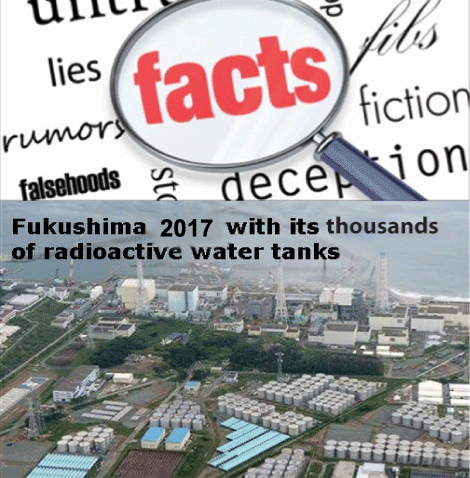
Critics of the clean-up note that 2020 is the year Tokyo is due to host the Olympics, having been awarded the Games after Abe assured the International Olympic Committee that Fukushima was “under control”.

Mitsuhiko Tanaka, a former Babcock-Hitachi nuclear engineer, accuses Abe and other government officials of playing down the severity of the decommissioning challenge in an attempt to win public support for the restart of nuclear reactors across the country.
“Abe said Fukushima was under control when he went overseas to promote the Tokyo Olympics, but he never said anything like that in Japan,” says Tanaka. “Anyone here could see that the situation was not under control.
on 5th anniversary of Fukushima nuclear catastrophe, the global nuke industry is in decline
 Terminal decline? Fukushima anniversary marks nuclear industry’s deepening crisis, Ecologist, Nuclear Monitor 10th March 2017 With the sixth anniversary of the Fukushima disaster falling on 11 March , nuclear lobbyists are arguing over solutions to the existential crisis facing nuclear power, writes Jim Green. Some favour a multinational consolidation of large conventional reactor designs, while others back technological innovation and ‘small modular reactors’. But in truth, both approaches are doomed to failure
Saturday March 11 marks the sixth anniversary of the triple-disaster in north-east Japan – the earthquake, tsunami and the Fukushima nuclear disaster.
And the news is not good. Scientists are wondering how on earth to stabilise and decontaminate the failed reactors awash with molten nuclear fuel, which are fast turning into graveyards for the radiation-hardened robots sent in to investigate them.
The Japanese government’s estimate of Fukushima compensation and clean-up costs has doubled and doubled again and now stands at ¥21.5 trillion (US$187bn; €177bn).
Indirect costs – such as fuel import costs, and losses to agricultural, fishing and tourism industries – will likely exceed that figure.
Kendra Ulrich from Greenpeace Japan notes in a new report that “for those who were impacted by the worst nuclear disaster in a generation, the crisis is far from over. And it is women and children that have borne the brunt of human rights violations resulting from it, both in the immediate aftermath and as a result of the Japan government’s nuclear resettlement policy.”
Radiation biologist Ian Fairlie summarises the health impacts from the Fukushima disaster: “In sum, the health toll from the Fukushima nuclear disaster is horrendous. At the minimum:
- Over 160,000 people were evacuated most of them permanently.
- Many cases of post-trauma stress disorder (PTSD), depression, and anxiety disorders arising from the evacuations.
- About 12,000 workers exposed to high levels of radiation, some up to 250 mSv
- An estimated 5,000 fatal cancers from radiation exposures in future.
- Plus similar (unquantified) numbers of radiogenic strokes, CVS diseases and hereditary diseases.
- Between 2011 and 2015, about 2,000 deaths from radiation-related evacuations due to ill-health and suicides.
- An, as yet, unquantified number of thyroid cancers.
- An increased infant mortality rate in 2012 and a decreased number of live births in December 2011.”
Dr Fairlie’s report was written in August 2015 but it remains accurate. More than half of the 164,000 evacuees from the nuclear disaster remain dislocated. Efforts to restore community life in numerous towns are failing. Local authorities said in January that only 13% of the evacuees in five municipalities in Fukushima Prefecture have returned home after evacuation orders were lifted.
As for Japan’s long-hyped ‘nuclear restart’: just three power reactors are operating in Japan; before the Fukushima disaster, the number topped 50……….http://www.theecologist.org/News/news_analysis/2988749/terminal_decline_fukushima_anniversary_marks_nuclear_industrys_deepening_crisis.html
Investors worried about bankruptcy risk in Toshiba’s troubled nuclear business Westinghouse
Toshiba’s troubled nuclear business Westinghouse is bringing in bankruptcy lawyers, City AM, Courtney Goldsmith, 9 Mar 17, Toshiba’s US nuclear business, Westinghouse, has hired bankruptcy attorneys, signalling to investors it is serious about the potential of a Chapter 11 filing.
The Japanese conglomerate brought in law firm Weil Gotshal & Manges to explore the option, but it had not yet taken a decision on a bankruptcy filing, sources told Reuters.
Toshiba’s shares closed down 7.2 per cent today.
The firm unexpectedly delayed its financial update last month as it announced it needed more time to probe its US nuclear business after revealing a multi-billion pound hole. It’s due to report earnings Tuesday, but a source has told Reuters the likelihood of Toshiba meeting this deadline was “fifty-fifty”.
If the firm fails to meet that deadline, it has until 27 March to file or could be delisted.
Although the troubled firm said it’s not aware of any intention for Westinghouse to file for Chapter 11 bankruptcy, sources have said it is one of several options being considered. The nuclear business faces cost overruns at two projects.
Toshiba has also hired a Japanese law firm to help estimate the how a US bankruptcy will impact the broader group, sources said…..
one issue may be financing guarantees given by the US government to help fund the construction of reactors at the Vogtle plant in Georgia, one of the two projects at the core of Westinghouse’s woes.
A 2014 statement on the US department of energy’s website says the loan guarantees totaled $8.3bn (£6.8bn)
Toshiba is also pursuing the sale of most, or even all, of its prized flash memory chip business, which will help protect it against future financial problems. Bids on the company, which Toshiba values at least 1.5 trillion yen, are due at the end of the month. http://www.cityam.com/260648/toshibas-troubled-nuclear-business-westinghouse-bringing
Radiation Spikes At Fukushima

Juan Carlos Lentijo of the International Atomic Energy Agency looks at tanks holding contaminated water and the Unit 4 and Unit 3 reactor buildings during a February 2015 tour of the tsunami-stricken Fukushima Daiichi nuclear power plant.
Almost six years after a tsunami caused a meltdown at the Fukushima Daiichi Nuclear Power Plant, the facility’s operator, Tokyo Electric Power (Tepco) faces overwhelming problems to clean up the site. Tepco now reports radiation in reactor 2 that would kill a worker in thirty seconds, and even destroys robots. Arjun Makhijani, the President of the Institute for Energy and Environmental Research and host Steve Curwood discuss the implications of this new report and the challenges of cleanup.

Arjun Makhijani is the President of the Institute for Energy and Environmental Research.
Transcript
CURWOOD: It’s Living on Earth, I’m Steve Curwood.
Six years after an earthquake and resulting tsunami devastated Fukushima, Japan and led to the meltdown of three nuclear power reactors there on the coast, radiation levels have reached a staggering 530 sieverts an hour, many times higher than any previous reading. Tepco, the plant’s operator, claims that radiation is not leaking outside reactor number two, site of these readings, but concedes there’s a hole in the grating beneath the vessel that contains melted radioactive fuel.
Joining us now to explain what it all means is Arjun Makhijani, President of the Institute for Energy and Environmental Research. Welcome back to Living on Earth Arjun.
MAKHIJANI: Thank you, Steve. Glad to be back.
CURWOOD: So, this report from TEPCO seems serious, maybe even ominous. What what exactly is going on?
MAKHIJANI: Well, they are exploring the molten core of the reactor in reactor number two with robots, and the robot called Scorpion went farther into the bottom of the reactor in an area called “the pedestal” on which the reactor kind of sits and measured much higher levels of radiation than before. The highest level was 73 Sieverts per hour before and this time they measured a radiation level more than seven times higher. It doesn’t mean it’s going up. It just was in a new area of the molten core that had not been measured before.
CURWOOD: Still, it sounds to me like it’s problematic, that six years after this meltdown there’s such a high reading.
MAKHIJANI: It is a very high reading; they may encounter even higher readings. The difficulty with this high reading is that the prospect that workers can actually go there, even all suited up, becomes more and more remote. Robots are going to have to do all this work – That was mostly foreseen – but the radiation levels are so high that even robots cannot survive for very long. So now they’re going to have to go back to the drawing board and redesign robots that can survive longer or figure out how to do the work faster, and it’s going to be more costly and more complicated to decommission the site.

The lid of Unit 4’s Primary Containment Vessel lies close to the reactor building. The reactor was shut down for maintenance at the time of the accident.
CURWOOD: Remind us, Arjun, please, of the human impact of this kind of radiation. What’s toxic to humans?
MAKHIJANI: Right. So, if you get high levels of radiation in a short period of time, four Sieverts is a lethal dose for about half the people within two months. So, in 530 Sieverts per hour would give you a lethal dose in less than 30 seconds.
CURWOOD: Wow.
MAKHIJANI: So, it’s a very, very, very high level of radiation. That’s why people cannot go into the reactor and work there. That’s not the end of the bad news, but that’s quite a bit of it.
CURWOOD: OK. All right, there is more bad news. I’m sitting down. Tell me.
MAKHIJANI: Yes, so the bottom of the reactor under the reactor there is a grating and then under the grating there’s the concrete floor, and what this robot discovered — It was supposed to go around the grating and survey the whole area, but it couldn’t because a piece of the grating was deformed and broken. So, now it appears that some of the molten fuel may have gone through the grating and maybe onto the concrete floor. We don’t know because even robotic surveys are now difficult, and a high radiation turns into heat, so the whole environment around the molten fuel is thermally very hot, and so whether it is going through the concrete, whether it is under the concrete, I don’t know that we have a good grip on that issue.
CURWOOD: So, Arjun, what’s going on with the reactors one and three? There have been published reports that TEPCO, Tokyo Electric Power Company that has these reactors, hasn’t really taken a good look at those reactors. What do you know?
MAKHIJANI: Well, they have to develop the robots, and I think that developing them, by looking at reactor two, and they’re finding these surprises, radiation levels much higher than previously measured. It shouldn’t actually be unanticipated. The big surprise here was that a part of the grating was gone, and so that the molten fuel would possibly have gone through the grating. So, I think similar surprises will await reactors one and three because each meltdown will have a different geometry.

Storing contaminated water in tanks at the Fukushima Daiichi site presents an ongoing risk, says Makhijani.
URWOOD: So, now what about the decay products here? We’re starting with the Uranium family, but we wind up with Cesium and Strontium – Strontium 90. What risk is there of Strontium 90 getting into groundwater there?
MAKHIJANI: Yeah, so the peculiar thing about a nuclear reaction is the initial fuel, Uranium, is not very radioactive. It’s radioactive but you can hold the uranium fuel pellets in your hand without getting a high dose of radiation. After it’s gone through the nuclear reaction – Fission, that’s what generates the energy – the fission products which result from splitting the Uranium atom are much more radioactive than Uranium, and Strontium 90 and Cesium 137 are two of the products that last for quite a long time, half-life 30 years, and are quite toxic. So, Strontium 90 is specially a problem when it comes in to contact with water. It’s mobilized by water. It behaves like calcium, so if it gets into like sea water and get into the fish, the bones of the fish, or human beings, of course, it gets into the bone marrow and bone surface, increases the risk of cancer, leukemia. So it’s a pretty nasty substance, and Strontium 90 has been contacted with water. You know, rainwater goes and contacts the molten fuel. Groundwater may be contacting the molten fuel. So, we have had Strontium 90 contamination and discharges into the ocean. They also collect the water. They’ve got about more than 1,000 tanks of contaminated water stored at the Fukushima site. By my rough estimate may be about 100 million gallons of contaminated water is being stored there.
CURWOOD: What happens if there’s an earthquake?
MAKHIJANI: That’s exactly right. So about a week into the accident, I sent a suggestion to the Japan Atomic Energy Commission that they should buy a supertanker, put the contaminated water into the supertanker, and send it off elsewhere for processing. They do have a site in the north of Japan which was supposed to be for plutonium separation, but it could be used to support the cleanup of Fukushima. But they rejected that proposal more than once and decided to build these tanks instead. They have a decontamination process on-site, and there are a very vast number of plastic bags on the site filled with contaminated soil. Nobody wants the stuff and nobody knows what’s going to happen with it.
CURWOOD: It’s six years after the original meltdown. How much of a disaster is Fukushima today?
MAKHIJANI: Well, Fukushima is possibly the longest running, continuous industrial disaster in history. It has not stopped because the risks are still there. This is going to take decades to decommission the site, and then what is going to happen with all this highly radioactive waste, ‘specially the molten fuel? Nobody knows.
CURWOOD: Arjun Makhijani is President of the Institute for Energy and Environmental Research. Thanks for taking time with us today, Arjun.
MAKHIJANI: So good to be back with you, Steve.
http://www.loe.org/shows/segments.html?programID=17-P13-00007&segmentID=6
Town mayor gives nod to restart Genkai nuclear plant in Saga Pref.

The Genkai Nuclear Power Plant is seen from a Mainichi Shimbun helicopter in Genkai, Saga Prefecture
SAGA, Japan (Kyodo) — A mayor in southwestern Japan approved a plan Tuesday to restart two nuclear reactors in his town, a step toward the resumption of a third atomic power plant in Japan since the 2011 Fukushima disaster.
“While taking the assembly’s approval seriously, I decided to accept the government’s policy,” Hideo Kishimoto, the mayor of Genkai in Saga Prefecture, told a press conference.
Now the restart of the Nos. 3 and 4 reactors at the Genkai plant operated by Kyushu Electric Power Co. depends on consent by seven other municipalities within a 30-kilometer radius of the plant amid lingering safety concerns about nuclear power plants.
The Japanese government is pushing for reactors to be restarted as nuclear power is regarded as a key energy source even after the March 2011 disaster at the Fukushima Daiichi plant in the days after a massive earthquake and tsunami struck northeastern Japan.
The Nos. 3 and 4 reactors at the Genkai plant passed in January tougher safety requirements introduced in the wake of the Fukushima nuclear disaster. A majority of the town assembly members voted in favor of the restart on Feb. 24.
Kishimoto told Saga Gov. Yoshinori Yamaguchi and Kyushu Electric Power President Michiaki Uriu of his approval Tuesday by phone.
The Saga governor will make a judgment on the matter after hearing from all mayors in the prefecture at a meeting March 18.
All four reactors at the Genkai plant had halted operations by December 2011 in the wake of the Fukushima catastrophe. Kyushu Electric decided to decommission the aging No. 1 reactor.
Of Japan’s 45 commercial reactors nationwide as of Tuesday, only three are now operating — the Nos. 1 and 2 reactors at Kyushu Electric’s Sendai plant in Kagoshima Prefecture, and the No. 3 reactor at Shikoku Electric Power Co.’s Ikata plant in Ehime Prefecture, western Japan, according to the Agency for Natural Resources and Energy.
http://mainichi.jp/english/articles/20170307/p2g/00m/0dm/080000c
Tepco data show 32,000 workers at Fukushima No. 1 got high radiation dose
 , Tepco data show http://www.japantimes.co.jp/news/2016/03/07/national/science-health/32000-fukushima-no-1-workers-got-high-radiation-dose-tepco-data-show/#.WL-YzNKGPGhJIJI
A reading of 5 millisieverts is one of the thresholds of whether nuclear plant workers suffering from leukemia can be eligible for compensation benefits for work-related injuries and illnesses.
Of those workers, 174 had a cumulative radiation dose of more than 100 millisieverts, a level considered to raise the risk of dying after developing cancer by 0.5 percent. Most of the exposure appears to have stemmed from work just after the start of the crisis on March 11, 2011.
The highest reading was 678.8 millisieverts.
Overall, a total of 46,490 workers were exposed to radiation, with the average at 12.7 millisieverts.
The number of workers with an annual dose of over 5 millisieverts increased 34 percent from fiscal 2013 to 6,600 in fiscal 2014, when workloads grew to address the increase in radiation-tainted water at the plant. The number was at 4,223 in the first 10 months of fiscal 2015, which ends this month, on track to mark an annual decline.
A labor standards supervision office in Fukushima Prefecture last October accepted a claim for workers compensation by a man who developed leukemia after working at the plant, the first recognition of cancer linked to work after the meltdowns as a work-related illness. Similar compensation claims have been rejected in three cases so far, according to the labor ministry.
The average radiation dose was higher among Tepco workers at the plant than among workers from subcontractors in fiscal 2010 and 2011. Starting in fiscal 2012, the reading was higher among subcontractor workers than among Tepco workers.
The average dose for subcontractor workers was 1.7 times the level of Tepco workers in fiscal 2013, 2.3 times in fiscal 2014 and 2.5 times in fiscal 2015 as of the end of January.
A separate analysis of data from the Nuclear Regulation Authority showed that the average radiation dose of workers at 15 nuclear power plants across the country, excluding the Fukushima No. 1 and No. 2 plants, fell to 0.22 millisievert in fiscal 2014, when none of the plants was in operation, down 78 percent from 0.99 millisievert in fiscal 2010.
‘Multiple missiles’ fired into Japanese waters, by North Korea
 North Korea fires ‘multiple missiles’ into Japanese waters Seoul, SMH. 6 Mar 17 : North Korea has fired ‘multiple missiles’ from its Tongchang-ri region where a missile base is located, South Korea’s military says.
The missiles flew about 1000 kilometres in possible retaliation by the reclusive state to joint US-South Korean drills that began last week.
apanese Prime Minister Shinzo Abe also said North Korea had fired four ballistic missiles, three of which fell into Japan’s exclusive economic zone.
Tokyo had “lodged a stern protest with North Korea,” Abe told reporters……
North Korea has threatened to take “strong retaliatory measures” after South Korea and the US began annual joint military drills on Wednesday that test their defensive readiness against possible aggression from the North.
North Korea criticises the annual drills, calling them preparation for war against it……http://www.smh.com.au/world/north-korea-fires-multiple-missiles-south-20170306-guremx.html
TEPCO blunders raise doubts on ability as nuke plant operator

Niigata Governor Ryuichi Yoneyama, center, is briefed by the chief of the Kashiwazaki-Kariwa nuclear power plant in the No. 6 reactor building in February, while TEPCO President Naomi Hirose, right, looks on.
Recent revelations concerning Tokyo Electric Power Co. raised fundamental doubts about whether the utility has done sufficient soul-searching over the accident at its Fukushima No. 1 nuclear power plant in 2011.
The revelations concern the Kashiwazaki-Kariwa nuclear power plant in Niigata Prefecture, where the company is seeking to restart the No. 6 and No. 7 reactors as soon as possible. In one instance, a key facility has been found to be lacking an adequate level of earthquake resistance.
TEPCO’s latest blunders emerged during the final stages of the Nuclear Regulation Authority’s screening of the two reactors, based on stricter safety standards introduced after the Fukushima nuclear disaster.
The NRA summoned TEPCO President Naomi Hirose. It should come as no surprise that the NRA’s chairman, Shunichi Tanaka, instructed Hirose to re-submit documents in the application for the restarts after ensuring their accuracy as a matter of his responsibility.
The new standards are nothing but the NRA’s minimum requirements for safe reactor operations.
Utilities have the primary responsibility for keeping track of the latest scientific knowledge and improving the safety of nuclear power plants.
A company that fails to pay appropriate attention to developments it finds inconvenient or cannot make swift decisions when faced with such a situation is not qualified to operate a nuclear reactor.
The NRA summoned Hirose over the earthquake resistance of a key building that is designed to serve as an on-site emergency response headquarters at the Kashiwazaki-Kariwa plant in the event of a severe accident.
TEPCO had said the building could withstand an earthquake with a maximum intensity of seven on the Japanese seismic scale. In the process of the NRA’s screening, however, the company acknowledged that it may not be able to withstand even half of the assumed strongest seismic shaking.
TEPCO said it learned about the inadequate level of earthquake resistance in 2014. The utility said the information was not shared within the company due to poor communications among different divisions. But that explanation should not be allowed to let it off the hook.
TEPCO also failed to disclose until recently other pieces of information about the Kashiwazaki-Kariwa plant, such as the possibility that an earthquake could cause liquefaction of the ground under a seawall built to protect the plant from tsunami.
NRA officials have criticized TEPCO for its reluctance to disclose problems in a straightforward manner.
Local governments around the plant are similarly aghast.
Niigata Governor Ryuichi Yoneyama, who has been cautious about endorsing TEPCO’s plan to restart the reactors, has stated that he does not trust the utility.
TEPCO also appears to be losing the trust of Kashiwazaki Mayor Masahiro Sakurai, who had shown some understanding to the idea of restarts. He said anxiety about TEPCO’s nature has “heightened” due to the latest revelations, combined with the disclosure last year that the company tried to cover up the core meltdowns at the Fukushima plant.
“There is now the possibility that I may not give my consent” to the restarts, he said.
The 2007 Chuetsu offshore earthquake destroyed an administrative building at the Kashiwazaki-Kariwa plant.
Learning lessons from the disaster, TEPCO started constructing base-isolated buildings designed to serve as on-site emergency response headquarters at its nuclear power plants.
During the 2011 nuclear disaster, such a building at the Fukushima No. 1 plant was used as the on-site command post.
But the NRA’s screenings of reactors operated by other utilities had revealed that there are cases where buildings constructed with base isolation technology do not meet the new safety standards.
Critics say TEPCO is not eager to incorporate new findings.
It has been repeatedly pointed out that TEPCO first needs to thoroughly reform its organization and corporate culture, among other aspects.
We feel compelled to state again that the company must confront its problems.
Inside the Fukushima nuclear station: robots are not good enough
“We should think out of the box so we can examine the bottom of the core and how melted fuel debris spread out,” TEPCO Head of Decommissioning Naohiro Masuda said.
Despite the failed probe missions, officials have added that they want to stick to their schedule of starting the site clean up in 2021.
Decommissioning the site is expected to cost tens of billions of dollars and last around 40 years.
Fukushima’s No. 2 reactor was found in February to have a radiation level of 530 sieverts.
Exposure to four sieverts is enough to be lethal, according to the National Institute of Radiological Sciences.
South Korea’s low-cost carrier Jeju Air also announced on Tuesday that it would not use Fukushima Airport due to fears of radiation.
Some of its customers had reportedly posted online that they would not use the airline because they didn’t want to “board airplanes that flew over Fukushima.” http://mashable.com/2017/03/03/fukushima-robots-fail/#at3NoAFNikqn
Daunting obstacles t o Fukushima cleanup, even as evacuees move back
As evacuees move back, Fukushima cleanup faces daunting obstacles, Science, By Dennis Normile Mar. 2, 2017 TOKYO—Six years into a decommissioning effort expected to last into the 2050s, an official leading the work on the stricken Fukushima Daiichi Nuclear Power Plant claims that cleanup crews are making “steadfast progress.” But thorny technical obstacles must be overcome.
Stemming ocean contamination has been a thorny challenge. Since early in the crisis, crews have circulated water through the damaged reactors to prevent overheating that could lead to further fuel melting. That water, and groundwater flowing through the site, is heavily contaminated and TEPCO has struggled to keep it from seeping into the Pacific. Schemes to divert groundwater away from the plant and freeze a wall of soil around the reactors down to bedrock—to contain contaminated water—have minimized leaks, Masuda said.
In the meantime, TEPCO has accumulated 960,000 tons of contaminated water stored in 1000 10-meter-tall tanks at the site. TEPCO has removed cesium, strontium, and more than 50 other radionuclides from that water. But they have been stymied by tritium, a radioactive hydrogen isotope in the water. Several experimental approaches to removing the tritium “were judged to be impractical,” Masuda said……
Another major hurdle is determining the condition and location of the melted fuel, much of which is believed to have dropped to the bottoms of the containment vessels where high radiation levels preclude human entry. Robotic investigations are proving problematic. In January, the camera on a robotic probe sent into the Unit 2 containment vessel was fried by radiation, though it did return important images before its demise. Then last month, a small robot on tanklike treads was sent through a 10-centimeter-diameter pipe into the vessel to investigate the presumed location of the damaged fuel. But it got tangled up in debris and was abandoned.
TEPCO is now thinking it might need a robot able to jump over debris. And they are planning robotic investigations of the units 1 and 3 containment vessels in preparation for a planning session this summer to set a policy for recovering the melted fuel. http://www.sciencemag.org/news/2017/03/evacuees-move-back-fukushima-cleanup-faces-daunting-obstacles
The nuclear problems of Hitachi
Hitachi NO2NuclearPower, March 2 017Meanwhile the Japanese company Hitachi which is planning to build the proposed plant at Wylfa on Anglesey, is set to lose tens of billions of yen this financial year after withdrawing from a uranium enrichment joint venture in the US. Hitachi is expected to report a 70 billion yen ($620 million) non-operating loss by the time books are closed at the end of March. The deficit is largely attributed to the joint venture GE Hitachi Nuclear Energy Inc. withdrawing from the uranium enrichment project. Hitachi no longer expects any profits from the North Carolinabased company, of which it owns 40% and the rest by General Electric. Hitachi and GE were expecting more nuclear power plants to be built when they launched the joint fuel enrichment business, but orders have been sluggish across the globe, forcing the project to be shelved. Nevertheless, Hitachi says it will be sticking with its nuclear power business. The company said No2NuclearPower nuClear news No.93, March 2017 4 that it plans to proceed with its project to build a plant in Britain by ensuring costs are thoroughly managed. (8)
In its favour is the fact that four ABWR reactors – the type of reactor it wants to build at Wylfa – have actually been built, in Japan. But their reliability has been poor. (9) The 2011 accident at Fukushima closed down all Japanese reactors, but according to IAEA the load factor – the proportion of time the reactors were generating power – for those ABWRs in the period between 2007-11 had been below 50%. (10 http://www.no2nuclearpower.org.uk/nuclearnews/NuClearNewsNo93.pdf
Time to transform Japan’s nuclear plant inspection system
Japan lies at the middle of 4 tectonic plates. The pressure of the plates has produced 113 active fault lines in Japan’s crust. It has also 118 active volcanoes. 10% of the world earthquakes occur in Japan.
To talk about nuclear safety there is like taking bets with people lives, is like talking about a death wish.

The government has submitted to the Diet a bill to revise the Act on the Regulation of Nuclear Source Material, Nuclear Fuel Material and Reactors. The bill includes the introduction of surprise inspections at nuclear plants by inspectors from the Secretariat of the Nuclear Regulation Authority, which would allow them to enter any part of a nuclear plant at any time, as well as a system where the state gives an overall evaluation to each plant based on the results of the inspections and other factors and release the data. These new systems are expected to come into operation in fiscal 2020.
With surprise inspections, it will be difficult for power companies to hide problems at their nuclear plants. And since evaluation results will be published and comparison among nuclear plants will be possible, the principle of competition comes into play, which is expected to encourage utilities to voluntarily develop safety measures at their own plants.
In the meantime, the Nuclear Regulation Authority (NRA) should work on boosting the number of nuclear plant inspectors and training such officials so that the revisions will lead to the improvement of nuclear plant safety.
The NRA was established in the wake of the March 2011 nuclear disaster at the Fukushima No.1 Nuclear Power Plant and new safety standards subsequently came into effect. Restarts of idled nuclear reactors based on the new standards are underway. At the same time, reviews on nuclear plant inspection systems had been put on the back burner.
The pillars of nuclear plant inspections conducted by the government and power companies are regular checkups, which are carried out about once every 13 months, and security examinations done four times a year. With regular inspections, facilities with higher levels of importance are screened, while security examinations mainly judge whether a nuclear plant is operated safely.
The dates and contents of these checks are set prior to the actual inspections, however, and the system lacks flexibility, preventing the government from acting on a case-by-case basis to check problems at each plant.
NRA Chairman Shunichi Tanaka has said that there is corporate culture within power companies where they think their nuclear plants are fine as long as they pass safety checks by government regulators. The International Atomic Energy Agency has also pointed out that this way of thinking is problematic and the agency recommended Japanese authorities improve nuclear plant inspection systems in the pre-disaster year of 2007 and again in January 2016.
Under the proposed bill, the division of roles shared by the government and power companies will be clarified. Utilities would be solely responsible for making sure that facilities at their nuclear plants meet safety standards, while the government would take the role of a watchdog, monitoring power companies’ safety measures and how inspections are being carried out to give an overall evaluation for each plant. The results of surprise inspections will be included in a nuclear plant’s overall grade, which will be reflected in the next inspection.
The new inspection system was inspired by those employed in the United States and other countries with nuclear power. While Japan will catch up with those countries in terms of the system after the law is revised, that alone is not enough.
In the United States, where around 100 nuclear reactors are in operation, there are some 1,000 inspectors at the U.S. Nuclear Regulatory Commission, and they undergo a two-year training program. In Japan, on the other hand, there are only around 100 inspectors for more than 40 reactors, and they receive a mere two weeks of training.
Unless the quality and quantity of the nuclear plant inspectors are secured, the effectiveness of the new system would become questionable.
Furthermore, the overall grades for each nuclear plant should be released in a way to make it easier for the public to understand. The government should also consider ways to make good use of the system such as changing the premiums of liability insurance policies for potential nuclear accidents depending on the nuclear plants’ safety grades.
http://mainichi.jp/english/articles/20170227/p2a/00m/0na/010000c
Global action is needed, NOW, to defeat the out-of-control Fukushima nuclear disaster.
Over the past few weeks, the Japanese have attempted to send their Scorpion robot into the damaged containment vessel areas. These attempts have resulted in the rapid destruction of these specially designed radiation-detecting robots — but not before measurements were made… reliable measurements, that indicate radiation leaking at 530 seiverts per hour. Such readings were described as “unimaginable.” Why? Because human death is likely at just 10 seiverts per hour of radiation exposure.
This is all current news — yet our national media and federal government will not investigate it, talk about it, or help in developing a strategy to defeat the problem.
There is no greater clear and present danger to the future of humanity and other life on this earth than the out-of-control Fukushima disaster.
If we get to work on the problem, I am absolutely confident that our human ingenuity and resourcefulness will defeat it. We are, in our human potentiality, that good — if we will only do it.
The Ongoing Fukushima Disaster http://pagosadailypost.com/2017/02/23/essay-the-ongoing-fukushima-disaster/ BY · FEBRUARY 23, 2017
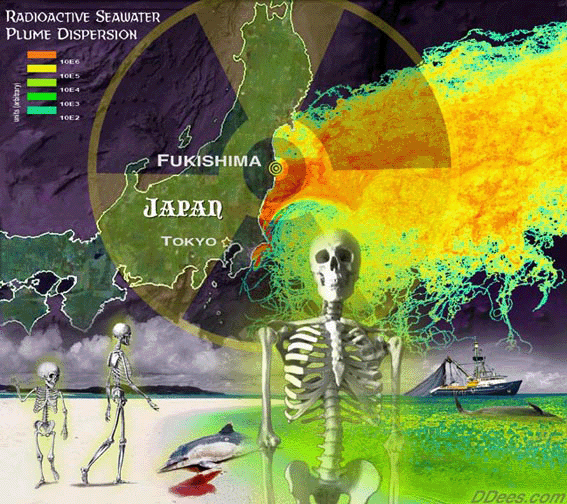
The material of the melted cores, called corium, has sunk down into the earth below their shattered former containment vessels, and resides within the shallow water table below — which results in an ongoing flow of radioactive material pouring into the ocean. Apparently, there is no existing technological solution to this issue, and there are increasing measurements of radioactive material within the vast Pacific Ocean and all along the western coasts of the North and South American continents.
The Federal Government of the United States does not (publicly) monitor such radiation inflows, and therefore, any information about the contamination comes from various activities funded by crowd-source financing of various private and public-good organizations, etc.
This I find somewhat odd — in that the United States has, in recent days, deployed their radiation-sniffing jet to fly about over Europe in the hopes of identifying the source of highly abnormal radioactive particles of Iodine-131 that have been wafting about upon the winds since (apparently) early January 2017. At this moment, there is no explanation. So… we’ll deploy United States taxpayer resources to help track down the source of a European Iodine-131 leak — which, incidentally, has a half-life of about eight days — and will discuss the problem publicly … but we won’t (publicly) monitor our western coasts and air for an ongoing radiation catastrophe now six years old, emitting radioactive particles with half-lives of thousands of years. The Federal Government of the United States won’t even talk about it.
Is the idea (or attitude) then that since we have no ability to arrest or fix the unrelenting Fukushima poisoning of our planetary environment, that we will just not talk about or acknowledge it in a public way? Are we going to continue to buy the demonstrably false notion put forth by the U.S. government that the vast waters of the Pacific ocean will act to “dilute” the radioactive poison over time — when it is a scientific fact that radioactive particles are not “dilutable” and are, instead, cumulative?
Are we going to continue to disassociate the massive die-offs and poisoning of ocean life from the obvious source, the cumulative effects of Fukushima radiation? Are we going to continue to enjoy our seafood because the Federal Government says that the radioactive levels within it are “within safe limits”? Are we going to continue to label people like myself (of which there are many) as “conspiracy theorists” and uneducated alarmists who have been expressing concern over the Fukushima catastrophe since it occurred — people like me who know from objective observed and scientific fact that all is not well with what is going on (or not going on) at Fukushima?
Over the past few weeks, the Japanese have attempted to send their Scorpion robot into the damaged containment vessel areas. These attempts have resulted in the rapid destruction of these specially designed radiation-detecting robots — but not before measurements were made… reliable measurements, that indicate radiation leaking at 530 seiverts per hour. Such readings were described as “unimaginable.” Why? Because human death is likely at just 10 seiverts per hour of radiation exposure.
This is all current news — yet our national media and federal government will not investigate it, talk about it, or help in developing a strategy to defeat the problem. I would submit that the ongoing Fukushima environmental catastrophe is — by far — the most urgent danger to humanity that we face. This is not a localized Japanese problem — it is a world-wide environmental emergency that is getting worse every day.
If humanity does not have the current technology to defeat this problem, then we need to get our best and brightest minds together from across the world and develop technology to defeat it, immediately. It is absolutely unacceptable and irresponsible for the world to simply ignore what it going on — indeed, it is eventually suicidal. If President Trump does not begin to openly talk about the ongoing global emergency threat of Fukushima and advocate for a solution, then I, for one, will publicly part ways with him — on this issue alone.
There is no greater clear and present danger to the future of humanity and other life on this earth than the out-of-control Fukushima disaster. All other issues of debate and controversy are small potatoes in comparison. President Trump needs to rally support for an effective response on this—indeed, the sheer gravity of the destruction being done to the world provides a superb opportunity to bring together a truly unified global response to an issue that threatens humanity. Japan does not have the resources or technological ability to solve this problem by itself — and no individual nation does, or could. Just as if humanity found itself mortally in danger from a source beyond the Earth and would therefore unify to defeat it, so too must it view the Fukushima situation as a mortal danger to humanity from within.
If we get to work on the problem, I am absolutely confident that our human ingenuity and resourcefulness will defeat it. We are, in our human potentiality, that good — if we will only do it.
Toshiba’s c rippling burden of its overseas nuclear business
 Overseas nuclear business a huge burden on Toshiba ,
  Japan News, February 22, 2017 By Miho Yokoi / Yomiuri Shimbun Staff Writer Toshiba Corp. has been facing a need to review its nuclear business because it has been a drag on the company’s reconstruction efforts, mostly caused by the huge loss booked in reactor building projects in the United States and construction delays in other countries.
Nonetheless, it will not be easy for the major electronics and machinery maker to considerably shrink its nuclear business overseas because there are only a handful of entities that can build such facilities.
Toshiba will likely book a loss of more than ¥700 billion for the April-December 2016 period, and U.S. subsidiary Westinghouse Electric Co. is a major factor behind the result…….
It is likely that Toshiba will face a ballooning loss if construction for the reactors [Plant Vogtle in Georgia, USA) continues to be delayed. “It would be a lie if we say there’s no risk at all,” said Corporate Vice President Mamoru Hatazawa.
Toshiba won contracts for building two reactors in Texas in 2009, but their construction has not yet started. The projects have been affected by the increase in the amount of U.S. shale gas production, which has caused fuel prices for thermal power generation to nosedive, thereby boosting needs for a method with cheaper running costs.
Meanwhile, Toshiba’s nuclear businesses in countries other than the United States have also been facing an uphill battle.
In China, for example, Westinghouse has undertaken construction of four nuclear reactors, originally with an aim to put them into operation between 2013 and 2015. However, none of them has been completed because of delays in the work.
The U.S. subsidiary also hoped to win contracts for developing six reactors in India, but the plan has been stalled because it is so risky for a builder to sign a contract under the current Indian law, which obliges the entity to assume liability for compensation in the event of a nuclear accident……..http://the-japan-news.com/news/article/0003536775
1 This Month

Protect Sazan Island from the Trump family! https://secure.avaaz.org/campaign/en/protect_sazan_island_from_the_trump_family_loc/?bqFCVab&v=174511&cl=22707147157&_checksum=5e9dde668860e8231c33699735e16a1fbf22ab2cb01da50c999fe8732b9775ef&utm_source=email&utm_medium=blast_email&utm_campaign=174511
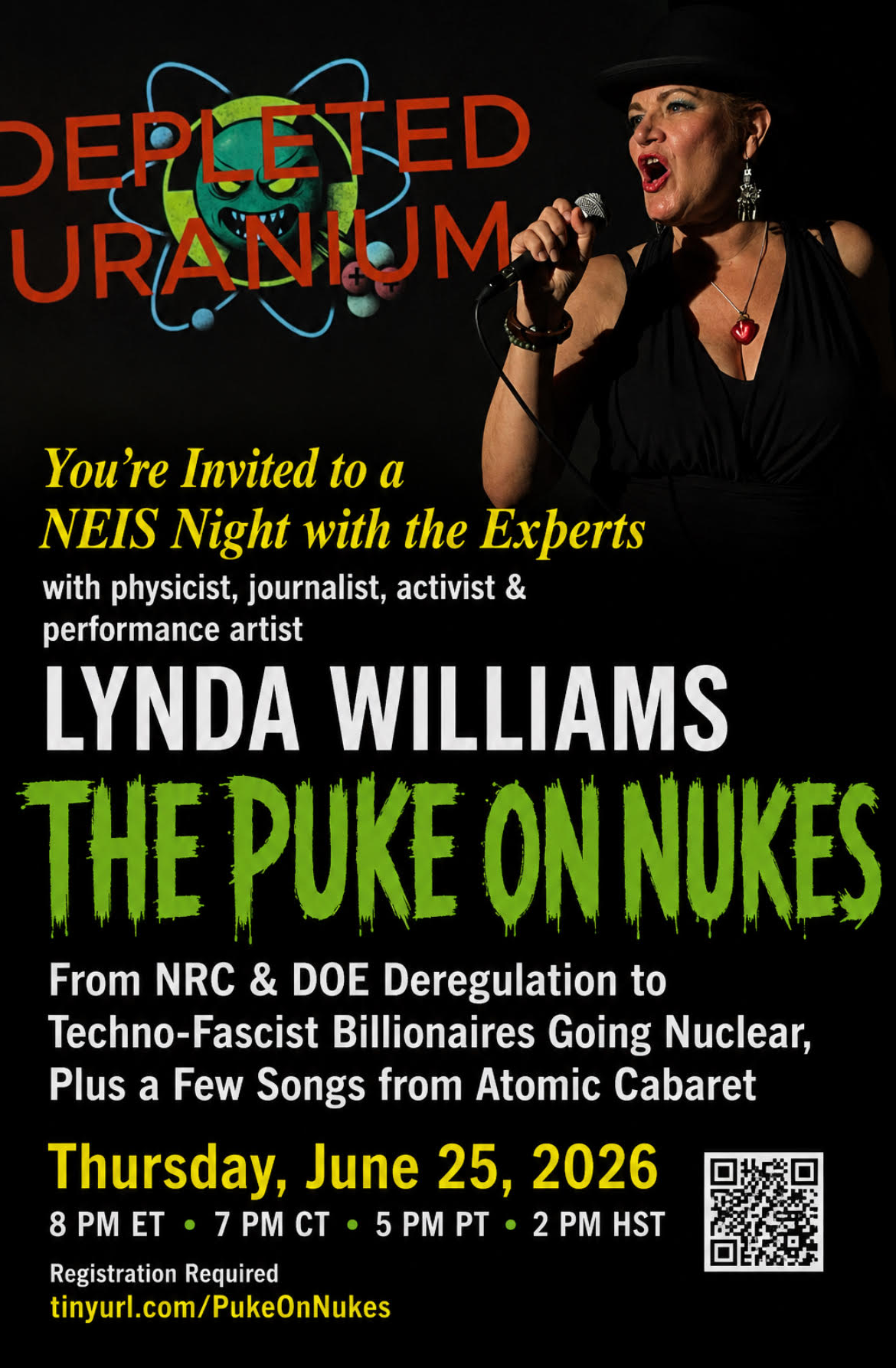
25 June- THE PUKE ON NUKES
Thursday, June 25, 2026
7pm Central Time (8pm ET, 6pm MT, 5pm PT) UTC – 5
From NRC & DOE Deregulation to Techno-Fascist Billionaires Going Nuclear, Plus a Few Songs from Atomic Cabaret REGISTER
26 June – Radiation Trainwreck at the NRC / Join the Protect Better Campaign – https://us02web.zoom.us/meeting/register/4ZlZ5_qLSHGiLSCg8FF6Bg#/registration


Cuba Is Not a Failed State – It Is a Besieged State
PETITION: “Global Appeal to Endorse Palestinian Right of Return of Refugees”
To see nuclear-related stories in greater depth and intensity – go to https://nuclearinformation.wordpress.com
-
Archives
- June 2026 (142)
- May 2026 (306)
- April 2026 (356)
- March 2026 (251)
- February 2026 (268)
- January 2026 (308)
- December 2025 (358)
- November 2025 (359)
- October 2025 (376)
- September 2025 (257)
- August 2025 (319)
- July 2025 (230)
-
Categories
- 1
- 1 NUCLEAR ISSUES
- business and costs
- climate change
- culture and arts
- ENERGY
- environment
- health
- history
- indigenous issues
- Legal
- marketing of nuclear
- media
- opposition to nuclear
- PERSONAL STORIES
- politics
- politics international
- Religion and ethics
- safety
- secrets,lies and civil liberties
- spinbuster
- technology
- Uranium
- wastes
- weapons and war
- Women
- 2 WORLD
- ACTION
- AFRICA
- Atrocities
- AUSTRALIA
- Christina's notes
- Christina's themes
- culture and arts
- Events
- Fuk 2022
- Fuk 2023
- Fukushima 2017
- Fukushima 2018
- fukushima 2019
- Fukushima 2020
- Fukushima 2021
- general
- global warming
- Humour (God we need it)
- Nuclear
- RARE EARTHS
- Reference
- resources – print
- Resources -audiovicual
- Weekly Newsletter
- World
- World Nuclear
- YouTube
-
RSS
Entries RSS
Comments RSS
 nuclear-news