 Japanese nuclear plant may be on quake fault line https://www.theguardian.com/world/2007/jul/19/nuclear.japan
· Leak during tremor worse than originally admitted
· IAEA calls for openness in investigation of errors Justin McCurry in Tokyo , July 2007 The world’s biggest nuclear power station faces an uncertain future after it emerged yesterday that it may lie directly above the fault line that triggered Monday’s earthquake in which nine people died and more than 1,000 were injured.
The Kashiwazaki-Kariwa plant – the biggest in the world in terms of output capacity – shook violently when a magnitude 6.8 earthquake struck Niigata prefecture in northern Japan on Monday morning. The plant was not designed to resist shaking caused by earthquakes of greater than magnitude 6.5.
On another day of embarrassment for Japan’s nuclear power industry, the Tokyo Electric Power Company (Tepco), which operates the plant, said the amount of radioactivity in water that leaked into the sea during the earthquake was 50% higher than it had originally said. The firm blamed a calculation error and said the levels were still well within safety standards.
Late yesterday it also said that 400 drums – not 100 as first reported – of low-level radioactive waste had toppled over during the quake. About 40 lost their lids, spilling their contents on to the ground as they fell. The spillage was one of more than 50 malfunctions the plant experienced in the immediate aftermath of the quake.
International nuclear inspectors said they were concerned by Tepco’s apparent lack of preparedness for such a powerful quake.
“It is clear that this earthquake … was stronger than what the reactor was designed for,” Mohamed ElBaradei, head of the International Atomic Energy Agency, told reporters in Kuala Lumpur. “I would hope and I trust that Japan would be fully transparent in its investigation.”
The mayor of Kashiwazaki, Hiroshi Aida, ordered Tepco to close the plant indefinitely. “The safety of the plant must be assured before it is reopened,” he said. The closure has forced the firm to ask six other power utilities to supply it with additional electricity through to the end of September to avoid power cuts when demand peaks later this summer.
Tepco is under pressure to explain why it took so long to inform the authorities of radioactive leaks and why just four employees were on hand to tackle a fire inside an electrical transformer that was extinguished only after firefighters arrived almost 90 minutes later.
The mishaps have raised questions about the wisdom of building nuclear power stations in a country where earth tremors are recorded, on average, every few minutes. New safety regulations were brought in last year, but upgrading ageing reactors to withstand larger tremors will require huge investment.
Akira Fukushima, of Japan’s Nuclear and Industrial Safety Agency, said no irregularities had been found in critical areas of the plant, but added: “It is possible that the epicentre fault line does run beneath the power plant.”
Inspectors reportedly identified four fault lines in the area while conducting a geological survey before work began on the Kashiwazaki plant in 1980, but concluded that they were inactive.
The Citizen’s Nuclear Information Centre said that the fault believed to have triggered the earthquake was not discovered during pre-construction surveys. “Clearly Japan’s earthquake safety standards are inadequate,” it said in a statement.
Tepco’s president, Tsunehisa Katsumata, defended the firm. “It is hard to make everything go perfectly … I think fundamentally we have confirmed that our safety measures work,” he said.
Japan, which has very few indigenous energy sources, depends on 55 nuclear plants for 30% of its electricity. Despite mounting public opposition, it plans to increase capacity to 40% by the end of the decade.
September 9, 2017
Posted by Christina Macpherson |
Japan, safety |
Leave a comment
World’s Largest Nuclear Power Plant One Step Closer To Operation http://oilprice.com/Latest-Energy-News/World-News/Worlds-Largest-Nuclear-Power-Plant-One-Step-Closer-To-Operation.html By Irina Slav – Sep 07, 2017, The Kashiwasaki-Kariwa nuclear power plant, the world’s largest, may get clearance to resume operations after six years of dormancy following the Fukushima disaster. The Japanese Nuclear Regulation Authority (NRA) granted the plant’s operator, Tepco, a qualified approval of its safety plan, and it could grant it effective approval as early as next week.
While the watchdog could issue a formal approval for Kashiwasaki-Kariwa’s restart later this fall, according to the Nikkei Asian Review, the actual resumption of the reactors is questionable: there is strong local community opposition to nuclear power as fears of another meltdown still linger.
Regulators have conducted technical safety evaluations of the plant, whose reactors are of the same kind as those that melted down in Fukushima, but there are still some reservations regarding Tepco’s safety efforts. The NRA has requested that Tepco’s proposed safety measures for Kashiwasaki-Kariwa be made more legally binding, and has set up a panel to devise ways to guarantee the utility keeps its word.
Even if the NRA approves the restart of the plant, however, the Niigata prefecture is unlikely to support it with an approval of its own. The governor, Ryuchi Yoneyama, is an outspoken opponent of nuclear power, and following the news of NRA’s pending approval said that the prefecture had “absolutely no intention of approving a restart” of the Kashiwasaki-Kariwa facility before an safety inspection of Fukushima was completed.
Tepco first applied for approval to restart two of Kashiwasaki-Kariwa’s seven reactors back in 2013, and has since worked to fulfill all safety requirements that regulators imposed. The company’s shares, however, jumped 3 percent on the news of NRA’s approval despite the slim chance of Kashiwasaki-Kariwa actually returning to operation.
The Fukushima disaster, caused by a tsunami in 2011, displaced 160,000 people, many of them permanently, and led to the shut down of all 50 nuclear reactors in the country. The cost of the disaster is estimated at US$197 billion.
September 9, 2017
Posted by Christina Macpherson |
Japan, politics |
Leave a comment
Nuclear regulator does dizzying U-turn on TEPCO reactor restart plans
 From left, the No. 5, 6 and 7 reactors at Tokyo Electric Power Co.’s Kashiwazaki-Kariwa nuclear power plant are seen in Kashiwazaki, Niigata Prefecture, in this April 21, 2016 file photo.
Tokyo Electric Power Co. (TEPCO), the utility responsible for the Fukushima No. 1 nuclear plant and its March 2011 triple meltdown, is aiming to get the reactors at its other power plants back on line.
The Nuclear Regulation Authority (NRA), which must approve any restarts, had been holding to a very strict line on TEPCO applications. However, on Sept. 6 the NRA abruptly changed track, taking a more sympathetic attitude and indicating that the No. 6 and 7 reactors at the utility’s Kashiwazaki-Kariwa nuclear plant in Niigata Prefecture would likely pass their safety inspections — a prerequisite for restart approval.
Despite the NRA’s suddenly sunny attitude, the prefectural government has not budged from its more cautious position. And TEPCO, which has made the Kashiwazaki-Kariwa plant a chief pillar of its business recovery plans, cannot flip the reactors’ “on” switch without the prefecture’s imprimatur, meaning the plant still has no clear restart schedule.
When the NRA summoned TEPCO President Tomoaki Kobayakawa and other top managers on July 10 this year to testify on the utility’s competence to keep running nuclear plants, authority chairman Shunichi Tanaka was unequivocal and unforgiving.

Nuclear Regulation Authority Chairman Shunichi Tanaka speaks to the Mainichi Shimbun during an Aug. 29, 2017 interview. (Mainichi)
“If TEPCO is unwilling or unable to finalize the decommissioning of the Fukushima (No. 1 station) reactors, it is simply not qualified to restart the Kashiwazaki-Kariwa plant,” Tanaka told the executives, adding, “I don’t see TEPCO showing any independent initiative whatsoever.”
The NRA chairman was referring to the longstanding problems with contaminated water and radioactive waste disposal plaguing TEPCO’s Fukushima plant decommissioning efforts. The utility tends to focus too much on trying to read the government’s mind on any and all Fukushima issues — an attitude that has long drawn NRA criticism.
When the NRA inspected the Kashiwazaki-Kariwa plant’s No. 6 and 7 reactors, it added a new evaluation category to the usual technological checklist, though it was not part of the new safety standards: “eligibility.” That is, TEPCO’s eligibility to run a nuclear power plant at all. After all, it was one of TEPCO’s plants that had succumbed to the worst nuclear disaster since Chernobyl. “TEPCO is different from other (power) companies,” Tanaka had said.
TEPCO President Kobayakawa and Chairman Takashi Kawamura are also a source of NRA concern. The two had no role in the utility’s response to the 2011 meltdowns, and Kobayakawa replaced a much more experienced hand in Naomi Hirose, a TEPCO managing director when the disaster struck. After his NRA dressing-down in July, Kobayakawa apparently visited the Fukushima disaster zone seven times.
However, there has been an apparent U-turn in Tanaka’s stance. A document submitted on Aug. 25 to the NRA under Kobayakawa’s name was sewn with phrases like, “We will carry the (Fukushima) reactor decommissioning through to the end,” and other terms suggesting a determined TEPCO attitude. At the same time, the document was bereft of details on specific preparedness measures or progress benchmarks for the decommissioning work.
Nevertheless, when Kobayakawa again appeared before the NRA on Aug. 30, the body indicated its acceptance of TEPCO’s position. Taking the contaminated water problem “as one example,” Tanaka stated that he recognized TEPCO’s lack of concrete countermeasure planning couldn’t be helped under the circumstances. One NRA executive revealed to the Mainichi Shimbun, “We avoided demanding a detailed (disposal measures) plan because we don’t legally have that authority, and doing so could pose legal risks.”
Pro-TEPCO sentiment was on conspicuous display when the NRA met again on Sept. 6, including acting Chairman Toyoshi Fuketa’s declaration that he “felt TEPCO’s drive to pass on the lessons of the (Fukushima nuclear) accident.”
Committee member Nobuhiko Ban stated that while the document the utility had submitted in the summer was a “declaration of intent,” he was “concerned over whether this alone can constitute eligibility” to run a nuclear plant. However, Tanaka wrapped up discussion by saying that “circumstances are not such that we can deny (TEPCO’s) eligibility.”
Tanaka will leave his NRA post on Sept. 18 after completing his five-year term in the chairmanship, and at a post-meeting news conference he was asked if he had wanted to bring the TEPCO issue to a close while in office.
“I can’t say that I’ve never felt that way,” Tanaka replied.
http://mainichi.jp/english/articles/20170907/p2a/00m/0na/019000c
NRA doubts TEPCO’s safety vow in Niigata, plans legal move
 Tokyo Electric Power Co. wants to restart the No. 6 and No. 7 reactors, shown in the forefront, at its Kashiwazaki-Kariwa nuclear plant in Niigata Prefecture.
The Nuclear Regulation Authority, skeptical of Tokyo Electric Power Co.’s promise to put safety ahead of profits, plans to gain legal assurances before allowing the embattled utility to start operating nuclear reactors again.
TEPCO has applied to restart two reactors at its Kashiwazaki-Kariwa plant in Niigata Prefecture, which would be the first run by the company since the disaster unfolded at its Fukushima No. 1 nuclear plant in March 2011.
Although NRA members agreed that the No. 6 and No. 7 reactors at the Kashiwazaki-Kariwa plant passed new regulations on technological aspects, they could not agree on whether the company has learned its lessons about safety management since the triple meltdown at the Fukushima plant.
To ensure TEPCO will put safety at the forefront of its operations, the NRA is considering holding the utility legally responsible for completing the entire decommissioning process of the Fukushima No. 1 nuclear plant.
The regulator expects to draft a checklist to verify the Kashiwazaki-Kariwa plant’s safety and other steps before it makes a final decision on whether to allow TEPCO to restart the reactors. The next meeting is scheduled for Sept. 13.
The NRA had previously determined that 12 reactors at six nuclear plants met new nuclear reactor regulations shortly after completion of their technological examinations.
The NRA also finished its technological examinations of the No. 6 and No. 7 reactors, the newest ones at the Kashiwazaki-Kariwa plant.
The plant has seven reactors, making it one of the largest nuclear power stations in the world. The two reactors that TEPCO wants to put online each has a capacity of 1.36 gigawatts.
TEPCO has said the resumption of the reactors are needed to turn around its business fortunes.
But NRA commissioners are reluctant to allow TEPCO to bring the plant online based solely on the results of the technological screening.
After the chairman and president of the utility were replaced in June, the NRA summoned the new top executives in July.
The watchdog demanded that they give a written response to the regulator’s position that TEPCO “is not qualified to operate the Kashiwazaki-Kariwa plant, given the seeming lack of determination and spotty track record to take the initiative in decommissioning (the Fukushima No. 1 plant).”
In August, the company submitted a paper to the NRA promising to “take the initiative in addressing the problem of victims of the nuclear disaster and to fulfill the task to decommission the plant.”
The paper also said the company “has no intention whatsoever to place economic performance over safety at the (Kashiwazaki-Kariwa) plant.”
Tomoaki Kobayakawa, the new president of TEPCO, called the paper a “promise to the public.”
Although the NRA commissioners on Sept. 6 recognized TEPCO’s commitment to safety to a certain degree, doubts remained.
Nobuhiko Ban, an NRA member who is a specialist on radiological protection, called for a system that would keep TEPCO committed to safety management in the future.
“Is it all right for us to take TEPCO’s vow at face value?” he said.
The NRA then decided to consider legal ways to hold TEPCO accountable for safety issues.
http://www.asahi.com/ajw/articles/AJ201709070026.html
September 7, 2017
Posted by dunrenard |
Japan | Kashiwazaki-Kariwa NPP, NRC, Reactor Restart, Tepco |
Leave a comment
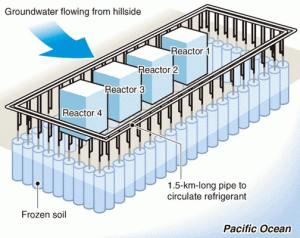
Tokyo Electric Power Company (TEPCO) has announced that the “ice wall” (formally known as the “Land-Side Impermeable Wall”) under construction at the crippled Fukushima Daiichi nuclear power plant in Japan has been
critically affected by rainfall from recent typhoons that have melted parts of the ice structure, allowing new pathways for highly contaminated waterto leak from the basements of the reactor buildings.
http://enformable.com/2016/09/ice-wall-fukushima-daiichi-damaged-recent-typhoons-japan/
September 6, 2017
Posted by Christina Macpherson |
Fukushima continuing |
1 Comment
 Nuclear plant operator halts uranium production, https://www3.nhk.or.jp/nhkworld/en/news/20170903_04/, The operator of a uranium enrichment plant in northern Japan has suspended uranium production to see if there are problems with its quality control system.
The plant in Rokkasho Village, Aomori Prefecture, is the only commercial facility in Japan to enrich uranium for nuclear power generation. A division of Japan Nuclear Fuel Limited that operates the plant was ordered to improve its quality control system last year.
It reported to the president that steps were taken, which turned out not to be true.
The Nuclear Regulation Authority then approved measures to prevent similar irregularities. The operator met the government requirements for producing uranium in May.
In one of a series of safety mishaps, a fire started at an emergency power generator. The operator had failed to replace parts for 28 years, more than 10 years longer than recommended by the manufacturer.
Officials at the authority said they wonder if the operator has the ability to determine problems and challenges. Japan Nuclear Fuel decided to take uranium out from enrichment facilities and once again check quality control problems.
September 4, 2017
Posted by Christina Macpherson |
Japan, reprocessing |
Leave a comment

 Hitachi UK reactors to get full Japanese loan insurance https://asia.nikkei.com/Politics-Economy/Policy-Politics/Hitachi-UK-reactors-to-get-full-Japanese-loan-insurance, Lenders seek guarantees as nuclear projects face post-Fukushima cost overruns, 2 Sept 17, TOKYO — Japan intends to fully insure bank loans for one of Hitachi‘s British nuclear plant projects in order to encourage domestic lenders to finance a particularly risky type of infrastructure export that Prime Minister Shinzo Abe’s government seeks to promote.
When Abe met with U.K. counterpart Theresa May here Thursday, the two leaders reaffirmed bilateral cooperation on nuclear plant construction. Japan’s support will include coverage for two reactors at the proposed Wylfa Newydd nuclear station in Wales — a rare example of loan insurance for a project in an advanced economy.
State-owned Nippon Export and Investment Insurance will write the loan insurance for reactors, which Hitachi will build through British arm Horizon Nuclear Power. The Japanese conglomerate, together with Tokyo and London, will conduct working-level talks to hash out a funding support framework, with the aim of breaking ground in 2019.
The project is estimated to cost over 2 trillion yen ($18.1 billion). Hitachi, the U.K. government and two state-backed entities — Japan Bank for International Cooperation and the Development Bank of Japan — are expected to pick up part of the tab. But private-sector financing will also be needed to close the funding gap.
NEXI, which normally indemnifies private lenders for 90-95% of financing, will enter into talks with Japanese banks toward fully guaranteeing loans for the Wylfa project.
Nuclear project costs have tended to balloon since since Japan’s 2011 Fukushima disaster owing to increased safety precautions. Seeing a higher risk of debt default, Japanese megabanks Bank of Tokyo-Mitsubishi UFJ and Mizuho Bank have sought full coverage by NEXI for any loans for nuclear plant development. Such insurance typically covers financing for projects in developing countries. NEXI is expected to impose conditions, such as a loan period of several decades, in return for an exception.
An accident or other troubles at the plant could expose BTMU and Mizuho to lawsuits from third parties because the banks would bear responsibility for financing the project. The two banks will decide on Wylfa financing based partly on discussions between Tokyo and London concerning damage compensation.
A default on the Wylfa loans would entail a taxpayer-funded repairs to the balance sheets of NEXI and JBIC. The loan insurance proposal is likely to spark a debate on whether promoting infrastructure exports in this way is worth the risk. The Abe government, for its part, will try to use the NEXI assurances to elicit more funding, public and private, from the British side.
With little prospect of constructing new reactors in Japan following the meltdowns at the Fukushima Daiichi nuclear power plant, domestic builders have focused their business offshore. Chinese state-owned enterprises are undertaking more global infrastructure projects, emboldening those who argue that Japan will be left behind in the race for overseas orders unless the country takes risks. In 2015, the U.K. became the first developed nation to approve a Chinese-made reactor.
September 4, 2017
Posted by Christina Macpherson |
Japan, marketing, politics, UK |
Leave a comment
NRA eager to clear Kashiwazaki-Kariya plant
 Tokyo Electric Power Company Holdings Inc. employees take part in a drill in the simulator of the central control room for a reactor inside the seismic isolation building at the company’s Kashiwazaki-Kariwa nuclear power station in Kashiwazaki, Niigata Prefecture, in February 2015.
Two Tokyo Electric reactors at the massive Kashiwazaki-Kariwa power station in Niigata Prefecture are expected to clear the initial safety hurdle for restarts soon, sources said Friday.
According to the sources, the Nuclear Regulation Authority will start talks on the issue on Wednesday, with a view to compiling a document that will certify the two units passed the new safety requirements introduced after the Fukushima nuclear crisis.
Tokyo Electric Power Company Holdings Inc. has been struggling to recover ever since the triple core meltdown in March 2011 because the seven-reactor Niigata plant is a crucial money maker. The utility has spent years trying to restart the plant, which is the only nuclear complex it runs aside from the disaster-hit Fukushima No. 1 plant in Fukushima Prefecture.
It filed for safety assessments for reactor Nos. 6 and 7 in September 2013.
The NRA wants to reach a conclusion on the issue before Chairman Shunichi Tanaka’s five-year term expires on Sept. 18, the sources said. But the move may trigger public criticism because Tepco still has a long way to go to scrap the ruined reactors at Fukushima No. 1, which was engulfed by quake-triggered tsunami and lost all power.
The Kashiwazaki-Kariwa complex is one of the world’s largest nuclear power plants and has an output capacity of 8.2 million kilowatts. Units 6 and 7 are boiling water reactors — the same type as the ones at Fukushima No. 1 — and the newest of the seven sitting along the Sea of Japan coast.
The governments hosting the Kashiwazaki-Kariwa plant are also cautious about restarting the units, with Niigata Gov. Ryuichi Yoneyama saying it will take “around three to four years” for the utility to win local consent on the matter.
Tepco, which is facing massive compensation payments and other costs from dealing with the world’s worst nuclear crises since Chernobyl, has been desperate to restart the idled reactors so it can reduce spending on costly fossil fuel imports needed to run the thermal power plants making up for the nationwide nuclear shutdowns.
Some reactors at other utilities have already resumed operations, but Tepco has been under constant scrutiny to determine whether it is qualified to once again operate a nuclear power plant.
Some inside the NRA have been reluctant to move ahead with the safety review at Kashiwazaki-Kariwa. But Tanaka strongly wants to set a course on the issue before he leaves his position at the NRA, and this was one of the factors that led to the latest development in Niigata, the sources said.
https://www.japantimes.co.jp/news/2017/09/02/national/tepco-hopes-niigata-reactors-will-clear-major-safety-hurdle-road-restart/#.WaxZlRdLfrc
September 3, 2017
Posted by dunrenard |
Japan | Kashiwazaki-Kariwa NPP |
Leave a comment
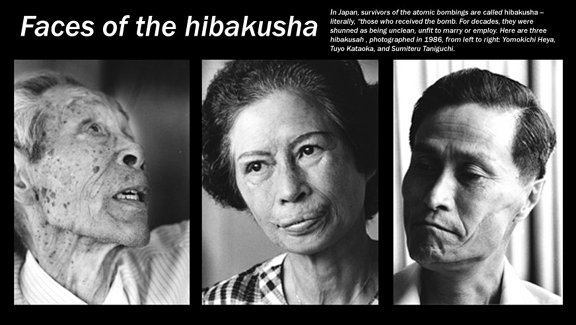
Sumiteru Taniguchi, Nagasaki Survivor and Nuclear Arms Foe, Dies at 88 By MOTOKO RICH https://www.nytimes.com/2017/08/31/world/asia/taniguchi-nagasaki-atomic-bomb.html Hisako Ueno, Makiko Inoue and Kaho Futagami contributed research.AUG. 31, 2017 TOKYO — Sumiteru Taniguchi, who survived the atomic bombing of Nagasaki as a teenager and went on to become a leading advocate for nuclear disarmament, died on Wednesday in Nagasaki. Overcoming a lifetime of debilitating pain and radiation-related illnesses, he lived to 88.
September 1, 2017
Posted by Christina Macpherson |
Japan, PERSONAL STORIES |
Leave a comment
Group: Water plan to remove Fukushima fuel ‘not viable’ http://www.asahi.com/ajw/articles/AJ201708310042.html, By KOHEI TOMIDA/ Staff Writer, August 31, 2017 The Asahi Shimbun A decommissioning organization on Aug. 31 formally recommended bypassing a safety measure to remove melted nuclear fuel from crippled reactors at the Fukushima No. 1 nuclear plant.
The Nuclear Damage Compensation and Decommissioning Facilitation Corp. (NDF) urged the central government and Tokyo Electric Power Co. to use the “airborne method” in which the melted fuel is removed even when the water level in the reactor containment vessel is kept low.
Proposals have been made to fill the containment vessels with water to restrain the spewing of radioactive materials during the fuel removal process.
But the NDF said that method is currently not viable because of the difficulties in patching up the holes in the containment vessels.
The government and TEPCO are expected to decide on a fuel removal method in September and confirm the specific steps next fiscal year.
The removal of equipment and other structural objects in and around the reactors must be completed before work can start on taking out melted fuel that remains in the pressure vessels.
The nuclear fuel that has seeped through the pressure vessels and landed at the bottom of the containment vessels will be the first to be removed.
Work will also have to be done to develop a robot arm that can remove fuel from the side of the containment vessel. Under the current schedule, removal of the melted fuel will start at one of the three, No. 1 to No. 3, reactors of the Fukushima No. 1 plant in 2021.
However, officials still do not know the exact location of the melted fuel in the reactors.
Hajimu Yamana, NDF president, pointed out there would likely be a need to combine various methods instead of pushing through with one specific procedure to meet the scheduled deadline.
September 1, 2017
Posted by Christina Macpherson |
Fukushima continuing |
Leave a comment
 Tepco faces another $5bn US suit over Fukushima nuclear disaster, Business Live, 24 AUGUST 2017 – 14:54 AGENCY STAFF TOKYO —Tokyo Electric Power Company Holdings (Tepco) said on Thursday it faces another US lawsuit over the 2011 Fukushima nuclear disaster, with the latest one demanding at least $5bn in compensation.
A total of 157 US residents who were supporting Fukushima victims at the time filed the class action suit in a California district court earlier this month against the utility and a US company…….
The plaintiffs, who joined aid efforts along with US troops shortly after the disaster, claim they were exposed to radiation because of the improper design, construction and maintenance of the plant.
They were seeking $5bn to cover the cost of medical tests and treatment needed to recover from the disaster, Tepco said in a statement.
They are also demanding compensation for physical, mental and economic damage but no further details such as a sum of money or the identities of the claimants were available.
It was the second multi-plaintiff suit filed against the utility in a US court following one by more than 200 individuals in 2013.
In Japan, more than 10,000 people who fled their homes over radiation fears have filed various group lawsuits against the government and the firm. https://www.businesslive.co.za/bd/companies/2017-08-24-tepco-faces-another-5bn-us-suit-over-fukushima-nuclear-disaster/
August 25, 2017
Posted by Christina Macpherson |
Fukushima continuing, Japan, Legal |
Leave a comment

 Navy Families Sue Fukushima Operators for Wrongful Death, Courthouse News, BIANCA BRUNO August 22, 2017 SAN DIEGO (CN)— Families of five Navy service members who died after responding to the Fukushima nuclear meltdown have sued Tokyo Electric Power Co., blaming the deaths on radiation illnesses contracted from the March 2011 disaster.
The families wish to join a lawsuit from 152 other members or survivors of members of the 7th Fleet who performed humanitarian response from March 11, 2011 until March 14, when the USS Ronald Reagan aircraft carrier was moved away from Fukushima due to detection of nuclear radiation in the air and on helicopters returning to the ship.
The new plaintiffs want to join in the third amended complaint Cooper, et al. v. TEPCO, et al., originally filed in the same court in 2012. They say it is only recently that they discovered the extent of the injuries, real and/or expected, due to exposure to radiation from the Fukushima Nuclear Power Plant.
The federal lawsuit was filed Friday and made available Monday in U.S. District Court in the Southern District of California. They sued General Electric in addition to Tokyo Electric Power Co., or TEPCO.
SAN DIEGO (CN) — Families of five Navy service members who died after responding to the Fukushima nuclear meltdown have sued Tokyo Electric Power Co., blaming the deaths on radiation illnesses contracted from the March 2011 disaster.
The families wish to join a lawsuit from 152 other members or survivors of members of the 7th Fleet who performed humanitarian response from March 11, 2011 until March 14, when the USS Ronald Reagan aircraft carrier was moved away from Fukushima due to detection of nuclear radiation in the air and on helicopters returning to the ship.
The new plaintiffs want to join in the third amended complaint Cooper, et al. v. TEPCO, et al., originally filed in the same court in 2012. They say it is only recently that they discovered the extent of the injuries, real and/or expected, due to exposure to radiation from the Fukushima Nuclear Power Plant.
The federal lawsuit was filed Friday and made available Monday in U.S. District Court in the Southern District of California. They sued General Electric in addition to Tokyo Electric Power Co., or TEPCO.
The Navy servicemen and -women want a $5 billion survivor fund for medical expenses.
They say General Electric designed defective the GE Boiling Water Reactors at Fukushima, which was run by TEPCO, Japan’s largest electric utility. The 7th Fleet’s Operation Tomodachi provided humanitarian relief after the tsunami and ensuing nuclear disaster. The sailors say they will need medical monitoring for life, payment of medical bills, and health monitoring for their children, including for possible radiation-induced birth defects.
“These harms include, but are not limited to, the following: illnesses such as leukemia, ulcers, gall bladder removals, brain cancer, brain tumors, testicular cancer, dysfunctional uterine bleeding, thyroid illnesses, stomach ailments, birth defects, death, and a host of other complaints unusual in such young adults and victims,” the complaint states…….
The families say the prime minister of Japan has effectively admitted the negligence of TEPCO. “This negligence was underscored on December 12, 2013, by admission of the former Prime Minister of Japan, Naoto Kan, who was in office when the Fukushima disaster took place. It was at that time that he admitted, for the first time: ‘People think it was March 12th (2011) but the first meltdown occurred 5 hours after the earthquake.’
“Unaware of either the meltdown or any potentially harmful radioactive release, the U.S. Sailor First Responders arrived off the coast of Fukushima during the afternoon of March 12, 2011 in order to carry out their mission of providing humanitarian aid to the victims of the earthquake and tsunami disaster. At no time did this mission include, nor expand into a response to a meltdown or a nuclear emergency at the FNPP. Rather, plaintiffs were carrying out their mission to provide humanitarian aid to the people of Japan by coming to their aid by delivering clean water, blankets, food, and other aspects of providing other humanitarian relief to the inhabitants of Fukushima Prefecture.”
The plaintiffs claim that though the nuclear meltdown was induced by a natural disaster, the Fukushima Nuclear Accident Independent Investigation Commission found in July 2012 that the meltdown was manmade because GE and TEPCO did not take adequate precautions for earthquakes and tsunamis.
They claim TEPCO ignored warnings of risk of damage by a tsunami, dismissed the need for better protection against seawater flooding, and failed to inspect, maintain and repair critical pieces of equipment……https://www.courthousenews.com/navy-families-sue-fukushima-operators-wrongful-death/
August 23, 2017
Posted by Christina Macpherson |
Fukushima continuing, Legal, USA |
Leave a comment
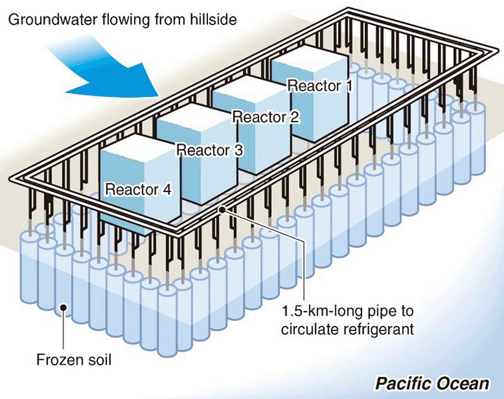
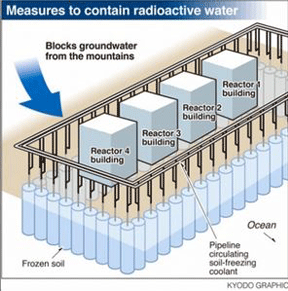 Daily Mail 22nd Aug 2017, The Fukushima nuclear plant’s operator Tuesday started freezing the last
section of a $320 million ice wall designed to cut down on vast amounts of
contaminated water at the site of the worst atomic accident in a
generation.
Tokyo Electric Power (TEPCO) began pumping coolant into the
remaining seven metres (23 feet) of its 1.5-kilometre underground wall
which encircles four reactors along Japan’s northeast coast. Underground
pipes circulate the coolant and freeze soil around the buildings. The
30-metre deep wall is designed to block underground water from nearby
mountains from flowing into the shattered complex and then seeping into the
Pacific.
It is reportedly expected to take more than two months until the
wall is completely frozen. The huge utility has been building the barrier
since March 2016 with the government picking up its 34.5 billion yen ($320
million) price tag. Even now, with the ice wall almost complete, about 140
tonnes of underground water flows into the plant daily, forcing the company
to pump it out and store it in on-site tanks.
“When the ice wall is completed, we estimate that the amount of underground water flowing into
the complex will be less than 100 tonnes,” a company spokesman said. But
some experts have cast doubt on the ice wall’s effectiveness in containing
the problem. http://www.dailymail.co.uk/wires/afp/article-4811494/Fukushima-reactor-ice-wall-nearly-finished.html
August 23, 2017
Posted by Christina Macpherson |
Fukushima continuing |
Leave a comment
BNEF 18th Aug 2017, In the basement of a three-story house in a leafy neighborhood in Tokyo,
about 40 lawyers crowded together, plotting against Japan’s massive
nuclear power industry. The host was 73-year-old Hiroyuki Kawai, one of
Japan’s most colorful litigators. The end game? To close all of the
country’s 42 reactors for good, a result that would be a major blow to
the future of atomic energy across the world.
For the staunch anti-nuclear activist, the risk of a meltdown outweighs the benefits of the relatively
clean source of power. Kawai is propelling the anti-nuclear movement
forward with a 22 trillion yen ($171 billion) shareholder lawsuit against
the company, among the largest in damages ever sought.
He wants to pressure the government and businesses to distance themselves from atomic power, and
while his court cases have yielded mixed results, his bold tactics are
garnering attention around the world. https://about.bnef.com/blog/how-a-harley-riding-ex-ally-of-villains-is-leading-a-nuke-revolt/
August 21, 2017
Posted by Christina Macpherson |
Japan, Legal, opposition to nuclear |
Leave a comment
 Japan’s intentional plutonium surplus https://english.kyodonews.net/news/2017/08/39a5a7121fcf-opinion-japans-intentional-plutonium-surplus.html ByAlan J. Kuperman, KYODO NEWS , 17 Aug 17,
Japan owns nearly 50 tons of separated plutonium. That is enough for over 5,000 nuclear weapons. Yet Japan has no feasible peaceful use for most of this material.
This raises an obvious question: How did a country that forswears nuclear arms come to possess more weapons-usable plutonium than most countries that do have nuclear arsenals?
Some argue it is the unforeseen consequence of unexpected events, such as the failure of Japan’s experimental Monju breeder reactor, or the Fukushima accident that compelled Japan to shut down traditional nuclear power plants.
Indeed, Kyodo News quoted a former U.S. government official last year making such a claim. He asserted that “The accumulation of plutonium by Japan was not anticipated by Congress or any agency of the U.S. government,” when Washington in 1988 gave Japan 30-year approval to separate plutonium from spent fuel originally supplied by the United States or irradiated in U.S.-technology reactors.
But that is false.
Japan’s massive accumulation of nuclear weapons-usable plutonium was foreseen three decades ago.
In testimony submitted to the U.S. Congress in March 1988, and published that year, Dr. Milton Hoenig of the Nuclear Control Institute — where I worked at the time — documented how Japan’s planned separation of plutonium from spent fuel greatly exceeded its planned recycling of such plutonium in fresh fuel. The inevitable result, he predicted, was that Japan would accumulate enormous amounts of separated plutonium.
As his testimony detailed: “By the end of the year 2017…according to present plans, about 255 metric tons of Japanese-produced plutonium will have been separated in reprocessing plants in Japan and Europe. The announced plans of Japan demand the use of some 130 metric tons of separated plutonium as reactor fuel through the year 2017, mainly in light-water reactors in a commercial program to begin in 1997.”
Thus, he concluded, Japan’s declared plans would yield 125 tons of surplus plutonium by 2017.
Subsequent unforeseen events did not cause Japan’s huge plutonium stockpile, as the U.S. official claimed, but actually reduced it somewhat. Notably, Japan has postponed the commercial operation of its huge Rokkasho reprocessing plant, which could separate another eight tons of plutonium each year.
The hard truth is that creation of a plutonium surplus was not an accident but the inevitable consequence of Japanese nuclear policy that the U.S. government acquiesced to in 1988.
Why did Japan intentionally acquire a stockpile of plutonium sufficient for thousands of nuclear weapons? Neighboring countries suspect it is to provide Japan the option of quickly assembling a large nuclear arsenal. Not surprisingly, both China and South Korea are now pursuing options to separate more plutonium from their own spent nuclear fuel.
Three urgent steps are necessary to avert this latent regional arms race. First, Japan should terminate its Rokkasho plant, which is an economic, environmental, and security disaster. The last thing Japan needs is more surplus plutonium.
Second, the United States and Japan should seize the opportunity of their expiring 1988 deal to renegotiate new terms restricting plutonium separation, which could also serve as a model for ongoing U.S.-South Korea nuclear negotiations.
Finally, innovative thinking is needed to shrink Japan’s plutonium stockpile. In light of the worldwide failure of breeder reactors, and post-Fukushima constraints on traditional reactors, most of Japan’s plutonium will never become fuel. Instead, it should be disposed of as waste. The U.S. government has recently made a similar decision, abandoning plans to use recovered weapons plutonium in fuel and instead intending to bury it.
U.S.-Japan collaboration to dispose of surplus plutonium in a safe, secure and economical manner could help make up for the misguided bilateral decisions that created this problem 30 years ago.
(Alan J. Kuperman is associate professor and coordinator of the Nuclear Proliferation Prevention Project — www.NPPP.org — at the Lyndon B. Johnson School of Public Affairs, University of Texas at Austin.)
August 18, 2017
Posted by Christina Macpherson |
- plutonium, Japan |
Leave a comment
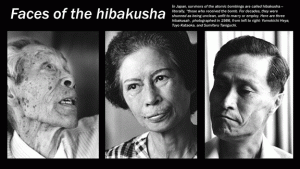 New head of A-bomb sufferers’ group strives for a world with no new hibakusha https://mainichi.jp/english/articles/20170812/p2a/00m/0na/025000c, August 13, 2017 (Mainichi Japan) “The dropping of an atomic bomb is an act decided by humans. Likewise, if humans decide to work together, we can eliminate nuclear weapons.” These were the words uttered by 77-year-old Sueichi Kido, who took over from Terumi Tanaka, 85, in June, as secretary-general of the Japan Confederation of A- and H-Bomb Sufferers Organizations after Tanaka had served in the role for 20 years.
Kido, himself an atomic bomb survivor (hibakusha), was just 5 years old when the atomic bomb was dropped on the city of Nagasaki. He was about 2 kilometers away from the hypocenter, and suffered burns to his face and upper body as a result.
The existence of hibakusha such as Kido became widely known once the press code that was in place during the Allied Occupation after World War II was lifted. He soon began to realize that he himself was a hibakusha. However, fearing discrimination, he decided not to tell people around him.
Twenty-five years after the atomic bomb was dropped on Nagasaki, Kido’s father died after bleeding from his eyes, nose and gums. Before Kido got married, he told his wife that he was a hibakusha. His wife’s older brother opposed the marriage and refused to attend the wedding.
In 1990, he attended a meeting in Gifu Prefecture aimed toward providing consultations for hibakusha, and the following year, he decided to set up a hibakusha group in the same prefecture. He came to feel that it was his duty as a hibakusha “to put his life on the line and strive toward making sure there are no more hibakusha in the future.”
In July this year, a historic treaty banning nuclear weapons was adopted — something hibakusha had wanted to see for many years. Nuclear nations and Japan are critical of the treaty, but Kido says, “There is no justice in the theory of nuclear deterrence. Nuclear nations and Japan are obviously being driven into a corner.”
To date, the Japan Confederation of A- and H-Bomb Sufferers Organizations has demanded that a clause on government compensation to people who have suffered from atomic bombs be inserted in the Atomic Bomb Survivors’ Assistance Act. As the new secretary-general of the confederation, Kido is striving toward achieving this goal.
“This clause isn’t just about atonement for the past. It is necessary in order to ensure that there are no more wars or damage involving nuclear weapons in the future,” Kido says.
August 14, 2017
Posted by Christina Macpherson |
Japan, PERSONAL STORIES, weapons and war |
1 Comment