Informal Labour, Local Citizens and the Tokyo Electric Fukushima Daiichi Nuclear Crisis: Responses to Neoliberal Disaster Management. ANU, Adam Broinowski, 7 Nov 17, “…..Conditions for Residents of Post-3.11 Radiation-Affected Areas
For roughly 30 years, the exclusion zone around Chernobyl has been set at 30 kilometres. Between 1 and 5 mSv/y is the assisted evacuation level and mandatory evacuation is 5 mSv/y and above. Unlike the approach adopted for Chernobyl, which was to achieve containment (a sarcophagus was built in eight months) and permanent resettlement of 350,000 people, the government and TEPCO have adopted a ‘dilution’ approach—to widely disperse and redistribute (‘share’) radioactive materials and waste and decontaminate residential areas. To date, this has permitted the permanent release through venting, dumping and incinerating of radioactive materials into the air, land, water and sea, and circulation in the food chain and recycled materials on a daily basis since March 2011.
Over the first few days at Fukushima Daiichi nuclear power station, severity (International Nuclear Event Scale) levels were steadily raised from level 3 to level 5 to level 7, and the mandatory evacuation zone was gradually expanded from 10 to 30 kilometres. On 16 March 2011, readings in Aizu-Wakamatsu Middle School (100 kilometres from FDNPS) in Fukushima Prefecture returned 2.57 microSv/h (microsieverts per hour),27 and Kōriyama (60 kilometres) recordings returned 3.6–3.9 microSv/h. Inside people’s homes in Kōriyama, levels were between 1.5 and 2.0 microSv/h and 8.2 microSv/h in the downpipes.28 This data was made public only three months later. On 6 April, schools in Fukushima Prefecture were reopened. As the boundaries, legal limits and information were gradually altered, populations were urged to return to work. At the same time the legal safety level for mandatory evacuation for the public (radiation safety level 1972) was raised from 1 to 20 mSv/y,29 based on a cumulative 100 mSv dose averaged over five years, suddenly shifting the parameters for ‘low-level’ radiation and designating the general public with the level previously designated to nuclear workers.
The US Government advised a mandatory evacuation zone of 50 miles (80 kilometres). Several nations’ embassies in Tokyo evacuated their staff. Of roughly 2 million in Fukushima Prefecture, about 80,000 people from 11 municipalities were ordered to evacuate while another 80,000 evacuated voluntarily. By late 2015, about 118,862 remained evacuated.30 Sixty thousand of these people live in temporary housing and many lacked basic needs. There were many evacuees who sought public housing who have been turned away.31 There are additional evacuees affected by the earthquakes and tsunami who come from other prefectures (including parts of Miyagi and Ibaraki), some of whom were also affected by radiation exposure.
The situation in many villages within contaminated areas signifies how government policies have further exposed a wide range of people—farmers, shopkeepers, taxi drivers, factory workers, mothers (as reproductive workers), school students, local public servants—to conditions informal workers have long had to endure. In several cases (i.e. Iitate, Minami Soma, Namie), the notification of residents of radiation danger was delayed and potassium iodide pills were not distributed. Similarly, data on weather patterns and distribution gathered by the SPEEDI monitoring system32 was suppressed. These populations were not adequately informed of what the dose readings meant in terms of health risk. When people did seek measurement and treatment for their likely exposures, hospitals and other institutions with the requisite measuring technologies refused to measure them, as it was deemed ‘there was no reason for internal contamination and so there was no reason to measure’.33 These people unwittingly became hibakusha (被曝者), broadly defined as victims of radiation exposure.
Even though the Fukushima Daiichi nuclear disaster has caused near-permanent pollution, the conflation of the radiation problem with tsunami and earthquake destruction to be managed as a single large-scale ‘clean-up’, reconstruction and revitalisation operation as instituted by the National Resilience Council 2013 has occluded the materiality of radiation.
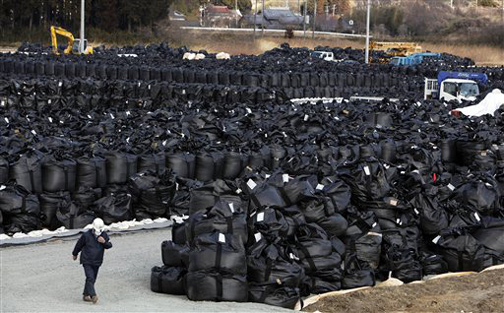
Informal workers on ‘decontamination projects’ washed down public buildings and homes and scraped up and replaced soil and sludge contaminated at levels found for example at between 84,000–446,000 Becquerels per kilogram (Bq/kg) in Kōriyama (60 km from Fukushima Daiichi).34 They also collected waste that included radioactive debris, uniforms and tools. The organic waste is stored on government-purchased land in black industrial bags piled in large walls and mounds to create a sort of buffer zone on town margins and in areas determined as long-term irradiated zones.35 Other contaminated waste is burned in newly constructed incinerators in towns nearest the plant (such as Futaba, Okuma, Naraha, Tamura, Tomioka, with more planned) in addition to the incineration already underway in major cities since 3.11, even while evacuees are being compelled to return to some of them (Tamura, Kawauchi, Naraha) where evacuation orders have been lifted. In addition, in June 2016 the Ministry of the Environment approved radioactive soil of up to 8,000 Bq/kg to be reused in national public works. Although stipulated to be used for roads and barriers (such as sea walls) under a layer of non-contaminated materials, there is concern that these will corrode over time leading to recirculation in the environment.
As compensation schemes are contingent upon where evacuees come from (whether these are areas where there are plans to lift evacuation orders, areas pending decontamination in the shorter term, or those deemed difficult to return to), those mandatory evacuees without property have received on average 100,000 yen per month while voluntary evacuees have received 60,000 yen per month, even if radiation levels in their residential areas were high.
The return to towns that received over 50 mSv/y (Futaba, Namie, Okuma) remains unlikely for decades, but if evacuees do return to other villages, they risk lifetime re-exposures of up to 20 mSv/y. In late 2015, Iitate village, for example, was divided into Areas 1 and 2, which are being prepared for repopulation (54,000 people), and Area 3, which so far remains out of bounds. Although the topsoil contaminated with Caesium was stripped and replaced (i.e. returning 0.6 microSv/h) and its houses and roads were washed down, 96 per cent of Iitate remained at 1 microSv/h. As Iitate is 75 per cent forest, which trapped a large stock of contamination, the land re-concentrates through radiation circulation (hence, quickly returned to 2.6 microSv/h).36 If the majority in Iitate, who are primarily agricultural workers, can no longer harvest vegetables, rice, wild mushrooms and vegetables (sansai 山菜) or burn wood for heat, and their houses are re-irradiated, then only the semi-autonomous elderly are likely to return. By August 2015, less than 10 per cent of roughly 14,000 eligible had applied for temporary return.37
So-called ‘decontamination’ and ‘remediation’ has been deployed to justify redefining evacuation boundaries and lifting evacuation orders so as to cut compensation payments. Following the 37th National Emergency Response Headquarters meeting held at the Prime Minister’s Office in June 2015 in which the Prime Minister decreed that ‘evacuees must return to their hometowns as quickly as possible and start new lives’,38 in late August 2015 evacuees were told if they chose to return home they would receive a one-off payment of 100,000 yen per household. If they did not, once evacuation orders had been lifted, ‘free rent’ (yachin hojo 家賃補助) for voluntary evacuees would be cut by March 2017 at the very latest.39 Further, the government announced its intention to partially lift the restriction on the ‘difficult-to-return zone’ by 2022 so as to counteract the negative image of the area and its produce.40 Without alternative income, and with a significant housing shortage due to the restriction of new public housing, many have been and will be forced to return to contaminated areas, to endure radiation exposure without compensation. If only the elderly return, there will be few prospects for young families in such towns where there is little local business and infrastructure, and public facilities and housing are in disrepair.
In Naraha, between May and August 2015, ambient readings in populated areas officially determined as ‘low or moderate’ returned 0.3–0.7 microSv/h and soil samples returned 26,480–52,500 Bq/kg of Caesium 137 and 134 combined (and 18,700 Bq/kg in the town’s water reservoir).41 While the majority of former residents are more likely to either pull down their houses and sell the land or maintain their homes as vacationers, there is additional private and state pressure to industrialise these former idylls as ‘reconstruction hubs’. As part of the ‘Innovation Coast’ plan, for example, 1,000 irregular workers have resided on the town’s outskirts as they built a giant research facility (estimated cost: 85 billion yen) to train hundreds of workers in reactor simulations and use of specialised robots. As industry colonises and transforms such towns, the pressing concern of unmitigated radiation levels in soil, forests and water, whether from distribution or recirculation, remains due to the long-lived decay and harmful effects of these radionuclides.
Similarly, in the effort to stimulate business, highways (Route 6) and train lines (Jōban line) passing directly through the (former) evacuation zone were reopened in 2015, although traffic must still travel with closed windows at the time of writing. Regular users of these corridors such as railway and transport workers and irregular nuclear workers accumulate higher doses from regular exposure while radioactive particles attached to vehicles are dispersed beyond contaminated areas. Clearly, a containment and permanent resettlement approach has been deemed untenable in the belief it would disrupt economic productivity levels. As one high school student insightfully observed, ‘Sensei … If they [really wanted to turn] Fukushima into an evacuation zone they’d have to block the Route 4 highway, Tōhoku expressway and Shinkansen’.42 Nevertheless, in lieu of overall reconstruction costs less conservatively estimated at half a trillion dollars, it may have been cheaper in the longer term to adopt permanent resettlement, education, health treatment and work creation strategies……http://press-files.anu.edu.au/downloads/press/n2335/html/ch06.xhtml?referer=2335&page=11
On the mediated surface, Fukushima Daiichi has been used to prove to the world that a nuclear disaster of significant scale can be overcome and that people can survive and return to their normal lives. The government has concentrated on proving that it is safe for the Olympics, safe for tourism, safe to consume local produce, and safe to restart nuclear reactors.
The authorities have furnished people with the means by which to normalise sickness and pathologise anxiety to justify the return to nuclear power reliance, while suppressing those who seek to resist it.
And so we return to the basic problem that no nuclear reactor can operate without radiation-exposed labour,
Informal Labour, Local Citizens and the Tokyo Electric Fukushima Daiichi Nuclear Crisis: Responses to Neoliberal Disaster Management ANU, Adam Broinowski, 8 Nov 17
Nuclear workers are important as sentinels for a broader epidemic of radiation related diseases that may affect the general population.1
The ongoing disaster at the Fukushima Daiichi nuclear power station (FDNPS), operated by Tokyo Electric Power Company (TEPCO), since 11 March 2011 can be recognised as part of a global phenomenon that has been in development over some time. This disaster occurred within a social and political shift that began in the mid-1970s and that became more acute in the early 1990s in Japan with the downturn of economic growth and greater deregulation and financialisation in the global economy. After 40 years of corporate fealty in return for lifetime contracts guaranteed by corporate unions, as tariff protections were lifted further and the workforce was increasingly casualised, those most acutely affected by a weakening welfare regime were irregular day labourers, or what we might call ‘informal labour’.
During this period, many day labourers evacuated rented rooms (doya どや) and left the various yoseba (urban day labour market よせば, or lit. ‘meeting place’) to take up communal tent living in parks and on riverbanks, where they were increasingly victimised. With independent unions having long been rendered powerless, growing numbers of unemployed, unskilled and precarious youths (freeters フリーター) alongside older, vulnerable and homeless day labourers (these groups together comprising roughly 38 per cent of the workforce in 2015)3 found themselves not only lacking insurance or industrial protection but also in many cases basic living needs. With increasing deindustrialisation and capital flight, regular public outbursts of frustration and anger from these groups have manifested since the Osaka riots of 1992.4
As Mike Davis observed, an un(der)protected informal sector in cities and industrial zones around the world occurs where there is a dilution or absence of labour rights and is characterised by ‘semi-feudal kickbacks, bribes, tribal or gang loyalties and ethnic exclusion’.5 Whether on a construction site, on the pavement, or in a domestic employment situation, informal labour comprises a surplus or reserve army of mercenary, irregular or precarious workers who pay off their debt for the opportunity to work through the availability of their cheap labour power.
In this chapter, first I outline the conditions of irregular workers at nuclear power plants and the excess burden they have borne with the rise of nuclear labour in Japan since the 1970s. I then turn to post-3.11 conditions experienced by residents in radiation-contaminated areas. Contextualising these conditions within the genealogy of radiodosimetry standards, I seek to show, through personal interviews and localised responses, how those who are regularly exposed to radiation from Fukushima Daiichi are now confronting problems similar to those faced by informal nuclear labour for decades in Japan. This analysis shows how, after 40 years or more of environmental movements as discussed in Chapter Four, the struggle continues to find viable solutions to the systemic production of the intertwined problems of environmental crises and labour exploitation, and suggests how potential alternative directions for affected populations may lie in their mutual combination………
Conclusions
From this discussion, it is evident how an advanced capitalist nation-state deploys a disposable population of informal labour to absorb the dangers inherent to the use of large-scale nuclear technologies and its private extractive and accumulation practices. Since its inception, nuclear power has been regarded by some as a symbol of Japan’s postwar civilisational progress.100 At the same time, the health of many thousands of people has been endangered in exposures to radiation while harms have been perpetrated upon local communities and nuclear workers and the environment more broadly as millions of people have been integrated within the centralising and concentrating dynamic of the transnational nuclear power industry.
On the mediated surface, Fukushima Daiichi has been used to prove to the world that a nuclear disaster of significant scale can be overcome and that people can survive and return to their normal lives. The government has concentrated on proving that it is safe for the Olympics, safe for tourism, safe to consume local produce, and safe to restart nuclear reactors (with 25 reactors expected to be supplying 20 per cent total energy by 2030). The neoliberal disaster model adopted, in which the state prioritises the profit of private corporations and their wealth-creating strategies while minimising public services and pursuing deregulation (e.g. of labour conditions), is indicated not only in the official intention to rebuild the local economy of Fukushima Prefecture, but also to expand, including through its transnational nuclear industry, Japan’s financial, military and industrial sector after Fukushima. This reflects the priority given to both the interests of the utilities, banks and construction companies involved in the reconstruction program, and those of multinational corporations, foreign governments and international regulatory and financial institutions involved in this sector.
At the same time, the sovereign duty to protect the fundamental needs of the population and reflect majority will is secondary to these priorities. Unlike a natural disaster, owing to the materiality of radiation that continues to be dumped and vented into the environment, facilitating the return to pre-disaster conditions by forgetting and rebuilding communities in contaminated areas is a practice of illusion. Despite the claims of the Abe administration and other nuclear promoters, Japan’s safety standards cannot adequately insure against the seismic activities or extreme weather events and their impacts on that archipelago. The authorities have furnished people with the means by which to normalise sickness and pathologise anxiety to justify the return to nuclear power reliance, while suppressing those who seek to resist it. The wealth of a healthy society and environment cannot be traded for the putative convenience and economic benefits of nuclear power generation as they are not comparable values. Official denial of the steady accumulation and exposure to ‘low-level’ internal radiation in a growing segment of the population only aggravates rather than protects the affected communities from the stresses related to Fukushima Daiichi. This inescapably leads to the need to address greater systemic problems that underlie such disasters.
As the previous organic life of village communities in contaminated zones is transformed into retirement villages and ad-hoc industrial hubs for temporary workers, this alienation from food, land, community, history, the human body and nature itself is a warning of the growing negative costs of the rapid expropriation and consumption of the planetary commons under a globalised system. Just as nuclear energy is not the solution to climate disruption caused by reliance on fossil fuels in a global capitalist economy, nor are radiation exposures comparable to everyday risks in modern society (i.e. transport accidents). If introducing ‘mistakes’ into the human genome is to be wagered against the daily conveniences of ‘modern’ life then this aspect of modernity is unsustainable. Although somewhat anthropocentric, it is a timely reminder that the Nobel Prize laureate (1946) Herman Müller stated in 1956, ‘the genome is the most valuable treasure of humankind. It determines the life of our descendants and the harmonious development of the future generations’.101
And so we return to the basic problem that no nuclear reactor can operate without radiation-exposed labour, particularly of informal or irregular workers. If these populations refused to work and joined in support with a network of translocal groups on informal and alternative life projects for greater self-sufficiency such as micro-financing, small-scale and permaculture farming on non-contaminated land, renewable and decentralised energy production and distribution, or campaigns for greater distribution of wealth, better public education and health improvement, these communities and workers could be active agents in devising models that could eventually become viable for adaptation to larger human populations. This application at scale cannot come too soon in the present context of imminent exhaustion of the planetary commons from the systemic demands for relentless economic growth and accumulation of wealth and power for the few.
Struggling Toshiba logs $436 mil. loss in 1st half, Japan News, 8 Nov 17After the announcement, Toshiba shares dropped 2.49 percent to ¥313 after spending most of the day hovering near the previous day’s close.
In its earnings statement, Toshiba also continued to warn the market about its “ability to continue as a going concern,” following the disastrous acquisition of U.S. nuclear energy firm Westinghouse, which racked up billions of dollars in losses before being placed in bankruptcy protection.
Those losses came to light as the group was still reeling from revelations that top executives had pressured underlings to cover up weak results for years after the 2008 global financial meltdown…..
After the announcement, Toshiba shares dropped 2.49 percent to ¥313 after spending most of the day hovering near the previous day’s close.
In its earnings statement, Toshiba also continued to warn the market about its “ability to continue as a going concern,” following the disastrous acquisition of U.S. nuclear energy firm Westinghouse, which racked up billions of dollars in losses before being placed in bankruptcy protection.
Those losses came to light as the group was still reeling from revelations that top executives had pressured underlings to cover up weak results for years after the 2008 global financial meltdown…..http://the-japan-news.com/news/article/0004057312
Frozen soil wall nearly complete; NRA still doubts effect , http://the-japan-news.com/news/article/0004052403, November 07, 2017 The Yomiuri Shimbun,A construction project to create frozen soil walls that encircle the ground beneath Tokyo Electric Power Company Holdings Inc.’s disaster-hit Fukushima No. 1 nuclear power plant is nearly finished.
Although TEPCO insists that the inflow of groundwater beneath the reactor buildings has been reduced, some members of the Nuclear Regulation Authority are skeptical about the project’s effectiveness. With ¥34.5 billion of public funds being spent on this project, the centerpeice of countermeasures for contaminated water, its cost-effectiveness is being carefully watched.
The project entails building a 1.5-kilometer-long frozen soil wall encircling the Nos. 1 to 4 reactors, with 1,568 pipes buried to a depth of about 30 meters below ground and coolant running through the pipes at minus 30 C to chill the soil.
The process is expected to prevent groundwater from flowing into the contaminated, highly radioactive underground water at such sites as the reactor buildings, and to avoid an increase of contaminated water.
The project began in March last year, and operations to freeze the final section, about seven meters wide, on the mountain side began in August this year.
The temperature of the underground soil has remained below zero, except for a part close the surface that is affected by outdoor air, meaning the project to create the 30-meter-deep walls is almost complete.
According to TEPCO’s assessment, before the project started, about 400 tons of groundwater was flowing into the ground underneath the reactor buildings and other sites daily. TEPCO had initially calculated that the daily inflow of groundwater could decrease to dozens of tons once the walls were installed. However, between April and September the inflow per day was between 120 tons and 140 tons, and in October it was around 100 tons. That the amount of inflow has decreased in stages as the soil freezing progressed seems to prove that the project has been effective to a certain extent. However, it is unclear if the inflow will decrease further in the future.
In parallel with the frozen soil wall project, TEPCO dug about 40 subdrain wells to pump up groundwater before it flows into the reactor buildings. It also reinforced measures to prevent rainwater from soaking into the ground by paving 1.33 million square meters of surface.
In the NRA view, those measures must also contribute greatly to reducing the inflow, casting doubt on the frozen soil walls project by saying the effect of them alone may be limited. The agency has become distrustful of TEPCO and urged the company to verify the effects.
Hiroshi Miyano, visiting professor at Hosei University specializing in system safety, said: “There is sure to be a part that doesn’t freeze completely, and it’s impossible to reduce the inflow to zero. TEPCO must continue applying this measure in tandem with draining the nearby wells for a while.”Speech
The comments from Nuclear Regulation Authority Chairman Toyoshi Fuketa suggest Japan may not make headway in meeting its electricity generation targets. By 2030, the country was expecting nuclear to power about one-fifth of its generation. However, utilities are having difficulty grappling with tougher rules on protecting reactors from natural disasters in the earthquake-prone country.
Following the Fukushima nuclear disaster in 2011, the world’s worst since Chernobyl in 1986, the NRA was set up in 2012 to draft new safety standards that have been described as among the world’s toughest.
Since then, 12 reactors at six nuclear plants have passed the safety requirements needed to restart, but only four reactors are currently operating. One more reactor that resumed operations after meeting the requirements has been shut down for scheduled maintenance.
Most of the approvals have been for reactors in western Japan and not on the east coast where Tokyo Electric Power Company Holdings Inc.’s Fukushima No. 1 station is located. The plant suffered multiple reactor meltdowns after an earthquake on the northeast coast caused a tsunami that swamped the site.
“We have accumulated experience in safety reviews, but comparatively speaking, many of the plants in eastern Japan that we are reviewing now have difficult natural conditions,” Fuketa, 60, said in the interview. “It’s doubtful the pace of approvals would quicken.”
A majority of Japanese oppose nuclear power after Fukushima, and restarts are a delicate political issue rather than just a matter of meeting technical safety requirements.
When asked if he could place a number of how many reactors may be approved for a resumption of operations in the next five years, Fuketa said: “I honestly do not know.”
About a dozen other reactors are going through safety checks as part of a relicensing process under the new rules.
Fuketa is known for taking tough positions during safety reviews of reactors and has been instrumental in directing the clean-up of the wrecked Fukushima plant.
The government set an energy mix plan in 2015 that forecasts relying on nuclear power to generate between 20 to 22 percent of the country’s electricity in 2030. That requires having about 30 reactors operating by then.
The nation’s nine regional power utilities and a wholesaler, Japan Atomic Power Co., have 42 nuclear reactors for commercial use, with a total generating capacity of 41,482 megawatts.
Three reasons why Japan will likely continue to reject nuclear weapons, WP, By Mike MochizukiNovember 6 President Trump is visiting Tokyo on Monday at a time of renewed national security debates within Japan. North Korea’s recent missile launches and nuclear tests have again prompted discussion in Tokyo on Japan’s policy against becoming a nuclear state.
Although Japan has long had the technical ability to develop nuclear weapons — its “nuclear hedge” — it has refrained from doing so. Japan instead remains firmly committed to its 1967 Three Non-Nuclear Principles of not developing, not possessing and not introducing nuclear weapons.
This is not the first time that Japan has reexamined those principles. Similar debates transpired after China’s hydrogen bomb test in 1967, the Soviet Union’s deployment of medium-range nuclear missiles in Siberia during the 1980s and North Korea’s first nuclear test in 2006.
Is this time different? Reacting to North Korea’s threatening behavior, former Japanese defense minister Shigeru Ishiba stated in September that Japan should at least debate the decision not to permit the introduction of nuclear weapons on Japanese territory. Ishiba implied that Tokyo should consider asking Washington to deploy tactical nuclear weapons in Japan.
This latest debate is likely to end in the same way as previous debates, however. Japan will continue to adhere to its Three Non-Nuclear Principles and forswear nuclear weapons. Here are three reasons for that:
1) Staying non-nuclear is part of Japan’s national identity
The Three Non-Nuclear Principles are a clear part of Japan’s national identity, not simply a policy preference. Repeated polls indicate overwhelming popular support for the three principles in Japan. A 2014 Asahi newspaper poll revealed that support for the principles had risen to 82 percent, compared with 78 percent in a 1988 poll. Despite growing concerns about North Korea’s nuclear program and China’s military power during this period, Japanese support for remaining non-nuclear actually increased…….
2) Powerful players in Japanese politics can block nuclear acquisition
In addition to public opposition to nuclear weapons, Japan has significant “veto players” — crucial political or economic actors that are likely to block efforts to develop nuclear weapons.
Japan has a robust nuclear energy industry. But public acceptance of nuclear energy in the 1950s resulted from a fundamental political bargain: nuclear energy, but no nuclear weapons……
3) Japan has good national security reasons to stay non-nuclear
There’s also a realist security calculation to consider. North Korean nuclearization is alarming, but it does not pose such an acute danger that Japanese leaders will be motivated to pay the high political costs necessary to weaken, much less revoke, the Three Non-Nuclear Principles.
North Korea acquiring the ability to deliver a nuclear weapon against the United States may weaken the protective U.S. nuclear umbrella somewhat, but U.S. nuclear and conventional military capabilities should be adequate to deter a North Korean nuclear attack on Japan……
40,000 protest Abe’s plans to revise Article 9 of Constitution http://www.asahi.com/ajw/articles/AJ201711040033.htm, By HIROTAKA KOJO/ Staff Writer,November 4, 2017About 40,000 people, including political party leaders, protested Prime Minister Shinzo Abe’s constitutional revision plans in front of the Diet building on Nov. 3, the 71st anniversary of the promulgation of the Constitution, organizers said.
Shouts of, “We are opposed to revising the Constitution” and “Protect Article 9,” echoed throughout the area in central Tokyo.
Participants at the rally, organized by a civic group, included Yukio Edano, head of the main opposition Constitutional Democratic Party of Japan, Kazuo Shii, chairman of the Japanese Communist Party, and Akira Kawasaki, a member of the International Steering Group of the International Campaign to Abolish Nuclear Weapons (ICAN), which won the Nobel Peace Prize this year.
The Abe administration plans to add wording to war-renouncing Article 9, which prohibits Japan from maintaining land, sea and air forces, to clarify the existence of the Self-Defense Forces.
Yuko Minami, a 30-year-old nursery school teacher from Fujimi, Saitama Prefecture, joined the protest with her workplace colleagues.
“First of all, I want the government to improve the environment for child-rearing,” she said. “But (the Abe administration) is going in the opposite direction by trying to revise Article 9.”
Another protester was Naoya Nakagawa, 90, a former university professor from Machida, western Tokyo.
“The current Constitution is the best in the world,” he said. “In order to keep it as it is, we have to change the politics that are trying to change the Constitution.”
Better than none, but how long do people have to stay in those temporary?
But even better would be to stop nuke.
Nobody can ever be fully protected when a nuclear reactor goes wrong, and expect it soon or later to go wrong, and most certainly in a country with many volcanos and earthquakes as Japan.
Nuclear safety is an oxymoron for the morons who believe it.
Clean air domes for evacuees to be introduced in Ikata, Ehime Prefecture, in the event of a nuclear disaster
IKATA, Ehime Prefecture–A nuclear power plant operator is readying folding domes here to provide shelter for up to 600 evacuees in the event of a nuclear accident.
Shikoku Electric Power Co. said Oct. 24 that it plans to install eight clean air domes at Ikata’s three evacuation centers west of the town’s nuclear power plant to protect residents from radiation.
The special shelters are expected to cost a total of 200 million yen ($1.76 million) and will be introduced by June next year.
It will be the first time for a power company to set up evacuation clean air domes in municipalities that are home to nuclear power plants, according to Shikoku Electric, although municipalities and other parties in Fukui Prefecture own such domes themselves.
The Ikata plant is situated at the root of the Sadamisaki Peninsula, which stretches east to west. Because 4,700 people live to the west of the plant, a big challenge is how to evacuate them when roads are blocked in a disaster.
In April, Shikoku Electric started considering introducing air domes to protect evacuees at temporary shelters in Ikata and began talks with Ehime Prefecture and Ikata town in late August to discuss the domes’ installation locations and total capacity as well as other topics.
The planned air domes will be made of polyester and measure 10 meters wide, 4 meters high, and 15 to 25 meters long. They will be equipped with air cleaning units that can remove more than 99 percent of radioactive materials such as cesium and iodine.
As evacuees are expected to stay in the domes for a week, they will also be furnished with toilets.
The domes can be folded into small sheets when stored, and four people can set one up in an hour, according to Shikoku Electric officials.
While three domes with a total capacity of 250 people will be introduced at the Seto Sogo gymnasium, three domes for 250 people and two domes for 100 people will also be deployed to the Misaki Sogo gymnasium and the gymnasium for Misaki elementary and junior high schools, respectively.
Those anti-radiation domes are to be set up inside the gymnasium buildings at the time of a nuclear crisis.
Maintenance and installation of the domes will be conducted by Shikoku Electric, whereas water, food and daily commodities for evacuees will be supplied by the town government.
Although the operations of the No. 2 reactor at the Ikata plant have been suspended, Koichi Tamagawa, an executive vice president of Shikoku Electric who is in charge of the Nuclear Power Division, on Oct. 24 reaffirmed the company’s intention to decide whether to restart the reactor by the end of this fiscal year.
Forbes 30th Oct 2017, Fukushima City is 50 miles northeast of the Fukushima-Daiichi Power Plant, so the radiation levels have been lower there than in the restricted areas, now reopening, that are closer to the plant. Hayama was unable to test monkeys in the most-contaminated areas, but even 50 miles from the plant,he has documented effects in monkeys that are associated with radiation.
He compared his findings to monkeys in the same area before 2011 and to a control population of monkeys in Shimokita Peninsula, 500 miles to the north. Hayama’s findings have been published in the peer-reviewed journal Scientific Reports, published by Nature.
Among his findings: Smaller Bodies — Japanese monkeys born in the path of fallout from the Fukushima meltdown weigh less for their height than monkeys born in the same area before the March, 2011 disaster, Hayama said. “We can see that the monkeys born from mothers who were exposed are showing low body weight in relation to their height, so they are smaller,” he said.
Smaller Heads And Brains — The exposed monkeys have smaller bodies overall, and their heads and
brains are smaller still. “We know from the example of Hiroshima and Nagasaki that embryos and fetuses exposed in utero resulted in low birth weight and also in microcephaly, where the brain failed to develop adequately and head size was small, so we are trying to confirm whether this also is happening with the monkeys in Fukushima,” Hayama said.
Asia Times 30th Oct 2017, Shaun Burnie: The global nuclear industry developed over the past fifty
years dependent upon vast quantities of steel components supplied by a relatively small number of specialized manufacturers. One of them is Kobe Steel Ltd.
The steelmaker, a pillar of corporate Japan, is embroiled in the early days of disclosure of falsification of steel manufacturing data that extends to products used in planes and trains, to motor vehicles and spacecraft.
And nuclear power plants. Kobe Steel and its broad collection of subsidiaries have supplied products to the nuclear industry both in Japan and around the world since the 1960’s. It’s a fair bet that every one of the 60 nuclear reactors operated in Japan since 1966 had some component supplied by Kobe Steel. http://www.atimes.com/article/nuclear-tentacles-kobe-steel/
The government’s new radioactive waste storage facility in Fukushima Prefecture kicked into full gear on Saturday after completing a roughly four-month trial run.
While the facility near the crippled Fukushima No. 1 nuclear complex is designed to store soil and other tainted waste collected during decontamination work for up to 30 years, it remains only half complete six years after the triple core meltdown struck in March 2011.
An estimated 22 million cu. meters of contaminated waste exists in Fukushima, but the facility does not yet have enough capacity to store it all, and residents fear it will sit there permanently in the absence of a final disposal site.
The government has been able to buy only 40 percent of the land so far but eventually plans to secure 1,600 hectares for the facility, which is expected to generate ¥1.6 trillion ($14.1 billion) in construction and related costs.
The storage facility is urgently needed to consolidate the 13 million cu. meters of radioactive waste scattered around the prefecture. The prolonged disposal work, among other concerns, is said to be keeping residents away from their hometowns even when the evacuation orders are lifted.
Also on Saturday, the government began full operation of a facility where waste intended for incineration, such as trees and plants, is separated from the rest.
Contaminated soil is sorted into different categories depending on cesium level before storage.
Operator set to request 20 years extra for Tokai nuclear plant http://www.asahi.com/ajw/articles/AJ201710270036.html, THE ASAHI SHIMBUN, October 27, 2017 Japan Atomic Power Co. is preparing to apply for a 20-year extension to operate the aged Tokai No. 2 nuclear plant beyond its 40-year life span, sources said.
Such an extension would be the first among Japan’s aged boiling-water reactors, which include those at the crippled Fukushima No. 1 nuclear power plant.
Tokai No. 2 nuclear plant’s reactor, which went into service in 1978, is in a heavily populated area not far from Tokyo.
The company deems the 20-year extension of the plant in Tokai, Ibaraki Prefecture, as imperative to securing a stable revenue stream, the sources said.
However, the plan is expected to bring a host of challenges to the operator.
One is how to secure funds so as to cover the costs to improve safety at the old facility required under the more stringent nuclear regulations set after the 2011 Fukushima disaster.
Another is to ease concerns of local governments of the area where nearly 1 million residents could be affected in the event of a serious accident.
The move toward the extension comes as the Nuclear Regulation Authority is set to rule that the plant has met standards set in the new regulations necessary for a restart, the sources said.
The Tokai No. 2 plant, about 120 kilometers from the heart of the capital, houses one unit capable of generating 1.1 gigawatts.
If Japan Atomic Power proceeds with its plan to apply for the extension, it needs to submit the application to the NRA by Nov. 28.
The Tokai No. 2 plant narrowly escaped a catastrophe like the one at the Fukushima No. 1 nuclear plant when it was struck by the magnitude-9.0 Great East Japan Earthquake and tsunami on March 11, 2011.
It took Japan Atomic Power three and a half days to shut the reactor down when the disaster knocked out power. One of the three emergency generators installed there became dysfunctional after they were submerged by tsunami.
Some experts said it could have become impossible to keep cooling the reactor if the tsunami had been 70 centimeters higher.
Japan Atomic Power is keen to extend the operation of the Tokai No. 2 nuclear plant as the facility is the only venue that will feasibly bring it revenue. It has no option but to apply for the extended operation,” said an official familiar with the management of the company.
Apart from the Tokai No. 2 nuclear plant, Japan Atomic Power owns three other reactors: one at the Tokai nuclear plant, also in Tokai, and two at the Tsuruga nuclear plant in Tsuruga, Fukui Prefecture.
The one at the Tokai nuclear plant and one unit at the Tsuruga nuclear plant are on their way to being decommissioned.
Prospects for whether the company can win approval for a restart of the remaining reactor at the Tsuruga nuclear plant are bleak, as it has been reported that the facility was likely built on an active seismic fault.
If the company pulled the plug on the Tokai No. 2 nuclear plant, it would mean that it would be left with no revenue sources.
That expected management crisis could likely affect the bottom line of utilities such Tokyo Electric Power Co., the operator of the Fukushima No. 1 nuclear plant, which has a stake in Japan Atomic Power.
The Tokai No. 2 nuclear plant supplies power to TEPCO and Tohoku Electric Power Co., and although extending its operation would keep those revenue sources open, it would also come with a huge price tag.
The company said Oct. 26 that the estimated costs of the safeguarding measures for a restart of the plant will balloon to about 180 billion yen ($1.58 billion), more than double the 78 billion yen projected initially.
The total sum is expected to further increase if Japan Atomic Power chooses to operate the plant beyond the 40-year limit, according to the sources.
The plant’s extended operation could prove to be a big headache for local governments nearby.
Municipalities within a 30-kilometer radius are required to draw up evacuation plans to prepare for a contingency in the post-Fukushima crisis years.
Hammering out workable plans for close to 1 million residents in the area is expected to be difficult, the sources said.
Even the Ministry of Economy, Trade and Industry, which oversees the nuclear industry, is cautious about the extension.
“The consequences would be too enormous if an accident did occur,” said a ministry official.
(This story was written by Tsuneo Sasai and Yusuke Ogawa.)
Kobe Steel sent products with tampered data to nuclear companies, Cars, trains, planes … and nuclear facilities. REUTERS, Oct 27th 2017 TOKYO— Kobe Steel supplied parts with false specifications for nuclear equipment owned by Japan Nuclear Fuel Ltd, JNFL said on Friday, adding that the products were not used.
The parts were destined for use in centrifuges to enrich uranium, a JNFL spokesman said by phone. Citing security reasons, he declined to provide further details.
Kobe Steel has not told JNFL whether there are any safety issues with the parts, the spokesman said.
A Kobe Steel spokesman confirmed the firm fabricated data about specialized coatings used on the parts and had not identified any safety issues.
JNFL is the second company in the nuclear power industry to receive components affected by the steelmaker’s data tampering.
Tokyo Electric Power Co said this month it had taken delivery of pipes from Kobe Steel that were not checked properly.
Japan’s atomic regulator has asked nuclear operators to check whether they are using Kobe Steel products at nuclear plants, it said on Wednesday, adding it had received no reports that Kobe Steel’s data tampering scandal had affected safety.
No deadline has been given for nuclear operators to report back to the Nuclear Regulation Authority, a spokesman said by phone on Friday.
The unfolding data tampering scandal has spread from Kobe Steel’s copper and aluminum business to most areas of the company and sent companies at the end of complex supply chains across the world scrambling to check whether the safety or performance of their products has been compromised.
While no safety issues have been identified, Japan’s third-largest steelmaker is likely to face claims for replacement parts and other costs.
Kawasaki Heavy Industries Ltd would ask Kobe Steel to cover any costs for replacement of parts or other expenses related to the data tampering, President Yoshinori Kanehana told reporters on Friday at an earnings briefing…….
Kobe Steel said on Thursday 88 out of 525 affected customers had yet to confirm its products were safe in the light of widespread tampering of specifications, but that it had not received any requests for recalls.
Hiroshima Survivor Setsuko Thurlow Recalls U.S. Bombing
‘We learned how to step over the dead bodies’: Setsuko Thurlow, 85, was 13 when she survived the attack. She has spent her life since campaigning against nuclear weapons Setsuko Thurlow will be in Oslo, Norway, on Dec. 10 to jointly accept the 2017 Nobel Peace Prize on behalf of this year’s laureate, the International Campaign to Abolish Nuclear Weapons (ICAN).
The 85-year-old Toronto resident is a Hibakusha — a survivor of the atomic attacks on Japan in 1945. Her hometown of Hiroshima was destroyed by the Americans on August 6, 1945.
Thurlow’s sister, burned and bloated from the blast, lived for four days afterwards. When she spoke, what she expressed was a mother’s guilt: Her child had been badly burned. How could she have let it happen?
“It’s not easy to carry these memories,” Thurlow says. “We learned how to step over the dead bodies.” She recalls feeling numb. She couldn’t cry. All she could do was watch, as Japanese soldiers tossed the lifeless bodies of her sister, Ayako, and her four-year-old nephew, Eiji, into a shallow grave, dousing them with gasoline, throwing in a match. Thurlow was 13.
She has spent much of her life since campaigning against nuclear weapons.
Her weapon is her words — and her resolve to keep telling the story. Thurlow sat down with the National Post at her home in Toronto.
Greenpeace 25th Oct 2017, Japan’s nuclear regulator must take urgent action to launch a
comprehensive investigation into the supply and widespread use of
potentially flawed Kobe Steel products in the Japanese nuclear industry,
Greenpeace and five other NGOs demanded today.
The groups submittedanalysis of Kobe Steel’s supply chain to the nuclear industry together
with a demand letter to The Nuclear Regulation Authority (NRA) commissioner
Toyoshi Fuketa on 24 October. http://www.greenpeace.org/japan/ja/news/press/2017/pr201710251/