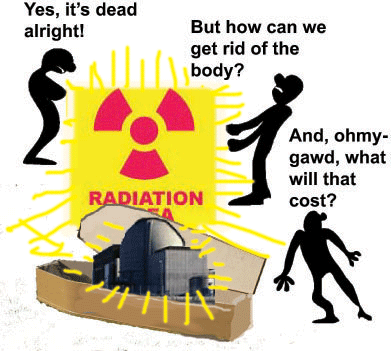
How long will treated water be stored at Fukushima nuclear plant?Japan News, March 09, 2018, The Yomiuri ShimbunSteadily progressing with the decommissioning of the reactors at Tokyo Electric Power Company Holdings, Inc.’s Fukushima No. 1 nuclear power plant will accelerate Fukushima Prefecture’s recovery. TEPCO must make safety the top priority when doing this work.
According to a schedule drawn up by the government and TEPCO, fuel from reactor No. 3’s spent nuclear fuel pool is slated to be removed in fiscal 2018. Equipment necessary for this work is already in place.
The large volume of nuclear fuel should not be kept inside the heavily damaged reactor. It is vital to reduce the risks posed by this fuel.
The schedule stipulates that the method for removing molten nuclear fuel from Nos. 1, 2 and 3 reactors — which suffered meltdowns — will be decided in fiscal 2019. To accomplish this, it also will be necessary to more precisely gauge the extent of the damage to the nuclear reactors and the levels of radioactive contamination.
In January, a camera sent in from the side of reactor No. 2 captured images of sediment that appears to be melted fuel at the bottom of the reactor. Moving forward, it is essential to retrieve some of this fuel to confirm its exact condition. …….
the “frozen soil wall” — constructed at a cost of ¥34.5 billion from government coffers — has had some effect in preventing water from seeping into the buildings. The underground wall freezes soil in a perimeter around the building and prevents groundwater from flowing through. The volume of contaminated water generated has declined from about 500 tons per day to about 150 tons. ……..
The frozen soil wall was expected to be a trump card for reducing the volume of contaminated water. While it cannot be counted on to be quite so effective, the government’s Committee on Countermeasures for Contaminated Water Treatment, a panel of experts, on Wednesday positively assessed the overall effort, saying, “A groundwater management system has been constructed.” It is vital to have multiple measures in place to prevent water contamination.
Yet challenges still abound. The committee pointed to the difficulties in dealing with heavy rain at the nuclear plant. Rainfall causes the volume of contaminated water to surge. Efforts to prevent rain from entering through damaged sections of the buildings and through drains must be sped up.
Contaminated water at the plant is treated and all radioactive materials, except tritium, are removed. What to do with this treated water also is a knotty problem. At other nuclear power facilities, treated water is released into the sea in accordance with discharge standards. About 850,000 tons of such water is being stored in tanks on the Fukushima nuclear plant grounds.
At some point, there will be no more room for new tanks. Nuclear Regulation Authority Chairman Toyoshi Fuketa has repeatedly said, “There is no option but to dilute the water and release it into the sea.” The government and TEPCO should not put off making a decision.
They will also need to take steps to thoroughly prevent harmful rumors from spreading, such as by ensuring that the safety of this process is widely known. http://the-japan-news.com/news/article/0004293218
On the seventh anniversary of the 2011 earthquake, tsunami and Fukushima nuclear accident, our thoughts and deepest sympathies continue to be with the people of Japan.
Every one of the tens of thousands evacuees from the 2011 Fukushima Daiichi triple reactor meltdown has a story to tell.
In our latest radiation survey we had the privilege to hear the experience of Mrs Mizue Kanno. As we entered the exclusion zone of Namie, Ms Kanno told us of the events seven years ago that were to change her life, her family and those of thousands of others.
Mrs Kanno was a social worker in Futaba less than 10 km from the nuclear plant. Eventually she made her way home after the devastating earthquake, and over the next few days thousands of people were evacuated to her home district of Tsushima. Families moved into her home. But soon they were warned by men in gas masks and protective clothing to get out immediately. The radioactive fallout from the nuclear plant, about 32 km away, had deposited high levels of contamination in this mountainous area of Namie.
Mrs Kanno now lives in western Japan, many hundreds of kilometres from her home in Fukushima. While she is a victim of nuclear power, she isn’t passive observer – instead she’s a female activist determined to tell her story. She campaigns across the Kansai region against nuclear power and for renewable energy.
Like thousands of other evacuees, she has joined lawsuits filed against the Tokyo Electric Power Company (TEPCO), and the Japanese government. Already found guiltyin multiple court proceedings of being criminally negligent in failing to take measures to prevent the meltdown, TEPCO and the government can expect many more rulings against them.
Because of the support of Mrs Kanno and her friends and neighbours, Greenpeace has been able to conduct a wide ranging survey inside the exclusion zone of Namie, published in our report, Reflecting in Fukushima.
While our survey report is filled with microsieverts and millisieverts, it’s far more about the lives and the land of Mrs Kanno her family, friends and neighbours.
Measuring thousands of points around homes, forests and farmland, it’s clear that this is an area that should not be opened to the public for many decades. Yet the government opened a main artery, route 114, while we were working in Namie.
One consequence is that people are stopping off and visiting areas high in radiation. At one house, radiation hot spots were over 11 microsieverts per hour (μSv/h) at one meter, and 137μSv/hat 10 centimetres. These levels are thousands of times the background level before the nuclear accident, and mean you’d reach your recommended maximum annual exposure in six days.
Yet, two people were working 10 meters away from the hot spot with no dosimeters or protective clothing. Mrs Kanno and our radiation specialists explained the levels of contamination and why it was necessary to take precautions.
In one zone in Obori, we measured radiation that would expose a decontamination worker to the 1 mSv/y limit in just 10 working days. The whole area is contaminated to varying high levels that will remain a threat into next century. How could the government be thinking of opening this area as early as 2023? More importantly, why?
It’s actually simple and wholly cynical. The Japanese government is desperate to restart nuclear reactors. Today only three are operating. Having areas of Japan closed to human habitation because of radioactive contamination is a very major obstacle to the government’s ambitions to operate 30-35 nuclear reactors. It’s a constant reminder to the people of Japan of the risks and consequences of nuclear power.
Yet, there are signs of positive change. Last month a panel of experts established by the Foreign Minister called for a mass scaling up of renewables, and warned of the risks from depending on coal plants and nuclear power. The voices of Mrs Kanno, the other thousands of Fukushima evacuees and the majority of people in Japan, and their demand for a different energy future, will be heard.
Throughout our time in Namie, as we visited the highly contaminated area of Obori and Tsushima – quiet, remote areas of natural beauty – Mrs Kanno told us about the life and traditions of families who for generations had supported themselves by farming. Now all of them are displaced and scattered across Japan. Yet the government is failing to even acknowledge their rights under domestic and international human rights law.
This week, we will be traveling to Geneva with mothers who are evacuees from Fukushima to the United Nations Human Rights Council session on Japan. The Japanese government has been under pressure to stop its violations of the human rights of Fukushima evacuees. Last week it accepted all recommendations at the UN to respect the human rights of Fukushima citizens. This included the German government recommendation to restore to a maximum annual public exposure of 1 mSv. This global safety standard has been abandoned by the Abe government.
The government’s decision is important, but now they need to be implemented if they are genuine in their commitments to the United Nations. On the 16 March this year, Mrs Kanno and other evacuees and their lawyers will attend the Tokyo high court for a ruling on Fukushima against TEPCO and the Government. One of the evacuee mothers, Akiko Morimatsu, together with Greenpeace, on the same day will speak at the United Nations to challenge the Japanese government to now fully apply the UN recommendations.
While we will be thousands of kilometers apart, we will be with Mrs Kanno on her day in court in Tokyo and she will be with us in Geneva. The Fukushima nuclear disaster has shattered lives but it has also brought us together determined to prevent such a terrible event from ever happening again and to transition Japan to a secure and safe energy future based on renewables.
Kazue Suzuki is an Energy Campaigner at Greenpeace Japan and Shaun Burnie is a Senior Nuclear Specialist at Greenpeace Germany
“The nuclear disaster was not a natural disaster, it was a very man-made disaster,” Watanabe says. “So we felt that there was now a need for clean energy and greater energy independence.”
“It was at that symposium that I started to really think about the need for an energy shift away from nuclear power and about how rich the prefecture of Fukushima is in renewable resources,” Sato says.
“Nuclear power companies are not prepared for the cost of decommissioning and could in some cases go bankrupt. Banks and pension funds have lent them a lot of money because they have been regarded as stable, so bankruptcies could become a national financial problem. This would be difficult for the government to handle and might directly hurt pensioners,” he says. “But now the government is just hiding the problem and postponing managing it.”
Fukushima looks to renewable energy sources in the aftermath of nuclear disaster, Japan Times, BYKAJSA SKARSGÅRD ,
Yauemon Sato | CHRISTINA SJOGREN11 Mar 18,
Steam rises from outdoor pools overlooking a waterfall at a 90-year-old hotel in Fukushima Prefecture’s Tsuchiyu Onsen.
“What has saved us since the disaster are the loyal regular guests and the new visitors who have come to study our town’s renewable energy plant. Without them, I’m sure we would have had to close,” says Izumi Watanabe, who has been director of Sansuiso Tsuchiyu Spa for 37 years.
“People come from other onsen areas all over Japan to learn how they can become energy independent and how the binary plant we have doesn’t affect our hot springs,” she says, challenging the preconception that onsen communities, fearing a negative impact on their tourism business, typically hold back the development of geothermal energy in Japan.
Watanabe was at a meeting in the city of Fukushima when the Great East Japan Earthquake struck seven years ago. She returned to Tsuchiyu Onsen to find her hotel intact, but two other hotels in the area damaged and the entire community without power.
or three snowy days, Watanabe sheltered 70 of her own and other hotels’ guests without electricity, telephones or working internet. Gathered together, they ate whatever stored food they could find. Over the next six months, her spa served as accommodation for police and rescue workers, grieving families and people displaced by the tsunami and nuclear crisis.
In total, this town of about 340 residents took in around 1,000 evacuees after the 2011 disasters. Five of the 16 hotels in Tsuchiyu Onsen have since gone out of business: two as a result of earthquake damage, the others on the back of a decline in visitor numbers from approximately 230,000 a year to about 70,000 as rumors of elevated radiation levels swirled. Members of the local community gathered together in October 2011 to discuss their future at what was dubbed the “Tsuchiyu Onsen reconstruction conference.” The locals decided they couldn’t simply go back to doing what they had done before — something new was needed to revive the town and create a safer future.
“The nuclear disaster was not a natural disaster, it was a very man-made disaster,” Watanabe says. “So we felt that there was now a need for clean energy and greater energy independence.”
A renewable energy plant and shrimp farm……….
A local, national concern
An hour’s drive inland, past Mount Adatara and Mount Bandai in the city of Aizu-Wakamatsu, people also started organizing after the nuclear disaster. In July 2011, around 200 people met in the sake brewery owned by Yauemon Sato, a ninth-generation brewer, to discuss the disaster and the future.
“It was at that symposium that I started to really think about the need for an energy shift away from nuclear power and about how rich the prefecture of Fukushima is in renewable resources,” Sato says.
Sato had no background in electricity production, but he did have experience in trying to get small breweries into markets dominated by larger manufacturers. He took one of the leading roles in the growing community power movement.
With the help of the Institute for Sustainable Energy Policies, which had also worked to promote locally owned renewable electricity production before the disaster, Aizu Electric Power Co. was established to manage the planned solar parks.
Today, the company has 70 solar power sites and Sato has become a vocal critic of the large nuclear- and fossil-fuel companies that control the grid through regional monopolies, thereby hindering the new renewable energy companies from getting into the market.
The monopolies argue that they are protecting the stability of the grid, so at present newcomers in some regions can only connect a maximum voltage of 50 kilowatts onto the network.
“This is a severe problem,” Sato says. “In 2020, the government is going to separate the power transmission business from the power production business, but these big electric companies are creating sister companies to run the grid, so it will still be in the control of the same big companies and continue to be difficult for other producers to use.”
The Aizu region is where shogun Tokugawa Yoshinobu’s rebels fought one of the last big battles against government troops in 1868. The people’s rights movement flourished here after the civil war. It matters here that it is the people of Fukushima who have paid the ultimate price for the nuclear power that was sold mainly to Tokyo.
Aizu Electrical Power Co., its logo a fist held up in the air over the letters AiPower, is challenging the electricity establishment of Japan, and is part of a bigger movement.
The first World Community Power Conference was held in the city of Fukushima in November 2016 on the same day as the Paris climate accord came into force. One of the organizers was the Japan Community Power Association, in which Sato is a board member. He is also the vice president of Genjiren, an anti-nuclear power association that, with the help of the former prime ministers Junichiro Koizumi and Morihiro Hosokawa, pitched a bill to the opposition parties in January calling for an immediate halt to nuclear power, together with a more ambitious national goal for renewables.
“Finally I feel that we have a political movement for an energy shift,” Sato says. “We want to make this a national citizens’ movement.”
Unsustainable politics defied
The grass-roots movement pushing for renewables is not alone. Both at home and abroad, the Japanese government has been criticized for failing to embrace broader renewable energy policies in the wake of the 2011 disasters while remaining open to the construction of additional coal plants and nuclear reactor restarts.
……… Tomas Kaberger, executive board chairman of the Renewable Energy Institute in Tokyo. believes the government is willing to restart more reactors because it fears the financial consequences of failing to do so. The reactors are valuable for the balance sheets of the power companies, but in reality they represent a significant decommissioning liability.“Nuclear power companies are not prepared for the cost of decommissioning and could in some cases go bankrupt. Banks and pension funds have lent them a lot of money because they have been regarded as stable, so bankruptcies could become a national financial problem. This would be difficult for the government to handle and might directly hurt pensioners,” he says. “But now the government is just hiding the problem and postponing managing it.”…….https://www.japantimes.co.jp/life/2018/03/10/environment/fukushima-looks-renewable-energy-sources-aftermath-nuclear-disaster/#.WqWVhx1ubGg
Abe celebrates Fukushima highway http://www.the-japan-news.com/news/article/0004295825, March 10, 2018 Fukushima (Jiji Press)— Prime Minister Shinzo Abe attended on Saturday the opening ceremony of a section of a highway in Fukushima Prefecture being promoted as a state project to support reconstruction from the March 2011 disaster.
Referring to the targeted completion of the Soma-Fukushima highway in fiscal 2020, when the Tokyo Olympic and Paralympic Games will be held, Abe said, “I hope people from around the world will use this highway and experience a reconstructed Fukushima.”
Of the 45-kilometer Soma-Fukushima highway, a 17-kilometer section linking the Fukushima cities of Soma and Date opened on Saturday
Safecast operates using measurements captured by volunteers. Data is verified and validated when two randomly selected people take the same measurement of the same place. Safecast’s reliable system means local people could count on its data and stay informed. Around 3,000 Safecast devices are deployed worldwide, and 100 to 150 volunteers regularly contribute their time and effort to the project.
As Safecast’s power and influence in society — both inside and outside of Japan — expanded, so did its technologies.
“We are a pro-data group, we are not an activist group,”
Back in 2011, soon after the 3/11 disaster, Safecast was born. Today, the global volunteer-centered citizen science organization is home to the world’s largest open data set of radiation measurements.
Safecast was a response to the lack of publicly available, accurate and trustworthy radiation information. The group initially set out to collect radiation measurements from many sources and put them on a single website. What the volunteers quickly realized was that there was simply not enough official data available.
Soon after the disaster, members attached a homemade Geiger counter to the side of their car and drove around Fukushima taking measurements. They quickly noticed that radiation levels were radically different even between streets, and that the government-issued city averages were far from sufficient as data that could be used by citizens to determine the safety of their areas.
Within weeks the group’s members decided to build their own Geiger counters and collect the data themselves. They picked the name Safecast the following month.
For months after the nuclear disaster began, the government released only very limited information about the spread of radiation. The first informative map of radiation levels in Fukushima, based on aerial surveys, was not available until May 2011. The first map with an adequate level of detail to show contamination in the Tokyo metropolitan area, including infamous “hot spots” in cities such as Kashiwa, Chiba Prefecture, was not released until October that year. As confusion spread and triggered panic among citizens, Safecast was determined to commit itself to one thing: openness. “What Safecast proves is that all the preparation in the world — all the money in the world — still fails if you don’t have a rapid, agile, resilient system,” explains Joi Ito, Safecast co-founder and director of MIT Media Lab, on Safecast’s website.
In 2012, Safecast began working with municipal governments in Fukushima to put Geiger counters on postal delivery cars and collect data. As international attention on the group’s activities grew, Safecast was invited to present its findings at an expert meeting at the International Atomic Energy Agency in February 2014.
Safecast operates using measurements captured by volunteers. Data is verified and validated when two randomly selected people take the same measurement of the same place. Safecast’s reliable system means local people could count on its data and stay informed. Around 3,000 Safecast devices are deployed worldwide, and 100 to 150 volunteers regularly contribute their time and effort to the project. “How do you make a trustworthy system where the people don’t have to trust each other?” Azby Brown, Safecast’s lead researcher, asked during a recent interview at its Shibuya office.
As Safecast’s power and influence in society — both inside and outside of Japan — expanded, so did its technologies. The group’s first mobile device, named “bGeigie” with b standing for bento (boxed lunch), was built and deployed in April 2011. The first of these needed to be tethered to a laptop for data collection. But the group soon developed all-in-one devices. They were gradually shrunk, and the “bGeigie Nano” sold as a kit is now the organization’s main machine. It’s compact and able to accumulate all of the data it captures onto a memory card.
In December, Safecast members were given a special tour of Tokyo Electric Power Co. Holdings’ gutted Fukushima No. 1 nuclear power plant. The operator allowed them, for the first time ever, to bring their sensors on site and openly measure radiation there during the hourlong tour, with the clear understanding that they would publish the data and radiation maps openly online. “We consider it an important step towards transparency on Tepco’s part,” Brown said in an email. Then in January, Safecast managed to install a “Solarcast Nano,” a solar-powered real-time radiation monitor, on the fence of an abandoned facility for the elderly about 2 km from Fukushima No. 1. It is the closest independent real-time data-collection point to the crippled plant. Over the years, the group has collected over 90 million data points worldwide. Each data point comes with a string of data containing the time, GPS coordinates and a radiation measurement.
It’s been seven years since the devastating earthquake and tsunami, and the subsequent meltdown of the nuclear power plant, so why is Safecast’s work still relevant today?
“We are a pro-data group, we are not an activist group,” said Pieter Franken, another Safecast founding member. Safecast is constantly supplying local people with up-to-date information on radiation conditions, allowing them to make crucial decisions such as where and when evacuees can move back. Many locals are also volunteers, motivated by their emotional attachment to the area and determined to do their part in rebuilding their hometown, the group said.
While most of Safecast’s volunteers in Japan are Japanese who wanted to help out as much and as quickly as they could with the skills that were available, the unique composition of the group’s core members — many of whom are non-Japanese and hailing from diverse academic and professional backgrounds — has given the group the advantage of an outside perspective, and an agility that locals lacked. Franken is a computer scientist who has worked in the financial industry for over 25 years, while another founding member, Sean Bonner, has worked in community activism and is currently an associate professor of media and governance at Keio University. And Brown, who is a senior adviser at the Kanazawa Institute of Technology and also teaches at other Japanese universities, is a design and architecture expert. “A true Japanese company would have spent two years making the perfect Geiger counter before they would have released anything,” said Franken. “You need a little bit of extra impulse,” he added. “I think that is where, if you look at the composition of this group, some of us were in a unique position because of our ability to work in Japan, but also work with people outside to provide that spark to go and do it.”
In fact, as Brown explained, they have the ability to work as foreigners in Japan — without facing the social consequences of speaking out, criticizing or breaking rules that have prevented many Japanese and local firms from being able to help out as much as they wanted to. At the same time, most key members of Safecast are long-term residents of Japan and their desire to help amid the disaster was deeply rooted. “Not one of us flew away or would even think of abandoning our home just because there is a disaster. We live in Japan; this is our home,” said Joe Moross, a Safecast engineer and expert on radiation and environmental sensors.
Unfortunately, the environmental effects of the nuclear disaster will persist for decades. Brown believes that because cesium is known to migrate slowly into the soil, there is a possibility that some plants and trees will show higher levels of radioactivity in five to 10 years as the cesium reaches their roots.”We have to keep the pressure up and the only way to do this is to consistently keep on going, even if there is no disaster,” explained Franken. Holding workshops for high school and college students both in Japan and around the world, Safecast is continuing to expand its dominance in the field of independent radiation monitoring. Franken explained that by hosting these events, Safecast hopes to increase its volunteers and people’s awareness about the nuclear issues at hand.
“It’s been an amazing experience to be able to create something positive out of something so negative,” Franken said.
There’s no slowing down for Safecast. “Globally, we still have a lot to fill in,” said Bonner, noting there are still many places that have no or little data, such as Russia and China. “(At the) beginning of last year we started to measure air quality as well, so that’s another effort that we’re starting to reach out to. Between those two things, that’s a significant amount of stuff.
“We haven’t finished what we started,” he said. “We can’t even begin to think of what’s the next thing. We still have a lot of work to do that we’re still deeply engaged in doing.”
Greenpeace 8th March 2018, The Japanese government has announced that it had accepted all four
recommendations made at the United Nations Human Rights Council (UNHRC) on
the rights of evacuees from the Fukushima Daiichi nuclear accident.
The decision is a victory for the human rights of tens of thousands of
evacuees, and civil society that have been working at the UNHRC and
demanding that Japan accept and comply with UN principles.
The decision means that the Japanese government must immediately change its unacceptable
policies, said Greenpeace.
The announcement by the Ministry of Foreign Affairs was made in a formal submission to the UNHRC. Japan is to give its
formal decision on 16 March at the UNHRC Universal Periodic Review session in Geneva to recommendations made by Austria, Portugal and Mexico on the need to respect the rights of Fukushima, particularly women and children,
and from Germany, which called on Japan to protect citizens from harmful
radiation by dramatically reducing permitted radiation exposure.
At an event held in Tokyo today, where two evacuee mothers, a leading lawyer
representing Fukushima citizens, Human Rights Now, and Greenpeace,
explained the crisis facing many survivors and the multiple violations of
their rights by the government of Shinzo Abe and the implications of its
decision to accept all the four UNHRC recommendations. http://www.greenpeace.org/japan/ja/news/press/2018/pr20180308/
https://mainichi.jp/english/articles/20180307/p2a/00m/0na/017000c(Mainichi Japan) Sixteen pieces of data relating to the underground disposal of highly radioactive waste generated by nuclear reactors, which scandal-hit Kobe Steel Ltd. and a subsidiary analyzed at the request of the Japan Atomic Energy Agency (JAEA), were falsified, forged or flawed in other ways, the nuclear research organization said.
The government-affiliated JAEA, which commissioned Kobe Steel and its subsidiary Kobelco Research Institute Inc. to analyze data on the impact of burying highly radioactive waste deep underground, has demanded that the steelmaker redo the work.
Kobe Steel expressed regret over the matter. “We’ll do our best to prevent a recurrence,” said a company official.
According to the JAEA, the data in question includes that on the corrosion of metal used for cladding tubes and containers for spent nuclear fuel. Between fiscal 2012 and 2016, the Nuclear Regulation Authority and the Ministry of Economy, Trade and Industry (METI) commissioned the JAEA to conduct the analyses, and the agency farmed out the work to the steelmaker and its subsidiary.
JAEA officials said most of the data was not accompanied by records of experiments conducted in the analyses, or had intentionally been altered.
According to METI’s Agency for Natural Resources and Energy and other sources, the report detailing the results of the analyses will be partially corrected following the discovery of the data falsification.
Fukushima makes anime to counter harmful rumors https://www3.nhk.or.jp/nhkworld/en/news/20180228_28/Japan’s Fukushima Prefecture has produced animated films stressing the safety of its agricultural and fishery products to dispel overseas rumors about radioactive contamination from the 2011 nuclear accident.
The prefecture has been trying to expand the international markets for its farm produce and seafood. The main challenge is to refute the negative rumors that have persisted since the nuclear accident.
The 5 “anime” films, each lasting about 4 minutes, are aimed at promoting the safety and quality of local peaches, rice, beef and other items.
In the films, high school girls play the roles of the food items and work hard together to improve their taste.
The prefectural government also plans to make available English, Chinese, Spanish and French versions, which will be shown for the first time at an event in Hong Kong in March.
These versions will also be posted on the Internet.
A prefectural official says the films represent the aspirations of food producers in Fukushima and will convey the safety of their products on an affable note, mainly to younger generations abroad.
Japan’s Mitsubishi acquires 5% stake in French nuclear power firm Orano for $306m, Deal Street Asia, Mars Woo February 28, 2018 Tokyo-headquartered Mitsubishi Heavy Industries (MHI) has completed its acquisition of a 5 per cent interest in Orano, a French multinational group specialising in nuclear power and renewable energy, for €250 million ($306 million).
In a statement on Wednesday, MHI said the completion of the investment, which was agreed upon in March 2017, would enhance technological and business cooperation between the two companies and strengthen global value chain for nuclear energy…….
Orano primarily focuses on the fuel cycle business, including uranium mining, enrichment, and conversion and processing of spent fuel. MHI had in 1991, partnered with Areva, now an Orano subsidiary, to form a joint venture in the fuel cycle business for the manufacture and sale of a full range of reprocessing equipment. The company said it aims to play an important role in forging stronger links between the Japanese and French nuclear energy industries, as confirmed by the two countries’ governments in October 2015.
The company said it aims to play an important role in forging stronger links between the Japanese and French nuclear energy industries, as confirmed by the two countries’ governments in October 2015. “By strengthening the relationship between manufacturers in Japan and France, every effort will be made to expand and improve structurally as a comprehensive manufacturer capable of supporting the global nuclear power generation business in all aspects; from production of nuclear fuel to plant design, construction and maintenance, and reprocessing of spent fuel,” MHI said in a statement. https://www.dealstreetasia.com/stories/japans-mitsubishi-acquires-5-stake-french-nuclear-power-firm-orano-306m-93291/
Bags of radioactive waste during radioactive decontamination process after the daiichi nuclear power plant irradiation, Fukushima prefecture, Iitate, Japan
Uranium and other radioactive materials, such as caesium and technetium, have been found in tiny particles released from the damaged Fukushima Daiichi nuclear reactors.
This could mean the environmental impact from the fallout may last much longer than previously expected according to a new study by a team of international researchers, including scientists from The University of Manchester.
The team says that, for the first time, the fallout of Fukushima Daiichi nuclear reactor fuel debris into the surrounding environment has been “explicitly revealed” by the study.
The scientists have been looking at extremely small pieces of debris, known as micro-particles, which were released into the environment during the initial disaster in 2011. The researchers discovered uranium from nuclear fuel embedded in or associated with caesium-rich micro particles that were emitted from the plant’s reactors during the meltdowns. The particles found measure just five micrometres or less; approximately 20 times smaller than the width of a human hair. The size of the particles means humans could inhale them.
The reactor debris fragments were found inside the nuclear exclusion zone, in paddy soils and at an abandoned aquaculture centre, located several kilometres from the nuclear plant.
It was previously thought that only volatile, gaseous radionuclides such as caesium and iodine were released from the damaged reactors. Now it is becoming clear that small, solid particles were also emitted, and that some of these particles contain very long-lived radionuclides; for example, uranium has a half-life of billions of years.
Dr Gareth Law, Senior Lecturer in Analytical Radiochemistry at the University of Manchester and an author on the paper, says: “Our research strongly suggests there is a need for further detailed investigation on Fukushima fuel debris, inside, and potentially outside the nuclear exclusion zone. Whilst it is extremely difficult to get samples from such an inhospitable environment, further work will enhance our understanding of the long-term behaviour of the fuel debris nano-particles and their impact.”
The Tokyo Electric Power Company (TEPCO) is currently responsible for the clean-up and decommissioning process at the Fukushima Daiichi site and in the surrounding exclusion zone. Dr Satoshi Utsunomiya, Associate Professor at Kyushu University (Japan) led the study.
He added: “Having better knowledge of the released microparticles is also vitally important as it provides much needed data on the status of the melted nuclear fuels in the damaged reactors. This will provide extremely useful information for TEPCO’s decommissioning strategy.”
At present, chemical data on the fuel debris located within the damaged nuclear reactors is impossible to get due to the high levels of radiation. The microparticles found by the international team of researchers will provide vital clues on the decommissioning challenges that lie ahead.
Tokyo Electric on Friday said it had spotted what is almost certainly fuel debris in reactor 2 at the Fukushima No. 1 plant that shows its fuel assembly likely dropped through the pressure vessel.
While Tokyo Electric Power Company Holdings Inc. got a peek at lava-like objects that looked like melted fuel in reactor 3 last year, this is the first time it has located similar debris in reactor 2.
Tepco inserted a 13-meter pipe-shaped device with two cameras on its tip into a 12-cm utility hole in the primary containment vessel to capture images of the area directly beneath the pressure vessel, which holds the core.
One camera spotted a handle for the fuel rod assembly lying at the bottom of the PCV, surrounded by sediment.
This means “there must have been a hole big enough to let the fuel rod assembly fall out of the reactor, so we are almost certain that the sediment around it is fuel debris,” Tepco spokesman Takahiro Kimoto explained at a news conference at the utility’s headquarters in Chiyoda Ward.
Kimoto also said the image shows pebble-like objects that look similar to the fuel debris witnessed at the Three Mile Island facility in Pennsylvania after its partial core meltdown in 1979.
The fuel melted after the mega-quake and tsunami of March 11, 2011, knocked out all power to the Fukushima No. 1 plant, crippling its vital cooling systems.
As a result, some of reactor 2’s fuel rods apparently melted and penetrated the bottom of the 20-cm-thick pressure vessel before dropping to the bottom of the PCV.
Locating the fuel debris is crucial to decommissioning the crippled plant, which is expected to take more than three decades. Tepco plans to decide on a plan for removing the fuel in fiscal 2019.
This is the first internal probe of reactor 2’s primary containment vessel since February last year, when it inserted a rod about 10 meters long to capture images of the interior.
At that time, Tepco found some black sediment stuck to the steel grating beneath the pressure vessel but could not tell what it was.
Last July, the utility sent a robot inside reactor 3’s PCV, where it found what was believed to be melted fuel debris.
Japan’s Tokyo Electric Power Company (Tepco) aims to become an innovative global energy and technology company, according to its president, Tomoaki Kobayakawa. He stressed the company will continue providing strong support for the restoration of Fukushima.
Tepco is Japan’s largest power company, supplying energy to the greater Kanto area, including the country’s two biggest cities, Tokyo and Yokohama. As well as the damaged Fukushima Daiichi plant, Tepco also owns the Fukushima Daini and Kashiwazaki-Kariwa nuclear power plants.
Speaking at a press conference held on 16 February at the Federation of Electric Power Companies of Japan, Kobayakawa said Tepco faces challenges posed by the deregulation of Japan’s energy markets, the country’s declining population, and the need to continue clean-up work in Fukushima Prefecture.
Tepco will continue its transformation from a local utility into an innovative global energy and technology company, partnering with other leaders around the world, Kobayakawa said.
Tepco aims to increase its revenue by JPY500 billion (USD4.7 billion) per year, generating a total of JPY450 billion in profit over the next decade.
Kobayakawa said this would be achieved through streamlining businesses and cost reduction, reorganisation and integration of nuclear power and distribution, as well as forming alliances with partners. Tepco will create businesses in new areas, which will create a value chain from fuel upstream to thermal generation and bundling the sale of electricity and natural gas.
Kobayakawa said Tepco’s parent company – Tepco Holdings – will create a management committee during the coming fiscal year to formulate a detailed plan for achieving its aim.
“Our main mission is guaranteeing the delivery of a stable supply of low-cost electricity to customers,” he said. “Within that mission, nuclear power is not everything. Thermal power, the procurement of renewable energy, and hydropower all play a part.”
“Renewables are an essential component of our future,” Kobayakawa said. “We believe we can scale up our renewables business to create a new source of revenue comparable to JERA.”
JERA is a 50/50 joint venture formed between Tepco and Chubu Electric Power Company in April 2015. The main business areas of JERA are: upstream fuel investments; fuel procurement; fuel transportation; fuel trading; replacement and construction of domestic thermal power plants; overseas power generation and energy infrastructure.
However, Kobayakawa stressed the focus on the future will not come at the expense of Tepco’s obligations to its past. Noting the steady improvement of the situation both inside the damaged Fukushima Daiichi nuclear power plant and in the surrounding area, Kobayakawa affirmed the corporate mission to rebuild communities and restore the trust of the residents, including efforts to support the sale of products from Fukushima Prefecture.
In May 2012, the Japanese government approved amendments to Tepco’s ten-year special business plan which effectively puts it under state control. Under the amendments, the government provided Tepco with JPY1 trillion in state funds in return for a 51% stake in the company.
In 2014, Tepco was reorganised into two main sections: a power generation business and a separate division dedicated to decommissioning the Fukushima Daiichi site.
A further reorganisation followed in April 2016, with Tepco being structured under Tepco Holdings. Its fuel and thermal generation operations were placed in a subsidiary called Tepco Fuel and Power Incorporated; its power transmission and distribution business became Tepco Power Grid Incorporated; and its electricity retail operations became Tepco Energy Partner Incorporated. Its nuclear-related operations remained within the holding company.
Mainichi 26th Feb 2018, The transportation of spent nuclear fuel from the site of the Fugen
prototype advanced converter reactor in central Japan will be postponed by
nine years to fiscal 2026 as a reprocessing facility has yet to be
determined, its operator said Monday.
Japan Atomic Energy Agency President Toshio Kodama announced the delay in a meeting with Fukui Gov. Issei
Nishikawa. The state-backed agency had initially aimed to complete
transportation of the fuel from the reactor in Tsuruga, Fukui Prefecture,
by next month. It was originally planned that the reprocessing facility in
Tokaimura, Ibaraki Prefecture, would receive the fuel, but the agency
decided in 2014 to scrap the plant due to the difficulty of satisfying
tighter safety regulations adopted following the 2011 Fukushima nuclear
crisis.
The agency had been looking to transport the fuel overseas for
reprocessing but discussions have not gone smoothly, sources close to the
matter said. The Fugen reactor is currently undergoing decommissioning
after being shut down in March 2003 without the prospect of being put to
commercial use, as a project to build a next-stage experimental reactor was
scrapped due to its high cost. Operation of the reactor started in 1979. https://mainichi.jp/english/articles/20180226/p2g/00m/0dm/071000c