The “forbidden life” of those caring for abandoned animals in Fukushima
Hero rescues pets from Fukushima nuclear wasteland
The 3/11 kitten that wasn’t The “forbidden life” of those caring for abandoned animals in Fukushima, Beyond Nuclear , By Linda Pentz Gunter, 20 March 18 “………. countless animals were indeed abandoned in Japan due to the natural disasters and the forced exile of those living too close to the stricken nuclear plant. Some international rescue groups did go in to try to help, but early on found conditions and access restrictions challenging if not prohibitive.
However, there were also individuals and groups in Japan who were not willing to sit back and watch animals starve. In addition to the rescue operations, a spay-neuter organization began work to prevent the inevitable proliferation of pets who, if they had survived at all, had now become strays. Shelters were eventually built with funds donated by supporters.
But there were some, chronicled in several remarkable films, who either never left, or who quickly returned to Fukushima Prefecture, with one sole purpose in mind: to look after the animals. Their charges soon multiplied and for some, it has become a full-time vocation.
In a 2013 ITN short news segment, we are introduced to 58-year old Keigo Sakamoto, who had already established an animal sanctuary in Nahara, just over 12 miles from the Fukushima plant. He was one who refused the order to evacuate, then found himself completely trapped within the zone, cut off from supplies. He survives on the generosity of individuals and stores outside the zone where he regularly collects discarded food and other supplies essential to keeping his animals — and himself — alive.
Then there are farmers who returned to save their livestock. One such, 53-year old Naoto Matsumura, is featured in the 18-minute Vice documentary, Alone in the Zone. He lives in what was then the ghost town of Tomioka — whose station reopening story we featured last week. But Matsumura could not accept the idea that dogs, cows, goats, ducks and even ostriches should be cast off without a care.
At first he evacuated with his family, fearing all the reactors were going to blow. But when his family faced rejection by relatives who said they were “contaminated”, and the hassle of evacuation shelters became unendurable, he returned home alone. And stayed. “I couldn’t leave the animals behind,” he said. “I am opposed to killing off the animals in the zone.”
Feeding them, and refusing to sign the “death warrant” requirement from the government, will, he hopes, spare them from slaughter. “So many of their fellow cattle died in pain,” he said, recalling the tragedy of cows left in barnes to starve. “To me, animals and people are equal.” ……https://beyondnuclearinternational.org/2018/03/16/the-3-11-kitten-that-wasnt/
$1 billion case against Tokyo Electric Power Company Holdings Inc by Americans affected by Fukushima nuclar dizaster
https://mainichi.jp/english/articles/20180320/p2g/00m/0dm/023000c (Mainichi Japan) TOKYO (Kyodo) — Some 200 U.S. residents filed a suit against Tokyo Electric Power Company Holdings Inc. and a U.S. firm seeking at least $1 billion to cover medical expenses related to radiation exposure suffered during the 2011 Fukushima nuclear disaster, the utility said Monday.
Many of the plaintiffs are suing TEPCO and the U.S. company, whose name was withheld by TEPCO, for the second time after a similar suit was rejected by the federal court in California in January.
They are seeking the establishment of a compensation fund of at least $1 billion to cover medical and other costs, the utility said.
The plaintiffs claim that the nuclear accident occurred due to improper design and management of the plant by TEPCO. They are also seeking compensation for physical and psychological damage suffered as a result of the disaster, said the utility.
In Operation Tomodachi, which began two days after the natural disasters, the aircraft carrier Ronald Reagan and other U.S. military resources and personnel were deployed to deliver supplies and undertake relief efforts at the same time as three reactors at the Fukushima Daiichi complex suffered fuel meltdowns.
Japanese Court sides with power company over Oma nuclear plant
 Court sides with power company over Oma nuclear plant http://www.asahi.com/ajw/articles/AJ201803190056.html, By KAZUKI NUNOTA/ Staff Writer, March 19, 2018 HAKODATE, Hokkaido–A court in northern Japan on March 19 dismissed a lawsuit to halt construction of a nuclear power plant in Aomori Prefecture on grounds there was no realistic possibility of a serious accident occurring.
Electric Power Development Co. (J-Power) is overseeing construction of the Oma nuclear plant in Oma, across the sea from Hakodate.
The facility is undergoing screening by the Nuclear Regulation Authority to ensure it meets new safety standards imposed after the 2011 Fukushima disaster.
Presiding Judge Chikako Asaoka at the Hakodate District Court said in her ruling, “At the moment, it is difficult to readily recognize the tangible danger of a grave accident likely to occur at the plant.”
The lawsuit focused on whether an active seismic fault existed in the seabed near the construction site, the dangers posed by the possibility of volcanic eruptions in the area and concerns about using only mixed-oxide (MOX) fuel, consisting of plutonium and uranium, as nuclear fuel.
The suit was filed in July 2010 by a group of 1,000 or so plaintiffs.
Japan-led Turkish nuclear plant project mired in cost overruns.
Nikkei Asian Review 18th March 2018 Another
setback looms for Tokyo’s infrastructure export drive. A Japan-led nuclear
power plant project in Turkey looks to cost more than twice as much as
initially projected, highlighting challenges for Tokyo’s push to export
Japanese infrastructure.
The Japanese and Turkish governments agreed on the
public-private project in 2013. The estimated total cost, pegged at around
2 trillion yen ($18.8 billion at current rates) at the time, has since
ballooned to more than 5 trillion yen, according to sources close to the
matter, due largely to the need to meet tougher safety standards
implemented after the March 2011 meltdowns at Tokyo Electric Power Co.
Holdings’ Fukushima Daiichi plant.
The plan is to build four reactors with
a total output of 4,500 megawatts in the Black Sea coastal city of Sinop,
using Atmea1 reactors Japan’s Mitsubishi Heavy Industries is developing
with France’s Areva.
Though the goal is to put the first reactor into
service in 2023, in time for Turkey’s centennial, the cost problem could
cause that date to slip.
Japan views nuclear power as an integral part of
efforts to export infrastructure around the world. As Mitsubishi Heavy and
the others hash out the Turkish project, a group led by Hitachi is putting
the finishing touches on plans to build two nuclear reactors in the U.K.,
on the Welsh coast.
Yet the Fukushima accident still casts long shadows
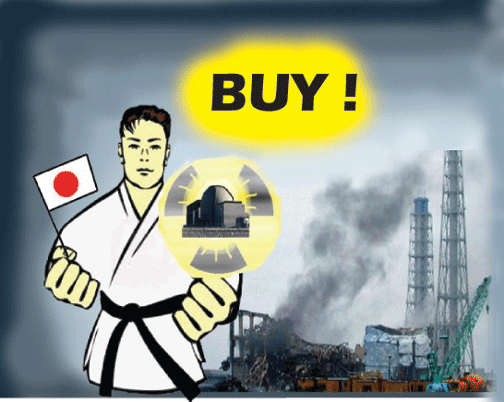 over the nuclear industry, and hurdles are growing higher. Vietnam has
cancelled orders for Japanese nuclear facilities amid financial concerns
and local opposition. Partly because of the rising cost of safety measures,
the financial risks of building nuclear plants abroad have grown too large
for companies alone to bear.
So Japan’s government has stepped in with
public financing and other aid, eager to support infrastructure exports,
which it considers a key economic growth strategy. Pursuing projects abroad
is in effect the only way for such companies as Mitsubishi Heavy and
Hitachi to maintain and profit from their nuclear technologies.
All nuclear power plants in Japan halted operations in the years after the Fukushima
disaster, and only a few have been approved to restart. Expanding plants or
building new ones is likewise difficult.
https://asia.nikkei.com/Politics-Economy/Economy/Japan-led-Turkish-nuclear-plant-project-mired-in-cost-overruns
Northern Japan court rejects lawsuit against construction of Ohma nuclear plant

Informational power to the people: Safecast volunteers monitor Fukushima radiation

NGO Safecast co-founder Pieter Franken explains to schoolgirls how to assemble a Geiger counter kit in their classroom in Koriyama City, Fukushima Prefecture.
Tracking Fukushima’s radiation , https://www.shine.cn/feature/lifestyle/1803181780/ Source: AFP Editor: Fu Rong Beneath the elegant curves of the roof on the Seirinji Buddhist temple in Japan’s Fukushima region hangs an unlikely adornment: a Geiger counter collecting real-time radiation readings.
The machine is sending data to Safecast, an NGO born after the March 2011 Fukushima nuclear disaster that says it has now built the world’s largest radiation dataset, thanks to the efforts of citizen scientists like Seirinji’s priest Sadamaru Okano.
Like many, Okano lost faith in the government after the nuclear meltdown seven years ago.
“The government didn’t tell us the truth, they didn’t tell us the true measures,” he said.
Okano was in a better position than most to doubt the government line, having developed an amateur interest in nuclear technology 20 years earlier after the Chernobyl disaster. To the bemusement of friends and family, he started measuring local radiation levels in 2007.
“The readings were so high, 50 times higher than natural radiation,” he said of the post-disaster data. “I was amazed. The news told us there was nothing, the administration was telling us there was nothing to worry about.”
That dearth of trustworthy information was the genesis of Safecast, said co-founder Pieter Franken, who was in Tokyo with his family when disaster hit. Franken and friends had the idea of gathering data by attaching Geiger counters to cars and driving around.
“Like how Google does Street View, we could do something for radiation in the same way,” he said. “The only problem was that the system to do that didn’t exist and the only way to solve that problem was to go and build it ourselves. So that’s what we did.”
Within a week, the group had a prototype and got readings that suggested the 20-kilometer exclusion zone declared around the Fukushima plant had no basis in the data, Franken said.
“Evacuees were sent from areas with lower radiation to areas with higher radiation” in some cases, he said.
The zone was eventually redrawn, but for many local residents it was too late to restore trust in the government.
Okano evacuated his mother, wife and son while he stayed with his flock.
A year later, based on his own readings and after decontamination efforts, he brought them back. He learned about Safecast’s efforts and in 2013 installed one of their static counters on his temple.
“I told them: ‘We are measuring the radiation on a daily basis… so if you access the (Safecast) website you can choose (if you think) it’s safe or not’.”
Norio Watanabe has been a Safecast volunteer since 2011. In the days after the disaster evacuees flocked to Koriyama, which was outside the evacuation zone. He assumed his town was safe.
He sent his children away, but stayed behind to look after his mother, a decision he believes may have contributed to his 2015 diagnosis of thyroid cancer.
“As a scientist, I think the chance that it was caused by the Fukushima accident might be 50-50, but in my heart, I think it was likely the cause,” he said.
His thyroid was removed and is now healthy, but Watanabe worries about his students, who he fears “will carry risk with them for the rest of their lives.”
“If there are no people like me who continue to monitor the levels, it will be forgotten.”
Safecast now has around 3,000 devices worldwide and data from 90 countries. Its counters come as a kit that volunteers can buy through third parties and assemble at home.
Tepco and other utilities eye joint nuclear plant project in Aomori Prefecture
Sanitising the Fukushima nuclear waste situation: Japanese newspaper succumbs to pressure

The Great Train Photo Robbery https://beyondnuclearinternational.org/2018/03/13/the-great-train-photo-robbery/
In 2019, Japanese govt hopes to extract a small sample of melted nuclear fuel from Fukushima reactor 2
First samples of Fukushima plant nuclear fuel debris to be collected in FY 2019 https://mainichi.jp/english/articles/20180316/p2a/00m/0na/018000c (Mainichi Japan) The government and Tokyo Electric Power Co. (TEPCO) are set to extract a small sample of melted nuclear fuel from the bottom of the No. 2 reactor’s containment vessel at the disaster-stricken Fukushima No. 1 nuclear plant as early as fiscal 2019.
The operation will be a test before starting full-scale collection of the fuel, targeted for 2021 or earlier. If development of technologies for debris retrieval shows promise, the operation may be moved up to the end of fiscal 2018. The government and TEPCO hope to ascertain the properties of the melted fuel and use the information for developing collection devices and debris containers.
This will be the first attempt to sample nuclear fuel debris from a reactor. Other materials, including those floating in contaminated water and substances stuck to robot probes, have been extracted from the plant’s reactors before. The No. 1, 2 and 3 reactors at the Fukushima No. 1 plant melted down in the March 2011 nuclear disaster.
The road map for collecting the melted fuel, last revised in September 2017, states that TEPCO would choose a first reactor to tackle by the end of fiscal 2019 and decide on a collection method. The utility would then start the retrieval process in 2021. As deciding on this process requires finalizing ways to contain, transfer and store the debris, the government and utility concluded that they would need to grasp the fuel’s current condition by extracting samples beforehand.
In January this year, a camera and dosimeter were sent into the containment vessel of the No. 2 reactor through an existing passage to find pebble- and clay-like masses at its bottom believed to be melted fuel. A source close to the government says the plan is to remotely guide a robot arm equipped with a camera and dosimeter into the containment vessel through the same passage, and extract a small amount of the suspected fuel debris.
The January probe of the containment vessel revealed radiation around the pebble-like masses measured 8 sieverts per hour — a level potentially lethal to humans after just one hour of exposure. Due to the ultrahigh radiation, the sampled material will be placed in a special radiation-shielded container before being removed from the reactor. After that, the sample will be brought to a Japan Atomic Energy Agency facility in Ibaraki Prefecture for analysis.
A government source told the Mainichi Shimbun that sampling the suspected fuel debris is different from the debris collection specified in the road map, and stressed that extracting samples should be beneficial to determine a method for retrieving the fuel.
‘It feels like we’re in jail’: Japan spent $12 billion on seawalls after the devastating 2011 tsunami — and now locals are feeling like prisoners

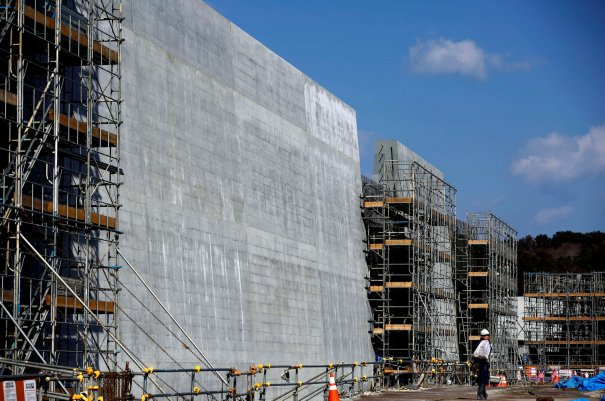


Olympic Games Spin – Based on Olympic Sized Lies – theme for March 2018
Fukushima today is the focus of the nuclear lobby’s most egregious lies. It’s hard to know where to start in examining them.


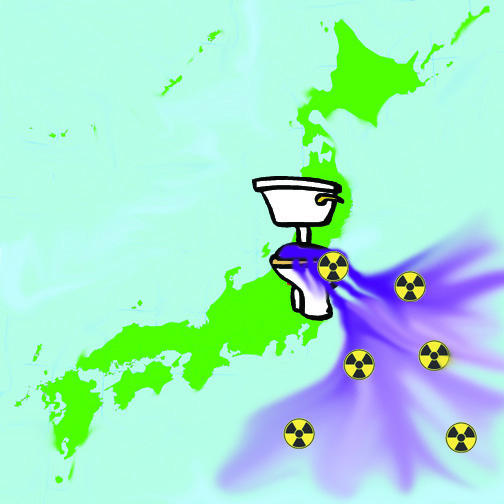

Let’s start with ionising radiation. This year’s March 11 report, by Shin-ichi Hayama, on the macaque monkeys of Fukushima reveals that they have radioactive cesium in their muscles, and significantly low white and red blood cell counts. They have reduced growth rate and smaller head sizes. These “snow monkeys” are close relatives to humans. Hayama’s 10 year study of the macaque provides a unique examination of the effects of chronic low level radiation affecting generations of monkeys.
New nuclear power for Japan, and nuclear technology as a profitable export? A visitor from another planet might well marvel at these fantasies – noting Fukushima’s radioactive shattered reactors, and ever growing masses of radioactive water – with Japan’s vulnerability to earthquakes.
The social costs continue – the rise in childhood and adolescent thyroid cancer, the worried evacuees, the stigma to Fukushim survivors. The financial costs of it all are unimaginable – and will be exacerbated by many legal cases won against the nuclear industry.
So – how does the global nuclear industry, backed by banks and governments respond?
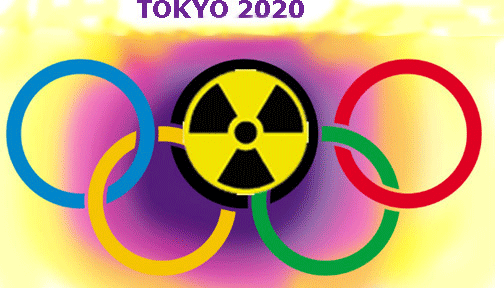 Why – by deciding to hold the 2020 Olympic Games in Tokyo, and pretending that everything is safe, clean green under control in North Eastern Japan!
LET THE OLYMPIC SPIN BEGIN – the survival of the nuclear industry depends on it!!
Harmful effects of radiation on Fukushima’s macaque monkeys
Stark health findings for Fukushima monkeys https://beyondnuclearinternational.org/2018/03/11/stark-health-findings-for-fukushima-monkeys-of-concern-for-humans/ By Cindy Folkers
Successful legal action against nuclear power, and more court cases to come
 Nuclear Power Facing a Tsunami of Litigation, Nippon, Shizume Saiji
  , [2018.03.12] In March 2011, a magnitude-9 earthquake triggered a giant tsunami that crippled the cooling system at the Fukushima Daiichi Nuclear Power Station, leading to a catastrophic accident that continues to reverberate seven years later. Science reporter Shizume Saiji surveys the legal fallout from the meltdown, from claims against the government and the operator to a raft of actions aimed at permanently shutting down the nation’s nuclear power industry………….
Complacency and Opacity
In the wake of the Fukushima accident, NISA (since replaced by the Nuclear Regulation Authority) was faulted for its lack of independence. The agency was under the authority of the Ministry of Economy, Trade, and Industry, which promotes the use of nuclear power, and officials maintain that its regulatory powers were limited. In addition, a closed, inbred environment encouraged unhealthy ties between NISA and the electric power industry. As a consequence, NISA had fallen into the habit of accommodating and supporting the utilities instead of overseeing them. TEPCO, for its part, had developed a deeply rooted culture of denial, habitually concealing information that might supply ammunition to anti-nuclear activists or fuel fears among the local citizenry. The company brushed off the warnings, convincing itself that the danger from a giant tsunami was purely hypothetical.
So far, district courts have reached decisions on three major class-action suits, and in each case they have agreed with the plaintiffs that the state and TEPCO could have foreseen the danger from a major tsunami once the 2002 report on earthquake risks was released. Two of the district courts, Maebashi and Fukushima, found both the state and TEPCO negligent for failing to prevent the meltdowns. The Chiba District Court, on the other hand, dismissed claims against the state on the grounds that the government was focusing on earthquake safety at the time and may not have been able to formulate effective measures in time to protect Fukushima Daiichi against the March 2011 tsunami. With the government and TEPCO girding up to appeal the lower courts’ decisions, the cases could drag on for years……….
Fighting Nuclear Power, One Plant at a Time
On a different but related front, citizens’ groups and other plaintiffs are vigorously pursuing lawsuits and injunctions aimed directly at shutting down nuclear power plants around the country.
Efforts to block nuclear energy development through legal action date all the way back to the 1970s.
………. At present, almost all of Japan’s operable nuclear power plants are in the midst of some kind of litigation. In one case, the plaintiff is a local government: The city of Hakodate in Hokkaidō has filed a lawsuit to block the construction and operation of the Ōma Nuclear Power Station across the Tsugaru Strait in Aomori Prefecture.[Excellent graphs show 38 nuclear reactors suspended, and 3 operating]
Lawyers on a Mission
Lawyers Kawai Hiroyuki and Kaido Yūichi have been key figures in the fight against nuclear power since before the Fukushima accident. In the wake of the disaster, they founded the National Network of Counsels in Cases against Nuclear Power Plants, a group that has been pursuing legal action against nuclear facilities on behalf of citizens and other plaintiffs nationwide.
Kawai and Kaido are also representing the shareholders of TEPCO, who are suing the company’s former executives for an unprecedented ¥5.5 trillion. In addition, as lawyers for the Complainants for the Criminal Prosecution of the Fukushima Nuclear Disaster, the two attorneys are working alongside the prosecuting team in the criminal case against three TEPCO executives, which parallels the civil suit in terms of arguments, evidence, and testimony.
Even so, the trial—which officially opened last June and is expected to continue at least through the coming summer—is expected to attract intense media coverage as witness examinations begin this spring. More than 20 witnesses are scheduled to testify. The case also involves a massive volume of documentary evidence, including records of interviews conducted by the government’s Investigation Committee on the Accident at the Fukushima Nuclear Power Station, along with countless pages of emails, internal memos, meeting minutes, and reports. Will all this information shed new light on the human factors behind the Fukushima accident? The nation will be watching closely.
(Originally published in Japanese on February 19, 2018). https://www.nippon.com/en/currents/d00388/?pnum=2
Long expensive ?intractable, task of cleaning up Fukushima’s radioactive water and rubble

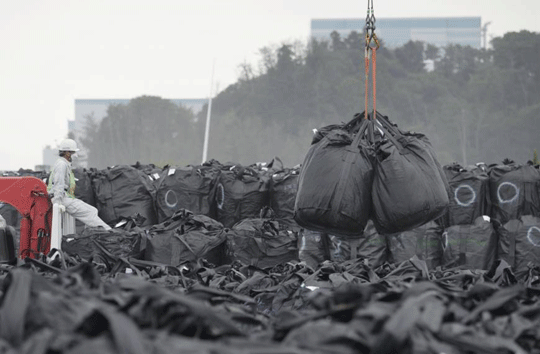
Clearing the Radioactive Rubble Heap That Was Fukushima Daiichi, 7 Years On
The water is tainted, the wreckage is dangerous, and disposing of it will be a prolonged, complex and costly process, Scientific American, By Tim Hornyak on March 9, 2018 Seven years after one of the largest earthquakes on record unleashed a massive tsunami and triggered a meltdown at Japan’s Fukushima Daiichi nuclear power plant, officials say they are at last getting a handle on the mammoth task of cleaning the site before it is ultimately dismantled. But the process is still expected to be a long, expensive slog, requiring as-yet untried feats of engineering—and not all the details have yet been worked out………
In the years since the disaster and the immediate effort to stanch the release of radioactive material, officials have been working out how to decontaminate the site without unleashing more radiation into the environment. It will take a complex engineering effort to deal with thousands of fuel rods, along with the mangled debris of the reactors and the water used to cool them. Despite setbacks, that effort is now moving forward in earnest, officials say. “We are still conducting studies on the location of the molten fuel, but despite this we have made the judgment that the units are stable,” says Naohiro Masuda, TEPCO’s chief decommissioning officer for Daiichi.
Completely cleaning up and taking apart the plant could take a generation or more, and comes with a hefty price tag. In 2016 the government increased its cost estimate to about $75.7 billion, part of the overall Fukushima disaster price tag of $202.5 billion. The Japan Center for Economic Research, a private think tank, said the cleanup costs could mount to some $470 billion to $660 billion, however. ……….
The considerable time and expense are due to the cleanup being a veritable hydra that involves unprecedented engineering. TEPCO and its many contractors will be focusing on several battlefronts.
WATERWORKS
Water is being deliberately circulated through each reactor every day to cool the fuel within—but the plant lies on a slope, and water from precipitation keeps flowing into the buildings as well. Workers built an elaborate scrubbing system that removes cesium, strontium and dozens of other radioactive particles from the water; some of it is recirculated into the reactors, and some goes into row upon row of giant tanks at the site. There’s about one million tons of water kept in 1,000 tanks and the volume grows by 100 tons a day, down from 400 tons four years ago……….
FUEL MOP-UP
A second major issue at Fukushima is how to handle the fuel¾the melted uranium cores as well as spent and unused fuel rods stored at the reactors. Using robotic probes and 3-D imaging with muons (a type of subatomic particle), workers have found pebbly deposits and debris at various areas inside the primary containment vessels in the three of the plant’s reactor units. These highly radioactive remains are thought to be melted fuel as well as supporting structures. TEPCO has not yet worked out how it can remove the remains, but it wants to start the job in 2021. There are few precedents for the task………
Shaun Burnie, senior nuclear specialist with Greenpeace Germany, doubts the ambitious cleanup effort can be completed in the time cited, and questions whether the radioactivity can be completely contained. Until TEPCO can verify the conditions of the molten fuel, he says, “there can be no confirmation of what impact and damage the material has had” on the various components of the reactors—and therefore how radiation might leak into the environment in the future.
Although the utility managed to safely remove all 1,533 fuel bundles from the plant’s unit No. 4 reactor by December 2014, it still has to do the same for the hundreds of rods stored at the other three units. This involves clearing rubble, installing shields, dismantling the building roofs, and setting up platforms and special rooftop equipment to remove the rods. Last month a 55-ton dome roof was installed on unit No. 3 to facilitate the safe removal of the 533 fuel bundles that remain in a storage pool there. Whereas removal should begin at No. 3 sometime before April 2019, the fuel at units No. 1 and 2 will not be ready for transfer before 2023, according to TEPCO. And just where all the fuel and other radioactive solid debris on the site will be stored or disposed of long-term has yet to be decided; last month the site’s ninth solid waste storage building, with a capacity of about 61,000 cubic meters, went into operation.
As for what the site itself might look like decades from now, cleanup officials refuse to say. …….https://www.scientificamerican.com/article/clearing-the-radioactive-rubble-heap-that-was-fukushima-daiichi-7-years-on/
1 This Month
26 September – International Day for the Total Elimination of Nuclear Weapons





PLEASE OPPOSE HR 8255 AND S.3639 – bills would accelerate satellite deployment, with no environmental review or safeguards – https://ncstd5li.quorum.us/campaign/169331/
To see nuclear-related stories in greater depth and intensity – go to https://nuclearinformation.wordpress.com
-
Archives
- September 2026 (283)
- August 2026 (330)
- July 2026 (355)
- June 2026 (287)
- May 2026 (306)
- April 2026 (356)
- March 2026 (251)
- February 2026 (267)
- January 2026 (308)
- December 2025 (358)
- November 2025 (359)
- October 2025 (375)
-
Categories
- 1
- 1 NUCLEAR ISSUES
- business and costs
- climate change
- culture and arts
- ENERGY
- environment
- health
- history
- indigenous issues
- Legal
- marketing of nuclear
- media
- opposition to nuclear
- PERSONAL STORIES
- politics
- politics international
- Religion and ethics
- safety
- secrets,lies and civil liberties
- spinbuster
- technology
- Uranium
- wastes
- weapons and war
- Women
- 2 WORLD
- ACTION
- AFRICA
- Atrocities
- AUSTRALIA
- Christina's notes
- Christina's themes
- culture and arts
- Events
- Fuk 2022
- Fuk 2023
- Fukushima 2017
- Fukushima 2018
- fukushima 2019
- Fukushima 2020
- Fukushima 2021
- general
- global warming
- Humour (God we need it)
- Nuclear
- RARE EARTHS
- Reference
- resources – print
- Resources -audiovicual
- Weekly Newsletter
- World
- World Nuclear
- YouTube
-
RSS
Entries RSS
Comments RSS

