it is impermissible for the government, which is spending such an enormous amount of taxpayers’ money on TEPCO, to allow the utility to give financial support to another collapsed company
If the state is rich enough to permit TEPCO to spend massive funds for unnecessary purposes, it should force the utility to take responsibility for causing the Fukushima nuclear accident and reduce the financial burden borne by the Japanese public. There is no need for TEPCO to survive any longer, because it has abdicated its responsibility for the nuclear accident and continues to support a virtually failed company.
The utility should go bankrupt and be liquidated.
* TEPCO’s annual electricity sales for 2016 totaled 241.5 billion kWh, which means each household is paying 789 yen to the utility annually. (The average electricity consumption per household in 2016 was 4,432kWh.)
Citizens’ Nuclear Information Center Create No Nukes World With Us CNIC Statement, April 11, 2018 : Liquidate TEPCO! http://www.cnic.jp/english/?p=4130, BY CNIC_ENGLISH · JUNE 4, 2018 On April 5, 2018, the government’s Nuclear Damage Compensation Dispute Resolution Center notified residents of Namie Town, Fukushima Prefecture, and TEPCO of its decision to discontinue its efforts to achieve an Alternate Dispute Resolution (ADR) on the residents’ demand for additional compensation for mental anguish caused by the 2011 Fukushima nuclear accident. Continue reading →
a minimum requirement for any form of political consent to onsite storage would be a clear commitment by the government to phase out all nuclear power by a fixed date, so that the final amount of waste can be determined and will not just keep growing, along with the burden on local people.
CNIC Seminar report: The problems with Japan’s Plutonium: What are they and how do we deal with them? http://www.cnic.jp/english/?p=4135Caitlin Stronell, CNIC BY CNIC_ENGLISH · JUNE 4, 2018 On April 20, CNIC organized a seminar with guest speaker Prof. Frank von Hippel, a nuclear physicist from Princeton University’s Program on Science and Global Security, presenting alternative ways to dispose of spent fuel instead of reprocessing, as well as options for disposal of separated plutonium. After this presentation of technical solutions, a panel discussion took place. Prof. Eiji Oguma, a historical sociologist from Keio University’s Faculty of Policy Management and a well-known commentator on the post-Fukushima anti-nuclear movement in Japan, pointed out the political barriers that must be overcome if any of these technical solutions were to be actually implemented, no matter how much more reasonable they may seem from economic and safety perspectives. CNIC’s General Secretary, Hajime Matsukubo was also on the panel and brought into the discussion the international implications of Japan’s plutonium policy including the US-Japan Nuclear Agreement.
Prof. von Hippel explained that plutonium disposal is a global problem, with more than half of the existent separated plutonium being produced as a result of civilian reprocessing, the rest produced for military purposes. Disposing of the plutonium that had been produced for weapons during the cold war has been a huge headache for the United States with planned disposal by burning it as MOX fuel in commercial reactors proving hugely expensive. America has all but abandoned its half-built MOX plant and is now looking towards the ‘dilute and dispose’ option.
This process would use glove boxes to mix 300 grams of plutonium oxide into a can of ‘star dust’ (a secret ingredient from which plutonium would be difficult to separate again). This can would then be placed in a plastic bag and another ‘outer blend can.’ Another way of immobilizing plutonium is the Hot Isostatic Pressing method, which is being developed in the UK and utilizes radiation-resistant, low-solubility ceramic. After plutonium has been immobilized, it is safer to bury it underground than keep it on the surface and Prof. von Hippel mentioned the deep borehole disposal method which uses techniques developed for drilling oil and geothermal wells that can bore five kilometers into the earth. In the US, however, plans for a demonstration project of this method of radioactive waste disposal were rejected by local governments.
Prof. von Hippel stressed that the main lesson for Japan is that separated plutonium is extremely difficult to dispose of and that it is definitely better not to separate any more than is already stockpiled. Instead of sending spent fuel from the nation’s nuclear power plants to Rokkasho for reprocessing, it would be safer and much cheaper and more efficient to set up dry cask storage for the spent fuel onsite at the plant. Prof. von Hippel showed us successful examples of this method in the US and suggested that there were moves in this direction in Japan as well.
Prof. von Hippel’s detailed technical solutions were very convincing. Yet despite the dangers of holding such a large plutonium stockpile (47 metric tons, enough for approximately 6,000 nuclear weapons), despite the massive costs involved and despite having no concrete viable plans as to how to actually use the separated plutonium, official Japanese government policy is to continue to separate even more plutonium at the Rokkasho Reprocessing Plant, which is currently due to commence operations in 2021.
In the panel discussion which followed Prof. von Hippel’s presentation, Prof. Oguma agreed that reprocessing was most certainly problematic, but, he pointed out, it will be extremely difficult to just put up onsite storage of spent fuel, no matter how reasonable a technical solution it is. Political consent must be gained from the people in communities, which will not just be hosting the nuclear power plant, but will be asked to store its radioactive waste as well. As Prof. Oguma pointed out, especially post-Fukushima Daiichi, no one trusts the Japanese Government’s nuclear policy and the likelihood that they will agree to yet another imposition that can be perceived to be long-term and dangerous, is very low. Much of the Japanese public also believes that onsite storage is merely an excuse for the nuclear industry to keep afloat. If spent fuel pools fill up, utilities will not be able to operate their plants. For many activists this is one way of closing them down, which is their main aim. Prof. Oguma argued that a minimum requirement for any form of political consent to onsite storage would be a clear commitment by the government to phase out all nuclear power by a fixed date, so that the final amount of waste can be determined and will not just keep growing, along with the burden on local people.
This is a significant difference in perspective. Prof. von Hippel’s main aim is to stop reprocessing and reduce stocks of separated plutonium, even if nuclear power generation continues, but Prof. Oguma claims that without an overall reassessment of the entire nuclear power policy it will be impossible to gain political consent for Prof. von Hippel’s proposed onsite storage.
The economics is not as straightforward as it sounds either. While it is undoubtedly cheaper, in a purely mathematical sense, to simply dispose of spent fuel as waste, instead of reprocess it and fabricate MOX fuel, the accounting systems of utilities make the more efficient alternative of direct disposal very difficult. At the moment, spent fuel is counted as an asset on utility balance sheets under the premise that it will become MOX fuel. If reprocessing is officially abandoned, all of the spent fuel ‘assets’ will become ‘liabilities’ and many utilities will be facing possible bankruptcy. Prof. Oguma suggested that the only way to overcome all these political and economic barriers is for the government to disclose all information on nuclear power and reprocessing and to conduct an open public debate on how to proceed. If a public consensus is reached, based on all the scientific, technical and economic data available, then reprocessing should be stopped.
CNIC’s Hajime Matsukubo pointed out that the Japanese government’s accountability crisis was not just domestic, but international. Building up such large stocks of plutonium at huge cost and with no credible purpose inevitably makes neighboring countries suspect Japan’s intentions. Indeed documents recently revealed show that the present Vice Minister of the Ministry of Foreign Affairs has long been an advocate of Japan becoming a nuclear weapons state. Japan’s opposition to President Obama’s proposal that the US adopt a no first-use of nuclear weapons policy, was reported in the Japanese media. Thus Japan’s credibility as a strong advocator of non-proliferation is already failing and the plan to separate even more plutonium at Rokkasho could easily provoke a regional nuclear arms race, destabilizing the region, just as hopes rise that the situation in North Korea may improve.
Mr. Matsukubo also pointed out that Japan is the only non-nuclear weapons state that is permitted to separate plutonium under the US-Japan Nuclear Cooperation (123) Agreement. This creates double standards which weaken the entire global non-proliferation regime. For example, Saudi Arabia is negotiating a 123 Agreement with the US and demands that it also be allowed to reprocess spent fuel ‘like Japan.’
For all of the above safety, economic and non-proliferation reasons, it would seem that there is plenty of ammunition for the movement against reprocessing. Indeed, Mr. Matsukubo said that in many ways it should be easier to stop reprocessing than stop nuclear power generation. Why hasn’t this happened? As well as the difficulties mentioned by Prof. Oguma, there is also the factor that the movement against reprocessing in Japan has not been as strong as the movement against nuclear power. Reprocessing seems like a more convoluted, more removed issue, perhaps difficult for people to grasp and focus on. All speakers agreed that the movement against reprocessing must be strengthened. The first thing that must be done to achieve this is to raise awareness and understanding regarding this issue within the broader anti-nuclear movement (both power generation and weapons) and the general public. Providing accurate information on the nuclear fuel cycle in a format that people can understand is the vital first step. As many people as possible must be informed about the costs, the dangers and the alternatives. The movement must be strong enough to demand that governments and utilities disclose all data, engage in an open debate and commit to implementing the consensus which emerges.
Prof. Oguma said that he and many other activists in Japan were committed to conveying the messages of Fukushima to the larger world, and to contributing to international solidarity on ending nuclear power. This also includes understanding how other countries see Japan. The plutonium issue is one that has particularly strong international impacts and implications and by pursuing this present policy the Japanese government is only damaging Japan’s international credibility, especially regarding non-proliferation.
The seminar concluded that, whether on an international level or a domestic one, the Japanese government must restore accountability and democracy, it must formulate a responsible nuclear policy that is demonstrably safe, economic and realistic and which has the consent of the people. Viable technical alternatives to reprocessing spent fuel are available but can only be implemented through raising awareness and a change in political will, which as a movement, we must focus on with added strength.
Group Introduction: No Nukes Wakayama http://www.cnic.jp/english/?p=4139 Kikuo Shimizu, No Nukes Wakayama Representative BY CNIC_ENGLISH · JUNE 4, 2018 The nuclear plant was defeated but the battle against the interim storage facility continues
It was in February 1977 that a nuclear power plant project was proposed in the former Hikigawa Town (now a part of Shirahama Town) in Wakayama Prefecture, western Japan. The town council decided to sell a block of town-owned land to Kansai Electric Power Company (KEPCO) at an ad hoc meeting. The town sold 660,000 square meters of mountainous forest land for 1.259 billion yen.
This created a profound controversy in the town. Those in favor of the project and those not in favor entered into an intense confrontation which lasted for 16 years. The town was divided into two, and even families were divided, generating conflicts between parents and children, and among siblings. In 1988, the town elected an anti-nuclear mayor, and the controversy gradually calmed down.
In Wakayama Prefecture there have been five candidate NPP sites, including Hikigawa, but all the projects were defeated by resistance from local populations. However, KEPCO’s Hikigawa NPP siting office has continued to operate, with four employees.
We, local residents against NPPs, have been concerned for more than ten years about the possibility of Hikigawa being selected as an interim nuclear waste storage facility site. However, we were almost convinced that no NPP would be built here because Hikigawa Town merged with neighboring Shirahama Town in 2006 in the course of the great Heisei merger of cities, towns and villages, and because of the Fukushima Daiichi nuclear disaster.
Concerning the issue of interim nuclear waste storage facilities, Governor Issei Nishikawa of Fukui Prefecture, which hosts many KEPCO NPPs along the Japan Sea coast, issued a statement that the prefecture would accept the restart of Ohi NPP units 3 and 4 on condition that interim nuclear waste storage facilities would be built outside the prefecture. The KEPCO president announced the company’s plan to select a facility site in 2018, to start construction in 2020, and to commence operation in 2030. In response to these announcements, Maizuru City and Miyazu City, situated along the Japan Sea shore, as well as the governor of Kyoto Prefecture in which the two cities are located, made it clear that they would not accept interim facilities in the respective municipalities. In Wakayama, located along the Pacific Ocean shore, the prefectural governor and the mayors of towns and cities have already stated that they would not admit high-level radioactive wastes, but the mayor of Shirahama Town has not ruled out hosting interim storage facilities. KEPCO and associated companies own about 1.2 million m2 of mountainous forest land on the coast in the Hikigawa area of Shirahama Town, and there is a port nearby that appears to be suitable for the transportation of nuclear fuel.
Concerned about such circumstances, residents organized a lecture gathering entitled “Say No to Interim Nuclear Waste Storage Facilities” on January 20 this year, inviting Mr. Hideyuki Koyama from Osaka Citizens Against the Mihama, Ohi and Takahama Nuclear Power Plants (“Mihama-no-Kai”) to speak. We also submitted a formal letter to the mayor of Shirahama Town on February 23, requesting the mayor to announce that the town would not accept the construction of an interim nuclear waste storage facility. Later, on April 16, the members of the Kansai Network Concerned with Evacuation Plans submitted another formal letter of similar content to the mayor. On May 23, No Nukes Wakayama, organized a general meeting in Tanabe City, Wakayama, and decided to launch further actions against the construction of interim nuclear waste storage facilities, specifically by organizing small talks and informative gatherings, and by talking to the town council, the council of area leaders, and various organizations in the town, aiming to expand the movement and stop the project by all available means. We commit ourselves to handing over the beautiful ocean, mountains and rivers safely to our children and grandchildren, and we are determined to make continued efforts to achieve this.
World’s Biggest Nuclear Plant Is Center Stage in Rural Election, Stephen Stapczynski– 8 June 2018 (Bloomberg) — The fate of the world’s largest atomic plant may be decided by a local election this weekend in a rural Japanese prefecture better known for its skiing and sake.
The top two candidates running in the June 10 Niigata gubernatorial race are opposed to the speedy restart of Tokyo Electric Power Co. Holding Inc.’s nuclear reactors — which the utility, known as Tepco, aims to fire-up as soon as 2019. But the degree to which the candidates oppose atomic power is being watched closely by investors, voters and local media.
……..While candidates backed by Prime Minister Shinzo Abe’s Liberal Democratic Party and the opposition both want to finish investigations into atomic safety before the Kashiwazaki-Kariwa reactors restart, their views diverge after that.
Chikako Ikeda, a member of the prefecture’s assembly and backed by a coalition of opposition parties, has said she doesn’t support Tepco restarting the facility. She is also calling for a local referendum to decide the fate of the units after the prefecture finishes its investigations, which could take another three years.
Hideyo Hanazumi, a former vice-governor of Niigata backed by Abe’s LDP party, has refused to say whether he supports the restart but has insisted that the prefecture’s investigations be completed before a decision is made. Tepco shares have lost almost 14 percent since the day before May 9 when he said the nation should rid itself of nuclear power in the long-term and continue the prefecture’s investigation.
Tokyo, (Jiji Press), 7 June 18,–Japanese “high school peace ambassadors” on Thursday expressed their hopes to convey the voices of hibakusha, or atomic bomb survivors, for nuclear abolition to the world, and spread peace across the globe.
The high school students, who took part in a campaign to collect signatures with the aim of abolishing nuclear weapons, have been selected as a candidate for the Nobel Peace Prize for 2018.
At an event in Tokyo on Thursday to report the peace ambassador activities, Konami Funai, 17, a high school third-grader from Fukuyama, Hiroshima Prefecture, western Japan, spoke about her visit to the secretariat of the Norwegian Nobel Committee in March.
“It made me even prouder of our activities,” she said, referring to the nomination as a Nobel prize candidate. But Funai added that even if they win the prize, it would not be their goal. “I’ll patiently continue to call for nuclear abolition.”
The high school peace ambassadors were nominated a Nobel Peace Prize candidate by the Norwegian committee, after Japanese lawmakers recommended them for the award with the campaign marking its 20th anniversary this year.
Storage tanks of contaminated water stand at Tepco’s Fukushima No. 1 nuclear power plant. Tepco estimates that at the current rate it will run out of tank space in 2020, and a decision must be made on what to do with the water well before then.
June 5, 2018
Virtually every news story about the Fukushima No. 1 nuclear power plant acknowledges the tremendous ongoing problem of contaminated water that is accumulating in approximately 850 large tanks on-site. There are about 850,000 tons of water in the tanks at present, from which all radionuclides of concern except tritium — radioactive hydrogen — have been effectively removed. More water accumulates each day, in quantities roughly equal to the amount of groundwater that seeps into the damaged reactor buildings. Tokyo Electric Power Company Holdings estimates that at the current rate it will run out of tank space in 2020. Something needs to be done well before then, and the decision should address the concerns of all stakeholders, public and private.
The Ministry of Economy, Trade and Industry recently announced that meetings will be held where the public can hear explanations of proposed solutions and comment on them. Unless they think seriously about how to prevent this from becoming yet another clumsy exercise in DAD — “decide, announce, defend” — these meetings will be a mere fig leaf that will allow the government to claim it has adequately consulted the public.
As it is, the government’s decision-making process itself appears to be dysfunctional, and we have reason to be skeptical that it will be possible to avert very bad domestic and international public reactions if and when this water is disposed of.
The Subcommittee on Handling Water Treated by the Polynuclide Removal Facility is one of several Japanese government committees organized by METI tasked with formulating a response to the problem of the radioactive water. The planned public sessions were announced at its eighth meeting, on May 18.
This is a step in the right direction, and is long overdue. Nevertheless it may well be a case of “too little, too late.” The decision, delayed for years, will almost certainly be to dilute the water and release it to the ocean, and meanwhile, public opposition to this idea has hardened. The issue hinges on both scientific understanding and public perception.
What is tritium?
Tritium, scientifically indicated as “H3,” occurs both naturally and through man-made processes. Tritiated water (HTO), like that accumulating at the No. 1 nuclear power plant, behaves almost identically to normal water, and can be taken up easily by living organisms. The scientific consensus is that the health risks from exposure to tritium are several orders of magnitude lower than those from radionuclides like cesium, radioactive iodine or strontium. This is reflected in allowable limits in drinking water, which are generally tens or hundreds of times higher for tritium than for these others, ranging from 100 Bq/L in the European Union to 76,103 Bq/L in Australia. Nevertheless, the scientific community acknowledges some uncertainty about these risks.
Leaving the tritiated water in the tanks at No. 1 is the riskiest thing to do, due to the possibility of ruptures or uncontrolled leaks. As far back as 2014, the International Atomic Energy Agency recommended a controlled release to the ocean as the safest course of action, and Japan’s Nuclear Regulation Agency concurred.
A Tritiated Water Task Force convened by METI in 2013 examined five options in detail, and in 2016 concluded that for reasons of cost, available technology, time required, and safety, diluting and discharging it to the ocean was the least objectionable approach. The task force presented relevant monitoring data from decades of similar releases of tritium to the ocean from nuclear facilities in Japan and abroad, noting that the quantities from the No. 1 plant would be many times smaller and the tritium levels in ocean life too low to be of real concern.
Tepco has made it clear that ocean release is its preference as well. The company says that it strives to meet government recommendations, and does not intend to act without government support, but is ultimately responsible for any actual decision.
In July 2017 Takashi Kawamura, chairman of Tepco, said publicly that the decision to release the tritiated water had already been made, and the public outcry was immediate, particularly from Fukushima fishermen who expected to be consulted. The company quickly backpedaled.
Constructing the dilution facilities and pipelines that an ocean release would require is expected to require almost a year after any decision is made. At the current rate, that means the “go” signal must be given by early 2019 at the latest. That no decision has been officially announced to date can be ascribed to the very reasonable expectation of a strong public backlash, and, I believe, the reluctance of any responsible government officials to be associated with such an unpopular decision.
Fishermen’s opposition
The strongest and most meaningful opposition comes from Fukushima’s fisheries cooperatives, which have suffered tremendously due to the 2011 disaster. Representatives of Tepco, METI and other government bodies that share the mandate for dealing with the contaminated water invariably stress how important it is to them to reach understanding and agreement with all stakeholders, the fisheries cooperatives in particular.
Takahiro Kimoto, a general manager in Tepco’s nuclear power division, explained, “The policies can’t and shouldn’t be determined by Tepco alone, but we continue discussing the available options with government and other stakeholders. These discussions are taking a long time, but we consider them essential.” Put bluntly, Tepco knows they will be pilloried no matter what, and seeks broad support.
Shuji Okuda, METI’s director for decommissioning and contaminated water management, stressed that no decision has yet been made regarding which of the five options for dealing with the tritiated water will be chosen. “It will be a decision of the Japanese government as a whole,” Okuda explains, “not one made by any single agency. And it will be based on ample discussions with all stakeholders.”
Although Tepco and METI indicate that they are prepared to accommodate the fishermen’s conditions regarding the release, the cooperatives are adamant. “We are totally opposed to the planned release,” explained Takaaki Sawada of the Iwaki Office of the Fukushima Prefectural Federation of Fisheries Cooperative Associations, known as FS Gyoren. “It’s not a question of money or compensation,” he continued, “nor of any level of concentration we might accept as safe. We do not think it should be our responsibility to decide whether or not to release it. We think it will be impossible for the public in general to understand why tritium is considered low risk,” he continued, “and expect there will be a large new backlash against Fukushima marine products no matter how scientifically it is explained.”
Much hinges on public understanding of the risks, and therefore on transparency. Robust and effective two-way communication is essential, not to persuade the public that official plans are acceptable, but to better equip them to participate in the debate in an informed way, and to push back where they feel it is necessary. It is the public’s right to demand this kind of inclusion.
Communication should be aimed not only at fishermen and Japanese consumers, but internationally to all who are concerned about what the effect on the Pacific will be. The government has been sitting on the Task Force recommendations for almost two years without taking action. That it has taken this long to even begin planning to engage the public on this issue is, again, because no one in a governmental decision-making position wants to be politically associated with the consequences of a tritium release.
According to METI, the content, location and timing of the public sessions will be discussed at the next subcommitee meeting in July. People unable to attend in person will be able to submit comments and questions via email. Though hastily planned events could possibly be held before the end of this year, it seems likely they will need to happen in 2019, bumping up against the decision deadline.
While some fishermen are likely to attend, the cooperatives themselves will likely refuse. This situation requires the actual involvement of citizens in the decision making process, but it is difficult to find instances of that actually happening in Fukushima since the accident in 2011. At the central government level in particular, it has almost always been DAD.
Regardless of whether one trusts scientific opinion or Tepco, the tritiated water cannot be left in the tanks at No. 1 indefinitely, and releasing it to the ocean, though not without risk, is the least objectionable of the available options. As it stands now, given the depth of public mistrust and the nature of misinformation in our current era, the situation is ripe for the maximum misunderstanding and negative social impact to occur if and when this tritiated water is finally released.
Unfortunately, I think we should be prepared for things to be done the “Kasumigaseki way”: for the decision to be avoided until the last possible moment, and for government officials to claim then that an unavoidable emergency had arisen and it couldn’t be helped.
There will be negative social impact no matter what, but unless responsible government officials step up soon, own the decision and ensure that public engagement is genuine, broad, and effective, these negative impacts will be unnecessarily magnified.
Azby Brown is the lead researcher for Safecast, a volunteer-based NPO that conducts open, independent, citizen-run monitoring of radiation and other environmental hazards worldwide. http://www.safecast.org
The No. 3 reactor of the Shimane nuclear power plant stands in the foreground, with the No. 1 and No. 2 reactors in the background.
June 2, 2018
The 2011 Fukushima nuclear disaster provided graphic evidence of the lasting and far-reaching damage that can result when this technology goes askew.
Electric utilities that operate nuclear power plants have a duty to respond with utmost sincerity to safety concerns among local governments and communities, especially cities and towns within 30-kilometer emergency planning zones. Utilities should treat local governments within the zones, which are required to develop emergency evacuation plans under stringent new regulations introduced after the March 2011 emergency, equally as the governments in nuclear host communities.
Chugoku Electric Power Co. recently took the first step toward the start of operations of the Shimane nuclear power plant’s new reactor, whose construction was halted following the Fukushima catastrophe.
The utility, based in Hiroshima, asked the Shimane prefectural government and the Matsue city government to approve its application to the Nuclear Regulation Authority (NRA) for safety screening of the No. 3 reactor under the new regulatory standards.
The No. 3 reactor was close to completion when the Fukushima No. 1 nuclear power plant went in a triple meltdown. Work to install the necessary safety measures is expected to finish in the first half of 2019.
This facility could become the first new nuclear reactor in Japan to start operation after the Fukushima disaster, an event that triggered tighter safety standards for nuclear plants.
The new reactor, if cleared for operation, will be in service until around 2060 under the principle that imposes a 40-year limit on the operational life of a reactor.
The reactor is part of a complex that has the distinction of being the only nuclear power plant located in the capital of a prefecture.
Within 30 km of the plant lie three other cities in Shimane as well as the cities of Sakaiminato and Yonago in neighboring Tottori Prefecture. Some 470,000 people live in the 30-km zone.
In 2011, authorities in Tottori Prefecture and the two cities signed an agreement with Chugoku Electric Power that commits the utility to put top priority on the safety of local residents in operating the plant.
These local governments have been demanding that the utility apply the procedures for obtaining consent for reactor operations from the Shimane and Matsue governments also to the local governments in Tottori Prefecture.
In April this year, the prefectural and municipal governments in Tottori formed a joint task force to assess the safety of the new reactor with the help of the utility.
Chugoku Electric Power’s move to seek the consent of only the Shimane prefectural government and the Matsue city government to start the process of bringing the reactor online has caused “considerable confusion” among the local communities in Tottori Prefecture, according to Tottori Governor Shinji Hirai.
“I feel bewildered” at the way the utility is going ahead with the plan, Hirai said with obvious and justifiable discontent.
Safety agreements between nuclear plant operators and local governments generally require utilities to secure the advance consent of the local governments when new reactors are built or important changes are made to existing facilities. In most cases, however, the scope of the local governments covered is limited to the prefectures and municipalities where the plants are located.
But an agreement was reached this spring between Japan Atomic Power Co. (JAPC), the operator of the Tokai No. 2 nuclear power plant in Ibaraki Prefecture, and five surrounding municipalities that commits JAPC to seek approval from these municipalities within the 30-km zone before bringing its idled reactor back on stream. They include the city of Mito, as well as Tokai village, which hosts the nuclear plant, and the prefecture.
Some local governments around the Shimane nuclear plant are calling on Chugoku Electric Power to hold advance talks over the operation of the new reactor with all the six cities within the 30-km zone. The utility should treat all the local governments within the emergency planning zone like host communities.
When Kyushu Electric Power Co. moved to restart the No. 3 reactor at its Genkai nuclear power plant in Saga Prefecture, four of the eight municipalities in three prefectures located within the 30-km zone were up in arms over the plan. But the procedures for the restart went ahead after the town of Genkai, which hosts the plant, and Saga Prefecture gave their consent.
Shimane Governor Zenbe Mizoguchi has indicated his intention to listen to the opinions of all the surrounding local governments, including those in Tottori Prefecture. The Shimane and Matsue governments plan to propose this approach to their respective local assemblies. The case of the Genkai plant should serve as a cautionary tale for these local governments.
In the wake of Fukushima, Tomonobu Narita is at the forefront of a movement to withdraw money from banks that back environmentally harmful energy projects.
YOKOHAMA, Japan — Buddhist priest Tomonobu Narita admits he hadn’t thought much about energy policy until the Fukushima nuclear meltdown forced tens of thousands of people to flee their homes in 2011.
Now he’s at the forefront of a budding movement in Japan to withdraw money from banks that provide finance for environmentally harmful energy projects.
“I was taught about the idea of how changing your bank account can contribute to bettering the environment, and that was an enlightenment for me,” said Narita, the third-generation head priest of a temple in Yokohama, south of Tokyo.
The campaign to “divest” from fossil fuels such as coal has gained traction in the United States, Europe and Australia in recent years, but environmental activists are now targeting Japan. They see the country as crucial to the success of international efforts to address climate change.
On top of fossil fuels — which release greenhouse gases into the atmosphere when burned, contributing to global warming — campaigners here are working to oppose nuclear power.
While advocates of nuclear power say it can provide carbon emissions-free energy, critics say the overall dangers are too high.
Residents are still barred from returning to some of the towns closest to the Fukushima Daiichi nuclear power station, where three reactor meltdowns occurred after the March 2011 earthquake and tsunami disaster.
Most of the country’s nuclear plants remain offline amid safety checks and legal challenges.
Driven by concern about nuclear power, Narita recently shifted some of his temple’s funds to a financial firm that is rated as one of Japan’s 45 “earth-friendly” banks. This means the bank is not known to provide finance for the fossil fuel and nuclear sectors.
Narita told NBC News he planned to explain the decision to his counterparts in other temples, believing that “we need to be more mindful of what we’re blessed with.”
Tomonobu Narita is the head priest of Totsuka Zenryo Temple in Yokohama, Japan.
“That small action when combined [with the actions of others] leads to a bigger effect, so I hope for divestment to have that kind of spread in Japan,” he said during an interview at Totsuka Zenryo Temple.
In the next room, about 100 people gathered to hear from the veteran American climate campaigner Bill McKibben, who co-founded the global divestment and climate action movement known as 350.org and has organized rallies around the world.
McKibben described being jolted into action by a visit to Bangladesh more than a decade ago when he saw people die from dengue — a mosquito-borne viral illness that is projected to worsen in that country as the globe warms. McKibben said he viewed it as “very unfair” that Bangladesh would bear major impacts from climate change when it had not been the source of most of the world’s greenhouse gas emissions.
“They’re suffering from a problem that they didn’t cause, a problem that we caused,” McKibben said. “And so, when I went back to the United States, I decided that the time had come to fight — in a good, nonviolent, Buddhist peaceful way,” he quipped to the temple crowd.
Now, McKibben said, it was important for the divestment movement to spread to Japan “because Japanese banks are now the biggest lenders of money for coal projects around the world.”
Japan’s Mizuho provided an estimated $11.5 billion in loans to the world’s top coal-plant developers from January 2014 to September 2017, according to analysis published by BankTrack, a pro-renewable energy network. That led to Mizuho being assessed as the most prolific lender in that category, followed by another Japanese financial group, MUFG, in second place, while Sumitomo Mitsui Banking Corporation came in at fifth.
These banks have signaled that they are weighing their future lending criteria.
Mizuho said on its website that it was currently discussing the “best due diligence methods” for reducing environmental and social risks, while MUFG told investors it would strengthen its focus on financing renewable energy.
A spokesperson for Sumitomo Mitsui told NBC News: “Coal-fired thermal power generation is considered as a relatively low-cost power generation method; however, since we consider that the impact on climate change is significant, we are considering [reviewing] our current credit policy.”
Still, the number of ordinary people in Japan actively divesting from fossil fuels remains small: Just 146 individuals have so far reported divestments worth 568.2 million yen ($5.1 million) since the campaign launched late last year, according to 350.org Japan.
Takejiro Sueyoshi, a former senior banking executive who is now a special adviser to the United Nations Environment Program Finance Initiative, believes it will require strong government leadership for banks to take a more assertive step toward renewables.
“Many people are very well aware of this matter, but what they are saying is: ‘Personally I understand that, but under the current situation no Japanese government [has set] any new direction, new policy, new strategy.’”
This was because the Japanese business culture tended to be “government-oriented,” he explained. “When the Japanese central government says ‘do this,’ they follow. And if the Japanese central government does not say anything about something, no institutions or companies will [act].”
Some senior government figures, at least, seem to be paying attention. The foreign minister, Taro Kono, recently blasted his country’s lackluster embrace of renewable sources like wind and solar as “lamentable.”
Japan’s target for renewables to make up 22 percent to 24 percent of its overall energy mix by 2030 is low, Kono said in a speech in January. He pointed out that such technology already accounts for about a quarter of the total global energy mix, and there had been a “dramatic decrease” in the price of renewables.
“We have prioritized keeping the status quo for fear of change,” said Kono, whose climate advisory panel warned the following month that Japan was facing increasing scrutiny from other countries about its plans to build dozens of new coal-fired power plants.
As the government and experts continue to debate the best way forward in terms of policy, campaigners will step up their efforts to build community momentum for change.
Narita, the Buddhist priest, said he had not sought media attention for his decision to divest but simply wanted to do his part “to contribute to society.” The action is grounded in his beliefs.
“Right now the greenery that we have, the earth, the soil — everything is a product of the things that people who have come before us have left behind, so we can’t just treat those things carelessly,” Narita said.
https://www.theguardian.com/environment/2018/mar/16/is-fukushima-doomed-to-become-a-dumping-ground-for-toxic-waste Despite promises of revitalisation from Japan’s government, seven years on from the nuclear disaster the area is still struggling This month, seven years after the 2011 Fukushima Daiichi reactor meltdowns and explosions that blanketed hundreds of square kilometres of northeastern Japan with radioactive debris, government officials and politicians spoke in hopeful terms about Fukushima’s prosperous future. Nevertheless, perhaps the single most important element of Fukushima’s future remains unspoken: the exclusion zone seems destined to host a repository for Japan’s most hazardous nuclear waste.
No Japanese government official will admit this, at least not publicly. A secure repository for nuclear waste has remained a long-elusive goal on the archipelago. But, given that Japan possesses approximately 17,000 tonnes of spent fuel from nuclear power operations, such a development is vital. Most spent fuel rods are still stored precariously above ground, in pools, in a highly earthquake-prone nation.
The Fukushima prefecture government is currently promoting a plan, dubbed The Innovation Coast, that would transform the unwelcoming region into a thriving sweep of high-tech innovation. Much of the development would be directed towards a “robot-related industrial cluster” and experimental zones like a robot test field.
The test field would develop robots tailored for disaster response and for other purposes on a course simulating a wide range of hurdles and challenges already well represented in Fukushima itself. Large water tanks would contain an array of underwater hazards to navigate, mirroring the wreckage-strewn waters beneath the Fukushima Daiichi plant, where a number of meltdown-remediating underwater robots have met a premature demise in recent years.
Elsewhere on the robot test field, dilapidated buildings and other ruins would serve as a proving ground for land-based disaster-response robots, which must navigate twisted steel rods, broken concrete and other rubble. Engineered runways and surrounding radiation-hit areas would serve as prime territory for testing parlous aerial drones for a range of purposes in various weather conditions – which would be difficult or impossible to achieve elsewhere in relatively densely populated Japan.
The planned site for the test field would link with a secluded test area about 13km south along the coast to coordinate test flights over the exclusion zone’s more or less posthuman terrain.
Naturally, unlike Fukushima’s human residents, robots would be oblivious to the elevated radiation levels found outside the Fukushima Daiichi facility. In addition, prefectural officials have suggested that the exclusion zone environs could play host to a range of other services that don’t require much human intervention, such as long-term archive facilities.
Proud long-time residents of Fukushima, for their part, see all this development as a continued “colonisation” of the home prefecture by Tokyo – a well-worn pattern of outsiders using the zone for their own purposes, as were the utility representatives and officials who built the ill-fated plant in the first place.
Years of colossal decontamination measures have scraped irradiated material from seemingly every forest, park, farm, roadside, and school ground. This 16 million cubic metres of radioactive soil is now stored in provisional sites in and around the exclusion zone, waiting to be moved to an interim storage facility that has hardly been started and for which nearly half of the land has not yet even been leased.
The state has promised to remove all the contaminated soil from Fukushima after 30 years, and government officials have been scrupulous in insisting that this will be the case – for soil. Yet in a nation with about 17,000 tonnes of highly radioactive spent fuel rods and no willing candidates for secure repositories, it is only a matter of time before it becomes possible for politicians to publicly back the idea of transforming the area around Fukushima Daiichi into a secure repository.
Government officials, including those tasked with nuclear waste storage, describe the quintessentially Japanese strategy of saki-okuri, or calculated postponement, in the context of nuclear waste storage. Such perception management is a subtle business, but by quietly and unrelentingly pushing back the day of reckoning – slowly changing the terms of debate – the broadly distasteful prospect of storing Japan’s most dangerous material in its most tragically maltreated region would become gradually less intolerable to Japanese sensibilities.
The expanse of Fukushima in and around the exclusion zone represents an already contaminated area with, since 2011, far fewer residents to protest against such plans. Such a rare opportunity for relatively unopposed intervention in a struggling area will surely prove irresistible to the nuclear lobby.
Fukushima has been marginalised, disenfranchised, and outmanoeuvred for decades. After all, the electricity from Fukushima Daiichi went straight to the capital, not to Fukushima itself, which bore the risks. Since 2011, Fukushima has been saddled with the staggering burden of the meltdown’s aftermath that, despite government PR, will encumber and stigmatise its citizens for at least several decades.
•Peter Wynn Kirby is a nuclear and environmental specialist at the University of Oxford
Japan’s divestment campaign pits Buddhist priest against banks In the wake of Fukushima, Tomonobu Narita is at the forefront of a movement to withdraw money from banks that back environmentally harmful energy projects.
by Daniel Hurst May.29.2018 NBC News, YOKOHAMA, Japan — Buddhist priest Tomonobu Narita admits he hadn’t thought much about energy policy until the Fukushima nuclear meltdown forced tens of thousands of people to flee their homes in 2011.
Now he’s at the forefront of a budding movement in Japan to withdraw money from banks that provide finance for environmentally harmful energy projects.
“I was taught about the idea of how changing your bank account can contribute to bettering the environment, and that was an enlightenment for me,” said Narita, the third-generation head priest of a temple in Yokohama, south of Tokyo.
The campaign to “divest” from fossil fuels such as coal has gained traction in the United States, Europe and Australia in recent years, but environmental activists are now targeting Japan. They see the country as crucial to the success of international efforts to address climate change.
On top of fossil fuels — which release greenhouse gases into the atmosphere when burned, contributing to global warming — campaigners here are working to oppose nuclear power.
While advocates of nuclear power say it can provide carbon emissions-free energy, critics say the overall dangers are too high.
Residents are still barred from returning to some of the towns closest to the Fukushima Daiichi nuclear power station, where three reactor meltdowns occurred after the March 2011 earthquake and tsunami disaster.
Most of the country’s nuclear plants remain offline amid safety checks and legal challenges.
Driven by concern about nuclear power, Narita recently shifted some of his temple’s funds to a financial firm that is rated as one of Japan’s 45 “earth-friendly” banks. This means the bank is not known to provide finance for the fossil fuel and nuclear sectors.
Narita told NBC News he planned to explain the decision to his counterparts in other temples, believing that “we need to be more mindful of what we’re blessed with.”
“That small action when combined [with the actions of others] leads to a bigger effect, so I hope for divestment to have that kind of spread in Japan,” he said during an interview at Totsuka Zenryo Temple. ………
Japan’s Mizuho provided an estimated $11.5 billion in loans to the world’s top coal-plant developers from January 2014 to September 2017, according to analysis published by BankTrack, a pro-renewable energy network. That led to Mizuho being assessed as the most prolific lender in that category, followed by another Japanese financial group, MUFG, in second place, while Sumitomo Mitsui Banking Corporation came in at fifth.
These banks have signaled that they are weighing their future lending criteria………
Takejiro Sueyoshi, a former senior banking executive who is now a special adviser to the United Nations Environment Program Finance Initiative, believes it will require strong government leadership for banks to take a more assertive step toward renewables. …….
Without doubt, the road ahead of TEPCO is a long one, beset with challenges greater than those faced to date. The Mid- and Long-Term Roadmap—the Japanese state-curated document outlining the decommissioning of Fukushima—envisions operations stretching a full 30-40 years into the future. Some have suggested it’s an optimistic target, others say that the plan lacks details on key, long-term issues such as permanent solid-waste storage beyond the onsite repository currently being employed. Certainly it is the case that key decisions remain. ……..
By all accounts, it is hard to gauge the costs for the Fukushima clean-up. Kohta told Ars that works completed to date have cost about 500.2 billion yen, or $4.7 billion—a tremendous sum, to be sure, but fractional compared to the estimate of 8 trillion yen ($74.6 billion) approved by the Japanese state last May for the complete decommissioning of Fukushima Daiichi.
THE REMEDIATION OF FUKUSHIMA —Remediating Fukushima—“When everything goes to hell, you go back to basics”ars Technica It may take 40 years for the site to appear like “a normal reactor at the end of its life.”WILLIAM STEEL –
Seven years on from the Great East Japan Earthquake of March 2011, Fukushima Daiichi nuclear power plant has come a long way from the state it was reduced to. Once front and center in the global media as a catastrophe on par with Chernobyl, the plant stands today as the site of one of the world’s most complex and expensive engineering projects.Beyond the earthquake itself, a well understood series of events and external factors contributed to the meltdown of three of Fukushima’s six reactors, an incident that has been characterized by nuclear authorities as the world’s second worst nuclear power accident only after Chernobyl. It’s a label that warrants context, given the scale, complexity, and expense of the decontamination and decommissioning of the plant.
How does a plant and its engineers move on from such devastation? The recovery initiatives have faced major challenges, constantly being confronted by issues involving radioactive contamination of everything from dust to groundwater. And those smaller issues ultimately complicate the remediation effort’s long-term goal: to locate and remove the nuclear fuel that was in the reactors……….
the severity of the accident is probably most keenly felt in the scale of the cleanup. The incident has necessitated the ongoing cleanup and decommissioning of the plant—something that Tokyo Electric Power Company (TEPCO), the plant’s owner and operator, is responsible for. Even though the plant is seven years into the cleanup and has accomplished a great deal, we won’t see a conclusion for decades yet. ……
Reactor investigations
While they’re now stable in terms of nuclear activity, Units 1-3 remain highly contaminated. As such, while the structural integrity of these buildings has been restored, relatively little work has been undertaken within them. (One notable exception is removal of contaminated water from condensers, completed last year.)
Over recent years, a variety of remotely operated devices and imaging technologies have performed investigations of these units. The intention has been to gather information on internal physical and radiological conditions of the PCVs—the heavily reinforced bell-shaped structures that host reactors. TEPCO wants, and needs, to understand what has happened inside. Some things are known: once melted, fuel mixed with structural materials including steel and concrete to form something known as corium. But precisely where the corium ended up, how much there is, and whether it’s submerged are just some of the questions in play.
The International Research Institute for Nuclear Decommissioning (IRID), which was established in April 2013 to guide R&D of technologies required for reactor defueling and decommissioning, is supporting TEPCO in seeking answers. IRID is composed of multiple stakeholders, including Japanese utilities and the major nuclear vendors Hitachi, Mitsubishi, and Toshiba.
Naoaki Okuzumi, senior manager at IRID, described for Ars the investigative approaches and technologies. Early work utilized Muon tomography, which Okuzumi described as “a kind of standard practice applied to each unit… to locate high density material (fuel) within PCVs.” It yielded low-resolution data on the approximate location of corium. But with pixels representing 25cm-square cross-sections, the information has been useful only in so far as validating computational models and guiding subsequent robotic investigations.
The latter task hasn’t been easy. In addition to the challenge of navigating the dark, cramped labyrinths of tangled wreckage left behind, TEPCO has had to contend with radioactivity—the high levels act something like noise in electronic circuits. The wreckage has made access a challenge, too, although varying points of ingress have been established for each PCV.
The circumstances mean that TEPCO hasn’t been able to simply purchase an off-the-shelf kit for these investigations. ”An adaptive approach is required because the situation of each PCV is different… there is no standard with investigating the PCVs by using robots,” said Okuzumi, describing an approach that has translated into devices being specially developed and built in response to conditions of each PCV.
But they’re making progress. As recently as January 2018, corium was identified for the first time inside Unit 2 using an enhanced 13m-long telescopic probe and a revised approach designed to overcome problems encountered during investigations in 2017. The situation was hardly easier at Unit 3, where the PCV is flooded to a depth of around 6.5m. Here, it took a remotely operated, radiation-shielded submersible called ‘Little Sunfish’ to locate corium in July 2017.
Altogether the investigations—featuring a litany of robotic devices—have revealed that little fuel remains in any of the cores of Units 1-3. In Unit 2, a large amount of corium is present at the bottom of the RPV; in Units 1 and 3, almost all fuel appears to have melted through the RPVs entirely and into the concrete floor of PCVs beneath. The information is crucial, as we’ll come to see, for future deconstruction work at the reactors, but it continues to be extended as investigations continue…………
the amount of contaminated water now being generated—a mix of groundwater, rainwater and water pumped into reactors for cooling—has decreased from about 520m3/day to about 140m3/day between last December and February. Even so, treating that amount of contaminated water is proving taxing.
Water treatment is happening at large-scale facilities that have been built onsite, including a multi-nuclide removal facility. Here, a so-called Advanced Liquid Processing System (ALPS) reduces concentrations of cesium isotopes, strontium, and other radionuclides to below legal limits for release. But one radionuclide remains: tritium……….
Without a feasible alternative for cleaning up the tritium, the (only) solution for ALPS-treated water has been storage. Well over a thousand tanks, each holding 1,200 cubic meters, now store tritium-laced water at the south end of the plant. ………
The ultimate plan for stored water is unknown; tritium has a half life of a dozen years, so physics won’t clean up the water for us. Some kind of controlled, monitored discharge—the likes of which is typical within the nuclear industry—is possible, according to Barrett. Indeed, the International Atomic Energy Agency has endorsed such a plan, which was proposed by the Atomic Energy Society of Japan in 2013. The plan involved diluting tritiated water with seawater before releasing it at the legal discharge concentration of 0.06MBq/L and monitoring to ensure that normal background tritium levels of 10Bq/L aren’t exceeded.
Discussions at both national and international levels would need to come first. Part of the difficulty here harkens back to societal dynamics surrounding risk and contamination: “In nuclear there is no such thing as absolute zero—sensitivity goes down to the atom. This makes discussion about decontamination or levels of acceptable contamination difficult………
Toward permanent solutions
In some sense, much of the restoration of order at Fukushima has been superficial—necessary but concerned with handling consequences more than root causes (see, TEPCO interactive timeline). Ultimately, Fukushima’s reactors must be decommissioned. Broadly, this work involves three phases: removing used fuel assemblies that are stored within ten-meter-deep spent fuel pools of each reactor building, management of melted-down reactors and removal of corium debris, and deconstruction of reactor buildings and the greater plant.
At Unit 4, spent fuel removal operations took around 13 months and concluded in December 2014. ……In all, 1,533 fuel assemblies were removed and transferred to a common spent fuel pool onsite.
Defueling of pools at Units 1 through 3, which suffered meltdowns, isn’t going to be as straightforward. For one, there’s some expectation of debris and circumstances requiring extraordinary removal procedures. “I wouldn’t be surprised if we find some structurally bent fuel assemblies caused by large pieces of concrete or steel,” said Barrett. Additionally, although radiation in Unit 3 has been reduced sufficiently to allow rotating shifts of workers to install defueling equipment, the already painstaking operations will have to be conducted remotely. The same is likely true for Units 1 and 2.
At Unit 3, the next in line for defueling, preparation is already well underway. In addition to decontamination and installation of shielding plates, TEPCO has removed the original fuel handling crane, which had fallen into the pool seven years ago, and installed a new fuel handling crane and machine. An indication of extraordinary containment methods being used, workers have built a domed containment roof at Unit 3. TEPCO’s Kohta told Ars, “Removal of spent fuel [at Unit 3] is scheduled to begin from around the middle of 2018;” meanwhile, Unit 1 is also in a preparatory stage and Unit 2 will be handled last.
Further down the line still, corium will have to be removed from melted-down reactors. It’s a daunting task, the likes of which has never been undertaken before. The reactors held varying, but known, amounts of uranium oxide fuel, about 150 tonnes each. But how much extra mass the fuel collected as it melted through reactor vessels is uncertain.
“At TMI there was exactly 93 tonnes in the reactor. Once we were done digging out fuel debris, we’d removed 130 tonnes. At Fukushima, I expect maybe a factor of five to ten more mass in core debris. It’s an ugly, ugly mess underneath the PCVs,” suggested Barrett.
High-powered lasers, drills and core boring technologies for cutting, and strong robotic arms for grappling and removing corium are already under development, according to IRID, but precise methodologies remain undecided……….
Without doubt, the road ahead of TEPCO is a long one, beset with challenges greater than those faced to date. The Mid- and Long-Term Roadmap—the Japanese state-curated document outlining the decommissioning of Fukushima—envisions operations stretching a full 30-40 years into the future. Some have suggested it’s an optimistic target, others say that the plan lacks details on key, long-term issues such as permanent solid-waste storage beyond the onsite repository currently being employed. Certainly it is the case that key decisions remain. ……..
Times 30th May 2018 Hitachi ‘won’t pay’ for nuclear accidents at proposed Wylfa plant on Anglesey. Hitachi could seek to absolve itself of financial responsibility for any accidents at its proposed new nuclear power station in north Wales.
The Japanese conglomerate has decided to continue with work developing the planned Wylfa plant on Anglesey after progress in financing talks with the government, which Hitachi is already relying on for a package of loan guarantees, subsidies and potential direct investment to make the project viable.
However, the company wants further concessions to reduce its risks, the Japanese newspaper Nikkei reported. Reports in several Japanese media outlets have claimed that the Wylfa plant could cost as much as three trillion yen, or almost £21 billion — making it even more expensive than Hinkley Point C.
EDF decided to build Hinkley Point only thanks to a 35-year subsidy contract from the government, which locks consumers into paying a fixed price for the power it generates and has been criticised for its high cost.
The Nikkei reported that some of Hitachi’s directors also wanted “safeguards that reduce or eliminate Hitachi’s financial
responsibility for accidents at the plant”. Nuclear operators are already obliged to take out insurance to cover their liabilities in case of an accident. If they are unable to secure insurance from the market, the government is obliged to step in and provide it instead. It is unclear what alternative arrangement or safeguards Hitachi might be seeking. https://www.thetimes.co.uk/edition/business/hitachi-wont-pay-for-nuclear-accidents-at-proposed-wylfa-plant-on-anglesey-gtm28q0k3
Toshiba exits US nuclear project https://www3.nhk.or.jp/nhkworld/en/news/20180531_37/31 May 18 Japanese electronics maker Toshiba is walking away from a nuclear energy project in the US. The firm says it won’t take part in building or operating the nuclear plant.
There are 2 reactors on the drawing board. Toshiba executives say the project is no longer financially viable.
They say an increase in shale production has caused a fall in electricity sales.
They also point to stricter regulations introduced after the 2011 nuclear accident in Fukushima. Toshiba joined the South Texas Project in 2008. Executives were hoping to start operating the reactors around 2016 or 2017.
But the power company that’s heading up the project hasn’t started building them.
Toshiba is cutting its ties to the nuclear power business overseas.
The firm incurred massive losses through its former American nuclear subsidiary, Westinghouse.
“Right now the greenery that we have, the earth, the soil — everything is a product of the things that people who have come before us have left behind,” Narita told NBC News. “We can’t just treat those things carelessly.”
A government-affiliated financial institution balked at an agency’s request to pump 75 billion yen ($688 million) into Hitachi Ltd.’s nuclear power project in Britain, while the entire plan came under fire from citizen groups.
The Agency for Natural Resources and Energy under the Ministry of Economy, Trade and Industry asked the Development Bank of Japan (DBJ) for the investment to help finance a new nuclear power plant designed by Hitachi Ltd. on the island of Anglesey off northwest Wales.
A DBJ executive expressed a willingness to invest but is reluctant to finance more than half of the requested amount, saying of the original figure, “The risk is big.”
Under the plan, Hitachi subsidiary Horizon Nuclear Power Ltd. will be in charge of constructing two reactors for the new nuclear power plant.
Hitachi plans to disperse the risk of loss and slash its investment ratio from the current 100 percent to less than 50 percent as preconditions for the start of construction.
After the company held an extraordinary board meeting on May 28 to discuss the project, Toshiaki Higashihara, president and CEO of Hitachi, told reporters, “We have not decided anything yet.”
The company intends to make an official decision in 2019 on whether to proceed with the project. The DBJ’s reluctance to invest the full amount requested is clouding Hitachi’s financing plan.
The economy ministry, however, considers Hitachi’s project the “touchstone for exports of nuclear power technology.”
The Japanese and British governments reached a broad agreement around the end of 2017 on providing financial support for Hitachi’s project, but they have not decided on specific measures to come up with the estimated 3 trillion yen in total costs.
Under a proposed blueprint, the British government will guarantee loans worth 2 trillion yen. British companies and institutions, Hitachi, and other Japanese companies and institutions would invest 300 billion yen each to cover the remaining costs, sources said.
However, it may not be enough. Construction costs for nuclear power plants have continued to increase as tighter safety standards are being adopted around the world.
Hitachi intends to recover the construction costs through sales of electricity generated from the plant. But if it cannot sell the power at high prices, the plant could become unprofitable.
The project faces criticism from outside sources.
A community group on the island of Anglesey and a Japanese nongovernmental organization submitted to the ministry on May 28 hastily collected signatures calling for the halt of the use of taxpayers’ money for the new nuclear plant.
They also sent a letter to Hitachi, asking the company to withdraw from the project.
Objections to the nuclear plant in Wales were also expressed through a joint program of PAWB, (Pobol Atal Wylfa-B or the People Against Wylfa-B), and FoE Japan, a member of Friends of the Earth International. About 6,000 individuals or members of groups in 37 countries provided their signatures to call for the scrapping of the nuclear power plant project.
They are also demanding that the Japanese government will not guarantee loans for the project and that Japanese government-affiliated banking institutions will not extend loans.
Mei Tomos, a member of PAWB, told a meeting in Japan that it would be irresponsible to proceed with the project when there is still no solution on how to deal with radioactive waste.
Tomos urged Japanese at the gathering to express their opinions, keeping in mind the experience of the 2011 Fukushima nuclear disaster.
 a minimum requirement for any form of political consent to onsite storage would be a clear commitment by the government to phase out all nuclear power by a fixed date, so that the final amount of waste can be determined and will not just keep growing, along with the burden on local people.
 CNIC Seminar report: The problems with Japan’s Plutonium: What are they and how do we deal with them? http://www.cnic.jp/english/?p=4135 Caitlin Stronell, CNIC BY CNIC_ENGLISH · JUNE 4, 2018 On April 20, CNIC organized a seminar with guest speaker Prof. Frank von Hippel, a nuclear physicist from Princeton University’s Program on Science and Global Security, presenting alternative ways to dispose of spent fuel instead of reprocessing, as well as options for disposal of separated plutonium. After this presentation of technical solutions, a panel discussion took place. Prof. Eiji Oguma, a historical sociologist from Keio University’s Faculty of Policy Management and a well-known commentator on the post-Fukushima anti-nuclear movement in Japan, pointed out the political barriers that must be overcome if any of these technical solutions were to be actually implemented, no matter how much more reasonable they may seem from economic and safety perspectives. CNIC’s General Secretary, Hajime Matsukubo was also on the panel and brought into the discussion the international implications of Japan’s plutonium policy including the US-Japan Nuclear Agreement.
 nuclear reactors — which the utility, known as Tepco, aims to fire-up as soon as 2019. But the degree to which the candidates oppose atomic power is being watched closely by investors, voters and local media.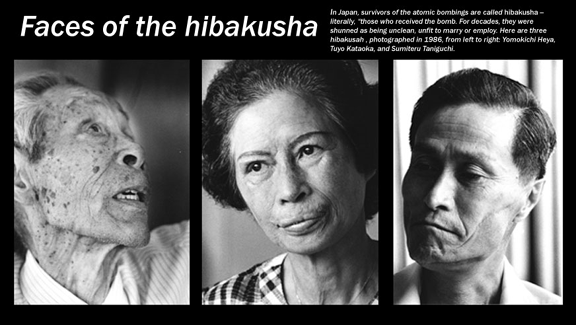


 Times 30th May 2018 Hitachi ‘won’t pay’ for nuclear accidents at proposed Wylfa plant on Anglesey. Hitachi could seek to absolve itself of financial responsibility for any accidents at its proposed new nuclear power station in north Wales.
 Toshiba exits US nuclear project https://www3.nhk.or.jp/nhkworld/en/news/20180531_37/ 31 May 18 Japanese electronics maker Toshiba is walking away from a nuclear energy project in the US. The firm says it won’t take part in building or operating the nuclear plant.


 nuclear-news