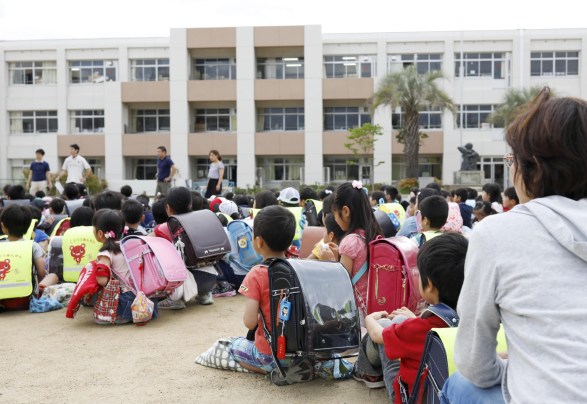
Strong earthquake shakes Osaka: Officials in neighboring Fukui Prefecture say all 15 nuclear reactors are still functioning

UK govt providing $billions for Wylfa nuclear power project, but Hitachi still scrambling for more money from Japan and USA

Nikkei Asian Review 16th June 2018 , Hitachi continues to search for ways to share the burdens of building a British nuclear power plant and now is sounding out the Development Bank of Japan and several Japanese power companies about taking stakes in the
project, a high hurdle as many are still struggling with the heavy financial fallout from the 2011 meltdown at Fukushima.
The cost projection for the project on the Welsh island of Anglesey has ballooned to 3 trillion yen ($27.1 billion). To keep it commercially viable, the British government pledged on June 4 to arrange the entire 2 trillion yen in necessary loans, twice its original offer. In addition, 900 billion yen is to be invested in the Hitachi subsidiary responsible for developing and building the plant, with 300 billion yen coming from a consortium of Japanese companies and the Japanese government.
The DBJ is considering an investment as a government-affiliated financial institution. Chubu Electric Power, Tokyo Electric Power Co. Holdings, Kansai Electric Power, Chugoku Electric Power and Hokuriku Electric Power are some of the utilities being approached
about taking small stakes in the project, as well as Japan Atomic Power. Hitachi is also asking the utilities for technical support.
Japan Atomic Power already plans to support such aspects as operation and maintenance of the U.K. plant with U.S. energy provider Exelon. Tepco and Chubu Electric both operate in Japan boiling water reactors, the same type that will bebbuilt on Anglesey. But winning participation from these companies will not be an easy task. Tepco must raise 16 trillion yen of the 22 trillion yen needed to decommission the Fukushima Dai-ichi nuclear plant and compensate victims of the meltdown. The company has said it will improve profitability to do so, but such efforts are still in the preliminary stages.
https://asia.nikkei.com/Business/Business-Deals/Hitachi-seeks-Japanese-partners-in-building-27bn-UK-nuclear-plant
Powerful earthquake north of Tokyo
Powerful quake jolts Gunma north of Tokyo; no injuries http://www.asahi.com/ajw/articles/AJ201806170031.html, THE ASAHI SHIMBUN, June 17, 2018
A strong earthquake shook the northern part of the Kanto region on the afternoon of June 17, the Meteorological Agency said.
The quake registered a lower 5 on the Japanese seismic intensity scale of 7 in Shibukawa, Gunma Prefecture, when it hit at 3:27 p.m. with a focus 14 kilometers from the ground surface. It originated in southern Gunma Prefecture. No injuries have been reported.
The agency said this is the first time a quake originating in the prefecture and measuring a lower 5 or stronger has been recorded since 1923.
The magnitude of the temblor is estimated at 4.6. No tsunami is expected, according to the agency.
Japan commits to reducing its excess of plutonium
 Japan to cap plutonium stockpile to allay U.S. concerns, THE ASAHI SHIMBUN, June 17, 2018
Japan plans to boost measures to curb surplus plutonium extracted from the reprocessing of spent fuel at nuclear power plants, including capping the country’s stockpile of the highly toxic material.
The move followed the U.S. and other countries’ calls for Japan to reduce excess plutonium in light of nuclear nonproliferation and the threat of terrorist attacks involving nuclear materials.
The Cabinet Office’s Japan Atomic Energy Commission will incorporate the measures in the five-point basic nuclear policy expected at the end of this month, the first revision in 15 years.
A reduction in the volume of plutonium held by Japan will also be specified in the government’s basic energy plan, which will be revised next month.
Japan possesses about 10 tons of plutonium inside the country and about 37 tons in Britain and France, the two countries contracted to reprocess spent nuclear fuel. The total amount is equivalent to 6,000 of the atomic bomb that devastated Nagasaki in 1945.
In the policy, announced in 2003, the government vowed not to possess plutonium that has no useful purpose. The government has pledged not to have surplus plutonium to the International Atomic Energy Agency………
Japan can reprocess spent nuclear fuel under the Japan-U.S. Nuclear Cooperation Agreement.
The 30-year pact is expected to be automatically extended beyond its expiration on July 16.
After the expiration, however, the pact will be scrapped six months after either Japan or the United States notifies the other side of its intention to do so.
Foreign Minister Taro Kono has expressed concern about the “unstable” future of the agreement after July, and Japan has worked to meet a request from Washington to clearly spell out steps to reduce Japan’s plutonium stocks.
The government’s draft policy calls for allowing retrieval of plutonium strictly based on the projected amount to be used at conventional nuclear reactors as mixed plutonium-uranium oxide fuel, commonly known as MOX fuel.
It will also step up oversight on utilities with the aim of reducing the amount of plutonium to a level allowing the nuclear reprocessing plant under construction in Rokkasho, Aomori Prefecture, and other facilities to operate properly.
In addition, electric power companies will cooperate with each other in the use of MOX fuel, so that the amount of Japan’s surplus plutonium that is now overseas will be reduced.
For example, Kyushu Electric Power Co. and Kansai Electric Power Co., two utilities that began using MOX fuel ahead of other utilities, will consider using more MOX fuel at their nuclear plants for the benefit of Tokyo Electric Power Co., whose prospect of bringing its Kashiwazaki-Kariwa nuclear power plant in Niigata Prefecture back on line remains uncertain.
When the 2.9 trillion yen ($26.37 billion) reprocessing plant in Rokkasho goes into full operation, about eight tons of new plutonium will be added annually as Japan’s surplus plutonium…..
of nine reactors that have resumed operations following the introduction of more stringent safety standards after the Fukushima No. 1 nuclear disaster in 2011, only four can use MOX fuel.
The operation of the Rokkasho plant will likely be significantly curtailed even if it is completed amid that environment.
(This article was written by Yusuke Ogawa, Rintaro Sakurai and Shinichi Sekine.) http://www.asahi.com/ajw/articles/AJ201806170027.html
Why does Japan persist with dangerous, unnecessary nuclear Rokkasho reprocessing? Is it to enable nuclear weapons?
 The Rokkasho reprocessing plant could ruin everything, Beyond Nuclear, By Kiyohiko Yamada, with additional contributions by Kurumi Sugita and Jon Gomon, 17 June 18
There is a nuclear fuel cycle center in Rokkasho village, located at the tip of Shimokita Peninsula in Aomori Prefecture, in the northernmost part of the main island of Japan.
On April 9, 1985, the governor of Aomori Prefecture gave the green light for the Rokkasho center to proceed. At first, it comprised three facilities:
•a uranium enrichment plant
•a fuel reprocessing plant
•a low-level radioactive waste repository
Later, two more facilities were added:
•a temporary storage facility of high-level radioactive waste returned from overseas after reprocessing,
•a MOX fabrication plant.
The nuclear fuel cycle center of Rokkasho village is operated by Japan Nuclear Fuel Limited (JNFL), notorious for its incompetent management. In October 2017, the Japanese Nuclear Regulation Autority (NRA) reported that JNFL violated safety measures. As the Mainichi Shimbun reported in an October 11, 2017 article, safety records were faked at the unfinished reprocessing plant.
“The NRA concluded on Oct. 11 that Japan Nuclear Fuel Ltd. (JNFL) has violated safety measures after it was learned that the firm failed to carry out the required checks and nevertheless continued to write down “no abnormalities” in safety check records. There has been a spate of incidents such as the flow of rainwater into facility buildings at the plant in the Aomori Prefecture village of Rokkasho.
“The plant, which is scheduled to reprocess spent nuclear fuel, was on the verge of hosting a final-stage NRA safety inspection, but the checkup is likely to be postponed considerably as JNFL now has to prioritize in-house inspections of all facilities at the plant.”The Japanese nuclear fuel cycle collapsed with the fast breeder reactor “Monju”
The Japanese government obstinately pursued a fast breeder reactor program, even though other similar projects had been abandoned elsewhere in the world. An estimated $9 billion was spent on Japan’s Monju prototype breeder reactor, which was so troubled it operated only 250 days during its 22-year existence. It was finally abandoned permanently in December 2016 and the decision was taken to decommission it.
And yet the Japanese government persists in trying to start operation of the Rokkasho reprocessing plant in the first half of 2021, even though the prospect of the fast breeder reactor’s commercialization has become improbable.
There is a contradiction here. Why start a reprocessing plant when there is no usage plan for the end product? One possible reason is that for quite some time, former Liberal Democratic Party (LDP) ministers have been hinting at the possibility of having nuclear weapons. Reprocessing extracts plutonium from irradiated reactor fuel. Perhaps the real intent is to have such a plutonium extraction plant which can produce eight tons of plutonium annually.
Surplus plutonium problem.……..
If the Rokkasho reprocessing plant is put into operation, it will create a surplus of eight tons of plutonium annually. The possession of such an amount of plutonium will most certainly increase tensions in Asia.
Risks involved in the Rokkasho plant
① The reprocessing plant is on a fault line
Japan is riddled with geological faults, and there is no stable stratum including at the Rokkasho reprocessing plant site. A large, active fault about 100 km in length lies on the Pacific Ocean side. Scientists warn that in the case of a big earthquake, a magnitude 8 tremor could seriously damage the reprocessing plant.
The operating company insists that a big earthquake will not occur in Rokkasho, but their seismograph is installed on bedrock, and is set so that it does not indicate more than a seismic intensity of 3. Why? It is because when seismic intensity higher than 3 is detected, it is necessary to make a total inspection of the reprocessing plant.
② Hakkoda and Towada volcanoes are nearby ….
③ Fighter jets fly near Rokkasho …..
Possibility of a serious accident …….
If the plant goes into operation, even without an accident, radiation exposure of the entire Aomori Prefecture, and of the Pacific Ocean, will be far too high
After the Fukushima Daiichi nuclear accident, many tanks were created on the site of the Fukushima nuclear power plant to store the tritium contaminated water after processing the radioactive water by the multi-nuclide removal facility (Advanced Liquid Processing System). In Fukushima prefecture, tritium contaminated water is not discharged into the ocean due to opposition from fishermen. In contrast, the same tritiated water was released in large amounts in Rokkasho during the active testing. Fishermen in Iwate once demanded that the reprocessing plant drainage be discharged into Mutsu Bay and not into the Pacific Ocean. The person in charge in Aomori Prefecture refused, saying, “Mutsu Bay would die”.
An upcoming mayoral election in Rokkasho Village could have important repercussions for the reprocessing plant. One candidate— Junk Endo — is resolutely opposed to opening it. The election takes place on June 24, 2018.
We are calling on our friends and colleagues all around the world to send Ms. Endo messages of support. It is important that Japanese authorities understand that the world is watching these elections. The people of Rokkasho do not need the leukemia clusters or the proliferation risks of a reprocessing plant. The world does not need more carcinogenic radioactive releases from yet another reprocessing plant when those at La Hague, France, and Sellafield, England, have already poisoned the air and seas far from their own lands. https://beyondnuclearinternational.org/2018/06/17/all-that-would-be-destroyed-reprocessing-japan/
Genkai nuclear power station restart sparks protest
 Japan Today 16th June 2018 , A nuclear reactor at a trouble-hit complex in southwestern Japan restarted
operations Saturday for the first time in more than six and a half years
amid lingering safety concerns. The No. 4 unit at the Genkai plant in Saga
Prefecture is the fourth reactor of operator Kyushu Electric Power Co’s to
go back online and the ninth nationwide under stricter safety rules
implemented after the Fukushima crisis in 2011. The utility aims to
generate and supply electricity from Wednesday and start commercial
operations in mid-July. The restart sparked local protests, with around 100
people gathering in front of the plant.
https://japantoday.com/category/national/trouble-hit-nuclear-reactor-in-southwestern-japan-resumes-operations
Govt plan to reuse radioactive soil for agriculture meets opposition
BNA 14th June 2018 Japan’s plan to reuse soil contaminated with radiation from the
Fukushima-Daiichi nuclear power plant accident for agriculture is sparking
something of its own nuclear reaction. Residents and other critics don’t
want any part of it.
https://www.bna.com/blowback-japanese-plan-n73014476527/
Why TEPCO should quickly close down Fukushima No. 2 nuclear plant
Editorial: TEPCO should quickly decommission Fukushima No. 2 nuclear plant, https://mainichi.jp/english/articles/20180615/p2a/00m/0na/026000c (Mainichi Japan). Tokyo Electric Power Co. (TEPCO) has finally announced that it will decommission its Fukushima No. 2 Nuclear Power Plant, more than seven years after the outbreak of the ongoing crisis at its tsunami-ravaged Fukushima No. 1 plant. If realized, all 10 nuclear reactors in Fukushima Prefecture would be dismantled.
Like the No. 1 plant, the No. 2 complex was also hit by tsunami generated by the March 2011 Great East Japan Earthquake. However, some of its external power sources remained intact, averting meltdowns at the plant.
The No. 2 plant remains offline, but a massive amount of nuclear fuel remains in the complex. Since prefectural residents have deeply rooted concerns about the plant’s safety and its possible reactivation in the future, the prefectural government has urged TEPCO and the national government, which effectively has the largest stake in the utility, to decommission the plant at an early date.
Reactivation of a nuclear plant requires consent from the local municipalities hosting the complex. Therefore, the resumption of operations at the No. 2 power station has always been a politically unfeasible option.
Moreover, more than 30 years have passed since operation of its four reactors began.
To operate the reactors beyond the 40-year limit set under new rules introduced after the outbreak of the nuclear crisis, it is necessary to invest a vast amount of money for additional safety measures. That means there were no merits to keeping the power station open in terms of the utility’s finances.
Nevertheless, TEPCO had delayed the decision to decommission the complex.
Once a utility decides to decommission a nuclear reactor, the operator cannot regard the facility or the nuclear fuel inside it as part of the company’s assets, weakening its financial base. It appears TEPCO may have waited to make the decision until the company had restored its financial strength.
However, even considering the financial strain that TEPCO experienced after the March 2011 disaster, it deserves criticism for its lack of sincerity, failing to provide a sufficient explanation to the public about its plans for the reactors.
TEPCO President Tomoaki Kobayakawa, who notified Fukushima Gov. Masao Uchibori of the decision, has admitted that the No. 2 plant “has hindered disaster recovery.” If so, the utility should promptly begin preparations to decommission the complex.
The power company already faces the extremely difficult task of decommissioning the Fukushima No. 1 nuclear plant. In order to smoothly carry out the decommissioning of the No. 2 plant as well, the company must exercise wisdom in allocating its management resources, such as funds and personnel. We hope TEPCO will cooperate with the government in swiftly materializing its plan for decommissioning the No. 2 power station.
The decommissioning of the Fukushima No. 2 plant would leave the Kashiwazaki-Kariwa Nuclear Power Plant in Niigata Prefecture as TEPCO’s sole atomic power station. This means that TEPCO may step up its efforts to persuade the local municipalities hosting that power plant to accept its reactivation. However, the company must keep in mind that the main priority is to ensure safety at the plant and to obtain the understanding and acceptance of local communities.
Tokyo Electric Power Company Holdings considers scrapping the shuttered Fukushima Dai-ni, or No. 2, nuclear plant
Japanese utility eyes scrapping 2nd Fukushima nuclear plant http://www.cbc.ca/news/world/japanese-utility-eyes-scrapping-2nd-fukushima-nuclear-plant-1.4705532, When Fukushima No. 2 is dismantled, Japan will have 35 workable reactors, down from 54 pre-disaster, The Associated Press
Japan approves 70-year plan to scrap nuclear reprocessing plant
https://mainichi.jp/english/articles/20180613/p2g/00m/0dm/072000c
(Mainichi Japan) TOKYO (Kyodo) — Japan’s nuclear watchdog on Wednesday approved a plan to scrap a nuclear fuel reprocessing plant northeast of Tokyo over a 70-year period with the cost projected at 1 trillion yen ($9 billion).
The facility in Tokaimura, Ibaraki Prefecture went into operation in 1977. It was Japan’s first spent-fuel reprocessing plant built under the nation’s nuclear fuel cycle policy, which aims to reprocess all spent nuclear fuel in order to reuse the extracted plutonium and uranium as reactor fuel in the resource-scarce country.
But the policy has run into a dead end as the completion of a separate fuel reprocessing plant in Aomori Prefecture, built on the technological expertise of the Tokaimura plant, has been delayed by more than 20 years.
The decommissioning cost will be shouldered by taxpayers as the Japan Atomic Energy Agency operating the Tokaimura plant, is backed by the state. Where to store the waste accumulated at the plant is undecided.
In 2014, the agency decided to decommission the plant due to its aging and the huge cost to run it under stricter safety rules introduced after the 2011 Fukushima nuclear crisis.
According to the plan approved by the Nuclear Regulation Authority, around 310 canisters of highly radioactive vitrified waste and some 360 cubic meters of radioactive waste are currently stored at the facility.
About 770 billion yen is estimated for the disposal of such waste and decommissioning of the facility and roughly 217 billion yen for the 10-year preparation work.
LDP-backed candidate wins governor’s race in Niigata

Amazingly High Radiation in Tokyo Bay — 131,000 Bq per Meter Squared
Abstract http://journals.plos.org/plosone/article?id=10.1371/journal.pone.0193414
A monitoring survey was conducted from August 2011 to July 2016 of the spatiotemporal
distribution in the 400 km2 area of the northern part of Tokyo Bay and in rivers flowing into it of radiocesium released from the Fukushima Daiichi Nuclear Power Plant (FDNPP) accident.
The average inventory in the river mouth (10 km2) was 131 kBq⋅m-2 and 0.73 kBq⋅m-2 in the central bay (330 km2) as the decay corrected value on March 16, 2011. Most of the radiocesium that flowed into Tokyo Bay originated in the northeastern section of the Tokyo metropolitan area, where the highest precipitation zone of 137Cs in soil was almost the same level as that in Fukushima City, then flowed into and was deposited in the Old-Edogawa River estuary, deep in Tokyo Bay.
The highest precipitation of radiocesium measured in the high contaminated zone was 460 kBq⋅m-2. The inventory in sediment off the estuary of Old-Edogawa was 20.1 kBq⋅m-2 in August 2011 immediately after the accident, but it increased to 104 kBq⋅m-2 in July 2016. However, the radiocesium diffused minimally in sediments in the central area of Tokyo Bay in the five years following the FDNPP accident.
The flux of radiocesium off the estuary decreased slightly immediately after the accident and conformed almost exactly to the values predicted based on its radioactive decay. Contrarily, the inventory of radiocesium in the sediment has increased.
It was estimated that of the 8.33 TBq precipitated from the atmosphere in the catchment regions of the rivers Edogawa and Old-Edogawa, 1.31 TBq migrated through rivers and was deposited in the sediments of the Old-Edogawa estuary by July 2016. Currently, 0.25 TBq⋅yr-1 of radiocesium continues to flow into the deep parts of Tokyo Bay.

US demands Japan reduce its plutonium stockpiles
Nikkei Asian Review 10th June 2018 , US demands Japan reduce its plutonium stockpiles. Trump-Kim summit raises
questions about Tokyo’s nuclear exemption. The U.S. has called on Japan to
reduce its high levels of stockpiled plutonium, a move that comes as the
Trump administration seeks to convince North Korea to abandon its nuclear
weapons, Nikkei has learned.
https://asia.nikkei.com/Politics/International-Relations/US-demands-Japan-reduce-its-plutonium-stockpiles
Why wasn’t TEPCO bankrupted? – Japan’s Citizens’ Nuclear Information Center
 Why wasn’t TEPCO bankrupted? http://www.cnic.jp/english/?p=4128 Hajime Matsukubo, CNIC, BY CNIC_ENGLISH · JUNE 4, 2018
The nuclear accident at Tokyo Electric Power Company’s (TEPCO’s) Fukushima Daiichi Nuclear Power Station (FDNPS) has left TEPCO under a huge pile of debt. At the time, there were arguments in favor of dissolving TEPCO, the liable party, but due to the Japanese government’s generous support, the company continues to exist to this day. In this article, we attempt to throw light on the reasons why TEPCO was not bankrupted.
Japan’s Act on Compensation for Nuclear Damage states in Section 3, “Where nuclear damage is caused as a result of reactor operation etc. during such operation, the nuclear operator who is engaged in the reactor operation etc. on this occasion shall be liable for the damage, except in the case where the damage is caused by a grave natural disaster of an exceptional character or by an insurrection.” In Section 4, the Act stipulates that “Where nuclear damage is covered by the preceding section, no person other than the nuclear operator who is liable for the damage pursuant to the preceding section shall be liable for the damage.” Thus while imposing on the nuclear power operator unlimited no-fault liability with liability concentrated in its hands, it also provides exemptions in the form of “a grave natural disaster of an exceptional character or by an insurrection.” At the same time, Section 16 provides for necessary government assistance to pay compensation, and Section 17 states that in the case of “a grave natural disaster of an exceptional character or by an insurrection” the government “shall take necessary measures to relieve victims and to prevent the damage from spreading.”
TEPCO’s cash and deposits as the accounts were closed at the end of the third quarter of 2010 (December 31, 2010) were 366.5 billion yen. With company bond redemptions of 500 billion yen coming up in FY2011 and the need to procure fuel worth 800 billion yen, financing from the market was fraught with difficulties after the FNDPS nuclear accident, bringing TEPCO close to bankruptcy.
TEPCO’s cash and deposits leaped up to 2.2 trillion yen at the close of accounts for FY2010 (March 31, 2011). This was almost all in long-term loans. According to news reports at the time, 1.865 trillion yen was provided in loans of three to ten years, with no warranty and at the same interest as before the accident, by eight financial institutions, including the Sumitomo Mitsui Banking Corporation (600 billion yen), the Mizuho Corporate Bank (500 billion yen) and the Mitsubishi UFJ Bank (300 billion yen). It is said that in the background to this was the statement by the then deputy minister of the Ministry for the Economy, Trade and Industry (METI), Kazuo Matsunaga, that “We must also not shirk responsibility. I would also like to see support from financial institutions.”
In August 2011, the government enacted the Nuclear Damage Compensation Facilitation Corporation Act to avoid a TEPCO bankruptcy. The scheme inherent in the act is as follows:
2) The Corporation shall levy a special contribution from the nuclear operator that caused the accident (in this case TEPCO).
3) The Corporation shall provide financial facilitation (granting of funds, acceptance of stocks, loans, purchase of company bonds, etc.) when the Corporation’s facilitation is required for compensation by the nuclear operator. To procure the funds necessary for financial facilitation, the Corporation can issue government-guaranteed compensation bonds to borrow money from financial institutions.
4) In the case that special support is required from the government, the Corporation and the nuclear operator shall determine the amount of compensation, prepare a “special business plan” that sets out the content and value of the financial support, policies for business management rationalization and so on, and receive approval from the relevant ministers (the Cabinet Office and METI). Following approval, the government will allocate government bonds to the Corporation, the necessary funds then being granted to the nuclear operator by the Corporation.
5) The Corporation shall pay into the national treasury money up to the amount of redemption of the government bonds.
Of this, it is presumed that the 4 trillion yen estimated for decontamination costs will be eventually supplemented by profits accruing from the sale of TEPCO stocks, the 1.6 trillion yen costs for intermediate storage facilities will be paid from the national treasury, and that 3.7 trillion yen of the total compensations will be paid by nuclear power operators from the general contributions, while 0.24 trillion yen will be borne by imposing a power distribution consignment charge on power companies that have entered the market recently due to deregulation of the power market.
Japan’s Citizens’ Nuclear Information Center calls for TEPCO to be liquidated
it is impermissible for the government, which is spending such an enormous amount of taxpayers’ money on TEPCO, to allow the utility to give financial support to another collapsed company
There is no need for TEPCO to survive any longer, because it has abdicated its responsibility for the nuclear accident and continues to support a virtually failed company.
Citizens’ Nuclear Information Center Create No Nukes World With Us CNIC Statement, April 11, 2018 : Liquidate TEPCO! http://www.cnic.jp/english/?p=4130, BY CNIC_ENGLISH · JUNE 4, 2018 On April 5, 2018, the government’s Nuclear Damage Compensation Dispute Resolution Center notified residents of Namie Town, Fukushima Prefecture, and TEPCO of its decision to discontinue its efforts to achieve an Alternate Dispute Resolution (ADR) on the residents’ demand for additional compensation for mental anguish caused by the 2011 Fukushima nuclear accident. Continue reading
1 This Month
26 September – International Day for the Total Elimination of Nuclear Weapons





PLEASE OPPOSE HR 8255 AND S.3639 – bills would accelerate satellite deployment, with no environmental review or safeguards – https://ncstd5li.quorum.us/campaign/169331/
To see nuclear-related stories in greater depth and intensity – go to https://nuclearinformation.wordpress.com
-
Archives
- September 2026 (281)
- August 2026 (330)
- July 2026 (355)
- June 2026 (287)
- May 2026 (306)
- April 2026 (356)
- March 2026 (251)
- February 2026 (267)
- January 2026 (308)
- December 2025 (358)
- November 2025 (359)
- October 2025 (375)
-
Categories
- 1
- 1 NUCLEAR ISSUES
- business and costs
- climate change
- culture and arts
- ENERGY
- environment
- health
- history
- indigenous issues
- Legal
- marketing of nuclear
- media
- opposition to nuclear
- PERSONAL STORIES
- politics
- politics international
- Religion and ethics
- safety
- secrets,lies and civil liberties
- spinbuster
- technology
- Uranium
- wastes
- weapons and war
- Women
- 2 WORLD
- ACTION
- AFRICA
- Atrocities
- AUSTRALIA
- Christina's notes
- Christina's themes
- culture and arts
- Events
- Fuk 2022
- Fuk 2023
- Fukushima 2017
- Fukushima 2018
- fukushima 2019
- Fukushima 2020
- Fukushima 2021
- general
- global warming
- Humour (God we need it)
- Nuclear
- RARE EARTHS
- Reference
- resources – print
- Resources -audiovicual
- Weekly Newsletter
- World
- World Nuclear
- YouTube
-
RSS
Entries RSS
Comments RSS

