Challenges ahead for debris removal at Fukushima https://www3.nhk.or.jp/nhkworld/en/news/20180102_05/This year will mark the 7th anniversary of the nuclear accident at the Fukushima Daiichi plant that occurred in March, 2011. The plant’s operator is hoping to eventually remove fuel debris from the damaged reactors.
Fuel debris is a mixture of melted nuclear fuel and broken reactor parts. Removing the debris is considered to be the biggest hurdle to the decommissioning of the reactors.
Last year, Tokyo Electric Power Company, or TEPCO, investigated the inside of the containment vessels of 3 reactors and confirmed, for the first time, the existence of lumps that are believed to be fuel debris in the No.3 reactor.
TEPCO plans to conduct a fresh probe of the No.2 reactor this month to confirm whether a mass on the floor under the reactor, observed last year, is actually fuel debris.
The government and TEPCO aim to begin removing debris in 2021. They are planning to determine which reactor to start with, and how to conduct the procedure, during fiscal 2019.
Workers will try this year to figure out which details need to be considered in order to make the decision.
Removing the debris requires thorough safety measures. For example, radioactive materials must be prevented from spreading and workers must be protected from exposure to radiation.
This autumn, the operator also plans to start removing spent nuclear fuel rods from the storage pool of the No.3 reactor building.
Kyodo News 25th Dec 2017, Radiation cleanup work began Monday in Futaba to make the town that
co-hosts the crisis-hit Fukushima Daiichi nuclear power plant inhabitable again by around spring 2022 under a government-led reconstruction project.
Cleanup work has been carried out in areas contaminated with radioactive substances released from the nuclear plant in the aftermath of the March 2011 huge earthquake and tsunami, with the plant operator Tokyo Electric
Power Company Holdings Inc. being responsible for the cost.
But the latest work in Futaba is the first of the government-led project to make areas designated as special reconstruction zones livable again. The government plans to carry out cleanup work and promote infrastructure development
intensively at national expense in those areas.
Japan is poised to flood the Pacific Ocean with one million tons of radioactive water contaminated by the Fukushima nuclear power plant —The amount of radioactive water at Fukushima is still growing, by 150 tons a day. | 26 Nov 2017 | The Japanese government is being urged by experts to gradually release radioactive water in to the Pacific Ocean more than six years after a tsunami overwhelmed the Fukushima nuclear power plant. The water is stored on site in around 900 large and densely packed tanks and could spill should another major disaster strike. The government has been urged to release the water into the ocean as all the radioactive elements of the water except tritium have [*allegedly*] been removed through treatment. But if the tank breaks, the contents may not be able to be controlled.
Academic paper: “Increases in perinatal mortality in prefectures contaminated by the Fukushima nuclear power plant accident in Japan” Source Institute: 医療問題研究会
Authors and copyright: Hagen Heinrich Scherb, Dr rer nat Dipl-Matha,∗, Kuniyoshi Mori, MDb, Keiji Hayashi, MDcEditor: Roman Leischik.
Abstract:
Descriptive observational studies showed upward jumps in secular European perinatal mortality trends after Chernobyl.
The question arises whether the Fukushima nuclear power plant accident entailed similar phenomena in Japan. For 47 prefectures representing 15.2 million births from 2001 to 2014, the Japanese government provides monthly statistics on 69,171 cases of perinatal death of the fetus or the newborn after 22 weeks of pregnancy to 7 days after birth.
Employing change-point methodology for detecting alterations in longitudinal data, we analyzed time trends in perinatal mortality in the Japanese prefectures stratified by exposure to estimate and test potential increases in perinatal death proportions after Fukushima possibly associated with the earthquake, the tsunami, or the estimated radiation exposure.
Areas with moderate to high levels of radiation were compared with less exposed and unaffected areas, as were highly contaminated areas hit versus untroubled by the earthquake and the tsunami. Ten months after the earthquake and tsunami and the subsequent nuclear accident, perinatal mortality in 6 severely contaminated prefectures jumped up from January 2012 onward: jump odds ratio 1.156; 95% confidence interval (1.061, 1.259), P-value 0.0009.
There were slight increases in areas with moderate levels of contamination and no increases in the rest of Japan.
In severely contaminated areas, the increases of perinatal mortality 10 months after Fukushima were essentially independent of the numbers of dead and missing due to the earthquake and the tsunami. Perinatal mortality in areas contaminated with radioactive substances started to increase 10 months after the nuclear accident relative to the prevailing and stable secular downward trend. These results are consistent with findings in Europe after Chernobyl.
Six Years After Fukushima, Robots Finally Find Reactors’ Melted Uranium The Japanese government and companies used radiation-hardened machines to search for the fuel that escaped the plant’s ruined reactors. By MARTIN FACKLER. NY Times 19 Nov 17 “……As officials became more confident about managing the disaster, they began a search for the missing fuel. Scientists and engineers built radiation-resistant robots like the Manbo and a device like a huge X-ray machine that uses exotic space particles called muons to see the reactors’ innards.
Now that engineers say they have found the fuel, officials of the government and the utility that runs the plant hope to sway public opinion. Six and a half years after the accident spewed radiation over northern Japan, and at one point seemed to endanger Tokyo, the officials hope to persuade a skeptical world that the plant has moved out of post-disaster crisis mode and into something much less threatening: cleanup……..
Tepco is keen to portray the plant as one big industrial cleanup site. About 7,000 people work here, building new water storage tanks, moving radioactive debris to a new disposal site, and erecting enormous scaffoldings over reactor buildings torn apart by the huge hydrogen explosions that occurred during the accident…….
The government admits that cleaning up the plant will take at least another three to four decades and tens of billions of dollars. A $100 million research center has been built nearby to help scientists and engineers develop a new generation of robots to enter the reactor buildings and scoop up the melted fuel.
At Chernobyl, the Soviets simply entombed the charred reactor in concrete after the deadly 1986 accident. But Japan has pledged to dismantle the Fukushima plant and decontaminate the surrounding countryside, which was home to about 160,000 people who were evacuated after accident.
Many of them have been allowed to return as the rural towns around the plant have been decontaminated. But without at least starting a cleanup of the plant itself, officials admit they will find it difficult to convince the public that the accident is truly over.
They also hope that beginning the cleanup will help them win the public’s consent to restart Japan’s undamaged nuclear plants, most of which remain shut down since the disaster……..
Engineers are developing the new radiation-resistant robots at the Naraha Remote Technology Development Center. It includes a hangar-sized building to hold full-scale mock-ups of the plant and a virtual-reality room that simulates the interiors of the reactor buildings, including locations of known debris.
The equipment, weighing 72 tons, was lifted up to the upper part of the plant’s No. 3 reactor using two large cranes.
The pool, located on a floor 36 meters above the ground, holds a total of 566 spent and unused nuclear fuel assemblies. Tepco plans to begin removing the fuel from the storage pool in the middle of fiscal 2018.
The installation work was originally slated to start Saturday, but was postponed due to strong winds.
With the device, the fuel assemblies will be moved from the pool to sturdy containers, which will be tightly sealed to block any emissions of strong radiation.
The work will be conducted in the water-filled pool, and then the containers will be then lowered to the ground using a different crane and transferred to another pool some distance from the reactor, where they will be stored.
The building housing the No. 3 reactor was heavily damaged by a hydrogen explosion that occurred shortly after the power station was knocked out by the tsunami following the magnitude 9 earthquake in March 2011.
After debris from the blast was removed from the upper part of the No. 3 reactor, Tepco started work in late July this year to install a cover on top of the reactor to shield the fuel-removing equipment from weather damage and prevent radioactive materials from spreading.
The crane to be used for lowering the fuel containers to the ground is slated to be installed in the upper part of the reactor on Nov. 20.
Informal Labour, Local Citizens and the Tokyo Electric Fukushima Daiichi Nuclear Crisis: Responses to Neoliberal Disaster Management. ANU, Adam Broinowski, 7 Nov 17, “…..Conditions for Residents of Post-3.11 Radiation-Affected Areas
For roughly 30 years, the exclusion zone around Chernobyl has been set at 30 kilometres. Between 1 and 5 mSv/y is the assisted evacuation level and mandatory evacuation is 5 mSv/y and above. Unlike the approach adopted for Chernobyl, which was to achieve containment (a sarcophagus was built in eight months) and permanent resettlement of 350,000 people, the government and TEPCO have adopted a ‘dilution’ approach—to widely disperse and redistribute (‘share’) radioactive materials and waste and decontaminate residential areas. To date, this has permitted the permanent release through venting, dumping and incinerating of radioactive materials into the air, land, water and sea, and circulation in the food chain and recycled materials on a daily basis since March 2011.
Over the first few days at Fukushima Daiichi nuclear power station, severity (International Nuclear Event Scale) levels were steadily raised from level 3 to level 5 to level 7, and the mandatory evacuation zone was gradually expanded from 10 to 30 kilometres. On 16 March 2011, readings in Aizu-Wakamatsu Middle School (100 kilometres from FDNPS) in Fukushima Prefecture returned 2.57 microSv/h (microsieverts per hour),27 and Kōriyama (60 kilometres) recordings returned 3.6–3.9 microSv/h. Inside people’s homes in Kōriyama, levels were between 1.5 and 2.0 microSv/h and 8.2 microSv/h in the downpipes.28 This data was made public only three months later. On 6 April, schools in Fukushima Prefecture were reopened. As the boundaries, legal limits and information were gradually altered, populations were urged to return to work. At the same time the legal safety level for mandatory evacuation for the public (radiation safety level 1972) was raised from 1 to 20 mSv/y,29 based on a cumulative 100 mSv dose averaged over five years, suddenly shifting the parameters for ‘low-level’ radiation and designating the general public with the level previously designated to nuclear workers.
The US Government advised a mandatory evacuation zone of 50 miles (80 kilometres). Several nations’ embassies in Tokyo evacuated their staff. Of roughly 2 million in Fukushima Prefecture, about 80,000 people from 11 municipalities were ordered to evacuate while another 80,000 evacuated voluntarily. By late 2015, about 118,862 remained evacuated.30 Sixty thousand of these people live in temporary housing and many lacked basic needs. There were many evacuees who sought public housing who have been turned away.31 There are additional evacuees affected by the earthquakes and tsunami who come from other prefectures (including parts of Miyagi and Ibaraki), some of whom were also affected by radiation exposure.
The situation in many villages within contaminated areas signifies how government policies have further exposed a wide range of people—farmers, shopkeepers, taxi drivers, factory workers, mothers (as reproductive workers), school students, local public servants—to conditions informal workers have long had to endure. In several cases (i.e. Iitate, Minami Soma, Namie), the notification of residents of radiation danger was delayed and potassium iodide pills were not distributed. Similarly, data on weather patterns and distribution gathered by the SPEEDI monitoring system32 was suppressed. These populations were not adequately informed of what the dose readings meant in terms of health risk. When people did seek measurement and treatment for their likely exposures, hospitals and other institutions with the requisite measuring technologies refused to measure them, as it was deemed ‘there was no reason for internal contamination and so there was no reason to measure’.33 These people unwittingly became hibakusha (被曝者), broadly defined as victims of radiation exposure.
Even though the Fukushima Daiichi nuclear disaster has caused near-permanent pollution, the conflation of the radiation problem with tsunami and earthquake destruction to be managed as a single large-scale ‘clean-up’, reconstruction and revitalisation operation as instituted by the National Resilience Council 2013 has occluded the materiality of radiation.
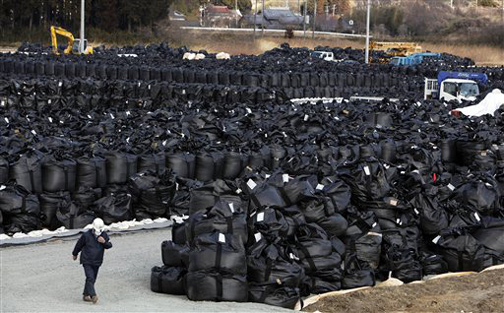
Informal workers on ‘decontamination projects’ washed down public buildings and homes and scraped up and replaced soil and sludge contaminated at levels found for example at between 84,000–446,000 Becquerels per kilogram (Bq/kg) in Kōriyama (60 km from Fukushima Daiichi).34 They also collected waste that included radioactive debris, uniforms and tools. The organic waste is stored on government-purchased land in black industrial bags piled in large walls and mounds to create a sort of buffer zone on town margins and in areas determined as long-term irradiated zones.35 Other contaminated waste is burned in newly constructed incinerators in towns nearest the plant (such as Futaba, Okuma, Naraha, Tamura, Tomioka, with more planned) in addition to the incineration already underway in major cities since 3.11, even while evacuees are being compelled to return to some of them (Tamura, Kawauchi, Naraha) where evacuation orders have been lifted. In addition, in June 2016 the Ministry of the Environment approved radioactive soil of up to 8,000 Bq/kg to be reused in national public works. Although stipulated to be used for roads and barriers (such as sea walls) under a layer of non-contaminated materials, there is concern that these will corrode over time leading to recirculation in the environment.
As compensation schemes are contingent upon where evacuees come from (whether these are areas where there are plans to lift evacuation orders, areas pending decontamination in the shorter term, or those deemed difficult to return to), those mandatory evacuees without property have received on average 100,000 yen per month while voluntary evacuees have received 60,000 yen per month, even if radiation levels in their residential areas were high.
The return to towns that received over 50 mSv/y (Futaba, Namie, Okuma) remains unlikely for decades, but if evacuees do return to other villages, they risk lifetime re-exposures of up to 20 mSv/y. In late 2015, Iitate village, for example, was divided into Areas 1 and 2, which are being prepared for repopulation (54,000 people), and Area 3, which so far remains out of bounds. Although the topsoil contaminated with Caesium was stripped and replaced (i.e. returning 0.6 microSv/h) and its houses and roads were washed down, 96 per cent of Iitate remained at 1 microSv/h. As Iitate is 75 per cent forest, which trapped a large stock of contamination, the land re-concentrates through radiation circulation (hence, quickly returned to 2.6 microSv/h).36 If the majority in Iitate, who are primarily agricultural workers, can no longer harvest vegetables, rice, wild mushrooms and vegetables (sansai 山菜) or burn wood for heat, and their houses are re-irradiated, then only the semi-autonomous elderly are likely to return. By August 2015, less than 10 per cent of roughly 14,000 eligible had applied for temporary return.37
So-called ‘decontamination’ and ‘remediation’ has been deployed to justify redefining evacuation boundaries and lifting evacuation orders so as to cut compensation payments. Following the 37th National Emergency Response Headquarters meeting held at the Prime Minister’s Office in June 2015 in which the Prime Minister decreed that ‘evacuees must return to their hometowns as quickly as possible and start new lives’,38 in late August 2015 evacuees were told if they chose to return home they would receive a one-off payment of 100,000 yen per household. If they did not, once evacuation orders had been lifted, ‘free rent’ (yachin hojo 家賃補助) for voluntary evacuees would be cut by March 2017 at the very latest.39 Further, the government announced its intention to partially lift the restriction on the ‘difficult-to-return zone’ by 2022 so as to counteract the negative image of the area and its produce.40 Without alternative income, and with a significant housing shortage due to the restriction of new public housing, many have been and will be forced to return to contaminated areas, to endure radiation exposure without compensation. If only the elderly return, there will be few prospects for young families in such towns where there is little local business and infrastructure, and public facilities and housing are in disrepair.
In Naraha, between May and August 2015, ambient readings in populated areas officially determined as ‘low or moderate’ returned 0.3–0.7 microSv/h and soil samples returned 26,480–52,500 Bq/kg of Caesium 137 and 134 combined (and 18,700 Bq/kg in the town’s water reservoir).41 While the majority of former residents are more likely to either pull down their houses and sell the land or maintain their homes as vacationers, there is additional private and state pressure to industrialise these former idylls as ‘reconstruction hubs’. As part of the ‘Innovation Coast’ plan, for example, 1,000 irregular workers have resided on the town’s outskirts as they built a giant research facility (estimated cost: 85 billion yen) to train hundreds of workers in reactor simulations and use of specialised robots. As industry colonises and transforms such towns, the pressing concern of unmitigated radiation levels in soil, forests and water, whether from distribution or recirculation, remains due to the long-lived decay and harmful effects of these radionuclides.
Similarly, in the effort to stimulate business, highways (Route 6) and train lines (Jōban line) passing directly through the (former) evacuation zone were reopened in 2015, although traffic must still travel with closed windows at the time of writing. Regular users of these corridors such as railway and transport workers and irregular nuclear workers accumulate higher doses from regular exposure while radioactive particles attached to vehicles are dispersed beyond contaminated areas. Clearly, a containment and permanent resettlement approach has been deemed untenable in the belief it would disrupt economic productivity levels. As one high school student insightfully observed, ‘Sensei … If they [really wanted to turn] Fukushima into an evacuation zone they’d have to block the Route 4 highway, Tōhoku expressway and Shinkansen’.42 Nevertheless, in lieu of overall reconstruction costs less conservatively estimated at half a trillion dollars, it may have been cheaper in the longer term to adopt permanent resettlement, education, health treatment and work creation strategies……http://press-files.anu.edu.au/downloads/press/n2335/html/ch06.xhtml?referer=2335&page=11
On the mediated surface, Fukushima Daiichi has been used to prove to the world that a nuclear disaster of significant scale can be overcome and that people can survive and return to their normal lives. The government has concentrated on proving that it is safe for the Olympics, safe for tourism, safe to consume local produce, and safe to restart nuclear reactors.
The authorities have furnished people with the means by which to normalise sickness and pathologise anxiety to justify the return to nuclear power reliance, while suppressing those who seek to resist it.
And so we return to the basic problem that no nuclear reactor can operate without radiation-exposed labour,
Informal Labour, Local Citizens and the Tokyo Electric Fukushima Daiichi Nuclear Crisis: Responses to Neoliberal Disaster Management ANU, Adam Broinowski, 8 Nov 17
Nuclear workers are important as sentinels for a broader epidemic of radiation related diseases that may affect the general population.1
The ongoing disaster at the Fukushima Daiichi nuclear power station (FDNPS), operated by Tokyo Electric Power Company (TEPCO), since 11 March 2011 can be recognised as part of a global phenomenon that has been in development over some time. This disaster occurred within a social and political shift that began in the mid-1970s and that became more acute in the early 1990s in Japan with the downturn of economic growth and greater deregulation and financialisation in the global economy. After 40 years of corporate fealty in return for lifetime contracts guaranteed by corporate unions, as tariff protections were lifted further and the workforce was increasingly casualised, those most acutely affected by a weakening welfare regime were irregular day labourers, or what we might call ‘informal labour’.
During this period, many day labourers evacuated rented rooms (doya どや) and left the various yoseba (urban day labour market よせば, or lit. ‘meeting place’) to take up communal tent living in parks and on riverbanks, where they were increasingly victimised. With independent unions having long been rendered powerless, growing numbers of unemployed, unskilled and precarious youths (freeters フリーター) alongside older, vulnerable and homeless day labourers (these groups together comprising roughly 38 per cent of the workforce in 2015)3 found themselves not only lacking insurance or industrial protection but also in many cases basic living needs. With increasing deindustrialisation and capital flight, regular public outbursts of frustration and anger from these groups have manifested since the Osaka riots of 1992.4
As Mike Davis observed, an un(der)protected informal sector in cities and industrial zones around the world occurs where there is a dilution or absence of labour rights and is characterised by ‘semi-feudal kickbacks, bribes, tribal or gang loyalties and ethnic exclusion’.5 Whether on a construction site, on the pavement, or in a domestic employment situation, informal labour comprises a surplus or reserve army of mercenary, irregular or precarious workers who pay off their debt for the opportunity to work through the availability of their cheap labour power.
In this chapter, first I outline the conditions of irregular workers at nuclear power plants and the excess burden they have borne with the rise of nuclear labour in Japan since the 1970s. I then turn to post-3.11 conditions experienced by residents in radiation-contaminated areas. Contextualising these conditions within the genealogy of radiodosimetry standards, I seek to show, through personal interviews and localised responses, how those who are regularly exposed to radiation from Fukushima Daiichi are now confronting problems similar to those faced by informal nuclear labour for decades in Japan. This analysis shows how, after 40 years or more of environmental movements as discussed in Chapter Four, the struggle continues to find viable solutions to the systemic production of the intertwined problems of environmental crises and labour exploitation, and suggests how potential alternative directions for affected populations may lie in their mutual combination………
Conclusions
From this discussion, it is evident how an advanced capitalist nation-state deploys a disposable population of informal labour to absorb the dangers inherent to the use of large-scale nuclear technologies and its private extractive and accumulation practices. Since its inception, nuclear power has been regarded by some as a symbol of Japan’s postwar civilisational progress.100 At the same time, the health of many thousands of people has been endangered in exposures to radiation while harms have been perpetrated upon local communities and nuclear workers and the environment more broadly as millions of people have been integrated within the centralising and concentrating dynamic of the transnational nuclear power industry.
On the mediated surface, Fukushima Daiichi has been used to prove to the world that a nuclear disaster of significant scale can be overcome and that people can survive and return to their normal lives. The government has concentrated on proving that it is safe for the Olympics, safe for tourism, safe to consume local produce, and safe to restart nuclear reactors (with 25 reactors expected to be supplying 20 per cent total energy by 2030). The neoliberal disaster model adopted, in which the state prioritises the profit of private corporations and their wealth-creating strategies while minimising public services and pursuing deregulation (e.g. of labour conditions), is indicated not only in the official intention to rebuild the local economy of Fukushima Prefecture, but also to expand, including through its transnational nuclear industry, Japan’s financial, military and industrial sector after Fukushima. This reflects the priority given to both the interests of the utilities, banks and construction companies involved in the reconstruction program, and those of multinational corporations, foreign governments and international regulatory and financial institutions involved in this sector.
At the same time, the sovereign duty to protect the fundamental needs of the population and reflect majority will is secondary to these priorities. Unlike a natural disaster, owing to the materiality of radiation that continues to be dumped and vented into the environment, facilitating the return to pre-disaster conditions by forgetting and rebuilding communities in contaminated areas is a practice of illusion. Despite the claims of the Abe administration and other nuclear promoters, Japan’s safety standards cannot adequately insure against the seismic activities or extreme weather events and their impacts on that archipelago. The authorities have furnished people with the means by which to normalise sickness and pathologise anxiety to justify the return to nuclear power reliance, while suppressing those who seek to resist it. The wealth of a healthy society and environment cannot be traded for the putative convenience and economic benefits of nuclear power generation as they are not comparable values. Official denial of the steady accumulation and exposure to ‘low-level’ internal radiation in a growing segment of the population only aggravates rather than protects the affected communities from the stresses related to Fukushima Daiichi. This inescapably leads to the need to address greater systemic problems that underlie such disasters.
As the previous organic life of village communities in contaminated zones is transformed into retirement villages and ad-hoc industrial hubs for temporary workers, this alienation from food, land, community, history, the human body and nature itself is a warning of the growing negative costs of the rapid expropriation and consumption of the planetary commons under a globalised system. Just as nuclear energy is not the solution to climate disruption caused by reliance on fossil fuels in a global capitalist economy, nor are radiation exposures comparable to everyday risks in modern society (i.e. transport accidents). If introducing ‘mistakes’ into the human genome is to be wagered against the daily conveniences of ‘modern’ life then this aspect of modernity is unsustainable. Although somewhat anthropocentric, it is a timely reminder that the Nobel Prize laureate (1946) Herman Müller stated in 1956, ‘the genome is the most valuable treasure of humankind. It determines the life of our descendants and the harmonious development of the future generations’.101
And so we return to the basic problem that no nuclear reactor can operate without radiation-exposed labour, particularly of informal or irregular workers. If these populations refused to work and joined in support with a network of translocal groups on informal and alternative life projects for greater self-sufficiency such as micro-financing, small-scale and permaculture farming on non-contaminated land, renewable and decentralised energy production and distribution, or campaigns for greater distribution of wealth, better public education and health improvement, these communities and workers could be active agents in devising models that could eventually become viable for adaptation to larger human populations. This application at scale cannot come too soon in the present context of imminent exhaustion of the planetary commons from the systemic demands for relentless economic growth and accumulation of wealth and power for the few.
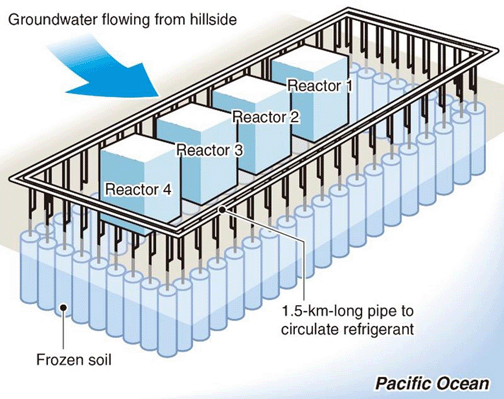
Frozen soil wall nearly complete; NRA still doubts effect , http://the-japan-news.com/news/article/0004052403, November 07, 2017 The Yomiuri Shimbun,A construction project to create frozen soil walls that encircle the ground beneath Tokyo Electric Power Company Holdings Inc.’s disaster-hit Fukushima No. 1 nuclear power plant is nearly finished.
Although TEPCO insists that the inflow of groundwater beneath the reactor buildings has been reduced, some members of the Nuclear Regulation Authority are skeptical about the project’s effectiveness. With ¥34.5 billion of public funds being spent on this project, the centerpeice of countermeasures for contaminated water, its cost-effectiveness is being carefully watched.
The project entails building a 1.5-kilometer-long frozen soil wall encircling the Nos. 1 to 4 reactors, with 1,568 pipes buried to a depth of about 30 meters below ground and coolant running through the pipes at minus 30 C to chill the soil.
The process is expected to prevent groundwater from flowing into the contaminated, highly radioactive underground water at such sites as the reactor buildings, and to avoid an increase of contaminated water.
The project began in March last year, and operations to freeze the final section, about seven meters wide, on the mountain side began in August this year.
The temperature of the underground soil has remained below zero, except for a part close the surface that is affected by outdoor air, meaning the project to create the 30-meter-deep walls is almost complete.
According to TEPCO’s assessment, before the project started, about 400 tons of groundwater was flowing into the ground underneath the reactor buildings and other sites daily. TEPCO had initially calculated that the daily inflow of groundwater could decrease to dozens of tons once the walls were installed. However, between April and September the inflow per day was between 120 tons and 140 tons, and in October it was around 100 tons. That the amount of inflow has decreased in stages as the soil freezing progressed seems to prove that the project has been effective to a certain extent. However, it is unclear if the inflow will decrease further in the future.
In parallel with the frozen soil wall project, TEPCO dug about 40 subdrain wells to pump up groundwater before it flows into the reactor buildings. It also reinforced measures to prevent rainwater from soaking into the ground by paving 1.33 million square meters of surface.
In the NRA view, those measures must also contribute greatly to reducing the inflow, casting doubt on the frozen soil walls project by saying the effect of them alone may be limited. The agency has become distrustful of TEPCO and urged the company to verify the effects.
Hiroshi Miyano, visiting professor at Hosei University specializing in system safety, said: “There is sure to be a part that doesn’t freeze completely, and it’s impossible to reduce the inflow to zero. TEPCO must continue applying this measure in tandem with draining the nearby wells for a while.”Speech
The government’s new radioactive waste storage facility in Fukushima Prefecture kicked into full gear on Saturday after completing a roughly four-month trial run.
While the facility near the crippled Fukushima No. 1 nuclear complex is designed to store soil and other tainted waste collected during decontamination work for up to 30 years, it remains only half complete six years after the triple core meltdown struck in March 2011.
An estimated 22 million cu. meters of contaminated waste exists in Fukushima, but the facility does not yet have enough capacity to store it all, and residents fear it will sit there permanently in the absence of a final disposal site.
The government has been able to buy only 40 percent of the land so far but eventually plans to secure 1,600 hectares for the facility, which is expected to generate ¥1.6 trillion ($14.1 billion) in construction and related costs.
The storage facility is urgently needed to consolidate the 13 million cu. meters of radioactive waste scattered around the prefecture. The prolonged disposal work, among other concerns, is said to be keeping residents away from their hometowns even when the evacuation orders are lifted.
Also on Saturday, the government began full operation of a facility where waste intended for incineration, such as trees and plants, is separated from the rest.
Contaminated soil is sorted into different categories depending on cesium level before storage.
BBC 18th Oct 2017, Robots have become central to the cleaning-up operation at Japan’s
Fukushima nuclear power plant, six years after the tsunami that triggered
the nuclear meltdown. It is estimated that around 600 tonnes of toxic fuel
may have leaked out of the reactor during the incident. The Tokyo Electric
Power Company is using a variety of robots to explore areas too dangerous
for people to go near. BBC Click was given rare access to the site to see
how the decontamination work was progressing. http://www.bbc.co.uk/news/av/technology-41584738/fukushima-disaster-the-robots-going-where-no-human-can
The Cleanup At Japan’s Fukushima Nuclear Plant Has Been Delayed Yet Again https://www.gizmodo.com.au/2017/09/the-cleanup-at-japans-fukushima-nuclear-plant-has-been-delayed-yet-again/George Dvorsky, With the backing of Japan’s government, Tokyo Electric Power Company Holdings (TEPCO) has decided to revise its plan to remove highly radioactive spent fuel from the damaged Fukushima nuclear power plant. It’s the fourth re-think made by the utility since the plant suffered a meltdown following the 2011 earthquake and tsunami — and yet another delay to a plan that’s expected to take anywhere from 30 to 40 years.
TEPCO, the company responsible for cleaning up the beleaguered Fukushima plant, has sketched out a revised roadmap for the decommissioning process, which was approved by Japan’s government yesterday, reportsThe Japan Times. The new plan calls for the extraction of the highly radioactive spent fuel from the cooling pools of reactors one and two starting in 2023 instead of 2020. Work on reactor three will go ahead as planned next year, having already been delayed earlier this year. All three reactors experienced core meltdowns following the 2011 earthquake and tsunami.
The decision to delay the decommissioning process was informed by recent robotic surveys and the identification of new technical and safety issues. In February of this year, soaring radiation levels fried a robot that was sent in to inspect and clean reactor two. Then in July, an aquatic robot managed to send back photos of what appeared to be melted nuclear fuelat the bottom of reactor three. The precise location of the melted fuel still needs to be confirmed, however, and more work needs to be done to create robots that can withstand the intense levels of radiation near the core. The new delays announced by TEPCO today were prompted by these realities, along with the discovery of previously unknown damage in the storage pool areas and the need for further radioactive decontamination.
Naohiro Masuda, head of TEPCO’s decommissioning efforts, said the three to four decade plan “may not sound convincing because of all the unknowns and [because] we haven’t found most of the melted fuel” within the reactor cores. But what’s needed, he said, is a target for developing the technologies required to accomplish this goal.
Under the revised plan, the cleanup process will require the removal of the fuel rod assemblies from the spent fuel pools before any of the melted fuel debris can be removed. An extraction plan for the removal of the radioactive debris won’t even be considered until 2019. At this point, the best case scenario sees the extraction of the melted nuclear fuel starting in 2021.
But TEPCO has also delayed choosing the specific method for the debris extraction, which is considered the most challenging phase of the decommissioning process. The favoured method at this point would involve removing the debris from the sides of the reactors after partially filling them up with water. That said, TEPCO still needs to produce an estimate showing how long it will take to remove the melted fuel, and a plan showing how and where the radioactive waste will be stored. It also has to decide what to do with the Fukushima plant itself.
If all this isn’t enough, there’s all that contaminated water to consider as well. TEPCO’s updated roadmap establishes new goals to reduce the amount of underground water at the plant. Currently, clean water underneath the plant is getting mixed together with water that’s being used to cool the damaged reactors, which subsequently becomes contaminated with radiation. TEPCO has made some progress in this regard, but it would now like to cut the amount of water used to 150 tonnes per day from the current 200 tonnes.
As this unfortunate episode makes painfully clear, when nuclear power goes wrong, it really goes wrong. Should all go according to plan, the plant won’t be fully decommissioned until the mid 2050s, and possibly even later given the many technical challenges that await.
http://www.enn.com/ecosystems/article/52701 From: University of Victoria September 29, 2017, For the first time since 2011, peak contamination levels in Pacific Canadian waters from Japan’s Fukushima Daiichi nuclear disaster are known, says a University of Victoria scientist who has been monitoring levels since the meltdown of three reactors at the plant.
Releases of radioactive elements from the Fukushima Daiichi Nuclear Power Plant accident in 2011 were the largest unplanned discharges of radioactivity into the ocean. The disaster, triggered by a 15-metre tsunami caused by a magnitude-9 earthquake, created widespread concern over the potential impact on marine life and human health.
“Contamination from Fukushima never reached a level where it was a significant threat to either marine or human life in our neighborhood of the North Pacific,” says UVic chemical oceanographer Jay Cullen.
Tokyo Electric Power Company (TEPCO) has announced that the “ice wall” (formally known as the “Land-Side Impermeable Wall”) under construction at the crippled Fukushima Daiichi nuclear power plant in Japan has been
critically affected by rainfall from recent typhoons that have melted parts of the ice structure, allowing new pathways for highly contaminated waterto leak from the basements of the reactor buildings. http://enformable.com/2016/09/ice-wall-fukushima-daiichi-damaged-recent-typhoons-japan/
Group: Water plan to remove Fukushima fuel ‘not viable’ http://www.asahi.com/ajw/articles/AJ201708310042.html, By KOHEI TOMIDA/ Staff Writer, August 31, 2017 The Asahi Shimbun A decommissioning organization on Aug. 31 formally recommended bypassing a safety measure to remove melted nuclear fuel from crippled reactors at the Fukushima No. 1 nuclear plant.
The Nuclear Damage Compensation and Decommissioning Facilitation Corp. (NDF) urged the central government and Tokyo Electric Power Co. to use the “airborne method” in which the melted fuel is removed even when the water level in the reactor containment vessel is kept low.
Proposals have been made to fill the containment vessels with water to restrain the spewing of radioactive materials during the fuel removal process.
But the NDF said that method is currently not viable because of the difficulties in patching up the holes in the containment vessels.
The government and TEPCO are expected to decide on a fuel removal method in September and confirm the specific steps next fiscal year.
The removal of equipment and other structural objects in and around the reactors must be completed before work can start on taking out melted fuel that remains in the pressure vessels.
The nuclear fuel that has seeped through the pressure vessels and landed at the bottom of the containment vessels will be the first to be removed.
Work will also have to be done to develop a robot arm that can remove fuel from the side of the containment vessel. Under the current schedule, removal of the melted fuel will start at one of the three, No. 1 to No. 3, reactors of the Fukushima No. 1 plant in 2021.
However, officials still do not know the exact location of the melted fuel in the reactors.
Hajimu Yamana, NDF president, pointed out there would likely be a need to combine various methods instead of pushing through with one specific procedure to meet the scheduled deadline.
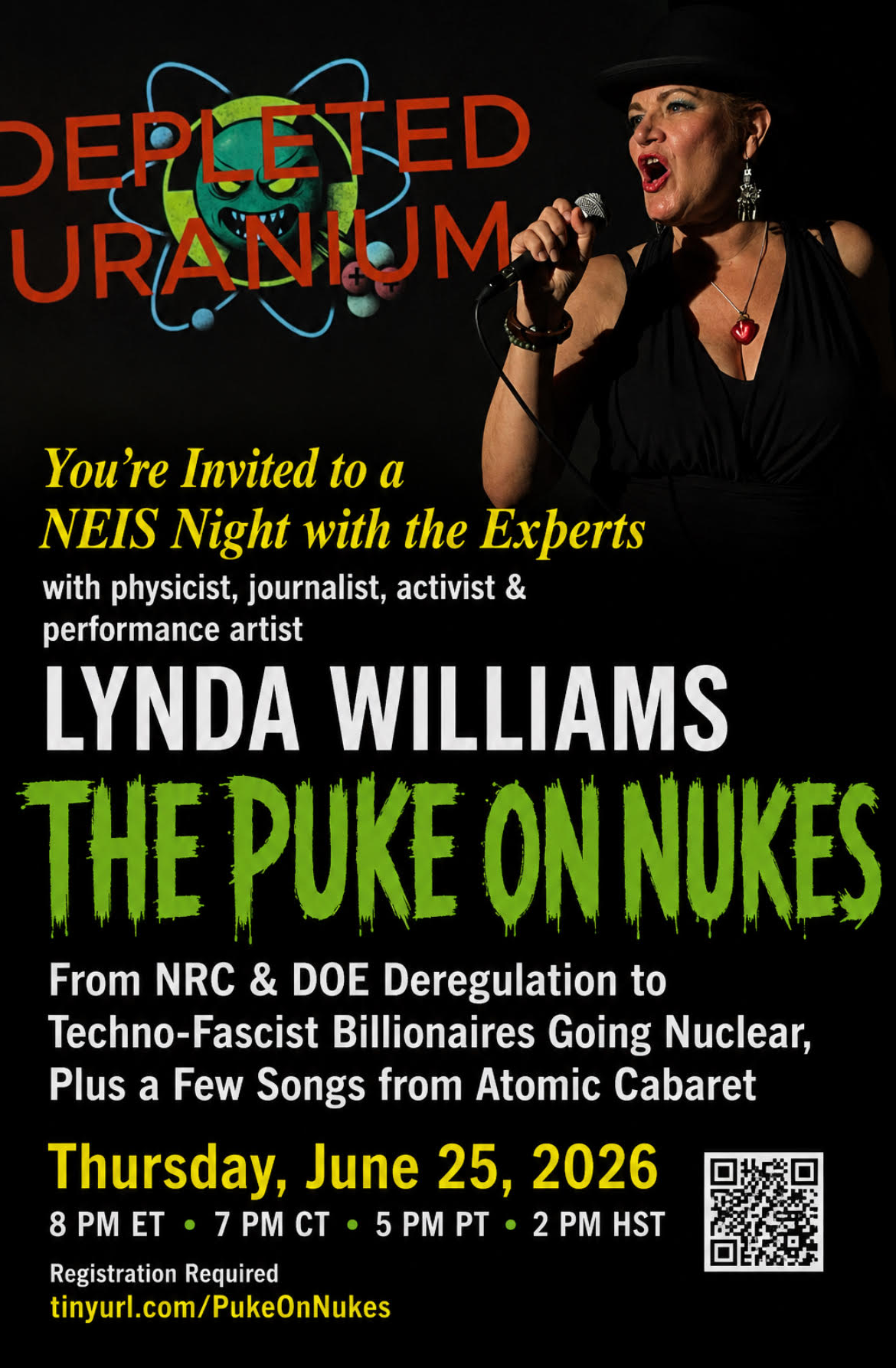
7pm Central Time (8pm ET, 6pm MT, 5pm PT) UTC – 5 From NRC & DOE Deregulation to Techno-Fascist Billionaires Going Nuclear, Plus a Few Songs from Atomic Cabaret REGISTER





 nuclear-news