Significant amounts of plutonium dispersed in Fukushima,and running into Pacific Ocean
Nuclear Expert in Japan: Plutonium “is everywhere… it is everywhere” after Fukushima reactors exploded — It’s being redeposited in “unanticipated” locations — “Black radioactive dust just wherever 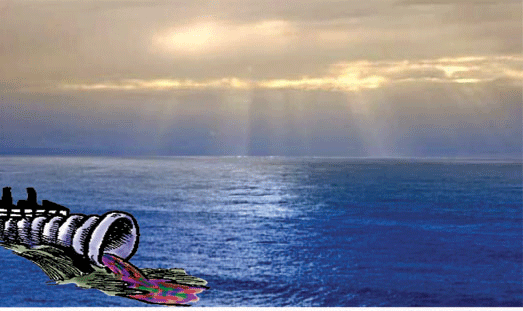 you go” — “It’s running right into Pacific Ocean” (VIDEO) http://enenews.com/nuclear-expert-plutonium-everywhere-everywhere-after-fukushima-reactors-exploded-being-redeposited-unanticipated-locations-black-radioactive-dust-running-pacific-ocean-video?utm_source=feedburner&utm_medium=email&utm_campaign=Feed%3A+ENENews+%28Energy+News%29Excerpts from interview with Arnie Gundersen, Fairewinds’ chief engineer and former nuclear engineer during speaking tour in Japan, Feb 17, 2016 (at 2:30 in):

Full interview here: Soundcloud | YouTube
How officials and popular academics have responded to disaster victims in the wake up of Tokyo Electric Power Company’s Fukushima nuclear accident
 About the author
I worked as a full-time teacher at a public high school in Fukushima for about twenty-five-and-a-half years, until July 31, 2011. During the first four years of my career, I taught at Futaba High School in Futaba-machi, home to the Fukushima Daiichi Nuclear Power Plant. Naturally, I have heard stories about the harsh working conditions of nuclear workers. For example, in a certain area of the power plant, working for 10 minutes would exceed the legal maximum daily radiation exposure limit. So each shift was officially recorded as 10 minutes even though their actual worked shift was 8 hours. The workers would primarily wipe water leaking from the piping surrounding the nuclear reactor. When workers died of illnesses like cancer, their families received unusually high amounts of cash as lump-sum payments, while actual workmen’s compensation insurance was not provided.
 At the time of the 2011 nuclear accident, I was living in a city 53 kilometers (33 miles) away from the power plant with my wife and two children. I was working at a public school 60 kilometers (37 miles) from the plant.
After the accident, on the evening of March 15, 2011, the maximum airborne radioactive levels of 23 microsievert/hour was detected in Fukushima City, where I worked. Outside the school the following day, however, the annual school acceptance announcements were held as scheduled. Several faculty, including myself, met with the principal to insist that usual outdoor announcement be cancelled as to avoid having young students exposed to radiation–but the announcement event was forced outdoors. The principal cited reasons such as, “the Fukushima Prefecture office strongly supports the outdoor plan” and he “had no choice as the school principal.”
From April 2011 on, aside from the prohibition of outdoor gym classes, neither my school nor the Fukushima Board of Education took any measures to prevent further radiation exposure for students. The school had students practice club activities outdoors as usual. Indoor club athletes were made to run outdoors as well, without any protective measure against radiation exposure. Despite the standard practice, measures such as gargling, washing hands, changing clothes, and showering weren’t deemed necessary for students when returning from outdoor activities. Since I had some knowledge about radiation exposure, I advised the students to take caution to remove potential contamination whenever possible. However, in response to my giving the students advice to prevent radioactive materials from entering the building, I had been cautioned by the Fukushima Prefectural Board of Education, in the form of official “guidance” which forbids me to even talk about radiation and nuclear power plants to the students. Given that I was officially barred from protecting students from radiation exposure, I decided to make my move: along with my family, I evacuated my hometown and relocated to Sapporo city in Hokkaido. Once we evacuated, we found out about a financial system by Fukushima Prefecture which supports voluntary evacuees from the areas outside of the officially restricted zone (though it only approved applications from evacuees pre-December 2012; those who evacuated thereafter would not be financially supported).
I have been teaching part-time in Hokkaido. Since finding out that within the public school system the Fukushima Prefecture Board of Education can intervene to oversee public high school relocation anywhere, I have been teaching at private schools only. Aside from my part-time job, I have been involved in a nuclear power plant damages lawsuit as a plaintiff as well as a member of the refugee organization.
 1. Fukushima Prefectural Government and the Tokyo Electric Power Company (TEPCO)’s Fukushima Nuclear Accident
The reactors at the TEPCO Fukushima Daiichi Nuclear Power Plant, especially Unit 1 and Unit 2, were delivered and installed from the US after the US manufacturer finished all of their construction. As for Units 3, 4, 5, and 6 the Japanese manufacturer added their own “improvements” to the original structure.
I will try to avoid a lengthy explanation. TEPCO’s Fukushima Daiichi Nuclear Power Plant frequently had accidents immediately after beginning operation and the nuclear workers’ exposure levels amounted to twice to ten times the average exposure dose at other nuclear plants. Furthermore, TEPCO kept a lot of serious accidents hidden from Fukushima Prefecture and the Japanese government. TEPCO proposed using Unit 3 for so-called pluthermal power generation, utilizing fuel which can contain weapons-grade plutonium in order to reduce the plutonium surplus in Japan. Eisaku Sato, then-governor of Fukushima, strongly objected to the proposal.The Japanese government arrested and convicted Governor Sato on bribery charges with the amount of the bribe recognized as “zero yen.” They drove him to resign, then elected Yuhei Sato as the new governor. As described above, neither the Fukushima governor nor the organization called the Fukushima Prefectural Government had power over TEPCO.
 2. Nuclear accident and the Fukushima Prefectural Government
March 11, 2011, when a massive earthquake hit a wide area including Fukushima Prefecture, the building of the Fukushima prefectural office (which had been planned to function as a Disaster Response Headquarters) was damaged in the earthquake. The headquarters were set up in a small building next to the main office building to serve temporary functions. The prefectural government has never publicized records of proceedings and documents from over 20 meetings in the beginning. From the 25th meeting, they finally began keeping records of proceedings.
At the time, the temporary disaster response headquarters was believed to have had little to no communication lines, and had reportedly only two satellite mobile phones. Although the communication infrastructure began to be rebuilt gradually, what was happening then still remains largely unknown. There has been no official investigation into the correspondence between the local governments, the central government and TEPCO, and no evacuation orders to the local communities.
As far as public record goes, the only time Fukushima Governor issued an announcement in the first week was on the evening of March 14th. “Follow the instructions and do not panic,”“High school entrance announcements will be held as planned on March 16th,”— these two lines were broadcast repeatedly throughout local media.
From another angle, the recordings of the TEPCO video conference shows that Fukushima Prefecture requested TEPCO make a public announcement saying “the explosion in the Unit 3 at Fukushima Daiichi will not cause health damage.” Appalled by the request, thinking they “couldn’t say such an irresponsible thing,” TEPCO decided to “ask the central government to suppress Fukushima Prefecture,”—as evidently recorded during the video conference.
However Fukushima Prefecture repeatedly expressed that in the “Nakadōri” region—which includes the prefectural capitol, Fukushima City, and the commercially and industrially flourishing Koriyama City—there would be zero risk of health damage from radiation.
There has been a use of protective measures like wearing long-sleeves and masks for school children, which may have been a globally familiar sight through media reports. However this was not a recommendation or an order issued by Fukushima Prefecture, but rather a result of demands from local PTAs to boards of education in individual school districts.
 Towards the end of March 2011, right before the school year resumed, the Fukushima governor was seen out in local grocery stores saying “Fukushima today is business as usual,” in which he began a campaign to “dispel harmful rumors” about local agricultural produce being contaminated by radiation. The governor also opposed widening the evacuation zone beyond the 20km radius of the nuclear power plant, and has repeatedly made remarks to avoid increasing the number of evacuees from outside the official evacuation zone.
As a result, aside from two local Fukushima newspapers, NHK, and four private television networks in addition to NHK Radio and Radio Fukushima, there was little to no mention of messages from outside Fukushima offering free housings and support networks for voluntary evacuees. Fukushima Prefecture also prohibited the use of not only public conference centers, but private facilities for hosting “counseling room” for evacuation as well. People around me practically had no knowledge of local autonomous support groups offering evacuation support. I have heard numerous times that “there is no evacuation order from outside the prefecture, meaning we have been abandoned.” In fact, it was Fukushima Prefecture who had been interfering with such efforts to reach our community.
 3. Hiroshi Kainuma, “the Sociologist”
In 2011, an author from Fukushima became renowned after publishing the book “Fukushima’ theory–the birth of a nuclear village,” based on a thesis he wrote as a sociology student at the University of Tokyo Graduate School of Interdisciplinary Information Sciences. His name is Hiroshi Kaiuma, born in Iwaki City, Fukushima, and graduated from the University of Tokyo Literature department at the age of 25 and advanced to the graduate program. I must note that this is difficult to grasp if you are not well-connected within Fukushima. But in short, Iwaki City, where Mr. Kainuma was born and raised, has very little connection to the Futaba district which hosts TEPCO’s power plant. In terms of large-scale trading areas, while the Futaba district is part of the Sendai, Miyagi Prefecture trade area, Iwaki City would be part of Mito City in Ibaraki Prefecture. In any case, Mr. Kainuma did not have strong connections to the Fukushima Prefectural government prior to March 11th, 2011.
Since the meltdown, however, he has somehow become “the Fukushima spokesperson who speaks about Fukushima on TV and radio.”
Additionally, I have written several critiques of his writings, one of which can be found on the following link (in Japanese): “Personal note on “‘Fukushima’ theory–the birth of a nuclear village”
4. Hiroshi Kainuma and the Fukushima Prefectural Government
After 3.11, his master’s thesis was published in books and he began to be featured in various media, including an appearance as a commentator on the popular evening program “Hodo Station (News Station).” We must note that the content of his remarks have been consistent—such as, “The acceptance of nuclear power plant by local communities was necessary for the regions’ survival”; “Those outside of Fukushima protesting against nuclear energy do not understand the reality of nuclear-hosting communities.” His views and comments on the anti-nuclear movement have been antagonistic from the beginning, for example, “People who oppose nuclear energy are rubbing local communities the wrong way.”
Mr. Kainuma currently holds the title of Junior Researcher of the Fukushima Future Center for Regional Revitalization, but at the same time he is a PhD student at the University of Tokyo. While it would be appropriate to call him a sociology researcher, I feel it’s an overestimation to refer to him as a sociologist.
Currently the gist of Mr. Kainuma’s speech is towards the “recovery of Fukushima in visible forms” and its target audience is outside Fukushima Prefecture. While many others have in fact been referring to “bags” jammed with contaminated waste—seen everywhere and impossible to be ignored upon entering Fukushima—Mr. Kainuma continues to emphasize the “ordinary Fukushima” without mentioning the bags.
I see the previous governor of Fukushima, Yuhei Sato, in Mr. Kainuma in many ways, like in his seeming lack of experience interacting with people in temporary housings immediately following the meltdowns, or with shelter residents still living with much confusion and inconveniences as a result of the disaster.
Even the current Fukushima governor does not seem to have made too many visits to temporary shelters during or after elections.
To those who evacuated Fukushima to outer prefectures like myself, the Prefecture kept even more distance. By principle, they never made any official inspection visits to meet the evacuees. There is a notable lack of inspection visits not only in remote areas such as Hokkaido, but also in places like Yamagata and Niigata which are adjacent to Fukushima Prefecture.
In the wake of the disaster, though there was housing support for those who evacuated the areas outside of Fukushima as well, such efforts have gradually died down—as of March 2016, state subsidies for housing would be available only for evacuees who are from Fukushima. In addition, the housing subsidy program for those who evacuated the non-restricted zone will end in March 2017. However, there is no housing program for returning residents to Fukushima even if they decide to move back there.
Starting March 2017, voluntary evacuees still living in outer prefectures need to choose one of the three following choices:
1) Return home to Fukushima while paying out-of-pocket for most of the expenses associated with the move and your life thereafter. 2) Continue living outside Fukushima while relinquishing your rights to access resources as a disaster victim 3) Upon proving your need for financial assistance, receive housing subsidies for up to 2 years to live in privately-owned housing.
The reason for this policy change was credited to correspondence between the Minister of Environment and the Nuclear Regulatory Authority, a non-governmental agency to provide scientific grounds for nuclear policy. The Minister of Envirnoment asked the NRA if “it is considered desirable to evacuate the areas that don’t have restrictions” to which the NRA answered, ”these areas are no longer fit to be evacuated.” It should be noted that there was no legal ground for this correspondence to be treated as official; how this exchange was reviewed and by whom is unknown.
Based on this document issued by the NRA, the Japanese government made a Cabinet decision to largely reduce support for evacuees through the Nuclear Accident Child Victim’s Support Law.
Following this decision, Fukushima Prefecture also determined its policy would end support for the voluntary evacuees from non-restricted areas.
Hiroshi Kainuma is working from an assumed role to justify such policy of Fukushima Prefecture, utilizing his position as a so-called sociologist. Even if he has ideas and views that differ from Fukushima Prefecture’s policy, he does not speak about them on media or at talk events.
For instance, when Mr. Kainuma was relatively unknown before 3.11, he had reportedly interviewed local anti-nuclear activists. Another instance tells us that although he had met and interviewed several people who have moved voluntarily out of the non-restricted areas, he proceeds to ignore the voices and opinions of them as though they had never existed.
Last year, nuclear reactors in Japan started resuming operation. Mr. Kainuma has not been seen or heard expressing opposition to it. Neither Fukushima Prefecture nor the Prefectural Assembly expresses any intentions to oppose nuclear restorations.
5. The current presence of “Hiroshi Kainuma”
Through the circumstances described above, Hiroshi Kainuma is working so as to be portrayed by the media as a Fukushima Prefecture spokesperson, intent on selling “business-as-usual” appeal and depicting a Fukushima that “overcame a nuclear disaster.”
Meanwhile, and quite unfortunately, many Fukushima residents agree with his words and actions. Just as there are many people hoping to forget the scars from the 1995 Great Hanshin Earthquake, there are many who explicitly “do not evacuate,” comprising an overwhelming majority of the Fukushima population and wishing to forget and move past the disaster and nuclear crisis.
Here we have an academic scholar who speaks for us and to those who are outside Fukushima as well, saying to leave the nuclear disaster in the past.
Thus, this concludes the significance of Hiroshi Kainuma’s existence today.
http://mp-nuclear-free.com/

No Legitimacy, No Principle in Japan’s Nuclear Victim Support Policy

Fukushima, Voices of Evacuees
By Toshinori Shishido
原発事故被害者支援策の、論理的根拠と正当性の欠如(日本語)
In July 2015, the Fukushima prefectural government announced its plan to terminate housing assistance for nuclear evacuees who fled areas outside of the restricted zone at the end of March 2017. It has absolutely no intention to change this policy as of this moment in February 2016.
In addition, by March 2017, the Fukushima Prefectural Office will lift evacuation orders for the entire prefecture, except for the immediate vicinity of the power plant designated the “difficult-to-return zone,” that has “equal to or greater than the external exposure dose of 50mSv/year.” (Insert: “translator’s note: the internationally recognized standard dose limit per year is 1mSv/year.) For residents who may eventually move back to these areas, the Prefectural Office has determined that it will only pay one year’s worth of compensation (1.2 million yen or US$ 10,500) per person and will terminate other special protective measures and financial incentives.
For residents of regions that have been designated as “difficult-to-return areas”, the Office has reportedly finished the payments of reparations in bulk, and is not going to make additional payments.
And for residents outside of Fukushima Prefecture, there has been almost no official support for damages from the nuclear power plant accident in the first place.
While the government has provided extremely limited housing support for very few residents from prefectures adjacent to Fukushima and for evacuees from these prefectures, it has gradually decreased the target population over time and plans to end all financial assistance for them by March 2018.
Although there is room to compensate local industries for damages, even in cases where the “Nuclear Damages Dispute Resolution Center” (or Alternative Dispute Resolution Center, ADR for short), established to bring speedy resolutions, has sought payment from Tokyo Electric Power Company, there are an increasing number of cases in which TEPCO has refused to pay. In addition, even though the ADR Center has repeatedly demanded that the Japanese government instruct TEPCO to comply with the settlements and make payments quickly, the Japanese government has not directed TEPCO to do so.
For sources related to above, please refer to:
Website of Education, Culture, Sports, Science and Technology “About compensation for nuclear damage caused by the Tokyo Electric Power Company Fukushima nuclear power plant accident” (in Japanese)
“About the guidance on the determination regarding damages caused by Tokyo Electric Power Company’s Fukushima Daiichi and Daini nuclear accident (PDF: 169KB, in Japanese)”
Website of Ministry of Education, Culture, Sports, Science and Technology, Nuclear Damages Dispute Resolution Center (in Japanese)
It is clear to us that Japanese officials have neglected to work on compensation, reparation, fact-finding, clarification of causes, and information disclosure from the nuclear accident until now. Not only that, but Japanese government agencies have destroyed some official documents from immediately after the nuclear accident without even notifying the public, on the grounds that there is a “legal obligation to preserve these documents for three years”.
Thanks to the destruction of documents from early stages, it has become extremely difficult to obtain proof that there have been measures that should have been implemented immediately after the nuclear accident, and it has become difficult to investigate and prove government blunders.
On matters besides those related to the nuclear accident, both the Japanese government and the Fukushima prefectural government are promoting and activating economic activities, including capital improvement projects fueled with tax money.
As for the motorways, all of Route 6, the main national highway, has been re-opened, and all of the Joban Expressway opened in 2015, ahead of the original construction schedule, which had been planned prior to the nuclear accident.
As for the railway, Japan Railway East Japan is aiming to reopen its entire Joban Line in the summer of 2020, prior to the Tokyo Olympics.

“Recovery” can be realized on roads and railroads through ample budgeting, gathering materials, and investing labor. The same is also true for most infrastructure, such as local government offices and electricity. The exception, however, is the water supply – there is no guarantee that radioactive isotopes that have accumulated at the bottom of the lake upstream of the intake will not be mixed into the water supply.
Including the issue of water supply, the fundamental causes of the troubles related to the current “revitalization” programs come from the government and Prefecture’s attitude that ignores the wishes of the residents who are victims. If I may borrow the phrase that has been used over time, there has been no “revitalization of humans.”
In other words, why doesn’t the “revitalization” from the nuclear accident that is promoted by the Japanese national government and the Fukushima prefectural government become the “revitalization” of people? Let us return to the starting point to consider this.
The reasons I propose are two-fold.
First, both the Japanese government and the Fukushima prefectural government continue to avert their eyes from the fact that this is a nuclear disaster. They never told residents about the extremely long timeline and difficulty of managing the aftermath of a nuclear disaster. Most of the media are constantly releasing words straight from the government and Fukushima prefecture without even investigating the contents. Hence, the majority of victims have been unable to face the complexity of the issues.
While it will soon be five years since March 11, 2011, it is hard to say that authorities have correctly communicated to the public how dangerous the situation had become, not only at the Fukushima Daiichi and Daini power plants under declaration of a Nuclear Emergency Situation, but also at the nearby Tokai 2 and Onagawa power plants.
Even Diet members and nuclear “scientists” have spoken unabashedly in the Diet and on television that “no problems occurred at [these] state-of-the-art nuclear power plants”, without being prompted to correct themselves. To say nothing of what happened to the ten reactors in Fukushima Prefecture and what is happening to them today, which is not even known.
On December 16, 2012, then-Prime Minister Noda used what had until then been only a scientific term, “cold shutdown,” to declare a “state of cold shutdown” in circumstances where this could not be [scientifically] declared. In other words, it was so necessary for the Japanese government to domestically fabricate the impression that “the nuclear crisis is over” that it used the term in a way not internationally recognized as a scientific concept.
And in regard to Reactors 1 to 4 at Daiichi, the government didn’t even bother making potentially realizable countermeasures an object of debate. They called issues inside the power plant “on-site” issues, implying there was little room for off-site intervention, and no projects after the “cold shutdown” declaration were deemed urgent. Naturally, we are left with no option to even ask beyond what options are available; how long these options will take to be effective or how long they will last.
Assuming this unstable situation at the power plant, it is impossible to discuss how
people’s daily existence around the accident plant [Daiichi] is possible to what distance, in what way.
The problem is not limited to within the facility. As long as we are unable to see distinctly what types of radioactive isotopes and how much they are present, at least within the vicinity of several miles off the plant, the “revitalization” planning would draw direct link from the clean up of the plant.
However, even in the areas within 10km (6.2 miles) radius of the plant where the airborne radioactive levels are relatively lower than its surroundings, the government has already decided to lift evacuation order by March of 2017.
Therefore, to those who will be living in the close proximity to the plant, the fate of the nuclear crisis is a matter of life and death. The government however insist that on-site (within plant facility) and off-site issues are two separate issues, refusing to incorporate clean-up plans into the “revitalization” roadmap.
Even if I give it extra compromise as to say the situation inside fences of the power plant is not related to “revitalization” activities, I must stress that both the government and Fukushima prefecture continue to defend an absurd stance on any potential radiological effects in the future, stating “any potential impact would be would be small enough to be unrecognizable.”
The state-led plans to proceed with human recovery as if the “disaster wasn’t a nuclear disaster” is extremely reckless, considering cases of Chernobyl nuclear accident and nuclear testings at Marshall Islands.However, the Japanese government and the Fukushima prefectural government continue to be reckless, ignoring “the people.”
My second point is that the Japanese government, the Fukushima prefecture as well as many local municipal offices have been deceiving us without a directly facing the human beings as victims and by neglecting the whereabouts of them.Essentially, when disasters and accidents bring damage, state bodies would have to desperately gather information from the first day in order to clarify the extent of the damage.
On the flip side, in regards to the victims and damages caused by the earthquake and tsunami that occurred on March 11, there have been evidences across the country that municipalities and governments put extensive efforts to grasp and understand the extent of damages as much as possible.even in municipalities where almost all of residences and even offices were damaged by the tsunami, there were attempts to understand the scale and circumstances of the damage.In places where the damages was too great for local municipalities to maintain their functions, prefectural governments cooperated trying to figure out actual damage.
However, with respect to the current nuclear accident, the government did not try to figure out scale of the damage or the actual situations of the victims.There is no way to find out the reason why they chose not to, unless you have access to confidential information by the government.
I suppose that the Japanese government and prefectural offices would have been liable for investigating the nuclear accident and not the local municipalities which didn’t have necessary human, organizational and technical resources. Yet there is no evidence of the government or prefectural offices having actively looked into the actual damages and status of evacuations caused by the nuclear contamination.
Rather, even when evacuees themselves demanded for official investigation, the authorities refused to act on their behalf and at times delayed publications of data they obtained.
I am yet to see a single governmental document on how nuclear evacuations took place. Perhaps such documents never even existed.
To my knowledge, in Japan, there has not been any official agencies or staff positions for creating and maintaining historical records of national events. Due to this, there is a serious lack of documentation that could be used as future reference. Nor the involvement of the responsible parties is ever questioned.
In fact, after writing the above paragraph I attempted to summarize evacuation processes as much as I could within my knowledge, only to find such efforts would require vast amount of writings and I would not know when I could finish such a project. Thus for the time being I would like to conclude my thesis here.
In conclusion, I will verify my points in summary.
The so-called “nuclear disaster victim assistance program” orchestrated by the Japanese government and Fukushima prefecture has been fraudulent since its inception. For the goal of their program has never been to protect the livelihood and safety of the victims and it lacked logical foundation.
By ending the inherently fraudulent assistance program, the government and Fukushima prefecture are crying out loud to the world that Fukushima has been recovered. The Fukushima prefectural government continues to actively send delegations overseas solely for the publicity purpose.
I repeat.
Fukushima Prefecture sends the delegations in order to round down the nuclear disaster victims and to disguise to the world the fact that the “reconstruction” they are proposing is ignoring the voices of victims.
No Legitimacy, No Principle in Japan’s Nuclear Victim Support Policy
No bliss in this ignorance: the great Fukushima nuclear cover-up

By Linda Pentz Gunter, 20th February 2016
The Japanese were kept in the dark from the start of the Fukushima disaster about high radiation levels and their dangers to health, writes Linda Pentz Gunter. In order to proclaim the Fukushima area ‘safe’, the Government increased exposure limits to twenty times the international norm. Soon, many Fukushima refugees will be forced to return home to endure damaging levels of radiation.
Dr. Tetsunari Iida is the founder and executive director of the Institute for Sustainable Energy Policies (ISEP) in Japan.
As such, one might have expected a recent presentation he gave in the UK within the hallowed halls of the House of Commons, to have focused on Japan’s capacity to replace the electricity once generated by its now mainly shuttered nuclear power plants, with renewable energy.
But Dr lida’s passionate polemic was not about the power of the sun, but the power of propaganda. March 11, 2011 might have been the day the Great East Japan Earthquake struck. But it was also the beginning of the Great Japan Cover-Up.
On the ISEP website, Iida extols the coming of the Fourth Revolution, following on from those in agriculture, industry and IT. “This fourth revolution will be an energy revolution, a green industrial revolution, and a decentralized network revolution”, he writes.
But in person, Iida was most interested in conveying the extent to which the Japanese people were lied to before, during and after the devastating nuclear disaster at Fukushima-Daiichi, precipitated on that same fateful day and by the deadly duo of earthquake and tsunami.
“Shinzo Abe says ‘everything is under control'”, said Iida, speaking at an event hosted by Nuclear Free Local Authorities, Green Cross, and Nuclear Consulting Group in late January. It was headlined by the former Japan Prime Minister, Naoto Kan, who was at the helm when the triple disasters struck. “Yes – under the control of the media!”
A trial for Tepco like post-war Tokyo Trials
The media may have played the willing government handmaiden in reassuring the public with falsehoods, but in July 2012, the Fukushima Nuclear Accident Independent Investigation Commission concluded that the disaster was really no accident but “man-made”. It came about, the researchers said, as a result of “collusion” between the government, regulators and the nuclear industry, in this case, Tepco.
“There should be a Tepco trial like the post-war Tokyo Trials”, Iida said, referring to the post World War II war crimes trial in which 28 Japanese were tried, seven of whom were subsequently executed by hanging.
Hope for such accountability – without advocating hanging – is fleeting at best. In 2011, while addressing a conference in Berlin hosted by the Heinrich Böll Foundation, I suggested the Tepco officials should be sent to the International Criminal Court at The Hague, (a body the US still conveniently refuses to recognize) to answer for what clearly amounts to crimes against humanity.
The remark caused a bit of a stir and earnest questions about the mechanism by which Tepco could be brought there. Needless to say, nothing of the kind ever happened, or is likely to.
Instead, the Abe’s government’s preferred tactic is to go full out to restart reactors and move everybody back home as soon as possible, as if nothing serious had happened. Just scoop off a little topsoil, cart it away somewhere else and, Abracadabra! Everything is clean and safe again!
Normalizing radiation, a policy and now a practice
Of course radiological decontamination is not that easy. Nor is it reliable. It is more like “pushing contamination from one spot to the next”, as independent nuclear expert, Mycle Schneider describes it. And radiation does not remain obediently in one place, either.
“The mountains and forests that cannot even be vaguely decontaminated, will serve as a permanent source of new contamination, each rainfall washing out radiation and bringing it down from the mountains to the flat lands”, Schneider explained. Birds move around. Animals eat and excrete radioactive plant life. Radiation gets swept out to sea. It is a cycle with no end.
Nevertheless, efforts are underway to repopulate stricken areas, particularly in Fukushima Prefecture. It’s a policy, and now a practice, of ‘normalizing’ radiation standards, to tell people that everything is alright, when clearly, there is no medical or scientific evidence to support this. And it was an approach already firmly and institutionally in place, even on March 11, 2011 as the Fukushima disaster first struck and much of the decision-making was left to individual judgement.
“We were told that evacuating poses a greater risk than radiation,” recalls Hasegawa Kenji, a farmer from Iitate, a village situated 45 kilometers from the Fukushima nuclear power plant. Featured in the Vice documentary ‘Alone In The Zone’, Hasegawa criticized Iitate’s mayor for making what he called a terrible mistake.
“Even when the scientists told the mayor that Iitate was dangerous, he ignored them all. He brought in experts from around the country who preached about how safe it was here. They said we had nothing to worry about. They kept telling us that. Eventually the villagers fell for it and began to relax. And the mayor rejected the idea of evacuating even more. That’s why nobody left, even though the radiation levels were so high.”
The nuclear industry did not tell the public the truth
The confusion surrounding evacuation was so profound that, as Zhang et al. noted in a September 11, 2014 study published in the International Journal of Environmental Research and Public Health: “Unclear evacuation instructions caused numerous residents to flee to the northwestern zone where radiation levels were even higher.”
All par for the course, said Iida. “I must emphasize, the people in the nuclear industry did not tell the public the truth and keep us informed.”
Next in the ‘normalization’ process came the decision to raise allowable radiation exposure standards to 20 millisieverts of radiation a year, up from the prior level of 2 mSv a year. The globally-accepted limit for radiation absorption is 1 mSv a year.
This meant that children were potentially being exposed to the same levels of radiation that are permitted for adult nuclear power plant workers in Europe. Some officials even argued that zones where rates were as high as 100 mSv a year should be considered ‘safe’. Writing on his blog, anti-pollution New Orleans-based attorney, Stuart Smith, observed wryly:
“Instead of taking corrective measures to protect its people, Japan has simply increased internationally recognized exposure limits. It seems that the priority – as we’ve seen in so many other industrial disasters in so many other countries – is to protect industry and limit its liability rather than to ensure the long-term health and well being of the masses. Go figure.”
The great repatriation lie
All of this set the perfect stage for the Great Repatriation Lie. “It’s the big cover-up,” Iida told his Westminster audience. “People are being told it’s quite safe to have a little [radiation] exposure.”
Indeed, at a recent conferences of prefectural governors, young people in particular were urged to return to Fukushima. “If you come to live with us in Fukushima and work there, that will facilitate its post-disaster reconstruction and help you lead a meaningful life”, said Fukushima Gov. Masao Uchibori.
Young people in Japan, however, appear not to be cooperating. Where evacuees are returning, the majority are senior citizens, who have less to lose from a health perspective and are more traditionally tied to the land and their ancestral burial grounds.
“They want to die where they were born and not in an unfamiliar place”, said Yoshiko Aoki, an evacuee herself who now works with others, and who also spoke at the London conference.
All of this impacts revenue from the inhabitants’ tax which constitutes 24.3% of all local tax sources and is collected by both prefectures and municipalities. It is levied on both individuals and corporations but with the bulk of revenue coming from individuals.
Senior citizens who have retired do not contribute to income tax, so the onus is on governors and mayors to lure as many working people as possible back to their towns and regions in order to effectively finance local public services.
Radioactive areas are hardest hit economically
Late last year, the Asahi Shimbun looked at tax revenues in the 42 municipalities affected by the triple 2011 disasters of earthquake, tsunami and the Fukushima meltdowns.
Unsurprisingly, the areas hardest hit by radiological contamination had suffered the biggest economic blows. Those areas free from radioactive fallout could simply rebuild after the tsunami and earthquake, and had consequently recovered economically, some even to better than pre-3/11 levels.
“On the other end of the scale, Namie, Fukushima Prefecture, marked the biggest decreasing rate – 72.9 percent – in tax revenues for fiscal 2014”, the Asahi Shimbun reported. “All residents of the town near the crippled nuclear plant remain in evacuation. Although tax payments from companies increased from decontamination work and other public works projects, income taxes paid by residents and fixed asset taxes have declined.”
To return or not to return is the question of the hour – or it will be come March 2017, when the Abe government has announced it will revoke many evacuation orders. At that point, government compensation to evacuees would be lifted, putting them under financial pressure to return. Cue more confusion.
People are confronted, said Iida, with “two extreme views, either that it’s very dangerous or quite safe. So it’s very difficult to decide which is the truth and it has been left up to individuals.”
One of those towns that could be declared ‘safe’ is Tomioka, Japan’s Pripyat, formerly home to close to 16,000 people but now uninhabited.
“It’s like a human experiment, that’s how we feel,” said Aoki in London, herself a former Tomioka resident. “The Governor of Fukushima spoke about a safe Fukushima. We want it to become safe, but our thoughts and reality are not one and the same.”
Observes Kyoto University professor of nuclear physics, Koide Hiroaki, in the Vice film, who has been outspoken for decades against the continued use of nuclear energy:
“Once you enter a radiation controlled area, you aren’t supposed to drink water, let alone eat anything. The idea that somebody”, he pauses, ” … is living in a place like that is unimaginable.”
http://www.theecologist.org/News/news_analysis/2987222/no_bliss_in_this_ignorance_the_great_fukushima_nuclear_coverup.html
TEPCO nears ‘deep freeze’ of soil wall at Fukushima plant

A large number of pipes and freezing equipment take up much of the space of Tokyo Electric Power Co.’s refrigerator plant at the embattled Fukushima No. 1 nuclear power plant on Feb. 19.
Packed with bulky silver pipes and freezing equipment, Tokyo Electric Power Co.’s plant to freeze underground soil at the crippled Fukushima No. 1 nuclear power plant is ready to start chilling.
On Feb. 19, TEPCO officials showed the interior of the newly built facility, the heart of the project to reduce accumulating radioactive water at the nuclear complex.
The plan envisages a frozen soil wall built around the reactor buildings by inserting 1,568 pipes to a depth of 30 meters.
Cooling agents, which register 30 degrees below zero, will be pumped into the pipes to freeze the surrounding soil.
In theory, the flow of groundwater into the reactor buildings, which would mix with contaminated water and empty out in the sea, will be blocked.
With approval from the Nuclear Regulation Authority earlier this month, the utility plans to start freezing the area facing the sea as early as March, a process expected to take about two and a half months.
In total, it will take seven to eight months to complete all the freezing of the underground soil, including the mountain side of the wall, according to TEPCO’s blueprint presented to the NRA this month.
That means that the project to build a frozen barrier will significantly lag behind the initial targeted completion date of the end of March.
http://ajw.asahi.com/article/0311disaster/fukushima/AJ201602210030
South Korean civic groups, including one monitoring radioactive contamination, requested the cancellation of the event and an apology from the Japanese Embassy in Seoul.

Tohoku promotional event in Seoul canceled at last minute
SEOUL – A Japanese government event in Seoul intended primarily to promote the tsunami-hit Tohoku region has been canceled at the last minute, the Japanese Foreign Ministry said Saturday.
“We continued talks with South Korean authority but could not obtain permission to hold the event,” a ministry official said. “We are not in the position to explain the background (of the cancellation).”
The event, “Explore REAL JAPAN in Seoul,” was to have started for a two-day run on Saturday at a shopping mall in Wangsimni Station in Seoul.
Participants planned to promote local foods and other products, such as confections and sake, at a joint booth run by the northeastern prefectures of Aomori, Miyagi and Fukushima in Tohoku and by Kagoshima Prefecture in the country’s southwestern region. Also planned was a folk singing performance.
The event was organized in part to help alleviate concerns about the safety of Japanese food due to the nuclear disaster at Tokyo Electric Power Co.’s Fukushima No. 1 power station in Fukushima Prefecture in March 2011.
On Friday, South Korean civic groups, including one monitoring radioactive contamination, requested the cancellation of the event and an apology from the Japanese Embassy in Seoul.
Fukushima, Miyagi and Aomori suffered radioactive contamination due to the nuclear disaster, and South Korea imposes restrictions on the import of seafood from the prefectures, the groups said, adding that confections produced in Fukushima would be promoted at the event.
The groups also urged the South Korean government to request Japan cancel the promotion.
http://www.japantimes.co.jp/news/2016/02/20/national/tohoku-promotional-event-in-seoul-canceled-at-last-minute/#.Vsi14-bzN_k
NRA commissioner suggests plan to remove all fuel debris at Fukushima plant may not be best option
FUKUSHIMA – A Nuclear Regulation Authority commissioner has suggested that removing all fuel debris from reactors at the meltdown-hit Fukushima No. 1 nuclear power plant may not be the best option.
“I wonder if the situation would be desired that work is still underway to extract fuel debris 70 or 80 years after” the nuclear disaster, NRA Commissioner Toyoshi Fuketa told reporters Friday.
“There are a variety of options, including removing as much fuel debris as possible and solidifying the rest,” he added.
Fuketa and another NRA commissioner, Satoru Tanaka, visited the complex Friday, the last of the commissioners to do so ahead of the fifth anniversary of the March 11, 2011, earthquake and tsunami that triggered to the triple meltdowns at the atomic plant.
His remarks could affect the decommissioning plan drafted by the government and the plant’s operator, Tokyo Electric Power Co. Under that scenario, fuel debris is to be disposed of over the course of 30 to 40 years.
Fuketa said that unlike the disaster at the Chernobyl nuclear power plant, it is “not realistic” to construct concrete buildings to cover reactors at the Fukushima No. 1 plant because the situation is different.
The commissioner also questioned whether construction of an underground ice wall around the reactor buildings to prevent radioactive water buildup will prove effective.
http://www.japantimes.co.jp/news/2016/02/20/national/nra-commissioner-suggests-plan-remove-fuel-debris-fukushima-plant-may-not-best-option/#.VsijEubzN_m
Fukushima disaster: Tepco to pay couple in landmark damages case
“A court in Japan has ordered the operator of the tsunami-hit Fukushima nuclear plant to compensate a couple who fled radiation, even though they lived outside the evacuation zone”
Tokyo Electric Power Company (Tepco) will pay 30m yen ($265,000; £185,00) for financial losses and poor health.
It is thought to be the first time Tepco has been found liable for people outside the mandatory evacuation area.
In 2011 the plant suffered multiple meltdowns after a quake and tsunami.
After that people who lived within 20km (12 miles) of the plant were ordered to evacuate, but thousands of others voluntarily left their homes and businesses over fears of radiation
Analysts say Thursday’s ruling could pave the way for many more compensation claims from such evacuees.
Depressed and stigmatised
In April 2014 some residents started to return to their homes in the exclusion zone, but many areas remain ghost towns with their former residents in temporary housing.
The sum awarded to the couple, who have not been named but are in their 40s, is also far greater than the 11m yen proposed by a government-established centre to mediate settlements for compensation cases.
According to the written submission, the husband became depressed and developed pleurisy after the evacuation and their children were stigmatised for their association with the Fukushima nuclear disaster.
Tepco has already been embroiled in a number of compensation claims. In 2011, the government ordered Tokyo Electric to pay 1m yen to every family within 30km of the plant.
EDITORIAL: Extent of suffering key to compensating Fukushima evacuees

The Fukushima No. 1 nuclear power plant on March 12, 2011, the day after the Great East Japan Earthquake and tsunami struck
An estimated 100,000 or so people are still living as evacuees as a consequence of the catastrophic accident at the Fukushima No. 1 nuclear power plant in March 2011.
This figure comprises about 18,000 evacuees who acted on their own initiative and fled from the 23 municipalities in Fukushima Prefecture that are outside government-designated evacuation zones. They include people who lived in areas that are not covered by the government-supported compensation program.
The circumstances of their decisions to leave their hometowns are more or less similar to those of the people who fled from areas covered by the evacuation orders. Many of them were concerned about the health of their children or found it difficult to continue their businesses in the affected areas.
But compensation paid to these “voluntary evacuees” by Tokyo Electric Power Co. (TEPCO), the operator of the crippled nuclear plant, ranging from 120,000 yen to 720,000 yen ($1,000 to $6,400) per person, was far smaller than the amounts received by residents of the evacuation areas.
On Feb. 18, a local court handed down a ruling that may open the door to greater relief for these evacuees.
The Kyoto District Court ordered TEPCO to pay about 30 million yen to a man and his wife for mental illnesses the husband suffered following their “voluntary evacuation” from the calamitous accident. The man, who is in his 40s, together with his wife and three children, filed a lawsuit against the utility seeking 180 million yen in damages, claiming he became unable to work because of mental and physical problems caused by the effects of the nuclear disaster.
Concerned about the possibility of his children’s exposure to radiation, the man decided to leave his home with his family. After they fled, the family stayed at hotels and lived in rented accommodation outside the prefecture.
As he had to live in unfamiliar surroundings, the man developed insomnia and depression. The district court acknowledged that the nuclear accident was the cause of these health problems.
Compensation payments to such voluntary evacuees are based on guidelines set by a central government panel addressing disputes over compensation for nuclear accidents. The guidelines say compensation payments should be based on three factors: increases in living expenses due to evacuation, mental damages and expenses incurred in fleeing and returning home.
TEPCO had paid a total of 2.92 million yen to the family based on the guidelines, but the family claimed the compensation was insufficient.
In its ruling, the district court argued that the guidelines only show “items and scope of damages that can be classified according to type.”
The ruling showed the view that damages with a causal link to the accident should be compensated for according to the circumstances involved. The basic principle for compensation espoused by the ruling is that the amounts of damages to be paid should be determined according to the circumstances of individual cases instead of being uniform and fixed.
Compensation payments to victims of the nuclear disaster, such as evacuees and affected businesses, come out of a 9 trillion yen treasure chest provided by the government to TEPCO.
With its management priority placed on its own early recovery from the consequences of the accident, however, the electric utility has been trying to terminate the payments as soon as possible and keep the amounts within the framework set by the guidelines. The company’s compensation policy has been criticized for failing to make the benefit of residents a primary consideration.
About 10,000 evacuees are involved as plaintiffs in damages suits filed with 21 district courts and branches around the country. This points to the high level of discontent with the compensation payments that have been paid out.
TEPCO should respond with appropriate sincerity to the demands of victims entitled to compensation and review its compensation policy and procedures.
The courts that are hearing these cases should hand down rulings that give sufficient consideration to the plight of the victims.
http://ajw.asahi.com/article/views/editorial/AJ201602200024
TEPCO ordered to pay couple who ‘voluntarily’ fled Fukushima after nuclear disaster

KYOTO–The Kyoto District Court ordered Tokyo Electric Power Co. to pay 30.46 million yen ($267,000) to a couple for mental illnesses the husband suffered following their “voluntary evacuation” from the Fukushima nuclear disaster.
The district court’s unprecedented ruling on Feb. 18 said the accident at TEPCO’s Fukushima No. 1 nuclear plant contributed to the insomnia and depression the husband developed after his family fled Fukushima Prefecture in 2011.
Although the plaintiffs did not live in a government-designated evacuation zone around the plant, the court said evacuating voluntarily is “appropriate when the hazard from the accident and conflicting information remained.”
The ruling was the first to award damages to voluntary evacuees, according to a private group of lawyers involved in lawsuits against TEPCO and the central government over the nuclear disaster.
The man, who is in his 40s, his wife and three children were seeking a total of 180 million yen against TEPCO.
According to the ruling, the husband and wife had managed a company that operated restaurants in Fukushima Prefecture. The family fled their home a few days after the nuclear accident started in March 2011 and moved to Kyoto in may that year.
The court acknowledged the man suffered severe mental stress because he had to leave his hometown and quit his position as representative of the company.
TEPCO had paid a total of 2.92 million yen to the family based on the central government’s compensation standards for residents who evacuated on their own.
The utility argued that its payments were appropriate because they were based on guidelines set by a central government panel addressing disputes over compensation for nuclear accidents. The guidelines dictate uniform and fixed payments for residents who left areas outside designated evacuation zones.
However, the district court said these guidelines “simply show a list of damages that can be broken down and the scope of damages.”
The court concluded that compensation amounts should instead reflect the personal circumstances of evacuees in nuclear accident-related cases.
It ordered TEPCO to compensate the couple for the period through August 2012, when radiation levels dropped to a certain level and information on the nuclear accident became more stable and accurate.
Specifically, the court said the husband and wife are entitled to part of the monthly remuneration of 400,000 yen to 760,000 yen they had received each for having to suspend their business following the nuclear accident.
But the court dismissed the damage claims of the couple’s three children, saying their compensation was already covered by TEPCO’s payments.
About 10,000 evacuees are involved in 21 damages suits filed in Fukushima Prefecture, Tokyo, Osaka and elsewhere.
An estimated 18,000 people from Fukushima Prefecture are still living in voluntary evacuation, according to the prefectural government.
http://ajw.asahi.com/article/0311disaster/fukushima/AJ201602190066
Tepco to compensate couple for damages from voluntary Fukushima evacuation
The Kyoto District Court has ordered the operator of the crippled Fukushima No. 1 nuclear power plant to pay about ¥30 million to a couple for economic and health damage caused by their decision to voluntarily flee the radiation in Fukushima Prefecture after the disaster.
The husband lost his job and developed a mental illness during the ordeal.
This is believed to be the first time a court has found Tokyo Electric Power Co. liable for damages stemming from a voluntary evacuation after the plant’s triple core meltdown, which was triggered by the Great East Japan Earthquake in March 2011.
The ruling is expected to affect similar lawsuits filed by voluntary evacuees across the country.
According to the Fukushima Prefectural Government, as of the end of October, some 18,000 people in 7,000 households who lived outside the designated evacuation zone remain evacuated outside Fukushima.
The sum awarded is also far more than the ¥11 million proposed by a government-established center that mediates out-of-court settlements for nuclear accident compensation cases. The settlement program is called ADR.
The center is for people who are not covered by Tepco’s direct compensation scheme. The ADR program is also aimed at reaching conclusions more quickly than through Tepco. Some 18,000 applications for settlement have been made, out of which 13,000 cases have been resolved. But the amount awarded through ADR tends to be small, experts say.
Hideaki Omori, the lead lawyer for the plaintiffs, said the ruling “set an example that there is no need to give up when evacuees do not feel satisfied with the sum” presented by the dispute resolution center.
The couple — who had moved twice before settling down in the city of Kyoto in May 2011 — had sought ¥180 million in damages.
The plaintiffs, who are in their 40s, expressed relief after the ruling.
“We are relieved that we will be financially alright for a while, but we still can’t imagine our future life,” they said in a statement released through their lawyers.
According to the written complaint, the husband became unable to work because he developed pleurisy (a respiratory disease) and depression after the evacuation. Their children also experienced emotional distress from being harshly treated by classmates because they came from Fukushima Prefecture.
The court also showed for the first time that such compensation should be extended for evacuation through the end of August 2012, rejecting claims for damages after that.
The court cited the gradual fall in radiation levels in the city of Koriyama, where the couple originally lived before the disaster, concluding that from September 2012 on, the levels were not serious enough to damage health.
After three reactors experienced meltdowns during the disaster, residents within 20 km of the nuclear plant and some areas beyond were ordered to evacuate. Many others also fled at their own discretion and remain in temporary housing.
http://www.japantimes.co.jp/news/2016/02/18/national/crime-legal/first-tepco-told-compensate-couple-damage-stemming-voluntary-fukushima-evacuation/#.VsbzN-bzN_l
TEPCO Turning Off Radiation Monitors While Testing Contaminated Waste Incinerators
Fukushima News 2/14/16: Turning Off Radiation Monitors While Testing Contaminated Waste Incinerators
Nuclear & Energy Feb. 9, 2016
The operator of the Fukushima Daiichi nuclear power plant is beginning tests of an incinerator that will burn contaminated waste produced in work to decommission the crippled reactors.
About 7,000 workers are engaged in the decommissioning effort each day.
As of the end of 2015, about 66,000 cubic meters of waste had accumulated at the plant. That’s enough to fill more than 100 25-meter swimming pools. The waste includes protective suits, metal sheets, and lumber.
Tokyo Electric Power Company has built an incinerator to burn the waste, and will begin testing it on Thursday or later.
The incinerator is designed to reduce the volume of waste by about 90 percent.
TEPCO officials say it can operate around the clock and dispose about 14 tons of waste per day.
Experts say the ash that results will have a higher concentration of radioactive materials than the original waste.
TEPCO says it will store the ash in drums inside a radiation-proof building. The utility also says it will install filters on the incinerator’s exhaust ducts to prevent the release of radioactive substances.
The test run will continue until February 18th. TEPCO says it will then check radioactivity levels in the exhaust fumes and hopes to launch full-scale operations by the end of March.
Court orders TEPCO to compensate evacuees
Court orders TEPCO to compensate evacuees
A court has ordered Tokyo Electric Power Company to compensate a family who chose to flee after the accident at the Fukushima Daiichi nuclear plant.
The Kyoto District Court issued the ruling on Thursday and told the utility to pay about 30 million yen, or over 260 thousand dollars.
The plaintiffs evacuated from Fukushima to Kyoto Prefecture and elsewhere on a voluntary basis.
They were seeking compensation of nearly 1.6 million dollars. They say they could not work since the accident due to insomnia, depression and other stress-related health problems.
The court said it’s reasonable that the plaintiffs voluntarily evacuated, as information on the danger of the unprecedented disaster had not been revealed.
The court also said the plaintiffs had to evacuate from familiar surroundings and that this caused considerable stress and illnesses.
http://www3.nhk.or.jp/nhkworld/english/news/20160218_31.html
TEPCO ordered to pay damages for voluntary evacuation from Fukushima
KYOTO — A court has ruled that the operator of the disaster-struck Fukushima Daiichi nuclear complex is liable for damages stemming from voluntary evacuation by residents in Fukushima Prefecture, believed to be the first ruling of its kind.
The Kyoto District Court on Thursday ordered Tokyo Electric Power Co (TEPCO) to pay about 30 million yen in damages to a couple in which the husband lost his job and developed mental illness after the family voluntarily fled in the wake of nuclear disaster triggered by a huge earthquake and tsunami in March 2011.
The sum the court awarded to the couple in their 40s is also much bigger than the 11 million yen proposed by a government-established center to mediate out-of-court settlements for nuclear accident compensation.
The plaintiffs said the ruling “set an example that there is no need to give up when evacuees do not feel satisfied with the sum” presented by the dispute resolution center. The couple, who have evacuated to the city of Kyoto, sought about 180 million yen from TEPCO in the lawsuit filed in 2013.
According to the ruling, the husband was managing a company before he and his family fled Fukushima in the wake of the nuclear disaster. The husband then developed sleeping problems and suffered from depression before becoming unable to work around May 2011.
Presiding Judge Masayuki Miki determined that the nuclear accident “was one of the main reasons” that the husband suffered mental and other problems. He also found that the financial loss the couple faced was the consequence of the accident.
Of the amount TEPCO was ordered to pay, about 21 million yen in damages is associated with lost employment income and expenses due to evacuation, the ruling said.
Another 1.7 million yen is compensation for being “forced to move to a land with no ties with Fukushima Prefecture which they were familiar with,” the court said, adding that they “lost a stable life.”
During the triple reactor core meltdown disaster, residents living within 20 kilometers of the TEPCO nuclear plant and some areas beyond were ordered to evacuate. Many others also fled from their homes at their own discretion.
http://www.japantoday.com/smartphone/view/national/tepco-ordered-to-pay-damages-for-voluntary-evacuation-from-fukushima
More than 1,100 water storage tanks at Fukushima plant … and counting

Storage tanks to contain radioactive contaminated water continue being constructed at Fukushima
February 13, 2016 By Satoru Semba
The construction of large steel tanks on the site around Fukushima nuclear power plant to store highly contaminated water running through the nuclear site continues. There is a planned further construction of 20 more steel containers which are expected to store 30,000 tons of contaminated water. In addition to the steel tanks that are being constructed with no end in site, there are more than 9 million large black vinyl bags piling up in neat rows around the site filled with radioactive contaminated soil that has been scraped off the surface around the nuclear plant. Heavy rain during September, 2015 around the area of Fukushima caused flooding and swept more than 700 of these bags containing Fukushima-contaminated soil and grass into local rivers. Many of these bags are still unaccounted for with some spilling their radioactive content into the water system.
OKUMA, Fukushima Prefecture–From the air, the rows of different colored water storage tanks at the crippled Fukushima No. 1 nuclear power plant resemble a giant integrated circuit board.
As the fifth anniversary approaches of the earthquake and tsunami disaster that unleashed the nuclear catastrophe, the stricken facility is fast running out of space to position the tanks holding highly contaminated radioactive water.
As of Feb. 12, there were 1,106 massive water tanks on the premises.
Tokyo Electric Power Co., operator of the plant, constructed the tanks to store radiation-contaminated water that has been accumulating at the plant since the disaster unfolded in March 2011.
The utility plans to construct 20 more water storage tanks to accommodate 30,000 tons of water that is expected to be generated in the remaining months of 2016.
As the tanks occupy much of the parking lots, green spaces and vacant areas, TEPCO has no choice but to build new tanks in the narrow alleys between the huge containers.
The accumulation of contaminated water has been a persistent problem at the plant, which is only in the very early stages of decommissioning, a process that will take 30 to 40 years.
Storage tanks to contain radioactive contaminated water continue being constructed at Fukushima
Speakers raise issues haunting Fukushima in finance panel public hearing
KORIYAMA, Fukushima Prefecture–To a central government committee meeting here on Feb. 17, hotel operator Shoko Yamazaki aired out her frustrations at the restart of nuclear power plants in Japan.
“Nuclear power plants in the nation were restarted with very little thought when the nuclear crisis in Fukushima has not even been settled,” said Yamazaki, whose hotel is in Aizuwakamatsu, Fukushima Prefecture. “Have we learned nothing from Fukushima?”
Yamazaki was one of the invited speakers who spoke of their concerns for a region still feeling the devastation caused by the Great East Japan Earthquake, tsunami and nuclear disaster of March 2011 in the hearing held by the Lower House Budget Committee.
The prefecture was chosen for the second time since the catastrophe for the special regional hearing as “March 11 will be the fifth anniversary (of the disaster), a landmark year,” said Wataru Takeshita, former reconstruction minister and head of the committee.
The opinions of four speakers recommended by both the ruling and opposition parties were heard at the hearing, which was held as part of the committee’s budget deliberation for the upcoming fiscal year.
Hiromi Watanabe, one of the public speakers, said it was urgent that the region rid itself of bad publicity from the Fukushima No. 1 nuclear power plant crisis that unfolded in the wake of the earthquake and tsunami.
“It continues to haunt not just agriculture and tourism, but various industries as well,” said Watanabe, the head of the Fukushima Chamber of Commerce and Industry.
He also urged the central government to put a stop to population decline and improve transportation in the region.
Meanwhile, Hajimu Yamana, the chairman of the Nuclear Damage Compensation and Decommissioning Facilitation Corp., said, “Findings on the cause of the nuclear accident and studies on its effects on population migration can be considered research for the reconstruction of Fukushima. It will become valuable information for the entire world.”
Yoshiharu Saito, a senior member of the disaster victim support group Fukushima Fukko Kyodo Center (Fukushima reconstruction communal center), talked about the central government’s plan to lift the evacuation orders on all regions except “difficult-to-return zones” by March 2017.
“The wishes of residents who want to return home should be granted, but at the same time we hope for the central government to assist those who are unable to do so,” Saito said.
http://ajw.asahi.com/article/0311disaster/recovery/AJ201602180062
Research center to use atomic-bomb studies to rebuild Fukushima communities

The presidents of Nagasaki University, Hiroshima University and Fukushima Medical University sign the agreement to establish a joint research center on the impact of low-level radiation doses and related themes in Hiroshima on Feb. 17.
Universities in Fukushima Prefecture and the atomic-bombed cities of Hiroshima and Nagasaki will deepen collaboration on radiation exposure studies and expand a research network to help rebuilding efforts around the stricken Fukushima nuclear plant.
Hiroshima University, Nagasaki University and Fukushima Medical University will establish a joint research center in Hiroshima in the 2016 academic year, which starts in April.
The education minister approved plans for the center last month, and the facility will be operated on government funds.
Hiroshima University and Nagasaki University both have core facilities that have conducted decades-long studies on radiation. The two schools have dispatched researchers to the Fukushima Medical University since April 2011 for studies on the health effects of the triple meltdown at the Fukushima No. 1 nuclear plant in March that year.
The three universities are expected to build research networks and expand cooperation at the new center.
“The study of low-level radiation exposure is growing urgent,” Mitsuo Ochi, president of Hiroshima University, said Feb. 17, when the university presidents signed the agreement to set up the center.
“We would like to fulfill our mission to contribute to Fukushima’s rebuilding efforts based on the results of basic research conducted by our university.”
The center will solicit research themes from across Japan in 10 areas, including assessments of the impact of low-level radiation doses on patients, development of methods to diagnose internal radiation exposure in patients, treatments of patients, and radiation protective agents.
Scientists who respond to the center’s request are expected to work together with researchers of the three universities.
The research center is also expected to cooperate with the Fukushima prefectural government on a program that assesses possible correlations between diseases and radiation doses.
In addition, it plans to offer advice on training people who are tasked to provide health care to those exposed to radiation.
The project also envisages providing assistance for workers who are exposed to radiation levels beyond expectations during the decommissioning of the Fukushima No. 1 nuclear power plant.
http://ajw.asahi.com/article/0311disaster/fukushima/AJ201602180036
1 This Month



26 September – International Day for the Total Elimination of Nuclear Weapons


PLEASE OPPOSE HR 8255 AND S.3639 – bills would accelerate satellite deployment, with no environmental review or safeguards – https://ncstd5li.quorum.us/campaign/169331/
To see nuclear-related stories in greater depth and intensity – go to https://nuclearinformation.wordpress.com
-
Archives
- September 2026 (219)
- August 2026 (330)
- July 2026 (355)
- June 2026 (287)
- May 2026 (306)
- April 2026 (356)
- March 2026 (251)
- February 2026 (267)
- January 2026 (308)
- December 2025 (358)
- November 2025 (359)
- October 2025 (375)
-
Categories
- 1
- 1 NUCLEAR ISSUES
- business and costs
- climate change
- culture and arts
- ENERGY
- environment
- health
- history
- indigenous issues
- Legal
- marketing of nuclear
- media
- opposition to nuclear
- PERSONAL STORIES
- politics
- politics international
- Religion and ethics
- safety
- secrets,lies and civil liberties
- spinbuster
- technology
- Uranium
- wastes
- weapons and war
- Women
- 2 WORLD
- ACTION
- AFRICA
- Atrocities
- AUSTRALIA
- Christina's notes
- Christina's themes
- culture and arts
- Events
- Fuk 2022
- Fuk 2023
- Fukushima 2017
- Fukushima 2018
- fukushima 2019
- Fukushima 2020
- Fukushima 2021
- general
- global warming
- Humour (God we need it)
- Nuclear
- RARE EARTHS
- Reference
- resources – print
- Resources -audiovicual
- Weekly Newsletter
- World
- World Nuclear
- YouTube
-
RSS
Entries RSS
Comments RSS
 nuclear-news