Mutations, DNA damage seen in Fukushima forests, says Greenpeace
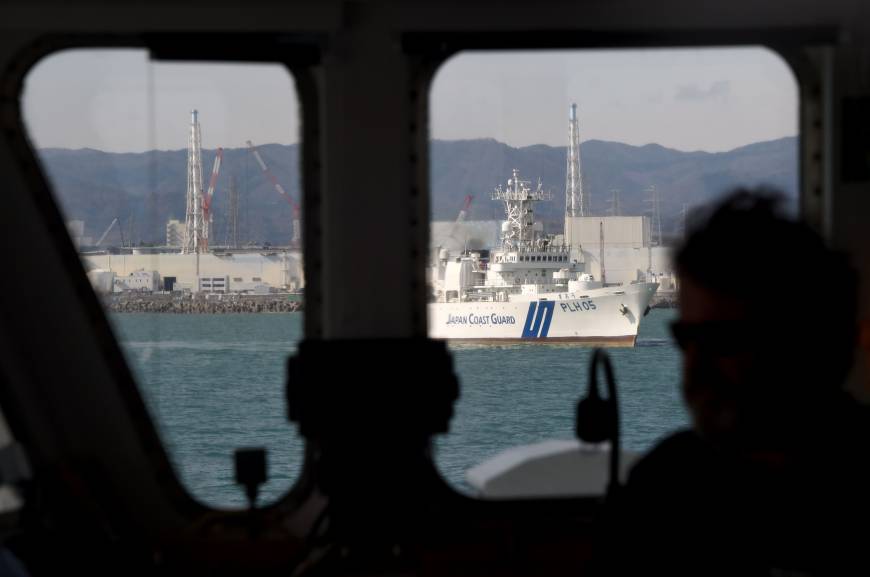
Conservation group Greenpeace warned on Friday that the environmental impact of the Fukushima nuclear crisis five years ago on nearby forests is just beginning to be seen and will remain a source of contamination for years to come.
The March 11, 2011 magnitude-9.0 undersea earthquake off the nation’s northeastern coast sparked a massive tsunami that swamped cooling systems and triggered reactor meltdowns at the Fukushima No. 1 nuclear plant.
Radiation spread over a wide area and forced tens of thousands of people from their homes — many of whom will likely never return — in the worst nuclear accident since Chernobyl in 1986.
As the fifth anniversary of the disaster approaches, Greenpeace said signs of mutations in trees and DNA-damaged worms were beginning to appear, while “vast stocks of radiation” mean that forests cannot be decontaminated.
In a report, Greenpeace cited “apparent increases in growth mutations of fir trees, … heritable mutations in pale blue grass butterfly populations” as well as “DNA-damaged worms in highly contaminated areas.”
The report came as the government intends to lift many evacuation orders in villages around the Fukushima plant by March 2017, if its massive decontamination effort progresses as it hopes.
For now, only residential areas are being cleaned in the short-term, and the worst-hit parts of the countryside are being omitted, a recommendation made by the International Atomic Energy Agency.
But such selective efforts will confine returnees to a relatively small area of their old hometowns, while the strategy could lead to re-contamination as woodlands will act as a radiation reservoir, with pollutants washed out by rains, Greenpeace warned.
The conservation group said its report relies largely on research published in peer-reviewed international journals.
But “most of the findings in it have never been covered outside of the close circles of academia”, report author Kendra Ulrich said.
The government’s push to resettle contaminated areas and also restart nuclear reactors elsewhere around the country that were shut down in the aftermath of the crisis are a cause for concern, Ulrich said, stressing it and the IAEA are using the opportunity of the anniversary to play down the impact of the radiation.
“In the interest of human rights — especially for victims of the disaster — it is ever more urgent to ensure accurate and complete information is publicly available and the misleading rhetoric of these entities challenged,” she said.
Scientists, including a researcher who found mutations of Fukushima butterflies, have warned, however, that more data are needed to determine the ultimate impact of the Fukushima accident on animals in general.
Researchers and medical doctors have so far denied that the accident at Fukushima would cause an elevated incidence of cancer or leukemia, diseases that are often associated with radiation exposure.
But they also noted that long-term medical examination is needed, especially due to concerns over thyroid cancer among young people — a particular problem for people following the Chernobyl catastrophe.
http://www.japantimes.co.jp/news/2016/03/04/national/science-health/mutations-dna-damage-seen-fukushima-forests-greenpeace/#.VtmtlObzN_m
Fukushima Bags of Trouble

Torn bags containing radioactive soil from decontamination work are seen dumped on a beach devastated by the March 11, 2011 tsunami in Naraha, near Tokyo Electric Power Co’s (TEPCO) tsunami-crippled Fukushima Daiichi nuclear power plant in Fukushima Prefecture.
The level of incompetence and irresponsibility displayed by the government is staggeringly awful.
http://www.japantoday.com/category/picture-of-the-day/view/bags-of-trouble
Japan’s nuclear refugees face bleak return five years after Fukushima
Tokuo Hayakawa carries a dosimeter around with him at his 600-year-old temple in Naraha, the first town in the Fukushima “exclusion zone” to fully reopen since Japan’s March 2011 catastrophe. Badges declaring “No to nuclear power” adorn his black Buddhist robe.
(For a video of ‘Fukushima refugees face a bleak return home’ click here)
Hayakawa is one of the few residents to return to this agricultural town since it began welcoming back nuclear refugees five months ago.
The town, at the edge of a 20-km (12.5 mile) evacuation zone around the crippled Fukushima Daiichi plant, was supposed to be a model of reconstruction.
Five years ago, one of the biggest earthquakes in history shook the country’s northeast. The 10-metre (33-foot) tsunami it spawned smashed into the power plant on the Fukushima coastline triggering a meltdown and forcing nearby towns to evacuate. The disaster killed over 19,000 people across Japan and caused an estimated 16.9 trillion yen ($150 billion) in damages.
Only 440 of Naraha’s pre-disaster population 8,042 have returned – nearly 70 percent of them over 60.
“This region will definitely go extinct,” said the 76-year-old Hayakawa.
He says he can’t grow food because he fears the rice paddies are still contaminated. Large plastic bags filled with radioactive topsoil and detritus dot the abandoned fields.
With few rituals to perform at the temple, Hayakawa devotes his energies campaigning against nuclear power in Japan. Its 54 reactors supplied over 30 percent of the nation’s energy needs before the disaster.
Today, only three units are back in operation after a long shutdown following the nuclear meltdown in Fukushima. Others are looking to restart.
“I can’t tell my grandson to be my heir,” said Hayakawa, pointing at a photo of his now-teenaged grandson entering the temple in a full protective suit after the disaster. “Reviving this town is impossible,” he said. “I came back to see it to its death.”
That is bound to disappoint Japan’s Prime Minister Shinzo Abe. Rebuilding Naraha and other towns in the devastated northeast, he says, is crucial to reviving Japan.
Tokyo pledged 26.3 trillion ($232 billion) over five years to rebuild the disaster area and will allocate another 6 trillion for the next five years.
VANISHING TOWN
More than 160,000 people were evacuated from towns around the Daiichi nuclear plant. Around 10 percent still live in temporary housing across Fukushima prefecture. Most have settled outside their hometowns and have begun new lives.
In Naraha, two restaurants, a supermarket and a post office, housed in prefabricated shacks, make up the town’s main shopping center. The restaurants close at 3 p.m.
No children were in sight at Naraha’s main park overlooking the Pacific Ocean on a recent morning. Several elderly residents were at the boardwalk gazing at hundreds of bags stuffed with radioactive waste.
In fact, the bags are a common sight around town: in the woods, by the ocean, on abandoned rice fields.
Little feels normal in Naraha. Many homes damaged in the disaster have been abandoned. Most of the town’s population consists of workers. They are helping to shut down Tokyo Electric Power Co’s (9501.T) Daiichi reactors or working on decontamination projects around town.
Other workers are building a new sea wall, 8.7 meters high, along a nearly 2 km stretch of Naraha’s coast, similar to other sea walls under construction in the northeast.
A local golf course has been turned into dormitories for workers. Some families have rented their houses to workers.
“Naraha is a workers’ town now,” said Kiyoe Matsumoto, 63, a member of the town council, adding that her children and grandchildren have no plans to come home.
RADIATION LEVELS
The town’s future depends on young people returning, residents say. But only 12 below the age of 30 have returned as worries about radiation linger.
Radiation levels in Naraha ranged from 0.07 to 0.49 microsieverts per hour in January, or 0.61-4.3 millisieverts per year. That compares with the government’s goal of one millisievert a year and the 3 millisieverts a year the average person in the United States is exposed to annually from natural background radiation.
The significant drop in atmospheric radiation allowed the government to lift the evacuation order last Sept. 5 – “the clock that had been stopped began ticking again,” Japan’s Reconstruction Agency said on its website.
“It is hoped that the reconstruction of Naraha would be a model case for residents returning to fully evacuated towns,” the agency statement said.
Prime Minister Shinzo Abe visited the town a month after that and repeated one of his favorite slogans: “Without reconstruction of Fukushima, there’s no reconstruction of Japan’s northeast. Without the reconstruction of the northeast, there’s no revival of Japan.”
But with few people coming back, there is little meaning in what the reconstruction department in Naraha does, said one town hall official who requested anonymity. “I don’t know why (Abe) came,” he said.
Back at his Buddhist temple, part of which he has turned into an office for his anti-nuclear campaign, Hayakawa called the idea Naraha could be a model of reconstruction “a big fat lie”.
“There’s no reconstructing and no returning to how it used to be before (March 11). The government knows this, too. A ‘model case’? That’s just words.”
($1 = 113.1100 yen)
http://www.reuters.com/article/us-japan-disaster-return-idUSKCN0W430X
Living in Limbo
Five years after the meltdown in Fukushima, the Japanese government’s effort to reboot its nuclear energy program is still being met with resistance.

The atmosphere in the packed meeting room is tense. It is a Wednesday night in November, and perhaps a hundred people have gathered at a community center in the city of Minamisoma, which begins about six miles north of the decimated Fukushima Daiichi nuclear power plant. At the front of the room sits a phalanx of government officials in dark suits. Facing them are men and women who were forced from their homes in Minamisoma’s Odaka district by nuclear fallout, and who are now being told they might be allowed back by spring. The question on the table is whether that move is premature. Twenty minutes into the discussion, the deep divide between the officials and the residents is clear.
An older man raises his hand. “There’s a tombstone behind my house where the radiation measures 10.5 microsieverts per hour. 10.5!” he says.
Multiplied over a year, the figure is 4.6 times the standard Japan’s government has set for mandatory evacuation, and 92 times the limit the International Commission on Radiological Protection recommends for the general population under normal circumstances. It is also far higher than most measurements taken recently in Odaka, where a massive government-sponsored cleanup – together with natural decay – is steadily lowering radiation levels.
“It’s probably a hotspot,” an environment ministry official says. “We can take care of it for you.”
“I asked the government for data about that spot in August, but I haven’t gotten anything. Why not?” the resident demands.
A woman in the audience shouts out: “Because they’re liars!”
“We think you’re afraid to give us the real data,” the man says.
Another resident speaks up: “The forest surrounding my house has not been decontaminated. Would you live in a place like that? I beg of you, please delay the resettlement!” Applause breaks out in the audience.
I kneel at the back of the crowd, surprised by the depth of the anger and skepticism coursing through the room. The normal tone of public space in Japan is deferential courtesy. That ordinary residents of a provincial town are willing to challenge officials so openly reflects a profound shift brought about by the nuclear disaster.
Simply put, far fewer people trust the government today than they did five years ago. The immediate cause of the disaster was an earthquake and tsunami on March 11, 2011 that deprived the coastal Fukushima plant of its power supply, and hence of its ability to keep reactors and spent fuel cool. A series of explosions and meltdowns followed, which led to the eventual evacuation of 164,000 people. Subsequent investigations soon revealed, however, that poor oversight and cozy ties between government, industry, and academia (the so-called “nuclear village”) laid the groundwork for the disaster. The public also learned that the government bungled the evacuation, causing thousands of people to suffer more radiation exposure than they otherwise would have.
Since then, resistance has extended deep roots. The clearest evidence of that is here in Fukushima, where residents like the ones in this room are fighting to make sure their rights are respected. But far beyond these borders as well, communities are embracing renewable energy and citizens are protesting government abuses of power more loudly than they have in decades. The question that remains after I slip out into the cool night air is how much that resistance is changing policy and politics in Japan.
At times, the answer seems to be: very little. The same political party that enabled the Fukushima disaster through half a century of pro-nuclear policy is back in power, three nuclear reactors are running again despite safety concerns, one more is about to restart, and 20 more are awaiting approval. Meanwhile, Japan played only a minor role at the Paris climate talks in November, and is pouring money into coal plants to compensate for its idled nuclear fleet. In Fukushima, the government remains intent on repopulating the 310-square-mile exclusion zone as quickly as possible.
I have come to Japan on the eve of the disaster’s fifth anniversary to try to make sense of these changes – to weigh hope against cynicism, transformation against retrenchment. What happens here matters globally. Japan is the world’s fifth largest carbon dioxide emitter, is the number-one importer of liquefied natural gas and number-two importer of coal, and a leading exporter of nuclear and “clean coal” technologies. Its domestic energy choices clearly affect the world’s efforts to tackle climate change. But my motivation is also personal. I was living in Japan when the disaster occurred. I witnessed firsthand both its devastating aftermath and the sense of hope for a more sustainable and democratic future that sprang up in its wake. I want to know the fate of that hope.
My host in Minamisoma is a retired postman and lifelong activist from Odaka named Tomio Kokubun. He began protesting nuclear power when he was 20 years old and a new plant – Fukushima Daiichi – was proposed south of his home. Back then, his anti-nuclear activism placed him on the fringe of a community eager to benefit from the jobs the plant brought to the region. Today, he tells me with just a hint of vindication, his neighbors concede he was right to worry.

Long-time anti-nuclear activist and Fukushima native Tomio Kokubun stands next to a sign he wrote and posted near his abandoned house. It reads: “Abe administration, don’t ignore the voice of the people and restart the nuclear reactors.”
I first met Kokubun in 2013 in the snowy mountains west of Fukushima City, where he and his family had been living since they fled the coast after the first explosion at the plant. It was clear that two years of displacement had taken their toll. Kokubun’s ailing mother-in-law and sister-in-law died after a series of evacuation-related moves, and his wife Mieko told me she felt isolated and unhappy in her new surroundings. His grown son, too, talked about how much he wanted his old life back.
Kokubun alone seemed galvanized by the chain of events. He had founded a sprawling association of evacuees and supporters, and was traveling regularly to speak against nuclear power. He was also deeply involved in a class-action lawsuit to gain more compensation from Tepco, the plant operator, for damages caused by the accident. (By 2015, over 10,000 evacuees and nearby residents had filed similar claims.) The stricter safety rules for nuclear plants that the government implemented later that year – including more rigorous backup power requirements – did not placate him. To the contrary, the disaster and its aftermath proved what he had always suspected – that any man-made system contains the potential for failure, and in the case of nuclear power, failure is catastrophic.
Now, two years later, Kokubun was back in Minamisoma, and I had arranged to meet him there the morning of the community meeting. As I looked around the clean, quiet bus stop, I caught sight of him grinning and waving at me from across the street. He was dressed in jeans and a plaid shirt, his snow-white hair poking out from under a tweed hat.
“We’re doing well,” he told me as I climbed into his car. He and Mieko had finally pulled together enough money to start building a new house farther north. In the meantime, they are living in a house in a part of their hometown that was only briefly evacuated. One reason for this move was Mieko’s worsening depression, which Kokubun told me had eased now that she was on familiar ground. The other reason was political.
“I felt strongly that I needed to expand my activism, and I thought if I came back here more people would sympathize with my message,” he said. In July of last year he launched a local organization focused on radiation safety, which so far has attracted around 100 members.
We headed into Odaka where Kokubun’s abandoned house is located. The cleanup was in full swing. Industrious men in masks power-washed sidewalks, dump trucks crowded the streets, and orange placards marked houses for demolition. Everywhere we went we saw squat black bags stuffed with tainted dirt and debris. (Almost 10 million of these bags litter Fukushima, awaiting transportation to a mid-term storage site near Fukushima Daiichi.)
At the community meeting later that night, the mayor of Odaka insisted that all this work was meant only to ensure displaced residents could return if they wanted to – not to force them back.
The dilemma, of course, is that contamination cannot be completely removed from the environment. It will linger in forests and ponds and backyard corners for decades to come, exposing anyone who returns to low but persistent levels of radiation. Science provides no clear answers regarding the potential health risks of that exposure. Above 100 millisieverts (mSv) cancer rates clearly rise; below that level, they may also rise slightly, but the increase is extremely hard to detect in population-level studies.
Following the Fukushima disaster, Japan’s government used the lack of scientific consensus on low-level radiation impacts to justify raising the acceptable level of exposure for the general population from 1 mSv to 20 mSv per year above background levels. (The International Commission on Radiological Protection’s recommended maximum exposure for the general population is 1 mSv under normal circumstances and between 1 mSv and 20 mSv after a nuclear accident.) The decision was, in effect, a pragmatic one. If the government had stuck with the 1 mSv limit, it would have had to evacuate far more people and establish a large, long-term exclusion zone similar to the one around Chernobyl. With the higher limit, bringing nuclear refugees back home became a possibility.
But why the fixation on return? Is it merely that Japan is small, land is precious, and people’s attachment to place fierce? As we drove through the strange landscape of black bags and masked men, Kokubun told me he believes otherwise. “The government is doing this to regain support for nuclear power,” he said. The logic is that if even Fukushima can be “fixed,” people will stop fearing the reopening and operation of other plants.
Kokubun’s response has been to do whatever he can to prevent the illusion of normalcy from seeping in – from dragging Tepco through court to lecturing nationwide about the situation on the ground to hosting visitors who want to see the exclusion zone for themselves. That he is 70 and has been fighting the same fight for 50 years appears not to bother him.
“Right now, the old have to protect the young,” he told me. “We’re the ones who accepted the nuclear plants, who allowed them to be built. The real responsibility lies with us.”
“Do you ever feel like giving up?” I asked.
“I will never give up,” he replied, almost cheerfully. “I will never accept nuclear power.”
A majority of Japanese now share Kokubun’s opinion. Over 70 percent of respondents in recent polls say they want to phase out nuclear power, and 8.5 million have signed a petition calling for renewable energy to replace reactors. Anti-nuclear protests in Tokyo drew hundreds of thousands of ordinary citizens at their peak in 2012. When the Democratic Party of Japan (DPJ) – which briefly held power before and after the disaster – asked for public input on its energy and environment policy in 2012, a record-breaking 89,000 people sent in comments, close to 90 percent of them opposing nuclear power.
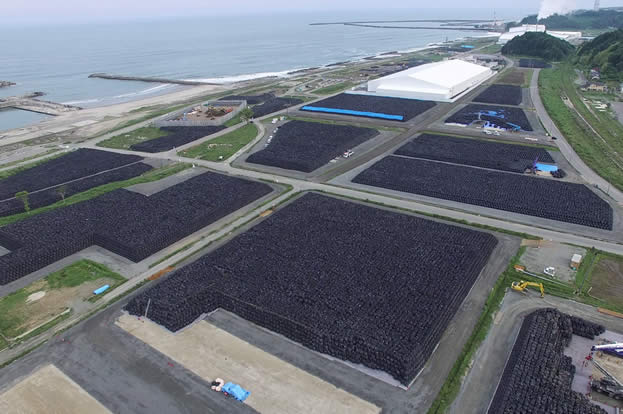
Bags stuffed with tainted dirt and debris stored near the sea. About 10 million of these bags litter Fukushima, awaiting transportation to a mid-term storage site.
The relationship between this surge in anti-nuclear sentiment and Japan’s broader energy policy is complex. The Fukushima disaster occurred just as global concern over climate change was accelerating. In 2009, then-Prime Minister Yukio Hatoyama had committed Japan to lowering carbon emissions a quarter below 1990 levels by 2020 – largely through a plan to increase nuclear power to half of the country’s electricity mix. The meltdowns changed everything.
“With the 3-11 disaster, everyone’s attention turned toward nuclear power. Since then, climate change has fallen more and more off the public’s radar as an important issue,” Takako Momoi told me when I stopped by the Tokyo office of Kiko Network, Japan’s biggest homegrown climate-change NGO, where she works as a manager. A minority of activists even began to spread the message that climate change was a ruse to gain support for nuclear power. In 2013, when the new government traded Hatoyama’s ambitious emissions goal for a 3 percent increase over 1990 levels by 2020, few people protested.
Coal has already seen a major resurgence. Construction of coal-fired power plants had stalled around 2009 due to climate change concerns, but now 48 new plants are planned or under construction, says Momoi. Even with much-touted new “clean coal” technology, she adds, these plants will emit as much carbon dioxide as those that burn oil.
Then there is the fact that even if the public prefers renewables to coal or nuclear, most people still prioritize the economy over the environment in elections. In 2012, voters ousted the DPJ in favor of the pro-nuclear Liberal Democratic Party (LDP), which has monopolized power for most of Japan’s post-war period. The LDP quickly set about formulating its own energy vision. It tossed out the public comments the DPJ had collected, kicked anti-nuclear advisors like those from Momoi’s organization off policy committees, and last summer finalized a long-term energy vision that calls for electricity to come from roughly equal parts nuclear, liquid natural gas, coal, and renewable sources by 2030.
At the local level, however, a more ambitious vision has started to emerge. Many communities are formulating their own renewable energy plans – Minamisoma among them. This March, the city of 63,000 released a “Non-Nuclear Power Declaration” reaffirming an earlier pledge to generate 65 percent of its electricity from renewable sources by 2020, and 100 percent by 2030 (compared to around 10 percent today). Construction is slated to begin this year on a solar farm large enough to power almost all of the city’s households, and four windmills are planned as well. A generous national feed-in tariff program introduced in 2012, which guarantees high prices to individuals and companies selling renewable energy to the grid, has lured corporate investors to these projects.

Cleanup workers power-wash a parking lot in the Odaka district of Minamisoma.
That, together with some smaller subsidy programs, should get the city to its 2020 goal, says Shunichi Shiga, who heads Minamisoma’s newly-established renewable energy division. Reaching 100 percent could be tougher. Power distributors say they’ve already reached the limit of how much renewable energy they can incorporate without major improvements to the grid, and now that the feed-in-tariffs are being ratcheted down, investing in renewable energy is looking riskier. Overcoming these obstacles, Shiga says, will require action at the national level. Momoi concurs. “The [local] movement to increase renewable energy is great, but within the current policy context, it will hit a ceiling,” she says. “There’s a need to think more about the big picture.”
Many people are, in fact, starting to think about what it will take to achieve true change at the national level. One of the most interesting developments set off by the disaster has been the emergence of a strong student movement protesting the government’s disregard for democratic processes. Although its focus is on military policy rather than energy issues, the underlying concern is the same.
Called Students Emergency Action for Liberal Democracy, or SEALDs, this small but vocal group of high school and university students coalesced in mid-2015 against a set of security bills that the LDP ultimately pushed through the Diet (Japanese parliament) in September. Using social media and protests outside the Diet building featuring fierce, smart speeches, the students quickly engaged a broader slice of society than old-school protesters had been able to. It was the most significant student movement since the 1960s.
Koichi Nakano, a political science professor at Tokyo’s Sophia University says SEALDs is a “direct descendant” of the civil-society awakening that followed the nuclear disaster. “They were high school students at the time [of the meltdowns], and for many of them the first experience of protest was those anti-nuclear rallies,” he tells me. “The disaster exposed the myth that was more credible in earlier times about the trustworthiness of ruling elites in Japan.”
Nakano is himself active in an organization opposing the security bills, and has collaborated closely with SEALDs over the past year. He too sees the roots of the nuclear and military issues as intimately linked. “There’s a sense that the 1 percent increasingly control our fate and the 99 percent of us are left out in the dark, uninformed and practically disenfranchised,” he says. “In the case of the security bills, it’s about the ruling elites of Japan in collusion with the American elites changing the interpretation of the constitution to allow Japan to take part in America’s wars even without Japan being attacked. The nuclear power issue is very similar because nuclear power is something that those big powers need to continue on for lucrative reasons. They wouldn’t want to see Japan dropping out from the nuclear power club.”
In spite of this, Nakano believes citizen activists have changed the government’s course, at least on energy. “There was a long period in which even [Prime Minister] Abe couldn’t restart the nuclear reactors. That has only to do with the strength of the opposition,” he tells me. “We are talking about ordinary citizens, without resources, stopping the reactors for many, many months.”
As important as these popular movements may be, the people who will determine Japan’s longer-term energy path are not in the crowds outside the Diet, or even inside its halls. They are in elementary and middle school classrooms across the country. Japan’s education system played a key role in creating the so-called “myth of nuclear safety” – the widespread belief that Japan’s reactors were indestructible – that led towards poor oversight and, ultimately, disaster. Likewise, the lessons children learn now about the Fukushima disaster will shape their views on energy and the environment throughout their lives. So, on my last day in Japan, I take the train back to Fukushima to talk with a professor who has spent the past five years trying to improve radiation education.

The contamination will linger in forests and ponds and backyard corners
for decades to come.
Shinobu Goto is a tall, serious man in his forties who teaches environmental education at Fukushima University. We meet on a Saturday evening in a cluttered university office, where we are joined by two members of the Fukushima teachers’ union, Toshiki Kokubun (no relation to Tomio) and Hiroshi Sato, whose name has been changed to protect his identity. All three were deeply impacted by the disaster.
Goto in particular says the unexpected catastrophe thrust him into a period of intense reflection and regret. He had not previously focused on nuclear education, but now he began to scour official teaching materials on the topic for evidence of bias. He found plenty: elementary-level readers titled Exciting Nuclear Power Land, illustrations of frowning coal plants juxtaposed with friendly nuclear reactors, claims that Japan’s reactors could withstand large earthquakes and tsunamis. Goto was not alone in his critique. The minister of education himself admitted that the pre-disaster texts contained information “contrary to reality,” and soon had them replaced.
Yet the new radiation readers that the ministry published in late 2011 were hardly an improvement. They included just 8 lines about the Fukushima disaster, and instead emphasized how useful and ubiquitous radiation is in daily life. In this, Goto saw the makings of a new myth – not that reactors are infallible, but that the radiation they emit when they do fail is nothing to worry about.
“The concept that the level of radiation we have in Fukushima is safe is being steadily created through education and PR,” he tells me as we sip tea in the quiet research building. He was particularly worried that kids weren’t getting the information they needed to protect their own rights to physical, mental, and social wellbeing. “If you don’t know the exposure limit is 1 or 5 mSv per year in other places, you don’t realize the situation in Fukushima is abnormal,” he says. “Education is empowerment in the sense that it allows you to make those critiques.”
Teachers needed a better option, so in early 2012 he assembled a group of 16 Fukushima University professors, and together they wrote an alternative reader from a human-rights perspective. He also began holding workshops to teach critical thinking skills to public school students, so they could assess government and media claims on their own. At this point, top-level administrators began pressuring him to tone down his activism. The school is the only national university in the prefecture; from the start, its administrators had echoed the government’s emphasis on recovery over risk.

A sign in Fatuba, directly north of the Fukushima Daiichi power plant, reading “Nuclear power, energy for a bright future.” The town is closed off now.
“They told me I had to put a sticker on the reader saying it wasn’t an official publication of the university. I said that’s discriminatory; you don’t do that for other publications,” Goto says. (University representatives tell me they are unable to confirm or deny Goto’s claims, citing personnel changes and a lack of relevant meeting minutes.)
He refused to back down. Ultimately, the reader was published without the sticker, helping to turn national attention on the official curriculum. That attention reverberated to the ministry of education; when the official readers were revised again in 2014, they included more information on the Fukushima disaster, and an acknowledgement that scientists hold “various views” on the impacts of low-level radiation. Still, a startling array of terms were missing: “meltdown,” “Nuclear Accident Child Victim’s Law,” “hotspot,” “thyroid cancer,” and “radioactive waste” among them.
Kokubun and Sato say most teachers in Fukushima don’t venture beyond the official curriculum, which allots just two hours a year for radiation education, partly because they are too busy, and partly because they’re pressured not to.
Sato, an elementary school teacher in Fukushima City, has experienced this pressure directly. “Some high-level board-of-education staff observed one of my classes [on radiation in 2013], and afterwards they said to me, Don’t you think today’s class might worry the children?” The content was purely science based: Sato had shown the kids a graph of the relationship between radiation and cancer, and pointed out that high levels of exposure can be deadly. (In lessons, he also explains that the current degree of contamination in Fukushima City carries a relatively low risk of cancer.)
Fukushima’s Board of Education tells me later that teachers are permitted to share science-based radiation material as long as it is widely accepted. “Our goal,” a staff member writes in an email, “is to teach children to make appropriate decisions based on correct knowledge and understanding of radiation.” However, Sato says he’s been told to avoid the topic by his principal, vice-principal, and other teachers.
Like Goto, he has not bowed to this pressure. Yet both he and Kokubun seem worn down by their lonely struggle. The government defends its interests tenaciously, and the public – with the exception of a determined minority – is all too eager to assist by turning away from the painful past. “People need to be angrier,” Kokubun says. “I’m sad that more people haven’t spoken out with us.”
Outside Goto’s office, the sky is growing dark. Kokubun and Sato need to head home. After they leave, I ask Goto how much hope he has that things will change. He says he feels like he is gasping for breath. The pace of progress is slow, and public interest in the disaster’s ongoing impact is dwindling. Still, he says, he is determined to continue his work.
Later, after he drops me off at the train station, I leaf through some papers he has given me, among them an essay he wrote for his hometown newspaper concluding with the following lines: “They say that history is written by the victors. I will be watching and acting to make sure the lessons of the Fukushima nuclear accident are not written to suit the interests of the perpetrators of this unprecedented man-made disaster.”
In that, and in the commitment of many others to do the same, there lies a glimmer of hope.
http://www.earthisland.org/journal/index.php/eij/article/living_in_limbo/
Very few return to “re-opened” town in Fukushima
Japan’s nuclear refugees face bleak return five years after Fukushima, Yahoo News, By Minami FunakoshNARAHA (Reuters) 3 Mar 16, – Tokuo Hayakawa carries a dosimeter around with him at his 600-year-old temple in Naraha, the first town in the Fukushima “exclusion zone” to fully reopen since Japan’s March 2011 catastrophe. Badges declaring “No to nuclear power” adorn his black Buddhist robe.
(For a video of ‘Fukushima refugees face a bleak return home’ click http://www.reuters.tv/Bus/2016/03/03/inside-fukushima-s-first-town-to-reopen)
Hayakawa is one of the few residents to return to this agricultural town since it began welcoming back nuclear refugees five months ago.
The town, at the edge of a 20-km (12.5 mile) evacuation zone around the crippled Fukushima Daiichi plant, was supposed to be a model of reconstruction.
Only 440 of Naraha’s pre-disaster population 8,042 have returned – nearly 70 percent of them over 60.
“This region will definitely go extinct,” said the 76-year-old Hayakawa.
He says he can’t grow food because he fears the rice paddies are still contaminated. Large plastic bags filled with radioactive topsoil and detritus dot the abandoned fields.
With few rituals to perform at the temple, Hayakawa devotes his energies campaigning against nuclear power in Japan. Its 54 reactors supplied over 30 percent of the nation’s energy needs before the disaster.
Today, only three units are back in operation after a long shutdown following the nuclear meltdown in Fukushima. Others are looking to restart.
“I can’t tell my grandson to be my heir,” said Hayakawa, pointing at a photo of his now-teenaged grandson entering the temple in a full protective suit after the disaster. “Reviving this town is impossible,” he said. “I came back to see it to its death.”
That is bound to disappoint Japan’s Prime Minister Shinzo Abe. Rebuilding Naraha and other towns in the devastated northeast, he says, is crucial to reviving Japan.
Tokyo pledged 26.3 trillion ($232 billion) over five years to rebuild the disaster area and will allocate another 6 trillion for the next five years.
VANISHING TOWN………
No children were in sight at Naraha’s main park overlooking the Pacific Ocean on a recent morning. Several elderly residents were at the boardwalk gazing at hundreds of bags stuffed with radioactive waste.
In fact, the bags are a common sight around town: in the woods, by the ocean, on abandoned rice fields.
Little feels normal in Naraha. Many homes damaged in the disaster have been abandoned. Most of the town’s population consists of workers. They are helping to shut down Tokyo Electric Power Co’s <9501.T> Daiichi reactors or working on decontamination projects around town.
Other workers are building a new sea wall, 8.7 meters high, along a nearly 2 km stretch of Naraha’s coast, similar to other sea walls under construction in the northeast……..
Back at his Buddhist temple, part of which he has turned into an office for his anti-nuclear campaign, Hayakawa called the idea Naraha could be a model of reconstruction “a big fat lie”.
“There’s no reconstructing and no returning to how it used to be before (March 11). The government knows this, too. A ‘model case’? That’s just words.” http://news.yahoo.com/japans-nuclear-refugees-face-bleak-return-five-years-064635977–finance.html
How solar energy can turn lives around in nuclear-devastatedFukushima
Adorable Japanese couple devastated by Fukushima turn lives around with solar http://www.greenpeace.org/international/en/news/Blogs/makingwaves/this-adorable-japanese-farming-couple-lost-th/blog/55657/

Eventually though, they decided to return.
“We have cattle and chickens and we had to come back to feed them. We couldn’t leave them and go elsewhere,” they told us in 2012.
But apart from dealing with the aftermath of such a tragic accident they also had to deal with the future of their farming business – their customer base fell due to fears of contaminated produce, and they even thought about giving up on farming.
But instead of letting the nuclear accident shape them, they knew they had to move forward – for themselves, for their community and for their children’s future.
In 2013 they opened up an organic shop, “Esperi” in the agricultural town of Miharu, Fukushima Prefecture. Their intention was to help revitalise the area and create a community space where people could gather and help each other in 2013. After all, the name “Esperi” means “hope” in Esperanto.
But this wasn’t enough. So in October 2015, the couple launched the Solarise Fukushima crowdfunding project to install solar panels on the rooftop of their shop. Their aim? “Hope to spread life with solar energy from Miharu town, Fukushima”.
Before they knew it people around Japan and the rest of the world began contributing to their crowd funding project, and about a month later they achieved their target of around 1.5 mil JPY (about 13,500 US). Messages from crowd funding supporters gave them the encouragement they needed, especially as they felt “forgotten”.
Greenpeace Japan helped launch the project, and in January 2016 solar panels were installed on the Esperi rooftop.
When the Greenpeace International radiation investigation team first met the couple in April 2011, Mrs Okawara said:
“Fukushima people are a bit naive. For a long time, we did not have money, and just accepted the plan of nuclear power plants. But for the future of our children it would be a shame if we didn’t continue organic farming and take drastic action.”
In 2012 Fukushima Prefecture pledged to switch to 100% renewable energy by 2040. But the policies that the Japanese government are currently promoting is heading in the opposite direction.
In order to achieve a sustainable, reliable and affordable electricity system, the Japanese government urgently needs to change course and streamline its actions. It needs to put the interests of people before those of the utilities and stop wasting efforts on restarting nuclear plants, stop investments in coal power plants that lock in climate destruction, and an set ambitious renewable energy target.
For many people in Fukushima, their biggest wish is for a life without nuclear energy and a future powered by clean, safe renewable energy. Esperi is a tangible testament to the community’s future – it’s our hope. Ai Kashiwagi is an energy campaigner at Greenpeace Japan.
The social toll on Fukushima families
For some Fukushima mothers, protecting children from radiation comes at heavy price, Asahi Shimbun February 23, 2016 Three-and-a-half years after fleeing to central Japan, a mother received a package from her husband who had opted to remain at their home in Fukushima Prefecture despite the nuclear disaster.
From Tamura, about 35 kilometers west of the stricken Fukushima No. 1 nuclear plant, the father sent snacks for the couple’s two children. The cardboard box also contained divorce papers.
“I cannot send money to my family whom I cannot see,” the husband told his wife.
She still refused to return home.
Thanks to decontamination work, radiation levels have fallen around the nuclear plant since the triple meltdown caused by the Great East Japan Earthquake and tsunami in March 2011. And families are returning to their hometowns, trying to resume normal lives.
But many mothers, distrustful of the government’s safety assurances, still harbor fears that radiation will affect the health of their children. As a result of these concerns, families are being torn apart, friendships have ended, and a social divide remains wide in Fukushima communities.
Around 70,000 people are still not allowed to return to their homes located in evacuation zones designated by the central government. And an estimated 18,000 people from Fukushima Prefecture whose homes were outside those zones remain living in evacuation………..
Sung Woncheol, a professor of sociology at Chukyo University, and others have conducted surveys on mothers whose children were 1 to 2 years old when the nuclear disaster started. The mothers live in Fukushima city and eight other municipalities in Fukushima Prefecture.
Of the 1,200 mothers who responded to the survey in 2015, 50 percent said they had concerns about child-rearing in Fukushima Prefecture.
Nearly 30 percent said they avoid or try to avoid using food products from Fukushima Prefecture, compared with more than 80 percent six months after the disaster.
But for some mothers, the passage of nearly five years since the disaster unfolded has not erased their fears of radiation.
The 36-year-old mother who received the divorce papers from her husband in autumn 2014 continues to live with her children in the central Japan city to which she had no previous connection.
A month after the nuclear disaster, she fled with her then 1-year-old son and her daughter, 10, from their home, even though it was not located in an evacuation zone.
She said she left Fukushima Prefecture because she “could not trust the data released by the central government.”……..http://ajw.asahi.com/article/0311disaster/fukushima/AJ201602230068
‘deep freeze’ of soil wall at Fukushima plant
TEPCO nears ‘deep freeze’ of soil wall at Fukushima plant http://ajw.asahi.com/article/0311disaster/fukushima/AJ201602210030 February 21, 2016 By HIROMI KUMAI/ Staff Writer
Packed with bulky silver pipes and freezing equipment, Tokyo Electric Power Co.’s plant to freeze underground soil at the crippled Fukushima No. 1 nuclear power plant is ready to start chilling.
On Feb. 19, TEPCO officials showed the interior of the newly built facility, the heart of the project to reduce accumulating radioactive water at the nuclear complex.
The plan envisages a frozen soil wall built around the reactor buildings by inserting 1,568 pipes to a depth of 30 meters.
Cooling agents, which register 30 degrees below zero, will be pumped into the pipes to freeze the surrounding soil.
In theory, the flow of groundwater into the reactor buildings, which would mix with contaminated water and empty out in the sea, will be blocked.
With approval from the Nuclear Regulation Authority earlier this month, the utility plans to start freezing the area facing the sea as early as March, a process expected to take about two and a half months.
In total, it will take seven to eight months to complete all the freezing of the underground soil, including the mountain side of the wall, according to TEPCO’s blueprint presented to the NRA this month.
That means that the project to build a frozen barrier will significantly lag behind the initial targeted completion date of the end of March.
TEPCO irresponsible in its assessment of core meltdowns
TEPCO’s statements on assessment of core meltdowns are irresponsible, Japan News, February 27, 2016 The Yomiuri Shimbun Is it possible that Tokyo Electric Power Co. intentionally refused to acknowledge “meltdowns” at crippled reactors of its Fukushima No. 1 nuclear power plant?
It was found that TEPCO had been unaware of assessment guidelines on meltdowns written in in-house regulations when the nuclear accident happened in Fukushima Prefecture. It denied any “meltdown,” which would suggest a serious situation.
“We were not aware at that time that there were such guidelines,” an official of the company said.
This has to be called a lame excuse by TEPCO, the largest electric power company in Japan.
According to the company’s nuclear disaster management manual at the time, a reactor core must be considered in meltdown if 5 percent or more of its nuclear fuel is believed to be damaged.
After the nuclear accident in the prefecture, a device to monitor radiation levels in containment vessels stopped working due to a power outage. After the device was restarted on March 14, 2011, it became possible to estimate how much nuclear fuel had been damaged in the reactors. The firm estimated 30 percent of the nuclear fuel in the No. 3 reactor of the plant had been damaged. If TEPCO had followed the guidelines, the situation apparently would have been a state of “meltdown.”
However, the firm, which called the situation “core damage,” claimed at the time that there was no clear definition of a meltdown. Two months had passed before TEPCO acknowledged at a press conference that the reactors had been in meltdown.
By intentionally avoiding the expression “meltdown,” which could have created more fear, didn’t the firm fail to convey the graveness of the situation to the public?……http://the-japan-news.com/news/article/0002776727
TEPCO now burning thousands of radioactive work clothes
TEPCO begins burning radiation-tainted work clothes at Fukushima plant Asahi Shimbun, February 26, 2016 By HIROMI KUMAI/ Staff Writer OKUMA, Fukushima Prefecture--Tokyo Electric Power Co. has started to incinerate the thousands of boxes of lightly contaminated waste, including clothing used by workers, at the Fukushima No. 1 nuclear power plant to reduce the amount of tainted waste on the site.
TEPCO, the plant operator, fired up a special on-site incinerator on Feb. 25 to burn protective suits, gloves, socks and other work clothes worn by plant workers that became contaminated with low-level radiation.
The operation will reduce the amount of tainted work clothing accumulating at the plant during decommissioning operations since the nuclear disaster unfurled in March 2011. The garments cannot be processed outside the plant due to the radiation.
The clothing being incinerated are items with the lowest levels of contamination that have been stored in tens of thousands of 1 cubic-meter special boxes. The number of containers reached 66,000 at the end of last year…….http://ajw.asahi.com/article/0311disaster/fukushima/AJ201602260071
Crisis mode continues at Fukushima nuclear wreck
5 Years Later, the Fukushima Nuclear Disaster Site Continues to Spill Waste
The cleanup effort could take decades; meanwhile the amount of radioactive material the plant leaks grows, Scientific American By Madhusree Mukerjee on March 1, 2016 “……..
Today the disaster site remains in crisis mode. Former residents will not likely return anytime soon, because levels of radioactivity near their abodes remain high. Even more troublesome, the plant has yet to stop producing dangerous nuclear waste: its operator, the Tokyo Electric Power Company (TEPCO), currently circulates water through the three melted units to keep them cool—generating a relentless supply of radioactive water. To make matters worse, groundwater flowing from a hill behind the crippled plant now mingles with radioactive materials before heading into the sea.
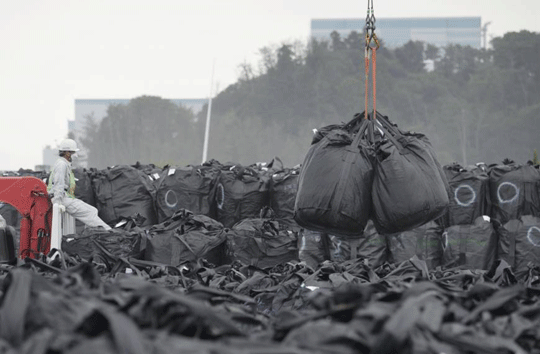
TEPCO collects the contaminated water and stores it all in massive tanks at the rate of up to 400 metric tons a day. Lately the water has been processed to reduce the concentration of radionuclides, but it still retains high concentrations of tritium, a radioactive isotope of hydrogen. Disputes over its final resting place remain unresolved. The same goes for the millions of bags of contaminated topsoil and other solid waste from the disaster, as well as the uranium fuel itself. Health reports, too, are worrisome. Scientists have seen an increase in thyroid cancers among the children who had lived in Fukushima at the time, although it is too early to tell if those cases can be attributed to the accident…….http://www.scientificamerican.com/article/5-years-later-the-fukushima-nuclear-disaster-site-continues-to-spill-waste/
Survey finds “post-disaster” reconstruction slow in Tohoku prefectures
The pace of reconstruction after the powerful earthquake and tsunami that hit parts of northeastern Japan in March 2011, and the subsequent nuclear disaster, differs from community to community, with a delay forecast in Fukushima municipalities affected by radiation from the accident, a Jiji Press survey has revealed.
The survey was conducted in January and February in a total of 42 municipalities along the Pacific coast in Iwate, Miyagi and Fukushima prefectures, and around Tokyo Electric Power Co.’s Fukushima No. 1 nuclear power station, where an unprecedented triple reactor meltdown occurred following the natural disasters.
Of the 42, 12 are in Iwate, and 15 each in Miyagi and Fukushima.
Of the total, 15 municipalities said that post-disaster reconstruction will be completed by the end of fiscal 2020 in March 2021, the final year of the reconstruction period designated by the government.
Three municipalities said reconstruction will finish by the end of fiscal 2016, one by the end of fiscal 2017, six by the end of fiscal 2018 and five by the end of fiscal 2019.
The city of Soma in Fukushima said it is difficult to say exactly when the construction projects will be completed.
Meanwhile, 11 municipalities, including nine in Fukushima, noted that post-disaster reconstruction will end in fiscal 2021 or later.
Many of the nine Fukushima towns and villages cited delays in work to decontaminate areas polluted with radiation and dispose of radiation-tainted soil, and the restoration of agriculture, forestry and fishery industries.
This suggests that industry reconstruction has been tardy, affected by shipment restrictions and misinformation about radiation.
The two other municipalities projecting the completion of reconstruction after fiscal 2020 are Sendai, the prefectural capital of Miyagi, and the Miyagi town of Minamisanriku.
Sendai faces a delay in land procurement for reconstruction projects, including one for elevating roads. The central district of Minamisanriku was devastated by the tsunami.
In Iwate, nearly 50 percent of the planned public housing for people who lost their homes in the quake and tsunami has been completed. The proportion stands at about 50 percent in Miyagi and 40 percent in Fukushima.
Of the 12 Fukushima municipalities where evacuation advisories were issued after the nuclear accident, six, including the towns of Tomioka and Okuma, said that their populations at the end of 2025 are expected to decrease by 20 percent or more from current levels.
Among other municipalities in Fukushima and the two other prefectures, five, including Minamisanriku, project drops of 15-20 percent and eight foresee declines of 10-15 percent.
An official of Minamisanriku said, “The population decrease in our town will likely accelerate, because the number of children is falling and some of the residents who have been evacuated to other areas have found new homes and jobs there and therefore opted not to return to Minamisanriku.”
In Miyagi, Sendai and three nearby municipalities expect increases in their populations, on the back of inflows of evacuees from other areas and the establishment of operational hubs by construction companies.
In Fukushima, population growth is forecast in the town of Shinchi, where a liquefied natural gas storage facility is planned to be constructed.
Many of the surveyed municipalities said that they want the central government to continue securing enough reconstruction budgets and providing personnel support, and to increase flexibility in subsidy programs.
The earthquake and tsunami killed more than 15,800 people and left over 2,500 others unaccounted for.
http://www.japantimes.co.jp/news/2016/02/28/national/social-issues/survey-finds-post-disaster-reconstruction-slow-tohoku-prefectures/#.VtMsmubzN_l
Does Tohoku’s disaster tourism exploit or educate?
Disaster tourism can be an unsettling descent into voyeurism as visitors ghoulishly gawk at, and photograph, those caught up in catastrophe as if they’re at a petting zoo. The concept has prompted widespread condemnation of insensitive tourists and travel companies exploiting disasters as marketing opportunities.
In the years following the Great East Japan Earthquake of 2011, opponents of disaster tourism have claimed that its economic benefits are overstated while the ethical shortcomings are legion. Advocates counter that the economic benefits can be significant, crucial to regional recovery, and that there are important lessons to be learned.
There is no longer much to gawk at along the Tohoku region’s tsunami-ravaged coast, however, save for some shattered buildings preserved to memorialize the tragedy. Bus companies and hotel operators pocket profits, but they also generate jobs and expose outsiders to a region that has always been a neglected backwater.
Recently I witnessed large buses from one local tour company disgorging dozens of sightseers for snapshots of the skeletal disaster management center and the derelict Takano Kaikan hall in Minamisanriku, Miyagi Prefecture. These tourists are spending money in local shops and restaurants in a remote place that has poor transport links and is in the middle of a noisy, messy all-encompassing rebuilding phase. What used to be the center of town is now a vast construction site dominated by giant berms of earth that will raise the town by about five meters.
I met a young man from Osaka who came as a volunteer and then decided to remain in the area. He pointed out that for devastated local businesses, disaster tourism is a welcome lifeline. Elsewhere, a big-screen TV in a hotel lobby features a 3-D video of the tsunami that allows guests to don special glasses and watch the unfolding tragedy. I suppose this could be educational, but the prevailing holiday atmosphere dissuaded me.
Denunciation of disaster tourism in Tohoku is grounded in sympathy for the victims and concerns that devastation is an unseemly attraction, but Australia National University’s Simon Avenell, author of “Transnational Japan in the Global Environmental Movement,” says he is not a purist in this regard.
“From a financial perspective, I’m generally supportive of disaster tourism, certainly because it brings people and some money into the region, but also because it offers local people a chance to express their feelings directly (rather than mediated through the press or TV),” he says. “As time goes by, 3/11 becomes less and less of a news item, so tourism can be at least a small communication pipeline for locals.”
However, Avenell also has qualms about the potential for masking serious unresolved issues, because by promoting a sense of normalization “it could actually hamper fundamental change (and) … its political benefits might be limited or even deleterious in the long run.”
The infamous Kyushu port of Minamata, which put mercury poisoning on the global radar in the 1970s, is now perhaps the most visited sight for school excursions by Kyushu students after Nagasaki’s atomic bomb park and museum. Chris McMorran, a senior lecturer in Japanese studies at the National University of Singapore, takes his students there. He says tourism officials from Tohoku visited Minamata to learn about the city’s educational disaster tourism initiatives and the role of kataribe (storytellers) in them.
“Using an itinerary to create an opening for reflection and communication has long fit the learning objectives of overseas field learning experiences,” he says. There are “packages that continue to attract visitors to Tohoku who want to hear from survivors, witness the destruction and (most intriguingly to me) view (and photograph) disaster monuments. In some areas, there are also new shopping areas targeted at tourists, which feature locally handmade products and restaurants. It seems like these places are actively promoted by locals trying to start businesses in the absence of other major economic activity.”
McMorran posits there are phases in Tohoku’s disaster tourism.
“First, through volunteerism, then volunteer tourism (or ‘voluntourism’), then disaster (recovery/support) tourism. It’s a fascinating evolution that has effectively controlled the potential anarchy of large-scale volunteerism and steered it into consumption (via tourism and the purchase of local goods) as the preferred disaster recovery response from citizens.”
The media has played a significant role in this latter phase. Philip Seaton, a professor of modern Japanese studies at Hokkaido University, has studied the role “contents tourism” has played in Tohoku’s recovery. This is where television shows, films and anime promote an area specifically by featuring it.
Producers chose sites “in disaster zones in the hope that the ‘contents tourism’ induced by popular culture would help in the more general economic revitalization efforts of disaster areas,” Seaton says. Prime examples include NHK dramas “Yae no Sakura,” set in Aizuwakamatsu, Fukushima Prefecture, and “Amachan,” set in Kuji, Iwate Prefecture. It is estimated that the latter generated ¥30 billion in economic benefits for Tohoku as fans of the series flocked to the gorgeous coastal location to sample local delicacies from the show.
It is also clear that a variety of organizations, ranging from religious and education institutions to NPOs and activist groups, are conducting study tours in the region that are explicitly educational. As I wrote two weeks ago, the ruins of Okawa Elementary School in Miyagi Prefecture are now a site for school tours that aim to improve disaster preparation. Universities are also running study tours in the region.
Hiroko Aihara, a journalist with Japan Perspective News, notes that the Japan NGO Center for International Cooperation has issued guidelines for responsible disaster tourism but remains ambivalent over “dark tourism,” which involves places associated with death and suffering. She is concerned about a lingering radiation risk in Fukushima and worries that if tours don’t involve local residents and the evacuees, visitors might get a skewed impression that downplays the nuclear disaster — which could be “converted to political propaganda by the ‘nuclear village,’” she says, referring to pro-nuclear interests. She also cautions that schools and teachers should disclose information about the dangers of radiation exposure near the stricken nuclear plant and suggests bringing individual measurement devices. If properly led, she agrees that educational tours can be beneficial, but she is not in favor of mere casual observation.
Fukushima Prefecture is sponsoring trips to Namie, an abandoned town just 9 kilometers away from Tepco’s three nuclear meltdowns, that convey a powerful message to visitors about the hubris of nuclear safety — underscored by the continuing ban on overnight stays. Nearby Futaba, however, has taken down the iconic pro-nuclear energy welcome sign that spanned the entryway into that ghost town because it had become a favored photo op for tourists. Some disgruntled locals feel it should have been preserved for posterity to help future generations learn the lessons of Fukushima, but abashed town officials claim the aging sign had become a safety hazard. At least that’s their story, and they’re sticking to it.
http://www.japantimes.co.jp/opinion/2016/02/27/commentary/tohokus-disaster-tourism-exploit-educate/#.VtLKBubzN_l
Are Organisms Adapting to Ionizing Radiation at Chernobyl?
Numerous organisms have shown an ability to survive and reproduce under low-dose ionizing radiation arising from natural background radiation or from nuclear accidents. In a literature review, we found a total of 17 supposed cases of adaptation, mostly based on common garden experiments with organisms only deriving from typically two or three sampling locations. We only found one experimental study showing evidence of improved resistance to radiation. Finally, we examined studies for the presence of hormesis (i.e., superior fitness at low levels of radiation compared with controls and high levels of radiation), but found no evidence to support its existence. We conclude that rigorous experiments based on extensive sampling from multiple sites are required.
Radiation research in children teeth in Japan
Prof. Chihiro Ichihara from Aichi Medical University, is an independent man.
He informed the audience about the children teeth project for measuring Strontium 90, with no government support, looking for funding.
Prof. Chihiro Ichihara collects children teeth and lets them measure for Strontium 90. He plans to build an own independent lab for parents.
Similar project was done until the1980s in the U.S. after the bomb tests. It was then supervised by Jay Gould. (STRONTIUM-90 IN BABY TEETH AS A FACTOR IN EARLY CHILDHOOD CANCER http://www.radiation.org/reading/ijhs/ijhs_9_2000.html)
To measure Sr90 is very difficult, because it emits only beta radiation. It causes bone marrow depression, destroys the stem cells and immune system, casuses bone cancer / sarcoma.
His project deserves more attention, because it is VITAL.
STRONTIUM-90 IN BABY TEETH AS A FACTOR IN EARLY CHILDHOOD CANCER
Jay M. Gould, Ernest J. Sternglass, Janette D. Sherman,
Jerry Brown, William McDonnell, Joseph J. Mangano
International Journal of Health Services
Volume 30, Number 3, Pages 515-539, 2000
Copyright Baywood Publishing Co., Inc
http://www.radiation.org/reading/ijhs/ijhs_9_2000.html
Kudos to Prof. Ichihara, wo worked at the research reactor in Kyoto: “He is a physicist specialising in Neutron transport experiments and their calculation as well as in gamma-ray spectrum measurement.
Currently, he teaches as a Visiting Professor at Aichi Medical University. He is a member of the Steering Committee of PDTN. Previously, Prof. Chihiro Ichihara was an Associate Professor at the Research Reactor Institute of Kyoto University.”
Special credits to Jan Hemmer for the pictures and the informations


1 This Month



26 September – International Day for the Total Elimination of Nuclear Weapons


PLEASE OPPOSE HR 8255 AND S.3639 – bills would accelerate satellite deployment, with no environmental review or safeguards – https://ncstd5li.quorum.us/campaign/169331/
To see nuclear-related stories in greater depth and intensity – go to https://nuclearinformation.wordpress.com
-
Archives
- September 2026 (219)
- August 2026 (330)
- July 2026 (355)
- June 2026 (287)
- May 2026 (306)
- April 2026 (356)
- March 2026 (251)
- February 2026 (267)
- January 2026 (308)
- December 2025 (358)
- November 2025 (359)
- October 2025 (375)
-
Categories
- 1
- 1 NUCLEAR ISSUES
- business and costs
- climate change
- culture and arts
- ENERGY
- environment
- health
- history
- indigenous issues
- Legal
- marketing of nuclear
- media
- opposition to nuclear
- PERSONAL STORIES
- politics
- politics international
- Religion and ethics
- safety
- secrets,lies and civil liberties
- spinbuster
- technology
- Uranium
- wastes
- weapons and war
- Women
- 2 WORLD
- ACTION
- AFRICA
- Atrocities
- AUSTRALIA
- Christina's notes
- Christina's themes
- culture and arts
- Events
- Fuk 2022
- Fuk 2023
- Fukushima 2017
- Fukushima 2018
- fukushima 2019
- Fukushima 2020
- Fukushima 2021
- general
- global warming
- Humour (God we need it)
- Nuclear
- RARE EARTHS
- Reference
- resources – print
- Resources -audiovicual
- Weekly Newsletter
- World
- World Nuclear
- YouTube
-
RSS
Entries RSS
Comments RSS
 nuclear-news