FIVE YEARS AFTER: Asahi survey: 70% of evacuees report declined health since 3/11
Almost 70 percent of 3/11 evacuees that answered an Asahi Shimbun questionnaire said their health had worsened since the triple disasters struck five years ago.
Comparing their current health to before the Great East Japan Earthquake, tsunami and Fukushima nuclear disasters, 23 percent of respondents said it had worsened greatly, while 46 percent said it had worsened somewhat.
One 67-year-old man living in temporary housing in Otsuchi, Iwate Prefecture, wrote: “I cannot use a chair because the temporary housing unit is so cramped. The condition of my knees has worsened because I have to sit on the floor for a long time.”
Questionnaires were sent out to 944 evacuees from the three hardest-hit prefectures of Iwate, Miyagi and Fukushima in February and responses were received from 619. While all respondents in 2012 were evacuees living in temporary housing, some have since moved back home.
Respondents also showed signs of psychological stresses in their responses to a question with the option to give multiple responses.
Forty-eight percent said they had experienced an increase in the concerns they felt, 37 percent said they felt down or lonely, 28 percent said they were more irritated and 25 percent said they had difficulty sleeping.
Only 22 percent said they were in a calmful state unchanged from before the disasters.
A 55-year-old woman who runs her own business and lives in an apartment in Yamada, Iwate Prefecture, said: “Whenever I see tsunami footage, I remember relatives who died and I become lonelier. I am also worried because I have no idea when I will be able to rebuild my home.”
A 77-year-old woman who was evacuated from Naraha, Fukushima Prefecture, to Aizu-Misato, also in the prefecture, said: “My life changed completely because of the nuclear accident, and I tend to feel more down. I also feel psychological uncertainty because I still do not have a settled residence.”
The respondents were also asked to list up to three policies they wanted the central and local governments to prioritize.
The most popular response for the second consecutive year was “subsidies for medical expenses” at 43 percent.
Other frequent responses were “improving elderly care services and rebuilding or expanding social welfare facilities” at 30 percent and “subsidies for monthly living expenses” at 28 percent.
The second most popular response last year was “financial support to rebuild own home.” This year that response came in fourth with 24 percent of respondents choosing it.
http://ajw.asahi.com/article/0311disaster/recovery/AJ201603220001
Incineration of radioactive waste begins at Fukushima nuclear plant
Tokyo Electric Power Co. (TEPCO) has begun incinerating radioactively contaminated clothing and other waste on the grounds of the disaster-hit Fukushima No. 1 Nuclear Power Plant in an effort to reduce the volume of waste.
A three-story incineration facility has been built on the north side of the plant grounds. Every day around 7,000 people work at the Fukushima plant, creating a massive amount of waste in the form of used radiation suits, gloves and boots. Pre-disaster incineration equipment was destroyed by the March 2011 Great East Japan Earthquake and tsunami, which led to the construction of the new facility.
As of the end of last year some 70,000 metric tons of this kind of waste was being held in storage containers. TEPCO estimates that by the year 2028, 358,000 tons of such waste will have been produced, but claims it can reduce the volume of the waste to as little as about one-fiftieth of its original size by incinerating it.
Radioactive materials contained in the smoke from the incinerator will be removed by filters on the exhaust pipes. The resulting ash will be sealed in specialized barrels, and TEPCO says there will be little danger from radioactive exposure.
However, in addition to the aforementioned waste there were, as of July last year, around 83,000 tons of lumber from trees cut down to make way for tanks storing contaminated water and 155,000 tons of other waste such as power plant debris from the hydrogen explosions that occurred there. These additional kinds of waste are expected to grow to 695,000 tons by 2028, and will not be processed at the incineration facility.
While TEPCO plans to construct facilities to burn this lumber and to break down debris in the future, these are not expected to all be operational until around fiscal 2020.
http://mainichi.jp/english/articles/20160321/p2a/00m/0na/004000c
Japan urges China to lift import ban on farm products in place since March 2011
BEIJING – Japan urged China on Monday to scrap its import restrictions on agricultural, forestry and fisheries products and food that have been in place since the March 2011 Fukushima nuclear disaster.
Kazuyoshi Honkawa, vice minister of agriculture, forestry and fisheries, made the request at a bilateral subcabinet-level dialogue in Beijing on agricultural issues.
The two countries reopened the dialogue for the first time in six years, after suspending talks due to deteriorated bilateral ties.
After the nuclear disaster at Tokyo Electric Power Co.’s crippled Fukushima No. 1 plant, China prohibited all imports of agricultural, forestry and fisheries products and food from 10 prefectures , including Fukushima, Miyagi and Ibaraki.
Honkawa asked Chinese Vice Agriculture Minister Qu Dongyu to urge authorities to lift the import ban. The embargo is administered by China’s General Administration of Quality Supervision, Inspection and Quarantine.
Honkawa said he did not receive a clear answer on the issue from the Chinese ministry.
After the dialogue, he told reporters that the rapidly growing Chinese market is very attractive for Japanese agriculture, forestry and fisheries industries, suggesting his ministry’s aim of expanding farm exports to China.
Economic relations between Japan and China have been on the mend in recent months.
At talks last November, Prime Minister Shinzo Abe and Chinese Premier Li Keqiang agreed to restart a high-level economic dialogue that brings together the two countries’ key economic officials at an early date this year. In December, Japan and China held economic partnership talks led by vice ministerial officials for the first time in more than five years.
Razing of wrecked homes lagging badly as Fukushima residents ponder return
The central government is covering the demolition costs for disaster-hit homes in Fukushima Prefecture, but 70 percent of the razing requests have not been completed.
The Environment Ministry plans to revise the procedures for handling demolition requests because the situation could further prevent residents from returning to the radiation-tainted areas.
As of Jan. 8, 5,780 applications — or over 70 percent of the 7,670 demolition requests — had not been processed.
Minamisoma aims to have the central government lift evacuation orders in most of the city this spring. But only 30 percent of the 2,600 houses earmarked for demolition have been razed, leaving 1,780 to go.
The town of Kawamata and the village of Katsurao also want evacuation orders lifted from April, but the razing is only 17 percent complete in Kawamata and 6 percent in Katsurao. Tamura and the village of Kawauchi have meanwhile torn down all homes earmarked for demolition.
The ministry says the time-consuming nature of the work is one reason for the backlog, since it involves confirming ownership, inspecting properties and calculating costs.
The central government has expanded the program to cover not only houses damaged by the quake and tsunami, but also those damaged by leaky roofs during the prolonged evacuation. This raised applications to a level officials can’t keep up with, the ministry said.
Evacuees are calling for speedier action. Tomoya Suzuki, 67, who fled the Odaka district of Minamisoma to the town of Shinchi further north, applied to have his house demolished last August. His application is still pending.
“I would like to go back to Odaka as soon as the evacuation orders are lifted, but I can’t rebuild my house unless it’s demolished,” he said.
The government has said it will lift evacuation orders in Minamisoma by March 2017.
“The central government has decided to lift evacuation orders when the living environment for the residents is not prepared yet,” he said. “I find that contradictory.”
The ministry says it cannot drastically increase manpower, and will deal with the glut by giving priority to those who wish to return.
TEPCO refuses to reimburse ¥20.1 billion in claims from Tohoku

Out of ¥53.1 billion in expenses incurred by six prefectures in the Tohoku region in response to the disaster at Tokyo Electric Power Co.’s Fukushima No. 1 nuclear power plant, TEPCO has still not agreed to reimburse ¥20.1 billion, The Yomiuri Shimbun has learned.
The prefectures have resorted or will resort to alternative dispute resolution (ADR) procedures to compel TEPCO to pay, but taxpayers may end up footing the bill in the end.
Different interpretations
Regarding compensation for damage caused by nuclear power plants, the government’s Dispute Reconciliation Committee for Nuclear Damage Compensation released preliminary guidance in August 2011 on what expenses TEPCO should reimburse local governments for.
This included the cost of damage to water and sewer services contaminated by radioactive material, and the cost of supporting victims on TEPCO’s behalf.

However, the guidance included a section stating that “depending on circumstances, additional expenses may be recognized as damage that should be reimbursed.” This spurred Fukushima Prefecture, where the nuclear power plant is located, and other prefectures to request compensation from TEPCO for various expenses incurred in responding to the disaster.
Fukushima Prefecture has so far demanded ¥37.1 billion from TEPCO.
The company paid ¥20.9 billion for expenses including the relocation of a prefectural high school and support for the reopening of small and medium-sized businesses, but has refused to pay for the salaries of prefectural government employees of the contamination response section established after the disaster. It has also refused to pay for such costs as ad campaigns intended to repair the image of the tourism industry, which has been damaged by the nuclear disaster.
Neighboring Yamagata Prefecture, which accepted a large number of evacuees from Fukushima Prefecture, had requested ¥1.1 billion as of last September. It has received reimbursement for such things as radiation inspections of agricultural and livestock products and the salaries of additional teachers in response to the influx of evacuated children, but this figure is less than one-third of the total request.
Miyagi Prefecture has only reached agreement on roughly ¥1.7 billion, about half of its request. Last March, Yamagata and Miyagi prefectures appealed to the nation’s Dispute Reconciliation Committee for Nuclear Damage Compensation for ADR. According to an official of Miyagi Prefecture, “the settlement will take some more time.”
Akita and Aomori prefectures have been denied 80 percent to 90 percent of their requests to cover expenses such as the production of ads to promote tourism and subsidies to purchase radiation measurement equipment. They have also applied for ADR, and Fukushima Prefecture intends to pursue this approach soon.
Iwate Prefecture has received an additional ¥256.7 million through ADR, but has not agreed on close to ¥900 million in other expenses yet.
The prefectural governments have made expenditures from their general budgets for the disaster response expenses, and explained to members of their assemblies that “expenses would be billed to TEPCO and offset as income at a later date.” However, as unsettled claims increase, the costs are becoming a burden on the prefectures.
Municipalities in the six Tohoku prefectures, as well as Chiba and Gunma prefectures and elsewhere outside Tohoku, have made similar compensation claims to TEPCO, but the two sides are far from agreement over payments.
A TEPCO spokesperson told The Yomiuri Shimbun: “We are processing and compensating claims for damage that meet the appraisal standards. For other expenses, we are making appropriate decisions as we consult with relevant parties about their circumstances.”
It is likely, however, that the different sides will fail to agree even through ADR.
The prefectures can fight on through civil lawsuits, but if they lose, both the legal expenses and disaster response expenses will have to be paid through taxpayer money
Here comes now Radioactive Organic!
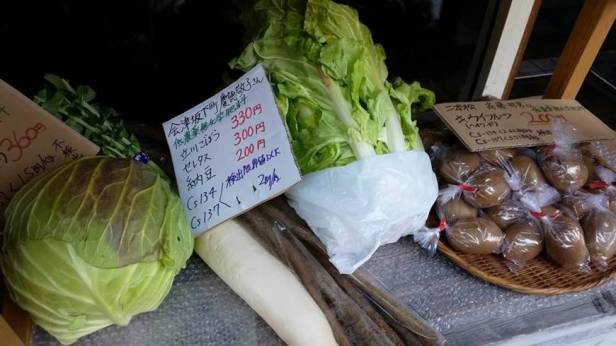
Close monitoring: At Orgando, a restaurant and mini-market in Tokyo, organic produce grown by Fukushima farmers is labeled with the amount of radioactive isotopes it contains to ease consumers fears. | © ORGANDO
Fukushima’s organic farmers still battle stigma
“All publicity is good publicity.” Nowhere does this specious PR maxim ring more hollow than in Fukushima Prefecture. As if the horrors of the 2011 Great East Japan Earthquake and the meltdown at the Fukushima No. 1 nuclear plant weren’t traumatic enough, the region’s economic and agricultural recovery has been severely hampered by the reputational damage it has suffered since 3/11. If you think that’s difficult, try farming organically in Fukushima.
Falling prices and an aging agrarian population have made things tough for farmers all over Japan, but the presence of the word “Fukushima” on a supermarket label is often enough to discourage shoppers from buying produce, organic or not, grown in the area. Regardless of how far from contaminated areas it was grown — Fukushima is Japan’s third-largest prefecture — the region’s produce can’t easily shake the stigma of radiation.
An important hub in the network of NGOs, government bodies and corporate benefactors trying to change the prefecture’s image has been Orgando, a cafe and mini-market in Tokyo’s Shimokitazawa neighborhood, run with the backing of the Fukushima Organic Agriculture Network. For the past three years, Orgando has built a devoted following by serving Tokyo residents the best of Fukushima’s seasonal organic produce, in particular the crops that Fukushima is perhaps most known for: peaches, apples and rice. The menu changes daily, making creative use of the ingredients that come in, and the walls are proudly decorated with profiles of the 30 or so farmers who have grown the food. Sadly, as with many post-3/11 schemes, Orgando was only guaranteed official financial support until the five-year post-disaster milestone and is set to close March 20.
Orgando has played a valuable role in forging links between local producers and urban consumers, and dispelling the idea that all the region’s produce is dangerously contaminated — fruit and vegetables sold in the store are clearly labeled to show the levels of cesium isotopes they contain. Official food-safety guidelines stipulate 100 becquerels of radioactive isotopes per kilogram as the acceptable limit for adults, with 50 becquerels/kg for dairy produce and infant food, and 10 becquerels/kg for drinking water. The daikon, carrots and strawberries on offer this week contain no detectable cesium, while, according to their labels, bags of beans contained 6 becquerels/kg, a negligible dose of radiation compared to our daily exposure from soil and cosmic rays.
Allaying fears about contamination was one of the themes discussed during a February event in Tokyo focused on the role organic agriculture could play in Fukushima’s recovery, organized by Ryo Suzuki of Japan Civil Network.
“People mistakenly think that everything from Fukushima is dangerous,” Norio Honda of Genki ni Narou Fukushima — an NPO promoting local revival — said at the event.
Setsuko Maeda, of agricultural collective Tanemaki Project Network agrees.
“Fukushima isn’t only about radiation,” she says. “Our farming and fisheries are full of vitality, and it’s important not to forget that.”
The event gathered representatives from organizations such as Oxfam Japan, A Seed Japan and travel agency JTB, to speak about the challenges facing organic producers in the prefecture, along with some of the major success stories. The atmosphere was convivial, and the presentations were interspersed with opportunities to sample Fukushima produce, including octopus, meat, potatoes, peaches and apple juice, and high-grade junmai sake made from local organic rice, fittingly named Kiseki or “miracle.”
Another major theme was bioremediation, the use of crops to cleanse contaminated soil of radioactive isotopes. One plant that has previously been used to reduce levels of cesium and strontium isotopes in soils around Chernobyl is rapeseed. The Green Oil Project aims to re-create these results in the Futaba district around the Fukushima No. 1 nuclear plant. Water-soluble cesium isotopes are sequestered in the plant’s tissues, which are fermented to produce biogas methane. The canola oil extracted from the seeds has a cesium content below the detectable limit of 0.03 becquerels/kg. To promote the initiative, local high school students created Yuna-chan, a cute mascot whose name combines the kanji for oil and rapeseed to market the organic oil. U.K. cosmetics company Lush, a keen supporter of organic produce, has also agreed to take a portion of the oil for use in its beauty products.
Ultimately, though, human connections were seen as most crucial to giving Fukushima produce the audience it deserves, and to generating an interest in farming among young people.
“It’s about exchange,” says Akihiro Asami, secretary general of the Fukushima Organic Agriculture Network. “Producers can come to Tokyo, but I want consumers to visit Fukushima, and not just meet selected farmers but ordinary residents, too. If they sample rural life there, they’ll want to get more involved to support those communities.”
Event-organizer Suzuki is positive about what the future holds: “By 2020, I really think the knowledge accumulated through the activities of farmers and NPOs in Fukushima will be ready to benefit sustainability and rural development not just in Japan, but around the world.”
Incidences of Thyroid Cancer in Children Rising in Fukushima
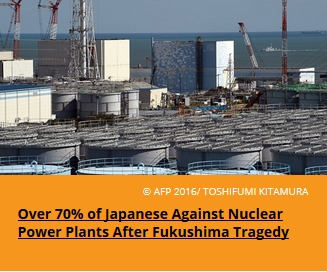
Last week marked the fifth anniversary of the disaster at the Fukushima-1 nuclear power plant which was triggered by a massive earthquake and tsunami that hit Japan five years ago.
“In Fukushima Prefecture at the time of the disaster around 360 thousand children under 18 years of age were residing in the area. Right now 166 children have been diagnosed with thyroid cancer (including cases of suspected malignancies). The percentage of thyroid cancer among residents of Fukushima is several times higher than the average percentage of incidences of thyroid cancer in the country,” Ban said.
The representative said that his organization studied the Chernobyl nuclear tragedy, and now they fear that the number of people with cancer could increase dramatically in the future.
“Parents were very concerned about the impact of radiation on children’s health, but could not talk openly about their concerns, leading to a stressful situation.”
In October 2015, Toshihide Tsuda, professor of Okayama University, speaking to foreign correspondents in Tokyo held a press conference regarding the growth of thyroid cancer in children in Fukushima Prefecture and how the disease was related to radiation as a result of the nuclear accident.
According to Ban, the government does not recognize the link between these two phenomena. After all, it is very inconvenient for Japan’s energy policy. The Japanese government, during the rule of the Democratic Party, spoke against increasing nuclear power but the situation changed with the advent of LDPJ, who took the decision to increase the nuclear power in the country.
“In April 2014, the government of Japan approved a method to increase the production of nuclear energy in total by 20-22% by 2030, indicating intention to return to the policy of conservation of nuclear energy as it was previously.”
Ban also mentioned that this is happening against the fact that 80% of the population supports the desertion of nuclear power plants altogether.
“Only the government and nuclear industrialists are promoting nuclear power development. Right now we are seeing a distorted situation where the political reality does not reflect the public opinion.”
However, implementation of the Basic Energy Development Plan is already facing certain difficulties, as was evidenced by the issuance of a temporary decision to stop the Takahama nuclear power plant on March 9. According to Hideyuki Ban, the energy development plan is likely to be revised in the next year.
Continuous Leaking Of Radioactive Strontium, Cesium From Fukushima To the Ocean

Scientists from the Universitat Autònoma de Barcelona (UAB) investigated the levels of radioactive strontium and cesium in the coast off Japan in September 2013. Radioactive levels in seawater were 10 to 100 times higher than before the nuclear accident, particularly near the facility, suggesting that water containing strontium and cesium isotopes was still leaking into the Pacific Ocean.
March 11 will be the 5th anniversary since the nuclear accident in Fukushima, Japan. The Tohoku earthquake and the series of tsunamis damaged the Fukushima Dai-ichi Nuclear Power Plant (FDNPP) causing a massive release of radioactivity into the atmosphere and the Pacific Ocean. Since then, the Tokyo Electric Power Company (TEPCO) and the Japanese authorities have focused on controlling the water flowing in and out of the FDNPP and on decontaminating the highly radioactive water used as coolant for the damaged reactors (about 300 m3 a day, cubic meter = 1000 L). This cooling water is then stored in tanks and, to some extent, being decontaminated.
A new study recently published in Environmental Science and Technology, uses data on the concentrations of 90Sr and 134,137Cs in the coast off Japan from the moment of the accident until September 2013, and puts it into a longer-time perspective including published data and TEPCO’s monitoring data available until June 2015. This study continues the work initiated after the accident in 2011 by some of the authors. These and other partners from Belgium and Japan are currently involved in the European FRAME project lead by Dr. Pere Masqué that aims at studying the impact of recent releases from the Fukushima nuclear accident on the marine environment. FRAME is encompassed within the European COMET project (https://wiki.ceh.ac.uk/display/COM/COMET-FRAME).
Seawater collected from the sea surface down to 500 m between 1 and 110 km off the FDNPP showed concentrations up to 9, 124 and 54 Bq·m−3 for 90Sr, 137Cs and 134Cs, respectively. The highest concentrations, found within 6 km off the FDNPP, were approximately 9, 100 and 50 times higher, respectively, than pre-Fukushima levels. Before the accident, the main source of these radionuclides was atmospheric deposition due to nuclear bomb testing performed in the 1950s and 1960s. The presence of 134Cs (undetectable before the accident) and the distinct relationship between 90Sr and 137Cs in the samples suggested that FDNPP was leaking 90Sr at a rate of 2,3 — 8,5 GBq d-1 (giga-Becquerel per day) into the Pacific Ocean in September 2013. Such a leak would be 100-1000 times larger than the amount of 90Sr transported by rivers from land to ocean. Additional risk is related to the large amounts of water stored in tanks that have frequently leaked in the past. These results are in agreement with TEPCO’s monitoring data which show levels of 90Sr and 137Cs up to 10 and 1000 times higher than pre-Fukushima near the discharge channels of the FDNPP until June 2015 (most recent data included in the study). The presence of 90Sr and 134,137Cs in significant amounts until 2015 suggests the need of a continuous monitoring of artificial radionuclides in the Pacific Ocean.
Continuous Leaking Of Radioactive Strontium, Cesium From Fukushima To the Ocean
Fukushima farmers grow flowers using polyester ‘soil’
I don’t think that what may be good for flowers is also good for vegetables which are to go into the stomach of people…
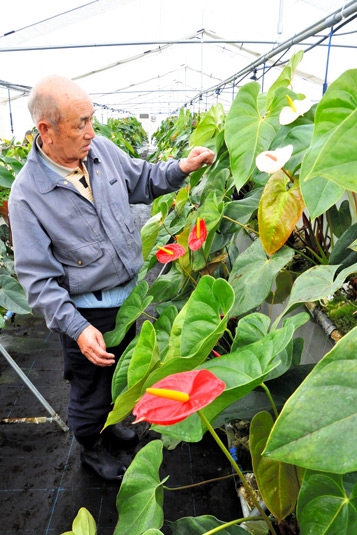
Farmer Yukichi Takahashi, 76, checks anthurium flowers grown in “soil” made up of polyester fibers in Kawamata, Fukushima Prefecture.
KAWAMATA, Fukushima Prefecture–Farmers here have started growing flowers using polyester “soil” in the hope that the cultivation method will dispel concerns among consumers about radioactive contamination from the nuclear disaster.
The farmers are being helped by a team from Kinki University’s Faculty of Agriculture in Higashi-Osaka, Osaka Prefecture, and have started cultivating anthurium ornamental plants utilizing the soil, which is made up of filamentous polyester fabrics.
“This cultivation method allows us to grow plants without concern over the negative impact of the nuclear accident,” said Yukichi Takahashi, a 76-year-old farmer who is a key member of the project. “My dream is that our flowers will be used in bouquets to be presented to athletes on the podium during the 2020 Tokyo Olympics.”
In a test run, 2,000 anthurium plants, known for their colorful, heart-shaped flowers, were grown in a 30-meter-long greenhouse in the Ojima district of Kawamata, located about 50 kilometers northwest of the crippled Fukushima No. 1 nuclear power plant.
Local farmers who participate in the project will set up an agricultural corporation later this year with the aim of eventually starting full-fledged farming and shipment.
The project began in spring 2014 after the university researchers learned about the plight of local farmers when they visited to measure radiation levels in the town, which is located on a high plateau surrounded by mountains.
“By using polyester fabrics as a cultivation medium instead of ground soil, this new method will help protect Fukushima farmers from harmful rumors that may stem from consumers’ concerns over soil contamination,” said project leader Takahiro Hayashi, a professor of horticulture at the university, which is known for its advanced aquafarming and agricultural programs.
Kawamata once prospered through livestock and tobacco farming, but the nuclear disaster, triggered by the Great East Japan Earthquake and tsunami on March 11, 2011, dealt a heavy blow to the area’s agricultural industry by spreading a large amount of radioactive fallout.
A southeastern strip of the town is still designated as a “zone being prepared for the lifting of the evacuation order,” and local residents remain evacuated from the district in temporary housing and elsewhere.
While radiation levels in the town’s agricultural produce have passed safety tests, consumers’ lingering concerns over possible contamination have undercut market competitiveness.
http://ajw.asahi.com/article/0311disaster/recovery/AJ201603200015
Honouring the Life and Work of Chiyo Nohara

Chiyo Nohara, who died aged 60, was member of the research team that published the first scientific evidence of harm to a living organism from radioactive contamination due to the accident at the Fukushima Daiichi Nuclear Power Plant.
Courage and heroism
In August 2012, the journal Nature published evidence that artificial radionuclides from the Fukushima Daiichi Nuclear Power Plant caused physiological and genetic damage to the pale grass blue butterfly Zizeeria mara [1]. Among the team at University of the Ryukyus Okinawa undertaking the research was a mature student in her first year, Chiyo Nohara. Chiyo died on 28 October 2015 at the age of 60 from a heart attack. Chiyo was a scientist who set out to protect her fellow human beings despite great pressure from the authorities and at great risk to her own life.
Chiyo once said to a friend [2] “No matter how much you researched and knew, it would be pointless if you die before letting the world know about what you learned”. Fortunately, Chiyo’s research was published, and provided the first scientific evidence of harm to a living organism from the accident at Fukushima. I will not describe the research itself, which is available in print [1]. (See also [3] Fukushima Mutant Butterflies Confirm Harm from Low-Dose Radiation, SiS 56.) Instead, I would like to concentrate on her response to the accident at Fukushima, and pay tribute to the intelligence, courage, and energy of Nohara and her team-mates in initiating the research, in undertaking the fieldwork, conducting laboratory experiments, and later defending their work against critics.
Chiyo was born 8 May 1955 in Ube city of Yamaguchi prefecture. She studied economics at Okayama University and Aichi University; taught accounting at university level, publishing numerous papers and was involved in public auditing at a local and national government level. But in 2010, at the age of 55, partly because her own daughter suffered allergies, Chiyo became interested in environmental health. She resigned from her university post and enrolled in the Biology graduate school programme of the Faculty of Science at University of the Ryukyus.
Accident at Fukushima Daiichi nuclear power plant
When the accident at Fukushima occurred in March 2011, Chiyo was only in her first year of study. Nevertheless, she persuaded her team that research in the Fukushima area was of crucial importance, and that it had to be started immediately. She had already been active in donating money and supplies to the victims of the tsunami and earthquake, but she said [4]:“I want to go to Fukushima. I want to see the stricken areas with my own eyes”. She said she “wanted to do anything” to help the people affected by the accident.
The graduate team, led by Associate Professor Joji Otaki, specialised in molecular physiology, and had been researching the mechanism of the pale grass blue butterfly’s (Zizeeria maha) peculiar colour patterns which are influenced by environmental conditions such as temperature. He saw that this species of butterfly could be used as an environmental indicator.
Conducting research in the contaminated territories
After much heart-searching three members of the graduate school decided to go to the contaminated territories of Fukushima. They all signed a written disclaimer [4]: “I am fully aware of the dangers of my activities in relatively high radiation level areas”. But several days before their scheduled trip to Fukushima, they were summoned to the Dean’s office. Chiyo and her team were subjected to some aggressive and unpleasant questioning from the Dean, the sub-Dean, and another member of staff. They were challenged with regard to their preparation and planning, and about the reaction they would elicit from people in Fukushima prefecture “when they see a team of the University of the Ryukyus pursuing butterflies with butterfly nets, while they are desperately searching for missing relatives [from the tsunami].”
Eventually, permission was given, subject to the correct radiological protection measures and strict crisis management planning in the event of another explosion at the nuclear power station. Interestingly the sub-Dean paid his respect to the team later saying that many research teams will not take risks for fear of losing funds but “this research team doesn’t care about such risks. They just want to know what is happening there. I support their work, but they make me nervous”.
The team left on 13 May 2011 for a six day field trip. They carried a Geiger counter to record radiation levels and gave themselves a strict 20 minute time limit at any one site. If no butterflies were found they moved on. They visited 15 sites in 4 prefectures (Tokyo, Ibaraki, Fukushima, Miyagi), and flew back to Okinawa on the 18 May with 144 butterflies.
Chiyo worries about her health
The work was continued over the next months in the university laboratories in Okinawa, and in September the team visited Fukushima prefecture once again and collected more specimens. Part of the laboratory research involved feeding the butterflies on oxalis corniculata contaminated by radionuclides from the Fukushima area. It was Chiyo and her husband who made the trips to the contaminated territories to collect contaminated oxalis – 15 trips in the space of 18 months. Inevitably Chiyo worried about her health. A friend said [2] “every time she went to Fukushima to collect butterflies, and every time she measured the radiation level of the contaminated oxalis, her physical condition deteriorated.But she did not want young students to do the job.”
The team collected first-voltine adults in the Fukushima area in May 2011 and some of these showed abnormalities. They reared two generations of progeny in the laboratories in Okinawa and found that although these had not been exposed to radiation, they had more severe abnormalities. They were also able to produce similar abnormalities in individuals from non-contaminated areas by external and internal low-dose exposures. Adult butterflies were collected from the Fukushima area in September 2011, and these butterflies showed more severe abnormalities than those collected in May. The team concluded that the artificial radionuclides from the Fukushima nuclear power plant had caused physiological and genetic damage to this species of butterfly.
Research “important and overwhelming in its implications”
The research was first published in August 2012 in Nature and international response was immediate[2]. The BBC detailed the research findings and included the comment that the study was “important and overwhelming in its implications for both the human and biological communities in Fukushima” [5]. Le Monde in France was more explicit, saying that although officially no-one has yet died from the effects of the radiation from Fukushima, many experts believe that people will fall ill and die in the years to come [6]. The BBC and the German TV company, ARD, came to interview Professor Otaki in Okinawa, and the American TV networks ABC, CNN and Fox also covered the story.
The research elicited a huge number of comments (276 139 in the first six months up to January 2013, according to the publisher’s website). The comments were answered by Chiyo and the team in a new paper in 2013 [7]. Eleven points were discussed in depth including the choice of this species as an environmental indictor, the possibility of latitude-dependent forewing-size reduction, the rearing conditions and the implications of the accumulation of genetic mutations. Many of the comments expressed were unscientific and politically motivated and could not be answered for that reason.
In Japan the research is not widely known
The mainstream Japanese media did not report the significance of this research, except for a few minor references. On personal blogs and Twitter accounts the research findings were widely disseminated but not always positively. The lack of press freedom in Japan since the Fukushima accident is very disquieting. In the 2010 Press Freedom Index of countries in the world, Japan ranked 11. By 2015 it had fallen to 61, and this is in large part due to secrecy about the accident at Fukushima [8]. In Europe and the United States, pictures of the pale grass blue butterfly, Z. maha and its abnormalities, post-Fukushima, can be accessed within seconds, but not so in Japan. The Japanese government’s response to the accident has been overwhelmingly to give falsely reassuring “information”. An example is Prime Minister Abe declaring to the Olympic Bid Committee in 2013 that “the Fukushima Daiichi nuclear plant is under control”, which is clearly not true [9].
It is an uphill struggle. Scientists and non-scientists in the West have a duty to help the Japanese people. Just as at Chernobyl, there is [10] “a fragile human chain made up, in the East, of activists in a country trapped in radioactive contamination and in the West, by activists who support them against scientific lies.” In 2014, Chiyo travelled to Geneva to present her research at the Forum on the Genetic Effects of Ionising Radiation, organized by the Collective IndependentWHO [11]. She was already ill. IndependentWHO have published the proceedings of this Forum and dedicated them to Chiyo Nohara, with the words “She died in the cause of scientific truth”. Within the pages of Science in Society, dedicated to scientific independence, I salute her. But we would be doing Chiyo Nohara a disservice if we did not add that the implications of her research are that no-one, and especially not children, should be living in the areas contaminated by the accident at Fukushima.
Susie Greaves
ISIS Report 07/01/16
Published first in ISIS – Institute of Science in Society
http://www.i-sis.org.uk/Honouring_the_Life_and_Work_of_Chiyo_Nohara.php
♦
References
1 – Hiyama A, Nohara C, Kinjo S, Taira W, Gima S Tanahara A and Otaki JM. The biological impacts of the Fukushima nuclear accident on the pale grass blue butterfly.Nature Scientific Reports2, 570, DOI: 10.1038/srep00570
2 – Obituary of Chiyo Nohara by Oshidori Mako in Days Japan, December issue, 2015, Vol.12, No.12, p.23.
3 – Ho M W. Fukushima mutant butterflies confirm harm from low dose radiation. Science in Society 56, 48-51, 2012.
4 – “Prometheus Traps: Pursuing Butterflies”, Nakayama Y, Asahi Shimbun, 2015 (Series no.4: 12 July 2015:, no.5: 14 July 2015, no.6: 15 July 2015, no.7: 16 July, 2015, no.8: 17 July 2015, no.10: 19 July 2015)
5 – “Severe abnormalities found in Fukushima butterflies”, Nick Crumpton, 13 August 2012, http://www.bbc.co.uk/news/science-environment-19245818
6 – “Des papillons mutants autour de Fukushima”, Philippe Pons, 15 August 2012, http://www.lemonde.fr/planete/article/2012/08/15/des-papillons-mutants-autour-de-fukushima_1746252_3244.html
7 – Hiyama A, Nohara C, Taira W, Kinjo S, Iwata M and Otaki JM, BMC Evolutionary Biology 2013, 13:168 http://www.biomedcentral.com/1471-2148/13/168 http://www.biomedcentral.com/content/pdf/1471-2148-13-168.pdf)
8 – “Japan slips in press freedom index.” Toko Sekiguchi, Wall Street Journal: Japan Real Time, 13 February 2015. http://blogs.wsj.com/japanrealtime/2015/02/13/japan-slips-in-press-freedom-rankings/
9 – “Japan Olympic win boosts Abe but Fukushima shadows linger”, Elaine Lies, Reuters, 9 September 2013, http://www.reuters.com/article/us-olympics-2020-japan-idUSBRE98806P20130909#ujqbOt12wDCbMa2v.97
10 – Tchertkoff W, Le crime de Tchernobyl: le goulag nucleaire. Actes Sud (2006)
11 – Collective IndependentWHO, Proceedings of the Scientific and Citizen Forum on the Genetic Effects of Ionising Radiation, (2015) http://independentwho.org/media/Documents_Autres/Proceedings_forum_IW_november2014_English_02.pdf
http://independentwho.org/en/2016/01/16/honouring-chiyo-nohara/
Anime portrays calamity of firefighters in rescue missions
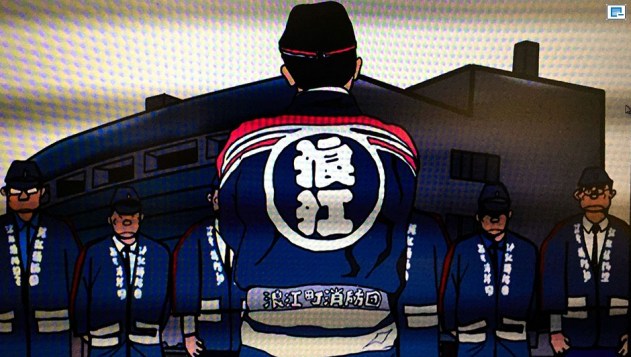
A scene from an anime featuring the struggles of volunteer firefighters in Namie, Fukushima Prefecture, after the March 2011 earthquake, tsunami and nuclear accident (Provided by Machimonogatari Seisaku Iinkai)
A citizens group in Hiroshima has produced an anime that realistically portrays the harrowing experiences of Fukushima firefighters as they attempted to rescue victims of the 2011 earthquake and tsunami.
“Munen Namie-machi Shobodan Monogatari” (The vexing tale of volunteer firefighters of Namie) shows the struggle of firefighters whose rescue efforts were impeded by the crisis that unfolded at the Fukushima No. 1 nuclear power plant after the Great East Japan Earthquake and tsunami.
Hitohisa Takano, one of the volunteer firefighters portrayed in the film, said he joined the anime project so he would not forget the mortification he felt when he could not save a tsunami survivor in the Ukedo district, one of the hardest-hit areas in the town of Namie in Fukushima Prefecture.
After the magnitude-9.0 quake and tsunami struck the coast of Tohoku on March 11, 2011, Takano headed to Ukedo to look for survivors.
Takano, now 54, said he heard a tapping sound emanating from a mountain of debris.
“I heard a groan, not words,” he said. “There was somebody there still alive.”
Takano hurried to the town hall to recruit his colleagues and secure heavy machinery to rescue the survivor.
But they could not return to the site that day because of the possibility of another tsunami striking the coast.
The rescue operation had to be put off until early the next morning.
But the next morning Takano was shocked when he was told the rescue operation had been scrapped because the entire town of Namie, with a population of 18,700, had to evacuate because of the developing crisis at the nearby plant.
“I could not save people I should have and had to flee,” Takano said. “I regret that. The culprit of all of this is the nuclear power plant.”
Five years after the onset of the nuclear disaster, Namie remains evacuated and resembles a ghost town.
“Munen Namie-machi Shobodan Monogatari” was organized and produced by Hiroshima’s Machimonogatri Seisaku Iinkai (The committee of producing a tale of a town).
Led by Hidenobu Fukumoto, the committee made the anime so that people throughout Japan could gain a better understanding about how people coped with the quake, tsunami and nuclear disaster in the immediate aftermath.
A preview of the nearly completed anime was shown in the prefectural capital of Fukushima in January to seek feedback from Namie evacuees before the completed version was cut.
Takano said he was baffled by several sequences toward the end.
They portrayed a series of events that took place after the nuclear crisis, which included the disposal of vegetables from the prefecture and the removal of a large sign touting nuclear energy as the engine for the future in Futaba, a town that co-hosts the crippled nuclear power plant with Okuma.
The clip that bothered Takano was that of a nuclear engineer in Tokyo on business who returned to Fukushima Prefecture soon after the accident occurred.
“I, and others, are responsible for this,” the engineer said in the film.
The scene was created based on an account of a resident of Okuma.
Takano said the scene goes too easy on Tokyo Electric Power Co., the plant operator.
“Frankly speaking, they are our enemies,” he said at the preview event. “Such scenes are in conflict with the anime’s title.”
Fukumoto, however, said the anime should cover the circumstances of as many individuals as possible, including those who worked for TEPCO, as well as those who received compensation for the accident.
“It is meaningful for us to portray a realistic picture of the stricken people for a national audience now that people in Fukushima Prefecture have become estranged from one another,” Fukumoto said.
A man from Namie reminded those at the preview that his town is not simply a victim of the disaster.
“There are many families in Namie who worked in the nuclear industry,” he said.
In February, about 15 people, including Takano, gathered at a studio in Fukushima for dubbing the final version of the film.
After holding a moment of silence for the victims of the disaster, the recording started.
“In this scene, we called out, knowing that there were actually people out there,” Takano said, giving instructions to others to make the scene sound as realistic as possible. “So we should sound tense.”
Despite disagreements over some scenes, they all related to the lines: “We lost our hometown. We are suffering and perplexed at what happened to us in the disaster.”
The 54-minute film will be available on DVD to be loaned for viewing events nationwide.
http://ajw.asahi.com/article/0311disaster/life_and_death/AJ201603190011
Nuclear accidents make mutant bugs and birds
Biologist Timothy Mousseau has spent years collecting mutant bugs, birds and mice around Chernobyl and Fukushima. In a DW interview, he shares some surprising insights into the effects of nuclear accidents on wildlife.

DW: Professor Timothy Mousseau, did you collect these mutant firebugs [pictured at the top of the page]?
Timothy Mousseau: Yes, the firebugs are really an eye-opener. My research partner Anders Moller and I were visiting Chernobyl on April 26, 2011. We were wandering around Pripyat collecting flowers, to study their pollen, when Anders reached down to the ground and pulled up this little bug with red and black markings. He said: “Tim, look, it’s a mutant – it’s missing an eye spot!”
From then on we started collecting these little bugs in each place we visited, from the most contaminated parts of the Red Forest to relatively clean areas in abandoned villages. Eventually we had several hundred of these little critters. It was very obvious that deformed patterns were much more prevalent in areas of high contamination.
This is just one of many similar anecdotes about the deformed critters of Chernobyl. Literally every rock we turn over, we find a signal of the mutagenic properties of the radiation in the region.

A pair of great tit birds collected near Chernobyl – left is normal, the individual on the right has a facial tumor
Is there a threshold of radiation below which there’s no effect?
The impact of radiation on rates of mutation, cancer and mortality varies a good deal by species. But statistically, there’s a simple relationship with dose. Small dose, small effect; big dose, big effect. There doesn’t appear to be a threshold below which there’s no effect.
Interestingly, organisms living in nature are much more sensitive to radiation than lab animals – comparing mice raised in labs and mice in the wild, exposed to identical levels of ionizing radiation, the mortality rate among wild mice is eight or 10 times that of lab mice. It’s because lab animals are protected from most stressors – like cold or hunger.
Are plants and trees affected too?
Yes, we’ve collected a lot of deformed pollen. Seen a lot of deformed trees, too. Pines often show growth-form abnormalities, even in normal areas with no radionucleotide contamination. Sometimes it’s an insect infestation, sometimes a hard freeze at the wrong time – you can find such anomalies anywhere.
But in contaminated areas of Ukraine, we have a correlation between frequency of abnormality and the Chernobyl event. It’s pretty strong evidence. There was a recent paper showing a very similar phenomenon in Fukushima. The trees there are very young, but will likely also be twisted up in knots 30 years from now!

Mousseau’s field crew collecting pollen and insect samples on the left, with the Chernobyl reactor in the distance. Right, a mutant pine tree at Chernobyl
What are the long-term effects of radiation on animal or plant species in contaminated areas? They’ve had their genomes altered. Will mutants persist?
Well, in the long run, no. The thing is, some background rate of mutations happens constantly in every species, even in uncontaminated areas – albeit at a much lower rate than in areas contaminated by nuclear accidents. So most genetic variants have been tried already. The great majority are either neutral or slightly deleterious. If a mutation had any benefit to offer, it would already be there in the population.
So the long-term effect of nuclear accidents on biodiversity is … none?
Yes, that’s right. Over evolutionary time, we expect that populations will return to normal after the mutagen disappears. Radionucleotides decay, hot sites eventually cool down, mutations become less frequent again, and healthy animal and plant populations recolonize the sites. So the genetic status quo ante returns – except if mutations have occurred that permanently enhance fitness, but that’s very rare.
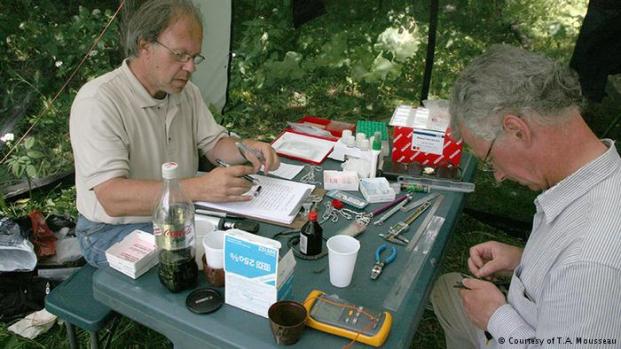
Mousseau (left) and colleague Anders Moller recording measurements in the field at Chernobyl
Some mutations might persist for a while if they’re adaptive during the hot phase. For example, there’s selection for animals whose cells produce a higher antioxidant load, which makes them more resistant to the effects of ionizing radiation. But that protection comes at a metabolic cost. After radiation levels die down, those variants will be selected back out of the population.
Where things get complicated is when the harmful mutations are recessive, that is, when it takes two copies [one for each chromosome] for the expression of the mutation. Many mutations fall into this category. They can accumulate in populations because they’re not expressed until two copies come into the same individual [one from the mother, the other from the father].
Because of this, populations can be affected by such mutations for many generations even after the mutagen is removed, and also, via dispersal, in populations that were never affected by the mutagen.
How can radioactive contamination interact with other problems that affect ecosystems, like habitat loss or climate change?
Certainly climate change is an additional stressor that is likely to interact with radiation to affect populations. We have demonstrated that while swallows in most places have moved their breeding dates forward in response to warming, in the Chernobyl area they are actually delayed. We hypothesize that this is due to the stress from the radioactive contaminants.
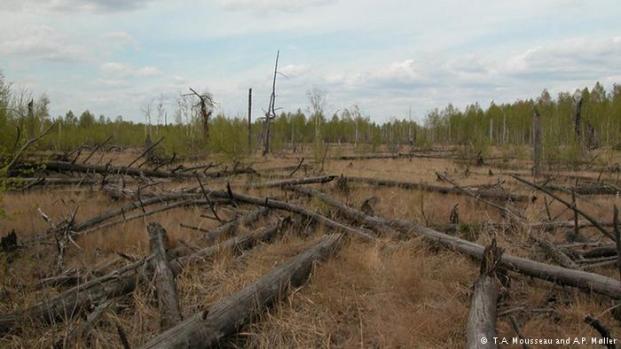
The Red Forest near Chernobyl in Ukraine presents a high risk of fire, as a lack of bacteria prevents the trees from decaying
The biggest fear at present is related to the observation of hotter and drier summers in Ukraine, and the resulting increase in number and size of forest fires. Last summer there were three large fires, and one of them burned through some very contaminated areas.
We have predicted that such events could pose a significant threat to both human populations and the environment via re-suspension and deposition of radionuclides in the leaf litter and plant biomass.
In addition to the threat of catastrophic wildfire spreading nuclear contamination, birds and mammals also move around. Do they absorb radioactive elements in their food and water in contaminated sites, carry them elsewhere, thus dispersing the contamination more widely?
Do animals move radionuclides? Yes! I did a study years ago that showed very significant amounts of radionuclides are exported every year by birds. But it seems unlikely that the amount is enough to cause measurable health effects – unless you’re eating the birds. It is known that some people living outside the Chernobyl Exclusion Zone are getting very significant doses from hunting the contaminated wild boar that leave the zone.
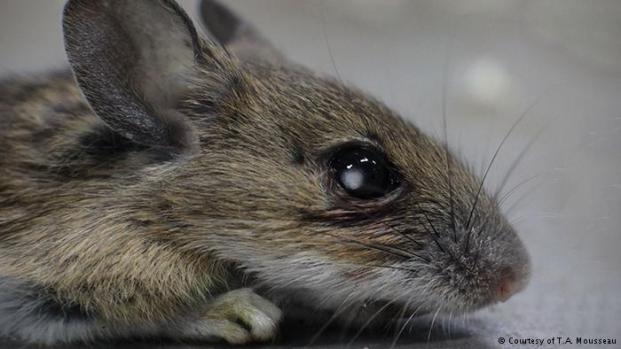
Mouse with cataract collected near Chernobyl – the more radioactive the site, the higher the frequency of defects
This year marks five years since the Fukushima accident, and 30 years since Chernobyl. How long will the contaminated zones around Chernobyl and Fukushima be mutagenic and dangerous?
Chernobyl was a nuclear fire and ongoing fission event for 10 days, with strontium, uranium and plutonium isotopes strewn into the landscape. They have long half-lives, so many areas will remain hazardous for centuries, even thousands of years.
Fukushima was largely a cesium event, and cesium radionucleotides have a relatively short half-life. The area will mostly naturally decontaminate itself within decades, at most within a couple hundred years.
Timothy Mousseau is a professor of biological sciences at the University of South Carolina in Columbia, South Carolina. He is one of the world’s leading experts on the effects of radionucleotide contamination from nuclear accidents on wild bird, insect, rodent, and plant populations.
Interview: Nils Zimmermann
Judges clad in protective gear inspect evacuated areas in Fukushima for on-site evidence in class action suit

Judge Hideki Kanazawa, third from right in the front row, walks through an area evacuated due to radiation while wearing protective clothing, near the homes of plaintiffs in a lawsuit over the nuclear disaster, in Futaba, Fukushima Prefecture, on March 17, 2016.
FUKUSHIMA–Fukushima District Court judges inspected the houses of three evacuated plaintiffs on March 17 in connection with a lawsuit filed against the government and Tokyo Electric Power Co. over the nuclear disaster.
It marked the first visit by judges to evacuation zones regarding litigation concerning the accident at the Fukushima No. 1 nuclear power plant, which was caused by the Great East Japan Earthquake and tsunami in March 2011.
Called “Nariwai Sosho” (livelihood suit), the lawsuit has about 4,000 plaintiffs seeking consolation money and the restoration of their former lives that were lost because of the nuclear accident.
What was gleaned from the on-site inspections will be used as evidence in the trial.
The plaintiffs had called for the judges to visit the affected sites and hear their explanations to assess the scope of damage of the nuclear disaster.
The inspections involving about 50 people, which were closed to the media, started at 10:45 a.m. and ended around 4:30 p.m.
Three judges, including Presiding Judge Hideki Kanazawa, first visited the home of Sadatoshi Sato, a 68-year-old who raised livestock before the disaster, in Namie.
Other plaintiffs, government officials and TEPCO representatives accompanied the judges. All participants wore white protective suits and masks.
At Sato’s home, the judges viewed empty cattle sheds. Sato had been raising about 150 cattle when the nuclear accident unfolded, but most of them starved to death while he was evacuating. Sato also took the judges to the site where the dead cattle were buried.
“I want the judges to give a thoughtful ruling so that the dead cattle would rest in peace,” Sato told reporters after the inspection.
The judges also visited the homes of 67-year-old Yuji Fukuda in Futaba and a woman in Tomioka who had been operating a piano school out of her house before the nuclear accident.
Fukuda’s house is in a difficult-to-return zone about 4 kilometers from the Fukushima No. 1 nuclear plant. He showed the judges his once-thriving garden. He also told them about a local store that is now desolate.
“I told the judges from the bottom of my heart that I am not the only one who has suffered,” Fukuda said. “I had wanted the judges to come sooner. But my hope has finally come true.”
http://ajw.asahi.com/article/0311disaster/recovery/AJ201603180055
Judges clad in protective gear visit Fukushima in class action suit
FUKUSHIMA — Judges from the Fukushima District Court donned protective gear to make an on-site visit on March 17 to towns evacuated due to high radiation levels, as they deliberate a class action lawsuit over the Fukushima nuclear disaster.
Some 3,900 people who lived in Fukushima Prefecture and adjacent prefectures at the time of the meltdowns at the Fukushima No. 1 nuclear plant have sued the government and plant operator Tokyo Electric Power Co. for compensation and a restoration of their hometowns to their pre-disaster state. According to lawyers for the plaintiffs, the March 17 visit is the first time that a court handling a lawsuit over the Fukushima disaster has made an on-site visit.
The visit consisted of around 50 people, including three judges and lawyers for both the plaintiffs and the defendants. They went to three evacuated towns, Futaba, Namie and Tomioka, where they looked inside the homes of plaintiffs, thrown into disorder by scavenging animals and full of strewn furniture and bad odors. They also walked by JR Futaba Station, now unmanned and silent.
Plaintiff Yuji Fukuda, 67, who evacuated from Futaba and is now living in the city of Iwaki, said after the visit, “The judges understood that we are continuing to suffer from being driven from our towns and having to leave our homes and properties unattended.”
At his cow barn, Sadatoshi Sato, 68, livestock farmer and plaintiff from Namie, explained to the judges how most of the around 150 cattle he kept had died from starvation after the town was evacuated.
The plaintiffs in the case are seeking 20 million yen in compensation each for 40 people who lived in areas that are under evacuation order. They are also seeking a reduction in radiation doses to pre-disaster levels, and payment of 50,000 yen per month to each plaintiff for the duration until this happens.
http://mainichi.jp/english/articles/20160318/p2a/00m/0na/003000c
Fukushima fuel melted through containment vessels and is “spewing radiation”
Reuters: Fukushima fuel melted through containment vessels and is “spewing radiation” — Nuke Expert: Fuel has “scattered all over the place” — Gov’t: Fuel may have burned out into environment — Tepco Official: Fuel could have flowed out “like lava in a volcano” (VIDEOS) http://enenews.com/tepco-official-admits-melted-fuel-flowed-like-volcanic-lava-nuclear-expert-melt-containment-vessel-fuel-scattered-all-place-reuters-fuel-melted-containment-spewing-radiation-guardian-fuel-be?utm_source=feedburner&utm_medium=email&utm_campaign=Feed%3A+ENENews+%28Energy+News%29
Reuters, Mar 11, 2016 (emphasis added): Today, the radiation at the Fukushima plant is still so powerful it has proven impossible to get into its bowels to find and remove the extremely dangerous blobs of melted fuel rods, weighing hundreds of tonnes… The fuel rods melted through their containment vessels in the reactors, and no one knows exactly where they are now… Tepco has been developing robots [to] negotiate obstacles in damaged tunnels and piping to search for the melted fuel rods.
Reuters, Mar 9, 2016: Five years on, melted fuel rods still spew radiation…
DW, Mar 11, 2016: The melted nuclear fuel and the destroyed pressure vessel in the nuclear reactors 1 to 3 continue to be major problems… “So far, nobody knows what exactly happened in there and how to solve it,” [Heinz Smital, a nuclear physicist] told DW. “Until now, there is no solution to recover the melted fuel rods from the reactors.”
News Corp Australia, Mar 11, 2016: Today, the radiation at the Fukushima plant is still so powerful it is impossible to extract and remove deadly melted fuel rods… [Tepco is] grappling with the fact that they don’t have the technology to find missing melted fuel rodsin three reactors at the plant. The rods melted through containment vessels in the reactors.
Guardian, Mar 11, 2016: [It’s] the most daunting task the nuclear industry has ever faced: removing hundreds of tons of melted fuel from the plant’s stricken reactors… something no nuclear operator has ever attempted… Of greatest concern, though, is reactor 1, where the fuel may have burned through the pressure vessel, fallen to the bottom of the containment vessel and into the concrete pedestal below – perhaps even outside it – according to a report by the International Research Institute for Nuclear Decommissioning… Masuda and Tepco engineers who spoke to the Guardian conceded that they still didn’t know where the fuel is located. “To be honest, we don’t know exactly where the fuel is”… Masuda said… “No one has ever done what we’re doing”…
PBS Newshour, Mar 11, 2016 (at 35:15 in):
- Miles O’Brien, PBS correspondent: What about the melted fuel in the reactor cores? They aren’t even sure where it all is.
- Lake Barrett, Tepco advisor: Is it in one big vertical lump on the floor underneath it? Or did it come down and flow like lava in a volcano and move out to the sides? We don’t know yet… Nothing of this magnitude [i.e. the attempt to remove Fukushima’s melted fuel] has ever been done by mankind…
Interview with nuclear engineer Hiroaki Koide (translation by Prof. Robert Stolz, transcription by Akiko Anson), published Mar 8, 2016: We simply do not know where the core is or in what state it is… [The government and TEPCO] are convinced that the melted core fell through the bottom of the pressure vessel and now lie at the bottom of the containment vessel―basically piling up like nuggets of the melted core [See Lake Barrett’s statement above]. There’s no way this would be the case. (Laughs)… It should have been scattered all over the place… Though the containment vessel is made of steel, if the melted core has come in contact with that steel, just as it ate through the floor of the pressure vessel, it could possibly have melted through the containment vessel… There are situations in which the containment vessel can suffer a melt-through. I think this likely has already happened.
Watch: PBS Newshour | Reuters
Panel holds 1st meeting to examine TEPCO’s meltdown judgment process
The outcome of this Tepco’s investigating Tepco will be for sure just another “We are very sorry” accompanied by three deep bows down the road…

A third party investigative panel set up by Tokyo Electric Power Co. held its first meeting Thursday to examine how the utility reached its conclusion on meltdowns at its Fukushima plant in the 2011 nuclear crisis after the company admitted recently it could have made an judgment sooner than it did.

“Local people in Fukushima are still having a difficult time even five years after the accident,” Yasuhisa Tanaka, a lawyer and chairman of the panel, said ahead of the meeting. He is also former chief justice of the Sendai High Court.
“As it has been pointed out that Tokyo Electric didn’t provide enough information, we have to address various issues including how information should be provided.”
The three-member panel, including two other lawyers, was established after TEPCO said last month it failed to use its internal operation manual that contains criteria for judging core meltdowns after a massive earthquake and tsunami struck its Fukushima Daiichi nuclear plant on March 11, 2011.
TEPCO could have determined that nuclear core meltdowns occurred at the plant three days after the complex was crippled, based on the manual that defines meltdowns as damage to more than 5 percent of a reactor core.
But the utility initially just said reactors cores had been damaged and did not acknowledge the meltdowns until May 2011, even as analysis of the plant’s situation showed some reactors had damage to more than 5 percent of their reactor cores as of March 14 that year.
Early in the crisis, the company said there was no basis to determine reactor core meltdowns.
Later analysis found that the No. 3 unit had damage to 30 percent of its reactor core and that 55 percent of the No. 1 reactor’s core was damaged, both as of March 14, 2011.
TEPCO said in late February this year that it discovered the manual while investigating how it responded to the Fukushima disaster at the request of Niigata Prefecture. The power company aims to restart a nuclear power plant in the prefecture.
Earlier this month, TEPCO President Naomi Hirose offered an apology over the revelation that the company underestimated the severity of the accident at a meeting of the House of Councillors Budget Committee.
“There are various questions such as why (the company) wasn’t able to use the manual and why it took so long to discover it. We hope (the panel) will conduct strict investigations and we will take measures” based on the outcome, Hirose said Thursday prior to the meeting.
TEPCO will disclose the outcome of discussions at the panel as soon as they are concluded.
http://kyodonews.net/news/2016/03/17/53605
1 This Month



26 September – International Day for the Total Elimination of Nuclear Weapons


PLEASE OPPOSE HR 8255 AND S.3639 – bills would accelerate satellite deployment, with no environmental review or safeguards – https://ncstd5li.quorum.us/campaign/169331/
To see nuclear-related stories in greater depth and intensity – go to https://nuclearinformation.wordpress.com
-
Archives
- September 2026 (219)
- August 2026 (330)
- July 2026 (355)
- June 2026 (287)
- May 2026 (306)
- April 2026 (356)
- March 2026 (251)
- February 2026 (267)
- January 2026 (308)
- December 2025 (358)
- November 2025 (359)
- October 2025 (375)
-
Categories
- 1
- 1 NUCLEAR ISSUES
- business and costs
- climate change
- culture and arts
- ENERGY
- environment
- health
- history
- indigenous issues
- Legal
- marketing of nuclear
- media
- opposition to nuclear
- PERSONAL STORIES
- politics
- politics international
- Religion and ethics
- safety
- secrets,lies and civil liberties
- spinbuster
- technology
- Uranium
- wastes
- weapons and war
- Women
- 2 WORLD
- ACTION
- AFRICA
- Atrocities
- AUSTRALIA
- Christina's notes
- Christina's themes
- culture and arts
- Events
- Fuk 2022
- Fuk 2023
- Fukushima 2017
- Fukushima 2018
- fukushima 2019
- Fukushima 2020
- Fukushima 2021
- general
- global warming
- Humour (God we need it)
- Nuclear
- RARE EARTHS
- Reference
- resources – print
- Resources -audiovicual
- Weekly Newsletter
- World
- World Nuclear
- YouTube
-
RSS
Entries RSS
Comments RSS
 nuclear-news