Big business creeps into agriculture as farmers dwindle
“Fukushima is known for perilla production, and Yajima began cultivating the plant in there in 1999 after learning skills from local farmers. But he pulled the plug on the operation following the triple core meltdown at the Fukushima No. 1 nuclear plant in 2011 during the quake and tsunami disasters in March that year.”
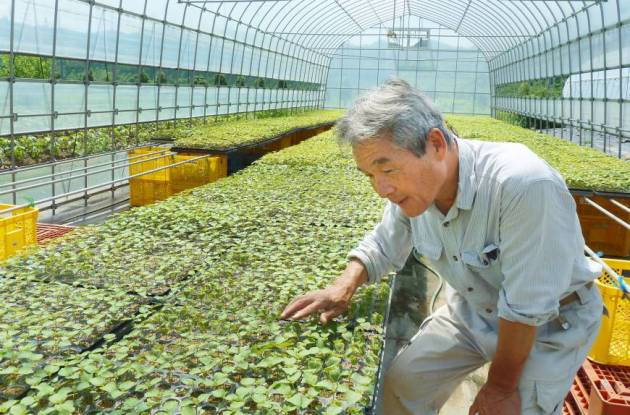
Shigeru Yajima, president of Morishige Bussan Co., takes a close look at perilla his firm is growing in Chichibu, Saitama Prefecture, in July.
With traditional family farms on the wane, corporations are increasingly entering the agriculture sector, taking advantage of an updated law allowing them to lease farmland across the country.
At the end of 2015, more than 2,000 companies were operating in the farm sector, a roughly five-fold increase from before the farmland law was revised in 2009, according to the Agriculture, Forestry and Fisheries Ministry.
Among them is Morishige Bussan Co., a food wholesaler in the city of Saitama that’s growing perilla on a 6-hectare patch of hilly land in Chichibu, Saitama Prefecture.
“We have doubled the patch since last year and are growing perilla all over the field,” Bussan President Shigeru Yajima said in early July.
Perilla plants are grown from seeds raised in vinyl greenhouses; those planted outside two weeks earlier were already 10 cm high.
“We have leased deserted arable land introduced by the Saitama prefectural and Chichibu municipal governments,” Yajima said. “Local people helped us improve the land.”
Oil obtained from perilla seeds is in booming demand as it is considered good for health and beauty, Yajima said.
“Though perilla seeds produced in China and South Korea are available, we stick to homegrown seeds,” he said.
Fukushima is known for perilla production, and Yajima began cultivating the plant in there in 1999 after learning skills from local farmers. But he pulled the plug on the operation following the triple core meltdown at the Fukushima No. 1 nuclear plant in 2011 during the quake and tsunami disasters in March that year.
Chichibu is suited to perilla cultivation because of its wide temperature variations, like Fukushima, said Yajima, who works the fields and processes the crops with five employees. Production of perilla and related business contribute to some 40 percent of Morishige’s annual sales of around ¥100 million.
To meet growing demand for perilla oil, Morishige farms out production of the plant to farmers in Gunma, Nagano and Miyagi prefectures.
Among other firms that have entered the farm sector, Kawaguchi Construction Co., a water supply and road construction company in the town of Minobu, Yamanashi Prefecture, grows Akebono Daizu (Akebono soybeans), a local specialty produced in a cool climate along the Fuji River in the southern part of the prefecture.
“We become busy with public works at the end of each fiscal year,” said Osamu Mochizuki, president of the company. “But as we have lots of time to spare early in each year, I decided (to farm soybeans) to protect jobs for employees.”
The amount of deserted arable land has been growing in Minobu, like other places, in line with the dwindling ranks of Japan’s aged farmers and the lack of successors. The prefectural government offered some 3 hectares of such land to Kawaguchi Construction.
“I decided to grow Akebono Daizu soybeans to help revitalize the local economy, hoping to develop them into a popular brand,” Mochizuki said.
Paste, curd and toasted flour made from dried soybeans are becoming popular. During an annual autumn fair to promote Akebono Daizu, many people visited the town to experience harvesting soybeans.
Of the roughly 2,000 corporations that have entered the agriculture sector, food companies accounted for 23 percent, agricultur and stock-breeding companies 22 percent and construction firms 10 percent.
Meanwhile, schools, medical institutions, social welfare corporations and nonprofit organizations represent a quarter of new institutional entrants into agriculture, according to Shinichi Shogenji, professor at the Graduate School of Bioagricultural Sciences at Nagoya University.
“It is a welcome development for them to use agriculture to support the independence of people with physical or mental disabilities, such as creating job opportunities,” Shogenji said.
Reuse of radioactive soil could cut costs by 1.5 trillion yen: ministry estimate
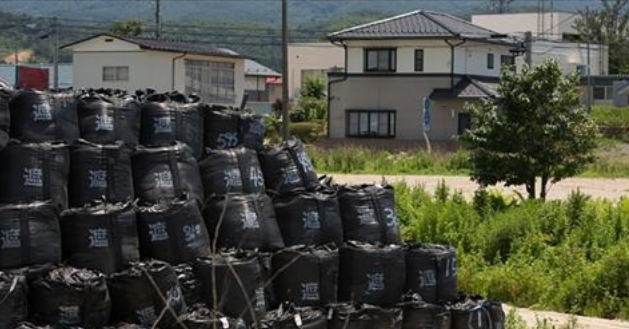
Behind the Environment Ministry’s controversial decision to allow reuse of highly radioactive soil emanating from the Fukushima nuclear disaster in public works projects was an estimate that the reuse could cut the costs of reducing radiation levels of such soil by over 1.5 trillion yen, it has been learned.
The estimate in question was presented during a closed-door meeting of the ministry in January and stated that reuse of radioactive soil generated from Fukushima decontamination work could cut the cost for purifying such soil from 2.9127 trillion yen in case the levels of radioactive cesium are reduced to 100 becquerels per kilogram to 1.345 trillion yen in case the cesium levels are cut down to 8,000 becquerels per kilogram. The estimate calls the latter option “reasonable from economic and social points of view.”
The Environment Ministry decided in June to allow reuse of soil with radioactive cesium of no more than 8,000 becquerels per kilogram in mounds under road pavements and other public works projects. The decision sparked criticism that it runs counter to the safety standards of 100 becquerels or less for recycling metals generated from the decommissioning of nuclear reactors under the Act on the Regulation of Nuclear Source Material, Nuclear Fuel Material and Reactors. The ministry has insisted that the radiation levels of tainted soil used in road mounds can be held down from 8,000 becquerels to around 100 becquerels by covering those mounds with concrete among other measures.
A ministry working group on safety evaluation of radiation effects held closed-door meetings over the issue on six occasions between January and May this year. In June, the Mainichi Shimbun reported that an estimate presented to one of those meetings stated, “For example, it will take 170 years for radiation levels to reduce to 100 becquerels if tainted soil of 5,000 becquerels is put to reuse,” sparking controversy. In response, the ministry on Aug. 1 released the minutes of the closed-door meetings and other documents on its website.
At the second meeting of the working group on Jan. 27, the copies of a document titled “About reasonable radioactivity concentrations of recycled materials” were handed out to attendants. The document, which was drawn up by the Japan Atomic Energy Agency, includes an estimate that the cost for reducing the radiation levels of tainted soil to 100 becquerels for recycling would reach 2.9127 trillion yen, with a volume reduction rate of 40 percent, adding that 40 percent of contaminated soil could not be put to reuse. Meanwhile, the estimate says it would cost 2.1185 trillion yen to drop the radiation levels of tainted soil to 3,000 becquerels, with a volume reduction rate of 0.5 percent, while it would cost 1.345 trillion yen to decrease the radiation levels of soil to 8,000 becquerels, with a volume reduction rate of 0.2 percent. The latter option could make 99.8 percent of tainted soil available for reuse, the estimate says.
“Considering economic and social factors, it is appropriate to set the radioactivity concentration of recycled materials at several thousand becquerels,” the document stated. A note of caution in the document states, “Apart from this, it is necessary to project the cost for final disposal (of tainted soil).”
A ministry official in charge of the issue told the Mainichi Shimbun, “The document was produced in response to a request by a member of the working group. As the document states, it is difficult to (set the standards for reusing tainted soil) at 100 becquerels from a realistic point of view.”
http://mainichi.jp/english/articles/20160803/p2a/00m/0na/014000c
Tepco’s hazmat suit guideline decreases burden on workers during summer heat
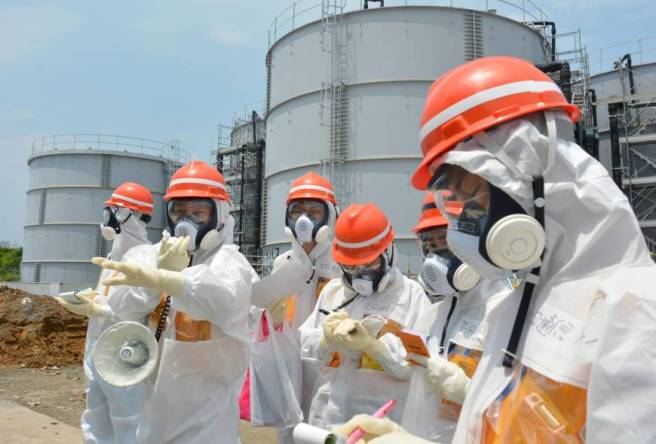
Tokyo Electric Power Company Holdings Inc., operator of the crippled Fukushima No. 1 power plant, has been revising guidelines for when workers need to wear full masks with hazmat suits or less-bulky outfits to improve their working conditions during the scorching summer.
While a full-body outfit limits radiation exposure, hazmat suits and full masks have been a heavy burden for workers because they restrict movement and make it difficult to breathe, prompting Tepco to revise the guidelines on their usage.
In March, Tepco changed the guidelines, dividing the premises into three areas.
In the area where radiation levels remain high, including inside reactor buildings 1, 2 and 3, workers will need to wear a full mask and disposable hazmat suit with a raincoat-like outer layer.
Workers meanwhile will need to wear full or half masks with hazmat suits in areas where radiation levels are lower, such as near tanks filled with radiation-tainted water. In the remaining area, the majority of which has low levels of radiation, workers only need to use disposable masks and their usual work outfits, Tepco said.
According to the utility, out of about 5,000 to 6,000 workers on the premises, about 47 percent were required to wear a full mask in June, down from about 66 percent in January, before the guidelines were changed.
Those who are required to wear a half mask increased to 48 percent from 28 percent in the same period, it said.
Before the guidelines were revised, about 8,000 disposable hazmat suits were used per day, but the number declined to about 4,000.
Even as hazmat suit requirements have halved, radiation exposure cases have remained unchanged at an average of two a day, Tepco said, adding that the risk of radiation exposure has not increased.
Tepco said it will offer summer outfits at the beginning of this month to lessen the chance of workers succumbing to heatstroke.
In July, the health ministry opened a health care office at J-Village near the Fukushima No. 1 power plant so that its workers can seek free health consultations from doctors who are versed in radiation exposure.
“During the summer period, the health of workers tends to worsen due to heatstrokes as well as other illnesses, so we need to step up measures to resolve the situation,” said a heath ministry official.
Small Progress of Landside Impermeable Wall freezing
The purpose of the Landside Impermeable Wall construction lies not in freezing soil to form an underground wall but in keeping groundwater from flowing into the reactor/turbine buildings and preventing new contaminated water being generated.
By closing less than 95 percent of the mountain side of the Landside Impermeable Wall in Phase 2 of the first stage, it is expected that the amount of groundwater flowing into the areas around the reactor/turbine buildings will be reduced. This will help keep groundwater from being contaminated during the first stage.
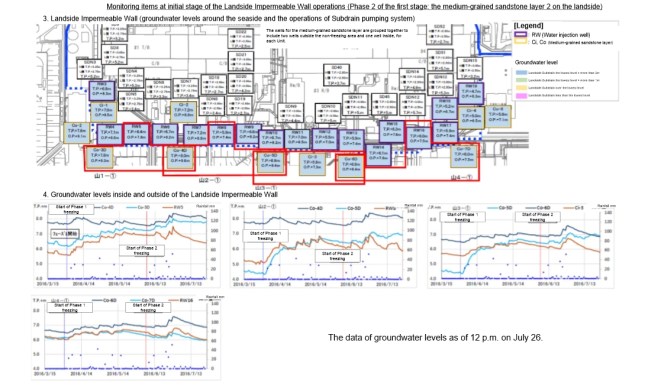
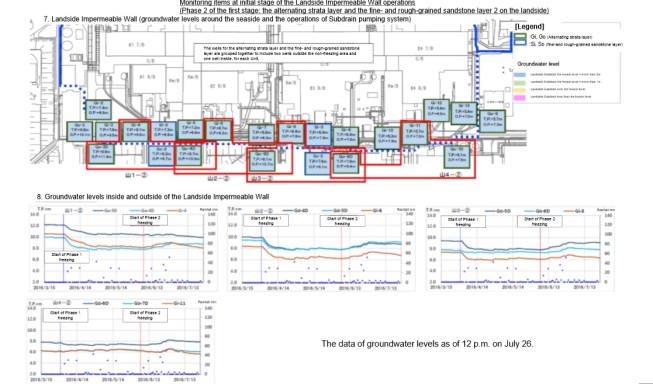
Throughout the first stage, how freezing of the Landside Impermeable Wall has progressed will be checked by monitoring the difference in groundwater levels inside and outside of the wall and the amount of groundwater pumped up by the subdrain and groundwater drain systems and the wellpoint system.
Groundwater levels and hydraulic heads (in the medium-grained sandstone layer 1 on the seaside)
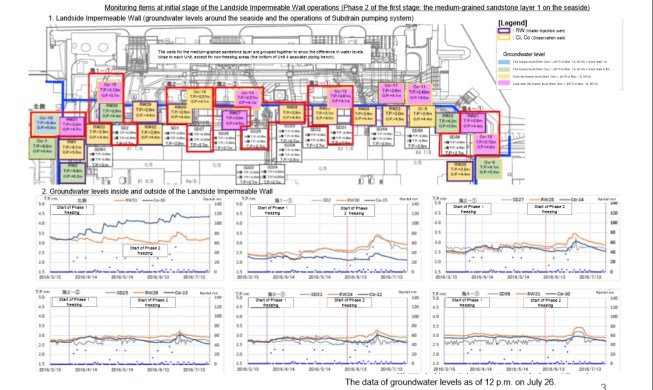
Groundwater levels and hydraulic heads (in the medium-grained sandstone layer 2 on the landside)
Groundwater levels and hydraulic heads (in the alternating strata layer and the fine-and rough-grained sandstone layer 1 on the seaside

Groundwater levels and hydraulic heads (in the alternating strata layer and the fine-and rough-grained sandstone layer 2 on the landside)
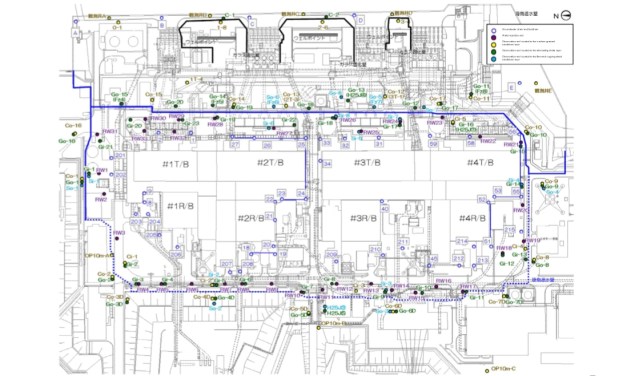
Location map of groundwater level observation wells (as of June 2016)
Progress of supplementary work

Progress of supplementary work (1BLK)
Over-time changes of the soil temperatures in the north side area of Unit 1 where the supplementary work is in progress The soil temperatures temporarily increased because of water which was used to bore through the ground during the supplementary work, but it has gradually decreased. Since the soil temperature around the thermometer pipe of 120-1S has not dropped sufficiently, however, the second round of injection is currently under way. TEPCO Holdings will continue to monitor the temperature changes.
Progress of supplementary work (9BLK)
As seen in the soil temperatures in the 1BLK area, that in the 9BLK area temporarily increased because of water which was used to bore through the ground during the supplementary work. The soil temperature around the thermometerpipe of 30-9S0 has dropped to around 0 degrees Celsius, and TEPCO Holdings will continuously monitor it. In the area around the thermometer pipe of 70-9S, the second round of injection is progressing.
Progress of supplementary work (12BLK)
Over-time changes of the soil temperatures in the east side area of Unit 2 (12BLK) where the supplementary work is in progress The soil temperatures have gradually decreased. Monitoring of the temperatures will continue.
Progress of supplementary work (13BLK)
Over-time changes of the soil temperatures in the east side area of Unit 2 (13BLK) where the supplementary work is in progress Since the soil temperature around the thermometer pipe of 30-13S has slowly decreased, the second round of injection is planned. Although the decrease of the soil temperatures around the thermometer pipes of 50-13S and 90-13S have been gradual but steady, monitoring of the temperatures is still under way.
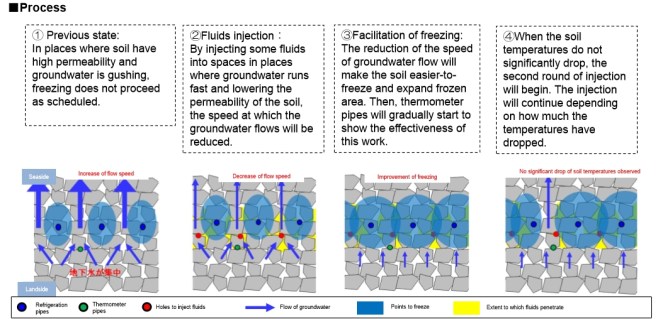
Purpose of supplementary work
To help further freeze soil in places where the soil temperatures have slowly dropped due to fast flowing groundwater, the speed at which the groundwater runs has to be reduced by making the permeability of the soil as low as that of soil in the vicinity of the places.
The purpose of the supplementary work lines not in constructing different walls from the landside impermeable wall but in changing locally highly permeable soil areas into areas with low permeabilities observed in the soil of the surrounding area.
Source: Tepco
Click to access handouts_160728_02-e.pdf
One More Worker Drops Dead At Fukushima Daiichi
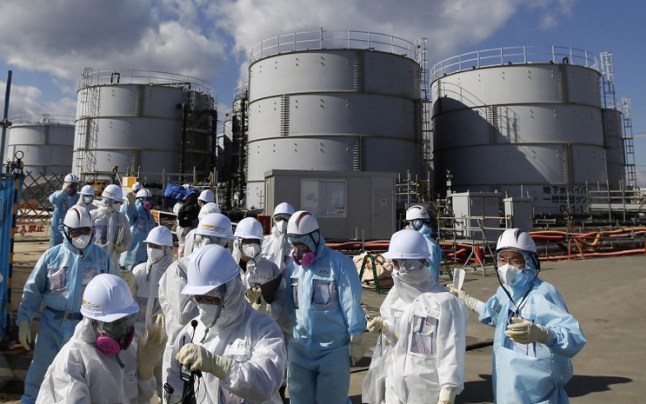
Another worker died on July 30, 2016 at Fukushima Daiichi. Tepco’s report indicates that he was found dead around 10:39am.
The weather recently has been warm but not extremely hot. Some of the early cases of workers dropping dead or falling ill at the plant were considered heat related. After this some heat related counter measures were put in place. Other cases were either never explained or vaguely claimed to be due to health problems.
http://www.tepco.co.jp/press/report/2016/1314410_8693.html
http://www.fukuleaks.org/web/?p=15653
Public fund may help decommission Fukushima

TOKYO — Japan’s Ministry of Economy, Trade and Industry is considering a public fund to ensure progress in the decommissioning of the Fukushima Daiichi nuclear power plant, ministry sources said on Saturday.

METI is specifically considering a new fund at the government-backed Nuclear Damage Compensation and Decommissioning Facilitation Corporation, the sources said.
A massive earthquake and tsunami hit the northeastern part of Japan on March 11, 2011. The twin natural disasters also triggered the meltdowns at the Nos. 1, 2 and 3 units of the nuclear plant.
According to the sources, the new fund would provide necessary financial support to Tokyo Electric Power Co. Holdings, or Tepco, the operator of the crippled nuclear plant, to help it carry out the decommissioning work.
Tepco would have to eventually repay any money to the national government, but over a long period, the sources said. The sources also said that the scheme under consideration would minimize the public burden while ensuring steady progress in the decommissioning work.
The Nuclear Damage Compensation and Decommissioning Facilitation Corporation currently has a majority stake in Japan’s largest utility.
It is said that removing melted nuclear fuel and other decommissioning work will take several decades to complete. The work is estimated to cost a few trillion yen (tens of billions of dollars).
As things stand now, Tepco will be able to secure around 2 trillion yen ($19.6 billion) to implement the decommissioning work.
If the exact cost of the decommissioning work is determined and if Tepco takes the accounting step of booking reserves in a lump sum to cover the cost, the utility’s liabilities could exceed its assets.
If Tepco were to fall into such a financial crisis, the decommissioning work as well as compensation payments to victims could be stalled. This would delay the reconstruction of Fukushima Prefecture.
http://asia.nikkei.com/Politics-Economy/Economy/Public-fund-may-help-decomission-Fukushima
World in Danger
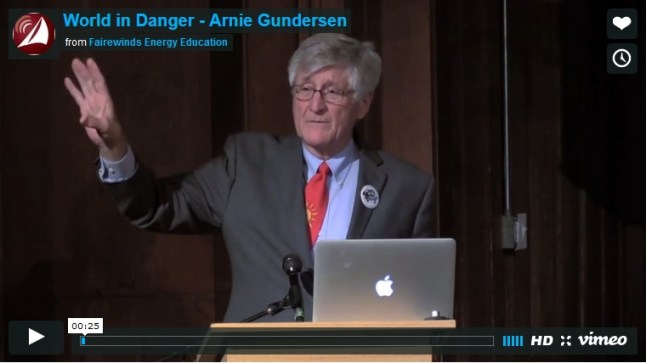
How does the Fukushima Daiichi meltdown disaster show the enormous risk potential for the continued operation of the Diablo Canyon atomic reactor?
Filmed by Ecological Options Network (EON) at Point Reyes Station in California, Fairewinds Chief Engineer Arnie Gundersen presents A World in Danger.
This presentation from the 2015 California speaking tour precedes a panel discussion “Tell All” between chief engineer Arnie Gundersen, Fairewinds founder and president Maggie Gundersen, and EON co-directors Jim Heddle and Mary Beth Brangan. The follow-up conversation can be found here.
EMCEE: (:47) I want to begin with a quote by that celebrated and famous American philosopher, W. C. Fields, who once said, “There comes a time in human events when we must seize the bull by the tail and stare the situation squarely in the face.” And that’s what we’re going to do tonight. So Arnie Gundersen, please take it away. (applause)
AG: The thing I’d like to talk about, and Tim alluded to it, is how the nuclear industry has so successfully framed this argument on nuclear. There’s a book Don’t Think of an Elephant. What’s the first thing you think of – it’s an elephant. And the person who frames the argument usually wins the argument. We wind up being labeled as anti-nuclear this’s or that’s. We never call them pro-nuclear zealots. They’ve been able to frame the argument.
Here’s an example. What’s wrong with this sentence – The Fukushima accident happened on March 11, 2011. (F: Accident) Accident. That’s one – there’s actually three, but the first – (F: It’s still happening) Yes. It’s still happening.
When the nuclear industry talks about Fukushima in the past tense, the fact of the matter is that it’s still bleeding into the Pacific and it will take 100 years and a half a trillion dollars to clean up but they want you to think it’s over. So (1) is it’s still happening; (2) is the world accident.
An accident is when you’re driving down the road and an owl flies in front of you and hits your window and takes you out. That’s an accident. You couldn’t foresee it. But the DIET commission – DIET is their parliament – has said this is not an accident. This was man-made. This was profoundly man-made. Engineers knew it for 40 years. So the wick on this time bomb was lit in 1967 when they started building it. And it happened to have exploded in 2011, but the accident was not an accident. It was a man-made disaster.
So I try to remove that from my vocabulary but it’s so ingrained because I was an engineer and I would bet everybody would call it an accident. It’s ingrained. It’s not an accident; it’s a disaster. And the last one is – I said the Fukushima accident.
Fukushima is a wonderful prefecture and they would much rather we call it Fukushima Daiichi, which stands for the first nuclear site at Fukushima, and then down the road about 6 miles is Fukushima Daini. It’s sort of like having the California accident. It means something to the people in Fukushima Prefecture that the disaster be properly phrased as the Daiichi accident.
Anyway, let’s get on with the show here. There’s four points I’d like to talk about.
The first is that nuclear accidents happen a lot more frequently than our regulators – (F: Nuclear events) – nuclear disasters – okay, there we go. Nuclear events happen a lot more frequently than our regulators would like you to know and that our politicians would like you to know and the nuclear industry would like you to know.
The second is that as time goes by, these disasters have been getting worse, not less worse.
The third one is, as bad as Fukushima Daiichi was, we’re lucky because it could have been much, much worse.
And the fourth, and it really hits here in California and the West Coast, is that radiation knows no borders.
So in my lifetime – here’s what I looked like right out of college – look at that tie, looks like I had a rug on or something – so that guy was brighter than the one who’s standing here, but probably was a little less wise. So I’d like to say that my wisdom might have increased but perhaps my intellect decayed a little bit. But over our joint career of 40-some-odd years, here’s what’s happened.
We’ve had a partial meltdown at Three Mile Island. We’ve had a complete meltdown at Chernobyl. We’ve had a complete meltdown at Fukushima Daiichi unit 1, a complete meltdown at Fukushima Daiichi unit 2, and a complete meltdown at Fukushima Daiichi unit 3.
So in those 35 years from TMI to today, we’ve had 5 meltdowns. So if you take 35 and divide by 5, this is not rocket science – you get 7. About once every 7 years, about once a decade, you’re going to have a meltdown. That’s what history shows.
But yet, the regulators and the Nuclear Regulatory Commission and the nuclear industry have been telling the political leaders that the chance of an accident is one in a million.
So if you take a million and divide that by 400 nuclear reactors, you get an accident – you get a disaster occurring about once every 2,500 years.
Well, history is telling us it’s once in 7 and yet regulators are basing their decision-making process on once in 2,500 years.
So this is an example how the argument has been distorted by the nuclear industry and, unfortunately, dramatically affects our Congressmen. Who in Congress would allow Diablo to run if they thought it was going to melt down in 7 years?
So the first point here is that policymakers are in one world and the real world data is in another. So the second issue is that accidents have become worse – disasters have become worse – I caught myself.
The first one is TMI. It was a partial meltdown, sort of like being partially pregnant. The team that took this picture – it’s an interesting story to talk about the mindset of nuclear power – they ran it about a year after the accident – the disaster – by the time I’m done here I’ll get this right. About a year after the disaster, they put a camera in from the top of the reactor. This is a true story from the people that were on that crew. They went down however many meters until where the reactor core should have been and they didn’t see it. So they pulled the camera up and said something’s wrong with our measurement. And they re-measured the wire and they put it back in a second time. And they didn’t see it. And they still pulled it back out again and said something’s wrong with our measurement. The core’s got to be there. They put it down a third time and they didn’t see it. And it was the third time that the person in charge of that said oh, my God, we have a meltdown.
Two years after with huge radiation releases and the psyche of the nuclear industry was such that they wouldn’t admit to themselves they had a meltdown until this picture came out.
So the consequences are not just in meltdowns. They’re also in casualties. If you go up on the Nuclear Regulatory Commission’s website, no one was hurt at Three Mile Island. And of course, the industry says that, too. This is Dr. Steve Wing. And the white line that runs diagonally through that from the – from here to there – that’s the Susquehanna River. This is Three Mile Island. And what Steve was able to do was look at the demographic data of lung cancer deaths 10 years after the accident. And he showed clearly that lung cancers in the river valley were awful compared to lung cancers on the hillsides. Why is that? When the accident happened, when the disaster happened, when the meltdown happened, there was a temperature inversion that day and it kept the radiation in the valley. Now the nuclear industry won’t admit this and Steve’s taken a lot of flack over it, but in fact this is what the data says. People did die after TMI.
This is a picture of the remnants of the nuclear core at Chernobyl. It’s called the elephant’s foot. It was taken by a robot about a year after the accident and – after the disaster, after the meltdown – and this elephant’s foot is so radioactive that if it were up here, we’d all be dead in about 2 minutes. That’s how much radiation is coming off that elephant’s foot right now. But we had a picture of what Three Mile Island looked like and we had a picture of what Chernobyl looked like within two years of the accident – disaster.
The next slide – first we all know that Europe was highly contaminated as a result of the meltdown at Chernobyl. Dr. Alexey Yablokov calculated that over a million people died from the radiation releases. The International Atomic Energy Agency says about 40 died. There’s a big difference there. (10:54)
So now let’s move on to Fukushima Daiichi. Where’s the cores? Nobody knows. We’re five years into this process and we don’t even have a picture of where those nuclear cores are. So the trend has been from a partial meltdown to a complete meltdown to three complete meltdowns and we don’t – the radiation levels are so high in that building that we can’t find those nuclear cores yet.
Next slide. This is a real quick sequence. This is from left to right, this is Fukushima Daiichi unit 1 – it’s already exploded – 2, 3, 4. I want you to keep an eye on 3 – that’s this one right here. Next slide. This can’t happen. According to the Nuclear Regulatory Commission, you can’t have a hydrogen explosion and you can’t have a detonation shockwave at a nuclear power plant. So don’t worry. What you see here didn’t happen.
And the example is – Diablo Canyon can’t withstand this. And so what the Nuclear Regulatory Commission says is that this event cannot happen. So therefore, Diablo Canyon can continue to operate. Well, that little slide here shows the initial burst of the explosion – the detonation shockwave. And the rest after that is ballistic. It just takes the roof off the building. But don’t worry, this can’t happen at Diablo Canyon.
I’m going to click it 21 times. (12:36 to 13:04) That’s not a detonation shockwave. There’s not a containment in the world that can withstand a detonation shockwave. So the regulator’s solution is to assume that a detonation shockwave can’t happen.
The next slide is another problem that the regulators have managed to corral. And that’s that containments don’t leak. That’s the dome at both Diablo and at San Onofre – that thing that looks like a half a hemisphere. That’s the containment dome. And I was discussing this – I was invited to talk to the advisory committee on reactor safeguards – the 17 wise men that guide the Nuclear Regulatory Commission back in 2010, four months before Fukushima Daiichi. And I was arguing that containments do leak and that they need to change their regulations, especially on a new reactor.
After that, the next month, NRC staff – 4,000 staff members wrote a position paper to the Nuclear Regulatory Commission and they said we assume the containment leak rate is zero.
So what happens here, this is an infrared picture of Fukushima Daiichi Unit 3 and it’s almost a month after the nuclear accident. The disaster. The big blob is the fuel pool which is boiling and mixing with air and you can see – there’s only a couple words on here that are in English – but it’s about 62 degrees centigrade, but that means it was about 130 degrees in the gases that are coming off. That was a big deal and it was also doing the same thing at unit 4 and in every other one. The fuel pools were boiling. But that’s not the key here. See that little dot right there? It says 128 degrees centigrade. What that means is that’s about 250 degrees. Remember, water boils at 212 at atmospheric conditions. What that tells me is that the containment was leaking like a sieve. There’s no containment integrity at Fukushima Daiichi Unit 3.
This is another one of those issues that the Nuclear Regulatory Commission pushed aside. There’s a telecoms between NRC and people in Tokyo and they estimate the containment was leaking at 300 percent per day.
If that number was applied to Diablo Canyon it would have to shut down immediately because the accident analysis – I can use it because it’s an NRC term – this says that they only assume a tenth of a percent per day. So this is another example of how the industry pushes the argument.
The next piece is a piece of nuclear fuel. This is in a scanning electron microscope and it was done by Marco Kaltofen at Worcester Polytechnic. The fascinating part of this was this was found 300 miles away from Fukushima Daiichi. So an accident/disaster doesn’t end at the site boundary. This is 300 miles away and if it’s on the – this was picked up in a vacuum cleaner bag. If it’s on the vacuum cleaner bags, it’s in your lungs because you’re breathing in whatever winds up on the floor. Next slide – these are car air filters. Each one of those black dots is a hot particle. If you look really carefully, we had a great slide projector – actually, we have one hot particle on a car air filter in Seattle – but the Fukushima City ones are obviously the worst. And a car breathes in just about what a person breathes in. So that the – God help us when these people get out 10 or 15 years and we start to see an increased incidence of lung cancer like Steve Wing discovered at TMI. But according to the NRC, TMI didn’t happen, either.
Okay. The last one in this series – Fairewinds asked for children’s shoes. And we got 7 pairs of shoes from Fukushima Daiichi and we compared them with 7 pairs of shoes in the United States. And basically, the shoes on the right are – that’s the lower limit of detection – that’s the best the instrument can do. The shoes of the U.S. kids are squeaky clean. And the shoes of the Japanese kids are loaded with cesium. Well, what do kids do? They tie their shoes, put their hands in their mouth and it’s all over the place in Japan.
So the second conclusion is that we went from a partial meltdown to a complete meltdown to three complete meltdowns. And the consequences are getting worse and the accident frequency is shortening. That’s not a good trend. And it’s actually going to get worse as these plants get older.
Diablo is now 30-plus years old in operating years, but it actually was designed in the 60’s and they built the reactor backward and things like that, that slowed down the construction. But we’re looking at a 1960’s technology with 1960’s concrete and as things get old, they all break down. My body keeps telling me. So conclusion number two is that disaster frequency – I’m sorry – disaster severity is increasing.
So the third piece of this revolves around the key piece of nuclear power that no one wants you to know about. Now we all know that when an uranium atom splits in half, it gives off lots of energy. That’s what makes nuclear power so cool and that’s what makes nuclear bombs explode. Take uranium, split it in half and you get lots of energy. If it stopped there, we wouldn’t have problem at Daiichi. But it doesn’t stop there, and this is what they don’t tell you about. That the explosion in the middle – the nuclear chain reaction in the middle – only gives off 93 percent of the heat. The other 7 percent comes from these pieces that are left over – that piece and that piece. They remain physically hot and radioactively hot for hundreds of years. (19:41)
So when Fukushima Daiichi had been safely shut down, it stopped the chain reaction. There were no new uranium atoms splitting. But the pieces left behind were still churning out 7 percent of the problem. 7 percent doesn’t sound like a whole heck of a lot except that – let’s look at Daiichi unit 2 – that was 4 million horsepower. 7 percent of 4 million is 270,000 horsepower of heat that it had to get rid of, and the nuclear core is only 12 x 12 x 12. So think about 270,000 horses in a space 12 x 12 x 12 and you’ve got to get rid of that heat and you can’t.
What happened at Daiichi was that – you all heard that the wave came in and knocked out the diesels and because the diesels couldn’t run there wasn’t cooling water. That’s true, but even if the diesels were on top of the Empire State Building, Daiichi still would have had a meltdown, and this is why.
Right along the water is a pile or rubble, and those are the cooling pumps that were designed to take away that quarter of a million horsepower from each reactor. The wave destroyed the cooling pumps. We call that the loss of the ultimate heat sink – LOUHS. So it doesn’t matter – and people will say well, at Diablo the reactor building is at 80 or 90 feet. Cooling pumps are at the water. So if a tsunami were to come, it’s not going to hit the building but it’s going to knock out the pumps along the water.
And the nuclear industry has phrased the problem as we don’t have a problem with Diablo because we’re way up on the cliff. The pumps aren’t up on the cliff because if they were, they couldn’t pump the water. The pumps are down at the water, and that’s a critical problem that was never addressed.
So on this issue, Fukushima could have been much worse. When the tsunami hit, it knocked out almost all the pumps. One pump survived at Daiichi, a couple down the road at Daini. But there were 14 nuclear power plants that lost their cooling water. 14 nuclear power plants lost their cooling water, which meant that – and of the diesels, there were 37 diesels – 24 failed to start. They only had 12 diesels to cool 14 nuclear power plants. And had it been just a hair worse, we would not have had 3 meltdowns like at Daiichi; we would have had 14. And that’s not a problem that can take out Japan. That’s the kind of problem that takes out the northern hemisphere. So the issue of luck plays an important piece of this.
So Daiichi could have been much worse. It was a complete technical failure. Every single system that was designed to work didn’t. And we owe our life in this hemisphere to the courage of a couple hundred Japanese workers on the site. And so courage is critical to this. The plant manager was highly respected by the people and when he stayed, they stayed. So I always dedicate my speeches to these couple hundred people – we call them the Fukushima Fifty. There was probably more than 50 but less than 200 people that stayed behind and now are getting leukemia as a results.
So that’s number one. The other piece is luck. When this accident happened – when this disaster happened, the wind was blowing out to sea about 80 percent of the time. Now had the wind been going the other way, as it does during some seasons in Japan, Japan would have been cut in half by the radiation releases just from those three nuclear reactors. You would have had northern Japan, southern Japan and this uninhabited belt in the middle.
So luck is that the wind was blowing in the right direction. The other piece of luck was that it happened during the day. There was 1,000 people at Daiichi on that Friday, including all the key managers. If it had happened 12 hours later in the middle of the night, there was 100 people there and no key managers. And the infrastructure for them to get into work was gone. It’s not like they could hop in the car and drive in to rescue the place. They could not have gotten there because the infrastructure had been destroyed. So were it not for a couple hundred courageous people and the luck of a 12-hour difference of when that earthquake and tsunami hit, this disaster at Daiichi would have taken out the country of Japan and highly contaminated the northern hemisphere as well.
This is Naoto Kan’s comment about the accident. Kan was the prime minister at the time of the accident, and he said “Our existence as a sovereign nation was at stake.” This parallels what Gorbachev said in his memoires. Gorbachev claims that the Soviet Union collapsed not because of Perestroika, but because of Chernobyl. So the two prime ministers who lived through this – one democratically elected, and one a communist leader – both came to the same conclusion, that this is a technology that is capable of destroying a country overnight. Unlike all the other things we live with, nuclear power can destroy the fabric of a country overnight.
So next slide – is nuclear power too big to fail? That would be the image I think you get when you look at this robust structure. But in fact, we’ve seen now three times, at Daiichi 1, Daiichi 2 and Daiichi 3 that that’s false. I like to say it this way. Sooner or later in any foolproof system, the fools are going to exceed the proofs.
So now last piece here is what does this mean for California and the west coast? It does mean that radiation knows no borders. It doesn’t stop at – it’s a Japanese accident and the radiation says oops, I’ve got to go back over the line and return to Japan. No. We’re all in this together. Radiation knows no borders.
What I was able to do is put together this little piece here that sort of explains the impact on California better than anything else I’ve seen. The meltdown at Daiichi caused 400 tons of water per day to be released into the Pacific. TEPCO’s frantically catching it in all these tanks. Those blue things and silver things. They weren’t there when the plant was built but they were building about a tank every two or three days trying to frantically catch this water, yet 400 tons a day was going into the Pacific. What does that mean? That’s the equivalent of 25,000 tractor loads of radioactive liquid being pumped into the Pacific. And it hasn’t stopped. That’s just in the first four years. Well, let’s talk about what that means. Should you be worried living in California?
And I’ll use this block as an example. The block is 10 x 10 x 10. So 10 x 10 x 10 – there’s 1,000 pieces in that block. Well, when I went to school, we were told dilution is the solution to pollution. And I think that the Daiichi issue is showing that we all live in a world that’s awfully small to dilute.
So let’s take a look at that first big block that’s 10 by 10 by 10. So let’s say each piece of that means a rem. A REM is a unit – Roentgen equivalent man – it’s a unit of radiation. You can think in Sieverts – 1,000 rem is 10 Sieverts. I grew up with REM so we’ll deal with REM. A thousand REM – if I gave you a block – here’s your block of a thousand REM – you’re dead in an hour. So now let’s take a tenth of that. Let’s split the block into 100. So now this is 10 by 10 by 1. So this is a block of 100 REM. So if I gave out 100 REM, 100 REM to the first 10 people here, one of the 10 of you would die of cancer. And we call this the linear no-threshold radiation theory. And what it means is, I keep cutting that block. I never get to the point where there’s some de minimus dose that we don’t have to worry about. Someone will get cancer from that radiation. So we’ve gone to 100 REM. One out of ten people exposed to 100 REM will die of cancer. So let’s go down – now we’re 10 – so 1 by 1 – so this is 10 REM. And if I spread that out to everybody in the room, there would be an increase of – one of you would get a cancer from that radiation. But what’s happening here, and I think you can see what the public policy people are counting on, is that statistically, about 40 percent of Americans die of cancer anyway. So to pick up that one extra person out of the 40 is epidemiologically really difficult. So the more it gets diluted, the less likely you are to know who’s going to die of cancer. But you can be sure that someone will.
And the last slide goes the same way. So as radiation gets diluted, it doesn’t mean that it hits some de minimus level and everybody’s safe. So when they talk about the fish in the Pacific are safe, really that’s not true. But what’s happening is there’s about 2 billion people in the Pacific and there’s a whole heck of a lot of these 10 by 10 by 10 cubes being thrown into the Pacific. So what you’re doing is you’ve got the cancer incidence down so it’s extraordinarily difficult for an epidemiologist to detect it in a population. But that there’ll be thousands and tens of thousands of cancers, you can count on. We just don’t know who. But is Fukushima causing cancers in the Pacific Basin? Absolutely.
So when I hear public health officials saying well, that fish only has 10 Becquerels so therefore, it’s safe to eat, it’s really not what they should be saying. That fish has 10 Becquerels so if you get cancer we won’t be able to prove it came from Fukushima. That’s the real way the statement should be made. So should you be worried? Personally, I’ve made the decision not to eat fish from the Pacific until my regulators measure the fish and tell me what’s in it. That’s a personal decision and there are people who are eating the fish.
There’s an issue called bioaccumulation which dilution is not related to. So as this radiation moves out into the environment, it gets picked up by the seaweed. We’ve already seen concentrations in the seaweed. Then the critters that eat the seaweed get even more. It’s almost like mercury and tuna – you know how it works its way up the food chain. And we will see over time increased concentrations of radiation at the top of the food chain – the salmon, the shark, the tuna, etc. So this issue of dilution is the solution to pollution only assumes that it’s in the water and it’s not bioaccumulating, which makes the problem even worse.
All right, well, thank you. As we say on our little button here: Radiation knows no borders. (32:33 Request to go back to a slide) What’s happening there is the concentration of radiation near Daiichi was large, but then as it moves out into the Pacific over time, it dilutes. But the same number of atoms are at play. So what you’re seeing in the Pacific now is the center of the Pacific is relatively uncontaminated compared to the Aleutian Islands down to Vancouver and down the California coast. And that will continue to move south until it gets to about the equator and starts to spin around again. But the source is not decaying. Ken Buesseler (33:18) and I have disagreements but one of the things I absolutely agree with Ken on is that the concentrations in the Pacific clearly show that the plant is continuing to bleed into the Pacific. If it had been a one-shot deal – if it happened in the first month and then was solved, we wouldn’t see this problem right now. So the fact Fukushima is continuing to bleed into the Pacific is I think one of the key issues at Woods Hole – who was very first to identify it – my hat’s off to them.
http://www.fairewinds.org/nuclear-energy-education//world-in-danger
TEPCO to seek gov’t assistance in decommissioning Fukushima nuke plant
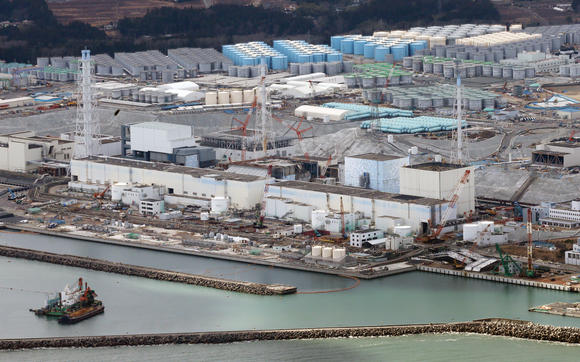
Tokyo Electric Power Co. (TEPCO) Holdings, Inc. is set to ask the national government for financial assistance in decommissioning the disaster-hit Fukushima No. 1 Nuclear Power Plant, company officials said.
The company will also seek consultations with the government over how it should foot the costs of paying compensation to those affected by the nuclear crisis and decontaminating areas affected by radioactive substances from the power station.
TEPCO Holdings has deemed that it cannot secure enough funds to fully cover these costs through its own efforts alone since the expenses are increasingly likely to surpass its estimates.
The utility has secured approximately 1 trillion yen to cover the expenses of decommissioning the crippled power plant and planned to raise another 1 trillion yen. However, it is expected to take the company 30 to 40 years to decommission the plant and deal with the aftermath of the crisis. Moreover, it has been pointed out that the actual decommissioning costs will far surpass 2 trillion yen.
At a news conference on July 28, Fumio Sudo, chairman of TEPCO Holdings, expressed fear that the company will face increased costs of shutting down the plant, pointing out that the decommission project is “work that nobody in the world has experienced.”
The utility currently pays compensation and covers the costs of decontamination work by borrowing money from the state through the Nuclear Damage Compensation and Decontamination Facilitation Corp.
However, the amount of compensation that the utility has so far paid has already reached 6 trillion yen, surpassing the 5.4 trillion yen initial plan. Moreover, decontamination costs are also expected to surpass 2.5 trillion yen as originally planned.
There are no prospects that operations at TEPCO’s Kashiwazaki-Kariwa Nuclear Power Plant in Niigata Prefecture, which would help increase the company’s profits, will be resumed in the foreseeable future. Moreover, TEPCO has faced intensifying competition in the electric power market as the retailing of power was fully liberalized in April. Under these circumstances, TEPCO Holdings is expected to ask the government to provide the firm with an infusion of public funds among other financial aid.
http://mainichi.jp/english/articles/20160729/p2a/00m/0na/012000c
Fukushima Unit 2 Muon Scan Inconclusive
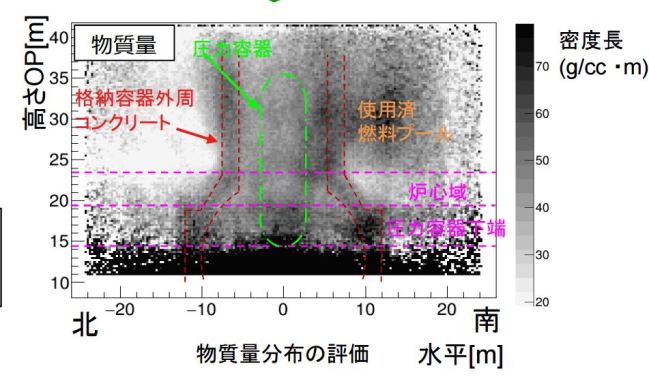
TEPCO and IRID released a set of reports on the muon scan of unit 2, as a follow up report to the June preliminary scan results.
Tepco makes an assertion in the new report that the majority of the melted fuel is present in the bottom of the reactor pressure vessel but that assertion is quite questionable upon further review of the reports.
To justify the assertion that most of the fuel is in the bottom of the RPV, Tepco uses a close view of the actual scan output. Viewed without the wider view it seems there must be some fuel in the bottom of the RPV and there probably is.
When you look at the same image with the entire scan view, the black area inside the RPV becomes less conclusive. This black band reaches far beyond containment and matches an area of interference documented on the earlier reviews of the scans.
TEPCO also goes on to make an estimate of fuel volume in the lower portion of the RPV based on these questionable images. They do not provide any justification for how they take the black spots in the image of the lower RPV and translate that to tons of melted materials and fuel.
Existing meltdown literature and findings expect some amount of fuel residue to exist in the bottom of the RPV even if the bottom of the RPV fails.
Both scans of unit 2′s vessel showed little remaining in the core region.
At this point the scans are inconclusive either way on the question of fuel in the bottom of the RPV.
Sources:
http://mainichi.jp/english/articles/20160729/p2g/00m/0dm/022000c
http://www.asahi.com/ajw/articles/AJ201607290050.html
Fuel in the Fukushima Reactor 2 Playing Hide and seek
In June 2016 Tepco released preliminary information announcing that the unit 2 muon scan showed no fuel in the reactor vessel, that the full scan would be completed by mid-July and should confirm any fuel findings, or lack thereof.
The scanner can detect masses of fuel 1 meter or larger.
The scans had identified the fuel in the spent fuel pool, confirming that the system was working properly and that the results were accurate.
The image below is the actual muon scan results with darker blue indicating areas where fuel is. The internal structures of the reactor are drawn in by TEPCO.
TEPCO originally thought there was fuel remaining in the bottom head of the reactor vessel. The scan clearly showed no significant amount of fuel remaining in the core region where the fuel was before the meltdown or in the bottom of the reactor vessel.
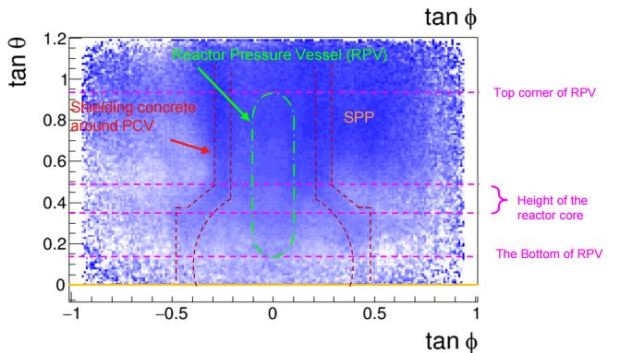
Tepco stating that the final scan report in July might refine the imagery but that it would unlikely change the results.
TEPCO handouts :
https://www.dropbox.com/s/i2bffm237u8osz6/muon%20unit%202%20handouts_160526_01-e.pdf?dl=0
https://www.dropbox.com/s/76w6rryxiwjbhoz/muonscan_2_daiichi_160526_06.pdf?dl=0
Now this Thursday July 28, 2016, one month later, Tepco announces that most of the melted nuclear fuel inside the No. 2 reactor is LIKELY located at the bottom of its pressure vessel.
That a study using muon imaging system was carried out by a team involving Tokyo Electric and the High Energy Accelerator Research Organization in Ibaraki Prefecture, that an ESTIMATED 130 tons of the so-called fuel debris REMAINS at the bottom of the vessel, that it is the first time the location and amount of the melted fuel have been estimated.
As high radiation levels are continuing to hamper direct access to the reactors, researchers have tracked muon elementary particles, which are produced as cosmic rays collide with atmospheric particles and change course when coming into contact with nuclear fuel.
The No. 2 reactor was in operation when the nuclear crisis was triggered by a powerful earthquake and subsequent tsunami that devastated Japan’s northeast.
About 160 tons of fuel assemblies are estimated to have been present inside the reactor vessel prior to the crisis. Most of the fuel is BELIEVED to have fallen to the bottom of the pressure vessel and mixed with nearby structures to form debris.
In the nuclear crisis, massive amounts of radioactive substances were released into the environment, with the Nos. 1, 3 and 4 reactor buildings damaged by hydrogen explosions.
The No. 4 reactor was offline for periodic maintenance work and all of its fuel was stored in the spent fuel pool, avoiding a meltdown.
The finding IF TRUE would be important as the data could help the operator to narrow down methods to remove the fuel debris, the most challenging task in decommissioning the plant’s Nos. 1 to 3 reactors that experienced meltdowns in the nuclear crisis that began in March 2011.
However, in mid-June 2016 using the same muon imaging system Tepco could not detect any fuel at the bottom of the reactor pressure vessel, now one month later Tepco announces that there is an estimated 130 tons of the so-called fuel debris remaining at the bottom of the vessel.
Question : has that fuel been playing hide and seek with Tepco?
Radioactive cesium stays for 3 years in bodies of Fukushima nuclear clean-up workers
 THREE-YEAR RETENTION OF RADIOACTIVE CAESIUM IN THE BODY OF TEPCO WORKERS INVOLVED IN THE FUKUSHIMA DAIICHI NUCLEAR POWER STATION ACCIDENT http://rpd.oxfordjournals.org/content/early/2016/03/14/rpd.ncw036.abstract
+Author Affiliations
Research Program for Radiation Dosimetry, National Institute of Radiological Sciences, 4-9-1 Anagawa Inage-ku, Chiba-shi 263-8555, Japan
- ↵*Corresponding author: nakano@nirs.go.jp
Abstract
Direct measurements of seven highly exposed workers at the Tokyo Electric Power Company Fukushima Daiichi Nuclear Power Station accident have been performed continuously since June 2011. Caesium clearance in the monitored workers is in agreement with the biokinetic models proposed by the International Commission on Radiological Protection. After 500 d from the initial measurement, however, the caesium clearance slowed. It was thought to be unlikely that additional Cs intake had occurred after the initial intake, as activity in foods was kept low. And, the contribution from the detector over the chest was enhanced with time. This indicates that insoluble Cs particles were inhaled and a long metabolic rate showed.
Citizen science takes on Japan’s nuclear establishment
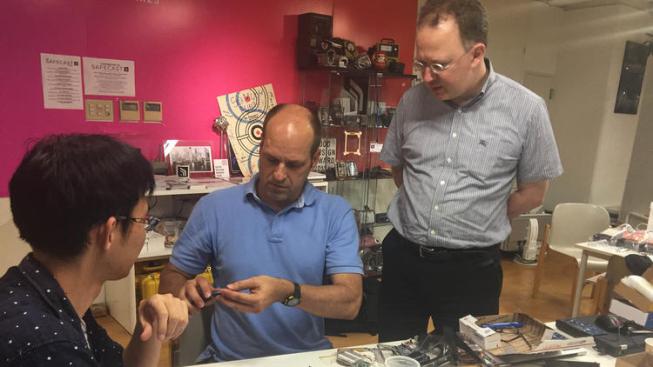
Joe Moross, center, and Pieter Franken, right, teach Kohei Matsushita how to assemble one of Safecast’s Geiger counter kits at the group’s Tokyo office on July 6, 2016.
As other Tokyo office workers poured into restaurants and bars at quitting time one recent evening, Kohei Matsushita went to the eighth floor of a high-rise for an unusual after-hours activity : learning how to assemble his own Geiger counter from a kit.
Hunched over a circuit board, the 37-year-old practiced his soldering technique as Joe Moross, a former L.A. resident with a background in radiation detection, explained how to fit together about $500 worth of components – including a sensor, circuit board, digital display, GPS module, battery and case.
“My family has a house near a nuclear power plant,” Matsushita said, explaining his motivation. “I want to take this there and collect data, and contribute to this pool of information.”
“This pool” is a stunning set of data – 50 million readings and counting, all logged and mapped on a website anyone can see – collected by volunteers with self-built equipment. Known as Safecast, the group was founded just days after the massive earthquake, tsunami and nuclear meltdown that shocked Japan in March 2011.
Though the immediate threat of radiation from the Fukushima Daiichi nuclear power plant has waned, interest in Safecast’s data has not. The organization, which takes no position on nuclear power, is supported by foundations, grants and individual donations.
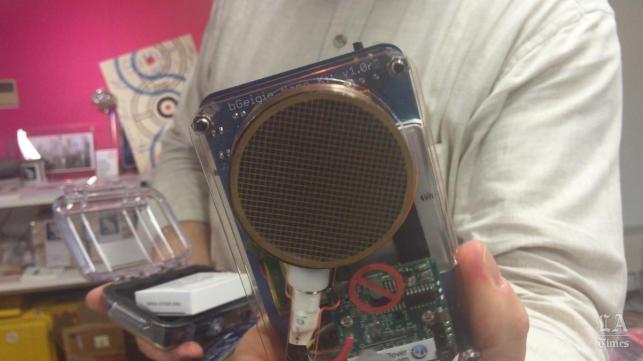
Safecast teaches Japanese citizens how to monitor radiation
Volunteers from Safecast teach people how to build geiger counters that are networked together to give them access to realtime data about radiation levels remaining after the 2011 Fukushima nuclear power plant melted down as a result of an earthquake and tsunami.
Part of the growing movement known as citizen science, the idea is to give people the knowledge and the tools to better understand their environment, and make more informed decisions based on accurate information.
Trust in both nuclear power plant operators and the government has not fully recovered since the disaster. As authorities push ahead with the contentious process of restarting dozens of nuclear reactors taken off-line in wake of the disaster, Japanese like Matsushita say a network of monitors controlled by ordinary people could serve as an early warning system in the event of another disaster.
Meanwhile, as Prime Minister Shinzo Abe’s administration continues with its extensive effort to decontaminate areas around Fukushima Daiichi and reopen evacuated towns and villages, potential returnees say they want a way to verify official numbers that indicate radiation really has dropped to safe levels.
“They want people to come back, but there’s no decontamination in the forest areas and those cover 75% of this village,” says retired engineer Nobuyoshi Ito, 72, who in 2010 opened an eco-farm retreat in Iitate, about 20 miles northwest of the nuclear power plant. Recently, he had Safecast install a radiation monitor at the retreat, which is still in a restricted zone. “We have to check ourselves.”
++
Joe Moross straps a GPS-enabled Geiger counter the size of a small brick to the back window of his red station wagon on the outskirts of Tokyo and begins a 16-hour day driving north through the most contaminated areas around the Fukushima nuclear plant. In the last five years, he calculates he’s driven 90,000 miles gathering data for Safecast.

Joe Moross has driven 90,000 miles gathering data for Safecast. A Geiger counter equipped with a GPS module hangs from the back window of his station wagon.
Through a Bluetooth connection, he can monitor the Geiger counter’s readings on his cellphone as he goes. But he also keeps a mental log of more qualitative signs of the region’s transformation.
“That 7-Eleven reopened in 2014,” he notes as he nears the town of Tomioka. “That Family Mart came back in 2015.” In the town of Naraha, he gasps. “That’s the first rice growing in the fields here in five years!”
Along the way, he passes several dozen fixed-point radiation monitors installed by the government along the roadsides. Their solar-powered, digital displays provide readouts in microsieverts per hour (μSv/hr); today’s show relatively low readings from 0.1 to 3.8 between the towns of Hirono and Minamisoma. That is less than what one would be exposed to on a long flight, although that exposure lasts only as long as the flight.
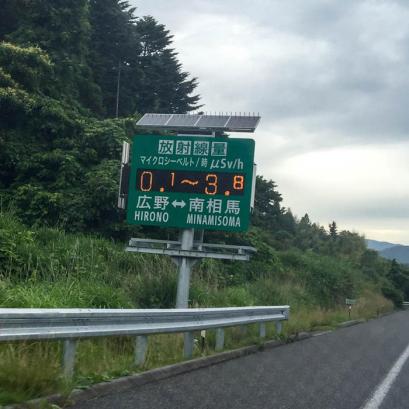
A roadside sign installed by the Japanese government south of the Fukushima Daiichi nuclear plant displays radiation readings.
Moross’ much more granular, mobile data, recorded every five seconds and uploaded to the Web the next day, generally matches the government signs, though when passing near the Fukushima plant, Moross’ counter produces readings above 4 μSv/hr. (Not long after the disaster, Safecast found readings higher than 30 in the region).
In the town of Iwaki, Moross drops in on Brett Waterman, a 51-year-old Australian who’s been teaching English in the area for 11 years and was having some technical issues with a Safecast monitor.
“Like most people, I knew nothing about radiation” when the disaster hit, says Waterman, who acquired an early Safecast Geiger counter through Kickstarter and has since upgraded to more sophisticated models as the group has refined its designs. Waterman says the data indicate Iwaki is now safe, but it’s important to keep generating frequent readings to provide a reference of what’s “normal” in case circumstances change.
Safecast holds regular sessions for adults to teach them to assemble their own devices and is planning a kids’ workshop as well. Plans and directions for building the devices are also available online for free. Organizers say that people who build their own monitors are much more motivated to use them.
“If they just buy one, they may use it once, throw it in a drawer and never upload any data,” says Moross. “If they make it themselves, they’re more invested.”
++
Safecast’s tiny Tokyo office feels like a combination tech start-up, old-school shop class, and comedy club for middle-aged expats. As Moross inspects Matsushita’s soldering progress, English teacher Jonathan Wilder, 59, is busy gathering switches, resistors, batteries, and sensors and parceling them out into plastic bags that will become kits for Safecast’s current workhorse Geiger counter, known as the bGeigie Nano.
Moross and Wilder trade jokes as Azby Brown, 60, an expert on traditional Japanese architecture, sits at another table typing up news for the group’s blog; he has just led Safecast’s efforts to publish its first scientific paper, in the Journal of Radiological Protection. Pieter Franken, a Dutch expatriate and chief technology officer for a large securities firm, looks over some materials for the group’s upcoming kids’ workshop.
“Safecast is an interesting social experiment, in a fairly anarchistic kind of way,” says Franken, one of the group’s founders. “It taps into trends including maker-spaces, the Internet of things and even artists. We attract people who want to break out of the traditional way of solving problems.”
Safecast grew out of an email conversation among Franken, L.A.-based tech entrepreneur Sean Bonner and MIT Media Lab director Joichi “Joi” Ito immediately after the March 11, 2011, disaster. As the Fukushima crisis unfolded, Safecast’s effort to produce and distribute Geiger counters and collect data snowballed, drawing in more expertise and volunteers. The group has successively iterated smaller and smaller Geiger counters with more functionality for data collection.
In the last five years, Safecast volunteers have taken radiation readings all over the world, from Brisbane, Australia, to Santa Monica. The group is also working on monitoring air quality in Los Angeles and elsewhere; recently, volunteers took methane readings around Porter Ranch during the gas leak there. Now, Safecast is trying to figure out how to depict that kind of data meaningfully online.
Moross says the potential applications for citizen-based environmental monitoring are vast, pointing to incidents such as the recent scandal over the lead-tainted water supply in Flint, Mich., as an example of where deeper community-based scientific knowledge could have improved debate and policymaking.
“Flint and Fukushima have parallels,” says Moross. “Democracy should start from facts, and we need to give citizens facts to understand what’s happening.”
Safecast has taken heat from both pro- and anti-nuclear activists, Brown says. “But if people spend some time with us, they find we are valuable.” Even Japan’s postal service has cooperated with Safecast, putting its monitors on carriers’ motorbikes in some towns and gathering data.
Safecast’s goal now is, essentially, “base-lining the world,” says Franken, crowdsourcing environmental data from every corner of the Earth.
“We should start with measuring our environments,” he says. “Then we can talk about things like global warming and air pollution; from there, activism can start. Once you know, for example, that your street is polluted, you can start to make a change. That’s where we can make a difference.”
http://www.latimes.com/world/asia/la-fg-japan-safecast-snap-story.html
Dumpling soup from Fukushima like grandma used to make

“Ganimaki suiton” (front) from Minamisoma, Fukushima Prefecture and “mami suiton” (back) of Naraha.
The Japan Football Village (J-Village) is a soccer training facility located in Naraha, Fukushima Prefecture, where Yoshiteru Nishi, chef for the national soccer team, works.
It is located about 20 kilometers from the Fukushima No. 1 nuclear power plant. After the 2011 accident at the plant, J-Village was used as a base for decommissioning work.
The green grass pitch was covered in gravel and turned into a parking lot. The restaurant was closed.
That summer, Nishi was asked to cook for the decommissioning workers. He had seen the workers eating canned or boil-in-the-bag foods.
“There are people who need my skills,” Nishi thought, and opened a cafeteria at the facility. He served a buffet of fried chicken, grilled fish, simmered dishes and more. He wanted to support those working in a grueling environment with nutritious meals.
Meanwhile, he opened a restaurant in the neighboring town of Hirono, where eating and drinking establishments remained closed due to the nuclear power plant accident.
“I wanted to create a place where the residents returning from evacuation spots can eat warm meals and feel relaxed,” the 54-year-old chef says.
The menu includes “suiton,” a local dumpling soup with chicken and vegetables that was popular at J-Village. Former national team coach Philippe Troussier once commented, “This is grandma’s taste,” and named it “mami suiton” (mommy’s suiton).
Nishi also introduced another version of suiton called “ganimaki,” a local specialty of Minami-Soma.
Ganimaki is a soup of “mokuzu-gani” (Japanese mitten crab) caught in local rivers. They are finely crushed and run through a sieve. When poured into boiling water, the essence floats up in fluffy form. In Minami-Soma, it is a dish served on festive occasions.
When he was small, Nishi would busy himself catching the deep-green-colored crabs in the river. When his mother stir-fried them with eggs, they tasted heavenly.
Due to radiation contamination caused by the Fukushima plant accident, the Japanese mitten crabs of Minami-Soma are not allowed to be consumed.
“I yearn for them all the more,” Nishi says.
For the recipe, he used crabs caught in Iwaki in southern Fukushima Prefecture.
“The food culture of Fukushima has been nurtured by the large number of people who live here,” Nishi says. “I will strive to keep the tradition alive.”
http://www.asahi.com/ajw/articles/AJ201607270008.html
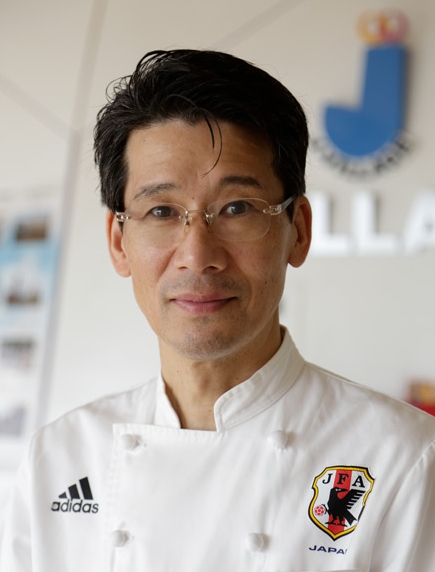
The Japan Football Village (J-Village) is a soccer training facility located in Naraha, Fukushima Prefecture, where Yoshiteru Nishi, chef for the national soccer team, works.
Space dose 1.55 micro Sv/h, Koriyama city, park waterside hotspot
Published on Jul 20, 2016 by Birdhairjp
July 16, 2016 (five years & four months from the nuclear disaster)
I monitored radiation around Gohyakubuchi-park of Koriyama city, Fukushima Prefecture, Japan.
Space dose of the height of the chest of the promenade circling the pond, was approximately 0.27 to 0.30 micro sievert per hour.
At the entrance of the park, a sighnboad shows the decontamination result by the city.
Before the decontamination: 2.33 micro Sv/h as of Sep of 2011
After the decontamination: 0.21 micro Sv/h as of Jun of 2016
(Air dose rate 50cm high from the ground level)
My monitor shows space dose 0.47 on the pond-side promenade near a floodgate to the waterway into the woods.
Space dose on the promenade in the park forest is at the height of the breast, was 0.3 to 0.45 micro Sv/h
To the waterside in the forest, there is a hot spot that radioactive material is collected.
Approaching to the place, the value of the dosimeter is jumped.
Space dose of the height of the breast in the hot spots were recorded 1.5-1.9 micro Sv/h.
Measuring instrument that was used during the video shoot, Ukraine made, ECOTEST’s MKS-05.
Koriyama city : population, about 330,000 people.
1 This Month
10 March A LIVE WEBINAR THE REAL EFFECTS OF NUCLEAR POWER
What the Industry Isn’t Telling Us
1:00 PM Mountain, 2 pm Central, 3 pm Eastern. Live on the Keepers of the Water Facebook page



18 March Webinar @ 1 PM EST: An Assessment of SMR Projects: The Case of Canada
register for the zoom:
https://us02web.zoom.us/webinar/register/WN_o8BIIOUvQ2ONJR1nta65DQ#/registration


of the week – STOP SMALL MODULAR REACTORS IN CANADA
To see nuclear-related stories in greater depth and intensity – go to https://nuclearinformation.wordpress.com
-
Archives
- March 2026 (119)
- February 2026 (268)
- January 2026 (308)
- December 2025 (358)
- November 2025 (359)
- October 2025 (376)
- September 2025 (258)
- August 2025 (319)
- July 2025 (230)
- June 2025 (348)
- May 2025 (261)
- April 2025 (305)
-
Categories
- 1
- 1 NUCLEAR ISSUES
- business and costs
- climate change
- culture and arts
- ENERGY
- environment
- health
- history
- indigenous issues
- Legal
- marketing of nuclear
- media
- opposition to nuclear
- PERSONAL STORIES
- politics
- politics international
- Religion and ethics
- safety
- secrets,lies and civil liberties
- spinbuster
- technology
- Uranium
- wastes
- weapons and war
- Women
- 2 WORLD
- ACTION
- AFRICA
- Atrocities
- AUSTRALIA
- Christina's notes
- Christina's themes
- culture and arts
- Events
- Fuk 2022
- Fuk 2023
- Fukushima 2017
- Fukushima 2018
- fukushima 2019
- Fukushima 2020
- Fukushima 2021
- general
- global warming
- Humour (God we need it)
- Nuclear
- RARE EARTHS
- Reference
- resources – print
- Resources -audiovicual
- Weekly Newsletter
- World
- World Nuclear
- YouTube
-
RSS
Entries RSS
Comments RSS
 nuclear-news