Radiocontamination of Tokyo
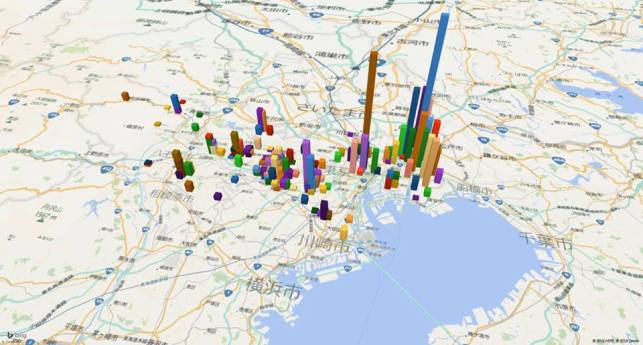
Based on the data released by everyone to the Minna-san data website, a map of the soil contamination of Tokyo by radioactivity was put together.
This data is the result of measurements from 2013 to now 2016.
You can see that the radioactive contamination spread over a wide range of Tokyo.
Particularly, Katsushika district, Edogawa district, Shinjuku district, Setagaya district and Bunkyō district.
Radioactive contamination of both radioactive cesium 134 and 137 exceeding 500Bq / kg has been confirmed.
Among other locations: Inagi city/ Katsushi district / Edogawa district / Eto district / Arakawa district / Kokubunji city / Kokuritsu City / Komae City / Mitaka City / Kodaira city/ Shinjuku district / Suginami district/ Setagaya district / Nishitama gun / Ome city / Chiyoda district / Ota District/ Oshima-cho / Machida city / Chofu city / Higashi Kurume City / Higashimurayama city / Hachioji city / Fuchu city / Musashino City / Fukuo city/ Bunkyo district / Toshima district/ Kita district / Tachikawa city.
Read more at: (in Japanese)
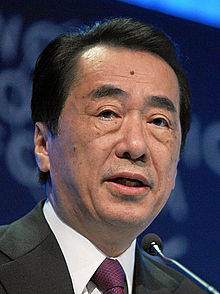
Reassessing the 3.11 Disaster and the Future of Nuclear Power in Japan: An Interview with Former Prime Minister Kan Naoto
Interview by Vincenzo Capodici, Introduction by Shaun Burnie, Translation by Richard Minear
Introduction
For more than two decades, the global nuclear industry has attempted to frame the debate on nuclear power within the context of climate change: nuclear power is better than any of the alternatives. So the argument went. Ambitious nuclear expansion plans inthe United States and Japan, two of the largest existing markets, and the growth of nuclear power in China appeared to show—superficially at least—that the technology had a future. At least in terms of political rhetoric and media perception, it appeared to be a winning argument. Then came March 11, 2011. Those most determined to promote nuclear power even cited the Fukushima Daiichi accident as a reason for expanding nuclear power: impacts were low, no one died, radiation levels are not a risk. So claimeda handful of commentators in the international (particularly English-language) media.
However,from the start of the accident at Fukushima Daiichi on March 11 2011,the harsh reality of nuclear power was exposed to billions of people across the planet, and in particular to the population of Japan, including the more than 160,000 people displaced by the disaster, many of whom are still unable to return to their homes, and scores of millions more threatened had worst case scenarios occurred. One authoritative voice that has been central to exposing the myth-making of the nuclear industry and its supporters has been that of KanNaoto, Prime Minister in 2011. His conversion from promoter to stern critic may be simple to understand, but it is no less commendable for its bravery. When the survival of half the society you are elected to serve and protect is threatened by a technology that is essentially an expensive way to boil water, then something is clearly wrong. Japan avoided societal destruction thanks in large part to the dedication of workers at the crippled nuclear plant, but also to the intervention of Kan and his staff, and to luck. Had it not been for a leaking pipe into the cooling pool of Unit 4 that maintained sufficient water levels, the highly irradiated spent fuel in the pool, including the entire core only recently removed from the reactor core, would have been exposed, releasing an amount of radioactivity far in excess of that released from the other three reactors. The cascade of subsequent events would have meant total loss of control of the other reactors, including their spent fuel pools and requiring massive evacuation extending throughout metropolitan Tokyo, as Prime Minister Kan feared. That three former Prime Ministers of Japan are not just opposed to nuclear power but actively campaigning against it is unprecedented in global politics and is evidence of the scale of the threat that Fukushima posed to tens of millions ofJapanese.
The reality is thatin terms of electricity share and relative to renewable energy,nuclear power has been in decline globally for two decades.Since the FukushimaDaiichiaccident, this decline has only increased in pace. The nuclear industry knew full well that nuclear power could not be scaled up to the level required to make a serious impact on global emissions. But that was never the point. The industry adopted the climate-change argument as a survival strategy: to ensure extending the life of existing aging reactors and make possible the addition of some new nuclear capacity in the coming decades—sufficient at least to allow a core nuclear industrial infrastructure to survive to mid-century.The dream was to survive to mid-century, when limitless energy would be realized by the deployment of commercial plutonium fast-breeder reactors and other generation IV designs. It was always a myth, but it had a commercial and strategic rationale for the power companies, nuclear suppliers and their political allies.
The basis for the Fukushima Daiichi accident began long before March 11th 2011, when decisions were made to build and operate reactors in a nation almost uniquely vulnerable to major seismic events. More than five years on, the accident continues with a legacy that will stretch over the decades. Preventing the next catastrophic accident in Japan is now a passion of the former Prime Minister, joining as he has the majority of the people of Japan determined to transition to a society based on renewable energy. He is surely correct that the end of nuclear power in Japan is possible. The utilities remain in crisis, with only three reactors operating, and legal challenges have been launched across the nation. No matter what policy the government chooses, the basis for Japan’s entire nuclear fuel cycle policy, which is based on plutonium separation at Rokkasho-mura and its use in the Monju reactor and its fantasy successor reactors, is in a worse state than ever before. But as KanNaotoknows better than most, this is an industry entrenched within the establishment and still wields enormous influence. Its end is not guaranteed. Determination and dedication will be needed to defeat it. Fortunately, the Japanese people have these in abundance. SB
The Interview
Q: What is your central message?
Kan: Up until the accident at the Fukushima reactor, I too was confident that since Japanese technology is of high quality, no Chernobyl-like event was possible.
But in fact when I came face to face with Fukushima, I learned I was completely mistaken. I learned first and foremost that we stood on the brink of disaster: had the incident spread only slightly, half the territory of Japan, half the area of metropolitan Tokyo would have been irradiated and 50,000,000 people would have had to evacuate.
Half one’s country would be irradiated, nearly half of the population would have to flee: to the extent it’s conceivable, only defeat in major war is comparable.
That the risk was so enormous: that is what in the first place I want all of you, all the Japanese, all the world’s people to realize.
Q: You yourself are a physicist, yet you don’t believe in the first analysis that people can handle nuclear power? Don’t you believe that there are technical advances and that in the end it will be safe to use?
Kan: As a rule, all technologies involve risk. For example, automobiles have accidents; airplanes, too. But the scale of the risk if an accident happens affects the question whether or not to use that technology. You compare the plus of using it and on the other hand the minus of not using it. We learned that with nuclear reactors, the Fukushima nuclear reactors, the risk was such that 50,000,000 people nearly had to evacuate. Moreover, if we had not used nuclear reactors—in fact, after the incident, there was a period of about two years when we didn’t use nuclear power and there was no great impact on the public welfare, nor any economic impact either. So when you take these factors as a whole into account, in a broad sense there is no plus to using nuclear power. That is my judgment.
One more thing. In the matter of the difference between nuclear power and other technologies, controlling the radiation is in the final analysis extremely difficult.
For example, plutonium emits radiation for a long time. Its half-life is 24,000 years, so because nuclear waste contains plutonium—in its disposal, even if you let it sit and don’t use it—its half-life is 24,000 years, in effect forever. So it’s a very difficult technology to use—an additional point I want to make.
Q: It figured a bit ago in the lecture by Professor Prasser, that in third-generation reactors, risk can be avoided. What is your response?
Kan: It’s as Professor Khwostowa said: we’ve said that even with many nuclear reactors, an event inside a reactor like the Fukushima nuclear accident or a Chernobyl-sized event would occur only once in a million years; but in fact, in the past sixty years, we’ve had Three Mile Island, Chernobyl, Fukushima. Professor Prasser says it’s getting gradually safer, but in fact accidents have happened with greater frequency and on a larger scale than was foreseen. So partial improvements are possible, as Professor Prasser says, but saying that doesn’t mean that accidents won’t happen. Equipment causes accidents, but so do humans.
Q: Today it’s five years after Fukushima. What is the situation in Japan today? We hear that there are plans beginning in 2018 to return the refugees to their homes. To what extent is the clean-up complete?
Kan: Let me describe conditions on site at Fukushima. Reactors #1, #2, #3 melted down, and the melted nuclear fuel still sits in the containment vessel; every day they introduce water to cool it. Radioactivity in the vessel of #2, they say, is 70 sieverts—not microsieverts or millisieverts, 70 sieverts. If humans approach a site that is radiating 70 sieverts, they die within five minutes. That situation has held ever since: that’s the current situation.
Moreover, the water they introduce leaves the containment vessel and is said to be recirculated, but in fact it mixes with groundwater, and some flows into the ocean. Prime Minister Abe used the words “under control,” but Japanese experts, including me, consider it not under control if part is flowing into the ocean. All the experts see it this way.
As for the area outside the site, more than 100,000 people have fled the Fukushima area.
So now the government is pushing residential decontamination and beyond that the decontamination of agricultural land.
Even if you decontaminate the soil, it’s only a temporary or partial reduction in radioactivity; in very many cases cesium comes down from the mountains, it returns.
The Fukushima prefectural government and the government say that certain of the areas where decontamination has been completed are habitable, so people have until 2018 to return; moreover, beyond that date, they won’t give aid to the people who have fled. But I and others think there’s still danger and that the support should be continued at the same level for people who conclude on their own that it’s still dangerous—that’s what we’re saying.
Given the conditions on site and the conditions of those who have fled, you simply can’t say that the clean-up is complete.
Q: Since the Fukushima accident, you have become a strong advocate of getting rid of nuclear reactors; yet in the end, the Abe regime came to power, and it is going in the opposite direction: three reactors are now in operation. As you see this happening, are you angry?
Kan: Clearly what Prime Minister Abe is trying to do—his nuclear reactor policy or energy policy—is mistaken. I am strongly opposed to current policy.
But are things moving steadily backward? Three reactors are indeed in operation. However, phrase it differently: only three are in operation. Why only three? Most—more than half the people—are still resisting strongly. From now on, if it should come to new nuclear plants, say, or to extending the licenses of existing nuclear plants, popular opposition is extremely strong, so that won’t be at all easy. In that sense, Japan’s situation today is a very harsh opposition—a tug of war—between the Abe government, intent on retrogression, and the people, who are heading toward abolishing nuclear reactors.
Two of Prime Minister Abe’s closest advisors are opposed to his policy on nuclear power.
One is his wife. The other is former Prime Minister Koizumi, who promoted him.
Q: Last question: please talk about the possibility that within ten years Japan will do away with nuclear power.
Kan: In the long run, it will disappear gradually. But if you ask whether it will disappear in the next ten years, I can’t say. For example, even in my own party opinion is divided; some hope to do away with it in the 2030s. So I can’t say whether it will disappear completely in the next ten years, but taking the long view, it will surely be gone, for example, by the year 2050 or 2070. The most important reason is economic. It has become clear that compared with other forms of energy, the cost of nuclear energy is high.
Q: Thank you.
TEPCO: Groundwater Surfaced and Possibly Leaked at Fukushima Plant During Typhoon
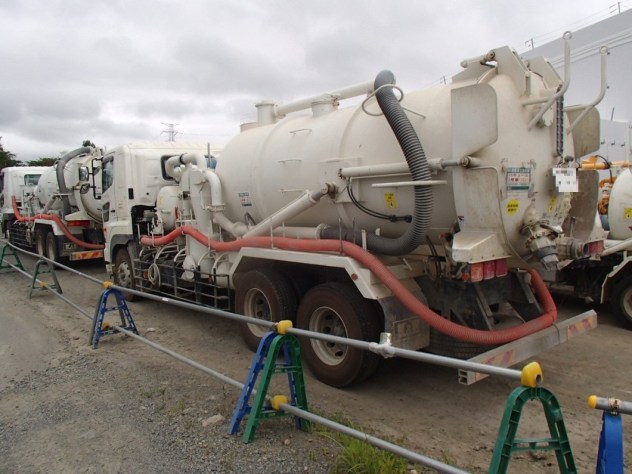
Fukushima Daiichi Floods, Show Lack of Preparedness
News reports indicated that groundwater at Fukushima Daiichi had risen so high it broke the surface and flowed into the port as a recent typhoon passed through the area. As TEPCO prepared to close the steel sea wall and freeze the underground frozen wall, NRA stopped the process for a review of the potential for flooding within the reactor building area.
The conclusion was that TEPCO thought they could sufficiently remove excess groundwater with the sump pump subdrain system near the reactor buildings. There were also concerns of the groundwater dropping too low, allowing contaminated water to flow out of the reactor building basements.
With all this review, nobody conceived a need for more water removal capacity. TEPCO ended up employing some sort of makeshift pumps and also using septic tank trucks to pump up water. This lack of anywhere for rainwater to go may have contributed to the water flowing out into the port as it built up on the surface.
Without some major changes at Daiichi this problem of groundwater rising to the surface and flowing into the port or the sea will continue to happen when significant rainfall takes place.
http://www.fukuleaks.org/web/?p=15765
Typhoon rain raises tainted Fukushima plant groundwater to surface
Heavy rain brought by Typhoon Malakas caused contaminated groundwater to rise to ground level at the radiation-hit Fukushima No. 1 nuclear plant Tuesday night, raising fears of tainted water flooding out to the plant’s port area, its operator said.
Tokyo Electric Power Company Holdings Inc. said in a press release that plant workers are doing their utmost to pump up tainted groundwater at the Fukushima compound, while trying to measure the level of radioactive substances contained in the water.
Under normal circumstances, groundwater taken from wells around the damaged reactor buildings at the Fukushima plant is filtered and stored in numerous tanks built on the compound.
Shortly before 10 p.m. Tuesday, groundwater reached the surface level at an observation well near the seawall at the power plant’s port, and at 11:30 p.m. Tuesday, groundwater stood at 3 cm above the surface level, Tepco said.
The well has a far higher wall and the ground around it is paved, the company said, playing down the possibility that any water flowed out of the well.
By 9 a.m. Wednesday, the water level had dropped to 3 cm below the surface.
Meanwhile, some rainwater may have flowed directly into the port before seeping underground, according to the company.
Tepco will continue pumping groundwater around the seawall, located near the damaged No. 1 to No. 4 reactors, and carry out close examinations of water inside the port, the company said.
In order to curb the flow of groundwater into the sea, the company has covered the seawall with water shields and carries out groundwater pumping operations.
Typhoon Malakas itself was downgraded to an extratropical depression at around 9 p.m. Tuesday as it moved along the coast of the Tokai region and swayed toward the Pacific. It was initially forecast to hit the Kanto region in the early hours of Wednesday.
The previous typhoon, Lionrock, earlier this month killed at least 17 people. Before Lionrock, two typhoons had claimed at least two lives in the northeast.
TEPCO: Possible water leak at Fukushima plant during typhoon
Tokyo Electric Power Co. said Sept. 21 it will check for radiation contamination in seawater near its crippled Fukushima nuclear plant after heavy rain from Typhoon No. 16 brought tainted groundwater to the surface.
The water reached the top of wells at the Fukushima No. 1 nuclear power plant, and there is a possibility that some of it spilled into the sea.
“We will analyze the seawater because we cannot determine whether groundwater containing radioactive materials has actually leaked,” a TEPCO official said.
The official added that the company believes most of the water that may have poured into the sea was rainwater that had not seeped into the ground.
The utility constantly monitors groundwater levels in wells around the reactor buildings at the plant to prevent overflows.
TEPCO said groundwater in wells on the seaside area of the nuclear complex reached the surface around 10 p.m. on Sept. 20 amid the heavy rain brought by the approaching typhoon. The water kept rising despite workers’ efforts to lower the level using makeshift pumps and septic tank trucks.
The groundwater level remained the same as of 7 a.m. on Sept. 21 before it finally dropped to about 3 centimeters from the surface two hours later, the company said.
According to TEPCO, about 575 millimeters of rain fell in the area of the nuclear plant from Aug. 1 to Sept. 20.
http://www.asahi.com/ajw/articles/AJ201609210047.html
Public to get new $83-billion bill for Fukushima, reactor expenses
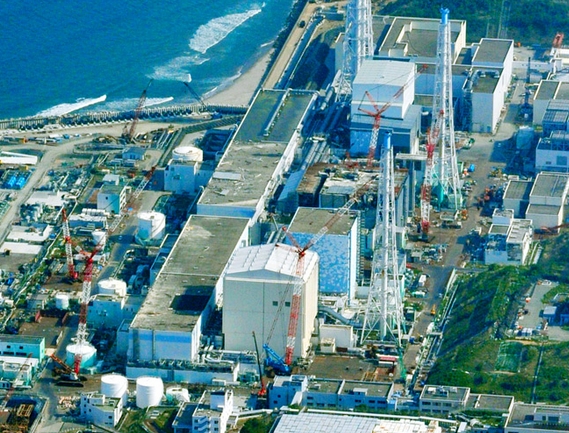
The crippled Fukushima No. 1 nuclear power plant is located in the towns of Okuma and Futaba in Fukushima Prefecture.
The government plans to make the public pay an additional 8.3 trillion yen (about $83 billion) to decommission reactors at the crippled Fukushima nuclear plant and provide compensation for evacuees of the 2011 disaster, sources said.
The public’s money will also be used for the future decommissioning of reactors at other nuclear plants, they said on Sept. 20.
The burden will also affect families that switched from nuclear power generating utilities to new electric power companies after the liberalization of the electricity retail market for families in April this year.
Major utilities that operate nuclear plants are, in principle, required to secure funds through electricity charges to decommission their reactors. Tokyo Electric Power Co., operator of the stricken Fukushima No. 1 nuclear plant, is no exception.
Under the reforms of the power industry, the new electric power companies, which do not operate nuclear plants, were exempt from shouldering any burden related to nuclear power.
But the industry ministry wants to change that arrangement.
Even people in the ruling coalition and the government are criticizing the plan as an attempt to ease the burden of utilities that had long held regional monopolies.
“The plan will damage the basic idea of the reforms,” said Taro Kono, former chairman of the National Public Safety Commission and a lawmaker of the ruling Liberal Democratic Party.
To realize the plan, the Ministry of Economy, Trade and Industry aims to submit revisions to the Electricity Business Law to the next year’s ordinary Diet session.
A government-approved organization is procuring funds from major electric power companies to assist in the eventual decommissioning of the reactors at the Fukushima No. 1 plant.
However, TEPCO has asked the government for additional support because more money will be needed for the lengthy operation.
The costs to decommission the reactors at the Fukushima plant are expected to soar to 6 trillion yen from the current estimate of 2 trillion yen, according to in-house documents of the industry ministry.
The ministry also needs an additional 3 trillion yen to cover compensation payments for evacuees from the 2011 nuclear disaster and 1.3 trillion yen to decommission reactors of other nuclear plants in the future, according to the documents.
To get the new electric power companies to pay part of the 8.3 trillion yen, the ministry plans to increase power grid “usage fees,” which are paid to major electric power companies.
“It is necessary to collect costs from all of the people fairly,” said a high-ranking official of the ministry.
Some of the consumers switched to new electric power companies because they did not want to continue using electricity produced by nuclear power plants.
But the ministry official pointed out that those consumers had been using nuclear-generated electricity until March.
New electric power companies, which do not have their own power grids, have concluded contracts with only 2 percent of all households in Japan.
The ministry is concerned that if more families switch from nuclear plant operators to the new companies, it could become difficult to secure sufficient funds to cover reactor decommissioning costs.
Under the ministry’s plan, a standard family of three in areas covered by TEPCO will be required to pay an additional 180 yen every month. In areas covered by other major electric power companies, the corresponding figure will be about 60 yen.
Fukushima Daiichi Contaminated Groundwater Pouring into the Sea
Fukushima Daiichi Groundwater Rises from Typhoon N°16 Sept. 21, 2016
« Groundwater level rises in the aftermath of Typhoon 16, due to its heavy rain the groundwater now reaches now the surface.
It is unclear as whether or not the groundwater has been contaminated with radioactive material as it poured out into the sea, To be determined later, Tepco says. »
http://www.news24.jp/sp/articles/2016/09/21/07341567.html
Tepco pumping groundwater from Fukushima plant.
The operator of the Fukushima Daiichi nuclear power station says it is pumping groundwater from under the plant to prevent contaminated water from leaking into the adjacent port.
Tokyo Electric Power Company says the heavy rains brought by Typhoon Malakas have raised the underground water levels around the plant’s embankments.
TEPCO officials say they added pumps to prevent the groundwater from rising further. They say the water rose nearly to the surface shortly before 10 PM on Tuesday.
The officials say this has prevented rain from permeating the ground and increased the risk that the rainwater could become contaminated and flow into the port.
The utility says that while it is pumping the groundwater to prevent leakage, it will measure the radioactive substances in the water.
http://www3.nhk.or.jp/nhkworld/en/news/20160921_09/
Underground Water Now Surfacing in Fukushima Daiichi
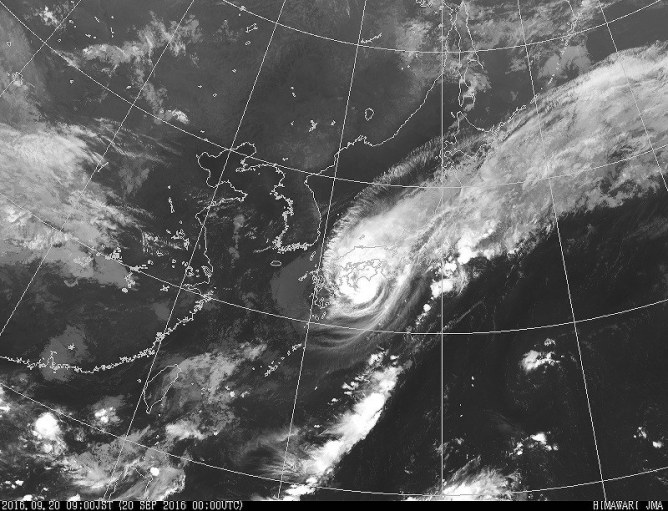
With Typhoon N°16 heavy rain, underground water level reaches ground surface at Fukushima Daiichi.
With the heavy rain associated with the approach of typhoon No. 16, Tepco announced that the underground water level of the sea side of the Fukushima Daiichi nuclear power plant area is now at ground level.
There is a possibility that contaminated groundwater has flowed into the sea mixed with the rain.
TEPCO plans soon to analyze the surface of the water and the seawater.
Reconstruct ‘difficult-to-return zones’ in keeping with residents’ wishes
In consideration of the feelings of evacuees who want to return home, it is important to promptly present a specific picture of how towns affected by the nuclear disaster will be reconstructed.
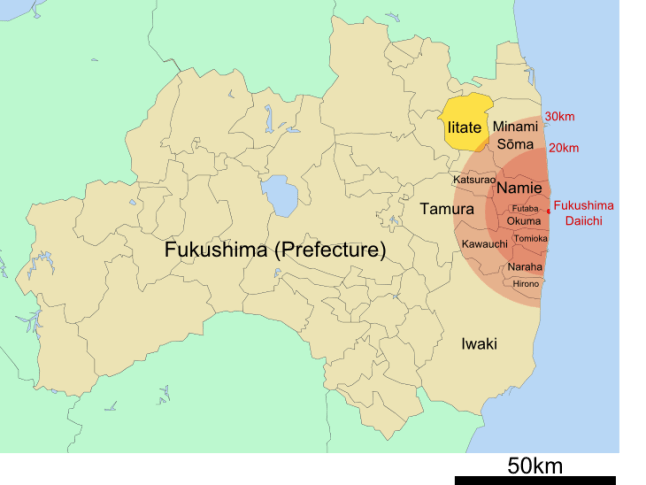
Regarding the “difficult-to-return zones” designated following the disaster at Tokyo Electric Power Company Holdings, Inc.’s Fukushima No. 1 nuclear power plant, the government has announced a policy of designating priority areas and carrying out full-scale decontamination work there starting next fiscal year.
Entry remains strictly restricted for the difficult-to-return zones, where the yearly dose of radiation was higher than 50 millisieverts as of March 2012. This is the first time for the government to announce a policy of allowing evacuees to eventually return home in the zones.
The zones spread over seven municipalities around the Fukushima plant, including the towns of Okuma, Futaba and Namie.
The latest policy is characterized by the government establishing “reconstruction bases” that center around town offices and railway stations, and drawing up development plans exclusively for the base areas. The government will implement the development of infrastructure, including roads, concurrently with the decontamination work. It aims to lift the evacuation orders for residents in the year 2022, making it possible for evacuees to return home.
To decontaminate the entire area within the difficult-to-return zones will require a sizable amount of money. It is an appropriate measure to move ahead with the decontamination work by narrowing down the target area from the viewpoint of pursuing efficiency.
In areas where the radiation dose is relatively low, namely areas where residence is restricted and where preparations are being made for the lifting of evacuation orders, evacuation orders have already been rescinded for five municipalities. Another four municipalities have also taken such measures as allowing residents to return home for long-term stays, with the aim of lifting the evacuation orders next spring.
Limited progress in returns
However, in areas where evacuation orders have already been lifted, there has not been as much progress in residents’ return as was hoped. Even in the town of Naraha, for which evacuation orders were lifted last autumn and which is considered a model case for residents’ return, only about 10 percent of residents have come back.
There has not been sufficient development of bases closely linked to people’s daily life, such as medical institutions and commercial facilities. This can be a primary factor in evacuees’ reluctance to return home. Younger generations also have strong concerns about their jobs and their children’s education following their return.
Even if residents of the difficult-to-return zones were able to return, that would be six years from now. It would be difficult for residents to plan for their daily life.
At the moment, matters such as where the reconstruction bases can be located and the details of development plans have yet to be decided. It is important to show residents early on how their hometowns would be reconstructed, so as to fulfill evacuees’ wishes of returning home.
Many evacuees have given up on returning home and rebuilt their lives within or outside Fukushima Prefecture. According to a survey taken last year by the Reconstruction Agency, only 11 percent of evacuees from Okuma and 13 percent of those from Futaba — the towns straddled by the plant — said they want to return home.
How should towns be reconstructed to induce evacuees to consider returning? Each municipality is urged to carefully take up the wishes of evacuees and reflect them in the development plans.
As Fukushima’s reconstruction progresses, the government needs to continue doing its utmost in assisting the prefecture so as not to have the difficult-to-return zones become “left-behind areas.”
Panel to examine options for wrecked Fukushima plant
A panel of experts will discuss reforms at Tokyo Electric Power Company Holdings Inc., including the costly plans to scrap its Fukushima No. 1 nuclear power plant, Industry minister Hiroshige Seko said Tuesday.
The costs of decommissioning the plant, ravaged by the 2011 triple meltdown, is expected to far exceed the initial estimate of ¥2 trillion, prompting the government to review its financial aid to the utility with the help of the private sector.
The government-appointed panel will meet for the first time in early October and draft proposals by year-end, Seko said, as Tepco plans to revise its business plan, compiled in 2014, possibly early next year.
Members of the panel include Akio Mimura, head of the Japan Chamber of Commerce and Industry, and other senior officials of major business groups. Tepco President Naomi Hirose will also join as an observer.
The utility’s business has been pressured by the costs of cleaning up contaminated areas and compensating those affected by the accident.
The growing costs of scrapping the plant as well as increased competition in the sector led the company to seek fresh government assistance in July.
S. Korea imports 400 tons of Fukushima goods
SEOUL, Sept. 19 (Yonhap) — South Korea has imported over 400 tons of foods grown with radiation exposure in Fukushima, Japan, over the past six years, a South Korean opposition lawmaker said Monday, despite local consumers’ worries over contamination.
A total of 407 tons of goods from the region were brought into the country, said Choi Do-ja of the main opposition Minjoo Party of Korea, citing data of the Korea Food and Drug Administration (KFDA) submitted to the National Assembly.
A devastating earthquake off the east coast of Japan and a subsequent tsunami in 2011 led to the meltdown of nuclear reactors there, sparking worries among South Korean consumers that Japanese-produced goods, especially fishery products, have been contaminated with radiation.
By products, processed fishery goods stood as the top product with 233 tons, followed by mixed products with 51 tons and candy with 41 tons, the data showed.
The South Korean government currently sends back unsafe products from the region after screening them for cesium and iodine.
“Our people think that the government should more sternly limit imported foods from Japan despite the Seoul government’s stance that food from Fukushima is relatively safe following strict quarantine,” Choi said.
Despite the increased exports, industry watchers said the public anxiety over Japanese fishery goods still exists. In 2015, local authorities rounded up owners of 70 stores that deceived consumers on the origins of Japanese fishery products.
http://english.yonhapnews.co.kr/news/2016/09/19/0200000000AEN20160919008100320.html
High-level Post-traumatic Stress Symptoms of the Residents in Fukushima Temporary Housing: Bio-psycho-social lmpacts by Nuclear Power Plant Disaster
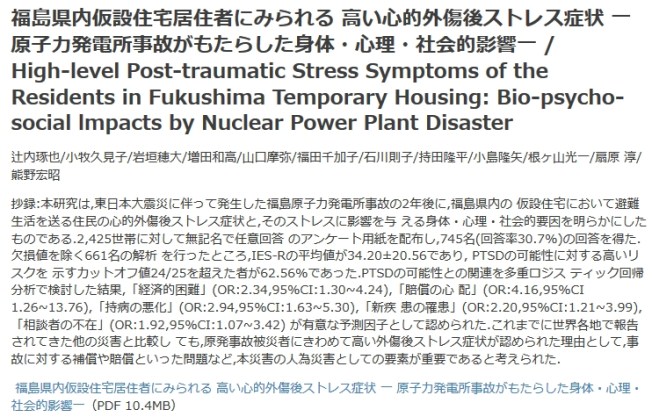
Takuya Tsujiuchi, Kumiko Komaki, Takahiro lwagaki, Kazutaka Masuda, Maya Yamaguchi, Chikako Fukuda, Noriko Ishikawa, Ryuhei Mochida, Takaya Kojima, Koichi Negayama, Atsushi Ogihara, Hiroaki Kumano
Backgrounds: Fukushima nuclear power plant disaster occurred following the Great East Japan Earthquake on March 11,2011. It bears comparison with the incident in Chernobyl in 1986 in the degree of radiological contamination to the surrounding environment.164,218 residents were displaced losing their home-land by this serious incident, of which 97,321 were relocated to other regions within the Fukushima prefecture, and 57,135 residents were relocated to other prefectures. The evacuees from Fukushima can be considered the largest number of internally displaced persons’ or ‘domestic refugees’ in Japan after the world war two.
Objective:This study investigated the scale of post-traumatic stress(PTS)symptoms in the evacuees as of two years after the Fukushima nuclear power plant disaster. It also tried to identify the impact of bio-psycho-social factors related to PTS symptoms.
Samples and methods:Questionnaire survey was conducted by Waseda University and Japan Broadcasting Corporation(NHK). 2,425 households living at temporary housings within Fukushima prefecture were asked to answer the Impact of Event Scale-Revised(IES-R)and the self-report questionnaires that we generated in order to evaluate the damage by the disaster in relation to several bio-psycho-social factors in refugee lives. There were 745 replies(the cooperation rate;30.7%),of which 661 were analyzed. Besides, multiple logistic regression analysis was performed to examine several bio-psycho-social factors as predictors for probable PTSD.
Results:High level PTS symptoms were found. The mean score of IES-R was 34.20±20.56, and 62.56%were over 24/25 cut-off point determined as broadly defined PTSD which means high-risk presence of probable PTSD. The significant differences by chi-square test of high-risk subjects were found among economic difficulty (P=.000), concerns about compensation (p=.000), lost jobs (p=.023), unsatisfying housing (p=.025), unsatisfying environment around temporary housing (p=.000), having chronic disease (p=.003), aggravation of chronic disease (p=.000), affection of new disease (p=.000), lack of necessary information (p=.000), family split-up (prO31), and lack of acquaintance support (p=.000). By the result of multiple logistic regression analysis, the significant predictors of probable PTSD were economic difficulty (OR:2.34,95%CI:1.30-4.24), concerns about compensation (OR:4.16,95% CI 1.26-13.76), aggravation of chronic disease (OR:2.94,95%CI:1.63-5.30), affection of new disease (OR:2.20,95%CI:1.21-3.99), and lack of acquaintance support (OR:1.92,95%CI:1.07-3.42).
Conclusion:The findings revealed that there is a high-risk presence of probable PTSD strongly related to a number of bio-psycho-social factors due to the nuclear power plant disaster and its consequent evacuation. Our findings underscore the specific characteristics of the nuclear disaster as man-made disaster. Since the socio-economic problems such as compensation and reparation have not been solved, it is suggested that prolonged uncertainty regarding the insufficient salvation of the evacuees might account for the high-level PTS symptoms.
(Received August 9,2015;accepted January 9,2016)
In Fukushima, A Bitter Legacy Of Radiation, Trauma and Fear
Five years after the nuclear power plant meltdown, a journey through the Fukushima evacuation zone reveals some high levels of radiation and an overriding sense of fear. For many, the psychological damage is far more profound than the health effects.
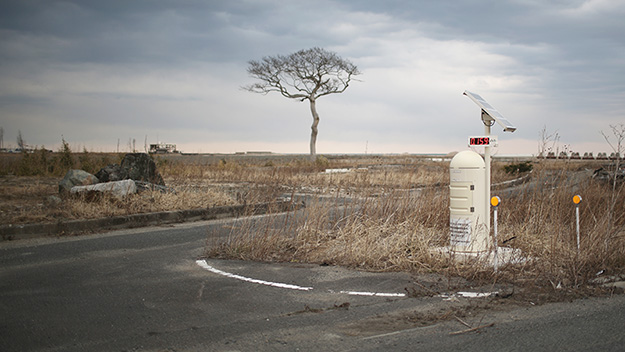
A radiation monitoring station alongside a road in Namie, Japan.
Japan’s Highway 114 may not be the most famous road in the world. It doesn’t have the cachet of Route 66 or the Pan-American Highway. But it does have one claim to fame. It passes through what for the past five years has been one of the most radioactive landscapes on the planet – heading southeast from the Japanese city of Fukushima to the stricken nuclear power plant, Fukushima Daiichi, through the forested mountains where much of the fallout from the meltdown at the plant in March 2011 fell to earth.
It is a largely empty highway now, winding through abandoned villages and past overgrown rice paddy fields. For two days in August, I traveled its length to assess the aftermath of the nuclear disaster in the company of Baba Isao, an assemblyman who represents the town of Namie, located just three miles from the power plant and one of four major towns that remain evacuated.
At times, the radiation levels seemed scarily high – still too high for permanent occupation. But radiation was just the start. More worrying, I discovered, was the psychological and political fallout from the accident. While the radiation – most of it now from caesium-137, a radioactive isotope with a half-life of 30 years – is decaying, dispersing, or being cleaned up, it is far from clear that this wider trauma has yet peaked. Fukushima is going to be in rehab for decades.
I began my journey with Baba, a small bustling man of 72 years, at Kawamata, a town on Highway 114 that is a gateway to the mountains beyond. These mountains are where the fallout was greatest, and the forests that cover most of their slopes have retained the most radioactivity. The mountains make up most of the government-designated “red zone,” where radiation doses exceed 50 millisieverts a year and which are likely to remain uninhabited for many years.
A second “yellow zone” has doses of 20-50 millisieverts, where returning may soon be possible; and a third “green zone,” with less than 20 millisieverts, is deemed safe to live in, and an organized return is under way or planned. Zones are re-categorized as radioactivity decays and hotspots are decontaminated.
To check progress, I took with me a Geiger counter that measured gamma radiation, the main source of radiation for anyone not eating contaminated food.
Beyond Kawamata, the road was largely empty and houses sat abandoned and overgrown. There was no cellphone signal. At first, houses we measured at the roadside had radiation doses equivalent to only around 2 millisieverts per year, a tenth of the government threshold for reoccupation. But within minutes, as we climbed into the mountains, radiation increased as we moved from green to yellow to red zones.
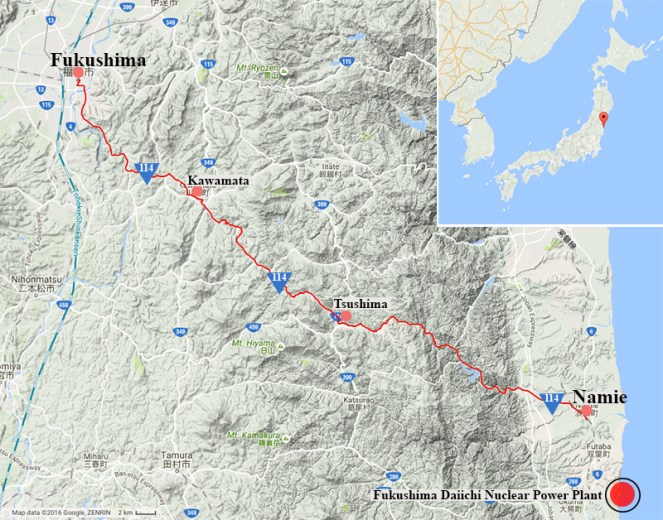
A map tracing Japan’s Highway 114 through the Fukushima evacuation zone
Despite the radiation, wildlife is thriving in the absence of people, Baba said. There are elk, wolves, lynx, monkeys, and bears in the mountains. “Nature here is beautiful,” he said, “but we can’t fish or collect bamboo shoots or eat the mountain vegetables that people used to harvest from the forests.”
We stopped by an abandoned gas station in Tsushima, a village in the lee of Mount Hiyama, where wild boar had excavated the soil right by a vending machine that appeared remarkably intact. The bright-red digital display on an official Geiger counter read the equivalent of 21 millisieverts per year, just above the limit for human habitation.
The day after the disaster at the power plant began, 1,400 people from Namie came to Tsushima after being ordered to evacuate. “I was among them,” said Baba. “We had no information. People were just told to come. When we arrived, we went to the village police station and found that the police there were in full protective clothing against the radiation. They said it was a precaution in case they had to go to the power plant, but they had obviously been told that something serious was going on that the population hadn’t been told. That’s when our suspicion about the honesty of the authorities began.”
Tsushima has since become an unofficial shrine to the disaster. In the window of an abandoned shop are posters with bitter, ironic messages, some directed at the nuclear plant’s operator, Tokyo Electric Power: “Thanks to TEPCO, we can shed tears at our temporary housing,” read one. “Thanks to TEPCO, we can play pachinko.” But one, in English, just said, “I shall return.”
Back on Highway 114, a car stopped, and a woman got out. Konno Hidiko was driving to Namie – day trips are allowed, but overnight stays banned – to clean her parents’ former house and tidy an ancestral grave before relatives visited during an upcoming religious holiday. “My parents are dead now, but I still clean their house,” she said. “There are mice inside and wild boar have been in. We won’t ever return to live there. But we might build a new house there one day.”
Further along, Baba stopped the car and walked up a path swathed in vegetation. “This is my house,” he said suddenly, pointing to a barely visible building. It was shuttered. But I noticed laundry still hanging to dry in an upstairs window. On a tour of the grounds, Baba showed me his plum trees. “The fruit is too dangerous to eat now, and we can’t drink the water from the well, either.” We found a shed where he and his schoolteacher wife once kept cattle, and a former hay shed where he stored old election banners.
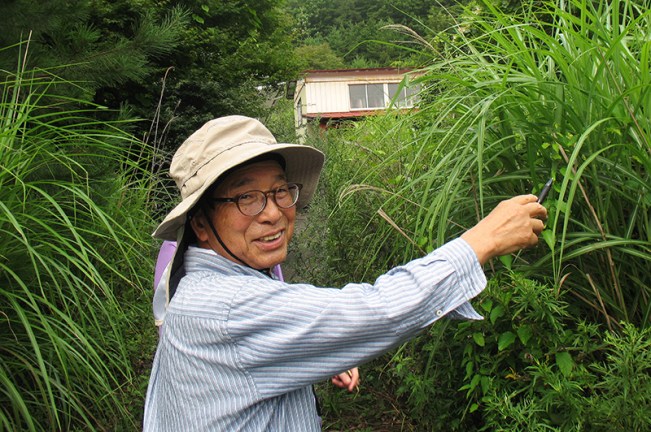
Baba Isao approaches his abandoned house in Namie.
I checked my meter. It read 26 millisieverts per year in the hay shed, but shot up to an alarming 80 in undergrowth outside. That was four times the safe level for habitation. No wonder Baba had no plans to return. “I am just the son of a farmer. I wonder who has a right to destroy our home and my livelihood,” he mused bitterly. “Please tell the world: No Nukes.”
At his local post office, an official monitor by the road measured 56 millisieverts. Mine agreed, but when we pointed it close to a sprig of moss pushing through the tarmac, it went off the scale. “They measured 500 millisieverts here last week,” Baba said. “Moss accumulates radioactivity.”
As we drove on, the roadside was now marked every few kilometers by massive pyramids of black plastic bags, containing radioactive soil that had been stripped from roadside edges, paddy fields, and house gardens as part of government efforts to decontaminate the land. An estimated 3 million bags, all neatly tagged, now await final disposal at facilities planned along the coast. But the task of transporting the soil is so huge that the authorities are building a new road so trucks can bypass the scenic mountain villages along Highway 114.
Through a checkpoint we came at last to Namie town. Just before my visit, major media such as The Guardian and CNN had published images of the town by a photographer who claimed to have gained secret, unauthorized entry to the “ghost town.” He posed in his images wearing a gas mask to show how dangerous it was.
My visit to the town had required a request in advance, via Baba, but no subterfuge. And I found Namie a surprisingly busy “ghost town.” Nobody is yet allowed to live there. But some 4,000 people work there every day, repairing the railway line and roads, building new houses, and knocking down quake-damaged shops, preparing for the planned return of its citizens in April 2017.
There was plenty of earthquake damage, and vegetation pushed through cracks in the roads and the pavement in the front yards. Black bags were everywhere. But the traffic lights functioned, and drivers obeyed them; there was a 7-Eleven and the vending machines had Coke in them. Nobody wore protective clothing or masks. My biggest safety concern was not radiation, but the news, conveyed over the town’s public address system on the afternoon I was there, that a bear had been spotted in the suburbs.
Despite its proximity to the power plant, average radiation levels in the town were down to around 2 millisieverts per year in Namie – lower, in fact, than I recorded in Fukushima City, which was never evacuated.
“I have no idea how many people will come back,” said Baba. “They have a lot of misgivings because of the radioactive contamination. And I think their fears are totally justified. It is totally unthinkable for me to return to my old place, so I cannot encourage them to return to theirs.” He quoted a survey of the town’s 21,000 former residents showing that only 18 percent wanted to come back. That sounded similar to nearby Naraha town, where only a fifth returned after the all-clear was given last year.
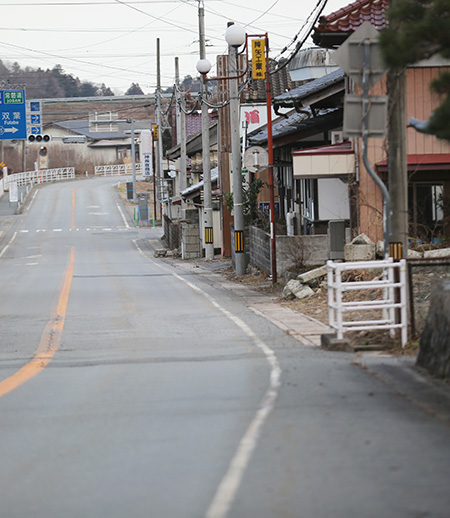
A deserted street in Namie in early 2016.
People especially feared for their children. The biggest concern was reports of an epidemic of thyroid cancer among children exposed to radioactive iodine in the days after the accident. An ultrasound screening program had found an apparent 30-fold increase in cysts, nodules, and some cancers in children’s thyroid glands. It had made headline news.
But at the Fukushima Medical University, doctors and medical researchers insisted that radiation doses were far too low to pose a serious cancer risk, not least because contaminated foodstuffs that could have harbored the iodine were rapidly withdrawn from sale. Ken Nollet, an American who is director of radiation health at the university, insists that the apparent epidemic was evidence only of better searching for disease. He told me a Korean screening study using the same techniques on a non-exposed population found similar rates to those in Fukushima’s contaminated zone.
Thanks to the rapid, if chaotic, evacuation of the area after the power plant began its meltdown, and the controls of foodstuffs, doctors say they believe there are unlikely to be many, if any, deaths among the public from radiation from the Fukushima accident. “A few members of the public got a CT scan’s worth of radiation; almost nobody received more than the dose from a barium meal,” said Nollet.
But there have been deaths nonetheless. Some 60 old people died as a direct result of the evacuation, including several who died of hunger after being left behind, said a doctor at Soma hospital, Sae Ochi. And depression remains widespread among evacuees, she says. There have been around 85 suicides linked to its after-effects. “It’s post-traumatic stress,” said Masaharu Maeda at Fukushima Medical University. “People with very negative views about the risks of radiation are more likely to be depressed. It’s a vicious circle.”
Some doctors told me that while the initial evacuation was necessary, the failure to plan a swift return as radiation levels fell had been disastrous. Apart from a few high-dose areas in the mountains, the psychological risks of staying away exceed the radiological risks of coming back. But the confusion has contributed to a serious loss of trust among the public for medical, as well as nuclear, authorities. “When we try to explain the situation,” says Nollet, “we are seen as complicit in nuclear power.”
It seems increasingly unlikely that the majority of families will return to the abandoned towns as the official all-clear is given. As we drove back from Namie, I dropped in on a group of old women living in an evacuation camp outside Kawamata. One told me they wanted to return to their old homes, but that “most young people simply won’t go back. They fear for their children, but also they have moved on in their lives, with new jobs and their children in new schools.”
And maybe that is not a bad thing. At a kindergarten in Soma City, just outside the exclusion zone, teachers told me that, away from the fear of radiation, there was a baby boom going on there. The crop of new students this year was the largest since the accident.
http://e360.yale.edu/feature/fukushima_bitter_legacy_of_radiation_trauma_fear/3035/
6th Citizen-Scientist International Symposium on Radiation Protection Date: Friday, October 7 – Monday, October 10, 2016
From the Reality of Chernobyl and Fukushima
Date: Friday, October 7 – Monday, October 10, 2016
Venue: Main Hall, Fukushima Gender Equality Centre 1-196-1 Kakunai, Nihonmatsu, Fukushima, 964-0904
The Citizen-Scientist International Symposium on Radiation Protection (CSRP), a politically, financially, ideologically and religiously independent non-profit organization, has been committed to keeping to minimum the damages on health and environment caused by the Tokyo Electric Fukushima Daiichi Nuclear Power Plant disaster that followed the Great East Japan Earthquake and Tsunami in March 11, 2011.
CSRP has been inviting administrative officials, researchers, NGOs, member experts of governmental inquiry commissions and international organizations working on radiation protection, etc. Since around the 3rd CSRP, this approach has started to bear fruit, because scientists and other stakeholders with different positions and paradigms began to share the same table of discussion, thus gradually making possible constructive exchange of views.
In the course of this approach, however, we began to encounter a new challenge that may concern the premise of the CSRP; the deeper we got into scientific discussion, the higher the hurdle for participation got for the general public, especially for younger generations. Also, the diversity of voices were to be alienated from pointed scientific discussions that are decisive for the decision-making of the radiation protection of the general public. This lead us to some interrogations : “Isn’t ‘science’ given too much importance in decision-making?”; “Is ‘science’ the only way for citizens to bring today’s situation under their power?”
While always continuing to examine new scientific findings with respect to health, environmental and social impacts of low-dose exposure, we added the theme of “Between Art and Science” to the 5th symposium last year, exposed various art works inspired by nuclear power and nuclear disasters, and organized a panel discussion with artists and scientists. This was the CSRP’s new attempt to question “science” and “scientificity” with a view to reexamining the relationships between science, art and philosophy before and after the modernity. The 6th CSRP of this year, held in the city of Nihonmatsu, Fukushima Pref., will collaborate with the Institute of Regional Creation by Arts, the University of Fukushima, to cosponsor the Fukushima Biennale 2016. We hope this new attempt will bring new visions to the participants.
As a place to learn and make full use of new findings exploring the effects of low-dose radiation exposure accumulating day by day, and to think together about the rights of people facing the consequences of the nuclear accident and about what epidemiology and public health should do in order to minimize the damage, we open the 6th Citizen-Scientist International Symposium on Radiation Protection.
Photos show nuclear tragedy’s toll on pets
“They never came back because the radiation levels were too high. The animal rescue teams knew the animals were abandoned and left there, so they had three weeks to go in there to find them,” said O’Connor, who added that farm animals usually had to be euthanized.

Akira Honda, founder of Nyander Guard Animal Rescue, shows photos of animals left behind in the aftermath of the 2011 earthquake, tsunami and nuclear disaster in Japan. The photos are on display at Ventura County Animal Services’ Camarillo shelter.
Shortly after the Fukushima Daiichi nuclear disaster in 2011 in Japan, nearby residents were immediately evacuated from their homes because of the risk of radiation exposure. They were forced to leave their animals behind.
Akira Honda, nicknamed Taicho, immediately raced to the disaster area from his hometown six hours away to help, and realized the need for an animal shelter near the radiation-contaminated exclusion zone.
A month later, Taicho established the Nyander Guard Animal Rescue about 25 miles away.
Photos of the animal rescue operation in Japan are being exhibited until Tuesday at the Ventura County Animal Services shelter in Camarillo. A fundraiser is also being held for the continued care of animals at Nyander Guard.
Taicho toured the no-kill Camarillo shelter, met with Camarillo Mayor Mike Morgan and shared his story with visitors to the shelter on Saturday.
Visitors to the exhibit have an opportunity to donate to Nyander Guard, which has rescued 740 dogs and cats and currently cares for more than 200 animals.
Kerry O’Connor, a Nyander Guard volunteer from Camarillo who now lives in Japan, helped bring the photo exhibit to the Camarillo shelter. Some of the photos of animals with severe injuries are too graphic and are kept in a separate notebook that can still be viewed.
O’Connor went to Japan to volunteer after the nuclear disaster that followed an earthquake and tsunami. She said residents in Fukushima were assured they’d be back at home after a day or so, so they left their animals.
“They never came back because the radiation levels were too high. The animal rescue teams knew the animals were abandoned and left there, so they had three weeks to go in there to find them,” said O’Connor, who added that farm animals usually had to be euthanized.
“A lot of people were scared but realized saving the animals was the right thing to do,” said O’Connor, who translated for the Japanese-speaking Taicho.
She said the rescued dogs and cats had been exposed to radiation.
“But unless you had a really high dosage in a short amount of time, it really does not affect them until about 30 years later, and they don’t live that long,” O’Connor said.
Taicho had a cat rescue operation before he started Nyander Guard.
At Nyander Guard, cats are able to roam in cat rooms, while bigger dogs have spacious kennels and smaller dogs are kept indoors. The dogs are walked twice a day and sometimes taken on trips to parks.
Although five years have passed since the disaster, the shelter still rescues and feeds abandoned animals in the restricted areas, which are becoming extremely hard to enter.
In addition to Nyander Guard, Taicho recently acquired another shelter that aided in rescuing the Fukushima animals, which tripling the staff’s work.
His goal is to make Japan a place where animals shelters are no-kill and to start a national protection organization.
http://www.vcstar.com/story/news/2016/09/17/photos-show-nuclear-tragedys-toll-pets/90376664/
Study on the impact of the Fukushima Nuclear Accident On Animals:
(Adobe. 64pg. PDF.)
Information about malformations of fetus and abortions in Fukushima
This video is from April 9, 2016, 6 months ago.
Two evacuated women from Fukushima talk about their experiences. One of them gives information about malformations of fetus and abortions.
With English subtitles which are not great but you can follow the story.
Long-term stays start in Tomioka
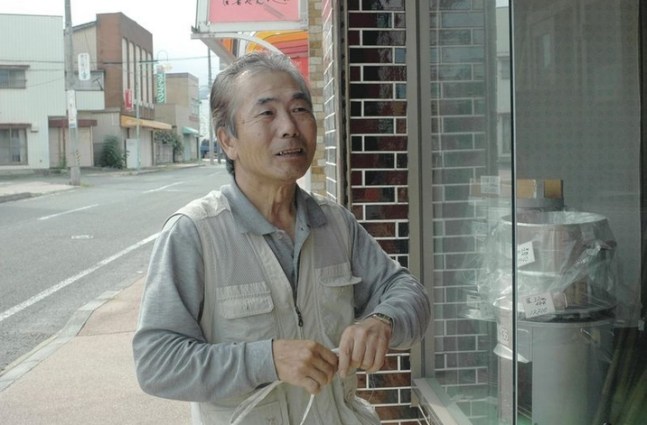
Shizuo Suzuki stands in front of his shop in Tomioka, Fukushima Prefecture, on Wednesday, with the empty shopping street visible in the background.
TOMIOKA, Fukushima — Long-term stays (see below) for residents of Tomioka, Fukushima Prefecture, started on Saturday. Evacuation orders for the town limits issued after the accident at Tokyo Electric Power Company Holdings, Inc.’s Fukushima No.1 nuclear power plant still stand.
The success of the project will hinge on how many residents the town can get back, with a view to having the evacuation orders lifted in April next year.
Shizuo Suzuki, 63, who resumed business 2½ years ago on a shopping street in the town’s Chuo district, which is part of a zone people are allowed to enter during the daytime, is hoping for some of the bustle of the town to return.
Suzuki’s hardware shop is on Chuo shopping street, which is on the west side of the JR Joban Line’s Tomioka Station. Suzuki took over the shop, which was established in 1952, after his father died in 1998. Before the 2011 Great East Japan Earthquake, the shop mainly dealt with materials such as cement, gravel and reinforced steel, supplying local building companies.
Although the earthquake didn’t do much damage to the shop, the nuclear plant accident which followed forced Suzuki and his 58-year-old wife to move out. After they drifted around various places in Fukushima Prefecture, including a gymnasium in Kawauchi, a neighboring village to the west of Tomioka, and a home of their relatives in Aizuwakamatsu, they finally settled in Iwaki.
Entering Tomioka became easier when the government eased regulations in 2013. The area around Suzuki’s shop was designated a residence restriction zone, making it possible for him to resume business there.
Suzuki, who was then working part-time at a construction company in Iwaki, decided to go back to his shop in January 2014. Although he did not know how many customers would come, he was looking forward to working in his hometown again.
“I wanted to stay positive and uphold my sense of purpose in life,” he said. Commuting from Iwaki, he cleaned up the shop and resumed business in March 2014, after decontamination of the area was complete.
Suzuki still commutes to Tomioka from Iwaki, which takes about an hour each way by car. The shop is open from 9 a.m. to 3 p.m. Five or six workers involved in decontamination work or building demolition in the neighborhood visit the shop daily and purchase items such as shovels, crowbars and ropes. As Suzuki’s shop is the only one to have resumed business in the area, the bustle of the shopping street has not yet returned.
According to the municipal government, shops that have reopened other than Suzuki’s are limited to convenience stores and gas stations. The town plans to open a commercial facility, publicly funded and privately operated, that includes a home-improvement center and restaurants at the end of November, for long-term-stay residents and in preparation for the lifting of evacuation orders.
“Streets will come back to life as people start returning for long stays. I hope other shops will resume business too,” Suzuki said. He had his home next to the shop demolished as it had decayed while he was away. He intends to rebuild his house and live in the town when other residents start to return.
■ Long-term stay
In anticipation of the lifting of evacuation orders, registered residents are allowed to stay in their houses to find out what problems they may face when they return to the town. The number of registered residents in Tomioka, Fukushima Prefecture, as of July 12 was 9,679 from 3,860 households. According to the central government, 119 residents from 56 households have applied for long-term stays as of Thursday.
1 This Month
10 March A LIVE WEBINAR THE REAL EFFECTS OF NUCLEAR POWER
What the Industry Isn’t Telling Us
1:00 PM Mountain, 2 pm Central, 3 pm Eastern. Live on the Keepers of the Water Facebook page



18 March Webinar @ 1 PM EST: An Assessment of SMR Projects: The Case of Canada
register for the zoom:
https://us02web.zoom.us/webinar/register/WN_o8BIIOUvQ2ONJR1nta65DQ#/registration


of the week – STOP SMALL MODULAR REACTORS IN CANADA
To see nuclear-related stories in greater depth and intensity – go to https://nuclearinformation.wordpress.com
-
Archives
- March 2026 (109)
- February 2026 (268)
- January 2026 (308)
- December 2025 (358)
- November 2025 (359)
- October 2025 (376)
- September 2025 (258)
- August 2025 (319)
- July 2025 (230)
- June 2025 (348)
- May 2025 (261)
- April 2025 (305)
-
Categories
- 1
- 1 NUCLEAR ISSUES
- business and costs
- climate change
- culture and arts
- ENERGY
- environment
- health
- history
- indigenous issues
- Legal
- marketing of nuclear
- media
- opposition to nuclear
- PERSONAL STORIES
- politics
- politics international
- Religion and ethics
- safety
- secrets,lies and civil liberties
- spinbuster
- technology
- Uranium
- wastes
- weapons and war
- Women
- 2 WORLD
- ACTION
- AFRICA
- Atrocities
- AUSTRALIA
- Christina's notes
- Christina's themes
- culture and arts
- Events
- Fuk 2022
- Fuk 2023
- Fukushima 2017
- Fukushima 2018
- fukushima 2019
- Fukushima 2020
- Fukushima 2021
- general
- global warming
- Humour (God we need it)
- Nuclear
- RARE EARTHS
- Reference
- resources – print
- Resources -audiovicual
- Weekly Newsletter
- World
- World Nuclear
- YouTube
-
RSS
Entries RSS
Comments RSS
 nuclear-news