77.2 Billion Dollars in Public Funds Sought for Post-Fukushima Disaster Costs
They were telling us that nuclear energy was safe and cheap….

8 trillion yen in public funds sought for post-Fukushima disaster costs
The Federation of Electric Power Companies of Japan (FEPC) has informally asked the government to inject some 8 trillion yen in public funds into efforts for nuclear damage compensation and decontamination work in areas around the Fukushima No. 1 nuclear power plant, it has been learned.
The FEPC has drawn up a report stating that an extra 8 trillion yen is estimated to be necessary even after Tokyo Electric Power Co. (TEPCO) and other major utilities shoulder the planned amount of costs for dealing with the aftermath of the Fukushima disaster, and has informally requested that the government foot the surplus amount. The government has heretofore taken the position that nuclear plant operators should bear the costs for nuclear damage compensation and decontamination work in principle. It is therefore expected to approach the request with caution.
The costs for Fukushima disaster damage compensation and decontamination work are funded under the following steps: the state issues cashable government compensation bonds to the Nuclear Damage Compensation and Decommissioning Facilitation Corp. (NDF), a government-authorized corporation; TEPCO then receives necessary funds from the NDF and spends them on nuclear damage compensation and decontamination work; the NDF then receives due contributions from TEPCO and other major utilities and pays back the funds to the state.
Among the contributions made by power companies to the NDF, funds for nuclear damage compensation are shouldered by TEPCO and other major utilities, and the funds for decontamination work are covered by profits on the sale of TEPCO shares held by the NDF, while the funds for building interim storage facilities for radioactive waste are covered by revenues from the tax on the promotion of power resources development.
In 2013, the government estimated that nuclear damage compensation would cost 5.4 trillion yen, while decontamination work would require 2.5 trillion yen and construction costs for temporary storage facilities for radioactive waste and other expenses would need 1.1 trillion yen. The total amounts to be granted to the NDF were estimated at a maximum 9 trillion yen.
However, the FEPC now forecasts that damage compensation would cost 2.6 trillion yen more at 8 trillion yen and the decontamination expenses 4.5 trillion yen more at 7 trillion yen, according to sources familiar with the matter. Furthermore, the FEPC forecasts that profits on the sale of TEPCO shares would be 1 trillion yen less than the initial estimate due to a fall in the stock prices, bringing the total fund shortages to 8.1 trillion yen.
Major utilities fear that they would ultimately be forced to shoulder the additional burden as the enormous costs for decontamination work cannot be covered by profits on the sale of TEPCO shares.
The FEPC has unofficially asked that the government foot the extra amount of costs necessary for nuclear damage compensation and decontamination work on the grounds that the business environment for major utilities has deteriorated amid the stalled reactivation of nuclear reactors that have been left idle since the Fukushima disaster and the intensifying competition among power companies following the liberalization of the electricity retail market this past spring.
While TEPCO has forked out 2 trillion yen for the decommissioning of disaster-stricken reactors at the Fukushima No. 1 nuclear plant, several trillion yen extra is projected to be necessary to cover the expenses. In July, Tokyo Electric Power Company Holdings Inc. asked for government assistance in covering the expenses for reactor decommissioning at the plant and other efforts. The FEPC’s recent request to the government, meanwhile, does not include financial assistance for reactor decommissioning.
The government is poised to discuss the costs for Fukushima disaster damage compensation and reactor decommissioning at a panel on TEPCO reform and Fukushima No. 1 plant issues to be convened on Oct. 5, where the FEPC’s request is likely to be deliberated on.
http://mainichi.jp/english/articles/20161004/p2a/00m/0na/017000c
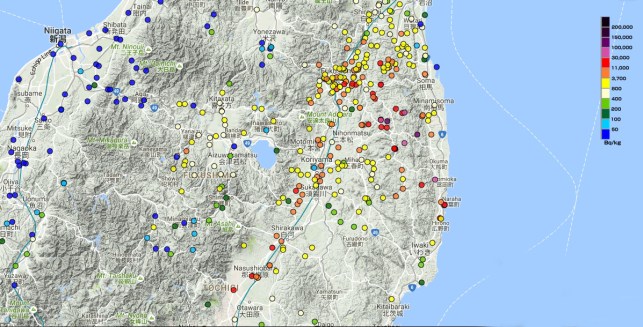
Eastern Japan Soil Becquerel Measurement Project Map



Iwaki City
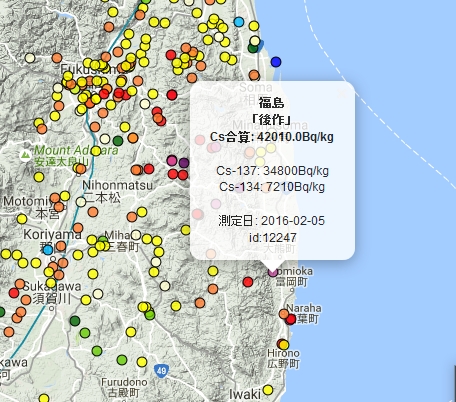
Tomioka
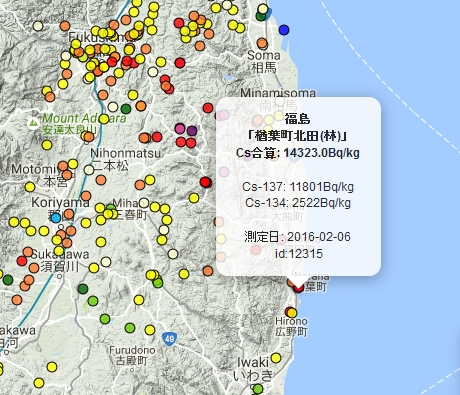
Naraha
Source Minna no Data website:
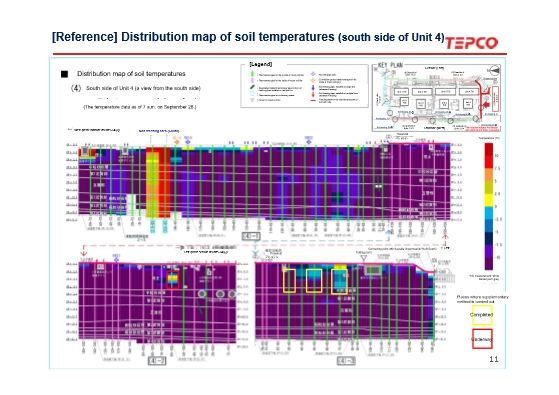
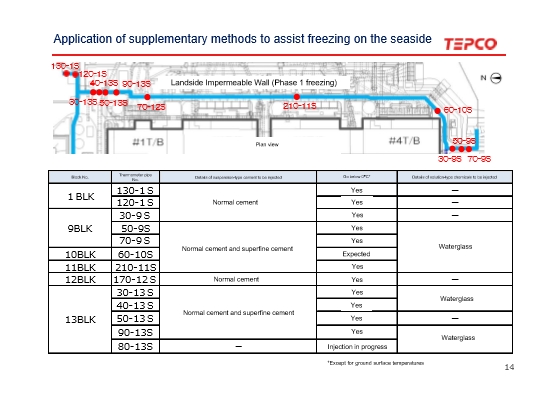
TEPCO Continues Injecting Concrete and a Soil Solidification Substance in Areas of the Frozen Wall
TEPCO also continues to inject concrete and a soil solidification substance in areas of the frozen wall that have been resistant to proper freezing.
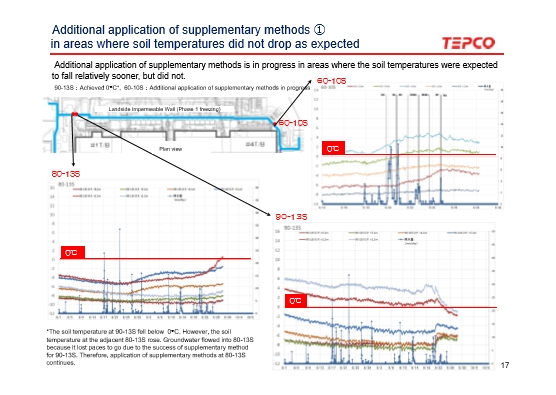
Groundwater levels inside the reactor areas has been on the rise due to more success freezing the sea side section of the wall.
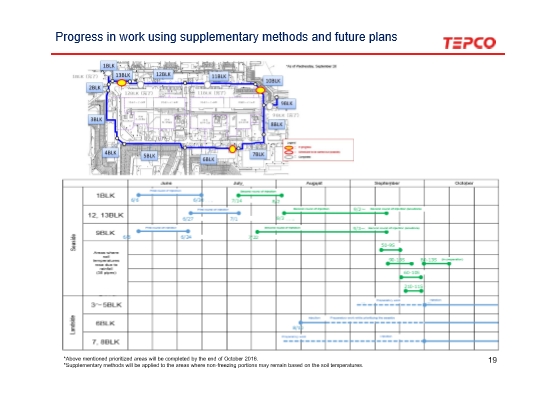
Therefore, application of supplementary methods at 80-13S continues.” Efforts to cement sections of the land side wall have begun and will take place through October.
They asked the NRA again within the last week for permission to freeze the remaining sections of the land side frozen wall sections.
TEPCO states that they have frozen 95 percent of the land side section of the wall.
TEPCO published a new report on the frozen wall dated September 29.
Another typhoon may hit Fukushima prefecture this week, if it does it may cause further problems with the frozen wall.
There was also a concerning note buried later in the report related to a section where they had used concrete to block the water flow.
So the concrete work just caused the water flow to divert to another part of the wall.
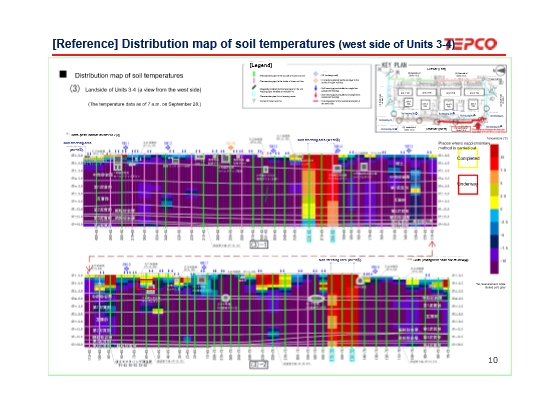
Progress of Landside Impermeable Wall freezing: Phase 2 of the first stage
○The purpose of the Landside Impermeable Wall construction lies not in freezing soil to form an underground wall but in keeping groundwater fromflowing into the reactor/turbine buildings and preventing new contaminated water from being generated.
○By closing less than 95 percent of the mountainside of the Landside Impermeable Wall inPhase2 of the first stage, it is expected that the amount of groundwater flowing into the areas around the reactor/turbine buildings will be reduced. This will help keep groundwater from being contaminated during the first stage.
○Throughout the first stage, how freezing of the Landside Impermeable Wall has progressed will be checked by monitoring thedifference in groundwater levels inside and outside of the wall and the amount of groundwater pumped up by the subdrain and groundwater drainsystems and the well point system.







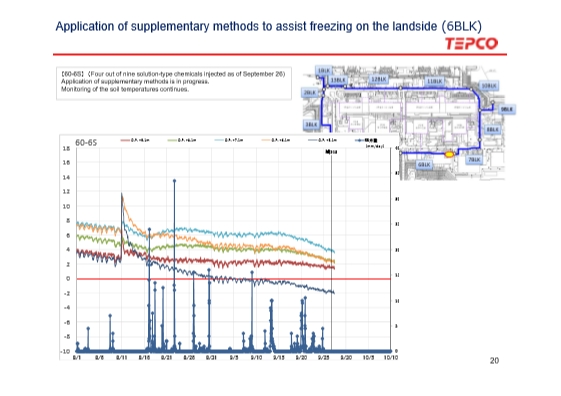
Read more Pdf:
http://www.tepco.co.jp/en/nu/fukushima-np/handouts/2016/images/handouts_160728_02-e.pdf
Increases in perinatal mortality in prefectures contaminated by the Fukushima nuclear power plant accident in Japan: A spatially stratified longitudinal study.
“Radiation damage spreading to Fukushima and other Tohoku Prefectures, and Kanto Prefectures Tokyo, Saitama, Chiba, is demonstrated. Perinatal mortality is increasing, it has been announced for the first time in peer-reviewed medical journals the Fukushima/Perinatal mortality link.”
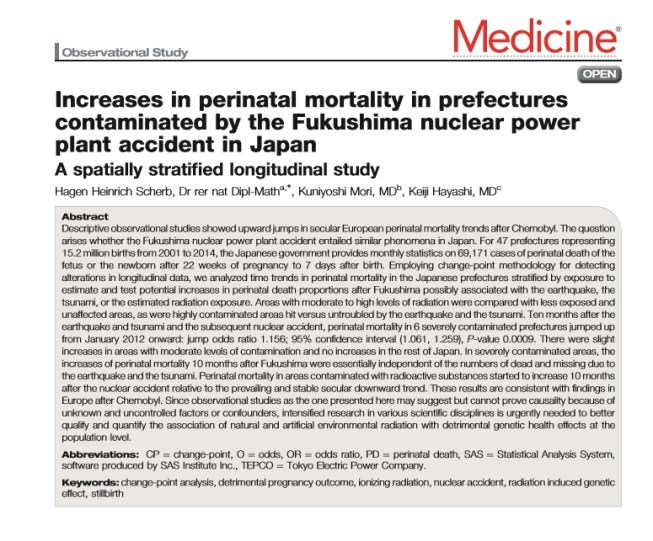

Abstract
Descriptive observational studies showed upward jumps in secular European perinatal mortality trends after Chernobyl.
The question arises whether the Fukushima nuclear power plant accident entailed similar phenomena in Japan.
For 47 prefectures representing 15.2 million births from 2001 to 2014, the Japanese government provides monthly statistics on 69,171 cases of perinatal death of the fetus or the newborn after 22 weeks of pregnancy to 7 days after birth.
Employing change-point methodology for detecting alterations in longitudinal data, we analyzed time trends in perinatal mortality in the Japanese prefectures stratified by exposure to estimate and test potential increases in perinatal death proportions after Fukushima possibly associated with the earthquake, the tsunami, or the estimated radiation exposure.
Areas with moderate to high levels of radiation were compared with less exposed and unaffected areas, as were highly contaminated areas hit versus untroubled by the earthquake and the tsunami.
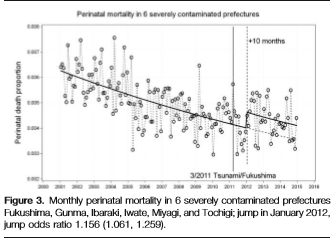
Ten months after the earthquake and tsunami and the subsequent nuclear accident, perinatal mortality in 6 severely contaminated prefectures jumped up from January 2012 onward: jump odds ratio 1.156; 95% confidence interval (1.061, 1.259), P-value 0.0009.
There were slight increases in areas with moderate levels of contamination and no increases in the rest of Japan.
In severely contaminated areas, the increases of perinatal mortality 10 months after Fukushima were essentially independent of the numbers of dead and missing due to the earthquake and the tsunami.
Perinatal mortality in areas contaminated with radioactive substances started to increase 10 months after the nuclear accident relative to the prevailing and stable secular downward trend.
These results are consistent with findings in Europe after Chernobyl. Since observational studies as the one presented here may suggest but cannot prove causality because of unknown and uncontrolled factors or confounders, intensified research in various scientific disciplines is urgently needed to better qualify and quantify the association of natural and artificial environmental radiation with detrimental genetic health effects at the population level.


https://www.ncbi.nlm.nih.gov/pubmed/27661055
http://ebm-jp.com/2016/10/media2016002/
Read more on the PDF:
http://ebm-jp.com/wp-content/uploads/media-2016002-medicine.pdf
Tainted Water Grows at Fukushima N-Plant despite Ice Wall

Tokyo, Oct. 2 (Jiji Pres)–Six months into operation, the much-hyped underground ice wall has not yet produced the intended effects of curbing the growth of radioactive water at Tokyo Electric Power Company Holdings Inc.’s stricken Fukushima No. 1 nuclear plant.
TEPCO initially claimed that the ice wall would prove effective in about a month and half, but the amount of contaminated water at the plant has continued to increase at a pace faster than projected by the utility.
The plant in northeastern Japan faces a chronic shortage of welded-type water storage tanks, while an increasing volume of tainted water has been transferred to the reactor and turbine buildings as a makeshift measure despite a high risk of leaks.
TEPCO constructed the 1.5-kilometer-long ice wall encircling the plant’s damaged No. 1 to No. 4 reactors in an attempt to block groundwater from flowing into reactor buildings and mixing with radioactive water accumulating inside.
The government has to date spent a total of 34.5 billion yen in the construction of the structure by freezing underground soil, which is believed to be technically very difficult.
Bioaccessibility of Fukushima-Accident-Derived Cs in Soils and the Contribution of Soil Ingestion to Radiation Doses in Children
Abstract
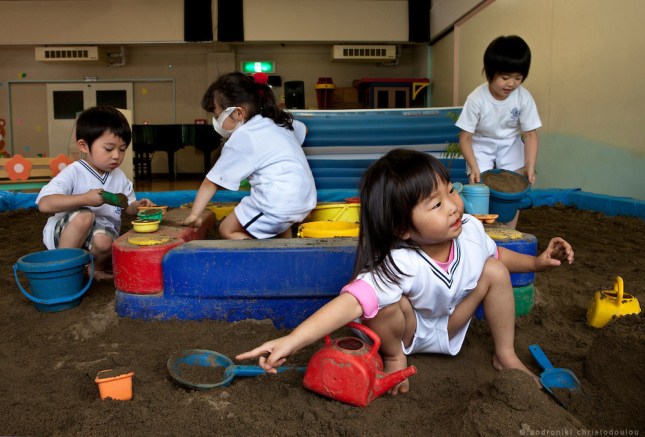
Ingestion of contaminated soil is one potential internal exposure pathway in areas contaminated by the Fukushima Daiichi Nuclear Power Plant accident.
Doses from this pathway can be overestimated if the availability of radioactive nuclides in soils for the gastrointestinal tract is not considered.
The concept of bioaccessibility has been adopted to evaluate this availability based on in vitro tests.
This study evaluated the bioaccessibility of radioactive cesium from soils via the physiologically-based extraction test (PBET) and the extractability of those via an extraction test with 1 mol/L of hydrochloric acid (HCl).
The bioaccessibility obtained in the PBET was 5.3% ± 1%, and the extractability in the tests with HCl was 16% ± 3%. The bioaccessibility was strongly correlated with the extractability. This result indicates the possibility that the extractability in HCl can be used as a good predictor of the bioaccessibility with PBET.
In addition, we assessed the doses to children from the ingestion of soil via hand-to-mouth activity based on our PBET results using a probabilistic approach considering the spatial distribution of radioactive cesium in Date City in Fukushima Prefecture and the interindividual differences in the surveyed amounts of soil ingestion in Japan.
The results of this assessment indicate that even if children were to routinely ingest a large amount of soil with relatively high contamination, the radiation doses from this pathway are negligible compared with doses from external exposure owing to deposited radionuclides in Fukushima Prefecture.
Government likely to retain grip on beleaguered Tepco
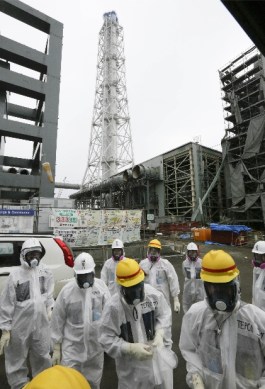
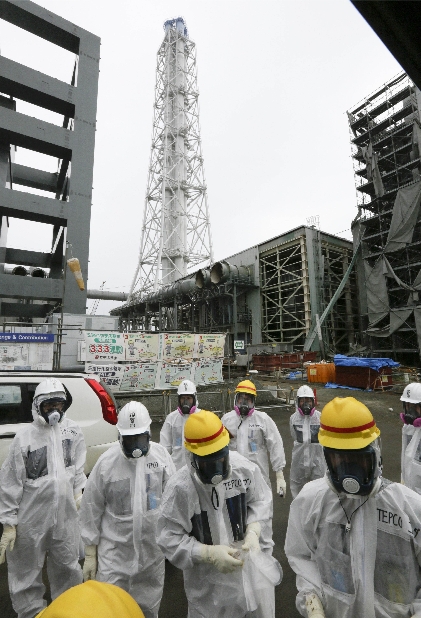
The government might stay involved in the management of Tokyo Electric longer than planned, given the ballooning costs of scrapping the Fukushima No. 1 nuclear power plant, sources close to the matter said.
The delay in reactivating the Kashiwazaki-Kariwa nuclear plant in Niigata Prefecture, the main pillar of the utility’s reconstruction plan, is another factor prompting the government rethink, the sources said Saturday. It had planned to end state control next April.
The government is leading the business operations of struggling Tokyo Electric Power Co. Holdings, which is facing huge compensation payments and other problems from the 2011 Fukushima nuclear disaster, because it has acquired 50.1 percent of the firm’s voting rights via the state-backed Nuclear Damage Compensation and Decommissioning Facilitation Corp.
Some bureaucrats at the Ministry of Economy, Trade and Industry have been dispatched to Tepco.
Tepco said in a business plan in 2014 that it would turn itself from a “temporarily publicly managed” company to a self-managed one starting next April.
The industry ministry will hold the first panel meeting Wednesday to discuss additional government support for the utility.
Tepco faces swelling costs for decommissioning the Fukushima No. 1 plant and compensating those affected beyond the previously estimated ¥11 trillion ($108 billion). Two reactors at the Kashiwazaki-Kariwa plant are under prolonged safety examinations by nuclear regulators.
The prospect of restarting the giant plant is also being complicated by impending changes in the leadership of the Niigata Prefectural Government, which hosts it.
To restart the plant, approval from the Niigata governor is needed.
Hirohiko Izumida, the current governor, was cautious about restarting the reactors because of Tepco’s failure to fully examine the cause of the Fukushima disaster. He withdrew his bid for re-election at the end of August.
Of the four candidates running for the Oct. 16 election, former Nagaoka Mayor Tamio Mori, 67, backed by the Liberal Democratic Party-Komeito ruling coalition, and Ryuichi Yoneyama, a 49-year-old doctor, are leading the race. Yoneyama has said he will follow Izumida’s stance and is opposed to any discussion of restarts unless the Fukushima disaster is thoroughly explained.
Tepco’s new business plan, including the revised schedule for ending state control, is expected to be compiled next January.
Tokyo Electric Power : Gov’t planning to stay involved in TEPCO’s management longer
The government is considering staying involved in Tokyo Electric Power Co.’s business management longer than currently planned, given larger-than-expected costs for scrapping the Fukushima Daiichi nuclear power plant, sources close to the matter said Saturday.
A delay in the process for reactivating its Kashiwazaki-Kariwa nuclear power plant in Niigata Prefecture, a main pillar of the utility’s reconstruction plan, is another factor prompting the government to think it would be too soon to end state control next April as initially planned, they said.
The government is leading business operations of the utility facing huge compensation payments and other problems from the 2011 Fukushima nuclear disaster as it has acquired 50.1 percent of the firm’s voting rights through the state-backed Nuclear Damage Compensation and Decommissioning Facilitation Corp.
Some bureaucrats of the Ministry of Economy, Trade and Industry are dispatched to the utility, known as TEPCO.
TEPCO said in a business plan in 2014 it would turn itself from the “temporarily publicly managed” company to a self-managed one starting next April.
The industry ministry will hold the first panel meeting Wednesday to discuss additional government support for the utility.
TEPCO faces swelling costs for decommissioning the Fukushima Daiichi plant and compensating those affected beyond the previously estimated 11 trillion yen ($108 billion). Two reactors at the Kashiwazaki-Kariwa plant are under prolonged safety examinations by nuclear regulators.
TEPCO’s new business plan including the revised schedule for ending state control is expected to be compiled next January.
Fukushima rice at Matsuri (Japanese cultural) festival in Trafalgar Square, London
Rice was among a number of products from Fukushima being promoted at the festival today, in order to help the recovery of the region. Young women were making their way through the throng holding up huge peaches and apples from Fukushima.
Members of Kick Nuclear London, Japanese Against Nuclear and friends handed out a few hundred copies of the following leaflet to visitors at the festival this afternoon :
Kick Nuclear has created a web page for those who want to find out more: https://kicknuclear.com/fukushima-rice/


Fukushima plant building exposed as TEPCO opens old wounds
The cover on reactor 1 was installed around the building of the devastated the reactor 1 in October 2011 and Tepco plans to dismantle it by December. It remains 17 panels of 20 tonnes to move. Inside, the spent fuel pool with 392 fuel assemblies in it, which Tepco intends to empty starting 2020 …
Now this uncovered “reactor” freely spits its radioactive lungs again in the open air. Yes that’s right. Tepco had mounted this cover to avoid polluting the air. Today we go back to square one.
The three reactors 1, 2 and 3 have lost their seal and radionuclides roam freely. There is simply no way to seal leaks. Even when the pool will be emptied, the problem will still be the same.
The levels of radioactivity escaping from the three reactors are unknown until Tepco wants to give us some figures, still without any true independent body to verify.
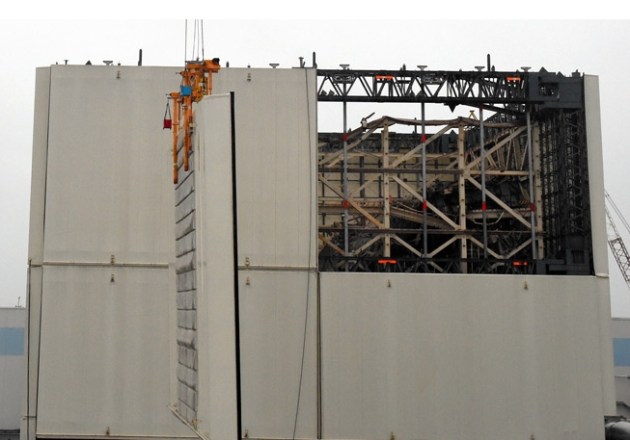
The devastated outer layer of Fukushima No. 1 nuclear power plant’s No. 1 reactor building has been exposed for the first time in almost five years in the painstaking reactor decommissioning process.
Plant operator Tokyo Electric Power Co. began removing on Sept. 13 the exterior walls of the cover installed around the structure to prevent the dispersal of radioactive materials on Sept. 13.
Shortly past 6 a.m., a large crane began removing a massive piece of the cover installed around the reactor building. The panel dismantled that day measured 23 by 17 meters and weighed 20 tons.
The cover was installed in October 2011 as a temporary measure after a nuclear meltdown occurred following the Great East Japan Earthquake and tsunami in March that year. The meltdown caused a hydrogen explosion, blowing the walls off the building.
Once the cover is dismantled, the operator can assess the state of the building’s interiors and remove the debris fallen onto the spent fuel pool inside.
“Steady progress is necessary in reconstruction, but we hope they will carry on the procedure with safety as the No. 1 priority,” said a Fukushima prefectural government official.
TEPCO said that it plans to remove the remaining 17 panels of the covering by the end of the year. The portion covering the roof has already been removed.
Once the cover is removed, the utility will begin drawing up plans to remove the 392 fuel assemblies from the spent fuel pool and melted nuclear fuel from inside the building.
The plant operator said that it plans to be extra careful during the procedure. It will shroud the building in tarpaulins once the cover is removed as a precautionary measure against dust and other materials containing radioactive materials from being carried aloft by the wind.
The utility and central government’s joint schedule for the decommissioning process of the reactor states that the removal of the fuel rods from the pool will start in fiscal 2020.
http://www.asahi.com/ajw/articles/AJ201609130070.html
Fukushima: Living a Disaster
Five years after the nuclear accident in Fukushima, an end to the disaster is not in sight. This short documentary tells the story of the people from Fukushima, forced to leave their homes without knowing if they could ever return, and explores the work that Greenpeace has been doing in the region since 2011. Sign the petition to end the nuclear nightmare and switch on renewables! http://grnpc.org/IgNDC
TEPCO to begin removing tainted water at Fukushima plant
Tokyo Electric Power Co. intends to begin pumping up highly contaminated water accumulating in the basements of buildings at its wrecked Fukushima No. 1 nuclear power plant by the end of March.
TEPCO disclosed its strategy Sept. 28 at a review meeting with the Nuclear Regulation Authority, the government’s nuclear watchdog.
In response, the NRA urged the utility to provide a detailed road map for the project.
Removing the huge volume of radioactive water in the reactor, turbine and other buildings has posed an urgent challenge for TEPCO.
The NRA pressed it to take action as soon as possible, pointing out that the contaminated water in the buildings’ basements is a likely reason flowing groundwater also gets polluted.
The NRA is also concerned that the contaminated water in the basements might leak into the sea if the nuclear complex is struck by another powerful tsunami.
TEPCO estimates that 68,000 tons of tainted water exists below the reactor and turbine buildings, as well as other structures.
Particularly worrisome is the estimated 2,000 tons of highly radioactive water in the condensers of the No. 1 through No. 3 turbine buildings, which accounts for 80 percent of the radioactive materials in all of the tainted water.
The contaminated water was transferred to the condensers in the immediate aftermath of the March 2011 triple meltdown.
TEPCO plans to finish transferring the water in the condensers by the first half of the next fiscal year and all of the contaminated water in the basements by 2020.
Heavy rains stall assessment of frozen wall at Fukushima plant
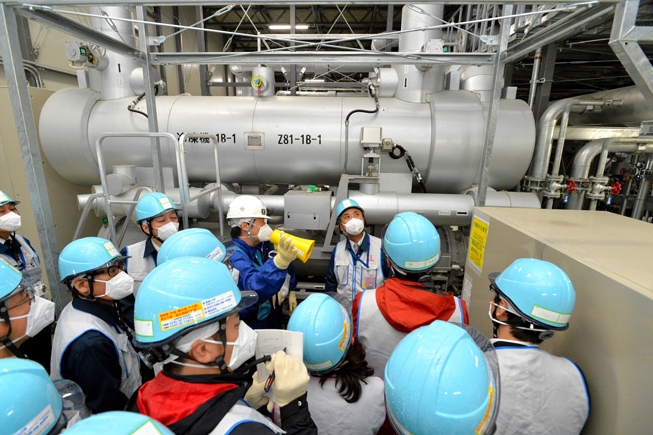
The equipment that cools coolant for the ice wall at the Fukushima No. 1 nuclear power plant
Tokyo Electric Power Co. reported a delay in the underground ice wall project at its Fukushima No. 1 nuclear power plant, citing the stalled assessment of the structure due to heavy rains from a recent typhoon.
The utility reported the delay at a review meeting with the Nuclear Regulation Authority, the government’s nuclear watchdog, on Sept. 28. TEPCO initially planned to assess the effectiveness of the ice wall by the end of this month.
According to TEPCO, the volume of groundwater pumped up in areas on the sea side of the facility was supposed to have dropped by now if the ice wall functioned properly.
But the company acknowledged this had not happened.
TEPCO had sought NRA approval to freeze a section of the ice wall facing the mountainside to enhance the effect of blocking groundwater, but it did not get the go-ahead.
“It does not make sense that the company sought approval to freeze the area facing the mountainside, just because the ice wall on the sea side did not go well,” said Toyoshi Fuketa, a commissioner of the NRA, told the meeting.
The groundwater level in the sea side portion outside the ice wall reached the surface on and off between Sept. 20 and Sept. 23 when the plant was struck by torrential rain as a result of Typhoon No. 16.
TEPCO said rainwater flowed into the sea, rather than seeping into the ground, because of the higher groundwater level.
Radioactive cesium in samples taken from the sea nearby measured a record high 95 becquerels per 1 liter.
According to the company, 0.8 percent of 5,800 or so observation spots set up on the sea side section of the ice wall showed that the soil has not been entirely frozen.
TEPCO officials believe that groundwater penetrated gaps in the ice wall before pushing up the groundwater level in the area downstream near the sea.
The frozen soil wall was built around the No. 1 through No. 4 reactor buildings. The government poured 35 billion yen ($350 million) into the project.
The objective was to block groundwater from mixing with contaminated water in the basements of the reactor and other buildings.
TEPCO started freezing soil in late March, but not all of the soil turned into ice, allowing a huge volume of groundwater to accumulate.
http://www.asahi.com/ajw/articles/AJ201609290073.html
Another panel removed at Fukushima Reactor 1
2016.09.29_06.00-09.00.Unit1 side
TEPCO Delays Replacing Tainted Water Tanks
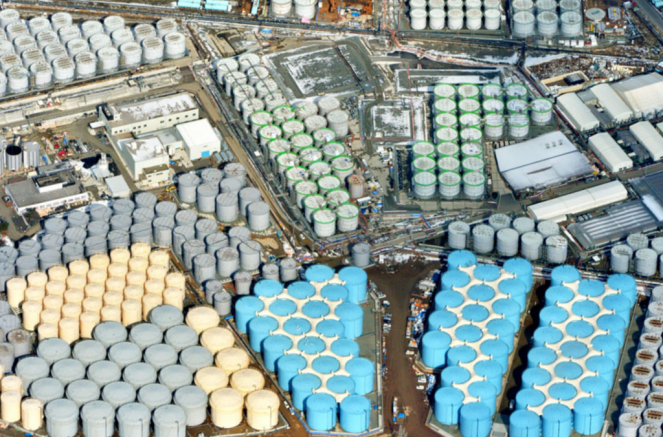
Tokyo, Sept. 28 (Jiji Press)–Tokyo Electric Power Company Holdings Inc. <9501> has effectively given up replacing tainted water storage tanks at its Fukushima No. 1 nuclear power station with safer ones at an early date, it was learned Wednesday.
It is believed to be the first time that the power firm has abandoned a deadline in its decommissioning work timetable, revised in June last year.
TEPCO now expects to finish the work in June 2018 at the earliest, according to documents submitted to a panel of the Nuclear Regulation Authority.
TEPCO initially planned to finish replacing the storage tanks with welded low-leakage ones early in the current business year through March 2017.
TEPCO remains unable to stop increases in the amount of radioactive water. The amount of contaminated water stored in the current tanks with a higher risk of leakage stood above 110,000 tons as of Thursday.
1 This Month


Website of the Week

New book – https://www.amazon.com/dp/1923372157?utm_source=substack&utm_medium=email
Now until to February 10, 2026 Radioactive waste storage in France: the debate is finally open! How to participate?
-
Archives
- January 2026 (118)
- December 2025 (358)
- November 2025 (359)
- October 2025 (377)
- September 2025 (258)
- August 2025 (319)
- July 2025 (230)
- June 2025 (348)
- May 2025 (261)
- April 2025 (305)
- March 2025 (319)
- February 2025 (234)
-
Categories
- 1
- 1 NUCLEAR ISSUES
- business and costs
- climate change
- culture and arts
- ENERGY
- environment
- health
- history
- indigenous issues
- Legal
- marketing of nuclear
- media
- opposition to nuclear
- PERSONAL STORIES
- politics
- politics international
- Religion and ethics
- safety
- secrets,lies and civil liberties
- spinbuster
- technology
- Uranium
- wastes
- weapons and war
- Women
- 2 WORLD
- ACTION
- AFRICA
- Atrocities
- AUSTRALIA
- Christina's notes
- Christina's themes
- culture and arts
- Events
- Fuk 2022
- Fuk 2023
- Fukushima 2017
- Fukushima 2018
- fukushima 2019
- Fukushima 2020
- Fukushima 2021
- general
- global warming
- Humour (God we need it)
- Nuclear
- RARE EARTHS
- Reference
- resources – print
- Resources -audiovicual
- Weekly Newsletter
- World
- World Nuclear
- YouTube
-
RSS
Entries RSS
Comments RSS
 nuclear-news