Radioactive water sprayed out on Fukushima workers, from tank leak

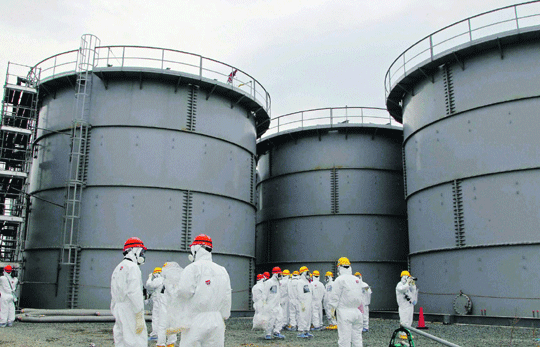 Fukushima Worker: People showered with highly radioactive water at plant — Leaking tanks spraying out contamination http://enenews.com/fukushima-worker-people-showered-highly-radioactive-water-plant-leaking-tanks-spraying-contamination
Title: People working at, living near Fukushima plant say Abe is in the dark
Source: Asahi Shimbun
Authors: Takuro Negishi and Shinichi Fujiwara
Date: September 20, 2013
[…] one man who has helped assemble the tanks from which contaminated water has leaked said, “I wonder if [Prime Minister Shinzo abe] is using words like ‘blocked’ and ‘control’ after really understanding what is going on at the site.”
The man recalls that one day he saw contaminated water spraying out of a tank. An employee of an affiliated company to TEPCO wore a raincoat over protective clothing to tighten a bolt on the tank, even as he was being showered with leaking water.
The man witnessed a similar scene on another day. However, TEPCO made no announcement about the two incidents.
“The affiliated company probably did not want to get on the bad side of TEPCO, so it stopped the leak and concealed the defect in the tank,” the man said. […]
Fukushima nuclear plant never should have been placed over river site
TV: Warnings the worst is yet to come at Fukushima — Deep underneath nuclear plant a massive pool of contamination is believed to be heading toward Pacific Ocean (VIDEO) Title: Fukushima leak questions handling of nuclear plant crisis
Source: ABC News (Australia)
Date: Sept. 19, 2013 MARK WILLACY, REPORTER: Atsunao Marui is one of Japan’s top groundwater scientists and a member of a panel set up by TEPCO and the Government to try to find ways of managing Fukushima’s growing reservoir of radioactive water. He says putting the nuclear plant on this stretch of coast in the first place was inviting disaster
ATSUNAO MARUI, GROUNDWATER SCIENTIST(voiceover translation): A river used to flow right where the turbine and reactor buildings are now standing, so the groundwater is flowing very fast through there and it’s spreading the contamination. The company should have known this could happen.
WILLACY: But there are warnings the worst is yet to come because it’s believed that deep beneath the nuclear plant is a massive underground pool of contaminated water which is slowly making its way towards the sea.
Fukushima rocked by earthquake
Earthquake rocks Japan’s Fukushima http://www.skynews.com.au/world/article.aspx?id=907741 20 Sept 13, A magnitude 5.3 earthquake has rocked Japan’s Fukushima prefecture.
The epicentre of the earthquake was 22km below the ground, according to the US Geological Survey.
It struck 20km west of the city of Iwaki, bordering the Pacific Ocean, at 2.25am (3.25am AEST) on Friday.
The epicentre was about 50km southwest of the damaged Fukushima Daiichi Nuclear Power Station, which was crippled by the major quake and tsunami in March, 2011.
The Japan Meteorological Agency, which put the quake at magnitude 5.8, said no tsunami warning had been issued.
The tremor caused buildings to shake in the capital Tokyo, 175km away, an AFP reporter there said.
It came just hours after Japanese Prime Minister Shinzo Abe toured the Fukushima nuclear plant on Thursday, ordering its operator Tokyo Electric Power to fix radioactive water leaks there.
TEPCO said in a statement to Kyodo news agency that no abnormalities in radiation or equipment were observed at the plant after the quake.
Leaks, cracks, and more lies at Fukushima Daiichi nuclear plant
TV: Officials concerned about 400 ft. tall pipe near Fukushima reactors collapsing during quake — 8 cracks found in support brace — Gov’t orders immediate investigation — Tepco unsure how to access area as radiation levels around it are 10 sieverts per hour (PHOTO & VIDEO) http://enenews.com/tv-officials-concerned-400-ft-tall-pipe-next-to-fukushima-reactors-will-collapse-during-quake-8-cracks-found-in-support-brace-govt-orders-immediate-investigation-tepco-unsure-how-to-acces
Fukushima Update: Leaks, Cracks and More Lies
NHK Newsline,, Sept. 19, 2013 (Transcript Excerpts): The people in charge of the Fukushima Daiichi nuclear plant have yet another problem on their hands. They say they found cracks in the brace supporting an exhaust pipe. Authorities are concerned the pipe could collapse in another earthquake […] Officials with Tepco say they spotted cracks in 8 places on the steel brace that holds the pipe upright. […] Overseers at the nuclear regulation authority are demanding that company officials investigate immediately. They want to know if the structure can withstand another earthquake.
NHK WORLD English, Sept. 18, 2013: […] workers on Wednesday discovered the cracks and cuts at 8 places in the buttress about 66 meters above the ground. The Nuclear Regulation Authority has ordered the company to assess the capacity of the pipe to withstand an earthquake as quickly as possible. The 120-meter vertical pipe stands between the number-1 and number-2 reactor buildings. […] they believe the 2011 earthquake damaged the steel framework. They say they have not observed any obvious damage in the pipe itself. The officials say they are considering how to access the pipe to assess its strength. The area around the pipe is contaminated with high levels of radiation measuring 10 sieverts per hour. Watch the broadcast here
Planned ice wall at Fukushima will make soggy ground worse, risking nuclear reactors collapsing
Asahi: Buildings at Fukushima plant can start floating from too much groundwater — Expert: Blocking groundwater with ice wall may weaken soil and cause buildings to topple (AUDIO) http://enenews.com/asahi-buildings-at-fukushima-plant-could-start-floating-from-continuous-flow-of-groundwater-expert-ice-wall-may-weaken-soil-and-cause-buildings-to-topple-audio
Asahi Shimbun,, Sept. 18, 2013: […] The site receives so much groundwater that special equipment–rendered useless by the 2011 earthquake and tsunami–was set up to prevent the plant’s buildings from floating on the continuous flow. […] The original site of the Fukushima No. 1 plant was a cliff more than 30 meters high. But 20 meters was lopped off […] putting the groundwater level only a few meters below the surface. The plant itself was constructed on land containing gravel layers through which water can easily pass through. In the past, a brook trickled by the No. 4 reactor. […] Without that pumping, the buildings faced the danger of being buoyed by rising groundwater. […] TEPCO officials have pinpointed only two locations, including the turbine building of the No. 1 reactor, where groundwater is entering the building basements. They believe there are many more breaches. […]
Atsunao Marui,, head of Groundwater Research Group at the National Institute of Advanced Industrial Science and Technology: “About 4 million tons of rain falls on the plant site over the course of a year. Of that figure, it is believed that between 1 million and 1.5 million tons seep into the ground.”
Gordon Edwards, nuclear expert (at 39:45 in): This underground river that we talked about flowing  thorough — the problem with this is they don’t really know how to stop it. […] They really don’t know how to stop this flow because it’s a major aquifer. One of the plans that they are talking about is… a wall of ice a mile long to act as a barrier to prevent the groundwater from going in to the cores of these damaged reactors, in order to try and solve the problem… And nobody knows if it’s actually going to work. In fact, some of the experts in Japan have said that by diverting the groundwater around the sides of the building, you may weaken the soil to the point where the buildings themselves topple — and that could be a far worse problem. So, they really don’t know what they’re going. They literally don’t know what they’re doing.
TEPCO still hopes to restart 2 intact Fukushima nuclear reactors
Japan premier urges full decommissioning of Fukushima nuclear site LA Times, By Carol J. Williams September 19, 2013, Japanese Prime Minister Shinzo Abe toured the crippledFukushima Daiichi nuclear power complex Thursday and urged its owner to abandon hopes of restarting the only two intact reactors and concentrate instead on unfinished cleanup operations, Japanese media reported.
Three of Fukushima’s six reactors suffered meltdowns after the March 11, 2011, earthquake and tsunami, and the fuel-cooling containment pool was seriously damaged at a fourth unit.
Japan is currently nuclear-free, as all 50 of its reactors are closed for maintenance, repairs, safety checks or inoperability.
But Fukushima owner Tokyo Electric Power Co., like most Japanese utilities with nuclear production facilities, has maintained hope of restarting its undamaged reactors if and when a new independent regulatory agency gives the green light after inspection…… http://www.latimes.com/world/worldnow/la-fg-wn-japan-nuclear-fukushima-20130919,0,2520396.story
Melting through reactor floors – Fukushima’s molten nuclear fuel cores
 Nuclear Expert: We believe molten fuel already melted through floors of Fukushima reactor buildings, or is still in process of melting through (AUDIO) http://enenews.com/nuclear-expert-believe-molten-fuel-already-melted-floors-fukushima-reactor-buildings-process-melting-audio
Title: THE DEEPENING CRISIS AT FUKUSHIMA
Source: Green Power and Wellness
Host: Harvey Wasserman
Date: Aug. 12, 2013
Harvey Wasserman, host: We don’t even know where these cores are, do we? That’s a really amazing situation.
Gordon Edwards, nuclear expert and president of the Canadian Coalition for Nuclear Responsibility: That’s correct. What’s happening is, how far these cores have penetrated through the floor of the reactor building, or not, is really unknown because the radiation levels are so intense, that not only can humans not go in there […] but even robots that they sent in there, the gamma radiation is so intense that it fries the electronic components after a few minutes. So the robots are of only very limited use for a short time.
The result is they just don’t know what the state is, but we believe that the molten core has melted through the bottom of the containment vessel, it’s onto the floor, and it’s probably either melted through the floor, or is in the process of melting through the floor… Units 1, 2, and 3. Now some of those units are perhaps in worse condition than others.
A thousand tons of radioactively polluted water dumped by TEPCO into Pacific Ocean
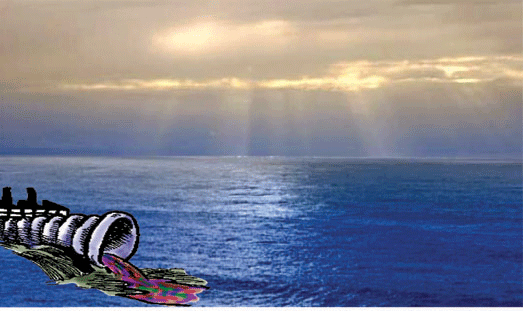 Fukushima Operator Dumps 1,000 Tons Of Polluted Water In Sea http://www.huffingtonpost.com/2013/09/17/fukushima-polluted-water-sea_n_3939014.html Agence France Presse | 09/17/2013 T The operator of the leaking Fukushima nuclear plant said Tuesday that it dumped more than 1,000 tons of polluted water into the sea after a typhoon raked the facility.
Typhoon Man-yi smashed into Japan on Monday, bringing with it heavy rain that caused flooding in some parts of the country, including the ancient city of Kyoto.
The rain also lashed near the broken plant run by Tokyo Electric Power (TEPCO), swamping enclosure walls around clusters of water tanks containing toxic water that was used to cool broken reactors. Continue reading
Fukushima’s radioactive trash pools are the REAL danger

Top scientists and government officials say that Tepco should be removed from all efforts to stabilize Fukushima. An international team of the smartest engineers and scientists should handle this difficult “surgery”.
The stakes are high
The REAL Fukushima Danger: Failure of Fuel Pools Could Trigger Worldwide Nuclear Radiation By Washington’s Blog Global Research, September 14, 2013
“…… the real problem is that the idiots who caused this mess are probably about to cause a much bigger problem.
Specifically, the greatest short-term threat to humanity is from the fuel pools at Fukushima.
If one of the pools collapsed or caught fire, it could have severe adverse impacts not only on Japan … but the rest of the world, including the United States. Indeed, a Senator called it a national security concern for the U.S.:
The radiation caused by the failure of the spent fuel pools in the event of another earthquake could reach the West Coast within days. That absolutely makes the safe containment and protection of this spent fuel a security issue for the United States.
Nuclear expert Arnie Gundersen and physician Helen Caldicott have both said that people should evacuate the Northern Hemisphere if one of the Fukushima fuel pools collapses. Gundersen said:
Move south of the equator if that ever happened, I think that’s probably the lesson there.
Former U.N. adviser Akio Matsumura calls removing the radioactive materials from the Fukushima fuel pools “an issue of human survival”.
So the stakes in decommissioning the fuel pools are high, indeed.
But in 2 months, Tepco – the knuckleheads who caused the accident – are going to start doing this very difficult operation on their own. Continue reading
TEPCO has been lying for 2 years, about radiation levels at Fukushima
 Tepco admits to reporting false radiation levels for nearly 2 years at Fukushima http://enenews.com/tepco-admits-to-reporting-false-radiation-levels-for-past-2-years-at-fukushima
KBS, Sept. 14, 2013: Japanese media say the Tokyo Electric Power Company (TEPCO) reported lower than actual levels of radioactivity in waters around the Fukushima Daiichi nuclear plant for nearly two years. […] TEPCO said the inaccurate measurements were taken from July 2011 until May this year, resulting in concentration levels of radioactive cesium being reported some becquerels lower than the actual level. It said the measurements were taken one-point-three kilometers south of the nuclear plant. […]
NHK, Sept 14, 2013: TEPCO under-reported cesium measurements […] After being notified of the error by the Nuclear Regulation Authority, TEPCO discovered that its previous per-liter measurements were several becquerels lower than actual figures. TEPCO says the error was due to the wrong assessment of the impact of radiation in the surrounding area. […] Experts at the meeting criticized what they called an elementary mistake. They also said the matter should not be left to TEPCO alone and called for the Authority’s involvement.
The perilous state of Fukushima nuclear buildings Nos 1 to 4
Endless Fukushima catastrophe: 2020 Olympics under contamination threat Dr Helen Caldicott RT.com: September 15, 2013“…….The levels of radiation in buildings 1, 2 and 3 are now so high that no human can enter or get close to the molten cores. It will therefore be impossible to remove these cores for hundreds of years if ever
Buildings 1, 2 & 3
If one of these buildings collapses, the targeted flow of cooling water to the pools and cores would cease, the cores would become red hot and possibly ignite releasing massive amounts of radiation into the air and water and the fuel in the cooling pools could ignite. It is strange that neither the US government in particular nor the global community seem to be concerned about these imminent possibilities and exhibit no urge to avert catastrophe.
Similarly the global media is strangely disconnected with the ongoing crisis. Most importantly, the Japanese government until very recently has obstinately refused to invite and collaborate with foreign experts from nuclear engineering companies and/or governments.
Building 4
This structure was severely damaged during the initial quake, its walls are bulging, and it sank 31 inches (79cm) into the ground. On the roof sits a cooling pool containing about 250 tons of hot fuel rods, most of which had just been removed from the reactor core days before the earthquake struck. This particular core did not melt because TEPCO was able maintain a continuous flow of cooling water, so the rods and their holding racks are still intact, but geometrically deformed due to the force of the hydrogen explosion.
The cooling pool contains 8,800 pounds of plutonium plus over 100 other highly radioactive isotopes. Instead of this core melting into a larval mass like the other three cores, it sits exposed to the air atop the shaky building. A large earthquake could disrupt the integrity of the building, causing it to collapse and taking the hot fuel rods with it. The cooling water would evaporate and the intrinsic heat of the radioactive rods would ignite a fire as the zirconium cladding reacted with air, releasing the radioactive equivalent of 14,000 Hiroshima-sized bombs and 10 times more cesium than Chernobyl……..http://rt.com/op-edge/fukushima-catastrophe-nuclear-olympics-883/
Appeal to United Nations to awaken the world to the Fukushima nuclear crisis
Help Educate Decision Makers About Fukushima Risks! http://salsa.democracyinaction.org/o/568/p/dia/action/public/?action_KEY=10780
Dear Mr. Secretary-General, I am extremely worried about the lack of the sense of crisis in Japan and abroad,as regards the worsening situation at the Fukushima Daiichi.
The international community is required to prevent the Fukushima accident from developing into the ultimate catastrophe of the world, a possibility the collapse of the Unit 4 by a mega earthquake could turn into a reality. It could happen at any moment! Faced with this unprecedented crisis, the mobilization of human wisdom is required on the widest possible scale. The full assumption of responsibilities by the Japanese Government is urgently needed.
The present abnormal lack of the sense of crisis is due to the fact that inconvenient truth is not disclosed. The international community has the duty, for example, to grasp correctly the precise volume of the continuous release of radiation from Fukushima.
In this connection, the official numbers published by Tepco, 10milliom BQ/H, unchanged for the last year and half, could hardly be trusted. They remain unchanged even after the revelation by Tepco that, since the accident in 2011, 400 tons of contaminated water daily leaked into the sea. Now the Government admits that 300 tons daily [60,000 gallons] flow into the sea.
The situation is worsening. And no solution in sight !
The so called international strategy to consider that Fukushima accident did not happen, as some papers writes, is doomed to failure. This strategy is evidenced by the continued promotion of nuclear reactors worldwide, and their restarting and exporting by Japan..Even if it succeeds to hide the head, it cannot hide the tail that is the contamination of the ocean on a planetary scale.
Conscientious citizens are now calling for the withdrawal of the invitation for Olympic games by Japan. Allow me to count on your understanding and support.Yours truly,
Mitsuhei Murata
Former Japanese Ambassador to Switzerland
Things at Fukushima are going badly – it’s a war-like situation
 Japan Media: “Things are going badly” — Fukushima “the same as war” says military officer in charge of forces at plant — Concern “workers on-site do not consent to join battle” — Crime skyrocketing, “people were held hostage” — Unprecedented ocean contamination and leaks are out of control http://enenews.com/japan-media-things-are-going-badly-fukushima-same-as-war-says-military-officer-in-charge-of-forces-at-plant-concern-workers-on-site-do-not-consent-to-join-battle-crime-skyrocketi
Jiji Press, , Sept. 6, 2013: Crime up among No. 1 plant staff […] In the first eight months of this year, 74 such workers were charged with crimes such as theft and fights resulting in injury. The figure is already close to three times the 2012 total of 26. The police reported only one such suspect in 2011 […] They were mostly suspected of theft […] or of harming others during brawls in their lodgings or bars. In one extreme case, people were held hostage as a result of a disagreement over hiring practices. […]
Mainichi, Sept. 2, 2013: Things are going badly. There’s radioactive water leaking, and it can’t be controlled. […] if the workers on-site do not consent to join battle, if they cannot muster the courage to keep up the fight, then we cannot expect real progress. At least, that’s the impression I got after talking with one of those workers […] I cannot write the worker’s name, or age, or job description here. But I can say that he is not an agitator […] he is a completely average employee [… “]we’re not getting any extra staff. The management says ‘do this’ and ‘do that,’ but I don’t think they really consider the workers’ radiation exposure doses at all. “Recently, some government minister came here (to the plant) and ran his mouth, right? When I see stuff like that, I think, ‘Gimme a break! What the hell do you know about anything?’” […] I’ve heard the officer in charge of the Self-Defense Forces efforts at the Fukushima plant describe the situation as being “the same as war.” […] The workers at the Fukushima plant deeply distrust those in Tokyo […] The waters next to the plant have been subject to unprecedented nuclear contamination […] After so much continuous failure, we must repair the damage done to Japan’s international reputation.
See also:
AP: Fukushima Daiichi workers could try to sabotage plant, warns their doctor
Fukushima’s spiking radiation requires international help, not just Japan’s short term fix
 Readings just above the ground near a set of tanks at the plant showed radiation as high as 2,200 millisieverts (mSv), Japan’s Nuclear Regulation Authority (NRA) said Wednesday. The previous high in areas holding the tanks was the 1,800 mSv recorded Saturday.
Both levels would be enough to kill an unprotected person within hours.
The measures do not address the full problem of water management at the plant or the bigger issue of decommissioning.
Critics said the government was mainly trying to cool down international media coverage ahead of the Olympics decision. A more sustainable option, he said, would be to seek global support to confront Fukushima’s unprecedented challenges
Fukushima radiation readings spike to highest levels Aljazeera September 4, 2013 The readings have jumped by more than a fifth Radiation readings around tanks holding contaminated water at the crippled Fukushima Daiichi nuclear plant have spiked by more than a fifth to their highest levels, Japan’s nuclear regulator said Wednesday, heightening concerns about the cleanup of the worst atomic disaster in almost three decades.
Radiation hot spots have spread to three holding areas for hundreds of hastily built tanks storing water contaminated by being flushed over three reactors that melted down at the Fukushima Daiichi plant in March 2011.
The rising radiation levels and leaks at the plant further inflamed international alarm, one day after the Japanese government said that it would step in with almost $500 million of funding to fix the growing levels of contaminated water at the plant. Continue reading
Fukushima nuclear reactor No 4 – a dangerous global worry
NYTimes: Countries increasingly worried about Fukushima Unit 4 spent fuel — Experts: Concern over potential cracks in pool walls — Professors: “In deteriorating condition”; “This is a critical global issue”; “Could have fatal consequences for Japan”http://enenews.com/spent-fuel-pool-4
New York Times, Sept. 3, 2013: […] thousands of workers and a small fleet of cranes are preparing for one of the latest efforts to avoid a deepening environmental disaster that has China and other neighbors increasingly worried: removing spent fuel rods from the damaged No. 4 reactor building and storing them in a safer place. […]
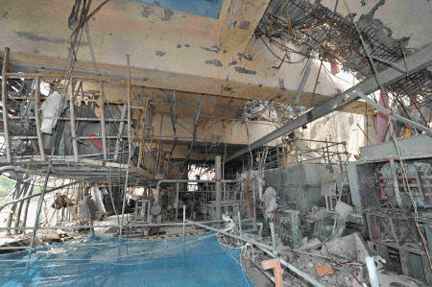
Xinhua, Sept. 4: […] Mitsuhei Murata, a former Japanese ambassador to Switzerland has officially called for the withdrawal of Tokyo’s Olympic bid, due to the worsening crisis at Fukushima, which experts believe is not limited to storage tanks, but also potential cracks in the walls of the spent nuclear fuel pools. […]
Telegraph,Sept 4, 2013: […] Tom Snitch, a senior professor at the University of Maryland and with more than 30 years’ experience in nuclear issues, said “[Japan officials] need to address the real problems, the spent fuel rods in Unit 4 and the leaking pressure vessels,” he said. “There has been too much work done wiping down walls and duct work in the reactors for any other reason then to do something. […] This is a critical global issue and Japan must step up.”
Japan Focus, Sept. 2, 2013: […] from November, TEPCO plans to begin the delicate operation of removing spent fuel from Reactor No. 4 fuel pool. […] The spent-fuel pool […] was damaged by the earthquake and tsunami, and is in a deteriorating condition. It remains vulnerable to any further shocks, and is also at risk from ground liquefaction. […] If a fuel rod is dropped, breaks or becomes entangled while being removed, possible worst case scenarios include a big explosion, a meltdown in the pool, or a large fire. […] This is literally a matter of national security – another mistake by TEPCO could have incredibly costly, even fatal, consequences for Japan. […]
1 This Month

of the week – Shut Down Drone Warfare!


Tell the Ukrainian Government to Drop Prosecution of Peace Activist Yurii Sheliazhenko

Petition to revoke the licensing of the Near Surface Nuclear Disposal Facility (NSDF) at Chalk River. https://www.ourcommons.ca/petitions/en/Petition/Details?Petition=e-7247
To see nuclear-related stories in greater depth and intensity – go to https://nuclearinformation.wordpress.com
-
Archives
- March 2026 (244)
- February 2026 (268)
- January 2026 (308)
- December 2025 (358)
- November 2025 (359)
- October 2025 (376)
- September 2025 (257)
- August 2025 (319)
- July 2025 (230)
- June 2025 (348)
- May 2025 (261)
- April 2025 (305)
-
Categories
- 1
- 1 NUCLEAR ISSUES
- business and costs
- climate change
- culture and arts
- ENERGY
- environment
- health
- history
- indigenous issues
- Legal
- marketing of nuclear
- media
- opposition to nuclear
- PERSONAL STORIES
- politics
- politics international
- Religion and ethics
- safety
- secrets,lies and civil liberties
- spinbuster
- technology
- Uranium
- wastes
- weapons and war
- Women
- 2 WORLD
- ACTION
- AFRICA
- Atrocities
- AUSTRALIA
- Christina's notes
- Christina's themes
- culture and arts
- Events
- Fuk 2022
- Fuk 2023
- Fukushima 2017
- Fukushima 2018
- fukushima 2019
- Fukushima 2020
- Fukushima 2021
- general
- global warming
- Humour (God we need it)
- Nuclear
- RARE EARTHS
- Reference
- resources – print
- Resources -audiovicual
- Weekly Newsletter
- World
- World Nuclear
- YouTube
-
RSS
Entries RSS
Comments RSS
 nuclear-news