China becoming more anxious over consequences of Fukushima nuclear disaster – calls for transparency
China’s action call over Fukushima, Shanghai Daily Source: Agencies | June 4, 2016 CHINA is extremely concerned about the consequences of the 2011 Fukushima nuclear accident, a foreign ministry spokeswoman said yesterday, and has urged the Japanese government to carry out timely follow-up measures.
“We hope Japan will take effective measures to provide timely, comprehensive and accurate information to the international community and protect the ocean environment,” Hua Chunying told a daily news briefing.
On Monday, the plant’s operator, Tokyo Electric Power Co, admitted for the first time that its insistence on referring to the incident as “nuclear reactor damage” over the past five years had “hidden the truth.”
According to Ken Buesseler, a marine radiochemist with the US Woods Hole Oceanographic Institution, the consequences of the Fukushima accident were “unprecedented,” since over 80 percent of the leaked radioactive substances had flowed into the sea.
“We hope Japan will maintain a high sense of responsibility to its own people, the people in neighboring countries and the international community,” Hua said. China is willing to communicate with relevant parties, including South Korea, she added.
China has also asked the International Atomic Energy Agency to enhance monitoring and evaluation of the radioactive water that had resulted from the accident, Hua said…….http://www.shanghaidaily.com/nation/Chinas-action-call-over-Fukushima/shdaily.shtml
Russia and China working together to market nuclear reactors to the world
 Russia, China Working on Plan on Nuclear Cooperation Development. MOSCOW (Sputnik) 2 June 16 — Russia and China are working on a comprehensive document on the development of the bilateral strategic cooperation in the field of nuclear energy, the protocol of the Russia-China intergovernmental energy cooperation commission said.
China’s plans for floating nuclear power plants- major risks, good terrorism targets
While floating power plants may seem to present exciting economic opportunities–both for sites lacking affordable power and for the entities selling the plants—they also come with major risks.
“naval bombardment” is a growing risk in the South China Sea. A floating nuclear power plant might make a tempting target.
 Floating nuclear power plants: China is far from first, Bulletin of the Atomic Scientists Dawn Stover , 2 June 16 On April 22, the state-owned Chinese newspaper Global Times reported that China plans to build as many as 20 floating nuclear power plants, the first of which could be producing power in just a few years. The story made a splash because the power from the floating reactors would most likely be used to accelerate construction of oil rigs and artificial islands in the South China Sea—already a source of border disputes and escalating tension between China and its neighbors.
Portable power stations may sound futuristic, but the idea is far from new. The United States launched the first floating nuclear power plant five decades ago, and Russia started its own construction project in 2000. Where the United States has seen a proprietary technology, though, China sees a marketing opportunity.
China floats an idea. Earlier this year, as part of its latest five-year plan, China’s National Development and Reform Commission approved the development of two nuclear reactors for marine platforms, one each from the country’s two big nuclear companies: The China General Nuclear Power Group will develop the ACPR50S, a small modular reactor with a generating capacity of 200 megawatts. Meanwhile, the China National Nuclear Corporation plans to work on the AC100S reactor, a marine version of its ACP100, which would generate 100 megawatts.
China General Nuclear has signed an agreement with China National Offshore Oil Corporation, which would presumably use floating nuclear power plants to provide power for offshore oil and gas exploration. China Shipbuilding Industry Corporation, the country’s largest shipbuilder, is building a barge-like platform for China General Nuclear’s pilot plant. An illustration of the platform looks very similar to Russian designs, which is not surprising. Only a few years ago, the Chinese were planning to build floating nuclear power plants in China using Russian technology; now the Chinese are floating their own designs………
Potential risks and rewards. Russia’s nuclear-powered icebreakers use highly enriched uranium, but the modified reactors for the Akademik Lomonosov will run on low-enriched uranium. That helps to alleviate concerns about proliferation, but environmental and safety concerns remain. A floating nuclear power plant would probably be safe from earthquakes, but storms could be a threat, and accident response would be slow in remote Arctic areas.
In the event of a nuclear accident, an offshore plant would have plenty of cooling water readily available. But a floating nuclear power plant might not have access to off-site backup power, and it would be more difficult to contain any radioactive releases than when an accident occurs at a land-based plant. A failed reactor might end up being abandoned at sea, as has happened to seven Soviet or Russian nuclear submarines.
Those risks aren’t preventing the Russians and Chinese from moving ahead with plans for floating nuclear power plants. Russia hopes to lease floating plants to other countries, and China sees an opportunity to capitalize on technologies originally developed by the United States and Russia…….
While floating power plants may seem to present exciting economic opportunities–both for sites lacking affordable power and for the entities selling the plants—they also come with major risks. As Bennett Ramberg, author of the book Nuclear Power Plants as Weapons for the Enemy: An Unrecognized Military Peril, noted in the Bulletin’s March 1986 issue: “[F]acilities can be placed on large lakes, inland seas, or oceans—on floating platforms surrounded by breakwaters, on floating vessels anchored to the marine floor, on artificial islands, or even undersea. However, there would be higher transmission costs for reactors, unique construction costs, and exposure to such dangers as ship collisions, accidental explosions, and naval bombardment.”
Thirty years later, “naval bombardment” is a growing risk in the South China Sea. A floating nuclear power plant might make a tempting target.
Editor’s note: The Bulletin’s archives from 1945 to 1998, complete with the original covers and artwork, can be found here. Anything after 1998 can be found via the search engine on the Bulletin’s home page. http://thebulletin.org/floating-nuclear-power-plants-china-far-first9522
China readies nuclear armed submarines for the Pacific
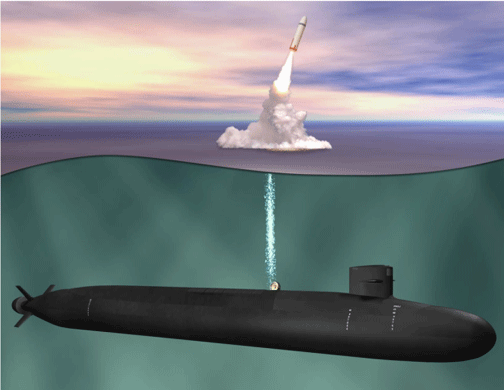
 China to send nuclear-armed submarines into Pacific amid tensions with US
Beijing risks stoking new arms race with move although military says expansion of the US missile defence has left it with no choice, Guardian, Julian Borger , 26 May 16 [ video, excellent graphics] The Chinese military is poised to send submarines armed with nuclear missiles into the Pacific Ocean for the first time, arguing that new US weapons systems have so undermined Beijing’s existing deterrent force that it has been left with no alternative.
Chinese military officials are not commenting on the timing of a maiden patrol, but insist the move is inevitable.
They point to plans unveiled in March to station the US Thaad anti-ballistic system in South Korea, and the development of hypersonic glide missiles potentially capable of hitting China less than an hour after launch, as huge threats to the effectiveness of its land-based deterrent force.
A recent Pentagon report to Congress predicted that “China will probably conduct its first nuclear deterrence patrol sometime in 2016”, though top US officers have made such predictions before…….
Last Tuesday, a US spy plane and two Chinese fighter jets came close to colliding 50 miles of Hainan island, where China’s four Jin-Class ballistic missile submarines are based. A fifth is under construction.
The two countries’ navies have also come uncomfortably close around disputed islands in the same region, and the chance of a clash will be heightened by cat-and-mouse submarine operations, according to Wu Riqiang, an associate professor at the School of International Studies at the Renmin University in Beijing.
“Because China’s SSBNs [nuclear missile submarines] are in the South China Sea, the US navy will try to send spy ships in there and get close to the SSBNs. China’s navy hates that and will try to push them away,” Wu said.
The primary reason Chinese military officials give for the move towards a sea-based deterrent is the expansion of US missile defence, which Moscow also claims is disturbing the global strategic balance and potentially stoking a new arms race.
The decision to deploy Thaad anti-ballistic interceptors in South Korea was taken after North Korea’s fourth nuclear test, and the stated mission of the truck-launched interceptors is to shield the south from missile attack.
But Beijing says the Thaad system’s range extends across much of China and contributes to the undermining of its nuclear deterrent. It has warned Seoul that relations between the two countries could be “destroyed in an instant” if the Thaad deployment goes ahead……
Under Xi’s assertive leadership, China seems determined that the Chinese nuclear deterrent will take finally to the ocean, and it has already taken thestep of putting multiple warheads on its missiles. Those steps are mostly in response to US measures, which in turn were triggered by unrelated actions by the North Koreans.
The law of unintended consequences is in danger of taking the upper hand. “The two sides may thus be stumbling blindly into severe crisis instability and growing competition by China with respect to strategic forces,” Lewis argues. “A competition between unevenly matched forces is inherently unstable.”http://www.theguardian.com/world/2016/may/26/china-send-nuclear-armed-submarines-into-pacific-us
1MDB Unit Bought by China Nuclear Firm Was Distressed, Auditor Says
1MDB Unit Bought by China Nuclear Firm Was Distressed, Auditor Says China General Nuclear Power bought Edra Global Energy from debt-laden 1MDB last year, WSJ, By YANTOULTRA NGUI May 26, 2016
KUALA LUMPUR, Malaysia—An audit of a key energy group sold by troubled state investment fund 1Malaysia Development Bhd. to a Chinese state-owned nuclear-power company flagged deep uncertainty over the company’s viability.
Notes from auditor Deloitte in the 140-page financial accounts of Edra Global Energy Bhd. for the year ended March 31, 2015, said the audit found “an existence of a material uncertainty which may cast significant doubt about the group’s and company’s ability to continue as a going concern.”
The auditor’s notes, reviewed by The Wall Street Journal, are part of the most detailed account of Edra’s finances at the time that China General Nuclear Power Corp.purchased the firm for 9.83 billion ringgit ($2.4 billion) last November as the fund, known as 1MDB, was struggling to meet its debt obligations……..http://www.wsj.com/articles/1mdb-unit-bought-by-china-nuclear-firm-was-distressed-auditor-says-1464251503
China getting prepared for nuclear emergencies
 China establishes national nuclear emergency team Reporter: Wu Guoxiu 丨 CCTV.com05-24-2016 China has established a national nuclear emergency rescue team, to cope with potential nuclear accidents, and take part in international rescue operations. CCTV reporter tells us more now on how the country is increasing its nuclear emergency preparedness.
The national rescue team is composed of armed forces members and existing rescue professionals. On duty 24-7, their job is to deal with serious nuclear accidents in the country, or abroad.
“The rescue team has 320 members, and six squads, including technical support, evacuation, rescue, radiation monitoring, decontamination and medical treatment. The bases will conduct drills, training and theoretical studies,” said Li Ganjie, Chief of China Nuclear Safety Bureau……..
“Exporting nuclear technology doesn’t mean you sell a nuclear power plant, it also involves nuclear safety and emergency systems. Our nuclear emergency response needs to be improved to meet the international level,” said Wang Yiren, Deputy Director of China Automatic Energy Authority…..http://english.cctv.com/2016/05/24/VIDEKSSxxWjhqULQlkfTq4BQ160524.shtml
China wants to market nuclear power to Sudan
China’s CNNC Seeking to Build Sudan’s First Nuclear Reactor http://www.bloomberg.com/news/articles/2016-05-24/china-s-cnnc-seeking-to-build-sudan-s-first-nuclear-reactor Stephen Stapczynski sstapczynski Aibing Guo May 24, 2016
-
State-owned CNNC signs deal with Sudan’s electricity ministry
-
Sudan said last year it aims to begin building reactor by 2021
-
China National Nuclear Corp. agreed with Sudan to build the African nation’s first atomic reactor, China’s latest effort to expand its nuclear technology footprint abroad.
A framework agreement between the two countries was signed Monday during a three-day visit to Sudan by Nur Bekri, director of China’s National Energy Administration, according to Xinhua News Agency. CNNC also signed a cooperation agreement with Sudan’s Ministry of Water Resources and Electricity, according to the People’ Daily.
China is seeking wider acceptance for its atomic technology and expertise amid a global call for cleaner energy. The country plans to export about 30 homegrown nuclear units by 2030, CNNC Chairman Sun Qin said in March, according to China Daily.
“The agreement is a step forward for China’s grand ‘One Belt, One Road’ plan to export technology, including nuclear power and high-speed railway technologies, to African and European nations,” Shi Yan, a Shanghai-based analyst at UOB-Kay Hian, said by phone. “China can provide both technological and financial support for developing nuclear power projects.” - CNNC has plans to build reactors in Argentina and Pakistan, while China General Nuclear Power Corp. is aiming for its own project in Kenya. CGN and Electricite de France SA signed an accord in October to build three reactors in the U.K., including the Hinkley Point plant in southwest England and a Chinese-developed reactor at Bradwell.
Sudan aims to begin building its first nuclear reactor in 2021 and start commercial operations by 2027, according to a government presentation last year for the International Atomic Energy Agency. The country is seeking to build two 600-megawatt pressurized water reactors, it said in the presentation.
With its current power capacity of roughly 3,025 megawatts, nuclear power will help it meet demand that is expected to swell to 8,500 megawatts by 2031, it said.
Chinese nuclear companies planning to carve up nuclear exports between each other
 China’s CGN to Avoid Competing Abroad Against Nuclear Partner http://www.bloomberg.com/news/articles/2016-05-19/china-s-cgn-to-avoid-competing-abroad-against-nuclear-partner Aibing Guo Stephen Stapczynski sstapczynski
-
China General Nuclear Power Corp. to focus on European markets
-
Nuclear companies formed a JV to export co-developed reactor
-
China General Nuclear Power Corp. said it won’t compete with China National Nuclear Corp. for customers in the same overseas markets as the two companies aim to increase exports of their co-developed nuclear reactor.
China General Nuclear Power will target customers in Europe and avoid markets where CNNC is active, such as South America, according to Huang Xiaofei, spokesman for China General Nuclear Power. CNNC didn’t respond to requests for comment. While the companies have merged their nuclear technologies into the Hualong One reactor, the country’s main export model, they separately market the design overseas, Huang said.
The companies build similar, but not identical, versions of the Hualong One and will maintain much of their own supply chains, according to the World Nuclear Association.They also established a joint-venture in March to integrate the technology.
CGN and Electricite de France SA signed an accord in October to build three reactors in the U.K., including the Hinkley Point plant in southwest England and a Chinese-developed reactor at Bradwell. CGN has also signed a memorandum of understanding with the Kenyan government in September to possibly build a Hualong One reactor, while CNNC has its own projects in Argentina and Pakistan. -
Taishan
Separately, two Areva SA-designed nuclear reactors in Taishan are on track to start commercial operation in China in the first half of 2017, according to Huang. The cost overrun for the reactors, known as an EPR, was caused by labor costs and loan interest and were within a reasonable range, he said. The company also plans to deliver its first small modular reactor, which can be used offshore, by 2020, he said
The country plans to export about 30 nuclear units by 2030, CNNC chairman Sun Qin said in March, according to China Daily.
The role of renewable energy in slowing climate change
Surge in renewable energy stalls world greenhouse gas emissions Falling coal use in China and the US and a shift towards renewable energy globally saw energy emissions level for the second year running, says IEA, Guardian, John Vidal, 17 March 16, Falling coal use in China and the US and a worldwide shift towards renewable energy have kept greenhouse gas emissions level for a second year running, one of the world’s leading energy analysts has said.
Preliminary data for 2015 from the International Energy Agency (IEA) showed that carbon dioxide emissions from the energy sector have levelled off at 32.1bn tonnes even as the global economy grew over 3% .
Electricity generated by renewable sources played a critical role, having accounted for around 90% of new electricity generation in 2015. Wind power produced more than half of all new electricity generation, said the IEA.
The figures are significant because they prove to traditionally sceptical treasuries that it is possible to grow economies without increasing climate emissions.
“The new figures confirm last year’s surprising but welcome news: we now have seen two straight years of greenhouse gas emissions decoupling from economic growth. Coming just a few months after the landmark COP21 agreement in Paris, this is yet another boost to the global fight against climate changem” said IEA director, Fatih Birol…….
A seperate report by the European Environment agency (EEA) shows that the EU-wide share of renewable energy has increased from 14.3% in 2012 to 15% in 2013. This allowed the EU to cut its demand for fossil fuels by 110m tonnes of oil equivalent in 2013. This, said the EEA, is the equivalent of a gross reduction of CO2 emissions of 362m tonnes in 2013. http://www.theguardian.com/environment/2016/mar/16/surge-in-renewable-energy-stalls-world-greenhouse-gas-emissions?CMP=share_btn_tw
China General Nuclear Power Corporation denies plan to take over Hinkley nuclear project build
 China nuclear company will not build Hinkley alone if EDF drops out CGN, which is helping French energy company with Hinkley Point C scheme, denies it will build reactors independently, Guardian, Terry Macalister, 13 May 16, The Chinese company helping EDF with plans to build new nuclear reactors at Hinkley Point in Somerset has flatly dismissed the idea it would go it alone if the largely state-owned French company dropped out.
“As a partner to EDF supporting the Hinkley Point project, CGN [China General Nuclear Power Corporation] has no independent plans to build reactors at Hinkley Point C,” it said in a statement.
The Department of Energy and Climate Change reiterated the message with its own statement, which said: “There is no proposal for the Chinese to build a reactor at Hinkley.”
The denials come after George Osborne’s father-in-law, Lord Howell, told the House of Lords that the Chinese were working on a “plan B” to step in if, as some expect, EDF abandons the controversial scheme…….https://www.theguardian.com/business/2016/may/13/hinkley-point-cgn-china-general-nuclear-power-corporation-edf-energy
China trebling its wind power capacity
 China’s wind-power installed capacity will escalate to 495 GW by 2030, says Global Data Wind Power Engineering, May 5, 2016 Michelle Froese Wind power installed capacity in China will more than treble from approximately 149 Gigawatts (GW) in 2015 to over 495 GW by 2030, representing a Compound Annual Growth Rate (CAGR) of 9%, according to research and consulting firm GlobalData.
The company’s latest report* states that China has the highest wind power globally by far, accounting for a third of cumulative wind power capacity worldwide in 2015, followed by the U.S. with 17% of the global share…….
Srivatsava comments: “China’s quick adoption of wind power can be attributed to a wider global trend driven by depleting fossil fuel reserves, the declining cost of wind power generation and a growing sensitivity towards environmental issues.
“China’s 13th Five Year Plan raised the 2020 wind target to 250 GW, and aims to shift focus from scale expansion towards quality and efficiency. In order to tackle rising pollution levels and reduce its dependence on imported oil, the country is promoting renewable energy sources such as wind. The government has a number of financial incentives such as feed-in tariffs in place to continue the development of wind power.”…….http://www.windpowerengineering.com/policy/reports/chinas-wind-power-installed-capacity-will-escalate-495-gw-2030-says-globaldata/
New kinds of nuclear dangers, with China’s plan for floating reactors
Fukushima at sea? China wants a fleet of floating nuclear power plants, CNN, By Tony Roulstone, 29 Apr 16
- China has ambitious plans to build a fleet of 20 floating nuclear reactors
- Russia is already building a floating nuclear power plant
- But storms, waves, maintenance all pose safety concerns<
CNN)China is planning to build nuclear reactors that will take to the sea to provide power in remote locations, possibly including the controversial man-made islands in the contested waters of the South China Sea.
These small power plants will be built in Chinese shipyards, mounted on large sea-going barges, towed to a remote place where power is needed and connected to the local power grid, or perhaps oil rig…….The plans have raised eyebrows and many are asking: Why are they being planned? Will they be safe? Will they be economic?
Seven floating nuclear power plants are planned by Russia. The first, the Akademik Lomonosov, should be completed this year at the high cost of $740m, according to World Nuclear News.
China Exclusive: Fukushima water tests faster with new tech
QINGDAO, Shandong, April 22 (Xinhua) — Chinese scientists have begun using a ship-borne device that provides immediate analysis of radioactivity in water, using it to check for pollution from the Fukushima nuclear accident in the Yellow Sea.
Previously, they faced the time-consuming task of transferring water into containers and bringing it to labs to check the concentration of cesium, a radionuclide. Cesium has a very low absorption rate into water, so large quantities of water must be analyzed.
The team with the State Oceanic Administration (SOA) that developed the device installed it on a police patrol ship for a 10-day voyage to the Yellow Sea area earlier this month. It took just one person to run the tests.
The development team’s Shi Hongqi explained that the device can filter seven liters of water per minute. It analyzed 22 samples of 800 liters in the Yellow Sea, finding no signs of dangerous radioactivity.
No specific data from the tests was disclosed, but Shi said the statistics will be included in annual SOA monitoring reports at the end of the year.
The SOA now plans to install more of these monitoring devices on police patrol ships, to check waters potentially affected by Fukushima as well as elsewhere.
http://news.xinhuanet.com/english/2016-04/22/c_135304059.htm
China tests very long range ballistic missile with 10 nuclear warheads
 China tests ballistic missiles with the longest range in the world, capable of striking US or Britain with TEN nuclear warheads http://www.dailymail.co.uk/news/article-3552542/China-tests-nuke-longest-range-ballistic-missile-world-capable-striking-Britain-ten-warheads.html
- The rockers are believed to have a maximum range of around 8,700 miles
- Pentagon officials slammed China for testing ‘intercontinental weapons’
- China’s defence ministry refused to deny that a test had been carried out
- For more of the latest news from China visit www.dailymail.co.uk/china
By JAY AKBAR FOR MAILONLINE 22 April 2016 |
China has tested a weapon which could be used to strike London and the United States with nuclear warheads.
The Dongfeng-41 missile, which has the longest range of any ballistic rocket in the world, can carry up to ten nuclear warheads.
US Pentagon officials are said to have slammed China for testing the ‘intercontinental weapons’, which have a maximum range of around 8,700 miles.
China hit back at its critics today, saying it was perfectly ‘normal’ to carry out ballistic missile launches.
US media site Washington Free Beacon, citing unnamed Pentagon officials, reported that China had carried out a test of its DF-41 long-range missile on April 12.
The report linked the tests to tensions between Washington and Beijing over the South China Sea, noting it came three days before a visit by US Secretary of Defence Ashton Carter.
In a brief response, China’s defence ministry did not deny a test had been carried out, but dismissed media reports of a specific location as ‘pure speculation’.
A statement on the ministry’s website said: ‘It is normal for us to carry out scientific research tests in our own territory, according to our plans, and they are not aimed at any specific nations or targets.’
China claims nearly all of the South China Sea, which is home to some of the world’s most important shipping lanes and is believed to contain vast oil reserves.
China planning Floating Nuclear Power Plants
China to Develop Floating Nuclear Power Plants, NYT, By MICHAEL FORSYTHE APRIL 22, 2016 HONG KONG — All the radar systems, lighthouses, barracks, ports and airfields that China has set up on its newly built island chain in the South China Sea require tremendous amounts of electricity, which is hard to come by in a place hundreds of miles from the country’s power grid.
Beijing may have come up with a solution: floating nuclear power plants.
A state-owned company, China Shipbuilding Industry Corporation, is planning to build a fleet of the vessels to provide electricity to remote locations including offshore oil platforms and the contentious man-made islands, the state-run newspaper Global Times reported on Friday.
The paper quoted an executive at the company, Liu Zhengguo, as saying that “demand is pretty strong” for the floating power stations, which would be built by one of its subsidiaries.
In January, Xu Dazhe, the director of the China Atomic Energy Authority,told reporters in Beijing that China was planning to develop offshore floating nuclear energy plants, saying they “must undergo a rigorous, scientific evaluation,” but also linking these to China’s desire to become a “maritime power.”……
Typhoons regularly cross the South China Sea, and ships and submarines that run on nuclear power generally have the means to quickly sail away from a storm. It is unclear how mobile or seaworthy these reactor ships will be. Safety regulations for the seaborne reactors are being drawn up and reviewed, Global Times said, quoting Tang Bo, an official at China’s National Nuclear Safety Administration.
David Lochbaum, a nuclear engineer and the director of the Nuclear Safety Project for the Union of Concerned Scientists, said that in the event of a major nuclear accident at a floating barge, like a meltdown of the reactor core, winds could carry radioactivity to large population centers.
“The floating nuke accident scenario also carries with it the potential for molten parts of the reactor core burning through the bottom of the barge to reach the water below,” Mr. Lochbaum wrote in an email. “The water is good for cooling, but not good for containment.”……..
Gregory B. Poling, director of the Asia Maritime Transparency Initiative at C.S.I.S. said it was too soon to tell how a possible deployment of the floating nuclear power stations would play out in the complicated politics of the South China Sea, though he said it was “potentially worrisome.”
“But it appears that the idea hasn’t gotten any farther than conceptualization yet, so we seem to have years to wait before we find out,” Mr. Poling wrote in an email.
A rendering of a possible Chinese floating nuclear power station was published on the English-language website of Global Times’s parent company, the Communist Party’s flagship newspaper, People’s Daily. The image showed the small ship or barge next to a pier, surrounded by what looked like floating ice. http://www.nytimes.com/2016/04/23/world/asia/china-nuclear-power-south-china-sea.html?_r=0
1 This Month
Chernobyl: The Lost Tapes – A good documentary on Chernobyl on SBS available On Demand for the next 3 weeks– https://www.sbs.com.au/ondemand/tv-program/chernobyl-the-lost-tapes/2352741955560

of the week–London Campaign for Nuclear Disarmament

Tell the Ukrainian Government to Drop Prosecution of Peace Activist Yurii Sheliazhenko
To see nuclear-related stories in greater depth and intensity – go to https://nuclearinformation.wordpress.com
-
Archives
- April 2026 (126)
- March 2026 (251)
- February 2026 (268)
- January 2026 (308)
- December 2025 (358)
- November 2025 (359)
- October 2025 (376)
- September 2025 (257)
- August 2025 (319)
- July 2025 (230)
- June 2025 (348)
- May 2025 (261)
-
Categories
- 1
- 1 NUCLEAR ISSUES
- business and costs
- climate change
- culture and arts
- ENERGY
- environment
- health
- history
- indigenous issues
- Legal
- marketing of nuclear
- media
- opposition to nuclear
- PERSONAL STORIES
- politics
- politics international
- Religion and ethics
- safety
- secrets,lies and civil liberties
- spinbuster
- technology
- Uranium
- wastes
- weapons and war
- Women
- 2 WORLD
- ACTION
- AFRICA
- Atrocities
- AUSTRALIA
- Christina's notes
- Christina's themes
- culture and arts
- Events
- Fuk 2022
- Fuk 2023
- Fukushima 2017
- Fukushima 2018
- fukushima 2019
- Fukushima 2020
- Fukushima 2021
- general
- global warming
- Humour (God we need it)
- Nuclear
- RARE EARTHS
- Reference
- resources – print
- Resources -audiovicual
- Weekly Newsletter
- World
- World Nuclear
- YouTube
-
RSS
Entries RSS
Comments RSS
 nuclear-news