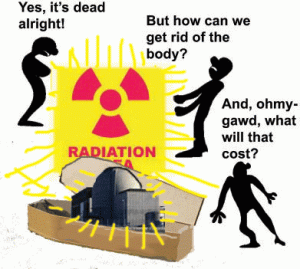
 Nucnet 1st March 2018, The Nuclear Decommissioning Authority (NDA) completely failed in both the procurement and management of a contract to clean up the UK’s Magnox
nuclear reactor and research sites, a report by the Public Accounts
Committee says.
The report, released on 28 February 2018, says this
disrupted an important component of vital nuclear decommissioning work and
cost the taxpayer upwards of £122m (€137m, $167m). The £6.2bn contract
— one of the largest awarded by the UK government — was to dismantle 12
first-generation Magnox nuclear sites.
It was awarded to Cavendish Fluor Partnership, a joint venture between UK-based Babcock International and
Fluor of the US. The committee, which oversees government expenditure,
said: “The NDA ran an overly complex procurement process, resulting in it
awarding the contract to the wrong bidder, and subsequently settling legal
claims from a losing consortium to the tune of nearly £100m.”
The committee also said the NDA, a public body established in 2004 to oversee
the clean-up of the UK’s nuclear legacy, “drastically
under-estimated” the scale of the work needed to decommission the sites
at the time it let the contract – a failure which ultimately led to the
termination of the Magnox contract nine years early.
The NDA did not have sufficient capability to manage the procurement or the complex process of
resolving differences between what the contractor was told to expect on the
sites and what it actually found, the committee concluded.
The NDA will now have to spend even more effort and money to find a suitable way of managing
these sites after the contract comes to an official end in September 2019,
the committee said. The NDA may have further wasted taxpayers’ money by
paying its previous contractor for work that was not done. The NDA cannot
fully account for £500m of the £2.2bn increase in the cost of the
contract between September 2014 and March 2017. In particular, it does not
know whether the £500m cost increase was due to its incorrect assumptions
about the state of the sites when it let the contract or underperformance
by the previous contractor.
https://www.nucnet.org/all-the-news/2018/03/01/accounts-committee-says-nda-completely-failed-with-6-2-billion-uk-magnox-contract
March 3, 2018
Posted by Christina Macpherson |
business and costs, decommission reactor, politics, UK |
Leave a comment
Guardian 2nd March 2018, The richest households should pay £410 a year more towards supporting
energy subsidies for wind farms, solar rooftops and home insulation
schemes, government-funded researchers have urged.
The UK Energy Research Centre (Ukerc) said that shifting environmental and social levies off
electricity bills and instead loading them on to general taxation would
reduce the cost of energy for more than two thirds of households. The
researchers argued the current approach to funding low-carbon power and
energy efficiency was regressive.
The poorest households spend 10% of their income on heating and keeping the lights on, compared to 3% for the
richest.
The report by Ukerc found that shifting the costs to taxation
would save the poorest 10% of households £102 a year, “a significant
difference for them”. Meanwhile the 10% of the country with the highest
income would pay an extra £410 a year, “a relatively small difference”
for such earners.
The two high income brackets below the richest group
would see rises of between £26 and £102 a year, while the remaining 70%
would see no change or a decrease.
John Barrett, professor of energy and climate policy, who worked on the analysis, said the status quo was hurting
the switch to greener energy. Subsidies for low-carbon power cost
billpayers £5.2bn in 2016-17 but are projected by the Treasury to rise to
£8.6bn in 2024-25 as new wind farms and other projects come online.
Campaigners have said for years that funding green energy subsidies through
energy bills is regressive because the poor are disproportionately
affected, but there has been little political appetite for a change.
https://www.theguardian.com/environment/2018/mar/02/richest-uk-households-should-pay-more-to-fund-clean-energy
March 3, 2018
Posted by Christina Macpherson |
renewable, UK |
Leave a comment

 Greenpeace protesters jailed for fireworks stunt at French nuclear plant, The Local Fr.28 Feb 18A French court on Tuesday sentenced two Greenpeace activists to a minimum of two months in jail for breaking into a nuclear power plant and setting off fireworks last year.
Six other protesters were handed five-month suspended sentences for the
October stunt at the plant in Cattenom, near the border with Luxembourg, which was intended to show the facility’s vulnerability to attack……..
Greenpeace said the fireworks were set off at the foot of a spent fuel pool — where nuclear plants store highly radioactive fuel rods that are removed from reactors after their use.
March 3, 2018
Posted by Christina Macpherson |
France, opposition to nuclear |
Leave a comment
 Japan’s Mitsubishi acquires 5% stake in French nuclear power firm Orano for $306m, Deal Street Asia, Mars Woo February 28, 2018 Tokyo-headquartered Mitsubishi Heavy Industries (MHI) has completed its acquisition of a 5 per cent interest in Orano, a French multinational group specialising in nuclear power and renewable energy, for €250 million ($306 million).
In a statement on Wednesday, MHI said the completion of the investment, which was agreed upon in March 2017, would enhance technological and business cooperation between the two companies and strengthen global value chain for nuclear energy…….
Orano primarily focuses on the fuel cycle business, including uranium mining, enrichment, and conversion and processing of spent fuel. MHI had in 1991, partnered with Areva, now an Orano subsidiary, to form a joint venture in the fuel cycle business for the manufacture and sale of a full range of reprocessing equipment. The company said it aims to play an important role in forging stronger links between the Japanese and French nuclear energy industries, as confirmed by the two countries’ governments in October 2015.
The company said it aims to play an important role in forging stronger links between the Japanese and French nuclear energy industries, as confirmed by the two countries’ governments in October 2015. “By strengthening the relationship between manufacturers in Japan and France, every effort will be made to expand and improve structurally as a comprehensive manufacturer capable of supporting the global nuclear power generation business in all aspects; from production of nuclear fuel to plant design, construction and maintenance, and reprocessing of spent fuel,” MHI said in a statement.
https://www.dealstreetasia.com/stories/japans-mitsubishi-acquires-5-stake-french-nuclear-power-firm-orano-306m-93291/
March 3, 2018
Posted by Christina Macpherson |
business and costs, France, Japan, politics international |
Leave a comment
 Putin unveils ‘invincible’ nuclear weapons to counter West , SMH, By Andrew Osborn, 2 March 18 Moscow: President Vladimir Putin unveiled an array of new nuclear weapons on Thursday, in one of his most bellicose speeches in years, saying they could hit almost any point in the world and evade a US-built missile shield.
Putin was speaking ahead of an election on March 18 that polls indicate he should win easily. He said a nuclear attack on any of Moscow’s allies would be regarded as an attack on Russia itself and draw an immediate response.
It was unclear if he had a particular Russian ally, such as Syria, in mind, but his comments looked like a warning to Washington not to use tactical battlefield nuclear weapons.
His remarks were greeted with scepticism in Washington, where officials cast doubt on whether Russia has added any new capabilities to its nuclear arsenal beyond those already known to the US military and intelligence agencies.
……. On Thursday, he sought to back his rhetoric with video clips of what he said were some of the new missiles. The images were projected onto a giant screen behind him at a conference hall in central Moscow where he was addressing Russia’s political elite.
Among weapons that Putin said were either in development or ready was a new intercontinental ballistic missile “with a practically unlimited range” able to attack via the North and South Poles and bypass any missile defence systems.
Putin also spoke of a small nuclear-powered engine that could be fitted to what he said were low-flying, highly manoeuvrable cruise missiles, giving them a practically unlimited range.
The new engine meant Russia was able to make a new type of weapon – nuclear missiles powered by nuclear rather than conventional fuel.
…….. Other new super weapons he listed included underwater nuclear drones, a supersonic weapon and a laser weapon.
…..Putin also voiced concerns about a new US nuclear doctrine, saying Russia’s own doctrine was defensive and only envisaged the use of nuclear weapons in response to an attack.Russia has repeatedly said it is keen to hold talks with the United States about the balance of strategic nuclear power and Putin put Washington and other nuclear powers on notice.
“We will view any use of nuclear weapons against Russia or its allies, be it of small, medium or any force, as a nuclear attack on our country,” he said. https://www.smh.com.au/world/europe/putin-unveils-invincible-nuclear-weapons-to-counter-west-20180302-p4z2fa.html
March 2, 2018
Posted by Christina Macpherson |
Russia, weapons and war |
Leave a comment
 As Nuclear Giant AREVA Reforms, Framatome Is Resurrected http://www.powermag.com/as-nuclear-giant-areva-reforms-framatome-is-resurrected/03/01/2018 | Sonal Patel a POWER associate editor.
Reforging its core business to return to competitiveness after record losses of €4.83 billion in 2014, French nuclear firm AREVA has split its five operational business units and rebranded them—again. All its assets related to the design and manufacture of nuclear reactors and equipment, fuel design and supply, and services to existing reactors now fall under Framatome, which until January 4 was known as New NP. Operations related to the nuclear fuel cycle will be undertaken by Orano, which until January 23 was known as NewCo.
Creation of the AREVA group itself was an overhaul effort. The company was formed in 2001 with the merger of Framatome, Cogema, a nuclear business of German giant Siemens, and French propulsion and research reactor arm Technicatome. Framatome—short for Franco-Américaine de Constructions Atomiques—was created in 1958 by Schneider, Merlin Gerin, and Westinghouse Electric to exploit the emerging pressurized water reactor (PWR) market.
. By 1975, the company had become the sole manufacturer of nuclear power plants in France, equipping French state-owned utility EDF with 58 PWRs, and gradually taking on more projects overseas, building reactors like South Africa’s Koeberg, South Korea’s Ulchin, and China’s Daya Bay and Ling-Ao. In 1989, Framatome and Siemens created a joint company called Nuclear Power International to develop the EPR, a third-generation reactor that complied with both French and German nuclear regulations. The companies eventually merged in 2001, retiring the Framatome name and giving birth to AREVA.
One of the company’s most prominent contract wins came in 2003 from Finnish utility Teollisuuden Voima Oy (TVO) for construction of the world’s first EPR, Olkiluoto 3, in southern Finland. In 2007, AREVA also signed a contract with EDF for an EPR in Flamanville, France, and separately with Taishan Nuclear Power Co., a joint venture 70% held by China Guangdong Nuclear Power Holding Corp. and 30% by EDF. Two years later, Siemens withdrew its capital in Areva NP—AREVA’s specialized nuclear steam supply system arm—citing a “lack of exercising entrepreneurial influence within the joint venture” as the reason behind the move, and transferred its 34% stake to the AREVA group.
But plagued by delays and cost overruns at Olkiluoto 3 (Figure 3) and Flamanville 3, as well as at a research reactor construction project, and financially hemorrhaging from renewable energy contracts, AREVA’s finances began to fall into disarray, reaching record losses in 2014. In 2015, EDF moved to snap up between 51% and 75% of the troubled nuclear giant’s reactor business, encouraged by the French government’s attempts to address a rivalry between the two majority state-owned companies.
In November 2016, AREVA and EDF signed a contract conferring to EDF exclusive control of a new entity—New NP—that oversaw AREVA’s reactor design and equipment manufacturing, fuel design and assemblies manufacturing, and reactor services. Closure of the sale was completed in December 2017, and EDF became the majority owner (holding 75.5% of shares) of New NP, while Mitsubishi Heavy Industries took on 19.5%, and Paris-based international engineering firm Assystem held 5%.
Then in January 2018, the companies rebranded New NP, reviving the Framatome name in a move to harken to its celebrated legacy. Staffed by 14,000 employees worldwide, Framatome today has an “existing global fleet of some 440 reactors representing output of around 390 GWe in 31 countries, and with new nuclear capacity on its way, the nuclear market presents opportunities in the areas of components, fuel, retrofits and services,” the company noted in January.
The name’s luster has this year already been burnished by two significant developments for the company. On January 25, the French Nuclear Safety Authority (Autorité de Sûreté Nucléaire [ASN]) gave Framatome and EDF the green light to resume manufacture of forgings for the French nuclear fleet at its 2006-purchased Le Creusot site (Figure 4), which was taken offline following the French regulator’s 2015 discovery of an anomaly in the composition in certain zones of the Flamanville EPR pressure vessel head and bottom head. In 2016, a quality audit identified “irregularities” in paperwork on nearly 400 plant components produced at the forge since 1965. Preventative measures ordered by ASN stemming from that debacle in December 2016 shut down more than half of France’s reactor fleet, sending contract prices across Europe soaring.
Also, on January 25, Framatome finalized and launched Enfission, a 50-50 joint venture with Lightbridge Corp., to commercialize the U.S. fuel technology developer’s metallic fuel. Lightbridge says that the “seed-and-blanket” design can safely operate at increased power density compared to standard uranium oxide fuel. For Framatome, which provides next-generation fuel assembly designs to more than 100 of about 260 light water reactors around the world, the partnership will strengthen its position in the global fuel market.
As part of restructuring efforts in June 2016, meanwhile, AREVA also created a separate company focused on the nuclear cycle, which it called, simply, “New Company” (NewCo). On January 23, that company was renamed “Orano.” The name is derived from Ouranos, a Greek god who personifies the heavens and was father of the Titans, and who in Roman mythology became “Uranus.” In 1789, German chemist and mineralogist Martin Heinrich Klaproth named his newly discovered rare metallic element “uranium” for the planet Uranus, which had also been recently found.
For Orano, the name is important because it “symbolizes a new start,” said CEO Philippe Knoche in January. “We have big ambitions for Orano, namely for it to become the leader in the production and recycling of nuclear materials, waste management, and dismantling within the next ten years.” Knoche also said, however, that the company’s name is written in lower case because the prospect of rebuilding a profitable operation will be done “with humility.” For now, the company’s operations will bank on reprocessing and nuclear growth in Asia rather than investing in new mines, owing to low prices of uranium, which have slipped 80% over the last decade as the nuclear sector sees a general slowdown.
March 2, 2018
Posted by Christina Macpherson |
business and costs, France, marketing of nuclear, politics, technology |
Leave a comment
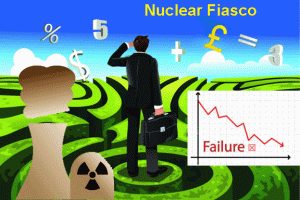 Telegraph 28th Feb 2018, The Government must share the blame for the bungling of a multi-billion
pound nuclear clean-up contract after failing to protect taxpayers from
spiraling costs, MPs have said.
In a damning report the Public Accounts Committee (PAC) accused the Government of being “culpable” in the
collapse of a contract to clean up Britain’s redundant fleet of Magnox
nuclear reactors. The Nuclear Decommissioning Authority’s £6.1bn deal was
aborted almost a year ago after it bungled how the 14 year contract was
awarded to the Cavendish Fluor Partnership (CFP) formed by Babcock and
Fluor.
The botched award led to a two year High Court legal battle which
effectively put taxpayers on the hook to pay £122m in compensation to
companies who bid for the Magnox work but failed to get it. The
committee’s report blamed the NDA for running “an overly complex
procurement process” which ultimately ended nine years early.
The NDA also drastically under-estimated the scale of the work needed to
decommission the sites at the time it awarded the contract, the report
said. The PAC said the debacle had caused “untold reputational damage” to
the NDA, but it added that the Government must share the blame for
approving the authority’s approach. Geoffrey Clifton-Brown, the
committee’s deputy chair, branded the contract “an appalling piece of
mismanagement and financial waste” which had cost the taxpayer over
£122m. The committee has asked the NDA to update MPs within three months
on its investigation into whether it overpaid its previous contractor and,
if so, how it planned to recover money.
https://www.telegraph.co.uk/business/2018/02/28/government-culpable-nuclear-clean-bungle/
March 2, 2018
Posted by Christina Macpherson |
politics, secrets,lies and civil liberties, UK |
Leave a comment
 Morning Star 28th Feb 2018, CATALOGUE of “appalling” mismanagement costing hundreds of millions of
pounds in taxpayers’ cash has been revealed by an investigation into the
government’s Nuclear Decommissioning Authority (NDA). The NDA handed out
contracts to private firms for the decommissioning of 11 ageing Magnox
nuclear reactors in British power stations, including Sellafield in Cumbria
and Hinkley A in Somerset.
https://www.morningstaronline.co.uk/article/ndas-failings-costing-taxpayers-millions
March 2, 2018
Posted by Christina Macpherson |
secrets,lies and civil liberties, UK |
Leave a comment
Bellona 27th Feb 2018, A Russian official has admitted there were missiles aboard the
Yekaterinburg nuclear submarine when it was ravaged by fire during repair
work at a shipyard near Murmansk in late 2011, reviving a six year old
mystery about what specific dangers faced the Russian public when the
accident occurred.
And while many Russian media rushed to report the
official’s remarks as conclusive proof that the submarine was armed with
nuclear missiles when it was swept by the blaze, it remains unclear whether
they, in fact, had been topped with their warheads at the time the fire
swept through the sub, injuring 19.
http://bellona.org/news/nuclear-issues/2018-02-russian-officials-offhand-remark-about-nuclear-submarine-fire-ignites-fresh-speculation-and-new-denials
March 2, 2018
Posted by Christina Macpherson |
incidents, Russia |
Leave a comment
 India, Russia, Bangladesh sign tripartite pact for civil nuclear cooperation, By Dipanjan Roy Chaudhury, ET Bureau| Mar 01, 2018, NEW DELHI: In a landmark development India for the first time signed a tripartite agreement on Thursday with foreing partners — Russia & Bangladesh — for civil nuclear cooperation.
Nuclear Power Cooperation of India Limited (NPCIL) will play a key role in building a nuclear power plant on foreign soil with the proposed supply of equipment and material for the power station being built by Russia in Bangladesh. India is also extending support for capacity building and has been training Bangladeshi nuclear scientists for the project.
The agreement was signed in Moscow on Thursday by Deputy Director General of Rosatom (Russia’s Alex civil nuclear body) Nikolay Spassky, Ambassador of Bangladesh in Russia S.M. Saiful Hoque and Indian Ambassador to Russia Pankaj Saran.
Rosatom is constructing nuclear power plant in Bangladesh on a turnkey contract basis. The scope of work includes design, production and supply of equipment, construction, installation, pre-commissioning and commissioning, according to Rosatom officials.
India, having experience in building its nuclear power stations and operating the Kudankulam Plant, built with Russian assistance, showed interest in participating in a Russian project in Bangladesh. The Memorandum set a framework for the interaction of the Russian Contractor, Indian and Bangladeshi experts in the implementation of the project. ……..https://economictimes.indiatimes.com/news/defence/india-russia-bangladesh-sign-tripartite-pact-for-civil-nuclear-cooperation/articleshow/63127669
March 2, 2018
Posted by Christina Macpherson |
India, marketing, Russia |
Leave a comment
 Edie 27th Feb 2018, Jeremy Corbyn has pledged that Labour would keep Britain in the EU internal
energy market (IEM) and the Euratom nuclear co-operation treaty. In a
landmark speech setting out his party’s stance on the UK’s future
trading relationships following Brexit, the opposition leader said it was
in Britain’s interests to remain part of Euratom. He said: “We will
want to remain a part of agencies like Euratom, regulating nuclear
materials in energy and health sectors.” The Labour leader also used his
speech to signal Labour will seek continued UK membership of the IEM to
help support the development of the low carbon energy sector. He said
barrier-free trade of low carbon goods is necessary to underpin the growth
of the UK’s low carbon and renewable energy sectors.
https://www.edie.net/news/11/Labour-would-keep-Britain-in-EU-internal-energy-market/
March 2, 2018
Posted by Christina Macpherson |
politics, UK |
Leave a comment
In 1985, a Russian Submarine Created an Atomic Disaster. The Radiation Lingers to This Day. Kyle Mizokami, 27 Feb 18,
According to Nuclear Risks, the accident scene was heavily contaminated with radioactivity. Gamma ray radiation was not particularly bad; at an exposure rate of five millisieverts per hour, it was the equivalent of getting a chest CT scan every hour. However, the explosion also released 259 petabecquerels of radioactive particles, including twenty-nine gigabecquerels of iodine-131, a known cause of cancer. This bode very badly for the emergency cleanup crews, especially firefighters who needed to get close to the explosion site, and the nearby village of Shkotovo-22. Forty-nine members of the cleanup crew displayed symptoms of radiation sickness, ten of them displaying acute symptoms.
In 1985, a Soviet submarine undergoing a delicate refueling procedure experienced a freak accident that killed ten naval personnel. The fuel involved was not diesel, but nuclear, and the resulting environmental disaster contaminated the area with dangerous, lasting radiation. The incident, which remained secret until after the demise of the USSR itself, was one of many nuclear accidents the Soviet Navy experienced during the Cold War.
The Soviet Union’s nuclear war planners had a difficult time targeting the United States. While the United States virtually encircled the enormous socialist country with nuclear missiles in countries such as Turkey and Japan, the Western Hemisphere offered no refuge for Soviet deployments in-kind.
One solution was the early development of nuclear cruise missile submarines. These submarines, known as the Echo I and Echo II classes, were equipped with six and eight P-5 “Pyatyorka” nuclear land attack cruise missiles, respectively. Nicknamed “Shaddock” by NATO, the P-5 was a subsonic missile with a range of 310 miles and 200- or 350-kiloton nuclear warhead. The P-5 had a circular error probable of 1.86 miles, meaning half of the missiles aimed at a target would land within that distance, while the other half would land farther away.
The missiles were stored in large horizontal silos along the deck of the submarine. In order to launch a P-5 missile, the submarine would surface, deploy and activate a tracking radar, then feed guidance information to the missile while it flew at high altitude. The system was imperfect—the command link was vulnerable to jamming, and the submarine needed to remain on the surface, helpless against patrol aircraft and ships, until the missile reached the target. Eventually the P-5 missiles were withdrawn and the P-5 missile was replaced with the P-6, a similar weapon but one with its own radar seeker for attacking U.S. aircraft carriers.
The introduction of the P-6 gave the Echo II a new lease on life. ……
On August 10, the submarine was in the process of being refueled. Reportedly, the reactor lid—complete with new nuclear fuel rods—was lifted as part of the process. A beam was placed over the lid to prevent it from being lifted any higher, but incompetent handling apparently resulted in the rods being lifted too high into the air. (One account has a wave generated by a passing motor torpedo boat rocking the submarine in its berth, also raising the rods too high.) This resulted in the starboard reactor achieving critical mass, followed by a chain reaction and explosion.
The explosion blew out the reactor’s twelve-ton lid—and fuel rods—and ruptured the pressure hull. The reactor core was destroyed, and eight officers and two enlisted men standing nearby were killed instantly. A the blast threw debris was thrown into the air, and a plume of fallout 650 meters wide by 3.5 kilometers long traveled downwind on the Dunay Peninsula. More debris and the isotope Cobalt-60 was thrown overboard and onto the nearby docks.
According to Nuclear Risks, the accident scene was heavily contaminated with radioactivity. Gamma ray radiation was not particularly bad; at an exposure rate of five millisieverts per hour, it was the equivalent of getting a chest CT scan every hour. However, the explosion also released 259 petabecquerels of radioactive particles, including twenty-nine gigabecquerels of iodine-131, a known cause of cancer. This bode very badly for the emergency cleanup crews, especially firefighters who needed to get close to the explosion site, and the nearby village of Shkotovo-22. Forty-nine members of the cleanup crew displayed symptoms of radiation sickness, ten of them displaying acute symptoms. …….
February 27, 2018
Posted by Christina Macpherson |
history, incidents, Russia |
Leave a comment
 Barents Observer 26th Feb 2018. Finland’s Radiation and Nuclear Safety Authority (STUK) says tiny amounts
of radioactive iodine-131 were measured in the air Kotka, east of Helsinki
in late January. The same isotope was then measured again last week north
to Kajaani. The levels were very low, ranging from 0,7 to 1,6
micro-becquerel per cubic meter air, STUK says in a news release
From where the radioactivity is coming is still unknown. Radioactive iodine-131
has a half-life of only eight days so the measurements are proof of a
rather recent release.
The source could be a nuclear reactor, a facility
producing isotopes for medical purposes or by releases from a nuclear
weapons related test. Norway’s Radiation Protection Authority (NRPA) on
Monday confirms detection of radioactive iodine also at several of the
country’s air-measurement stations.
https://thebarentsobserver.com/en/ecology/2018/02/traces-radioactive-iodine-air
February 27, 2018
Posted by Christina Macpherson |
environment, Finland |
Leave a comment
Actus Environnement 23rd Feb 2018, [Machine Translation] The welds of the Flamanville EPR would not meet all the technical requirements. ASN will give its opinion in the second half of 2018. It also
mentions dysfunctions in the organization of the site.
On February 22nd, EDF announced that it had detected defects in the secondary circuit welds
of the EPR reactor under construction in Flamanville (Manche). In question:
the quality of realization of the welds of the circuit which evacuates
steam of the steam generators towards the turbine.
Thirty-eight of the 66 welds in the circuit are affected. Questioned on the subject in the
National Assembly, Pierre-Franck Chevet, president of the Nuclear Safety
Authority (ASN), described the subject as “serious” .
This Friday, the ASN publishes a note in which it indicates to have questioned February 7 EDF
and Framatome about the site of the EPR. The gendarme of the nuclear
indicates that it “informed EDF and Framatome that it will collect the
opinion of the permanent group of experts for GP ESPN nuclear pressure
equipment [about the anomalies of welding]” . But, assures EDF, “[the]
pipes are in compliance with the regulation of nuclear pressure equipment”
The company ”
https://www.actu-environnement.com/ae/news/defauts-soudures-circuit-secondaire-epr-flamanville-30722.php4#xtor=ES-6
February 27, 2018
Posted by Christina Macpherson |
France, safety |
Leave a comment
Nuclear Transparency 23rd Feb 2018 [Machine Translation] Review of forgings at Le Creusot: EDF discovered
1,063 anomalies and 233 nonconformities on 23 reactors. Following the discovery of numerous irregularities at Creusot Forge, now Framatome, EDF continues its review of the parts installed in its reactors.
A first report was published in September 2017 . A second assessment has just been posted. EdF makes a count of compliance discrepancies by distinguishing “non-conformities” that relate to an internal requirement to the
manufacturer of “anomalies” relating to the regulatory or customer’s external requirements.
Some anomalies are similar to falsifications, according to the ASN. There are now 1,063 anomalies and 233 nonconformities out of 23 reactors only. Others are expected. http://transparence-nucleaire.eu.org/revue-pieces-forgees-creusot-edf-a-decouvert-1-063-anomalies-233-non-conformites-23-reacteurs/
Thursday Blog 24th Feb 2018, EDF has just revised upwards the number of defects affecting its reactors. The latest count of the company reports 1,063 ” anomalies ” (553 more than September 2017) and 233 ” non-conformities ” (103 more) on the equipment of 23 of its operating nuclear reactors. Added to this are 95 anomalies and 16 non-compliances on Flamanville EPR equipment revealed in September 2017.
These results are the result of EDF’s checks on all equipment manufacturing records from the plant. du Creusot (26732) and installed on its reactors. EDF released this second wave of results on Thursday 22 February.
http://leblogdejeudi.fr/nucleaire-edf-a-decouvert-1-063-anomalies-et-233-non-conformites-sur-23-reacteurs/
February 27, 2018
Posted by Christina Macpherson |
France, safety |
Leave a comment









 nuclear-news