The court said no to the application because it considered that there were problems with the copper canister that had to be resolved now and not later.
the UK’s National Nuclear Laboratory (NNL) is to carry out an expert peer review of a Canadian research programme on microbiologically influenced corrosion of canisters that will be used to dispose of used nuclear fuel.
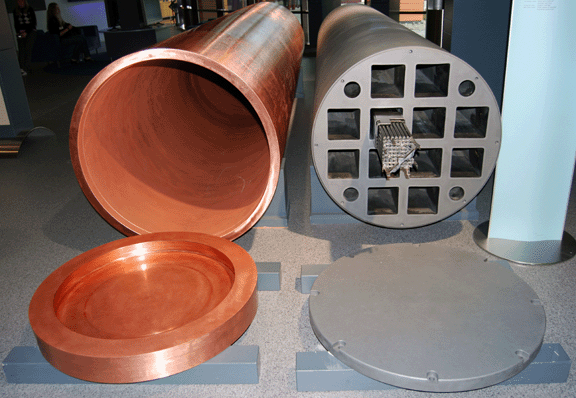
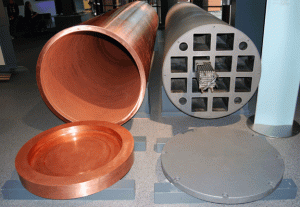 The Copper Corrosion Conundrum No2Nuclear Power http://www.no2nuclearpower.org.uk/wp/wp-content/uploads/2018/03/NuClearNews_No105.pdf
The Swedish Environmental Court has rejected the Nuclear Waste Company SKB’s license application for a final repository for spent nuclear fuel in Forsmark, Sweden. This is a huge triumph for safety and environment – and for the Swedish NGO Office for Nuclear Waste Review (MKG), the Swedish Society for Nature Conservation (SSNC), and critical scientists. Now it is up to the Swedish government to make a final decision.
The Environmental Court took into consideration viewpoints from all parties in the case, including scientists who have raised concerns about disposing spent nuclear fuel in copper canisters. During the legal proceedings, the Swedish NGO Office for Nuclear Waste Review (MKG) and the Swedish Society for Nature Conservation (SSNC) presented the shortcomings of this method of disposal. For many years, the environmental organisations have been arguing that the Nuclear Waste Company SKB need to listen to critical scientists, and investigate alternative disposal methods, especially the possibility of developing a very deep boreholes disposal system. (1) Johan Swahn, Director at MKG said:
“Several independent researchers have criticized both the applied method and the selected site. There is a solid documentation base for the Environmental Court’s decision. It is hard to believe the Swedish Government’s conclusions will be any different from the Court’s.”
MKG has made an unofficial translation into English of the Environmental Court opinion. (2)
The court said no to the application because it considered that there were problems with the copper canister that had to be resolved now and not later. The translation shows the courts judicial argumentation and why it decided not to accept the regulator – the Swedish Radiation Safety Authority’s (SSM’s) opinion that the problems with the integrity of the copper canister were not serious and could likely be solved at a later stage in the decision-making process. The court is quite clear in its statement and argumentation:
“The Land and Environmental Court finds that the environmental impact assessment meets the requirements of the Environmental Code and can therefore be approved. All in all, the investigation meets the high standards set out in the Environmental Code, except in one respect, the safety of the canister.” (Emphasis added)
“The investigation shows that there are uncertainties, or risks, regarding how much certain forms of corrosion and other processes can impair the ability of the canister to contain the nuclear waste in the long term. Overall, these uncertainties about the canister are significant and have not been fully taken into account in the conclusions of SKB’s safety analysis. The Land and Environmental Court considers that there is some leeway for accepting further uncertainties. The uncertainties surrounding certain forms of corrosion and other processes are, however, of such gravity that the Court cannot, based on SKB’s safety analysis, conclude that the risk criterion in the Radiation Safety Authority’s regulations has been met. In the context of the comprehensive risk assessment required by the Environmental Code, the documentation presented to date does not provide sufficient support for concluding that the final repository will be safe in the long term.” (Emphasis added)
The court says that the application is only permissible if the nuclear waste company SKB:
“…produces evidence that the repository in the long term will meet the requirements of the Environmental Code, despite remaining uncertainties regarding how the protective capability of the canister may be affected by: a. corrosion due to reactions in oxygen-free water; b. pit corrosion due to reaction with sulphide, including the contribution of the sauna effect to pit corrosion; c. stress corrosion due to reaction with sulphide, including the contribution of the sauna effect to stress corrosion; d. hydrogen embrittlement; e. radioactive radiation impact on pit corrosion, stress corrosion and hydrogen embrittlement.”
The main difference between the court’s and the regulator’s decision-making was that the court decided to rely on a multitude of scientific sources and information and not only on the material provided by SKB. It had also been uncovered that the main corrosion expert at SSM did not want to say yes to the application at this time that may have influenced the court’s decision-making. In fact there appear to have been many dissenting voices in the regulator despite the regulator’s claim in the court that a united SSM stood behind its opinion.
The court underlines in its opinion that the Environmental Code requires that the repository should be shown to be safe at this stage in the decision-making process, i.e. before the government has its say. The court says that some uncertainties will always remain but it sees the possible copper canister problems as so serious that it is not clear that the regulator’s limits for release of radioactivity can be met. This is a reason to say no to the project unless it can be shown that the copper canister will work as intended. The copper canister has to provide isolation from the radioactivity in the spent nuclear fuel to humans and the environment for very long time-scales.
It is still unclear how the process will proceed. The community of Östhammar has cancelled the referendum on the repository, as there will be no question from the government in the near future. The government has set up a working group of civil servants to manage the government’s handling of the opinions delivered by the court and SSM. SKB has said that it is preparing documentation for the government to show that there are no problems with the canister. Whether the government thinks this will be enough remains to be seen. This is likely not what the court had in mind. The government would be wise to make a much broader review of the issue. There is a need for a thorough judicial review on the governmental level in order to override the court’s opinion. Otherwise the government’ decision may not survive an appeal to the Supreme Administrative Court.
There are eminent corrosion experts who believe that copper is a bad choice as a canister material. There is also increasing experimental evidence that this is the case. The court’s decision shows the importance of democratic and open governance in environmental decisionmaking. It is important that the continued decision-making regarding the Swedish repository for spent nuclear is transparent and multi-faceted. (3)
Copper Canisters The canister has to enclose the nuclear waste for a very long; it is the final repository’s primary safety function. The canister has a 50 mm thick copper shell with an insert of cast iron. The canister must withstand corrosion and mechanical stress.
The investigation on the capability of the canister is extensive and involves complex technical and scientific issues. These include groundwater chemistry, corrosion processes, as well as creep and hydrogen embrittlement (this latter affects the mechanical strength of the canister). However, the parties taking part in the court proceedings disagreed on several issues crucial to the final repository’s long-term security.
The Land and Environmental Court considered the following uncertainties regarding the canister to be most important in the continued risk assessment:
- 1. General corrosion due to reaction in oxygen-free water. The parties have different views on scientific issues surrounding this kind of corrosion. The Court found that there is considerable uncertainty on this topic that has not been taken account of in SKB’s safety analysis
- .· 2. Local corrosion in the form of pit corrosion due to reaction with sulphide. The Court found that there is significant uncertainty regarding pit-corrosion due to reaction with sulphide. This uncertainty has not been included in the safety analysis. In addition, there is uncertainty about the sauna effect, which may have an amplifying effect on pit corrosion.
- · 3. Local corrosion in the form of stress corrosion due to reaction with sulphide. The Court found that there is significant uncertainty regarding stress corrosion due to reaction with sulphide. This uncertainty has not been included in the safety analysis. In addition, there is uncertainty about the sauna effect, which may have an amplifying effect on stress corrosion.
- · 4. Hydrogen embrittlement is a process that affects the mechanical strength of the canister. The Court found that significant uncertainty regarding hydrogen embrittlement remains. This uncertainty has not been taken account of in the safety analysis.
- · 5. The effect of ionizing radiation on pit corrosion, stress corrosion and hydrogen embrittlement. There is significant uncertainty regarding ionizing radiation impact on pit corrosion, stress corrosion and hydrogen sprays. This uncertainty has been included to a limited extent in the safety assessment.
Meanwhile, the UK’s National Nuclear Laboratory (NNL) is to carry out an expert peer review of a Canadian research programme on microbiologically influenced corrosion of canisters that will be used to dispose of used nuclear fuel. The NNL has been contracted by Canada’s National Waste Management Organisation (NWMO) to review its work on the potential for corrosion of the copper-clad canisters. The NWMO is responsible for designing and implementing the safe, long-term management of Canada’s used nuclear fuel under a plan known as Adaptive Phased Management. This requires used fuel to be contained and isolated in a deep geological repository, with a comprehensive process to select an informed and willing host for the project.
The used fuel will be isolated from the environment using a series of engineered barriers. Fuel elements comprise ceramic fuel pellets, which are themselves highly durable, contained inside corrosion-resistant zircaloy tubes to make fuel elements. Bundles of fuel elements are placed into large, durable copper-coated steel containers which are designed to contain and isolate used nuclear fuel in a deep geological repository, essentially indefinitely. The canisters will be placed in so-called “buffer boxes” containing by bentonite clay, providing a fourth barrier.
World Nuclear News reports that although copper is highly resistant to corrosion, under anoxic conditions – that is, where no oxygen is present – sulphate-reducing bacteria have the potential to produce sulphide, which can lead to microbiologically induced corrosion (MIC) of copper. Waste management organisations and regulators therefore need to understand the levels of sulphide that will be present in a geological disposal facility, to understand its potential to migrate to the canister surface and the potential for it to cause copper corrosion, the NNL said.
The NWMO has been actively developing computer models that will be used to evaluate the potential for MIC once a disposal site has been selected, and has selected the NNL to carry out a peer review of its work because of the UK laboratory’s expertise in the biogeochemical processes that could affect repository performance and in developing computer modelling techniques that simulate the effects of sulphate-reducing bacteria. The work is linked closely with NNL’s participation in the European Commission Horizon-2020 MIND (Microbiology in Nuclear waste Disposal) project. (4
March 14, 2018
Posted by Christina Macpherson |
Reference, Sweden, wastes |
1 Comment
 The Guardian view on nuclear fusion: a moment of truth Until recently the attractions and drawbacks of nuclear fusion reactors were largely theoretical. Within a decade this will not be the case https://www.theguardian.com/commentisfree/2018/mar/12/the-guardian-view-on-nuclear-fusion-a-moment-of-truth 13 Mar 18
One of the cliches of nuclear power research is that a commercial fusion reactor is only ever a few decades away – and always will be. So claims that the technology is on the “brink of being realised” by scientists at the Massachusetts Institute of Technology and a private company should be viewed sceptically.
The MIT-led team say they have the “science, speed and scale” for a viable fusion reactor and believe it could be up and running within 15 years, just in time to combat climate change. [?] The MIT scientists are all serious people and perhaps they are within spitting distance of one of science’s holy grails. But no one should hold their breath.
Fusion technology promises an inexhaustible supply of clean, safe power. If it all sounds too good to be true, that’s because it is. For decades scientists struggled to recreate a working sun in their laboratories – little surprise perhaps as they were attempting to fuse atomic nuclei in a superheated soup. Commercial fusion remains a dream. Yet in recent years the impossible became merely improbable and then, it felt almost overnight, technically feasible. For the last decade there has been a flurry of interest –and not a little incredulity –about claims, often made by companies backed by billionaires and run by bold physicists, that market-ready fusion reactors were just around the corner.
There are reasons to want to believe that fusion will one day be powering our lives. The main fuel is a heavy isotope of hydrogen called deuterium which can be extracted from water and therefore is in limitless supply – unlike the uraniumused in nuclear fission reactors. But fusion’s science is tricky and the breakthroughs rare. So far there has been no nuclear fusion reaction that has been triggered, continued and self-sustained. Neither has the plasma soup that exists at temperatures found in the stars been magnetically contained. Nor has any research group sparked a fusion reaction that has released more energy than it consumed, one of the main attractions of the technology. Perhaps the most successful fusion reactor has been the JET experiment, so far Europe’s largest fusion device, which ended up in the UK after the SAS stormed a hijacked German airliner in 1977 and Bonn backed the then prime minister Jim Callaghan’s request to host it. JET hasn’t even managed to break even, energy-wise. Its best ever result, in 1997, remains the gold standard for fusion power – but it achieved just 16 MW of output for 25 MW of input.
Hopes for fusion now rest with the
International Thermonuclear Experimental Reactor (Iter), a multi-national $20bn effort in France to show that the science can be made to work. Within a decade Iter aims to control a hydrogen bomb-sized atomic reaction for a few minutes. It is a vast undertaking. At its heart is a doughnut-shaped device known as a tokamak that weighs as much as three Eiffel towers. Iter’s size raises a question of how large a “carbon footprint” the site will leave. Like JET, Iter uses a fusion fuel which is a 50-50 mixture of deuterium and a rare hydrogen isotope known as tritium. To make Iter self-sustaining it will have to prove that tritium can be “
bred”, a not inconsiderable feat. Iter will also test how “clean” a technology fusion really is. About 80% of a fusion reaction’s energy is released as subatomic particles known as neutrons, which will smash into the exposed reactor components and leave tonnes of radioactive waste. Just how much will be crucial in assessing whether fusion is a
dirty process or not.
Iter’s worth is that it is a facility in the real world, where fusion’s promise can be tested. If it turns out to be better than expected then private investment is going to be needed to commercialise a fusion reactor. If it falls short then there must be a realistic rethink of fusion’s potential. After all, the money that has been poured into it could have been spent on cheap solar technology which would allow humanity to be powered by a fusion reactor that’s 150m kilometres away, called the sun.
March 14, 2018
Posted by Christina Macpherson |
EUROPE, technology |
Leave a comment
 Sudan, Russia to sign accord to develop nuclear power: SUNA agency https://af.reuters.com/article/topNews/idAFKCN1GP0ME-OZATP Reuters Staff, 13 Mar 18KHARTOUM (Reuters) – Sudan will sign a“roadmap” with Russia to build nuclear power stations during a visit to Moscow by Khartoum’s electricity minister, state news agency SUNA said on Monday.
SUNA said Water Resources, Irrigation, and Electricity Minister Moataz Mousa, who left Khartoum on Monday, would meet the head of Russia’s state nuclear agency Rosatom. The trip comes four months after Sudanese President Omar Hassan al-Bashir told his Russian counterpart Vladimir Putin he wanted to discuss nuclear power cooperation with Russia. SUNA quoted a spokesman for the ministry as saying the two sides would sign several memorandums of understanding including the roadmap“to implement a plan to develop nuclear (power) stations”. It did not elaborate. Reporting by Omar Fahmy, editing by David Evans
March 14, 2018
Posted by Christina Macpherson |
AFRICA, marketing, Russia |
Leave a comment
13 Mar 18
France will commit 700 million euros to the International Solar Alliance (ISA), President Emmanuel Macron said on Sunday at the founding conference of the organization, reiterating the European country’s commitment to the alliance and clean energy.
https://www.reuters.com/article/us-india-solar-alliance/france-to-commit-700-million-euros-to-international-solar-alliance-idUSKCN1GN0JU
March 14, 2018
Posted by Christina Macpherson |
France, renewable |
Leave a comment
Geological Screening, NO2 NuclearPower 14 Mar 18 On 30th January 2013, Cumbria County Council rejected the Government’s plans to undertake preliminary work on an underground radioactive waste dump. (See Cumbria Plan Dumped nuClear News No.47) The county and its western district councils Allerdale and Copeland were the only local authorities in the UK still involved in feasibility studies for a £12bn – £19bn disposal facility. So the rejection left the UK once again, without a plan for dealing with its nuclear waste legacy, let alone waste from proposed new reactors.
Then, in July 2014 the UK Government published a renewed process for siting a Geological Disposal Facility (GDF) – the ‘Implementing Geological Disposal’ White Paper. (1)
The White Paper explained that certain ‘Initial Actions’ would have to happen before formal discussions between communities interested in hosting a GDF and the delivery body Radioactive Waste Management Limited (RWM) could take place. (2)
These ‘Initial Actions’ included: · A National Geological Screening exercise; · The establishment of a policy framework for planning decisions in England; and · Development of a process of Working with Communities, including Community Engagement, Community Representation, Community Investment and the Test of Public Support…….http://www.no2nuclearpower.org.uk/wp/wp-content/uploads/2018/03/NuClearNews_No105.pdf
March 14, 2018
Posted by Christina Macpherson |
UK, wastes |
Leave a comment
 National assembly 9th March 2018, [Machine Translation]
La Hague: the boss of Orano (ex-Areva) minimizes the risks in the event of a plane crash on spent fuel pools. According to
Philippe Knoche, a plane crash or rocket fire could not damage enough spentfuel storage tanks to dewater them. “I would like to take this example
because our opponents use it a lot …”
March 12, 2018
Posted by Christina Macpherson |
France, safety |
Leave a comment
 Le Monde 10th March 2018, [Machine Translation] EPR: epilogue of the Finnish soap opera Areva. The nuclear group will pay hundreds of millions of euros in penalties for the
delay of ten years in the Olkiluoto reactor project.
http://www.lemonde.fr/economie/article/2018/03/10/epr-areva-en-passe-de-solder-son-lourd-contentieux-finlandais-avec-tvo_5268784_3234.html
Areva to pay Finland’s TVO 450 mln euros over nuclear reactor dispute https://www.reuters.com/article/tvo-areva-olkiluoto-settlement/areva-to-pay-finlands-tvo-450-mln-euros-over-nuclear-reactor-dispute-idUSL8N1QT0N1 Reuters Staff HELSINKI, March 11 (Reuters) – Finnish utility Teollisuuden Voima (TVO) said on Sunday it had agreed a settlement with French nuclear company Areva and Germany’s Siemens in the long-running dispute over cost overruns and delays on their EPR nuclear reactor project.
Areva-Siemens will pay TVO compensation of 450 million euros ($553.73 million), the Finnish company said in a statement.
TVO and Areva-Siemens were claiming billions of euros from each other due to the delays in the Olkiluoto 3 reactor project in southwest Finland. Its start was postponed last year to May 2019 – a decade later than planned.
$1 = 0.8127 euros Reporting by Tuomas Forsell
March 12, 2018
Posted by Christina Macpherson |
business and costs, Finland, France, Legal |
Leave a comment
 Mikhail Gorbachev: The U.S. and Russia Must Stop the Race to Nuclear War http://time.com/5191433/mikhail-gorbachev-nuclear-weapons-trump-putin-russia/ By MIKHAIL GORBACHEV 10 March 18
When I became the leader of the Soviet Union in 1985, I felt during my very first meetings with people that what worried them the most was the problem of war and peace. Do everything in order to prevent war, they said.
By that time, the superpowers had accumulated mountains of weapons; military build-up plans called for “space combat stations,” “nuclear-powered lasers,” “kinetic space weapons” and similar inventions. Thank God, in the end none of them were built. What is more, negotiations between the U.S.S.R. and the United States opened the way to ending the nuclear arms race. We reached agreement with one of the most hawkish U.S. presidents, Ronald Reagan, to radically reduce the arsenals.
Today, those achievements are in jeopardy. More and more, defense planning looks like preparation for real war amid continued militarization of politics, thinking and rhetoric.
The National Security Strategy and Nuclear Posture Review published by U.S. President Donald Trump’s administration in February orients U.S. foreign policy toward “political, economic, and military competitions around the world” and calls for the development of new, “more flexible” nuclear weapons. This means lowering the threshold for the use of nuclear weapons even further.
Against this backdrop, Russian President Vladimir Putin, in his recent address to the Federal Assembly, announced the development in Russia of several new types of weapons, including weapons that no country in the world yet possesses.
The Bulletin of Atomic Scientists, published in Chicago, set the symbolic Doomsday Clock half a minute closer to “Midnight” in January. As the scientists see it, we are now within two minutes of a global catastrophe. The last time this level of danger was recorded in 1953.
The alarm that people feel today is fully justified.
How should we respond to this new round of militarization?
Above all, we must not give up; we must demand that world leaders return to the path of dialogue and negotiations.
The primary responsibility for ending the current dangerous deadlock lies with the leaders of the United States and Russia. This is a responsibility they must not evade, since the two powers’ arsenals are still outsize compared to those of other countries.
But we should not place all our hopes on the presidents. Two persons cannot undo all the roadblocks that it took years to pile up. We need dialog at all levels, including mobilization of the efforts of both nations’ expert communities. They represent an enormous pool of knowledge that should be used in the interest of peace.
Things have come to a point where we must ask: Where is the United Nations? Where is its Security Council, its Secretary General? Isn’t it time to convene an emergency session of the General Assembly or a meeting of the Security Council at the level of heads of state? I am convinced that the world is waiting for such an initiative.
There is no doubt in my mind that the vast majority of people both in Russia and in the United States will agree that war cannot be a solution to problems. Can weapons solve the problems of the environment, terrorism or poverty? Can they solve domestic economic problems?
We must remind the leaders of all nuclear powers of their commitment under the Nuclear Non-Proliferation Treaty to negotiate reductions and eventually the elimination of nuclear weapons. Their predecessors signed that obligation, and it was ratified by the highest levels of their government. A world without nuclear weapons: There can be no other final goal.
However dismal the current situation, however depressing and hopeless the atmosphere may seem, we must act to prevent the ultimate catastrophe. What we need is not the race to the abyss but a common victory over the demons of war.
March 10, 2018
Posted by Christina Macpherson |
Russia, USA, weapons and war |
Leave a comment
| Russia to help with Ethiopia’s nuclear energy ambitions, African News |
|
| Source: Xinhua 2018-03-10 00:32:45 |
|

ADDIS ABABA, March 9 (Xinhua) — Ethiopia and Russia agreed on Friday to boost cooperation in nuclear energy during a visit by Russian Foreign Minister Sergey Lavrov.
Speaking to local and international media, Lavrov said Russia will assist Ethiopia’s nuclear energy ambitions as part of efforts to strengthen political, economic and cultural ties between the two nations…..http://www.xinhuanet.com/english/2018-03/10/c_137028152.htm
March 9, 2018
Posted by Christina Macpherson |
AFRICA, marketing, Russia |
Leave a comment
In Cumbria 9th March 2018, Nuclear Decommissioning Authority funds have helped two UK businesses
develop a small drone to measure radiation levels in the damaged reactor
building of the Fukushima nuclear power plant in Japan. The lightweight
drone uses lasers to self-navigate deep inside hazardous facilities where
GPS signals cannot reach, and has already been used successfully at
Sellafield.
The drone, called Remote Intelligence Survey Equipment for
Radiation or Riser, carries a sophisticated radiation detection and mapping
system which has been collecting vital information about conditions in the
remaining Windscale Pile chimney. More than 60 years after the 1957 fire,
the chimney remains highly contaminated.
http://www.in-cumbria.com/news/Cumbrian-technology-used-at-Japans-Fukushima-nuclear-power-plant-c5720302-2ca4-4270-854d-99e934c64148-ds
March 9, 2018
Posted by Christina Macpherson |
radiation, UK |
Leave a comment

Bird at left normal, at right – Chernobyl bird with facial cancer
Beyond Nuclear International 4th March 2018, It started with wolves. The packs around the Chernobyl nuclear plant, which exploded on April 26, 1986, were thriving, said reports. Benefitting from the absence of human predators, and seemingly unaffected by the high radiation levels that still persist in the area, the wolves, they claimed, were doing better than ever.
Appearances, however, can be deceptive. Abundant does not necessarily mean healthy. And that is exactly what
evolutionary biologist, Dr. Timothy Mousseau and his team began to find out as, over the years, they traveled to and researched in and around the Chernobyl disaster site in the Ukraine.
Then, when a similar nuclear disaster hit in Japan — with the triple explosions and meltdowns at
Fukushima Daiichi on March 11, 2011 — Mousseau’s team added that region to its research itinerary.
Mousseau has now spent more than 17 years looking at the effects on wildlife and the ecosystem of the 1986 Chernobyl
nuclear disaster. He and his colleagues have also spent the last half dozen years studying how non-human biota is faring in the wake of Fukushima. Ninety articles later, they are able to conclude definitively that animals and plants around Chernobyl and Fukushima are very far indeed from flourishing.
https://beyondnuclearinternational.org/2018/03/04/not-thriving-but-failing/
March 9, 2018
Posted by Christina Macpherson |
environment, Ukraine |
Leave a comment
 Energy Voice 8th March 2018, A leading independent nuclear expert has called for increased monitoring of
a Caithness beach after an “alarming” radioactive fragment was found.
Dr John Large, who oversaw the salvage of Russian nuclear sub Kursk in 2000
and advises governments around the world, said the situation was
“serious” and could threaten local communities.
The tiny particle of reprocessed fuel from Dounreay was discovered to contain radioactive
americium. Dr Large said the first recorded presence of the so-called
“daughter of plutonium” in nuclear waste washed up on Sandside beach,
near Reay, was probably discharged into the sea decades ago.
He added: “The trouble is that 20 or 30 or so years later it has turned up on a
beach. If it reaches the surface – which is quite possible given natural
disturbance by the tide etc – and gets dried out it can become airborne,
thus threatening local communities. It is alarming. “Of course it is
serious.
There’s not a lot you can do either – because finding these
particles is a random process, you cannot predict where they are.
“Monitoring needs to be stepped up because there is a real risk these
particles could end up in areas of population.”
A spokeswoman for Dounreay said: ”Addressing the legacy of radioactive particles in the
marine environment around Dounreay is an important part of the site’s
decommissioning programme. The particle monitoring regime for external
beaches has been carried out for many years and is reported on our
website.”
The particle was the 275th to be unearthed on the beach since
the discovery of the first in 1984. Found 18 centimetres under the surface
during a routine sweep on January 11, it has a caesium 137 count of 110,000
bequerels of radioactivity.
If ingested, americium-241 can work its way
into the bones, liver and, in males, the testicles, and remain in the body
for some time. Sand-sized fragments of irradiated nuclear fuel were flushed
into the sea from Dounreay in the 1960s and 1970s. Particles of irradiated
nuclear fuel were first detected on the Dounreay site coastal strip in 1983
and on the beach at Sandside in 1984. Work to recover particles from the
seabed was done between the 1990s and 2012.
https://www.energyvoice.com/other-news/165626/beach-needs-nuclear-monitoring/
March 9, 2018
Posted by Christina Macpherson |
environment, UK |
Leave a comment
 Sortir du Nucleaire 7th March 2018, In December 2017, a radioactive leak was detected at the Bugey nuclear
power plant, 35 km from Lyon. Four associations complain and call for the
immediate shutdown of the plant, which combines risks of all kinds.
On December 20, 2017, EDF detected an abnormal concentration of tritium in a
piezometer (tube allowing access to the water table) on the site of the
Bugey nuclear power station. The concentration of this radioactive
substance, which can cause serious damage to the DNA, reached 670
Becquerels per liter.
Larger concentration peaks (up to 1600 Bq / l) were
detected on subsequent days and at other locations on the site. This
presence of tritium in the Rhône water table suggests the release into the
environment of other radioelements and probably chemical elements.
Contaminated water has also certainly reached the Rhône.
http://www.sortirdunucleaire.org/Fuite-radioactive-a-la-centrale-nucleaire-du
March 9, 2018
Posted by Christina Macpherson |
France, incidents |
Leave a comment

 https://www.aljazeera.com/news/2018/03/france-police-battle-protesters-nuclear-waste-storage-plans-180304113529227.html
Police used tear gas during clashes with anti-nuclear protesters at a waste site in northeastern France on Saturday. by David Chater 4 Mar 18 Police in France have used tear gas on environmentalists protesting against plans to store nuclear waste near a town in the northeast.
The two groups clashed in a field near the proposed site.
Protesters are upset by plans to place nuclear waste 500 metres below the ground.
Al Jazeera’s David Chater reports from Lorraine.
March 5, 2018
Posted by Christina Macpherson |
France, opposition to nuclear |
Leave a comment
 Azer News, 5 Mar 18 On the day of the 26th anniversary of Kazakhstan’s accession to the United Nations, an official ceremony was held at the UN Headquarters for signing the Treaty on the Prohibition of Nuclear Weapons by the Republic of Kazakhstan, Kazinform to the Foreign Office’s press service reports.
The agreement was signed by the Permanent Representative of Kazakhstan to the United Nations, Ambassador Kairat Umarov, in accordance with the authority granted to him by Decree, No617 of 9 January 2018, of the President of Kazakhstan Nursultan Nazarbayev.
Kazakhstan had participated actively in the elaboration and adoption of the Treaty, which became the first legally binding document in the history of nuclear disarmament. Its main provisions are in line with the principled position of Kazakhstan, which has taken an ambitious path of becoming a leader in nuclear disarmament and non-proliferation after being a one-time holder of the world’s fourth nuclear arsenal. This was inspired by the historical decisions of President Nursultan Nazarbayev, in particular, on the closure of the second largest nuclear test site and renunciation of the nuclear legacy of the Cold War. Our country’s denuclearization was not an accidental decision, but a well-considered and thoughtful act by a responsible state that had learned the horrors of nuclear tests which have resulted in the suffering with worst possible consequences, subsequently even in the third generation.
Despite the unwillingness of some states, including the leading ones, to pursue disarmament, President of Kazakhstan continues to tirelessly urge the international community to achieve a world free of nuclear weapons……..
As is known, among the three types of WMDs – nuclear, chemical and biological – nuclear weapons are the only ones not prohibited by law. In this regard, the core of the Treaty is Article 1 “Prohibitions”, which contains provisions on the comprehensive ban of nuclear weapons. The Treaty is designed to remove this glaring gap in existing international legal instruments and is the first step towards eliminating nuclear weapons.
The Treaty on the Prohibition of Nuclear Weapons was adopted on 7 July 2017 with the support of 122 UN Member States. It was the outcome of two sessions of a UN Conference to negotiate a legally binding instrument to prohibit nuclear weapons, leading towards their total elimination. The conference took place on March and June-July 2017 in New York. It was open to the participation of all UN member states. However, nine de facto and de jure nuclear weapons possessing states, and their allies boycotted these talks.
To date, the Treaty has been signed by 56 states, five of which have ratified it. Kazakhstan has become the 57th signatory state. The Treaty shall enter into force 90 days after the fiftieth instrument of ratification has been deposited. https://www.azernews.az/region/128206.html
March 5, 2018
Posted by Christina Macpherson |
Kazakhstan, weapons and war |
Leave a comment











 nuclear-news