Putin’s new super-dooper longest submarine packed with nuclear torpedoes
Putin reveals world’s longest submarine packed with nuclear torpedoes capable of destroying an entire city The super sub’s weapons can dodge Nato’s underwater defences to hit cities, naval bases or aircraft carriers anywhere in Europe or on America’s eastern coast The Irish Sun, By Patrick Knox 21st April 2019, A GIANT Russian submarine which measures a staggering 604ft is due to be moved out of its secret construction shed as it nears completion.
The 14,700-ton Belgorod, which is twice the size of the Royal Navy’s Astute-class attack submarines, bristles with nuclear-tipped underwater drone torpedoes which are guided by artificial intelligence.
Russia’s president Vladimir Putin has boasted these “Poseidon” drones can completely destroy coastal targets 6,000 miles away.
They are specifically designed to thwart Nato underwater defences as it heads to targets in cities, naval bases or aircraft carriers anywhere in Europe or on America’s eastern coast.
The sub is also fitted with an underwater dock.
This allows it to launch a 180ft mini-sub and intelligence gathering drones……. https://www.thesun.ie/news/4009866/putin-reveals-worlds-longest-submarine-packed-with-nuclear-torpedoes-capable-of-destroying-an-entire-city/
Finland to start constructing nuclear plant with Russian reactor in 2021
|
New Europe By Kostis GeropoulosEnergy & Russian Affairs Editor,19 Apr 19 SOCHI, Russia – Fennovoima is proceeding with plans to build the Hanhikivi 1 nuclear power plant in the northern Finnish city of Pyhäjoki and expects to receive the construction license in 2021, Fennovoima CEO Toni Hemminki told New Europe in an interview on the sidelines of the 2019 Atomexpo XI in Sochi on 15 April. Fennovoima had originally expected to start construction of the plant in 2019.
“At the end of the year, the supplier, RAOS Project, communicated to us that, according to the estimation, we can start the construction in 2021 and then that means commercial operational date would be the 2028,” he said, referring to RAOS Project Oy, a subsidiary of Rosatom Energy International. “Those are the milestones that we are working on accordingly at the moment and we are also fine tuning the detailed schedule for it with the supplier,” he said, adding that the structure with the supplier is the same but there have been some organizational changes within Fennovoima. …… Hemminki argued that building the plant in Finland would be a showcase for the Rosatom State Atomiс Energy Corporation. “We might be the only customer of Rosatom that is commercial. ……
He noted that Russia would provide nuclear fuel to the Finnish plant for at least 10 years. Turning to sanctions against Russia, he said they did not affect the nuclear industry. “Globally, there are a few supplies going to different countries from Russia. I think this is functioning and for our project as well, we have not seen any direct effect at the moment,” Hemminki said……
He acknowledged that nuclear waste is a long-term fundamental issue, saying: “We are going to select the locations for final disposal in 2040 so that’s a very long-term project so it’s not acute at the moment.” https://www.neweurope.eu/article/finland-to-start-constructing-nuclear-plant-with-russian-reactor-in-2021/
|
|
|
UK’s EPA concerned over proposals for Sizewell new nuclear power station in Suffolk
ENDS 16th April 2019 The Environment Agency has flagged a series of concerns over proposals for a new nuclear power station in Suffolk, warning that a lack of detail means
that the impacts and proposed suitability of mitigations “cannot be
assessed at this time”. Energy firm EDF plans to build and operate the new
Sizewell C nuclear power station in Suffolk on land immediately to the
north of the Sizewell B power station. The application – which has yet to
be submitted – will be determined via the fast-track Planning Act 2008
regime for nationally significant infrastructure projects, with the
business secretary responsible for making a final decision.
https://www.endsreport.com/article/1582216/environment-agency-concerned-lack-detail-sizewell-c-plans
More disappointments for Europe’s new nuclear stations- no nuclear future for Europe?
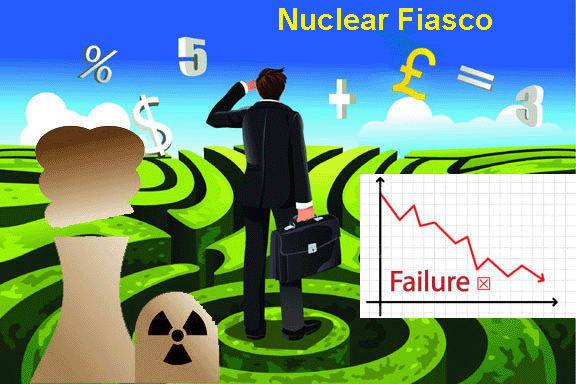 Europe’s new nuclear plants hit more snags https://climatenewsnetwork.net/europes-new-nuclear-plants-hit-more-snags/ Europe’s new nuclear plants hit more snags https://climatenewsnetwork.net/europes-new-nuclear-plants-hit-more-snags/
|
|
Nuclear Transparency Watch warns on the unwisdom of UK government subsidising Small Modular Nuclear Reactors (SMRs)
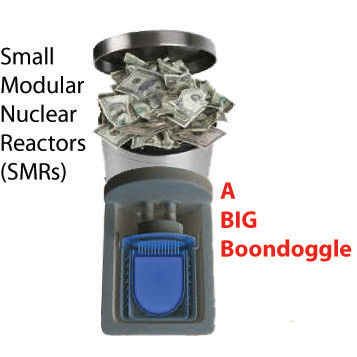 Small Modular Reactors – of SMRs and ANTs, by Jan Haverkamp http://www.nuclear-transparency-watch.eu/activities/small-modular-reactors-of-smrs-and-ants-by-jan-haverkamp.html
15 April 2019 The debate on Small Modular Reactors continues to warm up. The IAEA recently updated its webpages on the issue. SMRs are currently promoted by parts of the nuclear industry as an answer to the decrease of interest in normal gigawatt (GW)-scale reactors because of economic and technical realities.
Dr. David Lowry thinks it is time for a warning: “This article focuses on the UK, but similar arguments as I brought forward in Bratislava would apply to any other European government confronted with requests for support of this new sector.”
Some consternation in France, as EDF plans to split off its nuclear section
Le Monde 15th April 2019 For several weeks, EDF’s management and the executive have been
preparing a plan to separate nuclear activities from the rest of the group.
A high-risk issue for the government.
Le Monde 15th April 2019 The CGT secretary of the EDF works council, François Dos Santos, protested against the government’s desire to divide the group into two separate
subsidiaries.
Electricite de France (EDF) €33 billion debt, and more problems – its nuclear section to be nationalised.

 Times 16th April 2019 A row erupted in France yesterday after it emerged that EDF’s board will discuss plans to renationalise the group’s nuclear activities and split them from the rest of its business. Unions reacted with anger to what they depicted as the first step towards the dismantling of the energy group that is building Britain’s new reactors at Hinkley Point in Somerset.
The board is due to review the restructuring plan next month before presenting it to senior managers and union representatives in June, according to a source. The scheme involves the creation of a parent company to run the group’s 58 reactors in France, as well as new ones that it may build.
This part of the group could be renationalised, rolling back the partial privatisation of EDF in 2004, which left the state with an 83.7 per cent stake. Most of the rest of the group’s activities then would be placed in a subsidiary that would continue to seek private investors under the plan, which has been codenamed Project Hercules, according to the newspaper Le Parisien.
People close to President Macron, who has the final say, claim that he broadly supports the idea, but may backtrack if the price of compensating shareholders proves to be beyond the means of France’s hard-pressed state budget. A fierce union reaction also could prompt him to retreat,
commentators said.
Although a source insisted that the restructuring would have no direct impact on Hinkley Point, it is likely to create short-term uncertainty for EDF Energy, the group’s British division.
EDF is struggling to meet the cost of renovating its ageing French nuclear fleet, which is estimated at between €55 billion and €75 billion. In addition, the group, which has a debt of €33 billion, is facing several other difficulties, not least that it is committed to funding two thirds of the estimated £22.3 billion cost of the new-generation European pressurised reactors being built at Hinkley Point.
A similar reactor at Flamanville in northern France was meant to cost €3 billion and come on stream in 2012. The reactor is still not operating and the budget has reached €10.9 billion. Last week, it emerged that experts had advised that EDF should repair faulty weldings at Flamanville, which would add hundreds of millions of euros to the bill and lead to a further delay.
Climate change rallies block London roads
SBS News, 17 Apr 19 Thousands of activists led by Extinction Rebellion have blocked major roads in London to demand action on climate change, and promised to keep it up a week. Thousands of environmental activists have paralysed parts of central London by blocking Marble Arch, Oxford Circus and Waterloo Bridge in a bid to force the government to do more to tackle climate change.Under sunny skies on Monday, activists sang songs or held signs that read “There is no Planet B” and “Extinction is forever” at some of the capital’s most iconic locations.
Roadblocks will continue night and day at each site and the demonstrators say the protests could last at least a week….
The group is demanding the government declare a climate and ecological emergency, reduce greenhouse gas emissions to net zero by 2025, and create a citizen’s assembly of members of the public to lead on decisions to address climate change. ….
Extinction Rebellion wrote to Prime Minister Theresa May on Monday outlining their demands and asking for face-to-face talks, warning that they will escalate their disruptive actions over the coming weeks unless the government acts.
“Make no mistake, people are already dying,” the letter states. “In the majority world, indigenous communities are now on the brink of extinction. This crisis is only going to get worse … Prime Minister, you cannot ignore this crisis any longer. We must act now.”
Organisers of the protests circulated legal advice to anyone planning to attend, requesting they refrain from using drugs and alcohol, and asking them to treat the public with respect.
London’s police have advised people travelling around the city in the coming days to allow extra time for their journey in the event of road closures and general disruption. …… Extinction Rebellion wrote to Prime Minister Theresa May on Monday outlining their demands and asking for face-to-face talks, warning that they will escalate their disruptive actions over the coming weeks unless the government acts.
“Make no mistake, people are already dying,” the letter states. “In the majority world, indigenous communities are now on the brink of extinction. This crisis is only going to get worse … Prime Minister, you cannot ignore this crisis any longer. We must act now.”
Organisers of the protests circulated legal advice to anyone planning to attend, requesting they refrain from using drugs and alcohol, and asking them to treat the public with respect.
London’s police have advised people travelling around the city in the coming days to allow extra time for their journey in the event of road closures and general disruption………https://www.sbs.com.au/news/climate-change-rallies-block-london-roads
More countries headed to go into nuclear debt to Russia
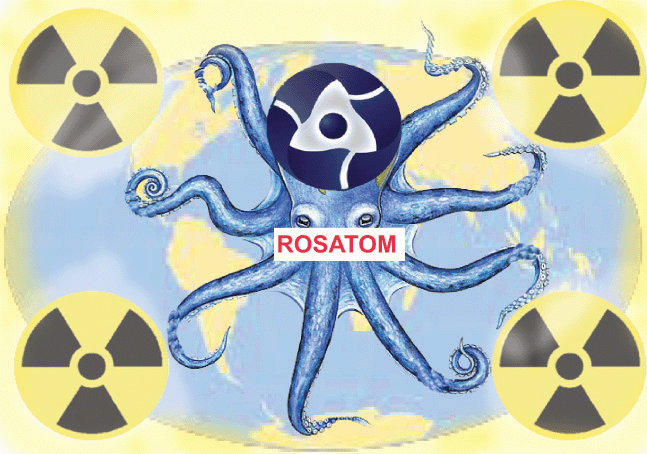 Rosatom forges more links with nuclear newcomers, 17 April 2019 Rosatom and its subsidiaries have this week signed a number of agreements with countries planning to introduce nuclear power to their energy mix, including Azerbaijan, Congo, Cuba, Ethiopia, Serbia and Uzbekistan. The documents were signed during the XI International Forum Atomexpo 2019 that the Russian state nuclear corporation is holding in Sochi. It also signed an agreement with established nuclear power country China. ………http://www.world-nuclear-news.org/Articles/Rosatom-forges-more-links-with-nuclear-newcomers
EDF’s Belleville nuclear power plant to continue to have increased monitoring by France’s nuclear regulator
 France’s ASN regulator keeps enhanced monitoring of EDF’s Belleville nuclear power plant https://uk.reuters.com/article/france-nuclearpower-safety/frances-asn-regulator-keeps-enhanced-monitoring-of-edfs-belleville-nuclear-power-plant-idUKL5N21Z2CQ, PARIS, April 17 (Reuters) – France’s ASN nuclear regulator said on Wednesday it was maintaining its close supervision of utility EDF’s 2,600 MW Belleville nuclear power plant, due to the need to continue to monitor safety practices despite some improvements. France’s ASN regulator keeps enhanced monitoring of EDF’s Belleville nuclear power plant https://uk.reuters.com/article/france-nuclearpower-safety/frances-asn-regulator-keeps-enhanced-monitoring-of-edfs-belleville-nuclear-power-plant-idUKL5N21Z2CQ, PARIS, April 17 (Reuters) – France’s ASN nuclear regulator said on Wednesday it was maintaining its close supervision of utility EDF’s 2,600 MW Belleville nuclear power plant, due to the need to continue to monitor safety practices despite some improvements.
The regulator placed the plant under enhanced supervision in September 2017, citing failures in safety standards. It noted that the state of the plant’s installations and safety practices had generally improved in 2018, but there was still work to do. “However… the progress noted remains to be consolidated and that the performance of the facilities must still improve,” the ASN said in a statement. The ASN also said it will carry out additional inspections and checks to documentation, while keeping track of EDF’s action plan to fix the issues. (Reporting by Bate Felix; Editing by Sudip Kar-Gupta) |
Youth climate change protests across Britain
Youth climate change protests across Britain – as it happened
Tens of thousands of young people in Britain and abroad are demonstrating for climate action in the latest wave of strikes, https://www.theguardian.com/environment/live/2019/apr/12/youth-climate-change-protests-across-britain-live Sarah Marsh 13 Apr 19,
- Students across the UK took to the streets on Friday to call for the government to act to tackle the climate change crisis. Protests took place everywhere from Birmingham, to Newcastle and beyond. Jake Woodier, from the UK Youth Climate Coalition, who took part in London, said: “It’s been a really fantastic day, with thousands and thousands of students protesting across the country, and continuing to build the movement.”
- A further 30 countries across the globe also held events today. Many shared their experiences over social media. It included activity in New Delhi in India, Istanbul in Turkey and Helsinki, Finland’s capital.
- Politicians, broadcasters, scientists and artists showed their support for young activists. David Attenborough was asked about the young people who have been marching all over the world. The Washington Post asked: when you look at that, what do you see, as someone generations ahead of them? Attenborough said: “I mean, strikes are a way of expressing a strong feeling that you have, but they don’t solve it. You don’t solve anything by striking. But you do change opinion, and you do change politicians’ opinions. And that’s why strikes are worthwhile.”
- The march in London brought Oxford street to a standstill. Organiser Cyrus Jarvis, 16, a year 11 student from London Academy school in Barnet, North London, said: “The police tried to frighten us with arrests but we just moved on. “We are really sorry for anyone who did have issues because of us, but unfortunately this is what we have to do to get our point across to the government.”
- On 22 April, the Guardian is hosting an event with Greta Thunberg and Anna Taylor, from the UK Student Climate Network, with an introduction from Caroline Lucas MP, and chaired by the Guardian’s Zoe Williams. You can find out more about this event here.
The Flamanville EPR risks a new delay , catastrophic for EDF
Liberation 11th April 2019 The Flamanville EPR risks a new catastrophic delay for EDF. The group ofexperts of the Nuclear Safety Authority considers that the electrician must
“repair” eight large defective welds on the Flamanville reactor. The work
could last until 2022 at the risk of ruining the reputation of the EPR,
which is already years behind schedule.
The untold story of the campaign to smear Julian Assange
This prospect prompted the UN Working Group on Arbitrary Detention and 33 EU parliamentarians to issue strongly worded statements to both the UK and Ecuadorian governments in December last year, warning against facilitating the prosecution of a journalist, editor and publisher for “publishing the truth”. The statements demanded Assange’s “immediate release, together with his safe passage to a safe country”, and reminded the UK of its “binding” legal obligations to secure freedom for Assange.
A critical task for propagandists such as those waging a psychological war on Wilkileaks, then, is to feed audiences material that supports official narratives and exclude that which does not. Since its inception, the smear campaign against Julian Assange and Wikileaks has been remarkably concerted and consistent in that regard.
With the new year, however, news broke that the International Monetary Fund (IMF) had offered Ecuador a $10 billion bailout in return for handing Julian Assange over to the United States. This bounty came on top of earlier US pressures and inducements, reportedly including increased oil exports, military co-operation and another $1.1 billion in IMF loans, with the US representative of the IMF instructing Ecuador that it must “resolve” its relationship with Julian Assange in order to receive the IMF money.
Australian Barrister Greg Barns has called it the blackmailing of a nation. News website 21st Century Wirecalled it “one of the biggest international bribery (or extortion) cases in history.”
While there is “not a single shred of evidence that any of [Wikileaks’] disclosures caused anyone harm”, writes journalist and author Nozomi Hayase, what Wikileaks did do in 2010 was expose thousands of previously unreported civilian deaths in Iraq and Afghanistan. These deaths included the nonchalant gunning down of children, journalists and their rescuers, and other “indiscriminate violence… torture, lies [and]bribery”, writes Chris Hedges. According to Pentagon Papers whistleblower Daniel Elsberg, the leaks exposed “a massive cover-up over a number of years by the American authorities”.
Julian in ‘critical danger’, new rules ‘torture’ – Assange mother *AUDIO*
The Psychology Of Getting Julian Assange, Part 2: The Court Of Public Opinion And The Blood-Curdling Untold Story, New Matilda, By Dr Lissa Johnson February 25, 2019 In her ongoing special investigation into the detention of Julian Assange, Dr Lissa Johnson turns to the art of smear, and how to corrupt a judicial system.
On Friday 14th February, the Editor in Chief of news website Consortium News, Joe Lauria, visited Sydney to host a ‘Politics in the Pub’ event: Whistleblowing, Wikileaks and the Future of Democracy. The event took place in anticipation of upcoming rallies to free Assange…….
. It is imperative that we pressure the Australian government to make sure its citizen, Julian Assange, is protected from the lawlessness of the American Empire.” Continue reading
We should be alarmed about the ongoing consequences of nuclear leaks and the risk of new nuclear disasters
The Chernobyl Syndrome, The New York Review of Books Sophie Pinkham, APRIL4, 2019
Manual for Survival: A Chernobyluie to the Futur
Midnight in Chernobyl: The Untold Story of the World’s Greatest Nuclear Disaster
Chernobyl: The History of a Nuclear Catastrophe
Moscow officials eventually realized that the reactor had exploded, and that there was an imminent risk of another, much larger explosion. More than thirty-six hours after the initial meltdown, Pripyat was evacuated. Columns of Kiev city buses had been sent to wait for evacuees on the outskirts of the city, absorbing radiation while plans were debated. These radioactive buses deposited their radioactive passengers in villages chosen to house the refugees, then returned to their regular routes in Kiev. Over the next two weeks, another 75,000 people were resettled from the thirty-kilometer area around Pripyat, which was to become known as the “Exclusion Zone,” and which remains almost uninhabited to this day.
The Soviet system began to marshal its vast human resources to “liquidate” the disaster. Many efforts to stop the fire in the reactor only made matters worse by triggering new reactions or creating toxic smoke, but doing nothing was not an option. Pilots, soldiers, firefighters, and scientists volunteered, exposing themselves to huge doses of radiation. (Many others fled from the scene.) They were rewarded with cash bonuses, cars, and apartments, and some were made “Hero of the Soviet Union” or “Hero of Ukraine,” but many became invalids or didn’t live to see their new homes. The radiation levels were so high that they made the electronics in robots fail, so “biorobots”—people in makeshift lead protective gear—did the work of clearing the area.
On April 28, a radioactive cloud reached Scandinavia. After attempts at denial, the Soviet government conceded that there had been an accident. Western journalists soon began reporting alarming estimates of Chernobyl casualties. To maintain the illusion that the accident was already under control, Moscow ordered Ukrainians to continue with the planned May Day parade in Kiev, about eighty miles away, thus exposing huge numbers of people—including many children—to radioactive fallout.
Thanks to word of mouth and to their well-honed skill at reading between the lines of official declarations, however, Kiev residents were already fleeing. By early May, the exodus had grown so large that it became almost impossible to buy a plane, train, or bus ticket out of the city. Tens of thousands of residents left even before the official order to evacuate children was issued, far too late, on May 15. Thousands of people were treated for radiation exposure in Soviet hospitals by the end of the summer of 1986, but the Soviet press was allowed to report only on the hospitalizations of the Chernobyl firemen and plant operators.
A few decades later, it seemed to many that the world’s worst nuclear disaster had caused surprisingly little long-term damage. The official toll is now between thirty-one and fifty-four deaths from acute radiation poisoning (among plant workers and firefighters), doubled leukemia rates among those exposed to exceptionally high radiation levels during the disaster response, and several thousand cases of thyroid cancer—highly treatable, very rarely fatal—among children. Pripyat became a spooky tourist site. In the Exclusion Zone, one could soon see wolves, elk, lynx, brown bears, and birds of prey that had almost disappeared from the area before Chernobyl; some visitors described it as a kind of radioactive Eden, proof of nature’s resiliency. But striking differences in new books about Chernobyl by Kate Brown, Adam Higginbotham, and Serhii Plokhy show that there are still many ways to tell this story, and that the lessons of Chernobyl remain unresolved.
Both Plokhy and Higginbotham devote their first sections to dramatic reconstructions of the disaster at the plant. Sketches of loving family life or youthful ambition introduce the central figures, making us queasy with dread. The two authors’ minute-by-minute descriptions of the reactor meltdown and its aftermath are as gripping as any thriller and employ similar techniques: the moments of horrified realization, the heroic races against time. The prescient 1979 film The China Syndrome, about a barely averted disaster at a nuclear plant and its cover-up, is mentioned in both books. The movie’s title comes from a former Manhattan Project scientist’s hypothetical discussion of a reactor meltdown in North America causing fuel to burn its way through the globe to China. Though that specific scenario was clearly impossible, “China syndrome” became shorthand for anxieties about nuclear material burning through the foundations of the Chernobyl plant and entering the water table, the Dnieper River Basin, and then the Black Sea.
Plokhy, a historian of Ukraine, provides a masterful account of how the USSR’s bureaucratic dysfunction, censorship, and impossible economic targets produced the disaster and hindered the response to it. Though the Soviets held a show trial to pin responsibility on three plant employees, Plokhy makes plain the absurdity of holding individuals accountable for what was clearly a systemic failure…….
For Plokhy, the greatest lesson of Chernobyl is the danger of authoritarianism. The secretive Soviet Union’s need to look invincible led it to conceal the many nuclear accidents that preceded Chernobyl, instead of using studies of them to improve safety. …. Once the reactor exploded, Soviet censorship kept citizens in the dark about the disaster, preventing them from taking measures to protect themselves.
But cover-ups and bureaucratic buck-passing don’t happen only in authoritarian governments. ………
we should be alarmed about the ongoing consequences of nuclear leaks and the risk of new nuclear disasters. Higginbotham points out that the United States now operates a hundred nuclear power reactors, including the one at Three Mile Island that suffered a serious accident in 1979, just twelve days after the release of The China Syndrome. France generates 75 percent of its electricity from nuclear power plants, and China operates thirty-nine nuclear power plants and is building twenty more. Some people see nuclear power plants, which do not emit any carbon dioxide, as the most feasible way of limiting climate change, and new reactor models promise to be safer, more efficient, and less poisonous. But what if something goes wrong?
And what about nuclear waste? There are hundreds of nuclear waste sites in the US alone. In February the Environmental Protection Agency ordered the excavation of a landfill near St. Louis containing nuclear waste, dumped illegally, that dated back to the Manhattan Project. For years, an underground fire has been burning a few thousand feet from the dump. It took the federal government twenty-seven years to reach a decision about how to deal with this nuclear waste dump near a major metropolitan area, yet we fault the Soviet government for its inadequate response to a nuclear meltdown that unfolded in a matter of minutes. US failure to adequately address longstanding hazards—not to mention the slow-motion catastrophe of climate change—is yet another indication that poor disaster response is hardly unique to authoritarian regimes.
Then there is the renewed threat of nuclear war. One of Gorbachev’s biggest achievements was the Intermediate-Range Nuclear Forces Treaty, which eliminated US and Soviet land-based intermediate nuclear weapon systems. This February the US withdrew from the treaty, with President Trump citing Russian noncompliance. His administration recently called for the expansion of the US “low-yield” nuclear force, which includes weapons the size of those dropped on Hiroshima and Nagasaki. Analysts have pointed out that a greater diversity of nuclear weapons makes it harder for a target to know whether it is facing a limited or existential threat—and therefore raises the risk that the target will overreact…………https://www.nybooks.com/articles/2019/04/04/chernobyl-syndrome/?fbclid=IwAR3t_0OOHrEx58i85ELla1otEQ8_vIOTpxhDaI0Lw7iWIpfP-4mT5aVLKtU
U.S Secretary of State Mike Pompeo says that Russia complies with the New START nuclear arms control treaty
|
Pompeo: Russia complying with nuclear treaty that’s up for renewal , The Hill 10 Apr 19, Secretary of State Mike Pompeo said Wednesday that Russia is largely in compliance with the New START nuclear arms control treaty with the United States, but indicated the Trump administration is looking at expanding the scope of the pact as renewal talks begin.“There are some arguments on the edges each, but largely they have been compliant,” Pompeo told the Senate Foreign Relations Committee. “Both the Russians and the United States have been compliant. We’re at the very beginning of conversations about renewing that. If we can get the deal right, if we can make sure it fits 2021 and beyond, President Trump has made very clear that if we can get a good solid arms control agreement, we ought to get one.”
The New START Treaty caps the number of nuclear warheads the United States and Russia can deploy at 1,550 each. There are also limits on the number of deployed intercontinental ballistic missiles (ICBM), submarine-launched ballistic missiles and heavy bombers equipped for nuclear warheads, as well as the number of deployed and nondeployed launchers. The Obama-era treaty expires in 2021, but there is an option to extend it another five years. Arms control advocates are worried Trump will let New START expire after he withdrew from a separate arms control treaty with Russia. Advocates warn that for the first time in decades the two biggest nuclear powers might not have limits on their nuclear arsenals. The other treaty, known as the Intermediate-Range Nuclear Forces (INF) Treaty, banned the United States and Russia from having nuclear and conventional ground-launched ballistic and cruise missiles with ranges between 300 and 3,400 miles. Trump announced in February he was starting the six-month process to withdraw from the INF Treaty after years of Russian violations. Current and former officials broadly agree Russia is in violation of the INF agreement, but there have been no similar accusations regarding New START. Still, in 2017, Trump called New START a “one-sided deal” that was “just another bad deal” made by former President Obama. At Wednesday’s hearing, Republicans touted the benefits of New START……. https://thehill.com/policy/defense/438217-pompeo-russia-complying-with-nuclear-treaty-up-for-renewal |
|
1 This Month
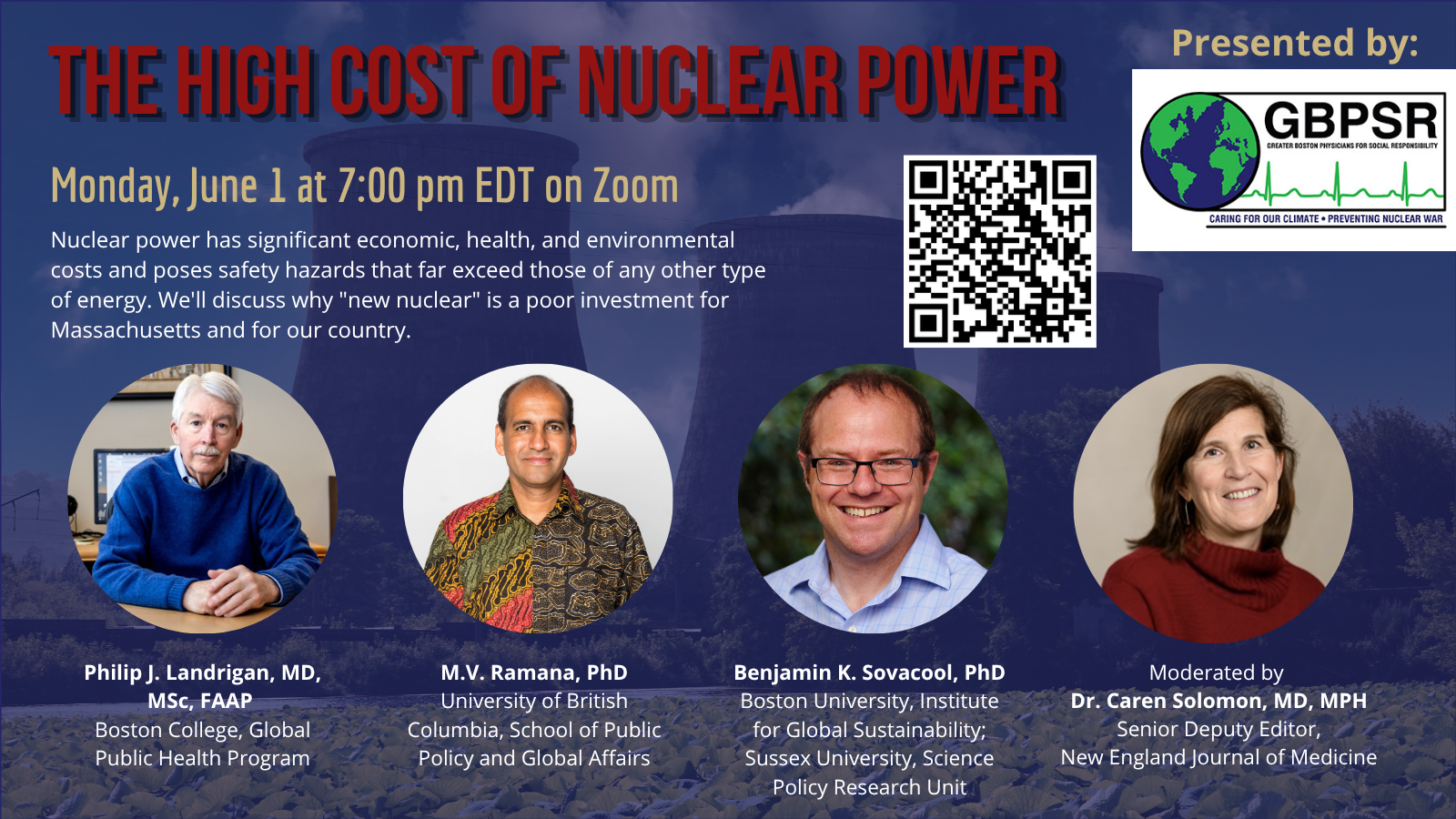
1 June Webinar – The High Cost of Nuclear Power – Register


of the week– Nuclear Reactor Information Task Force
To see nuclear-related stories in greater depth and intensity – go to https://nuclearinformation.wordpress.com
-
Archives
- May 2026 (255)
- April 2026 (356)
- March 2026 (251)
- February 2026 (268)
- January 2026 (308)
- December 2025 (358)
- November 2025 (359)
- October 2025 (376)
- September 2025 (257)
- August 2025 (319)
- July 2025 (230)
- June 2025 (348)
-
Categories
- 1
- 1 NUCLEAR ISSUES
- business and costs
- climate change
- culture and arts
- ENERGY
- environment
- health
- history
- indigenous issues
- Legal
- marketing of nuclear
- media
- opposition to nuclear
- PERSONAL STORIES
- politics
- politics international
- Religion and ethics
- safety
- secrets,lies and civil liberties
- spinbuster
- technology
- Uranium
- wastes
- weapons and war
- Women
- 2 WORLD
- ACTION
- AFRICA
- Atrocities
- AUSTRALIA
- Christina's notes
- Christina's themes
- culture and arts
- Events
- Fuk 2022
- Fuk 2023
- Fukushima 2017
- Fukushima 2018
- fukushima 2019
- Fukushima 2020
- Fukushima 2021
- general
- global warming
- Humour (God we need it)
- Nuclear
- RARE EARTHS
- Reference
- resources – print
- Resources -audiovicual
- Weekly Newsletter
- World
- World Nuclear
- YouTube
-
RSS
Entries RSS
Comments RSS
 nuclear-news