Russia launches a mission to investigate te Komsomolets, Soviet nuclear submarine sunk 32 years ago .
Bellona 25th May 2021, Russian scientists have embarked on a mission to the Komsomolets, a Soviet nuclear submarine that sank 32 years ago during an onboard fire off Norway’s northern coast, killing 41, in a bid to determine whether the wreck presents threats to the undersea environment.
The scientists, from Rosgidromet, Russia’s state weather agency which also measures radiation, set sail from Arkhangelsk last week aboard the Professor Molchanov research vessels, reaching the accident site over the weekend, Russian media reported.
Russia launches mission to the sunken Komsomolets nuclear submarine
Russia’s plans for nuclear-powered spacecraft to Jupiter
Russia Wants To Send A Nuclear-Powered Spacecraft To Jupiter This Decade, IFL Science 26 May 21,Russia is planning to send a nuclear-powered spacecraft to the grand gas giant of the Solar System, Jupiter, in 2030.
Roscosmos, Russia’s federal space agency, announced the plan for the mammoth 50-month journey last week. The journey will take it on a mini tour of the Solar System, taking pit stops around the Moon and Venus, dropping off spacecraft along its way, before heading on to Jupiter.
More specifically, a “space tug” with a nuclear-based transport and energy module dubbed Zeus will head towards the Moon where a spacecraft will separate from it. It will then pass by Venus to perform a gravity assist maneuver and drop off another spacecraft, before venturing towards Jupiter and one of its satellites.
“Together with the Russian Academy of Sciences, we’re are now making calculations about this flight’s ballistics and payload,” Roscosmos Executive Director for Long-Term Programs and Science Alexander Bloshenko told reporters, according to TASS news agency.
Most spacecraft use solar panels that convert the Sun’s energy into electricity. However, the deeper a spacecraft goes into the Solar System, the further it strays from the Sun and less solar energy is available. While batteries can be used for backup, some missions – such as Cassini and Voyager – have been powered from a radioisotope thermoelectric generator (RTG), which is a bit like a nuclear battery that uses heat from the radioactive decay of isotopes. RTGs are not nuclear reactors, however, as a chain reaction does not take place.
The new Zeus project, by comparison, is a whole nuclear reactor that will use fission reactions to drive the propulsion. In the words of Russian state media, it’s a “secrecy-laden project in development since 2010” that involves a 500-kilowatt nuclear reactor, weighing around 22 tons….
The Soviet Union launched a bunch of nuclear reactors into space during the Cold War as part of the RORSAT missions, a set of Soviet nuclear spy satellites launched between 1967 and 1988. On the other hand, the US has launched just one: SNAP-10A or SNAPSHOT, a nuclear-reactor power system launched in 1965.
The US has regained interest in nuclear-powered space travel over the past few decades. Just recently, the US Defense Advanced Research Projects Agency (DARPA) has commissioned three private companies – Blue Origin, Lockheed Martin, and General Atomics – to develop nuclear fission thermal rockets for use in lunar orbit, with the goal of demonstrating the technology above low Earth orbit in 2025. https://www.iflscience.com/space/russia-wants-to-send-a-nuclearpower-spacecraft-to-jupiter-this-decade/
Fission reactions have been spiking in an inaccessible Chernobyl chamber since 2016 – possibility of a runaway nuclear reaction
Chernobyl Alert and The Doomsday Clock The Conversation, BY ROBERT HUNZIKER 21 May 21, Like the mythical Phoenix, Chernobyl rises from the ashes.
A recent… “Surge in fission reactions in an inaccessible chamber within the complex” is alarming scientists that monitor the ruins of the Chernobyl Nuclear Power Plant in Ukraine. (Source: Nuclear Reactions at Chernobyl are Spiking in an Inaccessible Chamber, NewScientist, May 11, 2021).
It is known that this significant renewal of fission activity is located in Sub-Reactor Room 305/2, which contains large amounts of fissile material from the initial meltdown. The explosion brought down walls of the facility amongst tons of fissile material within the reactor as extreme heat melted reactor wall concrete and steel combined with sand used to control the explosion to form a lava-like intensely radioactive substance that oozed into lower floors, e.g., Room 305/2. That room is so deadly radioactive that it is inaccessible by humans or robots for the past 35 years.
Since 2016, neutron emissions from Room 305/2 have been spiking and increased by 40% over the past 5 years. It signals a growing nuclear fission reaction in the room. According to Neil Hyatt/University of Sheffield-UK: “Our estimation of fissile material in that room means that we can be fairly confident that you’re not going to get such rapid release of nuclear energy that you have an explosion. But we don’t know for sure… it’s cause for concern but not alarm,” Ibid.
If it is deemed necessary to intervene, it’ll require robotically drilling into Room 305/2 and spraying the highly radioactive blob with a fluid that contains gadolinium nitrate, which is supposed to soak up excess neutrons and choke the fission reaction. Meanwhile, time will tell whether the monster of the deep in Room 305/2 settles down on its own or requires human interaction via the eyes and arms of a robot, which may not survive the intense radioactivity. Then what?
Meanwhile, an enormous steel sarcophagus, a $1.8bn protective confinement shelter, the New Safe Confinement (NCS) was built in 2019 to hopefully prevent the release of radioactive contamination. NCS is the largest land-based object ever moved, nine years construction in Italy delivered via 2,500 trucks and 18 ships. It is expected to last for 100 years. Thenceforth, who knows?
Nevertheless, according to nuclear professionals, the question arises whether this recent fission activity will stabilize or will it necessitate a dangerously difficult intervention to somehow stop a runaway nuclear reaction.
Inescapably, the bane of nuclear power, once dangerously out of control, remains dangerously out of control, forever and on it goes, beyond human time. Unfortunately, one nuclear accident is equivalent to untold numbers, likely thousands, of non-nuclear accidents.
“We thus drift toward unparalleled catastrophe.” (Albert Einstein) https://www.counterpunch.org/2021/05/21/chernobyl-alert-and-the-doomsday-clock/
EDF’s report on silo collapse at Hinkley Point C nuclear construction raises more questions than answers
Stop Hinkley 24th May 2021, EDF Energy has published its report on the Ground Granulated Blast-furnace Slag (GGBS) silo collapse which took place on the Hinkley Point C construction site on 10th June last year. The report’s headline conclusion on the sudden silo collapse – that it was caused by the overloading of a bolted joint due to inadequate design, raises more questions than it answers.
Corrosion in the fuel cladding at France’s Chooz and Civaux nuclear stations
An investigation is underway at the Chooz and Civaux nuclear power plants
(6 GW) following the discovery of corrosion on the fuel cladding, in order
to prevent any radioactive leakage, announced EDF and the Nuclear Safety
Authority (ASN).
Montel 25th May 2021
Russia’s Arctic Council leadership now facing up to the problem of nuclear reactors dumped in the ocean
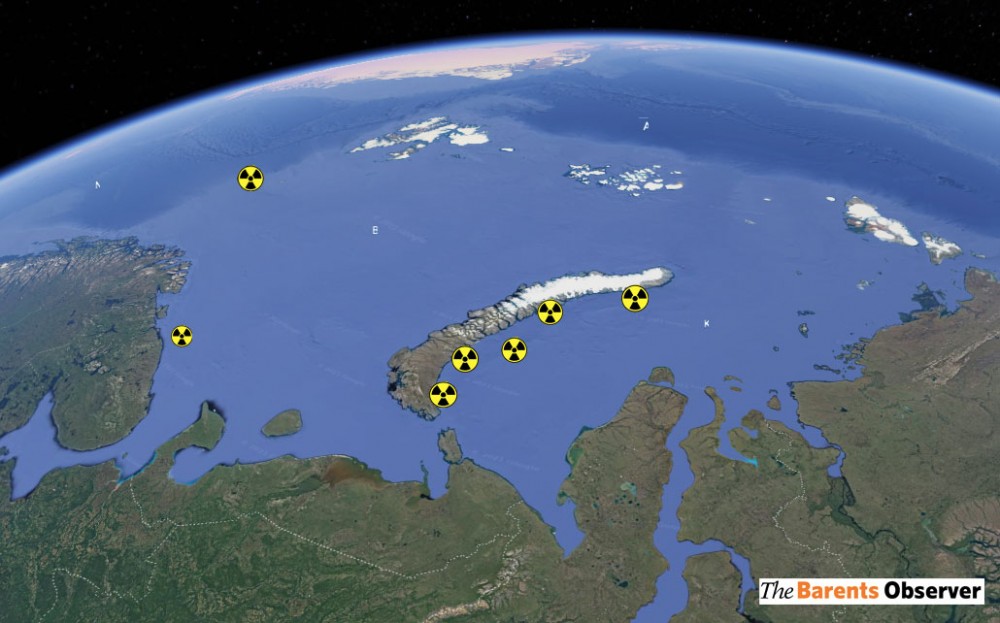
Reactors are dumped at several locations in the Kara Sea in addition to the two submarines K-159 and K-278 that sank in the Barents- and Norwegian Seas. Map: Barents Observer / Google Earth
Tackling dumped nuclear waste gets priority in Russia’s Arctic Council leadership https://thebarentsobserver.com/en/nuclear-safety/2021/05/lifting-nuclear-waste-kara-sea-gets-priority-russias-arctic-council
The reactors from the submarines K-11, K-19, and K-140, plus the entire submarine K-27 and spent uranium fuel from one of the old reactors of the Lenin-icebreaker have to be lifted from the seafloor and secured. Thomas Nilsen
Russia’s Foreign Ministry invites international experts from the other Arctic nations to a June 2022 conference on how to recover the sunken radioactive and hazardous objects dumped by the Soviet Union on the seafloor east of Novaya Zemlya.
No other places in the world’s oceans have more radioactive and nuclear waste than the Kara Sea.
While mentality in Soviet times was «out of sight, out of mind», the Kara Sea seemed logical. Ice-covered most of the year, and no commercial activities. That is changing now with rapidly retreating sea ice, drilling for oil-, and gas and increased shipping.
The submarine reactors dumped in shallow bays east of the closed-off military archipelago of Novaya Zemlya were all brought north for a good reason, they had experienced accidents and posed a radiation threat at the navy yards where people were working.
Dumping the reactors in shallow waters, someplace at only 50 meters, meant they could be lifted one day when technology allowed.
There is momentum now. For environmental and foreign policy reasons, Russia needs to take action now,” says nuclear safety expert Andrey Zolotkov. He works with Bellona Murmansk, an advocacy group promoting international cooperation to secure hazardous radioactive objects in Russia’s Arctic region. Zolotkov is pleased to see Moscow highlighting steps to secure the sunken reactors in the Kara Sea.
“Ecology is one of the few topics where Russia and foreign partners can conduct constructive dialogue nowadays,” he says.
However, Zolotkov underlines, “the issue of urgency can only be discussed after at least one expedition to the flooded objects.”
A worst-case scenario would be a failed lifting attempt, causing criticality in the uranium fuel, again triggering an explosion with following radiation contamination of Arctic waters.
Technical survey needed
With Russia now holding the chair of the Arctic Council, Zolotkov hopes such expedition can take place within the next two-year period.
A Russian-Norwegian expedition to the K-27 submarine in Stepovogo bay in 2012 took samples for studying possible radioactive leakages. Now, the Bellona expert, calls for an expedition to thoroughly study the strength of the hull and look for technical options on how to lift the heavy submarine and reactor compartments.
“Decades on the seafloor do not pass without impacts,” Andrey Zolotkov explains.
A previous study report made for Rosatom and the European Commission roughly estimated the costs of lifting all six objects, bringing them safely to a yard for decommissioning, and securing the reactors for long-term storage.
The estimated price-tag for all six is €278 million, of which the K-159 in the Barents Sea is the most expensive with a cost of €57,5 million. Unlike the submarines and reactors that are dumped in relatively shallow waters in the Kara Sea, the K-159 is at about 200 meters depth, and thus will be more difficult to lift.
In addition, about 17,000 objects were dumped in the Kara Sea in the period from the late 1960s to the early 1990s.
Most of that is containers with solid radioactive waste from the naval yards on the Kola Peninsula and in Severodvinsk. Some radioactive waste also originated from the repair and maintenance of the fleet of civilian nuclear-powered icebreakers in Murmansk.
Most of the objects are metal containers with low- and medium-level radioactive waste. The challenge today, though, are the reactors with high-level waste and spent uranium fuel, objects that will pose a serious threat to the marine environment for tens of thousands of years if nothing is done to secure them.
According to the Institute for Safe Development of Nuclear Energy, part of Russia’s Academy of Science, the most urgent measures should be taken to secure six objects that contain more than 90% of all the radioactivity.
The Arctic Council in late 2019 took a formal decision to establish a Working Group on radiation Emergency Prevention, Preparedness and Response (EPPR).
New study into mental health of atomic bomb test veterans

Eastern Daily Press 22nd May 2021, A nuclear test veteran blamed himself for the birth defects which he
believed he passed on to members of his family, his daughter has revealed.
Suzanna Ward spoke as a new study was launched into the mental health of
the children, wives and widows of nuclear veterans. Around 22,000 British
servicemen witnessed nuclear tests on mainland Australia, the Montebello
Islands off Western Australia and Christmas Island in the South Pacific,
during the 1950s and 1960s.
https://www.edp24.co.uk/news/new-study-into-mental-health-of-nuclear-veterans-7991116
Dalgety Bay – 20,000 tonnes of radioactive material from the area to screen, – clean-up begins at last.

Scotsman 23rd May 2021, 30 years on, Scotland’s radioactive beach clean-up begins at last. It’s not a scene which might usually be welcome, but locals in the Fife town of Dalgety Bay have been waiting decades for this – ever since highly dangerous radioactive material was detected on the shoreline more than 30 years ago. Contamination was first identified there in 1990, but the source – luminous paint used on aircraft navigation dials – dates back to theSecond World War.
The area was once home to Donibristle military airfield,
where a large number of planes were dismantled after the end of the
conflict in 1945 and the debris burned and buried. Part of the foreshore at
Dalgety Bay has been off limits to the public since 2011 due to the health
risks posed by radioactive debris.
Radium was used to coat instrument
panels so they could be seen in the dark, but it is radioactive and toxic
to human health, with a half life of 1,600 years. Work to clean up
potentially deadly radioactive contamination has got under way at Dalgety
Bay in Fife, caused by debris from aircraft used during the Second World
War.
David Barratt, Fife councillor for Inverkeithing and Dalgety Bay, has
welcomed the work finally getting started. He said: “It has taken over 30
years and significant pressure from the community to get to this point.
“I’m delighted that works are now under way and grateful to Sepa for
all their effort in ensuring it will be done right, providing a permanent
solution.
“It should send a clear message that it doesn’t matter how much
time passes, the polluter should always pay. “Time will tell if its
smooth sailing from here and whether a 2022 completion date is possible.
They have around 20,000 tonnes of material from the area to screen and the
more contamination they find, the longer it will take, but at least now we
know it will be safe, however long it takes.”
Anxieties on the impact of pandemic on the Hinkley Point C nuclear power project, -major delays could result

Telegraph 23rd May 2021, EDF has warned that the coronavirus pandemic could cause major delays to its £23bn Hinkley Point C nuclear power plant. Talks are continuing between the French state-owned power business and British officials about potential hold-ups caused by the Covid crisis. Hinkley’s start date has already been pushed back to June 2026 due to a six-month delay caused by the pandemic. It was originally due to come online in 2025 when it was given the go-ahead in 2016. EDF first raised concerns over the possible delays at the start of the pandemic with the Low Carbon Contracts Company (LCCC), the government-owned company that acts as counterparty on clean energy subsidy contracts. Under its subsidy contract, Hinkley Point C is guaranteed £92.50 per MwH for 35 years. The Somerset site – eing built by EDF and its Chinese partner CGN – will become the UK’s first nuclear power plant in decades. However, the length of this 35-year term will be cut if Hinkley is not generating by May 2029 – reducing the guaranteed income for EDF. It can be cancelled altogether if the plant is not operational by October 2033. EDF said it has not applied to the LCCC for a specific extension to those deadlines, but that on principle it may be entitled to an extension because Covid is a “force majeure” event – an unforeseen event that affects a company’s ability to deliver on its contract. It stressed that the June 2026 schedule for Hinkley Point C to start generating, which was announced in January, remains unchanged and the project is making good progress. “We anticipate that it may take some time to establish the true impact of Covid-19 on complex construction projects such as Hinkley Point, as it is still unknown when Covid-19 restrictions will cease.” https://www.telegraph.co.uk/business/2021/05/23/edf-warns-delays-hinkley-due-pandemic/ |
“You can forget about the protection of area of outstanding natural beauty because if Sizewell C nuclear goes ahead nowhere is safe”

Sizewell C: Bill Turnbull says nuclear plant will cause ‘devastation’ Presenter Bill Turnbull has told a Planning Inspectorate hearing the Sizewell C nuclear power station would cause “awful devastation”. BBC , 21 May 21,
The former BBC Breakfast anchor was speaking on the last day of a four-day public hearing into the proposed plant on the Suffolk coast.
He said he was speaking on behalf of “those who have no voice – the rare and abundant wildlife around Sizewell”.
Turnbull, who is now a presenter on Classic FM, spoke in the final session of the hearing, saying it was “in sorrow, because [Sizewell C] will be awful devastation”.
He said he lived about two and a half miles away from the proposed power plant, where “the wildlife is extraordinary”.
He expressed concern over the impact on local birds including nightingales, cuckoos and owls and called the proposed link road to the plant a “highway of destruction”.
Turnbull questioned building the plant next to RSPB Minsmere, asking the Planning Inspectorate “has the world gone that mad?”.
The 65 year old asked if the power plant was approved, “what message would it send?”
“You can forget about the protection of area of outstanding natural beauty because if Sizewell C goes ahead nowhere is safe,” he said.
The Planning Inspectorate also heard from actress Diana Quick, who said she had “became convinced nuclear was a dubious option” for energy generation.
Quick, who received a Bafta nomination for her role in Brideshead Revisited, said she was “very concerned about the pollution, from many sources, such as light, dust, and traffic fumes”.
She also said her home village, Theberton, had been flooded “with mud and water” and this could increase with the building of the power plant.
William Kendall, a farmer, food and drink entrepreneur and chairman of soft drinks manufacturer Cawston Press, also spoke at the hearing.
He said as a “lifelong environmentalist” he used to support Sizewell C, but subsequently saw “several neighbours and friends upset” by the plans.
Mr Kendall, who is also president of Suffolk Wildlife Trust, said he now believed there was an “overwhelming case against” the plant.
He said it would “leave our local tourism industry millions of pounds worse off”.
Mr Kendall said he had also spoken to politicians who were against Sizewell C, saying: “If you turn down this application no tears will be shed here or in Whitehall.”………..
A decision on the power plant is not expected until later this year. https://www.bbc.com/news/uk-england-suffolk-57202548
Poor outlook for the nuclear industry in Europe
Nuclear Power in the European Union, Heinrich Boll Stiftung, 26 April 2021 by Mycle Schneider Analysis
The issue of nuclear power has been with the European Union since the very beginning of the nuclear age. Where are operating nuclear power plants in the world? Who is building new reactors? What happened in the European region after Chernobyl and the Fall of the Berlin Wall?
26 April 2021 by Mycle SchneiderThis analysis is part of our dossier “Nuclear Power in Europe: 35 Years After the Chernobyl Disaster“.
The issue of nuclear power has been with the European Union since the very beginning of the nuclear age. French and British scientists were involved in the Manhattan Project, the development of the first nuclear weapons in the United States, and were able to share their new scientific knowledge with their colleagues at home after the Second World War. France and Britain rapidly developed their own nuclear weapons programs, and many European countries had their own military nuclear ambitions including—quite surprisingly—countries like Belgium, Germany, Italy, Sweden and Switzerland.
The Euratom Treaty, signed in 1957, established the European Atomic Energy Community with the purpose of “the speedy establishment and growth of nuclear industries”. It did not go as fast and as successfully as imagined. But in 1979, while the United Kingdom had 33 operating units, there were only a total of 58 reactors connected to the grid in what today are the EU27 Member States. By the end of the 1980s the fleet reached already its historic all-time high with 136 units in operation (see Figure 1). Only 106—30 less than in 1989—were left as of the end of 2020, about one quarter of the world total, with more than half (56) operated in just one country, France, while the remaining 50 units are located in 12 other Member States. The vast majority of the plants, 87 units or over 80 percent, are located in seven of the western countries, and only 19 are operating in the six newer Member States.
The region has not seen any significant nuclear
building-activity since the 1980s. While only 14 reactors were started up over the past 30 years, a total of 39 units ceased operation in the EU27, a net negative balance of 25 reactors. The decline of the industry has started decades ago.
Nuclear Construction – Little and Late
Since the Chernobyl disaster started unfolding 35 years ago, there have been only four construction starts in the western part of the EU27, two of which are still under construction, Olkiluoto-3 in Finland since 2005 and Flamanville-3 in France since 2007. Only two reactors were connected to the EU27-grid over the past 20 years, both in Eastern Europe with one unit each in the Czech Republic and Romania, none since Cernavoda-2 started up in 2007. Two reactors are still under construction in Slovakia (Mochovce-3 and -4), where construction started in… 1985. Maybe the first one will finally be connected to the grid in 2021.
The Finnish and French construction sites were meant to be the industrial demonstration of superior technology and engineering capacities leading to the first European Pressurized Water Reactors (EPR) ever built. Olkiluoto-3 (OL3) was meant to start generating power in 2009, followed by Flamanville-3 (FL3) in 2012. Instead, the projects turned into an industrial disaster and a financial fiasco – EPR seems to stand for European Problem Reactor. The projects have encountered numerous technical issues, from concreting to welding, with repeated quality-control problems. The EPR development was originally triggered by the Chernobyl accident, but 35 years later not a single EPR is operating in Europe (two have started up in China). The EPR case is also illustrating the very long lead times in the industry.
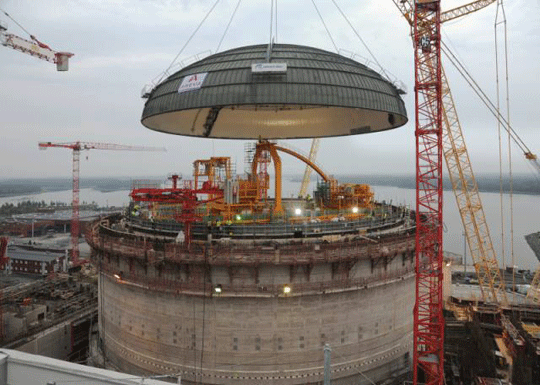
OL3 is currently scheduled to begin electricity generation by the end of 2021, with a 12-year delay, 16 years after construction start. The Finnish government had counted on OL3 as a low-carbon power source and had to substitute by other means of power generation, electricity imports, or the purchase of certificates to meet its climate obligations.
FL3 will be connected to the grid in 2023, at the earliest, if ever. The builders are still struggling with conceptual issues, non-conformities in the fabrication of parts, and inappropriate execution of specific tasks. The French Court of Accounts has estimated that total project costs would reach €19 billion. However, that estimate did not take into account the latest series of mishaps. When the decision was made to build the plant, almost 20 years ago, it was supposed to cost €2.5 billion………………………….
Old Machines – Expensive and Unreliable
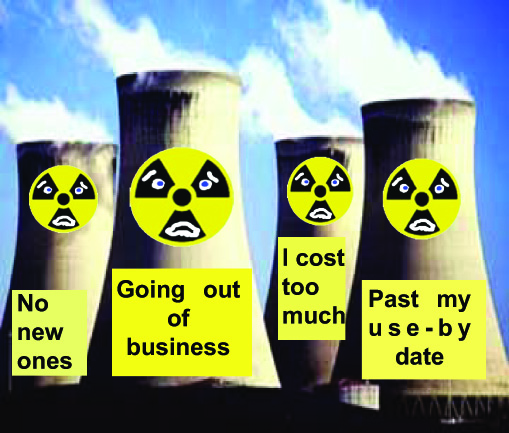
As a consequence of the lack of construction, the average age of the EU’s nuclear fleet has been increasing constantly and stands now at over 35 years on average. The age distribution shows that the vast majority—89 of 106—of the EU’s nuclear reactors have been in operation for 31 years and beyond. The ageing atomic fission machines become increasingly unreliable. In Belgium, with seven units now the second largest fleet in the EU, the average real output in 2018 dropped to less than half of what would have been expected at nominal capacity. In fact, on an average 180 days the reactors did not generate power at all, not a single kilowatt-hour. The EU’s largest nuclear generator, France, has its own problems with maintenance outages that become impossible to forecast. In 2019, the country counted 5,580 reactor-days with zero production. That was 1,700 reactor-days with no output more than planned. In 2020, nuclear generation dropped by another 12 percent to a 27-year low. The world’s largest nuclear operator, the state-controlled Électricité de France (EDF), has lost control over outage durations.
In 2020, nuclear plants have generated just over 700 Terawatt-hours (billion kilowatt-hours or TWh) in the EU27, a spectacular drop of almost 80 TWh or 11 percent compared to the previous year, while all renewable energy technologies increased their output by a combined 80 TWh. At the same time, electricity consumption dropped by over 100 TWh, in particular due to the COVID-19 pandemic and fossil-fuel-based power plants reduced generation by over 110 TWh. As a consequence, for the first time the share of renewable power generation including hydro (39 percent) outperformed fossil fuels (36 percent) according to Eurostat estimates, which indicate that the carbon footprint of the power sector dropped by 14 percent. While the figures are not yet available, it is already certain that non-hydro renewables generated more power than nuclear plants in 2020. Less consumption, less fossil fuels, less nuclear, more renewables and lower emissions in the end. Remains to be seen whether proactive climate-protection policy will be able to make up for the effects of the global pandemic………….https://eu.boell.org/en/2021/04/26/nuclear-power-european-union?dimension1=lisa2021
Nuclear newbuild – concrete projects or white elephants?
Nuclear Power in the European Union, Heinrich Boll Stiftung, 26 April 2021 by Mycle Schneider ”………………Nuclear Newbuild – Concrete Projects or White Elephants?
There are more or less credible “plans” for new nuclear plants, most of them in Eastern Europe.
The Czech government in 2020 signed a framework agreement with the national utility ČEZ to organize an international tender in order to have a decision by 2024 and start construction of two units at the Dukovany site in 2029. The potential role of Russian Rosatom is controversial. The Czech government has failed in earlier attempts to launch a new-build program. The outcome of this initiative is uncertain. In March 2021, Vaclav Bartuška, Special Envoy for Energy Security, recalled sarcastically that, as Government Envoy for Temelín [the other operating Czech nuclear plant site], he wrote in his final report to the government, he did “not believe in a nuclear project in a country that is unable to build a motorway network and high-speed train to Berlin or Munich”.[1] Reportedly, he nevertheless thinks the Dukovany project will go ahead.
In Hungary, after some 15 years of preparation, an application for a construction license for two new Russian designed reactors at the Paks site was submitted in June 2020. The project has raised significant controversy over the procedure under which the Russian contractor was chosen. In March 2021 a study published in the Journal of the Association of Hungarian Geophysicists questioned the earthquake safety of the site. At the same time, the Paks II project company has signed a contract with an engineering company to assess until the end of 2022 the conditions under which a construction license could be obtained. Some sources have suggested construction could already start in 2022. Considering the long history of delays of the project, a short-term construction start seems unlikely.
Poland has been contemplating the introduction of nuclear power since the 1970s and has started building two units in 1984, which were abandoned in 1990. No financing plan has yet been established, no technology, no sites chosen for “6–9 Gigawatt” of nuclear power by 2040. As earlier Polish plans, this one is not credible at this point………..https://eu.boell.org/en/2021/04/26/nuclear-power-european-union?dimension1=lisa2021
Sizewell nuclear project will harm Suffolk’s tourism industry
East Anglian Daily Times 20th May 2021, The construction of large-scale energy projects on the coast is of
“significant concern” to Suffolk’s tourism industry, a Planning
Inspectorate hearing on Sizewell C has heard. EDF Energy’s proposals to
build a £20billion nuclear power station are being discussed in a four-day
public hearing.
Katherine Mackie, chairman of the Aldeburgh Society, told
the hearing on Thursday a study had revealed that more than four million
tourists visit the area every year, bringing in more than £160million to
the economy. That number rose to £228m for the wider Suffolk Coast and
Heaths area of outstanding natural beauty (AONB) in 2019 with around 5,000
jobs supported, she added.
Mrs Mackie said the figures would be
“significantly impacted due to the loss of defined AONB characteristics”.
She also cited research by the Suffolk Coast Destination Management
Organisation, which found that construction of the Sizewell C project – as
well as ScottishPower’s proposed windfarm off the Suffolk coast – could
reduce visitor numbers by 17%.
https://www.eadt.co.uk/news/sizewell-c-edf-planning-inspectorate-public-hearing-7988408
Boris Johnson’s plan for more nuclear weapons in Scotland ‘breaks international law’

Boris Johnson’s plan for more nuclear weapons in Scotland ‘breaks international law’,The National, By Gregor Young 19 May, 21 BORIS Johnson’s plan to increase the UK’s stockpile of nuclear warheads would breach international law, experts have warned.
The Tory government announced in March that it wants to raise the legal limit on the number of the weapons of mass destruction, which would be available to its submarine fleet at Faslane. Currently, the cap is set at 180, but the new defence review revised that up to 260.
Downing Street will also send more troops abroad “more often and for longer” as part of the £24 billion hike in defence spending.
Scotland’s Justice Secretary previously described the proposals as “utterly unacceptable”, while Washington think tank, the Arms Control Association (ACA), said they were inconsistent with the UK Government’s prior pledges under the 1968 Nuclear Non-Proliferation Treaty (NPT).
That conclusion has now been backed by two academics at the London School of Economics who were commissioned to examine Johnson’s pledge by the Campaign for Nuclear Disarmament (CND), the Record has reported.
Led by Professor Christine Chinkin, a long-time consultant for the UN, and Dr Louise Arimatsu, a former fellow at the NATO Cyber Defense Centre, the legal report finds the increase constitutes a breach of article six of the NPT treaty.
CND general secretary Kate Hudson told the Record: “The increase in the UK’s nuclear arsenal has been exposed to intense criticism nationally and internationally, including from the United Nations. Thanks to the work of highly respected academic experts, we now know it is illegal under international law.
“Everything points to the decision costing tens of billions of pounds. During this pandemic, there are other urgent uses for public money.
“The decision breaks with the gradual nuclear reductions implemented by successive governments going back nearly 30 years and is at odds with the decision by Presidents Biden and Putin to continue bilateral nuclear reductions.”……………https://www.thenational.scot/news/19309984.boris-johnsons-plan-nuclear-weapons-scotland-breaks-international-law/
Iran: talks in Austria with UK, France and Germany head towards nuclear agreement
Iran nuclear deal ‘starting to take shape’ Albert Otti AAPThu, 20 May 2021 An agreement to restore the 2015 Iran nuclear deal is beginning to take shape after six weeks of talks, European diplomats say.
“Both on the nuclear side and on the sanctions side, we are now beginning to see the contours of what the final deal could look like,” senior diplomats said after the latest round of talks.
The negotiators from the UK, France and Germany – sometimes referred to as the E3 – have been meeting in working groups in the Austrian capital since early April, aiming to revive the 2015 nuclear deal which was crafted to prevent Iran from developing nuclear weapons.
The nuclear accord has been hanging by a thread since 2018 when then-US president Donald Trump pulled the US out and Iran began to increasingly violate its terms.
“However, success is not guaranteed. There are still some very difficult issues ahead. We do not underestimate the challenges that lay before us,” the diplomats said.
Negotiations are under way on which sanctions the US would be prepared to lift and what steps Iran would be willing to take in return to curb its nuclear program.
Iranian Deputy Foreign Minister Abbas Araghchi said the structure of the agreement had been achieved.
“The content is almost clear although not yet finalised,” he said……… https://thewest.com.au/politics/iran-nuclear-deal-starting-to-take-shape-c-2884918
1 This Month
19 May – Webinar No To Nuclear: Why Nuclear Power Destroys Lives, Derails Climate Progress and Provokes War
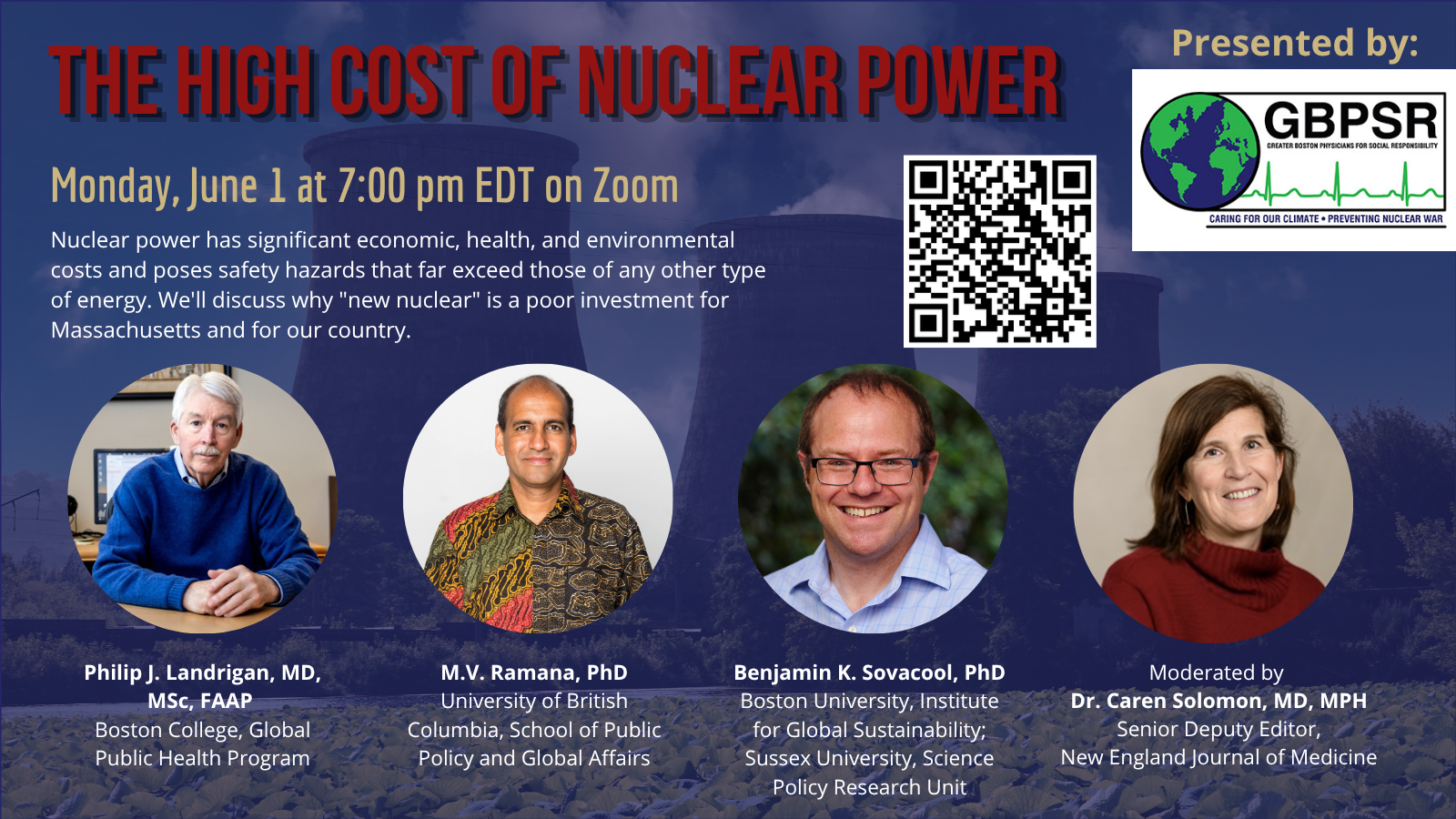
1 June Webinar – The High Cost of Nuclear Power – Register


of the week– Nuclear Reactor Information Task Force
To see nuclear-related stories in greater depth and intensity – go to https://nuclearinformation.wordpress.com
-
Archives
- May 2026 (211)
- April 2026 (356)
- March 2026 (251)
- February 2026 (268)
- January 2026 (308)
- December 2025 (358)
- November 2025 (359)
- October 2025 (376)
- September 2025 (257)
- August 2025 (319)
- July 2025 (230)
- June 2025 (348)
-
Categories
- 1
- 1 NUCLEAR ISSUES
- business and costs
- climate change
- culture and arts
- ENERGY
- environment
- health
- history
- indigenous issues
- Legal
- marketing of nuclear
- media
- opposition to nuclear
- PERSONAL STORIES
- politics
- politics international
- Religion and ethics
- safety
- secrets,lies and civil liberties
- spinbuster
- technology
- Uranium
- wastes
- weapons and war
- Women
- 2 WORLD
- ACTION
- AFRICA
- Atrocities
- AUSTRALIA
- Christina's notes
- Christina's themes
- culture and arts
- Events
- Fuk 2022
- Fuk 2023
- Fukushima 2017
- Fukushima 2018
- fukushima 2019
- Fukushima 2020
- Fukushima 2021
- general
- global warming
- Humour (God we need it)
- Nuclear
- RARE EARTHS
- Reference
- resources – print
- Resources -audiovicual
- Weekly Newsletter
- World
- World Nuclear
- YouTube
-
RSS
Entries RSS
Comments RSS
 nuclear-news