Where will Europe store its radioactive waste?
Euronews, By Tim Gallagher with Reuters 27/05/2022 –
A row is brewing in the Balkans as tensions mount over plans for a nuclear waste storage facility.
Croatia’s plan to store radioactive waste near its border with Bosnia is facing mounting opposition from its neighbour due to concerns the plant could have potentially devastating health and environmental impacts.
The site near the River Una, a Danube tributary, was chosen in 2018. In a bid to halt the plan, Bosnia responded by declaring their land closest to the location a nature reserve.
This scheme gained little ground and as the grand opening draws closer, Bosnians are growing increasingly concerned about the possible consequences on their pristine rivers and organic farming industry, not to mention public health.
“We fear the main impact of this devastating proposal will be on people’s lives and on the environment,” says Mario Crnkovic, an ecologist in the town of Novi Grad on the Bosnian side of the border, about one kilometre from the earmarked site.
Croatia has dismissed the concerns, but critics note that the government has yet to publish any health or environmental risk assessment of the proposal.
The area is prone to flooding and subject to regular seismic activity. It’s also still being cleared of landmines left over from the Balkan wars in the 1990s.
Diplomatic incidents over nuclear waste
The Balkans row is not the only diplomatic incident to happen over nuclear waste disposal in recent years.
In 2020 the Belgian government announced they had received recommendations for seven sites for underground disposal of nuclear waste, but didn’t specify where they were.
It wasn’t long before suspicions were aroused in Luxembourg, with the Luxembourgian environment minister, Carole Dieschbourg, stating they would be in the area of Namur, Dinant and Stavelot, close to their border with Belgium.
“That is right on our doorstep,” the minister announced, as she raised potential dangers to locals and accused the Belgian government of contravening the Espoo convention which regulates trans-border environmental impact reporting……………..
Where will nuclear waste be stored in the future?
Russian soldiers taking Chernobyl Nuclear plant by force during their invasion of Ukraine brought the dangers of unsafe nuclear waste to the forefront of the public imagination.
Most operational-storage facilities for nuclear waste are at surface level, with the UK, France, and Spain all making use of these short-term solutions.
However, the consensus for the future is that nuclear waste is best stored in a geological disposal facility (GDF) deep beneath our feet. Here in a space 700 – 1000 metres underground, spent reactors will be safely treated and sealed into rock structures with cement, leaving them to decay over hundreds of thousands of years.
Previous mooted suggestions of sending waste to space or burying it beneath the ocean floor have been abandoned, but there is an ongoing issue of how to warn future generations of the dangers of waste sites.
With no guarantee that today’s languages will be spoken or current iconography will be recognisable in thousands of years, it’s a risk that still-dangerous toxic waste could be accidentally opened up by curious archaeologists of the future.
In the 1980s the US government assembled the Human Interface Taskforce to work out how to prevent such a disastrous occurrence. One of their recommendations was to create fake myths and legends to ward off the curious.
Do communities want GDFs?
This toxic issue doesn’t just cause problems along borders, but often sees locals hotly contest proposals for GDFs near their communities by their own governments.
In the UK the country’s first GDF (which will store the 20th century waste currently stored in Sellafield, Cumbria) has been marketed as a big infrastructure project which will bring jobs and prosperity, leading to a bidding war between several different remote locations.
However, residents are not so keen on the idea of playing host to a poisonous repository, with retirees in the Lincolnshire village of Theddlethorpe proving particularly vocal.
Meanwhile in the sleepy French village of Bure, clashes between protestors and police over a GDF deep inside the clay soil of the region have led to much concern over potential nuclear leakage……………. https://www.euronews.com/green/2022/05/27/croatia-s-plans-for-radioactive-waste-worry-neighbouring-bosnia
Finland: Fennovoima withdraws from its new nuclear reactor application.
FENNOVOIMA on Tuesday announced it has withdrawn its application for a
building permit for a nuclear power plant in Pyhäjoki, Ostrobothnia,
delivering what many believe was the final blow to the controversial
project. The Finnish energy company reported earlier this month that it has
terminated the supplier contract for the plant with Raos Project, a Finnish
subsidiary of Russia’s Rosatom.
Helsinki Times 26th May 2022
Another university infiltrated by the nuclear industry – University of Derby and Rolls Royce

| Rolls-Royce Submarines announced plans recently to open a new academy dedicated to nuclear training within the city. The academy forms part of their Rolls-Royce Submarines’ plans to boost nuclear capability in the UK and create a pipeline for nurturing talent. In partnership with the University of Derby, the site will create 200 new apprenticeships every year for at least the next 10 years. The academy is set to open in September 2022. The Council’s iHub – managed by Connect Derby – will become the home of the new academy, taking centre-stage at the manufacturing-focused innovation and technology site, Infinity Park. Derby City Council 26th May 2022 https://www.derby.gov.uk/news/2022/may/ihub-rolls-royce-nuclear-skills-academy/ |
For the first time in history, nuclear sites have been caught up in the middle of warfare

With Russia’s invasion of Ukraine, nuclear facilities have been caught
up in the midst of conventional warfare for the first time in history. That
nightmare scenario is one that few of the industry’s players had
anticipated. In Chernobyl and Zaporizhzhia, Russian forces represent a
lingering threat to the most basic rules of nuclear security.
On the way to
Chernobyl along the Dnipro River, a two-hour drive from Kyiv, the imprint
left by Russia’s occupation remains, two months after an ordeal that
lasted from the February 24 invasion until March 31. Most bridges have been
destroyed and our driver warns us to stay on the pavement as landmines lurk
beyond. After the invasion, the exclusion zone around Chernobyl – a
30-kilometre radius around the notorious nuclear plant near Ukraine’s
border with Belarus – made global headlines once again.
For some 35 days,
Chernobyl personnel had to abide the Russian soldiers who seemed oblivious
to the dangers inherent in a nuclear site. Those in the civil nuclear
industry believe it is vital to deliberate on the issue of nuclear security
in wartime. Terrorist attack scenarios had been considered in the past. But
in light of the Russian invasion, the matter of adopting international
rules is now on the table. Over the past three months, Ukrainian
authorities have been calling – so far without success – for the
International Atomic Energy Agency (IAEA) to commit its members to
respecting a five-kilometre perimeter around nuclear facilities inside of
which no military forces can be permitted to penetrate.
France24 26th May 2022
Chinese involvement is entrenched in Britain’s nuclear power plans
In this week’s Gossage Gossip, our columnist discusses whether the
UK’s recent ban on China’s involvement in nuclear power came a little
too late. It has become clear that, for national security reasons
safeguarding the electricity system, the Government has decided to minimise
the amount of direct Chinese involvement in new nuclear construction. While
China was originally welcomed with open arms, the idea now is to kick the
Chinese out from their projected 40% funding of Sizewell C, and block
entirely the concept of a 100% Chinese reactor at Bradwell B.
But might this be a case of shutting the stable doors well after the horses have
bolted? For instance, it seems that the special constabulary force who
police Britain’s 10 civil nuclear sites do so using surveillance cameras
produced by a Chinese state-backed firm called Hikvision. This firm has
been sanctioned under export and investment restrictions by the US
government and is implicated in human rights abuses in Xinjiang. Due to the
sensitivity of their work, unlike regular British police forces, frontline
officers may be routinely armed. But it won’t stop their every move being
monitored by the camera manufacturers.
A major worry regarding Sizewell C
is reliable accessibility to copious amounts of cooling water, a growing
problem in dry East Anglia. The local supplier, Essex and Suffolk Water,
are statutorily bound to provide water on demand to all households – but
has no such obligations for non-residential establishments. All they can
offer is ‘best endeavours’ to supply. And who owns this water company?
Step forward Li-Ka Shing. His company, CK Group, also owns UK Power
Networks, just about the largest electricity distribution company in
Britain. Li-Ka Shing happens to be not just one of the richest men in
China, but also an industrialist known to be very close to President Xi.
Prospective constructor Electricité de France has been instructed to cost
out just how much more heavy dependence upon desalination of North Sea
water will add to their overheads, already upwards of £21 billion.
Electrical Review 26th May 2022
Security issues at UK’s civil nuclear facilities have reached highest level in 14 years
The number of formal reports documenting security issues at the UK’s
civil nuclear facilities has hit its highest level in at least 12 years
amid a decline in inspections, the Guardian can reveal. Experts said the
news raised concerns about the regulator’s capacity to cope with a
planned expansion in the sector. A total of 456 incident notification forms
documenting security issues at UK nuclear facilities were submitted to the
Office for Nuclear Regulation (ONR) over 2021, according to information
obtained by the Guardian and the investigative journalism organisation
Point Source. This is 30% higher than the 320 reports filed during the
whole of 2020 and more than double the 213 reports that were filed in 2018.
Guardian 26th May 2022
Global heating is affecting France’s nuclear reactors, as water temperatures rise in the rivers

Warming French rivers could take more nuclear supply offline, https://www.reuters.com/world/europe/warming-french-rivers-could-take-more-nuclear-supply-offline-2022-05-25/ 26 may 22, PARIS, May 25 (Reuters) – An unseasonably warm May has led to high water temperatures in several rivers throughout France, putting some nuclear plants’ output at risk during a period of historically high unavailability, Refinitiv Eikon data showed on Wednesday.
Reporting by Forrest Crellin Editing by David Goodman River water is often used for cooling reactors before being returned to the the river at a higher temperature.
Regulations are in place that limit reactor production during times of high heat to prevent the process from damaging local wildlife.
The exposed nuclear plants are the 1.8 gigawatt (GW) Bugey plant, the 2.6 GW Saint-Alban plant and the 3.6 GW Tricastin plant on the Rhone river in the south east, as well as the 3.6 GW Blayais plant on the Gironde river in the south west.
Because river temperature is closely correlated to air temperature, the recent heatwave in France would need to abate to reduce the risk of environmental outages.
Most rivers with power plants have an upper limit between 26 and 30 degrees Celsius for cooling, so critical supply losses would only take place if daily average temperatures are above the river’s maximum for at least a couple of weeks, the Refinitiv analysts said.
However, even with a spell of cooler weather, the situation is unlikely to simply disappear as we head into a warmer season, they added.
“The latest forecasts indicates that temperatures at Bugey and Tricastin will be below warning levels later this week, while Blayais will stay above warning levels and risk needing to down-regulate, if at nominal power,” said Refinitiv analyst Stefan Soderberg.
The current warning levels at the Blayais plant indicate that it is still lower than the maximum allowed temperature but above the level where supply reduction is needed to comply with regulations, he added.
The Blayais plant is operating at limited capacity, data from nuclear provider EDF (EDF.PA) showed.
French nuclear supply stood at a much reduced 50% of available capacity on Wednesday, with a slew of reactors having gone offline in recent months owing to issues with corrosion found in the welding of reactor safety circuits.
Pretense in UK that Wylfa and other new nuclear stations are affordable – investors are staying away in droves.
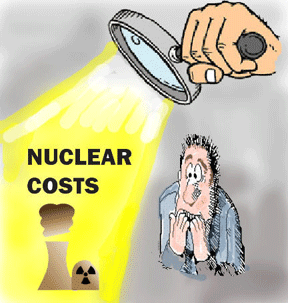
A new Wylfa will cost between £14 and £17bn to build and won’t be up
and running until the 2030s, the UK Government have been told. Sources told
the Times newspaper that the 2.3-gigawatt plant would take six years to
build, on top of a lengthy planning and regulatory process, meaning that it
would not be operational until the early years of the next decade.
Westinghouse and Bechtel, the reactor maker and engineering group, are
hoping to win UK Government backing for their plan to build two reactors at
Wylfa on Anglesey. Their AP1000 reactor design has already completed
initial safety approval for use in Britain. However, Bechtel were hoping to
secure £20m from the UK Government before being able to provide a full
breakdown of the total costs of the project. Ivan Baldwin, head of the UK
civil nuclear market for Bechtel, told the Times that this taxpayer funding
would enable the developer to “provide to the government an estimated
project cost” and “to determine the optimum construction schedule at
the site”.
Hitachi, of Japan, currently own the rights to the Wylfa site
after giving up on their own plans to build a nuclear power plant there.
Dylan Morgan from People Against Wylfa B (PAWB) responded to the
announcement to say that Boris Johnson was just “shooting from the
hip”. “All his bluster about possible new nuclear reactors displays an
astounding level of economic and environmental illiteracy,” he said.
“Firstly, where is the strong economy coming out of Covid and post
Brexit? No nuclear companies will go it alone and invest heavily in
building new nuclear reactors.
“As in the case of Rolls Royce and their
modular reactor which isn’t small at all at 475 MW, bigger than the old
Magnox reactors at Trawsfynydd, they want government public handouts for
designing the reactors, more astronomic handouts financed through our
already vastly inflated electricity bills to construct these radiotoxic
monstrosities, and then even more handouts for an agreed price for
electricity produced, and last but not at all least, the massive
decommissioning costs over thousands of years of reactors and all the
problems with storage of hazardous nuclear wastes.
“There is little wonder that no corporations have come forward in droves to get a nuclear
renaissance much promised from the Blair/Brown era going. “Labelling
Wylfa and Trawsfynydd as possible new sites for this most dangerous, dirty,
radiotoxic, health-threatening and expensive technology is an insult to the
people of Wales. “It is the totally wrong path to tread and it may be the
case that Johnson will not be in office for too long to realise his madcap
nuclear ambitions.”
Nation Cymru 24th May 2022
https://nation.cymru/news/new-wylfa-will-cost-14-17bn-to-build-and-wont-be-ready-until-2030s/
Europe remains economically dependent on Russia as long as it has nuclear energy
As long as nuclear power plants are operated in Europe, the EU will be
dependent on Russian uranium supplies, BUND’s new uranium atlas makes
clear.
Neither economically nor ecologically does nuclear power still make
sense. The new edition of the Uranium Atlas makes it clear that Europe will
not be able to detach itself economically from Russia as long as the states
continue to use electricity from nuclear power.
After all, both Germany and other European states obtain a large part of the uranium needed for this
purpose from mines in Russia and Kazakhstan. The Uranium Atlas (in German),
released last week, is published by the Bund für Umwelt und Naturschutz
Deutschland (BUND) together with the Nuclear Free Future Foundation, the
Rosa Luxemburg Foundation, the environmental foundation Greenpeace and
“.ausgestrahlt”. According to the report, around 40 per cent of
European uranium imports come from Russia and Kazakhstan. Thus, in addition
to fossil energy imports, European countries are significantly dependent on
Russia.
Posteo 28th April 2022
https://posteo.de/en/news/uranium-atlas-2022-nuclear-power-increases-europes-dependence-on-russia
Ireland’s Environment Minister Eamon Ryan rules out nuclear power as option in transition from fossil fuel dependence
Irish Examiner, 23 May 22, Eamon Ryan, the environment minister, has ruled out nuclear power as an option in the transition from fossil fuel, despite mounting calls from environmental voices to consider it.
Mr Ryan told the Irish Examiner it would be too expensive and cumbersome for Ireland to build a nuclear industry, insisting offshore wind is a far better and less expensive bet in the fight against climate change……………….. https://www.irishexaminer.com/news/arid-40878437.html
The risk of Green Parties selling their souls to the nuclear lobby – Finland succumbs to the nuclear siren-song
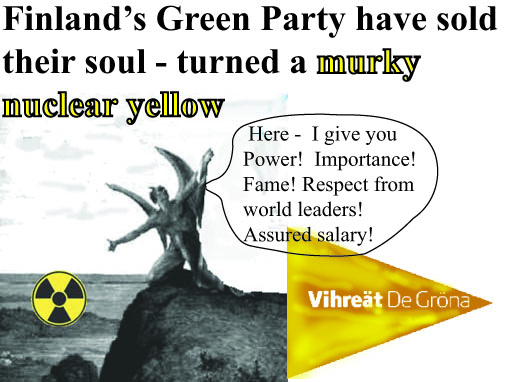
Yes, it’s been all too much for Finland. Green Party members are finding it much easier to get along with the international powers-that-be, by simply dropping their anti-nuclear principles.
I mean – if your well-paid job depends on it , and your status, and self-esteem as an important person. well – why oppose those prestigious leaders who now greenwash the nuclear industry.?
After all, Finland has a nuclear industry, and is very proud of its coming, though rather limited, nuclear waste facility. And Finland’s joining NATO, and however much they deny this, could well be hosting nuclear weapons before too long.
Finland’s Greens will probably find it easy to forget that the full nuclear fuel cycle emits lots of greenhouse gases, that it produces toxic wastes, that it has safety risks, that it is most uneconomic, and that the nuclear industry really has one sole raison-d’etre – nuclear weapons.
It’s just too hard to press on with energy efficiency, wind, sun and wave power – when you’re up against a tsunami of pro-nuke propaganda.
No doubt the nuclear lobby is salivating at the thought that other Green Parties might follow suit, and turn dirty yellow. But Finland is in a bit of a nervous breakdown over Russia. in this time of Ukraine war, and it is more likely that the global Green Party movement will stick to reality.
3 unplanned shutdowns of French nuclear reactors due to corrosion concerns, in the Framatome-designed piping
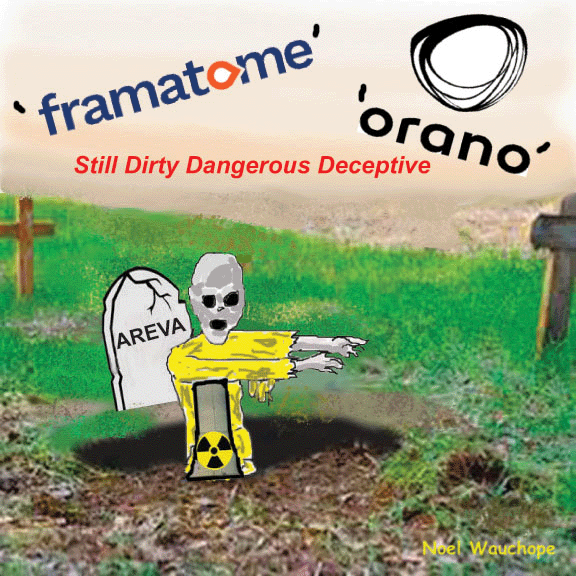
EDF revealed on Thursday that it will shut down the 1.3 GW Paluel 2, Penly
2 St Alban 2 and Cattenom 1 reactors next year, when no shutdowns were
planned so far, to check whether their auxiliary pipes to the primary
circuit are affected by corrosion. The dates of these shutdowns, which will
occur in the second quarter of 2023, must be published imminently on Remit,
said the deputy director of EDF’s nuclear production department Régis
Clément at a press conference in Paris.
The French group intends to check the rest of these 56 reactors by the end of 2023, or even the beginning of 2024, during the planned shutdowns which will be extended and the ten-year
visits, seven of which are scheduled for the rest of this year, he added.
Earlier on Thursday, EDF on Thursday revised the dates for thirteen
scheduled outages at nuclear power plants in 2022-23 due to
corrosion-related checks and repairs. Mr. Clément also asserted that the
“preponderant” cause of cracks due to corrosion on the auxiliary piping
to the primary circuit of certain reactors in the nuclear fleet was the
design of these circuits, developed by the EDF subsidiary Framatome. “Today
what we have as a clear conviction is that the design [of the auxiliary
circuits] appears to us as a preponderant cause”, he said.
Montel 19th May 2022
https://www.montelnews.com/news/1322042/corrosion-edf-rvle-les-4-units-quelle-arrtera-en-2023
Leaked emails expose UK Home Secretary Priti Patel’s connection to MI6-style ‘research and influence operation’AND to extraditing Julian Assange

British Home Secretary Priti Patel is due to imminently decide on whether WikiLeaks founder Julian Assange is extradited to the US, where he faces life imprisonment for journalistic activities.
Patel sat on the advisory council of the neoconservative Henry Jackson Society think tank alongside Lord James Arbuthnot – a former Conservative Minister of Defence whose wife, Lady Emma Arbuthnot, made two key rulings against Assange in 2018, before being forced to step aside due to a “perception of bias.”
it is safe to assume the intelligence cabal bringing its influence to bear on Patel would strongly favor his extradition to the US.
The GRAYZONE, KIT KLARENBERG·MAY 18, 2022,
A deeply anti-democratic MI6-linked cabal’s apparent influence on Priti Patel raises serious questions about her fitness to rule on Julian Assange’s extradition to the US.
- Cabal now managing MI6-inspired “research and influence operation”
- Effort may be funded by intelligence agency actors
- British Home Secretary implicated in plot
- Green advocates and perceived Chinese agents targeted
- Home Office infiltrated by cabal’s civil service mole
- Cabal seeks to seize power over energy policy and “displace” government minister
Hinkley Point C – costs soar, delays again. UK govt’s big bet on nuclear is backfiring
| The risks to the government’s plans to build another eight nuclear power plants have been underlined by the latest wave of ballooning costs and delays at Hinkley Point C. EDF, which is constructing the 3,200MW reactor in Somerset, has warned that estimated costs have jumped to between £25 billion and £26 billion, while the power station will not now start producing electricity until June 2027 at the earliest. The revised estimates are £3 billion higher than the previous cost projections in January last year, which were in turn well ahead of the group’s initial £18 billion forecast when the project was approved in 2016. Hinkley is Britain’s first new nuclear plant in decades. It is expected to power six million homes, with the government guaranteeing that consumers pay an index-linked £92.50 per megawatt hour, in 2012 prices, for its electricity. Construction costs are being met by EDF and its junior partner in the project, CGN of China. Critics seized on the latest overruns to point out the risks to Boris Johnson’s blueprint for another 24 gigawatts of new nuclear power by 2050. The Stop Sizewell C lobby group pointed out that, while EDF and CGN are on the hook for Hinkley’s “rocketing costs”, a proposed new financing model would see consumers paying upfront via higher bills for cost overruns. “The £20 billion estimate for Sizewell C is already two years out of date, with zero chance of it being delivered at that cost,” it said, noting that the risk of spiralling costs would “fall on consumers”. Doug Parr, Greenpeace’s UK policy director, said: “The government’s big bet on nuclear is backfiring with every extra billion added to the bill”. He advocated investment in offshore wind instead. Costs at the prototype for Hinkley, the Flamanville plant in France, have rocketed from €3.3 billion to €12.7 billion. Construction is running more than a decade late. Times 20th May 2022 https://www.thetimes.co.uk/article/hinkley-point-c-nuclear-plant-to-open-a-decade-late-9vsk6w9zx |
£3 billion more, 1 year longer: EDF Energy announces latest price hike and further delay at Hinkley Point C
£3 billion more, 1 year longer: EDF Energy announces latest price hike
and further delay at Hinkley Point C. Whilst news that yet another civil
nuclear power plant is to be delivered still further over-budget and still
further behind schedule may be ‘par for the course’, the Nuclear Free
Local Authorities still find EDF’s latest pronouncement that Hinkley
Point C will cost £3 billion more and take one year longer to build
shocking.
In a media release yesterday (Thursday 19 May), the French parent
of UK nuclear operator, EDF Energy, conceded that, on their latest
estimate, Hinkley Point C will now cost £25 to 26 billion to build and
become operational no earlier than July 2027.
EDF last updated its Hinkley
Point construction schedule in January 2021, when it stated the plant would
be delayed by a further six months to June 2026 with the cost rising by an
additional half billion pounds to £22 billion to 23 billion. NFLA Chair
Councillor David Blackburn commented: “EDF Energy have blamed COVID and
the Ukraine conflict for the price hike and the delay, but Hinkley Point C
was already way over budget and way behind schedule before either of these
calamities occurred. For the simple reality is that nuclear costs too much
and takes too long”.
NFLA 20th May 2022
1 This Month


of the week– Nuclear Reactor Information Task Force

14 May – online event From Bombs to Data Centres: the Face of Nuclear Colonialism
To see nuclear-related stories in greater depth and intensity – go to https://nuclearinformation.wordpress.com
-
Archives
- May 2026 (163)
- April 2026 (356)
- March 2026 (251)
- February 2026 (268)
- January 2026 (308)
- December 2025 (358)
- November 2025 (359)
- October 2025 (376)
- September 2025 (257)
- August 2025 (319)
- July 2025 (230)
- June 2025 (348)
-
Categories
- 1
- 1 NUCLEAR ISSUES
- business and costs
- climate change
- culture and arts
- ENERGY
- environment
- health
- history
- indigenous issues
- Legal
- marketing of nuclear
- media
- opposition to nuclear
- PERSONAL STORIES
- politics
- politics international
- Religion and ethics
- safety
- secrets,lies and civil liberties
- spinbuster
- technology
- Uranium
- wastes
- weapons and war
- Women
- 2 WORLD
- ACTION
- AFRICA
- Atrocities
- AUSTRALIA
- Christina's notes
- Christina's themes
- culture and arts
- Events
- Fuk 2022
- Fuk 2023
- Fukushima 2017
- Fukushima 2018
- fukushima 2019
- Fukushima 2020
- Fukushima 2021
- general
- global warming
- Humour (God we need it)
- Nuclear
- RARE EARTHS
- Reference
- resources – print
- Resources -audiovicual
- Weekly Newsletter
- World
- World Nuclear
- YouTube
-
RSS
Entries RSS
Comments RSS
 nuclear-news