Co-Founder of Green and Blacks Calls Out Small Modular Reactors: They Would Produce 30 Times As Much Nuclear Waste
While Nuclear Luvvies and Lords in Cumbria Big Up Small Modular Reactors being touted by Rolls Royce, science is stacked against them. IF science is genuinely allied to ethics and a living planet then Small Modular Reactors (or any nuclear fuelled plan ) should not even be on the table.
Co-Founder of Green and Blacks Calls Out Small Modular Reactors: They Would Produce 30 Times As Much Nuclear Waste — RADIATION FREE LAKELAND
ular Reactors
(or any nuclear fuelled plan) should not even be on the table. Craig Sams
the co-founder of Green and Blacks has written on social media: “This was
what I wrote 12 years ago. The New Scientist now reports that SMRs (Small
Modular Reactors) produce 30 times as much nuclear waste for the amount of
electricity produced and its more complex. I realise Boris upset everyone
by boozing when he should’ve been following his own rules, but condemning
future generations to even worse nuclear waste problems than we already
have is the real crime against humanity. No more nuclear. The French
nuclear power stations are corroding badly and nobody’s sure what to do.
The Irish Sea is still contaminating fish. We had to stop serving laver
bread in our restaurant Seed back in 1970 because of radioactive waste
contamination and things have only got worse since then. Wind, solar,
geothermal, oil,gas, anything but nuclear”
Radiation Free Lakeland 2nd June 2022
Russia Withdraws From Nuclear Arctic Safety Program with Norway, Amid Safety Concerns
Russia has announced its withdrawal from a nuclear safety program in the
Arctic region, furthering concerns experts have raised about a new period
of heightened nuclear risks. On Tuesday, representatives of Russian state
nuclear agency Rosatom said Norway would no longer be welcome to
participate in radiation safety projects the Nordic country had helped
fund.
The move closes nearly three decades of a bilateral partnership to
deal with nuclear safety in the aftermath of the Cold War. The announcement
has been seen as Moscow’s direct response to Norway’s recent decision to
freeze funding to the high-level joint commission after the invasion of
Ukraine. Norway has provided Russia with more than 2 billion euros to help
secure radioactive dumpsites and improve safety at power plants.
Newsweek 2nd June 2022
Russian-held nuclear plant faces critical shortage of spare parts, says Kyiv

Russian-held nuclear plant faces critical shortage of spare parts, says Kyiv https://www.reuters.com/business/energy/russian-held-nuclear-plant-faces-critical-shortage-spare-parts-says-kyiv-2022-06-03/
KYIV, June 3 (Reuters) – Europe’s largest nuclear power plant that lies in Russian-occupied Ukraine faces a critical shortage of spare parts, threatening the safety of its operations, Ukraine’s military intelligence agency said on Friday.
The plant in the southeastern region of Zaporizhzhia was occupied by Russian troops shortly after its Feb. 24 invasion, but the facility is still operated by Ukrainian technicians.
“A critical situation has developed at the … plant in terms of ensuring stable and safe operations. There are practically no spare parts and expendable materials left,” the Defence Intelligence of the Ministry of Defence said.
The facility is being operated by week-long rotations of staff who have all of their personal belongings and phones taken from them when they begin, it said in a statement.
Then-Soviet Ukraine was the site of the world’s worst nuclear accident at its now-defunct Chornobyl atomic power station north of Kyiv in 1986.
The International Atomic Energy Agency (IAEA) completed a three-day trip to the Chornobyl plant on Friday to ensure safety at the site during the war in Ukraine and said that it also wanted to visit the Zaporizhzhia plant. Reporting by Natalia Zinets in Kyiv and Francois Murphy in Vienna; writing by Tom Balmforth; Editing by Hugh Lawson
A lifeline for Westinghouse nuclear? Westinghouse to take over nuclear fuel supplies to Ukraine, replacing Russia as supplier
Ukraine signs deal with Westinghouse to end Russian nuclear fuel needs https://au.lifestyle.yahoo.com/ukraine-signs-deal-westinghouse-end-110151253.html
Fri, 3 June 2022 KYIV (Reuters) – Ukraine has signed a deal for the U.S. nuclear power company Westinghouse to supply fuel to all of its atomic power stations in an effort to end the country’s reliance on Russian supplies, Ukraine’s state nuclear company said on Friday.
The agreement also increases the number of new nuclear units Westinghouse will build to nine from an earlier five, and the company will establish an engineering centre in the country.
Ukraine has four working nuclear power stations, the largest of which, in Zaporizhzhia, fell under Russian control days after the Russian invasion began in February but is still operated by Ukrainian technicians.
Building on earlier agreements, the deal with Westinghouse stipulates that the company will supply fuel to all of Ukraine’s atomic plants.
Nuclear power covers around a half of all Ukrainian electricity needs and the energy minister said that in future Ukraine could also be a supplier of electricity to western Europe.
“We will modernise our fleet of nuclear power units, which will produce clean, safe and reliable energy without any Russian influence,” Energy Minister Herman Halushchenko said, according to a statement by the state atomic energy company Energoatom.
Energoatom on Thursday denied a report that it might shut down the Zaporizhzhia plant if Kyiv loses control of operations at the site.
Ukraine has repeatedly raised safety concerns about the plant since Russia’s invasion began on Feb. 24. On Friday, it warned that it was running out of spare parts.
(Reporting by Natalia Zinets; writing by Matthias Williams; editing by Barbara Lewis)
Belgian government pressed to pay for extension of nuclear reactors Doel 4 and Tihange 3
| Power suppliers Engie up the pressure, ask Belgian government to step in to share nuclear burden. In a letter to PM Alexander De Croo, the French power suppliers Engie are asking the federal government to pay part of the bill for the lifetime extension of Belgium’s youngest nuclear reactors Doel 4 and Tihange 3. Earlier, the federal government had decided to extend the time frame for the youngest two nuclear reactors with 10 years – until 2035 – to guarantee power supplies. The rest will have to close in 2025 as part of a larger energy deal. Flanders News 2nd June 2022 https://www.vrt.be/vrtnws/en/2022/06/02/power-suppliers-engie-ask-federal-government-for-extra-cash-if-t/ |
UK government urged to end its obsession with nuclear power

THE UK Government has been urged to end its “obsession” with nuclear
power and focus on renewable energy. The SNP have said it is “abundantly
clear” nuclear will cost more and will send energy bills soaring even
further, while people in Scotland “can see clean energy being produced in
their own backyards”.
It comes as a written response to a parliamentary
question confirms further delays to the UK’s Hinkley Point C nuclear
power station, which reports suggest could cost the taxpayer up to £26
billion – opening four years later than scheduled. MP Alan Brown, the party’s Shadow Minister for Energy and Climate change, said the delays added “insult to injury” for consumers, after UK
Government Business Secretary Kwasi Kwarteng admitted recently the
construction of new nuclear plants would initially raise household energy
bills.
Based on the contract awarded by the Westminster government to
Hinkley Point C, the electricity that will be generated by that existing
nuclear station will be priced at £92.50 per megawatt hour, for a 35-year
contract, whereas the electricity being generated from offshore wind is
currently priced at £39.65 per megawatt hour on a 15-year concession. This
means Hinkley Point C alone could add up to £40 a year to consumer bills,
compared to wind power, which could reduce bills by £8 a year. Brown said:
“This latest admission shows the Westminster government’s obsession
with nuclear power will do absolutely nothing to help people cope with the
spiralling Tory-made cost of living crisis. “For months we’ve heard
endless lectures and bleatings from the Tories on their nuclear obsession,
yet every week we’re treated to new reports and estimates of the true
cost of prioritising a massive shift towards nuclear.
“The latest reports simply add insult to injury for the consumers whose energy bills have
skyrocketed in recent months and who were promised a great reprieve when
the UK shifts its reliance to nuclear.
The Scottish Greens have also branded the UK Government’s drive towards nuclear as nonsensical. The
party’s climate change spokesperson, Mark Ruskell, said: “Both the Tory
Government and Labour Party’s ideological obsession with nuclear power
doesn’t make sense either economically or environmentally. “Nuclear is
hugely expensive and leaves a toxic waste legacy for generations. Instead
of investing in toxic white elephants, investment should be focused in
Scotland’s massive renewable potential.”
Lynn Jamieson, chair of the Scottish Campaign for Nuclear Disarmament (CND), said she rejected the UK
Government’s claims nuclear was good for the planet, and insisted we
should be transitioning away from it. She said: “The UK Government’s
claims that nuclear is good for the environment ignores the harms of
uranium mining, the radioactive waste, the risks of cancers and
catastrophic accident – irrationally favouring nuclear industries over
cheaper, safer and more quickly available renewables.
The National 1st June 2022
A warning from France, about nuclear delusions of grandeur,
Nuclear: ” Industrialists are in denial, politicians know nothing about it “

France had the madness of grandeur in wanting to build more and more powerful reactors.
Gaspard d’Allens and Émilie Massemin (Reporterre) Reporterre 28th May 2022
Nuclear ” unacceptable “, ” industrial disaster ” of the EPR , France and its ” delusions of grandeur “… Pillar of the fight against the atom, the engineer Bernard Laponche warns of the dangers of this technology.
You are reading Bernard Laponche’s great interview. The first part is here .
Reporterre — How do you analyze the return to grace of the nuclear industry by Emmanuel Macron, with the construction of six EPR2s and the study of eight additional ones ?
Bernard Laponche — It’s communication ! This operation is part of the mythology that goes back to General de Gaulle, and that Emmanuel Macron has taken over, according to which civil and military nuclear power is the basis of France’s independence.
EDF ‘s nuclear fleet is going through its worst crisis since its birth. The stalemate of the Flamanville EPR site , the chain shutdowns of reactors due to problems of corrosion and cracks, the problems at the Orano reprocessing plants in La Hague and the manufacture of Mox [1] in Marcoule, EDF on the verge of bankruptcy … This is unheard of. Between 2010 and 2020, nearly a hundred incidents occurred throughout the park. Bernard Doroszczuk, president of the Nuclear Safety Authority ( ASN ), recognized this on April 7, 2021 during a hearing in the Senate : “ A nuclear accident is possible in France. »
In this situation, it seems very difficult to hold a triumphant speech on nuclear power. But the industrialists are in denial, the politicians who promote it know nothing about it. All are surfing on the argument of the fight against climate change to promote the sector.
Why nuclear won’t save the climate ?
Greenhouse gas emissions are far from negligible. Nuclear fissions in an operating reactor, the source of the energy produced, do not effectively emit CO₂ . But all nuclear activities in a plant in operation – 800 employees on average – or during shutdowns for maintenance work, yes. These activities also very often cause leaks of gases that are very active in global warming, such as refrigerants (1,000 times warmer than CO₂) and especially sulfur hexafluoride (23,500 times more warming). The extraction of uranium from the mines of Canada, Niger and Kazakhstan, the construction of nuclear plants and power stations, the manufacture of nuclear fuels, the transport and storage of radioactive materials and waste also emit considerable quantities of CO ₂ and other greenhouse gases. For example, the work for each fourth ten-year inspection of a 900 megawatt ( MW ) reactor — there are thirty-two of them — mobilizes 5,000 workers, between six months and a year.
………………………………….. Take the case of the Flamanville EPR : very high CO₂ emissions during construction — several thousand cubic meters of concrete, hundreds of tons of steel and thousands of workers since 2007 — and we do not know still not sure if it will start one day, or when.
Today, nuclear represents only 10 % of the world’s electricity production and only makes it possible to avoid 2.5 % of the world’s greenhouse gas emissions. For it to contribute significantly to the fight against climate change, its share in the global electricity mix would have to be multiplied by at least five. Which, given the duration of construction of a plant, is absolutely technically impossible, even in fifty years.
Finally, due to accelerating global warming, power stations on the banks of the river will increasingly be confronted with warming waters and the reduction of this resource, and those on the seashore with rising ocean waters, caused by melting ice.
But above all, the nuclear issue cannot be reduced to greenhouse gas emissions. Other factors must be taken into account when choosing the electricity mix: the risk of a serious or major accident , the radioactive waste which accumulates for thousands of years, the proliferation of nuclear weapons through the enrichment uranium and the production of plutonium, via the reprocessing of irradiated fuel. This technique is unacceptable for the threat it poses to humanity.
As you remember, the setbacks accumulate for the sector. Which do you think is the most serious ?
The management of radioactive waste is very problematic. In the other nuclear-powered countries, irradiated fuel is considered waste as soon as it leaves the reactors. France, on the other hand, reprocesses its irradiated fuel to produce plutonium, initially for the atomic bomb. Nearly 70 tons of this radioactive material are currently stored at La Hague. The plutonium produced is now used to manufacture Mox fuel. Used in about twenty 900 MW reactors , it is more radioactive and more dangerous than ordinary enriched uranium fuel and is not reprocessed once it is irradiated.
The La Hague plant is one of the most dangerous installations in the world. It stores in its pools, unprotected against external attacks, the equivalent of 100 reactor cores in irradiated fuel. And she is aging. Some evaporators are down, preventing the site from operating at full capacity. The risk of bottling the fuels to be reprocessed and saturation of the storage pools is increasing.

It is urgent to stop reprocessing. The Nuclear Safety Authority recently mentioned the difficulties that are accumulating in the management of irradiated fuels. But the sector is stubborn, and prefers to mitigate the risk of saturation by asking to build a new large storage pool .
Even if we stopped reprocessing, the question of waste would still arise. What do you think of the only seriously studied project in France to bury them 500 meters underground in Bure (Meuse) ?
………………….. There are many criticisms and questions about this project, in particular from the Environmental Authority , independent experts, environmental organizations and local populations: on the legacy to future generations of hazardous waste for hundreds of thousands of years, on the risks during the 150-year period of construction and operation, on the choice of clay, on the risks of fire, hydrogen production, water pollution, etc. Such experiences abroad of deep burial of chemical or nuclear waste have proven to be catastrophic: Stocamine in France , Asse in Germany , WIPP in the United States. In addition, the cost of Cigéo, not yet estimated [4] , would be considerable, not to mention the CO ₂ emissions of such a project………………………………..
The number of reactors currently shut down is historically high. How do you assess the state of the park ?
France had the madness of grandeur in wanting to build more and more powerful reactors.
After the French natural uranium graphite gas ( UNGG ) model was abandoned in 1969, France bought the American Westinghouse license for pressurized water reactors. Framatome [5] was tasked with implementing the 1974 Messmer plan and delivered the first 900 MW reactors under Westinghouse license. EDF has thus built 34 reactors in less than ten years, which is a performance.
Framatome then developed a 1,300 MW model , then achieved a further power jump of around 1,450 MW . This latest model presented design problems from the start. The Civaux and Chooz plants were delivered two years late.
The difficulties continued with the EPR , of 1,650 MW , a veritable industrial disaster. The Flamanville EPR began construction in 2007 and was due to start in 2012. It has accumulated failures: concrete of its platform, welds to be redone several times, refusal of control command, falsification of equipment certificates, delivery of a non-compliant tank… The cost of the EPR , initially established at 3 billion euros, is now estimated at 19 billion euros by the Court of Auditors . The two Taishan reactors in China, built faster and commissioned in 2018 and 2019, are shut downsince the discovery of radioactive leaks from damaged fuel sheaths – without the cause of this phenomenon being understood yet.
……….. Every time you increase the power of a reactor, you have to redesign everything. The calculations to be performed are extremely complex. But if these leaks turned out to be linked to a design problem, it would be catastrophic for EDF , because all the EPRs would be affected.
Finally, for several months, EDF has been faced with a problem of corrosion and cracks on the emergency cooling circuits connected to the primary circuit of several reactors in the fleet, primarily its most powerful reactors (1,450 megawatts) at Civaux and Chooz, but also those of 1,300 MW and probably those of 900 MW . The Civaux, Chooz and Penly reactors have been shut down for several months and will perhaps remain so for years, for inspections after cutting and examination of the parts concerned in the safety cooling circuits ( RIS ) and the cooling circuits at the stop ( RRA), for repair. All reactors must be checked by the end of 2023. The cause of these faults is still poorly explained [6] and would be multifactorial: quality of the steel of the parts, method of welding, layout of the circuits…
Currently, between a third and a half of EDF ‘s reactors are shut down due to these difficulties and almost daily incidents on such and such a reactor.
During the war in Ukraine, civilian nuclear power became a military target with the seizure of the Chernobyl and Zaporijia power plants. How do you view this new risk ?
In Ukraine, the Chernobyl power plant, located on the northern border with Belarus, was equipped with four Soviet RBMK reactors commissioned between 1974 and 1983. After the 1986 disaster on reactor 4, the other three were definitively stopped between 1991 and 2000. There now remains on the site the destroyed reactor containing the molten core protected by a sarcophagus, a new arch intended to confine the radioactivity, but not at all designed to withstand strikes ; three reactors to be dismantled ; as well as storage facilities for irradiated fuel and radioactive waste. Many workers remain on site. The entry of Russian tanks into the prohibited fenced area of 2,600 km 2produced significant resuspension of radioactive aerosols and air contamination. Russian soldiers who dug trenches were irradiated. On March 30, the Russian army began to evacuate the Chernobyl site.
( Zaporizhia)…………………………………..The reactors, even shut down, and the storage facilities for irradiated fuels, must be supplied with cooling water and therefore constantly supplied with electricity. They are therefore extremely fragile vis-à-vis any external aggression in a situation of armed conflict or terrorist attack. Even if the reactor itself is not targeted, any bombardment, missile or shell can lead to a loss of water, by the piercing of a pipe for example, or of electricity by loss of the network or lack of fuel for emergency diesels. With the key to a risk of serious accident as in Three Mile Island (United States), even major as in Fukushima and Chernobyl. This intrinsic fragility is a warning for all nuclear plants and power stations in the world.
Reporterre 28th May 2022 https://reporterre.net/Nucleaire-Les-industriels-sont-dans-le-deni-les-politiques-n-y-connaissent-rien
Nuclear dependence
Europe must cut off Russian nuclear supply routes, From Ecodefense, Russia, Beyond Nuclear 30 May 22
Europe needs a plan in place for cutting ties with Russia’s nuclear giant Rosatom, says 2021 Right Livelihood Award winner and co-chairman of Ecodefense Vladimir Slivyak.
With the European Union tightening its sanctions against Russia, banning Russian imports of oil, gas, and coal has emerged as one powerful tool to starve the Kremlin’s war machine of funding it needs to continue its brutal aggression in Ukraine.
But one other major source of Russia’s revenue in Europe has largely remained unnoticed: Russia’s supplies of nuclear fuel and services to European nuclear power plants.
Seeking to close this gap in Europe’s concerted action against the war in Ukraine and to provide a comprehensive picture of the union’s reliance on Russian nuclear technology, environmentalists Patricia Lorenz, of Friends of the Earth Europe, and Vladimir Slivyak, a 2021 Right Livelihood Award laureate and co-chairman of the Russian environmental group Ecodefense, jointly presented over Zoom Russian Grip on EU Nuclear Power – an overview of Russia’s businesses and supply chains serving the European nuclear market.
The report comes on the heels of the European Parliament’s resolution demanding a full embargo on Russian nuclear fuel as well as oil, gas, and coal, and as Moscow’s war reveals the terrifyingly irresponsible actions at the hands of Russian troops at or near the sites of Ukraine’s nuclear power plants.
Through its uranium-producing mines, the fuel manufacturing subsidiary TVEL, and a number of other enterprises – including the German firm NUKEM and the Czech-based Škoda JS – as well as ties with France’s Framatome, Russia’s nuclear giant Rosatom earns billions supplying uranium, fuel assemblies, and maintenance, storage and transport services to nuclear companies and power plants in European countries. This includes fuel deliveries to Soviet-built nuclear power plants in Ukraine.
According to a late April report carried by Rosatom’s corporate outlet Strana Rosatom, the corporation’s total foreign revenue in 2021 rose 20.3% year on year, reaching $8.9 bn. In the first three months of 2022, Rosatom’s foreign earnings grew by 13%. TVEL’s revenue from nuclear fuel exports stood at $0.7 bn in 2020, said the corporation’s annual report for that year.…………………………………..
……….. Ecodefense’s Slivyak:
“Europe must stop its cooperation with Rosatom – stop participating in joint projects, including building nuclear power plants. Stop buying nuclear fuel from Rosatom,” he said.
…………. “A plan to replace nuclear energy with energy from other sources must be created, and the [Russia-dependent] operating reactors must be shut down,” Slivyak said. https://beyondnuclearinternational.org/2022/05/29/nuclear-dependence/
Ukrainian negotiator rules out deal with Russia
RT Sat, 28 May 2022 Presidential adviser Mikhail Podoliak said that any agreement with Moscow “isn’t worth anything
Despite Russian advances in the Donbass, Ukrainian presidential adviser and peace talks negotiator Mikhail Podoliak declared on Saturday that Kiev would not look for a peace agreement with Moscow. His statement contradicts earlier overtures toward diplomacy by President Volodymyr Zelensky.
“Any agreement with Russia isn’t worth a broken penny,” Podoliak declared in a Telegram post. “Russia has proved that it is a barbarian country that threatens world security.”
“Ukraine will fight with Russia until the victorious finale,” he continued, concluding that “A barbarian can only be stopped by force.”
Podoliak led the Ukrainian delegation during several rounds of unsuccessful peace talks during the initial weeks of Russia’s military operation in Ukraine. Now, his denunciation of talks with Moscow stands in stark contrast to President Volodymyr Zelensky’s acknowledgement earlier this week that he “may try and go the diplomatic way,” should Russian President Vladimir Putin be willing to talk directly………
A similar pattern has played out since the conflict began in February, with Zelensky periodically expressing interest in negotiating a settlement with Russia, only for his officials, the US State Department, or Zelensky himself to express the opposite sentiment shortly afterwards. After he announced his willingness to enter negotiations earlier this week, Zelensky came out on Friday and told his citizens that “there will be no alternative to our Ukrainian flags” flying over the Donbass republics of Donetsk and Lugansk – primarily Russian-speaking areas that declared independence from Ukraine in February…………..
Only a handful of dissenting voices – former Secretary of State Henry Kissinger among them – have urged the Ukrainians to sue for peace. Meanwhile, UK PM Johnson has instead called on the UK’s allies to send heavier weapons to Kiev, while the Biden administration reportedly gave the green light to deliver long-range rocket artillery systems to Ukraine https://www.rt.com/russia/556242-ukraine-negotiator-rejects-talks/
Nuclear safety warning threatens to derail Boris Johnson’s energy revolution
Austria objects to Sizewell C plant in its latest attack on British energy policy, Telegraph, By Helen Cahill 29 May 2022 . Boris Johnson’s plans for a nuclear energy revolution are facing a fresh hurdle after the Austrian government officially raised concerns about the safety of a new reactor design.
In a letter to the Business Department, Austria’s energy ministry raised the spectre of “severe accidents with high releases” at the Sizewell C plant to be built in Suffolk.The warning, made under the Espoo convention in which nearby countries are allowed to comment on nuclear projects, raises the prospect of legal action to derail Sizewell and will be considered by the Government as part of a planning decision in coming months.
…………………… The Austrians said that it is “questionable” whether the Sizewell design could guarantee that radioactivity will be retained within the reactor’s core.
They warned that the high power of the EPR reactor reduces the time available for an operator to react to any fault and prevent a major accident, and added: “At this time, it cannot be proven beyond doubt that severe accidents with high releases cannot occur.”
The intervention comes after Britain put nuclear power at the heart of its long-term energy strategy. https://www.telegraph.co.uk/business/2022/05/29/nuclear-safety-warning-threatens-derail-johnsons-energy-revolution/
France’s Nuclear Industry Slides Into Crisis

https://globeecho.com/news/europe/germany/frances-nuclear-industry-slides-into-crisis/ By David Sadler May 26, 2022,
France is less dependent on Russian gas than Germany – thanks to the country’s 56 nuclear reactors. But because more than half of them are standing still and Russia is disappearing as a customer, France’s nuclear industry is under pressure.
French President Emmanuel Macron had promised a “renaissance of nuclear energy” in February. He wants to have six new pressurized water reactors built. More electricity, more independence, more innovation – Macron is going all-out on the nuclear power card to push France’s industry forward.
Corrosion stalls the plans

But these ambitious plans are currently experiencing a serious setback: 29 of the 56 reactors are shut down. There is a double problem: the state-owned company EDF’s kiln park is showing its age. Many reactors are shut down for routine maintenance. But now, of all things, twelve of the younger series also have to be taken off the grid.
The reason is a corrosion problem that nobody expected. “At the moment, the controls do not allow any statement to be made as to how large the cracks in the cooling tubes are. The reactors have to be shut down for this,” says Bernard Doroszczuk, rapporteur for the Nuclear Safety Authority.
Proportion of nuclear power unplanned at low point
Instead of around 70 percent, France’s nuclear power plants only supplied 37 percent of the electricity requirement in April – less than ever before! Europe’s largest nuclear power provider, Electricité de France, currently estimates the group’s shortfall in revenue for 2022 at 18.5 billion euros. It is already foreseeable that there will be power shortages in winter.
But a quick solution to the technical problems is not in sight. Because there is a lack of skilled workers. “Basically, EDF estimates that by 2026 there will be a six-fold increase in the need for specialist staff. Above all when it comes to the machinery: i.e. pumps, the pipe network, and there is a lack of welders – that’s what drives everyone,” says Jean-Luc Lachaume from the security agency. “And this calculation does not even include the announced construction of new reactors. Nor does it include the need that has now arisen as a result of these unforeseen corrosion problems.”
Instead of renaissance, first of all, renovation. Security auditor Doroszczuk therefore calls for a Marshall Plan. “Industry and the state have to get involved now,” he demands. “Otherwise the announced goals are not tenable. And that would be the worst thing for the credibility of the entire industrial program.”
Russia has been the most important customer so far
On top of all these problems there is now the war in Ukraine. To date, Russia has been the most important customer of the French nuclear industry. Mycle Schneider, editor of the World Nuclear Industry Status Report, sees the items in the order books dwindling. Internationally, Russia was “the decisive, most aggressive promoter” of the construction of new nuclear power plants. And now suddenly this bottleneck has arisen. “In Finland, a project for a Russian nuclear power plant has already been officially canceled – and turbines for this nuclear power plant were to be delivered from France,” says Schneider.
In fact, the French Ministry of Economic Affairs even planned to take a 20 percent stake in the domestic turbine manufacturer in Belfort for the Russian company Rosatom. But that plan could now be shelved. France believed that its nuclear strategy was on the upswing. But the plans have gone haywire.
Energy sanctions on Russia – Russia’s nuclear supply chain should be sanctioned, too
As numerous countries in the west consider taking aim at Russia with energy sanctions over Moscow’s attack on Ukraine, Russia’s dominance in the nuclear energy sector is being overlooked, a paper from ColumbiaUniversity’s Center on Global Energy Policy warns.
While the Russian invasion of Ukraine drags into its fourth month, the European Union has
struggled to wean itself off Russian fossil fuel imports – the profits of which help fuel Moscow’s aggression in Ukraine.
But the Columbia paper, authored by Paul Dabbar, a former undersecretary of Energy for
Science at the Department of Energy, and Columbia researcher Matthew Bowen, suggests that Russia’s nuclear technology sector should also be the focus of economic boycotts.
From reactor construction to fuel fabrication, Russia occupies a predominant position on world nuclear markets. Of the 439 nuclear reactors operated around the world as of 2021, 38 were in Russia
itself and another 42 were built with Russian or Soviet technology.
Bellona 26th May 2022
US university report argues for sanctioning Russia’s nuclear supply chain
No credibility in the way that the Ukraine war is being reported – says Colonel Richard Black (ret)

Video: Col. Richard Black — U.S. Leading World to Nuclear War, The International Schiller Institute, 27 May 22, Mike Billington with Executive Intelligence Review interviews Col. Richard Black (ret.).
”…………………………..BILLINGTON: Many flag grade officers certainly understand the consequences that you just described in a rather hair-raising way. Why is it that, while there are some generals speaking out in Italy, in France, in Germany, warning that we are pursuing a course that could lead to nuclear war, why are there not such voices from flag grade officers—retired, perhaps—saying what you’re saying here today?
BLACK: You know, there’s been a tremendous deterioration in the quality of flag officers………. we now have “yes men.” These are not people whose principal devotion is to the United States and its people. Their principal devotion is to their careers and their ability to network with other military officers upon retirement. There’s a very strong network that can place military generals into think tanks, where they promote war, into organizations like Raytheon and Northrop Grumman, and all of these defense operations, where they can get on boards and things like that. So there’s quite a personal price that you pay for saying, “Hey, stop. War is not in the interests of the American people.” If we had a better quality of individual, we would have people with the courage who would say, “I don’t care what it costs me personally.” But it is very difficult to get into the senior ranks, if you are an individual guided by principle, and patriotism, and devotion to the people of this nation. That’s just not how it works. And at some point, we need a President who will go in and shake the tree, and bring a lot of these people falling down from it, because they’re dangerous. They’re very dangerous to America.
………………. Just like I asked what’s keeping the generals from speaking out, why, and what will it take, to get Americans to recognize that we can and must sit down with Russians, and with Chinese, and with all other nations and establish a true, just world based on the dignity of man and the right to development and security?
………. at this point, the media have been so totally censored and so biased that the American people really don’t have a perception of the need for anything of that sort. It’s going to be difficult.
………… The idea that somehow we have this enormously just cause, it doesn’t strike a great deal of the world that it is just, and much of the world does not accept the latest propaganda about war crimes: this thing about Bucha. That’s probably the most prominent of all the war crimes discussions.
And what was Bucha? There was a film taken of a vehicle driving down the road in Bucha, which had been recaptured from the Russians. And every hundred feet or so there was some person with his hands, zip tied behind his back, and he’d been killed. It was not announced until four days after the Ukrainians had retaken Bucha.
Now, we knew almost nothing about it. We actually didn’t even have proof that people had been killed. But assuming they had, we didn’t know where they had been killed. We did not know who they were. We did not know who killed them. We did not know why they were killed. No one could provide an adequate motive for the Russians to have killed them. The Russians held Bucha for a month. If they were going to kill them, why didn’t they kill them during that month? And if you’re going to slaughter a bunch of people, wouldn’t they all be in one place and wouldn’t you gun them all down there? Why would they be distributed along a roadside, a mile along the way? It makes no sense!
What we do know is that four days after the mayor of Bucha joyously announced that the city was liberated, four days after the Ukrainian army had moved in, and their special propaganda arm of the Ukrainian military were there, all of a sudden there were these dead people on the road. How come they weren’t there when the Russians were there? How come they only appeared after the Russians were gone?
If I were looking at it as simply a standard criminal case, and I was talking to Criminal Investigation Division or the FBI, or military police or something, I’d say, “OK, the first thing, let’s take a look at the Ukrainians.” My guess would be, and you start with a hunch when you’re investigating a crime—my hunch is that the Ukrainians killed off these people after they moved in, and after they looked around, and said, “OK, who was friendly towards the Russian troops while the Russians were here? We’re going to execute them.” That would be my guess. Because I don’t see any motive for the Russians to have just killed a few people on their way out of town.
And nobody questions this, because the corporate media are so monolithic. We know for a fact, from the mouth of the head of a Ukrainian hospital, the guy who ran the hospital, he boasted that he had given strict orders to all of his doctors, that when wounded Russian POWs, when casualties were brought in, they were to be castrated. Now, this is a horrific war crime, admitted from the mouth of the hospital administrator, and the Ukrainian government said, “we’ll kind of look into that,” Like it’s no big thing. I can’t think of a more horrific, horrific war crime, ever. Where did you hear about it, on ABC and MSNBC and CNN and FOX News? Not a whisper. And yet the proof is undeniable. We had another clip where there was a POW gathering point, where the Ukrainians would bring POWs to a central point for processing—and this is about a seven-minute video—and the Ukrainian soldiers simply gunned them all down.
And they had probably 30 of these wounded Russian soldiers lying on the ground, some of them clearly dying from their wounds. Some of them, they put plastic bags over their heads. Now, these are these are guys who are laying there, sometimes fatally wounded with their hands zip-tied behind their backs, and they’ve got plastic bags over their heads, making it difficult to breathe. And because they can’t raise their hands, they can’t take the bags off, so that they can breathe. At the end of the video, the Ukrainians bring in a van, and there are three unwounded Russian POWs. Without the slightest thought or hesitation, as the three come off, and their hands are bound behind their backs, they gunned down two of them, right on camera and they fall over. And the third one gets on his knees, and begs that they won’t hurt him. And then they gun him down! These are crimes. And these were not refuted by the Ukrainian government. But you’d never even know that they occurred! So far, I will tell you that the only proven—I’m not saying that there aren’t war crimes happening on both sides. I’m just telling you, that the only ones where I have seen, fairly irrefutable proof of war crimes, have been on the Ukrainian side.
Now, often you hear it said, well, the Russians have destroyed this or destroyed that. Well, I’ve got to tell you, you go back to the wars that we fought when we invaded Iraq, the “Shock and Awe,” we destroyed virtually everything in Iraq, everything of significance. We bombed military and civilian targets without much discrimination. The coalition flew 100,000 sorties in 42 days. You compare that to the Russians, who have only flown 8,000 sorties in about the same period of time. 100,000 American sorties versus 8,000, in about the same time. I think the Russians have tended to be more selective. Whereas we went out — the philosophy of Shock and Awe is that you destroy everything that is needed to sustain human life and for a city to function. You knock out the water supply, the electrical supply, the heat, the oil, the gasoline; so that you knock out all of the major bridges. And then you just continue to destroy everything.
So it’s really ironic. And keep in mind, Iraq is a relatively small country. Ukraine is a huge country. 100,000 sorties in 42 days, 8,000 sorties in about the same time. A tremendous difference in violence between what we did in Iraq, and what they have done in Ukraine. So there’s simply no credibility when you actually get down to the facts and you look at the way that the war has been conducted…………… https://schillerinstitute.com/blog/2022/04/26/video-col-richard-black-u-s-leading-world-to-nuclear-war/
EDF Nuclear Failures Undermine Europe’s Push to Exit Russian Gas
- France may need to import power from its neighbors this winter
That may drive up regional demand for gas to feed power plants - Bloomberg, By Rachel Morison and Francois De Beaupuy, 27 May 2022, Electricite de France SA’s nuclear failures are sending ripples through European energy markets, threatening to undermine the continent’s plan to turn its back on Russian gas.
- Europe’s biggest producer of atomic energy, which usually exports cheap power during the winter, may be forced to import this year after cutting its output forecast a third time. A fleet hobbled by faults is not just a problem for France but for countries such as neighboring Germany, which may have to burn more gas to keep the lights on despite pledging to cut its reliance on Moscow.
We have a French problem which is taking place at the wrong time, given the geopolitical situation,” said Nicolas Leclerc, co-founder of Paris-based energy consultant Omnegy. “The whole European equilibrium may be threatened.”…………. (subscribers only) https://www.bloomberg.com/news/articles/2022-05-27/edf-nuclear-failures-undermine-europe-s-push-to-exit-russian-gas
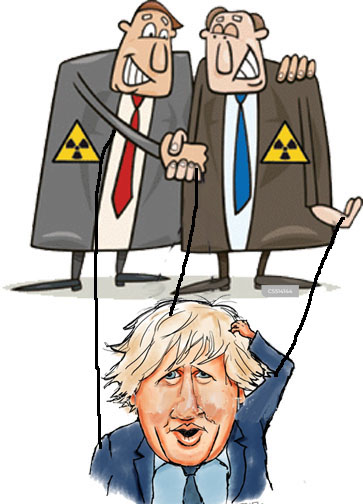
Boris Johnson promised ”1 nuclear reactor a year for 8 years” – one by 2040 if he’s lucky!
With the weather changing dramatically across the world, will politicians
finally take the climate crisis seriously? With a concerted effort, there
could still be time. But time is the critical thing. And on the campaign
trail in “red wall” seats before the May elections, the prime minister,
Boris Johnson, repeatedly promised building nuclear reactors “one a year
for eight years”.
Last week at the Conservative conference in Wales he
was at it again – this time promising one on Anglesey and another at
Trawsfynydd in Mid Wales.
Anyone who knows a little about nuclear reactors
(current designs 10 years late and £10bn over budget) or about the prime
minister’s other mega-projects – bridges across the Thames and Irish
Sea, and an airport in the Thames estuary – is confident that this
won’t happen.
A protest via my MP brought a measured response from Greg
Hands, the minister responsible for energy policy. He said provided
reactors were value for money and technically sound, the government’s
target for nuclear projects was to give one a final investment decision
this parliament, and two in the next – so maybe three building starts by
2030. On current trends that means one reactor possibly ready by 2040 and
two others much later. Far too late to heal the climate.
Guardian 27th May 2022
1 This Month


of the week– Nuclear Reactor Information Task Force

14 May – online event From Bombs to Data Centres: the Face of Nuclear Colonialism
To see nuclear-related stories in greater depth and intensity – go to https://nuclearinformation.wordpress.com
-
Archives
- May 2026 (163)
- April 2026 (356)
- March 2026 (251)
- February 2026 (268)
- January 2026 (308)
- December 2025 (358)
- November 2025 (359)
- October 2025 (376)
- September 2025 (257)
- August 2025 (319)
- July 2025 (230)
- June 2025 (348)
-
Categories
- 1
- 1 NUCLEAR ISSUES
- business and costs
- climate change
- culture and arts
- ENERGY
- environment
- health
- history
- indigenous issues
- Legal
- marketing of nuclear
- media
- opposition to nuclear
- PERSONAL STORIES
- politics
- politics international
- Religion and ethics
- safety
- secrets,lies and civil liberties
- spinbuster
- technology
- Uranium
- wastes
- weapons and war
- Women
- 2 WORLD
- ACTION
- AFRICA
- Atrocities
- AUSTRALIA
- Christina's notes
- Christina's themes
- culture and arts
- Events
- Fuk 2022
- Fuk 2023
- Fukushima 2017
- Fukushima 2018
- fukushima 2019
- Fukushima 2020
- Fukushima 2021
- general
- global warming
- Humour (God we need it)
- Nuclear
- RARE EARTHS
- Reference
- resources – print
- Resources -audiovicual
- Weekly Newsletter
- World
- World Nuclear
- YouTube
-
RSS
Entries RSS
Comments RSS
 nuclear-news