I spent decades in energy -Here are the problems with UK nuclear plans.
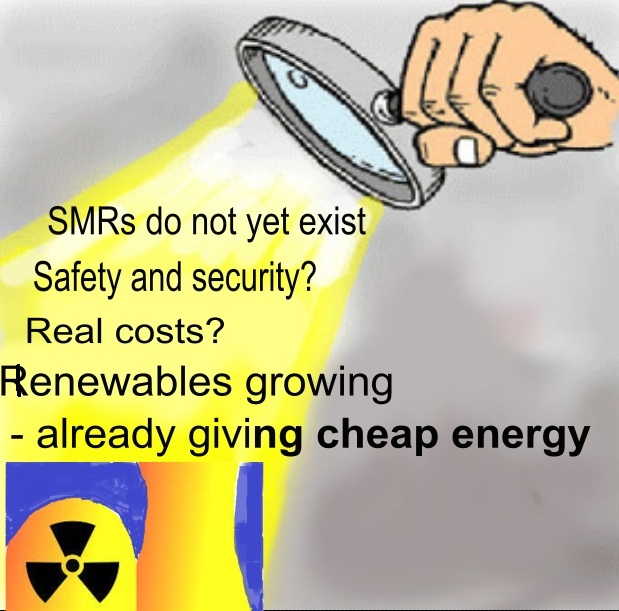
IT is clear that the issue of Scotland’s moratorium on new nuclear power
will be a key battle line in May’s Scottish Parliament election. Anas
Sarwar has joined the Labour energy minister Michael Shanks in the call for
building more nuclear power in Scotland – and the electricity cables to
take the generated electricity to energy-hungry England. MP Shanks
continues to declare that he would be relaxed about having a small
modularised reactor (SMR) erected in his constituency.
I am not sure how
the good people of Rutherglen feel about this. What I find mystifying is
the lack of proper scrutiny being applied to the claims made by those
members of the Nuclear Energy All-Party Parliamentary Group and its
well-funded nuclear lobbyists. It does not surprise me that they are unable
to set out what configuration they favour, as the reactors which they claim
will produce 400 MWs do not exist. They have not been manufactured, tested,
or installed – anywhere! As an engineer, I would be keen to ask the
politicians if they have thought about some of the basic elements of a
power plant. Do they have any ideas what the thermal capacity of the
proposed reactors are? Have they understood what the cooling requirements
might be? How about the status of the “core catcher”, the system
designed to prevent a Chernobyl-type event?
Be under no illusion, Shanks,
Sarwar and the nuclear lobby are building a Potemkin village, a deceptive,
impressive facade. They of course don’t want to talk about the European
Power Reactor (EPR) configuration being installed at astronomical cost at
Hinkley C. This project is forecast to cost around £45 billion when it
finally comes online sometime next decade. It is not easy to get a proper
sense of this sum but it might surprise people to realise that this is the
equivalent of paying £1 million every single day for 120 years – and this
is just the construction cost.
We have not even started talking about
operational costs, asset management and asset decommissioning. When Julia
Pyke, the managing director of Sizewell C, was asked by the BBC how the
project was going, she answered airily that it is “on schedule and within
budget”. I waited eagerly for the obvious follow-up question – what is
the budget and schedule? – but that never came. If the Sizewell C
construction consortium defies recent construction trends and achieve a 10%
saving relative to Hinkley C, that would still indicate a £40bn project
cost – which is enough to build 130 hospitals similar to, for example,
Forth Valley Royal Hospital.
The supporters of nuclear energy tell us that
we need these plants for baseload capacity. They fail to acknowledge that
in Scotland we already generate more capacity from renewables than we
consume – and this surplus is only going to grow as we continue to see more
investment in wind, solar, tidal and energy storage.
“What about
intermittency and the lack of system inertia?” is the nuclear advocates’
stock question when discussing the growth of renewables. This is a
legitimate question but the answer is beautifully simple – we will continue
to do what we do now, rely on combined-cycle gas turbines (CCGTs). Which is
reassuring as there will be no nuclear plant coming on stream anytime soon.
“But what about net zero?” might be the next question. Thankfully,
there are a raft of solutions to this currently available and more coming
on stream every week. For example, gas turbine manufacturers are building
on 50 years of experience of burning hydrogen and will be ready to burn
hydrogen or blended hydrogen/methane as quickly as the hydrogen market can
come on stream. My prediction is that the hydrogen market will come on
stream faster than any SMRs can be built – and if UK politicians had a
strategic bone in their bodies, they would be trying to beat our friends in
Europe to win the hydrogen race.
The National 31st Jan 2026, https://www.thenational.scot/news/25813385.spent-decades-energy-problems-uk-nuclear-plans/
Labour backbenchers revolt over Starmer’s nuclear plans

Ministers accused of scapegoating protected species for construction failures
Matt Oliver, 02 February 2026
Sir Keir Starmer’s plan for a nuclear renaissance faces a rearguard action
from Labour MPs and wildlife charities over claims it will be a
“catastrophe” for nature. As many as 40 backbenchers are rallying
against the Prime Minister’s proposal to overhaul environmental regulations
after an independent review said red tape was frustrating the construction
of new power stations.
The MPs and a coalition of environmental charities
including the Wildlife Trusts, the RSPB, the National Trust and the
Woodland Trust have accused ministers of scapegoating protected species
such as bats and newts for planning failures.
It comes ahead of a plan
expected to be published by ministers this month, setting out how they will
implement the review’s recommendations and whether they will adopt them in
full. Labour is also under pressure from an opposing group of pro-nuclear
campaigners, businesses and think tanks who argue reform is “essential if
we want to create jobs, tackle climate change, and cut energy bills”.
Britain is currently the most expensive place in the world to build nuclear
reactors, with critics blaming nature rules that have added hundreds of
millions of pounds of extra costs to construction. The review of nuclear
regulations, led by the economist John Fingleton, criticised regulators
such as the Office for Nuclear Regulation, the Environment Agency and
Natural England for presiding over a confusing and “duplicative” system
that prioritised “process over outcomes”.
A briefing circulated in
Parliament by the Wildlife Trusts claims that the review’s proposed changes
to habitat regulations “will do little to speed up planning decisions
but, instead, will turn the nature crisis into a catastrophe.” It argues
that the suggestion of a nature fund may be suitable in some cases but not
in the case of “irreplaceable habitats or species that cannot
re-establish elsewhere easily.”
The briefing adds: “The Government must
reject the nuclear regulatory review recommendations on environmental
regulations and end its confected war on nature as a barrier to
planning.” Chris Hinchcliffe, the Labour MP for North East Hertfordshire
who is coordinating the rebellion, said “a good number of colleagues”
shared the concerns. He said: “There is very clear polling on the
importance of nature to the British public and their desire to seek
stronger, not weaker, protections for nature. “Getting this wrong is a
real vote-loser, and is a misstep that the Government cannot afford.”
Responding to the findings in November, ministers vowed to present “a
full implementation plan” by late February and to push through the
changes within two years. On Monday, the campaign group Britain Remade
published a letter signed by businesses and think tanks urging ministers to
press ahead. The letter said: “If the Government is serious about growing
the economy, reducing bills, and delivering a new golden age of nuclear
energy, its implementation plan must back the Fingleton reforms in full.
“Nuclear energy is the most land-efficient zero-carbon technology we
possess. A single power station can power millions of homes. “If we are
serious about halting climate-driven nature loss, then nuclear energy must
expand in a safe, secure and sustainable way. “We cannot afford for the
Government to U-turn.”
Telegraph 2nd Feb 2026 https://www.telegraph.co.uk/business/2026/02/02/labour-backbenchers-revolt-over-starmer-nuclear-plans/
Germany: Ministry of the Environment: Mini‑reactors [SMNRs] not an option

Berlin (energate) – The gap between the hype and industrial reality surrounding nuclear energy is widening. This applies in particular to the smaller nuclear reactors, Small Modular Reactors (SMR). This is the conclusion of the World Nuclear Industry Status Report, which was commissioned by the Heinrich Böll Foundation, the Federal Office for the Safety of Nuclear Waste Management (BASE) and the Friedrich Ebert Foundation, among others.
by Leonie Wolf, energate, 22 January 2026
According to the study, nuclear energy remains “irrelevant” on the global market, as the 5.4
GW increase in nuclear capacity is offset by 100 times the combined new capacity of over 565
GW of wind and solar energy. Wind and solar plants
worldwide currently generate 70 per cent more electricity than nuclear reactors.
According to the report, there is still no market-ready product for Small Module Reactors (SMR), only a design certification and an approved standard design. Both come from the US company NuScale. The US Nuclear Regulatory Commission has already approved a total of three of the company’s models, but previous contracts with potential customers have been cancelled due to increased costs.
A first mini-reactor was cancelled in 2023.

According to the study, the two largest European start-ups Newcleo and Naarea are in financial difficulties; the French start-up Naarea has already filed for insolvency. The start-up is now to be taken over by the Polish-Luxembourgish group Eneris.
The Netherlands and France continue to rely on nuclear power
Despite these failures, other countries are sticking with nuclear energy. In the Netherlands, a debate on the use of SMR, which is seen as a measure to achieve the 2030 climate targets, has been ongoing for several years. In addition, the Dutch company Mammoet signed a memorandum of understanding with Electricité de France (EDF) at the end of 2025, which provides for the construction of nuclear plants in the Netherlands. Two nuclear power plants were already planned for 2022 and two more are still in operation.
Debate continues in Germany
Although Germany has withdrawn from nuclear energy, the debate about its benefits continues. Parliamentary State Secretary Rita Schwarzelühr-Sutter also spoke at the presentation of the World Nuclear Industry Status Report. When asked by energate, a spokesperson for the Federal Ministry for the Environment explained that Germany had “good reasons” for withdrawing from the use of nuclear power. The risks of nuclear energy and also of the use of SMRs remain “ultimately unmanageable”. In addition, the development and construction of smaller reactors raises many other unresolved issues.
There is also no reliable evidence to date for the safety promises. As a result, the disadvantages of nuclear energy would be transferred from a few large plants to many small ones. Ultimately, “the individual plants may become smaller, but the problems as a whole tend to become bigger”.
The spokesperson also referred to a study by the Federal Office for the Safety of Nuclear Waste Management, which energate has already reported on. According to the report, the advantages of mass production of SMRs would only outweigh their fundamental cost disadvantages compared to large reactors with a production volume of around 3,000 units.
The CDU/CSU (Christian Democrats) parliamentary group takes a different view. At the end of 2024, the CDU and CSU published a position paper in which they advocated research and development of nuclear power plants, including SMRs. CSUChairman Markus Söder also spoke out in favour of the use of SMRs in an interview with Die Welt at the end of 2025.
A total of 127 different designs worldwide
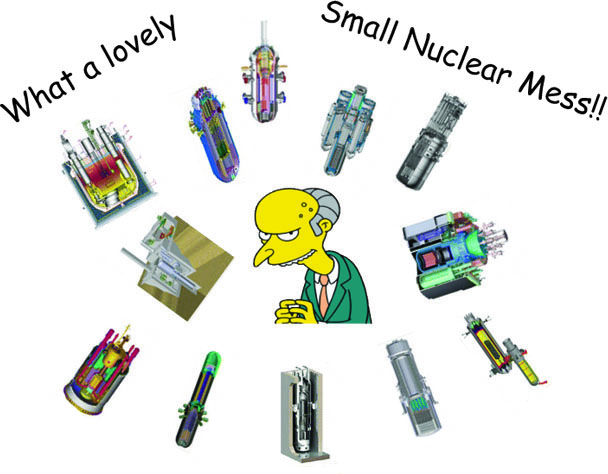
The report states that it is above all the continuous financial and political support for SMRs that keeps faith in them alive. In particular, private capital injections are playing an increasingly important role in driving research and development forward. There are 127 different SMR designs, so the funding amounts are widely spread. This means that most designs do not have sufficient financial resources to drive development forward
. According to the report, even the US start-up NuScale is still years away from building the first Small Module Reactor, although several designs have already been approved.
Europe in Panic: Trump’s Power Play Shakes the World Order
by Joshua Scheer, February 1, 2026 https://scheerpost.com/2026/02/01/europe-in-panic-trumps-power-play-shakes-the-world-order/
For decades, the Western Alliance has been treated as a permanent fixture of global politics — a transatlantic bond forged in the ashes of World War II and held together through the Cold War by a shared fear of the Soviet Union. But as this video argues, the world that created NATO no longer exists, and the assumptions that once held Europe and the United States together are cracking under the weight of new geopolitical realities.
The rise of China as an economic and technological superpower, Europe’s deepening trade ties with Beijing, and Washington’s escalating pressure campaigns have all exposed the uncomfortable truth: the “alliance” has always been a hierarchy, and the United States has always sat at the top. What’s different today is that the old Cold War glue no longer works — and the Trump administration’s aggressive economic demands, territorial ambitions, and threats toward its own allies have forced Europe to confront a question it has avoided for generations: Is dependence on Washington still sustainable?
Finland detects small amount of radioactivity, sees no health impact

Armen Press 30th Jan 2026, original at https://armenpress.am/en/article/1240847
Small amounts of radioactive substances have been detected in air samples in Finland though there was no risk to public health, Reuters reported citing the country’s nuclear safety watchdog.
“The concentrations were very low and posed no risk to people or the environment,” the Radiation and Nuclear Safety Authority (STUK) said in a statement, according to Reuters.
According to the report, STUK said that the radioactive substances did not originate from Finnish nuclear power plants, though it did not offer an explanation for their detection.
“In many cases, the source of the radioactive substances cannot be identified,” the agency said.
Finland, Sweden, Russia and the wider region have a number of nuclear power reactors.
Small Modular Reactors: Game changer or more of the same?
There has been a large amount of publicity on Small Modular Reactors (SMRs) based on exaggerated, unproven or untrue claims for their advantages over large reactors. Only one order for a commercially offered design has been placed (Canada) and that had yet to start construction in January 2026. The UK should not invest in SMRs until there is strong evidence to support the claims made for them.
Policy Brief, Stephen Thomas, Emeritus Professor of Energy Policy, Greenwich University, 31 Jan 26 https://policybrief.org/briefs/small-modular-reactors-game-changer-or-more-of-the-same/
Introduction
With current large reactor designs tarnished by their poor record of construction, attention for the future of new nuclear power plants has switched to Small Modular Reactors (SMRs). The image of these portrayed in the media and by some of their proponents is that they will roll off production lines, be delivered to the site on the back of a truck and, with minimal site assembly, be ready to generate in next to no time; they will be easy to site, a much cheaper source of power, be safer and produce less waste than large reactors; as a result, they are being built in large numbers all around the world. But what is the reality?
What are SMRs and AMRs?
In terms of size, the International Atomic Energy Agency (IAEA) defines SMRs as reactors producing 30-300MW of power and defines reactors producing up to 30MW as micro-reactors. In practice, the size of SMRs is increasing and of the seven designs that have received UK government funding, four are at or beyond the 300MW upper limit for SMRs.1 The vendors of the two micro-reactor designs funded by the UK have both collapsed,2 leaving the X-Energy Xe-100 the only reactor design, at 80MW, that is technically an SMR.
The term Advanced Modular Reactor (AMR) is largely a UK invention and denotes reactors using designs other than the dominant large reactor technologies — Pressurised and Boiling Water Reactors (PWRs and BWRs). In other countries, the term SMR covers all reactors in the IAEA’s size range. None of the proposed AMR designs are new, all having been discussed for 50-70 years but not built as commercial reactors. They can be divided into those built as prototypes or demonstration reactors — the Sodium-cooled Fast Reactor (SFR) and the High Temperature Gas-cooled Reactor (HTGR) — and those that have not been built — Molten Salt Reactors (MSRs) and Lead-cooled Fast Reactors (LFRs).
Some designs include a heat storage device so that when demand is high, this heat can be used to generate additional electricity as well as that generated by the reactors. When electricity demand is low, the heat produced by the reactor can be stored for when demand is higher, giving it a generating flexibility. For example, the Terrapower SFR design includes molten salt heat storage to boost the station’s output from 345MW to 500MW at peak times. This is intended to address the issue that operating reactors in ‘load-following mode’ is problematic technologically and economically. It is not clear whether this generating flexibility justifies the substantial additional expense of the heat storage system.
What is the case for SMRs and AMRs?
SMRs and AMRs are presented, not only by the nuclear industry, but also by the media and government, as established, proven, commercial products. The main claims for SMRs and AMRs compared to large reactors are:
- They will be cheaper to build per kW of capacity and less prone to cost overruns;
- They will be quicker and easier to build and less prone to delay;
- They will produce less waste per kW of capacity;
- Building components on factory production lines will reduce costs;
- Modular construction, reducing the amount of site-work, will reduce costs and delays;
- They will be safer;
- They will generate more jobs.
There have been numerous critiques that demonstrate these claims are at best unproven or at worst simply false.3 The summary of the critiques on each point is as follows.
Construction Cost
The first commercial reactors worldwide were mostly in the SMR size range, but they proved uneconomic and the vendors continually increased their size to gain scale economies, culminating in the 1600MW Framatome European Pressurised Reactor (EPR). Intuitively, a 1600MW reactor vessel will cost less than ten 160MW reactor vessels. While increasing their size was never enough to make the reactors economic, it is implausible that scaling them down will make them cheaper per unit of capacity because of the lost scale economies. It appears that SMRs are struggling to be economically viable. Holtec doubled the electrical output of its design at some point in 2023.4 The realistic competitors to SMRs are not large reactors but other low-carbon options such as renewables and demand-side management.
“While increasing their size was never enough to make the reactors economic, it is implausible that scaling them down will make them cheaper per unit of capacity because of the lost scale economies.”
Construction time
There is no clear analysis explaining why reactors are now expected to take longer to build and why they seem more prone to delay.5 However, it seems likely that the issue is that the designs have got more complex and difficult to build as they are required to take account of vulnerabilities exposed by events such as the Fukushima disaster. The problems thrown up by the occupation of Ukraine’s Zaporizhia site by Russia have yet to be taken up in new reactor designs. As a result of the 9/11 terrorist attack on New York, new reactor vessels are required to be able to withstand an aircraft impact. The conflict in Ukraine spilled on to the Zaporizhia site causing concerns that a serious accident would result. Analysis suggests that the exterior of other parts of the plant should be toughened. If the issue is complexity rather than size per se, reducing the size of the reactors may do no more than make construction a little easier.
Waste
For SMRs, there is a clear consensus that they will produce more waste per unit of capacity than a large reactor. For example, Nuclear Waste Services, the UK body responsible for waste disposal said: “It is anticipated that SMRs will produce more waste per GW(e) than the large (GW(e) scale) reactors on which the 2022 IGD data are based.”6 Alison MacFarlane, former chair of the US Nuclear Regulatory Commission (NRC) wrote: “The low-, intermediate-, and high-level waste stream characterization presented here reveals that SMRs will produce more voluminous and chemically/physically reactive waste than LWRs, which will impact options for the management and disposal of this waste.”7 The AMRs will produce an entirely different cocktail of waste varying according to the type of reactor.
“SMRs will produce more voluminous and chemically/physically reactive waste than Large Light Water Reactors”
Factory production lines
In principle and in general, production lines, which have high set-up costs, can reduce costs with high-volume items with a fixed design and a full order book. But, if demand is not sufficient to fully load the production line or the design changes requiring a re-tooling, the fixed costs might not be fully recoverable. The production lines proposed for SMRs will produce less than a handful of items per year — a long way from a car or even an aircraft production line — and the market for SMRs is uncertain, so guaranteeing a full order book is impossible. There is also a ‘chicken and egg’ issue that the economics of SMRs will only be demonstrated when the components are produced on production lines, but production lines will only be viable when the designs are demonstrated sufficiently to provide a flow of orders.
Modularity
Modularity is a rather vague term, and all reactors will be made up of components delivered to the site and assembled there, any difference between designs being down to the extent of site work. The Westinghouse AP1000 design is said to be modular but this did not prevent all eight orders suffering serious delays and cost overruns. Framatome now describes the successor design to the EPR, the 1600MW EPR2, as modular.8
Safety
Some of the SMRs and AMRs rely on ‘passive’ safety, in other words, they do not require the operation of an engineered system to bring the reactor back under control in the event of an accident. A common assumption is that because it is passive, it is fail-safe, and will therefore not require back-up safety systems and so will be cheaper. None of these assumptions is true and, for example, the UK Office of Nuclear Regulation (ONR) has said for the 20MW PWR design from Last Energy: “ONR advised that it is philosophically possible to rely entirely on two passive safety systems, providing there is adequate defence in depth (multiple independent barriers to fault progression)”.9 Some designs rely on being built underground but the Nuward and NuScale designs that use this have struggled to win orders with Nuward being abandoned and NuScale losing its only major order prospect because of rising costs.10
Job creation
A key selling point for SMRs is that they will require much less site work and that implies fewer jobs. More of the work will be done in factories but the business model for SMRs requires that, globally, as few factories be built as possible to maximise scale economies, so if, for example, the factory is not in the UK, neither will the jobs be.
What is the experience with SMRs?
Many reactors that fall into the size range of SMRs were built in the 1960s including 24 reactors in the UK. By the mid-60s, almost all new orders were for reactors larger than 300MW. This century, only two SMR projects have been completed11, one in China and one in Russia, but neither design appears to have any firm follow-up projects. Two projects are under construction, one in Russia and one in China, but neither design appears to have any further firm order prospects. There is one micro-reactor under construction in Argentina (see Table below).
The most advanced project using a commercially available design is for a GE Vernova BWRX-300 reactor to be built at the Darlington site in Canada. There appears to be a firm order for this reactor although by January 2026, construction had not started. The Canadian safety regulator will assess the design during the construction period, not before construction starts as would be required in most jurisdictions; this gives rise to a risk of delays and cost escalation if a design issue requiring additional cost emerges during construction.
There are several other projects with a named site and design, often presented in the media as being under construction, but these have yet to receive regulatory approval for the design, they do not have construction permits and a firm reactor order has not been placed. Those listed in Table 1 are the ones that appear most advanced in terms of regulatory approvals. Numerous other projects have been publicised, invariably with ambitious completion date targets, but they are some distance from a firm order being placed. Up to this point, historically, a high proportion of nuclear projects of all sizes announced do not proceed and there is no reason to believe this will not be the case with these projects. Once a firm reactor order has been placed, the project is more likely to go ahead because the cost of abandonment is high.
The two operating SMRs (in China and Russia) have a very poor record in terms of construction time and operating performance, but authoritative construction costs are not known. Completion of the three under construction is also behind schedule. While these projects are not for commercial designs, this provides no evidence that the ambitious claims for SMRs will be met.
Conclusions
The perception that SMRs are being built in large numbers is untrue and the claims made for them in terms of, for example, cost, safety, and waste are at best unproven and at worst false.
The image of them being much smaller than existing reactors is incorrect. The IAEA’s size range is arbitrary but the clear trend for SMRs to increase in size does put a question mark against the claims made for them such as reduced cost per kW due to small size, ease of siting and mass production. Most of the designs that have realistic order prospects are at or beyond the 300MW upper limit of the IAEA range for SMRs. This is illustrated by the Holtec design which, for more than a decade was being developed as a reactor, SMR160, designed to produce 160MW of electricity. In 2023 and with no publicity, the output of the reactor was doubled to become the SMR300 and projects using this technology are foreseeing 340MW of power. The idea that siting and building them will be easy is not credible; a reactor of more than 300MW will need to be carefully sited so it is not vulnerable to sea-level rise or to seismic issues and will require substantial on-site work including foundations, suggesting that the claim that these projects would be largely factory built is implausible. It would also mean that either the modules would be very large making them difficult to transport or would require a larger number of modules increasing the amount of site-work.
“The perception that SMRs are being built in large numbers is untrue and the claims made for them in terms of, for example, cost, safety, and waste are at best unproven and at worst false.”
This increased size also means that the image of a rolling production line producing large numbers of reactors is inaccurate. Rolls Royce, whose design has increased to 470MW, is anticipating its production lines would produce components for only two reactors per year.
The UK, along with Canada and the USA is in the vanguard of development of SMR designs. The history of nuclear power shows that developing new reactor designs is an expensive venture with a high probability of failure. The UK’s chosen design is the largest SMR design on offer and is being developed by a company with no experience designing or building civil nuclear power plants. Submarine reactors have very different design priorities and the reactors built by Rolls Royce use US designs. There is huge scope for the UK to build much cheaper offshore wind and to carry out energy efficiency measures which would have the double dividend of reducing emissions and tackling fuel poverty. It would make much more sense for the UK to let other countries make the investments and take the risk and only if SMRs are shown to fulfil the claims made for them to then adopt them as part of the UK’s generating mix.
| Country | Site | Vendor | Technology | Output MW | Status | Construction start | Commercial operation | Load factor |
|---|---|---|---|---|---|---|---|---|
| Russia | Lomonsov | Rosatom | PWR | 2 x 32 | Operating | April 2007 | May 2020 | 32.1% |
| Russia | Brest | Rosatom | SFR | 300 | Under construction | June 2021 | 2028/29 | |
| China | Shidoa Bay | Tsinghua | HTGR HTR-PM | 200 | Operating | December 2012 | December 2023 | 26.9% |
| China | Linglong 1 | CNNC | PWR ACP100 | 100 | Under construction | July 2021 | 2026? | |
| Argentina | Carem25 | CNEA | PWR Carem | 25 | Under construction | August 2015 | 2028? | |
| Canada | Darlington | GE Vernova | BWRX-300 | 300 | Firm order | – | 2030? | |
| USA | Kemmerer | Terrapower | SFR Natrium | 345 | Construction permit applied for | – | 2031? | |
| USA | Palisades | Holtec | PWR SMR300 | 2 x 340 | Pre-licensing | – | 2030? | |
| USA | Clinch River | GE Vernova | BWRX-300 | 300 | Construction permit applied for | – | 2033? | |
| UK | Wylfa | Rolls Royce | PWR | 470 | Design review | 2030? | 2035? | |
| UK | Llynfi | Last Energy | PWR | 4 x 20 | Site licence applied for | 2028? | 2030? |
Note: Load factor is the most widely used measure of reactor reliability and is measured as the electrical output of the plant as a percentage of the output produced if the reactor had operated uninterrupted at full power.
Endnotes…………………………………………………………………………………………………………………………………………………………….
Controversial plans for 139 homes on old Marchon site approved.
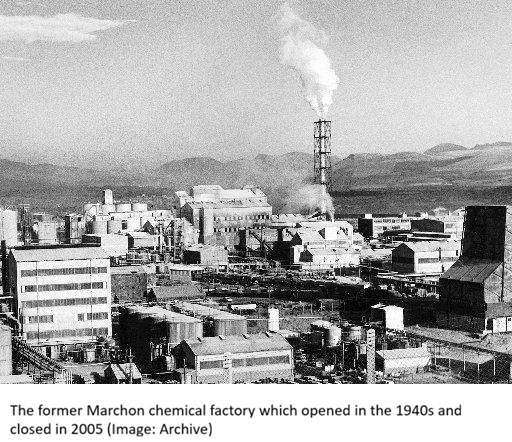
“We have been given no guarantees that this land is safe or that contamination will not be disturbed. It is unclear how old some of the contamination reports are, raising doubts over their accuracy and reliability.“
even the developer admits in the reports they do not fully know what they will uncover until excavation begins.
By Lucy Jenkinson, 10th December 2025, https://www.whitehavennews.co.uk/news/25684633.decision-due-controversial-plans-139-homes-old-marchon-site/
CONTROVERSIAL plans to build 139 homes on the site of a former chemical factory have been approved by planners today.
The application put forward by Persimmon Homes to build houses on the old Marchon site at Kells in Whitehaven, was considered by Cumberland Council’s planning committee this afternoon (December 9).
Members visited the site, which was formerly used to produce ingredients for detergents and toiletries from the 1940s until 2005, before making their decision.
The application is for phase one of the scheme, with an area of land designated to provide a commercial related development within phase two.
Persimmon Homes say the location creates an opportunity for ‘a vibrant residential development of good quality design’ and a range of housing types would be provided to meet local needs.
Access points would be created off High Road and there would be an opportunity to link with an existing national pedestrian and cycle network.
Concerns had been raised by some residents living nearby over the risk of contaminated land and the capacity of local services including school places and GP surgeries.
One resident who lives at Saltom Bay Heights said: “We have been given no guarantees that this land is safe or that contamination will not be disturbed. It is unclear how old some of the contamination reports are, raising doubts over their accuracy and reliability.”
“Proper up-to-date testing of the land has not been carried out, and even the developer admits in the reports they do not fully know what they will uncover until excavation begins. There are known areas where digging is restricted, yet no reassurance has been provided on what happens if contamination is released.
“There are not enough school places and GP surgeries and dental services are already overstretched in Whitehaven, yet these pressures have not been properly addressed. Approving this development without fully resolving these risks would be reckless and irresponsible. They can’t control the winds and airborne chemical contamination.”
Paula and Gary Marsh, who also live at Saltom Bay Heights, said they were ‘deeply concerned’ about the risk of airborne chemicals during excavation.
They said: “This development is being pushed forward without certainty, without transparency, and without adequate protection for public health. These risks are real, current, and long-term, and they cannot be dismissed.”
A remediation statement submitted with the application, which dates back to 2007, says the site was designated as contaminated land by the former Copeland Council, on the basis of sixteen pollutant linkages. These included petroleum hydrocarbons, phosphates and metals such as arsenic, copper, lead and mercury.
The Environment Agency said in its initial response to the plans that it considered the scheme to be ‘acceptable’ in principle but further detail should be agreed with the planning authority.
It also said if contamination not previously identified was found to be present at the site then no further development should be carried out until a remediation strategy detailing how the contamination would be dealt with had been approved by the local planning authority.
Persimmon Homes was approached for comment by The Whitehaven News.
Is it time to replace NATO with EATO?

The very worst outcome following the end of the war in Ukraine would be for a new Iron Curtain to be drawn, with Europe and Ukraine continuing to pursue a policy of political and cultural exceptionalism against Russia, while arming themselves to the teeth in anticipation of the next war.Time to think about a Eurasian Treaty to secure peace and security between Russia and Europe
If all that the Treaty included was a version of the Washington Treaty Preamble with Articles 1 and 2, it would help Europe, Ukraine and Russia to take a huge stride towards peaceful coexistence and mutually beneficial economic cooperation across the Eurasian landmass. Perhaps, with war seemingly approaching its final chapter, it’s time to create a new vision for coexistence.
Ian Proud, Jan 31, 2026, https://thepeacemonger.substack.com/p/is-it-time-to-replace-nato-with-eato?utm_source=post-email-title&publication_id=3221990&post_id=186398540&utm_campaign=email-post-title&isFreemail=true&r=1ise1&triedRedirect=true&utm_medium=email
In recent weeks, there has been renewed discussion of the future of NATO as a guarantor of security on the European mainland.
The newly published US National Defense Strategy has made it clear that it is for European States to manage the risk of future military conflict with Russia, to allow America to focus its efforts on competition with China in the Pacific.
America has reintroduced the concept of gunboat diplomacy, threatening to invade Greenland and to attack Iran, while also kidnapping the leader of a sovereign nation in Venezuela. And while only the first has induced genuine horror in European capitals, other developments, most notably the gunning down of two protestors in Minnesota, have made European citizens, if not its leaders, increasingly anxious about ties with the Americans.
Times have changed since the North Atlantic Treaty was signed in Washington DC on 4 April 1949.
Then, America was the nation that had provided enormous military support and troops to Britain and the Commonwealth, to take on Hitler’s Germany on the western front of World War II, as the Soviet Union drove the Nazis out, having halted their advance in Stalingrad.
Wartime allies became adversaries following the war, as Winston Churchill raised the spectre of Communism’s spread across Europe.
Yet the Soviet Union no longer exists as an epochal threat to the freedom and democracy of European States emerging from the devastation of World War II.
European states have largely all achieved a level of prosperity, peace and stability unseen in centuries, on a continent that was historically dominated by war and conquest by the largest powers.
Russia is now a functioning market democracy, albeit one that does not wish to see itself shackled to a normative system of liberal ‘values’ that increasing numbers of citizens across Europe are turning away from, as they press their governments to focus on domestic priorities.
The main outlier to that is Ukraine, which remains an economically failing state and seething hotbed of conflict, caused by the aspirations to expand a NATO military alliance and to inflict a strategic defeat on Russia which, in the future, historians will come to regard as a catastrophic mistake.
If the current trend of the USA turning its gaze across the Pacific continues, loosening the fabric of NATO to the point of disintegration, the primary underlying driver of war in Ukraine would evaporate.
No NATO would radically shift the nature of pan-European security, removing a long-standing and oft-stated Russian fear of external aggression from a military bloc that, even before members lift defence spending to 5% of GDP, accounted for 53% of global military expenditure.
Indeed, no NATO might also allow existing European Members to reappraise whether vast increases in defence spending were, in fact, necessary, or whether a new approach to pan-European security might allow them to re-focus in on the prosperity for which their citizens yearn.
That would only be possible, however, if, after the war in Ukraine ends, there was an effort by European states to re-establish relations with Russia, while at the same time deepening relations with Ukraine, despite the evident suspicion on all sides.
In the immediate post-war period, Ukraine would be the only state in the heart of Europe that did not fit in with the club.
Issues such as Ukraine’s endemic corruption, its war-induced democratic back-sliding, its tolerance of the neo-Nazi extremist fringe, and its efforts to erase all traces of Russianness, would have to be addressed should it pursue its stated aspiration of membership of the European Union.
Yet there is no reason to believe that it could not rebuild, with its sizeable, generally well-educated and industrious population, should it repopulate the country after the war ends.
A normalisation of relations with Russia, beyond the obvious benefits from the reopening of borders and reestablishment of people-to-people links, would help to reindustrialise European economies with the benefit of lower cost energy.
The very worst outcome following the end of the war in Ukraine would be for a new Iron Curtain to be drawn, with Europe and Ukraine continuing to pursue a policy of political and cultural exceptionalism against Russia, while arming themselves to the teeth in anticipation of the next war.
The very big risk is that a Ukraine so bruised and resentful following the cessation of hostilities would seek to shape European policy to remain explicitly anti-Russian, in the manner that Poland and the Baltic States have tried to do for many years.
That should never be allowed to happen.
For the very reason that grievance and distrust may dominate some aspects of European relations for a generation to come, a more stable framework for pan-European security will be needed to prevent another repeat of an avoidable war in Ukraine.
That might require the creation of a Eurasian Treaty (and associated Organisation – EATO) perhaps, based on the North Atlantic Treaty of 1949, but without the commitment to collective defence within Article 5.
If all that the Treaty included was a version of the Washington Treaty Preamble with Articles 1 and 2, it would help Europe, Ukraine and Russia to take a huge stride towards peaceful coexistence and mutually beneficial economic cooperation across the Eurasian landmass. Perhaps, with war seemingly approaching its final chapter, it’s time to create a new vision for coexistence. A draft Eurasian Treaty might begin as follows:
The Parties to this Treaty reaffirm their faith in the purposes and principles of the Charter of the United Nations and their desire to live in peace with all peoples and all governments.
They are determined to safeguard the freedom, common heritage and civilisation of their peoples, founded on the principles of democracy, individual liberty and the rule of law. They seek to promote stability and well-being in the Eurasian area. They are resolved to unite their efforts for the preservation of peace and security. They therefore agree to this Eurasian Treaty :
Article 1
The Parties undertake, as set forth in the Charter of the United Nations, to settle any international dispute in which they may be involved by peaceful means in such a manner that international peace and security and justice are not endangered, and to refrain in their international relations from the threat or use of force in any manner inconsistent with the purposes of the United Nations.
Article 2
The Parties will contribute toward the further development of peaceful and friendly international relations by strengthening their free institutions, by bringing about a better understanding of the principles upon which these institutions are founded, and by promoting conditions of stability and well-being. They will seek to eliminate conflict in their international economic policies and will encourage economic collaboration between any or all of them.
Sellafield is Awash with Acid Chemicals – Rivers, Sea, Soil, Nothing is Off Limits for “Disposal” of This Toxic Brew Mixed with Dangerous Radioactive Isotopes at the Arse End of Atomic “Clean Energy”.
Sellafield’s Latest £22 MILLION Chemical Tender for wiping the Arse End of “Clean Energy”
Marchon Chemical Works , contaminated industrial site, which supplied Sellafield with a sea of acid used in processes on site, is now insanely earmarked for housing!……………………………………………………………………………………………………………………………………………………..
There is a requirement for Sellafield Ltd to implement a Contract for Bulk and Packaged Chemicals to support site-wide operations and decommissioning activities across the Sellafield site.
This will include, but is not limited to, the following scope:
- Sodium Hydroxide 22% – IBC 1000L/1245kg
- Aluminium Sulphate 8% – Delivered via road tanker.
- Ferric Nitrate Solution – Delivered via road tanker.
- Praestol DW-31-EU – 1L/1.1kg
- Hydrochloric Acid 14% – IBC 1000L/1071kg
- Hydrated Lime – Per kg
- Nickel Nitrate – 10kg
- Sodium Carbonate Light – 25kg
- Sodium Hypochlorite (14/15%) – IBC 1000L/1255kg
- Pure Dried Vacuum Salt – Per kg
- Sodium Nitrate 36% – 834L/1068kg
- Granulated Sugar – 1000kg
- Sulphuric Acid 77% – IBC 1000L/1698Kg
- Sulphuric Acid 96% – Per kg
- Silver Zeolite Cartridges
- Silver Zeolite – 35g
- Brenntamer CL 845 – 25kg
- Lithium Nitrate – Per kg or 1230kg
…………………………………………………………………..
CPV classifications
24960000 – Various chemical products
24311521 – Caustic soda
24411000 – Nitric acid and salts
24311520 – Sodium hydroxide
24311410 – Inorganic acids
24311470 – Hydrogen chloride
24313100 – Sulphides, sulphites and sulphates
24311500 – Hydroxides as basic inorganic chemicals
24312120 – Chlorides
24311522 – Liquid soda
24311411 – Sulphuric acid
24313000 – Sulphides, sulphates; nitrates, phosphates and carbonates
24313120 – Sulphates
24313300 – Carbonates
24962000 – Water-treatment chemicals………………………………………………………………………………………………………………………………………………………………………………………………………………………….. https://mariannewildart.wordpress.com/2026/01/31/sellafield-is-awash-with-acid-chemicals-rivers-sea-soil-nothing-is-off-limits-for-disposal-of-this-toxic-brew-mixed-with-dangerous-radioactive-isotopes-at-the-arse-end-of-atomic/
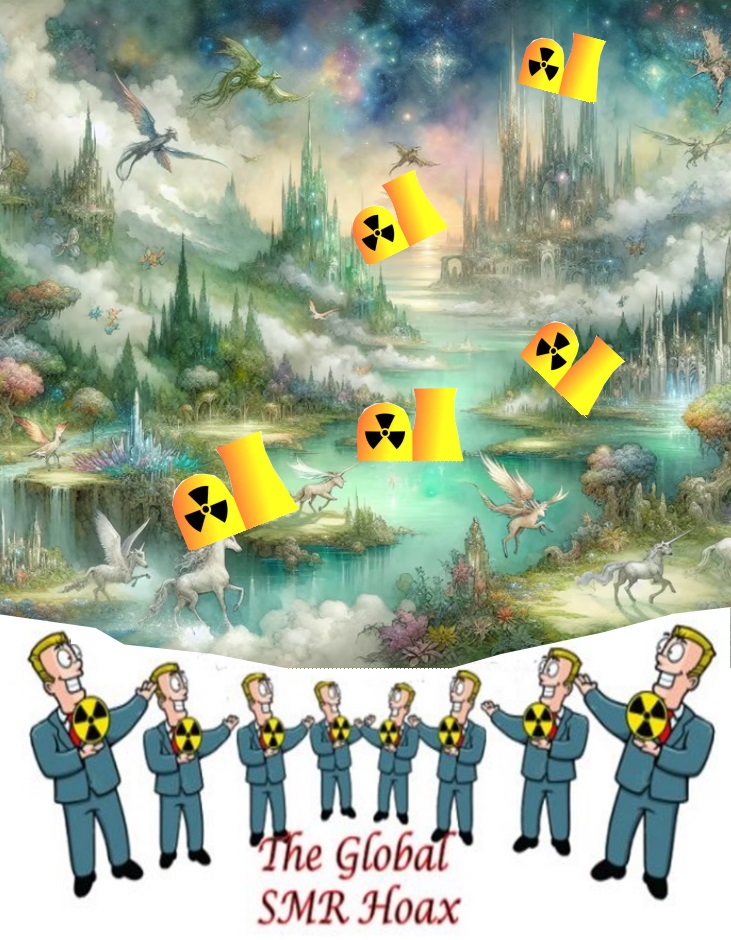
There’s a lot of hype around small modular reactors.
From Steve Thomas, Emeritus Professor of Energy Policy, University of Greenwich, London SE10, UK, 30 Jan 26 https://www.ft.com/content/085e92e6-2f7f-4381-9416-0aa59fa3a3
Richard Ollington (“Small nuclear reactors are worth the wait”, Opinion, January 16) makes three claims. First, that small modular reactors (SMRs) will get quicker and easier to build, citing the French programme as evidence. Second, Russia is building large numbers of SMRs and third, improving existing reactors and reviving retired ones could add 40GW of nuclear capacity. None of these claims stands up to scrutiny. Over the 15 years of the French programme, the real cost of reactors increased by some 60 per cent. Construction of the first eight reactors averaged 70 months while the last eight averaged 135 months.
Russia has completed only two SMRs and has one under construction. The two completed ones are barge-mounted reactors providing heat and power to an isolated Siberian community. They took 13 years to build and have a reliability of 40 per cent. Restarting two retired reactors (1.6GW), one owned by Meta, the other by Microsoft, is actively being considered, but awaits approval from the US Nuclear Regulatory Commission before decisions can be taken to bring them back to life. The increasing concentration of carbon in the atmosphere will not wait a decade to see if the ambitious claims for SMRs are met. So even if we were to believe the hype surrounding SMRs, we cannot afford to wait to see if they prove viable.
Barring last-minute nuclear deal, US and Russia teeter on brink of new arms race.

Reuters, By Mark Trevelyan and Jonathan Landay. January 30, 2026
- Summary
- New START treaty set to expire on February 5
- Trump hasn’t responded to Putin’s offer to extend missile limits
- End in sight to more than 50 years of mutual constraints
- Chinese build-up leaves US facing two big nuclear rivals
LONDON/WASHINGTON, Jan 30 (Reuters) – The United States and Russia could embark on an unrestrained nuclear arms race for the first time since the Cold War, unless they reach an eleventh-hour deal before their last remaining arms control treaty expires in less than a week.
The New START treaty is set to end on February 5. Without it, there would be no constraints on long-range nuclear arsenals for the first time since Richard Nixon and Soviet leader Leonid Brezhnev signed two historic agreements in 1972 on the first-ever trip by a U.S. president to Moscow.
Russian President Vladimir Putin has proposed the two sides should stick to existing missile and warhead limits for one more year to buy time to work out what comes next, but U.S. President Donald Trump has yet to formally respond.
Trump said this month that “if it expires, it expires”, and that the treaty should be replaced with a better one.
Some U.S. politicians argue Trump should reject Putin’s offer, freeing Washington to grow its arsenal to counter a rapid nuclear build-up by a third power: China.
Trump says he wants to pursue “denuclearisation” with both Russia and China. But Beijing says it is unreasonable to expect it to join disarmament talks with two countries whose arsenals are still far larger than its own.
WHY DO NUCLEAR TREATIES MATTER?
Since the darkest Cold War days when the United States and the Soviet Union threatened each other with “mutually assured destruction” in the event of nuclear war, both have seen arms limitation treaties as a way to prevent either a lethal misunderstanding or an economically ruinous arms race.
The treaties not only set numerical limits on missiles and warheads, they also require the sides to share information – a critical channel to “try to understand where the other side is coming from and what their concerns and drivers are”, said Darya Dolzikova at the RUSI think-tank in London.
With no new treaty, each would be forced to act according to worst-case assumptions about the weapons the other is producing, testing and deploying, said Nikolai Sokov, a former Soviet and Russian arms negotiator.
“It’s a self-sustaining kind of process. And of course, if you’ve got an unregulated arms race, things will get quite destabilising,” he said.
NEW TREATY NO SIMPLE TASK
Since the fall of the Soviet Union, Russia and the United States have repeatedly replaced and updated the Cold War-era treaties that limited the so-called strategic weapons they point at each other’s cities and bases.
The most recent, New START, was signed in 2010 by U.S. President Barack Obama and Dmitry Medvedev, a Putin ally who was then serving as Russian president for four years.
It caps the number of deployed strategic warheads at 1,550 on each side, with no more than 700 systems to deliver them from land, sea or air, by intercontinental ballistic missile, submarine-launched missile or heavy bomber.
Replacing it with a new treaty would be no simple task. Russia has developed new nuclear-capable systems – the Burevestnik cruise missile, the hypersonic Oreshnik and the Poseidon torpedo – that fall outside New START’s framework. And Trump has announced plans for a space-based “Golden Dome” missile defence system that Moscow sees as an attempt to shift the strategic balance……………………………………………………………………………………………………………………………………. https://www.reuters.com/business/aerospace-defense/barring-last-minute-nuclear-deal-us-russia-teeter-brink-new-arms-race-2026-01-30/
From the ashes, arises a Phoenix: Scottish NFLAs resolve to chart a new path

The UK/Ireland Nuclear Free Local Authorities will tomorrow pass into history as the Manchester-based Secretariat will cease to function and the post of NFLA Secretary will be disestablished.
But now at least there is the expectation that from out of the ashes a new phoenix will arise; for today our Scottish affiliated authorities took the decision ‘in principle’ to reform a Scottish Nuclear Free Local Authorities network with a Glasgow-based Secretariat.
NFLA Policy Advisor Pete Roche, known to many
of you for his invaluable daily and weekly information bulletins published
through No 2 Nuclear Power www.no2nuclearpower.org.uk, will continue to
support the new body. Over the next two months, the leadership of the
Scottish NFLAs will take legal and financial advice to best place the new
SNFLAs on a secure footing for the future. And, with Scotland facing
increasing nuclear threats from Ministers at Whitehall and a looming
Scottish Parliament election, the decision could not be timelier.
NFLA 30th Jan 2026, https://www.nuclearpolicy.info/news/from-the-ashes-arises-a-phoenix-scottish-nflas-resolve-to-chart-a-new-path/
SNP rules out any new nuclear power plants in Scotland

By Neil Smith, Largs & Millport Weekly News 30th Jan 2026
THE Scottish Government has again ruled out building new nuclear power plants, despite a plea from West Scotland MSP Jamie Greene.
At Holyrood on Thursday, the Liberal Democrat member asked if the SNP government would continue its opposition to new nuclear plants.
A new plant to replace Hunterston A and B in North Ayrshire has been called for in recent years – to no avail.
Cabinet Secretary for Climate Action and Energy, Gillian Martin, responded: “We do not support the construction of new nuclear power stations in Scotland under current technologies.
“And while we recognise the role that nuclear has played, new nuclear would take decades to deliver, comes at a very high cost and creates long-term radioactive waste liabilities.
“Scotland has abundant resources with the clear potential to meet electricity demand through continued deployment of renewable energy and storage, and we are prioritising technologies that are quicker to deliver, lower cost and proven to maintain security of supply rather than the new nuclear projects that would take decades to materialise.”……………………….
“I have to point out the cost of nuclear, if you look at Hinkley Point C. It was expected to be completed in 2025 at a cost of £18 billion. Now the cost is estimated at £46 billion and it is delayed until 2031. I think that’s a lesson for all” https://www.largsandmillportnews.com/news/25808021.snp-rules-new-nuclear-power-plants-scotland/
UN watchdog warns Ukraine war remains world’s biggest threat to nuclear safety.

30 January 2026, https://news.un.org/en/story/2026/01/1166863
The war in Ukraine remains the world’s biggest threat to nuclear safety as a fifth year of combat looms, the head of the UN nuclear watchdog warned on Friday, citing continued risks to power supplies at nuclear sites vulnerable to fighting nearby.
Addressing the International Atomic Energy Agency (IAEA) Board of Governors, Director General Rafael Grossi said the agency remains focused on preventing a nuclear accident as fighting continues to endanger critical infrastructure.
“The conflict in Ukraine is about to enter its fifth year,” Mr. Grossi said. “It continues to pose the world’s biggest threat to nuclear safety.”
IAEA teams remain deployed at all nuclear power plants affected by the conflict and publish regular updates on nuclear safety and security conditions.
The Board of Governors is the IAEA’s main decision-making body, bringing together representatives of 35 countries to oversee nuclear safety, security and safeguards, and to guide the work of the UN nuclear watchdog. Its current membership includes, among others Russia, the United States, United Kingdom, and France.
Off-site power a critical safety lifeline
Mr. Grossi stressed that a central safety requirement is reliable off-site power – the electricity a plant receives from the national grid. Without it, nuclear sites must rely on backup systems to run cooling and other essential safety functions.
“There must be secure off-site power supply from the grid for all nuclear sites,” he said, pointing to the IAEA’s “Seven Pillars” guidance for nuclear safety during armed conflict, where off-site power is pillar number four.
He also cited Principle 3 of the IAEA’s Five Principles for protecting the Zaporizhzhya Nuclear Power Plant (ZNPP) that “all efforts should be made to ensure off-site power remains available and secure at all times.”
Mr. Grossi said both sets of guidance have broad international support, including from the parties directly involved, and that he has repeatedly called for adherence to them, including at the UN Security Council.
Progress at Zaporizhzhya amid ongoing risks
He reported recent progress at ZNPP, where Europe’s biggest plant was reconnected on 19 January to its last remaining 330-kilovolt backup power line after repairs were carried out under a temporary ceasefire negotiated with Ukrainian and Russian counterparts.
The line had been damaged and disconnected since 2 January, reportedly due to military activity.
Until the reconnection, ZNPP relied on its last remaining 750-kilovolt main line to provide off-site power for safety systems needed to cool its six shutdown reactors and spent fuel pools. IAEA teams are also monitoring the plant’s ability to manage winter conditions, including keeping water in cooling and sprinkler ponds from freezing.
Beyond the plants themselves, Mr. Grossi warned that Ukraine’s electrical substations are also crucial to nuclear safety. “Damage to them undermines nuclear safety and must be avoided,” he said. An IAEA expert mission is now assessing 10 substations vital to nuclear safety amid ongoing strikes on the country’s power infrastructure.
Other nuclear sites also affected
IAEA teams have also reported military activity near other nuclear facilities, including the Chornobyl site, where damage to a critical substation disrupted multiple power lines and forced temporary reliance on emergency diesel generators. The affected lines have since been reconnected.
Mr. Grossi said the IAEA has shown how international institutions can help reduce risks and provide predictability in a volatile war. But, he added, technical measures have limits.
“The best way to ensure nuclear safety and security,” he said, “is to bring this conflict to an end.”
1 This Month
22 June – Virtual Event –Climate Change: New Data, New Debate

Monday, June 22, 2026 2:30 p.m. – 3:15 p.m. CT
YouTube. Register here

Protect Sazan Island from the Trump family! https://secure.avaaz.org/campaign/en/protect_sazan_island_from_the_trump_family_loc/?bqFCVab&v=174511&cl=22707147157&_checksum=5e9dde668860e8231c33699735e16a1fbf22ab2cb01da50c999fe8732b9775ef&utm_source=email&utm_medium=blast_email&utm_campaign=174511
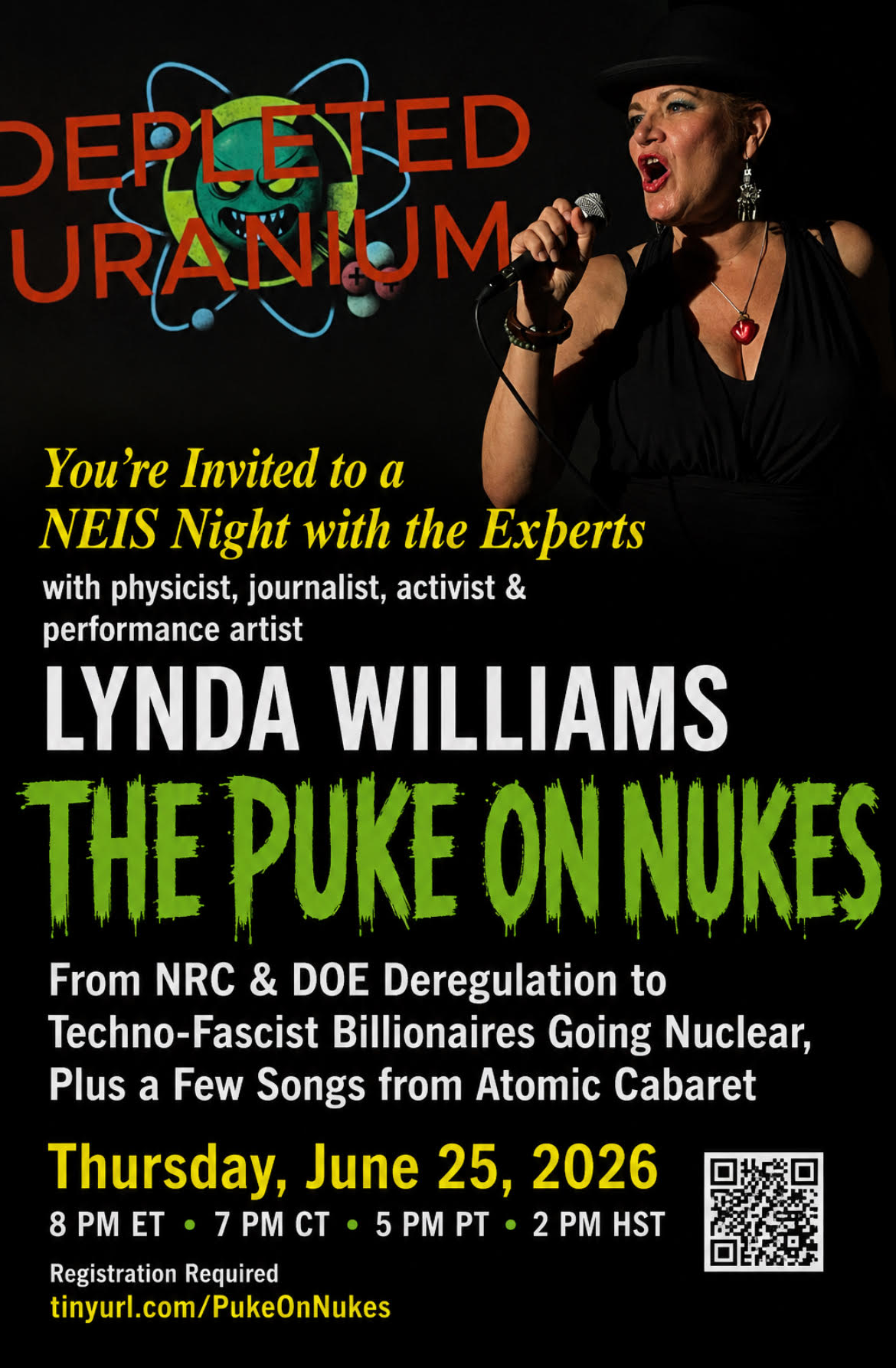
25 June- THE PUKE ON NUKES
Thursday, June 25, 2026
7pm Central Time (8pm ET, 6pm MT, 5pm PT) UTC – 5
From NRC & DOE Deregulation to Techno-Fascist Billionaires Going Nuclear, Plus a Few Songs from Atomic Cabaret REGISTER
26 June – Radiation Trainwreck at the NRC / Join the Protect Better Campaign – https://us02web.zoom.us/meeting/register/4ZlZ5_qLSHGiLSCg8FF6Bg#/registration


Cuba Is Not a Failed State – It Is a Besieged State
PETITION: “Global Appeal to Endorse Palestinian Right of Return of Refugees”
To see nuclear-related stories in greater depth and intensity – go to https://nuclearinformation.wordpress.com
-
Archives
- June 2026 (193)
- May 2026 (306)
- April 2026 (356)
- March 2026 (251)
- February 2026 (268)
- January 2026 (308)
- December 2025 (358)
- November 2025 (359)
- October 2025 (376)
- September 2025 (257)
- August 2025 (319)
- July 2025 (230)
-
Categories
- 1
- 1 NUCLEAR ISSUES
- business and costs
- climate change
- culture and arts
- ENERGY
- environment
- health
- history
- indigenous issues
- Legal
- marketing of nuclear
- media
- opposition to nuclear
- PERSONAL STORIES
- politics
- politics international
- Religion and ethics
- safety
- secrets,lies and civil liberties
- spinbuster
- technology
- Uranium
- wastes
- weapons and war
- Women
- 2 WORLD
- ACTION
- AFRICA
- Atrocities
- AUSTRALIA
- Christina's notes
- Christina's themes
- culture and arts
- Events
- Fuk 2022
- Fuk 2023
- Fukushima 2017
- Fukushima 2018
- fukushima 2019
- Fukushima 2020
- Fukushima 2021
- general
- global warming
- Humour (God we need it)
- Nuclear
- RARE EARTHS
- Reference
- resources – print
- Resources -audiovicual
- Weekly Newsletter
- World
- World Nuclear
- YouTube
-
RSS
Entries RSS
Comments RSS
 nuclear-news