Hokkaido town mayor eyes hosting nuclear waste site
 This facility in Finland is the only one where construction has begun on a final storage site for nuclear waste.
August 14, 2020
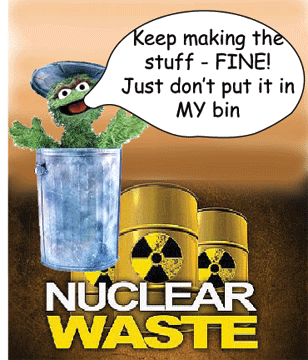
The mayor of Suttsu in western Hokkaido is bracing for a backlash after stating that he wants his small town to be considered as a final destination for nuclear waste by the central government.
“When I think about the future of our town, where the population has been shrinking, there is a need for financial resources to promote industry,” said Haruo Kataoka, 71, in an interview with The Asahi Shimbun.
“I am prepared for whatever form of bashing I may encounter.”
Kataoka may be in for a long fight.
Selecting the site for the nation’s final storage of nuclear waste is a three-stage process that can take up to 20 years. At each stage, the central government provides any municipality that has applied with annual grants.
Kataoka said he was considering having Suttsu apply for the first stage in which past records about natural disasters and geological conditions for the area are examined.
This stage normally takes about two years, and the municipality can receive up to 1 billion yen ($9.3 million) a year or a maximum total of 2 billion yen.
The annual budget for the Suttsu town government is 5 billion yen. Its main industries are oyster farming and fishing for Atka mackerel.
As of the end of March, the town’s population was 2,893. The population has decreased by 30 percent over the past two decades.
To encourage municipalities to submit applications, the central government in July 2017 released a map of areas that were considered scientifically appropriate as a site for the final storage of nuclear waste.
Suttsu is the first municipality expressing an interest in applying since that map was released.
But it remains to be seen if local residents will go along with Kataoka’s idea. He will hold a meeting in September to explain his intention and a decision will be made thereafter whether to proceed with the application.
Kataoka has also expressed interest in moving toward the second stage of the selection process in which boring samples are taken from underground. This is part of the four-year process to determine if the area meets general conditions to enable the selection process to move to the third stage, in which a test facility will be constructed underground.
In the second stage, the municipality can receive up to 2 billion yen a year, or a maximum total of 7 billion yen.
A municipal government can decide at any time to withdraw from the selection process and the grants it has received until then do not have to be returned.
Because nuclear waste may take up to 100,000 years for radiation to reach safe levels, any final storage site would have to be constructed at least 300 meters underground.
Suttsu is classified at the highest of four levels of appropriateness, according to the map released by the central government. Its location facing the Sea of Japan makes Suttsu highly suitable for transporting nuclear waste to the storage site.
But in addition to possible local opposition, the town government will also have to take into consideration an ordinance approved by the Hokkaido prefectural government in 2000 regarding nuclear waste that said no such waste should be brought onto the main northern island.
In a statement released on Aug. 13, Hokkaido Governor Naomichi Suzuki said the ordinance, “is an expression of the desire not to allow a final storage site within Hokkaido, and I believe I have no alternative but to abide by the ordinance.”
Kataoka said that the first stage of the selection process was just a study that did not represent a violation of the ordinance.
But at each stage of the selection process, the views of the prefectural governor and municipality mayor are solicited and any opposition will stop the process from proceeding.
Meanwhile, Hiroshi Kajiyama, the industry minister who oversees the process for selecting a final storage site, told reporters on Aug. 13 that a number of municipalities in addition to Suttsu had expressed interest in obtaining information about the selection process.
While Kajiyama acknowledged his awareness of the Hokkaido ordinance, he added that applying for the first stage of the process did not mean the municipality would automatically move to the second stage.
The central government has had to resort to offering annual grants to encourage municipal governments to express an interest in becoming the site for the final storage of nuclear waste.
Commenting on the interest shown by Suttsu, one government source said, “It is a step forward, but if we think about the entire process as a marathon, the race has just started and the runners have not yet even left the stadium (to reach the road).”
Meanwhile, other municipalities that in the past showed some interest in becoming the final storage site have more often than not met with huge local opposition.
In 2007, the mayor of Toyo in Kochi Prefecture on the island of Shikoku expressed interest in applying without first consulting the town assembly. Local opposition was so strong that a candidate opposed to the idea defeated the incumbent in the next election and the application was withdrawn.
There have also been reports of other municipalities expressing an interest in applying, but no formal announcement has been made until now.
Japan now possesses about 19,000 tons of spent nuclear fuel, but no progress has been made in selecting a site for its final storage. Foreign nations have also experienced difficulties in securing a site for such storage.
Finland is the only nation where actual construction of such a facility has begun.
(This article was written by Yasuo Sakuma, Ichiro Matsuo, Rintaro Sakurai and Yu Kotsubo.)
Plaintiffs angered by gov’t appeal in Hiroshima ‘black rain’ suit
 Head of the plaintiffs’ group, Masaaki Takano, right, and attorney Masayasu Takemori hold a press conference after the Hiroshima Municipal Government and the Hiroshima Prefectural Government appealed the Hiroshima District Court’s A-bomb health care aid ruling, in Hiroshima’s Naka Ward, on Aug. 12, 2020.
August 13, 2020
HIROSHIMA — Two weeks after a groundbreaking ruling in Japan to award government health care benefits to people exposed to radioactive “black rain” outside of the currently designated zone, the central government appealed, prompting aging plaintiffs to accuse the government of “buying time” and “waiting for them to die.”
In the lawsuit, the Hiroshima District Court recognized that all 84 plaintiffs in their 70s to their 90s had been exposed to radioactive black rain that fell after the 1945 bombing of Hiroshima by the United States military, outside a zone currently recognized by the government. On Aug. 12, however, the government persuaded the Hiroshima Municipal Government and the Hiroshima Prefectural Government and went ahead with its appeal.
While the central government has said it will review the current zone with an eye to expanding it, nobody knows when and who will be given benefits. The plaintiffs, whose average age is over 82, had hoped that a resolution would be reached in this milestone year — 75 years since the bombing — and are angered and disappointed.
At 2 p.m. on the day the state appealed the ruling, the plaintiffs and their attorneys held a press conference at the Hiroshima Bar Association building in the city’s Naka Ward. Masaaki Takano, 82, head of the plaintiffs’ group, was about 20 kilometers northwest of the hypocenter in what is now Hiroshima’s Saeki Ward when he was exposed to black rain as a 7 year old. He leaned forward and said forcefully, “There is a limit to life. If a decision is put off, there will be that many deaths.” He added, “The state has dismissed our demands multiple times. It cannot be trusted.”
In 1976, the state designated the zone eligible for government health benefits based on a meteorological observatory survey conducted in the chaotic period immediately following the end of World War II that pointed to where there had been heavy rains. Two years later, residents who had been exposed to rain outside the designated zone argued that it was unreasonable for the government to draw a line through the same neighborhood, with one part falling within the zone and the other part not.
The residents who fell outside the line established a predecessor organization to the Hiroshima prefectural black rain hibakusha liaison council. In the 42 years since, they have gathered tens of thousands of signatures for petitions, but have been repeatedly dismissed by the central government. Even when the Hiroshima municipal and prefectural governments argued for a widening of the zone eligible for health benefits, saying that black rain had fallen in an area six times that recognized by the central government, the state refused to acknowledge it. As a last-ditch effort, the plaintiffs filed a lawsuit in 2015. After a trial that lasted four years and nine months, they came out victorious. But by then, 12 of the plaintiffs had died, missing out on the opportunity to rejoice together.
“The state’s thinking of not giving us the recognition of being hibakusha and appealing the ruling, while considering expanding the zone in which people can receive state health benefits, is contradictory,” said plaintiff Kazuko Morizono, 82, who was exposed to black rain in what is currently Hiroshima’s Asakita Ward, some 17 kilometers north of the bomb’s hypocenter. While dealing with hypothyroidism, which is suspected to come from the effects of radiation from the atomic bomb, and other disorders, she has been active in the movement to have the zone for state aid for black rain victims expanded for over 20 years. Referring to the death of a fellow plaintiff in May whom she had often seen at the trial hearings, Morizono said, “I don’t have much confidence in my health, and I feel impatient that we have to hurry. Now the trial’s going to last longer.”
Seventy-three-year-old Kuraso Hirotani, who was 3 when he was exposed to black rain in what is now the Hiroshima prefectural town of Akiota, around 20 kilometers northwest of the hypocenter, said with frustration, “We were all given false hope with the (district court) victory. Both the mayor and the governor were persuaded by the central government.” In the Peace Declaration that the mayor of Hiroshima reads on the anniversary of the atomic bombing of Hiroshima every year on Aug. 6, Mayor Kazumi Matsui has over the past 10 years, including his latest speech, called on the state to “expand the ‘black rain areas.'” Hirotani continued, “If you’re truly a politician in a place where an atomic bomb has been dropped, you would not appeal. If they had not appealed, I would’ve thanked them and bowed my head.”
Meanwhile, there are those who see some hope in the state’s promise to consider expanding the zone designated as having been exposed to black rain. Akie Ueda, 79, who was 4 years old when she was exposed to black rain about 9 kilometers west of the hypocenter in what is now Hiroshima’s Saeki Ward, is unwell and did not join the plaintiffs’ group in the lawsuit. She said, however, that “It made me a little bit happy that they cared.” These days she spends most of the day in bed. “We do not have time left,” she said. “I hope they come out with a good result as soon as possible.”
(Japanese original by Misa Koyama and Akari Terouchi, Hiroshima Bureau, and Shinji Kanto, Fukuyama Bureau)
Japan’s nuclear fuel imports almost zero in 2019 as industry stagnates, 1st time in 50 yrs
 Japan’s imports of nuclear fuel were nearly zero last year, as many reactors remain idle or are slated to be decommissioned.
August 12, 2020
TOKYO (Kyodo) — Japan’s imports of fuel to power nuclear plants were close to zero last year, reflecting the stagnating nuclear industry following the Fukushima accident in 2011, official trade data showed Tuesday.
The effective halt in Japan’s imports of enriched and natural uranium or their assemblies is believed to be the first since the resource-poor country started securing the materials from overseas in the 1960s.
Most nuclear plants in Japan remain idle as stricter safety measures were implemented after a massive earthquake and ensuing tsunami crippled the Fukushima Daiichi nuclear complex. The operations of fuel manufacturing plants have also been suspended.
Japan’s imports of the fuel started around the time the country’s first commercial nuclear power station in the village of Tokai, Ibaraki Prefecture, achieved criticality in 1965.
The value of the three materials reached a record 280.4 billion yen ($2.64 billion) in 1984 as nuclear power plants increased, according to the government data.
In subsequent years, the value was around 100 billion yen to 150 billion yen before the level fell to 82.7 billion yen in 2012, one year after the Fukushima disaster.
In 2016, the value decreased further to 2.9 billion yen as more nuclear power plants were halted. Due to the resumptions of some nuclear plants, it recovered to nearly 50 billion yen in 2017 and 2018. But, it fell to 45 million yen in 2019, with small amounts likely imported for research purposes.
Comparable statistics for such materials are available from 1972.
Of the 54 nuclear reactors that were in operation before the Fukushima crisis, currently, only nine have come back online after clearing harsher safety measures.
In the wake of the accident, 21 reactors have been flagged for decommissioning in consideration of the hefty costs for refurbishments.
All four fuel manufacturing factories are offline as they are undergoing regulatory review under the new safety standards.
Kansai Electric Power Co., Shikoku Electric Power Co. and Kyushu Electric Power Co., which operate the nine plants currently back online, said they have enough fuel to run their reactors for the next several years.
Despite the slumping nuclear industry in Japan, the government has set a target for nuclear power generation to account for 20 to 22 percent of the country’s electricity supply by 2030, which requires resuming operations of 20 to 30 reactors.
https://www.japantimes.co.jp/news/2020/08/12/business/japan-nuclear-fuel-imports-zero/
Japan gov’t to appeal ruling on A-bomb “black rain” victims
August 13, 2020
The Japanese government has decided to appeal a recent court ruling awarding state health care benefits to people who were exposed after the 1945 atomic bombing of Hiroshima to radioactive “black rain” outside a zone it currently recognizes, sources with knowledge of the situation said Tuesday.
Late last month, the Hiroshima District Court ruled in favor of 84 plaintiffs in their 70s to 90s, saying they should receive the same health benefits as provided to atomic bomb survivors who were in the zone where the state has recognized black rain fell.
The ruling was the first court decision regarding the boundary of the area affected by radioactive rain after the world’s first nuclear attack, and on the subsequent health problems among survivors.
 A lawyer representing plaintiffs in a lawsuit demanding that state health care benefits be extended to people who were exposed to radioactive “black rain” after the 1945 U.S. atomic bombing of Hiroshima outside a zone currently recognized by the government holds up a sign after the Hiroshima District Court ruled in favor of the suit on July 29, 2020.
The city and prefectural governments of Hiroshima have long sought more assistance for atomic bomb survivors but accepted the government’s policy, the sources said.
The central government will appeal the district court’s ruling on Wednesday, according to the sources.
In the ruling, the court determined it was possible that black rain fell outside of the designated zone and reasonable to conclude the plaintiffs were affected by radiation if they were exposed to it.
The court then determined that the plaintiffs developed diseases specific to atomic bomb survivors due to the effect of black rain.
No prefecture in Japan wants to host nuclear waste dump
 No Japan prefectures positive about hosting nuclear waste site https://www.japantimes.co.jp/news/2020/08/14/national/prefectures-nuclear-waste-site/ –14 Aug 20, KYODO Nearly half of Japan’s 47 prefectures said they are opposed to or held negative views about hosting a deep-underground disposal site for high-level radioactive nuclear waste, a Kyodo News survey showed Friday. No Japan prefectures positive about hosting nuclear waste site https://www.japantimes.co.jp/news/2020/08/14/national/prefectures-nuclear-waste-site/ –14 Aug 20, KYODO Nearly half of Japan’s 47 prefectures said they are opposed to or held negative views about hosting a deep-underground disposal site for high-level radioactive nuclear waste, a Kyodo News survey showed Friday.
None expressed a favorable stance. The result signals further woes for the central government in its attempt to find a permanent geological disposal repository. Little progress has been made since the process to find local governments willing to host one started in 2002, due mainly to opposition from local residents. The survey was sent to all prefectures in July, with additional interviews conducted depending on their answers. While 16 prefectures such as Fukushima, Kanagawa and Okinawa clearly opposed hosting a site, seven others including Hokkaido, Kyoto and Nagasaki also expressed negative views. Most of the others did not make their positions clear.
“We are already undertaking a certain amount of social responsibility by hosting nuclear plants and providing energy,” Niigata Prefecture said in its response. Fukui Prefecture said, “We are generating power. Nuclear waste disposal should be handled by others.” Meanwhile, Hokkaido mentioned its existing ordinance to prevent nuclear waste from being brought into the northernmost main island, a view that contradicts the relatively positive stance held by one of its municipalities. The town of Suttsu said Thursday it is considering signing up for preliminary research into its land to gauge its suitability for hosting a disposal site. On Friday, however, its mayor, Haruo Kataoka, said the town has been asked by the prefecture not to apply for the preliminary study. Before Suttsu, the town of Toyo in Kochi Prefecture applied for the study in 2007, but it later withdrew the application following strong protests by local residents. In the Kyodo News poll, the western prefecture expressed opposition to hosting a disposal site, saying it faces the need to take measures against a possible major earthquake in the region. For permanent disposal, high-level radioactive waste, produced as a result of the process of extracting uranium and plutonium from spent fuel, must be stored more than 300 meters underground so that it cannot impact human lives or the environment. Elsewhere in the world, Finland and Sweden are the only countries to have decided on final disposal sites. |
|
Japan’s nuclear fuel imports almost zero in 2019 as industry stagnates
|
Most nuclear plants in Japan remain idle as stricter safety measures were implemented after a massive earthquake and ensuing tsunami crippled the Fukushima No. 1 nuclear complex. The operations of fuel manufacturing plants have also been suspended……. Of the 54 nuclear reactors that were in operation before the Fukushima crisis, currently, only nine have come back online after clearing harsher safety measures. In the wake of the accident, 21 reactors have been flagged for decommissioning in consideration of the hefty cost of refurbishment. All four fuel manufacturing factories are offline as they are undergoing regulatory review under the new safety standards. Kansai Electric Power Co., Shikoku Electric Power Co. and Kyushu Electric Power Co., which operate the nine plants currently back online, said they have enough fuel to run their reactors for the next several years. …….https://www.japantimes.co.jp/news/2020/08/12/business/japan-nuclear-fuel-imports-zero/ |
|
A doctor who is a hibakusha speaks out for the Treaty on Prohibition of Nuclear Weapons
Dr. Masao Tomonaga Surviving the nuclear bomb at Nagasaki 75 years ago showed me nuclear weapons shouldn’t exist https://www.nbcnews.com/think/opinion/surviving-nuclear-bomb-nagasaki-75-years-ago-showed-me-nuclear-ncna1236148
People like me learned firsthand the results of using nuclear weapons. A full-scale nuclear war would destroy both the world and humanity as we know it. Aug. 9, 2020, By Dr. Masao Tomonaga, vice president, International Physicians for the Prevention of Nuclear War
It has been 75 years since August 9, 1945, when the atomic bombing of Nagasaki opened the nuclear weapon age. I was 2 years old, and only 1 1/2 miles from ground zero of the nuclear explosion in there; I was, fortunately, unhurt by the blast itself. I was rescued by my mother from a half-destroyed wooden house just before it burned down.
I am one of a dwindling number of hibakusha — atomic bomb survivors; we are now, on average, 83 years old. Many of us still die of radiation-induced cancers and leukemia from the bombs dropped on our cities in 1945 because that exposure to radiation — when most of us were just 10 years old or younger — led to gene abnormalities in many organs that are still causing malignant diseases today.
That means, legally and morally, the human toll of the bombings is still unfolding and the total number of casualties cannot yet be calculated.
Only two atomic bombs of what we would, today, consider a rather small size were used by the United States in Japan: They were 20 kilotons (Nagasaki) and 15 kilotons (Hiroshima), whereas the common size today is a few hundred kilotons. Still, one 15- and one 20-kiloton bomb were enough to devastate two medium-sized Japanese cities and kill 200,000 or more people, either instantaneously or within five months due to acute radiation injuries and skin burns.
Almost the same numbers of hibakusha survived the immediate aftermath, only to go on living with the fear of both contracting radiation-related disorders and passing malignant genetic diseases onto their children.
We hibakusha learned firsthand the horrible human consequences of using nuclear weapons and thus have long feared that a full-scale nuclear war would destroy both the world and humanity as we know it. This made us determined to fight for nuclear abolition — for the sake of the rest of humanity.
Many hibakusha came together years ago, drawing emotional energy from one another, to begin a campaign against nuclear weapons and move humanity forward by spreading our testimonies worldwide and warning of the global danger of human extinction.
In our first success, we hibakusha witnessed the passage of the Nuclear Non-Proliferation Treaty in 1970 by the United Nations, which gave us hope for a nuclear weapon-free world.
Sadly, as we approached the 50th anniversary of the passage of the NPT, the push for nuclear disarmament had almost stopped, and it seemed like the race for nuclear weapons might begin anew. The U.S., for instance, in August 2019 abandoned the Intermediate-Range Nuclear Forces Treaty (signed by U.S. President Ronald Reagan in 1987), the New Strategic Arms Reduction Treaty (signed by U.S. President Barack Obama and Russian President Dmitry Medvedev in 2010) is set to expire next year, and other countries are building new, smaller nuclear weapons.
To push back against this new nuclear arms race, we hibakusha collaborated with the non-nuclear weapon states and many nongovernmental organizations such as ICAN, the International Campaign to Abolish Nuclear Weapons, to establish a Treaty on the Prohibition of Nuclear Weapons. We finally succeeded in July 2017, and since then, the TPNW has been signed and ratified by 43 countries — close to the 50 needed for it to become official under international law.
However, we are facing a serious opposition to the TPNW by the nuclear states, all of whom refuse to sign and ratify the treaty. There is a continuing belief in the nuclear weapon states and the allied countries under their “nuclear umbrella” — including many NATO states, Japan, Australia and Canada — that nuclear weapons are still necessary to keep peace.
Here in Japan, we hibakusha shed tears when our government declared at the United Nations Assembly in 2017 that it would not sign or ratify the TPNW, despite Japan being the only nation to experience nuclear attacks and know in the greatest detail the human consequences and social destruction of the weapons. The nuclear umbrella offered under the U.S.-Japan Security Treaty for the past 60 years has bound Japan tightly to U.S. political and military leaders, who oppose the treaty.
Fukushima’s contaminated waste water – more serious than previously thought
 Fukushima’s Contaminated Wastewater Could Be Too Risky to Dump in the Ocean, https://www.gizmodo.com.au/2020/08/fukushimas-contaminated-wastewater-could-be-too-risky-to-dump-in-the-ocean/ Dharna Noor :August 7, 2020 Almost a decade ago, the Tohoku-oki earthquake and tsunami triggered an explosion at Japan’s Fukushima Daiichi Nuclear Power Plant, causing the most severe nuclear accident since Chernobyl and releasing an unprecedented amount of radioactive contamination in the ocean. In the years since, there’s been a drawn out cleanup process, and water radiation levels around the plant have fallen to safe levels everywhere except for in the areas closest to the now-closed plant. But as a study from the Woods Hole Oceanographic Institution published in Science on Thursday shows, there’s another growing hazard: contaminated wastewater.
Radioactive cooling water is leaking out of the the melted-down nuclear reactors and mixing with the groundwater there. In order to prevent the groundwater from leaking into the ocean, the water is pumped into more than 1,000 tanks. Using sophisticated cleaning processes, workers have been able to remove some of this contamination and divert groundwater flows, reducing the amount of water that must be collected each day. But those tanks are filling up, and some Japanese officials have suggested that the water should dumped into the ocean to free up space.
But according to the new study, that’s not the only radioactive contaminant left in the tanks. By examining TEPCO’s own 2018 data, WHOI researcher Ken Buesseler found that other isotopes remain in the treated wastewater, including carbon-14, cobalt-60, and strontium-90. He found these particles all take much longer to decay than tritium, and that fish and marine organisms absorb them comparatively easily.
“[This] means they could be potentially hazardous to humans and the environment for much longer and in more complex ways than tritium,” the study says.
Though TEPCO’s data shows there is far less of these contaminants in the wastewater tanks than tritium, Buesseler notes that their levels vary widely from tank to tank, and that “more than 70% of the tanks would need secondary treatment to reduce concentrations below that required by law for their release.”
The study says we don’t currently have a good idea of how those more dangerous isotopes would behave in the water. We can’t assume they will behave the same way tritium does in the ocean because they have such different properties. And since there are different levels of each isotope in each different tank, each tank will need its own assessment.
“To assess the consequences of the tank releases, a full accounting after any secondary treatments of what isotopes are left in each tank is needed,” the study said.
Buesseler also calls for an analysis of what other contaminants could be in the tanks, such as plutonium. Even though it wasn’t reported in high amounts in the atmosphere in 2011, recent research shows it may have been dispersed when the explosion occurred. Buesseler fears it may also be present in the cooling waters being used at the plant. That points to the need to take a fuller account of the wastewater tanks before anything is done to dump them in the ocean.
“The first step is to clean up those additional radioactive contaminants that remain in the tanks, and then make plans based on what remains,” he said in a statement. “Any option that involves ocean releases would need independent groups keeping track of all of the potential contaminants in seawater, the seafloor, and marine life.”
Many Japanese municipalities have been pushing the government to reconsider its ocean dumping plans and opt to find a long-term storage solution instead, which makes sense, considering exposure to radioactive isotopes can cause myriad health problems to people. It could also hurt marine life, which could have a devastating impact on fishing economies and on ecosystems.
“The health of the ocean — and the livelihoods of countless people — rely on this being done right,” said Buesseler.
Nagasaki urges world ban on nuclear weapons 75 years after US atomic bomb blast
 Nagasaki urges world ban on nuclear weapons 75 years after US atomic bomb blast https://www.sbs.com.au/news/nagasaki-urges-world-ban-on-nuclear-weapons-75-years-after-us-atomic-bomb-blast 9 Aug 20, Survivors of the atomic bombing of Nagasaki have urged world leaders to do more for a nuclear weapons ban on the 75th anniversary of the US attack.
The Japanese city of Nagasaki has marked its 75th anniversary of the US atomic bombing, with the mayor and dwindling survivors urging world leaders including their own to do more for a nuclear weapons ban.
At 11.02am, the moment the B-29 bomber Bockscar dropped a 4.5-ton plutonium bomb dubbed “Fat Man”, Nagasaki survivors and other participants stood in a minute of silence to honour more than 70,000 dead.
The 9 August 1945 bombing came three days after the United States dropped its first atomic bomb on Hiroshima, the world’s first ever nuclear attack that killed 140,000.
Nuclear bomb devastation killed ove 90% of the doctors and nurses in Hiroshima
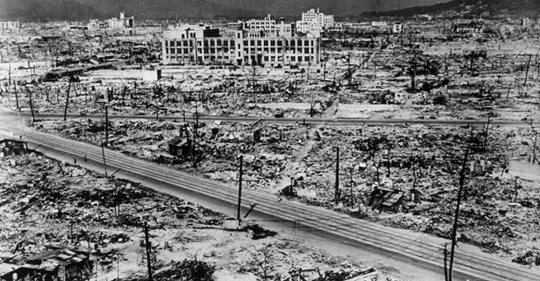
The horrific impact of the bomb was exacerbated by the fact that more than 90 percent of Hiroshima’s doctors and nurses were killed or injured by the bomb, while the blast left 42 out of 45 of the city’s civilian hospitals and two large army hospitals non-functional, according to the The International Campaign to Abolish Nuclear Weapons (ICAN).
This meant it was nearly impossible for the scores of injured to access aid, and most died without any care to ease their suffering from severe burns and radiation poisoning.
Before the attack Hiroshima had around 200 doctors, but the vast majority perished leaving only about 30 physicians who were able to perform their normal duties, according to a report created by the United States Strategic Bombing Survey.
Furthermore, more than 1,600 nurses out of nearly 1,800 were also killed, while medical stocks and supplies were also mostly destroyed.
Any hospitals within around 3,000 feet of ground zero were completely destroyed with almost everyone in them dying.
Two other large hospitals made from reinforced concrete that were located nearly 5,000 feet from the blast’s epicenter remained standing. However, the interiors suffered severe damage and around 90 percent of the occupants died, with many killed due to falling plaster, flying glass and fire.
Several medical centers that were located more than 7,000 feet away from ground zero also remained standing, although many were so badly damaged that they were not able to function.
The lack of medical facilities and staff only served to exacerbate the situation, as one eyewitness to the aftermath, Father Siemes, a German-born Jesuit professor who was in Hiroshima when the bomb fell, described, recounting the scene at an improvised first aid station.
“Iodine is applied to the wounds but they are left uncleansed. Neither ointment nor therapeutic agents are available. Those that have been brought in are laid on the floor and no one can give them any further care. What could one do when all means are lacking? Among the passersby, there are many who are uninjured,” he wrote.
“In the official aid stations and hospitals, a good third or half of those that had been brought in died. Everything was lacking, doctors, assistants, dressings, drugs, etcetera.”
Medical help had to be sent into the city from the outside, however, this took some time to arrive and several individuals who came to assist also ended up dying due to the high levels of lingering radiation.
On the 75th anniversary of the bombing, the International Physicians for the Prevention of Nuclear War (IPPNW), the only international medical organization dedicated to the abolition of nuclear weapons, told Newsweek that there can be “no useful medical response” to even a single nuclear attack on one city in their view.
“The infrastructure necessary would be destroyed and the personnel needed would be killed or badly wounded,” Chuck Johnson, IPPNW Director of Nuclear Programs, said. “Even a relatively small nuclear war would have atmospheric effects beyond the immediate blast, fire, and radiation, which could threaten billions of people with starvation due to crop failure. An all out nuclear war between the U.S. and Russia would end civilization and threaten to extinguish all human life.”
“We agree with President Reagan’s statement that ‘nuclear war can never be won and must never be fought,’ and are greatly concerned by the growing development of a new nuclear arms race among the nine nuclear weapons states.”
However, Johnson said the organization was “greatly encouraged” on the 75th anniversary of the first nuclear weapons attack on a human population, that three more nations—Nigeria, Ireland, and Niue—have become states parties to the UN Treaty on the Prohibition of Nuclear Weapons. This leaves only seven more states to submit ratification papers for the nuclear ban treaty to enter into force.”
“We look forward to the day when the UN declares that rogue nations which persist in developing and possessing nuclear weapons must listen to the world community and cease their activities which threaten all of us.”
Opening the floodgates at Fukushima
- Ken O. Buesseler
See all authors and affiliations
Vol. 369, Issue 6504, pp. 621-622
DOI: 10.1126/science.abc1507
Summary
Summary
In the time since Japan’s triple earthquake, tsunami, and nuclear disaster in 2011, much has improved in the ocean offshore from the Fukushima Daiichi Nuclear Power Plant (FDNPP). Concentrations of cesium isotopes, some of the most abundant and long-lived contaminants released, are hundreds of thousands of times lower than at their peak in April 2011. Since mid-2015, none of the fish caught nearby exceed Japan’s strict limit for cesium of 100 Bq/kg (1, 2). Yet, enormous challenges remain in decommissioning the reactors and clean-up on land. Small, and sometimes unexpected, sources of contaminants still continue to enter the ocean to this day (3). Two of the biggest unresolved issues are what to do with the more than 1000 tanks at the site that contain contaminated water and the impact of releasing more than 1 million tons of this water into the ocean.
http://www.sciencemag.org/about/science-licenses-journal-article-reuse
This is an article distributed under the terms of the Science Journals Default License. View Full Text
Rokkasho plant should be shut down in energy policy shift
 Japan Nuclear Fuel Ltd.’s Rokkasho nuclear fuel reprocessing plant in Rokkasho, Aomori Prefecture, in 2018
July 31, 2020
Japan’s nuclear watchdog has effectively endorsed the safety of a controversial nuclear reprocessing plant being built in a village along the Pacific coast in northern Japan.
The Nuclear Regulation Authority on July 29 approved an outline of safety measures for the trouble-plagued nuclear fuel reprocessing plant Japan Nuclear Fuel Ltd. is building in Rokkasho, Aomori Prefecture.
The NRA said the outline meets the new safety standards introduced after the 2011 Fukushima nuclear disaster.
The NRA’s decision marks a major step forward in constructing the plant for recovering plutonium from spent nuclear reactor fuel, the core facility for the government’s program to establish a nuclear fuel recycling system.
NRA Chairman Toyoshi Fuketa, however, stressed that the body’s decision does not mean an endorsement of the nuclear fuel recycling policy per se, saying in a news conference that it is a “policy issue” whether there is enough of a rationale for pursuing the policy.
Prime Minister Shinzo Abe’s administration should confront the reality that the catastrophic accident at the Fukushima No. 1 nuclear power plant has completely changed the environment surrounding nuclear power generation and make a fundamental review of the government’s nuclear energy policy.
Nuclear fuel recycling involves recovering plutonium from spent nuclear fuel to be reused in reactors. The government has been promoting recycling separated plutonium back into the fuel of reactors since the 1950s under the rationale that Japan, a nation poor in natural resources, needs to make more efficient use of nuclear fuel.
More than half a century on, the share of nuclear power generation in Japan’s overall electricity production is now very small as most of the reactors that were shut down in the wake of the Fukushima meltdowns have yet to be restarted.
It is also nearly impossible to find a site for building a new nuclear plant. As aged reactors will be decommissioned one after another in the coming years, the importance of nuclear power generation for Japan’s energy supply will steadily diminish.
Over the long term, Japan needs to phase out nuclear power generation to remove public anxiety about a large-scale accident.
Nuclear fuel recycling can have no great significance in this new era when Japan has to start shifting away from atomic energy. Many industrial nations have long given up nuclear reprocessing as economically unviable.
Another big problem with reprocessing the spent fuel is that it produces plutonium, a material that can also be used to make nuclear weapons.
Japan has a stockpile of some 46 tons of plutonium, stored both at home and abroad, an amount enough to make 6,000 atomic bombs. It is fueling fears and drawing criticism internationally.
Japan Nuclear Fuel’s plant in Rokkasho is designed to have the capacity of reprocessing 800 tons of spent nuclear fuel annually to recover 7 tons of plutonium.
But the plan to develop a fast neutron reactor that can “consume” plutonium by transforming it into other forms of nuclear waste, the key technology for plutonium consumption, has gone awry with the decision to decommission Japan’s “Monju” prototype sodium-cooled fast-breeder reactor.
There are clearly also limitations to the plan to burn so-called MOX (mixed oxide) fuel, which is usually plutonium blended with natural uranium, in existing nuclear reactors.
The government has promised the international community to reduce the nation’s surplus plutonium. That means the reprocessing operation at the Rokkasho plant will have to be restricted so that the amount of plutonium recovered will not exceed consumption.
It simply does not make sense to spend as much as 14 trillion yen ($134.33 billion) on building the plant to recover a small amount of plutonium.
Given that this huge cost will be passed onto consumers through higher electricity bills, it is impossible to win broad public support for the project.
If the government decides to pull the plug on the fuel recycling program, it will have to face tough policy challenges it has long avoided tackling, such as how to dispose of spent fuel. But the nation cannot make the inevitable leap into the new age of energy if it continues spending huge amounts on nuclear power generation, which is beset by so many problems.
There is a growing global trend toward renewable energy sources such as solar and wind power. This is the time for the government to make a radical shift in its energy policy.
Hiroshima court recognizes Hiroshima ‘black rain’ victims outside designated area as hibakusha after 75 years
How long will it take for the Fukushima victims outside the evacuation zone to be finally all recognized?
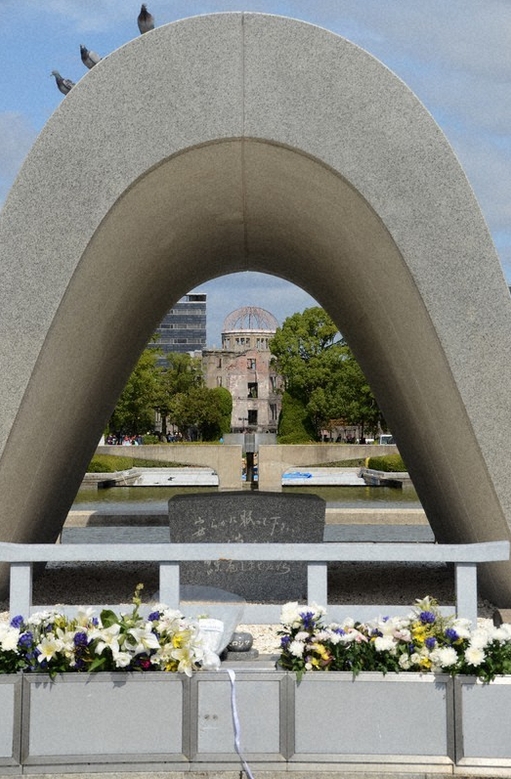 In this October 2019 file photo, the cenotaph for the 1945 atomic bombing victims is seen at the Hiroshima Peace Memorial Park. The Atomic Bomb Dome is seen in the background.
Japan court recognizes Hiroshima ‘black rain’ victims outside designated area as hibakusha
July 29, 2020
HIROSHIMA (Kyodo) — A Japanese court ruled Wednesday that state health care benefits should be extended to people who were exposed to radioactive “black rain” after the 1945 U.S. atomic bombing of Hiroshima outside a zone currently recognized by the government.
The Hiroshima District Court ruled in favor of a suit filed by 84 plaintiffs in their 70s to 90s. It said they should receive the same health care benefits as provided for atomic bomb survivors who were in the zone where the state has recognized black rain fell.
It is the first court decision regarding the boundary of the area affected by radioactive rain and subsequent health problems among survivors.
Presiding Judge Yoshiyuki Takashima said, “It is possible black rain fell outside the designated zone and reasonable to conclude that they were affected by radiation if they were exposed (to such rain.)”
The court then determined that the plaintiffs developed diseases specific to atomic bomb survivors due to the effect of black rain.
Following the ruling, Chief Cabinet Secretary Yoshihide Suga said in a press conference the government has not decided whether to appeal the ruling.
The designated area lies northwest of the hypocenter of the atomic bombing on Aug. 6, 1945 and measures about 19 kilometers in length and 11 km in width.
People who were recognized as being in the affected area at the time of the bombing are eligible to receive periodic health checkups free of charge. Among them, those who developed illnesses believed to be caused by radiation effects can receive free health care services in principle.
The 84 plaintiffs including deceased individuals represented by family members developed such illnesses as cancer and cataracts after they were exposed to black rain containing radioactive materials outside the designated area and consumed contaminated food and water.
They had applied to the city and prefectural governments of Hiroshima for health care benefits for atomic bomb survivors between 2015 and 2018, but their applications for atomic bomb survivors’ certificates were turned down.
The plaintiffs sued the Hiroshima city and prefectural governments from 2015, seeking the nullification of their decisions.
The local governments insisted there was no scientific evidence that radioactive rain fell on areas outside the designated zone and the plaintiffs’ health problems were caused by their exposure to radiation.
The ruling was also welcomed by people in Nagasaki Prefecture, where an atomic bomb was also dropped three days after Hiroshima and there are survivors who claim to have been exposed to radioactive rain but have not been eligible for the state’s healthcare aid.
“(The ruling) departed from the unscientific ways of judging whether plaintiffs are ‘hibakusha’ (A-bomb survivors) simply based on distances (from the hypocenter) and administrative jurisdictions,” said Koichi Kawano, an 80-year-old resident of the town of Nagayo in Nagasaki, who survived the bombing.
Japan’s law on supporting atomic bomb survivors defines victims eligible for state aid in the following four categories.
They are those who were directly exposed to the bombing, people who entered within 2 km from the hypocenters of Hiroshima or Nagasaki in the period of two weeks from the attacks, those who were affected by radiation while rescuing survivors or other reasons and fetuses exposed to radiation in the womb.
The plaintiffs claimed they fit into the third category.
Hiroshima court recognizes atomic bomb ‘black rain’ victims
July 29, 2020
TOKYO — A Japanese court on Wednesday for the first time recognized people exposed to radioactive “black rain” that fell after the 1945 U.S. atomic attack on Hiroshima as atomic bomb survivors, ordering the city and the prefecture to provide the same government medical benefits as given to other survivors.
The Hiroshima District Court said all 84 plaintiffs who were outside of a zone previously set by the government as where radioactive rain fell also developed radiation-induced illnesses and should be certified as atomic bomb victims. All of the plaintiffs are older than their late 70s, with some in their 90s.
The landmark ruling comes a week before the city marks the 75th anniversary of the U.S. bombing.
The U.S. dropped the world’s first atomic bomb on Hiroshima on Aug. 6, 1945, killing 140,000 people and almost destroying the entire city. The plaintiffs were in areas northwest of the ground zero where radioactive black rain fell hours after the bomb was dropped.
The plaintiffs have developed illnesses such as cancer and cataracts linked to radiation after they were exposed to black rain, not only that which fell but also by taking water and food in the area contaminated with radiation.
They filed the lawsuit after Hiroshima city and prefectural officials rejected their request to expand the zone to cover their areas where black rain also fell.
In Wednesday’s ruling, the court said the plaintiffs’ argument about their black rain exposure was reasonable and that their medical records showed they have health problems linked to radiation exposure.
One of the plaintiffs, Minoru Honke, who was exposed to black rain at age 4, said more than a dozen people died during the trial. “I want to tell them that we won,” he said.
Osamu Saito, a doctor who has examined atomic bomb survivors in Hiroshima, welcomed the ruling for considering the survivors’ welfare based on an assumption that anyone who was in these areas and hit by the rain could have been affected by radiation.
Earlier in the day, dozens of plaintiffs walked into the Hiroshima court in the rain, showing a banner saying “Certificates to all ‘black rain’ victims.” As soon as the ruling was issued, lawyers for the plaintiffs ran out of the court, showing a banner saying “Full victory,” and their supporters applauded and cheered.
Chief Cabinet Secretary Yoshihide Suga told reporters that the government will closely examine the ruling and respond after consulting with related government agencies and Hiroshima officials.
Japan’s trouble-plagued nuclear fuel reprocessing plant Rokkasho should be shut down

Rokkasho plant should be shut down in energy policy shift, Asahi Shimbun, July 31, 2020 “…….. The Nuclear Regulation Authority on July 29 approved an outline of safety measures for the trouble-plagued nuclear fuel reprocessing plant Japan Nuclear Fuel Ltd. is building in Rokkasho, Aomori Prefecture…..
The Nuclear Regulation Authority on July 29 approved an outline of safety measures for the trouble-plagued nuclear fuel reprocessing plant Japan Nuclear Fuel Ltd. is building in Rokkasho, Aomori Prefecture
It is also nearly impossible to find a site for building a new nuclear plant. As aged reactors will be decommissioned one after another in the coming years, the importance of nuclear power generation for Japan’s energy supply will steadily diminish.
Over the long term, Japan needs to phase out nuclear power generation to remove public anxiety about a large-scale accident.
Nuclear fuel recycling can have no great significance in this new era when Japan has to start shifting away from atomic energy. Many industrial nations have long given up nuclear reprocessing as economically unviable.
Another big problem with reprocessing the spent fuel is that it produces plutonium, a material that can also be used to make nuclear weapons.
Japan has a stockpile of some 46 tons of plutonium, stored both at home and abroad, an amount enough to make 6,000 atomic bombs. It is fueling fears and drawing criticism internationally.
Japan Nuclear Fuel’s plant in Rokkasho is designed to have the capacity of reprocessing 800 tons of spent nuclear fuel annually to recover 7 tons of plutonium.
But the plan to develop a fast neutron reactor that can “consume” plutonium by transforming it into other forms of nuclear waste, the key technology for plutonium consumption, has gone awry with the decision to decommission Japan’s “Monju” prototype sodium-cooled fast-breeder reactor.
There are clearly also limitations to the plan to burn so-called MOX (mixed oxide) fuel, which is usually plutonium blended with natural uranium, in existing nuclear reactors.
The government has promised the international community to reduce the nation’s surplus plutonium. That means the reprocessing operation at the Rokkasho plant will have to be restricted so that the amount of plutonium recovered will not exceed consumption.
It simply does not make sense to spend as much as 14 trillion yen ($134.33 billion) on building the plant to recover a small amount of plutonium.
Given that this huge cost will be passed onto consumers through higher electricity bills, it is impossible to win broad public support for the project.
If the government decides to pull the plug on the fuel recycling program, it will have to face tough policy challenges it has long avoided tackling, such as how to dispose of spent fuel. But the nation cannot make the inevitable leap into the new age of energy if it continues spending huge amounts on nuclear power generation, which is beset by so many problems.
There is a growing global trend toward renewable energy sources such as solar and wind power. This is the time for the government to make a radical shift in its energy policy. http://www.asahi.com/ajw/articles/13594167
1 This Month

22 June – Virtual Event –Climate Change: New Data, New Debate

Monday, June 22, 2026 2:30 p.m. – 3:15 p.m. CT
YouTube. Register here

Protect Sazan Island from the Trump family! https://secure.avaaz.org/campaign/en/protect_sazan_island_from_the_trump_family_loc/?bqFCVab&v=174511&cl=22707147157&_checksum=5e9dde668860e8231c33699735e16a1fbf22ab2cb01da50c999fe8732b9775ef&utm_source=email&utm_medium=blast_email&utm_campaign=174511
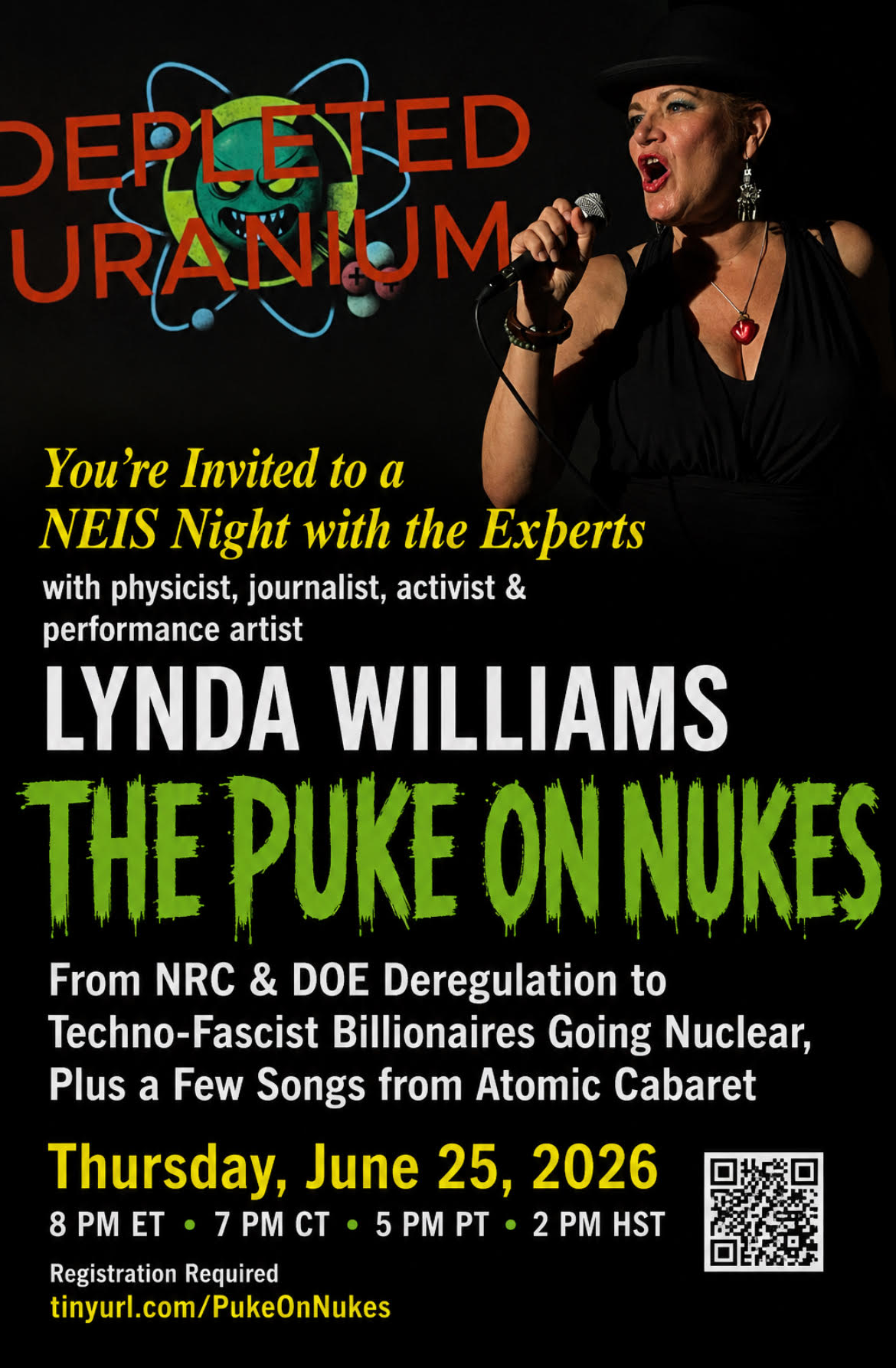
25 June- THE PUKE ON NUKES
Thursday, June 25, 2026
7pm Central Time (8pm ET, 6pm MT, 5pm PT) UTC – 5
From NRC & DOE Deregulation to Techno-Fascist Billionaires Going Nuclear, Plus a Few Songs from Atomic Cabaret REGISTER
26 June – Radiation Trainwreck at the NRC / Join the Protect Better Campaign – https://us02web.zoom.us/meeting/register/4ZlZ5_qLSHGiLSCg8FF6Bg#/registration


Cuba Is Not a Failed State – It Is a Besieged State
PETITION: “Global Appeal to Endorse Palestinian Right of Return of Refugees”
To see nuclear-related stories in greater depth and intensity – go to https://nuclearinformation.wordpress.com
-
Archives
- June 2026 (202)
- May 2026 (306)
- April 2026 (356)
- March 2026 (251)
- February 2026 (268)
- January 2026 (308)
- December 2025 (358)
- November 2025 (359)
- October 2025 (376)
- September 2025 (257)
- August 2025 (319)
- July 2025 (230)
-
Categories
- 1
- 1 NUCLEAR ISSUES
- business and costs
- climate change
- culture and arts
- ENERGY
- environment
- health
- history
- indigenous issues
- Legal
- marketing of nuclear
- media
- opposition to nuclear
- PERSONAL STORIES
- politics
- politics international
- Religion and ethics
- safety
- secrets,lies and civil liberties
- spinbuster
- technology
- Uranium
- wastes
- weapons and war
- Women
- 2 WORLD
- ACTION
- AFRICA
- Atrocities
- AUSTRALIA
- Christina's notes
- Christina's themes
- culture and arts
- Events
- Fuk 2022
- Fuk 2023
- Fukushima 2017
- Fukushima 2018
- fukushima 2019
- Fukushima 2020
- Fukushima 2021
- general
- global warming
- Humour (God we need it)
- Nuclear
- RARE EARTHS
- Reference
- resources – print
- Resources -audiovicual
- Weekly Newsletter
- World
- World Nuclear
- YouTube
-
RSS
Entries RSS
Comments RSS
 nuclear-news