For the first time, Pentagon comes clean on Israel’s nuclear weapons
 It’s Official: The Pentagon Finally Admitted That Israel Has Nuclear Weapons, Too The Nation, William Greider on March 20, 2015 “…… After five decades of pretending otherwise, the Pentagon has reluctantly confirmed that Israel does indeed possess nuclear bombs, as well as awesome weapons technology similar to America’s.
Early last month the Department of Defense released a secret report done in 1987 by the Pentagon-funded Institute for Defense Analysis that essentially confirms the existence of Israel’s nukes. DOD was responding to a Freedom of Information lawsuit filed by Grant Smith, an investigative reporter and author who heads the Institute for Research: Middle East Policy. Smith said he thinks this is the first time the US government has ever provided official recognition of the long-standing reality.
It’s not exactly news. Policy elites and every president from LBJ to Obama have known that Israel has the bomb. But American authorities have cooperated in the secrecy and prohibited federal employees from sharing the truth with the people. When the White House reporter Helen Thomas asked the question of Barack Obama back in 2009, the president ducked. “With respect to nuclear weapons, you know, I don’t want to speculate,” Obama said. That was an awkward fib. Obama certainly knows better, and so do nearly two-thirds of the American people, according to opinion polls.
In my previous blog, “What about Israel’s Nuclear Bomb?” I observed that the news media focused solely on Iran’s nuclear ambitions but generally failed to note that Israel already had nukes. That produced a tip about the Pentagon release in early February.
Yet the confirmation of this poorly kept secret opens a troublesome can of worms for both the US government and our closest ally in the Middle East. Official acknowledgement poses questions and contradictions that cry out for closer inspection. For many years, the United States collaborated with Israel’s development of critical technology needed for advanced armaments. Yet Washington pushed other nations to sign the Non-Proliferation Treaty, which requires international inspections to discourage the spread of nuclear arms. Israel has never signed the NPT and therefore does not have to submit to inspections.
Washington knew all along what the inspectors would find in Israel. Furthermore, as far back as the 1960s, the US Foreign Assistance Act was amended by concerned senators to prohibit any foreign aid for countries developing their own nukes. Smith asserts that the exception made for Israel was a violation of the US law but it was shrouded by the official secrecy. Since Israel is a major recipient of US aid, American presidents had good reason not to reveal the truth.
The newly released report—“Critical Technological Assessment in Israel and NATO Nations”—describes Israel’s nuclear infrastructure in broad terms, but the dimensions are awesome. Israel’s nuclear research labs, the IDA researchers reported, “are equivalent to our Los Alamos, Lawrence Livermore and Oak Ridge National Laboratories.” Indeed, the investigators observed that Israel’s facilities are “an almost exact parallel of the capability currently existing at our National Laboratories.”……..http://www.thenation.com/blog/202129/its-official-pentagon-finally-admitted-israel-has-nuclear-weapons-too#
North Korea claims to be nuclear missile ready
North Korea says can fire nuclear missile at ‘any time’ (Reuters) 19 Mar 15 – North Korea has the ability to fire a nuclear weapon and would use a nuclear missile in retaliation if it is attacked, the country’s ambassador to Britain told Sky News on Friday.
“It is not the United States that has a monopoly on nuclear weapons strikes,” Ambassador Hyun Hak-bong told Sky at the isolated Asian country’s London embassy.
Asked if that meant North Korea, which quit the nuclear Non-Proliferation Treaty in 1993, had the capability to fire a nuclear missile now, he replied: “Any time, any time, yes.”
“If the United States strike us, we should strike back. We are ready for conventional war with conventional war, we are ready for nuclear war with nuclear war. We do not want war but we are not afraid of war,” he added.
In a speech on March 3, North Korean Foreign Minister Ri Su Yong said his country had the power to deter an “ever-increasing nuclear threat” by the United States with a pre-emptive strike if necessary.
He also denounced military exercises staged by South Korea and the United States as provocative. The United States has said it is seriously concerned about North Korea’s nuclear work, which it says breaches international agreements.
North Korea has conducted three nuclear detonations, the most recent in February 2013, and the commander of U.S. forces in South Korea said in October he believed Pyongyang had the capability to build a nuclear warhead that can be mounted on a ballistic missile, although there had been no tests or other evidence to show it had taken that step. http://www.reuters.com/article/2015/03/20/us-northkorea-crisis-idUSKBN0MG26Q20150320
Security risks in Pakistan’s Tactical Nuclear Weapons programme
Pakistan’s Nuclear programme prone to security risks: US Report By Manu Pubby, ET Bureau | 21 Mar, 2015 NEW DELHI: A report on Pakistan’s tactical nuclear programme by a prominent Washington-based think tank raises questions on the country’s ability to secure warheads even in peacetime, concluding that the introduction of mini nuclear weapons in the subcontinent has substantially increased the risk of a confrontation with India getting out of hand.
UK Labour thinking about having fewer nuclear submarines
LABOUR ‘PONDERS FEWER NUCLEAR SUBS‘, Herald Scotland, 15 March 2015 A Labour government would consider if one submarine fewer could be used to provide Britain’s nuclear deterrent, Ed Balls has said……..
The SNP is committed to scrapping the nuclear weapons system, with the issue proving a major election issue north of the border.
Labour’s support for maintaining the nuclear deterrent could be a stumbling block to any post-election deal with the SNP.
Speaking on BBC Radio 5 Live’s Pienaar’s Politics, Mr Balls reiterated Labour’s commitment to providing Trident while offering the greatest value for money…..
In a statement, SNP MSP Bill Kidd said: “One submarine armed with Trident nuclear weapons of mass destruction is one too many – and a recent New Statesman survey showed three quarters of Labour’s Westminster candidates agree as they don’t support Trident renewal.
“An absolute priority for a strong team of SNP MPs at Westminster will be to use their clout to make sure that we don’t waste £100 billion on putting a new generation of nuclear weapons on the River Clyde – with the money saved invested in health, education and childcare.” http://www.heraldscotland.com/politics/scottish-politics/labour-ponders-fewer-nuclear-subs.120693836
Depleted uranium for Utah – mind boggling scenario

 Will Utah bury nation’s leftover depleted uranium?
The Utah Department of Environmental Quality just received this week additional information from EnergySolutions related to potential erosion and other “deep time” problems suspected to impact its Tooele County disposal site, pushing back the start of a public review to April 13.
Helge Gabert, project manager for the state on the depleted uranium issue, said the requested information was about a month late. It was submitted Wednesday for review. It will be incorporated into a subsequent analysis or safety evaluation that the agency will release for public comment about a week beyond its earlier time frame.
In addition, a pair of public meetings will be held the week of May 4, with a decision on disposal due July 1 from Rusty Lundberg, director of the Utah Division of Radiation Control.
To take the nation’s leftovers of 750,000 metric tons of depleted uranium, EnergySolutions has to first convince Utah regulators that its site will be safe for 10,000 years. Beyond that, it has to prove that the threat to public health will be minimal in the advent of a return of a Lake Bonneville or other “deep time geologic events” over 2.1 million years.
It is a mind boggling scenario, planning for all manner of circumstances that could play out, modeling time and performance over such an extended period that it is difficult to grasp.
EnergySolutions must account for the farmer who wanders onto the disposal site, unaware of the radiological hazard underneath his feet. Or the burrowing rodent that could cause vulnerabilities to the at-grade disposal site.
The company must try to figure out how the wind will deposit the sand, how dunes will form and when the lake returns — as some say it inevitably will — how the water might disperse the radiological hazard from an anticipated breach of the disposal barrier.
Such planning is something Utah is requiring because of the unique nature of depleted uranium, which is the byproduct of the uranium enrichment process for nuclear fuel. While depleted uranium has commercial applications, such as antitank armaments, demand for it is far outpaced by the amount that is generated. The U.S. Department of Energy has responsibility for its disposal.
Depleted uranium gets more radioactive as its isotopes try to get back to their natural state, and as these “daughter products” break down, they not only multiply, but increase in intensity.
The instability that occurs in the decay process occurs over 2.1 million years, with what was once classified as “low-level” radioactive waste breaching Utah-imposed limits on what is allowed to be buried in the state.
Gabert said there is no question that by 40,000 years, depleted uranium will violate the state’s prohibition on anything “hotter” than Class A waste, so it becomes a policy issue for current regulators to decide if its disposal is acceptable in the here and now.
“You could argue why does not the state just make the decision based on the science, but we have not made that. We are willing to hear out what the facility has to say,” Gabert said.
The deep time analysis looks in particular if the threat will be mitigated enough — if the doses of radioactivity would be diluted to the degree that even exposure to a higher “category” of waste would not cause harm.
Critics of the EnergySolutions’ proposal to dispose of the depleted uranium say no amount of assurances or analysis can safeguard human health given the sheer amount of unknowns.
Why is Israel’s nuclear bomb not discussed ?
After Bibi Netanyahu’s provocative speech to Congress, The New York Times provided helpful clarifications in an article headlined “What Iran Won’t Say About the Bomb.” Written by two superbly expert reporters, William Broad and David Sanger, the piece walked through the technical complexities for non-experts (myself included) and explained key questions Iranians have failed to answer.
But this leads me to ask a different question: What about Israel’s bomb? Why isn’t that also part of the discussion?
In the flood of news stories about Iran’s nuclear intentions, I have yet to see mention of Israel’s nuclear arsenal (if I missed some mentions, they must have been rare).
Yet Israel’s bomb is obviously relevant to the controversy. The facts are deliberately murky, but Israel has had nuclear weapons for at least forty years, though it has never officially acknowledged their existence. The Israeli diplomatic approach has been called “nuclear ambiguity.”……
My point is, the existence of Israel’s nuclear superiority is clearly a pivotal fact of life in the chaotic conflicts and occasional wars of the Middle East. It should not be left out.
Israel’s bomb might be an important factor in motivating Iran to seek a nuclear bomb of its own (though Iran denies that intention). It might also be the subtext for Netanyahu’s bellicose warnings and his occasional calls for bombing Iran’s nuclear facilities.
Bibi’s country would lose valuable leverage if it no longer had a nuclear monopoly in the region. Yet it might be considered a provocative act if Israel bluntly acknowledged its nuclear arsenal………
That brings the story back around to Bibi. For roughly twenty years, Netanyahu has now and then called for bombing Iran to crumple its nuclear intentions. The Obama administration is attempting to accomplish the same result peacefully, through negotiations.
As Juan Cole has written in The Nation, that may be a false choice, because Israeli intelligence and a former defense minister have admitted that Iran has no nuclear weapons program. Cole explained: “Nuclear weapons are in any case defensive, not offensive, and Iran could not deploy a bomb (if it had one, which it doesn’t) against Israel because the Israelis would retaliate by wiping Iran off the map,”
In other words, even if Tehran were to acquire nukes, it could not use them against Israel. Both nations would become prisoners of the stalemate that ruled the United States and Soviet Union for forty years during the Cold War. The doctrine was known as Mutually Assured Destruction, or MAD for short………http://www.thenation.com/blog/201369/what-about-israels-nuclear-bomb#
Our sick society uses dolphins to guard nuclear weapons
Military dolphins help defend the world’s largest stockpile of nuclear weapons, Business Insider,
“Nearly one-quarter of America’s 9,962 nuclear weapons are now assigned to the Bangor submarine base on Hood Canal, 20 air miles northwest of downtown Seattle,” the Seattle Timesreported in 2006.
Bangor was the name of a base that merged with another to form Kitsap in 2004.
“This makes Bangor the largest nuclear weapons storehouse in the United States, and possibly the world,” according to the Seattle Times……http://www.businessinsider.com.au/the-worlds-largest-stockpile-of-nuclear-weapons-is-defended-by-dolphins-2015-3
Russia has “in principle” the right to deploy nuclear weapons in Crimea
Russia says has right to deploy nuclear weapons in Crimea: report http://www.reuters.com/article/2015/03/11/us-russia-crimea-nuclear-idUSKBN0M710N20150311
MOSCOW Wed Mar 11, 2015 (Reuters) – Russia has the right to deploy nuclear arms in the Black Sea peninsula of Crimea, which Moscow annexed from Ukraine last year, a Foreign Ministry official said on Wednesday, adding he knew of no plans to do so.
“I don’t know if there are nuclear weapons there now. I don’t know about any plans, but in principle Russia can do it,” said Mikhail Ulyanov, the head of the ministry’s department on arms control, was quoted as saying by Interfax news agency. (Reporting by Vladimir Soldatkin, Writing by Thomas Grove; Editing by Christian Lowe)
America’s nuclear-weapons sites vulnerable to terrorism – pacifist activists demonstrate this

According to Matthew Bunn, a nuclear-security expert and a professor at Harvard University’s John F. Kennedy School of Government, during the nineteen-fifties and sixties “the Atomic Energy Commission (AEC) literally imposed no rules at all concerning how private companies with weapons-usable nuclear material had to secure such stocks.” The A.E.C. assumed that the financial value of the fissile material would encourage companies to safeguard it carefully. That wasn’t the case. For decades, plutonium was shipped across the United States without armed guards. In 1972, the terrorist attack on the Munich Olympics prompted much tougher federal oversight of fissile materials. The subsequent rise of international terrorism and the 9/11 attacks tightened the security even further. And yet, until the opening of the Highly Enriched Uranium Materials Facility, in 2010, tons of weapons-grade uranium were still being stored at Y-12 in a wooden building constructed during the Manhattan Project.
The traditional reliance on “guns, gates, and guards” for nuclear security may overlook a serious vulnerability at nuclear sites: the insider threat…….
Kirby had asked, “What do you think about what they do at Y-12?”
“I think with sadness that they are making a huge amount of money,” Sister Megan said.
Walli, Boertje-Obed, and Sister Megan were convicted by the jury on all counts. The three were now classified as violent offenders, because of the conviction for attacking government property. They were handcuffed, shackled, and led from the courtroom to jail…….

the walls of the penitentiary guarding this pacifist were taller and more impenetrable than any of the fences at Y-12. ♦http://www.newyorker.com/magazine/2015/03/09/break-in-at-y-12?mbid=social_twitter.http://www.newyorker.com/magazine/2015/03/09/break-in-at-y-12?mbid=social_twitter
U.S. lawmakers want defense budget of $577 billion
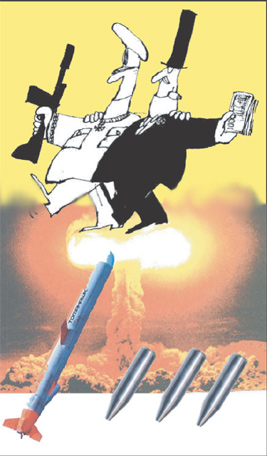 Thornberry’s Defense Budget Exceeds Pentagon’s Request by $16 Billion, DoD Buzz By Richard Sisk | Friday, February 27th, 2015 A lawmaker in the U.S. House of Representatives is calling for a fiscal 2016 defense budget that would exceed spending caps by $50 billion.
Rep. William “Mac” Thornberry, R-Texas, chairman of the House Armed Services Committee, submitted the proposal in a letter Friday to Rep. Tom Price, R-Georgia, and chairman of the House Budget Committee.
Thornberry and most of his colleagues on the defense panel recommended a national defense budget of $577 billion. The figure is $16 billion more than the Obama administration’s request — which already exceeds spending caps for the Defense Department’s base budget by about $35 billion. More importantly, it signals a growing divide within the GOP over how much funding the Pentagon should receive at a time when the U.S. military is taking on new missions in the Middle East, Europe and Asia……..
While defense hawks like Thornberry and Sen. John McCain, R-Arizona, are pushing for more military spending and an end to automatic budget cuts known as sequestration, budget hawks such as Price are trying to reduce overall federal spending to cut the deficit and balance the budget………http://www.dodbuzz.com/2015/02/27/thornberrys-defense-budget-exceeds-pentagons-request-by-16-billion/
Nuclear weapons expansion in North Korea

 North Korea’s Nuclear Expansion, NYT By THE EDITORIAL BOARDFEB. 27, 2015 North Korea could be on track to have an arsenal of 100 nuclear weapons by 2020, according to a new research report. The prediction, from experts on North Korea, goes well beyond past estimates and should force renewed attention on a threat that has been eclipsed by other crises.
At the moment, the United States and five other major powers are negotiating an agreement that would constrain the nuclear program in Iran, which does not possess any nuclear weapons. North Korea, on the other hand, is estimated to have already produced 10 to 16 weapons since 2003.
The new assessment comes from Joel Wit, a former American negotiator with North Korea who is now a senior fellow with the U.S.-Korea Institute at the Johns Hopkins University School of Advanced International Studies, and David Albright, head of the Institute for Science and International Security. They conclude that North Korea’s nuclear and missile programs have been growing since 2009 and are now “poised for significant expansion over the next five years.” That poses serious threats for other countries in Asia and for the United States.
Details about the programs are hard to come by given North Korea’s closed system. As a result, the researchers have outlined possible scenarios for the next five years, ranging from 20 nuclear weapons to 100, which would put North Korea on a par with India, Pakistan and Israel. Independently, China has also estimated the program to be capable of producing the higher range of weapons, another expert on North Korea told The Times.
North Korea already has 1,000 ballistic missiles including the medium-range land-based Nodong missile, which is mobile and accurate enough to attack cities, ports and military bases in Japan and South Korea. The country may also possess limited long-range missiles that can reach targets in the United States, the report said. It has also succeeded in miniaturizing nuclear weapons so they can fit on both medium-range and long-range missiles………….http://www.nytimes.com/2015/02/27/opinion/north-koreas-nuclear-expansion.html?_r=0
Obama’s Nuclear Zero Dream fading
 Is Obama’s Vision of Nuclear Zero Leading to Nowhere?, CounterPunch, by SHAMS UZ ZAMAN Islamabad. 27 Feb 15
As the Second Cold War gathers pace between Moscow and Washington, over range of issues, optimism is fading over possibility of ‘a world free of nuclear weapons’ envisioned by nuclear pessimists since the dawn of nuclear age. The prospects had never been so promising, as had appeared to be, after President Obama’s speech at Prague in 2007 followed by the announcement to cancel deployment of missile defence shield in European theatre, presumably due to Russian concerns. However, the situation changed after U.S. adopted the off-shore rebalancing policy, referred to as ‘Asia-Pivot’, in 2011 which presumably was aimed at containing China and Russia. Obama’s recent pledge to grant India the privileged nuclear status amongst the non-NPT signatory states has further damped the prospects to envision a world free of nuclear weapons in foreseeable future.
Since the promulgation of new set of U.S. strategic priorities for the Asia-Pacific region, China and Russia appears to be in the process of reviewing and enhancing their nuclear and missile capabilities. China recently tested its improved variant of road missile ICBM DF-31B, capable of delivering multiple warheads Multiple Independently Targeted Re-entry Vehicles (MIRVs) on the U.S. mainland, while its improved version, named DF-41, is still under development. China is also arming its fleet of stealth submarines with JL-2 ballistic missiles to acquire an assured second strike nuclear capability. Beijing’s antagonism to Washington’s Asia Pivot has seemingly provoked the former to forsake its traditional policy of non-interventionism and neutrality. Chinese non-traditional approach on Ukraine crisis and implicit support to Russia in this new escalating cold war can thus be better understood in the context.
Russians are not lagging behind either. Their newly developed SLBM, Bulava with a strike range of 10000 kms and capability to carry up to 6 – 10 MIRVs of 100 – 150 KT each has become part of the nuclear inventory. Russian President Vladimir Putin, in Sochi, criticized Washington for pursuing plans to develop hypersonic weapons under the Global Strike Programme and repudiated the U.S. allegations of violating the Intermediate-Range Nuclear Force (INF) which according to him was in response to U.S. unilateral abrogation of ABM treaty back in 2002. Russian emerging nuclear posture has also become a source of concern for the U.S. and NATO.
The U.S. nuclear initiatives also appear to be out of step with the contemplated roadmap towards a world free of nuclear weapons. Washington is in a process of revitalizing its nuclear arsenals at an astounding cost of $ 1 trillion spanning over a period of thirty years. Such plans risk undermining President Obama’s initiative for global nuclear zero and the future of new START initiative between Russia and United States.
In South Asia, Indian massive defence spending and conventional arms buildup risks offsetting the regional strategic balance. ……..
To mitigate these risks major powers, especially the U.S., China and Russia, shall have to take major initiatives by formulating a cooperative framework for debating and finding solutions to the contentious issues, (UN can also provide such a platform). State situated in troubled regions like India, Pakistan, Iran, North Korea and Israel could subsequently be involved to take on the challenging issues along with the subject of nuclear proliferation, without which Obama’s dream of nuclear zero would remain a distant utopia.
Shams uz Zaman holds M.Phil degree in Strategic & Nuclear Studies from National Defence University Islamabad. He is visiting faculty member at Roots University International College, Islamabad and frequently writes in newspapers, magazines and research journals on nuclear and strategic issues. He has has also co-authored the book: “Iran and the Bomb – Nuclear Club Busted”. http://www.counterpunch.org/2015/02/27/is-obamas-vision-of-nuclear-zero-leading-to-nowhere/
If a nuclear warhead detonated above midtown Manhattan?
What would happen if an 800-kiloton nuclear warhead detonated above midtown Manhattan? Bulletin of the Atomic Scientists, 25 Feb 15 Steven StarrLynn EdenTheodore A. Postol Russian intercontinental ballistic missiles are believed to carry a total of approximately 1,000 strategic nuclear warheads that can hit the US less than 30 minutes after being launched. Of this total, about 700 warheads are rated at 800 kilotons; that is, each has the explosive power of 800,000 tons of TNT. What follows is a description of the consequences of the detonation of a single such warhead over midtown Manhattan, in the heart of New York City.

The initial fireball. The warhead would probably be detonated slightly more than a mile above the city, to maximize the damage created by its blast wave. Within a few tenths of millionths of a second after detonation, the center of the warhead would reach a temperature of roughly 200 million degrees Fahrenheit (about 100 million degrees Celsius), or about four to five times the temperature at the center of the sun.
A ball of superheated air would form, initiallly expanding outward at millions of miles per hour. It would act like a fast-moving piston on the surrounding air, compressing it at the edge of the fireball and creating a shockwave of vast size and power.
After one second, the fireball would be roughly a mile in diameter. It would have cooled from its initial temperature of many millions of degrees to about 16,000 degrees Fahrenheit, roughly 4,000 degrees hotter than the surface of the sun.
On a clear day with average weather conditions, the enormous heat and light from the fireball would almost instantly ignite fires over a total area of about 100 square miles.
Hurricane of fire. Within seconds after the detonation, fires set within a few miles of the fireball would burn violently. These fires would force gigantic masses of heated air to rise, drawing cooler air from surrounding areas toward the center of the fire zone from all directions.
As the massive winds drove flames into areas where fires had not yet fully developed,the fires set by the detonation would begin to merge. Within tens of minutes of the detonation, fires from near and far would joinhave formed a single, gigantic fire. The energy released by this mass fire would be 15 to 50 times greater than the energy produced by the nuclear detonation……….
No survivors. Within tens of minutes, everything within approximately five to seven miles of Midtown Manhattan would be engulfed by a gigantic firestorm. The fire zone would cover a total area of 90 to 152 square miles (230 to 389 square kilometers). The firestorm would rage for three to six hours. Air temperatures in the fire zone would likely average 400 to 500 degrees Fahrenheit (200 to 260 Celsius).
After the fire burned out, the street pavement would be so hot that even tracked vehicles could not pass over it for days. Buried, unburned material from collapsed buildings throughout the fire zone could burst into flames when exposed to air—months after the firestorm had ended.
Those who tried to escape through the streets would have been incinerated by the hurricane-force winds filled with firebrands and flames. Even those able to find shelter in the lower-level sub-basements of massive buildings would likely suffocate from fire-generated gases or be cooked alive as their shelters heated to oven-like conditions.
The fire would extinguish all life and destroy almost everything else.Tens of miles downwind of the area of immediate destruction, radioactive fallout would begin to arrive within a few hours of the detonation.
But that is another story.
Editor’s note: This article is adapted from “City on Fire” by Lynn Eden, originally published in the January 2004 issue of the Bulletin of the Atomic Scientists. http://thebulletin.org/what-would-happen-if-800-kiloton-nuclear-warhead-detonated-above-midtown-manhattan8023
The long and tortuous process of ridding the world of nuclear weapons
As long as any state has nuclear weapons, others will want them. As long as they exist, they will be used again someday, if not by design and intent, then through miscalculation, accident, rogue launch or system malfunction. Any such use anywhere could spell catastrophe for the planet.
The only guarantee of zero nuclear weapons risk, therefore, is to move to zero nuclear weapons possession by a carefully managed process.
Belling the nuclear wildcat, Japan Times, 26 Feb 15 BY RAMESH THAKUR
“………..The peoples of the world recognize the dangers of nuclear arsenals. Curiously, however, their concerns and fears find little reflection in the media coverage or in governments’ policy priorities. Continue reading
India could develop thermonuclear weapons: it is secretly enriching uranium
India nuke enrichment plant expansion operational in 2015 – IHS BY DOUGLAS BUSVINENEW DELHI Fri Jun 20, 2014 (Reuters) – India is expanding a covert uranium enrichment plant that could potentially support the development of thermonuclear weapons, a defence research group said on Friday, raising the stakes in an arms race with China and Pakistan.
The revelation highlights a lack of nuclear safeguards on India under new Prime Minister Narendra Modi, while sanctions-bound Iran faces minute scrutiny in talks with world powers over its own nuclear programme.
New units at the Indian Rare Metals Plant would boost India’s ability to produce weapons-grade uranium to twice the amount needed for its planned nuclear-powered submarine fleet, IHS Jane’s said.
The facility, located near Mysore in southern India, could be operational by mid-2015, the research group said, basing its findings on analysis of satellite imagery and public statements by Indian officials.
“Taking into account all the enriched uranium likely to be needed by the Indian nuclear submarine fleet, there is likely to be a significant excess,” Matthew Clements, editor of IHS Jane’s Intelligence Review, told Reuters.
“One potential use of this would be for the development of thermonuclear weapons.” No comment was available from the Indian government press office or the foreign ministry. Pakistan reacted with consternation, with a senior aide to Prime Minister Nawaz Sharif saying the news underscored India’s “established hegemony”…….http://in.reuters.com/article/2014/06/20/india-nuclear-idINKBN0EV0JR20140620
1 This Month
23-25 October – on Zoom – World BEYOND War’s annual global conferenc


Shut down the radiation-damaged Heysham nuclear reactors now
To see nuclear-related stories in greater depth and intensity – go to https://nuclearinformation.wordpress.com

Say No to NASA’s Reckless Nuclear Reactor on the Moon
Say No to NASA’s Reckless Nuclear Reactor on the Moon

-
Archives
- October 2026 (190)
- September 2026 (339)
- August 2026 (330)
- July 2026 (355)
- June 2026 (287)
- May 2026 (306)
- April 2026 (356)
- March 2026 (251)
- February 2026 (267)
- January 2026 (308)
- December 2025 (358)
- November 2025 (359)
-
Categories
- 1
- 1 NUCLEAR ISSUES
- business and costs
- climate change
- culture and arts
- ENERGY
- environment
- health
- history
- indigenous issues
- Legal
- marketing of nuclear
- media
- opposition to nuclear
- PERSONAL STORIES
- politics
- politics international
- Religion and ethics
- safety
- secrets,lies and civil liberties
- spinbuster
- technology
- Uranium
- wastes
- weapons and war
- Women
- 2 WORLD
- ACTION
- AFRICA
- Atrocities
- AUSTRALIA
- Christina's notes
- Christina's themes
- culture and arts
- Events
- Fuk 2022
- Fuk 2023
- Fukushima 2017
- Fukushima 2018
- fukushima 2019
- Fukushima 2020
- Fukushima 2021
- general
- global warming
- Humour (God we need it)
- Nuclear
- RARE EARTHS
- Reference
- resources – print
- Resources -audiovicual
- Weekly Newsletter
- World
- World Nuclear
- YouTube
-
RSS
Entries RSS
Comments RSS

