Democrats push bill to stop a Trump pre-emptive strike on North Korea
Conyers-Markey legislation has two Republican backers in House
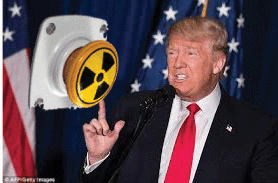
President’s threat to ‘totally destroy’ North Korea fuelled nuclear war fears, Guardian, Julian Borger 27 Oct 17, Congressional Democrats have introduced legislation aimed at preventing Donald Trump from launching a pre-emptive attack on North Korea, as concerns grew about the administration’s failure to explore talks with Pyongyang.
The new legislation prohibiting an attack on North Korea without congressional authority was launched by Democrats John Conyers in the House and Ed Markey in the Senate. It has two Republicans among the 61 backers in the House, but at present no formal Republican backing in the Senate.
“As a veteran of the Korean war, I am ashamed that our commander-in-chief is conducting himself in a reckless manner that endangers our troops stationed in South Korea and our regional allies,” Conyers said.
“President Trump’s provocative and escalatory rhetoric, with threats to unleash ‘fire and fury’ and ‘totally destroy’ North Korea, cannot be allowed to turn into reality,” Senator Markey said. “As long as President Trump has a Twitter account, we must ensure that he cannot start a war or launch a nuclear first strike without the explicit authorization of Congress.”
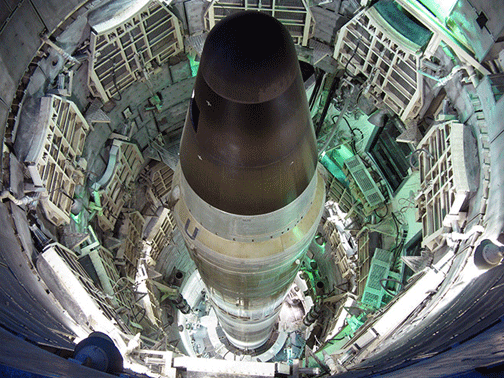
The bill’s supporters acknowledge that it will not pass without attracting more Republican support, but they argue that it helps focus attention on the unlimited authority of a US president to order the use of nuclear weapons, many of which can be launched within a few minutes. No official has the power to stop or even delay the launch.
Senator Dianne Feinstein, speaking at a conference organised by the Ploughshares Fund, an non-proliferation advocacy group said she once asked a former head of US Strategic Command if he would carry out a launch order even if he knew it was a catastrophically bad decision. “He looked me straight in the eye and said: Yes,” Senator Feinstein recalled……..
Ted Lieu, the Democratic congressman who co-authored the bill in January to limit the president’s power to launch a first strike said the best recruiter for Republican support was Trump’s behaviour.
Vasili Arkhipov, who prevented escalation of the cold war by refusing to launch a nuclear torpedo against US forces, is to be awarded new ‘Future of Life’ prize A senior officer of a Soviet submarine who averted the outbreak of nuclear conflict during the cold war is to be honoured with a new prize, 55 years to the day after his heroic actions averted global catastrophe.
On 27 October 1962, Vasili Alexandrovich Arkhipov was on board the Soviet submarine B-59 near Cuba when the US forces began dropping non-lethal depth charges. While the action was designed to encourage the Soviet submarines to surface, the crew of B-59 had been incommunicado and so were unaware of the intention. They thought they were witnessing the beginning of a third world war.
Trapped in the sweltering submarine – the air-conditioning was no longer working – the crew feared death. But, unknown to the US forces, they had a special weapon in their arsenal: a ten kilotonne nuclear torpedo. What’s more, the officers had permission to launch it without waiting for approval from Moscow.
Two of the vessel’s senior officers – including the captain, Valentin Savitsky – wanted to launch the missile. According to a report from the US National Security Archive, Savitsky exclaimed: “We’re gonna blast them now! We will die, but we will sink them all – we will not become the shame of the fleet.”
But there was an important caveat: all three senior officers on board had to agree to deploy the weapon. As a result, the situation in the control room played out very differently. Arkhipov refused to sanction the launch of the weapon and calmed the captain down. The torpedo was never fired.
Had it been launched, the fate of the world would have been very different: the attack would probably have started a nuclear war which would have caused global devastation, with unimaginable numbers of civilian deaths.
“The lesson from this is that a guy called Vasili Arkhipov saved the world,’’ Thomas Blanton, director of the National Security Archive at George Washington University, told the Boston Globe in 2002, following a conference in which the details of the situation were explored.
Now, 55 years after he averted nuclear war and 19 years after his death, Arkhipov is to be honoured, with his family the first recipients of a new award.
The prize, dubbed the “Future of Life award” is the brainchild of the Future of Life Insitute – a US-based organisation whose goal is to tackle threats to humanity and whose advisory board includes such luminaries as Elon Musk, the astronomer royal Prof Martin Rees, and actor Morgan Freeman.
“The Future of Life award is a prize awarded for a heroic act that has greatly benefited humankind, done despite personal risk and without being rewarded at the time,” said Max Tegmark, professor of physics at MIT and leader of the Future of Life Institute.
Speaking to Tegmark, Arkhipov’s daughter Elena Andriukova said the family were grateful for the prize, and its recognition of Arkhipov’s actions.
“He always thought that he did what he had to do and never considered his actions as heroism. He acted like a man who knew what kind of disasters can come from radiation,” she said. “He did his part for the future so that everyone can live on our planet.”
The $50,000 prize will be presented to Arkhipov’s grandson, Sergei, and Andriukova at the Institute of Engineering and Technology on Friday evening.
Dr Jonathan Colman, an expert on the Cuban missile crisis at the University of Central Lancashire, agreed that the award was fitting.
“While accounts differ about what went on on board the B-59, it is clear that Arkhipov and the crew operated under conditions of extreme tension and physical hardship. Once the nuclear threshold had been crossed, it is hard to imagine that the genie could have been put back into the bottle,” he said.
“President Kennedy had been very worried about the possibility of a clash between American warships and Soviet submarines in the Caribbean, and it is absolutely clear that his fears were justified,” Colman added, noting that certain decisions at the operational level were out of his control. “Ultimately, it was luck as much as management that ensured that the missile crisis ended without the most dreadful consequences.”
To shore up the INF, the United States could propose something the Russians have already advocated—that the INF Treaty be expanded to ban this category of ballistic missiles globally.Such a move would not immediately apply to the most troubling nuclear-tipped missiles, those with ranges far in excess of 1,000 kilometers. But a worldwide INF could be a first step toward an eventual goal of banning all ballistic missiles.
Ballistic missiles have beneficial purposes; they place satellites in orbit, and those satellites provide the world with vital communications capabilities and navigation and weather information. Ballistic missiles send astronauts and space stations into Earth orbit and research probes far across the solar system.
But ballistic missiles armed with nuclear warheads are enablers of apocalypse. There is no effective defense against these missiles, even though the United States has spent more than 30 years and $500 billion trying to build radars that can track them and interceptor missiles that will shoot them down.
Military ballistic missiles have other negative characteristics. The short time needed for them to reach target (if the United States and Russia are the assumed combatants, 10 to 30 minutes) creates pressure to launch first in a conflict. In a crisis, ballistic missiles on high alert can wind up becoming the leading edge of a devastating war begun by miscalculation.
Because of the obvious dangerousness of ballistic missiles, there is a long history of official efforts to limit or eliminate them. Those efforts have shown that agreements to reduce the dangers of ballistic missiles can catalyze improved relations between potential adversaries. The landmark 1987 Intermediate-Range Nuclear Forces (INF) treaty required Washington and Moscow to eliminate all ballistic missiles with ranges between 500 and 1,000 kilometers. Both nations recognized that these missiles could not be defended against and their proximity to the Cold War boundaries of Europe meant they were highly destabilizing in a crisis. A total of 2,692 missiles (including a small number of cruise missiles) were eliminated under the treaty.
Acknowledging the danger of nuclear ballistic missiles, President Reagan proposed an agreement requiring their total elimination to Soviet leader Gorbachev at their summit in Reykjavik, Iceland in 1985. The Soviets did not accept the proposal because Reagan insisted that America’s program to build missile defenses remain unconstrained. That program—known then as the Strategic Defense Initiative and today as the National Missile Defense Program—has yet to develop effective means to defeat ballistic missiles.
In the mid 1990s, Alton Frye, then Washington director of the US Council on Foreign Relations, advocated an international ban on offensive ballistic missiles, an idea whose time has perhaps come again. Many political and technical challenges would need to be addressed to negotiate and enforce new international limitations on ballistic missiles. But model institutional and scientific mechanisms for such efforts exist in the form of preceding treaties, including INF and New START. Procedures and technologies for inspection, verification, and enforcement of agreements limiting or banning all types of ballistic missiles have already been proven. Political will, as usual is the major missing ingredient.
While Perry proposes to eliminate only land-based ballistic missiles and retain submarine-based missiles, such a move could create powerful international momentum to negotiate new international limits or bans on certain types of ballistic missiles—with an ultimate goal of banning all nuclear-armed ballistic missiles. If a united international community were to seriously consider such a course, it could bring increased pressure on North Korea, Iran, and other nations to suspend or roll back their offensive ballistic missile programs. If they refused, the possibility of using military force against their nuclear and ballistic missile programs would gain legitimacy and support.
One place to start seeking new limits on ballistic missiles has been in the news for months: the INF Treaty, which the United States and Russia have accused one another of violating. Russia’s support of the treaty has weakened over the years because it is forbidden to deploy ballistic missiles with ranges between 500 and 1,000 kilometers, but its neighbors who are not party to the treaty are permitted to do so. China has many such missiles, and Turkey, South Korea, and Japan could develop them in the future. To shore up the INF, the United States could propose something the Russians have already advocated—that the INF Treaty be expanded to ban this category of ballistic missiles globally.
Such a move would not immediately apply to the most troubling nuclear-tipped missiles, those with ranges far in excess of 1,000 kilometers. But a worldwide INF could be a first step toward an eventual goal of banning all ballistic missiles. A renewed focus on the danger of these weapons—accompanied by US statements that it is willing to eliminate its land-based ICBMs under the right conditions—might elicit greater support from Russian and China in efforts to defuse the North Korean crisis and control Iranian missile testing.
Like the nuclear weapons ban treaty the UN recently adopted, a ballistic missile ban would require sustained, long-term effort to achieve anything like full success. But the United States has everything to gain from taking a leadership role and asserting that offensive ballistic missiles are dangerous and destabilizing weapons that should eventually be eliminated from the arsenals of all nations.
US Military Strike Against North Korea Pose Risk Of ‘Unacceptable War’: Expert, International Business Times, BY SUMAN VARANDANI@SUMAN09A mid the ongoing tensions in the Korean Peninsula of a possible nuclear threat from North Korea, the United States had said that further provocation from Pyongyang could result in a preventive military strike. However, a renowned American expert on the North Korean issue has told Yonhap News Agency that the U.S. would not remove all of North Korea’s nuclear and ballistic missile capabilities.
“A preventive military strike would not destroy all of North Korea’s capabilities. It would risk a wider war that would inflame South Korea and Japan and potentially cause millions of casualties,” Michael Green, vice president for Asia at the Center for Strategic and International Studies (CSIS), said last week in Washington, D.C., in his meeting with South Korean journalists.
Green proposed economic sanctions as the most viable tool to end North Korea’s nuclear weapons program. While mentioning about other ways in which the U.S. military strike could backfire, Green said: “It would also threaten the U.S. because North Korea has an ability even without ballistic missiles to transfer nuclear weapons to terrorist groups, so a preventive military strike would not get all of North Korea’s nuclear capabilities and would risk an unacceptable war.”
Green also claimed that diplomatic negotiations with Pyongyang would also not yield any concrete result as to stopping the Kim Jong Un regime’s nuclear advancement, given the country’s track record of breaking previous agreements.
“We shouldn’t end sanctions or military exercises in order to have dialogue with Pyongyang because then we will prove there’s no cost to North Korea for the path it’s on,” Green said, suggesting that the U.S. build “infrastructure of sustained consequence” for North Korea to facilitate diplomacy work with the regime. “We now have to restore deterrence and restore credibility if we have any chance in medium to long run diplomacy.”……http://www.ibtimes.com/us-military-strike-against-north-korea-pose-risk-unacceptable-war-expert-2605939
Take atmospheric nuclear test threat ‘literally’, North Korea diplomat says Washington SMH, 26 Oct 17 The North Korean foreign minister’s warning of a possible atmospheric nuclear test over the Pacific Ocean should be taken literally, a senior North Korean official has told CNN.
“The foreign minister is very well aware of the intentions of our supreme leader, so I think you should take his words literally,” Ri Yong-pil, a senior diplomat in North Korea’s Foreign Ministry, told CNN in an interview aired on Wednesday.
North Korean Foreign Minister Ri Yong-ho said last month Pyongyang may consider conducting “the most powerful detonation” of a hydrogen bomb over the Pacific Ocean amid rising tensions with the US.
CIA chief Mike Pompeo said last week that North Korea could be only months away from gaining the ability to hit the US with nuclear weapons.
Experts say an atmospheric test would be a way of demonstrating that capability. All of North Korea’s previous nuclear tests have been conducted underground.
Trump next week will make a visit to Asia during which he will highlight his campaign to pressure North Korea to give up its nuclear and missile programs……
The disclosure came at a hearing of the Commons Public Accounts Committee looking at the huge cost of building Hinkley Point power station which critics see as uneconomic and not properly costed.
It was raised in a paper submitted to the committee by Professor Andy Stirling, Fellow of the Academy of Social Sciences, and Dr Phil Johnstone, from the Science Policy Research Unit, Sussex University, which questioned whether the Ministry of Defence is being subsidized by the civil nuclear industry.
Their paper pointed out this is never publicly discussed but added: “If a UK withdrawal from civil nuclear power on grounds of uncompetitive economics were to leave these shared costs borne entirely on the military side, then UK military nuclear infrastructures would be significantly more expensive.
“If civil nuclear commitments are being maintained (despite adverse economics) in order to help cover these shared costs, then it is this that amounts to a cross-subsidy.”
The point was taken up by Meg Hillier, chair of the PAC, last week. She questioned Stephen Lovegrove, former Permanent Secretary, Department for Energy and Climate Change, on the issue.
“Mr Lovegrove, there has been an argument put forward by Sussex University that Hinkley is a great opportunity to maintain our nuclear skills base. With your hat on at the Ministry of Defence, are you having discussions with the business Department about this?”
Lovegrove replied: “We are, yes. In my last year at DECC, I was in regular discussion with Jon Thompson, former Permanent Secretary at the MOD, to say that as a nation we are going into a fairly intense period of nuclear activity … We are building the new SSBNs (nuclear armed nuclear submarines) and completing the Astutes … We are completing the build of the nuclear submarines which carry conventional weaponry. We have at some point to renew the warheads, so there is very definitely an opportunity here for the nation to grasp in terms of building up its nuclear skills.
“I do not think that that is going to happen by accident; it is going to require concerted Government action to make it happen. We are speaking to colleagues at BEIS ( Business, Energy and Industrial Strategy) fairly repeatedly about it, and have a number of forums in which we are doing that.”
The Sussex University paper also pointed out that private industry was making the link. Their paper said: “Rolls Royce acknowledged for the first time in a major public statement, that there also exists a deep interlinkage between British civil and military nuclear industrial capabilities … stating that “expansion of a nuclear-capable skilled workforce through a civil nuclear UK programme would relieve the Ministry of Defence of the burden of developing and retaining skills and capability. This would free up valuable resources for other investments.”
How a State Department Study Prevented Nuclear War With China, The U.S. considered preemptive strikes to prevent Mao from attaining nuclear weapons.The Diplomat By Franz-Stefan Gady, October 25, 2017, The People’s Republic of China (PRC) under Mao Zedong was the nuclear “rogue state” of the 1960s in the eyes of the United States. The PRC was viewed by officials in two consecutive U.S. administrations — John F. Kennedy and Lyndon B. Johnson — as both extremist and irrational, a country where the prevailing U.S. Cold War strategies of containment and deterrence would not apply. President Kennedy reportedly saw a nuclear China as “the great menace in the future to humanity, the free world, and freedom on earth.” Lyndon B. Johnson told a reporter in 1964 during the ongoing presidential campaign that “we can’t let [Barry] Goldwater [Johnson’s opponent] and Red China both get the bomb at the same time. Then the shit would really hit the fan.”
Given the possible disastrous consequences of a nuclear-armed PRC for the United States, both the Kennedy and Johnson administrations discussed the option of launching preventive strikes on Chinese nuclear weapon facilities. Amid these deliberations, a member of the U.S. Department of State’s Policy Planning Council, Robert H. Johnson, compiled two studies arguing that a nuclear China will not significantly alter the military balance of power in Asia and that, as a corollary, the United States would not need to take radical steps, including military action, in the foreseeable future. Johnson’s papers helped to broaden the discussion about possible policy options vis-à-vis China and may have contributed to the United States not launching a preventive attack on Chinese nuclear facilities in the early 1960s.
China: The Rogue State of the 1960s……..
The State Department Responds While Kennedy was considering preventive war against China’s nuclear weapons capability, several U.S. State Department officials grew skeptical about the White House’s alarmism and militancy. The then-head of the State Department’s Policy Planning Council (PPC), Walt Rostow, noted in July 1963 that even if Beijing developed nuclear weapons, its “desire to preserve its nuclear force as a credible deterrent might tend to make China even more cautious than it is today in its encounters with American power.” Rostow’s opinion was influenced by the first draft of a study titled “A Chinese Communist Nuclear Detonation and Nuclear Capability,” compiled by PPC staffer Robert H. Johnson in close cooperation with officials from the Pentagon, the CIA, the Arms Control and Disarmament Agency, and the U.S. Information Agency.
A 100-page version of the paper was distributed in October 1963 to select officials. It is unclear, however, whether Kennedy ever saw it. Its conclusion was distinctly non-alarmist. Most importantly, the report concluded that “apart from serving as an additional inhibition on some levels of U.S. attack upon the mainland, a Chinese nuclear capability need impose no new military restrictions on the U.S. response to aggression in Asia (…)” Even intercontinental ballistic missiles would not “eliminate this basic asymmetry.” Furthermore: “The basic military problems we will face are likely to be much like those we face now: military probing operations (…) relatively low-level border wars” and “‘revolutionary wars’ supported by the ChiComs [Chinese Communists].”
In short, the study suggested that the United States pursue status-quo policies vis-à-vis China (“present policies require no change”) anchored on nuclear deterrence.
The Impact
According to the scholars William Burr and Jeffrey T. Richelson, the study had an immediate impact……..
Robert H. Johnson’s reports helped accentuate the reasons against preventive war. They offered U.S. policymakers alternatives to more hawkish views on how to deal with a nuclear China. ……..
Considering the current U.S. administration’s disjointed responses to North Korea’s nuclear weapons program and the repeated talk of the possible necessity of military action, getting the government to “sing from the same sheet” on a very complex issue is no minor achievement. Indeed, our best hope may be that somewhere in the D.C. bureaucracy a 21st century incarnation of Johnson can get the ear of a senior administration official with access to U.S. President Donald Trump and offer a nuanced perspective on the nuclear standoff on the Korean Peninsula.
US Preparing to Put Nuclear Bombers Back on 24-Hour Alert, Defense One, BY MARCUS WEISGERBER OCTOBER 22, 2017 BARKSDALEAIRFORCEBASE, LA. — THE U.S. Air Force is preparing to put nuclear-armed bombers back on 24-hour ready alert, a status not seen since the Cold War ended in 1991.
That means the long-dormant concrete pads at the ends of this base’s 11,000-foot runway — dubbed the “Christmas tree” for their angular markings — could once again find several B-52s parked on them, laden with nuclear weapons and set to take off at a moment’s notice…….
Goldfein and other senior defense officials stressed that the alert order had not been given, but that preparations were under way in anticipation that it might come. That decision would be made by Gen. John Hyten, the commander of U.S. Strategic Command, or Gen. Lori Robinson, the head of U.S. Northern Command. STRATCOM is in charge of the military’s nuclear forces and NORTHCOM is in charge of defending North America……http://www.defenseone.com/threats/2017/10/exclusive-us-preparing-put-nuclear-bombers-back-24-hour-alert/141957/
“The omission of the word ‘any’ implies there could be a case of nuclear weapon use that would not cause inhumane consequences and therefore this type of use might be permitted”
“The Japanese draft resolution looks like one proposed by the United States or any other nuclear weapon states”
A draft resolution recently proposed by the Abe government to the United Nations General Assembly was dramatically watered down under diplomatic pressure from the United States, government sources have revealed.
Japan, the only nation to have been attacked with atomic weapons, saw the U.S. destroy Hiroshima and Nagasaki with two atomic bombs 72 years ago. it has proposed a series of draft resolutions on nuclear disarmament to the General Assembly since 1994.
Last year, its proposed resolution was adopted at the assembly’s plenary session with support from 167 nations, including the United States, while China, North Korea, Russia and Syria opposed and 16 other nations abstained.
In the middle of October, Japan submitted a resolution titled “United action with renewed determination toward the total elimination of nuclear weapons.”
Close examination of the text has found a few major changes from past resolutions.
Since 2010, Japan has drafted annual resolutions that include the same common sentence, which emphasizes “deep concern at the catastrophic humanitarian consequences of any use of nuclear weapons.”
The phrase, “the catastrophic humanitarian consequences of any use of nuclear weapons,” has been a keyword used by international movements pursuing a denuclearized world in recent years.
In July, this anti-nuclear campaign culminated in the adoption of the Treaty on the Prohibition of Nuclear Weapons at the United Nations — the first international law that prohibits state parties from developing, testing, possessing and using nuclear weapons in any manner, including “threat of use.”
In the most recently proposed resolution, the government deleted the word “any” from the frequently used phrase, rendering it as “deep concern at the catastrophic humanitarian consequences of nuclear weapons use.”
It seems a minor rhetorical change, but the deletion of “any” has raised concerns and sparked severe criticism from nuclear disarmament specialists in Japan.
“The omission of the word ‘any’ implies there could be a case of nuclear weapon use that would not cause inhumane consequences and therefore this type of use might be permitted,” professor Tatsujiro Suzuki, director of the Research Center for Nuclear Weapons Abolition at Nagasaki University, pointed out.
“It can’t be helped if Japan will be regarded (by the international community) as an unfit advocate for the abolition of nuclear weapons,” Suzuki said.
“The Japanese draft resolution looks like one proposed by the United States or any other nuclear weapon states,” said Akira Kawasaki, an International Steering Group member of ICAN, or the International Campaign to Abolish Nuclear Weapons.
ICAN will receive the Nobel Peace Prize at the end of this year in Oslo for its worldwide grass-roots campaign for the adoption of the Treaty on the Prohibition of Nuclear Weapons.
During a recent interview, Kawasaki said “the deletion of ‘any’ is so problematic” that several nations which have supported Japan’s annual resolutions in the past may not become a cosponsor of the resolution this year.
That wold pose a serious setback for Japan, which has taken a leading position in the international disarmament based on its strong credentials.
Governmental sources suggested that the administration of U.S. President Donald Trump opposes including the word “any” in the draft resolution, and that Japan made the concession to get Washington’s support for the document.
Trump has indicated a desire to accelerate the modernization of the U.S. nuclear arsenal in light of North Korea’s nuclear and missile provocations. Prime Minister Shinzo Abe has been deepening security cooperation with the United States and repeatedly requested more U.S. security assurances for Japan, including the “nuclear umbrella.”
Another conspicuous change in the latest Japanese resolution is that it urges only North Korea to sign and ratify the Comprehensive Nuclear Test Ban Treaty without delay, rather than the eight nations it named for the previous resolutions.
Japan is a key advocate of accelerating the CTBT, which requires ratification by eight nations including North Korea, China and the United States. The U.S. Republican Party is widely known as a strong opponent of CTBT.
“Our new draft resolution is the result of policy considerations for creating a common ground between nuclear weapon states and nonnuclear weapons states for furthering a practical approach (toward nuclear abolition),” said one official of the Ministry of Foreign Affairs without specifically explaining why they decided to make the notable changes in the draft resolution.
After six tests, the mountain hosting North Korea’s nuclear blasts may be exhausted, SMH, Anna Fifield, 21 Oct 17 Tokyo: Have North Korea’s nuclear tests become so big that they’ve altered the geological structure of the land?
Some analysts now see signs that Mount Mantap, the 2200-metre-high peak under which North Korea detonates its nuclear bombs, is suffering from “tired mountain syndrome”.
The mountain visibly shifted during the last nuclear test, an enormous detonation that was recorded as a 6.3-magnitude earthquake in North Korea’s northeast. Since then, the area, which is not known for natural seismic activity, has had three more quakes.
“What we are seeing from North Korea looks like some kind of stress in the ground,” said Paul G Richards, a seismologist at Columbia University’s Lamont-Doherty Earth Observatory.
“In that part of the world, there were stresses in the ground but the explosions have shaken them up.”
North Korea has conducted six nuclear tests since 2006, all of them in tunnels burrowed deep under Mount Mantap at a site known as the Punggye-ri Nuclear Test Facility. Intelligence analysts and experts alike use satellite imagery to keep close track on movement at the three entrances to the tunnels for signals that a test might be coming.
After the latest nuclear test, on September 3, Kim Jong Un’s regime claimed that it had set off a hydrogen bomb and that it had been a “perfect success”.
After the latest nuclear test, on September 3, Kim Jong Un’s regime claimed that it had set off a hydrogen bomb and that it had been a “perfect success”.
Images captured by Airbus, a space technology company that makes earth observation satellites, showed the mountain literally moving during the test. An 85-acre area on the peak of Mount Mantap visibly subsided during the explosion, an indication of both the size of the blast and the weakness of the mountain.
Since that day, there have been three much smaller quakes at the site, in the 2 to 3 magnitude range, each of them setting fears that North Korea had conducted another nuclear test that had perhaps gone wrong. But they all turned out to be natural.
If the mountain collapses and the hole is exposed, it will let out many bad things.
Wang Naiyan, former chairman of the China Nuclear Society
That has analysts Frank V. Pabian and Jack Liu wondering if Mount Mantap is suffering from “tired mountain syndrome”, a diagnosis previously applied to the Soviet Union’s atomic test sites.
“The underground detonation of nuclear explosions considerably alters the properties of the rock mass,” Vitaly V. Adushkin and William Leith wrote in a report on the Soviet tests for the United States Geological Survey in 2001. This leads to fracturing and rocks breaking, and changes along tectonic faults.
Earthquakes also occurred at the US’ nuclear test site in Nevada after detonations there.
“The experience we had from the Nevada test site and decades of monitoring the Soviet Union’s major test sites in Kazakhstan showed that after a very large nuclear explosion, several other significant things can happen,” Richards said. This included cavities collapsing hours or even months later, he said.
Pabian and Liu said the North Korean test site also seemed to be suffering.
“Based on the severity of the initial blast, the post-test tremors, and the extent of observable surface disturbances, we have to assume that there must have been substantial damage to the existing tunnel network under Mount Mantap,” they wrote in a report for the specialist North Korea website 38 North.
But the degradation of the mountain does not necessarily mean that it would be abandoned as a test site – just as the United States did not abandon the Nevada test site after earthquakes there, they said. Instead, the US kept using the site until a nuclear test moratorium took effect in 1992.
For that reason, analysts will continue to keep a close eye on the Punggye-ri test site to see if North Korea starts excavating there again – a sign of possible preparations for another test.
The previous tests took place through the north portal to the underground tunnels, but even if those tunnels had collapsed, North Korea’s nuclear scientists might still use tunnel complexes linked to the south and west portals, Pabian and Liu said.
Chinese scientists have warned that another test under the mountain could lead to an environmental disaster. If the whole mountain caved in on itself, radiation could escape and drift across the region, said Wang Naiyan, the former chairman of the China Nuclear Society and senior researcher on China’s nuclear weapons programme.
NATO’s Hidden Agenda: What’s Behind Drills With US Nuclear Weapons in Germany https://sputniknews.com/analysis/201710221058446313-germany-drills-us-nuclear-weapons/NATO is holding an American nuclear weapons safety procedure exercise at a base in Büchel, Germany and in the Belgian town of Kleine-Brogel. The legitimacy of such actions and the deployment of nuclear weapons in non-nuclear countries raises several questions. The drills have also been criticized by Russia.
Drills in Europe
The airbase in Büchel still houses up to 20 American nuclear bombs and is the only facility in Germany where nuclear weapons are deployed. Currently, Bundeswehr pilots and personnel from other NATO countries are practicing nuclear weapons handling procedures.
“This exercise is nicknamed ‘Steadfast Noon’ within the alliance and is held annually at military bases across Europe,” Otfried Nassauer, a researcher with the Berlin Information Center for Security (BITS), told Sputnik Germany.
He explained that during the drills which are supervised by the US military personnel, practice safety regulations while mounting a nuclear bomb on an aircraft and they are observed until the plane takes off. However, no real nuclear weapons are used in the drills.
Legal Dilemma Since the 1960s, NATO’s nuclear participation has provided for the possible use of American nuclear weapons by four non-nuclear European nations in the event of war. According to NATO officials, nuclear participation complies with the nuclear non-proliferation treaty, which is often disputed by critics.
“Their argument is that as a result of this situation a new group of countries emerges in between the nuclear and non-nuclear parties of the treaty. This is a group of pseudo-nuclear states, which are not mentioned by the treaty,” Nassauer pointed out.
German forces are not allowed to use nuclear weapons, in accordance with international law. However, during the current drills German personnel receive orders not from the defense ministry, but from NATO’s command.
“This creates an embarrassing situation. The law prohibits the use of nuclear weapons by German troops, but they receive such orders from NATO. They may try to disobey such orders at their own risk, because according to German laws a soldier must not obey an illegal order,” the analyst said.
Signal to Russia
Retired Bundeswehr colonel Ulrich Scholz, who was involved in NATO’s air force planning, described the drills a “questionable affair” and said they are likely to be a political argument against Russia.
Scholz expressed serious concerns about Germany’s national security. If we’re abandoning nuclear energy due to safety concerns but stockpiling nukes on our soil and taking part in these drills, I’ve got one question: is anybody out there concerned about Germany’s security?” he said.
The former officer also noted that Washington’s “geo-strategic interests” are now again focused on Russia, as it was during the Cold War.
According to Nassauer, the US is interested in keep all of its allies bound together. For the first time, Poland, Greece and the Czech Republic have been involved in the exercise this year. Moreover, the exercise has been held at different military facilities.
“In light of the continuing tensions between Russia and the West, all of the above looks like a political signal from NATO to Moscow,” he said.
On Friday, Russian Foreign Minister Sergei Lavrov called for the removal of US nuclear weapons from Europe.
“We gradually stand for the withdrawal of US nuclear weapons from Europe and their return to the US,” Lavrov said a nuclear weapons non-proliferation conference in Moscow.
The minister called on NATO to stop nuclear weapons drills in its non-nuclear members.
‘Worse than nuclear bombs!’ Putin reveals terrifying sci-fi weapon amid World War fears
VLADIMIR PUTIN has said that the development of genetically-modified soldiers is the next phase of military combat – and one worse than nuclear bombs. By OLI SMITHExpress. UK, Oct 22, 2017
Vladimir Putin warned a crowd of young students that scientists in Russia will soon break the genetic code and create something “worse than a nuclear bomb”.
In a shocking speech yesterday, the Russian leader suggested that his world could soon seen sci-fi super-human soldiers who cannot feel pain or fear.
President Putin said that science is moving at such a fast pace that the world is running out of the time to develop regulation around these eerie advances.
This comes amid escalation on the Korean penisula and mounting fears for the outbreak of nuclear war between North Korea and the US.
the life of Linus Pauling
QUOTE:
Pauling was one of the founders of molecular biology in the true sense of the term. For these achievements he was awarded the 1954 Nobel Prize in chemistry.
But Pauling was famous not only in the world of science. In the second half of his life he devoted his time and energy mainly to questions of health and the necessity to eliminate the possibility of war in the nuclear age. His active opposition to nuclear testing brought him political persecution in his own country, but he was finally influential in bringing about the 1963 international treaty banning atmospheric tests. With the award of the 1962 Nobel Peace Prize, Pauling became the first person to win two unshared Nobel Prizes (Marie Curie won one and shared another with her husband).
QUOTE:
In March 1954, following the Bikini Atoll explosion of a “dirty” thermonuclear superbomb, Pauling was in the news again when he began to call attention to the worldwide danger of radioactive fallout in the atmosphere. In the summer his renewed application for a passport was again turned down, but in November, when his Nobel Prize was announced, the State Department found itself in a public relations dilemma.
The fuss created by Pauling’s absence in London in 1952 would be nothing compared with the international outcry that could be imagined if Pauling were refused permission to travel to attend the Nobel Prize ceremony. So Pauling went to Stockholm, where he was a tremendous success, and followed this by visits to Israel, India, Thailand, and Japan. Everywhere—outside his own country—he was welcomed with enthusiasm, not only for his scientific accomplishments but even more for his political stance.
In the United States, too, the public was becoming increasingly concerned about radioactive fallout, not only from American tests but also from ever more powerful Soviet nuclear explosions. Increasing levels of strontium 90 and carbon 14 made newspaper headlines. Pauling claimed that the increased level of radioactive isotopes in the atmosphere was a danger not only to the living but also to future generations.
The spokesmen on the Atomic Energy Commission countered that, although radiation might be harmful, it was not harmful in the doses produced by the tests and that Pauling vastly exaggerated the dangers. In fact, all the estimates were tentative at best, but since the Atomic Energy Commission was responsible both for developing nuclear weapons and for monitoring the associated health hazards, its estimates were probably no more objective that those who demanded a stop to the tests. Andrei Sakharov (1990) estimated that every one-megaton test cost about 10,000 human lives…..
In 1960 the Senate Internal Security Subcommittee (SISS) headed by Senator Thomas Dodd issued a subpoena to Pauling to answer questions about Communist infiltration of the campaign against nuclear testing. At Pauling’s request the hearings were open and they soon turned into a public relations fiasco for Dodd and the SISS. This was partly because the members of the SISS had not done their homework and partly because it gave Pauling the excuse to lecture them about elementary civic rights and duties: “The circulation of petitions is an important part of our democratic process. If it is abolished or inhibited, it would be a step towards a police state.”
By this time public opinion was mostly on Pauling’s side, but the whole affair must have been experienced by him as an emotional strain—and a tremendous waste of his time and energy…..The treaty went into effect on October 10 and the following day Pauling was awarded the Nobel Peace Prize for 1962….. ”
North Korea could launch nuclear weapon at the US within months, CIA director warns THE CIA director has issued a scary warning on rogue state’s intentions as Russia urges not to back North Korea into a corner. news.com.au 21 Oct 17,Debra Killalea@DebKillaleaNORTH Korea is just months away from perfecting its nuclear weapons capabilities and could strike the United States within months.
That is the grim warning given by CIA Director Mike Pompeo who said the secretive state was getting closer to achieving its nuclear ambitions.
Mr Pompeo told a national security forum in Washington that US needed to behave as if “we are on the cusp of them achieving their objective of being able to strike the United States”.
“When you’re now talking about months, our capacity to understand that at the detailed level is in some sense irrelevant,” he said.
“Whether it happens on Tuesday or a month from Tuesday, we are at a time where the president has concluded that we need a global effort to ensure that Kim Jong-un doesn’t have that capacity.”
However he said there’s a difference between having the ability to fire a single nuclear missile and the capability of producing large amounts of material and developing an arsenal of such weapons.
During the same conference, US President Donald Trump’s National Security Adviser HR McMaster said the country was in a race to resolve the crisis.
“We are not out of time,” he told the forum, organised by the Foundation for Defense of Democracies think tank.
“But we are running out of time,” he said.
‘BACKED INTO A CORNER
It comes as Russia called for support for a plan between Moscow and Beijing to end US and South Korean military drills in exchange for North Korea halting its missile testing.
Foreign Minister Sergei Lavrov said a dialogue would prevent a huge humanitarian, economic and ecological catastrophe in the region.
Russian President Vladimir Putin has also repeated his calls for calm.
While condemning Pyongyang’s nuclear ambitions, Putin said the stand-off should be settled through dialogue and without “cornering North Korea, threatening to use force or going down to outright boorishness and swearing.”
….. US WILL ‘MEET MOST MISERABLE DEATH’
Meanwhile North Korea launched new violent threats against the US and South Korea overnight, promising any nations that provoke or invade the country would “meet the most miserable death”.
CHINA’S CHILLING MESSAGE TO DONALD TRUMP AND THE WORLD COMMUNITY, InQUISTR, Alan Ewart, 19 Oct 17, “…..The prospect of USA vs, North Korea war is terrifying. According to Global Firepower, the hermit nation has a standing army almost one million strong. North Korea also has a trained military reserve that is 5.5 million strong, and which could engage the U.S. in a Vietnam style guerrilla war for decades.
This leads some to think that a preemptive nuclear strike against North Korea would be the only effective way of waging war against a nation that is building a nuclear arsenal. Therein lies the danger, one which could easily tip the world into a nuclear World War 3. A nuclear attack on North Korean capital Pyongyang would kill millions and would be very likely to draw China into World War 3.
As you can see from the World Time and Date calculator, Pyongyang is just over 100 miles from Dandong, a Chinese city of almost one million people. Dandong would, therefore, be well within the fallout zone that would be caused by a nuclear strike on Pyongyang. Something that Chinese premier Xi Jinping will not tolerate.
As reported by the Daily Star, Xi Jinping has issued a chilling warning to the international community. In a speech at the 19th National Congress of the Communist Party President Xi warned that the Chinese army will be able to “prevail in both conventional and new theatres of operation.” China has the worlds biggest standing army with over 2.5 million regular troops. President Xi is currently pouring billions into new military hardware and boosting troop numbers.
China is North Korea’s main trading partner and only real ally, and there are real fears that Beijing would join any war on the side of Pyongyang. Chinese leaders have repeatedly told Donald Trump to “cool it” over North Korea as they try to find a peaceful resolution to the Korean conflict.