KIM Jong-un could test another nuclear weapon “at any time” after his September launch which caused three aftershocks, South Korean spies say.The Sun News Corp Australia Network NOVEMBER 3, 2017 NORTH Korea could be preparing another ballistic missile test amid “brisk activity” at one of Kim Jong-un’s nuclear research facilities, according to local media.
South Korea’s spy agency is anticipating another rocket launch, insisting the crackpot state would continuously push to develop “miniaturised, diversified” warheads, The Sun reports.
The South’s National Intelligence Service (NIS) has spotted “active movement” of vehicles at Kim’s research centre in Pyongyang — indicating the war-hungry despot is preparing another test.
The NIS said “the North will carry out additional nuclear tests and continue to push for the development of miniaturised, diversified nuclear warheads,” adding that a tunnel at a test site was ready to be used “at any time”.
The NIS also mentioned damage to the Punggye-ri nuclear site in the northeast of the country after three aftershocks following the North’s sixth and most powerful nuclear test on September 3.
Last month, a tunnel at the underground nuclear site reportedly collapsed, killing up to 200 people. The disaster happened at the remote Punggye-ri site on October 10, according to Japan’s TV Asahi.
The disaster has prompted fears of a massive radioactive leak which could spark a Chernobyl- or Fukushima-style disaster. The disaster has prompted fears of a massive radioactive leak which could spark a Chernobyl- or Fukushima-style disaster.
A North Korean official said the collapse happened during the construction of an underground tunnel, South Korea’s Yonhap news agency reports. Some 100 people are said to have been trapped by the initial tunnel collapse, with a further 100 lost in a second collapse during a rescue operation, Asahi reported on Tuesday.
The accident is believed to have been caused by Kim’s sixth nuclear test which weakened the mountain, according to the report. It was reported earlier this year that the mountain under which the base is believed to be hidden was at risk of collapsing and leaking radiation into the region. Experts said if the peak crumbles, clouds of radioactive dust and gas would blanket the region, the South China Morning Post reported.
The Punggye-ri test site is carved deep into the side of Mount Mantap.
The WHOI research team also compared the radioactive contamination at the Marshall Islands to the contamination found today near Fukushima in Japan in the aftermath of the Dai-ichi Nuclear Power Plant disaster. “In contrast to Fukushima, where cesium is the most abundant radionuclide of concern, in these atolls, the focus should be on plutonium, given its significantly high levels,” said WHOI radiochemist Ken Buesseler.
Scientists have found lingering radioactivity in the lagoons of remote Marshall Island atolls in the Pacific Ocean where the United States conducted 66 nuclear weapons tests in the 1940s and 1950s.
Radioactivity levels at Bikini and Enewetak Atolls were extensively studied in the decades after the testing ended, but there has been relatively little work conducted there recently. A team of scientists from Woods Hole Oceanographic Institution (WHOI) reported that levels of radioactive cesium and plutonium have decreased since the 1970s, but these elements continue to be released into the Pacific Ocean from seafloor sediments and lagoon waters.
The levels of plutonium are 100 or more times higher in lagoon waters compared to the surrounding Pacific Ocean and about two times higher for a radioactive form of cesium. Despite these enrichments, they do not exceed U.S. and international water quality standards set to protect human health, the scientists reported Oct. 30, 2017, in the journal Science of the Total Environment.
To determine the source of these radionuclides in lagoon waters, the WHOI scientists measured the amounts and flow of radioactive material entering the ocean from groundwater seeping from the islands. They found that groundwater was a relatively low source of radioactivity.
In particular, they found that radioactive groundwater was not leaking much from beneath one suspected potential source: the Runit Dome on the island of Runit—a massive 350-foot-wide concrete lid that covers 111,000 cubic yards of radioactive soil and debris that were bulldozed into a bomb crater and sealed over. It was constructed in the late 1970s by the U.S. government to contain contaminated waste from the nuclear tests. The bottom of the Runit Dome is not lined and below sea level, so scientists and others have been concerned that tidal action could move water through the buried radioactive material and bring it out to sea.
“The foundations of these island atolls are ancient coral reefs that have the porosity of Swiss cheese, so groundwater and any mobilized radioactive elements can percolate through them quite easily,” said WHOI geochemist Matt Charette. Though that does not seem to be happening now, the scientists advise that the Runit Dome area should be continuously monitored as sea level rises and the dome deteriorates.
Using isotopes of plutonium that act like a fingerprint to pinpoint sources, the WHOI scientists found that the seafloor sediments around Runit Island seem to be contributing about half of the plutonium to the lagoon. “Additional studies examining how radioactive plutonium moves through the environment would help elucidate why this small area is such a large source of radioactivity,” Buesseler said.
The WHOI scientists who conducted the study and wrote the report included Ken Buesseler, Matthew Charette, Steven Pike, Paul Henderson, and Lauren Kipp. They sailed to the islands aboard the research vessel Alucia on an expedition funded by the Dalio Explore Fund.
The team collected sediments from the lagoon with poster tube-sized collectors that were inserted by divers into the seafloor’s sediments, filled with mud, capped. Back in WHOI laboratories, the cores were sliced into layers and analyzed to reveal a buried record of local fallout from the nuclear tests. The scientists also collected and analyzed samples of lagoon waters .
On the islands, they collected groundwater samples from cisterns, wells, beaches, and other sites. They analyzed these samples for the levels of radioactive cesium and plutonium from weapons tests. For the first time on these islands, the scientists also measured isotopes of radium, a naturally occurring radioactive “tracer” that give scientists key information to determine how much and how fast groundwater flows from land into the ocean.
The WHOI research team also compared the radioactive contamination at the Marshall Islands to the contamination found today near Fukushima in Japan in the aftermath of the Dai-ichi Nuclear Power Plant disaster. “In contrast to Fukushima, where cesium is the most abundant radionuclide of concern, in these atolls, the focus should be on plutonium, given its significantly high levels,” said WHOI radiochemist Ken Buesseler.
The U.S. conducted 66 nuclear weapons tests between 1946 and 1958 at Bikini and Enewetak Atolls, each a ring of low-lying reef islands that surrounds a larger lagoon. Bikini has 26 islands; Enewetak had 42 islands, but three were bombed out of existence. They became known as the western part of the “U.S. Pacific Proving Grounds.”
Bikini and Enewetak are among 29 atolls that make up the Republic of the Marshall Islands, located in the equatorial Pacific, about 2,500 miles west of Hawaii. The collective land area of the thousands of small islands is equivalent to the area of Washington, D.C. but they are spread across an ocean area that exceeds the size of Alaska.
The work holds particular significance to the atolls’ indigenous populations which were evacuated before the tests and thus far have only been allowed to return to one small island in the Enewtak Atoll.
This research was funded by the Dalio Foundation and the Dalio Explore Fund.
The Woods Hole Oceanographic Institution is a private, non-profit organization on Cape Cod, Mass., dedicated to marine research, engineering, and higher education. Established in 1930 on a recommendation from the National Academy of Sciences, its primary mission is to understand the ocean and its interaction with the Earth as a whole, and to communicate a basic understanding of the ocean’s role in the changing global environment. For more information, please visit www.whoi.edu.
Russia AND the US send nuclear bombers to North Korea as tensions with Kim Jong-un soar
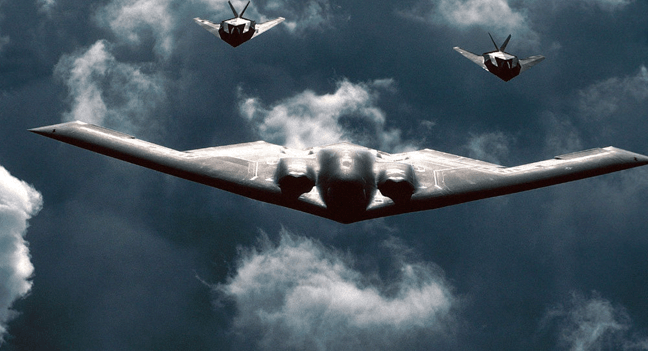
The US sent a nuclear-capable B-2 stealth bomber from Whiteman Air Force Base in Missouri on a long-range mission to the Pacific this weekend, The Sun, By Sam Webb, 31st October 2017,
RUSSIA and the US have flown nuclear bombers near North Korea as tensions grow over tyrant Kim Jong-un’s atomic threats.
President Donald Trump sent a nuclear-capable B-2 stealth bomber from Whiteman Air Force Base in Missouri on a long-range mission to the Pacific this weekend.
And the Russian Defence Ministry today announced that US and Japanese jets escorted Russia’s missile-carrying Tupolev-95MS strategic bombers during flights over the Sea of Japan and the Pacific.
A spokesman said: “Two strategic bombers Tupolev-95MS of Russia’s Aerospace Force have carried out routine flights over international waters of the Sea of Japan and the western part of the Pacific Ocean.
At certain sections of the route the Tupolev-95MS crews were accompanied by a pair of F-18 fighters (of the US Air Force), and a pair of F-15, F-4 and F-2A fighters (of the Japanese Air Force).”
US nuclear arsenal to cost $1.2tn over next 30 years, independent CBO report finds https://www.theguardian.com/world/2017/oct/31/us-nuclear-arsenal-cost-cbo-report CBO finds total price tag marks 25% increase from previous estimate
Nuclear Posture Review under way and expected by end of the year, Guardian, Julian Borger 1 Nov 17, The cost of the US nuclear arsenal over the next 30 years will be over $1.2tn, even before any new weapons ordered by the Trump administration, and is unlikely to be affordable without cuts elsewhere in the defence budget, according to a independent congressional report.
The total price tag marks nearly a 25% increase from previous estimate, taking in the modernisation programme established under the Obama administration, which account for $400bn, the Congressional Budget Office (CBO) found. The costs would peak in the 2020s and the 2030s.
A new Nuclear Posture Review is under way and expected around the end of the year. Trump has repeatedly vowed to bolster the nuclear stockpile, and the defence department is reportedly considering the development of a low-yield warhead for a ballistic missile, and reintroducing a sea-launched cruise missile, among a variety of new options.
The CBO report warns that such new capabilities would increase the total bill for the US arsenal yet further.
“If these plans reach fruition, it would be the largest nuclear build-up since the Reagan administration. This is not affordable,” said Stephen Schwartz, an independent nuclear analyst and editor of the book, Atomic Audit: The Costs and Consequences of US Nuclear Weapons Since 1940.
Pursuing nuclear modernization will be challenging in the current environment,” the report said, adding that it would compete with parallel ambitions to upgrade the navy and the air force, and increase the size of the army.
It is the first comprehensive costing of the US nuclear weapons programme. The report offers three approaches for cost reductions to make it affordable. One would keep the programme as is currently planned but delay elements of it, bringing potential savings of 5%.
The second looks at ways of reducing the programme but keeping to the existing ceiling agreed with Russia of 1550 deployed strategic warheads. One variant of that approach examined by the CBO would be to do without one leg of the nuclear ‘triad’, intercontinental ballistic missiles (ICBMs) and keeping air-launched and sea-launched weapons. That would generate savings of 10%, the report said.
The third approach would incorporate a reduction of the deployed strategic stockpile to 1000 warheads, a cut the defence department under the Obama administration said could be made without affecting the US nuclear deterrent, which would save 5% to 11% of the total.
“The report blows apart the “do everything or do nothing” false choice repeatedly posited by Pentagon officials,” Kingston Reif, the director for disarmament and threat reduction policy at the Arms Control Association, said. “But perhaps the biggest contribution of new CBO nuclear cost study is the evaluation of options to manage and reduce the mammoth price tag.”
Reif added: “Meanwhile, the Trump administration is reportedly considering adding new weapons to the arsenal, which would increase the budget train-wreck odds, and undermine US security.”
The collapse happened at the Punggye-ri nuclear test site in the northeast of the country on October 10, according to Japan’s TV Asahi. The disaster has prompted fears of a massive radioactive leak which could spark a Chernobyl- or Fukushima-style disaster, The Sun reported.
A North Korean official said the collapse happened during the construction of an underground tunnel, South Korea’s Yonhap news agency reports.
Some 100 people are said to have been trapped by the initial tunnel collapse, with a further 100 lost in a second collapse during a rescue operation, Asahi reported.
Lee Eugene, a spokeswoman at South Korea’s unification ministry, said: “We are aware of the report but do not know anything about it.”
The accident is believed to have been caused by Kim Joing-un’s sixth nuclear test which weakened the mountain, according to the report. It was reported earlier this year that the mountain under which the base is believed to be hidden was at risk of collapsing and leaking radiation into the region.
Experts said if the peak crumbles, clouds of radioactive dust and gas would blanket the region, the South China Morning Post reported.
The Punggye-ri test site is carved deep into the side of Mount Mantap. Geophysicist Wen Lianxing and his team at the University of Science and Technology of China in Hefei, Anhui province, said they were “confident” underground detonations were occurring underneath the mountain.
They posted an analysis of data collected from more than 100 seismic monitoring sites across China.
This has narrowed down the location of Pyongyang’s nuclear tests with a margin of error of just 100m. They’ve all been under the same mountain.
Seismic data showed the underground test triggered an earthquake of magnitude 6.3, around 10 times more powerful than the fifth test a year ago.
Satellite images showed the blast caused numerous landslides around the Punggye-ri test site, according to the Washington-based 38 North monitoring project.
But Chinese nuclear weapons researcher and chair of the China Nuclear Society Wang Naiyan told the Morning Post a collapse could spark a major environmental disaster.
He said: “We call it ‘taking the roof off’. If the mountain collapses and the hole is exposed, it will let out many bad things.
“A 100 kiloton bomb is a relatively large bomb. The North Korean government should stop the tests as they pose a huge threat not only to North Korea but to other countries, especially China.”
Satellite photos taken just a day after the blast reveal new gravel and scree fields shaken loose by the blasts at an elevation of about 2205m.
Analysts said these appeared more numerous and widespread than those caused by previous detonations — which would be in keeping with the increased size of the bomb.
Wang said there are limited mountains in North Korea that are “suitable” to conduct a nuclear test.
He said if the North had simply drilled into the side of the mountain, this increased the risk of “blowing the top off”.
News of the tunnel collapse comes after it emerged Russia and the US have both flown nuclear bombers near the country as tensions grow over Kim’s nuke threats.
Nuclear devices are often tested underground to prevent radioactive material released in the explosion reaching the surface and contaminating the environment.
This method also ensures a degree of secrecy.
A test site is carefully geologically surveyed to ensure suitability — usually in a place well away from population centres.
The nuclear device is placed into a drilled hole or tunnel usually between 200-800m below the surface, and several metres wide.
A lead-lined canister containing monitoring equipment is lowered into the shaft above the chamber.
The hole is then plugged with gravel, sand, gypsum and other fine materials to contain the explosion and fallout underground.
The release of radiation from an underground nuclear explosion — an effect known as “venting” — would give away clues to the technical composition and size of a country’s device.
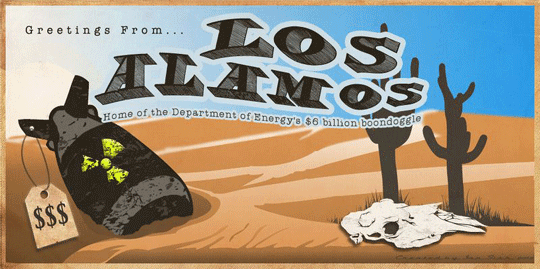
IT’S known as the birthplace of the atomic bomb. But a letter written to the bomb’s laboratory has us all extremely concerned. Matt Young@MattYoung, IN 2011 something alarming happened at a United States nuclear weapons laboratory that was deliberately kept quiet.
According to The Centre for Public Integrity, a pair of workers with “cavalier attitudes” at the Los Alamos National Laboratory stuffed “so much plutonium into a small space that they came close to triggering an accidental nuclear chain reaction, all to get some photos”.
“Plutonium is the unstable, radioactive, man-made fuel of a nuclear explosion, and it isn’t amenable to showboating,” it said. “When too much is put in one place, it becomes ‘critical’ and begins to fission uncontrollably, spontaneously sparking a nuclear chain reaction, which releases energy and generates a deadly burst of radiation.”
And it gets much, much worse.
Los Alamos National Laboratory in Santa Fe, New Mexico — responsible for the design of nuclear warheads — was a top secret facility during World War II and the birthplace of the atomic bomb.
But it is in a state of chaos — in fact, it has been for years.
A damning letter by the Defense Nuclear Facilities Safety Board, released this week and seen by news.com.au, said it had found “numerous weaknesses” in the lab’s safety standards dating back to 2014.
It had also failed recent safety tests indicating how it would respond to an emergency including radioactive leaks or earthquakes.
Referred as Project Y after it was established in 1943, the laboratory was one of a series of top secret labs in the United States given codewords to maintain secrecy at the time.
It was known as the “heart” of the nuclear project and was primarily responsible for the Manhattan Project, which developed the first ever nuclear weapons. The scientists within its labs were responsible for the creation of several atomic bombs, including the Fat Man, which was detonated in the Japanese city of Nagasaki in August, 1945.
It is also responsible for the hydrogen bomb.
Since the end of WWII, the lab continued its focus on bomb designs. It is still open today and is one of the largest science and technology institutions in the world with a focus on national security, space exploration and nuclear fusion, among other “non-war” technology.
“Though the world is rapidly changing, this essential responsibility (nuclear) remains the core mission,” it states on its website.
It is also “responsible for the safety, security, and effectiveness of the nuclear explosive packages in the stockpile”.
But over the years, more and more mistakes have begun to leak from its labs, with critical, radioactive material breached, dumped and mishandled.
Last week, the US Department of Energy, which is responsible overseeing the United States’ nuclear arsenal, put out a final request for proposals to manage the site.
UN Nuclear Inspections Chief Sees No Problems Checking Facilities In Iran, Radio Free Europe, 1 Nov 17,United Nations nuclear inspectors have encountered no problems in checking facilities in Iran to determine whether Tehran is complying with the 2015 nuclear deal, the head of the UN’s atomic energy agency has said.
“Our inspectors are discharging their responsibilities without problem,” International Atomic Energy Agency chief Yukiya Amano told reporters in Abu Dhabi on the sidelines of a conference on nuclear power on October 30…….
Amano on October 30 repeated his assessment that Tehran is keeping its commitments under the agreement one day after stating that conclusion after meeting with Iranian leaders in Tehran.
OVER a month ago 122 nations took the decisive step to bring the world closer to the shared aspiration of a nuclear weapons-free world. The Philippines, along with the other Asean members, was proud to be part of the historic moment that saw the adoption of the Treaty for the Prohibition of Nuclear-Weapons—a landmark agreement that strengthens the nuclear disarmament architecture, fulfills the goal set out in the Treaty on the Non-Proliferation of Nuclear Weapons, and delegitimizes once and for all the use of nuclear weapons.
The treaty represents the universalization of the Philippines’s fervent hope to put nuclear weapons firmly on the path of extinction, as set forth in its constitution and in the Treaty on the Southeast Asian Nuclear Weapons-Free Zone.
During the negotiations on the nuclear-weapons ban, the Philippines championed the inclusion of nuclear testing in the list of prohibited acts. It proposed language that would have committed States Parties to undertake not, and I quote, “to carry out any nuclear-weapon test explosion or any other form of nuclear-weapons testing.” However, as treaty negotiations go, the language proposal was watered down.
Be that as it may, what is important is that, under the nuclear- weapons-ban treaty, States Parties undertake not to conduct nuclear- weapons tests. With this, the act of nuclear-weapons testing is effectively declared illegal under international law.
The Philippines looks forward to signing the Treaty on the Prohibition of Nuclear Weapons on September 20 and usher in this new phase in our collective goal for the complete, irreversible and verifiable elimination of nuclear weapons.
The Philippines’s long-standing position against nuclear testing was first articul ated on the international stage when it signed the Comprehensive Nuclear Test Ban Treaty in 1996. It lent its voice to the growing clamor that recognized the detrimental effect of nuclear testing to the environment and its horrific consequences to humankind, where the suffering of victims can span generations.
Today, as in the years past, we call upon the remaining eight fellow UN member-states to finally heed the humanitarian imperative against nuclear tests and exercise their role as responsible citizens of the global community by finally signing onto the Comprehensive
Nuclear-Test-Ban Treaty (CTBT), thereby ushering it into force. The forthcoming Conference on the CTBT is the most opportune time to do this. It happens to be on the same day when the Treaty on the Prohibition of Nuclear Weapons will be opened for signature.
The actions of the Democratic People’s Republic of Korea constitute a flagrant violation of Security Council resolutions and pose a clear and present danger to international peace and security. Its actions demonstrate the urgent need for the CTBT to enter into force. While the Philippines, along with its fellow Asean members, condemn DPRK’s missile tests, it underlines the need to establish the international legal landscape that expressly delegitimizes its actions—if only to clearly and unequivocally articulate the collective desire of the community of nations to put a stop to them once and for all.
U.S. sends nuclear-capable B-2 stealth bomber on mission in Pacific ahead of Trump visit to Asia, Japan Times, BY JESSE JOHNSON,STAFF WRITER, 29 Oct 17, The U.S. military sent a nuclear-capable B-2 stealth bomber from Whiteman Air Force Base in Missouri on a long-range mission to the Pacific area of operations over the weekend, it said Sunday, a day after Pentagon chief Jim Mattis highlighted rival North Korea’s “accelerating” atomic weapons program during a visit to South Korea.
The U.S. military’s Strategic Command said in a statement that the type of long-range mission conducted was to “familiarize aircrew with air bases and operations in different geographic combatant commands, enabling them to maintain a high state of readiness and proficiency.”
In a message likely intended to reassure Japan and South Korea ahead of U.S. President Donald Trump’s visit to Asia, which kicks off later this week, the statement also referred to the B-2 mission as “a visible demonstration of commitment to our allies and enhancing regional security.”
The flight path of the B-2 was unclear, and Strategic Command did not respond to a request for comment, but the last time one of the stealth bombers flew near the Koreas was during a rare show of force over the peninsula in 2013. Military experts say that any U.S. strike on North Korea would almost certainly involve the powerful bombers……..
The weekend flight of the B-2, which can carry conventional as well as nuclear bombs, comes just ahead of Trump’s Asia tour, which is scheduled to kick off with a visit to Japan between Nov. 5-7. That visit will include talks with Prime Minister Shinzo Abe that are expected to focus on the North Korean nuclear crisis……
On Saturday Mattis blasted North Korea for “outlaw” behavior and vowed that the U.S. would never accept a nuclear North.
“North Korea has accelerated the threat that it poses to its neighbors and the world through its illegal and unnecessary missile and nuclear weapons programs,” he said, adding that U.S.-South Korean military and diplomatic collaboration thus has taken on “a new urgency.”
channelling revenues ultimately funded by electricity consumers towards a joint civil-military national nuclear industry base
Evidence from Andy Stirling and Philip Johnstone: As the early part of the process of the BEIS Committee Brexit Inquiry has unfolded, the salience of this civil/military link is being further underscored in statements in which a number of relevant senior civil servants and ministers are confirming that the priority attached to UK military submarine capabilities is deeply entangled in strategic commitments to civil nuclear industry strategy 6 . Several possibly serious implications therefore arise in relation to the particular circumstances of Brexit.
Written evidence from the University of Sussex, Science Policy Research Unit (BRN0015)
We submit this evidence to the inquiry on Brexit and the Implications for UK Business.s. The content draws on a detailed submission by the same authors to the Public Accounts Committee (PAC), discussed at the PAC witness session on Monday 9 th October 2017, which informed illuminating exchanges with senior civil service witnesses to that Committee and was subsequently published by PAC 1 . A number of potentially important implications arise in relation to issues under discussion around Brexit.
2: This earlier evidence to PAC addressed the otherwise difficult-to-explain intensity of Government commitments to civil nuclear power in the face of growing recognition of the relative competitiveness of alternative UK low carbon energy investments. Multiple grounds were found for inferring that this persistent Government attachment is due, at least in part (and with no public discussion), to perceived needs to engineer a cross-subsidy from electricity consumers to help cover costs of a national nuclear industrial base that is deemed to be essential for maintaining UK military nuclear infrastructures 2 .
3: The issues that arise are central to the general remit of the BEIS Committee. For instance, this recent evidence to the PAC documents significant statements by the National Audit Office, which suggest that UK military nuclear infrastructures are being bolstered by revenue flows to UK industry strategy in other sectors 3 . Many statements in support of this interpretation are cited from defence policy discussions, acknowledging incentives to “mask” costs of military industrial strategy behind civil energy programmes 4 . As a result, it is evident that Government-negotiated, high-price, guaranteed long-term contracts for civil nuclear power, are channelling revenues ultimately funded by electricity consumers towards a joint civil-military national nuclear industry base, whose full costs probably could not otherwise feasibly be covered by defence budgets alone. Resulting implications for wider industry strategy and energy policy have received effectively zero Parliamentary or other policy scrutiny.
4: Much other evidence was presented in submission to PAC, concerning this evidently significant-buthidden influence on civil industry policy by military nuclear considerations 5 . As a result, it seems that undetermined but likely large cross-subsidies are being engineered from UK electricity consumers, in order to cover otherwise insupportable costs of military nuclear industry strategies. In the present evidence we outline key implications for the BEIS Committee inquiry on nuclear implications of Brexit
5: As the early part of the process of the BEIS Committee Brexit Inquiry has unfolded, the salience of this civil/military link is being further underscored in statements in which a number of relevant senior civil servants and ministers are confirming that the priority attached to UK military submarine capabilities is deeply entangled in strategic commitments to civil nuclear industry strategy 6 . Several possibly serious implications therefore arise in relation to the particular circumstances of Brexit.
6: First, there are well-documented general concerns that Brexit-related pressures on the UK industrial base are likely to have a particular impact on large infrastructure projects, specifically including new nuclear build. If these developments unfold, then pressures are likely to intensify around the interlinkages between UK civil and military nuclear infrastructures. With foregone opportunities for industry strategy in other sectors (like offshore wind), the these Brexit-related implications for UK industrial strategy are central issues for the BEIS Committee, which remain unexplored elsewhere 7 .
7: Second, there are concerns that the economic effects of Brexit may include current and possible continuing future depreciation of Sterling. If these effects transpire as variously predicted, then economic pressures will likely intensify to find ways to cross-subsidise growing military nuclear costs in some fashion that mitigates the impact on public spending. Brexit may thus exacerbate incentives to ‘mask’ otherwise-unbearable wider industrial costs of military nuclear submarine infrastructures behind strategic support for civil nuclear supply chains ultimately funded by electricity consumers 8 .
8: Third, there are prospects that demand for UK access to overseas specialist nuclear skills may be aggravated by Brexit-related constraints on labour movement. If this occurs, then competition can be expected to accentuate between recruitment needs for national civil and military nuclear industries. Since key military nuclear skills in particular must for obvious reasons be disproportionately UKbased, so Brexit may reinforce upward pressures on costs of military nuclear infrastructures and so help further increase the pressures for cross-subsidy documented in the earlier PAC evidence 9
9: Fourth, there is the likely effect of Brexit in reinforcing pressures towards Scottish independence. If this transpires, then strong opposition in Scotland to continued associations with the current UK nuclear weapons infrastructure, mean that Brexit will make it more probable that a move will be required of key military nuclear facilities away from Scotland. The result will be a very large Brexitrelated increase in military nuclear costs, further exacerbating pressures for cross-subsidies 10 . 10: We hope it is useful to draw these emerging issues to the attention of the BEIS Committee – both in relation to the above specific repercussions around Brexit and to their wider implications for UK energy strategies, industrial policy and more general qualities of national democratic accountability 11 . October 2017
Extensive references are given on the original document .
Trump team drawing up fresh plans to bolster US nuclear arsenal Congress and US allies briefed on progress of Nuclear Posture Review Pence: ‘There’s no greater force for world peace than the US nuclear arsenal’, Guardian, Julian Borger 29 Oct 17,
The Trump administration is working on a nuclear weapons policy that is intended to mark a decisive end to the era of post-cold war disarmament, by bolstering the US arsenal and loosening the conditions under which it would be used.
A draft of the new Nuclear Posture Review (NPR) was presented in September at a White House meeting between Donald Trump and his top national security advisers. Congress and US allies have been briefed on the progress of the new draft.
The document is still being debated with a target for completion by the end of this year or the beginning of next. Among the new elements under consideration are a low yield ballistic missile intended primarily to deter Russia’s use of a small nuclear weapon in a war over the Baltic states; a sea-launched cruise missile; a change in language governing conditions in which the US would use nuclear weapons; and investments aimed at reducing the time it would take the US to prepare a nuclear test.
Trump has frequently voiced his intention to build up the US arsenal. According to one report, he was outraged at a meeting with military leaders in July when he was shown a downward sloping graph of the US weapons stockpile since the cold war, and had to be talked out of ordering a tenfold increase.
The White House denied the report but it has repeatedly made clear it aims to adopt a more aggressive nuclear stance………
Like much else about Trump’s presidency, the new policy is aimed at erasing the legacy of his predecessor. Barack Obama began his administration with a major speech in Prague in April 2009, committing the US to disarmament and the eventual elimination of nuclear weapons globally………
On Thursday, Christopher Ford, special assistant to the president on weapons of mass destruction and counterproliferation, told a meeting on nuclear threats organised by the Ploughshares Fund: “The traditional post-cold war approach of seeking to demonstrate disarmament bona fidesby showing steady numerical movement towards elimination, while trying to avoid steps that could actually undermine US national security, has largely run its course and is no longer tenable, especially given evolving security conditions.
“So it’s time to explore alternative approaches – and we are.”
Ford did not provide further details, as he said the NPR was still being worked on. Several sources briefed on its progress said elements under consideration include:
A low-yield ballistic missile, possibly using the Trident D5 missile but using only the first, fission, part of its two-stage warhead.
Bringing back nuclear Tomahawk sea-launched cruise missiles, which were dropped from the arsenal in 2013.
Reducing the lead time the US would need to resume nuclear testing from its current level of three years.
A relaxation of constraints laid down in Obama’s 2010 NPR, which pledged the US would only used its nuclear weapons in “extreme circumstances to defend the vital interests of the United States or its allies and partners” and never against non-weapons states in compliance with their non-proliferation obligations.
Any change in the US arsenal would have to be approved by Congress, which controls the funding for the nuclear weapons programme and which is already concerned that its ballooning cost is eating away at conventional capabilities.
Jeremy Corbyn’s shadow minister for peace has said a Labour government would sign a global anti-nuclear weapons treaty that would effectively confine the Royal Navy’s Trident submarines to port. Fabian Hamilton MP, in comments that risk reigniting the party’s internal divisions over the future of the UK’s nuclear deterrent, told i that while the issue of
Trident was “dead in the water” as it had been approved by Parliament,
a future Corbyn government would sign a UN treaty that bans nuclear weapons
and prohibits their use.
British navy sailors on nuclear Trident submarine fired after failing drug tests, ABC News, 29 Oct 17,Britain’s navy has fired nine sailors serving on a nuclear-armed submarine after they tested positive for cocaine, the country’s defence ministry says.
The crew were from HMS Vigilant, one of four Royal Navy submarines which operate the Trident nuclear missile system.
“We do not tolerate drugs misuse by service personnel. Those found to have fallen short of our high standards face being discharged from service,” a Royal Navy spokesman said.
Military chiefs must find an extra £300 million in savings this year to
cover a rise in the cost of Britain’s replacement fleet of Trident
submarines, The Times can reveal. The army is set to take a hit, with
commanders ordered to make at least £100 million of efficiency savings on
top of hundreds of millions of pounds that have already been squeezed out
of threadbare budgets for training, maintenance, accommodation and travel. https://www.thetimes.co.uk/article/forces-must-find-300m-for-rising-trident-costs-bmxnl9