Ironically, an Obama-era nuclear agreement with Russia went into full effect Monday. It was aimed, like previous agreements forged by the Reagan and George W. Bush administrations, to defuse the possibility of just such a cataclysmic “Great Power” conflict. Under the terms of the New START treaty, as it’s known, both Russia and the United States are committed to deploying no more than 1,550 nuclear warheads. There’s a strict verification regime on both sides, and proponents of the pact say those inspections have built confidence in the otherwise severely strained U.S.-Russia relationship.
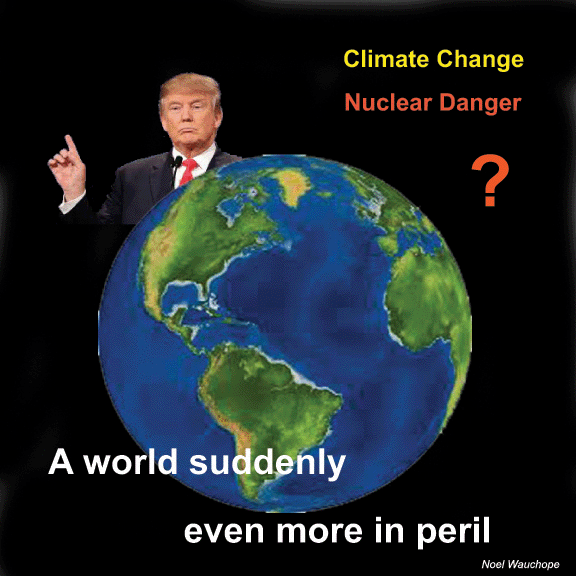
Trump’s nuclear policy is taking us back to the Cold War, WP By Ishaan TharoorFebruary 6 2018 The Trump administration has touted its new nuclear policy, released at the end of last week by the Pentagon, as a tough, realistic assessment of foreign threats and U.S. capabilities. The Nuclear Posture Review, the first to be conducted since 2010, purportedly describes “the world as it is, not as we wish it to be” — and calls for an expansion of America’s nuclear arsenal to confront the evolving capabilities of other nuclear powers.
Rep. Mac Thornberry (R-Tex.), chairman of the House Armed Services Committee, echoed the administration’s recommendations to increase the stockpile of “low-yield” nuclear weapons — armaments that could still wipe out whole cities — and deploy a number of these warheads on submarine-launched intercontinental ballistic missiles as a sign of American intent. “The U.S. must recognize the reality of a return to great power competition and posture itself accordingly,” he wrote in an op-ed for Defense News.
President Trump also plugged the new approach during last week’s State of the Union address.
Though boosters of the administration’s nuclear agenda frame it as a continuation of long-standing American policy, it is a marked reversal from the strategy of Trump’s predecessor. “The previous administration’s policy hinged on what President Barack Obama called a moral obligation for the United States to lead by example in ridding the world of nuclear weapons,” wrote my colleague Paul Sonne. “Officials in the Trump administration and the U.S. military argue that Obama’s approach proved overly idealistic, particularly as relations with Moscow soured. Russia, China and North Korea, they say, all advanced their nuclear weapons capabilities instead of following suit.”
Skeptics of the Trump administration’s embrace of nuclear weapons argue that they won’t be able to credibly deter the sort of low-level aggression carried out by countries like Russia in Eastern Europe and North Korea in northeast Asia. The strategy seems to embrace the weapons more for their own sake than any utility they might provide.
“The document reads less like a strategy of how best to deter threats to the United States and its allies and more like a piece of advocacy for nuclear weapons — a self-conscious defense of their utility, affordability, and an effort to expand their mission. It is less a Pentagon policy document than a memo from a powerful lobby,” wrote Adam Mount, a senior fellow at the Federation of American Scientists. “Rather than working to reduce nuclear dangers, the nation’s nuclear policy now reflects the reasoning of U.S. adversaries and readily follows them into a more dangerous world.”
Joe Cirincione, president of the Ploughshares Fund, which pushes for global disarmament, warned that the new nuclear posture also gives Trump wider scope to order nuclear strikes. That’s something a majority of Americans don’t trust him with, according to a recent Washington Post poll.
“The authors spend pages arguing that the world has grown exponentially more dangerous due to the weakness of Trump’s predecessors,” Cirincione said in a recent op-ed. “They completely ignore the agreements that decreased Russian arsenals, rolled back and froze Iran’s nuclear program, and eliminated and secured tons of nuclear material from terrorists. The Nuclear Posture Review paints a world of terrifying ‘Great Power’ conflict.”
Ironically, an Obama-era nuclear agreement with Russia went into full effect Monday. It was aimed, like previous agreements forged by the Reagan and George W. Bush administrations, to defuse the possibility of just such a cataclysmic “Great Power” conflict. Under the terms of the New START treaty, as it’s known, both Russia and the United States are committed to deploying no more than 1,550 nuclear warheads. There’s a strict verification regime on both sides, and proponents of the pact say those inspections have built confidence in the otherwise severely strained U.S.-Russia relationship.
But there’s little indication that the Trump administration has much interest in extending the agreement beyond 2021, when it is set to expire. Critics say that’s a scary prospect. “Even in this environment, as long as Russia complies, extension is critical,” wrote John F. Kerry, the former secretary of state, who as a senator marshaled support for the treaty’s passage through Congress. “To let one of the last elements of constructive engagement expire with no follow-on process would ignore the hard-fought lessons of the Cold War. It would court nuclear competition that brings neither stability nor security.”
ndeed, experts warn that the climate of nuclear competition ushered in by Trump could risk a new global buildup of nuclear weapons that offers little strategic gain.
“Risking a new nuclear arms race, as is now likely and would be even more so should New START be allowed to expire without a replacement in hand, would divert American resources away from our conventional advantage, and bring us no additional security,” wrote Jon Wolfsthal, a nonresident fellow at Harvard University’s Belfer Center for Science and International Affairs and a former Obama administration official. “It would also repeat the great mistakes of the Cold War when we learned that arms races and nuclear wars cannot be won, and are better left unfought.” https://www.washingtonpost.com/news/worldviews/wp/2018/02/06/trumps-nuclear-policy-is-taking-us-back-to-the-cold-war/?utm_term=.4f13c0dbcc63
Mattis has flipped on nuclear weapons since the Pentagon decided to take on China and Russia, Business Insider, ALEX LOCKIE, FEB 6, 2018
Secretary of Defence Jim Mattis used to question the US’s nuclear arsenal and had called for certain elements to be removed or reduced.
But since joining the Trump administration, Mattis has seemingly reversed his position, and he now supports building more.
Mattis’ U-turn suggests he has gained information that nuclear weapons will become important as the Pentagon confronts China and Russia.
The retired US Marine Corps Gen. Jim Mattis used to doubt the need for the US’s massive stockpile of nuclear weapons, but he has changed his tune since joining President Donald Trump’s administration as secretary of defence.
In 2015, Mattis questioned whether the US still needed ground-based intercontinental ballistic missiles, as he found the risk of accidental launches a bit troubling. When the Senate was confirming him as Trump’s secretary of defence, Mattis refused to offer his support for a program to update the US’s air-launched nuclear cruise missile.
But now Mattis has signed off on a new nuclear position that not only will modernise the ICBMs and cruise missiles but also calls for the creation of two new classes of nuclear weapons…….
The nuclear review, rolled out this year along with new national defence and national security strategies, points to a US more focused on combating major powers like Russia and China. Before joining the president, Mattis openly questioned the purpose of US nukes: Do they exist only to deter attacks? Or do they have an offensive value?
Heather Nauert , Department Spokesperson, Washington, DC, February 5, 2018
The United States of America and the Russian Federation have implemented the Treaty on Measures for the Further Reduction and Limitation of Strategic Offensive Arms (New START Treaty) for seven years. February 5, 2018 marks the date that the Treaty’s central limits on each country’s strategic nuclear arsenal take effect.
The United States completed its reductions and achieved these limits in August 2017. The Russian Federation has repeatedly stated its commitment to the New START Treaty, including meeting the central limits, and we expect our upcoming data exchange under the Treaty to reaffirm that commitment.
Implementation of the New START Treaty enhances the safety and security of the United States and our allies and makes strategic relations between the United States and the Russian Federation more stable, transparent, and predictable; critically important at a time when trust in the relationship has deteriorated, and the threat of miscalculation and misperception has risen. The Treaty exemplifies an enduring commitment by both parties to cooperate on issues affecting the strategic relationship and international security. The United States looks forward to continuing implementation of the Treaty with the Russian Federation.
The United States and the Russian Federation will exchange data on their respective strategic nuclear arsenals within the next month, as we have done twice per year over the last seven years in accordance with the Treaty. Through the Treaty’s verification regime, which includes short-notice, on-site inspections at military bases and facilities, the United States is able to verify the data provided by the Russian Federation regarding its strategic nuclear arsenal. The verification regime provides both countries insight into each other’s strategic nuclear delivery systems, warheads, and facilities, as well as data exchanges to track the status and makeup of nuclear weapons systems.
The recently released U.S. Nuclear Posture Review notes that arms control can contribute to U.S. security by helping to manage strategic competition among states. The United States remains committed to arms control efforts that advance U.S., allied, and partner security. The United States will continue to fully implement the New START Treaty and remains committed to working with others, including the Russian Federation, to create the conditions to support the ultimate goal of the global elimination of nuclear weapons. The New START Treaty remains a critical component for supporting global non-proliferation efforts and strategic stability between the United States and the Russian Federation. Through implementing the New START Treaty, the United States continues to demonstrate its commitment to fulfilling its arms control obligations, including under the Treaty on the Non-Proliferation of Nuclear Weapons.
China’s plan to use artificial intelligence to boost the thinking skills of nuclear submarine commanders
Equipping nuclear submarines with AI would give China an upper hand in undersea battles while pushing applications of the technology to a new level, SCMP, Stephen Chen, 05 February, 2018, China is working to update the rugged old computer systems on nuclear submarines with artificial intelligence to enhance the potential thinking skills of commanding officers, a senior scientist involved with the programme told the South China Morning Post.
A submarine with AI-augmented brainpower not only would give China’s large navy an upper hand in battle under the world’s oceans but would push applications of AI technology to a new level, according to the researcher, who spoke on condition of anonymity because of the project’s sensitivity.
“Though a submarine has enormous power of destruction, its brain is actually quite small,” the researcher said.
While a nuclear submarine depends on the skill, experience and efficiency of its crew to operate effectively, the demands of modern warfare could introduce variables that would cause even the smoothest-run operation to come unglued.
For instance, if the 100 to 300 people in the sub’s crew were forced to remain together in their canister in deep, dark water for months, the rising stress level could affect the commanding officers’ decision-making powers, even leading to bad judgment.
An AI decision-support system with “its own thoughts” would reduce the commanding officers’ workload and mental burden, according to the researcher……….
Up till now, the “thinking” function on a nuclear sub, including interpreting and answering signals picked up by sonar, a system for detecting objects under water by emitting sound pulses, has been handled almost exclusively by human naval personnel, not by machines.
Now, through AI technology, a convolutional neural network undergirds so-called machine learning. This structure underpins a decision support system that can acquire knowledge, improve skills and develop new strategy without human intervention.
Why the military wants $716 billion from Congress,The Hill , BY REBECCA KHEEL – 02/04/18The Trump administration is poised to ask Congress for $716 billion for defense for fiscal 2019, a major hike that budget analysts say aligns with administration’s stated goals of bulking up the military and preparing it to potentially fight near-peer rivals after years of focusing on terrorism.
“A total of $716 billion means that they are putting themselves on the trajectory for a big buildup in military power,” said Todd Harrison, a defense budget expert at the Center for Strategic and International Studies. “The caveat, though, is to really carry out the plans that they talked about in the past, you wouldn’t just need 7 percent growth in [fiscal] ’19; you would need similar levels of growth in the years following.”
President Trump came into office pledging to rebuild what he described as a “depleted” military. …..
“I’m not subtle,” Mattis told House and Senate Republicans on Thursday at their annual retreat at The Greenbrier resort in West Virginia.
“I need to make the military more lethal. Some people think I’m supposed to be an equal-opportunity employer,” Mattis added, according to several sources in the closed-door meeting.
Mattis told reporters at the Pentagon on Friday that he is “very happy” with the $716 billion request for next year.
Marzhan Nurzhan has a mission. The 25-year-old from Kazakhstan is rallying global youth to tackle one of the biggest threats to her generation. But time may be running out.
On Jan. 25, partly in response to North Korea’s recent weapons tests, international scientists moved the hands of the “Doomsday Clock” — a symbolic gauge that measures the risk of nuclear war — to 11:58. It’s the closest to midnight we’ve been since 1953.
Midnight represents Armageddon.
Nurzhan has been an international advocate for nuclear disarmament ever since she learned of the impact nuclear weapons had on her country. Two million Kazakhstanis still suffer cancer and birth defects, the fallout from decades of Soviet weapons tests.
While many international organizations are active on nuclear disarmament, advocates such as Nurzhan face a major challenge getting ordinary people engaged, especially youth.
During the Cold War, public demonstrations against nuclear arms were common. Today, not so much. Increased threats haven’t increased public interest, says Nurzhan.
Rob van Riet, peace and disarmament co-ordinator for the World Future Council, says: “[Nuclear disarmament] feels too large for a lot of people and they feel powerless.”
Issues such as climate change are daunting, but tangible. Ordinary citizens can contact politicians, demanding policies that reduce emissions.
More importantly, people have at least some control over their household energy use. But making superpowers give up their huge arsenals, let alone influencing a rogue state such as North Korea, seems unattainable.
Still, Nurzhan and Van Riet insist ordinary people can help reduce the global risk of nuclear conflict.
A powerful tool is divestment. The U.S., Russia and China want to upgrade their aging nuclear arsenals, and develop new types of smaller weapons that could be used on the battlefield. The companies that build parts for those bombs are supported by investors such as pension funds, and even our personal RRSP funds.
We can pressure investors to drop these companies from their portfolios, pushing them to get out of the bomb business.
Canada is uniquely positioned to be a leader in nuclear disarmament. As climate change makes Arctic waters more accessible to submarines, Russia and the US increasingly see the north as a key part of their nuclear strategy, according to van Riet.
As a respected Arctic nation, Canada could lead the campaign to make the region a nuclear-free zone.
Likewise, with public pressure, Canada could play a diplomatic leadership role and insist that all nuclear states follow the example of China and India and declare a “no first use” policy.
This would reduce the risk of conventional conflicts escalating into nuclear war.
But if Canada is to be that leader, we have to make it a priority for our government. Prime Minister Justin Trudeau has been conducting town halls across the country — a great opportunity to raise the issue, notes Douglas Roach, a former Canadian senator and Ambassador for Nuclear Disarmament.
“If he’s not hearing from people, he’s going to think people don’t care.”
The Cold War might be a distant memory, but its terrifying ghost still haunts us.
It’s time for us to engage again on nuclear disarmament.
The clock is ticking.
Craig and Marc Kielburger are the co-founders of the WE movement, which includes WE Charity ME to WE Social Enterprise and WE Day. For more dispatches from WE, check out WE Stories.
Days Past: Are you a Downwinder? , Shannon Williams, The Courier, 4 Feb 18 Downwinder: this term has become well known in Yavapai County. Downwind radiation exposure has been cited in many cancer diagnoses and blamed for the deaths of many long-term residents of the county.
How did this happen? During the Cold War, the U.S. government built a huge nuclear arsenal. Above-ground testing began in 1951 at the Nevada Test Site, where over 100 nuclear bombs were detonated through 1958. All nuclear testing stopped in 1958 by agreement among the United States, the United Kingdom and the USSR.
The government detonated several above-ground devices in July 1962. This was the last time nuclear weapons were tested above ground. Nuclear testing continued below ground at the Nevada Test Site. From Jan. 21, 1951, to Oct. 31, 1958, and June 30, 1962, to July 31, 1962, when above-ground testing was conducted, were later designated as Downwind time periods.
After the 1962 testing period, many of the workers at the test sites and local residents filed class action lawsuits alleging exposure to known radiation hazards. All of the suits were dismissed by the courts. Congress responded by creating the Radiation Exposure Compensation Act (RECA) on Oct. 5, 1990. The Act was then expanded in 2000, when the Radiation Exposure Screening and Education Program (RESEP) was created. RECA provides monetary compensation as an apology to individuals who developed certain cancers after their exposure to radiation. RECA authorized the payment of $50,000 to individuals who lived downwind from the Nevada Test Site and developed one of the specified diseases.
Congress designated several counties in Nevada, Utah and Arizona as areas impacted by the radiation exposure. In Arizona, the Downwind-eligible counties include Apache, Coconino, Gila, Mohave (above the Grand Canyon), Navajo and Yavapai………
Many local residents have been affected by these nuclear tests, as we now know. Perhaps the most well-known was longtime Prescott resident and former City Council member John Hanna, who died of non-Hodgkin’s lymphoma in October 2013 – which the government has acknowledged was likely caused by radiation from nuclear testing. Quoting from the book “Downwind: A People’s History of the Nuclear West,” by Sarah Alisabeth Fox: “Many families” in the areas affected by fallout “kept livestock and gardens or bought meat, milk, and produce from their neighbors, unwittingly gathering radiological contamination … and placing it on their dinner tables.”
To file a RECA claim, individuals need to provide documentation to show physical presence in the Downwind counties for two years during the Downwind time periods.
In addition, individuals need to establish their diagnosis of a compensable cancer. Compensable diagnoses include leukemia, multiple myeloma, lymphoma, and cancers of the thyroid, lungs, esophagus, and breast, among others. Applicants do not need to provide causation on their cancer diagnosis. They only need to gather medical records that show proof of the eligible cancer.
RECA expires on July 9, 2022. All Downwinder RECA claims must be submitted before this date.
Join Shannon Williams, health promotions manager with RESEP, when she presents “Downwinders Program: Are You Eligible?” at 2 p.m. Saturday, Feb. 10, at Sharlot Hall Museum. Come early, as seating is limited.
A nuclear first strike of North Korea is ‘tempting’, says legendary U.S. diplomat Henry Kissinger as Kim Jong-un warns Trump is pushing towards war, Daily Mail, 2 Feb 18
Kissinger, 94, warned that North Korean denuclearization was vital
He said that relations with Kim Jong-un’s country have reached a key juncture
The U.S. must now choose between pre-emptive military action or increasingly tighter sanctions, he said
His warning came before North Korea warned that the U.S. is pushing the whole world towards a ‘nuclear war’
By Alastair Tancred For Mailonline and Afp 3 February 2018
Former Secretary of State Henry Kissinger has said that the temptation to launch a pre-emptive strike on North Korea ‘is strong and the argument rational’.
He told a meeting of the Senate Armed Services Committee last week that North Korea poses the most immediate threat to global security, arguing that denuclearization of the regime must be a ‘fundamental’ American foreign policy goal.
The veteran diplomat was speaking before North Korea warned that the U.S. is pushing the whole world towards a ‘nuclear war’ in its latest letter submitted to the UN.
Former U.S. secretary of state Henry Kissinger), former secretary of state George Shultz, and former deputy secretary of state Richard Armitage, were testifng before the Senate Armed Services Committee on global security challenges
It said that joint military exercises between the U.S. and South Korea – coupled with American rhetoric in the Korean peninsula region – were bound to derail improving relationships between the two Koreas.
The Trump administration’s aims are ‘to provoke a nuclear war, which will undermine the improvement of inter-Korean relations and the easing of tensions,’ North Korean Foreign Minister Ri Yong Ho said in the letter to U.N. Secretary-General Antonio Guterres.
Mr Kissinger said that relations between the U.S, and north Korea had reached ‘a fork in the road’ in which the Trump administration may consider pre-emptive military action or increasingly tighter sanctions against Kim Jong-un’s regime.
‘We will hit that fork in the road, and the temptation to deal with it with a pre-emptive attack is strong, and the argument is rational, but I have seen no public statement by any leading official,’ President Nixon’s secretary of State told members of the Committee.
Kissinger, who at 94 continues to advise on foreign policy matters, joined two other foreign policy heavyweights – former Secretary of State George Shultz, 97, and ex-Deputy Secretary of State Richard Armitage, 72 — in testifying to the Committee about global security challenges.
The elder statesmen presented a picture of mounting international threats, including nuclear proliferation, Chinese authoritarianism, and Russia’s interference in US elections and its interventions in Eastern Europe.
Like President Donald Trump, the Pentagon’s new nuclear policy document sees a dark and threatening world. It argues that potential U.S. adversaries such as China, North Korea, and Russia are rapidly improving their nuclear capabilities and gaining an edge over the United States. But rather than laying out a plan to halt this slide into a more dangerous world and working to decrease reliance on nuclear weapons, the Nuclear Posture Review (NPR) hastens its rise by accepting the reasoning of U.S. adversaries and affirmatively embracing nuclear competition.
The central claim of the Nuclear Posture Review is that the United States must expand its reliance on nuclear weapons to protect the country and its allies—a complete reversal of the Obama administration’s effort to reduce reliance. To this end, the NPR proposes not only replacing an aging nuclear arsenal but further “supplement[ing]” it with two new missiles. It expands the circumstances in which the United States would consider employing nuclear weapons to include the ambiguously termed “non-nuclear strategic attacks” against infrastructure.
The review also includes a litany of other measures that could usher in a future in which nuclear competition is commonplace: increasing capacity to produce plutonium pits in case the United States urgently needs to expand its arsenal dramatically; training conventional forces to fight alongside nuclear ones; improving the readiness of the 150 or so nuclear weapons stationed in Europe for what had been symbolic reasons; and a new distrust of arms control measures, to name a few.
Uncharacteristically, the review contains several clumsy, contradictory, and misleading statements. For example, it gives opposing standards for deciding when the 1970s-era B83 1.2 megaton gravity bomb should be retired. Even prior to the review’s release, there were concerns that Trump’s retaliatory stance would raise the possibility of a disproportionate use of nuclear force, such as against a cyberattack. General Paul J. Selva, the nation’s second-ranking military officer, was forced to deny such claims as “fundamentally untrue.” (However, in expanding the nuclear mission to include the poorly defined category of “non-nuclear strategic attacks,” the document invites such an interpretation.) This kind of confusion surrounding the issuance of nuclear threats is frankly unacceptable, especially for an administration that also sends careless statements about its nuclear posture over Twitter.
One chart is so anxious to show that U.S. adversaries are advancing faster than the United States that it lumps together a range of dissimilar systems from the large Russian arsenal, the small Chinese arsenal, and the tiny North Korean arsenal. It lists highly advanced systems together with ones that have been indefinitely delayed, and even includes North Korea’s unproven missiles. When it comes to the United States, the chart omits myriad ongoing programs that have sustained and improved the world’s most capable nuclear force, as well as all of the upcoming programs to replace these systems with new ones.
On top of a pledge to carry out the Obama administration’s plans to “sustain and replace” nearly every system in the nuclear arsenal, the review calls for two “supplements”: a new option for a low-yield sea-launched ballistic missile (SLBM) and a new sea-launched cruise missile (SLCM) in lieu of the missiles removed from the fleet in the 1990s. Both are necessary, the NPR argues, because they “will help counter any mistaken perception of an exploitable ‘gap’ in U.S. regional deterrence capabilities.” Yet the review validates this perception by scrambling to fill that gap, stating that new flexible low-yield options are “important for the preservation of credible deterrence against regional aggression.” The statement weakens the credibility of U.S. strategic forces and signals to China, North Korea, and Russia that they should expect a low-yield strike to be met with a reciprocal and limited response (which they could consider an advantageous exchange).
Moreover, by taking this position, the NPR implicitly accepts the Russian belief that the lower yield of these weapons makes them more credible and more acceptable to use in regional wars. This is wrong for three reasons: first, even “low-yield” nuclear weapons are thousands of times more destructive than the largest conventional ones and risk contaminating huge swaths of allied or enemy territory; second, it is not at all clear that an adversary would be able to quickly ascertain that a nuclear detonation was a “low-yield” strike; and third, even if it could, it may not obligingly limit its response. Under such a theory, if Russia were reckless enough to carry out a small nuclear attack, the United States would have to shock it into restraint through nuclear retaliation. In relying on nonstrategic weapons for deterrence, the NPR exhibits the same mistaken logic that it worries is taking hold in Moscow.
The review neglects to make a compelling case for the necessity of its proposed systems. The claim that deploying a new SLCM could prompt Russia to retire its banned ground-launched cruise missiles is laughable. In general, generic language about “mistaken perceptions” is a thin justification for an expensive and potentially destabilizing new system. Just as the Air Force has struggled to make the case for why a new air-launched cruise missile is needed, the NPR fails to demonstrate that there are missions that cannot be performed by the existing systems and thus, that there is a need for new ones.
The review self-consciously insists that it “is not intended to, nor does it enable, ‘nuclear war-fighting.’ ” Yet the arguments about nonstrategic weapons and the capabilities of the proposed “supplements” enable the use of nuclear weapons in a limited regional war. The low-yield SLBM is apparently designed to promptly strike small and mobile targets such as an enemy’s mobile missile launcher or forward command post. If used this way, ballistic missile submarines, which were previously used for strategic deterrence, would also be able to perform battlefield missions.
Overall, the NPR reflects an outdated and simplistic view of deterrence. It argues that nuclear weapons provide unrivaled deterrent effects, so more options mean more deterrence. Today’s military planners, however, have a far more complex and nuanced understanding of deterrence. They plan to employ a range of capabilities across different domains to create a strategic effect appropriate to the specific threat. In some circumstances, issuing a nuclear threat may be necessary to deter an attack. Yet in other situations, it may be more credible and more compelling to threaten to defend against an attack or to impose unacceptable costs in the cyber-domain, in space, with sanctions, or with conventional weapons. No matter their yield or delivery method, nuclear weapons will never be seen as a credible deterrence to the kind of low-level aggression at which Russia and North Korea have proven adept.
This is part of the reason why the Obama administration sought to reduce reliance on nuclear weapons: if an objective can be met with conventional weapons it will be a more credible threat than a nuclear one. Yet the 2018 NPR explicitly says that “non-nuclear forces…do not provide comparable deterrence effects.” This says to our allies, “Don’t be assured by our conventional cooperation; demand nuclear commitments.” And it says to our adversaries, “Don’t be deterred by our conventional posturing; we are serious only when we make a nuclear threat.”
The tension between conventional and nuclear force also arises in the review’s approach toward funding the arsenal. Top defense officials have stated frankly that the Pentagon does not have a plan to pay the expected $1.7 trillion to update and operate the arsenal over the next 30 years. That figure will create serious tensions in a Pentagon wrestling with a dizzying array of other priorities: raising the readiness of U.S. forces, building new fleets of aircraft carriers, fighters, and attack submarines, and investing more funds in future research. Yet rather than attempting to solve the problem with cost the NPR dismisses it, declaring that nuclear weapons are “an affordable priority” comprising “a small fraction” of the defense budget. The fact remains that every dollar spent on a nuclear “supplement” is one that cannot be devoted to strengthening the service members who provide essential deterrence deployed around the world every day.
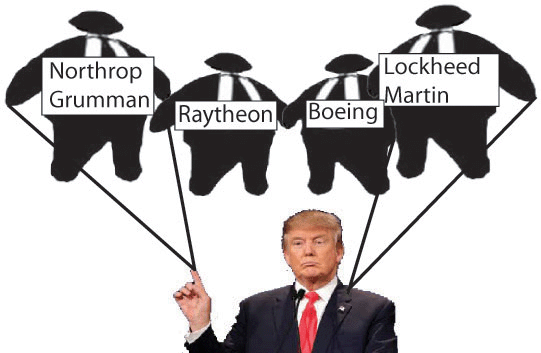
Each of the NPR’s failings derives in part from the structure of the review process itself, which considers nuclear weapons in isolation from other elements of American power. As a result, the document reads less like a strategy of how best to deter threats to the United States and its allies and more like a piece of advocacy for nuclear weapons—a self-conscious defense of their utility, affordability, and an effort to expand their mission. It is less a Pentagon policy document than a memo from a powerful lobby.
Future administrations would be better served by conducting a “deterrence posture review,” to explicitly consider the cost implications of its recommendations and to develop a strategy that uses all effective capabilities to deter aggression. This effort would encourage planners to integrate different levers of American power in their deterrence planning rather than to privilege one over others.
Yet the most significant problem with Trump’s Nuclear Posture Review is the slanted view it holds of the world and the obsolete theory of deterrence and war fighting that it promotes, which is so poorly suited to today’s threats. Rather than working to reduce nuclear dangers, the nation’s nuclear policy now reflects the reasoning of U.S. adversaries and readily follows them into a more dangerous world.
Buried In Trump’s Nuclear Report: A Russian Doomsday Weapon, NPR , February 2, 2018 GEOFF BRUMFIELToday, the Trump administration released a report on the state of America’s nuclear weaponry. The assessment, known as a Nuclear Posture Review, mainly concerns U.S. nukes and missiles.
But buried in the plan is a mention of a mysterious Russian weapon called “Status-6.” On paper, at least, Status-6 appears to be a kind of doomsday device. The report refers to it as “a new intercontinental, nuclear-armed, nuclear-powered, undersea autonomous torpedo.”
“The radius of total or near-total destruction is the size of a pretty large metropolitan area, actually,” says Edward Geist, a Russia specialist at the RAND Corporation who has spent time looking at the weapon. “It’s difficult to imagine in normal terms.”……
Status-6 looks like a giant torpedo about a third the length of a big Russian submarine. According to the slide, it is nuclear-powered, meaning it can roam for months and even possibly years beneath the ocean without surfacing. Its payload is a nuclear warhead “many tens of megatons in yield,” Geist says.
That’s thousands of times more powerful than the bombs dropped at the end of World War II and more powerful than anything currently in the U.S. and Russian arsenals.
Status-6 would launch from beneath a Russian submarine. It would shoot at a depth too deep to be intercepted, and travel for thousands of miles. Upon reaching its target along the U.S. coastline, it would detonate, swallowing up whatever city happened to be nearby.
“The only possible U.S. targets are large port cities,” says Mark Schneider, a senior analyst with the National Institute for Public Policy wrote in an e-mail. “The detonation of Status-6 in any of them would essentially wipe out their population into the far suburbs.”
“The detonation would cause a very large amount of radioactive fallout,” adds Pavel Podvig, an arms control expert who runs a blog called Russian Strategic Nuclear Forces. Podvig believes the weapon could potentially bathe the entire Northeast Corridor in radioactive soot.
Status-6 would probably be used as a “third-strike” weapon of last resort. If Russia fell under attack from the U.S. and couldn’t retaliate with its missiles, it might trigger Status-6: A doomsday machine. Or at least a doomsday-ish machine.
Then again, the whole thing might be a fake.
“The drawing of this drone looks more like an enlarged drawing of a smaller torpedo,” says Podvig. In other words, it looks like the Russians may have just taken some torpedo clip-art, blown it up to terrifying size and then broadcast it on state television.
Why?
“It’s a way to get our attention,” says Geist.
Geist says that the “leak” of Status-6 was deliberate. Russia worries that U.S. missile defenses might be able to shoot down its missiles in a nuclear war. By showing a plan for Status-6, Russia is warning the U.S. that if it continues to build such defensive systems, then Russia will find another way to strike: one that can’t be intercepted.
“My read of the whole Status-6 slide leak is that the Russians were trying to send us a message,” Geist says.
Podvig agrees that the leak of Status-6 is probably just a warning shot. But the fact it appeared in the Pentagon’s newest report on nuclear weapons shows that some war planners are taking the idea seriously.
There may be some politics involved in that decision as well, says Hans Kristensen of the Federation of American Scientists. The Trump administration is pushing hard for upgrades to America’s nuclear arsenal. In his State of the Union address, the president called for making the arsenal “so strong and so powerful that it will deter any acts of aggression by any other nation or anyone else.”
Citing Status-6 helps to build the case that upgrades to American nukes are needed, Kristensen says.
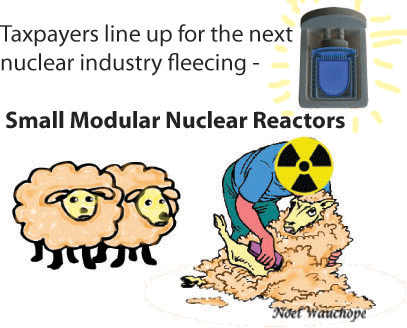
Report Urges Long-Term Power Agreements for SMRs at Federal Sites , Nuclear Energy InstituteFeb. 1, 2018—A new study funded by the U.S. Department of Energy recommends that federal agencies (such as DOE and the Defense Department) be allowed to enter into 30-year power purchase agreements with utility operators of small modular reactors (SMRs).
Typically defined as reactors having a generating capacity smaller than 300 megawatts-electric, SMRs are a good fit for sites like DOE’s 17 national laboratories, the study says.
For example, the Oak Ridge National Laboratory is the largest consumer of electricity among the agency’s sites and is engaged in several critical, round-the-clock defense and research-related activities………
“Leveraging the federal government’s strong credit standing as a purchaser of the power and its continual need for baseload power is important in the development of SMRs. Federal agency purchasers can help to set the market and offer more certainty to other initial buyers,” the study says.
“By creating an authority that permits federal agencies to purchase power for up to 30 years, SMR developers will be able to use traditional financing to repay a project financed project or a long-term bond over an up to 30-year term, making the financing more affordable.”
Currently, only the Department of Defense has the authority to enter into power purchase agreements of 30 years in duration, in certain circumstances.
The study urges moving the pilot project at Clinch River forward to completion……..
Another example of collaboration between a small modular reactor developer and a national laboratory is NuScale Power, of which the Utah Associated Municipal Power Systems (UAMPS) is planning to build up to 12 at the Idaho National Laboratory. Under this project, DOE or other federal entities could enter into power purchase agreements with UAMPS or its associated utilities. ……
Another example of collaboration between a small modular reactor developer and a national laboratory is NuScale Power, of which the Utah Associated Municipal Power Systems (UAMPS) is planning to build up to 12 at the Idaho National Laboratory. Under this project, DOE or other federal entities could enter into power purchase agreements with UAMPS or its associated utilities. ……
Oslo, Norway—From the indigenous communities exposed by remote nuclear tests, to activists living in bustling cities across the globe—a new resistance is growing. Peace Organizations worldwide have joined together to stand up to the nine nuclear-armed states in the form of the International Campaign to Abolish Nuclear Weapons, known commonly as ICAN. While many have hailed them for revitalizing the nuclear-disarmament movement, their greatest achievement to date is their influence on the creation of the Treaty on the Prohibition of Nuclear Weapons. This bold new step in disarmament stands out from previous anti-nuclear movements, because it went after a comprehensive ban. While it won’t as of yet directly eliminate a single nuclear weapon, as none of the current signatories have them, many believe it will significantly alter the nuclear-weapons industry.
The world’s powers remain at a crossroads. According to a recent Pew Poll, one of the few things Americans agree on today is that the nuclear threat coming from North Korea is real and should be taken seriously. On the other hand, the United Nations overwhelmingly voted to adopt a treaty that will prohibit nuclear weapons, and the disarmament movement, it seems, has never been more democratized. That is, ordinary people have never seemed to have such an impact on global affairs. So how can a campaign be awarded for its role in ridding the world of nuclear weapons when nuclear war seems so near?
The Norwegian Nobel Committee acknowledged ICAN’s role in the negotiations as the key factor for awarding it the Nobel Peace Prize for 2017. At this year’s ceremony, Berit Reiss-Andersen, chairman of the Nobel Committee, addressed critics of this movement: “Many people think that the vision of a nuclear weapons free world, global zero, is utopic, or even irresponsible. Similar arguments were once used to oppose treaties banning biological weapons, chemical weapons, cluster munitions and land mines. Nevertheless, the prohibitions became a reality and most of these weapons are far less prevalent as a result. Using them is a taboo.”
The Nobel chairwoman later invoked the words of Ronald Regan, saying, “A nuclear war cannot be won and must never be fought. The only value for our two nations possessing nuclear weapons is to make sure they will be never used, but then would it not be better to do away with them entirely?”
While many groups have come before them, ICAN is a unique coalition of people and organizations who have influenced governments to fill the crucial legal gap to nuclear disarmament, one they believe will help stigmatize and delegitimize these weapons as a valuable tool in global politics.
This global coalition has taken the reins of the disarmament movement that has been active since the 1940s. Its approach has engaged activists and diplomats in the global south, from countries that have been exposed to nuclear weapons and rejected them. ICAN democratized nuclear disarmament as an issue for anyone to take part in.
There are too many people in ICAN to profile in one article, so I dug through to find different representatives from different corners of the earth. Each brought their own backgrounds, medical, legal, social, and all came together over a decade ago to lobby for the ban.
In Australia, ICAN began with Felicity Ruby, Dimity Hawkins, Dr. Bill Williams, Dr. Tilman Ruff, and others who launched the global effort with a strong medical and scientific perspective. According to Dr. Kathleen Sullivan, a disarmament educator in the United States, and one of the campaign’s earlier members, “the initial thinking revolved around horror, humor, and hope—to amplify the need for a louder nuclear taboo, to educate the public, reignite the movement fueled more by what we love than what we fear.”
Ray Acheson, director of Reaching Critical Will, the disarmament program at the Women’s International League for Peace and Freedom (WILPF), was at the launch of ICAN in 2007 in Vienna, at a side event on the margins of the Non-Proliferation Treaty Preparatory Committee. “Originally the goal was to pursue a multilateral disarmament treaty with the nuclear-armed states’ support,” she explained, “but after these governments failed to implement their disarmament commitments and continued investing billions into nuclear-weapon modernization, our thinking shifted to go after a ban treaty instead.” While the nine nuclear-armed states and the NATO alliance show no signs of support for the treaty, ICAN helped design a treaty that didn’t need them, at least not at first. When Acheson appeared on Democracy Now!, the longtime member of ICAN’s International Steering Group said, “The treaty is actually designed not to include them necessarily. It would have been great if they had have come along, and it would have looked like a very different treaty. But given that they weren’t engaged in the negotiations and that they aren’t interested currently in disarmament, we needed to create something that could attack the system of nuclear weapons indirectly, getting around different economic, political, legal structures of nuclear weapons that keep the practices and policies of nuclear deterrence going currently.”
Tim Wright, director of ICAN Australia, was the very first volunteer back in 2006. Tim has advocated for ICAN in the Asia-Pacific region, and around the globe. According to Acheson, “He personally sat on the phone in New York and Australia and called individual countries to persuade them to join the humanitarian pledge against nuclear weapons, and will now do so for the treaty.” Wright, alongside a team of volunteers, also maintains the digital voice of ICAN, and constantly works to keep campaigners around the world informed and engaged with videos and social-media posts.
ICAN has inspired thousands of people around the world whose countries do not maintain nuclear arsenals to join the struggle for a nuclear-free world. Members like Drs. Peter Mburu and Kelvin Kibet of the International Physicians for Prevention of Nuclear War (IPPNW) have been moved by the devastating effects nuclear war would have on the planet, including in their hometown of Nairobi, Kenya. Mburu admits, “It is true we have bigger problems—extreme poverty, corruption, youth unemployment, but there is a question of justice. A few countries can form a cabal hoarding power under pretenses of global security. The effects of nuclear weapons are well-documented, and even a small detonation would indiscriminately affect far too many people, including people in my part of the world, albeit indirectly. That is unacceptable.”
The crater-scarred landscape of the Nevada Test Site. Most subsidences leave saucer-shaped craters are varying in diameter. 1995. This is the north end of Yucca Flat. Most tests have been conducted in this valley. From 1951 until 1958 119 atmospheric tests were conducted and from 1962 until 1992 more than 1,000 underground tests. Nye County, Nevada, USA. (PHoto by Galerie Bilderwelt/Getty Images)
Donald Trump Is Playing a Dangerous Game of Nuclear Poker , TIME, By W.J. HENNIGAN , 2 Feb 18 At a vast tract of uninhabited desert in southern Nevada, hundreds of moonlike craters dimple the wasteland, remnants of Cold War nuclear explosions that melted the bedrock and fused the sand to ensure that America could take part in the unthinkable: global thermonuclear war. The crowds of scientists and generals are long gone–the U.S. hasn’t tested a nuke since 1992, when then President George H.W. Bush declared a self-imposed testing moratorium. But the Nevada National Security test site is not completely abandoned. A skeleton crew of custodians oversees the long dormant facility, less than 90 miles northwest of Las Vegas, standing by to turn the lights back on if the day ever comes.
It may come sooner than many thought.
Since 1993, the Department of Energy has had to be ready to conduct a nuclear test within two to three years if ordered by the President. Late last year, the Trump Administration ordered the department to be ready, for the first time, to conduct a short-notice nuclear test in as little as six months.
That is not enough time to install the warhead in shafts as deep as 4,000 ft. and affix all the proper technical instrumentation and diagnostics equipment. But the purpose of such a detonation, which the Administration labels “a simple test, with waivers and simplified processes,” would not be to ensure that the nation’s most powerful weapons were in operational order, or to check whether a new type of warhead worked, a TIME review of nuclear-policy documents has found. Rather, a National Nuclear Security Administration official tells TIME, such a test would be “conducted for political purposes.”
The point, this and other sources say, would be to show Russia’s Vladimir Putin, North Korea’s Kim Jong Un, Iran’s Ayatullah Ali Khamenei and other adversaries what they are up against.
President Trump has not ordered such a test, but even the consideration of a show of force–by the nation that announced the atomic age by dropping nuclear weapons on Japanese cities in August 1945–marks a provocative shift from the sober, almost mournful restraint that has characterized the U.S. posture toward the weapons for decades. To prevent nuclear war and the spread of weapons to non-nuclear states, the strategy of Republican and Democratic Commanders in Chief alike has been to reduce nuclear arsenals and forge new arms-control agreements.
The Trump Administration, by contrast, is convinced that the best way to limit the spreading nuclear danger is to expand and advertise its ability to annihilate its enemies. In addition to putting the Nevada testing ground on notice, he has signed off on a $1.2 trillion plan to overhaul the entire nuclear-weapons complex. Trump has authorized a new nuclear warhead, the first in 34 years. He is funding research and development on a mobile medium-range missile. The new weapon, if tested or deployed, would be prohibited by a 30-year-old Cold War nuclear-forces agreement with Russia (which has already violated the agreement). And for the first time, the U.S. is expanding the scenarios under which the President would consider going nuclear to “significant non-nuclear strategic attacks,” including major cyberattacks………….
Rather than dissuading such efforts, arms-control experts from both political parties say, Trump’s moves will accelerate them. A new nuclear-arms race would not be limited to two superpowers seeking strategic balance in a Cold War but would include many nations, including foes in regions where hot wars are a regular occurrence. ………
Trump’s new plan also expands the President’s “first use” of nuclear weapons to circumstances that include “non-nuclear strategic attacks” against the U.S. or its allies. That could mean cyberattacks on nuclear command and control systems or civilian infrastructure, like the electricity grid or air-traffic-control system, arms-control experts have concluded. Previous Administrations limited the threat of a nuclear response to mass-casualty events, like chemical- and biological-weapon attacks. Stephen Schwartz, a nuclear weapons policy expert, said the key concern is the expansion of the nuclear umbrella to “include these new and not extreme possibilities, thus dramatically lowering the threshold for nuclear use.”
The Trump plan also takes a new, skeptical approach to nuclear arms-control agreements.
………. If Trump undoes the nuclear deal with Iran, analysts fear that Tehran will sprint for a weapon. Its regional rival Saudi Arabia could then develop its own atomic weapon, or import one from close ally Pakistan, which has its own fast-growing nuclear arsenal to counter arch-rival India’s. (Pakistan is building up its stockpile of tactical nuclear weapons.) China now has a nuclear-powered submarine, known as the Jin-class, that gives its military the ability to launch ICBMs from the sea……….. http://time.com/5128394/donald-trump-nuclear-poker/
North Korea: Trump administration’s ‘sloppy work’ in Nuclear Posture Review AT FIRST glance you might not see what’s wrong with this map used in Donald Trump’s nuclear review. But it has left some experts baffled. news.com.au , Debra Killalea, 1 Feb 18,
A DRAFT report of the Trump administration’s Nuclear Posture Review (NPR) has been slammed as embarrassing after featuring a graphic showing Debra Killaleaa very different looking North Korea.
The draft report, leaked two weeks ago, omits South Korea and instead shows the whole peninsula represented by the North’s flag.
Experts slammed the “sloppy work” in the report and said they hoped it would be corrected ahead of its final release tomorrow, US time.
Hans Kristensen, director of the Nuclear Information Project at the Federation of American Scientists, raised concerns about the map, tweeting the authors actually want to strengthen tailored deterrence.
The concerns over the graphic were echoed by Adam Mount, a senior fellow at the Centre for American Progress, who said the Pentagon could not release a policy document that failed to recognise South Korea.
He also slammed it as embarrassing and unforgivable, adding it was the latest in a series of “avoidable offences”.
South Korea is a major US ally with the two countries forging strong military and economic ties.
Two weeks ago, Mr Mount said the leaked review translates Mr Trump’s impulses into an order for new, more usable nuclear options. He also called it “strategically risky”.
The NPR is used to determine the role of nuclear weapons in the security strategy of the US.
‘EMBARRASSING’ ERROR
John Blaxland, Professor of International Security and Intelligence Studies and director of ANU’s Southeast Asia Institute, said the mistake was embarrassing but wasn’t worth reading too much into………
“There is a growing consensus among academic institutions and civil society organisations that the efficacy of nuclear weapons as a deterrent of state-on-state war has waned, if it ever worked effectively in the first place,” he said.
Prof Blaxland said some people argued it wasn’t the atomic weapons dropped on Japan in 1945 that led to Japan’s surrender but rather Russia’s declaration of war.
He also said the steps being proposed by the US today are likely to be extremely expensive and of dubious additional benefit…….
NO GOOD NUKE’
Critics are already warning the NPR could trigger another arms race and raise the risk of miscalculations that might spark an atomic conflict.
Beatrice Fihn, executive director of International Campaign to Abolish Nuclear Weapons (ICAN), said the Trump review raised some serious concerns.
“The risk of use for nuclear weapons has always been unacceptably high,” she said.
“The new Trump nuclear doctrine is to deliberately increase that risk. It is an all-out attempt to take nuclear weapons out of the silos and onto the battlefield.
“This policy is a shift from one where the use of nuclear weapons is possible to one where the use of nuclear weapons is likely.”
She also said there was no such thing as a good nuclear weapon.
CONCERNS GROW
The Union of Concerned Scientists has also raised some concerns about the review and has said the gap between China and the US is too wide to argue Washington is lagging behind in a significant way.
While acknowledging Beijing has made significant advances in its nuclear capabilities, it said China’s arsenal is smaller than the US had in 1950.
In a White Paper released last month, they also argue there’s little evidence China is pursuing “entirely new” nuclear capabilities.
The People for Nuclear Disarmament said the leaked NPR made global thermonuclear war more, not less, likely and global nuclear arms racing more probable.
Nuclear disarmament campaigner John Hallam said Mr Trump was looking for ways in which he could differentiate himself from, and take credit for, the immense expansion of US nuclear infrastructure initiated by former president Obama.
Mr Hallam said there is considerable continuity between the Obama and the Trump approach but there was a key difference.
“The only important difference — and it certainly is important — is that while under Obama, the direction of the US nuclear arsenal was officially down it is not officially up,” he said.
“Trump makes no bones about wanting to expand US nuclear capabilities. Never mind if they don’t need them. Never mind if it initiates an arms race or never mind if it makes an apocalypse more likely.
On 17 December 2017 Mexico became the fourth country to ratify the Treaty on the Prohibition of Nuclear Weapons.
This comes at a time where the World Economic Forum has recently disclosed that fear of a nuclear attack is one of the top things people all over the world fear most at the beginning of 2018.
This is a legitimate fear. With North Korea and the USA using threatening rhetoric about the size of their nuclear arsenals and stating that the nuclear option is on the table, who would have thought that the world would return to nuclear attack being a primary concern for so many people.
Now, more than ever, is the time to rally governments to ratify the Treaty on the Prohibition of Nuclear Weapons.
This treaty makes the production, transfer and selling of nuclear weapons illegal and if we had created and ratified this early, North Korea would not have been able to develop their nuclear weapons. But it is still not too late, over 50 states have already signed the treaty, the next step is for each state to ratify it, making it part of their national law. Once 50 states send the official letter saying they have ratified the treaty (known as an instrument of ratification) to the UN headquarters in New York, the treaty becomes law and every country in the world has to respect it, including North Korea.
North Korea is already facing crippling sanctions from the USA which will hinder it from its economic growth plans. Banning these weapons means that it will not be able to continue developing its nuclear weapons programme. Of course the other side of the coin is that USA, UK, India, Israel and Russia will also have to freeze their production and focus on creating a plan to denuclearize their arsenals. That would mean all states would essentially be getting rid of their nuclear capabilities together.