After the mass shooting in Las Vegas, the NRA is pulling ads supporting Republican candidates in Virginia, but not for long. The NRA is cynically pulling campaign ads in the wake of the mass shooting in Las Vegas — but only temporarily.
The gun extremists appear to believe that the country only needs eight days to forget about the worst mass shooting in modern American history, allowing them to exploit the gun issue to assist an ally.
According to Medium Buying, a firm that tracks ad spending, the NRA’s Political Victory Fund has postponed running ads that it planned to run in Virginia. Instead, the NRA will begin running its advertising on Oct. 10.
The group has endorsed Republican Ed Gillespie for Governor, along with his running mate Jill Vogel. The NRA is also backing John D. Adams, the Republican candidate for Attorney General.
The NRA praised Gillespie in an endorsement release in August, hailing him as “a leader in the growing national movement to expand our Second Amendment freedoms.”
Ralph Northam, the Democrat in the governor’s race, is an Army veteran and a hunter who has described himself as “a staunch advocate for commonsense gun safety laws.”
The NRA has often gone silent after mass shootings, as it has this time, with the hopes that it can wait out grief after the tragedy. Then, when the conditions are more favorable for its violent messages, the NRA promotes advertising that calls on gun owners to confront protesters with a “clenched fist.”
As the NRA cowers and tries to wait out the situation, groups like Moms Demand Action for Gun Sense In America are stepping up. Founder Shannon Watts released a statement on the shooting.
“I am sickened and heartbroken that, once again, American families will be torn apart by gun violence,” she said. “My thoughts are with the victims and their loved ones, whose lives will never be the same.”
She added, “While details are still unfolding, one thing is for sure: It doesn’t have to be this way. Americans should be able to go to concerts, to night clubs, to elementary schools and movie theaters without worrying about the threat of gun violence. While we grieve for the 50 people shot and killed and the more than 400 who are hospitalized, we must also act in their honor. Gun violence is preventable.”
The NRA doesn’t want anything done about gun violence in America because their ideal world is one in which the country is awash in firearms, no matter the risk to children and families. They go silent while still intending to back candidates who will enact their agenda unquestioningly.
But millions of Americans want something to be done, to stop attacks like the ones in Las Vegas, Charleston, Newtown, and so many other American cities and towns. And they will not be silenced.
Canada is missing its chance to shut the gate on nuclear weapons everywhere The Conversation, MV Ramana, Simons Chair in Disarmament, Global and Human Security at the Liu Institute for Global Issues, University of British Columbia, Lauren Borja, Incoming post-doctoral fellow, School of Public Policy and Global Affairs, University of British Columbia, University of British Columbia, Last month, the Treaty on the Prohibition of Nuclear Weapons (or the Ban Treaty) opened for signatures to all member states at the United Nations. The treaty is a product of sustained activism by civil society and key non-nuclear weapon states.
As researchers who study nuclear policy, we see this development as a landmark in the struggle to eliminate nuclear weapons.
The Ban Treaty would make it illegal for signatories to develop, produce, test, possess, use, threaten to use, or transfer nuclear weapons, among other restrictions.
Within days of being opened for signature, 53 countries have signed the treaty, and three have ratified. After signature and ratification by at least 50 countries, it comes into force.
The Ban Treaty was motivated by a clear recognition that the humanitarian impacts of nuclear weapons use and testing should be at the forefront of all discussions about these weapons. Dr. Tilman Ruff, co-president of International Physicians for the Prevention of Nuclear Wartestified at the United Nations in March: “An understanding of what nuclear weapons do invalidates all arguments for continued possession of these weapons and requires that they urgently be prohibited and eliminated as the only course of action commensurate with the existential danger they pose.”
The Ban Treaty, therefore, represents a shift in nuclear arms control, away from talking about nuclear weapons in terms of security and deterrence to focusing on the horrendous consequences of nuclear warfare.
This shift is reflected in the language of the Preamble of the Treaty which highlights concerns that the “catastrophic consequences of nuclear weapons” would “transcend national borders” and “pose grave implications for human survival.” The Treaty also posits that “complete” elimination “remains the only way to guarantee that nuclear weapons are never used again under any circumstances.”
Canada abandons traditional arms control emphasis
An emphasis on the humanitarian consequences, however, is not unique within arms control. Other forms of warfare, such as land mines, biological and chemical weapons, have also been outlawed because of such concerns. And such humanitarian concerns have often guided Canada’s diplomacy in the past, as illustrated by its leading role in the appropriately named Ottawa Convention to ban landmines……….
Looking ahead on nuclear disarmament
There has been widespread political support within Canada for being more active in furthering nuclear disarmament. In 2010, both the Senate and House of Commons unanimously adopted a resolution encouraging the Government of Canada “to engage in negotiations for a nuclear weapons convention” and “deploy a major worldwide Canadian diplomatic initiative in support of preventing nuclear proliferation and increasing the rate of nuclear disarmament.” The dynamic set off by the Ban Treaty offers a suitable opening for launching such an initiative.
In April of this year, Chrystia Freeland issued the following statement to mark the 20th anniversary of the entry into force of the Chemical Weapons Convention: “Twenty years ago today, the international community was united in denouncing the use of chemical weapons by anyone, anywhere, under any circumstance.”
When did nuclear disarmament become such a dirty word for the Tories? Guardian, Emily ThornberryUnlike her Conservative predecessors Theresa May won’t commit to the principle of a nuclear-free world – just so she can attack Jeremy Corbyn’s position
On this day, 65 years ago, near a remote island off the Australian west coast, a bomb was exploded in the hull of the empty navy frigate HMS Plym, its blast two-thirds more powerful than the one that destroyed Hiroshima. At that moment, Britain officially became the world’s third nuclear power.
Both Winston Churchill, who authorised the test, and Clement Attlee, who initiated it, believed its true significance lay not in increasing Britain’s military capabilities, but in further deterring the threat of nuclear war between Russia and the west, and ultimately in eradicating that threat.
Since that day in October 1952, 17 general elections have been held in Britain, and – while debates have often raged about a unilateral versus multilateral approach – the principle that the British government should always be working towards global disarmament has never seemed in doubt.
Until now, that is. Theresa May’s manifesto earlier this year was only the third by a sitting government since Britain got the bomb that made no mention at all of nuclear proliferation and the importance of arms control. And – unlike the two others – she had no excuse.
The previous exceptions to the rule were in February 1974, when Ted Heath tried to reduce his snap election to the single question “Who governs Britain?”; and 1997, when a fag-end Tory administration was barely going through the motions against New Labour.
But in every other case, the prime minister and government of the day treated it as almost a moral responsibility to make clear their long-term commitment to disarmament, often alongside a statement of their short-term plans to retain and renew Britain’s nuclear arsenal…….
So the question for the prime minister and her party is: “When did disarmament become such a dirty word?” Why are Jeremy Corbyn and the Labour party now derided for advocating policies that Tory governments once considered perfectly commonplace?……..
Look at the situation today, especially this summer’s volatile and unresolved standoff between Kim Jong-un and Donald Trump, and it is clear that the threat of nuclear conflict is definitely no less severe than in previous decades, and is arguably at its highest level since the early 1980s.
For past governments of all parties in Britain, that was the cue to step up their efforts on nuclear diplomacy, and commit to progress on disarmament. But from May, Boris Johnson and Michael Fallon, we hear the opposite, and the explanation is as depressing as it is straightforward.
They know that Corbyn – along with me and others – is a long-standing proponent of disarmament. They know that this issue has caused tension in the Labour party over the past two years. And they therefore regard any discussion of nuclear weapons simply as a chance to misrepresent Labour as soft and divided on defence.
In that context, the silence of the last Tory manifesto makes total sense; any commitment to make progress on arms control would have made it impossible for May’s attack dogs to tear holes in Labour for saying the same.
So this most unprincipled of prime ministers chooses to ignore the issue of disarmament simply for short-term political gain, something no sitting government has done since that massive blast 65 years ago on HMS Plym………
at least up until now, every government since Churchill’s has believed that – whatever the arguments that nuclear weapons are a necessary short-term deterrent – the only long-term and absolute guarantee of safety is to eliminate them entirely from the planet.
It should hardly be a surprise therefore for Labour’s leader to state that as his ambition, just as it was for Churchill, Macmillan, Thatcher, Major and Cameron. Indeed, the fact that Theresa May continues to attack Jeremy Corbyn for holding that principle is not just a massive departure from the standards of her postwar predecessors, but one of the many reasons she is not fit to stand in their – or his – company.
North Korean leader Kim Jong Un provides guidance on a nuclear weapons program in this undated photo released by North Korea’s Korean Central News Agency (KCNA) in Pyongyang September 3, 2017. KCNA via REUTERS
North Korea vows to become a ‘state nuclear force’, Aljazeera, 1 Oct 17
Pyongyang calls sanctions and pressure ‘futile’ in halting its development of nuclear weapons. North Korea’s state news agency has called the US-led effort to impose sanctions over its weapons programme futile, vowing the country inevitably will become a “state nuclear force”.
The comments on Sunday came from the Korean Central News Agency’s website Uriminzokkiri after US Secretary of State Rex Tillerson met for talks with China’s top diplomats and President Xi Jinping in Beijing on the Korean nuclear crisis.
Tillerson has been a proponent of a campaign of “peaceful pressure”, using US and UNsanctions and working with China to turn the screw on the regime.
In this documentary, Motherboard explores the life and legacy of the father of the hydrogen bomb. According to North Korea’s Foreign Minister, Kim Jong-un is considering testing its hydrogen bomb in the Pacific Ocean in response to rising tensions with President Trump. But in order to understand the significance of the hydrogen bomb, you need to understand the people who created it.
In a 2013 video documentary, Motherboard explored the life of Edward Teller: the father of the hydrogen bomb, and the inspiration for Stanley Kubrick’s character Dr. Strangelove.
According to Ralph Moir, Teller’s student and eventual colleague, Teller believed that scientists bear no responsibility for the use of their creations.
“He wanted to make a contribution to mankind, but he’s also very interested in science and anything new,” Moir told Motherboard in 2013. “It was patriotic to have a strong defense. But also, it was fascinating science.”
However, not everyone agreed with Teller. In the 1940s, this gave way to an ethical debate that split the world into two groups: Those who sided with Robert Oppenheimer, creator of the atom bomb, believed that a stronger successor to the atom bomb was dangerous and unnecessary. Those who sided with Teller believed in a benefit to building a weapon so destructive that it exists only in obsolescence.
The scientific community almost entirely sided with Oppenheimer, but President Truman sided with Teller. In 1952, the US successfully detonated the first hydrogen bomb.
Later in his life, Teller would help launch Plowshare, a US experiment for nuclear weapons use in building and construction. Teller also believed the US should invest in geoengineering, nuclear engines for spacecrafts, nuclear testing in space, and nuclear reactors powered by thorium rather than uranium. None of these ideas have yet come to fruition.
It’s been over a decade since his death, but Teller’s name remains controversial.
Trump Threatens Genocide, Crimes Against Humanity in North Korea, http://www.truth-out.org/news/item/42101-trump-threatens-genocide-crimes-against-humanity-in-north-korea, September 29,2017, By Marjorie Cohn, Truthout | News Analysis Donald Trump threatened to “totally destroy North Korea” in his address to the United Nations General Assembly on September 19. That threat violates the UN Charter, and indicates an intent to commit genocide, crimes against humanity, the war crime of collective punishment and international humanitarian law. Moreover, a first-strike use of nuclear weapons would violate international law.
By threatening to attack North Korea, Trump is endangering the lives of countless people. In the past, he has indicated his willingness to use nuclear weapons and Kim Jong-un has threatened to retaliate. The rapidly escalating rhetoric and provocative maneuvers on both sides has taken us to the brink of war.
Trump’s threat prompted North Korean foreign minister Ri Yong-ho to state, “Given the fact that this [threat] came from someone who holds the seat of the US presidency, this is clearly a declaration of war.”
Ri added, “Since the United States declared war on our country, we will have every right to make counter-measures, including the right to shoot down United States strategic bombers even when they are not inside the airspace border of our country.”
Such a move by North Korea would violate international law. But that does not justify US law-breaking. Two wrongs do not make a right. Moreover, the use of military force by either country would prove disastrous.
The UN Charter Requires Peaceful Dispute Resolution
After two world wars claimed millions of lives, the UN Charter was adopted in 1945 “to save succeeding generations from the scourge of war.”
The Charter mandates the peaceful resolution of international disputes and forbids the use of force except in self-defense or with Security Council authorization.
Article 2 requires that UN members “settle their international disputes by peaceful means in such a manner that international peace and security, and justice, are not endangered.” Peaceful means are spelled out in Article 33: Parties to a dispute likely to endanger international peace and security must “first of all, seek a solution by negotiation, enquiry, mediation, conciliation, arbitration, judicial settlement, resort to regional agencies or arrangements, or other peaceful means of their own choice.”
In 1953, after one-third of North Korea’s population was decimated, the United States and North Korea signed an armistice agreement. But the US never allowed a peace treaty to be adopted. North Korea has repeatedly advocated the signing of a peace treaty to formally end the Korean War. To this day, 30,000 US troops continue to occupy South Korea.
The US has also refused to pursue the “freeze-for-freeze” strategy suggested by China and Russia. Under this plan, North Korea would freeze its nuclear and missile testing, and the US and South Korea would end their annual, provocative joint military exercises. Vassily Nebenzya, Russia’s ambassador to the UN, said this path would offer “a way out” of the current situation.
Instead, the US has engineered punitive sanctions against North Korea, which have only strengthened the latter’s resolve to develop usable nuclear weapons. Since 1953, North Koreans have lived in fear of annihilation by the United States.
In his speech to the General Assembly, on top of his threats toward North Korea, Trump also issued a veiled threat to pull out of the Iran nuclear deal. That sends a dangerous message to North Korea that the US cannot be trusted to abide by its agreements.
The UN Charter Prohibits Threats and Preemptive Use of Force
Article 2 of the Charter states that all members “shall refrain in their international relations from the threat or use of force against the territorial integrity or political independence of any state.” Trump’s threat to totally destroy North Korea violates that mandate. In addition, the preemptive use of force violates the Charter.
The only exceptions to the Charter’s prohibition of the use of force are self-defense or approval by the Security Council.
Self-defense, under Article 51 of the Charter, is a narrow exception to the Charter’s prohibition of the use of force. Countries may engage in individual or collective self-defense only in the face of an armed attack. In order to act in lawful self-defense, there must exist “a necessity of self-defense, instant, overwhelming, leaving no choice of means, and no moment for deliberation,” under the well-established Caroline Case.
North Korea has not attacked the United States or another UN member country, nor is such an attack imminent.
Moreover, the Security Council has not authorized any country to use military force against North Korea The council resolutions that establish sanctions against North Korea end by stating the Council “decides to remain seized of the matter.” That means that the Council, and only the Council, has the authority to approve military action.
Both Trump’s threat to use military force against North Korea and the mounting of a preemptive strike would violate the Charter.
The Crime of Genocide
By stating the intention to totally destroy North Korea, Trump has threatened genocide.
The crime of “genocide,” as defined in the Rome Statute for the International Criminal Court, is committed when, with the intent to destroy, in whole or in part, a national, ethnical, racial or religious group, any of the following acts are committed: killing members of the group, causing serious bodily or mental harm to members of the group, or deliberately inflicting on the group conditions of life calculated to bring about its destruction in whole or in part.
Trump’s threat to totally destroy North Korea, if carried out, would destroy, in whole, the national group of North Koreans. That would amount to genocide.
Crimes Against Humanity
Under the Rome Statute, “crimes against humanity” include: the commission of murder as part of a widespread or systematic attack against any civilian population; or persecution against a group or collectivity based on its political, racial, national, ethnic or religious character, as part of a widespread or systematic attack against any civilian population.
Trump’s threat to totally destroy North Korea, if realized, would constitute a widespread and systematic attack against the civilian population of North Korea, which would amount to a crime against humanity.
The War Crime of Collective Punishment
The crime of “collective punishment” is a grave breach of the Fourth Geneva Convention, which is considered a war crime. Collective punishment means punishing a civilian for an offense he or she has not personally committed.
If Trump were to make good on his threat to totally destroy North Korea, he would be punishing the civilian population for offenses committed by the North Korean government. This would constitute the war crime of collective punishment.
Destroying North Korea Would Violate Distinction and Proportionality
The United States has a legal obligation to comply with the requirements of proportionality and distinction, two bedrock principles of international humanitarian law, as delineated in the First Protocol Additional to the Geneva Conventions.
“Proportionality” means an attack cannot be excessive in relation to the anticipated military advantage sought. “Distinction” requires that the attack be directed only at a legitimate military target.
The total destruction of North Korea would violate the principles of proportionality and distinction.
First-Strike Use of Nuclear Weapons Violates International Law
In its 1996 advisory opinion, “Legality of the Threat or Use of Nuclear Weapons,” the International Court of Justice (ICJ) determined that “the threat or use of nuclear weapons would generally be contrary to the rules of international law applicable in armed conflict, and in particular the principles and rules of humanitarian law.”
The ICJ went on to say, “However … the Court cannot conclude definitively whether the threat or use of nuclear weapons would be lawful or unlawful in an extreme circumstance of self-defence, in which the very survival of a State would be at stake.” That means that while the use of nuclear weapons might be lawful when used in self-defense if the survival of the nation were at stake, a first-strike use would not be.
Donald Trump’s apocalyptic threat against North Korea violates international law. It also imperils the lives of untold numbers of people. We must urge Congress to prevent Trump from launching a catastrophic war.
Copyright, Truthout. May not be reprinted without permission.
Marjorie Cohn is professor emerita at Thomas Jefferson School of Law, former president of the National Lawyers Guild and deputy secretary general of the International Association of Democratic Lawyers. Her books include The United States and Torture: Interrogation, Incarceration, and Abuse; Cowboy Republic: Six Ways the Bush Gang Has Defied the Law and Drones and Targeted Killing: Legal, Moral, and Geopolitical Issues. Visit her website: MarjorieCohn.com. Follow her on Twitter: @MarjorieCohn.
We may survive the Anthropocene, but need to avoid a radioactive ‘Plutocene’The Conversation, On January 27, 2017, the Bulletin of the Atomic Scientists moved the arms of its doomsday clock to 2.5 minutes to midnight – the closest it has been since 1953. Meanwhile, atmospheric carbon dioxide levels now hover above 400 parts per million.
Why are these two facts related? Because they illustrate the two factors that could transport us beyond the Anthropocene – the geological epoch marked by humankind’s fingerprint on the planet – and into yet another new, even more hostile era of our own making.
My new book, titled The Plutocene: Blueprints for a post-Anthropocene Greenhouse Earth, describes the future world we are on course to inhabit, now that it has become clear that we are still busy building nuclear weapons rather than working together to defend our planet.
I have coined the term Plutocene to describe a post-Anthropocene period marked by a plutonium-rich sedimentary layer in the oceans. The Anthropocene is very short, having begun (depending on your definition) either with the Industrial Revolution in about 1750, or with the onset of nuclear weapons and sharply rising greenhouse emissions in the mid-20th century. The future length of the Plutocene would depend on two factors: the half-life of radioactive plutonium-239 of 24,100 years, and how long our CO₂ will stay in the atmosphere – potentially up to 20,000 years.
During the Plutocene, temperatures would be much higher than today. Perhaps they would be similar to those during the Pliocene (2.6 million to 5.3 million years ago), when average temperatures were about 2℃ above those of pre-industrial times, or the Miocene (roughly 5.3 million to 23 million years ago), when average temperatures were another 2℃ warmer than that, and sea levels were 20–40m higher than today.
Under these conditions, population and farming centres in low coastal zones and river valleys would be inundated, and humans would be forced to seek higher latitudes and altitudes to survive – as well as potentially having to contend with the fallout of nuclear conflict. The most extreme scenario is that evolution takes a new turn – one that favours animals best equipped to withstand heat and radiation……….
If global warming were to reach 4℃, as suggested by Hans Joachim Schellnhuber, chief climate advisor to the German government, the resulting amplification effects on the climate would pose an existential threat both to nature and human civilisation.
Barring effective sequestration of carbon gases, and given amplifying feedback effects from the melting of ice sheets, warming of oceans, and drying out of land surfaces, Earth is bound to reach an average of 4℃ above pre-industrial levels within a time frame to which numerous species, including humans, may hardly be able to adapt. The increase in evaporation from the oceans and thereby water vapour contents of the atmosphere leads to mega-cyclones, mega-floods and super-tropical terrestrial environments. Arid and semi-arid regions would become overheated, severely affecting flora and fauna habitats.
The transition to such conditions is unlikely to be smooth and gradual, but may instead feature sharp transient cool intervals called “stadials”. Increasingly, signs of a possible stadial are being seen south of Greenland………..
Mounting our defence
Defending ourselves from global warming and nuclear disaster requires us to do two things: stop fighting destructive wars, and start fighting to save our planet. There is a range of tactics we can use to help achieve the second goal, including large-scale seagrass cultivation, extensive biochar development, and restoring huge swathes of the world’s forests.
Space exploration is wonderful, but we still only know of one planet that supports life (bacteria possibly excepted). This is our home, and there is currently little prospect of realising science fiction’s visions of an escape from a scorched Earth to some other world.
Nuclear bomb shelter sales are soaring due to North Korean threats, Yahoo Finance Daniel Howley Technology Editor, the saber rattling, coupled with North Korea’s stated objective of developing a nuclear-tipped missile capable of reaching the U.S. mainland, have plenty of people on edge.
And nowhere is that clearer than in the number of nuclear fallout shelters being purchased here in the U.S.
“We’re probably upwards of 1,000% from this time last year,” Gary Lynch, general manager of Rising S Company said of the number of bunkers his company has sold in 2017.
A size for everyone (sort of)
Texas-based Rising S Company, whose tagline is “Safe until the rising sun,” a nod to the Christian belief that the Second Coming of Christ will precede the end of the world, offers bunkers in a variety of price ranges. The base model is an 8 x 12-foot mini bunker for $39,500 while the top-of-the-line “The Aristocrat” luxury bunker, which features a bowling alley, gym, gun range, green house, pool and garage, goes for $8,350,000.
Sharon Packer, CEO of Utah-based Underground Shelters USA, says her company has seen sales of bunkers triple this year, with a significant increase taking place in the last six months. Packer, a nuclear engineer, says her company’s shelters can survive being within 1/4 of a mile from the blast crater of a 1-megaton nuclear bomb.
Underground’s best-selling shelter costs about $70,000 and gets you about 32 x 10 feet of space. Packer says you’d be able to stay in one of her company’s shelters for as long as you have access to clean water.
Brian Duvaul, sales manager with American Safe Room, a bunker company based in Oregon, explained that sales generally slow down around fall and winter as the ground becomes difficult to dig, but that so far this fall, sales are looking up…….
The analysis revealed a spike in strontium-90 levels in children born between 1954 and 1955. This coincided with a period of extensive nuclear testing that started in 1953. Among these children, strontium-90 levels were also found to be higher in those who were bottle-fed compared to those who were breastfed.
This observation further emphasized that the children were absorbing the radioactive element from the environment — picture acres of dairy farms showered with rain that has just passed through kilometers of atmosphere containing radioactive dust.
Experiments explained: Baby Tooth Survey In June 1963, shortly after publishing the first phase of the study, Dr. Eric Reiss, one of the main participating scientists, presented the findings in testimony before the American Senate committee. Two months later, the Partial Test Ban Treaty (PTBT) between the United States, the Soviet Union, and Britain was signed. This agreement prevented countries from performing test detonations of nuclear weapons, except for those conducted underground.
During a second phase of the study, a 50 per cent decline in strontium-90 was seen in children born in 1968, thanks in part to the PTBT that Franklin and her team helped bring about.
ZAHRA DANAEI/THE VARSITY, Humanity has been fundamentally transformed by the discovery of nuclear radiation and radioactive chemical elements. Marie and Pierre Curie discovered radium in the late 1890s, following Henri Becquerel’s discovery of radioactivity. Since then, World War I has led to the advent of the first X-ray machine, which treated injured soldiers, and World War II has brought upon the development of weapons of mass destruction.
Not long after, scientists began collecting radioactive baby teeth on American land: the unexpected aftermath of harnessing the unprecedented power of nuclear radiation.
One of those scientists was Ursula Franklin, the first female to receive the University Professor distinction at U of T in 1984. Franklin was an academic, an educator, a prolific writer, a highly vocal and active pacifist and feminist, but also held the lesser known titles of metallurgist, archaeometrist, practicing Quaker, and Holocaust survivor.
It is perhaps the result of her impactful social activism and visionary writings on war, globalism, social justice, and technology that some attention has been drawn away from Franklin’s scientific achievements.
One such accomplishment was a high-profile study that started in 1958. In collaboration with a number of scientists, Franklin investigated the impact of ground nuclear weapon testing, which had begun in the early 1940s in prelude to the attack on Japan at the end of World War II. Radioactive elements, one of which was strontium-90, had been released for the first time into the environment due to this nuclear weapon testing. Strontium-90 chemically resembles the important nutritional element calcium, leading to its incorporation along with calcium into the bones and teeth of developing unborn babies, which continues even after their birth.
Over the course of the 12-year study, the team collected more than 300,000 shed baby teeth, mostly from children in St. Louis, Missouri. The researchers incinerated and pulverized the teeth before extracting and analyzing its composite minerals.
The analysis revealed a spike in strontium-90 levels in children born between 1954 and 1955. This coincided with a period of extensive nuclear testing that started in 1953. Among these children, strontium-90 levels were also found to be higher in those who were bottle-fed compared to those who were breastfed.
This observation further emphasized that the children were absorbing the radioactive element from the environment — picture acres of dairy farms showered with rain that has just passed through kilometers of atmosphere containing radioactive dust.
In June 1963, shortly after publishing the first phase of the study, Dr. Eric Reiss, one of the main participating scientists, presented the findings in testimony before the American Senate committee. Two months later, the Partial Test Ban Treaty (PTBT) between the United States, the Soviet Union, and Britain was signed. This agreement prevented countries from performing test detonations of nuclear weapons, except for those conducted underground.
During a second phase of the study, a 50 per cent decline in strontium-90 was seen in children born in 1968, thanks in part to the PTBT that Franklin and her team helped bring about.
(CNN)Tensions on the Korean Peninsula have led to a lot of military terms being thrown about by politicians and the media.
To help you cut through the verbiage and hyperbole, here’s a list of common terms and what they really mean.
NUCLEAR POWERED AIRCRAFT CARRIER All active US Navy aircraft carriers are powered by nuclear reactors. They would not, however, typically carry nuclear weapons. US aircraft carriers have a displacement of about 97,000 tons. Japan and the US have smaller ships, with a displacement of 24,000 to 43,000 tons, which look like aircraft carriers but are considered helicopter destroyers and amphibious assault ships, respectively.
NUCLEAR SUBMARINE All active US Navy aircraft carriers are powered by nuclear reactors. They would not, however, typically carry nuclear weapons. US aircraft carriers have a displacement of about 97,000 tons. Japan and the US have smaller ships, with a displacement of 24,000 to 43,000 tons, which look like aircraft carriers but are considered helicopter destroyers and amphibious assault ships, respectively.
FRIGATE Frigates are at the smaller end of what are called major naval surface combatants, displacing around 2,400 to 4,100 tons. The US Navy has no frigates. They have been succeeded by littoral combat ships, lighter-armed more maneuverable next generation vessels. North Korea, South Korea and Japan also operate frigates. Frigates can be armed with a combination of missiles, shells and torpedoes.
DESTROYER The middle range of surface combatants, the destroyer (8,200 to 9,700 tons) is the backbone of the US Navy’s fleet, with more than 60 in service. Destroyers can be armed with a combination of missiles, shell-firing guns and torpedoes. US destroyers carry the Aegis missile defense system, designed to shoot down ballistic missiles. They also carry Tomahawk cruise missiles that can hit targets far inland. Japan and South Korea also operate destroyers.
CRUISER In the US Navy, the Ticonderoga-class cruisers (9,700 tons) are considered the largest of major surface combatants. They are armed with a combination of cruise missiles, standard missiles, shell-firing guns and torpedoes. Some carry the Aegis missile defense system. They are also used to coordinate the air defenses of aircraft carrier task forces. Japan and South Korea also operate cruisers.
STEALTH FIGHTER Stealth fighters are jets designed to be invisible to radar, making it much easier for them to evade enemy air defenses. The US military has two types of stealth fighters, the F-22 and the newer, more versatile F-35. Japan and South Korea are also acquiring F-35s.
STEALTH BOMBER The B-2 is the US bomber with the ability to be invisible to enemy radar. The four-engine jets can be armed with conventional or nuclear weapons. The US has only 20 of the billion-dollar bombers. The US is the only country with stealth bombers.
FIGHTER The US Air Force operates a variety of fighter aircraft, including F-15s and F-16s, as well as F-22s and F-35s. The US Navy and Marines operate F/A-18 aircraft from carriers. Although designated as fighters — an air-to-air combat term — all can attack ground targets with bombs and missiles. Japan and South Korea have versions of the F-15.
BOMBER Besides the B-2, the US operates B-1 and B-52 bombers. B-1s carry only conventional weapons while B-52s can be armed with conventional or nuclear bombs.
ICBM ICBM stands for intercontinental ballistic missile. The US defines missiles this way: intercontinental missiles have a range of more than 5,500 kilometers; intermediate-range missiles have a range of 3,000 to 5,000 kilometers; medium-range missiles have a range of 1,000 to 3,000 kilometers; and short-range missiles have a range of up to 1,000 kilometers. Ballistic missiles are fired on a lofted trajectory, usually going outside the Earth’s atmosphere. The missiles can be tipped with warheads, either nuclear weapons, conventional explosives or chemical agents.
BALLISTIC MISSILE DEFENSE (THAAD AEGIS, PATRIOT) Ballistic missile defense systems are designed to intercept enemy missiles before they reach a target. THAAD — or Terminal High Altitude Area Defense — is a ground-based radar and missile system designed to intercept ballistic missiles on their descent. Aegis, operated from US Navy as well as Japanese warships, is designed to kill enemy missiles mid-flight. Aegis and THAAD use kinetic, non-explosive energy to stop a missile, essentially like a bullet hitting a bullet. Patriot systems are designed to shoot down missiles at closer range than THAAD or Aegis.
LIVE-FIRE DRILL, UNILATERAL OR COMBINED A live-fire drill means the military units involved are using real ammunition during the exercise rather than simulating the combat experience. Unilateral drills are carried out by one country or branch of service. Combined drills are carried out by more than one country or branch of service.
HYDROGEN BOMB VERSUS ATOMIC BOMB Hydrogen bombs, or H-bombs use fusion, the same process that powers the sun. In a hydrogen (thermonuclear) bomb, “heavy” isotopes of hydrogen are forced together to release a much bigger punch — hundreds or even thousands of times more powerful than the only nuclear weapons that have been used in warfare. Atomic bombs use a process called fission. They split plutonium and/or uranium into smaller atoms in a chain reaction that releases massive amounts of energy. The bombs dropped on Hiroshima and Nagasaki, Japan, at the end of World War II were atomic bombs.
World War 3 threat: Hawaii residents ordered to ‘prepare for North Korea nuclear attack’ OFFICIALS in Hawaii have have told islanders to prepare for a nuclear attack from North Korea, saying it was time to take the threat from King Jong-un “seriously”.The Independent, By ROSS LOGANAuthorities held a secret meeting last week to discuss contingency plans in the event of Pyongyang launching a deadly missile at the US islands.
North Korean dictator Kim Jong-un has threatened to drop a hydrogen bomb over the Pacific Ocean amid fears Pyongyang has developed a nuclear missile capable of reaching Hawaii.
A document shared at the private talks, and obtained by local paper Honolulu Civil Beat, featured chapter headings such as “Enhance missile launch notification process between U.S. Pacific Command and the State Warning Point.”
The US state, in the middle of the Pacific Ocean, will also begin testing a warning siren system in November, giving residents between 12 and 15 minutes to take refuge.
Resident wil then be advised to stay indoors for 72 hours after an attack.
State representative Gene Ward told the Washington Post: “Now it’s time to take it seriously.”
Will North Korea sell its nuclear technology? The Conversation, Daniel Salisbury
Earlier this month CIA Director Mike Pompeo suggested “the North Koreans have a long history of being proliferators and sharing their knowledge, their technology, their capacities around the world.”
My research has shown that North Korea is more than willing to breach sanctions to earn cash.
A checkered history
Over the years North Korea has earned millions of dollars from the export of arms and missiles, and its involvement in other illicit activitiessuch as smuggling drugs, endangered wildlife products and counterfeit goods.
No choice for US but to accept a nuclear North Korea, ex-CIA analyst sayshttp://www.scmp.com/news/china/diplomacy-defence/article/2113296/no-choice-us-accept-nuclear-north-korea-and-more 28 Sept 17,US acceptance of a nuclear North Korea might include a nuclear-armed South Korea, said Su Mi Terry, who served under former US president George W. Bush. The US has no choice but to accept the nuclearisation of North Korea and China may need to live with a South Korea that is nuclear-armed or at least more heavily weaponised than the US’s ally is now, said a northeast Asia analyst formerly with the CIA.
US acceptance of a nuclear North Korea would need to come with military measures that include at minimum a robust missile defence system in South Korea regardless of how China might react to such a scenario, Su Mi Terry, who served as a senior North Korea analyst in the CIA under former President George W. Bush, told the South China Morning Post.
“We can be creative about containment and deterrence,” Terry, now a senior adviser at Bower Group Asia, a consultancy specialising in Asia-Pacific issues, said in an interview.
A containment and deterrence policy “doesn’t have to mean that we just sit around and say ‘that’s OK’. It may mean missile defence. It may mean ultimately after North Korea acquires its capability to attack the United States with a nuclear-tipped ICBM, it may mean that South Korea will have to go nuclear”.
Terry’s remarks reflect what some analysts are saying about realistic outcomes for the stand-off on the Korean Peninsula, but run counter to the official line in Washington and Beijing.
While the US and China have cooperated on passing unanimously a series of sanctions against Pyongyang and condemnations of the country’s nuclear weapons programme, the deployment of a US missile defence system in South Korea has stirred China’s anger.
In addition to her role at Bower Group, Terry is also a senior research scholar at the Columbia University’s Weatherhead East Asian Institute
China has consistently opposed the deployment of the US’s Terminal High Altitude Defense (THAAD) system in South Korea, saying it would do little to deter the missile threat from North Korea while allowing the US military to use its radar to look deep into China’s territory and at its missile systems.
The US and South Korea have resisted such calls, arguing that THAAD is a defensive system only. Yet, an effective missile defence for South Korea would likely require even more than the existing THAAD deployment.
The likelihood that the US and China will clash over containment and deterrence options has risen following a volley of militaristic threats between US President Donald Trump and Kim.
North Korea “will have to continue with the provocations, they will have to continue and complete their [nuclear] programme because Kim Jong-un has made it personal and Trump has made it personal”, Terry said.
“You see Kim Jong-un’s statement which came out after Trump made his UN speech. I’ve never seen anything like that, where he says he takes it personally, writing in the first person on the front page of Rodong Shimbun (an official North Korean government newspaper) and putting his name to it. There’s no way Kim Jong-un is going to back down from that. If he was going to back down he would not have made it so personal.”
Terry was referring to Kim’s response to a threat Trump made in his speech to the United Nations General Assembly last week to “totally destroy” North Korea. Kim said in his response carried by state media: “I will surely and definitely tame the mentally deranged US dotard with fire.”
China and the US remain engaged in finding a solution to their concerns around North Korea, with both sides aiming for denuclearisation.
US Secretary of State Rex Tillerson left Washington for Beijing on Thursday and will be there until October 1 for talks that will include Pyongyang’s nuclear and missile programmes.
Tillerson and his Chinese counterparts “will discuss a range of issues, including [President Donald Trump’s] planned travel to the region, the denuclearisation of the Korean Peninsula and trade and investment”, the US State Department said in an announcement earlier this week.
Former NATO military chief: there’s a 10% chance of nuclear war with North Korea
And a 20-30% chance of a conventional one. Vox by Yochi DreazenRetired Navy Adm. James Stavridis spent 37 years in the military, including four years as the supreme allied commander of NATO. Hillary Clinton vetted him as a possible running mate. President-elect Donald Trump considered naming him secretary of state. He is a serious man, and about as far from an armchair pundit as it’s possible to be.
And that’s precisely what makes his assessment of the escalating standoff with North Korea so jarring. Stavridis believes there’s at least a 10 percent chance of a nuclear war between the US and North Korea, and a 20 to 30 percent chance of a conventional, but still bloody, conflict.
“I think we are closer to a significant exchange of ordnance than we have been since the end of the Cold War on the Korean peninsula,” he said during a panel I moderated Tuesday at the University of Pennsylvania’s Perry World House.
His estimate of the potential death toll from even a nonnuclear war with North Korea is just as striking. North Korea has at least 11,000 artillery pieces trained on Seoul, South Korea’s capital of 25 million people, and would be certain to use them during any conflict. The US would be just as certain to mount a sustained bombing campaign to destroy those artillery pieces as quickly as possible.
The result? “It’s hard for me to see less than 500,000 to 1 million people, and I think that’s a conservative estimate,” he said.
Remember: That’s assuming North Korea doesn’t use its arsenal of nuclear weapons, which can already hit Seoul and much of Japan.
Speaking at the same event, Michèle Flournoy, formerly the No. 3 official at the Pentagon in the Obama administration, said Trump’s harsh rhetoric toward Pyongyang — which has included deriding North Korean leader Kim Jong Un as “Little Rocket Man” — created the real risk of an accidental war between the two countries.
“My worry is that all of this heated rhetoric has really charged the environment so that it’s much more likely now that one side or the other will misread what was intended as a show of commitment or a show of force,” she said. “It could be the basis of a miscalculation that actually starts a war that wasn’t intended at that moment.”…….
Here’s why the odds of war with North Korea are rising
Both Stavridis and Flournoy see Kim as a fundamentally rational leader whose overriding goals are to ensure the survival of his regime and his personal control over North Korea. Nuclear weapons, in Flournoy’s words, are “the ace that he could play if there was a conflict to say, ‘Stop, you’re not going to take me out without risking nuclear war.’”
Author challenges British denial over Pacific nuclear legacy http://www.radionz.co.nz/international/pacific-news/340397/author-challenges-british-denial-over-pacific-nuclear-legacy The author of a new book on Pacific nuclear weapons testing says he hopes it will shed more light on Britain’s tests in the region. US and French nuclear tests at Bikini atoll in the Marshall Islands and Murorua and Fangataufa atolls in Tahiti feature regularly in discussions about the environmental and social legacy of Pacific nuclear testing.
But the author Nic McLellan says the fallout of Britain’s hydrogen bomb tests at Kiritimati island in Kiribati isn’t as well documented.
Mr McLellan says unlike the US and France, Britain refuses to accept any responsibility for the negative impacts of its tests on the health of local men, women and children as well as its own soldiers and those from Fiji and New Zealand who observed the tests.
“The British of course tested in my own country Australia with atomic weapons and yet the hydrogen bomb tests in Kiribati are not very well known. And so the book is compiling a lot of information gathered and presents portraits of people who are opposed to the tests. It is really important to recognise that in the 1950s there was widespread opposition to these tests going ahead.”
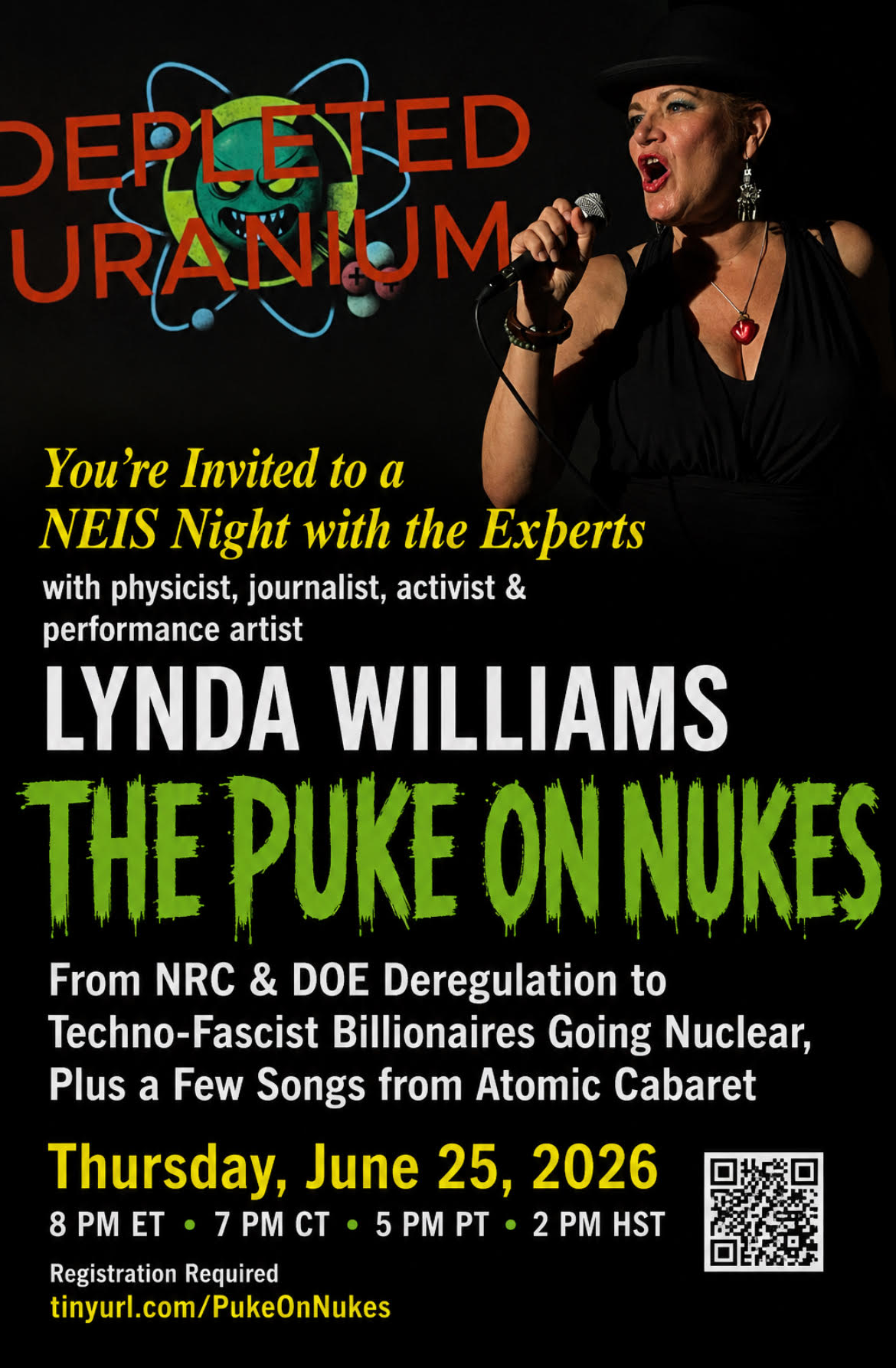
7pm Central Time (8pm ET, 6pm MT, 5pm PT) UTC – 5 From NRC & DOE Deregulation to Techno-Fascist Billionaires Going Nuclear, Plus a Few Songs from Atomic Cabaret REGISTER
 NRA pulls attack ads, hopes everyone forgets about mass slaughter in 8 days https://shareblue.com/nra-pulls-attack-ads-hopes-everyone-forgets-about-mass-slaughter-in-8-days/







 nuclear-news