China needs more nuclear warheads to deter US threat, military says, Commentary says the existing stockpile is big enough to prevent ‘bullying’ but should be expanded as Washington changes strategy, SCMP, Minnie Chan, 30 January, 2018 China must expand its nuclear stockpile so it can better deter and hit back at an enemy strike as geopolitical uncertainties mount and the US appears bent on a nuclear build-up, according to the Chinese military’s mouthpiece.
In the PLA Daily on Tuesday, a commentary said China had enough nuclear weapons to prevent “bullying” by other nuclear powers but still needed to respond to changes in US strategy.
“To enhance China’s strategic counterbalance in the region and maintain China’s status as a great power, and protect national security, China has to beef up and develop a reliable nuclear deterrence capability,” it said.
It also said China would still stick to the “no first use” doctrine, meaning there were no circumstances in which it would be the first to use nuclear weapons.
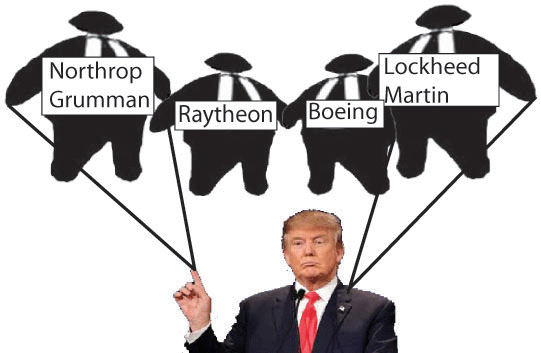
The commentary comes as the administration of US President Donald Trump is expected to unveil its new military weapons policy later this week.
A leaked draft of the document says Washington will ramp up new nuclear projects and deploy more “low yield” nuclear bombs, according to the Huffington Post.
Military analysts said China was poised to increase its own arsenal of nuclear warheads but there were no plans to rival the United States.
Beijing-based military analyst Zhou Chenming said China only needed to add about 100 warheads to its stockpile to counter threats from the US and India.
“Nuclear weapons are hugely expensive to maintain and China is very pragmatic. Beijing will not spend too much money on an arms race,” Zhou said.
Richard A. Clarke, chairman of Good Harbor Security Risk Management, was special adviser to the president for cybersecurity in the George W. Bush administration. Steve Andreasen was the National Security Council’s staff director for defense policy and arms control from 1993 to 2001 and teaches at the Hubert H. Humphrey School of Public Affairs.
A dangerous disconnect is emerging between the horrific impacts of even the limited use of nuclear weapons, and leaders and policymakers who seem intent on threatening nuclear use in an ever-expanding range of scenarios. If this continues, the risk that a nuclear weapon will be used for the first time in more than 70 years — deliberately or otherwise — will grow. We must return to a more sober dialogue and approach to policy.
The Trump administration appears poised to expand the circumstances under which the United States might use nuclear weapons, including in response to a cyberattack.
The time when leaders and policymakers in the United States, Russia and other countries had anything close to a personal connection with the effects of even a single nuclear weapon is becoming more distant. Memories of a smoldering Hiroshima and Nagasaki, the stark fear generated by the Cuban missile crisis or the massive protests sparked in the early 1980s by the deployment of U.S. and Soviet intermediate-range nuclear missiles in Europe no longer drive or even inform policy. As former secretary of state George P. Shultz told Congress last week, “I fear people have lost that sense of dread.”
When nuclear theory or war-gaming moved from the Pentagon to the White House during the Cold War, it was more often than not met by a skeptical president and civilian leadership, who rightly recoiled from risking nuclear catastrophe. That is not the case now.
Five years ago, the Pentagon’s Defense Science Board published a report equating the impact of Chinese and Russian capabilities to launch an “existential cyber attack” against the United States with the impact of a nuclear attack — and recommended that the United States be prepared to threaten the use of nuclear weapons to deter cyberattacks. When the board’s recommendation was exposed to the light of day by the two of us and others in 2013, it was publicly rebuked and, as a matter of policy, quietly discarded.
But just last month, the board’s proposal became U.S. policy. In December, the Trump administration’s National Security Strategy quietly expanded the role of nuclear weapons in U.S. defense plans, stating they are “essential” to prevent “non-nuclear strategic attacks” — i.e., cyberattacks.
This week, the Trump administration is expected to release its “Nuclear Posture Review.” A leaked pre-decisional draft reaffirms the policy of threatening nuclear use to prevent cyberattacks, but goes even further — expanding the role of U.S. forward-deployed nuclear weapons in NATO’s European defenses.
For decades, the United States has been moving to reduce the relevance of forward-deployed nuclear weapons in Europe, and for good reason: U.S. nuclear weapons in Europe have virtually no military utility, and their storage at bases in multiple countries presents a serious security risk. Removing them would reduce the risk of terrorism and instability, and would free up resources across NATO for other urgent defense tasks.
Moreover, as NATO has repeatedly stated, “The supreme guarantee of the security of the Allies is provided by the strategic forces of the Alliance.” With three nuclearized member states — the United States, Britain and France — NATO has a robust nuclear deterrent capable of being employed anywhere in defense of NATO interests.
The Trump Nuclear Posture Review not only rejects this logic, it ties our forward-deployed forces to NATO’s strategic forces as part of the bloc’s “supreme guarantee.” So rather than move in the direction of reducing nuclear risks by removing nuclear weapons from vulnerable sites, we will instead further cement them in place — when there is ample evidence of terrorist interest in nuclear facilities and, as is presently true in Turkey, evidence that the security of U.S. nuclear weapons reportedly stored there can change literally overnight.
Raising the profile of nuclear weapons in our defense plans comes at a time when the disastrous consequences of even limited nuclear use is becoming even more apparent. Alan Robock and his colleagues at Rutgers University — using newly updated climate models and the much greater computing power now available — have concluded that even a limited nuclear exchange (50 to 100 weapons) could create a “mini-nuclear winter” whose effects could last two to three years and create tens of millions of deaths from starvation because of the collapse of grain crops brought on by climate change.
Nuclear weapons present a unique threat of national devastation and global extinction. They are good for only one purpose: deterring nuclear attacks. Policies equating cyberthreats to nuclear threats, or raising the profile of nuclear weapons in our conventional defenses, undermine the credibility of nuclear deterrence by threatening use for lesser contingencies and makes nuclear use more likely.
Former nuclear power Kazakhstan shares lessons for North Korea, Nikkei Asian Review, January 30, 2018 UN ambassador highlights benefits of denuclearization, harm suffered by testing, ARIANA KING, UNITED NATIONS –– Few nuclear powers have ever volunteered to dismantle their arsenals, but Kazakhstan’s U.N. ambassador makes the case that a country stands only to gain by such a dramatic gesture.
Kazakhstan, which once held the fourth-largest nuclear stockpile with over 1,400 warheads, relinquished all of these Soviet-era weapons by April 1995.
“With the time passing, we more and more are convinced that that was a very right decision at the right moment,” Kairat Umarov, the ambassador and current president of the Security Council, told the Nikkei Asian Review in a recent interview. “And today we are very much proud of this decision,” he said, because Kazakhstan “gained a lot from this step.”……….
“The nuclear-free status of Kazakhstan may serve as an example and as practical guidance for other countries,” Nazarbayev said at that meeting, noting the “high international standing” his country gained by renouncing nuclear weapons. “We call upon all other states to follow our example. We called upon Iran to do so. Now we call upon North Korea to do so.”
“One thing we know for sure: Nuclear capability is not a good defense,” Umarov told The Nikkei. “It’s not a good way to protect a country.”
Possessing such weapons makes a country a target for other nuclear-armed nations, the ambassador added. “So that’s our experience, and we think that anything can be avoided if there is enough political will,” he said.
Umarov said attempts to persuade his North Korean counterparts of the merits of denuclearization have not been fruitful. “But at the end of the day, we think that it is political courage of leaders which really makes things different,” he said. A decision by North Korea to denuclearize would be “received with applause in the international community.”
For Kazakhstan, however, the voices of the victims of nuclear testing at the Semipalatinsk site also led Nazarbayev to dismantle the country’s nuclear program, Umarov said. Though decades have passed since the former Soviet republic closed Semipalatinsk, the legacy of nuclear testing continues.
“We right now have 1.5 million people who are suffering from the nuclear testing site,” Umarov said, citing genetic deformities that have plagued the population and continue to affect newborn children — three generations later.
“It is a very acute, sensitive issue for us,” Umarov asserted, recalling his work for a nongovernmental group in which he fought to shut Semipalatinsk. “So it’s not just we are playing with the politics, or trying to show that we are so principled because of political reasons. It is a very real thing with our population, with our people, and we are reflecting here the will of the people on that issue.”……….https://asia.nikkei.com/Politics-Economy/International-Relations/Former-nuclear-power-Kazakhstan-shares-lessons-for-North-Korea
North Korea and Donald Trump may be a recipe for accidental nuclear war — here’s how it could happen, Business Insider, DAVE MOSHER, JAN 29, 2018
North Korea likely has missile-ready nuclear weapons.
An expert in East-Asian nuclear policy says there is now an increased risk for nuclear miscalculation on the Korean Peninsula.
He believes President Donald Trump’s bellicose behaviour raises the chance that North Korean leader Kim Jong Un will mistake US military exercises as an invasion.
Kim’s logic in such a scenario may be similar to that of Japan’s in its preemptive attack on Pearl Harbour in 1941.
An isolated conflict between North Korea, South Korea, and the US could kill hundreds of thousands or even millions of people.
The Bulletin of the Atomic Scientists moved its Doomsday Clock forward 30 seconds on Thursday, pushing humanity’s proximity to disaster at a symbolic and alarming two minutes to midnight.
The organisation has adjusted the Doomsday Clock yearly since 1947. Though the Bulletin bases its clock’s position on multiple global threats, this year it highlighted the bellicose behaviour of President Donald Trump toward North Korea and his administration’s nuclear weapons posturing.
“To call the world nuclear situation dire is to understate the danger, and its immediacy,” Rachel Bronson, the president and CEO of the Bulletin, said during a press briefing on Thursday. It’s “the closest the Clock has ever been to Doomsday,” she added. “As close as it was in 1953, at the height of the Cold War.”
One of the Bulletin’s major concerns is about an “oops” moment of nuclear proportions involving the evolving nuclear arsenal of North Korean leader Kim Jong Un……..
The dangerous and fuzzy maths of miscalculation………
“It’s called miscalculation, where one side makes a calculation that war is inevitable,” Lewis said. “They don’t think that they’re starting a war, they just think they’re getting a jump on the other.”…….
How to step back from the brinkLawrence Krauss, a physicist at Arizona State University and a Bulletin chair member, said Thursday that there is still time to turn back the clock.
“It is not yet midnight and we have moved back from the brink in the past,” Krauss said.
The Bulletin makes a few recommendations to ease tensions with North Korea and avert a nuclear disaster:
First and foremost, it said: “US President Donald Trump should refrain from provocative rhetoric regarding North Korea, recognising the impossibility of predicting North Korean reactions.”
Second, the US should preemptively open military and diplomatic lines of communication with North Korea – not to signal weakness, but to show “that while Washington fully intends to defend itself and its allies from any attack with a devastating retaliatory response, it does not otherwise intend to attack North Korea or pursue regime change.”
And finally: “The world community should pursue, as a short-term goal, the cessation of North Korea’s nuclear weapon and ballistic missile tests. North Korea is the only country to violate the norm against nuclear testing in 20 years. Over time, the United States should seek North Korea’s signature on the Comprehensive Nuclear Test Ban Treaty – and then, along with China, at long last also ratify the treaty.”
Pentagon Wins as Trump Readies a $716 Billion Budget Request,Bloomberg, By
Anthony Capaccio and Erik Wasson
Big increase for Pentagon would deepen the U.S. deficit
Mattis has raised alarm over U.S. ‘competitive edge’ eroding
President Donald Trump will propose $716 billion in defense spending in his fiscal 2019 budget request, a 7.2 percent from his request for this year that backs the Pentagon’s push for a major buildup, a U.S. official said.
The funding would include $597 billion for the Defense Department’s base budget, with the rest going for its war-fighting account and to other government programs such as the Energy Department’s nuclear weapons program, said the official, who spoke on condition of anonymity in advance of the release of Trump’s second proposed budget next month.
The amount is a sharp increase from the $668 billion total Trump proposed last year for fiscal 2018 and also offered as a placeholder for fiscal 2019. Currently, the Pentagon is operating under stopgap funding at fiscal 2017 levels, which totaled $634 billion. The plan, reported earlier Friday by the Washington Post, represents a victory of defense hawks over those trying to constrain deficit spending.
The U.S. official confirmed Trump’s next proposed budget will include major increases on procurement spending over the $124 billion sought this year.
Mattis’s Push
Defense Secretary Jim Mattis has pushed for a jump in defense spending to match the breadth of the new National Defense Strategy he released this month……….
Ultimately, Trump’s proposal will be measured by the amount it exceeds the caps in the Budget Control Act of 2011.Unless Congress waives the budget limits, as it’s done three times in the past, the cap for fiscal 2019, which begins Oct. 1, is $563 billion for defense-related spending, including $534 billion for the base defense budget.
War-Fighting Fund
The official said more than $90 billion of Trump’s budget proposal would come from the war-fighting fund — known as Overseas Contingency Operations — that’s exempt from caps. While the fund is supposedly for pressing war needs, it’s often used as a tool to bulk up overall defense funding. Trump’s war-fighting budget for the current year includes $10 billion for weapons acquisition……..https://www.bloomberg.com/news/articles/2018-01-26/trump-is-said-to-seek-716-billion-for-defense-in-2019-budget
Reading the summary is illuminating, to say the least, and somewhat disturbing, as it focuses very little on actual defense of the realm and relates much more to offensive military action that might be employed to further certain debatable national interests. Occasionally, it is actually delusional, as when it refers to consolidating “gains we have made in Afghanistan, Iraq, Syria and elsewhere.”
At times Mattis’ supplementary “remarks” were more bombastic than reassuring, as when he warned
“…those who would threaten America’s experiment in democracy: if you challenge us, it will be your longest and worst day.”
He did not exactly go into what the military response to hacking a politician’s emails might be and one can only speculate, which is precisely the problem.
One of the most bizarre aspects of the report is its breathtaking assumption that “competitors” should be subjected to a potential military response if it is determined that they are in conflict with the strategic goals of the U.S. government. It is far removed from the old-fashioned Constitutional concept that one has armed forces to defend the country against an actual threat involving an attack by hostile forces and instead embraces preventive war, which is clearly an excuse for serial interventions overseas.
Some of the remarks by Mattis relate to China and Russia. He said that
“We face growing threats from revisionist powers as different as China and Russia, nations that seek to create a world consistent with their authoritarian models – pursuing veto authority over other nations’ economic, diplomatic and security decisions.”
There is, however, no evidence that either country is exporting “authoritarian models,” nor are they vetoing anything that they do not perceive as direct and immediate threats frequently orchestrated by Washington, which is intervening in local quarrels thousands of miles away from the U.S. borders. And when it comes to exporting models, who does it more persistently than Washington?
The report goes on to state that Russia and China and rogue regimes like Iran have “…increased efforts short of armed conflict by expanding coercion to new fronts, violating principle of sovereignty, exploiting ambiguity, and deliberately blurring the lines between civil and military goals.” As confusing civil and military is what the United States itself has been doing in Libya, Iraq and, currently, Syria, the allegation might be considered ironic.
he scariest assertion in the summary is the following:
“Nuclear forces – Modernization of the nuclear force includes developing options to counter competitors’ coercive strategies, predicated on the threatened use of nuclear or strategic non-nuclear attacks.”
That means that the White House and Pentagon are reserving the option to use nuclear weapons even when there is no imminent or existential threat as long as there is a “strategic” reason for doing so. Strategic would be defined by the president and Mattis, while the War Powers Act allows Donald Trump to legally initiate a nuclear attack.
What might that mean in practice? Back in 2005,Vice President Dick Cheney had requested “a contingency plan to be employed in response to another 9/11-type terrorist attack on the United States… [including] a large-scale air assault on Iran employing both conventional and tactical nuclear weapons … not conditional on Iran actually being involved in the act of terrorism directed against the United States.”
Possible employment of “weapons of mass destruction” responded to intelligence suggesting that conventional weapons would be unable to penetrate the underground hardened sites where Iran’s presumed nuclear weapons facilities were reportedly located. But as it turned out, Iran had no nuclear weapons program and attacking it would have been totally gratuitous. Some other neocon inspired plans to attack Iran also included a nuclear option if Iran actually had the temerity to resist American force majeure.
Pentagon planners clearly anticipate another year of playing at defense by keeping the offense on the field. An impetuous and poorly informed president is a danger to all of us, particularly as he is surrounded by general-advisers who see a military solution to every problem. Hopefully wiser counsel will prevail.
Philip Giraldi, Ph.D., is Executive Director of the Council for the National Interest.
US-South Korean war games will go on after Olympics, Pentagon says , By KIM GAMEL | STARS AND STRIPES, January 26, 2018SEOUL, South Korea — U.S. military exercises with South Korea will be held after the Olympics as planned despite a demand for a complete suspension from the North, the Pentagon said.
The planned war games cast a shadow over hopes that the recent détente between the two Koreas may lead to a broader dialogue with the United States after months of saber rattling over the North’s nuclear weapons program.
Defense Secretary Jim Mattis reiterated that military options remain at the ready to make sure diplomats have leverage in pressuring Pyongyang to denuclearize…….
Washington agreed to delay them until after the Olympics, which will be held on Feb. 9-25 in the South Korean alpine town of Pyeongchang. Mattis has said they would resume after the March 8-18 Paralympics.
But North Korea, which agreed to participate in the Winter Games as part of rare talks with the South, demanded a complete suspension……..
North Korea has frequently responded to the exercises — and similar drills held by the allies in the fall — with missile tests and a stream of bellicose rhetoric…….
Morning Star 27th Jan 2018, Fury as scandal-hit nuclear agency demands 23-fold radiation emissions
increase. CAMPAIGNERS have gone nuclear after the Atomic Weapons
Establishment (AWE) applied this week to increase radiation output from its
Berkshire site by over 2,000 per cent.
AWE, which produces Trident nuclear warheads, had two sites placed in renewed special measures last August over
safety concerns. Now the company is asking the Environment Agency to raise
the 4.4 megabecquerel radiation limit to 100MBq for tests it claims will
help counter nuclear terrorism.
But the Campaign for Nuclear Disarmament
(CND) said it was nuclear proliferation that increases chances of dangerous
material falling into hostile hands. The group also sounded the alarm over
the risk to public health. CND radiation expert Ian Fairlie said: “While
radiation amounts appear relatively low in the application, they represent
a 23-fold increase. If radiation is released into the water supply in
spikes, this could present a danger.”
Is Japan moving to renege on no-nuclear weapon policy? http://www.nationmultimedia.com/detail/opinion/30337363, opinion January 29, 2018 , By Cai Hong ,China Daily , Asia News Network , Tokyo Beatrice Fihn, executive director of the 2017 Nobel Peace Prize-winning International Campaign to Abolish Nuclear Weapons, was denied a meeting with Japanese Prime Minister Shinzo Abe during her recent visit to Japan.
Visiting Hiroshima and Nagasaki, Fihn urged Japan, the only country to have suffered nuclear attacks, to play a leading role in the campaign aimed at abolishing nuclear weapons.
It is not difficult to understand why Abe shunned Fihn. She has appealed to the Japanese government to join the nuclear weapons ban treaty. But on January 17, Japan and the United States allowed their agreement on nuclear cooperation to automatically renew in July, when it is supposed to expire. The agreement, signed in 1988, gives Japan blanket approval to reprocess spent nuclear fuel for weapons-grade plutonium. Japan adopted nuclear power in the 1950s (one of the first countries to do so) at the urging of the US. In fact, the US began engaging with Japan on nuclear energy soon after the end of World War II, as it was eager to promote and sell its nuclear reactor technology around the world.
Japan had to return some 300 kilograms of plutonium, provided by the US, Britain and France decades ago for what was described as research purposes, to the US in 2016. Thanks to the US-Japan cooperation agreement on peaceful uses of nuclear energy, Japan now owns 48 tonnes of separated plutonium, most of which is in Europe, where it was reprocessed. And Japan has no clearly defined use for this huge amount of nuclear material. Japan once hoped fast reactors would help meet its energy security needs, take care of its surplus plutonium and solve its spent fuel problem. But that hope has faded. Commercialising of fast reactors is still decades away. Surplus weapons-grade material have always worried arms control experts. In 1977, believing that nuclear weapons could be made from plutonium extracted from spent nuclear fuel in Japan’s light water reactors, the US conveyed its view to Tokyo, according to Japanese diplomatic documents declassified in 2013.
Now, despite having surplus plutonium, Japan is planning to open a massive spent reactor fuel reprocessing plant at Rokkasho, the country’s large commercial reprocessing facility, in the autumn of 2018. It is designed to produce 8,000kg of weapons-usable plutonium enough to make 1,000 nuclear weapons a year, according to International Atomic Energy Agency standards. The ostensible reason for operating the plant is recycling spent fuel to supply power reactors and a fast reactor.
In their Foreign Policy article on August 17, 2017, Henry Sokolski, executive director of the Nonproliferation Policy Education Centre, and William Tobey, a senior fellow at Harvard Kennedy School, said Japan has five reactors on line and terminated its only fast reactor project. So Japan cannot operate Rokkasho in the northern part of the country without piling up tons of plutonium for years on end. The Rokkasho plant would significantly increase Japan’s existing plutonium surplus. A potential linkage between Rokkasho’s product and nuclear weapons has been hanging over the project from the start. Japan will only be able to burn a fraction of the huge amount of nuclear material extracted there. Japanese reprocessing plants will produce reactor-grade plutonium, but they will have high weapons’ potential.
Japan has a “three Nos” national policy on nuclear weapons: no possession, no manufacture and no allowing nuclear weapons on Japanese territory. But there is no lack of Japanese politicians talking about nuclear weapons. Former Japanese defence minister Shigeru Ishiba, seen as a possible successor to Abe, said in September that Japan should have the technology to build a nuclear weapon if it wants to do so. He added, though, that he is not taking the position that Japan should have nuclear weapons.
Japan’s plutonium surplus goes against its principle of not possessing the material without a specified purpose.
The recent false alarm in Hawaii underscores the threat from nuclear devices. While there has been media attention placed on how the United States is taking military and diplomatic action against North Korea from launching a nuclear strike, there is little media attention given to how well the United States is medically prepared for a nuclear attack. According to a recent report in the Bulletin of the Atomic Scientists, U.S. cities are not medically prepared for a nuclear detonation. This report, written by Dr. Jerome Hauer, who was the former assistant secretary for the Office of Public Health Emergency Preparedness at the U.S. Department of Health and Human Services, asserts that the United States is completely unprepared to manage the aftermath of a nuclear detonation. We are at a moment in history where nuclear terrorism is an unfortunate reality. North Korea and Iran have established nuclear capabilities, and Pakistan has stockpiles of highly enriched uranium.
These countries have a history of supporting terrorist groups. It has been acknowledged by our government that highly enriched uranium can be smuggled into this country to build a 10-kiliton improvised nuclear bomb, like that dropped on Hiroshima in 1945. A nuclear threat would even include a dirty bomb that combines a conventional explosive with radioactive isotopes, which could contaminate an area and leave a residual radioactive “hot zone” that is too dangerous for even first responders to enter. Also, radioactive particles can disperse into the air and create a “plume” that could extend hundreds of miles away from ground zero and create a contamination area that would last for years.
A nuclear blast would instantly release a massive pressure wave and heat that would incinerate everything within half a mile and kill an estimated 75,000 to 100,000 people. Another 100,000 to 200,000 would suffer complexed radiation burns, while others would be exposed to high doses of radiation that would cause acute radiation syndrome that is characterized by bone marrow failure and gastrointestinal, cardiac, neurological and pulmonary toxicity. The starkest fact about a nuclear bomb attack is that it destroys the capacity to respond from a medical and civil service perspective. There will be a loss of local government services from firefighters, police and hospitals, along with loss of water, sewage and utilities. There will be a loss of communication systems to direct survivors where to evacuate for treatment.
The management of mass casualties from nuclear detonation is far more complex than for natural disasters. Hot zones are too dangerous for first responders to enter to render medical assistance to casualties. Yet, victims would still need to be evacuated somehow. According to the report, most U.S. cities lack medical preparedness to manage the aftermath of a nuclear explosion. FEMA has not devoted enough attention to address this issue. This makes it important for cities and states to develop plans for the worse case scenarios. Each state should have a plan of preparedness that includes special medical triage centers; coordinated schemes from state military and local police to provide mobile communication assets and protection against civil unrest; and specialized trained hospitals that can medical manage the injuries associated with a nuclear bomb. There needs to be a statewide plan from the governor’s office from each state, along with each state’s department of public health, to ensure there is sufficient medical preparedness.
Several government officials stated they were unable to take steps forward out of being accused of inciting fearmongering. However, developing a comprehensive preparedness program against nuclear threats should not just stop with military action but should include a medical preparation program regardless of how politically undesirable the subject may be. Preparedness should be mandated at every local and state government level.
• Alan Moy is CEO of Cellular Engineering Technologies and scientific director of the John Paul II Medical Research Institute.
Annick Girardin has told journalists in Tahiti that there will be an answer to the recently raised calls for such a study.Last week, a child psychiatrist, who had worked in French Polynesia for years, suggested that an independent investigation be carried out after noticing a high incidence of disturbed and deformed children among the off-spring of people exposed to radiation from the atmospheric tests.
Girardin has acknowledged the concerns, saying it has to be established how to deal with the question and to see if it is possible to work on it with other countries.
The minister has restated that the former president Francois Hollande recognised two years ago in Papeete the French legacy and assumed responsibility.
She has also launched a project in Papeete to build an institute of archives and documents related to the tests.
She has also frozen the sale of land in the city previously used by the navy for its command for it to be able to be used for a memorial site.The head of the nuclear test veteran’s organisation Roland Oldham is dismissive, saying this will only see the light of day once people are dead.
He has continued to urge Paris to compensate the nuclear test victims suffering from poor health.
Until 2009, France claimed its weapons tests were clean but then passed a law accepting compensation demands.
Hundreds of applications have been filed since but almost all have been thrown out.
Soros: Trump has US ‘set on a course towards nuclear war’CNBC , Jeff Cox | @JeffCoxCNBCcom, 26 Jan 18
Billionaire investor and political activist George Soros said President Donald Trump has the U.S. set on a course for nuclear war with North Korea.
Speaking at the World Economic Forum in Davos, Switzerland, Soros said Trump is trying to establish a “mafia state” in the U.S. but has failed so far.
The progressive activist said he sees the president’s place in the world as “temporary” and likely to “disappear in 2020 or even sooner.”
President Donald Trump has the U.S. on course for a nuclear war with North Korea, billionaire investor and progressive political activist George Soros said Thursday.
In a blistering critique of the country under Trump’s leadership, the head of Soros Fund Management and the Open Society Foundations painted a bleak picture.
“The fact of nuclear war is so horrendous that we are trying to ignore it, but it is real,” Soros said during a speech at the World Economic Forum in Davos, Switzerland. “Indeed, the United States is set on a course towards nuclear war by refusing to accept that [North] Korea has become a nuclear power.”
“This creates a strong incentive for North Korea to develop its nuclear capacity with all possible speed, which in turn may induce the United States to use its nuclear superiority pre-emptively, in effect to start a nuclear war to prevent a nuclear war, obviously a self-contradictory strategy.”
That wasn’t the only place Soros attacked Trump.
He compared the president to Russian strongman Vladimir Putin, saying Trump also would like to create a “mafia state” that suppresses individual rights. He can’t “because the Constitution and the institutions and a vibrant society won’t allow it.”
U.S. modernization efforts risk sparking a nuclear arms race with China. The Diplomat, By Kim Mu Kwan (Harry) 26 Jan 18, Since the end of the Cold War, the United States has been a leader of nuclear disarmament efforts. It gradually reduced its nuclear weapons stockpile through a series of arms reduction treaties with Russia. In 2009, then-President Barack Obama also affirmed “America’s commitment to seek the peace and security of a world without nuclear weapons.”
However, the United States still has an inexplicably large number of nuclear weapons. It maintains an arsenal of 1,393 strategic warheads deployed on 660 intercontinental ballistic missiles (ICBMs), 240 Trident II D5 submarine-launched ballistic missiles (SLBMs), 20 of which are on 12 Ohio-class submarines, and air-launched cruise missiles (ALCMs) equipped on 18 B-2 Spirit stealth bombers and 76 B-52H bombers.
In addition, contrary to global disarmament efforts, the United States recently began modernizing its nuclear arsenal. The Department of Defense (DOD) seeks to maintain and upgrade the country’s aging nuclear triad – IBCMs, SLBMs, and strategic bombers. The Congressional Budget Office (CBO) estimates the current modernization plans for U.S. nuclear forces would cost $400 billion between FY 2017 and FY 2026.
The Trump administration’s nuclear posture review is yet to be published (though a draft leaked earlier this month). However, it is hard to imagine his administration will discontinue this modernization effort. During the presidential campaign, Donald Trump repeatedly expressed his frustration about the “very terrible shape” of the country’s nuclear arsenal. He also has said he is preparing to have the arsenal in “tip-top shape,” though he denied reports that he wants a tenfold increase in the nuclear arsenal
This modernization effort not only undermines global disarmament efforts but also will force China to reevaluate its nuclear doctrine and reinvigorate its nuclear arsenal in order to maintain deterrence against the United States. China’s response could pose a serious threat to global disarmament efforts, U.S. national security, and regional stability in the Asia-Pacific………
North Korean leader Kim Jong Un provides guidance on a nuclear weapons program in this undated photo released by North Korea’s Korean Central News Agency (KCNA) in Pyongyang September 3, 2017. KCNA via REUTERS
Kim Jong-un has blown family cash on missile tests and has no money left to run North Korea
KIM Jong-un has reportedly spent almost an entire “slush fund” left to him by his dad on missile testing, leaving little money to run North Korea. The Sun News Corp Australia Network, JANUARY 27, 2018 KIM Jong-un has nearly blown the entire “slush fund” he inherited from his dad on nuclear tests, it has been claimed. Trigger happy Kim has staged a series of pricey nuke trials since taking over as leader after the death of his father Kim Jong-il in 2011.
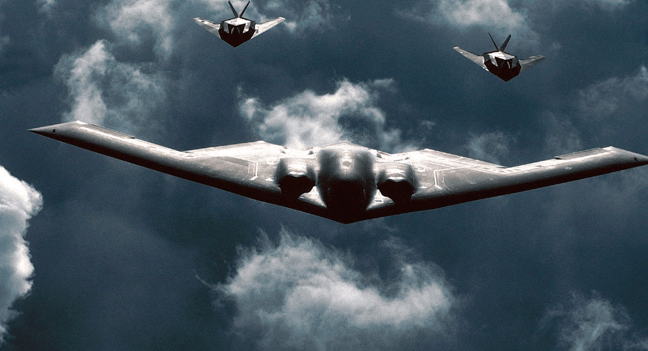
US stealth bombers in Guam appear to be readying for a tactical nuclear strike on North Korea, Business Insider, ALEX LOCKIE, JAN 25, 2018,
The US recently sent nuclear bombers to Guam that can carry tactical nukes that would be perfect for taking out Kim Jong Un.
Some have suggested that a quick tactical nuclear strike on North Korea could cripple the country’s nuclear infrastructure with few casualties.
Recent reports have suggested President Donald Trump considering a strike on North Korea, but some experts and politicians think the idea of a tactical nuclear strike is a recipe for disaster.
The US has been quietly amassing firepower in the Pacific during a lull in tensions with North Korea, but recent developments on an under-the-radar nuclear weapon suggest preparation for a potential tactical nuclear strike.
While the B-2 and B-52 are known as the air leg of the US’s nuclear triad, as they carry nuclear-capable air-launched cruise missiles, a smaller nuclear weapon that has undergone some upgrades may lend itself to a strike on North Korea………..
Despite evidence that tactical nuclear weapons won’t solve the North Korean military quagmire, President Donald Trump’s administration has looked favourably on smaller nuclear weapons.
Trump’s recent nuclear posture review recommended building more small nuclear weapons, as their size would make them easier to use in a conflict – something the International Security paper supports.