The cancer toll on nuclear workers: $15.5 billion in compensation and counting

Nuclear fallout: $15.5 billion in compensation and counting
They built our atomic bombs; now they’re dying of cancer
Nearly 33,500 former nuclear site workers died due to radiation exposure- report
 Nuclear Fallout: This story produced in partnership with ProPublica and the Santa Fe New Mexican. (Richly illustrated with photographs, videos, charts, documents interactive map)
Wave 3, By Jamie Grey and Lee Zurik |
LOS ALAMOS, NEW MEXICO (InvestigateTV) – Clear, plastic water bottles, with the caps all slightly twisted open, fill a small refrigerator under Gilbert Mondragon’s kitchen counter. The lids all loosened by his 4- and 6-year old daughters because, at just 38, Mondragon suffers from limited mobility and strength. He blames his conditions on years of exposure to chemicals and radiation at the facility that produced the world’s first atomic bomb: Los Alamos National Laboratory.
Gilbert Mondragon, 38, pulls the cap off a plastic water bottle that had been twisted open by his young daughters. He hasn’t the strength for those simple tasks anymore and blames his 20-year career at the Los Alamos National Lab. He quit this year because of his serious lung issues, which he suspects were caused by exposures at the nuclear facility. (InvestigateTV/Andy Miller)
Mondragon is hardly alone in his thinking; there are thousands more nuclear weapons workers who are sick or dead. The government too recognizes that workers have been harmed; the Department of Labor administers programs to compensate “the men and women who sacrificed so much for our country’s national security.”
But InvestigateTV found workers with medical issues struggling to get compensated from a program that has ballooned ten times original cost estimates. More than 6,000 workers from Los Alamos alone have filed to get money for their medical problems, with around 53 percent of claims approved.
The Los Alamos lab, the top-secret site for bomb design in 1943, has had numerous safety violations and evidence of improper monitoring, federal inspection reports show. Continue reading
North Korea: its nuclear weapons “complete”, but not planning to get rid of them (why should they?)
North Korea not giving up its nuclear weapons any time soon, Chronicle, 12 NOV, 2018 “……..North Korea declared its nuclear force “complete” and halted missile and nuclear bomb testing earlier this year, but U.S. and South Korean negotiators have yet to elicit from Pyongyang a concrete declaration of the size or scope of the weapons programs, or a promise to stop deploying its existing arsenal.
North Korea has said it has closed its Punggye-ri nuclear testing site and the Sohae missile engine test facility. It also raised the possibility of shuttering more sites and allowing international inspections if Washington took “corresponding measures,” of which there has so far been no sign.
Last week, North Korea called off a meeting with U.S. Secretary of State Mike Pompeo in New York, and state media said on Monday the resumption of some small-scale military drills by South Korea and the United States violated a recent agreement aimed at lowering tensions on the Korean peninsula.
The sites identified in the CSIS report are scattered in remote, mountainous areas across North Korea, and could be used to house ballistic missiles of various ranges, with the largest believed to be capable of striking anywhere in the United States……” https://www.chronicle.co.zw/north-korea-not-giving-up-its-nuclear-weapons-any-time-soon/
With Democrat majority in U.S. Congress, Trump’s plans for nuclear arsenal, space weapons, will meet opposition

 Divided Congress to clash over Space Force, nuclear arsenal, The Hill, BY REBECCA KHEEL – 11/11/18
Democrats next year will control the gavels for the defense and foreign policy committees in the House for the first time since 2010.
The party has been itching to check President Trump on a host of issues, from his relationship with Saudi Arabia to the ballooning defense budget.
But to get legislation through Congress, House Democrats will need to work with the Senate, which is still in Republican hands. And the chairmen poised to lead the defense and foreign policy panels in the upper chamber are seen as staunch Trump allies.
Here are the top foreign policy and defense fights to watch in a divided Congress:
U.S.-Saudi relations
Lawmakers in both parties have been eyeing ways to punish Saudi Arabia over the killing of U.S.-based journalist and Saudi critic Jamal Khashoggi.
House Democrats have said responses should include an end to U.S. military support for the Saudi-led coalition in neighboring Yemen’s civil war. Democratic lawmakers were already opposed to U.S. backing because of civilian casualties, but Khashoggi’s murder has given the issue new urgency……….
Space Force
The Trump administration has said it wants the establishment of a “Space Force” included in next year’s defense policy bill. That position has contributed to increasingly diverging opinions between House and Senate lawmakers……….
Defense budget
Smith [Rep. Adam Smith (D-Wash.), who’s poised to be chairman of the House Armed Services Committee] has said this year’s defense budget of $716 billion is “too high,” and in a Thursday letter announcing his run for chairman he vowed to target “inefficiency and waste” at the Pentagon……….
Nuclear weapons
One of Smith’s longtime concerns has been the U.S. nuclear arsenal. He opposed the Obama administration’s modernization plans, arguing they weren’t affordable.
With the Trump administration’s Nuclear Posture Review calling for new capabilities, Smith has stepped up his criticism, vowing to scrutinize the nuclear budget to look for savings in the overall defense budget.
In his Thursday letter, Smith said Democrats must “take substantial steps to reduce America’s overreliance on nuclear weapons.”
Adding to Democrats’ nuclear anxiety is Trump’s intention to withdraw from a Cold War-era arms accord with Russia known as the Intermediate-Range Nuclear Forces (INF) Treaty. Smith and Engel wrote a letter to the administration last month warning they “will neither support, nor enable, a precipitous course of action that increases the risk of an unconstrained nuclear arms race.”
Congress is limited in its power to prevent Trump from withdrawing from the treaty, but it could block funding for any new missiles that would be out of compliance with the accord……… https://thehill.com/policy/defense/415935-divided-congress-to-clash-over-space-force-nuclear-arsenal
Democrat dominated Congress can put the brakes on Trump’s nuclear weapons folly
Dem-led House can return sanity to nuclear weapons debate https://thehill.com/opinion/national-security/415923-dem-led-house-can-return-sanity-to-nuclear-weapons-debate, BY TOM Z. COLLINA, 11/09/18 Since the election of President Donald Trump two years ago, advocates of sane nuclear policy have been faced with a serious deficit of enlightened political leadership in key positions of power.
President Trump has called for new and more “usable” nuclear weapons, is seeking to abandon key arms control agreements, and Congress has been plowing ahead with a $2 trillion shopping spree to rebuild the Cold War nuclear arsenal. There has been essentially no effective check on this excessive and dangerous spending.
As of Tuesday night, that will change in January when Democrats take over the House.
Without real oversight, pro-nuclear bomb enthusiasts have had a free hand to promote Trump’s new “low-yield” warhead for Trident missiles; to undermine crucial international agreements like the Intermediate-Range Nuclear Forces (INF) Treaty; and to push for high-cost missile, submarine and bomber programs that we do not need.
Once these programs get off the ground, they become too big to stop. If we don’t act soon, we will be locked in to an excessive Cold War-style arsenal for the next 50 years. As new U.S. weapons are built, and Russia responds in kind, we will find ourselves back in an arms race that only defense contractors can win.
But now there is hope on the horizon. The elections have brought new leaders into power who share the widespread conviction that the United States has more nuclear weapons than it needs to be secure and that spending less on nukes can actually make us safer.
Rep. Adam Smith (D-Wash.) is poised to be the next chairman of the House Armed Services Committee. Rep. Smith has been a leading voice calling for saner nuclear policies for years and shows no signs of letting up.
Speaking at a conference in September, Smith said that, if he gets the gavel, nuclear weapons policy would be at the top of his list of things that will change.
“I think the Republican party and the nuclear posture review contemplates a lot more nuclear weapons than I — and I think most Democrats — think we need. We also think the idea of low-yield nuclear weapons are extremely problematic going forward,” Smith said. “When we look at the larger budget picture, that’s not the best place to spend the money.”
Smith added that the expected price tag for building new nuclear weapons meant the U.S. “certainly can’t afford it.
When Smith becomes the committee’s next chairman in January, proponents of nuclear sanity can once again start to think big. In addition to cancelling the “low-yield” and dangerous Trident warhead, Smith may seek to cancel the destabilizing $30 billion nuclear air-launched cruise missile, which he has said would “siphon limited resources from preserving nuclear deterrence without adding to our national security.”
Next, he could take on the wasteful and dangerous $200 billion program to build new ground-based nuclear missiles. Cancelling this weapon would help to reduce the risk of the United States accidentally or mistakenly launching its nuclear missiles in response to a false warning of a nuclear attack.
Finally, there is greater public concern than ever that President Trump cannot be trusted with his absolute and sole authority to launch nuclear weapons.
Most Americans do not realize that the president has unlimited nuclear launch authority with no real checks or balances from anyone. But once informed, they are very concerned. President Trump could order a nuclear war as easily as he could send a tweet.
This situation is both dangerous and unnecessary. The risks of having nuclear weapons ready to launch within minutes outweigh any perceived benefits, especially if the sole decision-maker cannot be trusted.
Rep. Smith has introduced a bill to make it U.S. policy to never launch nuclear weapons first in a conflict. Other bills would prohibit the first use of nuclear weapons without congressional approval.
These fixes would put legal limits on the president’s ability to launch nuclear weapons unilaterally, without provocation, and would provide a tremendous safeguard to our democracy and our national security.
Congress has been a blank check for the forces of nuclear overkill and overspending for far too long. It is time to bring bold, principled leadership back to nuclear policy, before it is too late.
Tom Z. Collina is director of policy for Ploughshares Fund, a public grantmaking foundation that supports initiatives to prevent the spread and use of nuclear weapons, and to prevent conflicts that could lead to their use.
Putin claims that Russia is developing an “invincible” nuclear weapon
World War 3: Russia to arm an ‘INVINCIBLE’ nuclear weapon by 2019 says Putin https://www.express.co.uk/news/world/1043374/world-war-3-vladimir-putin-latest-nuclear-weapon-ww3-russia
RUSSIA is finalising a nuclear weapon capable of wiping out an entire city by descending on Earth “like a meteorite” at 20 times the speed of sound, Vladimir Putin has claimed, sparking World War 3 fears. By ALICE SCARSI, Nov 9, 2018 Tensions between Washington and Moscow reached a new high as the Russian President claimed he has a weapon that can resist any anti-missile systems, making it almost invincible. Mr Putin said: “We know for certain, it’s an obvious fact and our colleagues realise it, that we surpassed all our competitors in this area. “Nobody has precise hypersonic weapons. Some plan to test theirs in 18 to 24 months. We have them in service already.”
Speaking to Russian news agency TASS, they said: “The scheduled period for placing the lead regiment on combat duty is the end of 2019.
Initially, the regiment will comprise at least two systems but eventually their number will rise to their organic quantity of six units.”
According to the claims made by Russia, the Avangard is an hypersonic glide vehicle, a spacecraft which is lofted into the atmosphere atop an intercontinental ballistic missile, such as the Satan II, to then glide down at hypersonic speed.
Being 20 times faster than the speed of sound means the Avangard could travel as fast as at 6860 m/s.
The digital danger to nuclear weapons
 The argument from cyberspace for eliminating nuclear weapons NOVEMBER 9, 2018 At the height of the Cold War in 1982, American psychiatrist Robert Jay Lifton argued that the “central existential fact of the nuclear age is vulnerability.” That warning predated the proliferation of computers into almost every aspect of modern life, including nuclear weapons.
Today, the destructiveness of nuclear weapons has been coupled with the vulnerability of computers to create new pathways to disaster.
Specifically, there is now the possibility that hackers could compromise the computers that control nuclear weapons or provide information to officials about impending nuclear attacks.
Weapons security critically flawed
An October 2018 report reinforced this sense of vulnerability. In it, the United States Government Accountability Office (GAO) described a number of problems commonly found in the modern weapons systems developed by the U.S. Department of Defense (DOD). Although the report itself doesn’t say so, officials confirmed that nuclear weapons programs were included in the study.
PIC
The findings of the GAO report echoed earlier warnings of the cyberthreat to nuclear weapons. These included a 2013 DOD report and one by the Nuclear Threat Initiative, a non-governmental nuclear weapon threat reduction organization based in Washington, D.C.
Our research examines the risks associated with nuclear weapons systems, including those of accidental or inadvertent nuclear war. The most pressing concern from the GAO report is the possibility that some of these vulnerabilities might affect “nuclear command and control,” the term used to describe the computer networks that continuously monitor and direct the vast U.S. nuclear arsenal (or Russia).
The recent GAO report broadly criticized all DOD weapons systems. Over the past five years (2012 to 2017), the GAO reported, “DOD testers routinely found mission-critical cyber-vulnerabilities in nearly all weapon systems that were under development. Using relatively simple tools and techniques, testers were able to take control of these systems and largely operate undetected.”
In other words, just about every weapon system being developed by the U.S. military is vulnerable to cyberattack. What stands out are both the scale of the problem and that these problems exist in systems that should be highly protected.
The computerized military
Computers play an outsized role in the U.S. military — from providing information through various sensors to forming the backbone of communications networks. Faster communications and increased access to information are both valuable assets and these goals can be achieved with computers. Computers have become ubiquitous in the military environment as countries demand quick access to information and communications.
But computers also introduce vulnerabilities. As their role grows to include connecting the weapons systems of most advanced countries, so does our vulnerability. The vulnerability of these weapons systems should be seen as an anticipated and, arguably unavoidable, consequence of the computer-filled world we live in.
The GAO report went farther than just identifying vulnerabilities — it identified a culture within the DOD that fails to recognize and adequately address cybersecurity problems. Officials routinely assumed their systems were safe and ignored warnings until very recently.
We have observed a similar overconfidence in the military officials responsible for nuclear command and control.
This is a problem because the command-and-control system relies on complex networks of interconnected computers. These computers connect early warning satellites and radars to the president and will be used to pass on presidential orders to launch nuclear weapons should that fateful decision ever be made.
Computers must also constantly monitor and coordinate the daily operation of U.S. nuclear arsenal. Timelines for decisions in this system are extremely compressed, allowing less than 10 minutes for critical launch decisions to be made. The combination of interactive complexity and the tight timeline is typical of many other technological systems that are susceptible to unpredictable, large-scale accidents……. weapons https://stuff.co.za/the-argument-from-cyberspace-for-eliminating-nuclear-weapons/
Russia warns that USA’s “limited nuclear operations” strategy could spark Word War 3
World War 3 alert: US nuclear weapon strategy will spark CATASTROPHE warns Russia, RUSSIA has warned a proposed US strategy involving the “limited” use of nuclear weapons would spark World War 3 if it is ever put into practice., Express UK, By HARVEY GAVIN, , Nov 8, 2018 |Elbridge Colby, who served as a high ranking official in Donald Trump’s administration, recently advocated the use of tactical nukes in targeted attacks to repel an attack by Russia or China. But Moscow today branded the plans “irresponsible and dangerous”, warning: “Using nuclear weapons in pinpoint attacks is tantamount to playing with the devil.” Mr Colby, a former deputy assistant secretary of defence for strategy and force development, explained the thinking behind his strategy in an article for Foreign Affairs magazine entitled ‘If you want peace, prepare for nuclear war’………
Russian Foreign Ministry Spokeswoman Maria Zakharova said any use of nukes, regardless of their size, would lead to global catastrophe.
Addressing reporters today, she said there are growing calls in Washington to “increase the role of nuclear weapons and expand the possibilities of the US nuclear arsenal” to counter the “mythical Russian threat”, according to the Moscow-based TASS news agency.
Ms Zakharova went on to demand answers on the proposed “limited nuclear operations” strategy.
She said: “I want a clarification: where would these limited operations be carried out?
“On what continent would this strategy be fulfilled, if it was fulfilled?”………https://www.express.co.uk/news/world/1042901/world-war-3-russia-usa-tactical-nuclear-weapon-strategy
Iran is not likely to restart its nuclear weapons programme any time soon
 Despite sanctions, Iran unlikely to restart nuclear program—yet, Bulletin of the Atomic Scientists, By Kelsey Davenport, November 5, 2018 Iran’s commitment to the 2015 nuclear deal will face another test starting November 5, when US sanctions targeting the country’s oil sector come back into effect. When Tehran concluded the agreement with six world powers—the United States, Russia, China, France, Great Britain, and Germany—it agreed to stringently limit nuclear activities in exchange for sanctions relief. The government of President Hassan Rouhani, and millions of ordinary Iranians, hoped this would bring major economic benefits by allowing foreign companies to do business with Iran. Despite the fact that Iran was complying with the terms of the deal—as documented by the International Atomic Energy Agency and the US State Department—the Trump administration decided on May 8 that it would reimpose the lifted sanctions, violating the agreement and dealing a harsh blow to Iran’s economy. That left Iran with a decision to make: Continue to comply with the agreement—known as the Joint Comprehensive Plan of Action, or JCPOA—which still had the support of the five other parties and the European Union? Or resume and expand nuclear activities the deal had restricted?
Fortunately, Washington’s unilateral decision to withdraw from the deal, and even the cut in oil exports that will kick in November 5, are unlikely to trigger a drastic shift in Iran’s approach to the nuclear agreement. Most likely it will continue to adhere to JCPOA terms—at least in the short term. It has had time to adjust to the expected cut in exports. And, given the tightening in the oil market and Iran’s willingness to sell oil at a discounted rate, it is unlikely that the Trump administration will succeed in pushing Tehran’s oil exports to zero. India and China, Iran’s two largest oil customers, communicated to the United States that a complete cut is unrealistic at this time. Additionally, Iran’s past history with sanctions demonstrates a high tolerance for economic pain, and Tehran appears poised to wait out the Trump administration.
Iran’s decision, though, is not solely dependent on sanctions, and could shift down the road. Recognizing how important it is to keep Iran from developing nuclear weapons, the European Union, Russia, and China are trying to find ways to preserve the economic benefits of the deal. Policymakers in the United States, meanwhile, still have a critical role to play. They can help keep the path open for a US return to the JCPOA, and prevent tensions from unnecessarily escalating over Iran’s nuclear rhetoric.
First, do no (more) harm. The Trump administration’s decision to reimpose sanctions—despite acknowledging Iran’s compliance with the JCPOA—dealt a serious blow to US credibility and significantly undermined the deal’s benefits to Iran. But US policymakers can still mitigate further negative impacts. This should start with reclaiming the narrative surrounding the deal and emphasizing its nonproliferation value.
The Trump administration has painted the deal as a failure because it did not “fix” Iran’s policies in areas beyond the nuclear program. But the JCPOA was only ever negotiated to block Iran’s pathways to nuclear weapons, and Tehran is clearly complying with the new restrictions and obligations. Trump’s blatant attempts to characterize the deal as a disaster must not go unchallenged, and policymakers supportive of its goals cannot wait for the next attack to defend it. The JCPOA put in place more intrusive, permanent, inspection provisions, and limits ensuring that for a decade, it would take Iran more than 12 months to produce enough fissile material for one bomb.
Furthermore, Iran may be more willing to continue adhering to the nuclear agreement—even without the full hoped-for economic benefit—if supporters of the deal in the United States continue to assert its security benefits, foreshadowing a return to US compliance under a different administration……..https://thebulletin.org/2018/11/despite-sanctions-iran-unlikely-restart-nuclear-program-yet/
Prime Minister Modi’s doublespeak on India’s first nuclear submarine
Nuclear submarine Arihant completes first deterrence patrol mission
The success of INS Arihant gives a fitting response to those who indulge in nuclear blackmail, says Prime Minister Narendra Modi
Live Mint, Nov 05 2018. New Delhi: Prime Minister Narendra Modi on Monday said that India’s first nuclear armed submarine INS Arihant had successfully completed its first deterrence patrol, heralding India’s entry into an exclusive club of powers with land, air and sea-based nuclear weapons delivery platforms………
North Korea warns it might return to developing nuclear weapons, if USA does not end sanctions
North Korea warns of returning to nuclear policy, News 24 2018-11-04 North Korea has warned the US it will “seriously” consider returning to a state policy aimed at building nuclear weapons if Washington does not end tough economic sanctions against the impoverished regime.
For years, the North had pursued a “byungjin” policy of simultaneously developing its nuclear capabilities alongside the economy.
In April, citing a “fresh climate of detente and peace” on the peninsula, North Korean leader Kim Jong Un declared the nuclear quest complete and said his country would focus on “socialist economic construction”.
But a statement issued by the North’s foreign ministry said Pyongyang could revert to its former policy if the US did not change its stance over sanctions.
“The word ‘byungjin’ may appear again and the change of the line could be seriously reconsidered,” said the statement carried by the official KCNA news agency late on Friday.
Sanctions
At a historic summit in Singapore in June, US President Donald Trump and Kim signed a vaguely-worded statement on denuclearisation.
But little progress has been made since then, with Washington pushing to maintain sanctions against the North until its “final, fully verified denuclearisation” and Pyongyang condemning US demands as “gangster-like”.
“The improvement of relations and sanctions are incompatible,” said the statement, released under the name of the director of the foreign ministry’s Institute for American Studies.
“What remains to be done is the US corresponding reply,” it added.
The statement is the latest sign of Pyongyang’s increasing frustration with Washington……..
In an interview with Fox News on Friday, US Secretary of State Mike Pompeo reiterated that sanctions will remain until Pyongyang carries out it denuclearisation commitments made in Singapore, adding he will meet with his North Korean counterpart next week. https://www.news24.com/World/News/north-korea-warns-of-returning-to-nuclear-policy-20181104
The Twin Threats of Climate Change and Nuclear Annihilation- new documentary with Noam Chomsky
 New Documentary by ChomskySpeaks.org with Noam Chomsky Challenges Establishment over Twin Threats of Climate Change and Nuclear Annihilation https://www.prnewswire.com/news-releases/new-documentary-by-chomskyspeaksorg-with-noam-chomsky-challenges-establishment-over-twin-threats-of-climate-change-and-nuclear-annihilation-300743226.html
Renowned public intellectual calls out Democrats and Republicans for escalating nuclear dangers and decries Republican Party “dedicated to the destruction of life” NEWS PROVIDED BY
ChomskySpeaks.org
Nov 02, 2018 BOSTON, Nov. 2, 2018 /PRNewswire/ — Executive Producer Randall Wallace and Director Patrick Jerome launch the online documentary, “Noam Chomsky: Internationalism or Extinction” on the website: http://ChomskySpeaks.org. Based on a lecture by the public intellectual who is often described as the “most quoted living intellectual,” the documentary brings both the activist energy and desperate concerns of climate change and nuclear escalation that are causing mass extinctions.
Against these dire realities, Noam Chomsky surveys “the internationalism” of inter-state cooperation and social movements as solutions. He notes the complicity of both Democratic and Republican parties in escalating nuclear tensions and nuclear proliferation. At the same time, he condemns the Republican Party for profit-driven policies leading to climate-altering, carbon pollution. The documentary is a compelling and urgent warning explaining such ideas and tools as “the Anthropocene,” “the Doomsday Clock,” “species extinction,” “internationalism,” “denialism,” “non-proliferation,” “NATO expansion,” “climate accords,” and “climate debt” among many others.
Many non-partisan organizations collaborated in organizing the original lecture upon which the documentary is based; several also supported the production of the documentary as a starting point for further analysis. These included peace movement organizations in collaboration with the Boston-based movement-building center, encuentro5 (http://encuentro5.org) and the democracy movement’s Liberty Tree Foundation for the Democratic Revolution (http://LibertyTreeFoundation.org). The video adds to their efforts at expanding the public conversation about vital issues of the day. A grant from the Wallace Action Fund supported the documentary.
Chomsky concludes his lecture with sober reflection on the urgent challenges facing humanity: “The tasks ahead are daunting and they cannot be deferred.” Media Contact:
Suren Moodliar
617-968-0880
204337@email4pr.com SOURCE ChomskySpeaks.org, Related Links http://chomskyspeaks.org
America’s new nuclear warhead designs – and what they cost.
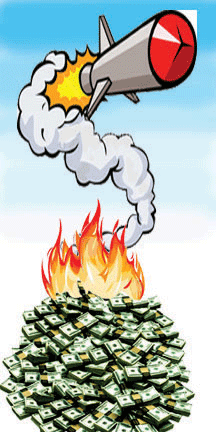 Here’s when all of America’s new nuclear warhead designs will be active — and how much they’ll cost, Military Times, 3 Nov 18, By: Aaron Mehta WASHINGTON — Estimates for the cost of America’s nuclear warheads have gone up in the last year, as the government prepares to develop and maintain as many as nine new systems in the next 25 years.
The National Nuclear Security Administration’s fiscal 2019 Stockpile Stewardship and Management Plan, released Thursday lays out the investments that could be needed for the NNSA over the next two and a half decades.
The NNSA is a semiautonomous department within the Department of Energy. While the Defense Department manages the delivery systems of the nuclear force — ships, planes and missiles — NNSA oversees the development, maintenance and disposal of nuclear warheads.
However, NNSA costs are not just about the warheads, as requirements range from upgrading aging infrastructure, to increasing the production of plutonium pits, to securing facilities. The agency expects capital investments during this period could require spending between $61.1 billion and $90.7 billion, for example.
And the overall cost of replacing America’s nuclear arsenal will be much higher when factoring in the development of new cruise missiles, intercontinental ballistic missiles and bomber aircraft.
Kingston Reif of the Arms Control Association said the report “highlights the enormous scope of work already on NNSA’s overburdened plate, and the additional work that the Nuclear Posture Review proposes to pile on top.”
He pointed to a chart in the report showing NNSA’s budgetary estimate for the next 25 years has grown significantly in the year since the FY18 estimate — by about $75 billion over the previous estimate.
“NNSA claims that this increase ‘is generally affordable and executable,’ but that’s wishful thinking,” Reif said, noting previous concerns raised by the Government Accountability Office that NNSA could not meet its requirements with its planned budget.
The cost increase is partly driven by the Trump administration’s Nuclear Posture Review. Released early this year, the NPR called for two new nuclear warhead designs as well as an overall recommitment to the nuclear triad………….https://www.militarytimes.com/smr/2018/11/02/heres-when-all-of-americas-new-nuclear-warhead-designs-will-be-active-and-how-much-theyll-cost/
A world on nuclear hair-trigger, if USA withdraws from INF Treaty?
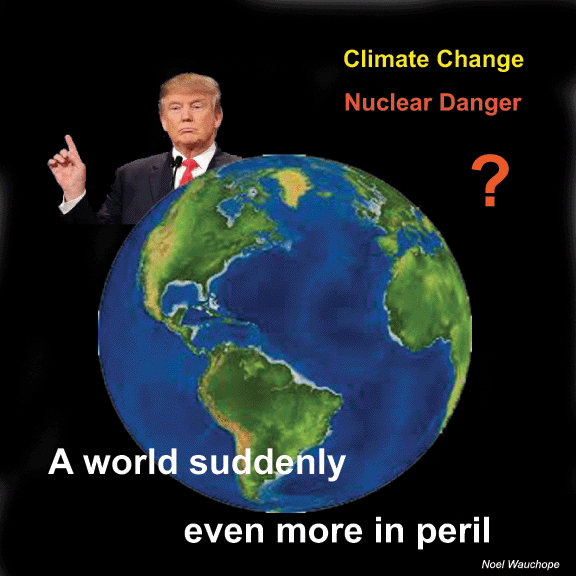 Would INF Withdrawal Recreate a Nuclear Hair-Trigger World? Junk enough arms control treaties, and the Cold War balance of terror will reign once again—this time with China in the mix. Foreign Policy, BY MICHAEL HIRSH, OCTOBER 23, 2018, “………The INF Treaty, signed in 1987, was a keystone of those early efforts to ease tensions. It sought to end the hair-trigger calculus embedded in the missiles that ringed the perimeter of the Soviet bloc, giving both sides scant minutes of warning before Armageddon. The INF Treaty was, as then-U.S. President Ronald Reagan said, the first nuclear treaty to eliminate, not just limit, nuclear arms. The United States and the Soviet Union pledged to destroy and permanently forswear all of their nuclear and conventional ground-launched ballistic and cruise missiles with ranges of 500 to 5,500 kilometers (300 to 3,400 miles).
Now, Washington plans to withdraw from the INF Treaty, according to U.S. President Donald Trump, who says that Russia has violated the agreement for years. Coupled with the prospect of no extension to the Strategic Arms Reduction Treaty, Washington may thus be opening the door to a return of a terrifying past. The Trump administration is not just threatening to roll back a slew of protections and safety precautions; it is also quite consciously restarting the arms race, with a full nuclear modernization plan that could cost up to $1.6 trillion over 30 years, according to an October 2017 report from the Congressional Budget Office and other accounts. The Russians and Chinese will undoubtedly respond, but with the cessation of treaty-authorized inspections, governments will be far more in the dark about what the other side is building.
……….Together, these moves could eventually leave the world facing a new kind of balance of terror, and on several different fronts. It’s no longer just about Washington and Moscow. China, which was for much of the Cold War a nuclear minnow and remains a much smaller nuclear power than the United States or Russia, has now stockpiled thousands of missiles, including tactical, cruise, medium-range, long-range, and intercontinental ballistic missiles launchable from air, land, and sea. That arsenal includes the mobile-launched Dongfeng-41, believed to be the world’s longest-ranged missile at a projected 7,500 miles.
Until now, Beijing has been restrained about tipping those missiles with nuclear warheads: It keeps an estimated 250 to 300 warheads, about as many as France. But that could begin to change if tensions rise and no treaty is in place to contain them.
…….. without treaty restrictions, a Pacific balance of terror could prove as unpredictable as what prevailed between Moscow and Washington during the darkest days of the Cold War.
The Trump administration claims that Russian President Vladimir Putin is responsible for the INF Treaty’s failure. In February 2007, Putin declared that the treaty no longer served Russia’s interests. Ever since, Russia has been violating it, claiming that its missile deployments are justified by U.S. missile defense. Even so, the violations have been relatively small-scale, mainly involving the construction of about 40 to 50 prohibited SSC-8 cruise missiles, said Matthew Bunn, a nuclear arms specialist at Harvard University’s Belfer Center. Bunn noted that the United States is also technically violating the treaty by taking a sea-based missile launcher, the Aegis, and putting it ashore. “If the shoe was on the other foot, we’d be screaming about that,” he said.……….HTTPS://FOREIGNPOLICY.COM/2018/10/23/WOULD-INF-WITHDRAWAL-RECREATE-A-NUCLEAR-HAIR-TRIGGER-WORLD/
Nuclear ban treaty may come into force in 2019: ICAN
 Treaty aims to stigmatise nuclear weapons as previous ones marginalised landmines and cluster munitions. Aljazeera, 29 Oct 2018 A treaty banning nuclear weapons could come into force by the end of 2019, backers of a campaign that won the 2017 Nobel Peace Prize said in an annual progress report on Monday.
The treaty aims to stigmatise nuclear weapons as previous treaties marginalised landmines and cluster munitions. Signatories promise to reject nuclear strategies and encourage others to follow suit.
The Nuclear Weapons Ban Monitor, published by Norwegian People’s Aid, said 19 states had already adhered to the 2017 Treaty on the Prohibition of Nuclear Weapons, putting it well on the way to the 50 ratifications it needs to come into force.
“We’re pushing for getting 50 ratifications by the end of 2019,” said Beatrice Fihn, executive director of the International Campaign to Abolish Nuclear Weapons.
“We have about 25, 30 countries that say that they will be ready by the end of 2019, so it’s definitely possible.”
The big nuclear powers oppose the treaty because they say it could undermine nuclear deterrence, which they credit with preventing conventional war. Fihn said such arguments were ridiculous fearmongering.
“If you follow that argument, that more nuclear weapons keep us safer, then why have a problem with North Korea having nuclear weapons?” she said……..https://www.aljazeera.com/news/2018/10/nuclear-ban-treaty-force-2019-ican-181029062510355.html
USA’s National Nuclear Security Administration under scrutiny, over plutonium pits
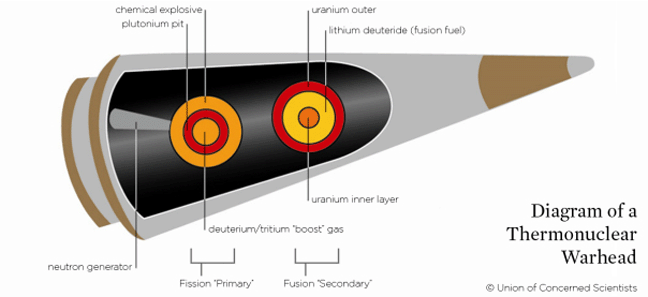
Watchdog groups seek review of plutonium plan http://www.santafenewmexican.com/news/local_news/watchdog-groups-seek-review-of-plutonium-plan/article_52eb4d8b-05bf-5715-9c8f-233132157ca0.html, By Andy Stiny | astiny@sfnewmexican.com,– 2 Nov 18
1 This Month
15 October. Joint Appeal for Nuclear Abolition Day -presentation to the UN on October 15 will be live on UNWebTV
Endorse the Nuclear Abolition Day Appeal
23-25 October – on Zoom – World BEYOND War’s annual global conference

To see nuclear-related stories in greater depth and intensity – go to https://nuclearinformation.wordpress.com
-
Archives
- October 2026 (139)
- September 2026 (339)
- August 2026 (330)
- July 2026 (355)
- June 2026 (287)
- May 2026 (306)
- April 2026 (356)
- March 2026 (251)
- February 2026 (267)
- January 2026 (308)
- December 2025 (358)
- November 2025 (359)
-
Categories
- 1
- 1 NUCLEAR ISSUES
- business and costs
- climate change
- culture and arts
- ENERGY
- environment
- health
- history
- indigenous issues
- Legal
- marketing of nuclear
- media
- opposition to nuclear
- PERSONAL STORIES
- politics
- politics international
- Religion and ethics
- safety
- secrets,lies and civil liberties
- spinbuster
- technology
- Uranium
- wastes
- weapons and war
- Women
- 2 WORLD
- ACTION
- AFRICA
- Atrocities
- AUSTRALIA
- Christina's notes
- Christina's themes
- culture and arts
- Events
- Fuk 2022
- Fuk 2023
- Fukushima 2017
- Fukushima 2018
- fukushima 2019
- Fukushima 2020
- Fukushima 2021
- general
- global warming
- Humour (God we need it)
- Nuclear
- RARE EARTHS
- Reference
- resources – print
- Resources -audiovicual
- Weekly Newsletter
- World
- World Nuclear
- YouTube
-
RSS
Entries RSS
Comments RSS

