Revisiting the Treaty on the Prohibition of Nuclear Weapons
 Lawfare, By Shanelle Van, Tuesday, November 27, 2018 One year ago, the International Campaign to Abolish Nuclear Weapons won the Nobel Peace Prize for its advocacy that contributed to the first legally binding treaty ban of nuclear weapons: the Treaty on the Prohibition of Nuclear Weapons, also known as the nuclear ban treaty. If and when it enters into force, the TPNW will legally bar treaty parties from—among other prohibited activities—possessing, developing, acquiring, testing, stockpiling, transferring, stationing, or threatening the use of nuclear weapons. It will also be illegal for treaty parties to “assist, encourage or induce, in any way, anyone to engage in any activity prohibited” by the treaty. Lawfare, By Shanelle Van, Tuesday, November 27, 2018 One year ago, the International Campaign to Abolish Nuclear Weapons won the Nobel Peace Prize for its advocacy that contributed to the first legally binding treaty ban of nuclear weapons: the Treaty on the Prohibition of Nuclear Weapons, also known as the nuclear ban treaty. If and when it enters into force, the TPNW will legally bar treaty parties from—among other prohibited activities—possessing, developing, acquiring, testing, stockpiling, transferring, stationing, or threatening the use of nuclear weapons. It will also be illegal for treaty parties to “assist, encourage or induce, in any way, anyone to engage in any activity prohibited” by the treaty.
|
|
Manchester City support’s for the U.N Nuclear Weapons Ban Treaty is welcomed by Nuclear Free Local Authorities (NFLA)
 NFLA 28th Nov 2018 , The Nuclear Free Local Authorities (NFLA) welcomes the unanimous decision
made today by Manchester City Council to formally support the International
Treaty for the Prohibition of Nuclear Weapons (TPNW). NFLA calls on the UK
Government to engage with the majority will of United Nations (UN) member
states by engaging in a process they have currently boycotted. The TPNW was
agreed at the UN by 122 countries (including the Republic of Ireland) in
July 2017 and is currently being ratified, a process that is expected to
conclude in 2019. The Treaty is a concerted attempt to move forward with
multilateral nuclear disarmament, but it has been opposed at every stage by
the nuclear weapon states, including the United Kingdom. NATO members, and
states like Australia and Japan who are linked to American security
policies, have also opposed this process.
http://www.nuclearpolicy.info/news/nfla-welcomes-manchester-city-council-becoming-first-european-city-formally-support-treaty-prohibition-nuclear-weapons/
Saudi Arabia’s Crown Prince Mohammad Bin Salman (MbS) and his goal of a nuclear kingdom
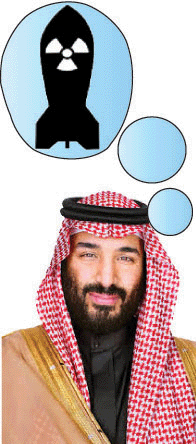 The Crown Prince May Build Himself a Nuclear Kingdom https://nationalinterest.org/blog/middle-east-watch/crown-prince-may-build-himself-nuclear-kingdom-37292 The Trump administration should keep a close eye on Saudi Arabia’s nuclear connections and activities. by Ronen Dangoor, 28 Nov 18
The horrific murder of Jamal Khashoggi shed light on the reckless and dangerous decisionmaking process of Saudi Arabia’s Crown Prince Mohammad Bin Salman (MbS). In addition to the latest crisis The New York Times recently published a story about how the prince’s closest security personnel sought to hire private foreign companies to assassinate senior Iranian officials—an act that could have trigger a regional military conflict. This conduct follows a string of other bizarre events in the last few months, initiated by MbS.
The crown prince has demonstrated arrogant, cruel, amateur and capricious behavior. His aggression has been left almost unmonitored by checks and balances inside the Saudi hierarchy. Indeed, MbS has constrained all his potential rivals and has taken full controlof Saudi Arabia’s security and intelligence bodies. As the Khashoggi scandal has proven—such power enables dictators to secretly execute dangerous operations. In parallel, he managed to become the darling of the West after he initiated economic reforms and launched his so called modern 2030 vision .
Now add Saudi’s long history of nuclear ambitions to the mix. For years, Saudi officials have warned that Saudi Arabia will not curb its nuclear ambitions if it will sense a threat to its national security, or if Iran advances in its nuclear program. Rumors were that Pakistan was obliged to provide the Saudis a ready-for-use nuclear weapon if and when the time comes. Things only got more complicated once the nuclear agreement (JCPOA) with Iran was signed in 2015, practically legitimizing Iran’s rights to maintain and develop its uranium enrichment capabilities. At the beginning of November 2018, the crown prince participated in the opening ceremony marking the launch of construction of Riyadh’s first research reactor . It’s still early days and only a symbolic act—the Saudis lack knowhow, technicians, infrastructure and academic expertise—but the country has both enough ambition and funds to advance anyway. Shortly after that the Saudi energy minister said the kingdom launches uranium exploration program.
Over the last decade, purchasing sixteen nuclear power reactors—later scaled back to two reactors—plus uranium enrichment capabilities preferably from the United States, has
featured prominently on the Saudi agenda. The official rationale is the country’s future needs to supply energy —with self-sufficient nuclear materials. While having enrichment capabilities can serve to counterbalance Iran, it may also constitute a future military nuclear program. During previous negotiations with Saudi officials, the Obama administration insisted that Saudi Arabia must comply with the “ gold standard ,” reflective of the conditions imposed on the UAE when it agreed to buy U.S. reactors in 2009. This standard requires a commitment not to enrich uranium or to produce plutonium as a strict condition for any agreement to sell nuclear reactors. According to current Secretary of State Mike Pompeo, the Trump administration has maintained this policy . In an interview with CBS in March 2018, MbS maintained that “without a doubt, if Iran developed a nuclear bomb, we would follow suit as soon as possible.”
Following the murder of Khashoggi, Senate members urged the Trump administration to curb any intention to sell nuclear reactors to the Saudi regime. This move is certainly necessary, but not nearly enough. An American refusal to his demands can push the prince to seek an alternative option elsewhere, with producers that will be all too happy to assist—for the right price.
Much of MbS’s current conduct lies parallel to previous experience with three other Middle East tyrants: former Iraqi president Saddam Hussein, Libya’s leader Muammar el-Qaddafi, and Syrian president Bashar al-Assad. These cynical dictators have a common denominator in their infinite ambitions, which ultimately led them to secretly promote a nuclear weapons program. They all relied heavily on their security systems in initiating these plans. Libya and Syria had no sufficient nuclear infrastructure, so they bought a turnkey nuclear project from Pakistan’s A.Q. Khan Network, and in the Syrian case from North Korea .
The Saudi nuclear issue has placed a challenge before the administration. If the prince is successful in surviving the current crisis, then that could prompt him to make even riskier decisions, including taking the nuclear path. Much like in Iraq, Libya and Syria, all the necessary components for that are now in place: A de facto dictator with delusions of grandeur and poor judgment, full control over the security services, unlimited funds for the purpose, a national sense of isolation, an acute threat, and a long-term nuclear vision. As Iran seems to be complying with the JCPOA, a Saudi move could instigate a nuclear arms race in the Middle East. To avoid this, the Trump administration should warn and restrict the Saudi heir. It should also keep a very close eye on Saudi Arabia’s nuclear connections and activities.
Ronen Dangoor is the former deputy head of the research and analysis division at the Israeli prime minister’s office.
Tensions rise as Russia prepares for USA to deploy nuclear weapons to Europe after ban treaty abandoned
Russia says it’s planning for the US to deploy nuclear weapons to Europe after ban treaty abandoned, Business Insider, Andrew Osborn and Tom Balmforth, Reuters, 26 Nov 18
Saudi Arabia’s crown prince Mohammed bin Salman – wanting a nuclear bomb?
|
Saudis Want a U.S. Nuclear Deal. Can They Be Trusted Not to Build a Bomb? NYT, By David E. Sanger and William J. Broad, Nov. 22, 2018, WASHINGTON — Before Saudi Arabia’s crown prince, Mohammed bin Salman, was implicated by the C.I.A. in the killing of Jamal Khashoggi, American intelligence agencies were trying to solve a separate mystery: Was the prince laying the groundwork for building an atomic bomb?The 33-year-old heir to the Saudi throne had been overseeing a negotiation with the Energy Department and the State Department to get the United States to sell designs for nuclear power plants to the kingdom. The deal was worth upward of $80 billion, depending on how many plants Saudi Arabia decided to build.
But there is a hitch: Saudi Arabia insists on producing its own nuclear fuel, even though it could buy it more cheaply abroad, according to American and Saudi officials familiar with the negotiations. That raised concerns in Washington that the Saudis could divert their fuel into a covert weapons project — exactly what the United States and its allies feared Iran was doing before it reached the 2015 nuclear accord, which President Trump has since abandoned. Prince Mohammed set off alarms when he declared earlier this year, in the midst of the negotiation, that if Iran, Saudi Arabia’s fiercest rival, “developed a nuclear bomb, we will follow suit as soon as possible.” His negotiators stirred more worries by telling the Trump administration that Saudi Arabia would refuse to sign an agreement that would allow United Nations inspectors to look anywhere in the country for signs that the Saudis might be working on a bomb, American officials said. Asked in Congress last March about his secret negotiations with the Saudis, Energy Secretary Rick Perry dodged a question about whether the Trump administration would insist that the kingdom be banned from producing nuclear fuel. Eight months later, the administration will not say where the negotiations stand. Now lurking behind the transaction is the question of whether a Saudi government that assassinated Mr. Khashoggi and repeatedly changed its story about the murder can be trusted with nuclear fuel and technology. Such fuel can be used for benign or military purposes: If uranium is enriched to 4 percent purity, it can fuel a power plant; at 90 percent it can be used for a bomb. Privately, administration officials argue that if the United States does not sell the nuclear equipment to Saudi Arabia someone else will — maybe Russia, China or South Korea. They stress that assuring that the Saudis use a reactor designed by Westinghouse, the only American competitor for the deal, fits with Mr. Trump’s insistence that jobs, oil and the strategic relationship between Riyadh and Washington are all far more important than the death of a Saudi dissident who was living, and writing newspaper columns, in the United States. Under the rules that govern nuclear accords of this kind, Congress would have the opportunity to reject any agreement with Saudi Arabia, though the House and Senate would each need a veto-proof majority to stop Mr. Trump’s plans. “It is one thing to sell them planes, but another to sell them nukes, or the capacity to build them,’’ said Representative Brad Sherman, Democrat of California and a member of the House Foreign Affairs Committee. Following Mr. Khashoggi’s death, Mr. Sherman has led the charge to change the law and make it harder for the Trump administration to reach a nuclear agreement with Saudi Arabia. He described it as one of the most effective ways to punish Prince Mohammed. “A country that can’t be trusted with a bone saw shouldn’t be trusted with nuclear weapons,” Mr. Sherman said, referring to Mr. Khashoggi’s brutal killingin the Saudi Consulate in Istanbul last month. Nuclear experts said Prince Mohammed should have been disqualified from receiving nuclear help as soon as he raised the prospect of acquiring atomic weapons to counter Iran. “We have never before contemplated, let alone concluded, a nuclear cooperation agreement with a country that was threatening to leave the nonproliferation treaty, even provisionally,” said William Tobey, a senior official in the Energy Department during the Bush administration who has testified about the risks of the agreement with Saudi Arabia. He was referring to the crown prince’s threat to match any Iranian nuclear weapon — a step that would require the Saudis to either publicly abandon their commitments under the nonproliferation treaty or secretly race for the bomb. The Trump administration declined to provide an update on the negotiations, which were intense enough that Mr. Perry went to Riyadh in late 2017. Within the last several months, a senior State Department official engaged in further discussions over the deal in Europe. ……..The core challenge for the Trump administration is that it has declared that Iran can never be trusted with any weapons-making technology. Now, it must decide whether to draw the same line for the Saudis. The United States’ own actions may be helping to drive the Saudis’ nuclear thinking. Now that the Iran agreement, brokered with world powers, is on the edge of collapse after Mr. Trump withdrew the United States, analysts are worried that the Saudis may be positioning themselves to create their own nuclear program in response. The kingdom has extensive uranium deposits and five nuclear research centers. Analysts said Saudi Arabia’s atomic work force was steadily growing in size and sophistication — even without producing nuclear fuel. Saudi leaders saw a political opening when Mr. Trump was elected. In its early days, the administration spent considerable time discussing ways that Saudi Arabia and other Arab states could acquire nuclear reactors. Michael T. Flynn, who briefly served as Mr. Trump’s national security adviser, backed a plan that would have let Moscow and Washington cooperate on a deal to supply Riyadh with reactors — but not the ability to make its own atomic fuel. As a precondition, American economic sanctions against Russia would have been dropped to allow Moscow to join the effort. Mr. Flynn was fired in early 2017 as questions swirled around his conversations with Russia’s ambassador to the United States, including about ending the trade restrictions. At his Senate confirmation hearing in November 2017, Christopher A. Ford, the assistant secretary of state for international security and nonproliferation, called the safeguards a “desired outcome.” But he equivocated on whether the United States would insist on them. Senator Edward J. Markey, a Massachusetts Democrat who sits on the Senate Foreign Relations Committee, described the administration’s approach as “a recipe for disaster.”…….The crown prince made headlines in March by shifting the public discussion over Riyadh’s intentions from reactors to atomic bombs. In a CBS News interview, he said that if Iran acquired nuclear arms, Saudi Arabia would quickly follow suit. …….Mr. Falih, the energy minister, raised concerns about the outcome of negotiations with Washington by insisting publicly that Riyadh would make its own atomic fuel. ………https://www.nytimes.com/2018/11/22/world/middleeast/saudi-arabia-nuclear.html |
|
Russia to give up its policy of ‘no first use’ of nuclear weapons
Russia rewrites nuclear rule book to fire first, The Times, 23 Nov 18 President Putin would have the power to launch nuclear first strikes under plans approved by the Russian parliament.
Senators in the Federation Council, the upper house, have recommended tearing up the military doctrine that forbids initial use of weapons of mass destruction. It comes after Mr Putin said that Moscow would retaliate if the United States withdrew from a landmark Cold War missile treaty.
Russia
The revision would allow the president to order nuclear strikes in response to enemy use of conventional weapons, a significant departure from the military doctrine that prohibits first use unless Russia is threatened by weapons of mass destruction or if its “very existence is in jeopardy” ……. (subscribers only) https://www.thetimes.co.uk/article/russia-rewrites-nuclear-rule-book-to-fire-first-r9gg2mpqm
USA’s endless cycle of weapons spending is set to get more extreme

Trump’s Defense Spending Is Out of Control, and Poised to Get Worse https://www.rollingstone.com/politics/politics-features/trump-defense-spending-757028/ 15 Nov 18,
Using a time-honored trick, a bipartisan congressional panel argues we should boost the president’s record defense bill even more
The East Yorkshire village almost wiped out by a nuclear bomb
It was, understandably, opposed by residents Alex Grove 18 NOV 2018
It is a quaint rural hamlet on the coast of East Yorkshire with around 600 people and a few small amenities.
Life in Skipsea is peaceful, sleepy and quiet, but a controversial proposal put forward by scientists 65 years ago threatened to effectively wipe out the village from existence and change the face of the seaside village forever.
In 1953, almost 240 miles away from Skipsea in another similarly small Berkshire village called Aldermaston, scientists at the Atomic Research Establishment seriously considered detonating a nuclear weapon next to Skipsea.
At the time it had a medieval church and the remains of a Norman castle but not much else, and its close proximity to the RAF base at Hull made it an ideal spot to explode an atomic bomb.
In the midst of the Cold War, the UK wanted to find a coastal site for an above-ground atomic bomb explosion after detonating under the sea off a group of islands near Australia in 1952.
They first opted for a Scottish beauty spot called Duncansby Wick near Caithness in the Highlands of Scotland, but this plan was halted by the damp.
They turned their attention to Donna Nook in Lincolnshire before settling on Skipsea.
However, the people of the small East Riding village were not going to relinquish their hamlet without a fight. Unsurprisingly, community leaders rallied to protest against the idea arguing the site chosen was too close to bungalows and beach huts. The area’s MPs encouraged the government to reconsider the radical plan and with opposition to the idea too fierce, the government backed down and secured Skipsea’s future with the bomb test carried out at Emu Field – a desert area in South Australia.
The village was still used later on by The Royal Observer Corps as a site for a Cold War observation post on the east coast of England. The site remained active from October 1959 until its decommissioning in September 1991. It gathered dust for years before being restored by an enthusiast ten years ago.
People may not think there is much to do in Skipsea with the village home to a couple of churches and post offices, a village hall a pub and a few shops.
However, this tale of old will just make you appreciate the fact that this quiet, sleepy village even exists at all.
How the USA gave up on protecting its citizens against nuclear attack, and settled for just elite shelters
How the U.S. Government Might Have Survived a Nuclear War, Yes, this is the real Deep State, National Interest,
Rocky Flats still radioactively polluted
CNN Planet Earth: Poisoned Earth – Rocky Mountain Arsenal
The Dangers of Rocky Flats Are Forgotten but Not Gone, Westword, | NOVEMBER 17, 2018 “……..After nearly forty years of producing plutonium triggers for nuclear bombs, Rocky Flats was closed in 1992 after an endless series of fires, leaking storage containers and other accidents. At that time, it was said that Rocky Flats was likely to become a “national sacrifice zone” — a place so toxic it would never be fit for human habitation.
Then in 2000, only a few years later, Kaiser-Hill was given a contract to complete the closure of Rocky Flats, agreeing to clean up the entire 6,245-acre site in less than six years on a budget of $4 billion.
Really? From “sacrifice zone” to “70-year marginal clean up” to “perfectly safe” in less than six years? How is this possible?
The cleanup of Rocky Flats was declared complete in 2006 and, even more astonishing, new homes in the Candelas development began to appear in 2012, immediately south of Rocky Flats, near the buffer zone. Now, despite continuing protest, the Deputy Secretary of the Interior has ruled that the Rocky Flats National Wildlife Refuge (the innocuous new name for the plant) is safe enough for visits by children on school field trips.
The efforts to hide the dirty secrets of Rocky Flats are nothing new, and neither is the willingness of people to ignore the truth in order to lead lives free of worry. Newbies to Colorado, many of whom have invested much to make major life changes, are the biggest naysayers, wearing blinders to avoid the unsettling truth about their new choice of residence………..
We all lived in the Broomfield area of the Front Range from the early ’60s onward, I told the woman. For more than twenty years, I said, we all drank water from the Great Western Reservoir, Broomfield’s plutonium-laden water supply, and began suffering our health problems in the mid- to late ’80s. And this is just one family, I told her. One little family out of tens of thousands of families, all of which can tell their version of the same horror story. (When the members of a family or multiple families within a community contract this much cancer, says my primary care doctor, the cause is nearly always environmental.)……….
if Rocky Flats is so safe, why did an independent sample of soils east of Rocky Flats along Indiana Street in 2012 show plutonium contamination 100 times greater than allowable background levels? Why did a 2016 study led by Metropolitan State University of Denver find that those living downwind from Rocky Flats have unusually high rates of breast, thyroid, prostate, colon and rare cancers? And why do veterinarians in the Arvada-Westminster area report that dogs that frequent the Westminster Hills Dog Park — located just east of Rocky Flats and adjacent to the contaminated Great Western Reservoir — have abnormally high rates of bone and foot cancers?
More important, if Rocky Flats is so safe, why are home buyers immediately south of ground zero presented with advisory notices only at closing and told not to plant root-bound vegetables in gardens? One would think buyers would pay serious attention to such red flags, especially those buyers with young children……..
“In less than a generation we have almost forgotten what happened at Rocky Flats, and why it must never happen again,” says Kristen Iversen in Full Body Burden , her landmark exposé/history of Rocky Flats. ……..https://www.westword.com/news/op-ed-rocky-flats-dangers-are-forgotten-not-gone-11001314
President of French Polynesia admits that leaders lied, over 3 decades, about dangerous radioactivity from French nuclear tests
 French Polynesian president acknowledges nuclear test lies https://www.princegeorgecitizen.com/french-polynesian-president-acknowledges-nuclear-test-lies-1.23500250, Thomas Adamson / The Associated Press, NOVEMBER 16, 2018 PARIS —French Polynesian President Edouard Fritch has said the leaders of the French collectivity of islands in the South Pacific lied to the population for three decades over the dangers of nuclear testing.
France gives Tahiti site for nuclear memorial
https://www.radionz.co.nz/international/pacific-news/376007/france-gives-tahiti-site-for-nuclear-memorial 15 November 2018 The French National Assembly has voted to give French Polynesia a building in Papeete for a memorial site of the French nuclear weapons tests. The decision means that the site of the former command complex of the French Navy in Papeete will be made available for this new centre.
North Korea tests new ‘ultramodern tactical weapon’ amid stalled nuclear diplomacy
It didn’t appear to be a test of a nuclear device or a long-range missile with the potential to target the U.S. NBC News, Nov. 16, 2018, By Associated Press
SEOUL, South Korea — North Korean leader Kim Jong Un observed the successful test of an unspecified “newly developed ultramodern tactical weapon,” state media reported Friday.
It didn’t appear to be a test of a nuclear device or a long-range missile with the potential to target the U.S. A string of such tests last year had many fearing war before the North turned to engagement and diplomacy.
The North hasn’t publicly tested any weapons since November 2017, but in recent days Pyongyang reportedly expressed anger at U.S.-led international sanctions and ongoing small-scale military drills between South Korea and the United States.
Earlier this month, North Korea’s Foreign Ministry warned it could bring back its policy of bolstering its nuclear arsenal if it doesn’t receive sanctions relief.
Diplomacy has stalled since a summit between Kim and President Donald Trump in June, with Washington pushing for more action on nuclear disarmament and the North insisting that the U.S. first approve a peace declaration formally ending the Korean War and lift sanctions.
For the first time, a full account of the horror results of UK’s nuclear bomb experiments
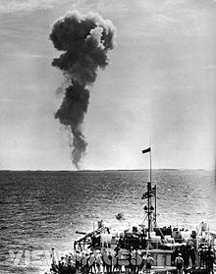 Britain’s nuclear bomb test legacy of early deaths and deformed children, Mirror, Susie Boniface 14 NOV 2018
The horrific story behind the UK’s nuclear experiments have been told in full for the first time. After the horrors of the Second World War, it was deemed necessary for Britain to have a weapon that could unleash hell.
When atom bombs were dropped on Japan in 1945, LIFE magazine reported: “People’s bodies were terribly squeezed, then their internal organs ruptured…….
Of the 22,000 scientists and servicemen who took part in radioactive experiments in Australia and the South Pacific, just a handful are alive.
Their families report cancers, rare medical problems, high rates of miscarriage – and deformities, disability and death for their children – and their grandchildren.
Now, the full story of Britain’s nuclear experiments has been told for the first time in a new Mirror website that details not only the scientific, military and political battles, but the human fallout.
DAMNED features top-secret documents, eyewitness accounts and searing testimonies.
The site takes its name from an editorial written in 2002 by Mirror editor Richard Stott, who thundered: “How many more generations of the damned will our politicians allow to suffer before they accept the calamities of their predecessors and the consequences of their own cowardice?”
In May, the Mirror called for an award for the veterans and Defence Secretary Gavin Williamson has ordered a medal review.
DAMNED begins with Operation Hurricane in 1952, when Britain exploded its first atomic bomb, covers the Minor Trials in South Australia, which left the landscape littered with plutonium debris for decades, and reports on Operation Grapple in 1958 when the UK detonated its biggest weapon.
It also details the human cost and shows how every other nuclear nation on Earth came to accept and recognise their nuclear heroes – leaving Britain the only one to deny a duty of care………
In May, the Mirror called for an award for the veterans and Defence Secretary Gavin Williamson has ordered a medal review……….
DAMNED has a memorial section with the pictures and health problems of every veteran from our archives. Some of their stories can be read here: …… https://www.mirror.co.uk/news/uk-news/britains-nuclear-bomb-test-legacy-13590455
USA’s next chairman of the House Armed Services Committee aims to scrap Trump’s nuclear weapons policy
Smith aims to scrap Trump’s nuclear weapons policy, Defense News , 13 Nov 18WASHINGTON — Rep. Adam Smith — set to become the next chairman of the House Armed Services Committee in the new Congress — and other Democratic lawmakers said Wednesday they hope to use their party’s takeover of the House to check the Trump administration’s expansive policies toward nuclear weapons.
1 This Month
15 October. Joint Appeal for Nuclear Abolition Day -presentation to the UN on October 15 will be live on UNWebTV
Endorse the Nuclear Abolition Day Appeal
23-25 October – on Zoom – World BEYOND War’s annual global conference

To see nuclear-related stories in greater depth and intensity – go to https://nuclearinformation.wordpress.com
-
Archives
- October 2026 (139)
- September 2026 (339)
- August 2026 (330)
- July 2026 (355)
- June 2026 (287)
- May 2026 (306)
- April 2026 (356)
- March 2026 (251)
- February 2026 (267)
- January 2026 (308)
- December 2025 (358)
- November 2025 (359)
-
Categories
- 1
- 1 NUCLEAR ISSUES
- business and costs
- climate change
- culture and arts
- ENERGY
- environment
- health
- history
- indigenous issues
- Legal
- marketing of nuclear
- media
- opposition to nuclear
- PERSONAL STORIES
- politics
- politics international
- Religion and ethics
- safety
- secrets,lies and civil liberties
- spinbuster
- technology
- Uranium
- wastes
- weapons and war
- Women
- 2 WORLD
- ACTION
- AFRICA
- Atrocities
- AUSTRALIA
- Christina's notes
- Christina's themes
- culture and arts
- Events
- Fuk 2022
- Fuk 2023
- Fukushima 2017
- Fukushima 2018
- fukushima 2019
- Fukushima 2020
- Fukushima 2021
- general
- global warming
- Humour (God we need it)
- Nuclear
- RARE EARTHS
- Reference
- resources – print
- Resources -audiovicual
- Weekly Newsletter
- World
- World Nuclear
- YouTube
-
RSS
Entries RSS
Comments RSS

