Trump administration considers adding a special new military branch – for weapons in space
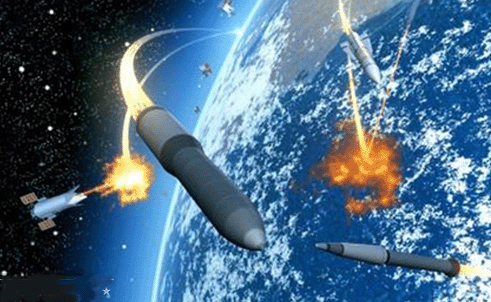
Trump considers adding a military branch – for space, News Target , 04/21/2018 / By David Williams “……..President Trump himself has declared that creating an entirely new branch of the military, one that’s dedicated solely for matters of defense and war in space – is now in the cards.
Indeed, the POTUS said in a speech recently that the U.S. could benefit from the creation of a so-called Space Force, which would be built with a focus on preparing the country for space-related war efforts. Its existence would be in line with the idea that space is the “ultimate high ground” that needs to be protected at all costs.
According to the POTUS, space really is just like all the other areas that the current branches of the military are meant to protect. “My new national strategy for space recognizes that space is a war-fighting domain, just like the land, air and sea,” he said during a speech to service members in San Diego. “We may even have a Space Force.”
The President shared the details of how the idea for this new military branch came to be. He said that he had been musing recently about the possibility of adding such a division to the military, in addition to the ones that already exist – Air Force, Army, Coast Guard, Marines, and Navy. “I said, ‘Maybe we need a new force. We’ll call it the Space Force,’” he said. “And I was not really serious. And then I said, ‘What a great idea. Maybe we’ll have to do that. That could happen.’”
It might seem like a joke or something that’s going to be impossible to do for now, but there are certainly those who support this idea in the military itself. It is said that the idea aligns quite well with the renewed focus of the military forces on maintaining U.S. space dominance.
….. According to Navy Vice Adm. Charles A. Richard, the deputy commander of U.S. Strategic Command, having a working space force could be beneficial in the same way that nuclear weapons are, by serving as deterrents. “Just as nuclear assets deter aggression by convincing potential adversaries there’s just no benefit to the attack, we have to maintain a space posture that communicates the same strategic message,” he explained. “I submit [that] the best way to prevent war is to be prepared for war, and we’re going to make sure that everyone knows we’re going to be prepared to fight and win wars in all domains, to include space.”…… https://www.newstarget.com/2018-04-21-trump-considers-adding-a-military-branch-for-space.html
High cancer rates in UK’s nuclear test veterans
Mirror 22nd April 2018 , Survivor of Britain’s nuclear tests lost all his teeth, had thyroid tumour
and wife suffered two stillbirths – and he was one of ‘lucky’ ones
EXCLUSIVE: Sixty years ago on Christmas Island, these army veterans had to
put their hands over their eyes as a nuke 100 times more powerful than
Hiroshima was set off – and more than half their unit died of cancer.
https://www.mirror.co.uk/news/world-news/survivor-britains-nuclear-tests-lost-12409628
How artificial intelligence could start a nuclear war
Why artificial intelligence might trigger a nuclear war https://www.technologyreview.com/the-download/610996/why-artificial-intelligence-might-trigger-a-nuclear-war/
Well before Terminator robots rise and attack us, AI could help us destroy ourselves with nuclear weapons, warns a new study.
The news: A RAND Corporation report concludes that military adoption of artificial intelligence and other emerging technologies could have a destabilizing effect over the next couple of decades and lead some nation to take the nuclear option.
Details: Strategic stability provided by “mutually assured destruction” might be undermined if AI offers a new—and vastly better—way to target an adversary’s weapons systems, the report says. The findings are drawn from information collected through workshops with experts on nuclear weapons, national security, government policy, and AI.
Algorithms for peace: It isn’t all doom and gloom. The study also suggests that under some scenarios, AI could help preserve strategic stability by providing new ways of gathering and analyzing information about nuclear capabilities.
A Strangelove scenario? It is notoriously difficult to predict what AI will look like 10 or 20 years from now. That said, even current AI looks likely to have a big impact on the military. The RAND report may only heighten calls to weaponize the technology and make its development a national priority.
Trump’s Nuclear Posture Review makes allowance for NEW NUCLEAR BOMB TESTING
War on the rocks 20th April 2018 , While the Obama administration’s Nuclear Posture Review included a
blanket commitment not to conduct explosive nuclear tests, the Trump
administration’s 2018 version of the document argues that the United
States “must remain ready to resume nuclear testing if necessary to meet
severe technological or geopolitical challenges [emphasis added].”
Severe technological challenges that could merit a return to testing do not
currently exist. Specific geopolitical challenges, a new criterion, are not
defined. Does this mean the administration could resume testing if China
continues making aggressive moves in the South China Sea? If North Korea
tests another missile? If Russian hackers disrupt U.S. government websites?
https://warontherocks.com/2018/04/mushroom-clouds-beneath-the-surface-the-dangers-of-a-return-to-nuclear-testing/
Yes Virginia, reactor-grade plutonium can be used to make nuclear weapons
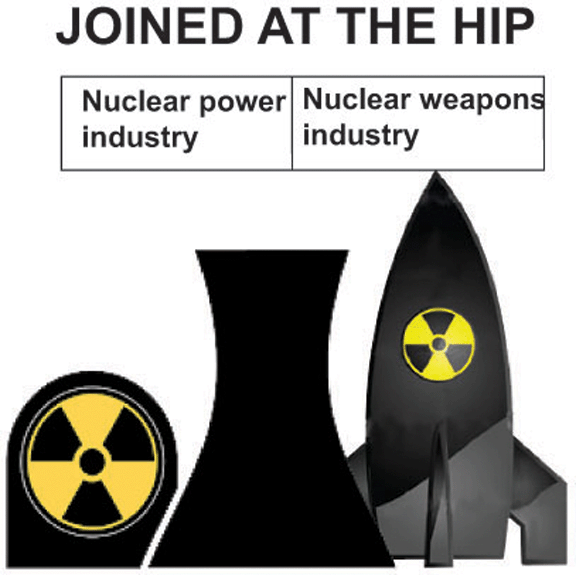
NPEC 20th April 2018 , In Reactor-Grade Plutonium and Nuclear Weapons: Exploding the Myths,
long-time defense analyst Gregory S. Jones draws from his decades of
research using publicly available, unclassified information to debunk the
persistent fallacy that reactor-grade plutonium cannot be used to build
reliable nuclear weapons. This belief has long been held by a segment of
the nuclear power industry determined to use plutonium as reactor fuel
despite its highly uneconomical nature. Further, this mistaken belief has
made reactor-grade plutonium readily available to many non-nuclear weapon
states.
http://www.npolicy.org/thebook.php?bid=37
North Korea just promised a huge concession on its nuclear weapons. It’s done that before.
South Korean President Moon Jae-in said North Korea might end its nuclear program while the US keeps its troops in South Korea. We’ve been here before. Vox By
30 UK civil society organisations call on Britain to sign UN Treaty on the Prohibition of Nuclear Weapons (TPNW).
 Nuclear Ban 17th April 2018 , In advance of the Non-Proliferation Treaty Preparatory Committee which
meets in Geneva from April 23rd over 30 UK civil society organisations have
co-signed a letter to Boris Johnson, challenging the government to take its
disarmament responsibilities seriously and in particular to participate in
the UN Treaty on the Prohibition of Nuclear Weapons (TPNW).
http://www.nuclearban.scot/challenge-to-uk-to-participate-in-nuke-ban-treaty/
America’s Nuclear Posture Reviews (NPR) – inconsistencies, limitations, and questions unanswered
Scared ex-Soviet general warns NUCLEAR war is INEVITABLE
World War 3 IMMINENT! Scared ex-Soviet general warns NUCLEAR war is INEVITABLE
A SCARED former Russian army general issued a harrowing warning that a nuclear war is “inevitable” and it is an “illusion” if leaders feel they can control a military conflict between the US and Russia. Express UK By THOMAS HUNT, Apr 17, 2018 Former Russian general: Use of nuclear weapons is inevitable
Speaking to Channel 4 News, he said: “I think it’s worse than the Cold War, which we have been waging for 40 years after the Second World War.
“In the Cold War time I was in the armed forces and I was quite comfortable I’d say.
“There were definite duels and definite red lines – everybody knew what to do.There were no threats, no sanctions, no isolation, no cornering, no nothing.
“There was just ideological confrontation, but people on both sides knew how far they could go.”
The military veteran was then asked by the presenter whether rising tensions could lead to a third world war.
The General responded: “Of course. I repeat, you cannot control military confrontation between Russia and the United States.
Of course Russia cannot wage a war against the United States. For years, economically it cannot.
“In the general purpose forces, we are a bit lagging behind the United States.
“And of course, Russia will no accept any kind of defeat.
“So the involvement of nuclear weapons is inevitable.”
When asked if he is just trying to scare viewers, Mr Buzhinskiy said he was scared for the possible repercussions. He added: “I am scared myself because I have children and I have grandchildren so I am scared for their fate.”
……..https://www.express.co.uk/news/world/947171/World-War-3-Russia-news-nuclear-war-inevitable
Strikes on Syria. What may happen next between Russia and USA?
Syria strikes: The real impact is in Moscow, April 14, 2018 After nearly a week of tension that sometimes verged on the surreal, the US and its allies finally carried out strikes against regime targets in Syria on Friday night. The strikes, more limited than once seemed likely, were designed to deter the Assad regime’s use of chemical weapons once and for all.
US, British and French forces launch air strikes on chemical weapons sites in Syria
Syria: US, British and French forces launch air strikes in response to chemical weapons attack,
US, British and French forces have pounded chemical weapons sites in Syria with air strikes in response to an alleged poison gas attack that killed dozens in the rebel-held town of Douma last week.
Key points:
- US, UK and France hit three chemical weapons sites in Syria
- US Defence Secretary says strikes were a “one-time shot”
- Strikes biggest intervention yet by Western powers against Assad regime
In a televised address to the nation, US President Donald Trump said the three nations had “marshalled their righteous power against barbarism and brutality”.
The strikes were the biggest intervention by Western powers against President Bashar al-Assad in the country’s seven-year-old civil war, which has pitted the US and its allies against Russia.
The Pentagon said the strikes targeted a research centre in Damascus, along with a chemical weapons storage facility and command post west of Homs……
British Prime Minister Theresa May said the strikes were not about intervening in a civil war nor were they about a regime change.
“We cannot allow the use of chemical weapons to become normalised within Syria, on the streets of the UK or anywhere else in our world,” Ms May said…….
Russia’s Defence Ministry said the majority of missiles fired during the attack were intercepted by Syrian air defence systems using Soviet-produced hardware, including the Buk missile system. http://www.abc.net.au/news/2018-04-14/us-to-strike-syria-in-response-to-chemical-weapons-attack/9658900

Deutsche Welle Expose Nuclear Power and Nuclear Weapons Link
Marianne Wildart, 8 Apr 18In this recent article the German News outlet ‘Deutsche Welle’ expose the link between civil nuclear and nuclear weapons. Nuclear ‘energy’ is a political choice.
……….A study by the Lappeenranta University of Technology (LUT) in Finland simulating the costs of the global transition to renewables and found that a 100-percent renewable energy system would be cheaper that what we have today.
Fell, meanwhile, has documented the explosion of nuclear powers costs, as well as the security concerns over new nuclear reactors.
Yet India, Saudi Arabia, Turkey and the UK remain committed to building new nuclear power plants. And Fell sees a motive for this that has nothing to do with securing an affordable energy supply. “The main driving force behind the new nuclear reactors are nuclear weapons, and the desire for nuclear weapons,” he told DW.
Scientists at the University of Sussex have come to a similar conclusion. In their study of British nuclear policy they attribute the construction of new reactors to cross-funding with military nuclear programs. They argue that maintaining nuclear power programs and expertise at the expense of electricity customers has the advantage of relieving the defense budget…. https://wordpress.com/read/feeds/331643/posts/1820643667
Could new U.S. tactical missile projects trigger a new nuclear arms race?
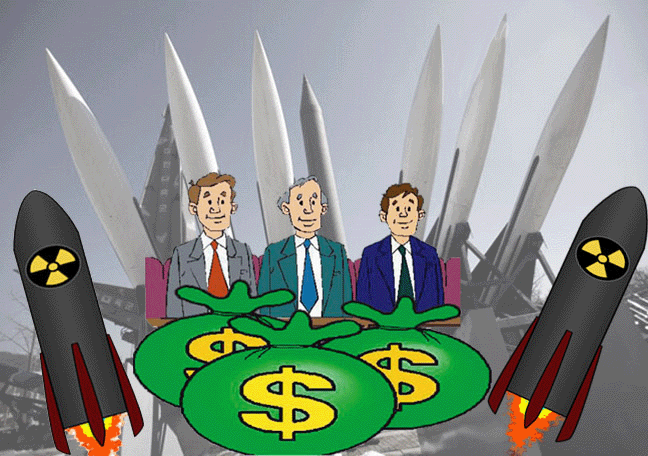 Are the U.S. Army and DARPA Trying to Start a Nuclear Arms Race? National Interest, Michael Peck, 6 Apr 18, Could new U.S. tactical missile projects trigger a new nuclear arms race?
Recent comments by U.S. Army leaders, and a new project from Pentagon research agency DARPA, point to the United States developing new long-range battlefield missiles.
“499 kilometers and beyond” is a very significant phrase, because the 1987 Intermediate Range Nuclear Force Treaty (INF), signed by Ronald Reagan and Mikhail Gorbachev, banned nuclear and conventional missiles with a range of 500 to 5,500 kilometers (or about 300 to 3,400 miles). The agreement came in the midst of an arms race after the Soviets deployed SS-20 intermediate-range nuclear missiles which threatened Western Europe, to which the United States responded by deploying Pershing II and ground-launched cruise missiles.
The conventional weapons provision pointed to an uncomfortable fact: there is no way to peek inside a nose cone to be sure the missile isn’t carrying a nuclear warhead. So while conventional intermediate-range missiles could have many uses (attacking airfields, command centers, etc.), a missile launched from, say, Germany could hit Moscow with a nuclear weapon.
Indeed, the INF treaty obligated both sides to dismantle a lot of expensive hardware: 2,692 weapons, from short-range tactical missiles to long-range cruise missiles. It also established mechanisms for both sides to verify compliance. The treaty has been assailed in recent years, with the United States accusing Russia ofviolating the agreement by deploying a new ground-launched cruise missile. Putin’s recent speech, in which he boasted of Russia developing a nuclear-powered cruise missile, isn’t likely to reduce tensions.
However, General Brown suggested that the U.S. Army wouldn’t mind breaching the INF treaty. “‘I know there’s the INF treaty…but we need to push beyond that,’” Brown said, according to Politico.
At the same time, DARPA is pursuing its OpFires missile program. “The United States ground-based forces are currently limited in effective range of surface-to-surface precision fires,” according to DARPA. “The OpFires program seeks to provide operational/theater level commanders with flexible capabilities to strike time sensitive targets while providing persistent standoff from unpredictable land launch positions.”
DARPA says “the overarching goal of the OpFires program is to develop and demonstrate a novel ground-launched system enabling advanced tactical weapons to penetrate modern enemy air defenses and rapidly and precisely engage critical time sensitive targets.”……….http://nationalinterest.org/blog/the-buzz/are-the-us-army-darpa-trying-start-nuclear-arms-race-25231
Researchers from 30 countries call for boycott of South Korean university, in campaign against lethal autonomous weapons
We are locked into an arms race that no one wants to happen, global researchers warn
A CHILLING letter claims the world is on the cusp of opening a dangerous Pandora’s box — and there is no going back. http://www.news.com.au/technology/innovation/we-are-locked-into-an-arms-race-that-no-one-wants-to-happen-global-researchers-warn/news-story/fc6dfa060c66ed876beb79d1b7530cc6 Nick Whigham@NWWHIGHAM 5 Apr 18
The boycott comes in advance of a meeting next Monday in Geneva, Switzerland, of 123 member nations of the United Nations discussing the challenges posed by lethal autonomous weapons. Twenty-two of those nations have already called for an outright and pre-emptive ban on such weapons.
The open letter announcing the boycott against the South Korean university said autonomous weapons are the “third revolution in warfare” and warned about letting the genie out of the bottle.
“At a time when the United Nations is discussing how to contain the threat posed to international security by autonomous weapons, it is regrettable that a prestigious institution like KAIST looks to accelerate the arms race to develop such weapons,” the letter said.
“We therefore publicly declare that we will boycott all collaborations with any part of KAIST until such time as the President of KAIST provides assurances, which we have sought but not received, that the Center will not develop autonomous weapons lacking meaningful human control,” the researchers said.
“If developed, autonomous weapons will be the third revolution in warfare. They will permit war to be fought faster and at a scale greater than ever before. They have the potential to be weapons of terror. Despots and terrorists could use them against innocent populations, removing any ethical restraints. This Pandora’s box will be hard to close if it is opened.”
Professor Walsh organised the boycott which involves researchers from 30 countries and includes three of the world’s top deep learning experts, Professor Stuart Russell from the University of California, Berkeley, who authored the leading textbook on AI and roboticist Prof Wolfram Burgard, winner of the Gottfried Wilhelm Leibniz Prize, the most prestigious research prize in Germany.
“Back in 2015, we warned of an arms race in autonomous weapons,” Professor Walsh said in a statement alongside the letter. “We can see prototypes of autonomous weapons under development today by many nations including the US, China, Russia and the UK. We are locked into an arms race that no one wants to happen.
“KAIST’s actions will only accelerate this arms race. We cannot tolerate this.”
Professor Walsh has long campaigned against the development of autonomous weapons.
He has previously travelled to speak in front of the United Nations in an effort to have the international body prevent the proliferation of so-called killer robots with the ability to think for themselves.
Speaking to news.com.au last year he said “the arms race is already starting.”
He believes it’s no longer a question of whether military weapons are imbued with some level of autonomy, it’s just a matter of how much autonomy — which poses a number of worrying scenarios, particularly if they fall into the wrong hands.
“They get in the hands of the wrong people and they can be turned against us. They can be used by terrorist organisations,” he warned.
“It would be a terrifying future if we allow ourselves to go down this road.
1 This Month

Protect Sazan Island from the Trump family! https://secure.avaaz.org/campaign/en/protect_sazan_island_from_the_trump_family_loc/?bqFCVab&v=174511&cl=22707147157&_checksum=5e9dde668860e8231c33699735e16a1fbf22ab2cb01da50c999fe8732b9775ef&utm_source=email&utm_medium=blast_email&utm_campaign=174511

25 June- THE PUKE ON NUKES
Thursday, June 25, 2026
7pm Central Time (8pm ET, 6pm MT, 5pm PT) UTC – 5
From NRC & DOE Deregulation to Techno-Fascist Billionaires Going Nuclear, Plus a Few Songs from Atomic Cabaret REGISTER
26 June – Radiation Trainwreck at the NRC / Join the Protect Better Campaign – https://us02web.zoom.us/meeting/register/4ZlZ5_qLSHGiLSCg8FF6Bg#/registration


Cuba Is Not a Failed State – It Is a Besieged State
PETITION: “Global Appeal to Endorse Palestinian Right of Return of Refugees”
To see nuclear-related stories in greater depth and intensity – go to https://nuclearinformation.wordpress.com
-
Archives
- June 2026 (142)
- May 2026 (306)
- April 2026 (356)
- March 2026 (251)
- February 2026 (268)
- January 2026 (308)
- December 2025 (358)
- November 2025 (359)
- October 2025 (376)
- September 2025 (257)
- August 2025 (319)
- July 2025 (230)
-
Categories
- 1
- 1 NUCLEAR ISSUES
- business and costs
- climate change
- culture and arts
- ENERGY
- environment
- health
- history
- indigenous issues
- Legal
- marketing of nuclear
- media
- opposition to nuclear
- PERSONAL STORIES
- politics
- politics international
- Religion and ethics
- safety
- secrets,lies and civil liberties
- spinbuster
- technology
- Uranium
- wastes
- weapons and war
- Women
- 2 WORLD
- ACTION
- AFRICA
- Atrocities
- AUSTRALIA
- Christina's notes
- Christina's themes
- culture and arts
- Events
- Fuk 2022
- Fuk 2023
- Fukushima 2017
- Fukushima 2018
- fukushima 2019
- Fukushima 2020
- Fukushima 2021
- general
- global warming
- Humour (God we need it)
- Nuclear
- RARE EARTHS
- Reference
- resources – print
- Resources -audiovicual
- Weekly Newsletter
- World
- World Nuclear
- YouTube
-
RSS
Entries RSS
Comments RSS
 nuclear-news