 The nuclear arms race is back … and ever more dangerous now https://www.theguardian.com/world/2019/aug/17/nuclear-arms-race-is-back-and-more-dangerous-than-before Simon Tisdall Donald Trump has increased spending on America’s arsenal while ripping up cold war treaties. Russia and China are following suit. Imagine the uproar if the entire populations of York, Portsmouth or Swindon were suddenly exposed to three times the permissible level of penetrating gamma radiation, or what the nuclear physicist Ernest Rutherford termed gamma rays. The outpouring of rage and fear would be heard across the world.
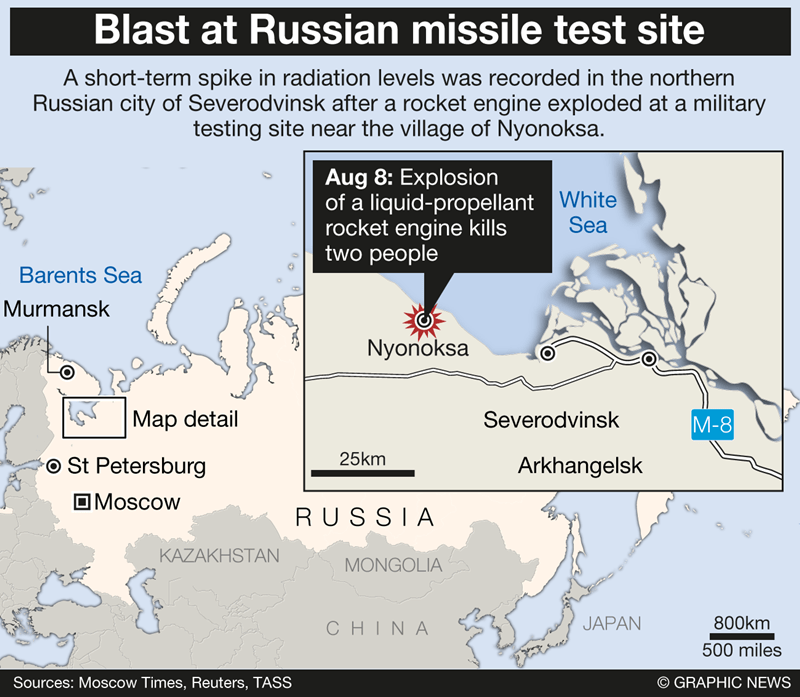
That’s what happened to the roughly 200,000 people who live in the similarly sized northern Russian city of Severodvinsk on 8 August, after an explosion at a nearby top-secret missile testing range. Russia’s weather service, Rosgidromet, recorded radiation levels up to 16 times higher than the usual ambient rate.
Yet the incident has been met with surly silence by Russia. It was five days before officials confirmed a blast at the Nyonoksa range had killed several people, including nuclear scientists. No apologies were offered to Severodvinsk residents. There is still little reliable information. “Accidents, unfortunately, happen,” a Kremlin spokesman said.
That callous insouciance is not universally shared. According to western experts, the explosion was caused by the launch failure of a new nuclear-powered cruise missile, one of many advanced weapons being developed by Russia, the US and China in an accelerating global nuclear arms race
Vladimir Putin unveiled the missile, known in Russia as the Storm Petrel and by Nato as Skyfall, in March last year, claiming its unlimited range and manoeuvrability would render it “invincible”. The Russian president’s boasts look less credible now.
But Putin is undeterred. Denying suggestions that the missile is unreliable, the Kremlin insisted Russia was winning the nuclear race. “Our president has repeatedly said that Russian engineering in this sector significantly outstrips … other countries,” a spokesman said.
Now fast-forward to 16 August, and another threatening event: the test-firing by North Korea of potentially nuclear-capable ballistic missiles, the sixth round of launches since July. More than two years of vanity diplomacy by Donald Trump has not convinced Pyongyang it is safe to give up its nukes – proof, if it were needed, that unilateral counter-proliferation initiatives do not work.
Arms control experts say a consistent, joined-up international approach is woefully lacking. Thus Israel’s undeclared nuclear arsenal is tolerated, and the idea of a bomb developed by Saudi Arabia is no longer ruled out. But the merest hint that Iran may build a nuclear weapon is greeted with megatons of hypocritical horror.
In a sense, the problem is circular. Putin argues that Russia’s build-up is a response to destabilising US moves to modernise and expand its own nuclear arsenal – and he has a point. Barack Obama, the former president, developed a $1.2tn plan to maintain and replace the “triad” of US air, sea and land-based nuclear weapons.
Trump has gone much further. The Pentagon’s nuclear posture review, published last year, proposed an additional $500bn in spending, including $17bn for low-yield, tactical nuclear weapons that could be used on conventional battlefields. The first of these new warheads is due to become operational next month.
Critics in Congress say low-yield weapons make nuclear warfare more likely, and oppose Trump’s budget increases. But with US planners saying the biggest national security threat is no longer terrorism but nuclear-armed states, there is little doubt that many new weapons projects will get the go-ahead.
The renewed nuclear arms race is a product of Trump’s America First outlook and that of comparable ultra-nationalist and insecure regimes elsewhere. Trump’s emphasis on defending the “homeland” is leading inexorably to the militarisation of US society, whether at the Mexican border, on inner-city streets or in its approach to international security.
“We have far more money than anybody else by far,” Trump said last October. “We’ll build up until [Russia and China] come to their senses.” Outspending the opposition was a tactic employed by Ronald Reagan in the 1980s. And Trump is putting taxpayers’ money where his mouth is. Overall, annual US military spending is soaring, from $716bn this year to a proposed $750bn next year.
The paradox is that even as the risk of nuclear confrontation grows, the cold war system of treaties that helped prevent Armageddon is being dismantled, largely at Trump’s behest. Earlier this month, the US withdrew from the 1987 Intermediate-range Nuclear Forces (INF) treaty with Russia (which rid Britain and Europe of US missiles deployed in the early 80s).
The US is also signalling it will not renew the New Start strategic nuclear weapons treaty when it expires in 2021. Washington claims Moscow cheated on the INF pact; Russia denies it. But the real US concern is that both treaties tie its hands, especially regarding China – another example of the impact of America First thinking.
This increasingly unregulated, three-way contest poses indisputable dangers. The US plans were “unnecessary, unsustainable, and unsafe” and “increase the risks of miscalculation, unintended escalation, and accelerated global nuclear competition”, the independent US-based Arms Control Association said in April.
With a much smaller arsenal than the US and Russia, China, too, is “aggressively developing its next generation of nuclear weapons”, according to a major Chinese weapons research institute. Nor, given Moscow’s and Washington’s behaviour, has it an incentive to stop, despite Trump’s vague proposal for a trilateral disarmament “grand bargain”.
Like the US, China – while historically pledged to “no first use” – wants potential enemies to believe it may actually use tactical nukes. As Dr Strangelove would doubtless appreciate, this, perversely, increases the chances that it will.
The dreadful example these nuclear arms-racers are setting to non-nuclear states such as Iran is obvious. By failing to uphold arms control agreements, neglecting collaborative counter-proliferation efforts, and building new, more “usable”, dangerously unproved weapons like the one that irradiated Severodvinsk, the nuclear powers are digging their own graves – and ours.
August 19, 2019
Posted by Christina Macpherson |
politics international, USA, weapons and war |
Leave a comment
We Can’t Confront Climate Change While Lavishly Funding the Pentagon, BY JP Sottile, Truthout. August 18, 2019
 The Pentagon is staring down the barrel of what could become the longest, hottest war in U.S. history. This titanic clash pits the largest military the world has ever seen against an omnipresent opponent that can marshal resources like no enemy it has ever encountered.
That opponent is climate change, and according to a
joint investigationby
NBC News and
InsideClimate News, the extreme heat it brings is already generating military casualties. But soldiers like
Sgt. Sylvester Cline are not dying where you might expect, such as scorching, oil-rich targets like Iraq, where Cline served during a lie-tainted war. Unlike the overwhelming majority of Uncle Sam’s
long list of military conflicts, this war is also being waged on U.S. soil. Sadly, the Arkansas-based sergeant was just one of “at least 17 troops to die of heat exposure during training exercises at U.S. military bases since 2008.”
In fact, the total number of heat-strokes and cases of heat exhaustion suffered by active-duty service members rose by 60 percent between 2008 and 2018 (from 1,766 to 2,792). Forty percent of these incidents occurred in the Southeastern United States in places like Fort Benning (Georgia), Camp Lejeune (North Carolina) and Fort Polk (Louisiana). Over that same period, the Southeast region has experienced average summer temperatures that were the nation’s hottest on record, and a staggering 61 percent of major Southeast cities show the effects of these worsening heat waves, according to the
Fourth National Climate Assessmentreleased in 2018.
As Brown University’s Costs of War research project
recently pointed out, the Defense Department “remains the world’s
single largest consumer of oil – and as a result, one of the world’s top greenhouse gas emitters.” British researchers at Durham University and Lancaster University
published a corroborating report detailing the profuse use of hydrocarbons to fuel U.S. military adventurism. They astutely pointed out the dilemma of attempting to confront “the effects of climate change while remaining the largest single institutional consumer of hydrocarbons in the world.” …….
every year the U.S. political system reflexively funds a
world-dominating defense budget that directly benefits the oil industry, client states and the entire hydrocarbon-based economy. Basically, it’s a global protection racket that generates
huge profits for defense companies that sell weapons to the Pentagon.
And the
U.S. governmentalso
pushes arms sales abroad, particularly to
oil-rich clients like those in the Middle East. All of those arms sales sustain
thousands of jobs in states and congressional districts around the U.S. That, in turn, creates constituencies for members of Congress who collect millions in campaign contributions from both the
defense and
oil industries to make sure they can maintain
de facto subsides for their weapons and their oil. Taxpayers and consumers complete the circuit through their “contributions” to the empire’s public-private partnership: They get to keep on buying oil, gas and plastic, while paying taxes for the military. It’s a perpetual ATM fueled by oil.
Meanwhile, U.S. citizens fill the ranks of the military services that guarantee the continuation of a hydrocarbon system that’s now cooking them alive as they train on U.S. soil. It’s the ghoulish internal logic of the oil-driven imperium, one that generates its rationale for being through its continued existence.
Funding the Pentagon, Fueling the Fallout
Now this self-perpetuating system threatens to engulf the thawing Arctic, which is becoming a
new frontier for untapped oil and gas. Of course, there’d be no scramble for the Arctic’s once-impenetrable hydrocarbon resources without the unprecedented melting caused by our hydrocarbon-driven climate crisis. But that sad irony was purposefully ignored by Secretary of State Mike Pompeo at a recent meeting of the eight-nation
Arctic Council in Finland. Unsurprisingly, the
Rapture-ready Pompeo
refused to sign the meeting’s
joint accord because it mentioned the climate crisis now devastating the Arctic’s ecosystems. Instead, Secretary Pompeo
extolled the
supposed benefits of the big melt that’s rapidly altering the pristine landscape of the ever-less frozen frontier:
The Arctic is at the forefront of opportunity and abundance. It houses 13 percent of the world’s undiscovered oil, 30 percent of its undiscovered gas, an abundance of uranium, rare earth minerals, gold, diamonds, and millions of square miles of untapped resources, fisheries galore.
It’s a predictable statement from an
oil-obsessed administration that salivates at the prospect of
drilling, baby, drilling in the Arctic. At the same time, Secretary Pompeo put the world on notice,
stating that the region has become an “arena of global power and competition.” Without irony, he
warned Russia and “
non-Arctic” nations like China against “
aggressive” behavior. Actually, China is
already there and
drilling in cooperation with Russia in
a de facto alliance around the issue of the opening Arctic, a fact that is likely to become
budgetary catnip for U.S. empire. Competition for this new frontier is quickly becoming the latest oily justification to pour money into yet another theatre of operations. In other words, the climate crisis is not only a byproduct of empire, but it’s becoming a rationale for even more empire.
Actually, it’s already started
The troops sent to the border to “assist” U.S. Customs and Border Patrol and to “build” Trump’s wall are, like Sergeant Cline’s heat-related death, a harbinger of things to come. They are not only seeing firsthand the desperation of people willing to walk up to 2,000 milesto flee the fallout from decades of U.S. interventionism in Central America, they are witnessing the start of a widely predicted climate migration crisis. A brutal mix of prolonged drought, water scarcity and deforestation is exacerbating the suffering in El Salvador, Guatemala and Honduras. As InsideClimate News noted, Honduras typifies the unfair paradox of the climate crisis because “like so many developing countries” it “has contributed relatively little to the greenhouse gas emissions,” but “projections suggest it is especially imperiled by climate change.”
Low-emission countries like
Bangladesh,
Mozambique and
Fiji are already feeling the heat of the climate crisis. And, as U.S. troops suffer from heat waves in the Southeast, the impact of climate crisis is also being felt acutely in the U.S. in places like the
Alaskan village of Newtok, which requested and was
finally granted Federal Emergency Management Agency money to flee the relentless march of climate-caused erosion. Obviously, the crisis is not 50-75 years away, as Environmental Protection Agency Administrator and former hydrocarbon lobbyist Andrew Wheeler
smugly proclaimed — and
the Pentagon knows it.
Unfortunately, the longer the U.S. continues to garishly fund the Pentagon and its oil-based protection racket, the harder it will be to deal with the massive ecological and human fallout caused by the hydrocarbon economy. Ultimately, it might be impossible to halt or even mitigate the climate crisis without also ending empire. And if we are not careful, the same forever war mentality that has continually shifted from one enemy to another will find yet another reason to exist — this time as a bulwark against the escalating impacts of a climate crisis it helped to create in the first place.
August 19, 2019
Posted by Christina Macpherson |
climate change, USA, weapons and war |
Leave a comment
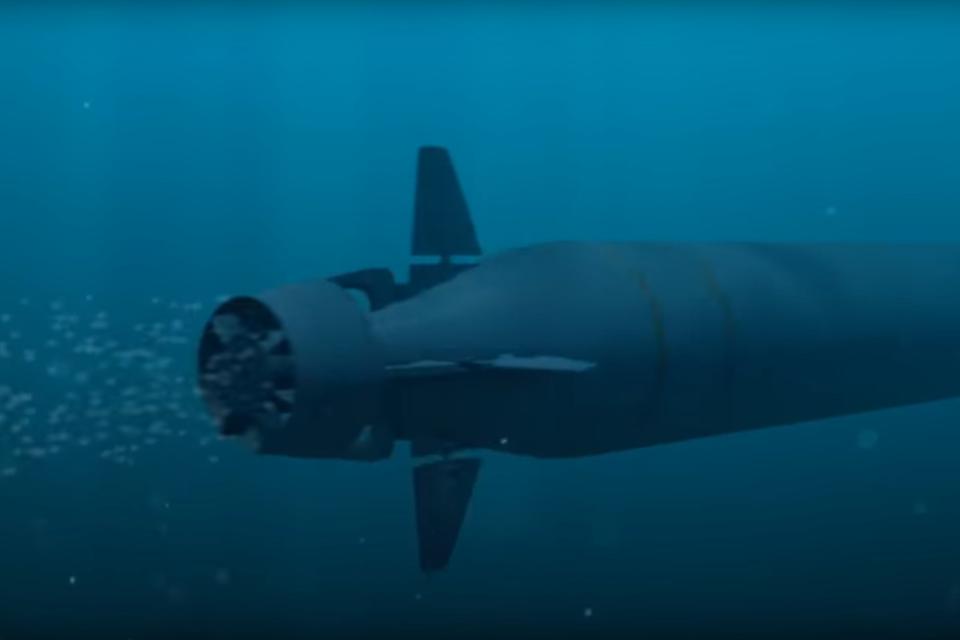
Russia Testing Nuclear-Powered Mega-Torpedo Near Where Deadly Explosion Occurred https://www.forbes.com/sites/hisutton/2019/08/17/russia-testing-nuclear-powered-mega-torpedo-near-where-deadly-explosion-occurred/#7f3e00632d7fH I Sutton, Aerospace & DefenseI cover the changing world of underwater warfare. Details are still emerging of the explosion of a nuclear-powered engine that killed at least seven people in northern Russia last week. Conflicting reports, rumors and speculation center around whether the engine was for a nuclear-powered cruise missile, codenamed Skyfall by NATO, or some other weapon-related reactor. One of the possible weapons in the frame is the Poseidon mega-torpedo. This new weapon is described as an Intercontinental Nuclear-Powered Nuclear-Armed Autonomous Torpedo by the U.S. government
One of the possible weapons in the frame is the Poseidon mega-torpedo. This new weapon is described as an Intercontinental Nuclear-Powered Nuclear-Armed Autonomous Torpedo by the U.S. government.
The unique drone-like weapon is in an entirely new category. Launched from a large submarine, potentially from under the protection of the arctic ice cap, it would have virtually unlimited range and Russia claims that it will run so deep that it cannot realistically be countered with existing weapons. It’s designed to be armed with a nuclear warhead, reportedly of 2 megatons, which represents a slow but unstoppable death-knell for the residents of coastal cities such as New York or San Francisco in the event of a nuclear war. The Russian Ministry of Defense also claims that it will be usable against high value maritime targets such as the U.S. Navy’s carrier battle groups.
It is massive, around 30 times larger than the heavyweight torpedoes commonly used aboard submarines, and twice as large as submarine launched ballistic missiles (SLBMs). Specially constructed submarines will be able to carry six Poseidon each. Unlike existing missile submarines, which are termed SSBNs, this type of submarine doesn’t even have a designation yet. Possibly SSDN will be used to denote a nuclear powered drone-carrying submarine.
Poseidon is being tested in the region, my analysis of information gathered from public sources shows. For trials it is being launched by a special submarine based in Severodvinsk, near the Nyonoksa testing site where the explosion occurred. The submarine is named Sarov after the city where the All-Russian Scientific Research Institute of Experimental Physics, which developed the nuclear engine involved in the explosion, is based. Sarov is also the city where the victims of the blast were laid to rest. In recent years the Russian Ministry of Defense has been open about Sarov’s role in the tests. The submarine rarely puts to sea but my analysis of information gathered from public sources shows that it did venture out into the White Sea in June, pointing to possible recent test launches.
Poseidon was first revealed to the public in dramatic fashion by Russian state media in the fall of 2015, when a slide on the new weapon was visible during a meeting with President Putin. The apparent security lapse was probably not by accident.
The project itself has since been traced back much further to the end of the Cold War, and defense watchers had an inkling of a giant torpedo-like weapon under development for about five years prior to the staged leak.
The weapon has been in testing since around 2014 and is likely to be nearing the production phase with deployments at sea from the early 2020s. The first submarine slated to carry the weapon operationally was launched in April in Severodvinsk. The gigantic Belgorod submarine is still undergoing fitting out and will not be operational for a few years. The second submarine, Khabarovsk, is also nearing completion and two more SSDNs are expected to follow, providing Russia with a new dimension in nuclear deterrence.
August 19, 2019
Posted by Christina Macpherson |
Russia, weapons and war |
Leave a comment
 A Major Cyber Attack Could Be Just as Deadly as Nuclear Weapons, Says Scientist https://www.sciencealert.com/a-major-cyber-attack-could-be-just-as-damaging-as-a-nuclear-weapon, JEREMY STRAUB, THE CONVERSATION, 18 AUG 2019
People around the world may be worried about nuclear tensions rising, but I think they’re missing the fact that a major cyberattack could be just as damaging – and hackers are already laying the groundwork.
With the US and Russia pulling out of a key nuclear weapons pact – and beginning to develop new nuclear weapons – plus Iran tensions and North Korea again test-launching missiles, the global threat to civilization is high. Some fear a new nuclear arms race.
That threat is serious – but another could be as serious, and is less visible to the public. So far, most of the well-known hacking incidents, even those with foreign government backing, have done little more than steal data.
Unfortunately, there are signs that hackers have placed malicious softwareinside US power and water systems, where it’s lying in wait, ready to be triggered. The US military has also reportedly penetrated the computers that control Russian electrical systems.
Many intrusions already
As someone who studies cybersecurity and information warfare, I’m concerned that a cyberattack with widespread impact, an intrusion in one area that spreads to others or a combination of lots of smaller attacks, could cause significant damage, including mass injury and death rivaling the death toll of a nuclear weapon.
Unlike a nuclear weapon, which would vaporize people within 100 feet and kill almost everyone within a half-mile, the death toll from most cyberattacks would be slower. People might die from a lack of food, power or gas for heator from car crashes resulting from a corrupted traffic light system. This could happen over a wide area, resulting in mass injury and even deaths.
This might sound alarmist, but look at what has been happening in recent years, in the US and around the world.
In early 2016, hackers took control of a US treatment plant for drinking water, and changed the chemical mixture used to purify the water. If changes had been made – and gone unnoticed – this could have led to poisonings, an unusable water supply and a lack of water.
In 2016 and 2017, hackers shut down major sections of the power grid in Ukraine. This attack was milder than it could have been, as no equipment was destroyed during it, despite the ability to do so. Officials think it was designed to send a message.
In 2018, unknown cybercriminals gained access throughout the United Kingdom’s electricity system; in 2019 a similar incursion may have penetrated the US grid.
In August 2017, a Saudi Arabian petrochemical plant was hit by hackers who tried to blow up equipment by taking control of the same types of electronics used in industrial facilities of all kinds throughout the world.
Just a few months later, hackers shut down monitoring systems for oil and gas pipelines across the US This primarily caused logistical problems – but it showed how an insecure contractor’s systems could potentially cause problems for primary ones.
The FBI has even warned that hackers are targeting nuclear facilities. A compromised nuclear facility could result in the discharge of radioactive material, chemicals or even possibly a reactor meltdown.
A cyberattack could cause an event similar to the incident in Chernobyl. That explosion, caused by inadvertent error, resulted in 50 deaths and evacuation of 120,000 and has left parts of the region uninhabitable for thousands of years into the future.
Mutual assured destruction
My concern is not intended to downplay the devastating and immediate effects of a nuclear attack. Rather, it’s to point out that some of the international protections against nuclear conflicts don’t exist for cyberattacks.
For instance, the idea of “mutual assured destruction” suggests that no country should launch a nuclear weapon at another nuclear-armed nation: The launch would likely be detected, and the target nation would launch its own weapons in response, destroying both nations.
Cyberattackers have fewer inhibitions. For one thing, it’s much easier to disguise the source of a digital incursion than it is to hide where a missile blasted off from.
Further, cyberwarfare can start small, targeting even a single phone or laptop. Larger attacks might target businesses, such as banks or hotels, or a government agency. But those aren’t enough to escalate a conflict to the nuclear scale.
Nuclear grade cyberattacks
There are three basic scenarios for how a nuclear grade cyberattack might develop. It could start modestly, with one country’s intelligence service stealing, deleting or compromising another nation’s military data.
Successive rounds of retaliation could expand the scope of the attacks and the severity of the damage to civilian life.
In another situation, a nation or a terrorist organization could unleash a massively destructive cyberattack – targeting several electricity utilities, water treatment facilities or industrial plants at once, or in combination with each other to compound the damage.
Perhaps the most concerning possibility, though, is that it might happen by mistake. On several occasions, human and mechanical errors very nearly destroyed the world during the Cold War; something analogous could happen in the software and hardware of the digital realm.
Defending against disaster
Just as there is no way to completely protect against a nuclear attack, there are only ways to make devastating cyberattacks less likely.
The first is that governments, businesses and regular people need to secure their systems to prevent outside intruders from finding their way in, and then exploiting their connections and access to dive deeper.
Critical systems, like those at public utilities, transportation companies and firms that use hazardous chemicals, need to be much more secure.
One analysis found that only about one-fifth of companies that use computers to control industrial machinery in the US even monitor their equipment to detect potential attacks – and that in 40 percent of the attacks they did catch, the intruder had been accessing the system for more than a year.
Another survey found that nearly three-quarters of energy companies had experienced some sort of network intrusion in the previous year.
But all those systems can’t be protected without skilled cybersecurity staffs to handle the work. At present, nearly a quarter of all cybersecurity jobs in the US are vacant, with more positions opening up than there are people to fill them.
One recruiter has expressed concern that even some of the jobs that are filled are held by people who aren’t qualified to do them. The solution is more training and education, to teach people the skills they need to do cybersecurity work, and to keep existing workers up to date on the latest threats and defense strategies.
If the world is to hold off major cyberattacks – including some with the potential to be as damaging as a nuclear strike – it will be up to each person, each company, each government agency to work on its own and together to secure the vital systems on which people’s lives depend. 
Jeremy Straub, Assistant Professor of Computer Science, North Dakota State University.
August 19, 2019
Posted by Christina Macpherson |
2 WORLD, weapons and war |
Leave a comment
World War 3: Unexploded US nuclear weapon hiding beneath Japanese waters ‘covered up’ https://www.express.co.uk/news/world/1166479/world-war-3-nuclear-bomb-japan-philippine-sea-us-soviet-union-cold-war-sptWORLD WAR 3 could have erupted after the United States Navy accidentally dropped a nuclear bomb in Japanese waters – and it is still there today. by CALLUM HOARE, Aug 18, 2019. On December 5, 1965, just three years after the Cuban Missile Crisis pushed Cold War tensions to the limits, the US made a monumental mistake during a training exercise. A United States Navy Douglas A-4E Skyhawk attack aircraft fell off the side of aircraft carrier USS Ticonderoga while sailing through the Philippine Sea. The pilot, Lieutenant Douglas M Webster, the plane, and the B43 nuclear bomb on board all fell into the water, 68 miles from the coast of Kikai Island, Japan.
However, it was not until 1989 that the Pentagon admitted the loss of a one-megaton hydrogen bomb.
The revelation inspired a diplomatic inquiry from Japan, however, neither the weapon, or the pilot, was ever recovered.The incident, the most serious involving nuclear weapons in the Navy’s history, showed that US warships carried atomic weapons into Japanese ports in violation of policy, according to researchers.
Japanese law banned ships carrying nuclear weapons from sailing in its territorial waters or calling on its ports following the terrible Hiroshima and Nagasaki incidents.
However, the US warship routinely docked in Japan.
William M. Arkin of the liberal Institute for Policy Studies claimed in 1989: “For 24 years, the US Navy has covered up the most politically sensitive accident that has ever taken place.
“The Navy kept the true details of this accident a secret not only because it demonstrates their disregard for the treaty stipulations of foreign governments but because of the questions it raises about nuclear weapons aboard ships in Vietnam.”
The event was highly sensitive, with Japan being the only country to ever be attacked with nuclear weapons at the end of World War 2.
On September 8, 1951, 49 nations drew a line under the devastating event and signed the Treaty of San Francisco – also known as the Treaty of Peace with Japan.
The document officially ended US-led occupation of Japan and marked the start of re-establishing relations with the allied powers.
Meanwhile, In 1965, the US was arguably at the height of tensions with the Soviet Union.
Not only did the accident threaten to spoil already tenuous relations with Japan, but it would have also have given the USSR an excuse to start a nuclear war.
Despite the worrying claims, the US Navy confirmed inn 1989 that the waters were too deep for the weapon to pose a threat.
Worryingly though, it would not be the last of the nuclear gaffes for America. On January 17, 1966, a B-52G USAF bomber collided with a KC-135 tanker during a refuelling mission at 31,000 feet over the Mediterranean Sea.
During the crash, three MK28-type hydrogen bombs headed for land in the small fishing village of Palomares in Almeria, Spain.
Worse still, the explosives in two of the weapons detonated on impact, contaminating the surrounding area of almost one square mile with plutonium.
The fourth sunk off the coast of Spain and was recovered three months later.
August 19, 2019
Posted by Christina Macpherson |
general, history, incidents, Reference, USA, weapons and war |
Leave a comment
Nuclear rethink: A change in India’s nuclear doctrine has implications on cost & war strategy
A nuclear doctrine states how a nuclear weapon state would employ its nuclear weapons both during peace and war. Economic Times ET Bureau|, Aug 17, 2019,
“…….. revoking the NFU would have its own costs. First, India’s image as a responsible nuclear power is central to its nuclear diplomacy. Nuclear restraint has allowed New Delhi to get accepted in the global mainstream. From being a nuclear pariah for most of the Cold War, within a decade of Pokhran 2, it has been accepted in the global nuclear order. It is now a member of most of the technology denial regimes such as the Missile Technology Control regime and the Wassenaar Arrangement. It is also actively pursuing full membership of the Nuclear Suppliers Group. Revoking the ‘no first use’ pledge would harm India’s nuclear image worldwide.
Parting away with NFU would also be costly otherwise. A purely retaliatory nuclear use is easier to operationalize. Nuclear preemption is a costly policy as it requires massive investment not only in weapons and delivery systems but also intelligence, surveillance and reconnaissance (ISR) infrastructure. The latest estimates of India’s nuclear weapons by the Bulletin of Atomic Scientists point to a small arsenal of 130-150 nuclear warheads even though it has enough militarygrade plutonium to produce 200 warheads.
In fact, when compared with the estimates a decade earlier of 70 nuclear warheads, there has only been a modest increase in India’s nuclear inventory. If India does opt for first use of nuclear weapons and given that it has two nuclear adversaries, it would require a far bigger inventory of nuclear weapons particularly as eliminating adversaries’ nuclear capabilities would require targeting of its nuclear assets involving multiple warheads. The controversy around the supposed low yield of its Hydrogen weapon test in 1998 further complicates this already precarious calculation.
Similarly, first use of nuclear weapons would require a massive increase in India’s nuclear delivery capabilities. There is yet no evidence suggesting that India’s missile production has increased dramatically in recent times. Moreover, India is yet to induct the Multiple Reentry Vehicle (MRV) technology in its missiles, which is fundamental to eliminating hardened nuclear targets. Finally, India’s ISR capabilities would have to be augmented to such a level where India is confident of taking out most of its adversary’s arsenal. According to a senior officer who had served in the Strategic Forces command, this is nearly an “impossible task”. Finally, India would have to alter significantly its nuclear alerting routine. India’s operational plans for its nuclear forces involve a four-stage process. Nuclear alerting would start at the first hints of a crisis where decision-makers foresee possible military escalation. This would entail assembly of nuclear warheads and trigger mechanisms into nuclear weapons. The second stage involves dispersal of weapons and delivery systems to pre-determined launch positions. The third stage would involve mating of weapons with delivery platforms.
The last and final stage devolves the control of nuclear weapons from the scientific enclave to the military for their eventual use. Canisterization of missiles has combined the dispersal and mating of weapons into a single step, cutting down the effort required for achieving operational readiness. Even then, this model does not support first use of nuclear weapons as it gives ample warning to the adversary of India’s intentions. There is certainly a need for a reappraisal of India’s nuclear doctrine.
All doctrines need periodic reviews and India’s case is no exception. Given how rapidly India’s strategic environment is evolving, it is imperative to think clearly about all matters strategic. But if Indian policymakers do indeed feel the need to review the nation’s nuclear doctrine, they should be cognizant of the costs involved in so doing. A sound policy debate can only ensue if the costs and benefits of a purported policy shift are discussed and debated widely. https://economictimes.indiatimes.com/news/defence/nuclear-rethink-a-change-in-indias-nuclear-doctrine-has-implications-on-cost-war-strategy/articleshow/70718646.cms
August 19, 2019
Posted by Christina Macpherson |
depleted uranium, India, politics |
Leave a comment
Trump is laying the ground for a nuclear arms race in the Gulf
Trump’s mismanagement of the nuclear issue in the Middle East is damaging the international nonproliferation regime. Alzaeera, by Luciano Zaccara, Over the past three months since the Trump administration imposed severe sanctions on Iran, which have significantly curbed its oil exports and exacerbated its economic crisis, tensions in the Gulf have escalated. Commercial vessels have been attacked, oil tankers seized and drones shot down. Despite these escalations, both sides are holding back and at least in the short-term, an open conflict so far seems unlikely.
In the long-term, however, the highly-problematic approach that the United States has adopted towards the nuclear issue could have devastating consequences. Two recent developments point in that direction.
First, the Trump administration has given a green light to US companies to work on nuclear projects in Saudi Arabia. According to a report recently released by the US Congress Oversight Committee, “with regard to Saudi Arabia, the Trump Administration has virtually obliterated the lines normally separating government policymaking from corporate and foreign interests.”
The report also stated that the evidence collected and analyzed “raise serious questions about whether the White House is willing to place the potential profits of the President’s friends above the national security of the American people and the universal objective of preventing the spread of nuclear weapons.”
The White House seems committed to allowing the transfer of sensitive nuclear technology without demanding that Riyadh abide by US legal requirements not to engage in activities that can lead to nuclear proliferation.
Second, in response to mounting pressure from the US, Iran has announced that it is going to backtrack on a number of commitments made under the Joint Comprehensive Plan of Action (JCPOA) if the international community does not take measures to ameliorate the effects of US sanctions on its economy.
Iran has already stopped complying with limits on the production of enriched uranium and heavy water, invoking articles 26 and 36 of the agreement, which entitle it to do so if the other parties reintroduce nuclear-related sanctions.
Thus, Washington’s incapacity to deal with the Iranian file in a coherent manner, and its erratic policies on nuclear proliferation, are pushing the Middle East towards a dangerous nuclear competition between Saudi Arabia and Iran.
Nuclear ambitions
The nuclear aspirations of both countries are not new………
A collapsing nonproliferation regime
With its ill-advised policies in the Gulf, the Trump administration is not only encouraging a nuclear race in the region by allowing Saudi Arabia to acquire nuclear technology, but it is also undermining the international non-proliferation regime.
Since nuclear powers agreed in the 1960s to curb the spread of nuclear weapons, there have been a number of cases in which countries – including Israel, India, and Pakistan – have broken international rules in pursuit of nuclearisation and not faced serious consequences.
The double standards applied by the Trump administration have been particularly damaging to international nonproliferation agreements. Trump has pursued normalisation of relations with North Korea – a state that openly tested and detonated nuclear devices – while withdrawing from a nuclear deal with Iran, which was strictly abided by all provisions and was not working on developing a nuclear bomb.
Effectively, the US government destroyed a well-functioning agreement that enjoyed wide international support in order to satisfy the commercial interests of a few individuals close to the White House and give an advantage to one side in the growing regional rivalry in the Middle East.
These actions have thrown the international community into disarray, as now there appears to be no clear consensus on what nuclear activities can be considered a threat, what evidence state actors must present to be regarded as truly committed to nonproliferation and what instruments – legal, economic, or military – should be used to enforce the nonproliferation regulations.
Washington’s unilateral (mis)management of the nuclear issue is endangering the whole nonproliferation regime, weakening any multilateral agreement or negotiation, and leaving solely the White House to decide on how to deal with these abovementioned questions.
In the current volatile situation in the Middle East – with intensifying confrontation along religious, ethnic, territorial and ideological cleavages – the lack of a robust non-proliferation agreement will encourage a nuclear race in the region and increase the chances of pre-emptive military attacks that could lead to large-scale war. Luciano Zaccara is professor of Gulf Politics at the Qatar University Gulf Studies Center. https://www.aljazeera.com/indepth/opinion/trump-laying-ground-nuclear-arms-race-gulf-190801130430388.html
August 18, 2019
Posted by Christina Macpherson |
2 WORLD, politics international, weapons and war |
Leave a comment
India hints at changing ‘no first use’ nuclear policy Channel News Asia, NEW DELHI: India’s defence minister hinted on Friday (Aug 16) that New Delhi might change its “no first use” policy on nuclear weapons, amid heightened tensions with fellow atomic power Pakistan.
India committed in 1999 to not being the first to use nuclear weapons in any conflict. Among India’s neighbours China has a similar doctrine but arch rival Pakistan does not.
Defence Minister Rajnath Singh made the comment on Twitter after visiting Pokhran, the site of India’s successful nuclear tests in 1998 under then prime minister Atal Vajpayee.
“Pokhran is the area which witnessed (Vajpayee’s) firm resolve to make India a nuclear power and yet remain firmly committed to the doctrine of ‘No First Use’ (NFU),” Singh wrote.
“India has strictly adhered to this doctrine. What happens in future depends on the circumstances,” Singh tweeted.
The statement comes as tensions rise with Pakistan after Prime Minister Narendra Modi’s government stripped Indian-administered Kashmir of its autonomy, a move sharply condemned by Islamabad……..
Observers said Singh’s statement is the clearest so far with regards to a change in India’s nuclear doctrine.
……….https://www.channelnewsasia.com/news/asia/india-hints-at-changing-no-first-use-nuclear-policy-11816218
August 17, 2019
Posted by Christina Macpherson |
India, politics international, weapons and war |
Leave a comment
Russian military orders village evacuation, then cancels it, following explosion that killed five nuclear scientists, Secrecy surrounding an explosion that killed five nuclear scientists and caused a spike in radiation levels has sparked fears of a cover-up in Russia, with authorities backflipping on orders to evacuate a nearby village.
https://www.abc.net.au/news/2019-08-14/russian-nuclear-explosion-mystery/11411470
Key points:
- Medics who treated victims of an accident have been sent to Moscow for medical examination
- Russia’s state weather service said radiation levels spiked in Severodvinsk by up to 16 times
- Many Russians spoke angrily on social media of misleading reports reminiscent of Chernobyl
The explosion took place on Thursday at a naval weapons range on the coast of the White Sea in northern Russia.
State nuclear agency Rosatom said the accident occurred during a rocket test on a sea platform.
The rocket’s fuel caught fire after the test, causing it to detonate, it said in a statement carried by Russian news agencies.
Two days later, after a spike in radiation levels was reported, Rosatom conceded the accident involved nuclear materials.
On Tuesday (local time), the Russian military ordered residents of the small village of Nyonoksa to temporarily evacuate, citing unspecified activities at the nearby navy testing range.
But a few hours later, it said the planned activities were cancelled and told the villagers they could go back to their homes, said Ksenia Yudina, a spokeswoman for the Severodvinsk regional administration.
Local media in Severodvinsk said Nyonoksa residents regularly received similar temporary evacuation orders, usually timed to tests at the range.
Russia’s state weather service said radiation levels spiked in the Russian city of Severodvinsk, about 30 kilometres west of Nyonoksa, by up to 16 times following the explosion.
Emergency officials issued a warning to all workers to stay indoors and close the windows, while spooked residents rushed to buy iodide, which can help limit the damage from exposure to radiation.
‘People need reliable information’
Many Russians spoke angrily on social media of misleading reports reminiscent of the lethal delays in acknowledging the Chernobyl accident three decades ago.
US experts said they suspected the cause was a botched test of a nuclear-powered cruise missile commissioned by President Vladimir Putin.
Boris L Vishnevsky, a member of the St. Petersburg City Council, told the New York Times that dozens of people had called asking for clarification about radiation risks.
“People need reliable information,” Mr Vishnevsky told the Times.
“And if the authorities think there is no danger, and nothing needs to be done, let them announce this formally so people don’t worry.”
The five scientists that died in the explosion were buried Monday in the closed city of Sarov — which houses a nuclear research facility and is surrounded by fences patrolled by the military.
While hailing the deceased as the “pride of the atomic sector”, Rosatom head Alexei Likhachev pledged to continue developing new weapons. “The best tribute to them will be our continued work on new models of weapons, which will definitely be carried out to the end,” Mr Likhachev was quoted as saying by RIA news agency.
Medics who treated victims sent to Moscow
Medics who treated the victims of an accident were sent to Moscow for medical examination, TASS news agency cited an unnamed medical source as saying on Tuesday.
The medics sent to Moscow have signed an agreement promising not to divulge information about the incident, TASS cited the source as saying.
US President Donald Trump said on Twitter on Monday the United States was “learning much” from the explosion and the United States had “similar, though more advanced, technology”.
He said Russians were worried about the air quality around the facility and far beyond, a situation he described as “Not good!”
But when asked about his comments on Tuesday, the Kremlin said it, not the United States, was out in front when it came to developing new nuclear weapons.
“Our president has repeatedly said that Russian engineering in this sector significantly outstrips the level that other countries have managed to reach for the moment, and it is fairly unique,” Kremlin spokesman Dmitry Peskov said.Mr Putin used his state-of-the nation speech in 2018 to unveil what he described as a raft of invincible new nuclear weapons, including a nuclear-powered cruise missile, an underwater nuclear-powered drone, and a laser weapon.
Tensions between Moscow and Washington over arms control have been exacerbated by the demise this month of a landmark nuclear treaty.
August 15, 2019
Posted by Christina Macpherson |
incidents, Russia, secrets,lies and civil liberties, weapons and war |
Leave a comment
Why the U.S. Abandoned Nuclear-Powered Missiles More Than 50 Years Ago
President Donald Trump says the U.S. has a missile like the one that killed seven in the Russian arctic. That’s untrue, because the U.S. abandoned the idea decades ago.
Aug 13, 2019 Last week’s mysterious nuclear accident in Russia became even more mysterious as the government admitted that a small nuclear reactor had exploded, killing seven people.
Evidence is piling up that the incident is somehow related to Russia’s development of a nuclear-powered cruise missile, and President Donald Trump took to Twitter to state that the U.S. has a similar system. One problem: the U.S. looked into nuclear-powered cruise missiles more than half a century ago before rejecting them as impractical.
Last week’s mysterious nuclear accident in Russia became even more mysterious as the government admitted that a small nuclear reactor had exploded, killing seven people.
Evidence is piling up that the incident is somehow related to Russia’s development of a nuclear-powered cruise missile, and President Donald Trump took to Twitter to state that the U.S. has a similar system. One problem: the U.S. looked into nuclear-powered cruise missiles more than half a century ago before rejecting them as impractical.
Earlier reports of the August 8th incident stated that two individuals from Russia’s Defense Ministry were killed and six badly injured. Russia’s nuclear energy agency, has since admitted five of its employees were also killed in the explosion, with another three receiving injuries and burns. According to the Guardian, Rosatom said it was working on a number of experimental technologies, including “miniaturised sources of energy using [fissile] materials,” though a spokesperson did not explain how such research was related to the explosion.
After the incident, Greenpeace accused the Russian government of a coverup, using its own data to claim that radiation levels in the nearby city of Severodvinsk briefly spiked up to twenty times normal levels. The levels were not serious enough to warrant public health warnings.
A consensus is emerging that the nuclear accident is in some way related to Russia’s development of the Burevestnik (“Storm Petrel”) nuclear-powered cruise missile, known by NATO as the SSC-X-9 Skyfall. One advantage of a nuclear-powered missile would be a nearly unlimited range, allowing the missile to fly much longer than conventionally powered cruise missiles. This would allow the missile to fly around U.S. air defenses, skirting entire continents if necessary.
The United States tried to develop a nuclear-powered cruise missile in the 1950s and 1960s but abandoned the project as impractical. The weapon was known as Supersonic Low Altitude Missile, or SLAM, and it would have been the most dangerous nuclear weapon ever made.
SLAM, also known unofficially known as “The Big Stick,” was designed as a low-flying cruise missile. A rocket booster would launch SLAM into the air and boost it to speeds where its nuclear-powered ramjet engine would kick in. Once activated, the engine would give SLAM a top speed of Mach 3.5. The YouTube channel Curious Droid has a great mini-history on this doomsday weapon:
The missile would fly unusually low for a missile of its time, just 1,000 feet, to avoid enemy radars. The supersonic shockwave was projected to leave a trail of devastation, flattening forests, buildings, and killing anyone in the missile’s flight path.
SLAM, despite being advertised as a missile, was actually more like an unmanned bomber. Instead of a single warhead, it carried up to 26 hydrogen bombs, each hundreds of times more powerful than the bombs dropped on Hiroshima and Nagasaki. SLAM could fly a predetermined route over an enemy country or even continent, ejecting H-bombs on targets below. Once out of bombs SLAM would fly one last mission, running into a final target that would shower the target zone with lethal radioactivity.
SLAM was never built because it was too dangerous to even test. The dangerous levels of radioactivity unleashed by the nuclear engine was a big plus in some apocalyptic wartime scenario, but it couldn’t even be tested in the skies over the U.S. SLAM was also overtaken by intercontinental ballistic missile development, which could deliver a thermonuclear warhead against a target in Russia in half an hour.
Whatever Russia was really testing last week in the arctic, it’s likely something that should’ve remained an unused relic of the Cold War. https://www.popularmechanics.com/military/research/a28690053/russia-nuclear-powered-missile-skyfall/
August 15, 2019
Posted by Christina Macpherson |
Russia, Small Modular Nuclear Reactors, technology, weapons and war |
1 Comment
 Trump tries to brag about ‘advanced’ US nuclear technology and gets immediately called out https://www.indy100.com/article/trump-nuclear-cruise-missile-advanced-technology-russia-explosion-national-security-9055336
14 Aug 19,by Conrad Duncan Donald Trump was immediately shut down by experts after he suggested the US had “more advanced” nuclear missile technology than Russia.
On Thursday, five Russian nuclear engineers were killed in a rocket engine explosion, which is thought to be linked to tests for a nuclear-powered cruise missile announced by Vladimir Putin in March 2018.
In his typically tactless style, Trump shared his thoughts on the explosion yesterday by claiming the US was “learning much” from the blast and had even more advanced technology.
Trump’s tweet caught the attention of national security experts because it meant one of two things:
- Trump had just revealed a secret US nuclear-powered cruise missile programme
- He was bluffing about a missile programme that the US does not have
It doesn’t exactly take, ahem, a rocket scientist to know that both of those explanations are quite bad.
For example, Michael McFaul, who worked both for the US National Security Council and as Barack Obama’s Ambassador to Russia, had no idea what Trump was talking about.
Other experts on nuclear weapons couldn’t find public evidence for Trump’s claim either.
In fact, there was once a programme to develop a nuclear-powered cruise missile during the Cold War, called Project Pluto, but the US abandoned it because it was believed to be too dangerous – potentially creating missiles for which there was no known defence.
So if the US does have “more advanced” technology than Russia on this, the president should definitely not be tweeting about it. Of course, there’s a good chance that Trump is bluffing again about matter that he doesn’t fully understand.
It wouldn’t be the first time.
August 15, 2019
Posted by Christina Macpherson |
politics, secrets,lies and civil liberties, USA, weapons and war |
Leave a comment
An on-board reactor would give an engine almost unlimited range. In the case of a guided cruise missile, it could circle the world before receiving orders to attack from out of the blue.
But they’re not easy to control.
They operate at extremely high temperatures. They use explosive fuels, such as liquid hydrogen. And any accident could have devastating, long-lasting effects.
|
‘Dirty bomb’: Mystery Russian ‘superweapon’ kills five https://www.news.com.au/technology/innovation/military/dirty-bomb-mystery-russian-superweapon-kills-five/news-story/c3f85442bc12c6fea43cc4cf67df392e 13 Aug 19It was an explosion, played down by Russian officials — until they were forced to admit five people were dead and many more are at risk.
Jamie Seidel When an experimental missile exploded at a secret Russian base, things were immediately odd. Children from the nearby city of Severodvinsk were sent home from school. Its 185,000 residents were told to stay indoors. Doses of Iodine were distributed. All shipping was barred from the area for at least 30 days.
What could cause such a reaction?
How could a relatively small explosion cause such confusion?
Russia’s nuclear energy agency Rosatom eventually stepped forward: It explained that a missile testing an “isotope power source for a liquid-fuelled rocket engine” had misfired.
Rosatom conceded the accident on Thursday night had killed five, and three were being treated for burns.
Russian officials said elite scientists Alexey Vyushin, Yevgeny Koratayev, Vyacheslave Lipshev, Sergey Pichugin and Vladislav Yanovsky — were killed during tests on a liquid propulsion system
Little else is officially known.
But military analysts have been speculating.
Was it some sort of “dirty bomb”, with a radioactive warhead? Could it have been a failed launch from a nuclear-powered submarine?
Suspicion has also fallen on one of President Vladimir Putin’s vaunted new “superweapons”.
STORMY PETREL
The idea of using a nuclear-reactor powered ramjet isn’t new
It appears to have been thought up by Nazi rocket scientists during the dying days of World War II. With the fall of Berlin, these experts were divided up between the United States and the Soviet Union.
Both nations embarked upon experimental nuclear-powered missile projects in the 1950s. It was quickly recognised the radiation-spewing technology was far too perilous to be practical.
But a boisterous President Putin revealed what he called the 9M730 Burevestnik (Petrel) early last year as one of six new “superweapons”. NATO calls it the SSC-X-9 “Skyfall”.
“Since its range is unlimited, it can manoeuvre as long as you want. No one in the world has anything like that,” Mr Putin boasted. “It may appear some day, but by that time we will develop something new.”
The accompanying presentation showed the missile weaving its way between radar stations in the mid-Atlantic, passing around South America’s Cape Horn and worming its way up towards Hawaii.
Mr Putin said the missile was successfully tested in late 2017 and was “invincible against all existing and prospective missile defence and counter-air defence systems”.
“I want to tell all those who have fuelled the arms race over the last 15 years, sought to win unilateral advantages over Russia, introduced unlawful sanctions aimed to contain our country’s development: Aall that you wanted to impede with your policies have already happened,” Mr Putin declared. “You have failed to contain Russia.”
But things don’t appear to be going to plan.
EXPLOSIVE POTENTIAL
Nuclear propulsion is promising — but also problematic. Continue reading →
|
August 12, 2019
Posted by Christina Macpherson |
incidents, Reference, Russia, weapons and war |
1 Comment
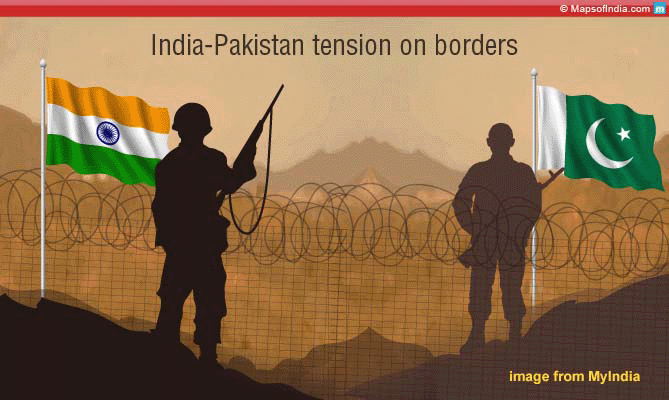
 Hair-Trigger Nuclear Alert Over Kashmir, Common Dreams, India and Pakistan, where people starve in the streets, waste billions on military spending because of the Kashmir dispute. Now some of India’s extreme Hindu nationalists warn they want to reabsorb Pakistan, Bangladesh, and even Sri Lanka into Mother India. by Eric Margolis 11 Aug 19
Two of the world’s most important powers, India and Pakistan, are locked into an extremely dangerous confrontation over the bitterly disputed Himalayan mountain state of Kashmir. Both are nuclear armed.
Kashmir has been a flashpoint since Imperial Britain divided India in 1947. India and Pakistan have fought numerous wars and conflicts over majority Muslim Kashmir. China controls a big chunk of northern Kashmir known as Aksai Chin.
In 1949, the UN mandated a referendum to determine if Kashmiris wanted to join Pakistan or India. Not surprisingly, India refused to hold the vote. But there are some Kashmiris who want an independent state, though a majority seek to join Pakistan……
What makes this confrontation so dangerous is that both sides have important tactical and nuclear forces arrayed against one another. These are mostly short/medium-ranged nuclear tipped missiles, and air-delivered nuclear bombs. Strategic nuclear weapons back up these tactical forces. A nuclear exchange, even a limited one, could kill millions, pollute much of Asia’s ground water, and spread radioactive dust around the globe – including to North America. ….https://www.commondreams.org/views/2019/08/11/hair-trigger-nuclear-alert-over-kashmir
August 12, 2019
Posted by Christina Macpherson |
India, Pakistan, politics international, weapons and war |
Leave a comment
 Pacific nuclear veterans’ descendants sought for study. https://www.odt.co.nz/news/national/pacific-nuclear-veterans-descendants-sought-study A search is underway for descendants of service personnel who witnessed a nuclear test at Mururoa Atoll to take part in a nationwide study.A Mururoa Nuclear Veterans Group wants all veterans who were deployed to Mururoa Atoll in 1973, and their families, to be part of a study as it’s believed their children may have been affected by their parents’ exposure to radiation.
The then Labour government sent a frigate to Mururoa Atoll, including then Cabinet Minister Fraser Colman, to protest against French nuclear testing there.
Mururoa Nuclear Veterans Group wants all people on the frigate, and their families to be part of a study as it’s believed their children may have been affected by their parents’ exposure to radiation. The group, which was established in 2013 to press the government to help families with nuclear related illnesses, had 135 members who served at the protest. Of those, 56 had children or grandchildren with unexplained medical conditions.
University of Otago associate professor David McBride, has been tasked with conducting the first medical testing of veterans’ children and grandchildren.
To establish whether genetic transfer of illnesses are related to exposure to nuclear radiation and create a registry “would be difficult but not impossible,” Mr McBride said.
Mururoa Nuclear Veterans Group vice-president, Tony Cox, was concerned veteran’s offspring could be more susceptible to conditions like leukaemia and auto-immune diseases.
“If we don’t do it now, when we die no one else is going to care. Their sickness and problems we consider is directly attributable to our service,” Mr Cox said.
“Be it Operation Grapple, Christmas Island, Mururoa, anywhere else … widows and children especially we are looking for.” The University of Otago will carry out the study from October or November this year, but a registry needs to be created for the study to work.
Mr Cox encouraged anyone with a nuclear testing background to come forward to take part in the study or identify themselves in order to be included in the registry.
August 12, 2019
Posted by Christina Macpherson |
health, OCEANIA, weapons and war |
Leave a comment
|
Accept Reality: North Korea Will Remain a Nuclear State. U.S. policy toward North Korea always has been one of second-best options. Preparing for a world with North Korea as a nuclear power is a necessity for the future. National Interest by Doug Bandow,11 Aug 19, President Donald Trump has discovered that nations around the world will not readily submit to his will. His administration has increased sanctions on and made military threats against Cuba, Venezuela, Russia, Iran and North Korea. So far, none of them have surrendered to Washington. Only the Democratic People’s Republic has come to the negotiating table.
The president’s willingness to talk with North Korea’s Supreme Leader Kim Jong-un deserves praise, despite complaints from the warmongering Right and partisan Left. However, his demand for instant and complete denuclearization was never realistic.
Alas, negotiations in which the president placed so much hope have ground to a halt. Most recently, North Korean diplomats skipped the ASEAN summit, where Secretary of State Mike Pompeo had expected to meet with North Korean foreign minister Ri Yong-ho. Said Pompeo: “We stand ready to continue our diplomatic conversation with the North Koreans,” but, he added, “I regret that it looks like I’m not going to have an opportunity to do that while I’m here in Bangkok.”
Indeed, the bilateral relationship is deteriorating. The United States and the Republic of Korea are conducting military exercises, despite bitter attacks by Pyongyang. The DPRK is conducting short-range missile tests, embarrassing the Trump administration and unnerving both the ROK and Japan. The president continues to express his confidence in Kim’s commitment to denuclearize, but the former might find that position harder to defend in the face of Democratic Party attacks as the 2020 presidential campaign accelerates.The North is forever unreasonable and obstructionist. That is unlikely to change. But in this case Pyongyang’s position is logical, reflecting the interests of the Kim family regime. After all, Kim is supposed to abandon his leverage in return for vague promises of positive benefits in the future. However, the United States routinely coerces governments on its enemies list, such as Serbia, Afghanistan, Iraq and Libya. Notably, none of those countries had a nuclear deterrent…….
the president should clearly reject belief that the alternative to denuclearization is war. The threat of attack, if credible, might offer negotiating leverage, but also would raise tensions and make the North more likely to preempt military action it believed to be imminent. After all, given United States conventional superiority, the North must use or quickly lose its military capabilities and would be forced to respond almost instantly to any assault by Washington. …..
|
|
August 12, 2019
Posted by Christina Macpherson |
North Korea, politics international, weapons and war |
Leave a comment