
A spokesperson for the Kremlin was blasé about the Nyonoksa explosion, stating that “accidents happen.” Yes, they do, but nuclear-powered cruise missile programs don’t just happen. They represent dangerous and unnecessary choices to goose a nation’s theoretical military supremacy, incentivizing other nations to follow suit, risks be damned. The arms control regimes that once moderated U.S. and Russian decisions are already crumbling, and another big one—the New Strategic Arms Reduction Treaty, or New START—may expire in 2021. What exactly transpired in the White Sea on August 8 may remain fuzzy, but what is becoming increasingly clear is the risk to life associated with a new generation of nuclear arms proliferation between the U.S. and Russia. With ultranationalist leaders and weapon fetishists in control of Washington and Moscow, buttressed by military yes-men and mercenary defense contractors, there’s little to stand in the way of a new, irrationally exuberant buildup of bizarre new nuclear forces.
Canada didn’t sign the nuclear ban treaty, but can still take up its humanitarian provisions
|
Canada played a critical role in nuclear development. We should play a critical role in reparations,
Canada didn’t sign the nuclear ban treaty. But we can still take up its humanitarian provisions · for CBC News Aug 30, 2019 Canada holds contradictory positions in the world of nuclear weapons. We played an essential role in their development, but we never built any bombs of our own. Comprehensive Nuclear-Test-Ban Treaty
We are also already a party to every other major nuclear non-proliferation treaty, including the Comprehensive Nuclear-Test-Ban Treaty, which bans all nuclear weapons testing. This was easy for us to join in 1998; we had no nuclear weapons to test. However, engaging with the Treaty on the Prohibition of Nuclear Weapons would give Canada an opportunity to go beyond our existing, relatively painless, obligations. And we would also be the first nuclear umbrella state to do so, thus setting a meaningful and lasting precedent. Perhaps most importantly, Canada has a moral obligation to provide aid to victims and environments affected by nuclear testing. We don’t like to talk about it much, but Canada played a critical role in the development of these horrific weapons: scientists at the Montréal Laboratory were an essential part of the Manhattan Project, and the first atomic bombs were made with uranium shipped from the Northwest Territories. These are unfortunate truths that Canadians have yet to truly reckon with, but committing to a platform of nuclear reparations would be a good start. https://www.cbc.ca/news/opinion/canada-nuclear- |
|
|
The Once and Future Threat of Nuclear Weapon Testing
The Once and Future Threat of Nuclear Weapon Testing, Just Security by Ambassador Thomas Graham Jr. 30 Aug 19 The Nuclear Non-Proliferation Treaty (NPT) is the central security instrument of the United States and the world community. It is based on a strategic bargain between the five nuclear weapon states in the NPT (the United States, the United Kingdom, France, Russia, and China) and the 185 non-nuclear-weapon parties to the treaty. The current worldwide moratorium on nuclear weapon testing and the intended ultimate conversion of that ban to legally binding treaty status by bringing the Comprehensive Test Ban Treaty (CTBT) into force are essential to the long-term viability of this strategic bargain. But some Trump administration officials have signaled hostility to the CTBT and an interest in the United States resuming nuclear weapon testing, which could cause a catastrophic unraveling of that bargain…….. https://www.justsecurity.org/66020/the-once-and-future-threat-of-nuclear-weapon-testing/
Nuclear winter – the global threat to life

Nuclear winter would threaten nearly everyone on Earth https://www.sciencedaily.com/releases/2019/08/190828080543.htm
Second study of its kind confirms extreme impacts from US vs. Russia nuclear war
- Date:
- August 28, 2019
- Source:
- Rutgers University
- Summary:
- If the United States and Russia waged an all-out nuclear war, much of the land in the Northern Hemisphere would be below freezing in the summertime, with the growing season slashed by nearly 90 percent in some areas, according to a new study. Indeed, death by famine would threaten nearly all of the Earth’s 7.7 billion people, according to the research.
-
If the United States and Russia waged an all-out nuclear war, much of the land in the Northern Hemisphere would be below freezing in the summertime, with the growing season slashed by nearly 90 percent in some areas, according to a Rutgers-led study.
Indeed, death by famine would threaten nearly all of the Earth’s 7.7 billion people, said co-author Alan Robock, a Distinguished Professor in the Department of Environmental Sciences at Rutgers University-New Brunswick.
The study in the Journal of Geophysical Research-Atmospheresprovides more evidence to support The Treaty on the Prohibition of Nuclear Weapons passed by the United Nations two years ago, Robock said. Twenty-five nations have ratified the treaty so far, not including the United States, and it would take effect when the number hits 50.
- Lead author Joshua Coupe, a Rutgers doctoral student, and other scientists used a modern climate model to simulate the climatic effects of an all-out nuclear war between the United States and Russia. Such a war could send 150 million tons of black smoke from fires in cities and industrial areas into the lower and upper atmosphere, where it could linger for months to years and block sunlight. The scientists used a new climate model from the National Center for Atmospheric Research with higher resolution and improved simulations compared with a NASA model used by a Robock-led team 12 years ago.
The new model represents the Earth at many more locations and includes simulations of the growth of the smoke particles and ozone destruction from the heating of the atmosphere. Still, the climate response to a nuclear war from the new model was nearly identical to that from the NASA model.
“This means that we have much more confidence in the climate response to a large-scale nuclear war,” Coupe said. “There really would be a nuclear winter with catastrophic consequences.”
- In both the new and old models, a nuclear winter occurs as soot (black carbon) in the upper atmosphere blocks sunlight and causes global average surface temperatures to plummet by more than 15 degrees Fahrenheit.
Because a major nuclear war could erupt by accident or as a result of hacking, computer failure or an unstable world leader, the only safe action that the world can take is to eliminate nuclear weapons, said Robock, who works in the School of Environmental and Biological Sciences.
Narrow escapes from nuclear war
|
A few small goofs nearly threw the world into nuclear war Popular Science , Excerpt: End Times, By Bryan Walsh
If there’s an important post in America’s national defense establishment, chances are that William Perry has held it. He worked as a civilian expert in electronic intelligence in the 1960s, served as undersecretary of defense for research and engineering, and ended his career in government service as President Bill Clinton’s defense secretary from 1994 to 1997. He served on the University of California’s board of governors for the laboratory at Los Alamos—where the first nuclear bomb was developed—and is currently the head of the board at the Bulletin of the Atomic Scientists. Even at 91 years old his voice still exudes authority, and his words demand attention in capitals around the world. What makes Perry special, however, is that he is one of the last living American statesmen who saw with his own eyes just how close we came to nuclear annihilation. And what he came to understand was that the real threat of nuclear war wasn’t from military competition, but from the way that simple misunderstandings and technical errors could spiral out into planetary catastrophe. It wasn’t the war in nuclear war that was so dangerous—it was the nuclear, the fact that thousands of megatons of explosive power kept on a hair trigger made any mistake irrevocable…… Perry got involved in what would become known as the Cuban Missile Crisis. ….. The stage was set for the single moment in the modern age when the human race may have come closer to extinction than it ever has before or since. On October 27, 1962, as part of the U.S. naval quarantine of Cuba, American destroyers and the aircraft carrier USS Randolph managed to corner the Soviet submarine B-59. The U.S. ships began dropping small depth charges—underwater explosive devices—around the sub. The American commanders weren’t trying to sink the sub but rather to force it to the surface, an intention they had made clear to Soviet military leaders in Moscow. What the Americans didn’t know was that the sub had been out of touch with Moscow for days. When depth charges began exploding around the sub, the crew had every reason to believe that World War III had begun. An exhausted Captain Valentin Savitsky gave the orders to prepare the sub’s nuclear torpedo for firing. A successful hit on the Randolph would have vaporized the aircraft carrier, which in turn would have put the U.S. nuclear war plan for total retaliation into play. Thousands of American warheads would have been on their way to targets in the Soviet Union, China, and other nations. The Soviets would have responded, and the worst would have come true. The decision to launch a nuclear weapon on board the Soviet sub had to be authorized by three officers. Ivan Maslennikov, the deputy political officer, said yes. But Vasili Arkhipov, Savitsky’s second in command, refused. He convinced Savitsky to instead bring the sub to the surface, where a U.S. destroyer ultimately allowed the ship to return to Russia. …….. The Cuban Missile Crisis is only the best known of many, many times when World War III was almost triggered by accident. William Perry himself lived through one when he was serving in the Department of Defense in 1979 and was awakened in the middle of the night by a watch officer at NORAD who said his monitors were showing two hundred Soviet intercontinental ballistic missiles (ICBMs) en route to the United States. It turned out to be a computer error. Less than a year later, on June 3, 1980, military computers showed thousands of Soviet missiles headed toward the States. Then–national security adviser Zbigniew Brzezinski was about to recommend a counterattack until he was told at the last minute that the alarm had been generated by a faulty computer chip—one that cost all of 46 cents. Perhaps the closest the world came to nuclear war after the Cuban Missile Crisis was on September 26, 1983, with the reported launch of several ICBMs from the United States. Lieutenant Colonel Stanislav Petrov was on duty that night, and his job was straightforward: register the missile launch and report it to Soviet military and political command. An ICBM takes half an hour to reach its target, which meant Petrov had only minutes to authenticate the apparent attack in time for the Soviets to launch a counterattack. Yet Petrov judged that the United States would not launch a first strike with only a handful of missiles, so he instead reported a system malfunction. And then he waited. “Twenty-three minutes later I realized that nothing had happened,” Petrov told the BBC in 2013. “If there had been a real strike, then I would already know about it. It was such a relief.” ………… But the side effect of nuclear-enforced peace was the creation of existential risk for the entire species. Every year, every day, every moment, global catastrophe could strike at the push of a button. “Today, every inhabitant of this planet must contemplate the day when this planet may no longer be habitable,” President Kennedy told the United Nations in 1961. “Every man, woman, and child lives under a nuclear sword of Damocles, hanging by the slenderest of threads, capable of being cut at any moment by accident or miscalculation or by madness.” And we live under that sword still. Excerpted from End Times by Bryan Walsh. https://www.popsci.com/end-times-nuclear-war-accidents/ |
|
|
Russia fears fatal consequences if the NEWSTART nuclear arms treaty is allowed to lapse
Calls on Donald Trump to start talks about the last remaining nuclear weapons agreement between Russia and the U.S. remain unanswered, 18 months before it expires, increasing the risk of an unhindered arms race, according to Russian President Vladimir Putin’s spokesman. The consequences will be “quite fatal” if Russia and the U.S. let lapse the 2010 New START treaty limiting both nuclear powers’ strategic arsenals, Kremlin spokesman Dmitry Peskov said on a call with reporters Monday. “Undoubtedly, strategic stability on the overall global level will be affected, because we all — I mean humanity — we will be left without a single document that would regulate this area.”…….. (subscribers only) https://www.bloomberg.com/news/articles/2019-08-26/russia-says-u-s-silence-on-last-nuclear-treaty-may-be-fatal |
|
|
NATO nuclear bombs are stored in violation of international law in Italy, Germany, Belgium, the Netherlands and Turkey.
|
NATO Nuclear Gaff, Voltaire Network , by Manlio Dinucci It’s a stale old secret. But it is also one of the most
 formidable denials of the Atlantic Alliance: nuclear bombs are stored in violation of international law in Italy, Germany, Belgium, the Netherlands and Turkey. By mistake, a member of the NATO Parliamentary Assembly wrote it in a report immediately withdrawn. VOLTAIRE NETWORK | ROME (ITALY) | 26 AUGUST 2019 formidable denials of the Atlantic Alliance: nuclear bombs are stored in violation of international law in Italy, Germany, Belgium, the Netherlands and Turkey. By mistake, a member of the NATO Parliamentary Assembly wrote it in a report immediately withdrawn. VOLTAIRE NETWORK | ROME (ITALY) | 26 AUGUST 2019 That the United States keeps nuclear bombs in five NATO countries – Italy, Germany, Belgium, the Netherlands and Turkey – has long been proven (especially by the Federation of American Scientists – FAS) [1]. But NATO never officially admitted it. However something has just gone off the rails. In the document titled “A new era for nuclear deterrence? Modernization, Arms Control and Alien Nuclear Forces”, by Canadian Senator Joseph Day on behalf of the Defense and Security Committee of the NATO Parliamentary Assembly, the’ secret ’has been revealed. ….. Accusing Russia of keeping many tactical nuclear weapons in its own arsenal, the document states that the US nuclear weapons deployed in advanced positions in Europe and Anatolia (ie near Russian territory) serve “To ensure the full involvement of the Allies in NATO’s nuclear mission and the concrete confirmation of the US nuclear commitment to the security of the European allies of the Alliance”. As soon as Senator Joseph Day’s document was published online, NATO intervened by deleting it and then republishing it as an amended version. Too late though……… This confirms what we have documented for years …… All this in violation of the Non-Proliferation Treaty, ratified by both the US and Italy. Meanwhile the Parliament is tearing on the TAV but not on the Bomb, that it tacitly unanimously approves. …………… Translation Roger Lagassé Source |
|
Russia launched two ballistic missiles from nuclear-powered submarines in the Arctic Ocean and the Barents Sea
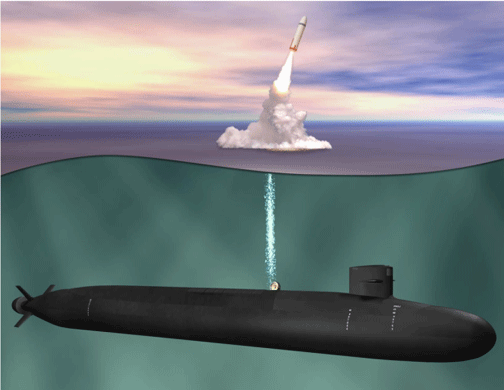 Russia says it launched 2 ballistic missiles in the Arctic Ocean as part of combat training By Amir Vera, CNN August 25, 2019 Russia launched two ballistic missiles from nuclear-powered submarines in the Arctic Ocean and the Barents Sea on Saturday, according to a tweet from the Russian Ministry of Defense.
Hiroshima Round Table’s urgent appeal to save nuclear agreements
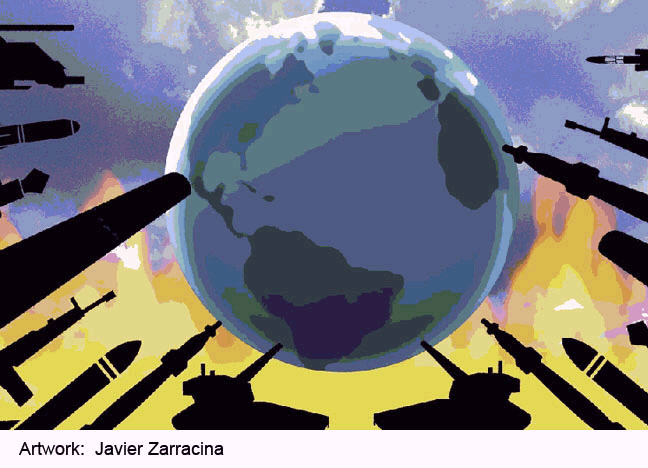 Urgent appeal to save nuclear agreements https://www.japantimes.co.jp/opinion/2019/08/25/commentary/japan-commentary/urgent-appeal-save-nuclear-agreements/#.XWL9GugzbIU
BY RAMESH THAKUR HIROSHIMA, 25 Aug !9 – The Hiroshima Round Table held its seventh annual meeting last Wednesday and Thursday. For the first time, in recognition of the uniquely dangerous international security environment since the dawn of the atomic age in this beautiful city, the Round Table issued an urgent appeal to maintain existing nuclear arms control, disarmament and nonproliferation pacts and to build on them in order to deepen strategic stability. Continue reading
As Trump trashed nuclear weapons treaty, Putin promises ‘symmetrical response’ to US missile test
 Putin promises ‘symmetrical response’ to US missile test after end of nuclear treaty Telegraph UK 23 AUGUST 2019
Vladimir Putin has promised a “symmetrical response” to the US test of a missile banned under a nuclear weapons treaty rubbished this month by the Trump administration amid fears of a new arms race.A new land-based version of the navy’s Tomahawk cruise missile fired from an island in California struck a target more than 310 miles away on Sunday, according to the Pentagon. The recently defunct 1987 US-Russian intermediate-range nuclear forces treaty banned land-based missiles with ranges between 310 and 3,410 miles.
On Friday, Mr Putin told his security council that the test just 16 days after the treaty’s demise proved that the United States had long been developing weapons in violation of the agreement, while accusing Russia of the same as part of a “propaganda campaign”……
“For a symmetrical response, it would be enough to take Kalibr and put it on land and conduct a launch,” defence analyst Alexander Golts told The Telegraph. “That wouldn’t take a huge effort.”
Japan to report that North Korea can now miniaturise nuclear warheads
North Korea now able to miniaturise nuclear warheads – Japan defence report
Upcoming review out of Tokyo will reportedly say missile programme poses ‘serious and imminent threat’ Guardian Justin McCurry in Tokyo 21 Aug 19, Japan’s government will reportedly state that North Korea is capable of miniaturising nuclear warheads in a forthcoming defence report, it has emerged.
Tokyo will upgrade its estimate of the regime’s nuclear capability, having said last year only that the technical feat was a possibility, the conservative Yomiuri Shimbun newspaper said on Wednesday, without citing sources.
The defence report will maintain Japan’s contention that North Korea’s nuclear and ballistic missile programmes pose a “serious and imminent threat” to its security after recent meetings between Donald Trump and the North’s leader, Kim Jong-un, failed to make progress on denuclearisation. The report is expected to receive cabinet approval in mid-September, the Yomiuri said…….
In 2017, a leaked US intelligence assessment concluded that North Korea had developed the technology to produce nuclear warheads small enough to fit inside missiles, theoretically giving it the ability to send nuclear-armed intercontinental ballistic missiles [ICBMs] to distant targets, including the US mainland.
North Korea’s short- and medium-range missiles can strike South Korea and Japan, including US military assets in those countries……. https://www.theguardian.com/world/2019/aug/21/north-korea-now-able-to-miniaturise-nuclear-warheads-japan-defence-report
Burevestnik, SKYFALL nuclear weapons – “of course, it’s a dick-measuring contest,”
next superpower arms race will be even more foolish than the last one. New Republic , By August 22, 2019, The United States and Russia are entering a new arms race, and the costs aren’t just monetary. On August 8, Russian civilians around the remote village of Nyonoksa found themselves downwind of a military nuclear propulsion experiment gone wrong in the White Sea, just outside the Arctic Circle. According to the Russian ministry of defense, a liquid propellant rocket engine had gone awry and exploded.The exact sort of weapon Russia may have been testing is unknown, but the balance of evidence points to a probable culprit: the Burevestnik nuclear-powered cruise missile. Nuclear nonproliferation expert Jeffrey Lewis and his team of researchers out in Monterey, California, have done much of the work in compiling this evidence, which includes the presence of a nuclear fuel carrier ship that was known to have been involved in recovery efforts after a previous failed test of the missile. Known in NATO countries as the SSC-X-9 SKYFALL, the Burevestnik’s atomic propulsion is said by Russian state media to give the missile “almost unlimited range, non-predictable trajectory and high air defense penetration capacity.”……..
In the end, much of what may be driving investment and research on this weapon—beyond Putin’s chest-thumping—may be the sprawling and influential Russian defense bureaucracy. (Overspending on exotic military systems is not an exceptionally American trait.)
That’s the shaky strategic logic behind it. But the common-sense logic, as the radioactive Nyonoksa explosion shows, is even less kind. If a nuclear-powered cruise missile sounds exotic and a little dangerous, that’s because it is. Missiles go boom—usually intentionally, but often enough not—and whatever nuclear power source they might be using onboard wouldn’t be immune.
There’s still little consensus among American experts about how exactly the Burevestnik might leverage nuclear power for propulsion. If you thought nuclear fission weapons were complex, nuclear rocket propulsion is more arcane and mysterious still. In the 1950s and 1960s, U.S. scientists drafted fanciful plans to give missiles nuclear engines, on the assumption that they’d be able to fly longer and farther than any weapon yet conceived. But the Americans eventually gave up; the technical challenges and environmental risks weren’t worth it. The Russians haven’t given up just yet, but they may someday…..
For the Russian leadership, a weapon like Burevestnik is a prestige project, a way to set Moscow apart from its competition……
Of course, Donald Trump couldn’t stomach another head of state flaunting his fancy rocket. The president tweeted on August 12 that the United States has “similar, though more advanced, technology.” As nuclear chemist Cheryl Rofer observed, this was a rare tweet by Trump’s standards: one that criticized Russia. “And of course, it’s a dick-measuring contest,” Rofer added. (Trump’s done this before, chiding North Korean dictator Kim Jong Un on Twitter over the size of his “nuclear button.”) To the extent he grasps the salient issues, it’s likely the president has already asked Pentagon officials why the United States doesn’t have a nuclear-propelled cruise missile of its own.
A folly, endangering us all, If Trump ends another nuclear treaty
 If Trump ends another nuclear treaty, it will be the height of folly, by Michèle Flournoy and Kingston Reif, August 19, 2019 Michèle Flournoy is co-founder and managing partner of WestExec Advisors. She served as the Under Secretary of Defense for Policy from February 2009 to February 2012. Kingston Reif is the director for Disarmament and Threat Reduction Policy at the Arms Control Association.
(CNN)During his first two and a half years in office, President Donald Trump and his administration have laid waste to numerous international agreements originally designed to strengthen US security, bolster US alliances, and constrain US adversaries. The toll has been particularly high with respect to deals concerning nuclear arms control and nonproliferation.
Over the past 14 months, the administration has withdrawn from the 2015 Iran nuclear deal and abandoned the 1987 Intermediate Range Nuclear Forces (INF) Treaty. Both of these valuable agreements have been discarded without a viable plan to replace them.
Now the administration is signaling that it might jettison yet another nuclear pact, the2010 New Strategic Arms Reduction Treaty (New START) with Russia. Doing so would be the height of folly and would deal a significant blow to US national security. With the US withdrawal from the INF Treaty having just taken effect on Aug. 2, New START will be the only remaining agreement constraining the size of the world’s two largest nuclear arsenals. Were New START to disappear, for the first time in nearly half a century there would be no legally binding limits on American or Russian nuclear stockpiles. The risk of unconstrained US-Russian nuclear competition, and of even more tense bilateral relations, would grow.
New START also includes a comprehensive monitoring and verification regime to ensure compliance. But the agreement is set to expire on Feb. 5, 2021. Under its terms, it can be extended by up to five years if both presidents agree.
In an appearance before an activist group this summer, however, US National Security Advisor John Bolton, who before joining the administration calledNew START an “execrable deal,” said that while no decision has been made, he thinks an extension is “unlikely.”
Donald Trump ramps up nuclear weapons, rips up arms treaties: Russia follows
The nuclear arms race is back … and ever more dangerous now https://www.theguardian.com/world/2019/aug/17/nuclear-arms-race-is-back-and-more-dangerous-than-before Simon Tisdall Donald Trump has increased spending on America’s arsenal while ripping up cold war treaties. Russia and China are following suit. Imagine the uproar if the entire populations of York, Portsmouth or Swindon were suddenly exposed to three times the permissible level of penetrating gamma radiation, or what the nuclear physicist Ernest Rutherford termed gamma rays. The outpouring of rage and fear would be heard across the world.
That’s what happened to the roughly 200,000 people who live in the similarly sized northern Russian city of Severodvinsk on 8 August, after an explosion at a nearby top-secret missile testing range. Russia’s weather service, Rosgidromet, recorded radiation levels up to 16 times higher than the usual ambient rate.
Yet the incident has been met with surly silence by Russia. It was five days before officials confirmed a blast at the Nyonoksa range had killed several people, including nuclear scientists. No apologies were offered to Severodvinsk residents. There is still little reliable information. “Accidents, unfortunately, happen,” a Kremlin spokesman said.
That callous insouciance is not universally shared. According to western experts, the explosion was caused by the launch failure of a new nuclear-powered cruise missile, one of many advanced weapons being developed by Russia, the US and China in an accelerating global nuclear arms race
Vladimir Putin unveiled the missile, known in Russia as the Storm Petrel and by Nato as Skyfall, in March last year, claiming its unlimited range and manoeuvrability would render it “invincible”. The Russian president’s boasts look less credible now.
But Putin is undeterred. Denying suggestions that the missile is unreliable, the Kremlin insisted Russia was winning the nuclear race. “Our president has repeatedly said that Russian engineering in this sector significantly outstrips … other countries,” a spokesman said.
Now fast-forward to 16 August, and another threatening event: the test-firing by North Korea of potentially nuclear-capable ballistic missiles, the sixth round of launches since July. More than two years of vanity diplomacy by Donald Trump has not convinced Pyongyang it is safe to give up its nukes – proof, if it were needed, that unilateral counter-proliferation initiatives do not work.
Arms control experts say a consistent, joined-up international approach is woefully lacking. Thus Israel’s undeclared nuclear arsenal is tolerated, and the idea of a bomb developed by Saudi Arabia is no longer ruled out. But the merest hint that Iran may build a nuclear weapon is greeted with megatons of hypocritical horror.
In a sense, the problem is circular. Putin argues that Russia’s build-up is a response to destabilising US moves to modernise and expand its own nuclear arsenal – and he has a point. Barack Obama, the former president, developed a $1.2tn plan to maintain and replace the “triad” of US air, sea and land-based nuclear weapons.
Trump has gone much further. The Pentagon’s nuclear posture review, published last year, proposed an additional $500bn in spending, including $17bn for low-yield, tactical nuclear weapons that could be used on conventional battlefields. The first of these new warheads is due to become operational next month.
Critics in Congress say low-yield weapons make nuclear warfare more likely, and oppose Trump’s budget increases. But with US planners saying the biggest national security threat is no longer terrorism but nuclear-armed states, there is little doubt that many new weapons projects will get the go-ahead.
The renewed nuclear arms race is a product of Trump’s America First outlook and that of comparable ultra-nationalist and insecure regimes elsewhere. Trump’s emphasis on defending the “homeland” is leading inexorably to the militarisation of US society, whether at the Mexican border, on inner-city streets or in its approach to international security.
“We have far more money than anybody else by far,” Trump said last October. “We’ll build up until [Russia and China] come to their senses.” Outspending the opposition was a tactic employed by Ronald Reagan in the 1980s. And Trump is putting taxpayers’ money where his mouth is. Overall, annual US military spending is soaring, from $716bn this year to a proposed $750bn next year.
The paradox is that even as the risk of nuclear confrontation grows, the cold war system of treaties that helped prevent Armageddon is being dismantled, largely at Trump’s behest. Earlier this month, the US withdrew from the 1987 Intermediate-range Nuclear Forces (INF) treaty with Russia (which rid Britain and Europe of US missiles deployed in the early 80s).
The US is also signalling it will not renew the New Start strategic nuclear weapons treaty when it expires in 2021. Washington claims Moscow cheated on the INF pact; Russia denies it. But the real US concern is that both treaties tie its hands, especially regarding China – another example of the impact of America First thinking.
This increasingly unregulated, three-way contest poses indisputable dangers. The US plans were “unnecessary, unsustainable, and unsafe” and “increase the risks of miscalculation, unintended escalation, and accelerated global nuclear competition”, the independent US-based Arms Control Association said in April.
With a much smaller arsenal than the US and Russia, China, too, is “aggressively developing its next generation of nuclear weapons”, according to a major Chinese weapons research institute. Nor, given Moscow’s and Washington’s behaviour, has it an incentive to stop, despite Trump’s vague proposal for a trilateral disarmament “grand bargain”.
Like the US, China – while historically pledged to “no first use” – wants potential enemies to believe it may actually use tactical nukes. As Dr Strangelove would doubtless appreciate, this, perversely, increases the chances that it will.
The dreadful example these nuclear arms-racers are setting to non-nuclear states such as Iran is obvious. By failing to uphold arms control agreements, neglecting collaborative counter-proliferation efforts, and building new, more “usable”, dangerously unproved weapons like the one that irradiated Severodvinsk, the nuclear powers are digging their own graves – and ours.
Losing the climate war: the unholy alliance between the Pentagon and the fossil fuel industries
We Can’t Confront Climate Change While Lavishly Funding the Pentagon, BY JP Sottile, Truthout. August 18, 2019
 The Pentagon is staring down the barrel of what could become the longest, hottest war in U.S. history. This titanic clash pits the largest military the world has ever seen against an omnipresent opponent that can marshal resources like no enemy it has ever encountered.
Funding the Pentagon, Fueling the Fallout
The troops sent to the border to “assist” U.S. Customs and Border Patrol and to “build” Trump’s wall are, like Sergeant Cline’s heat-related death, a harbinger of things to come. They are not only seeing firsthand the desperation of people willing to walk up to 2,000 milesto flee the fallout from decades of U.S. interventionism in Central America, they are witnessing the start of a widely predicted climate migration crisis. A brutal mix of prolonged drought, water scarcity and deforestation is exacerbating the suffering in El Salvador, Guatemala and Honduras. As InsideClimate News noted, Honduras typifies the unfair paradox of the climate crisis because “like so many developing countries” it “has contributed relatively little to the greenhouse gas emissions,” but “projections suggest it is especially imperiled by climate change.”
Russia Testing Nuclear-Powered Mega-Torpedo Near Where Deadly Explosion Occurred

Russia Testing Nuclear-Powered Mega-Torpedo Near Where Deadly Explosion Occurred https://www.forbes.com/sites/hisutton/2019/08/17/russia-testing-nuclear-powered-mega-torpedo-near-where-deadly-explosion-occurred/#7f3e00632d7fH I Sutton, Aerospace & DefenseI cover the changing world of underwater warfare. Details are still emerging of the explosion of a nuclear-powered engine that killed at least seven people in northern Russia last week. Conflicting reports, rumors and speculation center around whether the engine was for a nuclear-powered cruise missile, codenamed Skyfall by NATO, or some other weapon-related reactor. One of the possible weapons in the frame is the Poseidon mega-torpedo. This new weapon is described as an Intercontinental Nuclear-Powered Nuclear-Armed Autonomous Torpedo by the U.S. government
-
Archives
- October 2026 (112)
- September 2026 (339)
- August 2026 (330)
- July 2026 (355)
- June 2026 (287)
- May 2026 (306)
- April 2026 (356)
- March 2026 (251)
- February 2026 (267)
- January 2026 (308)
- December 2025 (358)
- November 2025 (359)
-
Categories
- 1
- 1 NUCLEAR ISSUES
- business and costs
- climate change
- culture and arts
- ENERGY
- environment
- health
- history
- indigenous issues
- Legal
- marketing of nuclear
- media
- opposition to nuclear
- PERSONAL STORIES
- politics
- politics international
- Religion and ethics
- safety
- secrets,lies and civil liberties
- spinbuster
- technology
- Uranium
- wastes
- weapons and war
- Women
- 2 WORLD
- ACTION
- AFRICA
- Atrocities
- AUSTRALIA
- Christina's notes
- Christina's themes
- culture and arts
- Events
- Fuk 2022
- Fuk 2023
- Fukushima 2017
- Fukushima 2018
- fukushima 2019
- Fukushima 2020
- Fukushima 2021
- general
- global warming
- Humour (God we need it)
- Nuclear
- RARE EARTHS
- Reference
- resources – print
- Resources -audiovicual
- Weekly Newsletter
- World
- World Nuclear
- YouTube
-
RSS
Entries RSS
Comments RSS

