Russian nuclear submarine aborts ballistic missile test
|
Russian nuclear submarine aborts ballistic missile test, MOSCOW (Reuters) 21 Oct 19, – A Russian nuclear submarine aborted the test firing of an intercontinental ballistic missile during a military exercise overseen by President Vladimir Putin last week, the Ministry of Defence said on Monday.The nuclear submarine, K-44 Ryazan, part of Russia’s Pacific Fleet, was meant to launch two R-29R ballistic missiles from the Sea of Okhotsk on Oct. 17, but fired only one successfully with the other remaining in its tube onboard the submarine, the Vedomosti daily reported earlier on Monday.
The incident occurred on the same day as Putin oversaw the drills from a command center at the Defence Ministry in Moscow. The aborted drill was part of wider war games for Russia’s armed forces, known as ‘Thunder 2019,’ which were designed to test the readiness of the country’s strategic forces for a nuclear conflict. ….Reporting by Alexander Marrow; Editing by Andrew Osborn https://www.reuters.com/article/us-russia-missiles-drills/russian-nuclear-submarine-fails-to-test-fire-ballistic-missile-vedomosti-idUSKBN1X010P |
|
India keeps increasing its nuclear weaponry – aimed at Pakistan and China
“India is estimated to have produced enough military plutonium for 150 to 200 nuclear warheads, but has likely produced only 130 to 140,” according to Hans Kristensen and Matt Korda of the Nuclear Information Project at the Federation of American Scientists. “Nonetheless, additional plutonium will be required to produce warheads for missiles now under development, and India is reportedly building several new plutonium production facilities.”
In addition, “India continues to modernize its nuclear arsenal, with at least five new weapon systems now under development to complement or replace existing nuclear-capable aircraft, land-based delivery systems, and sea-based systems.”……https://news.yahoo.com/indias-nuclear-weapons-arsenal-keeps-183000277.html
How America was prepared to kill billions with nuclear weapons on Russia and China
America Would Have Killed Billions Nuking Russia and China in Nuclear War https://nationalinterest.org/blog/buzz/america-would-have-killed-billions-nuking-russia-and-china-nuclear-war-89731
A very real cold war horror story.
But it turns out that had global nuclear war erupted during the early 1960s, it would have been the Russians and Chinese who would have reverted to living like the Flintstones.
The report included questions and answers regarding the various nuclear targeting options. These ranged from attacks on enemy nuclear and conventional forces while minimizing collateral damage to enemy cities, to attacking cities as well as military forces on purpose. This latter option would have been “in order to destroy the will and ability of the Sino-Soviet Bloc to wage war, remove the enemy from the category of a major industrial power, and assure a post-war balance of power favorable to the United States.”
The answer was that Pentagon war plans already included the destruction of cities as a way to destroy the urban and industrial backbone. “This should result in greater population casualties in that a larger portion of the urban population may be placed at risk.”
This was because of China’s rural society at the time. “Thus, the attack of a large number of place names [towns] would destroy only a small fraction of the total population of China. The rate of return for a [nuclear] weapon expended diminishes after accounting for the 30 top priority cities.”
Note that while annihilating one-third of China’s population was deemed uneconomical, the U.S. military took it for granted that the Soviet Union and China would be destroyed as viable societies.
Interestingly, Russia and China would be reduced to the level of Conan the Barbarian—but not Albania. “Should there be capability to withhold all attacks in Albania, Bulgaria and Romania?” asks the document.
The answer was that “the capability should exist to withhold attacks against Soviet satellites (either individually or collectively).” Other documents state that potential nuclear targets included the Sino-Soviet bloc—but not Yugoslavia.
Michael Peck is a contributing writer for the National Interest. He can be found on Twitter and Facebook. This first appeared in September 2018.
Turkey isn’t “holding 50 US nuclear weapons ‘hostage”
|
Is Turkey Holding 50 US Nuclear Weapons ‘Hostage’? A metaphorical reference has been taken literally by some. Snopes,
the long-standing concern that some 50 nuclear weapons are stored at the U.S. air base in Incirlik, just dozens of miles from the Syrian border. Some have for years expressed concerns about the security of those weapons, citing instability in the region. …….
he potentially disastrous specter of the Turkish government taking hold of American nukes. It’s not an impossible scenario, but it’s unlikely, said Jeffrey Lewis, director of the East Asia Nonproliferation Program at the James Martin Center for Nonproliferation Studies at the Middlebury Institute of International Studies at Monterey, a private graduate school in Vermont. And describing the weapons as “hostages” is metaphorical. The weapons are not literally being held “hostage” by Erdogan in that the U.S. can take them out of Incirlik any time it chooses. “The U.S. could take them out tomorrow if they wanted,” Lewis said. But the problem is that “some people don’t want to take them out, because if they do, they’ll never be able to put them back in.” Lewis added that he doesn’t believe it would end diplomatic relations between the U.S. and Turkey if the U.S. decided to remove the weapons, although he noted it would be tricky amid the tense situation involving the Kurds. He also raised doubts about how much the Turks prioritize the weapons, noting the weapons stored at Incirlik are gravity bombs — they can only be delivered via aircraft, and no Turkish aircraft certified to deliver nuclear weapons exist. The United States also doesn’t keep an aircraft that can deliver nukes permanently parked at Incirlik, either. In other words, Lewis said, “it’s basically a storage depot.” Although it’s true there are about 50 American nuclear weapons being stored at Incirlik Air Base in Turkey, the weapons are in the possession of the U.S. military. Erdogan is not literally holding them “hostage” so much as new developments in Turkey have made it more complicated for the U.S. to move them out. However, the weapons remain under U.S. control, and as it stands, the U.S. retains the power to move them out of Turkey at will. https://www.snopes.com/fact-check/turkey-50-us-nuclear-weapons/ |
|
|
Hiroshima residents exposed to A-bomb ‘black rain’ developed health problems: lawyers
October 16, 2019 (Mainichi Japan) HIROSHIMA — Nearly all of the 85 plaintiffs in a class action lawsuit who claim to have been exposed to radioactive “black rain” that fell on Hiroshima and surrounding areas in the immediate aftermath of the U.S. atomic bombing of the city in 1945 have been diagnosed with health problems that could be related to radiation, their lawyers said.
The plaintiffs, of whom eight have already died, and their representatives have brought the case to the Hiroshima District Court, demanding the Hiroshima prefectural and municipal governments provide them health care benefits on the basis that they were exposed to the radioactive rain outside the designated area set by the central government. Research by the legal team representing the plaintiffs have revealed that almost all of the plaintiffs have been diagnosed with health issues that “radiation cannot be ruled out” as their causes.
The state has issued certificates for A-bomb survivors who were in the designated area near the epicenter. These certificates enable them to receive free medical care. As the actual health damage caused by the radioactive black rain remains unclear, however, the central government in 1976 named a 19-kilometer by 11-kilometer area northwest from the state-designated radiation exposure area “a special health checkup zone.” Those who were in this zone are subject to free health checkups, and if they develop illnesses involving at least one of 11 kinds of disorders that the government lists as potentially radiation-related, such as cardiovascular diseases, they are given the certificates…….https://mainichi.jp/english/articles/20191016/p2a/00m/0na/006000c
China Calls for Maintaining Global Strategic Stability and Reducing Nuclear Conflicts Risks
|
China Calls for Maintaining Global Strategic Stability and Reducing Nuclear Conflicts Risks https://www.fmprc.gov.cn/mfa_eng/wjbxw/t1708327.shtml–2019/10/16 The 16th PIIC Beijing Seminar on International Security was held in Shenzhen, China on the 16th October, 2019. It is organised by China Arms Control and Disarmament Association (CACDA), Program for Science and National Security Studies (PSNSS),and Nuclear Threat Initiative (NTI). Scholars and experts from China, the U.S., Russia, the U.K.,Germany, Italy, Belgium, Japan, South Korea, Mongolia and other countries participated in this seminar. The Director-General of the Department of Arms Control of the Foreign Ministry Fu Cong attended the opening ceremony and made a keynote speech, calling for maintaining global strategic stability and reducing risks of nuclear conflicts. Fu Cong said that the global strategic security situation has dramatically worsened over the past few years. Unilateralism and hegemonism is rising in international relations, posing major threats to the international order based upon international law. Returning to the cold war mentality, the U.S. has withdrawn from or renegaded on a host of multilateral arms control agreements, with the aim of seeking unilateral and overwhelming military superiority. With these actions, mutual trust and cooperation between major powers have been severely eroded, the global strategic stability is being seriously undermined, the international norms and multilateral regimes are under severe stress, and the deficit of global security governance is becoming more prominent. Fu Cong emphasized that continued erosion of global strategic stability would inevitably lead to a relapse of nuclear arms race. And the risks of nuclear conflicts would increase. All nuclear-weapon States should take measures to diminish the role of nuclear weapons in their national security doctrines. Nuclear-weapon States should provide unconditional and unambiguous security assurances to non-nuclear-weapon States. Countries should exercise restraint in building and deploying strategic capabilities. Nuclear disarmament should be pursued in a reasonable and pragmatic manner. Nuclear-weapon States should enhance dialogue on nuclear doctrines and strategies. Nuclear non-proliferation issues should be resolved through political and diplomatic means. And the challenges created by emerging technologies should be properly addressed. Fu Cong said that China expresses its deep regret over the U.S.’s withdrawal from the INF Treaty. It is of China’s view that the U.S. withdrawal will have a direct negative impact on global strategic stability, on peace and security in Europe and Asia-Pacific region, as well as the international arms control regime. The fact that the U.S. has conducted a ground-based intermediate-range cruise missile test less than three weeks after its withdrawal from the Treaty shows that its withdrawal was meant to free its hands in developing advanced weaponry in order to seek unilateral military advantage. . China firmly opposes the U.S. deployment of ground-based intermediate-range missiles in the Asia-Pacific region. The U.S. missiles, if deployed in the region against others’ expectations, would be virtually on China’s doorsteps. Should that happen, China would have no choice but to take necessary countermeasures in defence of its national security. China urges the U.S. and other countries concerned to exercise restraint and prudence on this matter. Fu Cong also briefed on China’s efforts in maintaining global strategic stability, including China’s “no first use” policy, and stressed that China has shown maximum transparency in its nuclear strategy, exercised the utmost restraint on the development of its nuclear force, and adopted an extremely prudent attitude toward the use of nuclear weapons. China will remain committed to peaceful development and continue to advocate for multilateralism. And China will always be a positive force for international arms control and disarmament efforts and a contributor to the lofty cause of safeguarding peace and security of the mankind. |
|
Marshall Islands’ nuclear clean-up workers concerned about radiation leaking
|
Nuclear warning: Toxic waste equivalent to 2,000 Hiroshima bombs could be leaking in sea https://www.express.co.uk/news/science/1191538/nuclear-waste-cold-war-cleanup-hiroshima-us-news-nuclear-bomb
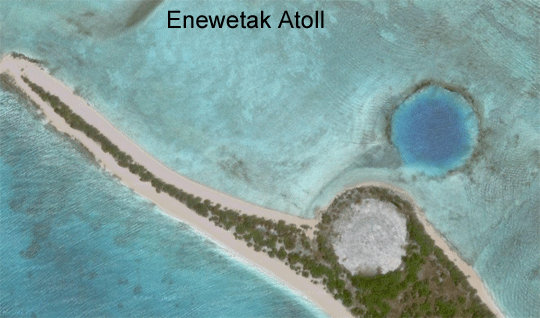
A CONCRETE dome filled with nuclear waste could be leaking into the ocean, with experts urging the US government to act urgently as humans “cannot wait”.By SEAN MARTIN, Wed, Oct 16, 2019 |Enewetak Atoll is a series of small islands in the South Pacific which the US government used to test its nuclear weapons following World War 2 from 1948 to 1958. Over a ten year period, 30 megatons of weapons – equivalent to 2,000 Hiroshima bombs – were dropped on the islands during the Cold War. When the US had finished its testing, it built a concrete barrier known as the Runit dome to store the debris of 43 nuclear explosions in a clean-up operation lasting from 1977 to 1980.
However, employees who worked on the clean-up believe the dome could be leaking radioactive waste into to the ocean.
In response, the US has invested $1,689,000 (£1.32m) in a mission to analyse the dome, but there are claims that it could be too late as the waste could have seeped into the ocean, which would have an effect on the marine ecosystem.
Paul Griego, a former radiochemist who worked on the cleanup operation from June 1977 to October 1978, said: “We need the very same funding and for the very same analysis – the dome can wait for radiochemical analysis but we are human and we cannot wait.
While the US government said staff were subjected to just low-levels of radiation and wore all the necessary protective gear, Mr Griego has said this was not the case. The 62-year old added: “We are certain we have the very same radionuclides in our bodies that that would be found in the dome. “We were bombarded with radiation while building the dome, we drank the contaminated water, inhaled the dust-filled air, absorbed contaminates though our skin, ate the fish we caught and more. “We are not only denied the diagnostic resources, we are denied healthcare to cover our radiation and toxin-related illnesses.
“The government’s refusal to provide radiochemical resources is malicious and feeds into the status quo. “It places the burden of proof of an illness on the individual rather than the moral responsibility of our government.” The mission saw more than 1,000 employees tasked with collecting contaminated soil and radioactive debris, which was then mixed with concrete and placed in a nuclear test crater, which was sealed in a concrete dome.
However, people who were on the scene said that the dome was not lined with concrete, and warn it could be seeping into the ocean. For this reason, the US will embark on an 18 month mission to analyse the dome to see if needs to be reinforced or perhaps completely removed. Doug Domenech, Assistant US Secretary of the Interior for Insular and International Affairs, said: “The US Departments of the Interior and Energy are partnering on this important analysis of Runit Dome so that we can be responsive to both Congress and concerns expressed by the Enewetak community in the Marshall Islands.”
|
|
America’s Nuclear Doomsday Submarines
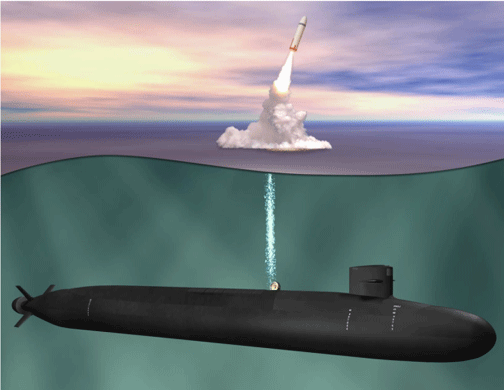 Meet the Ohio-Class: America’s Nuclear Doomsday Submarines, National Interest, by Sebastien Roblin 16 Oct 19,”………. The most deadly of the real-life kaiju prowling the oceans today are the fourteen Ohio-class ballistic-missile submarines, which carry upwards of half of the United States’ nuclear arsenal onboard. Meet the Ohio-Class: America’s Nuclear Doomsday Submarines, National Interest, by Sebastien Roblin 16 Oct 19,”………. The most deadly of the real-life kaiju prowling the oceans today are the fourteen Ohio-class ballistic-missile submarines, which carry upwards of half of the United States’ nuclear arsenal onboard.
If you do the math, the Ohio-class boats may be the most destructive weapon system created by humankind. Each of the 170-meter-long vessels can carry twenty-four Trident II submarine-launched ballistic missiles (SLBMs) which can be fired from underwater to strike at targets more than seven thousand miles away depending on the load.
As a Trident II reenters the atmosphere at speeds of up to Mach 24, it splits into up to eight independent reentry vehicles, each with a 100- or 475-kiloton nuclear warhead. In short, a full salvo from an Ohio-class submarine—which can be launched in less than one minute—could unleash up to 192 nuclear warheads to wipe twenty-four cities off the map. This is a nightmarish weapon of the apocalypse. ………. https://nationalinterest.org/blog/buzz/meet-ohio-class-americas-nuclear-doomsday-submarines-88386
|
|
Russia showcases its nuclear arsenal with huge war games
|
Russia kicks off huge war games to test its nuclear arsenal, CBS News, BY DARIA LITVINOVA, OCTOBER 15, 2019 MOSCOW — Russia kicked off a sweeping military exercise of its Strategic Missile Forces on Tuesday. The Defense Ministry said the drills would include 16 practice launches of cruise and ballistic missiles.
Dubbed “Thunder-2019,” the war games were set to last three days and involve 12,000 troops, 213 missile launchers, 105 aircraft, 15 surface warships and five nuclear submarines………
Last week, Putin announced that Russia would start developing short- and intermediate-range missiles in response to U.S. plans to deploy such weapons in Asia. They are missiles that were banned for decades under the INF. Russia formally withdrew from the Reagan-era treaty soon after the U.S., which had accused Moscow of working on new missiles that violated the terms of the accord. https://www.cbsnews.com/news/russia-war-games-thunder-2019-test-strategic-nuclear-weapons-today-after-inf-collapse-2019-10-15/ |
|
2019 Nuclear Weapons Ban Monitor report
 Nuclear Weapons Ban Monitor 2019 is here, https://banmonitor.org/news/nuclear-weapons-ban-monitor-2019-is-here The 2019 report of the Nuclear Weapons Ban Monitor was launched at a side event during the UN General Assembly in New York on 16 October. This watchdog measures progress towards a world free of nuclear weapons, by using the 2017 UN Treaty on the Prohibition of Nuclear Weapons (TPNW) as a yardstick. The report also evaluates the extent to which the policies and practices of all states comply with the prohibitions in the TPNW, regardless of whether they have joined the Treaty yet. Nuclear Weapons Ban Monitor 2019 is here, https://banmonitor.org/news/nuclear-weapons-ban-monitor-2019-is-here The 2019 report of the Nuclear Weapons Ban Monitor was launched at a side event during the UN General Assembly in New York on 16 October. This watchdog measures progress towards a world free of nuclear weapons, by using the 2017 UN Treaty on the Prohibition of Nuclear Weapons (TPNW) as a yardstick. The report also evaluates the extent to which the policies and practices of all states comply with the prohibitions in the TPNW, regardless of whether they have joined the Treaty yet.
The 2019 report of the Nuclear Weapons Ban Monitor, which is researched and published by the organization Norwegian People’s Aid (NPA), identifies 31 mostly European states – including countries like Belgium, Denmark, Italy, the Netherlands, Norway, and Spain – as “nuclear-weapon-complicit states”. These are states that do not themselves possess nuclear weapons but have outsourced their nuclear postures to one or more nuclear-armed allies through arrangements of extended nuclear deterrence, or so-called “nuclear umbrellas”. They have endorsed or acquiesced in the continued possession and potential use of nuclear weapons on their behalf.
– It is not only the nine nuclear-armed states that stand between the international community and its long-standing goal of a world free of nuclear weapons. So do the 31 nuclear-weapon-complicit states. Their role in assisting, encouraging, and inducing continued retention of nuclear weapons had not been given much attention prior to the adoption of the TPNW in the UN in 2017, says the editor of the Nuclear Weapons Ban Monitor, Grethe Lauglo Østern of NPA. The nine nuclear-armed states and the 31 nuclear-weapon-complicit states do not support the TPNW, and some of them actively oppose it. The majority of the world’s states, however, stand behind the Treaty. The Nuclear Weapons Ban Monitor categorizes a total of 135 countries as TPNW supporters.
– As of October 2019, 32 states are full states parties to the TPNW, while another 48 states have signed it, but not yet ratified it. In addition, 55 countries have voted in favour of the Treaty in the UN, but not yet taken steps to adhere to it, says Østern. Support for the TPNW is high in all regions apart from Europe, where 34 states (or 69%) today are opposed to signing it. Only 17 countries in the world are undecided on the TPNW. The TPNW will be binding, international law when 50 states have ratified it. The Nuclear Weapons Ban Monitor shows that the Treaty is moving steadily towards early entry into force, despite obstructionism from nuclear-armed states. At the time of writing, the TPNW had, by a close margin, the second fastest speed of adherence of the treaties on weapons of mass destruction, though significantly slower than the 1968 Treaty on the Non-Proliferation of Nuclear Weapons (NPT). Among the states that have ratified the TPNW already are Kazakhstan and South Africa, both of which once had nuclear weapons but subsequently disarmed; two of only four states ever to do so.
– A facts-based debate on the UN prohibition on nuclear weapons is essential if we are to achieve the goal of a world without nuclear weapons. This applies to civil society, and to politicans and diplomats. The Nuclear Weapons Ban Monitor gathers and makes available crucial data, says NPA’s secretary general Henriette Westhrin. Even though the nuclear-armed states are resisting the TPNW, Westhrin believes it is important that countries without nuclear weapons now are taking the lead and becoming the first states parties to the Treaty. In doing so they are creating a long-overdue norm that nuclear weapons are unacceptable, and an international framework for their elimination. – The first parties to the TPNW have a responsibility to use this tool to break decades of acquiescence to the nuclear threat and to encourage other states to stop justifying the “benefits” of nuclear weapons. The impact of the TPNW will be built gradually and will depend on how it is received and used by each and every UN member state, says Westhrin. Contact: Grethe Lauglo Østern, Editor of the Nuclear Weapons Ban Monitor on +41 78 717 9137 or e-mail: gretheo@npaid.org
|
|
|
Radioactive chlorine from nuclear bomb tests still present in Antarctica
|
Radioactive chlorine from nuclear bomb tests still present in Antarctica, Phys Org, by Abigail Eisenstadt, American Geophysical Union 16 Oct 19, Antarctica’s ice sheets are still releasing radioactive chlorine from marine nuclear weapons tests in the 1950s, a new study finds. This suggests regions in Antarctica store and vent the radioactive element differently than previously thought. The results also improve scientists’ ability to use chlorine to learn more about Earth’s atmosphere. Scientists commonly use the radioactive isotopes chlorine-36 and beryllium-10 to determine the ages of ice in ice cores, which are barrels of ice obtained by drilling into ice sheets. Chlorine-36 is a naturally occurring radioactive isotope, meaning it has a different atomic mass than regular chlorine. Some chlorine-36 forms naturally when argon gas reacts with cosmic rays in Earth’s atmosphere, but it can also be produced during nuclear explosions when neutrons react with chlorine in seawater. Nuclear weapons tests in the United States carried out in the Pacific Ocean during the 1950s and the 1960s caused reactions that generated high concentrations of isotopes like chlorine-36. The radioactive isotope reached the stratosphere, where it traveled around the globe. Some of the gas made it to Antarctica, where it was deposited on Antarctica’s ice and has remained ever since. Other isotopes produced by marine nuclear bomb testing have mostly returned to pre-bomb levels in recent years. Scientists expected chlorine-36 from the nuclear bomb tests to have also rebounded. But new research in AGU’s Journal of Geophysical Research: Atmospheres finds the Vostok region of Antarctica is continuing to release radioactive chlorine into the atmosphere. Since naturally produced chlorine-36 is stored permanently in layers of Antarctica’s snow, the results indicate the site surprisingly still has manmade chlorine produced by bomb tests in the 1950s and in the 1960s……… https://phys.org/news/2019-10-radioactive-chlorine-nuclear-antarctica.html |
|
Removing a nuclear arsenal from Turkish soil is a necessary step in reducing a global danger.
Why Are U.S. Nuclear Bombs Still in Turkey? The best time to get atomic weapons out was several years ago. The second best time is now. The New Republic, By ANKIT PANDAOctober 16, 2019
The American relationship with Recep Tayyip Erdoğan’s Turkey has been fraught for half a decade, but never this bad. Last week, American troops were intentionally targeted by Turkish artillery units in Northern Syria as Erdoğan’s forces advanced and President Donald Trump ordered the U.S. into a unilateral withdrawal. The Pentagon sternly warned that Turkey’s troops would face “immediate defensive action” from American forces if such an encounter were to be repeated……..
Putin warns on the need for a new nuclear weapons treaty
 PUTIN TAKES SWIPE AT TRUMP FOR WITHDRAWING FROM NUCLEAR TREATY: ‘IT WAS NOT WORTH RUINING’, Newsweek,
In an interview with Arabic-speaking journalists ahead of his visit to Saudi Arabia and the United Arab Emirates, Putin reiterated Russia’s opposition to the withdrawal in February from the INF, which had been signed in 1987 by Soviet leader Mikhail Gorbachev and President Ronald Reagan.
It banned missiles with ranges of between 310 and 3,400 miles but the U.S. and Nato had accused Russia of violating the pact by deploying a new type of cruise missile, a claim Moscow denied.
Putin said: “It think it was a mistake…and that they could have gone a different path. I do understand the U.S. concerns. While other countries are free to enhance their defences, Russia and the U.S. have tied their own hands with this treaty. However, I still believe it was not worth ruining the deal; I believe there were other ways out of the situation.”
Putin said that the U.S. must back a new START Treaty, which expires in 2021, to restrict a race to acquire strategic nuclear weapons.
“The new START Treaty is actually the only treaty that we have to prevent us from falling back into a full-scale arms race. To make sure it is extended, we need to be working on it right now. We have already submitted our proposals; they are on the table of the U.S. administration. There has been no answer so far.
“If this treaty is not extended, the world will have no means of limiting the number of offensive weapons, and this is bad news. The situation will change, globally. It will become more precarious, and the world will be less safe and a much less predictable place than today,” Putin said, according to a transcript of the interview on the Kremlin website.
Putin said that his doubt over the U.S. commitment to nuclear disarmament stretched back to 2002, when under President George W. Bush, Washington withdrew from the Anti-Ballistic Missile (ABM) Treaty, which had imposed limits on missile defence systems……… https://www.newsweek.com/putin-start-treaty-trump-arms-race-1464921
USA anxiety over its nuclear weapons stashed in Turkey
The US is rethinking the 50-plus nuclear weapons it keeps in Turkey, Quartz, By Tim Fernholz, 14 Oct 19, Turkish forces are pushing into northern Syria, replacing and sometimes even firing on the US troops retreating at Donald Trump’s orders.
The question of whether Turkey, a member of the North Atlantic Treaty Organization, is really a US ally was put to US defense secretary Mark Esper on Fox television this morning. “No, I think Turkey, the arc of their behavior over the past several years has been terrible,” he said.
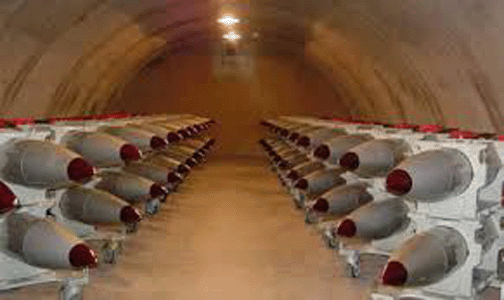
Which brings up a problem: The US is storing perhaps 50 air-dropped thermonuclear bombs at its Incirlik Airbase in southern Turkey, less than 100 miles from the Syrian border where this conflict is taking place.
The nuclear stockpile dates back to the Cold War, when the US sought to keep a sufficient supply of atomic weapons deployed in Europe to deter potential Soviet aggression. Belgium, the Netherlands, Germany, and Italy also host similar arsenals, and the US trains the participating nations in the use of the doomsday devices.
Today, these bombs remain in place largely because of inertia, and the hope that countries like Turkey will see the depot as sufficient reason not to develop nuclear weapons of their own. It doesn’t seem to be working: Last month, Turkish president Recep Tayyip Erdogan said he could “not accept” efforts to prevent Turkey from developing its own atomic bombs.
But instability in Turkey and the region, along with Ankara’s close relationship with Russia, have had American strategists talking about re-locating their weapons for years. (The US does not officially discuss the arsenal, but there is no indication that the stockpile has been removed.)……..https://qz.com/1727158/us-rethinking-the-50-plus-nuclear-weapons-it-keeps-in-turkey/

The truly dangerous situation of USA’s nuclear weapons
|
US nuclear weapons policies are alarmingly dangerous. https://www.ucsusa.org/nuclear-weapons/us-weapons, 13 Oct 19, The United States tested the first atomic device in July of 1945. Seven years later, it exploded the first thermonuclear weapon—designed in part by Richard Garwin, who now serves on the board of the Union of Concerned Scientists. In the following years, the United States amassed many thousands of nuclear weapons, each capable of immense destruction. At the height of the Cold War, the United States maintained roughly 30,000 nuclear bombs and warheads, though the total number of weapons has fallen, thanks in part to US-Soviet and US-Russian treaties and agreements. The policies governing when, where, and why the United States would use nuclear weapons remain unconscionably risky. The US arsenalAs of 2019, the US arsenal contained some 4,000 nuclear weapons, about half of which are deployed and ready to be delivered. Their destructive capabilities range widely: the most powerful weapon—the “B83”—is more than 80 times more powerful than the bomb dropped on Hiroshima. The smallest weapon has an explosive yield of only 2 percent that of the Hiroshima bomb. Such “low-yield” weapons are designed to be used on the battlefield, increasing the likelihood they may actually be used.
The country’s weapons are deployed in submarines and in 80-foot-deep missile silos across the American west. Others are stored at air force bases, where they can be loaded on long-range bombers. Some 150 US bombs are deployed at airbases in five European countries. The arsenal’s primary purpose is “deterrence”—i.e., it’s intended to dissuade others from launching a nuclear attack. However, current policies allow the United States to use nuclear weapons first against Russia, China, or North Korea, effectively beginning a nuclear war.
New weaponsOver the coming years the Pentagon plans to spend more than a trillion dollars maintaining and rebuilding the entire US nuclear arsenal, which is both unnecessary and unwise. US weapons are maintained and upgraded on an ongoing basis and many don’t require replacement. Certain types should be eliminated altogether because they are redundant and provocative.
The main outcome of the Pentagon’s spending spree may be to spark an arms race with Russia and China, which would be expensive and dangerous—especially in the absence of strong arms control agreements.
PoliciesThe risk of nuclear war has as much to do with policy as it does to do with the weapons themselves. In the United States, the President is granted sole authority to launch nuclear weapons. He or she doesn’t need to consult with anyone beforehand and can issue a launch order with very few checks and balances. It’s also US policy that nuclear weapons can be used first in a non-nuclear conflict with a nuclear-armed state, i.e. not only in retaliation. If the United States crossed the nuclear threshold and started a nuclear war, it would open up our country to a retaliatory attack. Additionally, 400 land-based missiles are kept on hair-trigger alert, meaning they’re maintained in a ready-for-launch status. Current policy allows the United States to launch these missiles on warning of an incoming attack, despite a long history of false alarms and close calls. Collectively, these and other policies increase the risk of nuclear war. Better policies would reduce that risk. |
|
-
Archives
- October 2026 (112)
- September 2026 (339)
- August 2026 (330)
- July 2026 (355)
- June 2026 (287)
- May 2026 (306)
- April 2026 (356)
- March 2026 (251)
- February 2026 (267)
- January 2026 (308)
- December 2025 (358)
- November 2025 (359)
-
Categories
- 1
- 1 NUCLEAR ISSUES
- business and costs
- climate change
- culture and arts
- ENERGY
- environment
- health
- history
- indigenous issues
- Legal
- marketing of nuclear
- media
- opposition to nuclear
- PERSONAL STORIES
- politics
- politics international
- Religion and ethics
- safety
- secrets,lies and civil liberties
- spinbuster
- technology
- Uranium
- wastes
- weapons and war
- Women
- 2 WORLD
- ACTION
- AFRICA
- Atrocities
- AUSTRALIA
- Christina's notes
- Christina's themes
- culture and arts
- Events
- Fuk 2022
- Fuk 2023
- Fukushima 2017
- Fukushima 2018
- fukushima 2019
- Fukushima 2020
- Fukushima 2021
- general
- global warming
- Humour (God we need it)
- Nuclear
- RARE EARTHS
- Reference
- resources – print
- Resources -audiovicual
- Weekly Newsletter
- World
- World Nuclear
- YouTube
-
RSS
Entries RSS
Comments RSS

