Iran categorically opposes nuclear weapons – Foreign Minister Mohammad Javad Zarif
Zarif: Iran categorically opposes nuclear arms, Islamic Republic News Agency Tehran, Oct 12, IRNA – Iranian Foreign Minister Mohammad Javad Zarif in a message referred to Iranian Supreme Leader Ayatollah Seyyed Ali Khamenei’s remarks that nuclear weapons are immoral, saying Iran categorically opposes such weapons.
“#Iran’s Leader has long made it abundantly clear that nuclear weapons are immoral & contravene Islamic principles,” Zarif wrote on his Twitter account on Saturday.
“Their development, acquisition, stockpiling & use is thus forbidden,” he added.
Zarif noted: “We’re categorically opposed to nuclear arms as a religious/moral duty & strategic imperative.”
On Wednesday, Ayatollah Khamenei emphasized that making, keeping and utilizing nuclear weapons are banned according to the Islamic law, …….. https://en.irna.ir/news/83514156/Zarif-Iran-categorically-opposes-nuclear-arms
U.S. Congress ponders reckless decision to increase production of plutonium bomb cores or “pits.”
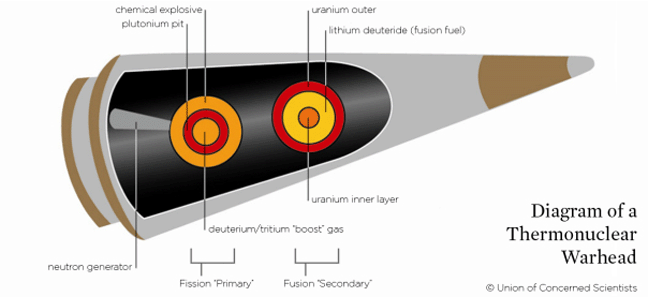
Pits are the triggers for thermonuclear weapons. Currently, the United States does not manufacture plutonium pits on an industrial scale. In its fiscal 2020 budget request the National Nuclear Security Administration (NNSA) seeks authorization to produce at least 80 plutonium pits per year by 2030 at two facilities separated by some 1,500 miles. The Senate NDAA fully funds the request. The House instead authorizes 30 pits per year, all at the Los Alamos National Laboratory in NM. Los Alamos is presently authorized to produce 20 pits annually.
Plutonium pit production at such a large scale represents a major departure from our post-Cold War nuclear weapons policy. Since the Rocky Flats Plant in CO closed in 1989 following a raid by the FBI environmental crimes unit, the United States has produced pits at an annual rate of 11 or fewer. Further, there have been no orders for newly manufactured pits in nearly a decade.
Instead, the government has been utilizing some of the approximately 20,000 plutonium pits in storage at the Pantex Plant in Texas to conduct its ongoing warhead maintenance and refurbishment programs. These pits have very long lifetimes. JASON, a DOD organized group of independent scientific experts, estimated that plutonium pits will last 100 years or more.
Clearly, the Senate NDAA is not meant to maintain the safety and reliability of the existing nuclear weapons stockpile. Instead, future production is intended to enable modified pit designs for new-design warheads, contrary to longstanding U.S. arms control objectives. Given the current moratorium on explosive testing of nuclear weapons, those pits cannot be full-scale tested or, alternatively, could prompt the United States to return to nuclear testing. This would have international proliferation consequences beyond anything we’ve seen since the most dangerous days of the Cold War.
As if to confirm that this is the ultimate plan, NNSA’s Lawrence Livermore National Lab has already begun to create a warhead, called the W87-1, that goes beyond previously-tested limits. The design that Livermore is pursuing contains a novel plutonium pit, unlike any pits in the stockpile or in storage at Pantex. The W87-1 is slated go on top of a new-design intercontinental ballistic missile, the Ground Based Strategic Deterrent. It too is controversial due to unknowns regarding its pending cost, schedule, and significant  integration challenges to accommodate the new warhead.
Further, the 80 pit per year capability will not be reachable in the time frame NNSA posits, and its facilities may not be able to operate properly at that production rate. A Pentagon-funded report by the Institute for Defense Analyses in 2019 concluded that 80 pits per year is not achievable “on the schedules or budgets currently forecasted” by the NNSA. This problem is compounded by the fact that the Savannah River Site in SC, NNSA’s proposed location to produce 50 of the 80 pits annually, has been plagued with decades of cost overruns and mismanagement. Additionally, Los Alamos’s pit production capability has been crippled by safety lapses, even at the lower rate.
Placing a novel warhead design in the active nuclear weapons stockpile with a substantially untested pit is irresponsible. Rapidly increasing production at sites with spotty records compounds that error with added safety hazards. Increasing plutonium pit production to a rate of 80 or more annually is both reckless and unnecessary.
The Conference Committee can follow the Senate approach that heedlessly increases our country’s risk levels. Alternatively, it can follow a more rational approach to nuclear security by supporting the House NDAA that restricts select funding for nuclear weapons production and deployment — including for expanded plutonium pit production.
Marylia Kelley is the executive director of the Livermore, CA-based Tri-Valley CAREs. For 36 years she has monitored the programs, capabilities and budgets of U.S. nuclear weapons complex, including at Livermore Lab. She has provided testimony on nuclear weapons design and production before the House Armed Services Committee of the U.S. Congress and the California State Legislature. In 2002, she was inducted into the Alameda County Women’s Hall of Fame.
North Korea threatens to resume nuclear, long-range missile tests
 North Korea threatens to resume nuclear, long-range missile tests
Pyongyang’s warning follows the weekend breakdown of North Korea-US nuclear talks in Sweden. Aljazeera, 10 Oct 2019 North Korea has called outside condemnation of its weapons launches a “grave provocation” and has threatened to resume nuclear and long-range missile tests.
The warning on Thursday by Pyongyang’s foreign ministry followed the weekend breakdown of North Korea-United States nuclear negotiations in Sweden, the first such talks between the two countries in more than seven months.
North Korea said the talks collapsed because the US didn’t have any new proposals, and whether it maintains its moratorium on major weapons tests was up to Washington………
US-led diplomacy aimed at stripping North Korea of its nuclear programme had been stalemated since the second summit between President Donald Trump and North Korean leader Kim Jong Un in Vietnam in February ended without any agreement.
That summit fell apart after Trump rejected Kim’s demands for major sanctions relief in return for limited steps towards denuclearisation. https://www.aljazeera.com/news/2019/10/north-korea-threatens-resume-nuclear-long-range-missile-tests-191010091337349.html
Submarine launched missiles in Israel’s probably 300 Nuclear Weapons
Israel May Have 300 Nuclear Weapons (Including Submarine-Launched Missiles) National Interest Sébastien Roblin 11 Oct 19, Israel has never officially admitted to possessing nuclear weapons.
Unofficially, Tel Aviv wants everyone to know it has them, and doesn’t hesitate to make thinly-veiled references to its willingness to use them if confronted by an existential threat. Estimates on the size of Tel Aviv’s nuclear stockpile range from 80 to 300 nuclear weapons, the latter number exceeding China’s arsenal.
To forestall such a strategy, Israeli has aggressively targeted missile and nuclear technology programs in Iraq, Syria and Iran with air raids, sabotage and assassination campaigns. However, it also has developed a second-strike capability—that is, a survivable weapon which promises certain nuclear retaliation no matter how effective an enemy’s first strike.
Russia has a pointless, but scary Seaborne Nuclear Weapon
Key point: Moscow’s deadly weapon is pointless but is still apart of mutually-assured-destruction.On May 22, 2018, the Russian submarine Yuri Dolgoruky slipped beneath the waves of the Arctic White Sea. Hatches along the submerged boat’s spine opened, flooding the capacious tubes beneath. Moments later, an undersea volcano seemingly erupted from the depths.
Amidst roiling smoke, four stubby-looking missiles measuring twelve-meters in length emerged one by one. Momentarily, they seemed on the verge of faltering backward into the sea before their solid-fuel rockets ignited, propelling them high into the stratosphere. The four missiles soared across Russia to land in a missile test range on the Kamchatka peninsula, roughly 3,500 miles away.
You can see the launch sequence in this video.
Like the nuclear-powered ballistic missile submarines (SSBNs) operated by United States, China, France, the United Kingdom, and India, the primary purpose of Borei-class submarines is almost unimaginably grim: to bring ruin to an adversary’s cities, even should other nuclear forces be wiped out in a first strike.
Each of the submarine’s sixteen R-30 Bulava (“Mace”) missiles typically carries six 150-kiloton nuclear warheads designed to split apart to hit separate targets. This means one Borei can rain seventy-two nuclear warheads ten times more destructive than the bomb dropped on Hiroshima on cities and military bases over 5,800 miles away.
The Borei is the most advanced SSBN in the Russian Navy, and is designed to replace its seven Soviet-era Delta-class SSBNs. Throughout most of the Cold War, Soviets submarines were noisier than their Western counterparts, and thus vulnerable to detection and attack by Western attack submarines. …….
The Bulava has an unusually shallow flight trajectory, making it harder to intercept, and can be fired while the Borei is moving. The 40-ton missiles can deploy up to forty decoys to try to divert defensive missiles fire by anti-ballistic missiles systems like the Alaska-based
Ground-based Midcourse Defense system. https://news.yahoo.com/russia-terrifying-seaborne-nuclear-weapon-053000241.html
A-bomb survivor Toshiki Fujimori urges nuclear haves and have-nots to join hands on abolition
Fujimori, 75, assistant secretary-general at the Japan Confederation of A- and H-Bomb Sufferers Organizations (Nihon Hidankyo), urged both sides to join forces to bring about a peaceful world.
Fujimori was exposed to radiation from the atomic bomb dropped on Hiroshima on Aug. 6, 1945, while his mother was carrying him on her back to a hospital. After the bombing, six of his 12 family members died, Fujimori said.
Three days after, the second U.S. atomic bomb devastated Nagasaki.
NEW YORK – Hibakusha Toshiki Fujimori called for nuclear states and non-nuclear states to cooperate on abolishing atomic weapons as a meeting on the subject was held at U.N. headquarters in New York on Thursday.
Fujimori, 75, assistant secretary-general at the Japan Confederation of A- and H-Bomb Sufferers Organizations (Nihon Hidankyo), urged both sides to join forces to bring about a peaceful world.
Fujimori was exposed to radiation from the atomic bomb dropped on Hiroshima on Aug. 6, 1945, while his mother was carrying him on her back to a hospital. After the bombing, six of his 12 family members died, Fujimori said.
Three days after, the second U.S. atomic bomb devastated Nagasaki.
India and Pakistan sliding toward potential nuclear war
 Kashmir crackdown: A warning of nuclear war between India and Pakistan, Axios, Dave Lawler $ Oct 19, India and Pakistan are sliding toward potential nuclear war, according to the president of Pakistani-controlled Kashmir. The warning comes as Pakistan attempts to rally global outrage against its neighbor and rival.
Catch up quick: On Aug. 5, India revoked the constitutional autonomy of Jammu and Kashmir — the state it controls within the disputed Himalayan territory — while instituting a communications blackout and a curfew enforced by hundreds of thousands of troops.
North Korea launches missile into waters near Japan days before nuclear talks set to resume with U.S.
LA Times By VICTORIA KIM, STAFF WRITER OCT. 1, 2019, SEOUL — North Korea fired a ballistic missile Wednesday that landed in the Sea of Japan, also known as the East Sea, less than 200 miles from the Japanese coast, according to the South Korean military and the Japanese coast guard.
The launch came a day after North Korea said it would resume nuclear talks with the U.S. this weekend. The last time a North Korean missile landed in Japan’s exclusive economic zone was LA Times November 2017……. https://www.latimes.com/world-nation/story/2019-10-01/north-korea-launches-missile-into-waters-near-japan-days-before-nuclear-talks-set-to-resume-with-u-s
Nuclear weapons an unacceptable danger to humanity – U.N.Secretary-General António Guterres
 Elimination of nuclear weapons ‘only real way’ to allay fear of a constant threat, Guterres insists, https://news.un.org/en/story/2019/09/1047712 Progress made in reducing the danger posed by nuclear arsenals has not only come to a halt, “it is going in reverse”, and any use of a nuclear weapon in the future would ignite “a humanitarian catastrophe.” Elimination of nuclear weapons ‘only real way’ to allay fear of a constant threat, Guterres insists, https://news.un.org/en/story/2019/09/1047712 Progress made in reducing the danger posed by nuclear arsenals has not only come to a halt, “it is going in reverse”, and any use of a nuclear weapon in the future would ignite “a humanitarian catastrophe.”
Secretary-General António Guterres surveyed the state of the disarmament debate during a high-level meeting of the 74th Session of the UN General Assembly on Thursday, coinciding with the commemoration of the International Day for the Total Elimination of Nuclear Weapons. “A qualitative nuclear arms race is underway”,’ he warned, and rising tensions, mistrust between nuclear-armed States, and muddy rhetoric about the utility of nuclear weapons are some of the factors to blame. Although atomic weapons have only been used twice, by the United States in 1945, around 14,500 remain in the world today, with over 2,000 nuclear tests conducted to date according to the UN’s disarmament wing (UNODA) . “The elimination of nuclear weapons has been the United Nations’ highest disarmament priority from day one,” Mr. Guterres said in his opening remarks. “We strive for a world free of nuclear weapons because we know these weapons pose a unique and potentially existential threat to our planet.” Born at a time of heightened distrust, the United Nations must do everything to ensure that the tragedy suffered by the people of Hiroshima and Nagasaki never happens again, President of the General Assembly, Tijanai Mihammad-Bande reminded delegates in attendance. Remembering such devastation “makes it crucial” that everything that can be done, is done, to ensure this moment in history “was the last time such weapons are deployed,” he said. “‘Never again,’ must remain our main refrain” he urged. Last year the Secretary-General launched a new disarmament agenda with a clear implementation plan; a complement to the cornerstone Treaty on the Non-Proliferation of Nuclear Weapons (NPT) which entered into force in 1970, with a total of 191 States joining – more than any other arms limitation agreement. The UN’s disarmament plan supports a number of other treaties with the aim of exterminating nuclear proliferation and testing, including the Treaty on the Prohibition of Nuclear Weapons (TPNW), and the Comprehensive Nuclear-test-Ban Treaty (CTBT). The Secretary-General urged all State Parties to collaborate at the upcoming 2020 Review of the NPT to further ensure its fundamental goals are met. “Failure to do so will only further undermine the regime,” he warned. “Nuclear weapons present an unacceptable danger to humanity. Let us not forget that the only real way to eliminate the threat of nuclear weapons is to eliminate nuclear weapons themselves,” Mr. Guterres maintained. |
|
Weapons proliferation risk of nuclear power in space
“There’s a lot of opposition in Congress and in nonprofit groups to any further use of highly-enriched uranium,” Kuperman tells us. “So if NASA wants to use highly-enriched uranium for this space reactor, it might provoke opposition to space reactors in general.
“NASA is introducing political risks to its plan by going this highly-enriched uranium route,” he adds.
The Trump administration ordered NASA in August to craft guidelines for safely using nuclear reactors on Mars or the moon. NASA is also moving ahead with its nuclear power ambitions under it’s Kilopower project to build a highly-enriched uranium reactor that could deliver 10 kilowatts of electrical power continuously for at least 10 years. The space agency launched a study in fiscal 2019 with the Department of Energy to determine how both low and highly-enriched uranium could meet different needs. But the agency “has not made a final decision on highly-enriched uranium versus low-enriched uranium for surface power,” according to NASA spokeswoman Clare Skelly……… https://www.politico.com/story/2019/09/27/nuclear-power-nasa-mars-alan-kuperman-q-and-a-1510896
A rude concrete sign indicates a deadly truth about nuclear radiation and cancer

|
Nuclear tomb leaking radioactive waste into oceans has ‘rude message’ beneath crumbling shell https://www.thesun.co.uk/tech/9986929/nuclear-tomb-radioactive-waste-message-shell/
Harry Pettit, Senior Digital Technology and Science Reporter 23 Sep 2019, A CONCRETE tomb that’s haemorrhaging radioactive waste into the world’s oceans has a very rude hidden message beneath its shell. 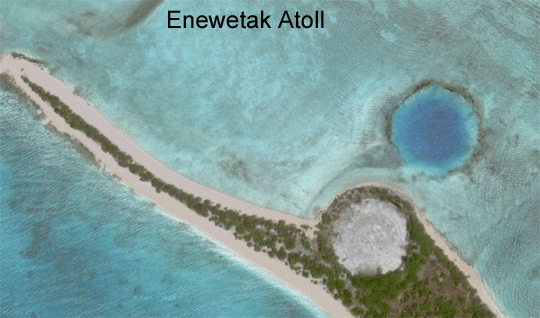 The men who built the dome in the 1970s sculpted a hand flipping the middle finger, which they buried inside the structure before it was sealed and left to crumble on a remote Pacific island. The Enewetak atoll in the South Pacific was used by the US government to test 30 megatons of atomic weapons – equivalent to 2,000 Hiroshima bombs – between 1948 and 1958. After 43 nuclear detonations, thousands of people were sent to clean the islands, shifting 3million cubic feet of contaminated soil and debris into a blast crater. He said: “The dome is a monumental size, so we wanted to put something inside there, but this was during the Cold War so the idea of an official time capsule wasn’t going to work. “So… a rubber glove? Well, we had plenty of those so that worked.” But if Mr Griego and his comrades left their mark on the island, it also left its mark on them. Our members were dying,” he said. “Dying of cancer. Given the damage wrought by the dome, the middle-finger message turned out to be more apt than anyone realised at the time. “The Runit salute turned out to be the right message in several ways,” said Paul, 62.
“One message is what’s happened to the men that were actually tasked to build this dome? What happens now to the Marshallese, the islanders? “What happens now to the Pacific Ocean, to the rest of the world? The dome is leaking and it has been leaking from the beginning.” The US government does not recognise those who worked to clean Enewetak as atomic veterans, so they cannot receive radiation exposure compensation from the Department of Veterans Affairs. |
|
Corporate greed, fighting over America’s extravagant $85 billion nuclear missile program
 become the Defense Department’s primary provider of ballistic missiles, Boeing has launched an aggressive lobbying campaign,
There was an $85 billion elephant in the room at this year’s Air Force Association conference, an annual trade show where thousands of uniformed airmen rub shoulders with suit-clad defense contractors hawking the latest advanced weaponry.
Those entering the conference hotel in National Harbor, Md., were welcomed by an enormous blue banner splashed with the Northrop Grumman logo and the words “LEGENDARY DETERRENCE” ― a not-so-subtle reference to the company’s ballistic missile ambitions.
Northrop is poised to take over a massive Air Force nuclear weapons program called Ground Based Strategic Deterrent, or GBSD, which will call on a team of contractors to replace the U.S. military’s aging stock of Minuteman III intercontinental ballistic missiles. But Boeing’s Arlington-based defense business, which has handled the Minuteman program since 1958, has launched an aggressive lobbying campaign in defense of its interests.
Northrop “is on a path to a sole-source opportunity,” Boeing GBSD Program Manager Frank McCall warned in an interview Wednesday on the floor of the trade show.
“There has never been a time in the history of the Minuteman when the Air Force wasn’t supported by both companies,” he said, adding that he thinks the Pentagon is taking “a winner-take-all approach” that is “unprecedented in the history of intercontinental ballistic missiles.”
The ground-based missiles make up one leg of the U.S. nuclear triad, which aims to be ready to deliver warheads at a moment’s notice from air, land or sea. They are meant to deter other countries from launching a nuclear strike by sending a message that any first-mover will be destroyed immediately.
The different components of the triad are extremely expensive to build and keep at the ready. For the new ground-based missiles, the Pentagon faces a difficult dilemma as it tries to get the best solution for the best price.
The Air Force had hoped to evaluate multiple competing options. But Boeing, thought to be the only viable competitor aside from Northrop, says it won’t participate unless the Air Force changes its approach.
With Boeing out, the Northrop-led team appears to be the Pentagon’s only option, something that could make it hard for the government to negotiate a fair price.
It is a common dilemma facing Defense Department weapons buyers, who have the impossible task of running a competitive marketplace when there are, at best, two or three potential suppliers for the most expensive weapons systems. The U.S. defense industry has consolidated to a worrying degree in the decades since the Cold War, officials and analysts say, with a handful of dominant suppliers exerting tremendous influence.
A White House report released last year found 300 cases in which important defense products are produced by just a single company, a “fragile” supplier, or a foreign supplier.
There is big money at stake for Boeing and Northrop: Defense Department estimates for the long-term cost of the program range between $62 billion and $100 billion. Both companies have formidable lobbying operations, spending $7.2 million and $8.3 million, respectively, on Washington lobbyists in 2019.
Boeing’s stewardship of the Minuteman program brought it roughly 600 defense contracts totaling $8 billion in the first 30 years of the programs, according to estimates provided by the company. Northrop has traditionally taken a secondary role handling complex systems integration.
In 2017, Northrop and Boeing were awarded contracts worth $349.2 million and $328.6 million, respectively, to develop their own version of a next-generation replacement for the Minuteman. In July, the Air Force asked each company to submit a proposal, hoping to compare the two missile designs and negotiate a fair price.
Boeing quickly threw a wrench into that plan, announcing July 25 that it would walk away from the competition because the Air Force’s request for proposals allegedly favored Northrop.
Boeing’s concerns stem from Northrop Grumman’s 2017 acquisition of a company called Orbital ATK for $7.8 billion. Orbital ATK ― which operates as a Northrop Grumman business unit called Innovation Systems ― is a dominant producer of rocket motors that power ballistic missiles. Aerojet Rocketdyne, the other U.S. manufacturer of rocket motors, also is working with Northrop.
Boeing has taken its case to the Pentagon, as well as to the Federal Trade Commission, but has failed to block the deal.
“We continue to stand ready to support this important program,” wrote Leanne Caret, president of Boeing’s Arlington-based defense business, in a July 23 letter seen by The Washington Post. “As we have discussed, we believe there are other procurement structures that could provide this capability more rapidly at less cost, and we will look for ways to leverage the work … to help support this critical national security mission.”
Boeing later approached Northrop about the possibility of teaming up but was rejected, a Boeing official said. So it came as little surprise Monday when Northrop released the list of companies it is teaming up with, and Boeing isn’t on it.
Air Force officials stood by their approach but declined to comment on how they will proceed.
“We are very open to a variety of proposals. … We are open to teaming relationships. We just don’t want to dictate,” Will Roper, the Air Force’s assistant secretary for acquisition, technology and logistics, told reporters Monday. “We think it should be decided by industry and what they think is best value.”
Soon afterward, Boeing countered that it is pursuing a multifaceted advocacy and lobbying campaign asking the government to force Northrop to collaborate.
“We believe it is a path to a better weapons system solution that will allow us to field the solution more quickly than either company could handle on its own,” said McCall, the Boeing official.
Analysts expressed concern over the current arrangement, in which Northrop will almost certainly be the only bidder. Whether Boeing’s proposal will resolve the problem is less clear.
“I would much rather see a direct competition between Northrop and Boeing,” said Dan Grazier, a former Marine Corps captain working at the Project on Government Oversight, a watchdog group. “The best practice for any acquisition system would be a solid, honest, competitive prototyping, where the government can weigh competing options and get a competitive price.”
Nuclear watchdog groups warn legal action over environmental impact of plutonium pit production
|
Federal officials have set a deadline of 2030 for ramped-up production of plutonium pits. The work will be split between Los Alamos National Laboratory in northern New Mexico and the Savannah River Site in South Carolina. Lawyers for the Natural Resources Defense Council, Nuclear Watch New Mexico, Savannah River Site Watch and Tri-Valley Communities Against a Radioactive Environment threatened legal action in a letter sent this week to officials. In June, the National Nuclear Security Administration said it would prepare an environmental impact statement on pit-making at Savannah River. A less extensive review was planned for Los Alamos this week .
|
|
America’s 1,032 Nuclear Weapons Tests, and the tons of problems they caused
 Little-Known Fact: America Tested 1,032 Nuclear Weapons on Its Own Soil https://nationalinterest.org/blog/buzz/little-known-fact-america-tested-1032-nuclear-weapons-its-own-soil-81706
That’s a lot of nukes.

New nuclear weapons that could make continents uninhabitable
Russia’s New Nuclear Weapon Could Make America Uninhabitable, The National Interest•September 20, 2019
Each of the submarine’s sixteen R-30 Bulava (“Mace”) missiles typically carries six 150-kiloton nuclear warheads designed to split apart to hit separate targets. This means one Borei can rain seventy-two nuclear warheads ten times more destructive than the bomb dropped on Hiroshima on cities and military bases over 5,800 miles away. ……..
|
An SSBN’s primary purpose is to remain undetected long enough to unleash its terrifying firepower—a strategy made easier thanks to their nuclear reactors allowing them remain submerged for months at a time. [ and they say that small nuclear reactors have nothing to do with nuclear weapons!] ……..
However, the Borei represents only half of the Russian Navy’s future sea-based nuclear deterrence force. The other half will come from a unique fleet of four Khaborovsk-class submarines each carrying six nuclear-powered Poseidon drone-torpedoes designed to swim across oceanic distances to blast coastal cities and naval bases with megaton-yield warheads. Moscow, it seems, would like a little more redundancy in its ability to end civilization as we know it in the event of a nuclear conflict. Sébastien Roblin holds a master’s degree in conflict resolution from Georgetown University and served as a university instructor for the Peace Corps in China. He has also worked in education, editing, and refugee resettlement in France and the United States. He currently writes on security and military history for War Is Boring. This first appeared in June 2019 and is being republished due to reader interest. https://nationalinterest.org/blog/buzz/russias-new-nuclear-weapon-could-make-america-uninhabitable-82051  |
|
-
Archives
- October 2026 (112)
- September 2026 (339)
- August 2026 (330)
- July 2026 (355)
- June 2026 (287)
- May 2026 (306)
- April 2026 (356)
- March 2026 (251)
- February 2026 (267)
- January 2026 (308)
- December 2025 (358)
- November 2025 (359)
-
Categories
- 1
- 1 NUCLEAR ISSUES
- business and costs
- climate change
- culture and arts
- ENERGY
- environment
- health
- history
- indigenous issues
- Legal
- marketing of nuclear
- media
- opposition to nuclear
- PERSONAL STORIES
- politics
- politics international
- Religion and ethics
- safety
- secrets,lies and civil liberties
- spinbuster
- technology
- Uranium
- wastes
- weapons and war
- Women
- 2 WORLD
- ACTION
- AFRICA
- Atrocities
- AUSTRALIA
- Christina's notes
- Christina's themes
- culture and arts
- Events
- Fuk 2022
- Fuk 2023
- Fukushima 2017
- Fukushima 2018
- fukushima 2019
- Fukushima 2020
- Fukushima 2021
- general
- global warming
- Humour (God we need it)
- Nuclear
- RARE EARTHS
- Reference
- resources – print
- Resources -audiovicual
- Weekly Newsletter
- World
- World Nuclear
- YouTube
-
RSS
Entries RSS
Comments RSS

