Big boys and their nuclear toys – Hello, omnicide
 A Tight Grip On Our Nuclear Toys, Hello, omnicide. Anti War.com
 by Robert Koehler November 08, 2019
“Everyone wants to play with the big boys, and the only way to become one of the big boys is to have nuclear toys.”
Attention Planet Earth! Attention Planet Earth! It is time to grow up.
The words are those of Mohamed ElBaradei, then director general of the International Atomic Energy Agency, from a 2005 interview, several months before he and the agency were awarded the Nobel Peace Prize. They remain eerily relevant in 2019, summing up as they do the puerile recklessness that is in the process of regaining its grip on geopolitics. Nuclear weapons treaties are withering on the vine and proliferation threatens a triumphant return.
Hello, omnicide. We may not be as lucky as we were in the Cold War era, when the consequences of nuclear accidents and political brinkmanship were relatively contained and the victims of nuclear development were limited to the people who lived near test areas like the Marshall Islands, Kazakhstan or the Nevada Test Site in the western United States. Nuclear stockpiles have shrunk, not grown, and nuclear-armed nations number nine.
This is still insane, of course. That number should – must – find its way to zero, as declared by the Treaty on the Prohibition of Nuclear Weapons, which was passed by a United Nations vote of 122-1 in 2017 but still awaits actual ratification by 50 countries (32 have ratified it so far). Hope-inspiring as that treaty is, the big boys – who boycotted the U.N. vote two years ago – still control the game, and led by the USA, they are pulling out of the treaties that constrain them. ……..
lobal leadership is adolescent in nature. Big boys rule and lust for power takes control of the brain, especially power in a competitive context. If you represent the interests of a nation-state, you could easily become consumed by the hostile environment in which those interests are trying to establish themselves. And the interests of the planet as a whole (e.g., survival, a future) could easily disappear as anything but idealistic, ignorable abstractions. Disarmament? Give me a break. Not when regional powers, as Erlanger also writes, are “challenging American hegemony.”
Add to this the transnational, corporate interest in militarism. There’s no money in peace, which is seen mostly as a black hole, the lull between wars. Money doesn’t start to flow until the bullets and the bombs start to fly. If you’re opposed to war, the real enemy isn’t Russia or China’ it’s the military-industrial complex (which can smell, for instance, the trillion-plus-dollars earmarked for an upgraded nuclear arsenal).
So what we have right now is a world in which the public’s natural desire for peace is diverted to the status of impossible, at least until we destroy our enemies and secure our hegemony; and the growing global peace movement remains utterly marginalized. How much time do you think will be devoted to the issue of denuclearization, let us say, in the looming presidential race?
All of which leads me back to the Kings Bay Plowshares 7, the seven courageous peace activists who were arrested last year after they cut through the fencing around the Kings Bay Naval Base, in St. Mary’s, Ga., the Atlantic home port of the country’s Trident nuclear missile-carrying submarines, and entered the base without permission. There, they poured out vials of blood (their own) on the grounds, hung up signs and issued an indictment of the U.S. military for violating the 1968 UN Nuclear Non-Proliferation Treaty.

Their trial, during which they were not allowed to present their case on the global danger of nuclear weapons, recently ended. To no one’s surprise, they were found guilty and await sentencing.
“. . . and they shall beat their swords into plowshares, and their spears into pruning hooks; nation shall not lift up sword against nation, neither shall they learn war anymore.”
And Isaiah 2:4, the 3,000-year-old cry for peace, remains irrelevant.
Robert Koehler is an award-winning, Chicago-based journalist and nationally syndicated writer. His new book, Courage Grows Strong at the Wound is now available. Contact him at koehlercw@gmail.com or visit his website at commonwonders.com. Reprinted with permission from PeaceVoice. https://original.antiwar.com/robert-koehler/2019/11/07/a-tight-grip-on-our-nuclear-toys/
USA’s intercontinental ballistic missiles- epitome of nuclear corruption
 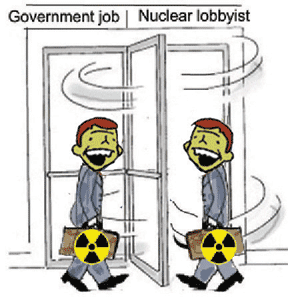  Why Are We Rebuilding the ‘Nuclear Sponge’? https://nationalinterest.org/feature/why-are-we-rebuilding-%E2%80%98nuclear-sponge%E2%80%99-94371
Welcome to the “nuclear sponge.” A bizarre idea that has outlived its questionable Cold War-era usefulness, the nuclear sponge is the United States’ collection of land-based intercontinental ballistic missiles intended to “soak up” a nuclear attack. by Tom Z. Collina Akshai Vikram 6 Nov 19, The media is abuzz about the epic battle between corporate titans Northrop Grumman and Boeing over who will win the $100 billion contract to build a new nuclear-armed ballistic missile. For those who are keeping score, it looks like Northrop will win a sole-source contract, which would be a disaster for taxpayers.
But media coverage of the Clash of the Titans is missing the real story. This is not about contractor wars or sweet-heart deals. This is about the integrity of our government: why, thirty years after the end of the Cold War, are we rebuilding nuclear weapons that we do not need? Why are we spending national treasure to buy weapons that make us less safe?
What if we told you that residents of Colorado, Montana, Nebraska, North Dakota, and Wyoming are being used as bait in a nuclear war with Russia? Surely, no sane person would accept or offer such terms. However, if you live anywhere near these states, you already have a nuclear target on your back. Welcome to the “nuclear sponge.” A bizarre idea that has outlived its questionable Cold War-era usefulness, the nuclear sponge is the United States’ collection of land-based intercontinental ballistic missiles (ICBMs) intended to “soak up” a nuclear attack. Before the development of nuclear-armed submarines that can hide their locations at sea, ICBMs were the crux of American nuclear strategy. Today, however, their only purpose is to draw fire away from other targets (like New York and San Francisco) in the (suicidal and thus highly unlikely) event of a first strike by Russia. The Air Force does not plan to launch the missiles in a war, but to have them draw a nuclear attack to the Upper Midwest.
We’re not making this up—that’s what former Defense Secretary Jim Mattis told Congress. However, sacrificing the Upper Midwest not only undervalues the people who live there but would not actually spare the residents of other states. A major nuclear war with Russia would doom the entire nation. It would little matter whether one resides in Manhattan or Montana.
Why then are we rebuilding the nuclear sponge? The answer, as House Armed Services Committee Chair Adam Smith (R-CA) recently highlighted, has much more to do with parochial interests and money than national security. When asked at a recent press conference why states would want to host the missiles, and thereby put themselves at risk, Smith said, only partly in jest, “They’re fond of their missiles. Apparently, they want to be targeted in a nuclear first strike.” And then, more seriously, he said “They want the jobs . . . no matter the circumstances. And that’s not rational. It’s parochial.”
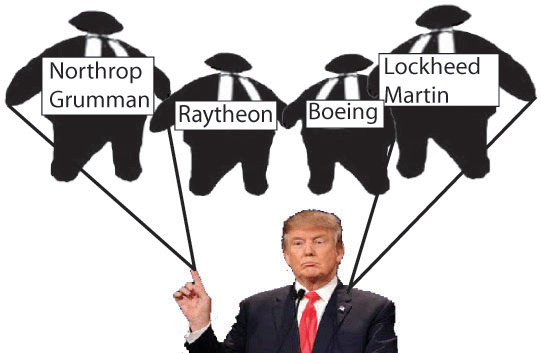 With current ICBMs getting older, the Trump administration has greenlit a new cohort of missiles as part of an almost $2 trillion nuclear rebuild plan over the next thirty years. The price tag for the new ICBM alone is potentially $140 billion. That contract is currently slated to go to Northrop Grumman, even as it fights off a Federal Trade Commission investigation for unfair competition, which may cost taxpayers “billions.” With current ICBMs getting older, the Trump administration has greenlit a new cohort of missiles as part of an almost $2 trillion nuclear rebuild plan over the next thirty years. The price tag for the new ICBM alone is potentially $140 billion. That contract is currently slated to go to Northrop Grumman, even as it fights off a Federal Trade Commission investigation for unfair competition, which may cost taxpayers “billions.”Northrop Grumman and others have hijacked the nuclear-security agenda of the United States through the usual Washington channels: lobbying and
 campaign contributions. In the 2018 election cycle, Northrop spent $5.6 million in campaign contributions. In fact, Northrop spends more than any other defense contractor on lobbying and is just behind Amazon and Facebook. Defense contractors have grown even more powerful with a willing ally in the White House. Simply put, the Trump administration has filled its top national-security ranks with people holding extensive ties to major defense contractors. campaign contributions. In the 2018 election cycle, Northrop spent $5.6 million in campaign contributions. In fact, Northrop spends more than any other defense contractor on lobbying and is just behind Amazon and Facebook. Defense contractors have grown even more powerful with a willing ally in the White House. Simply put, the Trump administration has filled its top national-security ranks with people holding extensive ties to major defense contractors. Mattis worked for General Dynamics and received speaking fees from Northrop Grumman. The current defense secretary, Mark Esper, worked for Raytheon. Ex-White House Chief of Staff John Kelly worked for DynCorp; former Deputy Defense Secretary Mike Shanahan’s employment history at Boeing goes back over thirty years. Meanwhile, Undersecretary of Defense for Policy John Rood worked for Lockheed Martin as did former Secretary of the Air Force Heather Wilson. In fact, that’s where she skirted lobbying restrictions. This list goes on. Mattis worked for General Dynamics and received speaking fees from Northrop Grumman. The current defense secretary, Mark Esper, worked for Raytheon. Ex-White House Chief of Staff John Kelly worked for DynCorp; former Deputy Defense Secretary Mike Shanahan’s employment history at Boeing goes back over thirty years. Meanwhile, Undersecretary of Defense for Policy John Rood worked for Lockheed Martin as did former Secretary of the Air Force Heather Wilson. In fact, that’s where she skirted lobbying restrictions. This list goes on. Programs such as a new ICBM are strategically unnecessary, economically unsustainable, and morally abhorrent. The missiles would be destroyed in a first strike (Russia knows where they are; you can find them on Google Maps) and serve no purpose except to “absorb” blows in a war whose fallout would kill most Americans anyway. Some jobs are created—but far more jobs could be created if the money was spent in other ways. In 2019, there are surely better ways to employ people than to have them guard Cold War relics. As Smith observed after visiting bases that host nuclear weapons, “what struck me was that the job is unbelievably boring.” Maybe that’s why substance abuse continues to plague these sites, with service members literally falling asleep on duty. Clearly, our nuclear policy needs a reboot. As Sen. Elizabeth Warren(D-MA) has said “Take any big problem we have in America today and you don’t have to dig very deep to see the same system at work . . . despite our being the strongest and wealthiest country in the history of the world, our democracy is paralyzed. And why? Because giant corporations have bought off our government.” Warren was talking about climate change, guns, and healthcare, but her remarks hold just as true for nuclear weapons. The next president must tackle corruption in nuclear policy aggressively—by throwing away the nuclear sponge. Tom Collina is Policy Director and Akshai Vikram is a Hale Fellow at Ploughshares Fund, a global security foundation in Washington DC. |
|
Deadline looms for nuclear veterans and descendants study
The study lead by University of Otago associate professor David McBride will look into the connection between nuclear veterans and their children, who may have been affected by their parents’ exposure to radiation.
So far only 166 people had signed up, according to Mururoa Nuclear Veterans president Gavin Smith.
Mr Smith implored more to join, saying about 500 people went to the Christmas Island and were exposed to nuclear tests in the 1950s and about 500 went to Mururoa during the 1970s.
“Everyone who has a veteran father or grandfather that served there and has maybe deceased or may be living but mentioned nothing of it, I urge them to contact the University of Otago,” he said.
He said the study was crucial because veteran’s children may have been affected by their parents’ exposure to radiation, which could make their offspring more susceptible to conditions like leukaemia and auto-immune diseases.
“Our study is open to all nuclear veterans. If we don’t do it in our generation, it’s going to be an even bigger battle for the next generation.”
The group, which was established in 2013 to press the government to help families with nuclear related illnesses, had 135 members who served at the protest.
Of those, 56 had children or grandchildren with unexplained medical conditions.
Testing would begin next week at the University of Otago, with a timeframe and details on the study yet to be confirmed.
The human species at threat of wipeout – nuclear war in space
Bruce Gagnon ‘War in Space’ interview
Nuclear space war ‘would wipe out humans in days with Earth becoming Hiroshima’
https://www.dailystar.co.uk/news/weird-news/nuclear-space-war-would-wipe-20765135 A fierce critic of the Space Force says the Earth would “burn” and turn into a Hiroshima-style landscape should a nuclear war erupt, By Katy Gill, Video News Reporter, 3 NOV 2019,
A nuclear war in space would be catastrophic for the human civilisation as Earth would transform into a Hiroshima-style landscape with humans being wiped out in a matter of days.
That’s according to Bruce Gagnon, the co-founder and coordinator of the Global Network Against Weapons & Nuclear Power in Space.
US President Donald Trump has repeatedly said he is hoping to create the sixth branch of the US military – the Space Force – in 2020 to, among other things, protect satellites in space from other nations.
There are those that believe new fleets of military craft are already being built, pointing to various UFO sightings across the US in recent months.
But Bruce thinks it could open the doors for a new domain of warfare – with the consequences being devastating.
He explained to Daily Star Online that if a nuclear war erupted above Earth, “everything would burn”.
“The cities are burning, the forests are burning, the planet is burning,” he added.
“There’s no food, you can’t grow anything, everything poison, everything radioactive, we all die.” Bruce spoke of how food production will immediately halt because of the atmosphere burning up and affecting crops.
This will lead crowds of people to raid their local supermarkets.
“How long is that going to last? How long do we have after that?” he asked.
“Probably a few days. Not much longer than that. It’s going to happen fast.Who wants to be alive when the whole world looks like Hiroshima?”
Bruce said after the fire’s smoke and debris floods into the atmosphere it will block the sun.
This would eventually see the Earth freeze because the sun is no longer visible to the planet.
“So the Earth freezes and you have whatever is left after this nuclear war is finished,” he added.
In the past, Bruce told the site that USAF is “creating a new generation of space soldiers by indoctrinating kids“.
A Global Review : Threats o f Nuclear Conflict:
 Threats of Nuclear Conflict: A Global Review – Part 1, Global Policy
By Scott L. Montgomery and Thomas Graham, Jr. – 31 October 2019
Beginning with South Asia, Scott L. Montgomery and Thomas Graham, Jr. introduce a two-part essay taking stock of contemporary prospects of nuclear conflict.
Our world in the second decade of the 21st century approaches the abandonment of cooperation in the realm of nuclear arms control. We have entered a new era of threat that is real, growing, and not in the least accidental. Nor is it due to the dark gods of human nature or the unfavorable fate of having freed the nuclear genii from its bottle.
The new era must be counted part of a deteriorating international order. Within the past five years, this situation has tended to elevate conflict above collaboration, risk above security, and, above all, new weapons above arms agreements. Rising hostility between the U.S. and Russia, the U.S. and China, Russia and NATO, Pakistan and India, North Korea and its neighbors, has effectively brought the risk of nuclear conflict to its highest level in many decades. Efforts by warhead states today to strengthen their arsenals on their own nationalist terms are proving not to dissuade but encourage thoughts of proliferation elsewhere.
Greatly adding to this troubling climate have been actions by the Trump Administration, which has withdrawn and threatened to withdraw from alliances around the world and from multiple non-proliferation treaties. This global retreat has torn holes in what was once considered an essential nuclear umbrella for Europe and parts of East Asia. Most of all, though, open hostility among warhead states makes the world fearful, less secure, and more likely to find reasons for nuclear “self-protection.” After 25 years of post-Cold War progress in reducing nuclear weapons, warhead states are altering course. Ignoring a look in the mirror, they perceive the global landscape as more menacing and are therefore making it so.
Facts and Numbers
At present, the world has approximately 13,890 nuclear warheads. Of these, 9,300 are in military stockpiles, with perhaps 3,600 deployed by operational forces. Half of these are kept on high operational alert.
Though still large, these figures represent an immense reduction from Cold War numbers, whose total went as high as 70,000 in the late 1980s. Such reduction happened because of arms control agreements, mainly between Russia and the U.S., but also involving the post-Soviet nations of Belarus, Kazakhstan, and Ukraine, all of which gave up the weapons that remained on their territory after dissolution of the USSR. One example of a successful agreement was the Megatons to Megawatts program, which, between 1995 and 2013, recycled fuel for as many as 20,000 Soviet weapons so it could be burned in U.S. nuclear power plants. Similarly, the New START treaty between Russia and the U.S., signed by Presidents Obama and Medvedev in 2010, continued reductions into 2019.
The hopeful message of such programs was, and is, crystal clear: though built for reasons of security, nuclear weapons are a massive threat to human life and society. Reducing their number defines the only true path to increased security in a world where such weapons exist.
Yet that lesson now appears to be unheard. Efforts to continue scaling back the size and lethality of arsenals have ceased. They have even begun to reverse. This is a direct result of nations having launched programs to “upgrade” and “modernize” their weapons. Such are terms that tend to sanitize work that will replace older bombs and missiles with more reliable and precise versions, while adding new, low-yield nuclear weapons that risk lowering the threshold of actual use, especially in battlefield situations. Russia and the U.S., with over 90% of the global stockpile, have been the target of related media attention in the past two years. But a focus here can hide similar efforts underway in China, India, Pakistan, North Korea, and France.
Yet the rationality here can, and should, be reversed. At higher reliability and accuracy, significantly fewer weapons are needed, not an equal or greater number. Such would be a potentially effective step toward still further reductions and a less threatening global environment. As non-proliferation experts have long argued—and as President Reagan and Soviet Premier Gorbachev both agreed at their 1986 Reykjavik arms control meeting—nuclear weapons are misunderstood as purely a deterrent, being instead the makers of an endangered world where such protection can seem legitimate.
Working directly against such thinking, however, the U.S. in August 2019 officially walked away from one of the most important arms control treaties in existence. This was the Intermediate Nuclear-Forces Treaty (INF) between the U.S. and Soviet Union signed in 1987, eliminating all ground-launched ballistic and cruise missiles with a range between 500 and 5,500 km. Destruction of these weapons was a major achievement, eliminating an entire class of nuclear weapons for the first time and marking a real improvement in security for both European and Soviet-Warsaw Pact countries……….
It is not only the U.S., therefore, that is driving the new era of nuclear insecurity. Though the Trump Administration is especially outstanding in raising the level of hostility and uncertainty, it is not alone in doing so. ……..
South Asia
India and Pakistan sit at the top of concerns about nuclear conflict. The countries have fought three major wars since partition in 1947 and have come close to others at least a dozen times. It is no exaggeration to say that mutual fear and hatred bind these nations as much as separating them. Tensions have continued to rise, especially since the deadly 2008 terrorist attacks in Mumbai, which were followed by a string of other attacks by Islamic militants, killing many hundreds of Indians and wounding thousands. Antagonism has also grown with the rise to power of the Hindu nationalist BJP party and election of its candidate, Narendra Modi, as prime minister. While Modi sought talks with Pakistan in his first term, these were derailed by the terrorist attack at Pathankot airbase in 2016 and simultaneous assault on India’s consulate in the northern Afghan city of Mazar-e-Sharif.
Confrontation intensified in 2019, when a suicide bombing in Kashmir killed at least 40 Indian security personnel and ignited a military exchange involving air strikes and a dogfight, with an Indian plane shot down and its pilot captured (later released unharmed by Pakistan). Several months later, tens of thousands of Indian troops entered Kashmir and established what amount to martial law, placing a number of opposition political leaders under house arrest. The government of Prime Minister Modi then announced it was ending the special, semi-autonomous status of Kashmir and adjacent Jammu, revoking nearly all of Article 370 of the Indian Constitution and therefore claiming the two disputed territories as part of India. This was done without any negotiation involving Pakistan, which reacted with outrage and threats of violence.
Pakistan
Recent study shows Pakistan has been increasing its nuclear stockpile very rapidly. This is partly due to a “domino” situation that involves China expanding its weapons capability, with India responding to this increase, thus adding a sense of urgency in Pakistan. Neither South Asian country has been forthcoming about how much fissile material it actually has, posing questions about safeguards. Pakistan is known to have four heavy-water plutonium-producing reactors, three of which have been built since 2009. It also now has two reprocessing plants for removing plutonium from spent civilian reactor fuel.
………. India
India, meanwhile, is countering nuclear build-up on two fronts and building new plutonium production reactors for the purpose. Like Pakistan’s facilities, India’s are not under international safeguards, as the country is not a member of the Nuclear Non-Proliferation Treaty. According to officials at the Indira Gandhi Centre for Atomic Research, as many as six new fast-breeder reactors will come online by the early 2030s, greatly increasing the country’s ability to produce weapons-grade fuel……
Though confidential, India’s long-range plans might well involve doubling its current stockpile of 130-140 warheads to create what it considers a reliable deterrent to both Chinese and Pakistani nuclear forces…………
Conclusion
South Asia can thus be described as a delicate imbalance with regard to nuclear threat. While a potential nuclear exchange between the U.S. and Russia continues to be a nexus of attention, India and Pakistan must be viewed as being in a far greater state of tension and risk………
Today is a new era of political conflict, arms races, and growing tension around the globe. It is an era in which defense officials speak in terms of “usability” and “escalate to deescalate” with respect to nuclear weapons on the battlefield. As we know, however, modern battlefields are not in distant, isolated places. Military bases and facilities, including those with nuclear weapons, are rarely far removed or somehow shielded from populated areas. And, as studies have repeatedly shown, any exchange that involves the destruction of buildings, towns, or cities, would have massive environmental impacts for the entire globe.
A greatly weakened environment for nuclear arms control should be a concern to everyone. At a time when nation-states are becoming less cooperative with one another, more typified by both internal and external political conflicts, the possibility for miscalculation rises no small amount. While Pakistan and India are the focus of related worry at present, they are only part of a larger landscape of nuclear uncertainty whose outlines have again grown dark. https://www.globalpolicyjournal.com/blog/31/10/2019/threats-nuclear-conflict-global-review-part-1
United Nations adopts Japan’s nuclear disarmament resolution
|
They call for increased transparency of policies of nuclear-armed powers to build mutual trust between countries. The resolution urges the promotion of educational programs such as interaction with atomic bomb survivors. It also proposes a framework to facilitate dialogue between nuclear-armed nations and others. Members of the committee approved the resolution by a majority, with 148 of 178 countries voting in favor. Four countries objected and 26 abstained. The United States abstained, saying the plan does not reflect the world’s changing security environment. Brazil also abstained on the grounds that the resolution should call for stronger commitments from nuclear-armed nations to disarm. Brazil supports the UN Treaty on the Prohibition of Nuclear Weapons, which Japan has not joined. Members of the committee approved the resolution by a majority, with 148 of 178 countries voting in favor. Four countries objected and 26 abstained. The United States abstained, saying the plan does not reflect the world’s changing security environment. Brazil also abstained on the grounds that the resolution should call for stronger commitments from nuclear-armed nations to disarm. Brazil supports the UN Treaty on the Prohibition of Nuclear Weapons, which Japan has not joined. |
|

A USA Bill to make sensible but significant cuts to “nuclear weapons and delivery systems.”
 New Bill Renews Debate on Nuclear Modernization, https://www.cato.org/blog/new-bill-renews-debate-nuclear-modernization November 1, 2019 By Eric Gomez
On Tuesday, Senator Ed Markey (D-MA) and Representative Earl Blumenauer (D-OR) reintroduced bicameral legislation that would save U.S. taxpayers $75 billion on nuclear modernization costs over the next decade. The “Smarter Approach to Nuclear Expenditures Act,” or SANE Act, proposes sensible but significant cuts to “nuclear weapons and delivery systems.”
According to a press release from Sen. Markey’s office, the SANE Act will include the following:
- Reduce the purchase of Columbia-class submarines from 12 to 8, cut the existing ICBM fleet from over 400 to 150, and reduce deployed strategic warheads from approximately 1,500 to 1,000 – saving $13.1 billion
- Cancel the development of a new air-launched cruise missile and an associated warhead life extension program – saving $13.3 billion
- Reduce to 80 the purchase of new B-21 long-range bombers – saving $11.6 billion
- Cancel the development of new ICBMs and a new nuclear warhead – saving $13.6 billion
- Cancel the development of a new submarine-launched cruise missile – saving $9 billion
- Limit the plutonium pit production target to 30 per year – saving $9 billion
Sen. Markey stated that “The United States should fund education, not annihilation; that is our future…We need sanity when crafting America’s budget priorities, and more and improved nuclear weapons defies common sense.”
Rep. Blumenauer added that “these disastrous weapons will never be the answer to solving our complex and ever-changing national security threats…We should not be investing trillions of dollars of our budget on an outdated and irresponsible nuclear arsenal.”
At the time of the press release, the SANE Act was co-sponsored by Sen. Bernie Sanders (I-VT) and by eight members in the House. It has also been endorsed by several prominent organizations, including the Ploughshares Fund, Women’s Action for New Directions (WAND), Peace Action, Friends Committee on National Legislation (FCNL), Global Security Institute, and World Future Council.
Caroline Dorminey, policy director of WAND and my former colleague here at Cato, stated, “With defense budgets skyrocketing and a bow wave of costs bearing down on the Pentagon in upcoming years, now is the time for hard choices. Senator Markey, Representative Blumenauer, and cosponsors offer a clear alternative that will keep Americans safe without wasting their tax dollars on weapon systems that serve our past, not our future.”
Dorminey, who also co-edited Cato’s recently released America’s Nuclear Crossroads: A Forward-Looking Anthology with me and whose recommendations from her chapter on how best to manage nuclear modernization echo many of the proposals within the bill, also noted that “the SANE Act demonstrates [that] there are ample opportunities to craft a revised nuclear modernization plan that better reflects the shifting strategic priorities and evolution of threats facing the United States.”
Sen. Markey and Rep. Blumenauer have introduced various versions of the SANE Act in past years without success. Given current fiscal and political realities, perhaps this time will be different. Yet, whether the SANE Act passes or not, the legislation highlights the need for policymakers to have a robust debate on the merits of the modernization plan, if not America’s nuclear posture more broadly.
You can read the full bill here. To learn more about this and other pressing issues in nuclear deterrence and arms control, download a copy of America’s Nuclear Crossroads.
The hazards of nuclear submarines
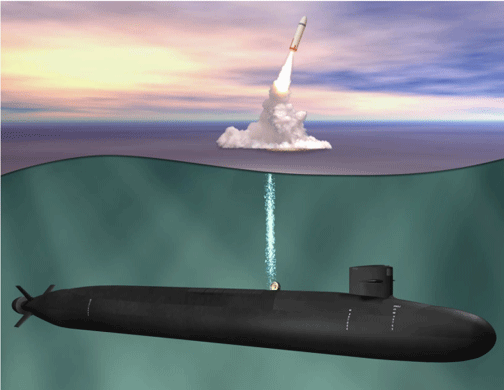
In 2019, a new set of nuclear dangers emerged for Southasia. The growing danger was underscored during the military crisis between India and Pakistan in February 2019, when India put one or more of its nuclear submarines on “operational deployment mode.” During the crisis, the Pakistani Navy claimed to intercept an Indian submarine. No one has confirmed if this interception involved an Indian submarine carrying nuclear weapons. With India and Pakistan on an accelerated programme of acquiring and developing nuclear submarines, Southasia needs to pay urgent attention to the risks of nuclear accidents at sea.
The expansion of nuclear operations to the sea also raises issues about who has the ability to authorise the use of these weapons, especially in a crisis. This is of particular concern in the case of India because it has already deployed such weapons. According to a November 2018 announcement by Prime Minister Narendra Modi, the Arihant nuclear-powered submarine successfully completed its maiden “patrol”.
A further source of concern is the August 2019 announcement by India’s defence minister to the effect that the country’s ‘No First Use’ (NFU) policy – which pledges not to attack with nuclear weapon unless attacked first – “would depend on the circumstances.” His comments, made during a period of increased tension between India and Pakistan following the amendment to Article 370 of India’s Constitution conferring special status to Jammu & Kashmir, underscore these risks.
India’s nuclear submarines……… Strategic competition with China in the Indian Ocean may be another factor. Serving and retired members of India’s Navy publicly express concerns about the deployment of Chinese submarines, warships and tankers in the Indian Ocean.
India’s growing arsenal also makes it a more valuable ally for the United States in its efforts to deal with the growth in China’s political and military power. For some time now, the US and India have been conducting joint naval exercises.
Pakistan’s naval force
Pakistan, for its part, announced the setting up of a Naval Strategic Force Command in 2012. Pakistan’s Navy has started preparing to put nuclear-armed cruise missiles on conventional submarines. The cruise missile is expected to be the 450-kilometer range Babur, which had a successful underwater test launch in 2018. There are reports that Pakistan is seeking to develop or acquire a nuclear-powered submarine…..
Submarine accidents
Almost all the countries operating nuclear-powered or nuclear-armed submarines have experienced accidents, often with significant loss of life and the spread of radioactivity in the environment. There have been over 40 accidents involving nuclear-powered submarines, claiming a total of over 650 lives. Of these accidents, more than half involved Soviet/Russian submarines resulting in over 400 deaths. The United States comes next, with at least a dozen submarine accidents leading to well over 200 deaths.
Two accidents have involved India’s nuclear submarines. …….
It would be unreasonable to expect that no more accidents involving nuclear submarines would ever take place. Nuclear submarines involve many technologies that are susceptible to a range of accidents affecting the submarine, nuclear reactor, missiles and nuclear weapons. All of these are operating under challenging conditions: deep under water, with limited supplies of air and water, possibly under attack. None of these factors is likely to change…….. Should a naval nuclear-reactor accident occur, especially at or near a naval base, coastal city or town the consequences could extend far beyond the vessel and its crew……
Pathways to war
The introduction of nuclear armed submarines, whether diesel or nuclear-fuelled, increases the likelihood of conventional conflicts escalating to a nuclear one. Any use of nuclear weapons would have devastating consequences, especially if the use of nuclear weapons by one country sets off a nuclear response from the other side.
In a military crisis, nuclear armed submarines increase the potential for nuclear war because they open up new risk pathways. The Australian strategist Desmond Ball pointed out in 1985 that “the sea is the only area where nuclear weapon platforms [of adversary states] … actually come into physical contact” and this contact can lead to accidents from several kinds of what seem to be typical naval operations.
There have already been incidents of Indian and Pakistani naval platforms coming into physical contact, for example in 2011, when the Pakistani vessel PNS Babur brushed past India’s INS Godavari. Contact between Navy forces from India and Pakistan might also result from deliberate attempts to attack submarines. Both countries are known to be acquiring anti-submarine warfare capabilities.The consequences of such events could be worse if submarines come into contact with each other during periods of heightened tensions or crises.
During a crisis, there may be inadvertent attacks on submarines carrying nuclear weapons, because these are intermingled with submarines carrying only conventional weapons. One notable instance occurred during the Cuban Missile Crisis, when US ships used practice depth charges against Soviet nuclear-armed submarines. This almost led to the use of nuclear weapons by the Soviet submarine.
Challenges to controlling nuclear weapons
A significant new challenge resulting from the deployment of nuclear weapons at sea is managing command and control. To the extent that such things are publicly known, India and Pakistan were believed to keep their nuclear weapons on land separate from the delivery vehicles, be they missiles or aircraft. This separation makes it harder for the weapons to be used without proper authorisation. With submarines armed with nuclear weapons at sea, this separation may not be possible and so the risk of unauthorised use is greater.
At the same time, one purpose of the nuclear-armed submarine is to be a final fail-safe means of nuclear attack even if a country’s political leadership is killed and its cities destroyed. To serve this role, the nuclear weapons on the submarine cannot rely on timely launch orders from political authorities. A further problem for submarines is that they are supposed to remain hidden from the enemy. Constant communication from the submarine to the military or civilian leadership may make it easier to detect. All of this means that during the time of a crisis, the personnel in a nuclear submarine might be the ones making decisions on whether or not to use nuclear weapons.
Southasians need to consider how they feel about trusting their lives in some future crisis to the restraint of Indian or Pakistani submariners far from home and fearful that their vessel is under attack, trying to decide about launching their nuclear missiles in a ‘use them or lose them’ scenario. The consequences would be devastating.
~Zia Mian is co-director of Princeton University’s Program on Science and Global Security, where he also directs the Project on Peace and Security in South Asia.
~M V Ramana is the Simons Chair in Disarmament, Global and Human Security at the Liu Institute for Global Issues in the School of Public Policy and Global Affairs at the University of British Columbia in Vancouver, Canada.
~Abdul H Nayyar is a physicist and a founder and former President of the Pakistan Peace Coalition, a national network of peace and justice groups. https://himalmag.com/nuclear-dangers-of-the-naval-kind-2019/?fbclid=IwAR0G8NZSV5ANg7Ag7KcuJU_80iv3pNJiqb6E_T12sylV9BaJWIvcZ3Vb_j0
 |
ReplyForward
|
China Rejects Policy of Nuclear Launch on Warning of an Incoming Attack
Cong also asked nuclear weapons states to take additional steps to diminish the role of nuclear weapons in their national security doctrines, including joining China in publicly committing to never use nuclear weapons first.
The Chinese Foreign Ministry’s criticism of launch on warning comes less than two weeks after Russian president Vladimir Putin announced China was cooperating with Russia “to model a national early warning system.” At present only the United States and Russia have systems that allow them to detect missile launches.
Those systems give both nuclear-armed nations the option to launch a retaliatory response as soon as the system warns them of an incoming missile attack. Russia and the United States keep their missiles on high alert so they are ready for rapid launch on warning.
Both the Russian and the US early warning systems have a history of generating false warnings. The practice of combining those systems with preparations for rapid launch creates the danger that either country could start a nuclear war by mistake.
China’s current policy is to wait to retaliate until after being struck first. It protects its small nuclear force of several hundred nuclear capable missiles from an enemy first strike by hiding them in a large network of underground tunnels. The missiles are kept off alert and the warheads are stored separately. They would be brought together and mated with the missiles only after the Chinese leadership gave the order to prepare for a launch.
Some Chinese officials are concerned recent improvements to US satellite reconnaissance, forward-based radars, precision guidance systems and ballistic missile defenses might lead US decision makers to believe China’s nuclear forces could be neutralized, allowing the United States to strike China first without fear of nuclear retaliation. Recent improvements to Chinese nuclear forces, in particular the development of a longer range intercontinental ballistic missile that can carry multiple warheads, are intended to convince US decision-makers not to take that risk.
Several years ago researchers at the Chinese Academy of Military Science (AMS) suggested China could eliminate concerns about the vulnerability of its nuclear forces by moving to a launch on warning posture. Fu Cong responded to a question about the AMS suggestion by stating that in his view a launch on warning posture would be incompatible with China’s long-standing promise not to use nuclear weapons first under any circumstances.
Cong also said he was unaware of Putin’s statement on cooperation on an early warning system, but that the existence of such a project did not imply that China would change its nuclear policy and shift to a launch on warning posture. Such a change would also require China to keep its missiles on constant alert with warheads attached so that they could be launched quickly. A former director of China’s nuclear weapons lab told me privately that the cooperative project with Russia on warning technology would increase China’s overall situational awareness but would not lead to a change China’s nuclear doctrine, policy or practice.
Jury finds Catholic anti nuclear activists guilty on all charges
The seven defendants, known together as the Kings Bay Plowshares 7, are Elizabeth McAlister, 79; Jesuit Fr. Stephen Kelly, 70; Martha Hennessy, 64; Patrick O’Neill, 63; Clare Grady, 60; Mark Colville, 58; and Carmen Trotta, 57. Five of the seven — all but Hennessy and McAlister — represented themselves.
Bill Quigley, who represented McAlister and is a law professor at Loyola University New Orleans, said in a statement outside the courthouse that it was an “honor to be with these seven brave, courageous, faithful people.”
“They have told the truth despite the cost. They have taken their actions despite the risks. And they still have more consequences to go in their efforts to try and save all of our lives, and the lives of all of our children and grandchildren, and the lives of everybody around the world,” Quigley said.
The group was arrested in the early morning hours of April 5, 2018, on Kings Bay Naval Base where they broke in to perform a non-violent protest known as a “plowshares action,” taking its name from a verse in the book of Isaiah that says “nations will beat swords into plowshares.” The protest included symbolically hammering on statues of nuclear missiles, pouring human blood around the base and hanging banners with messages denouncing nuclear weapons.
In August 2019, a federal judge denied the activists’ request to dismiss charges under the Religious Freedom Restoration Act
During the trial, O’Neill told the jury that a dramatic protest was necessary to alert the world to the dangers of nuclear weapons.
Evidence presented by the prosecution suggested the protestors did a total of around $30,000 worth of damage to government property.
Following the verdict, the defendants remained positive and continued to pronounce their message of peace as they gathered with friends and family at a press conference outside the courthouse. They thanked their supporters, told stories, sang hymns and even danced around the sidewalk to profess their continued belief in their mission.
“It’s been an incredible experience and it’s not over yet,” said Hennessy. “The efficiency of the state can never be underestimated yet we proceed in humility. The weapons are still there, the treaties are being knocked down one after the next, but we are called to keep trying and we will do this together. We have no other choice.”
Judge Lisa Godbey Wood, who tried the case, ruled Oct. 18 that the defendants would not be allowed to bring in expert witnesses to speak to the dangers of nuclear weapons or the motivations of the defendants.
owever, following the verdict, O’Neill expressed gratitude that he and his co-defendants were able to testify about their beliefs concerning the immorality of nuclear weapons.
“I think collectively we said what needed to be said,” O’Neill said.
With the exception of Kelly — who remains in custody for outstanding charges in another state — all defendants were allowed to leave the courthouse on bond while they await their sentencing hearing.
Multiple defendants, all of whom are white, connected their case to issues with the criminal justice system and mass incarceration.
“The Pentagon has many installations and we just walked out of one of them,” said Colville. “It’s a place where they weaponize the law and they wield it mostly against the poor. … Once in a while people of privilege like us get a taste of it, and when we do, we should hear the word ‘guilty’ as a blessing on us because it gives us an opportunity to stand with people who hear ‘guilty’ all the time, every day.”
After the verdict was announced, Wood told the defendants they have 14 days to file a motion for a new trial, acquittal or any other motion they see fit.
[Jesse Remedios is an NCR Bertelesen intern. His email address is jremedios@ncronline.org.]
Over 300 financial institutions put $748 billion in to nuclear weapons companies
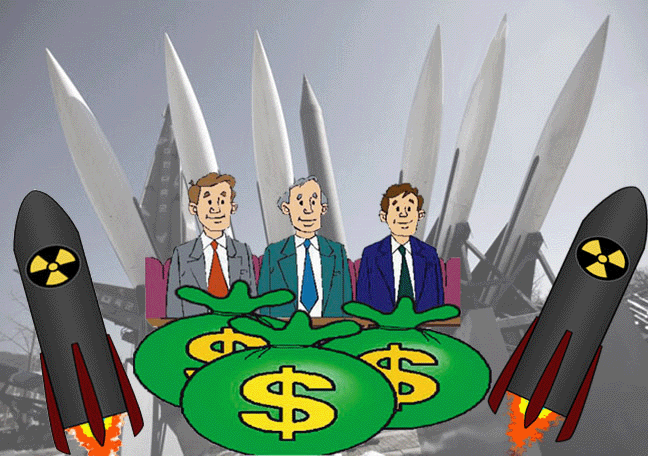
Of the 325 investors, eight are Japanese lenders with a total investment of $25.5 billion, says the Netherlands-based PAX. The eight include Mitsubishi UFJ Financial Group Inc., Mizuho Financial Group Inc. and Sumitomo Mitsui Financial Group Inc.
The 18 recipients, which PAX calls “the top 18 nuclear weapon producing companies,” include Boeing Co. and Lockheed Martin Corp. a U.S. defense giant involved in the manufacturing of the long-range nuclear Minuteman intercontinental ballistic missile.
The total investment was up 42 percent from the tally in the previous report, which covered 20 companies in a period between January 2014 and October 2017, according to Susi Snyder, a PAX member who is the main author of the new report.
She attributed the increase to a 192 percent jump by Boeing and a 300 percent surge by French defense company Thales SA.
Snyder, however, said the number of investors “continues to drop” amid rising criticism against investment in inhumane weapons such as nuclear bombs.
She cited a provision in the nuclear weapons ban treaty banning “to assist” developing nuclear weapons or other nuclear explosive devises. The treaty was adopted in 2017 at the U.N. General Assembly.
Snyder praised Resona Holdings Inc. for not providing loans to borrowers that are involved in the development of nuclear weapons.
Such a policy is “a really positive step” toward reducing — and eventually eliminating — nuclear weapons, she said.
Of the eight Japanese lenders listed in the report, Fuyo General Lease Co. said it has not invested in nuclear weapon producing companies, although a company that had business dealings with a Fuyo subsidiary in the United States was acquired by a nuclear weapons-related company.
Sumitomo Mitsui Trust Holdings Inc. said it invests in the given companies through some index funds handled by a group company.
Six other lenders — Mitsubishi UFJ, Mizuho, Sumitomo Mitsui, Orix Corp., Nomura Holdings Inc. and the Development Bank of Japan — said they do not comment on individual dealings.
PAX focused on all financial institutions involved in underwritings of share and bond issuances for one or more of the 18 companies since January 2017 and own at least 0.5 percent of the outstanding shares or bonds of at least one of the companies based on the latest data available through June last year.
Seven Peace Activists Found Guilty of “Conspiracy” for Anti-Nuclear Protest
 Seven Peace Activists Found Guilty of “Conspiracy” for Anti-Nuclear Protest, https://truthout.org/video/seven-peace-activists-found-guilty-of-conspiracy-for-anti-nuclear-protest/, BY Amy Goodman, Democracy Now!, October 25, 2019
In Georgia, a federal grand jury on Thursday found seven Catholic peace activists guilty on three felony counts and a misdemeanor charge for breaking into the Kings Bay Naval Submarine Base on April 4, 2018. The activists, known as the Kings Bay Plowshares 7, entered the base armed with hammers, crime scene tape, baby bottles containing their own blood, and an indictment charging the U.S. government with crimes against peace. The base is home to at least six nuclear ballistic missile submarines, each of which carries 20 Trident thermonuclear weapons.
AMY GOODMAN: The activists will be sentenced within the next 90 days. They face more than 20 years in prison. This is Plowshares activist Martha Hennessy.
National nuclear commission strategy for Marshall Islands
Marshalls endorses nuclear commission strategy, https://www.rnz.co.nz/international/pacific-news/401921/marshalls-endorses-nuclear-commission-strategy The Marshall Islands government has endorsed the adoption of a national nuclear commission strategy for the next three years.
The strategy honours the legacy of Marshallese nuclear heroes and heroines who fought and continue to demand accountability for their communities.
The strategy was mandated in the Marshall Islands parliament, or Nitijela, as part of the National Nuclear Commission Act of 2017.
It focuses on five broad themes for nuclear justice: compensation, health care, the environment, national capacity, and education and awareness.
From 1946 to 1958, the US used the Marshall Islands to test its nuclear weapons.
The commission also aims to establish an independent panel of scientists and specialists in fields related to radiation exposure, to provide the republic’s citizens access to trusted, independent science.
The commission’s chair, Rhea Moss-Christian, said the NNC strategy was a tool for all Marshallese, whether living in the islands or overseas, to use in their individual and collective efforts to respond to the devastation resulting from the US nuclear weapons testing program in the Marshall Islands.
“It is also a resource for our partners and friends outside the Marshall Islands to understand the nuclear testing impacts that persist today and how they can support the Marshallese people,” Ms Moss-Christian said.
$85B Nuclear Missile Competition Gets Messier as Feds Investigate Northrop,
GLOBAL BUSINESS EDITOR, 27 Oct 19, Boeing is breaking up its ICBM team — just as the Federal Trade Commission begins looking into the company’s allegations that Northrop wasn’t playing fair.
The Pentagon’s effort to build a new ICBM just took another step toward a no-competition sole-source award — and the prospective lone bidder just came under federal investigation for anti-competitive behavior.
Two pieces of news broke late this week concerning the U.S. Air Force’s Ground Based Strategic Deterrent program, whose total value has been estimated at $85 billion. First, the service stopped paying Boeing for ICBM-related technology-development work that began in 2017. In response, the company has begun to break up the specialized team of engineers it brought together to create a replacement for the Cold War-era Minuteman III, according to a Boeing source close to the project.
Second, a Northrop Grumman filing revealed that the Federal Trade Commission is looking into allegations that the company is not abiding by an agreement that allowed its 2018 acquisition of Orbital ATK, one of just two U.S. makers of solid rocket motors. Those terms required the company to sell rocket motors “on a non-discriminatory basis to all competitors for missile contracts.”
Until July, Boeing and Northrop had both been planning to bid on the ICBM contract. Then Boeing announced that it would withdraw, charging that it had been unfairly handicapped in the competition because Northrop had slow-rolled an agreement that would have paved the way for Boeing to buy rocket motors from Orbital ATK……. https://www.defenseone.com/business/2019/10/usaf-puts-its-icbm-chips-northrop-feds-launch-investigation/160888/
Nuclear power and nuclear weapons always inextricably bound together
 RICHARD BELL: Nuclear power heightens peril of nuclear weapons, RICHARD BELL https://www.thechronicleherald.ca/opinion/local-perspectives/richard-bell-nuclear-power-heightens-peril-of-nuclear-weapons-367646/In his Oct. 12 column, “Four parties’ climate change platforms blowing smoke; nuclear power offers way forward,” Bill Black says he wants to “have an honest conversation about climate change after the election.”
We could start by having an honest conversation about nuclear power.
I don’t disagree for a second that climate change poses an existential threat to the survival of the human species. But in his enumeration of a few of the problems with nuclear power, Black leaves out the biggest one: nuclear weapons. They are an existential threat to the survival of the human species right now.
The problem here is that the atoms don’t know the difference between war and peace. When you train nuclear physicists, there’s not one textbook on atoms for peace and a different textbook on atoms for war. Giving people the knowledge and technology to build and operate nuclear power plants gives them almost all the knowledge they need to make at least crude nuclear weapons.
Once you know the physics, the only real limitation is getting your hands on enough fissile material to make a weapon. The world has been very fortunate thus far that making large enough quantities of fissile material is extremely expensive, something that only nation states have managed to finance, so far.
If you want to see how peaceful nuclear power leads directly to nuclear weapons, you have only to look at Canada’s role in India’s nuclear weapons program. India exploded its first nuclear weapon on May 18, 1974, using plutonium from a 40-megawatt CIRUS research reactor that Canada had donated under a plan to promote development. A condition of the donation was that it be used for peaceful purposes only — a condition that the Indians claimed to have met by declaring the blast a “peaceful nuclear explosive.”
The last thing we should be doing is spreading nuclear technology more broadly, since, in the end, such a policy will only increase the number of nations with nuclear weapons and make the threat of a nuclear war even more serious.
Black could also spend some time reading the history of attempts to rein in the dangers of nuclear proliferation caused by the spread of nuclear power plants.
He mentions, for example, that we could reduce the risk of proliferation by “providing a safe facility for other countries’ handling of spent fuel.” (Countries bent on going nuclear can extract plutonium from spent fuel.) There have been efforts to internationalize the control of nuclear materials, like having spent fuel handled in one place, since the United States floated the Baruch Plan at the United Nations in 1946. Every effort to establish such a “safe facility” has failed. There is nothing on the horizon to suggest that a new effort would succeed.
Nuclear power is a technology that has never matured. Each plant is a one-off, with construction cost overruns soaring into the billions in some of the most recent reactors, like the French one at Flamanville that was originally priced at $5.5 billion, and a few days ago reached $20.8 billion.
From the 1950s onward, nuclear power proponents have insisted that the “next generation” of nuclear power plants would finally solve all the problems that had bedevilled the industry thus far. But with each passing decade, the “next generation” has failed to deliver. Nuclear power turns out to be a fiendishly demanding and difficult way to boil water.
There is also plenty of evidence that the rapid drop in the price of renewable electricity from wind and solar is already competitive, if not cheaper, than new nuclear. As noted energy analyst Amory Lovins concluded in a 2017 paper published in The Electricity Journal, “Subsidizing distressed nuclear plants typically saves less carbon than closing them and reinvesting their saved operating cost into several fold-cheaper efficiency.”
Richard Bell lives in Musquodoboit Harbour. He is editor of the monthly newspaper, the Eastern Shore Cooperator. He is also co-author of the Sierra Club Book, Nukespeak: Nuclear Language, Myths, and Mindset, originally issued in 1982. Sierra Club Books commissioned an electronic update of the book on its 30th anniversary.
-
Archives
- October 2026 (112)
- September 2026 (339)
- August 2026 (330)
- July 2026 (355)
- June 2026 (287)
- May 2026 (306)
- April 2026 (356)
- March 2026 (251)
- February 2026 (267)
- January 2026 (308)
- December 2025 (358)
- November 2025 (359)
-
Categories
- 1
- 1 NUCLEAR ISSUES
- business and costs
- climate change
- culture and arts
- ENERGY
- environment
- health
- history
- indigenous issues
- Legal
- marketing of nuclear
- media
- opposition to nuclear
- PERSONAL STORIES
- politics
- politics international
- Religion and ethics
- safety
- secrets,lies and civil liberties
- spinbuster
- technology
- Uranium
- wastes
- weapons and war
- Women
- 2 WORLD
- ACTION
- AFRICA
- Atrocities
- AUSTRALIA
- Christina's notes
- Christina's themes
- culture and arts
- Events
- Fuk 2022
- Fuk 2023
- Fukushima 2017
- Fukushima 2018
- fukushima 2019
- Fukushima 2020
- Fukushima 2021
- general
- global warming
- Humour (God we need it)
- Nuclear
- RARE EARTHS
- Reference
- resources – print
- Resources -audiovicual
- Weekly Newsletter
- World
- World Nuclear
- YouTube
-
RSS
Entries RSS
Comments RSS

