The Nuclear Non Proliferation Treaty – now more important than ever
 A landmark nuclear arms treaty shows its age https://www.axios.com/nuclear-weapons-treaty-50-d6ee3022-54f4-4853-bac8-89dfcb5a5f01.html Bryan Walsh, 8 Mar 20 March 5 marked the 50th anniversary of the Treaty on the Non-Proliferation of Nuclear Weapons (NPT) going into force. A landmark nuclear arms treaty shows its age https://www.axios.com/nuclear-weapons-treaty-50-d6ee3022-54f4-4853-bac8-89dfcb5a5f01.html Bryan Walsh, 8 Mar 20 March 5 marked the 50th anniversary of the Treaty on the Non-Proliferation of Nuclear Weapons (NPT) going into force.
Why it matters: While the number of atomic warheads in the world has fallen considerably since the darkest days of the Cold War, the club of nuclear-armed countries has expanded. With countries including the U.S. updating their nuclear arsenals and arms control treaties in danger of collapsing, many experts believe the risk of nuclear conflict is rising. Flashback: In the early days of the Cold War, it seemed inevitable that we would face “a world in which 15 or 20 or 25 nations may have [nuclear] weapons,” as President John F. Kennedy said in 1963.
Yes, but: More recently that commitment has wavered, as former U.S. ambassador to NATO Ivo Daalder wrote in the New York Times.
The bottom line: The NPT was one of the first steps the world took to reduce the risk of a global nuclear holocaust. If we forget its lessons, we will be risking our future. |
|
Trump’s America prepares to use low-level nuclear weapons as “a viable option” – Russia fears
 Russia Fears US Under Trump Now Ready to Use Nuclear Weapons as ‘Viable Political Option’ https://www.commondreams.org/news/2020/03/06/russia-fears-us-under-trump-now-ready-use-nuclear-weapons-viable-political-option“This dramatically increases the chance of a nuclear exchange due to miscalculation or human error.”by Eoin Higgins, staff writer
 |
“Washington is not just modernizing its nuclear forces, but is striving to give them new capabilities, which greatly expands the likelihood of their use,” Russian Foreign Ministry spokeswoman Maria Zakharova said Friday. Zakharova told reporters that the U.S. increase in nuclear weapons capabilities earlier in the year, when the military deployed a low-yield ballistic warhead to its submarines, reduces the threshhold for using the weapons and brings the world closer to the possibility of nuclear war. As Common Dreams reported, the move was seen by International Campaign to Abolish Nuclear Weapons treaty coordinator Tim Wright as “an alarming development that heightens the risk of nuclear war.” “Of particular concern is the expansion of the range of U.S. low-yield weapons in its nuclear arsenal, including the development and deployment of such munitions for strategic carriers,” said Zakharova. The U.S. in February angered Russian officials for a war game in which the Pentagon ran a scenario where Russia attacked a NATO ally with a low-yield nuclear weapon and the U.S. responed with a “limited” nuclear strike. According to RT, the Russian government’s concerns are based in part on the U.S.’s nuclear doctrines:
As the Washington Physicians for Social Responsibility’s Bruce Amundson and Joseph Berkson wrote for the Seattle Times in February after the U.S. deployment of low-yield weapons was announced, the deployment raises the risk of overreaction and escalation:
In her remarks Friday, Zakharova said Moscow was treating U.S. moves as a sign the country “has made a decision to consider a nuclear conflict as a viable political option and are creating the potential [scenario] necessary for it.” President Donald Trump and his administration have been reluctant to commit to renewing the Nuclear Nonproliferation Treaty in April 2021. The treaty turned 50-years-old on March 5, leading United Nations General Secretary António Guterres in a statement to call on treaty signatories to recommit to world peace. “The Secretary-General calls on States parties to make the most of this opportunity to strengthen international peace and security through the promotion of non-proliferation of nuclear weapons and nuclear disarmament, as well as measures to strengthen implementation of the NPT and achieve its universality,” said Guterres. |
Middle East nuclear arms race to begin, as United Arab Emirates to open world’s largest nuclear reactor?
UAE’s nuclear plant fuels fears of Middle East arms race World’s largest reactor seen as a threat to stability in highly charged region Nikkei Asian Review, NESREEN BAKHEIT and HIDEMITSU KIBE, Nikkei staff writers, MARCH 06, 2020 DUBAI — The United Arab Emirates will soon become the newest player on the nuclear stage as it prepares to open the Arab world’s first nuclear power plant.
State-run Korea Electric Power Corporation of South Korea is finishing work on four nuclear reactors in the Al Dhafra region of Abu Dhabi. Known as Barakah and owned by Emirates Nuclear Energy Corporation, the plant is scheduled to go online later this month with a capacity of 5.6 gigawatts.
Barakah is likely to fuel fears in the already tense region, given the uncertainty over the Joint Comprehensive Plan of Action, or Iran nuclear deal, and Israel’s lack of transparency over its nuclear program. Experts warn about more nuclear plants, increased uranium enrichment, and a possible nuclear arms race in what is arguably the most volatile region in the world……
the UAE’s neighbors are far from comfortable with the new plant.
Qatar expressed concern in a letter to the International Atomic Energy Agency, stating that an accidental discharge of radioactive material from Barakah could reach the capital of Doha in under 13 hours.
There are also concerns that the facility could be attacked. Paul Dorfman, researcher at University College London, told Nikkei that the risk of a missile attack on a nuclear facility is not to be discounted. Yemeni rebels claimed responsibility for just such an attack that targeted Barakah while still under construction in 2017. ……
Egypt and Jordan have also jumped on board the nuclear bandwagon. Egypt is set to build four nuclear reactors this year in collaboration with Russia in the El Dabaa region west of Cairo. Lawmaker Ahmed al Tantawi is wary of his country’s nuclear program, stating that Egypt already has a surplus of electricity.
Jordan’s nuclear program, however, faces problems such as financing and how to mitigate potential terrorist attacks. There is also a shortage of water needed to cool reactors, as it is one of the world’s most arid countries.
Iran’s nuclear ambitions are the most alarming. The country already has one nuclear power reactor at the Bushehr power plant and has two other Russian-designed reactors in the works. Construction on one began in November 2019 and is scheduled to finish in 2023. Another is still in the planning stage.
Tehran had curtailed enrichment under the nuclear deal, from which the U.S. withdrew in 2018. But the situation drastically changed in January after the U.S. drone assassination of Iranian Gen. Qassim Soleimani.
“Iran is still adhering to some of its duties under the JCPOA, such as International Atomic Energy Agency oversight,” Mohammed Marandi, political analyst at the University of Tehran, told Nikkei. “But with regards to research and development, the Iranians will no longer accept limitations due to the Europeans and Japanese [not cooperating],” he added.
The European Union tried to save the Iran Nuclear Deal after the administration of U.S. President Donald Trump withdrew. Later, however, the U.K., France and Germany invoked the dispute settlement framework in the deal after Iran increased enrichment activities on the heels of Soleimani’s assassination. Even Japan tried to help by mediating between Tehran and Washington but ultimately failed to ease tensions.
Israel, which is notably not a signatory to the Treaty on the Non-Proliferation of Nuclear Weapons, has a highly advanced military. The Nuclear Threat Initiative, a U.S. nuclear research entity, warns that Israel possesses nuclear weapons along with a large supply of ballistic and cruise missiles to deliver them. And there is no open consensus among experts as to the extent of Israel’s nuclear program.
Analysts say that U.S. policy is encouraging a Middle East nuclear arms race in two ways. First, the U.S. defense and nuclear industries view the region as a lucrative market, with Saudi Arabia being a key buyer. Second, the inaction of Europe, Russia and China to counter U.S. sanctions against Iran do not encourage Tehran to remain a party to the nuclear deal. https://asia.nikkei.com/Politics/International-relations/UAE-s-nuclear-plant-fuels-fears-of-Middle-East-arms-race
India retains its nuclear weapons no-first-use policy
No change in India’s nuclear doctrine: MEA, PTI NEW DELHI, MARCH 04, 2020 “There has been no change in India’s nuclear doctrine,” Minister of State for External Affairs V. Muraleedharan said in the Lok Sabha https://www.thehindu.com/news/national/no-change-in-indias-nuclear-doctrine-mea/article30981553.ece
There has been no change in India’s nuclear doctrine, the Ministry of External Affairs (MEA) said on March 4.
Responding to a question in the Lok Sabha, Minister of State for External Affairs V. Muraleedharan said India is committed to maintaining credible minimum deterrence and the policy of no-first use of nuclear weapons.
There has been no change in India’s nuclear doctrine,” he said.
India has a declared nuclear no-first-use policy under which a country cannot use nuclear weapons as a means of warfare unless first attacked by nuclear weapons.
Trump gives huge funding increase to nuclear agency that develops nuclear warheads
The White House gave this nuclear agency a giant funding increase. Can it spend it all? Defense News By: Aaron Mehta 4 Mar 20, WASHINGTON — Members of Congress used a hearing Tuesday to question whether the National Nuclear Security Administration, a semiautonomous arm of the Department of Energy that handles development of nuclear warheads, can spend an almost 20 percent funding increase requested by the Trump administration.
As part of its national security budget request, the White House asked for more than $46 billion for nuclear programs in fiscal 2021. That includes $28.9 billion for the Department of Defense, which develops the delivery systems such as the B-21 bomber and the new replacement for intercontinental ballistic missiles, as well as $15.6 billion for NNSA’s nuclear weapons accounts and another $1.7 billion for nuclear reactor work, run through the NNSA on behalf of the Navy.
That NNSA total represents a major increase in agency weapons funding over levels projected in the previous budget request, something that several members noted during an appearance by NNSA head Lisa Gordon-Hagerty at the House Armed Services Committee’s Strategic Forces Subcommittee…….
Allison Bawden, director of the natural resources and environment team within the Government Accountability Office, who also appeared before the committee. Bawden warned that the “spend rate has to go up very quickly” for NNSA to be able to spend all the money coming its way.
Asked directly by Rep. Susan Davis, D-Calif., if NNSA could successfully execute a roughly $3 billion increase from its FY20 to FY21 request, Bawden said it would be “very challenging” to do so.
Expect agency officials to face similar questions about how to spend its money on Wednesday, when they appear in front of the House Energy and Water Development, and Related Agencies Subcommittee, the appropriations panel with the most direct control of the NNSA’s budget.
The chairwoman of that subcommittee, Rep. Marcy Kaptur, D-Ohio, told Defense News this week that the administration is “again proposing a nuclear weapons budget that does not establish clear priorities.”
“The proposed $3.1 billion increase for weapons is simply sprinting toward failure, and Congress should right-size NNSA’s workload to match what the complex can realistically do,” Kaptur said……….
an estimated $81.37 billion to be spent on nuclear weapons programs, including modernization of a number of warheads. Combined with the Pentagon’s plan to spend about $87 billion over that same time frame on nuclear modernization, the overall price tag for the Future Years Defense Program could be at least $163 billion.
Stephen Young, an expert with the Union of Concerned Scientists, said that the nuclear “bow wave” of spending that has long been predicted is finally arriving. But he agrees that the NNSA is likely to be challenged in spending its significant increase in dollars.
“The problem is, the NNSA will almost certainly fail to achieve its admittedly aggressive timelines, even though it is throwing money at the problem. If the United States does not have an achievable, realistic warhead plan, the Pentagon will face difficult choices going forward,” Young said. “The good news is, because the U.S. nuclear arsenal is so robust, even if the NNSA has significant failures, the U.S. deterrent will remain robust.” https://www.defensenews.com/smr/nuclear-arsenal/2020/03/04/the-white-house-gave-this-nuclear-agency-a-giant-funding-increase-can-it-spend-it-all/
Russia’s Poseidon thermonuclear torpedo being tested
Russia’s New Nuclear Torpedo Is A Threat To More Than Just America’s Aircraft CarriersBut its coastal cities as well. National Interest. by Michael Peck, 4 Mar 20, Key point: Or is this just more hype? You make the call. Russia has begun underwater tests of its Poseidon thermonuclear torpedo.
The Poseidon is an 80-foot-long nuclear-powered submersible robot that is essentially an underwater ICBM. It is designed to travel autonomously across thousands of miles, detonate outside an enemy coastal city, and destroy it by generating a tsunami.
“In the sea area protected from a potential enemy’s reconnaissance means, the underwater trials of the nuclear propulsion unit of the Poseidon drone are underway,” an unnamed Russian defense official told the TASS news agency.
The source also said the “the reactor is installed in the hull of the operating drone but the tests are being held as part of experimental design work rather than full-fledged sea trials at this stage.”
TASS also reports the Poseidon, — the name was chosen in a Web contest held by Russia’s Ministry of Defense – will be armed with a 2-megaton warhead. That’s more than enough to destroy a city. But that leaves the question of why Russia would choose to nuke an American city with an underwater drone – even one that allegedly travels 100 miles an hour – when an ICBM can do the job in 30 minutes.
Russia suggests the Poseidon is a retaliatory weapon that would revenge a U.S. first strike even if American missile defenses were capable of stopping hundreds of Russian ICBMs. But even in the unlikely event that the U.S. could intercept 500 or more Russian ballistic missiles, a delivery system that could take days or weeks to reach its target seems hardly an efficient deterrent.
TASS also reports the Poseidon, — the name was chosen in a Web contest held by Russia’s Ministry of Defense – will be armed with a 2-megaton warhead. That’s more than enough to destroy a city. But that leaves the question of why Russia would choose to nuke an American city with an underwater drone – even one that allegedly travels 100 miles an hour – when an ICBM can do the job in 30 minutes.
Russia suggests the Poseidon is a retaliatory weapon that would revenge a U.S. first strike even if American missile defenses were capable of stopping hundreds of Russian ICBMs. But even in the unlikely event that the U.S. could intercept 500 or more Russian ballistic missiles, a delivery system that could take days or weeks to reach its target seems hardly an efficient deterrent…..
The puzzle is why a giant robot submarine would be needed to detonate a nuclear warhead near a U.S. aircraft carrier ….. https://nationalinterest.org/blog/buzz/russias-new-nuclear-torpedo-threat-more-just-americas-aircraft-carriers-129207
EXPERTS: NUCLEAR WEAPONS SHOULD BE FRONT-BURNER ISSUE IN 2020 RACE FOR WHITE HOUSE

Bulletin of the Atomic Scientist Briefing Audience Told: “We Are Living in a World Where the Next President Will Decide if the Number of Nuclear Weapons Go Up or Down.”
 CHICAGO, IL///March 2, 2020///Two leading experts raised serious concerns today about the lack of substantive discussion among U.S. presidential candidates about their plans for U.S. nuclear weapons and related threats around the globe. They noted that arms control agreements resulted in the number of nuclear weapons in the world being slashed from 70,000 to 14,000, with that progress now in danger of being reversed.
The Bulletin of the Atomic Scientists briefing held one day before Super Tuesday included an appeal to both candidates and the news media to move nuclear weapons to the forefront of the 2020 elections.
Former Obama science adviser John P. Holdren said: “We live in a soundbite and Twitter culture. It’s difficult to express nuclear weapons threats in 240 words or an eight-second quote … We should be talking about embracing a no-first-use policy. We have much cheaper and safer ways to deal with conventional and biological attacks than using nuclear weapons and therefore launching a much wider nuclear war. That threat is not worth it. Candidates should be talking about their views on ‘no first use.’”
Holdren now is the Teresa and John Heinz Professor of Environmental Policy at Harvard’s Kennedy School of Government, Co-Director of the School’s Science, Technology, and Public Policy program, Professor of Environmental Science and Policy in the Department of Earth and Planetary Sciences, and Affiliated Professor in the John A. Paulson School of Engineering and Applied Science. Holdren also is Visiting Distinguished Professor at Tsinghua University in Beijing, China, and Senior Advisor to the President at the Woods Hole Research Center, a pre-eminent scientific think tank focused on global climate change. From January 2009 to January 2017, he was President Obama’s Science Advisor and Senate-confirmed Director of the White House Office of Science and Technology Policy (OSTP).
Alexandra Bell, the senior policy director at the Center for Arms Control & Non-Proliferation, said: “There are well over 4,000 nuclear weapons in the U.S. stockpile. Anyone running for President is asking the public to trust them … The next President is going to decide if we live in a world when the number of nuclear weapons is going up or going down. If we lose the (arms control) agreements, we are definitely headed to a world where that number is going up. That is why this should be a major issue in the 2020 election cycle.”
Previously, Bell served as a senior adviser in the Office of the Under Secretary for Arms Control and International Security. She has also worked on nuclear policy issues at the Ploughshares Fund.
Holdren said that the issue of “no first use” was considered at length during the Obama Administration and that a decision was deferred in the President’s second term “on the assumption that Hillary Clinton would win” the 2016 election.
Bell noted that President Trump is the first U.S. president since John F. Kennedy to fail to initiate a major arms control agreement in their first term in office. She said: “Whoever the next person is to sit behind that Resolute Desk is going to having to deal with a number of issues that have been left behind to them.”
Both Holdren and Bell agreed that the news media (except for a handful of key outlets) are not paying enough attention to nuclear weapons issues. But they also agreed that it is incumbent on experts to find a way to talk about nuclear weapons that engages presidential candidates, elected officials, the media, and the public.
John Mecklin, editor-in-chief of the Bulletin of the Atomic Scientists, moderated the expert panel discussion.
For more background information, see Nuclear Weapons Policy and the U.S. Presidential Election, an edition of the Bulletin of the Atomic Scientists available free online until March 31, 2020.
ABOUT THE BULLETIN OF THE ATOMIC SCIENTISTS
December 2020 marks the 75th anniversary of the first edition of the Bulletin of the Atomic Scientists, initially a six-page, black-and-white bulletin and later a magazine, created in anticipation that the atom bomb would be “only the first of many dangerous presents from the Pandora’s Box of modern science.” The Bulletin of the Atomic Scientists’ iconic Doomsday Clock was reset on January 23, 2020 to 100 seconds to midnight. www.thebulletin.org.
MEDIA CONTACT: Max Karlin, (703) 276-3255 and mkarlin@hastingsgroup.com.
EDITOR’S NOTE: A streaming recording of the Bulletin of the Atomic Scientists’ briefing will be available at www.thebulletin.org/nukes2020vote as of 5 p.m. CST/6 p.m. EST/2300 GMT on March 2, 2020.
Nuclear testing left a signature of radioactive carbon all around the world
When Linus Pauling accepted the 1962 Nobel Peace Prize for his campaigning against hydrogen bombs, he said that carbon 14 “deserves our special concern” because it “shows the extent to which the earth is being changed by the tests of nuclear weapons.”
If people’s teeth have a very low level of radiocarbon, it means that they were born well before Castle Bravo. [thermonuclear atom bomb test] People born in the early 1960s have high levels of radiocarbon in their molars, which develop early, and lower levels in their wisdom teeth, which grow years later. By matching each tooth in a jaw to the bomb curve, forensic scientists can estimate the age of a skeleton to within one or two years.
Even after childhood, bomb radiocarbon chronicles the history of our body.
 Your Inner H-Bomb Nuclear testing left a signature of radioactive carbon all around the world—in trees and sharks, in oceans and human bodies. Even as that signal disappears, it’s revealing new secrets to scientists. The Atlantic, Story by Carl Zimmer, 2 Mar 20,
 “…… Among the isotopes created by a thermonuclear blast is a rare, radioactive version of carbon, called carbon 14. Castle Bravo and the hydrogen-bomb tests that followed it created vast amounts of carbon 14, which have endured ever since. A little of this carbon 14 made its way into Clark’s body, into his blood, his fat, his gut, and his muscles. Clark carried a signature of the nuclear weapons he tested to his grave.
I can state this with confidence, even though I did not carry out an autopsy on Clark. I know this because the carbon 14 produced by hydrogen bombs spread over the entire world. It worked itself into the atmosphere, the oceans, and practically every living thing. As it spread, it exposed secrets. It can reveal when we were born. It tracks hidden changes to our hearts and brains. It lights up the cryptic channels that join the entire biosphere into a single network of chemical flux. This man-made burst of carbon 14 has been such a revelation that scientists refer to it as “the bomb spike.” Only now is the bomb spike close to disappearing, but as it vanishes, scientists have found a new use for it: to track global warming, the next self-inflicted threat to our survival. ……. Continue reading
The Castle Bravo bomb and its effects on the soldiers, and on the planet
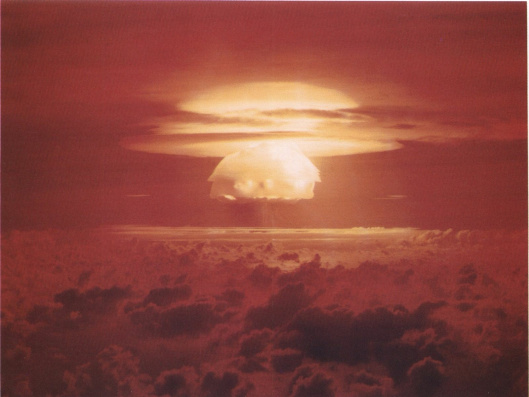
Your Inner H-Bomb, Nuclear testing left a signature of radioactive carbon all around the world—in trees and sharks, in oceans and human bodies. Even as that signal disappears, it’s revealing new secrets to scientists. The Atlantic, by Carl Zimmer, 2 Mar 20,
In the morning of March 1, 1954, a hydrogen bomb went off in the middle of the Pacific Ocean. John Clark was only 20 miles away when he issued the order, huddled with his crew inside a windowless concrete blockhouse on Bikini Atoll. But seconds went by, and all was silent. He wondered if the bomb had failed. Eventually, he radioed a Navy ship monitoring the test explosion.
“It’s a good one,” they told him.
Then the blockhouse began to lurch. At least one crew member got seasick—“landsick” might be the better descriptor. A minute later, when the bomb blast reached them, the walls creaked and water shot out of the bathroom pipes. And then, once more, nothing. Clark waited for another impact—perhaps a tidal wave—but after 15 minutes he decided it was safe for the crew to venture outside.
The mushroom cloud towered into the sky. The explosion, dubbed “Castle Bravo,” was the largest nuclear-weapons test up to that point..
It was intended to try out the first hydrogen bomb ready to be dropped from a plane. Many in Washington felt that the future of the free world depended on it, and Clark was the natural pick to oversee such a vital blast. He was the deputy test director for the Atomic Energy Commission, and had already participated in more than 40 test shots. Now he gazed up at the cloud in awe. But then his Geiger counter began to crackle.
“It could mean only one thing,” Clark later wrote. “We were already getting fallout.”
That wasn’t supposed to happen. The Castle Bravo team had been sure that the radiation from the blast would go up to the stratosphere or get carried away by the winds safely out to sea. In fact, the chain reactions unleashed during the explosion produced a blast almost three times as big as predicted—1,000 times bigger than the Hiroshima bomb.
Within seconds, the fireball had lofted 10 million tons of pulverized coral reef, coated in radioactive material. And soon some of that deadly debris began dropping to Earth. If Clark and his crew had lingered outside, they would have died in the fallout.
Clark rushed his team back into the blockhouse, but even within the thick walls, the level of radiation was still climbing. Clark radioed for a rescue but was denied: It would be too dangerous for the helicopter pilots to come to the island. The team hunkered down, wondering if they were being poisoned to death. The generators failed, and the lights winked out.
“We were not a happy bunch,” Clark recalled.
They spent hours in the hot, radioactive darkness until the Navy dispatched helicopters their way. When the crew members heard the blades, they put on bedsheets to protect themselves from fallout. Throwing open the blockhouse door, they ran to nearby jeeps as though they were in a surreal Halloween parade, and drove half a mile to the landing pad. They clambered into the helicopters, and escaped over the sea.
As Clark and his crew found shelter aboard a Navy ship, the debris from Castle Bravo rained down on the Pacific. Some landed on a Japanese fishing boat 70 miles away. The winds then carried it to three neighboring atolls. Children on the island of Rongelap played in the false snow. Five days later, Rongelap was evacuated, but not before its residents had received a near-lethal dose of radiation. Some people suffered burns, and a number of women later gave birth to severely deformed babies. Decades later, studies would indicate that the residents experienced elevated rates of cancer. ……….https://www.theatlantic.com/science/archive/2020/03/how-nuclear-testing-transformed-science/607174/
Veterans groups not happy -France wants to abolish the National Commission for Monitoring the Consequences of Nuclear Tests.
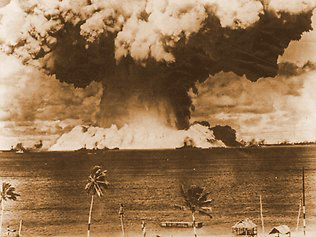 Dismay over plans to scrap French nuclear monitoring commission, https://www.rnz.co.nz/international/pacific-news/410780/dismay-over-plans-to-scrap-french-nuclear-monitoring-commission 2 March 2020 Nuclear test veterans groups in French Polynesia have reacted with dismay at reports that Paris wants to abolish the National Commission for Monitoring the Consequences of Nuclear Tests.
Last week, the French publication Canard Enchaine reported that as part of administrative changes and cost-cutting measures, dozens of commissions would be disestablished.
The commission is the body bringing together state authorities, representatives of the French Polynesian government and veterans associations to work on the list of radiation-induced illnesses deemed to be relevant for compensation.
The head of the group Moruroa e tatou Hiro Tefaarere has told the broadcaster La Premiere the move was inadmissible yet not surprising for the Macron government.
He said the French president on one hand described colonialism as a crime against humanity and on the other everything was suppressed which would recognise the consequences of the tests.
France carried out more than 190 nuclear weapons tests in the Pacific and until 2010 maintained that they were clean and posed no threat to human health.
French Polynesia’s president has reportedly raised his concerns in a letter to the French prime minister.
U.S. Pentagon demands $167 billion tax-payer nuclear funding through to 2025

|
Pentagon Plan Calls for a $9 Billion Surge in Nuclear Spending by 2025, TIME, BY TONY CAPACCIO / BLOOMBERG, FEBRUARY 26, 2020 The Pentagon’s five-year nuclear weapons plan calls for requesting at least $167 billion through 2025 — building from the $29 billion sought for next year to $38 billion, according to previously undisclosed figures. The commitment includes research, development, procurement, sustainment and operations. It reflects a major boost to an effort started under President Barack Obama to replace aging nuclear systems, such as Minuteman III missiles and command and control systems. It doesn’t include funding for the Energy Department’s National Nuclear Security Administration, which is requesting $19.8 billion for fiscal 2021, including $15.6 billion for nuclear weapons activities. Congressional Democrats have been generally supportive of increased nuclear weapons spending, but Defense Secretary Mark Esper is likely to be questioned about the size and scope of the five-year plan when he testifies Wednesday before the House Armed Services Committee. Esper is also likely to face bipartisan opposition from the defense-focused committee on President Donald Trump’s plan to shift $3.8 billion from Pentagon programs to his wall on the Mexican border. The Defense Department’s five-year plan on nuclear programs calls for $29 billion for fiscal 2021, $30 billion in 2022 and $33 billion in 2023, before jumping to $37 billion in 2024 and $38 billion in 2025. The plan includes $25 billion for research and procurement — but not support and operations for — the new Columbia-class intercontinental ballistic missile submarine that begins construction this year, $24 billion for improved nuclear command and control and $23 billion for the Air Force’s B-21 bomber. ….. https://time.com/5790901/pentagon-nuclear-weapons-spending/ |
|
U.S. Pentagon toys with a plan to win a “limited nuclear war” against Russia
 US staged ‘limited’ nuclear battle against Russia in war game
The Pentagon has briefed about the simulated exchange in a move that could signal readiness to fight and win nuclear conflict, Guardian, Julian Borger in Washington, Tue 25 Feb 2020 The US conducted a military exercise last week which simulated a “limited” nuclear exchange with Russia, a senior Pentagon official has confirmed.The war game is notable because of the defence department’s highly unusual decision to brief journalists about the details and because it embodied the controversial notion that it might be possible to fight, and win, a battle with nuclear weapons, without the exchange leading to an all-out world-ending conflict.
The exercise comes just weeks after the US deployed a new low-yield submarine-launched warhead commissioned by Donald Trump, as a counter to Russian tactical weapons and intended to deter their use.
According to a transcript of a background briefing by senior Pentagon officials, the defence secretary, Mark Esper, took part in what was described as a “mini-exercise” at US Strategic Command in Nebraska. Esper played himself in the simulated crisis, in which Russia launched an attack on a US target in Europe……
The official said that “in the course of [the] exercise, we simulated responding with a nuclear weapon”, but described it as a “limited response”.
The limited response could suggest the use of a small number of nuclear weapons, or an existing low-yield weapon, or the new W76-2 low-yield submarine-launched missile which was deployed in the Atlantic for the first time at the end of last year. The deployment only became public at the end of January……
The briefing was first reported by National Defense, a trade magazine of the National Defense Industrial Association.
Hans Kristensen, the director of the nuclear information project at the Federation of American Scientists, pointed out that it was extremely rare for the Pentagon to give such detailed briefings about nuclear exercises and suggested it could have been a marketing exercise for the new weapons being added to the US arsenal.
“Remember, it’s only a few weeks ago that we had the official confirmation that this new low-yield warhead had been deployed,” Kristensen said. “And we’re now moving into a new budget phase where they have to go to Congress and try to justify the next new nuclear weapon that has a low-yield capability which is a sea-launched cruise missile. So all of this has been played up to serve that process.”……
Arms control advocates are concerned that the leadership in both the US and Russia are developing a mindset in which their vast nuclear arsenals are not just the ultimate deterrent but weapons that could be used to win “limited” conflicts. https://www.theguardian.com/world/2020/feb/24/limited-nuclear-war-game-us-russia
Terrorism risks in Pakistan’s upgraded nuclear weapons
Pakistan’s Nuclear Weapons Get a Longer Range and Greater Precision
How difficult would it be for one of the nation’s ruthless terrorist groups to gain control over its nuclear arms? The Trumpet BY JEREMIAH JACQUES • FEBRUARY 24 2020
Pakistan successfully test-fired a new version of its Ra’ad ii nuclear-capable air-launched cruise missile on February 16, in the latest sign of the nation’s thermonuclear weapons advancement.
The Pakistan military’s Inter-Services Public Relations (ispr) said in a statement that the new version of the Ra’ad ii can travel up to 375 miles, nearly twice the range of the earlier model. It noted that the missile is “equipped with state-of-the-art guidance and navigation systems ensuring engagement of targets with high precision.” The combination of the longer range and the precision navigation “significantly enhances” the military’s “air delivered strategic standoff capability on land and at sea,” the ispr said…….
Pakistan has steadily developed more powerful, more compact and more numerous nuclear warheads—and, as evidenced by the new Ra’ad ii variant, more deft systems to deliver them.
Meanwhile, parts of Pakistan have become hotbeds of intensifying Islamic radicalism, which calls the security of these unfathomably destructive weapons into question. “Pakistan is the most dangerous country in the world,” Michael Morell, a former acting Central Intelligence Agency director, told Axios in 2018. “[A]nti-state jihadist extremism is growing in Pakistan, creating the nightmare society down the road: an extremist government in Islamabad with nuclear weapons.”
The Pakistani military has control over the nation’s 70 to 90 nuclear weapons. But the military routinely works with some of the most dangerous terrorist groups on the planet, including the ruthless Haqqani branch of the Afghan Taliban. The Brookings Institution noted, “Pakistan has provided direct military and intelligence aid” to the Haqqani, which has resulted in “the deaths of U.S. soldiers, Afghan security personnel and civilians, plus significant destabilization of Afghanistan.” …….. https://www.thetrumpet.com/21979-pakistans-nuclear-weapons-get-a-longer-range-and-greater-precision
Question USA’s need for a New Nuclear Sea-Launched Cruise Missile
Does the US Need a New Nuclear Sea-Launched Cruise Missile?
The case for a new sea-launched cruise missile raises worrying questions.The Diplomat By Robert Farley, February 24, 2020 According to a new report from Defense News, the United States is moving forward on development of a dangerous new nuclear capability. Aaron Mehta of Defense News reported on February 21 that the Department of Defense intends to create a program of record for a submarine launched cruise missile (SLCM) equipped with a nuclear warhead. The request comes in response to Trump administration preferences set forth in the 2018 Nuclear Posture Review, which also called for the deployment of low-yield nuclear warheads on submarine launched ballistic missiles.
The United States has not deployed a nuclear armed SLCM since the retirement of the TLAM-N in 2013. ……..
The deployment of a newer, more survivable SLCM would not exactly create a new problem so much as reintroduce an old one. Nuclear cruise missiles take up space on a ship and require different kinds of crew expertise. Their storage alongside conventional missiles creates an obvious potential for accidents. Discrimination would also become a problem. The United States has launched a great many cruise missiles from submarines as part of the War on Terror and associated conflicts. China, Russia, and other nuclear powers can credibly recognize such launches as carrying conventional munitions. If attack submarines reacquire the capability to launch nuclear weapons, then Beijing and Moscow need to worry about every missile launch within range of their territory.
This would become more, not less, problematic in context of a direct conflict between the United States and China. The U.S. has promised to hold targets within China at risk during a general conflict, presumably with cruise missiles. Heretofore China has not needed to account for the possibility that these missiles might carry nuclear warheads, but if the U.S. deployed nuclear SLCMs then any strike might be interpreted as a nuclear attack…….https://thediplomat.com/2020/02/does-the-us-need-a-new-nuclear-sea-launched-cruise-missile/

Britain buying new nuclear warheads from USA: Pentagon knew about it, UK Parliament did not
|
The revelation has dismayed MPs and experts who question why they have learned of the move – which will cost the UK billions of pounds – only after the decision has apparently been made. It has also raised questions about the UK’s commitment to staunching nuclear proliferation and the country’s reliance on the US for a central plank of its defence strategy. Earlier this month, Pentagon officials confirmed that its proposed W93 sea-launched warhead, the nuclear tip of the next generation of submarine-launched ballistic missiles, would share technology with the UK’s next nuclear weapon, implying that a decision had been taken between the two countries to work on the programme. In public, the UK has not confirmed whether it intends to commission a new nuclear warhead. The Ministry of Defence’s annual update to parliament, published just before Christmas, says only: “Work also continues to develop the evidence to support a government decision when replacing the warhead.” But last week Admiral Charles Richard, commander of the US strategic command, told the Senate defence committee that there was a requirement for a new warhead, which would be called the W93 or Mk7. Richard said: “This effort will also support a parallel replacement warhead programme in the United Kingdom, whose nuclear deterrent plays an absolutely vital role in Nato’s overall defence posture.” Ed Davey, acting leader of the Liberal Democrats, said: “It is totally unacceptable that the government seems to have given the green light to the development of new nuclear weapon technologies with zero consultation and zero scrutiny. Britain under Johnson increasingly looks like putty in Trump’s hands. That Britain’s major defence decisions are being debated in the United States, but not in the UK, is a scandal. Under Johnson, it seems that where Trump leads, we must follow.” ………. https://www.theguardian.com/uk-news/2020/feb/22/pentagon-gaffe-reveals-uk-deal-replace-trident-nuclear-weapon |
|


-
Archives
- October 2026 (112)
- September 2026 (339)
- August 2026 (330)
- July 2026 (355)
- June 2026 (287)
- May 2026 (306)
- April 2026 (356)
- March 2026 (251)
- February 2026 (267)
- January 2026 (308)
- December 2025 (358)
- November 2025 (359)
-
Categories
- 1
- 1 NUCLEAR ISSUES
- business and costs
- climate change
- culture and arts
- ENERGY
- environment
- health
- history
- indigenous issues
- Legal
- marketing of nuclear
- media
- opposition to nuclear
- PERSONAL STORIES
- politics
- politics international
- Religion and ethics
- safety
- secrets,lies and civil liberties
- spinbuster
- technology
- Uranium
- wastes
- weapons and war
- Women
- 2 WORLD
- ACTION
- AFRICA
- Atrocities
- AUSTRALIA
- Christina's notes
- Christina's themes
- culture and arts
- Events
- Fuk 2022
- Fuk 2023
- Fukushima 2017
- Fukushima 2018
- fukushima 2019
- Fukushima 2020
- Fukushima 2021
- general
- global warming
- Humour (God we need it)
- Nuclear
- RARE EARTHS
- Reference
- resources – print
- Resources -audiovicual
- Weekly Newsletter
- World
- World Nuclear
- YouTube
-
RSS
Entries RSS
Comments RSS

