A dangerous idea to abandon nuclear arms treaties with Russia
Yet, the nuclear arms control edifice that was built up over half a century is in danger of coming apart. The Trump administration has decided to withdraw from one major agreement, the Intermediate-range Nuclear Forces (INF) Treaty, citing Russian violations. And it has shown no interest in extending New START before it expires 18 months from now.
Behind both decisions is the idea that U.S.-Russian arms control has become an anachronism, and that future arms control efforts must now also include Chinese capabilities. While Russia’s apparent deployment of a banned ground-based nuclear missile provided the formal reason for abandoning the INF Treaty, President Donald Trump also cited China’s unconstrained deployment of intermediate-range missiles as a justification for ending the agreement. And rather than extending New START for five years, administration officials suggest that any future accord must also limit Chinese nuclear weapons.
After more than 50 years of U.S.-Russian arms control negotiations and agreements, there is scope for thinking anew about how best to reduce nuclear dangers. But abandoning long-standing agreements and conditioning any new negotiations on including China are not the best way to do that.
It took the United States and Soviet Union standing at the very brink of nuclear war, at the height of the Cuban missile crisis in 1962, to understand the importance of managing their nuclear capabilities through negotiations.
After the crisis, both countries instituted a hotline so they could communicate to avert misunderstandings. They agreed to ban above-ground nuclear testing and negotiated a treaty to limit the spread of nuclear weapons. And they began the effort to limit and ultimately reduce the number and type of weapons each side could deploy. As important, both accepted intrusive inspection regimes designed not only to verify compliance with the terms of the agreements but to enhance mutual confidence that neither side was seeking a decisive nuclear advantage.
The true lesson of the Cuban missile crisis was that countries could miscalculate each other’s actions and intentions, raising the very real risk of nuclear confrontation. The commitment to dialogue, to engage in extensive talks on strategic stability and negotiate real limits on capabilities, and to open each country up to foreign inspectors, helped create confidence that for all the differences between them, the United States and Russia shared an overriding need to avoid a nuclear war.
That effort has proven exceedingly successful. Nuclear arsenals, though still far too large, have been sharply reduced. Nuclear crises like Cuba have been avoided. And while there have been questions about compliance, none of the violations ever constituted a threat so dire as to heighten the risk of nuclear confrontation.
U.S.-Russian arms control has worked in its most fundamental aim — to reduce the chance of war, especially nuclear war. That is why the decision to withdraw from the INF Treaty next month is a mistake. The new Russian missile deployment is a violation and has to be addressed, and the treaty contains procedures for doing so. If the violation persists, there are ways to punish Russia, through sanctions and other means. But withdrawing from a treaty that has served the United States and its European allies well for decades risks an arms race that is destabilizing and unwinnable.
The same is true for New START. Russia has indicated it is willing to extend its terms for five years. The United States has nothing to lose by agreeing to its extension, thus limiting Russian nuclear deployments and extending the highly intrusive inspection measures that provide real insight into Russian capabilities.
There is a case to be made for including China in future nuclear negotiations, though its nuclear deployments of some 200 weapons is but a small fraction of what the United States and Russia still possess. Russia, moreover, will no doubt also insist on including the similarly-sized French and British nuclear forces in such a multilateral negotiation, a prospect that neither Paris nor London is likely to welcome.
It will no doubt take time, and real effort, to decide on a new negotiating framework beyond the two major nuclear powers. Until such time, both Washington and Moscow will be much better off if the nuclear framework they have developed over the past 50 years remains in place.
— Ivo Daalder is the president of the Chicago Council on Global Affairs and a former U.S. ambassador to NATO.
ACTIVISTS WALK “CEASE AND DESIST” ORDER INTO NUCLEAR WEAPONS BASE
BÜCHEL, Germany — Eleven international peace activists entered the Büchel Air Base southwest of Frankfurt early this morning to deliver what they called a “Treaty Enforcement Order” declaring that the sharing of US nuclear weapons at the base is a “criminal conspiracy to commit war crimes.”
Upon entering the base’s main gate with a printed “cease and desist order,” they insisted on seeing the base commander to deliver the order in person.
“We refuse to be complicit in this crime,” said Brian Terrell of Voices for Creative Nonviolence in Chicago, Illinois. “We call for the nuclear bombs to be returned to the US immediately. The Germans want these nuclear weapons out of Germany, and so do we.”
The group included people from Germany, The Netherlands, the United Kingdom, and the United States. All eleven were detained by military and civilian authorities and were released after providing identification. This is the third year in a row that a delegation of US peace activists has joined Europeans and others in protesting the US nuclear weapons at Büchel. The local group Nonviolent Action for Abolition of Nuclear Weapons (GAAA) convenes the International Action Week, demanding permanent ouster of the US nuclear weapons, cancellation of plans to replace today’s B61s with new hydrogen bombs, and Germany’s ratification of the 2017 Treaty on the Prohibition of Nuclear Weapons.
“Delivery of the ‘Cease and Desist Order’ is an act of crime prevention,” said John LaForge, of the US peace group Nukewatch and coordinator of the US delegation. “The authorities think the entry is a matter of trespass. But these nuclear bomb threats violate the UN Charter, the Treaty on Nonproliferation of Nuclear Weapons, and the 2017 Treaty on the Prohibition of Nuclear Weapons.” he said, adding, “Interrupting government criminality is a duty of responsible citizenship.”The activists included: (from the United States) Susan Crane, Richard Bishop, Andrew Lanier, Jr., Brian Terrell, Ralph Hutchison, and Dennis DuVall; (from the UK) Richard Barnard; (from The Netherlands) Margriet Bos, and Susan van der Hijden; and (from Germany) Dietrich Gerstner, and Birke Kleinwächter.
Susan van der Hijden of Amsterdam, who is just back from the US where she visited the Kansas City, Kansas site of a factory working on parts of the new replacement bomb, known as the B61-12. “The planning and training to use the US H-bombs that goes on at Büchel cannot be legal, because organizing mass destruction has been a criminal act since the Nuremberg Trials after WWII,” van der Hijden said.
Dangerous nuclear arms race to follow, if New Start Treaty is not renewed
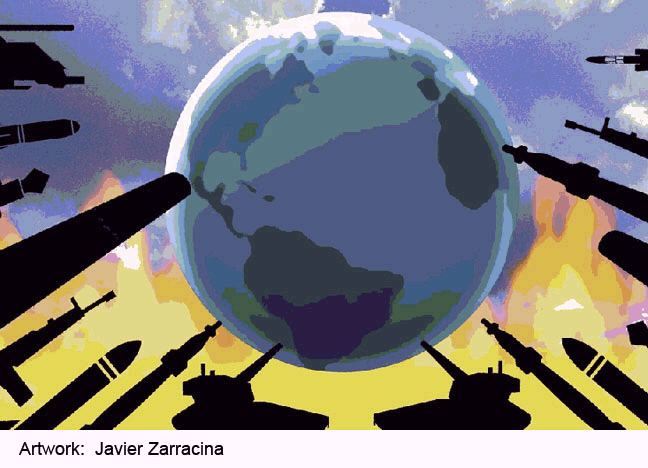
Clock’s ticking on one of world’s most important nuclear treaties. A dangerous arms race may be next, By Eliza Mackintosh, CNN, July 20, 2019 This week, senior American officials traveled to Switzerland to deliver President Donald Trump’s “vision for a new direction in nuclear arms control.” That vision is to strike a wide-ranging deal that would limit the arsenals of not only the US and Russia, but also China for the first time.
Port Townsend City Council passes resolution to ban nuclear weapons
 Residents tout small steps in same direction , Peninsula Daily News, By Brian McLean, Sunday, July 21, 2019 , PORT TOWNSEND — Port Townsend City Council members were moved when several residents impressed upon them the value of taking small steps toward a larger issue.
The council unanimously passed a resolution last week in support of a worldwide ban on nuclear weapons following similar actions earlier this spring by the Jefferson County commissioners and the county health department.
“My sense about what this means is not just moving away from the constant waste of money that, if it’s ever put to use, may cost us all of our lives, but also to free up the science and technology and engineering necessary to move towards a more useful strategy as a country,” said Port Townsend’s Doug Milholland, a resident who drove the efforts to pass the resolution.
“Let’s say yes to life.”
Forest Shomer, a speaker in May at the Global Earth Repair conference in at Fort Worden, said that whatever happens in the Key City reverberates.
“We’re right across the water from [Naval Magazine] Indian Island,” Shomer said. “We’ve heard the words so much, ‘Neither confirm nor deny,’ so we don’t know if, right at this moment, we’re sitting three miles away from nuclear weapons.
“It’s pretty personal to Port Townsend to make a statement of how we feel about that.”…. bmclean@peninsuladailynews.com. https://www.peninsuladailynews.com/news/port-townsend-city-council-passes-resolution-to-ban-nuclear-weapons/
World security needs nuclear New Start agreement – USA-Russia, not a distraction about China
|
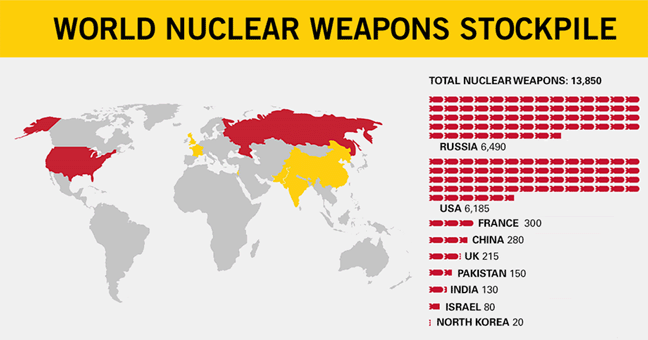
Nobody wins a nuclear war — especially not two nuclear behemoths. https://thehill.com/opinion/international/453576-nobody-wins-a-nuclear-war-especially-not-two-nuclear-behemoths BY DANIEL R. DEPETRIS,— 07/17/19 U.S. and Russian officials met this week in Geneva for what one hopes will be new strategic arms reduction talks. Trump administration officials are cautiously optimistic the discussions could lead to a more substantive negotiation about capping — and perhaps even decreasing — the number of nuclear weapons both countries have in their stockpiles. This matters for U.S. and global security because these two nations possess more than 90 percent of all nuclear weapons. President Trump, however, wants to go further than a simple extension of the 2010 The New Strategic Arms Reduction Treaty (START) agreement or a new bilateral treaty with the Russians. Instead, he is prodding China to join a trivariate arrangement. But in prefacing or linking an extension of New START to a fresh accord that includes the Chinese, the administration is increasing the possibility of ending up with neither. For one, pushing Beijing to into a three-way deal is like pushing on a locked door. The Chinese have shown no interest in a three-way deal, in large measure because their nuclear arsenal is a fraction (roughly 2 percent) of the globe’s entire inventory. At roughly 290 warheads, Beijing’s nuclear weapons program is minuscule when compared to the thousands of combined warheads Washington and Moscow have stockpiled. Indeed, China stockpile is less than 1/20th the size of the United States and about 1/22th the size of Russia’s. To expect the Chinese to participate in a new arms control negotiation with two nuclear superpowers when the numbers are so steadily stacked against them is a fool’s errand. Beijing’s no-first use nuclear policy, in place since its first ever nuclear explosive test in 1964, was recently reaffirmed just last year. An offensive nuclear strike is not something U.S. officials in Washington have to worry about. To focus on a U.S.-Russia-China nuclear agreement at the expense of keeping an already existing New START accord alive is the wrong priority. New START, signed in April 2010, was a win-win, pragmatic arms control agreement for both sides. The pact cut the U.S. and Russian stockpiles byaround one-third; capped the amount of nuclear warheads on deployed intercontinental ballistic missiles at 1,550; limited the number of deployed and non-deployed ICBM launchers to 800; and allowed each country to verify compliance with the treaty, including on-site inspections, information exchanges and advanced notices. Unlike the Intermediate Range Nuclear Forces Treaty, inspectors have verified Moscow’s compliance with the letter of the deal. For two countries that possess a combined 12,675 nuclear weapons, New START is a critical enforcing mechanism for nuclear parity and a stable balance of power. It is now the only functional arms control accord preventing the U.S. and Russia from entering another costly, risky arms race. The deal expires in February 2021 but could be extended for another five years if both Presidents Trump and Putin agree to do so. Putin has already expressed his interest. Trump, someone who considers himself a transactional pragmatist, shouldn’t waste any more time before doing the same. An extension of New START, however, is not only important for strategic stability between the two nuclear superpowers (without New START, there is nothing stopping either the United States or Russia from building and deploying more and better nuclear warheads). but also valuable for stabilizing the entire U.S.-Russia relationship in desperate need of improvement. For this reason, a constructive relationship with Moscow is unquestionably a good thing for U.S. security. Extending New START is a no-brainer and indeed could very well be an opportunity to mend relations. It’s not hyperbole to describe U.S.-Russia relations as being at their lowest since the land-based missile build-up in Europe in the early 1980s. From Syria and Ukraine to NATO and cybersecurity, Washington and Moscow are often on opposite sides of the issue. Even though both nations share some interests, including arms control and countering terrorism, Washington has become the epicenter of anti-Russia sentiment, where condemning Putin and advocating for sanctions is sport. Good politics, however, doesn’t necessarily correspond with good statecraft or foreign policy. Talking with adversaries, rivals, or competitors is a critically important component of effective foreign policy. We must engage with the world as it is, not as we wish it to be. Simply ignoring the Russians, pretending they don’t exist, or believing that using the stick unreservedly against Moscow will force it to cry uncle and change its policies to our liking makes conflict between nuclear superpowers more likely. Giving New START another five years of life is perhaps the only issue Washington and Moscow can agree on in today’s political climate. It’s perhaps the most important reason the U.S. and Russia must find a way to co-exist. Ensuring New START survives should be pursued aggressively for the sake of U.S. and global security Nobody wins a nuclear war — especially especially not two nuclear behemoths with thousands of warheads apiece. Daniel R. DePetris is a fellow at Defense Priorities, a foreign policy think tank focused on promoting security, stability and peace. |
|
|
Secret Locations of U.S. nuclear weapons in Europe revealed

Leaked NATO report reveals where USA is hiding SIX nuclear weapons – and they’re in EUROPE https://www.express.co.uk/news/world/1155277/us-nuclear-weapons-map-secret-locations-nukes-europe-nato-news
THE SECRET locations of US nuclear weapons in Europe were been accidentally revealed in a NATO-affiliated report. By KATE WHITFIELD, , Jul 19, 2019 The document was titled “A new era for nuclear deterrence? Modernisation, arms control and allied nuclear forces”. It was first published in April and written by a Canadian senator for the Defense and Security Committee of the NATO Parliamentary Assembly. The document, which has now been deleted, seems to confirm long-held suspicions that US nuclear weapons are being stored in Europe.
The document referred to the sites of roughly 150 American nuclear weapons.
Locations in Belgium, Germany, Italy, the Netherlands and Turkey were identified.
The report was seen by Belgian newspaper De Morgen, which said: “These bombs are stored at six US and European bases — Kleine Brogel in Belgium, Büchel in Germany, Aviano and Ghedi-Torre in Italy, Volkel in The Netherlands, and Incirlik in Turkey.”
The document did not attribute this information to any source.
In the final version of the document, published last week, the reference was removed.
The latest version of the report instead makes reference to aircraft capable of carrying nuclear weapons.
The report says: “The European Allies often cited as operating such aircraft are Belgium, Germany, Italy, The Netherlands, and Turkey.”
A NATO official told The Washington Post the report was “not an official Nato document” and pointed out that it was written by the alliance’s parliamentary assembly.
The official added: “We do not comment on the details of Nato’s nuclear posture.”
While the storage of US nuclear weapons has long been suspected, many are viewing this as confirmation.
De Morgen’s report was headlined: “Finally in black and white: There are American nuclear weapons in Belgium.”
And Dutch broadcaster RTL News said: “NATO reveals the Netherlands’ worst-kept secret.”
Kingston Reif, director for disarmament and threat-reduction policy at the Arms Control Association, said the presence of US nuclear weapons in Europe was “no surprise”.
He added: “This has long been fairly open knowledge.”
The presence of the weapons resulted from an agreement reached in the 1960s and is thought to be a relic of the Cold War era.
But in recent years, fears have grown over whether parts of the continent, such as Turkey, are the best place to store them in the wake of terrorist extremism in the region.
How many nuclear weapons does the USA have?
The US was the first country to manufacture nuclear weapons and, to date, is the only country to have used them in combat – in the Hiroshima and Nagasaki bombings in World War II.
Since 1945, the United States produced more than 70,000 nuclear warheads – more than all other nuclear states combined.
At its peak in 1967, the US military had a stockpile of 31,255 warheads.
Now, the most recent figures suggest the US has an estimated 4,018 nuclear weapons in either deployment or storage.
US nuclear weapon locations in Europe accidentally exposed in NATO committee report,
US nuclear weapon locations in Europe accidentally exposed in NATO committee report, BY OWEN DAUGHERTY – 07/16/19 A report from a NATO committee that has since been deleted reportedly exposed the the secret locations of U.S. nuclear weapons in Europe.
The Washington Post reports that the document by a Canadian senator for the Defense and Security Committee of the NATO Parliamentary Assembly detailed the future of the organization’s nuclear deterrence policy but accidentally exposed the open secret.
The report stated that U.S. nuclear weapons are being stored in Belgium, Germany, Italy, the Netherlands and Turkey.
While the document titled “A new era for nuclear deterrence? Modernisation, arms control and allied nuclear forces” was originally published in April without making waves, a Belgian newspaper Tuesday published a copy of the document featuring the locations of about 150 U.S. nuclear weapons .
“These bombs are stored at six US and European bases — Kleine Brogel in Belgium, Büchel in Germany, Aviano and Ghedi-Torre in Italy, Volkel in The Netherlands, and Incirlik in Turkey,” a section of the newspaper’s report read, according to the Post.
The Post made note that the original document did not attribute this information to any source.
A final version of the report was reportedly published last week that did not have any specific references to where the weapons are stored…… https://thehill.com/policy/international/europe/453426-us-nuclear-weapon-locations-in-europe-accidentally-exposed-in
The first victims of the first atomic explosion might have been American children.
After a nearly half a century of denial, the US Department of Energy concluded in 2006, “the Trinity test also posed the most significant hazard of the entire Manhattan Project.
Ionizing radiation is especially damaging to dividing cells, so the developing infant, both before and after birth, is susceptible to radiation damage, as Alice Stewart, an epidemiologist who first demonstrated the link between X-rays of pregnant women and disease in their children,[12] first warned in 1956.[13]This damage may be seen years later with the development of leukemia and other cancers in children exposed in utero to ionizing radiation, as Stewart and others confirmed in subsequent studies.[14] By 1958, the United Nations Scientific Committee on the Effects of Atomic Radiation recognized that, in the short term, radiation damage can be reflected in fetal and infant deaths.[15]
Fallout protection was not a priority for the Trinity explosion.
The current body of historical evidence of harm, negligence, and deception—especially the evidence of increased infant death following the first nuclear explosion—should be more than enough for long overdue justice for the people in New Mexico who were downwind of Trinity.
Is cancer the legacy left by world’s first atomic bomb test?
Trinity: “The most significant hazard of the entire Manhattan Project” https://thebulletin.org/2019/07/trinity-the-most-significant-hazard-of-the-entire-manhattan-project/?utm_source=Newsletter&utm_medium=Email&utm_campaign=Newsletter072219&utm_content=Nuclear_Trinity_071519
By Kathleen M. Tucker, Robert Alvarez, July 15, 2019 For the past several years, the controversy over radioactive fallout from the world’s first atomic bomb explosion in Alamogordo, New Mexico on July 16, 1945—code-named Trinity—has intensified. Evidence collected by the New Mexico health department but ignored for some 70 years shows an unusually high rate of infant mortality in New Mexico counties downwind from the explosion and raises a serious question whether or not the first victims of the first atomic explosion might have been American children. Even though the first scientifically credible warnings about the hazards of radioactive fallout from a nuclear explosion had been made by 1940, historical records indicate a fallout team was not established until less than a month before the Trinity test, a hasty effort motivated primarily by concern over legal liability.
In October 1947, a local health care provider raised an alarm about infant deaths downwind of the Trinity test, bringing it to the attention of radiation safety experts working for the US nuclear weapons program. Their response misrepresented New Mexico’s then-unpublished data on health effects. Continue reading
Alarmingly high radiation in soil, ocean sediments and fruits from Marshall Islands

Radiation Levels at the Marshall Islands Remain Disturbingly High https://gizmodo.com/radiation-levels-at-the- marshall-islands-remain-disturb-1836382678?IR=T, George Dvorsky– 15 July 19
An analysis of soil samples, ocean sediment, and fruits from the Marshall Islands—the site of nearly 70 nuclear weapons tests during the 1940s and 1950s—has revealed alarmingly high levels of radiation, with some regions at levels exceeding areas affected by the Fukushima and Chernobyl disasters.
From 1946 to 1958, the United States conducted 67 nuclear tests in the Marshall Islands, a series of atolls located north of the equator between Hawaii and Australia. Twenty-three of these tests were conducted at Bikini Atoll and 44 near Enewetak Atoll, but fallout spread throughout the entire Marshall Islands, exposing the indigenous people there to dangerous levels of radiation.
Much of the Marshall Islands remains uninhabitable as a consequence of these nuclear tests, and it’s not immediately clear when Marshallese residents will be able to return to their ancestral homes. Three new studies published today in Proceedings of the National Academy of Sciences suggests their long-awaited return won’t happen anytime soon. A research team led by Emlyn Hughes and Malvin Ruderman from the Center for Nuclear Studies at Columbia University has detected unsafe levels of radiation in the soil, ocean sediment, and fruits in these contaminated areas.
Three years ago, the same team discovered alarming levels of gamma radiationin the Marshall Islands, and at levels that exceeded scientists’ expectations. The three new PNAS studies add to this prior work, which is being done to determine which, if any, of the Marshall Islands are safe for resettlement, and the specific risks that would be faced by returning indigenous peoples.
For the first study, the researchers measured background gamma radiation in soil samples taken from four atolls in 2017 and 2018: Bikini, Enewetak, Rongelap, and Utirik. Gamma radiation on Bikini and Naen islands were well beyond the maximum exposure limit as stipulated in agreements between the United States and the Republic of the Marshall Islands. On Bikini, the levels were as high as 648 millirems per year, and on Naen they were as high as 460 millirems per year. Safe exposure to radiation is 100 millirems per year, according to the U.S.-Republic of the Marshall Islands agreement.
These levels are “significantly higher” than “areas affected by the Chernobyl and Fukushima accidents,” wrote the study authors. The “radiation levels on Bikini Island, which served as the primary island for habitation on the atoll, before and in the aftermath of the testing, are too high for relocation to Bikini,” according to the new research. Some of the outer islands “may not [be] suitable for habitation on their own, but… islanders may visit in search of food, especially in times of harvest.”
For the second paper, the researchers explored the Castle Bravo crater—the site of the most powerful nuclear test ever conducted by the United States, which happened on March 1, 1954. This 15-megaton explosion vaporized the land beneath it, forming a crater 1.5 kilometers (0.9 miles) wide and 75 meters (246 feet) deep on Bikini Atoll. The ensuing fallout was comprised of pulverized coral, water, and radioactive particles. Traces of the radioactive debris were detected as far as Japan, India, Australia, Europe, and even the United States.
The Castle Bravo explosion also produced radioactive material that settled into the ocean sediment. From the research vessel Indies Surveyor, the researchers collected nearly 130 core samples from the Castle Bravo crater from 2017 to 2018. Analysis showed that, six decades later, the radiation levels are still “orders of magnitude” above normal levels within the top inch of sediment across the entire crater. The researchers conclude thusly:
In summary, there is still residual contamination of radionuclides throughout the Bravo bomb crater, from center to rim. We find that the radionuclide distribution is fairly uniform across the crater with some tapering off toward the crater rim….Although the lagoon is gradually filling in over time, contamination levels from residual long-lived radioactive isotopes, such as plutonium and americium, will likely last for centuries. The nuclear weapon tests caused a dramatic change in sediment composition. Additional studies to determine what the impact on life is in the lagoon craters, especially at the deeper depths, would be valuable.
The third paper is an analysis of fruits found in the Marshall Islands, namely coconuts and pandanus fruits. Cesium-137 features a half-life of around 30 years, and it’s easily absorbed by plants, presenting a potential health hazard. Sadly, 11 islands were found to have coconuts and pandanus fruits with radioactivity exceeding limits established by several countries and international organizations, including International Physicians for the Prevention of Nuclear War (IPPNW). Once again, some of the levels exceeded values found near Fukushima and Chernobyl.
“Based upon our results, we conclude that to ensure safe relocation to Bikini and Rongelap Atolls, further environmental remediation… appears to be necessary to avoid potentially harmful exposure to radiation,” wrote the authors in the study.
All-in-all, some very discouraging results, as much of the Marshall Islands remain unsafe for resettlement. It’s not immediately clear when these islands will be free of radiation, or if people will ever return to Bikini Atoll. Sadly, climate change is making a bad situation worse, as rising sea levels could render many of the safe Marshall Islands uninhabitable.
Space is “new domain of military operations” – nuclear weapons enthusiast Gen Mark Milley , Trump’s choice to head Joint Chiefs of Staff
Does this guy think that USA can start, and win a nuclear war? I have moved this item up to the front page, because of its importance – should this belligerent man get in control of USA’s nuclear weapons policy.
 Milley throws support behind nuclear modernization, Space Force, Defense News, 14 July 19, WASHINGTON — U.S. President Donald Trump’s choice for the next chairman of the Joint Chiefs of Staff has thrown his full support behind nuclear modernization plans, the creation of a Space Force and developing new capabilities to offset China.
Iran says reducing nuclear deal commitments to save it from ‘total collapse
Iran says reducing nuclear deal commitments to save it from ‘total collapse’, Press TV, Jul 5, 2019 Foreign Minister Mohammad Javad Zarif says Tehran’s decision to scale down its commitments under the JCPOA is indeed aimed at protecting the multilateral deal, not killing it.
Back on May 8, Iran notified its remaining partners in the 2015 nuclear deal that it would suspend the implementation of some of its commitments in reaction to the US’ unilateral withdrawal and Europe’s failure to live up to its commitments.
Speaking in an exclusive email interview with The New York Times published on Thursday night, Zarif said Iran made the decision as it “can indeed prevent the deal from total collapse.”
The Joint Comprehensive Plan of Action (JCPOA) “was and remains the best POSSIBLE agreement on the nuclear issue,” Zarif said, adding that its total collapse “will be detrimental to the interests of all, including the US.”
He said Iran “will remain committed to the deal as long as the remaining participants (EU, France, Germany, UK, Russia and China) observe the deal.”
“Survival or collapse of the JCPOA depends on the ability and willingness of all parties to invest in this undertaking. In a nutshell, a multilateral agreement cannot be implemented unilaterally,” Zarif said.
He also said that Iran’s decision to reduce its commitments was taken in line with its legal rights under paragraphs 26 and 36 of the nuclear deal, saying, “Paragraph 36 of JCPOA is a clear example that we negotiated this deal with the full understanding that we could not trust the commitment of the West.
As part of the first phase of scaling down its commitments, Iran exceeded the 300-kilogram limit set by the JCPOA on its low-enriched uranium stockpiles……….
The JCPOA obliges the European partners to prove their commitment to the nuclear deal in action, Zarif said, adding that the Islamic Republic would commit to the agreement in exactly the same way as those countries would.https://www.presstv.com/Detail/2019/07/05/600190/Iran-Zarif-JCPOA-nuclear-deal-commitments
U.S., Russia to discuss nuclear arms limits in Geneva on Wednesday –officials
U.S., Russia to discuss nuclear arms limits in Geneva on Wednesday –officials https://news.yahoo.com/u-russia-discuss-nuclear-arms-185425751.html
WASHINGTON, July 15 (Reuters) – Representatives from the United States and Russia are set to meet in Geneva on Wednesday to explore the idea of a new accord limiting nuclear arms that could eventually include China, U.S. senior administration officials said on Monday.
U.S. President Donald Trump has said that he would like to see a new type of arms control deal with Russia and China to cover all types of nuclear weapons, a topic that he has discussed individually with Russian President Vladimir Putin and Chinese President Xi Jinping.
China is not currently a party to nuclear arms pacts between the United States and Russia.
The U.S. delegation will be led by U.S. Deputy Secretary of State John Sullivan and will include Tim Morrison, a top aide at the White House National Security Council, as well as representatives from the Pentagon, the Joint Chiefs of Staff, and the National Security Agency, said the U.S. officials, who spoke to reporters on condition on anonymity.
Russia’s deputy foreign minister, Sergei Ryabkov, will lead the Russian delegation, the U.S. officials said.
“We actually feel that – touch wood – we’ve actually got to a point where we can try to start this again,” one of the officials said, listing off a long series of incidents that have soured relations between the United States and Russia during the past year.
“I say touch wood because we’re always just one incident away from unfortunately things getting derailed,” the official said. (Reporting by Roberta Rampton Editing by Marguerita Choy)
Russia’s new Nuclear-Powered Aircraft Carrier? Just all talk?
But the Kremlin for years has celebrated scale models of future flattops, all without spending any money to actually design or build the vessels.The longer the Russian navy waits, the less likely it is that a new carrier directly will replace Kuznetsov when the aging, unreliable ship finally decommissions.
A defense-industry source said the Kremlin had begun a technical assignment for a future nuclear-powered carrier under program name Project 11430E Lamantin, TASS reported in July 2019.
But the Russian navy’s own commander-in-chief, Nikolai Yevmenov, told reporters there was no firm deadline for funding or construction. “There will be, of course, a nuclear-powered aircraft carrier but not in the short-term perspective,” Yevmenov said.
……..Russia’s entire annual military budget rarely exceeds $70 billion. Only a small fraction of that typically pays for ships.
The high cost of a replacement vessel perhaps explains why the Kremlin is determined to keep Kuznetsov in service as long as possible. The Russian navy plans to dry-dock Kuznetsov starting in 2020 and conduct extensive repairs on the 1980s-vintage vessel………https://nationalinterest.org/blog/buzz/russian-navy-get-nuclear-powered-aircraft-carrier-answer-nyet-67022
General Mark Milley wants low-yield nuclear missile warheads, doctrine of a “winnable” nuclear war
Trump’s nominee for top US military commander calls for nuclear buildup to confront China, WSW, By Bill Van Auken 13 July 2019
In testimony before the US Senate Armed Service Committee Thursday, Gen. Mark Milley, Trump’s nominee for chairman of the Joint Chiefs of Staff, called for a major buildup of the US nuclear arsenal, while identifying China as the main target of US imperialism’s war machine……..
“From East Asia to the Middle East to Eastern Europe, authoritarian actors are testing the limits of the international system and seeking regional dominance while challenging international norms and undermining US interests,” Milley said. “Our goal should be to sustain great power peace that has existed since World War II, and deal firmly with all those who might challenge us.”
Asked by the chairman of the Senate panel, Oklahoma Republican Senator James Inhofe, what he was most concerned about in terms of the US confrontation with China and Russia, Milley responded: “I think the very No. 1 for me and No. 1 stated for the Department of Defense is the modernization, recapitalization of the nation’s nuclear triad. I think that’s critical. Secondly, I would say, is space. It’s a new domain of military operations.”
“I think China is the main challenge to the US national security over the next 50 to 100 years,” General Milley, said…….
He charged that China is “using trade as leverage to achieve their national security interests and the One Belt, One Road is part of that.” He said that China is “primarily in competition for resources to fund and improve their military and build and fuel their economy.”
The US response to these economic developments is largely military. Milley spelled out the US military buildup in what the Pentagon terms the “Indo-Pacific” region that is the main arena of confrontation with China. This consists, the general said, of 370,000 US troops, 2,000 warplanes and 200 ships.
Asked whether he thought it would be “helpful” to place conventionally armed, ground-launched intermediate-range missiles in the Indo-Pacific region to help deter Chinese interests in the region, Milley responded, “I do.”
These weapons had been banned under the 1987 Intermediate-Range Nuclear Forces (INF) Treaty, which the Trump administration abrogated earlier this year. Washington claims that it is acting in response to alleged Russian violations of the treaty—an allegation that Moscow denies.
The US has advanced the theory that Moscow has adopted a wildly adventurist strategy of utilizing a low-yield tactical nuclear weapon against US-NATO conventional forces encircling its territory on the assumption that Washington would not respond with an all-out thermonuclear attack. No evidence has been presented to support this claim.
In any case, the principal target in the abandonment of the INF treaty is China. Beijing is not a signatory to the accord and has developed its own missiles as a counterweight to the US military buildup in the region………
Milley also defended the development of low-yield nuclear missile warheads that are to be launched from submarines, describing the weapons as “an important capability to have in our arsenal in order to deal with any potential adversary.”
The weapons are ostensibly aimed at countering potential Russian use of similar warheads in a war in Europe. They significantly lower the threshold for nuclear war, while raising the likelihood that the country on the receiving end of such a missile—unable to know the size of its warhead—would deliver a full-scale nuclear response.
Milley’s testimony comes barely a month after the Pentagon briefly posted and then yanked off the internet a 60-page document titled “Joint Publication No. 3-72 Nuclear Operations.” The document, prepared at the request of the current Chairman of the Joint Chiefs of Staff Marine Gen. Joseph Dunford, has since been classified as “for official use only.”
The document spells out the Pentagon’s shift from the Cold War era doctrine of mutually assured destruction (MAD) to the concept of a limited use of nuclear weapons resulting in a winnable war.
The “joint doctrine” outlined in the document bluntly states that “nuclear weapons could create conditions for decisive results and the restoration of strategic stability. Specifically, the use of nuclear weapons will fundamentally change the scope of a battle and develop situations that call for commanders to win.”
It continues: “Employment of nuclear weapons can radically alter or accelerate the course of a campaign. A nuclear weapon could be brought into the campaign as a result of perceived failure in a conventional campaign … Integration of nuclear weapons employment with conventional and special operations forces is essential to the success of any mission or operation.”
This gung-ho attitude toward winning by going nuclear is somewhat tempered by the acknowledgement that “The greatest and least understood challenge confronting troops in a nuclear conflict is how to operate in a post-nuclear detonation radiological environment.”
The document counsels: “Knowledge of the special physical and physiological hazards, and psychological effects of the nuclear battlefield, along with guidance and training to counter these hazards and effects, greatly improves the ground forces ability to operate successfully.”
How US military commanders are supposed to prepare for the “special effects” of a battlefield in which the dead may number in the hundreds of thousands, if not millions, is not clarified.
Earlier this month, the Pentagon’s Defense Threat Reduction Agency solicited proposals from the tech industry for the development of Virtual Reality “training and testing platforms for DoD combat forces operating in a battlefield nuclear warfare (BNW) environment.”
In an oddly worded passage, the document makes clear that any use of a tactical nuclear weapon can quickly provoke all-out nuclear war. “Whatever the scenario for employment of nuclear weapons, planning and operations must not assume use in isolation but must plan for strike integration into the overall scheme of fires,” it states.
The chilling testimony delivered by Milley on Thursday, spelling out US imperialism’s preparations for war with China and the increasing turn toward a doctrine of a “winnable” nuclear war, was accompanied by pledges from both Democratic and Republican senators that they would quickly confirm the general’s nomination. https://www.wsws.org/en/articles/2019/07/13/nuke-j13.html
Tahitians remember atomic bomb tests and withdraw from France’s propaganda memorial project

Marchers in Tahiti ‘mourn’ French nuclear weapons test legacy https://asiapacificreport.nz/2019/07/05/marches-in-tahiti-mourn-french-nuclear-weapons-test-legacy/, By PMC Editor -July 5, 2019 , By RNZ Pacific
An estimated 2000 people have joined a march in French Polynesia this week to mark the 53rd anniversary of France’s first atomic weapons test in the Pacific.
The first test was on July 2, 1966, after nuclear testing was moved from Algeria to the Tuamotus.
Organisers of the Association 193 described it as a “sad date that plunged the Polynesia people into mourning forever”. The test on Moruroa atoll was the first of 193 which were carried out over three decades until 1996.
The march was to the Place Pouvanaa a Oopa honouring a Tahitian leader.
The march and rally were called by test veterans’ groups and the Maohi Protestant church to also highlight the test victims’ difficulties in getting compensation for ill health.
After changes to the French compensation law, the nuclear-free organisation Moruroa e Tatou wants it to be scrapped as it now compensates no-one. The Association 193 said it was withdrawing from the project of the French state and the French Polynesian government to build a memorial site in Papeete, saying it will only serve as propaganda.
Apart from reparations for the victims, the organisation wants studies to be carried out into the genetic impact of radiation exposure.
1 This Month

Protect Sazan Island from the Trump family! https://secure.avaaz.org/campaign/en/protect_sazan_island_from_the_trump_family_loc/?bqFCVab&v=174511&cl=22707147157&_checksum=5e9dde668860e8231c33699735e16a1fbf22ab2cb01da50c999fe8732b9775ef&utm_source=email&utm_medium=blast_email&utm_campaign=174511
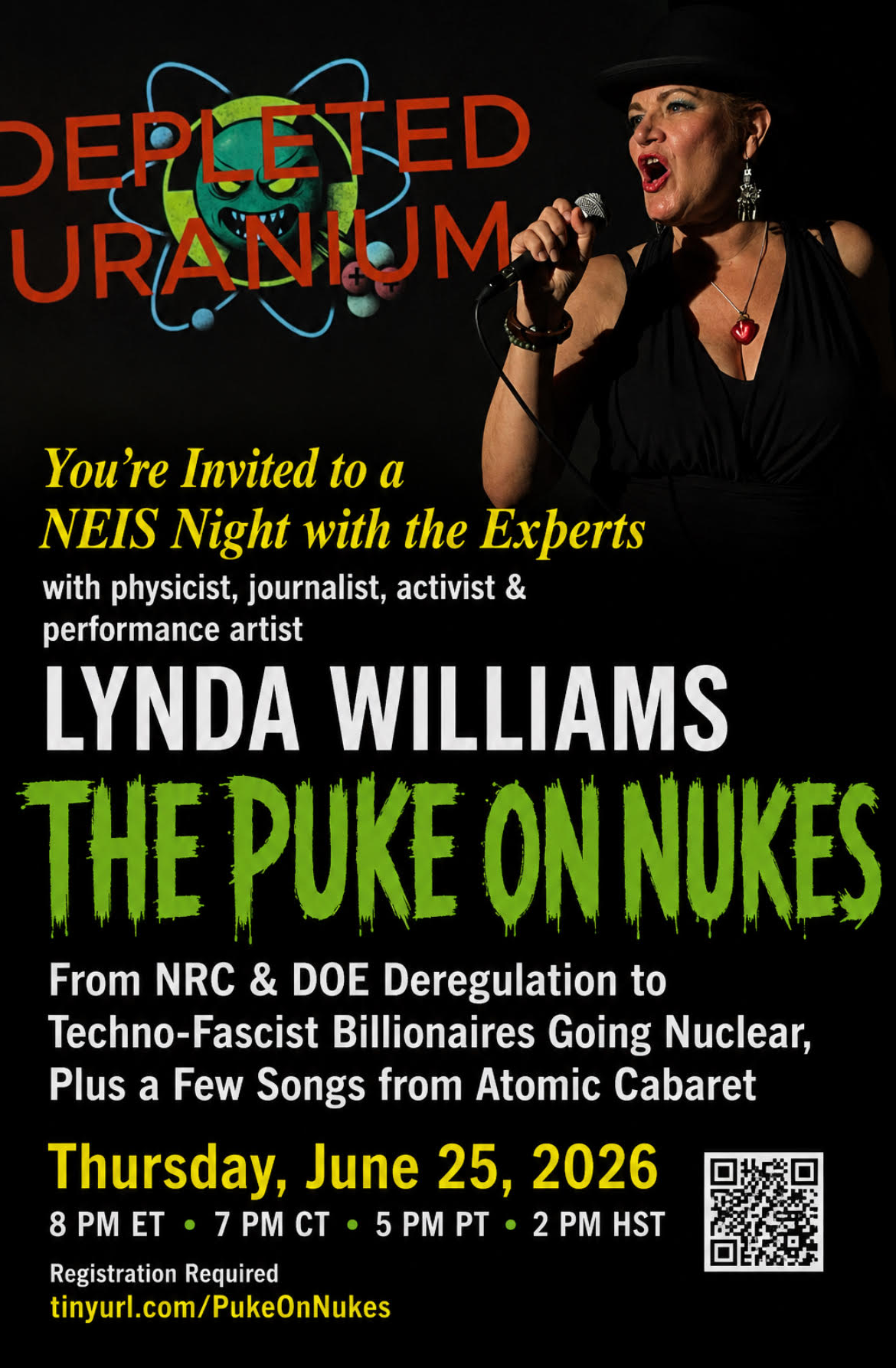
25 June- THE PUKE ON NUKES
Thursday, June 25, 2026
7pm Central Time (8pm ET, 6pm MT, 5pm PT) UTC – 5
From NRC & DOE Deregulation to Techno-Fascist Billionaires Going Nuclear, Plus a Few Songs from Atomic Cabaret REGISTER
26 June – Radiation Trainwreck at the NRC / Join the Protect Better Campaign – https://us02web.zoom.us/meeting/register/4ZlZ5_qLSHGiLSCg8FF6Bg#/registration


Cuba Is Not a Failed State – It Is a Besieged State
PETITION: “Global Appeal to Endorse Palestinian Right of Return of Refugees”
To see nuclear-related stories in greater depth and intensity – go to https://nuclearinformation.wordpress.com
-
Archives
- June 2026 (129)
- May 2026 (306)
- April 2026 (356)
- March 2026 (251)
- February 2026 (268)
- January 2026 (308)
- December 2025 (358)
- November 2025 (359)
- October 2025 (376)
- September 2025 (257)
- August 2025 (319)
- July 2025 (230)
-
Categories
- 1
- 1 NUCLEAR ISSUES
- business and costs
- climate change
- culture and arts
- ENERGY
- environment
- health
- history
- indigenous issues
- Legal
- marketing of nuclear
- media
- opposition to nuclear
- PERSONAL STORIES
- politics
- politics international
- Religion and ethics
- safety
- secrets,lies and civil liberties
- spinbuster
- technology
- Uranium
- wastes
- weapons and war
- Women
- 2 WORLD
- ACTION
- AFRICA
- Atrocities
- AUSTRALIA
- Christina's notes
- Christina's themes
- culture and arts
- Events
- Fuk 2022
- Fuk 2023
- Fukushima 2017
- Fukushima 2018
- fukushima 2019
- Fukushima 2020
- Fukushima 2021
- general
- global warming
- Humour (God we need it)
- Nuclear
- RARE EARTHS
- Reference
- resources – print
- Resources -audiovicual
- Weekly Newsletter
- World
- World Nuclear
- YouTube
-
RSS
Entries RSS
Comments RSS
 nuclear-news