Donald Trump caught in a rather serious lie about USA’s “more advanced” nuclear missile technology
 Trump tries to brag about ‘advanced’ US nuclear technology and gets immediately called out https://www.indy100.com/article/trump-nuclear-cruise-missile-advanced-technology-russia-explosion-national-security-9055336
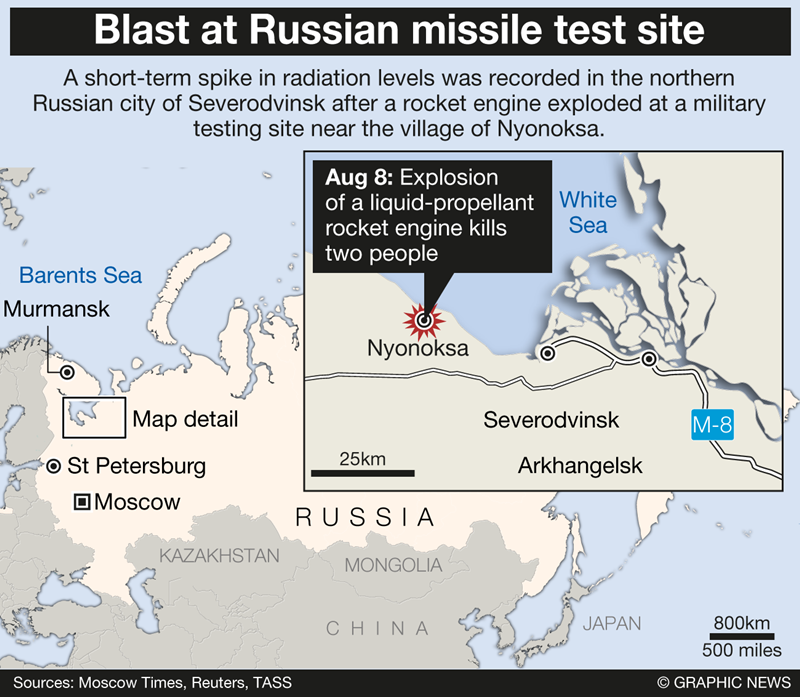
On Thursday, five Russian nuclear engineers were killed in a rocket engine explosion, which is thought to be linked to tests for a nuclear-powered cruise missile announced by Vladimir Putin in March 2018.
In his typically tactless style, Trump shared his thoughts on the explosion yesterday by claiming the US was “learning much” from the blast and had even more advanced technology.
Trump’s tweet caught the attention of national security experts because it meant one of two things:
- Trump had just revealed a secret US nuclear-powered cruise missile programme
- He was bluffing about a missile programme that the US does not have
It doesn’t exactly take, ahem, a rocket scientist to know that both of those explanations are quite bad.
For example, Michael McFaul, who worked both for the US National Security Council and as Barack Obama’s Ambassador to Russia, had no idea what Trump was talking about.
In fact, there was once a programme to develop a nuclear-powered cruise missile during the Cold War, called Project Pluto, but the US abandoned it because it was believed to be too dangerous – potentially creating missiles for which there was no known defence.
‘Dirty bomb’: Mystery Russian ‘superweapon’ kills five
An on-board reactor would give an engine almost unlimited range. In the case of a guided cruise missile, it could circle the world before receiving orders to attack from out of the blue.
But they’re not easy to control.
They operate at extremely high temperatures. They use explosive fuels, such as liquid hydrogen. And any accident could have devastating, long-lasting effects.
|
‘Dirty bomb’: Mystery Russian ‘superweapon’ kills five https://www.news.com.au/technology/innovation/military/dirty-bomb-mystery-russian-superweapon-kills-five/news-story/c3f85442bc12c6fea43cc4cf67df392e 13 Aug 19It was an explosion, played down by Russian officials — until they were forced to admit five people were dead and many more are at risk.
Jamie Seidel When an experimental missile exploded at a secret Russian base, things were immediately odd. Children from the nearby city of Severodvinsk were sent home from school. Its 185,000 residents were told to stay indoors. Doses of Iodine were distributed. All shipping was barred from the area for at least 30 days. What could cause such a reaction? How could a relatively small explosion cause such confusion? Russia’s nuclear energy agency Rosatom eventually stepped forward: It explained that a missile testing an “isotope power source for a liquid-fuelled rocket engine” had misfired. Rosatom conceded the accident on Thursday night had killed five, and three were being treated for burns. Russian officials said elite scientists Alexey Vyushin, Yevgeny Koratayev, Vyacheslave Lipshev, Sergey Pichugin and Vladislav Yanovsky — were killed during tests on a liquid propulsion system Little else is officially known. But military analysts have been speculating. Was it some sort of “dirty bomb”, with a radioactive warhead? Could it have been a failed launch from a nuclear-powered submarine? Suspicion has also fallen on one of President Vladimir Putin’s vaunted new “superweapons”. STORMY PETREL The idea of using a nuclear-reactor powered ramjet isn’t new It appears to have been thought up by Nazi rocket scientists during the dying days of World War II. With the fall of Berlin, these experts were divided up between the United States and the Soviet Union. Both nations embarked upon experimental nuclear-powered missile projects in the 1950s. It was quickly recognised the radiation-spewing technology was far too perilous to be practical. But a boisterous President Putin revealed what he called the 9M730 Burevestnik (Petrel) early last year as one of six new “superweapons”. NATO calls it the SSC-X-9 “Skyfall”. “Since its range is unlimited, it can manoeuvre as long as you want. No one in the world has anything like that,” Mr Putin boasted. “It may appear some day, but by that time we will develop something new.” The accompanying presentation showed the missile weaving its way between radar stations in the mid-Atlantic, passing around South America’s Cape Horn and worming its way up towards Hawaii. Mr Putin said the missile was successfully tested in late 2017 and was “invincible against all existing and prospective missile defence and counter-air defence systems”. “I want to tell all those who have fuelled the arms race over the last 15 years, sought to win unilateral advantages over Russia, introduced unlawful sanctions aimed to contain our country’s development: Aall that you wanted to impede with your policies have already happened,” Mr Putin declared. “You have failed to contain Russia.” But things don’t appear to be going to plan. EXPLOSIVE POTENTIAL Nuclear propulsion is promising — but also problematic. Continue reading |
India and Pakistan on Hair-Trigger Nuclear Alert Over Kashmir
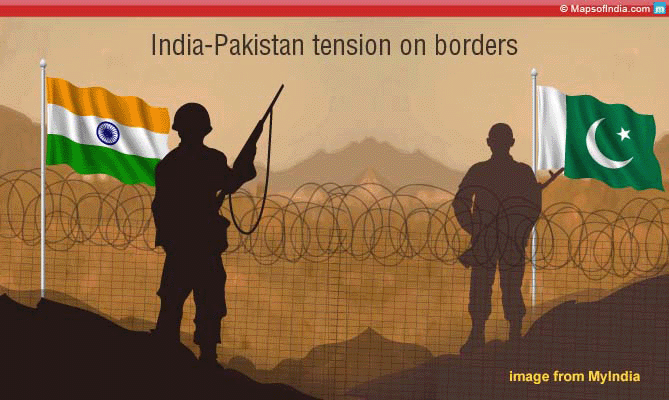 Hair-Trigger Nuclear Alert Over Kashmir, Common Dreams, India and Pakistan, where people starve in the streets, waste billions on military spending because of the Kashmir dispute. Now some of India’s extreme Hindu nationalists warn they want to reabsorb Pakistan, Bangladesh, and even Sri Lanka into Mother India. by Eric Margolis 11 Aug 19
Kashmir has been a flashpoint since Imperial Britain divided India in 1947. India and Pakistan have fought numerous wars and conflicts over majority Muslim Kashmir. China controls a big chunk of northern Kashmir known as Aksai Chin.
In 1949, the UN mandated a referendum to determine if Kashmiris wanted to join Pakistan or India. Not surprisingly, India refused to hold the vote. But there are some Kashmiris who want an independent state, though a majority seek to join Pakistan……
What makes this confrontation so dangerous is that both sides have important tactical and nuclear forces arrayed against one another. These are mostly short/medium-ranged nuclear tipped missiles, and air-delivered nuclear bombs. Strategic nuclear weapons back up these tactical forces. A nuclear exchange, even a limited one, could kill millions, pollute much of Asia’s ground water, and spread radioactive dust around the globe – including to North America. ….https://www.commondreams.org/views/2019/08/11/hair-trigger-nuclear-alert-over-kashmir
Health research on descendants of Pacific nuclear veterans.
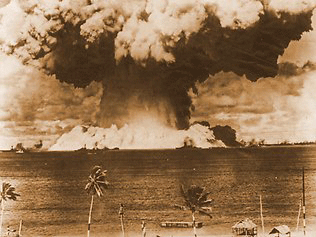 Pacific nuclear veterans’ descendants sought for study. https://www.odt.co.nz/news/national/pacific-nuclear-veterans-descendants-sought-study A search is underway for descendants of service personnel who witnessed a nuclear test at Mururoa Atoll to take part in a nationwide study.A Mururoa Nuclear Veterans Group wants all veterans who were deployed to Mururoa Atoll in 1973, and their families, to be part of a study as it’s believed their children may have been affected by their parents’ exposure to radiation.
The then Labour government sent a frigate to Mururoa Atoll, including then Cabinet Minister Fraser Colman, to protest against French nuclear testing there.
Mururoa Nuclear Veterans Group wants all people on the frigate, and their families to be part of a study as it’s believed their children may have been affected by their parents’ exposure to radiation. The group, which was established in 2013 to press the government to help families with nuclear related illnesses, had 135 members who served at the protest. Of those, 56 had children or grandchildren with unexplained medical conditions.
University of Otago associate professor David McBride, has been tasked with conducting the first medical testing of veterans’ children and grandchildren.
To establish whether genetic transfer of illnesses are related to exposure to nuclear radiation and create a registry “would be difficult but not impossible,” Mr McBride said.
Mururoa Nuclear Veterans Group vice-president, Tony Cox, was concerned veteran’s offspring could be more susceptible to conditions like leukaemia and auto-immune diseases.
“If we don’t do it now, when we die no one else is going to care. Their sickness and problems we consider is directly attributable to our service,” Mr Cox said.
“Be it Operation Grapple, Christmas Island, Mururoa, anywhere else … widows and children especially we are looking for.” The University of Otago will carry out the study from October or November this year, but a registry needs to be created for the study to work.
Mr Cox encouraged anyone with a nuclear testing background to come forward to take part in the study or identify themselves in order to be included in the registry.
It’s realistic to accept North Korea as a nuclear state
|
Accept Reality: North Korea Will Remain a Nuclear State. U.S. policy toward North Korea always has been one of second-best options. Preparing for a world with North Korea as a nuclear power is a necessity for the future. National Interest President Donald Trump has discovered that nations around the world will not readily submit to his will. His administration has increased sanctions on and made military threats against Cuba, Venezuela, Russia, Iran and North Korea. So far, none of them have surrendered to Washington. Only the Democratic People’s Republic has come to the negotiating table. The president’s willingness to talk with North Korea’s Supreme Leader Kim Jong-un deserves praise, despite complaints from the warmongering Right and partisan Left. However, his demand for instant and complete denuclearization was never realistic. Alas, negotiations in which the president placed so much hope have ground to a halt. Most recently, North Korean diplomats skipped the ASEAN summit, where Secretary of State Mike Pompeo had expected to meet with North Korean foreign minister Ri Yong-ho. Said Pompeo: “We stand ready to continue our diplomatic conversation with the North Koreans,” but, he added, “I regret that it looks like I’m not going to have an opportunity to do that while I’m here in Bangkok.” Indeed, the bilateral relationship is deteriorating. The United States and the Republic of Korea are conducting military exercises, despite bitter attacks by Pyongyang. The DPRK is conducting short-range missile tests, embarrassing the Trump administration and unnerving both the ROK and Japan. The president continues to express his confidence in Kim’s commitment to denuclearize, but the former might find that position harder to defend in the face of Democratic Party attacks as the 2020 presidential campaign accelerates.The North is forever unreasonable and obstructionist. That is unlikely to change. But in this case Pyongyang’s position is logical, reflecting the interests of the Kim family regime. After all, Kim is supposed to abandon his leverage in return for vague promises of positive benefits in the future. However, the United States routinely coerces governments on its enemies list, such as Serbia, Afghanistan, Iraq and Libya. Notably, none of those countries had a nuclear deterrent…….
the president should clearly reject belief that the alternative to denuclearization is war. The threat of attack, if credible, might offer negotiating leverage, but also would raise tensions and make the North more likely to preempt military action it believed to be imminent. After all, given United States conventional superiority, the North must use or quickly lose its military capabilities and would be forced to respond almost instantly to any assault by Washington. …..
a DPRK nuke would not really threaten America. There is no evidence that Kim or anyone else in Pyongyang’s ruling elite is suicidal…….https://nationalinterest.org/feature/accept-reality-north-korea-will-remain-nuclear-state-72296
|
|
Another expensive nuclear weapons race about to take off
Are We Headed for Another Expensive Nuclear Arms Race? Could Be. https://www.nytimes.com/2019/08/08/world/europe/arms-race-russia-china.html, By Steven Erlanger,Aug. 8, 2019 BRUSSELS — After the recent death of the treaty covering intermediate-range missiles, a new arms race appears to be taking shape, drawing in more players, more  money and more weapons at a time of increased global instability and anxiety about nuclear proliferation.
 The arms control architecture of the Cold War, involving tens of thousands of nuclear weapons, was laboriously designed over years of hard-fought negotiations between two superpowers — the United States and the Soviet Union. The elaborate treaties helped keep the world from nuclear annihilation.
Today, those treaties are being abandoned by the United States and Russia just as new strategic competitors not covered by the Cold War accords — like China, North Korea and Iran — are asserting themselves as regional powers and challenging American hegemony.
The dismantling of “arms control,” a Cold War mantra, is now heightening the risks of a new era when nuclear powers like India and Pakistan are clashing over Kashmir, and when nuclear Israel feels threatened by Iran, North Korea is testing new missiles, and other countries like Saudi Arabia are thought to have access to nuclear weapons or to be capable of building them.
The consequence, experts say, is likely to be a more dangerous and unstable environment, even in the near term, that could precipitate unwanted conflicts and demand vast new military spending among the world’s biggest powers, including the United States.
“If there’s not nuclear disarmament, there will be proliferation,” said Joseph Cirincione, a nuclear analyst and president of the Ploughshares Fund, a global security foundation. “If big powers race to build up their arsenals, smaller powers will follow.”
“As long as the big boys cling to their toys, others will want them,” he added, quoting the former head of the International Atomic Energy Agency, Mohamed ElBaradei.
Not only are the big boys clinging to them, there are more big boys now, and they want more toys. Continue reading
China’s nuclear policy
|
Paving the Way for a Shift? Evidences from China’s Nuclear Documents, International Policy Digest, The historical roots of the Chinese nuclear doctrine dates back to the traumatic experiences of the Korean War and the Taiwan Strait crises during the 1950s when the United States, then bound to South Korea and Taiwan, kept on the table a nuclear option against Beijing. After testing their first A-bomb in southern Xinjiang in October 1964, Beijing stated that, given the power of annihilation, “China will not at any time or under any circumstances employ atomic weapons first.” The no first use (NFU) policy is, then, congenitally rooted in China’s nuclear doctrine……… The main concern for the U.S. and its allies in Asia is whether China is modernizing its nuclear arsenal solely to secure a credible and effective second-strike capacity or if it is overhauling its nuclear policy toward a completely new approach. If the above-analyzed documents were meant to pave the way for more meaningful shift away from the traditional Chinese nuclear posture, then, Asia’s security environment would be significantly altered and global peace could be sorely tested. https://intpolicydigest.org/2019/08/09/paving-the-way-for-a-shift-evidences-from-china-s-nuclear-documents/
|
|
|
It kills slowly, painfully – A Nagasaki survivor speaks about nuclear radiation
Nagasaki nuclear bomb survivor warns , calls for negotiation
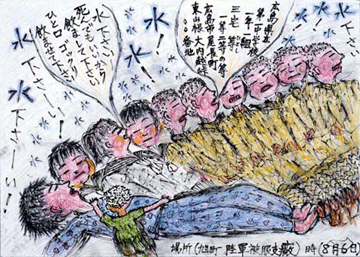 It kills slowly, painfully’: Nagasaki atomic explosion survivor has a message for US, North Korea http://www.hindustantimes.com/world-news/it-kills-slowly-painfully-nagasaki-atomic-explosion-survivor-has-a-message-for-us-north-korea/story-BB2nANm1xGmNZ4x73Gx32K.html
Nobu Hanaoka was only 8-months-old when the US dropped Fat Man — a Plutonium bomb — on the Japanese city of Nagasaki on August 9, 1945. Sep 25, 2017 HT Correspondent Hindustan Times, New Delhi
“Does he have all five fingers?” This was a Nagasaki atomic bomb survivor’s first question to the doctor when his son was born.Nobu Hanaoka, 73, says he was relieved when the doctor replied that his son was in perfect health. “I had hoped that the radiation did not affect the child,” Hanaoka told Al Jazeera.
Hanaoka was only eight months old when the US dropped ‘Fat Man’ — a Plutonium bomb — on the Japanese city of Nagasaki on August 9, 1945, killing about 74,000 people. Three days before, ‘Little Boy’ — the first-ever atomic bomb, dropped on Hiroshima — had claimed 140,000 lives.
Hanaoka — clad in a simple, grey coat, has a message for the United States and North Korea as tensions escalate between the two countries over the possibility of a nuclear war.
“This is the kind of weapon that doesn’t just kill. It kills indiscriminately. It kills slowly and painfully.”
“And it shouldn’t be allowed on the surface of the Earth,” the survivor says after a pause.
“We were not even in the city of Nagasaki. We were outside. And yet the radiation that came from the bombing went far beyond the city limits,” Hanaoka said, before explaining the three ways an atomic bomb can kill.
Hanaoka’s mother and sister died due to radiation when he was six, he says, adding that he overheard the doctor telling his father the boy wouldn’t live to see his 10th birthday. “So I knew that I was not going to live long,” Hanaoka says in the video.
The atomic bomb survivor says he was always concerned for his health and feared he was dying when he got a simple cold. He also had survivor’s guilt, a mental condition in which a person feels remorse for surviving a traumatic event when others did not. “Why did my sister and mother, who were wonderful people… beautiful and smart and gentle, and they had to die.”
“And yet, I, who am not unworthy, am still alive?”
“I want all nations to come together and start finding a way of eliminating nuclear weapons altogether,” Hanaoka tells Al Jazeera after warning that there will be millions of casualties if either the US or North Korea is attacked with radioactive weapons.
North Korea’s foreign minister Ri Yong Ho told the United Nations General Assembly last week that targeting the US mainland with its rockets was inevitable after “Mr Evil President” Donald Trump called Pyongyang’s leader a “rocket man” on a suicide mission.
Trump, too, dialled up the rhetoric against North Korea over the weekend, warning Ho that he and its leader Kim Jong Un “won’t be around much longer” as Pyongyang staged a major anti-US rally.
The North had threatened to “sink” Japan into the sea and fired two missiles over the northern island of Hokkaido in the space of less than a month. Pyongyang said this month it had carried out an underground test on a hydrogen bomb estimated to be 16 times the size of the US bomb that destroyed Hiroshima in 1945. It was its sixth and largest nuclear test.
Survivors of Hiroshima-Nagasaki — the only two nuclear attacks in the history of mankind — warned of the threat of atomic weapons in a photo essay by the Time magazine last month. It quoted another survivor Fujio Torikoshi (86) as saying all he wanted was to forget the bombing. “We cannot continue to sacrifice precious lives to warfare. All I can do is pray – earnestly, relentlessly – for world peace.”
America’s nuclear-weapons policy isn’t what you think—it’s much worse
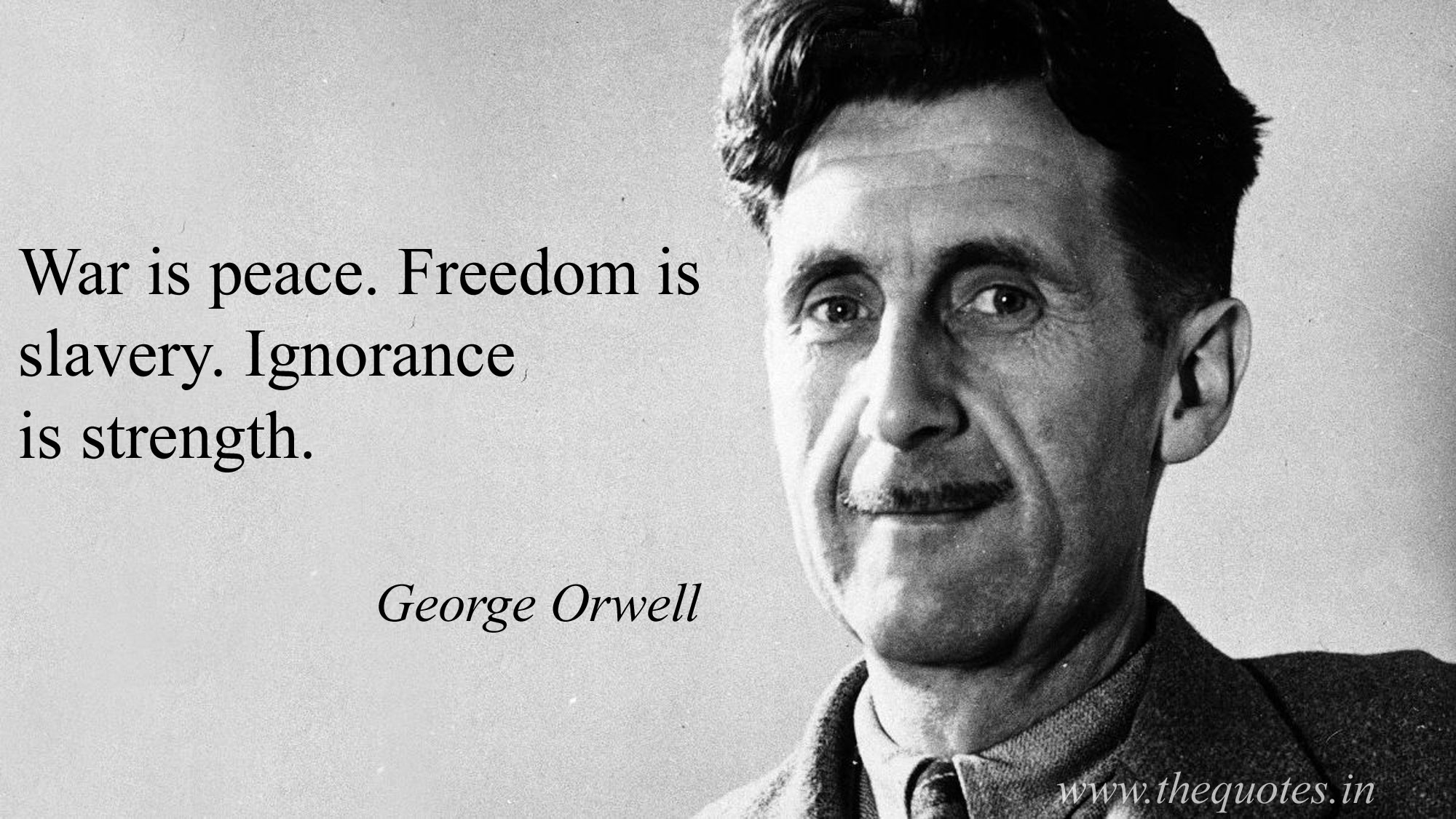 The US Strategic Command, which was created in the post-Cold War period to manage US nuclear strike capabilities, has even brought back the Orwellian motto of its predecessor, the Strategic Air Command: “Peace is our Profession.”
many experts consider missile defense destabilizing: It doesn’t get you defense—it gets you a new arms race.
Where does this path lead? If history is a guide: nowhere good.
The best-case scenario is that we get out of this era without any nukes going off, having spent our money and resources on weapons that forever sat in silos. That’s money we won’t be able to spend on improving the social safety net, on improving medical care, on basic scientific and medical research, on energy security, on infrastructure upgrades, or on mitigating climate change.
America’s nuclear-weapons policy isn’t what you think—it’s much worse https://qz.com/1680411/us-and-russia-are-starting-another-nuclear-war/, By Alex Wellerstein August 6, 2019
In the chaos that currently makes up the day-to-day of American foreign policy—a trade war here, tearing up international agreements and treaties there—it can be easy to miss the larger developments.
One of these, which occasionally rears its head in a frightened headline, is that there is a new nuclear arms race well under way.
In the United States, we typically get this in the form of news about the capabilities of other countries: Russia is developing a “doomsday torpedo,” China is developed “hypersonic missiles,” and so on. Whether these specifics are real or hype (experts are divided about the reality of the “doomsday torpedo”), they are part of a broader reality:
We’re back in an arms race. But it’s not a new one. Continue reading
How the viewing public was ‘protected’ from seeing what the Hiroshima and Nagasaki nuclear bombing did to people
Hiroshima and Nagasaki on the cutting room floor https://thebulletin.org/2019/08/hiroshima-and-nagasaki-on-the-cutting-room-floor/ By Thomas Gaulkin, August 5, 2019 Seventy-four years after nuclear weapons were first and last used in war, it can be challenging to conceive of the devastation they cause. But even in the immediate months after the atomic bombs were dropped on Hiroshima and Nagasaki in August 1945, news accounts offered a view of ingenuity and destruction that often elided the human cost.
The newsreels below [on original] were mainly screened to audiences in 1946 and 1947 and detail the destructive force of the explosions almost entirely through excited accounts of the structural damage to the cities. There’s occasional mention of the lost city populations and the scientific knowledge to be gained from studying their casualties, but hardly any description of what people actually suffered, let alone personal accounts. It’s instructive to look at and listen to these reports today, and contemplate what is missing.
The 12-minute reel below was produced by the US War Department in 1946. “Tale of Two Cities” makes selective use of film that was confiscated from a Japanese filmmaker, Akira Iwasaki—though you wouldn’t know that from the narration, which boasts that “army cameramen have found and filmed pictorial evidence that tells in twisted steel and stone the effect of death-dealing atomic power.” (Some twenty years later, historian Eric Barnouw obtained more of Iwasaki’s footage and produced a remarkably different narrative that documented the horrible physical impact of the attacks on Hiroshima’s citizens.)
Contrasted with the triumphant tone of the news/propaganda made for 1940s audiences, silence changes everything. Made public only decades later, the two films below —one beginning with footage of wounded victims, the other, a full-color glimpse of survivors picking up the pieces of the ruined city—report what those above do not, without a single word.
Nagasaki And Hiroshima (1945)
Harrowing Accounts from Hiroshima Survivors
Hiroshima nuclear bombing, and the birth of the Doomsday Clock
 Hiroshima atomic bomb: The US nuclear attack that changed history, Aljazeera, 7 Aug 19, Hiroshima atomic bomb: The US nuclear attack that changed history, Aljazeera, 7 Aug 19,
As Japan marks 74th anniversary of world’s first nuclear bomb attack, we examine the events that shaped history. Japan has marked 74 years since a US atomic bomb attack that razed the city of Hiroshima to the ground at the end of World War II. What happened in Hiroshima?On August 6, 1945, at about 8:15am Japanese time, the US aircraft Enola Gay dropped an untested uranium-235 gun-assembly bomb nicknamed “Little Boy” over Hiroshima. The devastation was unlike anything in the history of warfare, ushering in the era of weapons of mass destruction. Hiroshima was immediately flattened. The resulting explosion killed 70,000 people instantly; by December 1945, the death toll had risen to some 140,000. The radius of total destruction was reportedly 1.6km. “The impact of the bomb was so terrific that practically all living things – human and animal – were literally seared to death by the tremendous heat and pressure set up by the blast,” Tokyo radio said in the aftermath of the explosion, according to a report by The Guardian in August 1945. “All the dead and injured were burned beyond recognition. Those outdoors were burned to death, while those indoors were killed by the indescribable pressure and heat.” But the damage did not end there. The radiation released from the explosion caused further suffering. Thousands more died from their injuries, radiation sickness and cancer in the years that followed, bringing the toll closer to 200,000, according to the Department of Energy’s history of the Manhattan Project. ….. The bombings were as questionable back then as they are today. Six out of seven five-star US generals and admirals at the time felt there was no need to drop the bomb because Japanese surrender was imminent. ……. The power of the atomic bomb would usher a change in geopolitics that still reverberates to this day, with several countries currently vying to acquire this technology.
|
|
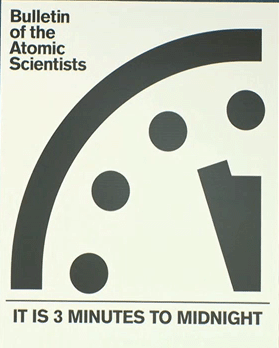
The saga of Rocky Flats Nuclear Weapons Plant AND what happened to the Grand Jury documents??

Rocky Flats Nuclear Weapons Plant Closed Long Ago, but Is Still a Hot Topic https://www.westword.com/news/rocky-flats-nuclear-plant-shut-down-thirty-years-ago-but-is-still-a-hot-topic-11437949, | AUGUST 7, 2019
Colorado almost had its own Chernobyl.
That’s what then-congressman Jared Polis told the U.S. House of Representatives on May 12, 2009, the fortieth anniversary of a fire at what was then called the Rocky Flats National Munitions Plant, sixteen miles upwind of Denver.
“I rise today to commemorate one of the most fateful days in the history of the State of Colorado, the day the Rocky Flats Nuclear Weapons Plant outside of Boulder nearly became America’s own Chernobyl, some thirty years before that terrible accident in the Ukraine,” Polis told his colleagues. “On Mother’s Day of that year, a fire broke out amid the glove boxes in Building 776, where plutonium spheres were being manufactured for use as cores for some of the most powerful weapons in human history. The fire quickly spread throughout the facility, as many of the fire alarms had been removed to make room for more production. It is estimated that between 0.14 and 0.9 grams of plutonium 239 and 240 were released before a heroic band of perhaps forty firefighters were able to control and eventually douse the fire. Those firefighters faced the immense decision of whether to battle the blaze with water, which could have set off a chain reaction, with the resulting explosion literally contaminating the entire Denver metropolitan area. Luckily for us all, they chose correctly.
“Still, plutonium was released into the environment from that accident, through the air vents in the roof of the building and via firefighters extinguishing it. Thousands of Coloradans were exposed, although how many we’ll never know. The firefighters, of course, were exposed most severely, and everyone nearby faced greatly increased risks of serious disease. Indeed, many of those involved have since contracted and died from cancers and other conditions tied to radiation exposure.”
Unlike Chernobyl, the site of a massive nuclear explosion on April 26, 1986, that exposed at least half a million Russians to radiation, decimated the land for miles around and inspired HBO’s Chernobyl that educated a new generation to collateral damages of the nuclear age, Rocky Flats was not a nuclear power plant. In fact, Colorado’s only nuclear-generating facility, Fort St. Vrain near Platteville, had its own problems from when it began generating electricity in 1976 and was shut down entirely in 1989.
By then, what became known as the Rocky Flats Nuclear Weapons Plant had been in operation for almost three decades; it was a manufacturing facility that created plutonium triggers for this country’s nuclear arsenal. But it still dealt with one of the most toxic elements on the planet, one with a half-life of 24,000 years, as well as many deadly chemicals. By the time of the 1969 Rocky Flats fire, the plant had been manufacturing those triggers for sixteen years, largely in secret.
Rocky Flats was not Chernobyl. But what happened there was bad enough — though just how bad may never be known. Documents about the plant, like some of the plutonium that was processed there, have a way of disappearing.\
PROJECT APPLE
By then, scientists had realized that they’d misread the wind patterns when siting Rocky Flats; they’d relied on measurements taken at Stapleton Airport northeast of Denver, without accounting for how winds shifted as they came over the mountains and through the canyons. Rather than being safely out of the path of any plutonium release, Denver was at ground zero, sixteen miles downwind. Even so, residents were not warned of potential dangers after the fires.
At the time, Dr. Carl Johnson, head of the Jefferson County health department, was revealing his own concerns about the evils of Rocky Flats. He released studies suggesting that Denver’s overall cancer rates were higher than expected, and the rates around Rocky Flats higher still. Property near the plant set for the development of 10,000 homes exceeded the state’s plutonium soil contamination standard by a factor of seven, he reported. As a result, federal housing officials directed realtors to warn prospective homebuyers who wanted government loans in order to purchase houses in the area that there could be potential liabilities.
In 1981, Johnson was fired by Jefferson County. The feds soon removed its directive to realtors.
SPILLED SECRETS
In the first week of August 1989, two dozen citizens from across Colorado were sworn in as members of Special Grand Jury 89-2. The grand jurors met for a week every month for over two years, and after hearing from dozens of witnesses and going through hundreds of boxes of documents, they were prepared to consider charges not just for workers at the plant, but for their federal overseers. “We didn’t care who they were or how high up the chain of command they were,” one grand juror later told Westword.
It wasn’t Chernobyl, but the story about Rocky Flats exploded just the same.
CLEANING UP
After the raid, Rocky Flats never made another nuclear trigger. The feds and Rockwell agreed to an early termination of the Rockwell management contract in September 1989, the day after the company filed a civil suit against the DOE, the EPA and the Department of Justice, arguing that the feds had failed to provide proper waste-disposal sites for radioactive materials. A week later, Rocky Flats was named a Superfund site, and EG&G signed a contract to operate the facility starting January 1, 1990. By then, the focus had been changed from nuclear-materials production to cleanup, and most of the 5,000-plus employees stayed on to do the job. Among other things, nearly 3,600 containers of pondcrete and saltcrete — 4.3 million pounds of low-level solidified waste that had been packaged like barrels, until they started to crumble and leak (the grand jurors had heard considerable testimony about that failed system) — were moved, and the solar ponds where waste had been stored were drained. Plutonium located in the ducts, which Stone had warned about, was removed.
As the story of the Rocky Flats grand jury became national news, Congress held hearings to determine whether justice had been denied. The hearings made headlines, but secured nothing more than a promise of more transparency from the DOE. Foreman McKinley even ran for Congress, in hopes that he’d be able to tell the full story from the floor of the House of Representatives. (Although that attempt failed, he ultimately served in the Colorado Legislature and co-authored a book titled The Ambushed Grand Jury…and thus far has avoided any contempt-of-court charges.)
In 1995, EG&G staff and the DOE held a Rocky Flats Summit with 150 community activists, regulators, state officials and members of citizen oversight committees to discuss cleanup plans, including reducing the risk of plutonium to site workers and the public, and deferring some environmental restoration and cleanup in order to reduce that risk. When EG&G declined to sign up for a second round, Kaiser-Hill took over the project. The draft Rocky Flats Vision and Rocky Flats Cleanup Agreement were released in March 1996, four years after the Justice Department had made its deal with Rockwell; Governor Roy Romer signed them that June. What had been predicted to be a cleanup project that would take decades and tens of billions of dollars was put on the fast track.
After nearly ten years and $7.7 billion, the remediation job was declared complete in 2005. More than 800 structures had been decontaminated and demolished, including five major plutonium facilities and two major uranium facilities. While much of the low-level radioactive waste was shipped to other disposal sites, the most contaminated rubble was buried far below the ground in the Central Operable Unit: 1,308 acres at the center of the facility, where most of the manufacturing had been done, which would be declared off-limits forever. The 5,000-plus acres around the COU, in the Peripheral Operable Unit, were turned over to the U.S. Fish and Wildlife Service in 2007 to revamp into a wildlife refuge, much as the Rocky Mountain Arsenal had been two decades earlier.
Even though the grand jurors were still silenced, the secrets of Rocky Flats seeped out in other ways. Workers who’d become sick sued the government, and public officials took up their cause. Nearby homeowners who’d suffered bad health and other losses filed a class-action suit against Rockwell and Dow; their case was finally heard in U.S. District Court Judge John Kane’s courtroom, where former FBI agent Lipsky testified as to what he’d found at the plant. Despite the testimony about problems on those properties, houses were popping up along the southern border of Rocky Flats, and some new homeowners started to wonder if they’d bought more than they bargained for. And as plans to finally complete the northwest segment of the beltway around Denver progressed, municipalities began questioning whether construction of the Jefferson Parkway, set to go along the east side of Rocky Flats, would really be safe.
As the date of the Rocky Flats National Wildlife Refuge’s opening neared, activist groups filed suit to keep the gates closed. Last September, Congressman Polis made a last-second request to Ryan Zinke, then-secretary of the Department of the Interior, which oversees Fish and Wildlife, to consider “my constituents’ request that the DOI complete further testing of air, water, and soil at the Refuge site by March 2019, and that until further testing has been completed, the Refuge site remain unopened to the public.”
Although Polis never heard from Zinke, he got his answer: The refuge opened to the public on September 15, 2018 (the suits filed to prevent its opening are still pending). But even those who have no concerns about the refuge’s safety were taken aback last November when a British company proposed fracking alongside Rocky Flats: While cleanup experts had considered the effects of water runoff, and burrowing animals, and even prairie fires, they’d never considered that drilling operations would bore down and then up into the property from the sides. The proposal was pulled, and last month Representative Joe Neguse, who took over the first congressional seat when Polis was elected governor, introduced legislation that would prohibit oil, gas and mineral drilling beneath federally owned Superfund sites, such as Rocky Flats.
Meanwhile, the debate over whether the surface is really safe continues.
In January, attorney Pat Mellen decided to try a different tack. On behalf of seven groups — the Alliance of Nuclear Workers Advocacy Groups, Rocky Flats Downwinders, Candelas Glows/Rocky Flats Glows, Environmental Information Network, Rocky Flats Neighborhood Association, Rocky Flats Right to Know and the Rocky Mountain Peace and Justice Center — she filed a motion asking that materials considered by Colorado’s first-ever special grand jury be released. “The documents gathered by the Grand Jury and now under seal are a unique resource that provides the detailed evidence of whether specific locations or hot spots of unremediated or undiscovered hazardous substances must outweigh a site-wide ‘safe’ determination made for other purposes,” she argued.
MISSING IN ACTION
And then on July 24, Mellen received an email from Kyle Brenton, assistant U.S. Attorney in the U.S. Attorney’s office where Mike Norton had negotiated the Rockwell deal thirty years before, that the grand jury documents were missing. “Can you imagine that?” says McKinley. “The Justice Department has a long history of losing stuff. They lost all kinds of stuff…plutonium, reports.”
And some things never change, he notes. When the grand jury was sent home back in 1992 and its files first sealed, the head of the Department of Justice was William Barr. Today, Barr is again the attorney general.
Lipsky, who was transferred to the FBI’s Los Angeles gang unit not long after his investigation of Rocky Flats, is now a private investigator who continues to push for the release of the real story about Rocky Flats. When he heard that the documents were missing, “the only thing I could do was laugh,” he says. Brenton’s email estimates that “60-some boxes are not physically in our office space now.” Lipsky’s agents filled many times that many boxes with documents seized during the raid at Rocky Flats.
According to Brenton, his office had custody of the requested documents until at least 2004. He’s now going through boxes of documents from linked cases, such as whistleblower Stone’s suit against Rockwell, and the Cook class-action litigation that finally found victory and a $375 million settlement in Kane’s courtroom, to see if they were misfiled.
“It is incidents like this that continue to foster uncertainty and fear within the communities that are the most impacted,” Polis’s office says of the missing grand-jury documents. “Our administration is committed to government transparency and public access to information. That’s why our Department of Public Health and Environment recently requested that these records be unsealed for the public.”
For a time, there was a stash of grand jury documents at U.S. District Court Judge Richard Matsch’s courtroom. At one point, the grand jurors had petitioned Matsch to allow them to tell their story; that request was denied, and Matsch passed away this spring. Judge Finesilver had relevant documents, too; before he died in 2006, he gave 180 boxes of records to the Denver Public Library, with the stipulation that they be kept closed until 2009.
That August, a librarian began cataloguing the contents, then ran across two boxes holding various forms of the grand jury report marked “Not for public release.” He called the clerk of the U.S. District Court to ask if the documents could be made public. Instead, the clerk picked up the boxes and demanded that anything else that surfaced involving Rocky Flats be sent to the court. The missing grand jury materials are not the only documents devoted to Rocky Flats, of course. The Colorado Department of Public Health and Environment still has voluminous files, including a giant binder detailing all the different chemicals once used at the Rocky Flats Nuclear Weapons Plant. For a time, Front Range Community College hosted a Rocky Flats Reading Room, though much of the materials are now in the University of Colorado archives, which has a “wealth of information,” according to David Abelson, executive director of the Rocky Flats Stewardship Council. “Walling off these documents from public view creates an impression that there’s a lack of information regarding management of the site.”
That impression is misguided, he thinks: His group includes representatives from most of the local governments around Rocky Flats, all but one of which supports recreation at the refuge. Still, in June the council passed a resolution against allowing fracking near the plant, and it’s keeping an eye on three studies being done of environmental conditions at the refuge, the results of which are due this fall. The current samples will be compared to historic samples…if those can be found.
For now, Mellen is drilling down into the case of the missing documents. On July 31, she filed a motion asking the judge to give the U.S. Attorney’s Office thirty days to find them. “I actually believe it’s a bigger number of boxes than that,” she says of Brenton’s estimate. “But right now, I’d be happy with that.”
Rocky Flats isn’t Chernobyl, but this could still blow up.
Malaysian President urges Japan to lead the world in rejection of nuclear weapons
Putin And Trump are ‘normalising’the increasing numbers, and the use, of nuclear weapons
 The more that Putin and Trump revalidate the role of nuclear weapons in strengthening national security, the more they normalise the discourse of nuclear weapons use and embolden calls for nuclear weapon acquisition in other countries.
A nuclear world in disarray https://www.aspistrategist.org.au/a-nuclear-world-in-disarray/ 7 Aug 2019, Ramesh Thakur We are in a uniquely dangerous period in the atomic age. Geopolitical tensions have spiked in Europe, in the Middle East, on the subcontinent and in East Asia. The nuclear arms control architecture is fraying and crumbling, but no negotiations are underway to reduce global nuclear stockpiles.
A hostile international security environment, the proliferation of nuclear weapons and the emergence of new space, cyber and AI technologies have increased the risk of accidental or deliberate use of nuclear weapons. The growing strategic risks and uncertainty in turn fuel the vicious cycle of renewed interest among US allies in a nuclear deterrent as a hedge against receding US primacy and reliability.
At the conclusion of a United Nations conference on 7 July 2017, 122 states parties of the Nuclear Nonproliferation Treaty adopted a new Treaty on the Prohibition of Nuclear Weapons. All nine countries that possess the bomb (China, France, India, Israel, North Korea, Pakistan, Russia, the UK and the US) boycotted the conference and rejected the treaty. They have done their very best since then to invalidate the concerns behind the drive to adopt it.
The 2018 US nuclear posture review will guide the Trump administration’s nuclear decision-making, modernisation, targeting and signalling. With an expansive vision of the role of nuclear weapons, its threefold effect is to enlarge the US nuclear arsenal, lower the threshold for the use of nuclear weapons, and broaden the contingencies in which the threat of nuclear weapons can be wielded as a tool of diplomatic coercion.
The 2015 Iran nuclear deal established a robust dismantlement, transparency, inspections and consequences regime. Last year, President Donald Trump pulled the US out of the agreement and reimposed sanctions on Iran, despite its still being in compliance with its obligations. That put Washington in breach of the multilaterally negotiated and UN-endorsed Joint Comprehensive Plan of Action. Trump’s decision will have reconfirmed North Korea’s belief that the one thing standing between its security and a US attack is the bomb. It has also caused the recent surge in tensions in the Persian Gulf.
On 1 February, Trump decided to suspend US participation in the Intermediate-Range Nuclear Forces Treaty—an arms control agreement with Russia that contributed to the end of the Cold War and underpinned European strategic stability for three decades. It lapsed on 2 August. Trump has also rebuffed Russian overtures to discuss a five-year extension of New START beyond 2021. His second summit with North Korea’s leader Kim Jong-un in Hanoi in Februarycollapsed without agreement and Pyongyang now seems to be expanding its nuclear arsenal. Still, at least the US and North Korea are engaged in high-level and working-level discussions and the fear of an imminent war has faded.
The altered US nuclear posture will have cascading effects on the arsenals, doctrines and deployments of other nuclear-armed states. On 1 March 2018, Russian President Vladimir Putin boasted of a new array of invincible nuclear weapons that can penetrate any defences anywhere in the world. He noted the US had not heeded Russian warnings when it pulled outof the 1972 anti-ballistic missile treaty in 2002. ‘You didn’t listen to our country then. Listen to us now’, he said. Putin’s language was reminiscent of the Cold War.
After the US–Russian suspensions of the INF Treaty, Putin warned that Russia could place hypersonic nuclear weapons on submarines deployed near US waters to match the time in which US missiles based in Europe could strike Russia. He also warned of a radioactive tsunami that could be triggered in densely populated coastal areas by a new nuclear-powered underwater drone dubbed ‘Poseidon’.
The more that Putin and Trump revalidate the role of nuclear weapons in strengthening national security, the more they normalise the discourse of nuclear weapons use and embolden calls for nuclear weapon acquisition in other countries. In Australia, this debate has been restarted most recently by Hugh White.
Meanwhile, the official newspaper of the People’s Liberation Army has called for China to strengthen its nuclear deterrence and counterstrike capabilities to match the US’s and Russia’s developing nuclear strategies. China is upgrading its relatively small nuclear arsenal. It rejected Germany’s request to save the INF Treaty by agreeing to trilateralise it, emphasising that its warheads in the low hundreds cannot be compared with US and Russian arsenals in the several thousands.
India and Pakistan are enlarging, modernising and upgrading stockpiles, while investing in battlefield tactical nuclear weapons and systems to counter them. The INF Treaty was the first disarmament agreement of the nuclear age. In an unwelcome symmetry, on 26 February we witnessed the first airstrikes by one nuclear-armed state against another, and the two engaged in a deadly dogfight above the skies of Kashmir the next day. Another India–Pakistan war is a question of when, not if.
The US, described by former Canadian disarmament ambassador Paul Meyer as ‘the high priest of nuclear orthodoxy’, has left its allies looking rather foolish. Washington had led them in dismissing the nuclear weapon ban treaty as impracticable virtue-signalling, instead extolling the decades-long efforts at step-by-step measures to advance the cause of nuclear disarmament that had seen global stockpiles plummet by over two-thirds from their Cold War peak.
When unkind critics noted that the only steps that were visible were leading backwards, Washington responded by launching a new initiative on ‘creating the conditions for nuclear disarmament’. Lest some conditions be specified and met, however, Washington suddenly embraced the more nebulous and inherently subjective language of ‘creating an environment for nuclear disarmament’.
During the Cold War, Soviet citizens who kept to the straight path as the communist party veered sharply to the left or right were denounced as ‘deviationists’. For decades, US allies have been singing from the same hymn book, joining it in the insistence that the step-by-step, progressive approach was the only realistic path to nuclear disarmament. Instead of embracing the new orthodoxy from their fallible high priest, they should do a hard-nosed analysis of the merits of the changing risk–reward calculus of integrating more deeply with the nuclear alliance structure or joining the majority of countries in trying to rid the world of nuclear weapons.
Hiroshima Day – a time to review America’s “presidential first use” nuclear weapons policy

Hiroshima, Nagasaki, and no first use https://thebulletin.org/2019/08/hiroshima-nagasaki-and-no-first-use/ By Elaine Scarry, Zia Mian, August 5, 2019 On August 6 and August 9, we again take time to contemplate the US atomic bombing of Hiroshima and Nagasaki in 1945. The arrangements that permitted a US president to drop an atomic bomb on tens of thousands of civilians continue to be in place today.
The United States has a “presidential first use” policy which means that President Trump, acting alone, can issue the order for a nuclear strike, even if our own country is not under nuclear attack. This concern has been raised in the Democratic Party presidential primaries for the 2020 election, with some candidates arguing for a shift to a US policy of no first use of nuclear weapons. There is already legislation pending in Congress to this effect.
A conference held at Harvard in 2017, “Presidential First Use of Nuclear Weapons: Is it Legal? Is it Constitutional? Is it Just?” brought together a US congressman, a US Senator, a former missile launch officer, several constitutional law professors, a former secretary of defense, a physicist, and several philosophers to address this question as it applies to the United States, Russia, China, India, Pakistan, and North Korea.
Youtube videos of all their lectures can be found here. An edited transcript of some of the talks at the conference is available here.
1 This Month

Protect Sazan Island from the Trump family! https://secure.avaaz.org/campaign/en/protect_sazan_island_from_the_trump_family_loc/?bqFCVab&v=174511&cl=22707147157&_checksum=5e9dde668860e8231c33699735e16a1fbf22ab2cb01da50c999fe8732b9775ef&utm_source=email&utm_medium=blast_email&utm_campaign=174511
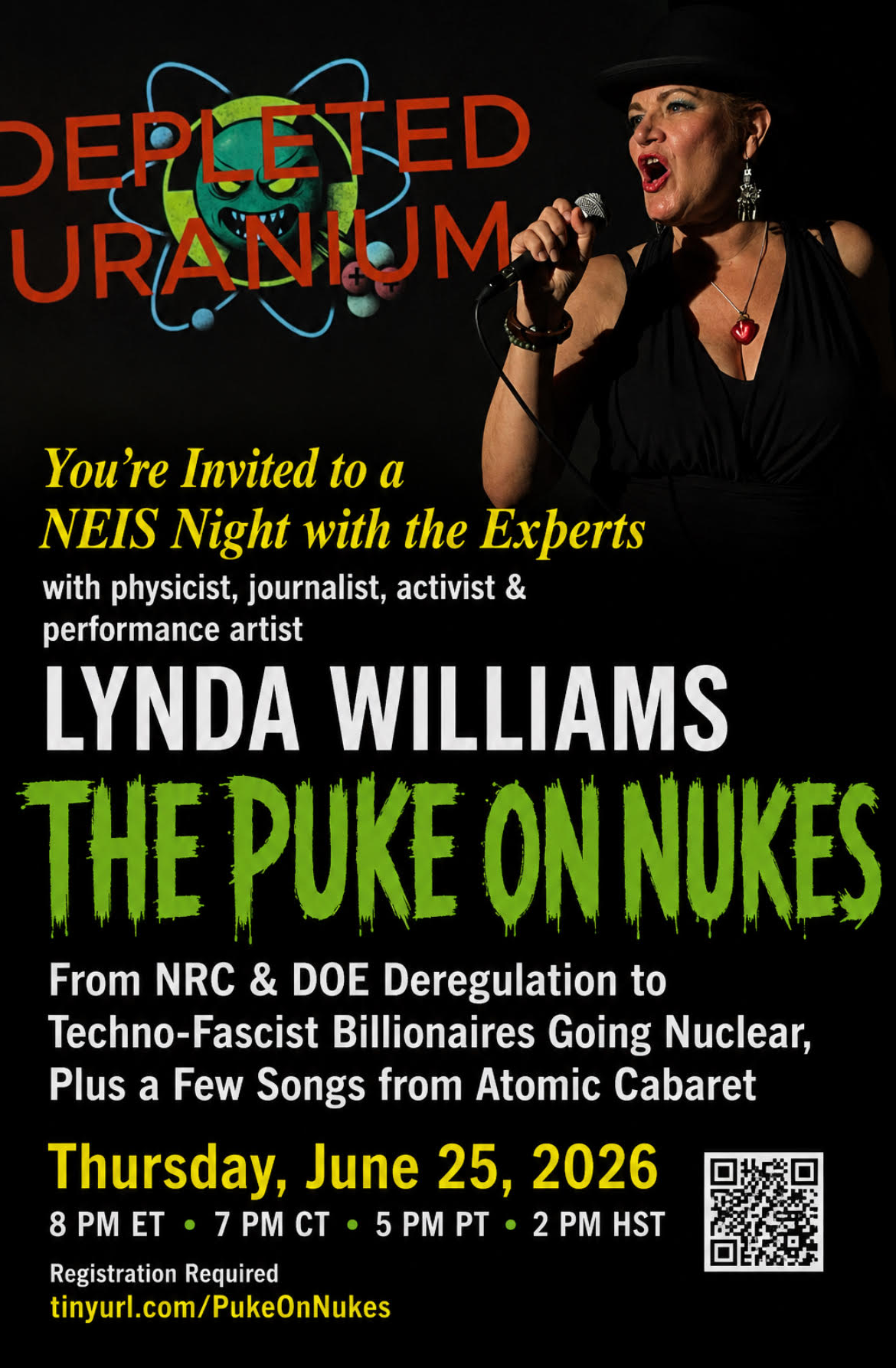
25 June- THE PUKE ON NUKES
Thursday, June 25, 2026
7pm Central Time (8pm ET, 6pm MT, 5pm PT) UTC – 5
From NRC & DOE Deregulation to Techno-Fascist Billionaires Going Nuclear, Plus a Few Songs from Atomic Cabaret REGISTER
26 June – Radiation Trainwreck at the NRC / Join the Protect Better Campaign – https://us02web.zoom.us/meeting/register/4ZlZ5_qLSHGiLSCg8FF6Bg#/registration

Cuba Is Not a Failed State – It Is a Besieged State
PETITION: “Global Appeal to Endorse Palestinian Right of Return of Refugees”
To see nuclear-related stories in greater depth and intensity – go to https://nuclearinformation.wordpress.com
-
Archives
- June 2026 (138)
- May 2026 (306)
- April 2026 (356)
- March 2026 (251)
- February 2026 (268)
- January 2026 (308)
- December 2025 (358)
- November 2025 (359)
- October 2025 (376)
- September 2025 (257)
- August 2025 (319)
- July 2025 (230)
-
Categories
- 1
- 1 NUCLEAR ISSUES
- business and costs
- climate change
- culture and arts
- ENERGY
- environment
- health
- history
- indigenous issues
- Legal
- marketing of nuclear
- media
- opposition to nuclear
- PERSONAL STORIES
- politics
- politics international
- Religion and ethics
- safety
- secrets,lies and civil liberties
- spinbuster
- technology
- Uranium
- wastes
- weapons and war
- Women
- 2 WORLD
- ACTION
- AFRICA
- Atrocities
- AUSTRALIA
- Christina's notes
- Christina's themes
- culture and arts
- Events
- Fuk 2022
- Fuk 2023
- Fukushima 2017
- Fukushima 2018
- fukushima 2019
- Fukushima 2020
- Fukushima 2021
- general
- global warming
- Humour (God we need it)
- Nuclear
- RARE EARTHS
- Reference
- resources – print
- Resources -audiovicual
- Weekly Newsletter
- World
- World Nuclear
- YouTube
-
RSS
Entries RSS
Comments RSS
 nuclear-news