North Korea launches missile into waters near Japan days before nuclear talks set to resume with U.S.
LA Times By VICTORIA KIM, STAFF WRITER OCT. 1, 2019, SEOUL — North Korea fired a ballistic missile Wednesday that landed in the Sea of Japan, also known as the East Sea, less than 200 miles from the Japanese coast, according to the South Korean military and the Japanese coast guard.
The launch came a day after North Korea said it would resume nuclear talks with the U.S. this weekend. The last time a North Korean missile landed in Japan’s exclusive economic zone was LA Times November 2017……. https://www.latimes.com/world-nation/story/2019-10-01/north-korea-launches-missile-into-waters-near-japan-days-before-nuclear-talks-set-to-resume-with-u-s
Nuclear weapons an unacceptable danger to humanity – U.N.Secretary-General António Guterres
 Elimination of nuclear weapons ‘only real way’ to allay fear of a constant threat, Guterres insists, https://news.un.org/en/story/2019/09/1047712 Progress made in reducing the danger posed by nuclear arsenals has not only come to a halt, “it is going in reverse”, and any use of a nuclear weapon in the future would ignite “a humanitarian catastrophe.” Elimination of nuclear weapons ‘only real way’ to allay fear of a constant threat, Guterres insists, https://news.un.org/en/story/2019/09/1047712 Progress made in reducing the danger posed by nuclear arsenals has not only come to a halt, “it is going in reverse”, and any use of a nuclear weapon in the future would ignite “a humanitarian catastrophe.”
Secretary-General António Guterres surveyed the state of the disarmament debate during a high-level meeting of the 74th Session of the UN General Assembly on Thursday, coinciding with the commemoration of the International Day for the Total Elimination of Nuclear Weapons. “A qualitative nuclear arms race is underway”,’ he warned, and rising tensions, mistrust between nuclear-armed States, and muddy rhetoric about the utility of nuclear weapons are some of the factors to blame. Although atomic weapons have only been used twice, by the United States in 1945, around 14,500 remain in the world today, with over 2,000 nuclear tests conducted to date according to the UN’s disarmament wing (UNODA) . “The elimination of nuclear weapons has been the United Nations’ highest disarmament priority from day one,” Mr. Guterres said in his opening remarks. “We strive for a world free of nuclear weapons because we know these weapons pose a unique and potentially existential threat to our planet.” Born at a time of heightened distrust, the United Nations must do everything to ensure that the tragedy suffered by the people of Hiroshima and Nagasaki never happens again, President of the General Assembly, Tijanai Mihammad-Bande reminded delegates in attendance. Remembering such devastation “makes it crucial” that everything that can be done, is done, to ensure this moment in history “was the last time such weapons are deployed,” he said. “‘Never again,’ must remain our main refrain” he urged. Last year the Secretary-General launched a new disarmament agenda with a clear implementation plan; a complement to the cornerstone Treaty on the Non-Proliferation of Nuclear Weapons (NPT) which entered into force in 1970, with a total of 191 States joining – more than any other arms limitation agreement. The UN’s disarmament plan supports a number of other treaties with the aim of exterminating nuclear proliferation and testing, including the Treaty on the Prohibition of Nuclear Weapons (TPNW), and the Comprehensive Nuclear-test-Ban Treaty (CTBT). The Secretary-General urged all State Parties to collaborate at the upcoming 2020 Review of the NPT to further ensure its fundamental goals are met. “Failure to do so will only further undermine the regime,” he warned. “Nuclear weapons present an unacceptable danger to humanity. Let us not forget that the only real way to eliminate the threat of nuclear weapons is to eliminate nuclear weapons themselves,” Mr. Guterres maintained. |
|
Weapons proliferation risk of nuclear power in space
“There’s a lot of opposition in Congress and in nonprofit groups to any further use of highly-enriched uranium,” Kuperman tells us. “So if NASA wants to use highly-enriched uranium for this space reactor, it might provoke opposition to space reactors in general.
“NASA is introducing political risks to its plan by going this highly-enriched uranium route,” he adds.
The Trump administration ordered NASA in August to craft guidelines for safely using nuclear reactors on Mars or the moon. NASA is also moving ahead with its nuclear power ambitions under it’s Kilopower project to build a highly-enriched uranium reactor that could deliver 10 kilowatts of electrical power continuously for at least 10 years. The space agency launched a study in fiscal 2019 with the Department of Energy to determine how both low and highly-enriched uranium could meet different needs. But the agency “has not made a final decision on highly-enriched uranium versus low-enriched uranium for surface power,” according to NASA spokeswoman Clare Skelly……… https://www.politico.com/story/2019/09/27/nuclear-power-nasa-mars-alan-kuperman-q-and-a-1510896
A rude concrete sign indicates a deadly truth about nuclear radiation and cancer

|
Nuclear tomb leaking radioactive waste into oceans has ‘rude message’ beneath crumbling shell https://www.thesun.co.uk/tech/9986929/nuclear-tomb-radioactive-waste-message-shell/
Harry Pettit, Senior Digital Technology and Science Reporter 23 Sep 2019, A CONCRETE tomb that’s haemorrhaging radioactive waste into the world’s oceans has a very rude hidden message beneath its shell. 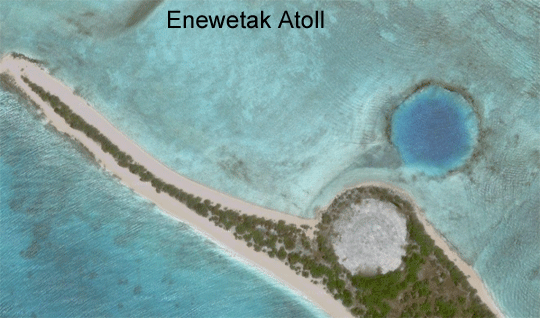 The men who built the dome in the 1970s sculpted a hand flipping the middle finger, which they buried inside the structure before it was sealed and left to crumble on a remote Pacific island. The Enewetak atoll in the South Pacific was used by the US government to test 30 megatons of atomic weapons – equivalent to 2,000 Hiroshima bombs – between 1948 and 1958. After 43 nuclear detonations, thousands of people were sent to clean the islands, shifting 3million cubic feet of contaminated soil and debris into a blast crater. He said: “The dome is a monumental size, so we wanted to put something inside there, but this was during the Cold War so the idea of an official time capsule wasn’t going to work. “So… a rubber glove? Well, we had plenty of those so that worked.” But if Mr Griego and his comrades left their mark on the island, it also left its mark on them. Our members were dying,” he said. “Dying of cancer. Given the damage wrought by the dome, the middle-finger message turned out to be more apt than anyone realised at the time. “The Runit salute turned out to be the right message in several ways,” said Paul, 62.
“One message is what’s happened to the men that were actually tasked to build this dome? What happens now to the Marshallese, the islanders? “What happens now to the Pacific Ocean, to the rest of the world? The dome is leaking and it has been leaking from the beginning.” The US government does not recognise those who worked to clean Enewetak as atomic veterans, so they cannot receive radiation exposure compensation from the Department of Veterans Affairs. |
|
Corporate greed, fighting over America’s extravagant $85 billion nuclear missile program

 become the Defense Department’s primary provider of ballistic missiles, Boeing has launched an aggressive lobbying campaign,
There was an $85 billion elephant in the room at this year’s Air Force Association conference, an annual trade show where thousands of uniformed airmen rub shoulders with suit-clad defense contractors hawking the latest advanced weaponry.
Those entering the conference hotel in National Harbor, Md., were welcomed by an enormous blue banner splashed with the Northrop Grumman logo and the words “LEGENDARY DETERRENCE” ― a not-so-subtle reference to the company’s ballistic missile ambitions.
Northrop is poised to take over a massive Air Force nuclear weapons program called Ground Based Strategic Deterrent, or GBSD, which will call on a team of contractors to replace the U.S. military’s aging stock of Minuteman III intercontinental ballistic missiles. But Boeing’s Arlington-based defense business, which has handled the Minuteman program since 1958, has launched an aggressive lobbying campaign in defense of its interests.
Northrop “is on a path to a sole-source opportunity,” Boeing GBSD Program Manager Frank McCall warned in an interview Wednesday on the floor of the trade show.
“There has never been a time in the history of the Minuteman when the Air Force wasn’t supported by both companies,” he said, adding that he thinks the Pentagon is taking “a winner-take-all approach” that is “unprecedented in the history of intercontinental ballistic missiles.”
The ground-based missiles make up one leg of the U.S. nuclear triad, which aims to be ready to deliver warheads at a moment’s notice from air, land or sea. They are meant to deter other countries from launching a nuclear strike by sending a message that any first-mover will be destroyed immediately.
The different components of the triad are extremely expensive to build and keep at the ready. For the new ground-based missiles, the Pentagon faces a difficult dilemma as it tries to get the best solution for the best price.
The Air Force had hoped to evaluate multiple competing options. But Boeing, thought to be the only viable competitor aside from Northrop, says it won’t participate unless the Air Force changes its approach.
With Boeing out, the Northrop-led team appears to be the Pentagon’s only option, something that could make it hard for the government to negotiate a fair price.
It is a common dilemma facing Defense Department weapons buyers, who have the impossible task of running a competitive marketplace when there are, at best, two or three potential suppliers for the most expensive weapons systems. The U.S. defense industry has consolidated to a worrying degree in the decades since the Cold War, officials and analysts say, with a handful of dominant suppliers exerting tremendous influence.
A White House report released last year found 300 cases in which important defense products are produced by just a single company, a “fragile” supplier, or a foreign supplier.
There is big money at stake for Boeing and Northrop: Defense Department estimates for the long-term cost of the program range between $62 billion and $100 billion. Both companies have formidable lobbying operations, spending $7.2 million and $8.3 million, respectively, on Washington lobbyists in 2019.
Boeing’s stewardship of the Minuteman program brought it roughly 600 defense contracts totaling $8 billion in the first 30 years of the programs, according to estimates provided by the company. Northrop has traditionally taken a secondary role handling complex systems integration.
In 2017, Northrop and Boeing were awarded contracts worth $349.2 million and $328.6 million, respectively, to develop their own version of a next-generation replacement for the Minuteman. In July, the Air Force asked each company to submit a proposal, hoping to compare the two missile designs and negotiate a fair price.
Boeing quickly threw a wrench into that plan, announcing July 25 that it would walk away from the competition because the Air Force’s request for proposals allegedly favored Northrop.
Boeing’s concerns stem from Northrop Grumman’s 2017 acquisition of a company called Orbital ATK for $7.8 billion. Orbital ATK ― which operates as a Northrop Grumman business unit called Innovation Systems ― is a dominant producer of rocket motors that power ballistic missiles. Aerojet Rocketdyne, the other U.S. manufacturer of rocket motors, also is working with Northrop.
Boeing has taken its case to the Pentagon, as well as to the Federal Trade Commission, but has failed to block the deal.
“We continue to stand ready to support this important program,” wrote Leanne Caret, president of Boeing’s Arlington-based defense business, in a July 23 letter seen by The Washington Post. “As we have discussed, we believe there are other procurement structures that could provide this capability more rapidly at less cost, and we will look for ways to leverage the work … to help support this critical national security mission.”
Boeing later approached Northrop about the possibility of teaming up but was rejected, a Boeing official said. So it came as little surprise Monday when Northrop released the list of companies it is teaming up with, and Boeing isn’t on it.
Air Force officials stood by their approach but declined to comment on how they will proceed.
“We are very open to a variety of proposals. … We are open to teaming relationships. We just don’t want to dictate,” Will Roper, the Air Force’s assistant secretary for acquisition, technology and logistics, told reporters Monday. “We think it should be decided by industry and what they think is best value.”
Soon afterward, Boeing countered that it is pursuing a multifaceted advocacy and lobbying campaign asking the government to force Northrop to collaborate.
“We believe it is a path to a better weapons system solution that will allow us to field the solution more quickly than either company could handle on its own,” said McCall, the Boeing official.
Analysts expressed concern over the current arrangement, in which Northrop will almost certainly be the only bidder. Whether Boeing’s proposal will resolve the problem is less clear.
“I would much rather see a direct competition between Northrop and Boeing,” said Dan Grazier, a former Marine Corps captain working at the Project on Government Oversight, a watchdog group. “The best practice for any acquisition system would be a solid, honest, competitive prototyping, where the government can weigh competing options and get a competitive price.”
Nuclear watchdog groups warn legal action over environmental impact of plutonium pit production
|
Federal officials have set a deadline of 2030 for ramped-up production of plutonium pits. The work will be split between Los Alamos National Laboratory in northern New Mexico and the Savannah River Site in South Carolina. Lawyers for the Natural Resources Defense Council, Nuclear Watch New Mexico, Savannah River Site Watch and Tri-Valley Communities Against a Radioactive Environment threatened legal action in a letter sent this week to officials. In June, the National Nuclear Security Administration said it would prepare an environmental impact statement on pit-making at Savannah River. A less extensive review was planned for Los Alamos this week .
|
|
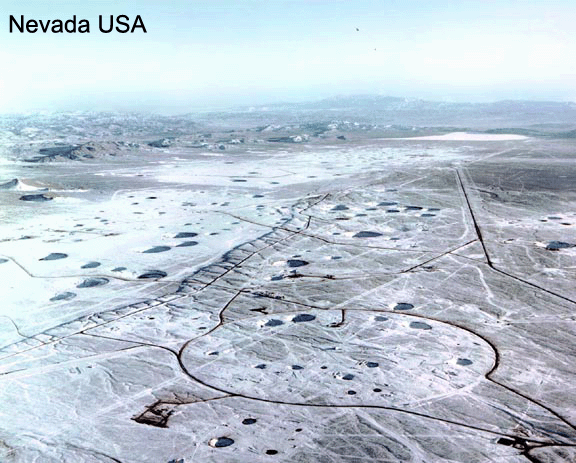
America’s 1,032 Nuclear Weapons Tests, and the tons of problems they caused
 Little-Known Fact: America Tested 1,032 Nuclear Weapons on Its Own Soil https://nationalinterest.org/blog/buzz/little-known-fact-america-tested-1032-nuclear-weapons-its-own-soil-81706
That’s a lot of nukes.
New nuclear weapons that could make continents uninhabitable
Russia’s New Nuclear Weapon Could Make America Uninhabitable, The National Interest•September 20, 2019
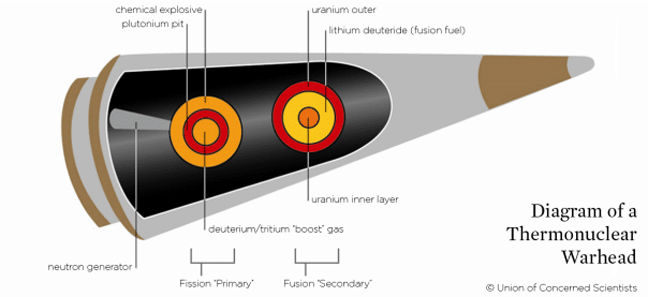
Each of the submarine’s sixteen R-30 Bulava (“Mace”) missiles typically carries six 150-kiloton nuclear warheads designed to split apart to hit separate targets. This means one Borei can rain seventy-two nuclear warheads ten times more destructive than the bomb dropped on Hiroshima on cities and military bases over 5,800 miles away. ……..
|
An SSBN’s primary purpose is to remain undetected long enough to unleash its terrifying firepower—a strategy made easier thanks to their nuclear reactors allowing them remain submerged for months at a time. [ and they say that small nuclear reactors have nothing to do with nuclear weapons!] ……..
However, the Borei represents only half of the Russian Navy’s future sea-based nuclear deterrence force. The other half will come from a unique fleet of four Khaborovsk-class submarines each carrying six nuclear-powered Poseidon drone-torpedoes designed to swim across oceanic distances to blast coastal cities and naval bases with megaton-yield warheads. Moscow, it seems, would like a little more redundancy in its ability to end civilization as we know it in the event of a nuclear conflict. Sébastien Roblin holds a master’s degree in conflict resolution from Georgetown University and served as a university instructor for the Peace Corps in China. He has also worked in education, editing, and refugee resettlement in France and the United States. He currently writes on security and military history for War Is Boring. This first appeared in June 2019 and is being republished due to reader interest. https://nationalinterest.org/blog/buzz/russias-new-nuclear-weapon-could-make-america-uninhabitable-82051  |
|
Dramatic rise in the risk of a US-Russia nuclear war, which would kill mega millions
 US-Russia nuclear war would kill 34 million people within hours and is increasingly likely, Princeton study concludes, Independent UK, Risk of catastrophic conflict has risen ‘dramatically in the past two years’, academics warn Jon Sharman. 18 Sep 19, More than 90 million people would be killed or injured in a nuclear war between the US and Russia if a conventional conflict went too far, according to a new simulation created by researchers.
Such a scenario has become “dramatically” more plausible in the last two years because the two countries have dropped support for arms-control measures, according to a team from Princeton University.
The simulation, the result of a study at Princeton‘s Science and Global Security programme (SGS), suggests 34 million people would be killed and 57 million injured in the first hours of an all-out nuclear conflagration – not counting those left ill by fallout and other long-term problems.
In the animation, electronic trails of ballistic missiles arc across the screen, before blossoming into a carpet of white discs.
Worldwide destruction would include the nuclear incineration of Europe, which the Princeton scientists claimed could be brought about by the escalation of a conventional war between Russia and Nato………. https://www.independent.co.uk/news/world/americas/us-russia-nuclear-war-trump-putin-simulation-europe-nato-a9109116.html
USA Senate panel concerned about technical problems in nuclear weapons
 Senate panel wants probe into nuclear weapons glitches, Roll Call, John M. Donnelly @johnmdonnelly 18 Sept 19,
Panel is concerned that problems might reflect fundamental oversight shortcomings that have broader implications. The panel is concerned that recent glitches in atomic weapons may have broader implications, and senators want to get to the bottom of the issue. Separately, a congressional aide familiar with the issue said the problems will add hundreds of millions of dollars to the atomic weapons budget.
“The Committee is concerned that a recent technical challenge demonstrates a lack of systems engineering and highlights a lack of coordination and leadership focus, which in turn jeopardizes successful program execution,” the report says.
The document does not mention any particular programs or provide details on the nature of the technical challenges. But experts on nuclear weapons said the panel is almost certainly referring to problems with two new weapons: a bomb called the B61-12 and a modified submarine-launched warhead called the W-88.
In both those programs, problems with commercially manufactured electrical components have caused months of delays, U.S. government officials have publicly acknowledged.
In another sign of intensifying congressional concern over the programs, the House Armed Services Subcommittee on Strategic Forces plans to hold a hearing Sept. 25 on those two programs.
Senate appropriators suggested in their report that they are worried the delays in these programs may reflect fundamental oversight shortcomings and could cause ripple effects in other nuclear initiatives, such as keeping nuclear weapons out of terrorists’ hands, updating warship reactors and modernizing facilities.
The investigation must find causes and solutions, the panel said, and it must “ensure the extent of condition is not more widespread than currently reported.”……….. https://www.rollcall.com/news/congress/senate-panel-wants-probe-nuclear-weapons-glitches
Security dangers of nuclear energy in space
Nuclear Energy in Space: Nonproliferation Risks http://www.spaceref.com/news/viewpr.html?pid=54634, University of Texas-Austin, September 17, 2019
On October 17, experts from NASA, Congress, and reactor companies will gather in the nation’s capital to discuss ongoing development of nuclear reactors for space missions and the potential security risks.
The event is free, but pre-registration is required. For further details, and to register, please see: https://space-nuclear.eventbrite.com.
The program will feature Jeffrey A. Sheehy, NASA’s Chief Engineer in the Space Technology Mission Directorate. The keynote address will be delivered by Rep. Bill Foster (D-IL), the only physicist in Congress and a member of the House Science Committee.
Controversy centers on NASA’s choice of fuel for the reactor it tested in 2018 for use on a planetary surface: weapons-grade, highly enriched uranium. NASA scientists believe such uranium would enable smaller reactors, reducing launch costs. However, critics argue it could undermine decades of U.S. progress in reducing worldwide civilian commerce in this dangerous material, create a precedent that could help rogue countries obtain nuclear weapons, sharply increase security costs, impede NASA’s cost-saving collaboration with commercial partners who lack licenses for such uranium, and potentially disperse nuclear weapons material to adversaries in the event of a launch failure. They say that an alternative reactor fuel – low-enriched uranium, which is unsuitable for nuclear weapons – could reduce the security, economic, and political risks.
Last month, President Trump issued a Presidential Memorandum on the launch of space nuclear systems, which highlighted the security risk: “Due to potential national security considerations associated with nuclear nonproliferation . . . The President’s authorization shall be required for Federal Government launches . . . when such systems utilize any nuclear fuel other than low-enriched uranium.” In June 2019, the U.S. House of Representatives passed an appropriations bill that included an amendment by Rep. Foster, directing NASA to “work towards the development of a low enriched uranium (LEU) space power reactor.”
Israel’s duplicity about its nuclear weapons
Israel wants to keep leaders in Washington distracted and always a little off-balance, so they will end up without the bandwidth and the stamina needed to confront Israel over the continuation of colonial expansion in the lands occupied in 1967.byHelena Cobban
How is it still possible to write a lengthy article about the military/strategic dynamic among the triad of Israel, Iran, and the United States while making zero mention of Israel’s robust nuclear-weapons capability? New York Times staffers Ronen Bergman and Mark Mazzetti, and their editors at the Times magazine clearly think this is quite okay. In their recent lengthy article, “The Secret History of the Push to Strike Iran,” Bergman and Mazzetti looked at the U.S.-Israeli coalitional aspect of the past 17 years in the project to prepare for launching military or special-ops actions against Iran. They followed in the long tradition within the big corporate media of deliberately ignoring Israel’s nuclear capability, a factor that is central to any understanding of the forces at play in the Middle East and also, crucially, those at play in the U.S.-Israeli relationship.
The authors’ omission of any mention of Israel’s nuclear capabilities—and the ability these capabilities have long given to the country’s leaders to exert strong, continuing nuclear blackmail on Washington—is one serious flaw in their narrative. Another is that they seriously downplay the importance of the fact that Israel’s military is incapable, on its own, of inflicting debilitating damage on Iran’s nuclear program using only “conventional,” that is non-nuclear, weapons. (The two lacunae could perhaps be linked, as we will see below.)
Early in the article, Bergman and Mazzetti set the scene for how they see the strategic dynamic among Israel, Iran, and Washington by citing an analysis provided by Ilan Goldenberg, who was an up-and-coming Pentagon official in the Obama administration………….
A few things about the nuclear dimension of the U.S.-Israel-Iran triangle have been clear to me for a long time. One is that the longstanding refusal of most members of the U.S. political elite (officials, legislators, think-tankers, corporate media, and so on) to even mention the fact of Israel’s own nuclear-weapons capabilities and to take full account of them in public discussions of strategic matters in the Middle East is extremely harmful. Among the harms inflicted by that refusal (and by the general political clout that Israel wields in Washington) is that Israel’s longstanding ability to wield a form of nuclear blackmail against Washington—as I have written about for more than 30 years now—is never mentioned. Nor is the fact that, while Iran has been a full member of the NPT and has submitted to a full range of inspections of its nuclear research facilities for many decades now, Israel is not a member and has never been subjected to any such inspections.
(Another thing that is almost never mentioned is that all journalists based in Israel—as Bergman is—are subject to the country’s rigorous censorship system. This censorship is particularly strict regarding all military issues.)
………… so long as Iran does not break out of the NPT, Israel can quietly, behind the veil of its longstanding policy of “nuclear ambiguity”, continue to exert a form of “extreme-case” nuclear deterrence against Iran. (And to use the threat of a potential unveiling as a potent means of leverage against decision-makers in Washington.)
So why, then, do we have all the continual hullabaloo and endless navel-scratching in the Western corporate media (and the Western political system, more broadly) about the possibility—not yet anywhere close to a fact, but a possibility, some time in the future—that Iran may start to build a nuclear-weapons capability?
My conclusion is that a good part of this navel-scratching is a deliberate tactic of diversion: a way for the decision-makers in Israel and their supporters to keep leaders in Washington and elsewhere distracted and always a little off-balance, so they will end up without the bandwidth and the stamina needed confront Israel over the continuation of its project of colonial expansion in the lands occupied in 1967.
That colonial project in the West Bank (including East Jerusalem) and in Golan is what all Israeli leaders since 2001 have cared about most deeply. And they all knew that one great way to head off any efforts a U.S. president might make to challenge the project was to raise a hubbub about Iran’s alleged pursuit of nuclear weapons.
“Why do you keep talking to us about human rights or international law issues in the Palestinian territories?” was the essential message such efforts sent to decision-makers in Washington. “Stop worrying about those. We will handle them as we see fit, and you should butt out. But meantime, keep looking at all those shiny objects over there in the Iranian nuclear program! And by the way, keep your aid money flowing to our military. Otherwise, just imagine what havoc we could create for you in the Gulf…”
USA’s new National Security Adviser – out of the Bolton nuclear frying pan, into the Kupperman nuclear fire?
 Trump’s Acting National Security Adviser Said Nuclear War With USSR Was Winnable
Questioning “mutual assured destruction,” Charles Kupperman called nuclear conflict “in large part a physics problem.” Huffington Post, By Nick Robins-Early , 16 Sept 19, President Donald Trump’s acting national security adviser, former Reagan administration official Charles Kupperman, made an extraordinary and controversial claim in the early 1980s: nuclear conflict with the USSR was winnable and that “nuclear war is a destructive thing but still in large part a physics problem.”Kupperman’s suggestion that the U.S. could triumph in a nuclear war went against dominant theories of mutually assured destruction and ignored the long-term destabilizing effects that such hostilities would have on the planet’s health and global politics.
Kupperman, appointed to his new post on Tuesday after Trump fired his John Bolton from the job, argued it was possible to win a nuclear war “in the classical sense,” and that the notion of total destruction stemming from such a superpower conflict was inaccurate. He said that in a scenario in which 20 million people died in the U.S. as opposed to 150 million, the nation could then emerge as the stronger side and prevail in its objectives.
His argument was that with enough planning and civil defense measures, such as “a certain layer of dirt and some reinforced construction materials,” the effects of a nuclear war could be limited and that U.S. would be able to fairly quickly rebuild itself after an all-out conflict with the then-Soviet Union.
“It may take 15 years, but geez, look how long it took Europe to recover after the Second World War,” Kupperman said. Referring to the Japanese city on which the U.S. dropped the first atomic bomb in 1945, he also claimed that “Hiroshima, after it was bombed, was back and operating three days later.”
At the time,Kupperman was executive director of President Ronald Reagan’s General Advisory Committee on Arms Control and Disarmament. He made the comments during an interview with Robert Scheer for the journalist’s 1982 book, “With Enough Shovels: Reagan, Bush, and Nuclear War.”
The National Security Council did not immediately respond to questions on whether Kupperman, 68, still holds the same views of nuclear conflict as he did in the early 1980s. Kupperman’s seemingly cavalier attitude toward the potential death of millions of people was criticized at the time both by Democratic politicians and arms control experts.
It seems reasonable to suggest the crazies are in charge of the nukes,” Jeremy Stone, president of the Federation of American Scientists, wrote about Kupperman and his colleagues in 1984.
Contemporary nuclear experts similarly criticize Kupperman’s beliefs as wrongheaded and dangerous.
“Kupperman’s comments might as well have come straight from the script of (the film) ‘Dr. Strangelove.’ He was part of a group of defense analysts at the time who weren’t shy about sharing such views,” said Kingston Reif, director for disarmament and threat reduction policy at the Washington-based Arms Control Association, who first noted Kupperman’s views in a Twitter post in January when Kupperman was hired as the deputy national security adviser.
“The simple fact is that a nuclear war can’t be won and must never be fought,” Reif said.
But rather than being sidelined as a relic of Cold War hubris, Kupperman now holds one of the most powerful positions in the White House. Although his role is temporary, civil rights groups have also already called on him resign over his extensive ties to the Center for Security Policy, an anti-Muslim think tank founded by conspiracy theorist Frank Gaffney.
Gaffney is a prominent anti-Muslim activist who repeatedly promoted the conspiracy theories that members of President Barack Obama’s administration were working to enforce Islamic law in the U.S., that the Muslim Brotherhood had infiltrated top levels of government and that Obama was secretly Muslim himself. Kupperman served on the board of directors for Gaffney’s Center for Security Policy between 2001-2010.
“CSP has continuously promoted Islamophobic conspiracy theories, and anyone, like Mr. Kupperman, who has so closely associated with them for so long is ― at the very least ― complicit in their brand of anti-Muslim bigotry and should not be entrusted with one of the highest-ranking security roles in the United States,” Council on American-Islamic Relations Executive Director Nihad Awad said Tuesday.
Before joining the NSA, Kupperman served as an informal adviser to Bolton and worked as a defense industry executive at Boeing and Lockheed Martin. He was a critic of the Iranian nuclear deal and in 2017 co-signed a letter to Trump backing Bolton’s plan to withdraw from the agreement.
Here are excerpts of Kupperman’s comments from his interview with Scheer: ……..https://www.huffingtonpost.com.au/entry/charles-kupperman-nuclear-war-trump-nsa_n_5d7b9809e4b03b5fc88212fd
Ontario’s secretive role in helping Trump to nuclear weaponise Space
 The space race has a dirty nuclear secret and it’s right here in Ontario, https://nowtoronto.com/news/space-race-nuclear-power-ontario/ by Rosemary Frei, SEPTEMBER 16, 2019
 Unbeknownst to most Canadians, the Darlington nuclear power plant 70 kilometres east of Toronto has been playing a not-so-small role in the U.S. race to weaponize space
The 50th anniversary of the Apollo 11 mission added momentum to the new push to go farther into outer space than humans have ever gone before.
Ontario’s nuclear industry could receive both a reflected glow from the extraterrestrial travel hype and a new revenue stream. It could also potentially increase international nuclear-weapons proliferation.
Unbeknownst to most Canadians, the Darlington nuclear power plant 70 kilometres east of Toronto has already been playing a not-so-small role in the space race.
The plant has been producing radioactive plutonium-238 as fuel for spacecraft in NASA’s mushrooming space pipeline since 2017.
“We are proud to have Ontario play a part, however small, in this most noble of human endeavours,” OPG’s then-president and CEO Jeff Lyash said in a news release.
Canadian Nuclear Laboratories (CNL), which runs the Chalk River facility near Ottawa, another participant in the initiative, posted a “Success Stories” article on its website seven days later. It cautioned that “this opportunity is still subject to regulatory and licensing processes.” But it quotes a CNL official as saying “staff should take a lot of pride in the fact that we are key partners.”
CNL has continued communicating with other project stakeholders. But when NOW contacted CNL for a comment it responded on September 5 that it is no longer involved in the project. OPG has removed the news release from its website and did not respond to NOW’s request for information. Turns out a company called Technical Solutions Management (TSM) is steering the initiative now.
TSM is owned by former nuclear-industry executives Billy Shipp, Pierre Tremblay and Paul Spekkens. CEO Shipp told NOW in an August 29 phone interview that NASA has yet to give its formal thumbs-up.
“For us to get out ahead of our client [NASA], in terms of anticipated need [for plutonium-238], or making statements of their need, is not that professional on our part. So we really have been very low-key on this,” Shipp says when reached for an interview aboard a boat off Vancouver Island.
But he noted that U.S. President Donald Trump’s establishment of a Space Command makes the project more likely to proceed.
Plutonium-238 has long been used to fuel flight, via conversion into electricity of the intense heat the atom pumps out. The U.S. powered military satellites with it in the 1960s. NASA also harnessed it most recently to propel Curiosity Rover to Mars in 2011.
The steps involved for the manufacture of made-in-Canada plutonium-238 to supplement the U.S.’s production involves first synthesizing neptunium-237, plutonium-238’s precursor at the Pacific Northwest National Laboratory in Richland, Washington.
From there, the material is transported to Chalk River where it is put into bundles before it’s sent to Darlington and inserted into CANDU reactors. There, the neptunium-237 catches stray neutrons, transforming it into plutonium-238. The bundles are shipped back to Chalk River where the plutonium-238 is separated from by-products and packaged into pellets. The pellets are transported to Idaho National Lab where they are readied as ‘nuclear batteries’ for spacecraft engines. The current price of plutonium-238 isn’t public, but back in 2003 one kilogram was worth about $8 million U.S.
Gordon Edwards, co-founder and president of the Canadian Coalition for Nuclear Responsibility, says the form of radioactivity emitted by plutonium (namely, alpha particles) is highly toxic when inhaled but often isn’t picked up by radiation detectors.
For example, in November 2009, hundreds of workers at OPG’s Bruce nuclear plant breathed in plutonium dust (a by-product of nuclear-energy production) but the plutonium remained undetected for weeks. Many of the workers had not been given respirators. It was the largest preventable exposure of workers to internal radioactive contamination in the history of the civilian nuclear industry.
Even worse, says Edwards, is the fact the process used to create plutonium-238 can also be used to transform depleted uranium into plutonium-239, the key explosive in nuclear bombs.
“I grant that TSM’s plutonium-238 program does not fundamentally enhance this danger, but it does provide an opportunity to tell the public and politicians that if you can produce one kind of plutonium for the space program you can just as easily produce another kind of plutonium for a nuclear-weapons program, using essentially the same CANDU technology,” Edwards tells NOW.
However, no one inside the space or nuclear industries appears be seriously addressing these well-known problems. And there is plenty of money potentially available for a new plutonium-238 venture. NASA projects its research and development budget – including developing power and propulsion systems – will be $1.5 billion next year, rising to $3.4 billion by 2024.
TSM’s other co-owners, Tremblay and Spekkens, are well-placed to move such a project forward. Tremblay was OPG’s chief nuclear operating officer and president of OPG’s subsidiary Canadian Nuclear Partners. He became AECOM Canada Nuclear Operations’ president and CEO in August 2018. The American multinational is playing key roles in the multi-billion-dollar Darlington refurbishment. Tremblay started consulting for AECOM in June 2016; an industry article about this said the firm “has recruited key expertise that will undoubtedly position the company to play a key part in the massive nuclear power projects anticipated for Ontario over the next decade.”
Spekkens retired in 2016 as OPG’s vice president of science and technology and as chair of the CANDU Owners Group, a Toronto-based private organization that promotes CANDU use around the world. He then became a consultant and director of nuclear technology at Kinectrics.
He opined on the nuclear industry’s future at a June 2017 conference. In the abstract of his lecture, Spekkens says “this future will, of course, depend heavily on technology. But also (and perhaps equally) important will be non-technical considerations such as public acceptance, a pipeline full of qualified future employees, public policy in several levels of government, and of course, finances.”
Inside the US military’s $223 million ‘doomsday plane,’ capable of surviving a nuclear blast
|
Inside the US military’s $223 million ‘doomsday plane,’ capable of surviving a nuclear blast, Business Insider ABBY NARISHKIN, STEVE CAMERON,16 Sept 19,
|
|
1 This Month

Protect Sazan Island from the Trump family! https://secure.avaaz.org/campaign/en/protect_sazan_island_from_the_trump_family_loc/?bqFCVab&v=174511&cl=22707147157&_checksum=5e9dde668860e8231c33699735e16a1fbf22ab2cb01da50c999fe8732b9775ef&utm_source=email&utm_medium=blast_email&utm_campaign=174511
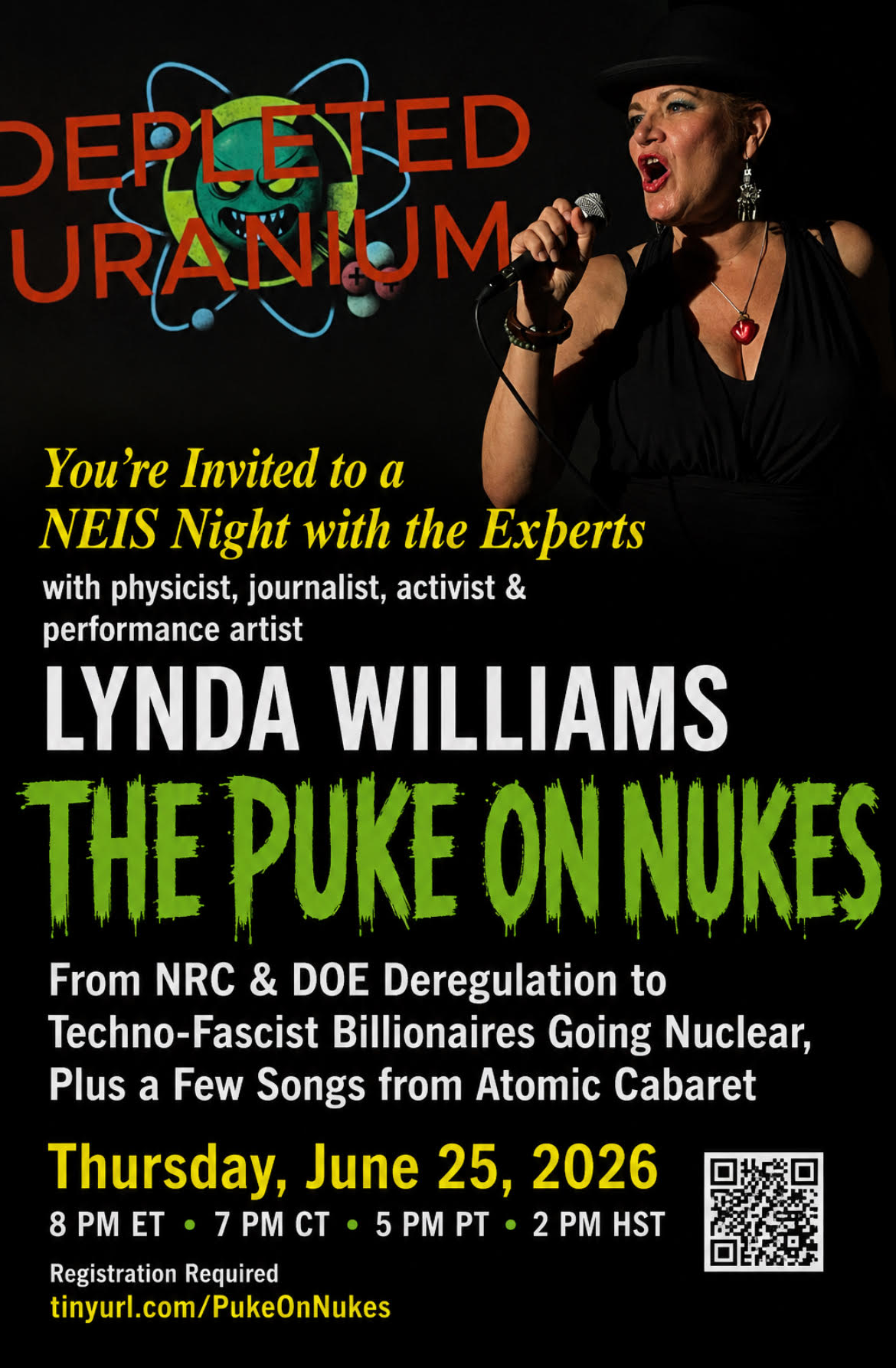
25 June- THE PUKE ON NUKES
Thursday, June 25, 2026
7pm Central Time (8pm ET, 6pm MT, 5pm PT) UTC – 5
From NRC & DOE Deregulation to Techno-Fascist Billionaires Going Nuclear, Plus a Few Songs from Atomic Cabaret REGISTER
26 June – Radiation Trainwreck at the NRC / Join the Protect Better Campaign – https://us02web.zoom.us/meeting/register/4ZlZ5_qLSHGiLSCg8FF6Bg#/registration


Cuba Is Not a Failed State – It Is a Besieged State
PETITION: “Global Appeal to Endorse Palestinian Right of Return of Refugees”
To see nuclear-related stories in greater depth and intensity – go to https://nuclearinformation.wordpress.com
-
Archives
- June 2026 (142)
- May 2026 (306)
- April 2026 (356)
- March 2026 (251)
- February 2026 (268)
- January 2026 (308)
- December 2025 (358)
- November 2025 (359)
- October 2025 (376)
- September 2025 (257)
- August 2025 (319)
- July 2025 (230)
-
Categories
- 1
- 1 NUCLEAR ISSUES
- business and costs
- climate change
- culture and arts
- ENERGY
- environment
- health
- history
- indigenous issues
- Legal
- marketing of nuclear
- media
- opposition to nuclear
- PERSONAL STORIES
- politics
- politics international
- Religion and ethics
- safety
- secrets,lies and civil liberties
- spinbuster
- technology
- Uranium
- wastes
- weapons and war
- Women
- 2 WORLD
- ACTION
- AFRICA
- Atrocities
- AUSTRALIA
- Christina's notes
- Christina's themes
- culture and arts
- Events
- Fuk 2022
- Fuk 2023
- Fukushima 2017
- Fukushima 2018
- fukushima 2019
- Fukushima 2020
- Fukushima 2021
- general
- global warming
- Humour (God we need it)
- Nuclear
- RARE EARTHS
- Reference
- resources – print
- Resources -audiovicual
- Weekly Newsletter
- World
- World Nuclear
- YouTube
-
RSS
Entries RSS
Comments RSS
 nuclear-news