Discussion on Poland, Germany hosting nuclear weapons
Playing Warsaw against Berlin on nuclear weapons, European Leadership Network, Katarzyna Kubiak |Policy Fellow 1 June 20, The German domestic dispute about its future role in NATO nuclear sharing is heating up again. But the discussion took a new turn when in May 2020 US Ambassador to Poland Georgette Mosbacher tweeted “If Germany wants to diminish nuclear capability and weaken NATO, perhaps Poland – which pays its fair share, understands the risks, and is on NATO’s eastern flank – could house the capabilities.” How much merit does this “perhaps” have?
NATO nuclear sharing is an arrangement in which the United States deploys about 150 nuclear free-fall bombs in Germany, Italy, Belgium, the Netherlands and Turkey, of which about 80 are for delivery by European NATO aircraft. Berlin, Rome, Brussels and Amsterdam possess nuclear-certified planes and train their pilots on the nuclear mission, while several other Allies, including Poland, would support NATO nuclear operations with conventional air tactics (SNOWCAT).
In December 2015, asked if Poland would want to join NATO’s nuclear sharing program, Deputy Defence Minister Tomasz Szatkowski said, “concrete steps are currently under consideration.” The interview stirred confusion. The Polish Ministry of Defence rectified that it was not working on Poland’s accession to the program. It pointed out that Szatkowski’s statement should be read in the frame of the then on-going international discussion about widening allied participation in NATO’s nuclear sharing. It also made clear that Warsaw did not seek to acquire nuclear weapons, and that any form of Polish participation in NATO nuclear sharing requires domestic and allied political arrangements. Yet since the interview, rumours that Poland is interested in joining NATO’s nuclear sharing have become prevalent.
Limited technical merit
Poland does not host American nuclear weanuclear pons. It does not have the necessary infrastructure to do so, nor does it possess aircraft certified for the mission. Poland participates in SNOWCAT and observers spotted Polish F-16 aircraft supporting NATO’s nuclear strike exercises in 2013, 2014 and 2017. Warsaw has recently ordered 32 F-35A aircraft with the first anticipated for delivery between 2025 and 2026. The United States certified the F-35 to carry tactical nuclear weapons. Belgium, Italy and the Netherlands already procured or ordered the jets to replace their ageing dual-capable aircraft prescribed to NATO’s nuclear mission. While the Polish procurement of the F-35 could be interpreted as building readiness to receive weapons, it should be remembered that other NATO allies with no roles in nuclear sharing (like Denmark and Norway) also bought F-35.
Legal uncertainty
Moving American nuclear weapons from Germany to Poland and Polish participation in NATO nuclear sharing is not a clear-cut matter legally either. Poland is a party to the Nuclear Non-Proliferation Treaty (NPT). Article I of this treaty, applicable to nuclear-weapons states, prohibits the transfer of “control” of nuclear weapons “to any recipient whatsoever.” While some experts view existing NATO nuclear sharing arrangements compatible with the NPT, others voice scepticism.
A clear breach of political commitments……
Vague political benefits……
Questionable militarily benefits ……
The merit……
The United States never publicly offered Poland to become a host state. In October 2019, when the US government was reviewing plans for evacuating its nuclear weapons from Turkey out of political concerns, no US government representative openly suggested relocating these weapons to Poland. Ambassador Mossbacher seems to have simply instrumentalised Poland, playing
The claim that nuclear power is needed for national security is a masked money-grab
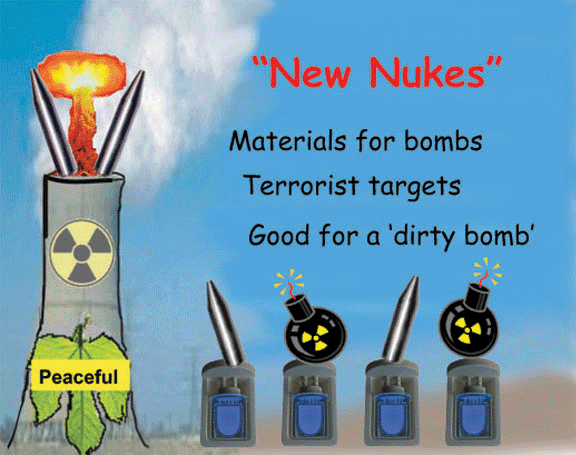

that price won’t only be paid by emptying our wallets . It will also be paid in health and safety. State senators with dollar signs twinkling in their eyes are lining up for relief handouts that will do nothing to fix our healthcare crises — laid bare under the coronavirus crisis — nor our economy. But they are playing the Russia card to get the money.
Make Nuclear Great Again? https://beyondnuclearinternational.org/2020/05/31/make-nuclear-great-again/, May 31, 2020 by beyondnuclearinternational By Linda Pentz Gunter
The claim that nuclear power is needed for national security is a masked money-grab
The US Department of Energy’s assertions about Russian and Chinese supremacy in the nuclear sector is reminiscent of the “Commie plot” rhetoric of the 1950s. But it’s a thinly disguised ploy to feed at the federal subsidies trough and revive a moribund industry.
A few years ago I attended two days of the Nuclear Deterrence Summit, held just outside Washington, DC. In my defense, I’ll say it was a necessity. I really wanted to get inside how these people think. There was plenty of talk about the need for nuclear weapons, their range and potency, all done with a calm equilibrium devoid of conscience. It was chilling.
But it was also the theatre of the absurd. At one point there was actually talk about a “missile gap.” The Russians were getting ahead. This must be stopped. Was I on the set of a remake of Dr. Strangelove? Was this General ‘Buck’ Turgidson railing about “commie plots” and “mineshaft gaps”?
Life, as it turns out, is routinely stranger than any fiction. Turgidson is still with us, and he has extended his brief to include “civilian” nuclear power plants in the competition with the “Ruskies” and now, the Chinese. Continue reading
The soaring costs of Trump’s nuclear weapons’ spending – the new arms race
 Trump Boosts Nuclear Weapons Spending, Fueling a New
  Arms Race, Jon Letman, Truthout, – 31 May 2020, Spending by the world’s nine nuclear nations climbed to nearly $73 billion in 2019, nearly half of it by the United States alone. At the same time, the Trump administration has prioritized nuclear weapons in its defense budget while abandoning nuclear treaties, fumbling negotiations and confounding allies. The administration’s lack of coherent goals, strategies or polices have increased nuclear dangers, leaving the U.S. “blundering toward nuclear chaos with potentially disastrous consequences.” Those are the findings of two separate reports published in May that examine nuclear spending and strategy under Trump.
The findings of the reports lay bare the soaring costs and dangers of the Trump administration’s pursuit of more nuclear pits; the fast tracking of a new generation of intercontinental ballistic missiles; and the deployment of new, low-yield submarine-launched nuclear weapons. In May, The Washington Post reported that Trump officials are in ongoing discussions about resuming explosive nuclear weapons testing.
The first report, titled “Enough is Enough: Global Nuclear Weapons Spending 2019,” published by the International Campaign to Abolish Nuclear Weapons (ICAN), is a densely-packed 12-page snapshot of how the world’s nuclear-armed nations collectively spent $72.9 billion on nuclear weapons last year, an increase of more than $7 billion over 2018. That worked out to almost $200 million per day in 2019.
Among the nine nations that collectively (but very unevenly) possess over 13,000 nuclear weapons, in 2019 four countries (Russia, China, France and India) increased nuclear spending modestly, three remained flat (the U.K., North Korea and Israel), and one cut spending slightly (Pakistan). Only the United States sharply increased nuclear expenditures over the previous year, from $29.6 billion to $35.4 billion.
According to Alicia Sanders-Zakre, ICAN policy and research coordinator and lead author of the report, the modernization of existing weapons and the expansion of arsenals is likely to drive further increases on nuclear spending in coming years……..
Sanders-Zakre calculated that total nuclear spending among the U.S., France and U.K. in a single year could cover all their respective shortfalls in “ICU beds, annual salaries for doctors and nurses, and ventilators … and [they would] still have just enormous amounts of money left over.”……
“Blundering Toward Nuclear Chaos”
A second report, “Blundering Toward Nuclear Chaos: The Trump Administration After Three Years,” published by the American Nuclear Policy Initiative (ANPI), an independent project of Global Zero, takes a sweeping look at how the U.S. is navigating the complex nuclear landscape under the undisciplined and unpredictable rule of Donald Trump.
Calling for broad changes, the report’s authors present a disturbing triptych of instability, inexperience and incompetence, making a powerful case for the urgent need to correct and redirect the U.S.’s approach to nuclear weapons policy. …….
The authors also closely examine how Trump has played a disruptive — even destructive — role in dismantling international agreements and nuclear treaties, most notably the Joint Comprehensive Plan of Action or Iran nuclear deal, the Intermediate-Range Nuclear Forces Treaty, while acting in a manner that runs counter to arms control and nonproliferation………
This comes as Trump has vowed to cut financial support for the Centers for Disease Control and Prevention and stop funding for the World Health Organization, even as Trump’s special presidential envoy for arms control recently said the U.S. was prepared to “spend China and Russian into oblivion” in order to win a new arms race.
Under Trump, nuclear spending and tensions are sharply increasing, but U.S. allies are anxious and uncertain and adversaries are antagonized. At a time when more than 100,000 Americans have been killed by a virus that can’t be stopped with a bomb, both the ICAN and ANPI reports illustrate how Trump’s unrestrained embrace of nuclear weapons is not making a U.S. that is safer, only a U.S. that is alone…… https://truthout.org/articles/trump-boosts-nuclear-weapons-spending-fueling-a-new-arms-race/?eType=EmailBlastContent&eId=830d2f87-01bf-4442-abdf-acad5127c85e
Trump’s ominous creation of the U.S. Space Force – for the purposes of war
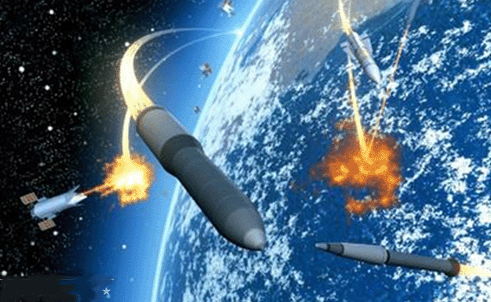
How much will it cost? The vast costs will be shouldered by taxpayers, likely by slashing funding for essential social needs. The aerospace industry has suggested defunding “entitlement programs” to pay for “everything space.” That would likely include cutting Social Security, Medicare, and Medicaid among other social and welfare programs. In his proposed fiscal year 2021 budget, Trump is recommending $15.4 billion for the Space Force. The Space Force, if it is allowed to continue, will clearly be a multi-billion dollar annual affair.
Who will profit?
Raytheon is emerging as a major beneficiary of Space Force work. Perhaps not uncoincidentally, Mark Esper, Trump’s U.S. Secretary of Defense at the time the Space Force was announced, is a former lobbyist for the corporation. Other major contractors for the Space Force will be Northrop Grumman, Boeing and Lockheed-Martin, the world’s biggest military contractor.
Space Force is no laughing matter, May 31, 2020 by beyondnuclearinternational
What started as “a joke” his now deadly serious; and just plain deadly Continue reading
Eminent Persons Warn Against Any Demonstration Nuclear Test Explosion
Eminent Persons Warn Against Any Demonstration Nuclear Test Explosion InDepth News, By Reinhard Jacobsen VIENNA (IDN) 30 May 20– Members of the CTBTO Group of Eminent Persons (GEM) have expressed “deep concern about credible press reports” that senior U.S. officials have discussed the possibility of conducting “a demonstration nuclear test explosion”.
They warn that if carried out, it would break the global moratorium on nuclear weapon test explosions and severely undermine the Comprehensive Nuclear Test Ban (CTBT) regime, established to help detect and deter nuclear weapon test explosions anywhere in the world.
“Nuclear weapon test explosions, for any purpose, are a vestige of a bygone era,” the Group maintains. “Only one state this century has detonated nuclear weapon tests, and today all of the world’s nuclear armed states are observing nuclear test moratoria,” it adds.
The CTBT bans all nuclear explosions, thus hampering both the initial development of nuclear weapons as well as significant enhancements. The Treaty also helps prevent harmful radioactive releases from nuclear testing.
The U.S. is among eight ‘Annex 2’ States that must sign and ratify before the Treaty comes into force. Along with China, Egypt, Iran and Israel, the U.S. has signed but not ratified the Treaty. However, the other three Annex 2 countries – India, North Korea and Pakistan – have not even signed.
The CTBT has so far been signed by 184 States, of which 168 have ratified the Treaty.
The GEM, launched on September 26, 2013 at the United Nations Headquarters in New York, supports and complements the CTBTO’s efforts to promote the CTBT entry into force, as well as reinvigorating international endeavours to achieve this goal. The group comprises eminent personalities and internationally recognized experts.
The CTBTO, with Dr Lassina Zerbo as Executive Secretary since August 2013, is the Preparatory Commission for the Comprehensive Nuclear-Test-Ban Treaty Organization. It is an international organization established by the States Signatories to the Treaty on November 19, 1996, and has its headquarters in Vienna, Austria. An Agreement (A/RES/54/28) to regulate the relationship between the United Nations and the CTBTO was adopted in 2000 by the General Assembly.
The GEM members are calling on eight hold-out Annex 2 countries to ratify the CTBT. “The most effective way to resolve possible concerns about very low-yield nuclear explosions and enforce compliance” with the Treaty, is to bring it into force. “When it does enter into force, States have the option to demand intrusive, short-notice on-site inspections to investigate suspicious activities,” they maintain……… https://www.indepthnews.net/index.php/global-governance/ctbto/3579-eminent-persons-warn-against-any-demonstration-nuclear-test-explosion
Ex-president Kravchuk estimates compensation for Ukraine’s nuclear weapons at US$250 bln.
Ex-president Kravchuk estimates compensation for Ukraine’s nuclear weapons at US$250 bln. UNIAN Information Agency 30 May 20 No negotiations were held with the United States on the compensation.Leonid Kravchuk, the first president of independent Ukraine, estimates compensation for scrapping the country’s nuclear weapons after signing the Budapest memorandum at US$250 billion. “The nuclear weapons were tactical, they also went to Russia. There were Backfire carriers, these are legendary aircraft. They also were transferred to Russia. If one counts everything – it’s somewhere about US$250 billion,” Kravchuk told Ukrainian TV host and journalist Alesia Batsman during the Batsman program.
“grave challenge to global peace and security” – Nuclear watchdog on potential U.S. nuclear test
 Nuclear watchdog says any US test would be ‘grave challenge to peace’
Lassina Zerbo, head of body monitoring test ban treaty, responds to White House discussions about potential first US test for 28 years, Guardian, Julian Borger in Washington, Fri 29 May 2020 The head of the international watchdog monitoring nuclear tests has warned that a US return to testing being contemplated by the Trump administration would present a “grave challenge to global peace and security”.
The idea was shelved for the time being, but appears not to have been rejected outright. Drew Walter, acting deputy assistant secretary of defence for nuclear matters, said this week that an underground nuclear test could be carried out within months “if the president directed”.
Arms control advocates said that the fact such a step was contemplated was disturbing, as it would be likely to lead to a return to nuclear testing by the world’s other nuclear weapons powers, and the demise of the 1996 Comprehensive Nuclear-Test-Ban treaty (CTBT)……
The US signed the CTBT in 1996 but the Senate voted against ratifying it. The treaty has been signed and ratified by 168 states but it will not come into force until the US, China, Israel and Egypt have ratified it, and it is signed and ratified by India, Pakistan and North Korea.
Meanwhile, the US has observed a voluntary moratorium on tests, as have the UK, France, Russia and China, and the CTBTO preparatory commission was established to set up a network of 300 seismic, hydroacoustic, infrasound and radionuclide sensors around the world, that helped identify nuclear tests by India, Pakistan and North Korea.
Zerbo noted that the US is the biggest financial contributor to the CTBTO and its verification regime.
Over the past year, the US has accused Russia and China of secretly conducting very low-yield tests, an accusation that both countries have denied, and for which the US has yet to provide evidence.
“The CTBTO’s international monitoring system [IMS] has been operating as normal and has not detected any unusual event,” Zerbo said. The IMS, complemented by the national technical means of the states signatories themselves, provides full confidence that the system can detect nuclear test explosions according to the provisions of the treaty.”
He added that the only way to remove all doubts was to bring the CTBT into force.
“At that point, the provisions for on-site inspections would come into effect, allowing for on-site visits at short notice if requested by any state party.” https://www.theguardian.com/world/2020/may/28/nuclear-watchdog-us-underground-test-challenge-to-peace
Fiji ratifies the TREATY ON THE PROHIBITION OF NUCLEAR WEAPONS.
Prohibition of Nuclear weapons treaty ratified https://www.fbcnews.com.fj/news/parliament/prohibition-of-nuclear-weapons-treaty-ratified/
|
|

Resuming Nuclear Testing a Slap in the Face to Survivors
Resuming Nuclear Testing a Slap in the Face to Survivors HTTPS://ALLTHINGSNUCLEAR.ORG/GUEST-COMMENTARY/RESUMING-NUCLEAR-TESTING-A-SLAP-IN-THE-FACE-TO-SURVIVORS LILLY ADAMS , UCS | MAY 26, 2020, The news that the Trump administration is considering resuming nuclear weapons testing is morally abhorrent. The current US moratorium on nuclear testing was put in place for many reasons, but we must not forget one crucial reason: In conducting explosive nuclear tests, the US government killed thousands of innocent people and sickened untold thousands more.
The very suggestion of resuming nuclear testing is shocking and a slap in the face to testing survivors who have spent decades watching their loved ones pass away—survivors like Sandra Walsh, of Salt Lake City, who grew up in Parowan in southern Utah, which received high levels of fallout from the Nevada Test Site.
“My family and I are Downwinders,” said Walsh. “I have had thyroid cancer and I have lost three of my children, three little girls, a mother should die before her children. My family, three sisters and my mom and dad all have had cancer. I have helped over 5000 downwinders get the help they need from the government. That is just a small amount of the people that have been affected by the bomb testing. My hope is that it will never happen again.”
Millions of Americans exposed to radioactive fallout
By treaty, the United States is barred from conducting above-ground nuclear tests, the type that created the mushroom clouds that regularly spread radiation across much of the country in the 1950s and 1960s. But underground testing has its own deadly risks, as well as severe environmental and health consequences. In fact the second most fallout-intensive nuclear weapons test in the continental US was an underground test in Nevada, exposing millions of Americans to radioactive fallout as far away as Iowa and Illinois. Another test—one that was intended to be fully contained underground—accidentally released 80,000 curies of radioactive iodine-131 into the atmosphere.
In addition, any resumption of explosive testing could quickly lead other nuclear weapons states to resume testing as well, further accelerating the arms race that is already building around the world. The kind of nuclear posturing we are seeing today led to massive above-ground testing and resulting deaths during the Cold War. We should do everything possible to avoid heading down this path again.
To do this, we must understand the history and the consequences of testing. The United States conducted over 1,000 nuclear weapons tests between 1945 and 1992, and 216 of them were above ground. The US conducted far more tests than any other country, with Russia conducting just over 700 tests and China only 45.
The scope of death and illnesses that resulted from this testing is hard to quantify, but it was devastating no matter how you look at it. A 1997 study from National Cancer Institute, which only examined thyroid cancers that may have resulted from exposure to I-131 estimated that up to 75,000 cancers could be connected to the testing. That study did not look at other illnesses that might have resulted from exposure to additional radioactive contaminants.
Meanwhile, in 2008, Arjun Makhijani, President of the Institute for Energy and Environmental Research, estimated deaths from nuclear testing at around 200,000. A recent study from the University of Arizona put the number higher, at 340,000 to 460,000 likely deaths. A study from International Physicians for the Prevention of Nuclear War estimated that ultimately, global cancer deaths from nuclear testing could reach 2.4 million.
Radioactive fallout from nuclear weapons testing spread across the United States, including Arizona, Colorado, Idaho, Montana, Nevada, New Mexico, Utah and Guam. In 1953, radiochemistry students in Troy, New York, 2,500 miles from the Nevada Test Site, measured radiation levels many times above normal, which were later connected to a nuclear weapons test in Nevada two days earlier. In the Marshall Islands, the US tested 67 nuclear weapons. The total explosive yield of those tests is equal to one Hiroshima-sized bomb detonated every single day for 20 years. The Defense Threat Reduction Agency admits that in the course of nuclear weapons testing, 550,000 military service members were exposed to radiation.
Seventy-five years after the first above-ground nuclear weapons test, the victims of nuclear weapons testing are in many cases still fighting for basic recognition of harm, as well as compensation for their often staggering health concerns. Downwinders of tests and uranium workers are fighting for equitable compensation through the Radiation Exposure Compensation Act, which currently has gaping holes in coverage and is set to expire in 2022.
Nuclear test survivors still owed billions
Tona Henderson, head of Idaho Downwinders, which has been fighting since 2004 for compensation for downwinders in Idaho, stated:
“It is unbelievable that anyone would think it was alright to start nuclear testing again! The government has not even compensated the Downwinders from the first 100 tests. We don’t need to kill and maim our own citizens again. On Memorial weekend we honored our fallen soldiers. Downwinders have suffered losses through no fault of their own, yet there will be no parades or flag draped coffins for us. Would you do these tests if your children or grandchildren were in the fallout path?”
Largely because of the impact of nuclear testing, Marshallese people living in the United States were promised Medicaid under an agreement called the Compact of Free Association, but this was stripped from them in 1996. In addition, the US owes billions of dollars to the Marshall Islands for unpaid health and environmental claims due to testing.
Shamanda Hanerg, Lani Kramer, Desmond Doulatram with REACH-MI, a non-profit in the Marshall Islands focused on their nuclear legacy, shared the following statement in response to the news:
“With outstanding human rights claims, one should pay no surprise as to why the Marshall Islands has been aggressive in the international scene in climate change and nuclear disarmament.
Our grandparents and parents suffered tremendously from the horrific effects of the nuclear testing (by the U.S. Government) on our beautiful islands. That was 74 years ago. We haven’t returned to our home, our ancestral heritage, because our land is contaminated by the many toxins and poisons we can’t even pronounce. Some of our islands were vaporized instantly from the nuclear testing.
We suffered severe burns from being in the direct fallout of the bombs. We continue to have miscarriages, still births, birth defects, various cancers, genetic disorders, and many more illnesses.
The enormity of the devastation of damages done by the nuclear testing is unfathomable, unthinkable, and inhumane. The mass destruction of the bombs on our islands have left us nuclear nomads…emotionally, mentally, and physically scarred forever.
More than ever we need to be emboldened and united in our quest to fight for justice and nuclear disarmament. For the U.S. Government to even consider continuing with nuclear testing would be an injustice to the People of the Marshall Islands.”
As a country, we have so much work left to do to right the wrongs of nuclear testing. It is unconscionable that the Trump administration is now considering resuming testing while these people are still fighting for justice.
During pandemic, U.S. military runs the largest maritime war games in the world
COVID-19: US Military Pursues War Games Amid Contagion, Consortium News, May 26, 2020 A robust schedule of military maneuvers and exercises is either underway or planned for Europe and the Pacific this year, with more in store for 2021, Ann Wright reports. During the pandemic the U.S. military is running the largest maritime military maneuvers in the world, with Rim of the Pacific (RIMPAC) coming to the waters off Hawaii Aug. 17-31, bringing 26 nations, 25,000 military personnel, up to 50 ships and submarines and hundreds of aircraft.Hawaii hasstringent measures to combat the spread of Covid-19, with a mandatory 14-day quarantine for all persons arriving in the state; returning residents as well as visitors. This quarantine is required until at least June 30, 2020.
The U.S. Army is also pursuing a 6,000-person war game in Poland, June 5-19, with a Polish airborne operation and a U.S.-Polish division-size river crossing.
If these weren’t too many military operations during an epidemic in which personnel on 40 U.S. Navy ships have come down with the hyper-contagious virus and during which military personnel and their families have been told not to travel, plans are also underway for a U.S. Army division-sized exercise in the Indo-Pacific region in less than a year. Known as Defender 2021, the U.S. Army has requested $364 million to conduct the war exercises throughout Asian and Pacific countries.
The pivot to the Pacific, begun under the Obama administration, and maintained by the Trump administration, is reflected in a U.S. National Defense Strategy (NDS) that sees the world as “a great power competition rather than counterterrorism and has formulated its strategy to confront China as a long-term, strategic competitor.”
Earlier in May, the U.S. Navy sent at least seven submarines, including all four Guam-based attack submarines, several Hawaii-based ships and the San Diego-based USS Alexandria to the western Pacific in what the Pacific Fleet Submarine Force announced as simultaneous “contingency response operations” for all of its forward-deployed subs. This was all in support of the Pentagon’s “free and open Indo-Pacific ” policy — aimed at countering China’s expansionism in the South China Sea — and as a show of force to counter ideas that the capabilities of U.S. Navy forces have been reduced by Covid-19…….
In May, 2020, the Australian government announced that a delayed six-month rotation of 2,500 U.S. Marines to a military base in Australia’s northern city of Darwin will go ahead based on strict adherence to Covid-19 measures including a 14-day quarantine. The Marines had been scheduled to arrive in April but their arrival was postponed in March because of the pandemic.
The remote Northern Territory, which had recorded just 30 Covid-19 cases, closed its borders to international and interstate visitors in March, and any arrivals must now undergo mandatory quarantine for 14 days. U.S. Marine deployments to Australia began in 2012 with 250 personnel and have grown to 2,500. The Joint U.S. Defense facility Pine Gap— the U.S. Department of Defense, Five Eyes and CIA surveillance facility that pinpoints airstrikes around the world and targets nuclear weapons, among other military and intelligence tasks — was also adapting its policy and procedures to comply with Australian government COVID restrictions.
As the U.S. military expands its presence in Asia and the Pacific, one place it will NOT be returning to is Wuhan, China. In October 2019, the Pentagon sent 17 teams with more than 280 athletes and other staff members to the Military World Games in Wuhan. Over 100 nations sent a total of 10,000 military personnel to the games in Wuhan last October.
The presence of a large U.S. military contingent in Wuhan just months before the outbreak of the Covid-19 in Wuhan in December 2019, fueled a theory by some Chinese officials that the U.S. military was somehow involved in the outbreak, which now has been used by the Trump administration and its allies in Congress and the media that the Chinese deliberately used the virus to infect the world and adding justification for the U.S. military build-up in the Pacific region.
Ann Wright served 29 years in the U.S. Army/Army Reserves and retired as a colonel. She was a U.S. diplomat for 16 years and served in U.S. Embassies in Nicaragua, Grenada, Somalia, Uzbekistan, Kyrgyzstan, Micronesia, Afghanistan and Mongolia. She resigned from the U.S. government in March 2003 in opposition to President George W. Bush’s war on Iraq. She is co-author of “Dissent: Voices of Conscience.” https://consortiumnews.com/2020/05/26/covid-19-military-pursues-war-exercises-amid-contagion/
Trump withdraws from Open Skies Treaty, throws more doubt on the future of the New START nuclear treaty
 Open Skies withdrawal throws nuclear treaty into question, The Hill, BY REBECCA KHEEL – 05/25/20 Open Skies withdrawal throws nuclear treaty into question, The Hill, BY REBECCA KHEEL – 05/25/20
President Trump‘s move this week to withdraw from an international pact meant to prevent accidental war has added to concerns about the fate of a separate arms control treaty with Russia. The Trump administration says formal talks with Moscow on extending the New START agreement, which places limits on deployed nuclear warheads, will start imminently. But after Trump announced Thursday he is withdrawing from the Open Skies Treaty, arms control advocates raised fresh doubt about the future of New START, which is set to expire in February. Trump has shown deep skepticism toward international agreements — and those negotiated under the Obama administration in particular — but the administration insists it hasn’t given up on arms control….. he person Trump has tapped to negotiate an extension or replacement has made no guarantees, saying at a think tank event this past week he’s “not going to speculate” on whether the treaty will be extended “at this very early stage” and arguing the United States could win an arms race if need be. “We know how to win these races and we know how to spend the adversary into oblivion,” Marshall Billingslea, the special presidential envoy for arms control, said during a Hudson Institute webcast. “If we have to, we will, but we sure would like to avoid it.” The wrangling over the decades-old arms control regime comes as much of the world’s attention is focused instead on the coronavirus pandemic, which Democrats have accused Trump of using as a cover to withdraw from Open Skies with little attention. “The president should be focused on combating the coronavirus, not dragging America toward a costly and potentially devastating nuclear arms race,” House Foreign Affairs Committee Chairman Eliot Engel (D-N.Y.) said in a statement on Trump’s move to pull out of Open Skies….. New START caps the number of deployed nuclear warheads the United States and Russia can have at 1,550 a piece, and it places limits on deploying weapons that can deliver the warheads and creates a verification regime that includes 18 on-site inspections per year. The agreement, which was negotiated by the Obama administration, is set to expire Feb. 5, 2021. But the treaty includes an option to extend it for another five years without needing the approval of either country’s legislature. Arms control advocates have sounded the alarm about the future of New START since last year after Trump withdrew from the Intermediate-range Nuclear Forces Treaty, a pact that banned Russia and the United States from having ground-launched missiles of a certain range. Now, those warnings are intensifying. In a statement opposing Trump’s Open Skies withdrawal, Sen. Jeanne Shaheen (D-N.H.) also highlighted “the uncertainty surrounding its commitment to New START,” calling the combination of both “very alarming.” The Open Skies Treaty, which was first proposed by former President Eisenhower but didn’t enter into force until 2002, allows its more than 30 signatories, including the U.S. and Russia, to fly unarmed observation flights over each other. The intention is to provide transparency about military activities to avoid miscalculations that could lead to war. The Trump administration formally submitted its notice of intent to withdraw Friday, kicking off a six-month period before the withdrawal is final. ……. Russia, meanwhile, has previously offered to extend the treaty immediately without any preconditions and has also recently expressed a willingness to include some of the new weapons Washington is concerned about. But on the heels of the U.S. withdrawal from Open Skies, Ryabkov on Friday cast doubt on New START’s extension…… Derek Johnson, executive director of Global Zero, which advocates for the elimination of nuclear weapons, argued Trump’s move on Open Skies “does not bode well for New START.” “Rather than accept Russia’s offer to extend New START immediately and without preconditions, the Trump administration has proposed instead to negotiate a new trilateral agreement that includes China. Without extending New START, this proposal is either a fool’s errand or a deliberate farce,” Johnson said in a statement. “Getting China’s nuclear forces under control is a worthy goal, and sustained efforts are required to do that — but if New START goes the way of the Intermediate-Range Nuclear Forces and Open Skies Treaties, the possibility of a bigger deal goes with it.” https://thehill.com/policy/defense/499240-open-skies-withdrawal-throws-nuclear-treaty-into-question |
|
On weapons treaties US administration is blundering toward nuclear chaos
 Fumbling the nuclear football: is Trump blundering to arms control chaos?
The president believes he alone can negotiate away nuclear weapons and win a Nobel prize – but he has quit three treaties and gutted his administration of experts, Guardian, Julian Borger in Washington Sun 24 May 2020
The Trump administration signaled this week that it was ready to get back in the business of nuclear arms control. A newly appointed envoy, Marshall Billingslea, made his first public remarks to announce talks with Russia are about to resume.
“We have concrete ideas for our next interaction, and we’re finalizing the details as we speak,” Billingslea said.
The fact that this relaunch came on the same day that the US was pulling out of the Open Skies Treaty (OST) – the third withdrawal from an arms control agreement under the Trump presidency – underlined the contradictions at the heart of the administration’s approach towards nuclear weapons.
According to those who have worked for him on the issue, Trump is preoccupied with the existential threat of nuclear war, and resolved that he alone can conjure a grand arms control bargain that would save the planet – and win him the Nobel prize.
But at the same time, he is clearly thrilled by the destructive power that the US arsenal gives him, boasting about the size of his nuclear button, and a mystery “super duper” missile he this week claimed the US had up its sleeve.
Administration officials have been left to try to confect a coherent-sounding policy out of such contradictory impulses – so far without success.
“He believes only he has what it takes to make the big deal, if only everyone else – all the experts – would get out of his way,” a former senior official said. “But he just has no idea about how to make it happen.”
 Billingslea, the new envoy, is not an arms control specialist. He previously served as the undersecretary for terrorist financing at the US Treasury and was nominated last year to the top human rights job at the state department – but that foundered amid controversy over his involvement in the post 9/11 torture programme . The arms control envoy job did not require Senate confirmation.
In his maiden speech as envoy, Billingslea made clear that if there were to be a new arms race, the US would win.
“We know how to win these races and we know how to spend the adversary into oblivion,” he said in a videoconference organised by the conservative Hudson Institute thinktank on Thursday. It was a statement of bravado as the US plunged into recession owing about $7tn in foreign debt, $1tn to China.
Billingslea argued Trump would succeed through his mastery of the art of the deal.
“The president has a long and successful career as a negotiator, and he’s a master at developing and using leverage,” he said, showing an early instinct for what it takes to keep your job in this administration.
So far, however, Trump has failed to negotiate a single arms control agreement. His flamboyant summitry with Kim Jong-un produced nothing, and the North Korean nuclear weapons programme has continued unabated. Meanwhile the president has taken the US out of three arms control agreements, leaving them dead, dying or maimed.
He walked out of the nuclear deal with Iran in 2018, and the following year withdrew from the Intermediate-range Nuclear Forces (INF) treaty, which had kept nuclear missiles out of Europe since the cold war. Then on Thursday, he confirmed the US was leaving the OST, agreed in 1992 as a means of building transparency and trust between Russia and the west through observation overflights of each other’s territory.
That may not be the end of Trump’s arms control demolition. The Senate never ratified the 1996 Comprehensive Test Ban treaty, which – partly as a result – has yet to come into force. But the US has signed it and observes a voluntary moratorium on nuclear tests.
Hawks in the administration, however, want a renunciation. At a high-level White House meeting last week, the suggestion was raised that the US carry out its first underground nuclear test since 1992, according to former officials. The proposal was resisted by the state and energy departments. A senior administration official told the Washington Post however the proposal is “very much an ongoing conversation.”
The only arms control agreement still in effect is the 2010 New Start treaty, which limits US and Russian deployed strategic nuclear weapons to 1,550 each. It is due to expire in February but it can be extended for another five years. The Trump administration has not taken a position on whether it wants an extension, however.
“There’ll be plenty of time to look at the full range of options related to that treaty,” Billingslea said. At the same time he made clear he viewed New Start as being inadequate, criticising its verification requirements, its exclusion of non-strategic, shorter-range weapons – and, most importantly, the fact that it does not include China……
Arms control advocates in the administration believe that the insistence on China’s inclusion was originally pushed by Trump’s third national security adviser, John Bolton, a lifelong opponent of arms control treaties, and his like-minded aide, Tim Morrison, as a means of killing off New Start.
……Disarmament advocates worry that even if Billingslea re-establishes regular contacts with Moscow, the US no longer has the diplomatic muscle to pursue substantive, complex arms negotiations because of the steady loss of experienced staff responsible for such negotiations.
“It’s not obvious they have a kind of a serious team in place to try and make that happen,” a western diplomat said.
“Three years after entering office, the Trump administration lacks a coherent set of goals, a strategy to achieve them, or the personnel or effective policy process to address the most complex set of nuclear risks in US history,” a group of arms control experts wrote in a report this month by the disarmament group, Global Zero. “Put simply, the current US administration is blundering toward nuclear chaos with potentially disastrous consequences.” https://www.theguardian.com/world/2020/may/24/nuclear-weapons-donald-trump-arms-control-chaos
Kim Jong-un Moves to Increase North Korea’s Nuclear Strength
Kim Jong-un Moves to Increase North Korea’s Nuclear Strength, NYT, 24 May 20
After another weekslong absence from public view, Mr. Kim convened his top military body to promote top aides specializing in nuclear and missile forces.
USA’s Plan to spend Russia and China ‘into oblivion’ in arms race will bankrupt only America
|
Scott Ritter is a former US Marine Corps intelligence officer. He served in the Soviet Union as an inspector implementing the INF Treaty, in General Schwarzkopf’s staff during the Gulf War, and from 1991-1998 as a UN weapons inspector. Follow him on Twitter @RealScottRitter In a stunning display of arrogance, ignorance, and hubris, President Trump’s new arms control czar threatens to spend America’s adversaries into “oblivion” in any new arms race. But the joke is on him.
Trump’s newly appointed Special Presidential Envoy for Arms Control Marshall Billingslea has breathed new life into an historical interpretation that holds the United States won the Cold War with the Soviet Union by escalating an arms race that turned out to be unsustainable for Moscow, bankrupting the Soviet economy and accelerating the collapse of the Soviet Union as a political entity. In remarks made to the Hudson Institute, a conservative think tank, Billingslea noted that the threat of a new arms race would be enough to bring both China and Russia to the negotiating table for the purpose of crafting a new trilateral arms control treaty that would replace the current bilateral New START treaty, scheduled to expire in February 2021. We intend to establish a new arms control regime now, precisely to prevent a full-blown arms race,” Billingslea said. If, however, either Russia or China (or both) decided to forego negotiations and continue to pursue new strategic nuclear weapons, then President Trump “has made clear that we have a tried and true practice here”.
|
|
NPT’s 50th Anniversary Encourages 17 Signatories To Remind Five Nuclear-Weapons States of Their Commitments
 NPT’s 50th Anniversary Encourages 17 Signatories To Remind Five Nuclear-Weapons States of Their Commitments IDN -In Depth News By UN Bureau, 24 May 20, NEW YORK (IDN) – The upcoming 2020 Review Conference of a landmark international treaty on the Non-Proliferation of Nuclear Weapons (NPT), postponed due to the COVID-19 pandemic, presents “a timely opportunity for the States Parties to undertake a comprehensive review and assessment” of its current status, says the Joint Communiqué issued on May 19 by 17 States Party to the NPT. NPT’s 50th Anniversary Encourages 17 Signatories To Remind Five Nuclear-Weapons States of Their Commitments IDN -In Depth News By UN Bureau, 24 May 20, NEW YORK (IDN) – The upcoming 2020 Review Conference of a landmark international treaty on the Non-Proliferation of Nuclear Weapons (NPT), postponed due to the COVID-19 pandemic, presents “a timely opportunity for the States Parties to undertake a comprehensive review and assessment” of its current status, says the Joint Communiqué issued on May 19 by 17 States Party to the NPT.
A total of 191 States have joined the Treaty, including the five nuclear-weapon States – USA; Russia, China, Britain and France – which entered into force in 1970. More countries have ratified the NPT than any other arms limitation and disarmament agreement, which analysts perceive as a testament to the Treaty’s significance. Signatories to the communique look forward to work with other States Parties. There is no doubt that the implementation of disarmament commitments would have allowed more resources to be allocated for sustainable development as well as international cooperation and preparedness to deal with such public health and global emergencies. “It is now time that States Parties translate words into concrete actions backed by clear and agreed-upon benchmarks and timelines. Only through such efforts can we look ahead towards a successful next 50 years of the NPT, improving on the important achievements of the last 50 years, which we presently commemorate,” accentuates the communique. Following is the full text of the Joint Communique:…… https://www.indepthnews.net/index.php/opinion/3564-five-nuclear-weapons-states-urged-to-fulfil-commitments-on-npt-s-50th-anniversary |
|
-
Archives
- October 2026 (112)
- September 2026 (339)
- August 2026 (330)
- July 2026 (355)
- June 2026 (287)
- May 2026 (306)
- April 2026 (356)
- March 2026 (251)
- February 2026 (267)
- January 2026 (308)
- December 2025 (358)
- November 2025 (359)
-
Categories
- 1
- 1 NUCLEAR ISSUES
- business and costs
- climate change
- culture and arts
- ENERGY
- environment
- health
- history
- indigenous issues
- Legal
- marketing of nuclear
- media
- opposition to nuclear
- PERSONAL STORIES
- politics
- politics international
- Religion and ethics
- safety
- secrets,lies and civil liberties
- spinbuster
- technology
- Uranium
- wastes
- weapons and war
- Women
- 2 WORLD
- ACTION
- AFRICA
- Atrocities
- AUSTRALIA
- Christina's notes
- Christina's themes
- culture and arts
- Events
- Fuk 2022
- Fuk 2023
- Fukushima 2017
- Fukushima 2018
- fukushima 2019
- Fukushima 2020
- Fukushima 2021
- general
- global warming
- Humour (God we need it)
- Nuclear
- RARE EARTHS
- Reference
- resources – print
- Resources -audiovicual
- Weekly Newsletter
- World
- World Nuclear
- YouTube
-
RSS
Entries RSS
Comments RSS

