Turkey’s Foreign Minister explains hurdles in Turkey’s path to nuclear weapons
|
Many obstacles in Turkey’s path to nuclear weapons – Yakış, Ahval 16 Sept 19,
Several hurdles stand in the way of Turkish President Recep Tayyip Erdoğan achieving his vision of acquiring nuclear weapons, former Foreign Minister Yaşar Yakış wrote in an article for the Arab News website. Addressing businessmen earlier this month, Erdoğan said it was unacceptable for other countries to have nuclear weapons while Turkey had none, spurring observers to consider the possibility. ……. Turkey is a signatory to the nuclear Non-Proliferation Treaty, which means it has sworn not to pursue nuclear weapons. Turkey has also committed to the Nuclear Test Ban Treaty of 1996, the Missile Technology Control Regime that bars the proliferation of chemical, biological and nuclear-tipped ballistic missiles, and the Hague Code of Conduct against ballistic missile proliferation of 2002, Yakış said. “If Turkey is determined to acquire nuclear warheads, it would first have to withdraw from all these international instruments. If it acquires nuclear warheads without withdrawing from them, it will face sanctions,” said Yakış . Meanwhile, Turkey’s withdrawal from these international treaties would not entitle it to acquire nuclear warheads; it would still need to find a nuclear state willing to cooperate, according to Yakış. Additionally, Turkey has no missile capable of delivering a nuclear payload, so would either have to develop its own or find a country willing to supply one, he added. “It is still unclear whether the establishment in Turkey will follow Erdoğan’s abrupt move,” said Yakış. “But, in the long term, Erdoğan’s idea may gain traction with the public.” https://ahvalnews.com/nuclear-treaty/many-obstacles-turkeys-path-nuclear-weapons-yakis |
|
Frightening new simulation of a US-Russia war triggered by one ‘tactical’ nuclear weapon
A new simulation called “Plan A,” by researchers at Princeton’s Program on Science and Global Security, shows how the use of one so-called tactical or low-yield nuclear weapon could lead to a terrifying worldwide conflict.
In the roughly four-minute video, a Russian “nuclear warning shot” at a US-NATO coalition leads to a global nuclear war that leads to 91.5 million deaths and injuries.
Under President Trump, the US is ramping up production of tactical nuclear weapons, ostensibly to target troops and munitions supplies. While advocates say these weapons would keep wars from escalating, the simulation finds the opposite outcome.
The dissolution of the INF treaty in August raised the stakes for nuclear war, as both the US and Russia were free to develop weapons previously banned under the treaty.
The risk of nuclear war has increased dramatically in the past two years,” the project states. Nuclear strikes are an extremely remote possibility, but their chances are rising experts warn.The simulation is called “Plan A,” and it’s an audio-visual piece that was first posted to to YouTube on September 6. (You can watch the full video at the end of this story.) Researchers at the Science and Global Security lab at Princeton University created the animation, which shows how a battle between Russia and NATO allies that uses so-called low-yield or “tactical” nuclear weapons – which can pack a blast equivalent to those the US used to destroy Hiroshima or Nagasaki in World War II – might feasibly and quickly snowball into a global nuclear war.
“This project is motivated by the need to highlight the potentially catastrophic consequences of current US and Russian nuclear war plans. The risk of nuclear war has increased dramatically in the past two years,” the project states on its website……… https://www.businessinsider.com.au/tactical-nuclear-weapons-escalation-us-russia-war-animated-strike-map-2019-9?r=US&IR=T
Why Russia’s first atomic submarines were a nuclear nightmare
The United States launched the first nuclear-powered submarine, the USS Nautilus, in 1954, revolutionizing undersea warfare. The Nautilus’s reactor allowed it operate underwater for months at a time, compared to the hours or days afforded conventional submarines. The following year, the Soviet Union began building its own nuclear submarine, the Project 627—known as the November class by NATO. The result was a boat with a few advantages compared to its American competition, but that also exhibited a disturbing tendency to catastrophic accidents that would prove characteristic of the burgeoning Soviet submarine fleet during the Cold War.
Russia’s nuclear torpedoes at the bottom of the sea
A Dead Russian Submarine Armed with Nuclear Torpedoes was Never Recovered, National Interest, Robert Farley, September 15, 2019
Key point: She rests at a depth of 15,000 feet —too deep to make recovery practical.
The Novembers (627):

Global catastrophe ever closer as nuclear arms race revs up
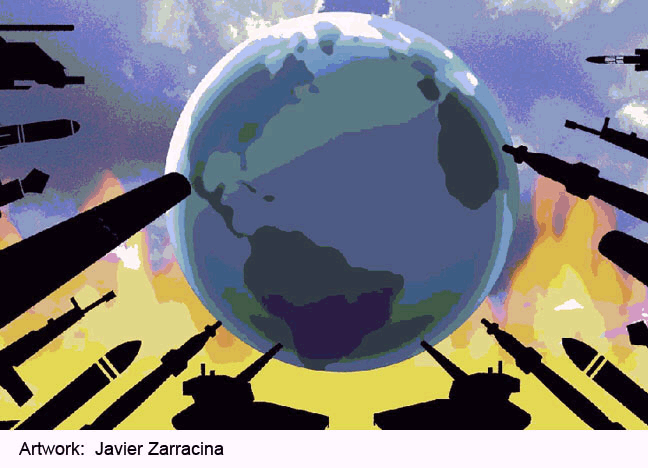
New nuclear arms race brings higher risk of global catastrophe, The New Daily,
Veteran defence and security analyst Brian Toohey has warned that talk of war between the West, and China and Russia, along with brinkmanship with North Korea and Iran, has escalated the conditions that can lead to catastrophic accidents and mistakes.
Adding to the potential for disastrous nuclear consequences, Mr Toohey’s latest book – to be published this week – reveals that “many missile control systems can now be hit by a wide range of previously unknown cyber-warfare tools available to terrorists, hoaxers and governments”.
Mr Toohey’s book, Secret – The Making of Australia’s Security State, outlines a terrifying situation where nuclear  weapons continue to exist in massive numbers.
They are in the hands of governments with little or no framework to regulate their use, movement and deployment.
Russian President Vladimir Putin escalated the arms race with a 2018 declaration that Russia was developing “supposedly invulnerable delivery systems for nuclear weapons”.
President Putin later released a video of a purported prototype being tested.
“These systems are unlikely to materialise because Russia can’t afford them. However, it could afford to smuggle warheads into target countries,” Mr Toohey said.
Mr Toohey does not excuse China’s “abrasive behaviour” in the South China Sea, which is adding to tensions already exacerbated by trade “wars”.
US President Donald Trump, meanwhile, has aggravated the tense international situation with rhetoric declaring he wants America to have more nuclear weapons than anyone else.
President Trump had approved the 2018 Nuclear Posture Review, which emphasised the integration of nuclear and non-nuclear warfare in the US’s military doctrine, training and exercises.
The US abandoned the Intermediate-Range Nuclear Forces Treaty, which also allows it to put these weapons in western Europe as well as much closer to China.
Mr Toohey quoted the head of the Australian-led International Campaign to Abolish Nuclear Weapons, Beatrice Fihn, in her Nobel Prize acceptance speech: “The only rational course of action is to cease living under conditions where our mutual destruction is only one impulsive tantrum away”.
As well as government actions, Mr Toohey’s book also lists a frightening history of nuclear false alarms and accidents from the Cold War years to the present.
“Human error is ever-present. What is clear is that the risk remains of an accidental nuclear war started by missiles launched in error,” he states.
Nuclear near misses
In 2007, despite strict safety protocols, six nuclear-armed cruise missiles were mistakenly loaded onto a B-52 bomber at the US Minot Air Force Base.
“The plane sat on the tarmac unguarded overnight and then flew 2400 kilometres to another base, where it was nine hours before a maintenance crew realised the weapons were live”.
The Union of Concerned Scientists reported that nuclear war was narrowly averted in 1983 when a Soviet officer was confronted with early-warning data indicating that the US had launched five nuclear missiles.
Instead of notifying his superiors, the officer decided it was a false alarm and took no further action.
The UCS concluded: “If a different officer had been on duty, the false alarm could easily have turned into a catastrophe”.
Mr Toohey writes that nothing so starkly illustrates the “depravity of nuclear war planning” as the targeting list for the US Single Integrated Operational Plan, which anticipated deaths in the millions in targeted cities.
And “nothing so bleakly illustrates the irresponsibility of the planners as their continued refusal to install self-destruct devices that activate when missiles are launched by accident”, he said.
Australia is complicit Continue reading
US experts propose having Artificial Intelligence control nuclear weapons
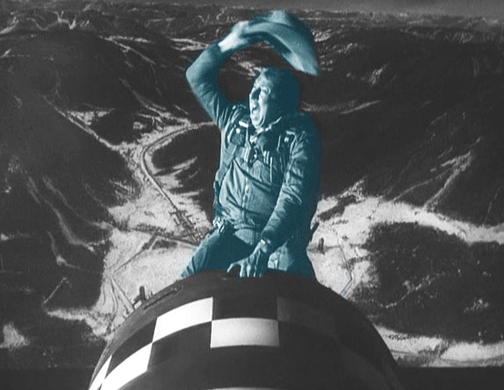 Strangelove redux: US experts propose having AI control nuclear weapons https://thebulletin.org/2019/08/strangelove-redux-us-experts-propose-having-ai-control-nuclear-weapons/
By Matt Field, AA August 30 2019 Hypersonic missiles, stealthy cruise missiles, and weaponized artificial intelligence have so reduced the amount of time that decision makers in the United States would theoretically have to respond to a nuclear attack that, two military experts say, it’s time for a new US nuclear command, control, and communications system. Their solution? Give artificial intelligence control over the launch button.
In case handing over the control of nuclear weapons to HAL 9000 sounds risky, the authors also put forward a few other solutions to the nuclear time-pressure problem: Bolster the United States’ ability to respond to a nuclear attack after the fact, that is, ensure a so-called second-strike capability; adopt a willingness to pre-emptively attack other countries based on warnings that they are preparing to attack the United States; or destabilize the country’s adversaries by fielding nukes near their borders, the idea here being that such a move would bring countries to the arms control negotiating table.
Still, the authors clearly appear to favor an artificial intelligence-based solution.
“Nuclear deterrence creates stability and depends on an adversary’s perception that it cannot destroy the United States with a surprise attack, prevent a guaranteed retaliatory strike, or prevent the United States from effectively commanding and controlling its nuclear forces,” they write. “That perception begins with an assured ability to detect, decide, and direct a second strike. In this area, the balance is shifting away from the United States.”
History is replete with instances in which it seems, in retrospect, that nuclear war could have started were it not for some flesh-and-blood human refusing to begin Armageddon. Perhaps the most famous such hero was Stanislav Petrov, a Soviet lieutenant colonel, who was the officer on duty in charge of the Soviet Union’s missile-launch detection system when it registered five inbound missiles on Sept. 26, 1983. Petrov decided the signal was in error and reported it as a false alarm. It was. Whether an artificial intelligence would have reached the same decision is, at the least, uncertain.
One of the risks of incorporating more artificial intelligence into the nuclear command, control, and communications system involves the phenomenon known as automation bias. Studies have shown that people will trust what an automated system is telling them. In one study, pilots who told researchers that they wouldn’t trust an automated system that reported an engine fire unless there was corroborating evidence nonetheless did just that in simulations. (Furthermore, they told experimenters that there had in fact been corroborating information, when there hadn’t.)
University of Pennsylvania political science professor and Bulletin columnist Michael Horowitz, who researches military innovation, counts automation bias as a strike against building an artificial intelligence-based nuclear command, control, and communications system. “A risk in a world of automation bias is that the Petrov of the future doesn’t use his judgment,” he says, “or that there is no Petrov.”
The algorithms that power artificial intelligence-systems are usually trained on huge datasets which simply don’t exist when it comes to nuclear weapons launches. “There have not been nuclear missile attacks, country against country. And so, training an algorithm for early warning means that you’re relying entirely on simulated data,” Horowitz says. “I would say, based on the state-of-the-art in the development of algorithms, that generates some risks.”……..
There is some precedent for the system proposed by the War on the Rocksauthors, who have served in government or in the military in nuclear-weapons-related capacities. In the fictional world of Hollywood, that precedent was established in Stanley Kubrick’s nuclear satire Dr. Strangelove and called the “Doomsday Machine,” which author Eric Schlosser described this way for The New Yorker:
“The device would trigger itself, automatically, if the Soviet Union were attacked with nuclear weapons. It was meant to be the ultimate deterrent, a threat to destroy the world in order to prevent an American nuclear strike. But the failure of the Soviets to tell the United States about the contraption defeats its purpose and, at the end of the film, inadvertently causes a nuclear Armageddon. ‘The whole point of the Doomsday Machine is lost,’ Dr. Strangelove, the President’s science adviser, explains to the Soviet Ambassador, ‘if you keep it a secret!’”
About two decades later, satire became closer to reality with the advent of the Soviet Union’s semiautomated Dead Hand system, formally known as Perimeter. When that system perceived that the Soviet military hierarchy no longer existed and detected signs of a nuclear explosion, three officers deep in a bunker were to launch small command rockets that would fly across the country initiating the launch of all of the Soviet Union’s remaining missiles, in a sort of revenge-from-the-grave move. The system was intended to enhance deterrence. Some reports suggest it is still in place.
The possibility that taking humans out of the loop might lead to an accidental launch and unintended nuclear war is a main element in US Naval War College Prof. Tom Nichols’ harsh characterization of the Dead Hand system in a 2014 article in The National Interest: “Turns out the Soviet high command, in its pathetic and paranoid last years, was just that crazy.”
But Lowther and McGiffin say a hypothetical US system would be different than Dead Hand because “the system itself would determine the response based on its own assessment of the inbound threat.“ That is to say, the US system would be better, because it wouldn’t necessarily wait for a nuclear detonation to launch a US attack.
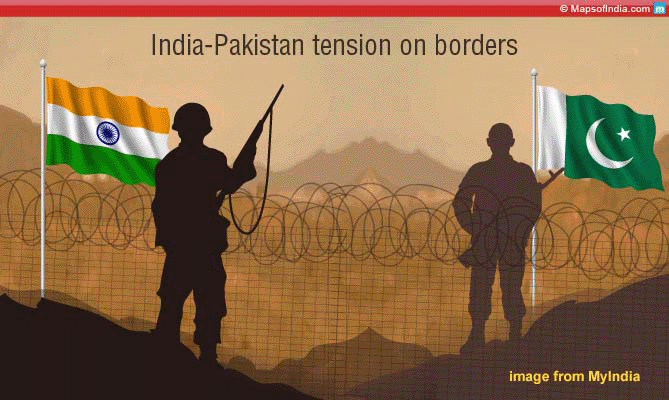
Tensions between India and Pakistan, as India contemplates abandoning its No First Use policy on nuclear weapons
|
Some experts watching the situation have told Naturethat the risk of a conflict between the two countries has never been greater since they both tested nuclear weapons in 1998……… What is no first use and who else has adopted it? Of the world’s eight declared nuclear-weapons states, only China and India have an unambiguous no first use nuclear weapons policy. This is a commitment only to use nuclear weapons in response to a nuclear attack and never in retaliation for one using conventional weapons. Such a policy also includes comprehensive protocols in which activating nuclear weapons would only ever be a last resort. India tested its first nuclear weapon in 1974 and the government committed to no first use in 2003, five years after conducting a second set of nuclear-weapons tests on 11 and 13 May 1998. The intention in declaring no first use was partly to help defuse tensions with its neighbour, which had responded to India’s second test with its own nuclear tests the same month. Over the past two decades, Pakistan has amassed 150–160 nuclear missiles, to India’s 130–140, according to the Stockholm International Peace Research Institute. Both countries, moreover, have advanced nuclear weapons, as well as ballistics research and development programmes. Why doesn’t Pakistan have a no first use policy? According to Feroz Hassan Khan, who teaches security studies at the Naval Postgraduate School in Monterey, California, if Pakistan were to adopt the same policy, that would negate its reason for developing nuclear weapons in the first place……..https://www.nature.com/articles/d41586-019-02578-5 |
|
A freezing and deathly aftermath would follow a US-Russian nuclear war
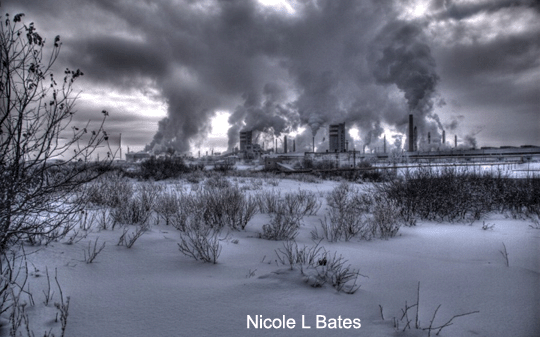 HERE’S WHAT WOULD FOLLOW US-RUSSIA NUCLEAR WAR https://www.futurity.org/nuclear-war-united-states-russia-2144632/ AUGUST 28TH, 2019 Indeed, death by famine would threaten nearly all of the Earth’s 7.7 billion people, says coauthor Alan Robock, a professor in the environmental sciences department in the School of Environmental and Biological Sciences at Rutgers University–New Brunswick. HERE’S WHAT WOULD FOLLOW US-RUSSIA NUCLEAR WAR https://www.futurity.org/nuclear-war-united-states-russia-2144632/ AUGUST 28TH, 2019 Indeed, death by famine would threaten nearly all of the Earth’s 7.7 billion people, says coauthor Alan Robock, a professor in the environmental sciences department in the School of Environmental and Biological Sciences at Rutgers University–New Brunswick.
The study in the Journal of Geophysical Research–Atmospheres provides more evidence to support the Treaty on the Prohibition of Nuclear Weapons the United Nations passed two years ago, Robock says. Twenty-five nations have ratified the treaty so far, not including the United States, and it would take effect when the number hits 50. Lead author Joshua Coupe, a doctoral student at Rutgers University, and other scientists used a modern climate model to simulate the climatic effects of an all-out nuclear war between the United States and Russia. Such a war could send 150 million tons of black smoke from fires in cities and industrial areas into the lower and upper atmosphere, where it could linger for months to years and block sunlight. The scientists used a new climate model from the National Center for Atmospheric Research with higher resolution and improved simulations compared with a NASA model used by a research team Robock led 12 years ago. The new model represents the Earth at many more locations and includes simulations of the growth of the smoke particles and ozone destruction from the heating of the atmosphere. Still, the climate response to a nuclear war from the new model was nearly identical to that from the NASA model. “This means that we have much more confidence in the climate response to a large-scale nuclear war,” Coupe says. “There really would be a nuclear winter with catastrophic consequences.” In both the new and old models, a nuclear winter occurs as soot (black carbon) in the upper atmosphere blocks sunlight and causes global average surface temperatures to plummet by more than 15 degrees Fahrenheit. Because a major nuclear war could erupt by accident or as a result of hacking, computer failure, or an unstable world leader, the only safe action that the world can take is to eliminate nuclear weapons, says Robock. Additional researchers from the National Center for Atmospheric Research and University of Colorado, Boulder contributed to the study. Source: Rutgers University |
|
|
Canada didn’t sign the nuclear ban treaty, but can still take up its humanitarian provisions
|
Canada played a critical role in nuclear development. We should play a critical role in reparations,
Canada didn’t sign the nuclear ban treaty. But we can still take up its humanitarian provisions · for CBC News Aug 30, 2019 Canada holds contradictory positions in the world of nuclear weapons. We played an essential role in their development, but we never built any bombs of our own. Comprehensive Nuclear-Test-Ban Treaty
We are also already a party to every other major nuclear non-proliferation treaty, including the Comprehensive Nuclear-Test-Ban Treaty, which bans all nuclear weapons testing. This was easy for us to join in 1998; we had no nuclear weapons to test. However, engaging with the Treaty on the Prohibition of Nuclear Weapons would give Canada an opportunity to go beyond our existing, relatively painless, obligations. And we would also be the first nuclear umbrella state to do so, thus setting a meaningful and lasting precedent. Perhaps most importantly, Canada has a moral obligation to provide aid to victims and environments affected by nuclear testing. We don’t like to talk about it much, but Canada played a critical role in the development of these horrific weapons: scientists at the Montréal Laboratory were an essential part of the Manhattan Project, and the first atomic bombs were made with uranium shipped from the Northwest Territories. These are unfortunate truths that Canadians have yet to truly reckon with, but committing to a platform of nuclear reparations would be a good start. https://www.cbc.ca/news/opinion/canada-nuclear- |
|
|
The Once and Future Threat of Nuclear Weapon Testing
The Once and Future Threat of Nuclear Weapon Testing, Just Security by Ambassador Thomas Graham Jr. 30 Aug 19 The Nuclear Non-Proliferation Treaty (NPT) is the central security instrument of the United States and the world community. It is based on a strategic bargain between the five nuclear weapon states in the NPT (the United States, the United Kingdom, France, Russia, and China) and the 185 non-nuclear-weapon parties to the treaty. The current worldwide moratorium on nuclear weapon testing and the intended ultimate conversion of that ban to legally binding treaty status by bringing the Comprehensive Test Ban Treaty (CTBT) into force are essential to the long-term viability of this strategic bargain. But some Trump administration officials have signaled hostility to the CTBT and an interest in the United States resuming nuclear weapon testing, which could cause a catastrophic unraveling of that bargain…….. https://www.justsecurity.org/66020/the-once-and-future-threat-of-nuclear-weapon-testing/
Nuclear winter – the global threat to life

Nuclear winter would threaten nearly everyone on Earth https://www.sciencedaily.com/releases/2019/08/190828080543.htm
Second study of its kind confirms extreme impacts from US vs. Russia nuclear war
- Date:
- August 28, 2019
- Source:
- Rutgers University
- Summary:
- If the United States and Russia waged an all-out nuclear war, much of the land in the Northern Hemisphere would be below freezing in the summertime, with the growing season slashed by nearly 90 percent in some areas, according to a new study. Indeed, death by famine would threaten nearly all of the Earth’s 7.7 billion people, according to the research.
-
If the United States and Russia waged an all-out nuclear war, much of the land in the Northern Hemisphere would be below freezing in the summertime, with the growing season slashed by nearly 90 percent in some areas, according to a Rutgers-led study.
Indeed, death by famine would threaten nearly all of the Earth’s 7.7 billion people, said co-author Alan Robock, a Distinguished Professor in the Department of Environmental Sciences at Rutgers University-New Brunswick.
The study in the Journal of Geophysical Research-Atmospheresprovides more evidence to support The Treaty on the Prohibition of Nuclear Weapons passed by the United Nations two years ago, Robock said. Twenty-five nations have ratified the treaty so far, not including the United States, and it would take effect when the number hits 50.
- Lead author Joshua Coupe, a Rutgers doctoral student, and other scientists used a modern climate model to simulate the climatic effects of an all-out nuclear war between the United States and Russia. Such a war could send 150 million tons of black smoke from fires in cities and industrial areas into the lower and upper atmosphere, where it could linger for months to years and block sunlight. The scientists used a new climate model from the National Center for Atmospheric Research with higher resolution and improved simulations compared with a NASA model used by a Robock-led team 12 years ago.
The new model represents the Earth at many more locations and includes simulations of the growth of the smoke particles and ozone destruction from the heating of the atmosphere. Still, the climate response to a nuclear war from the new model was nearly identical to that from the NASA model.
“This means that we have much more confidence in the climate response to a large-scale nuclear war,” Coupe said. “There really would be a nuclear winter with catastrophic consequences.”
- In both the new and old models, a nuclear winter occurs as soot (black carbon) in the upper atmosphere blocks sunlight and causes global average surface temperatures to plummet by more than 15 degrees Fahrenheit.
Because a major nuclear war could erupt by accident or as a result of hacking, computer failure or an unstable world leader, the only safe action that the world can take is to eliminate nuclear weapons, said Robock, who works in the School of Environmental and Biological Sciences.
Narrow escapes from nuclear war
|
A few small goofs nearly threw the world into nuclear war Popular Science , Excerpt: End Times, By Bryan Walsh
If there’s an important post in America’s national defense establishment, chances are that William Perry has held it. He worked as a civilian expert in electronic intelligence in the 1960s, served as undersecretary of defense for research and engineering, and ended his career in government service as President Bill Clinton’s defense secretary from 1994 to 1997. He served on the University of California’s board of governors for the laboratory at Los Alamos—where the first nuclear bomb was developed—and is currently the head of the board at the Bulletin of the Atomic Scientists. Even at 91 years old his voice still exudes authority, and his words demand attention in capitals around the world. What makes Perry special, however, is that he is one of the last living American statesmen who saw with his own eyes just how close we came to nuclear annihilation. And what he came to understand was that the real threat of nuclear war wasn’t from military competition, but from the way that simple misunderstandings and technical errors could spiral out into planetary catastrophe. It wasn’t the war in nuclear war that was so dangerous—it was the nuclear, the fact that thousands of megatons of explosive power kept on a hair trigger made any mistake irrevocable…… Perry got involved in what would become known as the Cuban Missile Crisis. ….. The stage was set for the single moment in the modern age when the human race may have come closer to extinction than it ever has before or since. On October 27, 1962, as part of the U.S. naval quarantine of Cuba, American destroyers and the aircraft carrier USS Randolph managed to corner the Soviet submarine B-59. The U.S. ships began dropping small depth charges—underwater explosive devices—around the sub. The American commanders weren’t trying to sink the sub but rather to force it to the surface, an intention they had made clear to Soviet military leaders in Moscow. What the Americans didn’t know was that the sub had been out of touch with Moscow for days. When depth charges began exploding around the sub, the crew had every reason to believe that World War III had begun. An exhausted Captain Valentin Savitsky gave the orders to prepare the sub’s nuclear torpedo for firing. A successful hit on the Randolph would have vaporized the aircraft carrier, which in turn would have put the U.S. nuclear war plan for total retaliation into play. Thousands of American warheads would have been on their way to targets in the Soviet Union, China, and other nations. The Soviets would have responded, and the worst would have come true. The decision to launch a nuclear weapon on board the Soviet sub had to be authorized by three officers. Ivan Maslennikov, the deputy political officer, said yes. But Vasili Arkhipov, Savitsky’s second in command, refused. He convinced Savitsky to instead bring the sub to the surface, where a U.S. destroyer ultimately allowed the ship to return to Russia. …….. The Cuban Missile Crisis is only the best known of many, many times when World War III was almost triggered by accident. William Perry himself lived through one when he was serving in the Department of Defense in 1979 and was awakened in the middle of the night by a watch officer at NORAD who said his monitors were showing two hundred Soviet intercontinental ballistic missiles (ICBMs) en route to the United States. It turned out to be a computer error. Less than a year later, on June 3, 1980, military computers showed thousands of Soviet missiles headed toward the States. Then–national security adviser Zbigniew Brzezinski was about to recommend a counterattack until he was told at the last minute that the alarm had been generated by a faulty computer chip—one that cost all of 46 cents. Perhaps the closest the world came to nuclear war after the Cuban Missile Crisis was on September 26, 1983, with the reported launch of several ICBMs from the United States. Lieutenant Colonel Stanislav Petrov was on duty that night, and his job was straightforward: register the missile launch and report it to Soviet military and political command. An ICBM takes half an hour to reach its target, which meant Petrov had only minutes to authenticate the apparent attack in time for the Soviets to launch a counterattack. Yet Petrov judged that the United States would not launch a first strike with only a handful of missiles, so he instead reported a system malfunction. And then he waited. “Twenty-three minutes later I realized that nothing had happened,” Petrov told the BBC in 2013. “If there had been a real strike, then I would already know about it. It was such a relief.” ………… But the side effect of nuclear-enforced peace was the creation of existential risk for the entire species. Every year, every day, every moment, global catastrophe could strike at the push of a button. “Today, every inhabitant of this planet must contemplate the day when this planet may no longer be habitable,” President Kennedy told the United Nations in 1961. “Every man, woman, and child lives under a nuclear sword of Damocles, hanging by the slenderest of threads, capable of being cut at any moment by accident or miscalculation or by madness.” And we live under that sword still. Excerpted from End Times by Bryan Walsh. https://www.popsci.com/end-times-nuclear-war-accidents/ |
|
|
Russia fears fatal consequences if the NEWSTART nuclear arms treaty is allowed to lapse
Calls on Donald Trump to start talks about the last remaining nuclear weapons agreement between Russia and the U.S. remain unanswered, 18 months before it expires, increasing the risk of an unhindered arms race, according to Russian President Vladimir Putin’s spokesman. The consequences will be “quite fatal” if Russia and the U.S. let lapse the 2010 New START treaty limiting both nuclear powers’ strategic arsenals, Kremlin spokesman Dmitry Peskov said on a call with reporters Monday. “Undoubtedly, strategic stability on the overall global level will be affected, because we all — I mean humanity — we will be left without a single document that would regulate this area.”…….. (subscribers only) https://www.bloomberg.com/news/articles/2019-08-26/russia-says-u-s-silence-on-last-nuclear-treaty-may-be-fatal |
|
|

NATO nuclear bombs are stored in violation of international law in Italy, Germany, Belgium, the Netherlands and Turkey.
|
NATO Nuclear Gaff, Voltaire Network , by Manlio Dinucci It’s a stale old secret. But it is also one of the most
 formidable denials of the Atlantic Alliance: nuclear bombs are stored in violation of international law in Italy, Germany, Belgium, the Netherlands and Turkey. By mistake, a member of the NATO Parliamentary Assembly wrote it in a report immediately withdrawn. VOLTAIRE NETWORK | ROME (ITALY) | 26 AUGUST 2019 formidable denials of the Atlantic Alliance: nuclear bombs are stored in violation of international law in Italy, Germany, Belgium, the Netherlands and Turkey. By mistake, a member of the NATO Parliamentary Assembly wrote it in a report immediately withdrawn. VOLTAIRE NETWORK | ROME (ITALY) | 26 AUGUST 2019 That the United States keeps nuclear bombs in five NATO countries – Italy, Germany, Belgium, the Netherlands and Turkey – has long been proven (especially by the Federation of American Scientists – FAS) [1]. But NATO never officially admitted it. However something has just gone off the rails. In the document titled “A new era for nuclear deterrence? Modernization, Arms Control and Alien Nuclear Forces”, by Canadian Senator Joseph Day on behalf of the Defense and Security Committee of the NATO Parliamentary Assembly, the’ secret ’has been revealed. ….. Accusing Russia of keeping many tactical nuclear weapons in its own arsenal, the document states that the US nuclear weapons deployed in advanced positions in Europe and Anatolia (ie near Russian territory) serve “To ensure the full involvement of the Allies in NATO’s nuclear mission and the concrete confirmation of the US nuclear commitment to the security of the European allies of the Alliance”. As soon as Senator Joseph Day’s document was published online, NATO intervened by deleting it and then republishing it as an amended version. Too late though……… This confirms what we have documented for years …… All this in violation of the Non-Proliferation Treaty, ratified by both the US and Italy. Meanwhile the Parliament is tearing on the TAV but not on the Bomb, that it tacitly unanimously approves. …………… Translation Roger Lagassé Source |
|
Russia launched two ballistic missiles from nuclear-powered submarines in the Arctic Ocean and the Barents Sea
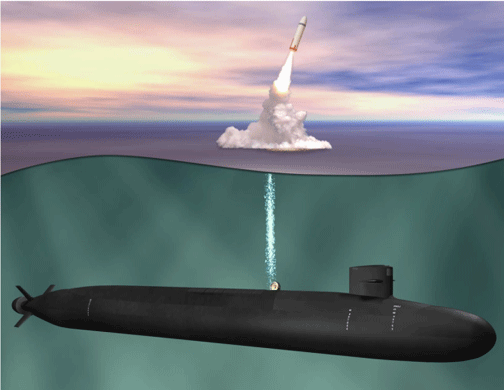 Russia says it launched 2 ballistic missiles in the Arctic Ocean as part of combat training By Amir Vera, CNN August 25, 2019 Russia launched two ballistic missiles from nuclear-powered submarines in the Arctic Ocean and the Barents Sea on Saturday, according to a tweet from the Russian Ministry of Defense.
1 This Month

Protect Sazan Island from the Trump family! https://secure.avaaz.org/campaign/en/protect_sazan_island_from_the_trump_family_loc/?bqFCVab&v=174511&cl=22707147157&_checksum=5e9dde668860e8231c33699735e16a1fbf22ab2cb01da50c999fe8732b9775ef&utm_source=email&utm_medium=blast_email&utm_campaign=174511
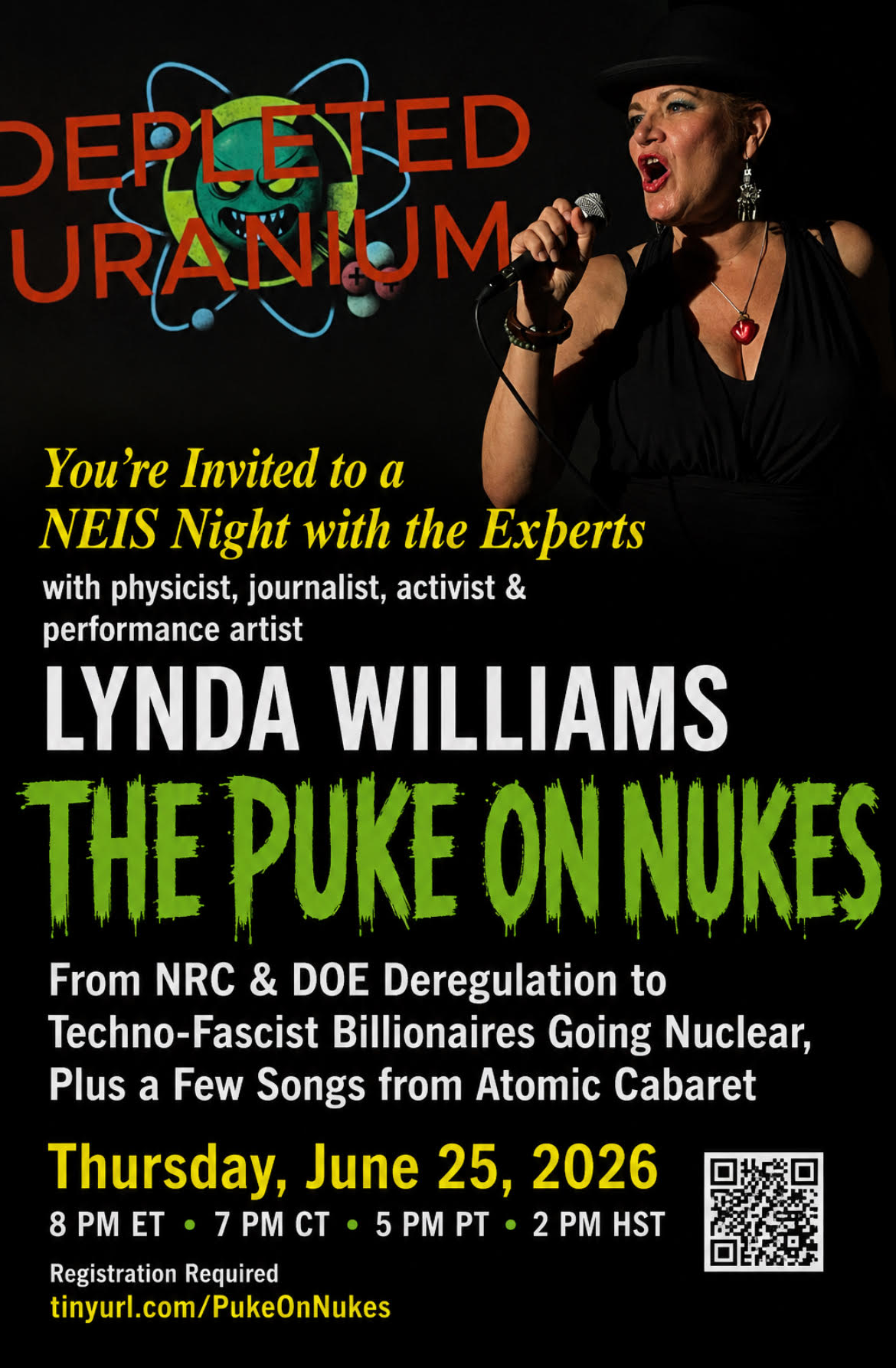
25 June- THE PUKE ON NUKES
Thursday, June 25, 2026
7pm Central Time (8pm ET, 6pm MT, 5pm PT) UTC – 5
From NRC & DOE Deregulation to Techno-Fascist Billionaires Going Nuclear, Plus a Few Songs from Atomic Cabaret REGISTER
26 June – Radiation Trainwreck at the NRC / Join the Protect Better Campaign – https://us02web.zoom.us/meeting/register/4ZlZ5_qLSHGiLSCg8FF6Bg#/registration


Cuba Is Not a Failed State – It Is a Besieged State
PETITION: “Global Appeal to Endorse Palestinian Right of Return of Refugees”
To see nuclear-related stories in greater depth and intensity – go to https://nuclearinformation.wordpress.com
-
Archives
- June 2026 (142)
- May 2026 (306)
- April 2026 (356)
- March 2026 (251)
- February 2026 (268)
- January 2026 (308)
- December 2025 (358)
- November 2025 (359)
- October 2025 (376)
- September 2025 (257)
- August 2025 (319)
- July 2025 (230)
-
Categories
- 1
- 1 NUCLEAR ISSUES
- business and costs
- climate change
- culture and arts
- ENERGY
- environment
- health
- history
- indigenous issues
- Legal
- marketing of nuclear
- media
- opposition to nuclear
- PERSONAL STORIES
- politics
- politics international
- Religion and ethics
- safety
- secrets,lies and civil liberties
- spinbuster
- technology
- Uranium
- wastes
- weapons and war
- Women
- 2 WORLD
- ACTION
- AFRICA
- Atrocities
- AUSTRALIA
- Christina's notes
- Christina's themes
- culture and arts
- Events
- Fuk 2022
- Fuk 2023
- Fukushima 2017
- Fukushima 2018
- fukushima 2019
- Fukushima 2020
- Fukushima 2021
- general
- global warming
- Humour (God we need it)
- Nuclear
- RARE EARTHS
- Reference
- resources – print
- Resources -audiovicual
- Weekly Newsletter
- World
- World Nuclear
- YouTube
-
RSS
Entries RSS
Comments RSS
 nuclear-news